The Letters at the Table
Part I — The Chair
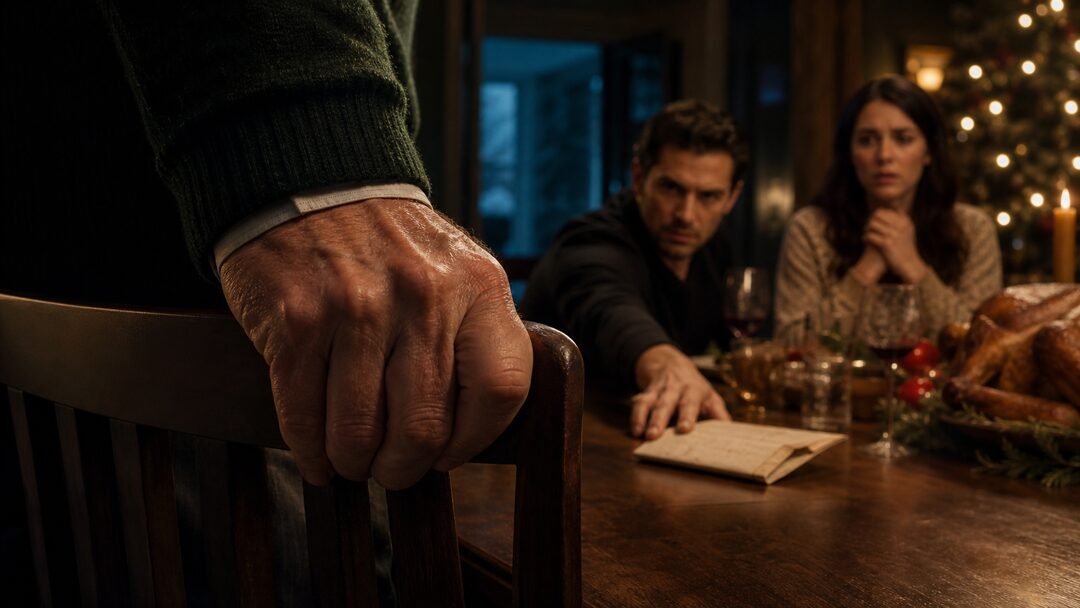
Robert Miller’s hand closed around the back of the dining chair so hard the wood creaked.
No one reached for the turkey.
No one lifted a glass.
The candles burned between the plates, the Christmas tree glowed in the corner, and the whole table sat frozen around a dinner that had been perfect ten minutes ago. Perfect napkins. Perfect roast. Perfect daughter home for Christmas with a ring on her finger and hope in her face.
Then Daniel had placed the letter beside the serving platter.
Now Robert stood at the head of the table, silver hair neat, dark green sweater smooth over his shoulders, face carved into the hard calm his children knew too well.
His son stared up at him from the far side of the table.
“Why did you hide the letter?” Daniel asked.
Robert did not look at the envelope.
“Stop.”
Daniel’s jaw tightened. “No.”
Emily’s hands were clasped near her plate. Her engagement ring caught candlelight as her fingers trembled. “What letter?”
The envelope lay between the cranberry dish and the carving knife.
It was old, folded at the corners, military gray-green once, now faded into the color of dust. There was no readable marking on it anymore. Nothing dramatic. Nothing that should have been able to ruin Christmas dinner.
Robert still would not touch it.
Lisa Miller, Robert’s sister-in-law, stood near the sideboard with a gravy boat in both hands. She had been the one insisting everyone come together this year. She had lit the candles. She had put out Robert’s late wife’s china. She had said, more than once, “We are not wasting another Christmas being careful around each other.”
Now she looked like she wished she could take the sentence back.
Daniel leaned forward.
“You knew he was alive,” he said.
Emily turned to him. “Who?”
Daniel’s eyes softened for one second. Then he looked back at Robert.
“The medic who pulled you out of Farrow Ridge.”
The room changed.
Not loudly. Nothing broke. No one gasped.
But Emily’s face went still in a way Robert could not bear.
She had been five when it happened. Too young to remember the clinic clearly. Old enough to remember heat, smoke, a man’s arms, and the sound of her mother calling from somewhere she could not see.
Robert had built the rest of the story for her.
A brave medic had saved her. The medic had died before Robert could thank him. Her mother had already been gone by the time Robert reached the clinic. None of it was anyone’s fault.
That was the story.
It had held for twelve years.
Daniel tapped the envelope once.
“His name was Brian Keller,” he said. “He wrote to her. More than once.”
Emily looked at Robert. “Dad?”
Robert’s grip tightened on the chair.
Daniel noticed. Of course he noticed. Daniel had grown up reading his father’s hands because Robert’s face rarely gave him anything.
“Don’t do this,” Robert said.
Daniel laughed once, without humor. “You mean don’t do it here?”
“It is Christmas.”
“You made it every day.”
That landed harder than Robert expected.
Lisa set the gravy boat down carefully, as if one more small sound might split the room. Around the table, cousins and in-laws kept their eyes low. The children had been sent to the living room after dessert and were laughing faintly at a movie behind the closed doors.
The laughter made everything worse.
Emily reached toward the envelope.
Robert’s voice cracked like a command. “Don’t.”
Her hand stopped.
She stared at him.
That was when Robert knew he had already lost the room.
Not because Daniel had accused him.
Because Emily had seen him fear a piece of paper.
Part II — The Letter
Daniel pushed the envelope closer to Emily.
Robert moved faster than anyone expected. His hand left the chair and came down on the table beside it, not touching the envelope, just blocking the space around it.
“Daniel,” he said, low.
Daniel did not flinch. “I found it in your desk.”
Lisa whispered, “You went through his desk?”
“I was looking for insurance papers after his scare in October.” Daniel’s eyes stayed on Robert. “He locked this in the false bottom with Mom’s wedding photo and his Farrow Ridge files.”
Emily’s face tightened at their mother’s name.
Robert heard it, that tiny intake of breath. The one she made whenever grief entered a room without knocking.
He had tried to spare her from that sound.
God help him, he had done everything for that.
Daniel said, “Tell her why you told us Brian Keller died overseas.”
Robert looked at Emily. “Because he should never have contacted you.”
The words came out before he could soften them.
Emily recoiled slightly. Not much. Enough.
Daniel’s voice rose. “So you admit he did?”
“I admit he was unwell.”
“Convenient.”
Robert turned on him. “You were not there.”
“No. But Brian was.”
“Brian Keller was broken after Farrow Ridge.”
“So were we.”
Daniel’s hands were flat on the table now. He looked younger in candlelight, almost like the angry boy he had been after the funeral, when Robert came home without their mother and with Emily wrapped in a hospital blanket.
Back then Daniel had asked the same question every night for weeks.
Why didn’t you get there sooner?
Robert never answered fully.
A father learned what not to say.
A commander learned faster.
Emily’s voice cut through them.
“What did he want to tell me?”
Both men looked at her.
That was the first time all night the room truly remembered whose life they were arguing over.
Daniel swallowed. “He wanted to meet you.”
Emily blinked. “Why?”
“He said you asked him not to leave you. He wanted you to know he didn’t.”
Robert closed his eyes.
There it was. The first crack.
Emily looked down at the envelope. “You said he died.”
“I said what I thought would let you sleep,” Robert said.
“No,” Daniel said. “You said what let you sleep.”
Robert’s hand went back to the chair.
Lisa stepped forward. “Maybe we should all take a minute.”
“No,” Emily said.
It was not loud. That was why everyone heard it.
She reached around Robert’s hand and took the envelope.
Robert could have stopped her.
He did not.
Emily opened it slowly. The paper inside was folded twice. Her fingers shook at the edge, but she did not ask anyone else to read it for her.
The room watched her unfold her own past.
Robert looked at the candles instead.
He remembered Farrow Ridge in flashes because that was the only way his mind allowed it.
A clinic with broken windows. Radio static. A road that could take only one truck at a time. His wife, Mary, volunteering in the clinic because she had refused to evacuate before the last patients. Emily with a fever in the back room. A senior officer’s family trapped near the south road. Men shouting for instructions.
One truck.
Two directions.
One call.
Daniel’s voice came softer now. “Read it, Em.”
Emily read silently at first.
Her eyes moved once across the page.
Then again.
The color left her face.
She pressed one hand to her mouth.
Robert heard Lisa whisper, “Oh, honey.”
Emily lowered the letter.
“He was alive,” she said.
Robert did not answer.
She looked at him.
“He was alive after?”
“Yes.”
“How long?”
Robert looked away.
Daniel answered for him. “Long enough to write five letters.”
Emily stared at Robert as if he had become a stranger while standing in the same place.
“Five?”
Robert said, “Emily—”
“Five?”
His hand tightened again around the chair.
He could control men under fire. He could deliver a casualty notification without shaking. He could stand at his wife’s grave and keep his children upright.
But he could not tell his daughter why he had opened the first letter and locked away the rest.
Not yet.
Maybe not ever.
Emily looked back at the paper.
Her voice broke only on the last word.
“He says Mom was waiting.”
No one moved.
The candles flickered.
Robert’s whole body went cold.
Part III — What He Kept
For twelve years, Robert had trusted the version he gave her.
Mary was gone before he arrived.
The clinic was already lost.
Emily survived because a medic carried her through smoke and debris and handed her to Robert outside.
There was grief in the story, but no choice inside it. No one to blame. No question that could be sharpened into a blade and turned toward the table.
But Brian Keller had written differently.
Emily held the letter with both hands.
“‘Your mother kept asking if your father was coming,’” she read. Her voice was barely there. “‘I told her he was. I don’t know if I should have said that. I only knew you were scared.’”
Robert stepped back from the chair.
The room swayed once. Not from age. From memory.
Mary’s last message had reached him at 18:40.
Clinic still holding. Emily feverish. Need transport.
At 18:43, the second call came in: senior officer’s family pinned near the south road, communications failing, escort vehicle disabled.
At 18:45, Robert redirected the only available transport.
He had told himself the south road was strategic. He had told himself Mary was trained, steady, capable. He had told himself another vehicle would reach the clinic soon.
Another vehicle did not.
By the time he arrived, Brian Keller had already carried Emily out. Mary had not come with them.
Robert’s report said communication failure delayed the clinic evacuation.
That was not entirely false.
That was how lies survived respectable men.
Emily lowered the paper. “Did you know she was alive when the first call came?”
Daniel’s eyes closed.
Lisa turned away.
Robert said nothing.
Emily’s face changed.
Not tears first.
Recognition.
“You knew.”
Robert found his voice. “I knew she had sent a message. I did not know conditions inside.”
“Dad.”
“I had conflicting reports.”
“Dad.”
“There was one vehicle.”
“Dad.”
The third time, the word was not a plea. It was a command.
Robert stopped.
Emily looked at him across the candles and cold turkey and untouched bread. “Did you choose somewhere else first?”
The room had never been so quiet.
Robert heard the children laughing faintly in the next room again.
He thought: this is why. This is exactly why.
Because once a truth entered, it did not enter politely. It walked through every room. It sat with every memory. It touched children who had not even been born when the decision was made.
“I made the call I believed I had to make,” he said.
Daniel pushed back from the table. “There it is.”
Robert looked at him sharply. “You think I wanted that?”
“I think you wanted no one to ask.”
Daniel stood now. The son facing the father. The boy who had waited at the window that night, old enough to know ambulances did not bring everyone home.
“You shut down every question,” Daniel said. “Every year. Every Christmas. Every time Emily asked about Mom, you made her feel guilty for needing more.”
Robert’s voice hardened. “I was trying to protect her.”
Emily laughed once. It sounded nothing like laughter.
“From my own life?”
Robert flinched.
Lisa stepped to Emily’s side but did not touch her. She had always touched first. Straightened collars. Refilled glasses. Smoothed arguments before they found their true shape.
This time, she let her hands hang at her sides.
Robert noticed that too.
Emily looked down at the letter again.
“Brian says he wanted me to know I wasn’t abandoned.”
“You weren’t,” Robert said too quickly.
She looked up. “Then why does everyone keep leaving the room when I ask?”
The sentence emptied him.
Robert turned toward the glass doors.
Outside, winter pressed blue against the windows. Snow moved lightly beyond the patio lights. The room behind him was gold and red and green, all the colors of a life he had tried to keep warm by refusing to let the cold in.
He took one step away from the table.
Daniel’s voice cut after him. “Don’t walk out.”
Robert stopped.
His hand reached for the back of another chair.
Then he let it go.
He walked to the open doorway instead.
The cold air came in when he pulled the glass door wide.
Emily whispered, “Dad?”
Robert did not answer.
For one terrible moment, every person at the table believed he was leaving.
Maybe he almost was.
Then he turned toward the entry cabinet beside the door.
His hands found the small wooden box on the lower shelf.
He had kept it there for twelve years, close enough to the family room that he could pretend it belonged to the house and not to the past.
When he came back, the box was in his hands.
Daniel stared at it.
Emily stood slowly.
Robert placed it on the table.
Inside were four more envelopes, unopened.
And one photograph.
Emily in a hospital bed, tiny and pale, a stuffed bear tucked under one arm.
Beside her sat a young man in a medic’s uniform, one hand lifted awkwardly, as if he did not know whether he was allowed to wave at the camera.
Brian Keller.
Alive.
Real.
Not the nameless dead hero Robert had given her.
Emily touched the edge of the photo.
“You kept this?”
Robert nodded.
“Why?”
He had rehearsed answers to questions like that. Responsible answers. Fatherly answers. Answers that sounded like sacrifice.
None survived her face.
“Because I couldn’t throw it away,” he said.
Emily’s eyes filled. “But you could keep it from me.”
Part IV — The Door
The cold from the open door moved through the room until the candles began to tremble.
Lisa crossed to shut it, then stopped halfway.
No one told her to.
Robert stood behind his chair with the box open before him. The letters lay between the plates like guests who had been invited late and would not leave.
Daniel’s anger had gone quiet.
That frightened Robert more.
When Daniel was shouting, Robert knew where to stand. When Daniel went silent, the room belonged to Emily.
She held the photograph now. Her thumb rested near Brian Keller’s face.
“He came to see me?”
Robert shook his head. “I didn’t allow it.”
Daniel made a sharp sound.
Robert looked at him. “He wrote after discharge. He said he had nightmares. He said seeing Emily might help him. I thought that was wrong.”
“Wrong for him?” Daniel asked. “Or dangerous for you?”
Robert’s mouth closed.
Emily looked at her brother. “Daniel.”
He stopped.
She looked back at Robert. “Answer me.”
Robert sat down.
It was the first time all evening he had lowered himself to their level.
The chair made a small sound against the floor. No one moved to help him. No one softened the moment for him.
“He knew parts of what happened,” Robert said.
“What parts?”
“That your mother was alive when the first evacuation request came.”
Emily’s eyes shut briefly.
Robert forced himself on.
“He knew I redirected transport. He knew the report did not say that clearly.”
“Clearly,” Daniel repeated.
Robert accepted the blow. “Truthfully.”
Lisa’s hand went to the back of a chair. Not gripping. Just needing something solid.
Emily sat too, slowly, still holding the photograph.
“Did Mom know?” she asked.
Robert looked at her.
“That you sent the transport somewhere else?”
He wanted to say no.
He wanted one mercy.
Then he remembered Mary’s last recorded message. Not the official one. The one he had never transcribed.
Tell Robert I understand.
And after a pause:
Tell him to come anyway.
“She knew I had a choice,” Robert said.
Emily’s face crumpled for half a second before she pulled it back together.
That restraint was worse than sobbing.
Daniel stepped away from the table and pressed both hands to the top of his head. “Jesus.”
“Daniel,” Lisa said softly.
“No,” Emily said. “Let him.”
The room obeyed her.
Robert looked at his daughter and saw, with a clarity that almost undid him, that he had mistaken softness for weakness for years. He had protected the child who survived. He had not noticed the woman who kept surviving after.
He picked up the first unopened letter.
The paper was still sealed.
Emily’s voice stopped him.
“Don’t open that one first.”
Robert looked at her.
She held out the letter she had already read. “Finish this one.”
“I don’t think—”
“Don’t.”
One word.
No raised voice.
No tears.
Robert heard Mary in it.
He took the letter.
His hands were not steady now.
Brian Keller’s handwriting was careful, almost painfully plain.
Robert read from the paragraph Emily had stopped at.
“‘I am sorry I could not save your mother. She was awake when I reached you. She told me your father would come. She said he always came when it mattered.’”
Robert stopped.
His throat closed.
Emily’s voice was barely above a whisper. “Keep going.”
Robert did.
“‘I don’t know what happened with the transport. I only know you kept asking me not to leave. I want you to know I didn’t leave because I wanted to. I handed you to your father myself. He held you like he had nothing else left.’”
Robert’s eyes burned.
He had not remembered that part.
Or he had refused to.
He had held Emily in the snow outside the clinic while the building collapsed inward behind them. She had been burning with fever and asking for her mother. Robert had pressed his face into her hair and promised something he could not name.
He read the final lines.
“‘If they tell you I died, they are wrong. If they tell you you were forgotten, they are wrong too. You were loved in that room. I thought you should know.’”
No one spoke.
The turkey sat untouched, cooling under the candlelight.
The Christmas tree blinked cheerfully in the corner, absurd and faithful.
Emily placed the photograph beside the letter.
Then she asked the question that had been waiting behind every other question.
“Did Mom wait for you?”
Robert did not hide behind the mission.
He did not say communications.
He did not say conditions.
He did not say Christmas.
“Yes,” he said.
Emily folded both hands in her lap.
Robert continued because stopping there would be another kind of cowardice.
“She was alive when the first call came. I sent the vehicle to the south road. I believed more lives depended on it. I believed another transport would reach the clinic.”
He looked at the letter.
“It didn’t.”
Emily’s breathing changed.
Daniel moved toward her, then stopped himself.
Good, Robert thought dimly. Let her choose.
Emily stared at him. “And after?”
“After, I told you the version I could live near.”
Her eyes lifted.
“Near,” she said.
Robert nodded once. “Not with.”
That was the closest he came to asking for pity.
Emily did not give it.
“I loved you,” he said.
Her face twisted. “I know.”
That was the punishment.
She knew.
His love was not the question.
Part V — The Box
Christmas dinner did not end.
It simply became something else.
Lisa quietly blew out two candles that had burned too low. Someone took the children upstairs. A cousin began clearing plates, then stopped when Emily looked at the turkey and whispered, “Leave it.”
So the meal stayed.
Cold. Perfect. Ruined.
Robert sat beside Emily now, not at the head of the table. The empty chair at the end remained where he had stood before, looking larger than it should have.
Daniel stood near the open door with his arms folded, staring into the blue winter dark. He had wanted this night. He had forced it. Now that it had arrived, he looked like he wished it had taken another shape.
Emily held the wooden box in her lap.
“Are there more?” she asked.
Robert nodded toward the envelopes. “Four.”
“You opened only the first?”
“Yes.”
“Why not the others?”
He looked at the tablecloth.
“Because the first one had enough truth in it.”
Daniel turned. “That’s not an answer.”
“No,” Robert said. “It’s the closest thing I have.”
Emily ran her thumb along the edge of the box. “Did Brian know you hid them?”
“I don’t know.”
“Is he alive now?”
Robert closed his eyes.
That was the question he had hoped she would not ask because he did not know, and not knowing was another thing he had chosen.
“I don’t know,” he said.
Emily took that in.
She did not accuse him.
Somehow that made it worse.
Lisa came back from the kitchen doorway and set a cup of tea near Emily. Her hostess hands had finally found something useful that did not silence anyone.
“I’m sorry,” Lisa said.
Emily looked at her. “Did you know?”
Lisa shook her head. “No.”
Then, after a pause, she added, “But I knew not to ask.”
That sentence stayed in the room.
Robert looked at her.
Lisa did not look away.
For years, she had kept holidays gentle. She had filled absences with side dishes and seating charts. She had told Daniel to let things rest, told Emily her father loved her, told Robert the children would come around.
Now she seemed to understand that peace had been another room with the door closed.
Emily picked up the next envelope.
Robert started to speak, then stopped.
She noticed.
“Good,” she said.
She opened it.
The second letter was shorter. Brian wrote about physical therapy, about waking up from dreams of the clinic, about hoping Emily liked dogs because he had started volunteering at a shelter and did not know what to do with gentleness unless it had four legs.
Emily smiled once through tears.
It vanished quickly.
The third letter came from six months later. Brian wrote that if Robert thought contact was harmful, he would respect it, but he asked that Emily be given the choice when she was older.
Emily looked at Robert at that.
He lowered his eyes.
The fourth letter remained sealed.
She did not open it yet.
Instead, she stood and carried it toward the open doorway.
Cold blue light washed over her sweater, her face, the ring on her hand. For a second she looked like the girl in the photograph and the woman at the table and someone Robert had never been allowed to meet.
Daniel stepped aside.
Emily stood at the threshold and opened the final letter.
Robert did not follow.
He stayed seated.
That was the only obedience he had left to offer.
Emily read silently.
The snow outside drifted past the patio lights.
After a long moment, she folded the letter and pressed it against her chest.
Daniel asked, “What does it say?”
Emily did not answer at first.
Then she turned.
“He said he hoped I knew I was loved by more people than I remembered.”
Robert covered his mouth.
Not to stop himself from speaking.
To hold in the sound that wanted to come out.
Emily walked back to the table. She placed the last letter in the box with the others. Then she shut the lid.
Not hard.
Not gently either.
“Are you angry?” Robert asked.
Emily looked at him like the question was too small.
“Yes.”
He nodded.
“Are you leaving?”
She looked toward the open door.
Then back at him.
“No.”
The word loosened something in him, and he hated himself for feeling relief before he had earned it.
Emily saw that too.
“I’m not staying because this is okay,” she said.
“I know.”
“I’m staying because I have questions.”
Robert nodded again.
Daniel moved from the doorway toward his sister, then stopped beside her chair.
For once, he did not speak for her.
Emily noticed.
She reached for his hand.
He took it.
Robert watched them, the two children he had tried to protect by making himself the wall between them and the worst night of their lives.
He saw now what walls became when they stayed up too long.
Not shelter.
Distance.
Part VI — The Open Door
The house was quieter after midnight.
The children slept upstairs. The cousins had gone home with leftovers no one wanted. Lisa washed dishes slowly in the kitchen, not because they mattered, but because her hands needed work while the family changed shape without her arranging it.
The dining room remained half-lit.
The turkey sat carved and cold.
The chair at the head of the table was empty.
Robert sat beside Emily with the wooden box between them.
Daniel had stepped outside to breathe and had not fully closed the door behind him. Cold air slipped through the gap. No one asked him to shut it.
Emily had asked twelve questions so far.
Robert had answered nine.
Three required names he could not remember without records. He promised to find them.
The promise felt dangerous in his mouth because promises had once been how he covered uncertainty. This one would have to become work.
Emily stared at the box.
“Did you think I would stop loving you?”
Robert closed his eyes.
There it was.
The question beneath every other question.
“Yes,” he said.
She was quiet for so long he opened his eyes again.
Her face was tired. Older than it had been at dinner. Younger too, somehow, as if some hidden child inside her had finally been allowed to grieve in the right direction.
“I don’t know what I feel,” she said.
“That’s fair.”
“I don’t want you to make it easier for me.”
“I won’t.”
She looked at him, and he understood she did not believe him yet.
He deserved that.
Daniel came back inside, cheeks red from the cold. He paused when he saw Robert still seated beside Emily, not at the head of the table, not standing guard over the room.
Something in Daniel’s face softened, but he hid it quickly.
Emily saw anyway.
“I’m mad at you too,” she told him.
Daniel blinked. “Me?”
“You made it your fight first.”
His mouth opened, then closed.
Robert watched his son learn the difficulty of not defending himself.
Finally Daniel nodded. “I did.”
Emily leaned back in her chair.
“Don’t do that again.”
“I won’t.”
She almost smiled. “You will.”
Daniel looked down. “I’ll try not to.”
That was the first honest family joke of the night, and no one laughed because it hurt too much. But something moved in the room that was not dread.
Lisa came to the doorway with a dish towel in her hands.
“Tea?” she asked, then shook her head at herself. “Sorry. I don’t know what to do.”
Emily looked at her. “Neither do we.”
Lisa nodded once and stayed where she was.
No smoothing. No fixing.
Just witness.
Emily opened the box again and placed the photograph on the table.
The little girl in the hospital bed looked back at them from a life nobody had told properly. Brian Keller sat beside her, awkward, alive, trying to smile for a camera he probably hated.
Emily touched the photo.
“I want to find him,” she said.
Robert looked at her. “I’ll help.”
“No,” she said.
The word was not cruel.
It was clear.
“I’ll decide how.”
He felt the old instinct rise—contacts, records, calls, the need to act before pain could deepen.
He let it pass.
“All right,” he said.
Emily picked up the wooden box.
For one second, Robert thought she might carry it away and leave him with the empty table.
Instead she held it in her lap and looked toward the open glass door.
Snow drifted beyond it.
Warm light behind them. Cold air before them. The house no longer sealed against either.
Emily stood.
Robert did too, out of reflex.
She looked at him.
He sat back down.
A small thing.
A beginning.
Emily walked to the doorway and stood where he had stood earlier, framed in blue winter light. Then she turned back toward the table, toward Daniel, toward Lisa, toward her father.
“Sit down, Dad,” she said.
Robert was already sitting.
Still, he understood.
Not at the head.
Not above her.
With her.
Emily held the box tighter.
“I’m not done asking.”
Robert looked at the cold dinner, the burned candles, the empty chair, the open door, and the children he had tried to protect from a night that had followed them anyway.
Then he nodded.
Outside, snow kept falling.
Inside, no one moved to close the door.