The Day the Quiet Man Asked the Ship to Wait
Part I — The Sound Beneath the Steel
Frank touched the destroyer like a man greeting someone who had stopped breathing.
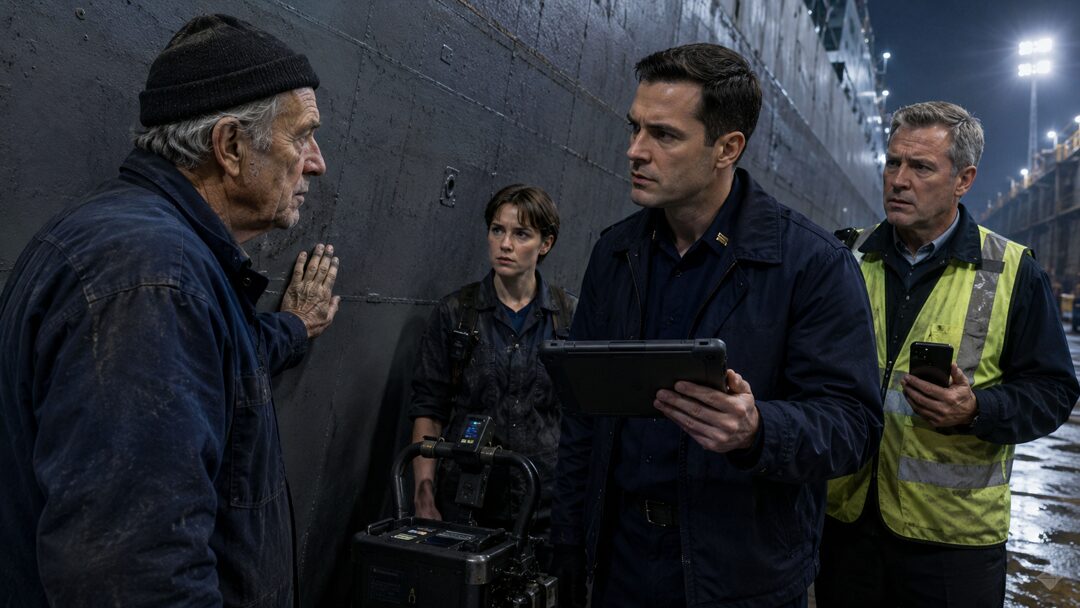
No one in the dry dock said that out loud. They only watched him: the young engineers with their tablets, the sailors with their folded arms, the officer with the tight mouth and the spotless clipboard screen. Above them, the newly refitted ship rose in floodlight and shadow, a gray wall of steel tall enough to make every person beneath it seem temporary.
Frank was seventy-six, narrow-shouldered, and slow with one leg. His dark watch cap sat low over his ears. His faded jacket had salt along the cuffs. In his left hand he carried a wooden cane polished smooth by years of weight and weather.
In his right hand, he wore no glove.
He had taken it off the moment he reached the hull.
“Mr. Frank,” Tyler said, using the polite tone people used when they were already annoyed. “We don’t need a performance. We need a second opinion.”
Frank did not look at him.
He pressed his bare palm flat against the cold steel and leaned closer until his ear nearly touched the painted surface. The dock seemed to hold its breath around him. Somewhere above, a chain clinked. Somewhere below, water moved through a drainage channel with a soft black sound.
Amy, the youngest engineer on the team, stood beside her scanner cart and watched Frank’s fingers.
They were not trembling.
That bothered her.
Old men trembled when they were tired. Men pretending to know things trembled when too many people watched. Frank’s hand was still, spread wide against the hull as if he were reading a page no one else could see.
Tyler glanced at his tablet.
“The pressure cycle is complete,” he said. “Every formal inspection is green. The only reason you’re here is because command wanted a legacy technician to sign off on what we already know.”
Frank’s eyes remained closed.
“You hear it?” he asked.
Tyler’s jaw tightened. “Hear what?”
Frank opened his eyes then, but he still did not turn. “Run it again. Lower pulse.”
George, the shipyard administrator, gave a short laugh from behind them. His hard hat looked too new. His vest was too clean. His phone had buzzed three times in two minutes.
“We are six hours from readiness certification,” George said. “The ship sails tomorrow morning. We’re not restarting a test because someone wants to listen to paint.”
Frank finally looked at him.
Nobody laughed after that.
He did not glare. He did not raise his voice. His face was lined and weathered, the skin around his eyes folded by sun, salt, and old restraint. He only looked at George as though the man had spoken from very far away.
“Paint doesn’t answer,” Frank said.
Amy felt the sentence move through the group.
Tyler took a breath through his nose. He was thirty-eight, disciplined, tired, and young enough to still believe exhaustion could be hidden by posture. His uniform sat neat under his shipyard jacket. He had been handed the final certification because he was good at clean decisions.
This was not becoming clean.
“The resonance appeared during load simulation,” Tyler said, more to the room than to Frank. “It is faint. It is inconsistent. It does not exceed tolerance.”
“Then you won’t mind running it again,” Frank said.
George stepped forward. “Lieutenant Commander—”
Tyler lifted one hand, stopping him without looking away from Frank.
He disliked the old man’s certainty. He disliked the way everyone had gone quiet around it. Most of all, he disliked that command had brought Frank in after Tyler’s team had already completed the work. It made him feel watched, corrected, distrusted.
But refusing a lower pulse test would look worse than allowing one.
“Fine,” Tyler said. “One cycle. Low pulse. Then we’re done.”
Amy turned back to her cart and reset the scan array. The deck lights flickered once as the dock systems shifted. A low vibration entered the floor, too faint to hear at first, felt more through the soles than the ears.
The destroyer began to hum.
Frank’s body changed.
It was small, but Amy saw it. His shoulders locked. His bare hand pressed harder into the hull. His mouth tightened, not with surprise, but recognition.
As if something buried had spoken his name.
Tyler saw it too.
“What is it?” he asked.
Frank swallowed. His eyes stayed on the steel.
“Again,” he said.
Tyler’s face hardened. “No. You asked for one.”
Frank dragged his hand three inches along the hull and stopped.
“Here,” he whispered.
The word was quiet.
It still reached everyone.
Part II — The Yellow Circle
Amy scanned the section Frank indicated.
The device returned clean.
She scanned it again, slower, changing pressure and angle. A colored grid bloomed across her screen, harmless bands of stress and expected reinforcement. Nothing critical. Nothing alarming. Nothing that could justify holding a ship the size of a city in dock while command called every ten minutes.
“No defect,” Amy said.
She heard how relieved George was before he spoke.
“There,” George said. “Thank you. Can we all return to reality?”
Frank did not move away from the hull.
Tyler turned the tablet outward just enough for Frank to see the results. “You see this? No separation. No fracture. No breach risk. You said here. The machine says no.”
Frank looked at the screen for one second.
Then he asked, “Do you have a grease pencil?”
The silence that followed was worse than laughter.
Amy looked from Tyler to George. George gave her a look that said absolutely not. Tyler gave her a look that said don’t make this worse.
Frank simply waited.
There was something difficult about how he waited. He did not look embarrassed. He did not seem defiant. He seemed patient in the way a storm door was patient against wind.
Amy opened the top drawer of her tool case.
She had three grease pencils: white, red, yellow.
She handed him the yellow one.
George muttered, “This is absurd.”
Frank uncapped the pencil with his teeth. He leaned toward the gray hull and drew a small circle around the spot where his palm had stopped. The yellow line looked almost childish against the enormous ship. Fragile. Ridiculous. Impossible to ignore.
Then he drew a short line beneath it.
“Do not launch,” he said.
Tyler’s eyes flashed. “You don’t have authority to say that.”
“No,” Frank said. “I just have memory.”
The words landed badly.
Tyler stepped closer. “Memory doesn’t stop a ship.”
Frank looked down at his cane, then back at the yellow circle. “It should, sometimes.”
George’s phone rang. He turned away, answered, and lowered his voice, which made everyone listen harder.
“Yes, sir. We’re still on schedule. There’s a minor technical discussion.” He paused. His eyes moved to the yellow circle. “No, nothing verified.”
Tyler heard the word verified and felt the trap tighten. Verified meant safe. Unverified meant delay. Delay meant questions. Questions meant blame traveling upward until it found someone low enough to hold it.
And right now, Tyler was standing directly beneath it.
The destroyer was scheduled to join a humanitarian security mission near a disputed maritime border, escorting relief vessels through waters where threats appeared and disappeared in fog, rumor, and politics. The mission mattered. The timing mattered. The briefing rooms above the yard were full of people using words like stability and deterrence and signal.
Tyler knew what one postponed launch could do.
He also knew what one visible yellow circle could do if someone photographed it.
“Clean the mark,” George said after ending the call.
Frank’s hand tightened around the cane.
Tyler did not immediately answer.
Amy looked down at her scanner again. The data still said no. But something about the placement bothered her. Frank had not marked the strongest vibration point. He had marked a place several feet away, where the stress map looked ordinary. Too ordinary, maybe.
She crouched and ran her gloved hand lightly along the hull.
The paint thickness changed near the circle.
Barely.
“Wait,” Amy said.
George closed his eyes. “Not you too.”
She ignored him. “This section has a covered reinforcement seam.”
Tyler frowned. “It was part of the refit.”
“No,” Amy said, zooming in on the structural overlay. “This seam is older than the refit. The refit plates are over it.”
Frank turned his head slightly.
Amy felt, with a strange chill, that he already knew.
Tyler checked the ship records on his tablet. His thumb moved fast. Then slower.
“Old operational repair file,” he said. “Access restricted.”
George spread his hands. “That is normal.”
Frank finally looked at Tyler.
“Who approved the pattern?”
Tyler did not answer at once.
That was the first moment Amy saw doubt enter him.
Not fear. Not yet.
Just a hairline opening.
Part III — What Paper Could Not Hear
The second test was not officially necessary, which meant no one wanted to be responsible for ordering it.
Tyler ordered it anyway.
He called it a calibration check. George called it a waste. Amy called it nothing and adjusted the scanner head as Frank directed her, two degrees down, half an inch left, less pressure on the casing.
“Your machine is listening too hard,” Frank said.
Amy glanced at him. “That’s not how scanners work.”
“No,” he said. “That’s how people work.”
The low pulse began again.
This time, Amy watched both the screen and Frank’s face.
At first the readings behaved exactly as before. Soft stress variation. Background noise. Nothing to hold a ship. Then Frank lifted two fingers from the hull and placed them just above the yellow circle.
“Now,” he said.
Amy angled the scanner.
For half a second, the screen changed.
A pale line appeared beneath the surface, thin and wrong, like a closed eye opening in the dark.
Then it vanished.
Amy froze.
Tyler saw her face. “What?”
“I had something,” she said.
George snapped, “Something is not evidence.”
“I know what evidence is.”
“Then show it.”
Amy replayed the capture. The frame stuttered, blurred, and returned to clean.
George gave a hard little nod. “There. Artifact.”
Frank’s eyes stayed on the yellow circle.
Tyler turned to him. “What are you not telling us?”
Frank’s thumb moved over the head of his cane. Back and forth. Back and forth.
“Years ago,” he said, “a ship in evacuation service developed a hum during stress loading. Readings came back clean. Men with clean uniforms said clean readings meant clean steel.”
His voice remained even.
That made it worse.
Amy lowered the scanner without realizing it.
“What happened?” she asked.
Frank stared at the hull.
“The flaw was behind a reinforcement seam. False load path. Under pressure, the outer plate answered for the inner one. Instruments heard the outside and missed what was opening underneath.”
George looked impatient. “Which ship?”
Frank did not answer.
Tyler caught that. “Which ship, Frank?”
The old man’s mouth tightened.
“Doesn’t matter.”
“It matters if you’re using it to hold this vessel.”
Frank turned then, fully, and Tyler saw anger in him for the first time. Not hot anger. Old anger. The kind that had run out of flame and become iron.
“Men died below deck because the sound was dismissed as noise.”
The dock went still.
Even George looked away.
Tyler felt the sentence strike him and resisted it. He could not let grief become procedure. He could not stop a deployment because an old man had carried a ghost into a dry dock.
“Was there an inquiry?” Tyler asked.
Frank’s eyes narrowed. “There was paperwork.”
“That’s not an answer.”
“It was enough of one for the people who needed sleep.”
Amy looked down at the yellow circle.
It no longer looked ridiculous.
It looked lonely.
Tyler stepped closer to Frank and lowered his voice. “You come in here with half a story, no file name, no hard data, and a warning that could delay an entire mission. Do you understand the position you’re putting me in?”
Frank’s answer came softly.
“You’re afraid of being wrong in front of command.”
Tyler’s face flushed. “Careful.”
Frank leaned slightly on his cane. “You should be more afraid of being wrong at sea.”
For a second, Tyler hated him.
Not because he was disrespectful.
Because he was right enough to hurt.
George’s phone buzzed again. He looked at the screen, then at Tyler.
“They want certification status in thirty minutes.”
Tyler looked up at the ship. Gray steel. Floodlights. Yellow circle. A faint vanished line on Amy’s scanner that might have been nothing.
He had built his career on not mistaking feeling for fact.
Now fact had started behaving like it was afraid to be seen.
Part IV — The Missing File
Amy found the maintenance reference in a restricted archive folder that should have contained a complete refit history and instead contained gaps.
The file did not say disaster. It did not say danger. It did not even say failure.
It said: emergency reinforcement pattern transferred from prior class guidance.
“Prior class guidance,” Amy read aloud. “No originating record attached.”
George stood behind her, face stiff. “That means the origin is classified.”
“It means the origin is missing,” Amy said.
Tyler took the tablet from her and scrolled through the record. Dates. Contractors. Approvals. Old signatures scanned badly enough to blur at the edges. A reinforcement seam no one had questioned because it had already existed before the latest refit.
The ship had inherited a decision.
No one in the dock seemed to like that.
Tyler found Frank standing beside the yellow circle again, his cane planted between his boots.
“Why didn’t you tell us you signed off on the old repair?” Tyler asked.
Amy looked up sharply.
Frank did not.
George’s eyes widened. “You what?”
Frank’s face remained still, but the hand on his cane tightened until the knuckles went pale.
Tyler held up the tablet. “Your initials are in the guidance chain.”
Frank closed his eyes once.
Only once.
“It was temporary,” he said.
The word seemed too small for the space.
Tyler’s voice dropped. “Temporary became standard?”
“It became convenient.”
“And men died?”
Frank opened his eyes.
“There were other signatures.”
“That’s not what I asked.”
Frank looked at him then, and the years between them did not feel like age anymore. They felt like distance from a room Tyler had never entered and Frank had never left.
“Yes,” Frank said.
Amy lowered her gaze.
George inhaled sharply, already calculating what that sentence could mean for the shipyard, for the command, for anyone whose name appeared in the chain between then and now.
Tyler had expected denial. He had prepared for a bitter old technician blaming superiors, blaming politics, blaming instruments, blaming time.
He had not prepared for confession without relief.
Frank touched the hull again.
“I told myself the sea took them,” he said. “For a while, that was easier.”
Nobody answered.
Then the radio on Tyler’s shoulder crackled.
“Certification status required. Proceed unless hard evidence indicates unsafe condition. Repeat, proceed unless hard evidence is present.”
George seized on it like a rope. “There it is. We have no visible defect. No stable scan. No authority to hold.”
Amy turned to Tyler. “We can run one more pulse test with the scanner fixed on the seam.”
George snapped, “And if nothing appears?”
“Then nothing appears.”
“And if something appears after you overstress a ship that is supposed to deploy tomorrow?”
Amy’s face tightened. She had no easy answer.
Frank capped the yellow pencil and placed it in his jacket pocket.
Then, after a moment, he took it out again.
He leaned toward the hull and drew a second small slash beside the circle.
Shorter. Sharper.
Like an accent beside a word no one wanted to read.
Tyler stared at it. “What are you doing?”
Frank stepped back.
“Giving it one more place to speak.”
George threw up one hand. “This is theater.”
Amy shook her head. “No. He marked the seam intersection.”
Tyler looked at her.
She held up the tablet with the old overlay aligned beneath the current scan. The yellow circle sat almost exactly over the hidden transition point between reinforcement patterns.
“He’s not guessing,” Amy said.
The radio crackled again.
“Lieutenant Commander, acknowledge.”
Everyone looked at Tyler.
There were moments in a career that came disguised as paperwork. Tyler had been trained to recognize threats, chain of command, mission priority, operational risk. No one had trained him for an old man’s yellow circle.
He lifted the radio.
“Conducting final verification,” he said.
George stared at him as if he had just stepped off a ledge.
The dry dock systems powered up.
The ship began to hum.
Part V — Now You Hear It
The first seconds were clean.
Amy’s scanner held steady against the hull. The stress pattern moved across her screen in calm bands. The yellow circle did nothing. The slash beside it looked foolish again.
George exhaled loudly, already preparing his complaint.
Then Frank removed his glove from his pocket and dropped it on the floor.
Amy looked at him.
His bare hand was on the hull.
His eyes were open.
“Lower,” he said.
Tyler checked the test level. “We’re within authorized range.”
“Lower sound. Not pressure.”
Tyler almost told him that made no sense.
Then he heard it.
Not with his ears first. With his teeth. A faint change in the vibration, a second tone hiding beneath the first. The steel was not humming evenly anymore. It was answering itself from inside.
Frank’s palm flattened.
“Now you hear it,” he said.
Amy’s screen flared.
“Internal separation,” she said. Her voice cracked on the second word. “I’ve got it. I’ve got it—wait, it’s growing.”
The radio exploded with command voices.
“Cease test.”
“Hold certification protocol.”
“Report condition.”
George stepped toward Tyler. “Shut it down.”
Tyler’s hand hovered over the control relay.
If he stopped the test now, they had a scanner bloom, maybe a captured anomaly, maybe enough to argue for delay, maybe not. It could vanish again. It could become another artifact in another file.
The yellow circle trembled.
Frank did not move.
Amy whispered, “Tyler.”
A thin dark line appeared inside the yellow circle.
At first it was so small Tyler thought his eyes had invented it. A shadow beneath paint. A hairline in gray. Then the line lengthened along the hidden seam, precise and quiet, as if the ship had been holding its breath for years and had finally let it out.
George went pale.
“Clear the dock,” Tyler said.
No one moved fast enough.
He turned and shouted it.
“Clear the dock now.”
Sailors scattered. Engineers pulled back. Amy grabbed her scanner but kept her eyes on the screen as she retreated.
The crack opened another inch.
Not violently. Not with the drama of an explosion or collapse. It opened with terrible patience.
Paint split. A dark gap appeared beneath the refit plate. The yellow circle framed it almost perfectly.
Tyler held the test for two more seconds.
Two seconds in which his career rearranged itself.
Two seconds in which every clean report became questionable.
Two seconds in which Frank stood beside a truth no one could dismiss anymore.
Then Tyler killed the test.
The hum died.
The dock fell silent so completely that the last echo seemed embarrassed to remain.
No one spoke.
Amy stared at the scanner capture. George stared at the crack. Tyler stared at Frank.
The old man had not smiled.
That was what broke something in Tyler.
If Frank had smiled, Tyler could have resented him. If Frank had said I told you so, Tyler could have hidden behind anger. But Frank only stood there, cane in one hand, bare palm still near the hull, looking at the exposed darkness as though it had taken him back somewhere he had never wanted to go.
Tyler looked at the yellow circle again.
It was no longer a mark.
It was a witness.
The radio on his shoulder crackled.
“Status?”
Tyler lifted it slowly.
“Certification denied,” he said. “The vessel will not launch.”
There was a burst of overlapping voices.
He spoke over them.
“Repeat. The vessel will not launch.”
George turned away, phone already in hand, no doubt trying to decide which version of the truth would cost him least.
Amy lowered her scanner and looked at Frank.
“How did you know?” she asked.
Frank did not answer right away.
He picked up his glove from the floor and folded it once.
“Because steel remembers pressure better than paperwork,” he said.
This time, no one questioned him.
Part VI — What Stayed Unpainted
By morning, the shipyard had changed its language.
No one called it a minor resonance anymore. No one called Frank ceremonial. No one asked Amy whether the image on her scanner might be an artifact. The crack had made everyone more honest than they had planned to be.
The launch was delayed.
An inquiry began before breakfast.
George signed the delay order with a face like a locked cabinet. He did not apologize, but his signature went where it had to go. Sometimes humility looked less like transformation and more like a hand moving because it had no clean excuse left.
Tyler gave his statement three times.
Each time, the questions circled the same point.
Why did you continue the test?
Why did you refuse certification?
Why did you trust an unverified warning?
The first time, he tried to explain the scanner bloom, the restricted file, the reinforcement seam.
The second time, he explained the stress pattern.
The third time, he stopped trying to make courage sound procedural.
“I heard it change,” he said.
The room went quiet after that.
Amy archived the crack images before anyone asked her to. She labeled the file with date, hull section, scanner angle, pressure level, and Frank’s name. Not as blame. Not as decoration. As record.
When she finished, she sat alone for a minute with her hands folded under her chin.
She believed in instruments.
She still did.
But she would never again forget that an instrument could only answer the question someone had known enough to ask.
Frank came back to the dry dock near dusk.
No one had called him. No one had asked him to return. The inquiry team had gone upstairs. The engineers had left temporary barriers around the opened section. The destroyer stood quiet in the dimming light, larger somehow now that it had been proven vulnerable.
Frank walked slowly.
Cane. Step.
Cane. Step.
The yellow circle was still there.
So was the crack inside it.
He stopped in front of the hull and rested the tip of his cane on the concrete beside the exposed seam. For a long moment, he did nothing else.
Tyler found him there.
He had removed his officer’s cover. Without it, he looked younger and more tired.
“I told them not to paint over it yet,” Tyler said.
Frank did not look back. “They will.”
“Not until every sailor assigned to this ship sees it.”
That made Frank turn.
Tyler’s face held no performance now. No clipped authority. No impatience pretending to be discipline. Just a man standing beside the consequence of a decision that had saved people and might still cost him.
Frank studied him.
“Command won’t like that,” he said.
“No.”
“George won’t like it either.”
“He likes very little that doesn’t stay on schedule.”
Frank looked back at the yellow circle.
For the first time all day, something almost like amusement crossed his face. It vanished quickly.
Tyler stepped closer, but not too close.
“What was the old ship called?”
Frank’s hand tightened around the cane.
For a moment, Tyler thought he would refuse. The name had been the one thing Frank had kept for himself, the last door unopened. Maybe naming it would not free him. Maybe nothing could.
Then Frank looked at the crack, and his expression changed.
Not healed.
Not relieved.
Only willing.
“Virginia,” he said.
The name hung in the dry dock.
Not loud. Not dramatic. Just present.
Tyler lowered his eyes.
Frank touched the cane once against the floor.
Tap.
A small sound under the towering ship.
Then he put his glove back on.
“I signed a temporary repair,” Frank said. “Other men made it permanent. I let myself believe that made me less responsible.”
Tyler did not rush to forgive him.
That would have been too easy, and both men knew it.
Instead, Tyler said, “You came back today.”
Frank’s jaw moved once.
“Yes.”
It was not enough.
It was also not nothing.
Above them, the floodlights clicked on one by one, turning the gray hull silver, then white, then gray again. The yellow circle remained stubbornly bright.
Amy appeared at the far end of the dock, carrying a sealed evidence case. She stopped when she saw them and did not interrupt.
George passed behind her with two officials from command, speaking in a low urgent voice. When he reached the marked hull, he slowed despite himself.
Everyone slowed there now.
That was the power of it.
Not the crack alone. Not the old man. Not the officer who had stopped the launch.
The mark forced people to pause.
It made denial visible.
Tyler looked at Frank. “I’ll put it in the crew briefing.”
Frank shook his head. “Don’t make it about me.”
“It isn’t.”
The old man waited.
Tyler looked at the ship.
“It’s about what we choose to hear before the proof gets loud.”
Frank said nothing.
But he stayed.
Together they stood in front of the destroyer as the dry dock settled into evening, the young officer and the old technician, the clean report and the yellow circle, the ship that would not sail and the memory that had finally been allowed to speak.
The crack remained inside the mark.
The mark remained on the steel.
And before any sailor boarded that vessel again, they would have to stand where Frank had stood, look at what everyone almost missed, and learn the shape of a warning before it became a loss.