The Letter He Carried Into The Room Nobody Opened For Him
Part I — The Old Card
“Sir, this facility doesn’t honor museum pieces.”
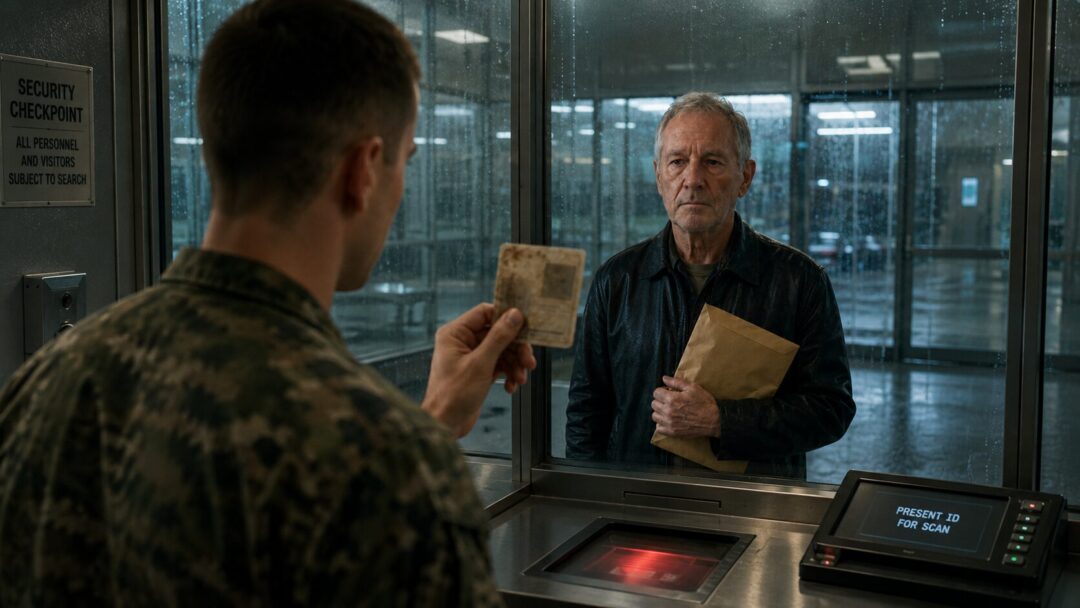
Sergeant Joseph held the old service ID between two fingers, high enough for the man behind the glass to see it, low enough for Corporal Kathleen beside him to notice the smirk.
On the public side of the checkpoint, the elderly man did not reach for the card.
He stood with rainwater darkening the shoulders of his worn leather jacket. His hair was gray and cut short in the old style, neat without trying to be. One hand rested on a sealed manila envelope tucked beneath his left arm.
He looked too thin for the jacket.
He looked too still for the room.
Joseph had seen men like him before. Retired officers who expected doors to open because they remembered a time when doors had opened faster. Former enlisted men with faded tattoos and sharp opinions. Men who arrived at restricted wings with stories, old badges, and the belief that the building owed them something.
Today was not the day for it.
The lockdown drill had already put everyone on edge. Two elevators were sealed. The south corridor was closed. A general was expected for a memorial review upstairs, and Joseph had been told three times that no civilian entered the secure wing without a verified appointment.
He tapped the ID once against the counter.
“This card isn’t in the active system,” he said. “There’s no appointment under your name.”
The old man’s eyes stayed on the card.
“Then scan it.”
Joseph gave a short laugh through his nose. Kathleen glanced down at her terminal, hiding half a smile.
“I just told you, sir. It’s not active.”
“I heard you.”
The old man’s voice was low. Not weak. Not loud. Just placed exactly where it needed to be.
“Scan it properly, not politely.”
Kathleen looked up.
Joseph’s smile thinned.
There was something about the sentence that annoyed him more than it should have. It sounded like an order without rank. It sounded like the old man expected obedience but refused to explain why.
Joseph turned the card in his hand.
The laminate had yellowed at the edges. The photo showed a much younger version of the man outside the glass: dark hair, hard jaw, eyes already older than the face around them. Most of the printed identifiers had faded. The embedded strip was scratched.
“Do you know what wing you’re trying to enter?” Joseph asked.
“Yes.”
“This is not a public records office.”
“I know.”
“You carrying court papers? A claim form? Complaint packet?”
The old man’s hand shifted over the envelope.
“No.”
“Then what’s in the envelope?”
The man looked at him for the first time.
“Something that isn’t yours.”
Kathleen’s smile disappeared before Joseph’s did.
The line behind the man had begun to grow. A nurse in blue scrubs checked her watch. A maintenance contractor shifted a toolbox from one hand to the other. A young woman with a visitor badge whispered into her phone.
Joseph felt all their eyes.
He could not let an old man in a wet jacket turn his checkpoint into a scene.
“Sir,” he said, slowly, “I can either deny the card and ask you to step aside, or I can call the public liaison desk and have them walk you back downstairs.”
The old man did not move.
“Scan it.”
Joseph stared at him through the glass.
Kathleen leaned closer, voice lowered. “Just run it. If it bounces, it bounces.”
Joseph gave her a look.
She shrugged. “Clears the line.”
He hated that she was right.
With exaggerated patience, Joseph placed the old ID flat on the scanner pad.
The machine blinked once.
Then the screen froze.
Joseph waited for the standard denial tone.
It did not come.
The scanner ring, normally blue, flashed white. Then it went dark.
Kathleen sat up straighter.
The old man remained exactly where he was.
The scanner ring lit red.
Not soft red. Not an error color.
A hard, steady red that filled the glass booth like a warning.
On Joseph’s monitor, every open window vanished. A single black command box appeared.
HOLD. SENIOR COMMAND NOTIFICATION REQUIRED.
Joseph’s hand moved toward the silent alarm before he could think.
The system beat him to it.
A metal shutter slid halfway down over the inner corridor door. The checkpoint locks engaged with three heavy clicks. Somewhere behind them, a phone began ringing.
Kathleen whispered, “What did you scan?”
Joseph did not answer.
On the other side of the glass, the old man placed his palm flat over the manila envelope, not like he was hiding it.
Like he was keeping it safe.
Part II — Red Light
“Step back from the window,” Joseph ordered.
The old man stepped back exactly one pace.
Not two.
Joseph noticed.
He hated that he noticed.
Kathleen was typing fast now, her earlier amusement gone. “The system sent a command notification upstairs.”
“To who?”
She looked at the screen. Her face changed.
“To Major General Pamela.”
Joseph went still.
Pamela was not simply a name on a directory. She commanded the entire medical complex. She was the reason half the secure wing had been polished twice that morning. She was scheduled to speak in the memorial hall at thirteen hundred.
Joseph looked through the glass again.
The old man looked back at him with the weary patience of someone who had already waited longer than anyone in the room could understand.
“What is your business with Major General Pamela?” Joseph asked.
The man’s eyes flicked once toward the camera in the corner.
“I promised someone I would deliver this to her.”
“The envelope?”
“Yes.”
“Who gave it to you?”
The old man did not answer.
Joseph leaned closer to the microphone.
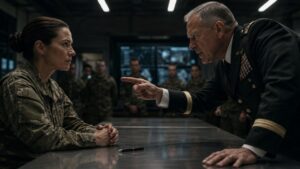
“Sir, a red command hold is not a visitor inconvenience. That system just locked this station. Until command clears you, you answer my questions.”
The man’s expression did not change.
“You can ask them,” he said. “That isn’t the same as me owing you the answers.”
Kathleen stopped typing.
The line behind the old man had gone quiet. The nurse was no longer checking her watch. The contractor had put his toolbox down.
Joseph felt heat under his collar.
He had never lost control of a checkpoint. Not once. He knew the rules, the codes, the escalation paths. He had earned this post because he was sharp, because he noticed details, because he did not let emotion soften procedure.
But the old man was making procedure feel small.
“What’s your name?” Joseph asked.
The old man glanced at the ID trapped beneath the red scanner glow.
“It’s on the card.”
“I’m asking you.”
“David.”
“Last name?”
The man waited a beat too long.
“Enough for that machine to know me.”
Kathleen looked at Joseph, a warning in her eyes now. Not fear. Something more uncomfortable.
Maybe shame.
Joseph ignored it.
“This isn’t how access works,” he said.
The old man’s gaze lowered to Joseph’s uniform, then returned to his face.
“No,” he said. “It isn’t how respect works either.”
The words landed quietly.
That made them worse.
Joseph opened his mouth, but the corridor behind him changed before he could speak. Footsteps. Not hurried. Controlled.
The kind of footsteps that made junior personnel straighten before they saw who was coming.
Major General Pamela entered the checkpoint vestibule with two aides behind her and stopped so suddenly one of them almost collided with her shoulder.
Joseph snapped upright.
“Ma’am, we have an unverified visitor with a command hold. I initiated—”
“Open the window.”
Joseph blinked. “Ma’am?”
Pamela had not looked at him once.
She was looking through the glass at the old man.
Her face had gone pale beneath its composure.
“Open the window, Sergeant.”
Kathleen moved first. Her fingers flew over the release panel. The glass partition hummed, then unlocked with a soft mechanical sigh.
The old man did not step forward.
Pamela did.
She stood on the inside of the threshold, shoulders square, eyes fixed on him as if seeing two men at once: the one in front of her, and someone younger standing behind him in memory.
“Captain David,” she said.
The checkpoint went silent.
The old man’s mouth tightened.
“Not anymore.”
Pamela’s voice lowered.
“In this building,” she said, “yes.”
Joseph felt the blood leave his face.
Kathleen looked down at the old ID glowing red on the scanner as if it had become something fragile.
David did not seem vindicated.
That was the first thing Joseph could not understand.
If a general had just corrected the room on his behalf, Joseph would have expected satisfaction. Anger. At least a glance in his direction.
David gave none of it.
He only touched the envelope again.
“I came because today was the day,” he said.
Pamela’s composure faltered.
For the first time, Joseph saw not command in her face, but fear.
Part III — The Envelope
Pamela led David into a small waiting room off the security corridor.
Joseph expected to be dismissed. He almost hoped for it.
Instead, Pamela turned at the door.
“Sergeant Joseph. Corporal Kathleen. You stay.”
Joseph swallowed. “Ma’am?”
“The alert requires two station witnesses until it is cleared.” Pamela paused, then looked at David. “And perhaps the system chose correctly.”
David’s eyes moved to Joseph and Kathleen.
“I didn’t come for an audience.”
“No,” Pamela said. “You never did.”
That sentence carried history.
The waiting room was plain: four chairs, a low table, a wall clock, a framed print of a lighthouse. Rain tapped the narrow window in quick silver lines. The secure wing hummed beyond the door.
David sat only after Pamela did.
The envelope stayed across his knees.
Pamela’s hands were folded, but the knuckles had gone white.
“How long have you had it?” she asked.
David looked at the envelope.
“Long enough to learn that waiting doesn’t make a thing lighter.”
Joseph stood near the door, trying not to breathe too loudly. Kathleen stood beside him, arms straight at her sides. Neither looked like they belonged in the room anymore.
Pamela’s voice softened.
“Was it his?”
David nodded.
Joseph watched the general’s face change around the word she did not say.
“Raymond,” she said.
David closed his eyes once.
“Yes.”
For a moment, the room held only the rain.
Pamela was fifty-something, composed in the way high rank often demanded. But when she said that name, she did not sound like a general. She sounded like someone young, standing in a doorway, waiting for a car that never came.
“My brother wrote letters all the time,” she said. “My mother kept every one.”
“This one never made it home.”
“Why?”
David ran one thumb along the sealed edge.
“Because he gave it to me after the last pickup was called.”
Joseph felt Kathleen glance at him.
Pickup.
Last.
The words opened a door neither of them had permission to walk through.
Pamela’s jaw tightened.
“The official record says he was on the evacuation list.”
“He was.”
“It says he died during movement.”
David did not answer.
The silence was not empty.
Pamela leaned forward.
“Captain.”
He looked up at the title.
She did not take it back.
“What does the record leave out?”
David held the envelope with both hands now.
“That he gave up his place.”
Pamela’s face did not break. It came close.
“There were wounded men in the lower ward,” David said. “Too many to move. Not enough stretchers. Not enough time. Your brother had already carried three out himself. He could have boarded.”
“He didn’t.”
“No.”
“Why?”
David’s eyes shifted to the window. The rain blurred the outside world into gray.
“He said they were still calling for their mothers.”
Kathleen looked away.
Joseph stared at the floor.
David’s voice remained even, and that made it more painful than if it had shaken.
“He put the letter in my hand and told me if I got out before him, I should bring it to you. Not your parents. You.”
Pamela’s breath caught.
“To me?”
“He said you were the one who would understand later.”
Her mouth moved, but no words came out.
David placed the envelope on the table between them.
He did not push it toward her.
“He was wrong about one thing,” he said. “Later took longer than he thought.”
Pamela looked at the envelope as if touching it would alter the shape of her entire life.
“Why now?” she asked.
David’s answer came slowly.
“Because your memorial review today includes his name.”
Pamela’s eyes lifted.
“And because last month,” he added, “my doctor told me to stop pretending time is patient.”
No one moved.
Joseph suddenly understood that the man at the window had not been trying to get inside a building.
He had been trying to make it through a door inside himself.
Part IV — What Silence Protected
Pamela opened the envelope with care.
The paper inside had aged to a soft cream. There were two sheets, folded once. A name at the top in firm, slanted handwriting.
Pamela touched the first page but did not unfold it yet.
“There were rumors,” she said.
David watched her hands.
“There are always rumors.”
“About you.”
“Yes.”
“That you left men inside.”
Joseph’s stomach tightened.
Kathleen’s eyes flicked toward David, then away.
David did not flinch.
“I signed the report.”
Pamela looked at him sharply.
“The report that blamed you.”
“It did not use that word.”
“It didn’t need to.”
David accepted that with a small nod.
Pamela’s voice was controlled, but something under it had sharpened.
“You let them write it that way?”
“I helped them write it that way.”
The air seemed to leave the room.
Joseph had thought the story was turning simple: old hero, young fool, general arrives, respect restored.
But now the floor shifted again.
Pamela stood.
“Why would you do that?”
David stayed seated.
“Because the truth would have started a fight above the families’ heads.”
“What truth?”
“That the order to withdraw came late. That the ward should have been cleared earlier. That men who were promised transport were left waiting because command wanted the public schedule to look clean.”
Pamela’s face hardened.
Joseph felt the room narrow around him.
David continued, each word carefully chosen.
“If that fight opened then, benefits would have been frozen while committees argued. Names would have become leverage. Your brother’s choice would have been used by men who never knew him.”
“So you let them blame you.”
“I let the record close.”
“For them?”
“For the families.”
Pamela’s eyes shone, but her posture stayed severe.
“And for yourself?”
David looked down.
There it was.
The first crack.
“No,” he said. “Not for myself.”
Pamela turned toward the wall, one hand at her mouth.
Joseph could not look at David now without seeing the checkpoint again: the old man standing in wet leather, letting a young sergeant talk down to him because he had survived worse than insult.
Kathleen spoke before Joseph could.
“I’m sorry,” she whispered.
David looked at her, almost surprised.
She flushed. “I mean—earlier. I shouldn’t have—”
He spared her the rest.
“You noticed before he did.”
Joseph felt that like a slap, though David had not raised his voice.
Kathleen’s eyes lowered.
Pamela sat again. She unfolded the letter.
Only then did David reach toward it, not to stop her, but because his hand seemed to remember holding it under different light, in a different room, with alarms sounding somewhere far away.
Pamela read silently for several seconds.
Her face changed line by line.
Then she stopped.
“He mentions me,” she said.
David nodded.
“He said you were stubborn.”
A brief, broken sound escaped her. Not quite a laugh. Not quite grief.
“He said that?”
“He said it with admiration.”
Pamela looked down again.
The room waited with her.
When she folded the letter, she did not put it away.
“I want this entered into the memorial archive.”
David’s head came up.
“No.”
Pamela stared at him.
“No?”
“No names turned into weapons. No old hearings. No public correction to make people feel clean.”
“This is not about feeling clean.”
“It becomes that quickly.”
“This is about truth.”
David’s expression darkened with something close to exhaustion.
“Truth is not a broom, General. You don’t sweep a room with it and call everything restored.”
Pamela absorbed the words.
Joseph did too.
David’s hand returned to the envelope.
“Your brother should be remembered for what he chose,” he said. “Not for who failed him.”
Pamela’s voice dropped.
“And you?”
He looked at her.
“I have been remembered enough by people who weren’t there.”
Part V — The Walk
The alert cleared at 12:47.
Joseph saw the notification appear on his tablet.
AUTHORIZED ESCORT REQUIRED.
He wished it had assigned anyone else.
Pamela stood in the corridor outside the waiting room, the letter held against her chest in its envelope. Her aides waited at a careful distance. The memorial hall would be filling by now.
“Sergeant,” she said.
Joseph straightened.
“Escort Captain David to the hall.”
David looked as if he might refuse.
Pamela saw it.
“Please,” she said, and the word was not an order.
That was what made him nod.
The walk took less than three minutes.
It felt longer.
Joseph walked half a pace behind David, close enough to guide, not close enough to crowd. Kathleen followed with the old ID in one hand, holding it differently now. Not by the edge. Not casually. She held it flat against her palm.
They passed sealed doors, framed commendations, polished floors. People stepped aside when they saw the general’s party behind them, but a few looked first at David and tried to understand why an old man in a rain-dark jacket was being escorted through a restricted corridor.
Joseph heard himself speak before he had planned the words.
“Sir.”
David kept walking.
“Captain,” Joseph corrected.
David stopped.
The corridor stopped with him.
Joseph swallowed.
“I owe you an apology.”
David turned.
Joseph had practiced apologies before. Brief ones. Professional ones. The kind that protected everyone from discomfort.
This one would not come out clean.
“I was out of line at the window,” Joseph said. “I made assumptions. I spoke without respect.”
David studied him.
Joseph forced himself not to look away.
“I thought being strict meant I was doing the job right.”
“That can be part of it.”
Joseph nodded once.
“But not all of it.”
“No.”
The old man’s eyes moved over Joseph’s uniform.
Not unkindly.
Not softly either.
“A uniform gives you duties before it gives you importance,” David said.
The sentence landed in Joseph’s chest and stayed there.
“Yes, sir,” he said.
David began walking again.
Kathleen touched Joseph’s sleeve as she passed. Not comfort. Not correction. Just acknowledgment that she had heard it too.
The memorial hall doors stood open.
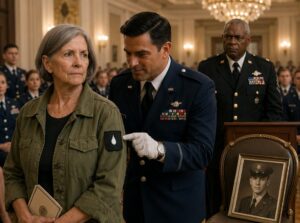
Inside, chairs were arranged in precise rows. Officers and medical staff sat beneath muted lights. A lectern stood at the front beside a display of service photographs. On one table lay printed programs with Raymond’s name among others.
Pamela entered first.
The room rose.
David stopped at the threshold.
For the first time that day, he looked afraid.
Not of the people.
Of what memory might do once it had witnesses.
Pamela turned back.
“You do not have to speak,” she said.
“I know.”
“But I am asking you to stand where he can be remembered correctly.”
David’s jaw tightened.
Joseph saw the refusal forming.
Then Kathleen stepped forward.
Quietly, without waiting to be told, she placed the old ID on the lectern.
Beside it, she placed the manila envelope.
Two objects that had looked like inconvenience at the window.
Now the whole room seemed to rearrange itself around them.
David looked at her.
Kathleen stepped back.
Joseph moved to the side doors and opened the path.
Not because anyone ordered him.
Because it was the only useful thing left to do.
David walked in.
Part VI — What the Letter Said
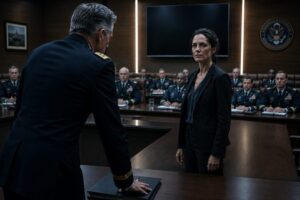
Pamela did not give the speech printed in the program.
She stood behind the lectern for a long moment, the room waiting for familiar phrases: service, courage, sacrifice, remembrance. Words everyone respected. Words everyone had heard.
Instead, she rested her hand on the envelope.
“My brother Raymond’s name is in today’s archive review,” she said. “For many years, I believed I knew the shape of his final act.”
No one moved.
“Today, I learned the shape was incomplete.”
A ripple went through the room, small but unmistakable.
David stood beside the lectern, not behind it. His hands were clasped in front of him. His face had gone distant in the way people look when the present has become thin.
Pamela unfolded one page.
She did not explain the mission.
She did not name blame.
She did not turn old failure into public spectacle.
She read only a few lines.
“Pamela, if this reaches you, it means I asked the wrong man to keep one more promise. Don’t be mad at him. He already carries too many. I stayed because they were still calling for their mothers, and my hands wouldn’t stop helping. Tell Mom I wasn’t scared at the end. That part might be a lie, but tell her anyway.”
Pamela stopped.
The hall was silent.
Not ceremonial silent.
Human silent.
The kind that made breathing feel like intrusion.
She folded the page carefully.
“My brother was not merely taken by circumstance,” she said. “He made a choice. Today, that choice enters this room with the dignity it should have always had.”
Her eyes moved to David.
He gave the smallest shake of his head, as if begging her not to give him more than he could carry.
Pamela understood.
She stepped back from the lectern.
David did not move.
For a moment Joseph thought he would say nothing. Maybe that would have been enough. Maybe his presence beside the envelope was the whole story.
Then David looked at Raymond’s name in the program.
“He was not left behind,” he said.
His voice was rougher now.
“He chose not to leave first.”
That was all.
It was enough.
The room did not erupt. No applause rushed in to make the moment easier. Pamela bowed her head. Several people followed. Kathleen wiped her cheek quickly, as if angry at herself for being seen.
Joseph stared at the old ID on the lectern.
He remembered holding it between two fingers.
Museum piece.
His face burned.
When the memorial ended, people approached Pamela slowly. Some offered condolences. Some asked careful questions. None approached David at first, perhaps sensing that gratitude, if spoken too quickly, could become another weight.
David stepped away from the lectern.
He took the envelope, now empty of its long secrecy, and handed the letter back to Pamela.
“No,” she said softly. “It belongs with you.”
He looked at the page.
Then at her.
“It was never mine.”
Pamela held his gaze.
After a moment, she accepted it.
Joseph watched David turn toward the exit without waiting for recognition.
That, more than anything, made him move.
Part VII — The Return
The rain had not stopped.
It streaked the glass beyond the checkpoint in silver threads, the same way it had when David first arrived.
The line was gone now. The corridor was quiet. The scanner had returned to its ordinary blue glow, as if nothing had happened.
But Joseph could not look at it the same way.
David stood once more on the public side of the security window.
Only now Joseph stood inside it with the old ID in both hands.
Kathleen stood behind him.
She was not smiling.
Joseph opened the glass partition fully. He did not pass the card through the slot.
He stepped around the counter and came to David directly.
The old man watched him approach.
Joseph held out the ID with both hands.
“Captain David,” he said, “your identification.”
David looked at the card before taking it.
For a second, Joseph thought the old man might refuse the title again.
He did not.
His fingers closed over the card slowly.
“Thank you, Sergeant.”
Joseph nodded.
There were apologies that asked to be forgiven.
There were apologies that simply tried to become better behavior.
Joseph hoped this was the second kind.
Pamela arrived as David tucked the ID into his jacket.
She carried the letter now in a slim archival folder, held against her side rather than her chest. Her face had recovered its command, but not entirely. Something younger remained in it.
David looked toward the doors.
“You’ll put it in the archive?” he asked.
“Only what honors him,” Pamela said. “Not what uses him.”
He considered that.
Then nodded.
Kathleen opened the outer door. Rain-scented air moved into the checkpoint.
David stepped toward it, then paused.
Pamela straightened.
So did Joseph.
So did Kathleen.
No one announced it.
No one gave a command.
Pamela raised her hand first.
Her salute was formal, exact, and full of everything she did not say: brother, promise, anger, gratitude, years.
David looked at her for a long moment.
Then he raised his hand.
It trembled slightly.
That tremor did not weaken the gesture.
It told the truth about its cost.
Joseph raised his hand too.
Not because the room required it.
Because he finally understood that respect was not something rank extracted from people. It was something truth asked of them.
Kathleen followed.
Four people stood divided by years, glass, duty, and memory, holding one quiet shape between them.
David lowered his hand first.
He looked at Joseph, then Kathleen, then Pamela.
For the first time all day, his face softened.
Not into peace.
Not completely.
But into something less alone.
He turned and walked into the rain with the empty envelope beneath his arm.
Joseph watched until the doors closed behind him.
The scanner stayed blue.
The checkpoint stayed quiet.
But the room no longer felt like a place that decided who mattered.
It felt, for one brief moment, like a place that had remembered.