What She Carried Forward
Part I — The Ceremony
Captain David Soto saw the red before he saw her face.
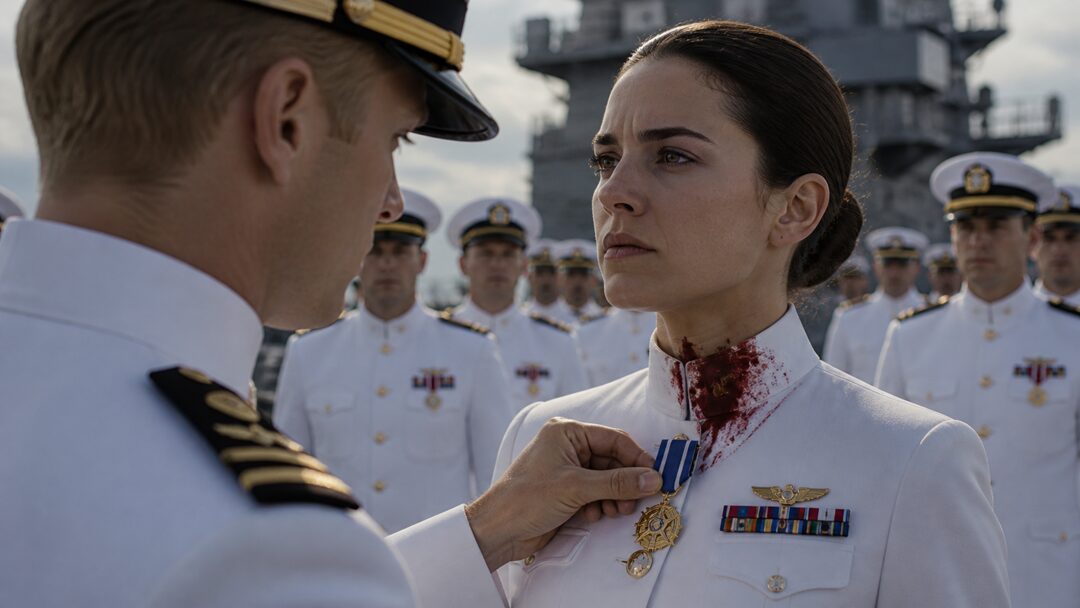
It was small at first, no wider than the head of a pin, blooming beneath the left edge of Lieutenant Commander Emily Carter’s white collar while the entire crew of the USS Hartford stood in formation around them.
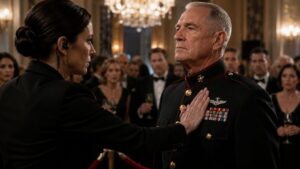
David’s hand was already raised.
The medal lay in his palm.
The citation waited on the lectern behind him.
The cameras waited too.
Emily did not move.
The sun struck the flight deck so hard that every uniform looked carved from salt. Behind her, officers stood shoulder to shoulder in perfect rows. A fighter jet crouched in the background like a silent witness. The wind snapped at sleeves, flags, ribbons, hair. Nothing else was permitted to move.
But the red spot moved.
It widened slowly.
David stepped closer.
Emily’s eyes stayed forward.
“Lieutenant Commander,” he said quietly, low enough that only she could hear, “you’re injured.”
Her jaw tightened once.
Not pain. Not fear.
Warning.
David looked from the spreading mark to her face. Her dark hair had been pinned so tightly beneath her cap that not a strand had escaped. Her uniform was immaculate everywhere except that collar. Her skin had gone pale beneath the careful discipline of her expression.
He had seen people hide pain before.
He had never seen anyone weaponize stillness.
“Step out of formation,” he said. “That’s an order.”
Emily’s eyes shifted to his.
The movement was tiny, but it hit him harder than a shout.
“Finish what you started, Captain.”
For one second, the deck disappeared.
Not the crew. Not the jet. Not Rear Admiral Patricia Hayes standing ten yards away with her silver hair and polished stare. Not the line of officers waiting for the ceremony to continue.
Only Emily’s voice remained.
And beneath it, another voice from three years ago, half-buried in smoke and static.
Tell my sister—
David pushed the memory down so sharply it felt like swallowing glass.
He looked at Emily’s collar again. The stain had reached the seam. It was not old. It was not ceremonial. It was not something she could have failed to notice.
He leaned in just enough to shield the movement from the front row and touched two fingers near the edge of the fabric.
Emily did not flinch.
That frightened him more than if she had.
“Corpsman,” David said, turning his head.
“No,” Emily whispered.
His hand stopped.
A rear admiral could ignore a whisper. A captain could not.
“Commander Carter.”
“Read it.”
The citation on the lectern trembled in the wind. David could hear the faint slap of paper against wood, the cough of someone in formation, the distant grind of machinery beneath the deck.
Rear Admiral Hayes angled her head.
The ceremony had paused too long.
David felt every eye on his back.
He had commanded through alarms, smoke, fire, bad maps, broken communications, and men begging for impossible choices. He knew how to hold a room, a bridge, a deck, a disaster.
But Emily Carter stood bleeding in front of him, and for the first time in years, he did not know whether taking command meant stopping her or letting her continue.
“Captain Soto,” Admiral Hayes called, pleasant and hard, “proceed.”
Emily’s lips barely moved.
“You heard her.”
David picked up the citation.
His hands were steady.
His chest was not.
Part II — The Words They Kept Clean
“For exceptional courage,” David read, “under extreme operational conditions during Operation Gray Lantern…”
The name moved across the deck like a door opening in a locked room.
No one in formation reacted. They had been trained better than that.
Emily did not react either.
Only the red at her collar changed. It slipped beneath the top ribbon of her uniform and stained the edge of the fabric beneath the medal David had not yet pinned.
Operation Gray Lantern had saved thirty-seven personnel.
That was the official line.
It had been repeated in reports, briefings, memorial programs, and finally this citation. Thirty-seven saved. One lost. A classified evacuation. A damaged lower compartment. A contained fire. A courageous response.
Clean words.
Clean enough to survive paperwork.
Clean enough to fit on a plaque.
David had signed the first report himself.
“Lieutenant Commander Carter maintained communications integrity,” he continued, “coordinated evacuation support under compromised conditions, and demonstrated unwavering commitment to mission success…”
Emily’s eyes stayed on him.
Not the crowd.
Not the admiral.
Him.
Three years ago, she had not looked at him that way. She had stood beside a folded flag with both hands clasped so tightly her knuckles had gone white. Mark Carter’s name had been spoken, but not his choice. His rank had been spoken, but not his last words. His service had been honored, but his final act had been reduced to a sentence broad enough to hide inside.
After the memorial, Emily had asked David one question.
“Was he alone?”
David had answered like an officer.
“He did his duty.”
She had stared at him then, and he had known immediately that he had chosen the wrong truth.
Not a lie.
Worse.
A safe truth.
Now she stood in front of him with a stain creeping beneath the medal ribbon, forcing him to read the same kind of language again.
The deck wind caught the page.
David tightened his grip.
Behind Emily, a young ensign’s eyes flicked toward the blood. Another officer saw it too. Concern passed through the formation in small forbidden movements.
Admiral Hayes saw those movements.
“Captain,” she said.
David kept reading.
“…and by her actions preserved the integrity of sensitive materials critical to fleet security.”
Emily gave a sound that almost was not a laugh.
It was too soft for anyone but him.
David lowered the page a fraction.
“That line,” she said, “is new.”
The blood reached the medal’s ribbon.
David saw it soak into the red stripe until the color became impossible to separate from itself.
“What happened to you?” he asked.
Emily’s face did not change.
“Someone wanted me cleaner than this.”
A cold line moved through him.
That morning, he had received a message from security: minor disturbance near storage passage C-12, no personnel detained, no injuries logged.
No injuries logged.
Emily had entered the ceremony twenty minutes later in dress whites.
David looked again at her collar. The cut was hidden beneath the fabric, high on the left side, but now that he knew to look, he could see the stiffness under the seam. Something was there.
Not gauze.
Not skin.
Something hard.
“Emily,” he said, and the use of her first name struck both of them.
Her eyes sharpened.
“Don’t.”
He returned to the citation because the crowd was listening, because Hayes was watching, because Emily had trapped him inside the one place he could not easily silence her.
That was when he understood the first part of it.
She had not come to receive a medal.
She had come because everyone would be forced to watch what happened when someone tried to take her away.
Part III — The Thing Beneath the Collar
David finished the first page and set it down.
His throat had gone dry.
Emily’s breathing had changed. Not enough for the crew to see. Enough for him. Her shoulders remained square, but the pause between breaths had shortened. Her skin had taken on the gray-white color of someone bargaining with her own body.
“Step out,” he said again.
The order was quieter this time.
So was her refusal.
“No.”
“You’re losing blood.”
“I know.”
“Then stop proving a point.”
Her eyes lifted, steady and bright with something harsher than anger.
“That’s what you think this is?”
He said nothing.
Because yes, part of him had.
A protest. A challenge. A public accusation sharpened into spectacle.
But spectacle did not explain the object under her collar.
His gaze dropped once more.
Emily saw him see it.
Her face changed for the first time. Not fear. Calculation. A woman measuring whether the person in front of her had finally caught up.
“C-12,” David said.
Her lips pressed together.
“You heard about that?”
“I heard nothing happened.”
“Then you heard what they needed you to hear.”
A memory flashed through him: gray light, emergency lamps, the lower deck filled with smoke, a voice on comms saying the lock was warped, the lock won’t hold, if it doesn’t hold they won’t make it through.
Mark Carter had been laughing ten minutes before that.
Not because anything was funny.
Because some men laughed to keep panic from finding a place to sit.
David remembered Mark’s sleeves rolled, hands black with grease, one cheek streaked with soot. He remembered the quick, crooked grin that appeared whenever someone told him something could not be fixed.
He remembered giving the order.
Hold the bulkhead.
Then later, when the fire began to move faster than the damage-control map predicted, he remembered giving another.
Evacuate.
He remembered Mark answering.
Can’t yet.
That was the part no report carried.
David forced himself back onto the deck.
“What’s in your collar?” he asked.
Emily’s expression became still again.
“What they missed.”
Hayes began walking toward them.
Not hurriedly. Never hurriedly. She moved like the deck itself had agreed to clear a path for her.
David felt the ceremony tightening around them.
The crew saw the admiral move, and the small forbidden glances stopped. Everyone faced forward. Everyone became proper again.
That was what institutions did best. They taught the body to behave even when the soul was watching something wrong happen.
Hayes stopped beside the lectern.
Her voice carried only enough.
“Commander Carter, you will report to medical immediately.”
Emily looked past David to the admiral.
“After the citation, ma’am.”
“That was not a request.”
“No, ma’am.”
The answer was perfectly respectful.
It was also disobedience.
A ripple moved through the officers closest to them. David could feel it. The whole deck seemed to inhale and hold.
Hayes turned to David.
“Captain Soto.”
Two words.
An order hidden inside his name.
He had been given the clean path.
Remove Emily. Send her below. Finish the ceremony. Preserve order. Let the report remain sealed. Let the blood be handled by medical and the questions handled by offices with doors.
Emily swayed.
Not much.
Just enough that David’s hand rose before his rank could stop it.
He caught her at the shoulder.
Under his palm, the hidden object pressed against the soaked seam of her collar.
Small.
Flat.
Hard-edged.
A recorder.
His fingers froze.
Emily’s eyes met his.
There was pain in them now. Real pain. Not only physical. Not even mostly physical.
“She sewed it in herself,” Hayes said softly.
David looked at the admiral.
Hayes’s face gave away nothing except that she had known enough to guess.
“Captain,” Hayes said, “remove your hand and have her escorted below.”
Emily’s voice came out thin.
“They tried that already.”
C-12.
No injuries logged.
Someone wanted me cleaner than this.
David’s mouth went cold.
“Who?” he asked.
Emily gave the smallest shake of her head.
It did not mean she did not know.
It meant not here. Not yet. Not in a way that could be denied.
Hayes stepped closer.
“This ceremony is over.”
Emily’s knees bent.
David caught her more firmly.
For a moment, she leaned into him because her body had betrayed what her will refused to admit.
The crew saw it.
Hayes saw it.
David saw the recorder beneath the blood-dark seam and understood the rest.
Emily had not hidden evidence because she trusted him.
She had hidden it where he would have to touch the wound to find it.
Part IV — What Mark Chose
“Secure Commander Carter,” Hayes ordered.
Two master-at-arms moved from the side of the formation.
Emily tried to straighten.
David did not release her.
“Stand down,” he said.
The two sailors stopped at once.
Hayes’s eyes went flat.
“Captain.”
David heard the warning.
He also heard Mark Carter, years younger and already doomed, speaking through static.
Captain, they’re not through yet.
The memory did not arrive as a full scene. It came in fragments, the way the mind preserved what it could not forgive.
Red emergency lamps.
A sealed passage.
The roar behind a bulkhead.
Thirty-seven personnel moving through the evacuation route, coughing, stumbling, half-blind.
Mark at the manual lock because the hydraulic system had failed.
David on the bridge, watching temperatures climb on a screen that made human terror look like numbers.
“Carter, pull back,” David had ordered.
“Negative,” Mark said.
“That is an order.”
A pause.
Then Mark, breathing hard, almost amused.
“Then write me up after.”
David had looked at the evacuation count.
Twenty-nine through.
Eight remaining.
The fire line shifted.
The lock would not hold unless someone kept pressure on the manual brace. Everyone knew what that meant. Mark knew first.
“Get out of there,” David said.
Mark did not answer at once.
When he did, his voice had changed.
Not frightened.
Settled.
“Tell Emily I finally followed a plan.”
The recording had captured that. David knew because he had heard it once, in a secured review room, with Hayes standing behind him and two intelligence officers sitting across the table.
The rest of the recording had captured something else too.
A misrouted convoy. A failed intelligence estimate. Civilian assets in the wrong place at the wrong time. Gray Lantern had not been only an evacuation. It had been a cleanup after a decision no one wanted named.
Mark’s choice saved thirty-seven people.
The report said he was lost during fire spread.
Not false.
Not true enough.
Hayes had called it operational necessity.
David had called it unbearable and signed anyway.
Now Emily stood in front of him with Mark’s final words pressed beneath her collar.
“David,” Hayes said.
No rank this time.
That was how he knew she was afraid.
Emily heard it too. A tired, fierce light moved through her face.
“You knew,” she whispered.
David did not answer.
Her mouth tightened.
“All these years, you knew he stayed.”
“Yes.”
The word landed between them with no protection around it.
Emily closed her eyes once.
It was the only time she looked as if she might break.
“You let me hate the wrong thing.”
David’s grip on her shoulder loosened.
“No,” he said. “You hated the silence. You were right.”
Hayes’s voice cut in.
“This is not the place.”
Emily opened her eyes.
“That’s why it has to be.”
The line carried farther than she intended.
The front rows heard it.
Then the second.
Then the silence changed.
It was no longer ceremonial silence. It was listening silence.
Hayes realized it too late.
“Captain Soto,” she said, crisp and public now, “you will have Commander Carter escorted to medical and surrender any unauthorized material for secure review.”
There it was.
A clean order.
A lawful-sounding order.
A way back.
David looked at the medal still resting against Emily’s uniform, pinned crooked now because of the way he had caught her. The ribbon had darkened at one edge. The metal glinted bright against the spreading stain.
An award for a version of courage that could be displayed.
A clasp sharp enough to open what had been hidden.
Emily’s fingers found his sleeve.
Not gripping.
Anchoring.
“If you send me below,” she said, “they’ll call it confusion. Blood loss. Grief. Anything but proof.”
David looked into her face.
“You should have brought it to me.”
“I did.”
That hurt more than accusation.
Because she was right.
She had brought it to him in the only place where he could not quietly put it in a drawer.
Hayes stepped forward.
“Captain, last warning.”
David heard the ship around him. Metal underfoot. Wind across the deck. A hundred held breaths. Rank. Career. Command. The long polished machinery of obedience.
Then Emily’s voice, low enough for only him.
“Now read the part they left out.”
Part V — The Part They Left Out
David removed the medal from Emily’s chest.
A murmur moved through the crew before discipline crushed it.
Hayes’s hand snapped up.
“Captain Soto.”
David ignored her.
He turned the medal in his hand until the clasp faced outward. His fingers were steady again, but not because he was calm.
Because the decision had already been made.
Emily watched him.
Her face had gone nearly colorless. Sweat gathered at her temple. Her breath caught once as he lifted the edge of her collar.
“I’m sorry,” he said.
She gave him a look that was almost a smile and nowhere near forgiveness.
“Don’t waste it.”
He slid the clasp under the inner seam and pulled.
The fabric tore with a soft, brutal sound.
Someone in formation whispered a curse.
The collar opened.
A small sealed recorder slid against David’s fingers, slick at one edge where the reopened cut had bled around it. Emily’s knees failed then. David caught her before she fell, one arm around her back, the other hand holding the device up where the front rows could see it.
Hayes went still.
That was worse than anger.
“Captain,” she said, “you are compromising classified material in a public setting.”
David looked at the recorder.
Then at Emily.
Then at the crew.
“No,” he said. “I’m correcting the record.”
Hayes moved toward him, but the formation had changed.
No one stepped out of line. No one disobeyed. But every face had turned toward David now. Not to Hayes.
To David.
That was the first fracture.
He pressed the recorder’s playback.
Static burst over the deck through the small speaker, thin and ugly in the open air.
Then a voice.
Mark Carter’s voice.
“Manual brace is holding.”
Emily’s face changed so sharply that David almost stopped.
She had prepared for proof.
She had not prepared to hear him.
“Carter, pull back,” David’s recorded voice ordered.
Static.
Heat alarms.
Coughing.
Then Mark, breathless.
“Not yet. They’re still moving.”
Emily’s hand rose and covered her mouth.
No one on the deck moved.
The recording jumped, damaged or compressed.
David’s old voice came again, harder this time.
“That is an order.”
Mark laughed once.
Even through static, it was him.
“Then write me up after.”
A sound escaped Emily.
It was not a sob. It was smaller and worse. A sound with nowhere to go.
David lowered his head.
The recorder continued.
“Eight left,” another voice called in the background.
Mark’s breathing turned rough.
“Tell Emily…” Static swallowed the rest.
Emily reached for the recorder like touch could clear the sound.
David held it closer to her.
The static thinned.
Mark’s voice returned, quiet now.
“Tell Emily I finally followed a plan.”
Emily closed her eyes.
Tears slipped out, but her posture stayed straight in David’s arms, as if even grief had to stand inspection.
Then came the part no citation had carried.
“Lock’s failing,” Mark said.
A blast of noise.
Then his voice again, strained but clear.
“If I let go, they don’t make it.”
David’s recorded voice: “Mark, get out.”
No rank. No title.
Only the name.
Mark answered with a calm that had haunted David for three years.
“Thirty-seven is enough reason, sir.”
The recording ended there.
Not with explosion.
Not with dramatic music.
Just an abrupt silence that left the deck emptier than before.
For several seconds, no one spoke.
David looked at Hayes.
The admiral’s face had become unreadable in the way official documents were unreadable. Smooth. Formal. Built to survive.
But her eyes had changed.
She knew the deck had heard.
Not all of Gray Lantern. Not the full classified failure. Not the whole machinery beneath the omission.
But enough.
Enough to make the old sentence impossible.
David handed the recorder to the nearest communications officer.
“Copy this to the ship’s official log,” he said. “Attach it to the commendation record for Petty Officer Mark Carter.”
Hayes’s voice was quiet.
“You do not have authority to declassify that material.”
David met her eyes.
“No, ma’am. I have responsibility for what I sign.”
Emily’s weight sagged against him.
The corpsman finally reached them.
This time she did not refuse.
As they lowered her onto the stretcher, Emily caught David’s sleeve once more.
Her fingers were cold.
“Say his name,” she said.
David bent close.
“I will.”
“No.” Her eyes held his. “Not to me.”
He understood.
His throat tightened.
He stood while they carried her away, the torn collar open, the ruined white fabric no longer hiding anything.
Then Captain David Soto turned to face the crew of the USS Hartford.
For the first time that morning, he put the citation down.
Part VI — What Remained
Emily woke to the sound of her brother’s name.
At first she thought she had carried it out of a dream.
The medical bay lights were soft. Her shoulder and neck felt packed with heat and distance. Someone had bandaged the cut beneath her collarbone. Someone had replaced the torn dress jacket with a clean blanket.
Her mouth tasted like salt.
Then the ship’s announcement system crackled overhead.
“Petty Officer Mark Carter,” David Soto’s voice said, “remained at the manual lock during Operation Gray Lantern after being ordered to evacuate. His action preserved the evacuation route long enough for thirty-seven personnel to clear the compartment.”
Emily stared at the ceiling.
The words did not bring him back.
They did not make the three years lighter.
They did not erase the memorial, the sealed files, the looks that told her to accept what she had been given, the hands in C-12 that morning grabbing at her collar, the hot line of pain when she refused to surrender the only piece of him that still spoke plainly.
But the words moved through the ship.
Not in a closed room.
Not in a sealed report.
Through the ship.
“His final action,” David continued, and his voice changed on the word final, almost imperceptibly, “will be entered into the official record with full command acknowledgment pending inquiry.”
A nurse stood beside Emily’s bed, pretending not to listen.
Emily turned her face toward the wall.
The tears came without permission now. Silent. Hot. Exhausted.
She had thought the truth would feel like victory.
It felt like setting down something heavy and discovering the shape of it still lived in her hands.
The announcement ended.
The room returned to machines, footsteps, distant ship noise.
After a while, the curtain moved.
David stood there without his cap.
He looked older than he had on the flight deck.
There were no medals in his hands now. No citation. No polished paper. No ceremony to hide behind.
Only a folded page.
Emily wiped her face with the edge of the blanket before she looked at him. It was a useless gesture. He saw anyway.
“Admiral Hayes has convened a review,” he said.
“I heard.”
“I submitted myself for inquiry.”
“I heard that too.”
He nodded once.
For a few seconds, neither of them spoke.
The silence between them had changed. It was not clean. It was not forgiven. But it no longer had to pretend it was empty.
David held out the folded page.
Emily did not take it.
“What is it?”
“The corrected log entry.”
Her eyes stayed on his hand.
“Is all of it in there?”
“No.”
She looked up.
He did not look away.
“Not yet,” he said. “But his part is. Yours too. And mine.”
Emily’s expression hardened, then faltered.
“You don’t get absolution for naming what you hid.”
“I know.”
She believed him.
That made it worse in a different way.
He set the folded page on the small table beside her bed.
“I should have told you,” he said.
“Yes.”
“I told myself silence protected the mission.”
“It protected you too.”
The words landed.
David accepted them without defense.
“Yes.”
Emily turned her head back toward the ceiling.
She was tired beyond anger now. Or maybe anger was still there, but deeper, less useful, no longer the only thing holding her upright.
“Mark hated speeches,” she said.
David’s mouth moved almost into a smile.
“I remember.”
“He would’ve hated that announcement.”
“He would have corrected my delivery.”
This time Emily almost smiled too.
It hurt. The smile. The memory. The fact that David could share it.
That was the cruelest part of complicated grief. Sometimes the person who had failed you was also one of the few people who remembered the dead correctly.
David moved toward the curtain.
“Captain,” Emily said.
He stopped.
She had not called him David.
Not yet.
Maybe not ever.
But her voice was different from the deck.
“When they ask why you did it,” she said, “don’t say it was for me.”
He looked back.
“Then what should I say?”
Emily closed her eyes.
Outside the medical bay, somewhere deep in the ship, sailors were moving through corridors with Mark Carter’s name newly alive between them. Not enough. Never enough. But no longer nothing.
“Say you finished what you started.”
David bowed his head once.
Then he left.
Emily reached for the folded page only after the curtain fell still.
Her fingers shook when she opened it.
The first line was formal. Official. Imperfect.
But there, in black ink, was her brother’s name.
Not as a symbol.
Not as a sentence broad enough to hide inside.
As a man who had made a choice.
Emily pressed the page flat against the blanket and let herself breathe without standing at attention.