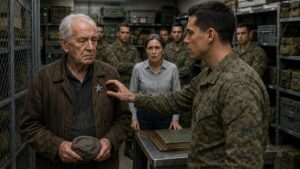
The Young Officer Told The Old Man To Leave Until A Dog Tag Changed His Voice
Chapter 1: The Old Man At The Restricted Lunch Table
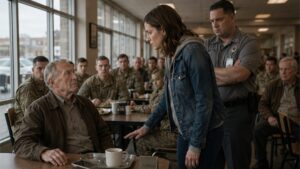
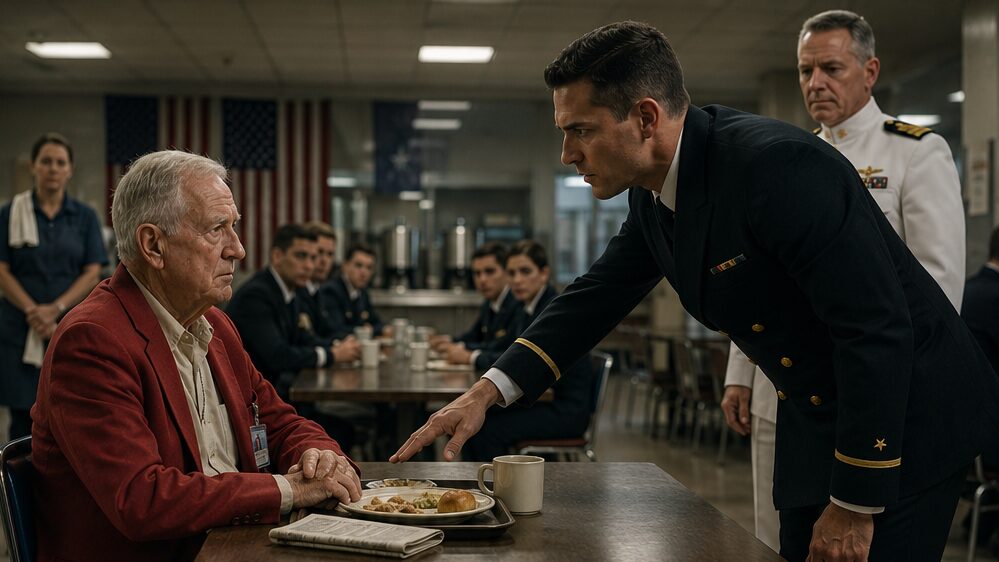
The young officer’s hand stopped inches from Ronald Mitchell’s tray.
Ronald did not look at the hand first. He looked at the sleeve. Dark dress fabric, clean cuff, polished button, the kind of sharpness that belonged to someone still measured every morning by inspection and mirrors. Then he looked at the fingers, spread slightly as if the tray might be evidence.
His sandwich sat untouched except for one careful bite. A small paper cup of soup had cooled to a thin skin. Beside the plate lay the folded memorial roster, creased once down the center because Ronald’s hands had shaken when he picked it up from the entrance table.
The dining hall had gone quieter around him.
Not silent. Never silent. Trays still clicked against rails. Chairs scraped. Someone laughed too loudly in the far corner and then stopped as if caught by the wrong kind of weather. The smell of coffee, floor wax, and warmed bread hung in the high white room. Flags stood near the entry doors. A row of framed photographs watched from the wall above the serving line.
Ronald kept one hand over the old tag beneath his red blazer.
The blazer was too bright for the room. He had known that when he took it from the closet before sunrise. Its elbows had gone soft, and one brass button was not original, but it was the only jacket he owned that did not seem apologetic. Under it, his pale shirt hung loose at the collar. The old metal tag lay there, cold when he arrived, warm now from his chest.
“Sir,” the young officer said.
The word was polite only in shape.
Ronald lifted his eyes.
The officer stood across the table, shoulders squared, chin held the way young men held it when they believed the room had asked them to be taller. His nameplate read GARCIA. His face was narrow, controlled, still young enough that irritation looked like certainty on him.
“This area is restricted,” the officer said.
Ronald glanced toward the dining hall doors. The sign there said MEMORIAL LUNCH — RESERVED SEATING. Under it, a smaller printed sheet listed units, guests, and check-in requirements. He had read it twice before entering and once more after Susan Baker, the cafeteria supervisor, had looked at his worn visitor badge and said, “Just don’t sit near the front if you’re not on the list.”
Ronald had nodded then. He had taken a tray because the attendant behind the line pushed one toward him. He had chosen soup because it was simple. He had sat at the end of the room, away from the podium, away from the officers’ tables, away from the polished shoes and young voices.
“I can move,” Ronald said.
The officer’s eyes flicked to the roster. “That’s not the issue.”
Ronald’s fingers tightened on the paper.
The roster had been printed on heavy cream-colored stock. Each name was arranged beneath the title of the annual memorial luncheon. Some names had ranks. Some had dates. Some had small symbols beside them. Ronald had found men he remembered only as voices through rain, men he remembered as hands hauling ropes, men he remembered as shapes in red emergency light. A few names had appeared exactly where they should.
One had not.
He had started at the top again, slowly, because age made strangers assume you had missed what younger eyes would see. He had read every line. He had turned the page over even though he knew there was nothing on the back. He had pressed a thumb against the blank margin until it bent.
Not there.
“Sir,” Officer Garcia repeated, lower now. “Are you a family guest?”
Ronald folded the roster halfway, then unfolded it. “No.”
“Retired staff?”
“No.”
“Then I need to see your authorization.”
Ronald moved his hand toward the temporary visitor badge clipped to his jacket pocket. The plastic sleeve had yellowed at the corners. The security desk attendant had written his name in block letters with a marker that had begun to fade before he reached the dining hall.
The officer did not take it.
“That allows access to the public corridor,” Garcia said. “Not reserved dining.”
A few young service members at the next table had turned fully now. One still held a fork in the air. Another looked away when Ronald’s gaze passed over him, but not before Ronald saw curiosity sharpen into embarrassment.
Ronald felt the heat rise behind his ears. It had been years since a room had looked at him all at once.
He could leave. He had learned how to leave rooms without making the chairs accuse anyone. He could fold the roster into his inside pocket, carry his tray to the return window, and step back into the corridor where the air smelled faintly of paint and metal. He could drive home before afternoon traffic and place the roster in the drawer with the others. He could tell himself he had tried.
His hand slipped from the badge to the dog tag beneath the jacket.
The metal edge pressed into his palm.
Garcia noticed the movement but not the reason for it. His eyes dropped to Ronald’s hand, then to the tray. “Sir, if you’re confused about where you’re supposed to be, I can have someone escort you.”
The word confused landed softly. That made it worse.
Ronald looked down at the soup. A faint skin had gathered again, wrinkled at the edges. He thought of a different room, not this one: steel deck slick under boots, a cup sliding from a mess table because the world had tilted, someone laughing until the laugh turned into a shout. He did not let the memory finish.
“I’m not confused,” he said.
Garcia’s mouth tightened. “Then help me understand why you’re sitting in a restricted room with an official program you weren’t issued.”
Ronald rested both hands on either side of the roster. His fingers were knotted now, the nails trimmed short. He had not worn his ring in years because his knuckle no longer allowed it. The young officer’s eyes touched those hands and moved away.
Susan Baker watched from near the beverage station with a towel over one shoulder. She looked uncomfortable but did not step in. Ronald did not blame her. Every institution had a way of teaching people where their courage was allowed to stand.
The front doors opened. A group in white uniforms entered with the clean movement of people expected somewhere. Ronald saw them only at the edge of his vision. He kept his attention on Garcia because a man who was being corrected deserved to be looked at, even when the correction was wrong.
“I’ll finish reading,” Ronald said, “then I’ll leave.”
Garcia leaned a little closer. “Reading what?”
“The names.”
That gave the officer a pause too small for most people to see. Ronald saw it because he had spent years reading faces in bad weather, before voices could carry.
Garcia looked at the paper again. “That roster belongs with event staff.”
“It was on the table.”
“For invited guests.”
Ronald breathed in through his nose. The room smelled less like bread now and more like old coffee.
“I won’t damage it.”
“That isn’t your decision.”
At the nearest table, someone murmured something Ronald could not hear. A chair leg scraped. His throat felt dry. He could feel the tag against his chest, the old chain caught on a thread inside his shirt. It would be easy to pull it out. Easy to let the metal speak before he had to.
He did not.
That was not why he had come.
He had not come to prove he belonged in the room. He had come because a man who no longer had a voice had been left outside it.
Garcia extended his hand.
“Sir, I’ll take the roster now.”
Ronald looked at the hand again. Clean nails. Strong wrist. A hand that had probably never had to hold something dead and pretend, for one more minute, that it was only lost.
He slid the roster back a few inches, not fast, not dramatic. Just enough.
The officer’s expression hardened.
“I’m asking respectfully,” Garcia said.
Ronald heard the careful warning inside the word respectfully. He had heard that kind of word before, dressed for inspection, polished for witnesses.
He pushed his chair back halfway. His knees complained. The tray trembled when the table shifted. Soup lapped against the side of the cup. Several faces turned more openly now.
For one thin second, Ronald nearly stood.
Then his eyes fell again to the blank space where the name should have been.
He sat back down.
Garcia’s hand moved toward the roster.
“You can’t keep official property,” he said.
Chapter 2: The Officer Leaned Over The Tray
Nicholas Garcia had been told three times that morning that the memorial lunch could not afford another mistake.
The first warning came from the security desk, where the guest list had loaded late and half the printed badges did not match the names on the screen. The second came from Susan Baker, who had stepped out of the kitchen with a tray of rolls and said, not unkindly, “Officer, if they put one more family at the wrong table, you’re going to have widows standing in the serving line.” The third came from his own reflection in the glass beside the dining hall doors, where he caught himself looking younger than he felt allowed to be.
So when he saw the old man in the red blazer seated alone with a reserved roster, Nicholas saw the problem before he saw the person.
That was how he would remember it later. Not with excuses. Just the order of things. Problem first. Person second.
The dining hall had already been rearranged twice. Front tables for command staff. Side tables for families. Rear tables for overflow. The memorial display had been placed near the flags, then moved because sunlight washed out the photographs. A chaplain had asked for a microphone. A medical volunteer needed space near the rear exit. Two younger service members had tried to sit near the honored guests and had to be moved before anyone important noticed.
Nicholas had noticed everything. That was his job.
The old man had entered during the lunch rush.
At first, Nicholas barely registered him: elderly civilian, red jacket, visitor badge, slow walk, cafeteria tray balanced carefully in both hands. He had seemed like someone’s grandfather who had wandered a little too far from the public hall. Nicholas had turned toward another issue, a family seated at the wrong table, and by the time he looked again, the old man was reading the memorial roster.
Not glancing at it. Reading it like it had accused him.
Nicholas crossed the room because someone had to.
Now the old man sat across from him with one hand over the paper and the other near his chest. His face was pale, lined deeply around the mouth. Not weak exactly. Weathered. Still, he did not look like a man who should be at the center of a dispute in a room full of uniforms.
“Sir,” Nicholas said, keeping his voice low, “I need the roster.”
The old man did not raise his voice. “I heard you.”
“Then please hand it to me.”
A whisper moved through the nearby table. Nicholas felt it like a draft at the back of his neck. He hated that. Not the whisper itself, but the possibility that the room would see uncertainty in him. He had spent too much of his first year trying to prove his discipline was not borrowed from the uniform.
The old man’s hand remained where it was.
Nicholas leaned forward. “This is a restricted event. If your name isn’t on the list, you can’t remain seated here.”
The old man looked up. His eyes were gray, or maybe blue faded by the room’s overhead light. “My name being there isn’t the trouble.”
Nicholas did not know what to do with that sentence. It sounded deliberate, almost rehearsed, but not like an excuse.
“Then whose name are you looking for?”
The old man looked down.
Nicholas waited. The room watched.
When no answer came, he reached for the roster.
The old man moved faster than Nicholas expected. Not sharply, not with panic. He simply covered the paper with his whole palm, and something beneath his shirt shifted loose.
A metal tag slid from under the red blazer.
It dropped against the pale fabric with a small sound Nicholas heard despite the dining hall noise. A dull tap. Old metal on a button.
Nicholas glanced at it, meaning only to register whether it was some keepsake, some decoration from a gift shop or veterans’ fundraiser. He saw a chain darkened by years. He saw a tag worn soft at the edges. The stamped letters were hard to read upside down, but not all of them.
MITCHELL.
A number below it.
A service mark.
Nicholas’s mouth opened, then closed.
The old man’s hand moved to cover it, but he stopped halfway, as if he had grown tired of hiding and ashamed of showing at the same time.
At the front of the room, one of the officers in white had gone still.
Nicholas sensed it before he looked. The kind of stillness that changed a space more than movement would have. Conversations thinned. A chair scraped. The officer in white, Joseph Anderson, had been speaking with the chaplain near the flags. Now he was staring across the dining hall, not at Nicholas, but at the tag against the old man’s chest.
Joseph’s face did not show shock. It showed recognition fighting its way through memory.
He walked toward them.
Nicholas straightened instinctively.
“Officer Garcia,” Joseph said.
“Sir,” Nicholas answered.
The old man stayed seated.
Joseph stopped at the side of the table. His eyes moved from Ronald’s face to the dog tag and back again. Something softened in his jaw. When he spoke, his voice was quieter than Nicholas expected.
“Mr. Mitchell?”
The old man’s fingers curled once on the table. “Yes.”
Joseph drew himself to attention.
Not for the room. Not with theatrical force. His heels came together. His shoulders settled. His right hand rose in a clean salute, held with the full weight of someone who understood that a salute could be either empty habit or a promise not to rush past what stood before him.
The dining hall went silent enough for Nicholas to hear the hum of the beverage cooler.
Ronald Mitchell did not stand. He did not smile. He did not reach for the salute as if it belonged to him. His face tightened, almost with pain, and his eyes lowered to the roster still beneath his hand.
After a moment, he gave a small nod.
Joseph lowered his hand.
Nicholas felt heat climb up his neck. He looked at Ronald’s tray: the soup cooling, the sandwich untouched, the napkin folded carefully beside the plate. A minute ago, those things had looked like evidence that the old man was misplaced. Now they looked like a man had tried to sit quietly with his grief and had been made to defend the chair.
“Sir,” Nicholas said, but he did not know which man he meant.
Joseph did not look away from Ronald. “Who cleared him through the desk?”
Nicholas swallowed. “He has a public corridor badge. He wasn’t on the event list.”
“Did you ask why he was here?”
Nicholas almost said yes. But he had asked for authorization. He had asked if Ronald was family. He had asked for the roster. He had not asked why the roster made the old man’s hands shake.
“No, sir,” Nicholas said.
The words scraped.
Susan Baker stood near the coffee urn, both hands on the towel now. Around the nearby tables, younger service members stared at their plates or at Ronald with that helpless look people get when they realize their silence has taken a side.
Joseph pulled out the chair beside Ronald but did not sit. “May I?”
Ronald studied him, then gave another small nod.
Joseph sat slowly, leaving space between them. Nicholas noticed that. The senior officer did not crowd the old man. He did not take the roster. He did not ask for the tag. He made the table less like an interrogation simply by changing where his body stood.
“Mr. Mitchell,” Joseph said, “I know your name.”
Ronald’s eyes remained on the paper. “A lot of men knew my name once.”
“I saw it in the old rescue files when I was a lieutenant.”
“That was a long time ago.”
“Yes, sir.”
Ronald flinched almost imperceptibly at the sir. Nicholas saw it and wondered how many words could be both honor and burden depending on when they arrived.
Joseph looked at the roster. “You came for the memorial lunch.”
Ronald moved one finger along the fold in the paper. “I came for the names.”
The room seemed to hold that sentence.
Nicholas stood beside the table, suddenly aware of the angle of his own body. He had been leaning over Ronald moments earlier. His shadow had fallen across the tray. He stepped back half a pace.
Joseph noticed, but said nothing.
“Mr. Mitchell,” he said, “is there someone missing from that list?”
Ronald’s hand pressed flat.
At first Nicholas thought the old man would not answer. His face had gone closed in a way that felt older than stubbornness. Then Ronald looked up, not at Nicholas, not even at Joseph, but toward the flags near the entry.
“Yes,” he said.
Joseph waited.
Ronald touched the dog tag through his shirt, not hiding it now, just feeling for its edge as if checking whether it had survived the room.
Joseph’s voice softened further. “Can you tell me who?”
Ronald finally turned toward him.
“That is not the name missing today.”
Chapter 3: The Name That Was Not Printed
Joseph Anderson had saluted hundreds of times in his life and regretted only a few.
He regretted the automatic ones. The ones tossed across parking lots while thinking of weather, schedules, emails, inspections. The ones that had the shape of respect without its attention. He had not regretted the salute in the dining hall, but as he walked beside Ronald Mitchell through the corridor toward records, he understood it had been the easiest thing he would be asked to do that day.
The old man moved slowly but did not ask for help.
Joseph shortened his own pace without making a performance of it. Nicholas followed two steps behind, carrying nothing, saying nothing. Susan Baker had wrapped Ronald’s untouched sandwich in a napkin and placed it in a paper bag before they left the dining hall. Ronald had accepted the bag with a quiet “Thank you,” and Susan had looked at the floor as if the words were heavier than she expected.
The corridor outside the dining hall was cooler. Fluorescent light flattened the walls. Framed photographs marked anniversaries, command changes, ships, crews, disaster relief missions, smiling groups of men and women standing in rows with the sea behind them. Ronald did not look at most of them.
He kept the folded roster in his left hand.
Joseph glanced at it once. “I can have someone bring us another copy.”
“This one has the blank space,” Ronald said.
Joseph understood enough not to ask what that meant.
At the end of the corridor, the noise of the dining hall faded behind a set of double doors. Nicholas cleared his throat.
“Mr. Mitchell,” he said.
Ronald stopped.
Nicholas stopped too quickly and nearly spoke over himself. “I owe you an apology.”
Ronald turned only halfway. The red blazer hung loose on his shoulders. In the hall light, the old dog tag had slipped fully into view. Its chain disappeared beneath his collar, dark against the pale shirt.
Nicholas stood straight, but stiffness had replaced authority. “I was out of line.”
Ronald looked at him for a long second. “You were in a hurry.”
“That doesn’t excuse it.”
“No.”
The single word landed without anger.
Nicholas took it. Joseph saw him take it. That mattered more than any polished apology would have.
Ronald continued walking.
Records was located past the administrative wing, behind a door with a keypad and a small sign instructing visitors to check in at the front desk. Joseph entered his code. Inside, the air smelled like paper, toner, and old cardboard. A clerk at the counter looked up from a monitor.
Katherine Lewis wore a navy cardigan over her staff badge. Her hair was pulled back, and a pencil rested behind one ear. She took in Joseph’s white uniform first, then Nicholas, then Ronald.
“Commander Anderson,” she said. “I thought everyone was at the luncheon.”
“Most are,” Joseph said. “We need help with a memorial roster.”
Katherine’s expression tightened in the practical way of someone who had heard the word urgent too many times from people who meant inconvenient. “The printed rosters came from Public Affairs. If there’s a typo, they’ll have to correct it for next year.”
“It may not be a typo.”
Ronald stood near the counter, paper bag in one hand, roster in the other. His breathing had deepened from the walk, but he held himself carefully, refusing the chair by the wall because no one had offered it in time and now accepting it would feel like surrender.
Joseph noticed too late.
“Please,” he said, pulling the chair closer. “Sit if you’d like.”
Ronald glanced at him. For a moment, Joseph thought he would refuse. Then Ronald sat, not because he had been told to, but because he chose the chair on his own terms.
Katherine came around the counter. “What name are we checking?”
Joseph looked to Ronald.
Ronald did not answer.
The quiet stretched.
Nicholas shifted his weight. Joseph resisted the urge to fill the space for him. Recognition had opened the door, but it could not drag Ronald through it.
At last Ronald unfolded the roster and placed it on the counter. He pointed to the section headed RESCUE AND RECOVERY SUPPORT PERSONNEL. His fingertip rested on a gap between two printed lines.
“There,” he said.
Katherine leaned closer. “Sir, there isn’t a name there.”
“I know.”
“Which name should be there?”
Ronald’s finger did not move. “Donald Hall.”
The name changed the room in no visible way. No lights flickered. No drawer opened by itself. No photograph fell from a wall. Joseph disliked that. Some names should have weight enough to alter the air.
Katherine repeated it as she typed. “Donald Hall.”
Her keyboard clicked. The monitor reflected faint blue in her glasses.
“Approximate service period?” she asked.
Ronald’s jaw worked once. “Late sixties. Attached temporary to a rescue crew out of Norfolk. Not permanent crew. Not on the original manifest the way he should have been.”
Katherine typed again. “Branch?”
“Navy.”
“Rank?”
Ronald’s eyes lowered.
Joseph watched his hand move toward the dog tag, then stop before touching it. “He was young,” Ronald said.
Katherine waited, expecting more.
Ronald gave none.
She tried another search. Then another. The printer beside the desk hummed and settled. Outside the office, a cart rattled down the corridor.
“I have several Halls,” Katherine said. “None matching a Donald Hall attached to that unit in the active indexed files.”
“It won’t be indexed right,” Ronald said.
Katherine glanced up. “Why do you say that?”
“Because if it were, he would be on the list.”
Nicholas looked down.
Joseph stepped closer to the counter. “Could he be in temporary assignment records?”
“Possibly. But those are incomplete for that period.” Katherine’s voice remained careful. Not dismissive, but guarded by procedure. “Some of the paper files were scanned years ago. Some were damaged before transfer. If he wasn’t permanently assigned, he may not appear under the unit’s main file.”
Ronald gave a short nod, as if she had confirmed something he had already carried.
Joseph said, “What would you need?”
Katherine looked from him to Ronald. “A service number. Orders. A casualty reference. A personal document if the family submitted one. Anything tying him to the operation.”
The dog tag seemed to grow heavier against Ronald’s chest.
Nicholas saw it too. Joseph could tell by the way the younger officer’s eyes went there and then quickly away, ashamed of looking.
Ronald folded the roster along the existing crease. His thumb smoothed the blank space once.
“I came in 1998,” he said. “They told me records had moved.”
Joseph said nothing.
“I came in 2007. They said the memorial list was ceremonial, not official.”
Katherine’s face changed slightly.
“I came in 2016,” Ronald continued. “Couldn’t get past the desk. Different rules by then.”
Nicholas’s mouth tightened.
Ronald looked toward the closed office door. “Today the guard gave me a yellow badge and told me where lunch was. I thought maybe that was enough.”
Joseph felt the shame of the institution settle on him—not dramatic, not crushing, but steady and deserved.
“Mr. Mitchell,” he said, “we can continue now.”
Ronald looked at him with tired patience. “Can you?”
The question was not cruel. That made it worse.
Katherine returned to the computer and opened another database. She typed with more focus this time, no longer treating the matter as a printed-program error. “I can check non-indexed scanned attachments. It may take time.”
“The memorial begins soon,” Nicholas said, then stopped, realizing how it sounded.
Ronald looked at him.
Nicholas lowered his voice. “I mean only that there may still be time to correct the spoken list.”
Ronald studied him, then looked away.
Katherine typed Donald Hall again. A loading circle spun. A file list appeared, then collapsed into an error message. She frowned and tried a different field.
“Nothing in the current digital file,” she said.
Ronald’s hand closed around the roster.
Joseph watched his shoulders draw inward, not like a man surprised by defeat, but like one meeting an old appointment.
Katherine softened her voice. “That doesn’t mean there’s nothing anywhere.”
Ronald nodded once.
But the old dog tag rested against his shirt, and Joseph could see now that Ronald knew exactly where something was.
Chapter 4: The Record Room Kept The Wrong Silence
Katherine Lewis did not like mysteries in records.
She liked dates that matched. She liked names spelled the same way twice. She liked forms signed where they were supposed to be signed, cross-references that opened without error messages, and old files that had been scanned with all corners visible. When the system failed, people looked at her as if the failure belonged to her hands.
Donald Hall did not exist in the current digital file.
That did not mean he had never existed. Katherine knew better than that. The base carried its past in uneven layers: polished displays near the public corridors, climate-controlled archives for command histories, gray boxes of temporary transfers in a back room where the labels had faded to the color of weak tea. Some records had been saved because someone important had asked. Some had survived because nobody cared enough to throw them away.
She looked at Ronald Mitchell, seated beside the counter with the paper bag on his lap and the memorial roster folded in his hand.
He had the stillness of someone who had waited so long that waiting had become part of his body.
“I can search the scanned attachments by operation number,” Katherine said. “But I need some kind of anchor.”
Joseph Anderson stood near her desk, arms at his sides, not leaning over her chair, not crowding the monitor. Nicholas Garcia had taken a place near the wall. He held himself stiffly, as if afraid any movement would become another mistake.
Ronald looked at the roster. “It was a rescue response.”
“Yes, sir. You said that.”
“Storm season.”
Katherine waited for more, but he had already gone somewhere the rest of them could not follow.
His eyes were open, fixed on the floor near the filing cabinets. The record room’s fluorescent lights hummed above them. Somewhere deeper in the office, a copier clicked through a stack of paper. Outside, a muffled announcement came over the corridor speakers, too distorted to understand.
Ronald said, “There was a temporary crew list. Handwritten.”
Katherine turned back to her keyboard. “Temporary crew list. Rescue response. Norfolk attachment. Late sixties.”
She tried the search again, this time widening the date range. Too many results. She narrowed by unit. Too few. She searched Hall without first name and found maintenance requests, transfer notices, a dental form for another man, a supply complaint from a different station.
Nothing that tied Donald Hall to the memorial roster.
“Could he have served under a middle name?” she asked.
Ronald’s mouth moved faintly. Not a smile. The ghost of remembering one. “He hated paperwork. Said his mother gave him one name and the Navy could learn it.”
Nicholas looked down.
Katherine typed again.
A file opened halfway and froze. She waited. The spinning circle turned on the screen like a small insult.
“Come on,” she whispered.
Joseph said, “We can request archive support.”
“We can,” Katherine said. “But not before tonight’s program.”
Ronald’s thumb moved along the folded edge of the roster. Katherine had seen people bring documents into this office before: discharge forms, dependent records, old orders, letters from families trying to prove something for a benefit, a burial, a plaque, a school project. Most people held papers as proof. Ronald held this paper as if it had hurt him.
She lowered her voice. “Mr. Mitchell, did you bring anything with you?”
The question changed him.
It was not visible to someone in a hurry. But Katherine was trained by files, by faint marks, by the difference between a copy and an original. Ronald’s shoulders tightened under the red blazer. The hand near his chest closed, not over the dog tag this time, but just below it, near the inside pocket.
Joseph saw it too. He turned slightly away, giving Ronald the courtesy of not staring.
Nicholas did not move.
Ronald said, “Maybe.”
Katherine left her hands still on the desk. “You don’t have to show me anything you’re not ready to show.”
The old man looked at her then. His eyes were dry, which somehow made them harder to meet.
“Ready doesn’t have much to do with it anymore,” he said.
No one answered.
Katherine stood and went to the back cabinets. “Let me check the physical index.”
She unlocked the narrow records room with a key from her badge reel. The door opened with a tired scrape. Inside were shelves of gray boxes, some newer, some old enough to have string ties. She ran her finger along labels: MEMORIAL CORRESPONDENCE, TEMP DUTY FILES, RESCUE SUPPORT, PARTIAL SCANS, DAMAGED ORIGINALS.
She pulled two boxes and carried them to the table.
Nicholas stepped forward. “May I help?”
Katherine almost said she had it. Then she looked at him—the careful posture, the lowered voice, the shame he was trying not to display as performance—and she handed him the lighter box.
“Set it there,” she said.
He did.
Ronald watched that small exchange without comment.
For the next twenty minutes, they worked through paper. Katherine led the search. Joseph read dates from photocopied lists. Nicholas sorted folders into stacks after asking how she wanted them arranged. Ronald sat with the roster on his knees, saying very little, but once in a while he corrected a year, a unit abbreviation, a word that had been transcribed wrong.
“Not recovery,” he said once.
Katherine looked up. “The folder says recovery support.”
“It was rescue first. Recovery later.”
The room went quiet.
She changed the label on her notepad.
At the bottom of the second box, Nicholas found a folder with a warped corner. “Temporary Attachments — Weather Response.”
Katherine took it carefully.
The paper inside had been copied badly. Names slanted down the page. Some ink had bled. Several lines were unreadable, but there were initials, ranks, service numbers, short notes written in a hand impatient with space.
Katherine followed the list with a pencil.
“No Donald Hall,” she said.
Ronald closed his eyes.
Then Joseph leaned closer. “Wait. What’s that one?”
Halfway down the second page, beneath a smeared line, was a temporary assignment entry. D. HALL. No first name. No full unit. A partial service number with two digits missing. Beside it, in the margin, someone had written: boat crew assist.
Katherine felt the room gather around the scrap of ink.
“It isn’t enough,” she said gently.
Ronald opened his eyes.
“It places a D. Hall near the operation,” she continued. “But for a formal correction, they’ll ask for more.”
Joseph’s jaw tightened. “But it supports his statement.”
“It supports part of it.”
Nicholas looked toward Ronald. “There has to be something else.”
Ronald did not answer.
His fingers went again to the inside pocket of the red blazer.
Katherine pretended to look down at the folder, giving him privacy inside a room where there was none. She heard the faint shift of cloth. Then Ronald drew out an envelope.
It was old, the paper yellowed at the edges, folded soft from years of being carried and not opened. There was no official seal on it. No typed label. Only a name written by hand, faded but legible.
Donald Hall.
Ronald held it above his lap.
Joseph took one step toward him, then stopped.
Katherine did not reach.
Nicholas barely breathed.
Ronald looked at the envelope as if surprised it had weight after all these years. His thumb brushed the handwriting once. The old dog tag rested against his shirt above it, dull and quiet.
“This was not for the Navy,” Ronald said.
Katherine kept her voice steady. “What is it?”
Ronald’s lips pressed together. When he answered, the words came low.
“A letter that should have gone home.”
Joseph’s eyes lowered.
Katherine waited. Procedure had nothing useful to say.
Ronald turned the envelope over. The flap was still closed, but the glue had long since dried into a brittle line. He could have opened it with one finger. He did not.
“If I give you this,” he said, “it becomes a record.”
“Yes,” Katherine said.
He nodded, not to her, but to the thing in his hand.
For the first time that afternoon, Katherine saw fear on his face.
Not fear of the room. Not fear of officers or rules or embarrassment. Fear of taking something private and placing it under fluorescent lights, where people could stamp it, scan it, misread it, preserve it, and still fail to understand what it had cost.
Ronald slid the envelope halfway from his lap toward the table.
Then he stopped.
His hand remained on it.
“I need a minute,” he said.
Chapter 5: The Letter Ronald Could Not Unfold
The chapel room had no stained glass, only a narrow window that looked onto the side of the memorial hall and a strip of trimmed grass beyond it. Three rows of simple chairs faced a small wooden table. On the table sat a box of tissues, a battery candle, and a folded flag under glass.
Ronald chose the last chair in the back row.
He had always trusted the last row. It let a man see the door. It let him leave without turning his back on too many people. It let silence sit beside him without being asked to introduce itself.
Joseph did not follow him in. Neither did Katherine. They had offered the room and then left him to it. Nicholas had remained somewhere in the corridor. Ronald had heard his shoes stop outside, then move away.
The envelope lay across Ronald’s knees.
Donald Hall.
The handwriting had faded, but Ronald did not need to read it. He knew the slant of every letter, the hard angle of the D, the way the final l dipped too low. Donald had written like he talked, quick and unwilling to waste space.
Ronald touched the old tag at his chest.
One tag was his. The other, the one he kept deeper beneath his shirt on a separate chain, was not. He had not shown that yet. Not to Joseph. Not to Katherine. Not even to the men who had asked in earlier years why he came and left before the ceremony began.
He slipped two fingers inside his collar and drew it out.
Donald Hall’s tag was darker than his own. The stamped letters were worn shallow from years of being held. Ronald had cleaned it once, long ago, and then never again. The tarnish seemed to belong to it, like weather belonged to stone.
He placed it on the envelope.
The metal made almost no sound.
Through the wall, he heard the memorial hall being prepared. A microphone thumped. Someone tested it with half a word. Chairs shifted in rows. The annual ceremony would begin soon. Names would be read. Heads would bow. People would say never forgotten with good intentions and incomplete paper.
Ronald closed his eyes.
The rain came back first.
Not as memory exactly. More like a door opened somewhere behind his ribs. Rain against metal. Rain in his mouth. Rain running under his collar until his shirt clung to his spine. The deck moving under him. A light swinging overhead. Someone shouting numbers. Someone else praying without knowing he was.
Donald had been younger than Ronald remembered him now. That was the cruelty of outliving a man by decades; eventually the dead became younger than your grandchildren.
He had arrived as temporary help because the weather response needed hands and did not care what the paperwork had caught up with. He was all elbows, grin, and complaints. He borrowed gloves. He sang badly. He called every officer “boss” until someone told him not to, then did it only when they could not prove it.
On the second night, a small craft came in wrong through heavy water.
Ronald remembered the flare. He remembered the rope cutting across his palm. He remembered Donald moving before the order finished leaving anyone’s mouth. Donald did not look heroic. He looked annoyed that the sea had made a mess of things and expected someone else to clean it up.
They got three men across.
The fourth line snapped.
Ronald had gone down hard. His shoulder struck the rail, and for a moment there was only white pain and rain. Donald’s hand caught the back of his jacket. Another wave hit. The deck tilted. Ronald heard Donald shout something he never fully remembered after, except that it ended with his name.
When it was over, Ronald had Donald’s tag in his fist.
And later, in the low gray hour after the worst of it, someone handed him the letter.
“He was going to mail it,” the man said.
Ronald had not opened it. It had not been his. He told himself he would find the right address. Then the unit moved, records shifted, a family could not be reached, and the temporary assignment became a line missing from a cleaner version of events.
At first, Ronald thought the Navy would fix it.
Then he thought someone else had.
Then he was ashamed he had waited.
Years gathered. His wife died. Friends stopped answering phones because no one was there to answer them. Bases changed gates. Young guards looked at old badges as if they were props from a school play. Ronald kept the envelope in drawers, then boxes, then inside the red blazer on days he told himself he might finally go.
He came in 1998 with Donald’s tag in his pocket and left when the clerk said archived records were off-site.
He came in 2007 and sat in his car while rain blurred the windshield.
He came in 2016 and turned around when the security desk attendant asked who had invited him.
Today, he had made it as far as the lunch table.
Ronald opened his eyes.
The battery candle flickered without heat.
He took the envelope in both hands. The old paper flexed weakly. He slid one finger under the flap and stopped.
It was still not his letter.
That had been the shape of the burden for so long that he hardly knew what it would be without it. If he opened it, he betrayed Donald’s privacy. If he kept it closed, he let Donald remain a partial initial on a damaged form. If he gave it to the record unopened, strangers might open it under policy and call that care.
His throat tightened.
“You should have had your name,” Ronald whispered.
The room did not answer.
He thought of Nicholas leaning over the tray, young face stern with borrowed certainty. He thought of Joseph’s salute, clean and restrained, arriving too late and yet not meaningless. He thought of Katherine changing her notepad from recovery to rescue because he had corrected one word.
Rescue first. Recovery later.
That was the part records lost when they grew tidy. They kept outcomes. They lost intention.
Ronald looked down at Donald’s tag.
“You pulled me up,” he said. “And I let them write you down wrong.”
His hand shook. He closed it around the tag until the stamped letters pressed into his palm.
No, not let. That was too easy and too cruel. He had been young, then hurt, then transferred, then swallowed by years and the ordinary cowardices grief permits. But the result was the same: Donald Hall’s name had not been spoken.
Ronald placed the envelope on the small wooden table beneath the glass-cased flag. He set Donald’s tag on top of it. Then he sat back down before his knees could decide for him.
The door opened softly.
He did not turn.
A voice from the threshold said, “Mr. Mitchell?”
Nicholas.
Ronald kept his eyes on the table. “If you came to apologize again, don’t.”
The silence behind him held.
“No, sir,” Nicholas said, then corrected himself. “No, Mr. Mitchell.”
Ronald heard the effort in that correction. Not smooth yet. That was better.
Nicholas remained at the doorway. He did not step in.
“I was told you might need water,” he said.
“I don’t.”
“Yes.”
A pause.
Ronald finally looked back.
Nicholas stood with one hand at his side and the other holding a small paper cup. Not extended. Not offered like a solution. Just held, in case it became wanted.
His face had lost the hard certainty from the dining hall. Without it, he looked tired and younger.
“I can leave it outside,” Nicholas said.
Ronald studied him.
The hallway light outlined the shape of his uniform. Behind him, voices moved toward the memorial hall. The program was coming, with or without the missing name.
“Why are you standing out there?” Ronald asked.
Nicholas looked at the threshold, then back at him. “Because I didn’t ask before I stepped into your space last time.”
Ronald said nothing.
Nicholas held the cup a little lower. “May I come in?”
Chapter 6: Nicholas Asked Before He Spoke
Nicholas Garcia had never noticed how loud his shoes were until he tried to enter a quiet room respectfully.
Every step seemed to announce him. Heel, floor, breath. He moved slowly, aware of Ronald Mitchell watching from the last row, aware of the envelope on the small table, aware of the dog tag resting on top of it like a thing with its own right to silence.
He stopped beside the first row of chairs.
Not close. Not far enough to look afraid.
Ronald glanced at the paper cup in his hand. “You can set it there.”
Nicholas placed the cup on the chair nearest the aisle instead of carrying it to Ronald. He did not want to make the old man reach around him. He did not want to lean again. The memory of his own shadow falling over Ronald’s tray made his neck burn.
Through the wall came the first notes of recorded music from the memorial hall.
Nicholas stood with his hands at his sides.
Ronald watched him. “You’re missing the program.”
“I know.”
“You have duties.”
“Yes.”
“That usually matters to you.”
Nicholas accepted the strike because it was clean and earned. “It does.”
Ronald looked back toward the envelope. “Then go.”
Nicholas should have. He had already done enough wrong for one day. He could return to the hall, stand near the wall, make sure the families were seated, keep the aisles clear, and let Commander Anderson handle what came next. That would be neat. That would be safe. That would be another version of stepping away before he understood what had happened.
“I thought discipline meant keeping things in order,” Nicholas said.
Ronald did not turn. “It can.”
“I used that as an excuse not to see you.”
The old man’s shoulders moved with one slow breath.
Nicholas looked at the dog tag on the table. He wanted to ask whose it was. He wanted to ask why the envelope had not been opened, why Donald Hall was missing, what kind of rescue could follow a man for most of his life. The questions crowded his mouth.
He kept them there.
“I don’t need you to tell me anything,” Nicholas said. “I just need to know whether there’s something I can do before they start reading the names wrong.”
Ronald turned then.
For the first time, Nicholas saw anger in him. Not hot anger. Not the kind that looks for something to break. This was older and more disciplined. It sat deep in Ronald’s eyes, sharpened by years of being asked too late what should have been done sooner.
“You can’t fix it before they start,” Ronald said.
Nicholas nodded. “Then after they start.”
“That sounds like fixing.”
“No.” Nicholas swallowed. “It sounds like not making you carry the whole thing alone if you decide to hand it over.”
Ronald’s gaze stayed on him long enough that Nicholas wanted to look away.
He did not.
The music in the next room faded. A microphone crackled. Commander Anderson’s voice came through faintly, welcoming guests, thanking families, naming the purpose of the annual memorial. The words were familiar, formal, careful.
Ronald looked toward the wall.
Nicholas lowered his voice. “They haven’t reached the list yet.”
Ronald’s hand went to his own tag at his chest, then to the empty space beneath it where Donald’s had rested for years.
“You were rough with an old man,” Ronald said.
“Yes.”
“You were wrong before you knew my name.”
“Yes.”
“You won’t undo that by standing politely for ten minutes.”
“I know.”
Ronald seemed to consider whether the answer was too quick. Then he looked toward the water cup.
“My tray still on the table?”
Nicholas blinked. “Sir?”
Ronald’s eyes returned to him.
Nicholas corrected himself. “Mr. Mitchell.”
“Yes,” Nicholas said. “Susan Baker cleared the plates around it, but she left yours. She said you hadn’t finished.”
Ronald’s expression shifted faintly. Not softness. Recognition of a small thing done properly.
“She kept it there?”
“Yes. She also told two people the table wasn’t open.”
Ronald looked down.
Nicholas said, “She didn’t make an announcement.”
“Good.”
The old man reached into his jacket and drew out the folded roster. He held it for a moment, then extended it toward Nicholas.
Nicholas did not take it at once.
Ronald noticed. “You wanted it badly enough earlier.”
Nicholas looked at the paper, then at him. “May I?”
Ronald gave the smallest nod.
Nicholas took the roster with both hands.
It was only paper. Cream stock, black ink, a crease down the center, a faint mark where Ronald’s thumb had pressed near the blank space. But Nicholas held it as carefully as he would have held a flag passed to him by a grieving family. Not because it was the same thing. Because he understood now that care had to begin before he fully understood the object.
Ronald watched his hands.
“Donald Hall,” Ronald said.
Nicholas nodded. “Donald Hall.”
“Not D. Hall. Not temporary attachment. Not boat crew assist.”
“Donald Hall.”
The old man’s jaw tightened. “He was twenty-three.”
Nicholas felt the number land in him. Twenty-three was not history. Twenty-three was younger than he was.
“He didn’t get to become old,” Ronald said.
From the memorial hall came the chaplain’s voice. Then silence. Then the first names began, carried through the wall in a steady cadence.
Ronald closed his eyes.
Nicholas looked toward the table where the envelope and tag waited. “Do you want Commander Anderson?”
“No.”
“Katherine?”
“Not yet.”
The names continued next door.
Ronald rose slowly. Nicholas stepped back, giving him room. The old man’s hand brushed the chair in front of him for balance. Nicholas saw the effort it cost and did not offer an arm. Not because he did not want to. Because Ronald had not asked.
Ronald walked to the small table. He stood before the envelope for a long moment.
Then he picked up Donald Hall’s tag.
His thumb moved once across the letters. Nicholas could hear the faint scrape of skin on old metal.
“I kept telling myself I was guarding it,” Ronald said.
Nicholas stood still.
“Some things you guard so long they disappear anyway.”
The names from the next room moved closer to the rescue section. Nicholas could feel time tightening.
Ronald placed the tag back on the envelope. “Tell Commander Anderson I’ll give this to the record.”
Nicholas’s breath caught.
Ronald looked at him. “But not so they can make a moment out of me.”
“No.”
“And not before his name.”
Nicholas nodded. “Donald Hall first.”
Ronald held his gaze.
“Say it like a name,” Ronald said. “Not a correction.”
Nicholas felt shame rise again, but this time it had work attached to it.
“I will.”
The old man returned to the last chair and lowered himself into it. He suddenly looked exhausted, as if removing the second tag had taken more strength than the walk from the dining hall.
Nicholas picked up the roster, careful not to fold it more than it already was.
At the door, he paused. “Mr. Mitchell?”
Ronald looked up.
“I’m going to stand beside the table when you come back,” Nicholas said. “Not in front of it.”
Ronald’s eyes remained unreadable.
Then he gave one small nod.
Nicholas stepped into the corridor. The memorial hall doors stood open ahead of him. Commander Anderson’s voice had reached the printed section where the missing name should have lived.
Nicholas walked faster, holding the roster in both hands.
Chapter 7: The Salute Was Not The Last Respect
Ronald Mitchell heard Donald Hall’s name before he reached the memorial hall doors.
Not clearly at first. The corridor bent the sound, softened it, carried it through open space and polished tile until it seemed less spoken than remembered. He stopped with one hand against the wall, the red blazer pulling tight across his shoulders, and listened.
“Donald Hall.”
The voice was Joseph Anderson’s.
Not hurried. Not inserted like an apology. Not lowered as if the name might not deserve the same air as the others.
“Donald Hall,” Joseph said again, and this time the microphone caught the edges cleanly. “Temporary rescue crew attachment. Navy. Twenty-three years old.”
Ronald closed his eyes.
Nicholas stood a few feet ahead of him, near the memorial hall entrance. He had not taken the roster inside alone and made an announcement. He had gone first to Joseph, then to Katherine, then returned to the hallway and waited for Ronald, holding the door open without touching him, without saying the old man needed to hurry.
Now he stood beside the open doorway, not in front of it.
Inside, the hall was full enough that no one turned all at once. Families sat in rows. Service members stood along the walls. The flags at the front were still. The printed programs lay in laps, wrong in every hand that held one.
Joseph stood at the podium in his white uniform. Katherine waited near a side table with the damaged folder, the partial crew list, and the unopened envelope placed inside a clear protective sleeve. She had not scanned it yet. She had not opened it. Ronald had told her it could become record, but not spectacle, and she had listened carefully enough to understand there was a difference.
On the table beside her lay Donald Hall’s tag.
Not thrown down. Not displayed high. Placed flat on a dark cloth, handled with two hands when Katherine moved it, as if the small metal piece had arrived with its own honor guard of silence.
Ronald entered at the back.
No one announced him. That was mercy.
A few heads turned. Susan Baker stood near the side wall, still in her cafeteria supervisor’s shirt, her towel gone now, hands folded in front of her. She saw Ronald and moved quietly to the last row, pulling one empty chair back just enough that he would not have to struggle with it. Then she stepped away.
Ronald paused.
Earlier that day, he might have refused the chair because it had come too late. Now he sat because Susan did not make him accept it in front of anyone. She simply made space and let him decide.
Nicholas remained standing beside the row.
Not close enough to claim him. Close enough to keep others from crowding.
Joseph looked up from the podium and found Ronald at the back. He did not salute this time. He gave the smallest nod and returned to the paper in front of him.
“We are correcting the record tonight in the presence of those gathered to remember,” Joseph said. “The correction is not ceremonial. It is overdue.”
The hall held still.
Ronald kept his hands on his knees. His own dog tag rested beneath his shirt again. The empty feeling where Donald’s had hung for so many years was worse than he had expected. He had thought grief would lighten when shared. Instead, it had changed shape, becoming less private and more real.
Joseph continued. “The current printed program omits Donald Hall’s full name. The omission appears to have come from incomplete temporary assignment records connected to a rescue response. The available file confirms a D. Hall attached as boat crew assist. Additional personal material has been provided to begin formal correction.”
He did not say by whom.
Ronald breathed through the ache in his chest.
A woman in the second row touched her program. A young service member near the wall lowered his eyes. No one clapped. Ronald was grateful for that. Applause would have broken the fragile thing being repaired.
Joseph looked down once more.
“Before we continue,” he said, “we will speak the name as it should have been spoken.”
He stepped back from the podium.
The room rose.
Not in a wave. Not with the dramatic scrape of sudden realization. It happened unevenly, because some were old, some confused, some balancing programs, some following the movement of others. A few service members stood first. Families followed. Susan stood by the wall. Katherine stood beside the table with the tag.
Nicholas did not look at Ronald to see whether he approved.
That mattered too.
Ronald remained seated for two seconds longer. His knees had stiffened. His right hand trembled once against his thigh. Then he stood, slowly, while Nicholas stayed still and let him rise under his own strength.
Joseph spoke the name a third time.
“Donald Hall.”
The room repeated it.
Not perfectly together. Not like a chant. Like people learning the weight of syllables they should already have known.
“Donald Hall.”
Ronald’s vision blurred. He did not wipe his eyes. He looked toward the table where the tag lay and, for a moment, saw not old metal but a wet deck under a swinging light. Donald grinning with rain on his face. Donald complaining that the Navy could lose a man’s socks before breakfast and his paperwork by lunch. Donald’s hand gripping the back of Ronald’s jacket, hauling him up with an angry strength that had never made it into any report.
Then the hall returned.
Joseph bowed his head. The room followed. Silence settled—not the embarrassed silence of the cafeteria, not the procedural silence of records, but something chosen.
When everyone sat, Joseph did not turn the correction into a story. He did not decorate it with words about sacrifice until the man disappeared beneath them. He simply placed Donald Hall’s name into the memorial list and continued.
Ronald listened until the last name was read.
Afterward, people did not rush him. That, he suspected, was Joseph’s doing, and perhaps Nicholas’s. The hall emptied in careful streams. Family members spoke in low voices near the flags. A few service members passed Ronald’s row and straightened slightly, but none forced gratitude upon him. One older veteran at the aisle paused, met Ronald’s eyes, and gave a nod that carried no question.
Ronald returned it.
Katherine approached only after the row had cleared.
She carried the protective sleeve with the envelope inside and the tag resting separately on a small cloth-covered tray. Nicholas walked beside her, holding the corrected roster. Joseph followed a step behind.
They stopped at Ronald’s row.
Katherine said, “Mr. Mitchell, I have not opened the letter.”
Ronald looked at the envelope. Its old flap remained closed.
“We can enter it as sealed personal correspondence pending proper archival review,” she said. “The tag and the partial assignment record are enough to start a formal correction. The letter may help later, but it does not have to be opened tonight.”
Ronald absorbed that slowly.
For decades, he had imagined only two choices: keep it hidden or surrender it completely. He had not imagined someone might take custody of it without taking possession of its meaning.
“Will his name stay?” he asked.
Joseph answered. “It will be corrected in the spoken record tonight. The formal record starts tomorrow. I will sign the request. Katherine will attach the supporting documents. Nicholas will deliver the amended roster to Public Affairs before he leaves.”
Nicholas looked at Ronald. “If you permit it.”
Ronald studied him.
The young officer’s face was still marked by the day. Shame had not left him. Good, Ronald thought. Not because he wanted the boy punished, but because shame, if carried correctly, could become attention.
“You don’t need my permission to do your duty,” Ronald said.
Nicholas accepted that with a small nod. “No. But I need your permission before I touch what you brought.”
Ronald looked from him to the tray in Katherine’s hands.
Donald’s tag lay on the cloth, dull under the hall lights. It seemed smaller now that it was no longer against his chest. Almost impossible that something so small could alter the sound of a room.
Ronald reached out.
Katherine did not move the tray toward him too fast. She brought it close and held it steady. Ronald took the tag one final time.
The metal was warm from the room.
He closed his fist around it and saw rain again, but only for a breath. Then he opened his hand and placed the tag beside the corrected roster Nicholas held.
Nicholas did not shift under the weight of that small sound.
“Two hands,” Ronald said.
Nicholas immediately brought his other hand under the roster.
Ronald gave the faintest nod. “That’s better.”
Joseph’s mouth tightened briefly, not quite a smile.
Susan Baker appeared at the back of the hall carrying a small paper bag. She stopped when she saw the group, uncertain whether to interrupt. Ronald noticed her and raised one hand slightly.
She came forward.
“Your sandwich,” she said. “I replaced the soup. It was cold.”
Ronald looked at the bag. “You didn’t have to.”
“No,” Susan said. “I didn’t.”
There was no apology in the words, but there was something better: a thing done differently because the day had taught her where dignity lived.
Ronald accepted the bag.
The cafeteria was nearly empty when they returned. The long tables had been wiped down. Chairs were tucked in, except for one at the end near the rear of the room, pulled back and left open. Ronald’s tray had been removed, but a clean place setting waited there: napkin, cup, spoon, no fuss.
Nicholas stood beside the chair, not behind it, not touching it.
Ronald looked at him. “You guarding the table now?”
Nicholas lowered his eyes, then raised them. “Keeping it open.”
“For who?”
Nicholas did not answer too quickly. “For whoever should not have to prove they belong before they sit.”
Ronald looked away first.
He sat. His knees hurt. His hands were tired. The space beneath his shirt felt empty without Donald’s tag. But the emptiness no longer felt like theft. It felt like a place where air could finally move.
Susan set a fresh cup of soup on the tray.
Joseph remained near the doorway, speaking quietly with Katherine. The corrected roster lay in Nicholas’s hands, Donald’s tag secured carefully beside it, ready for the record room. The memorial hall beyond them was still lit, but the voices there had thinned to murmurs.
Ronald unwrapped the sandwich.
He took one bite, chewed slowly, and swallowed.
Nicholas stood nearby until Ronald glanced at him.
“Go,” Ronald said.
Nicholas nodded. He took one step, then stopped. “Mr. Mitchell.”
Ronald looked up.
Nicholas stood straight, but not stiffly. “Donald Hall first.”
Ronald held his gaze.
“Yes,” he said. “Donald Hall first.”
Nicholas left for the records office with the roster held in both hands.
Ronald remained at the cafeteria table. No one asked him to move. No one asked for his badge. No one leaned across his tray.
After a while, Joseph came to the doorway and gave him a quiet nod. Ronald returned it. There was no salute this time. The earlier one had opened the door. This was something steadier.
Ronald finished half the soup before it cooled.
When he finally rose, Susan did not hurry over. Joseph did not announce him. Katherine did not call after him with another form. He carried the paper bag in one hand and touched his own tag through his shirt with the other.
At the dining hall entrance, he paused and looked back.
The chair at the end table remained pulled out.
Nicholas was no longer there to guard it. He had left it open anyway.
Ronald stepped into the corridor without ceremony, walking slowly beneath the framed photographs, carrying less than he had brought in.
The story has ended.