The Old Man at the Gate Held a Crumpled Paper They Should Have Read First
Chapter 1: The Rusted Truck at the Polished Gate
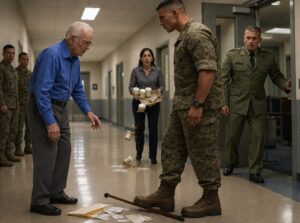
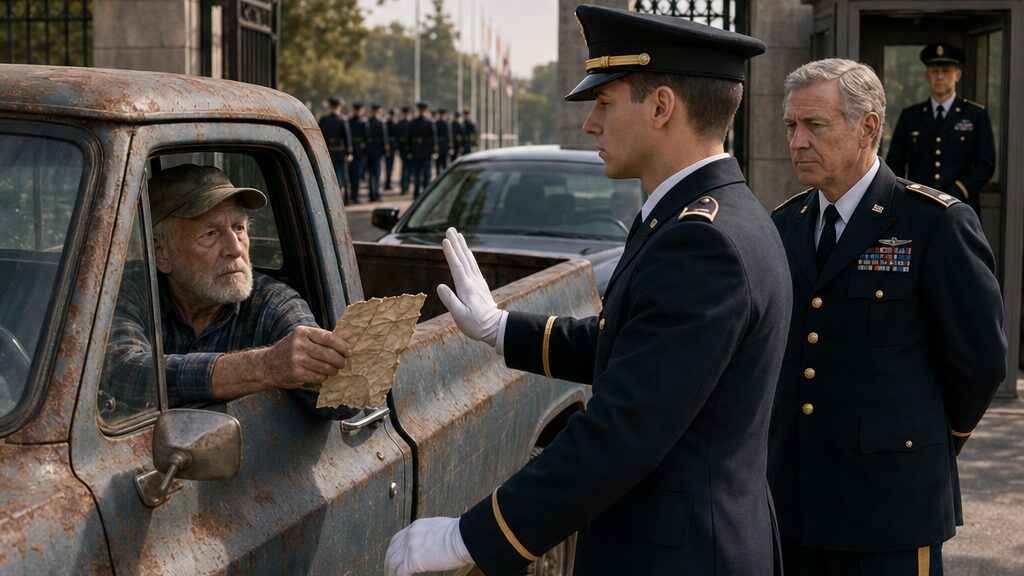
The gate guard raised his white-gloved hand before Samuel Wright’s front tire had finished crossing the painted stop line.
The old pickup answered with a tired cough, a shudder through the steering wheel, and a soft metallic clink somewhere under the hood. Samuel eased his foot off the brake, then pressed it again until the truck settled with its nose pointed at the black iron gate. Beyond the bars, flags moved in the morning wind. A line of polished black vehicles waited near the curb. Uniforms crossed the stone walkway in pairs, pressed and bright, their shoes striking the pavement with clean little sounds.
Samuel’s truck did not belong among them.
The left fender was rusted through at the edge. The hood had a gray primer patch where the original blue had surrendered years ago. The passenger door shut only if lifted from beneath. A strip of black tape held one corner of the rearview mirror steady. On the seat beside him, a paper folded into quarters lay under his right hand, soft from years of being opened and closed.
The young officer stepped closer.
“Sir, this lane is for authorized entry only.”
Samuel looked up through the open window. The officer was tall, maybe not yet thirty, with a sharp cap brim and a face trained into stillness. The name on his uniform read Allen. His gloves were clean enough to look new.
Samuel nodded once. “I’m here for the memorial.”
The officer’s eyes moved from Samuel’s face to the truck, then to the dashboard, then to the cracked windshield sticker from two years back. He did not smirk. That almost made it worse. He was polite in the way men were polite when they had already decided the answer.
“Do you have a current base pass?”
Samuel lifted the folded paper. His fingers did not open as quickly as they used to. The knuckles had thickened. The thumbnail on his left hand had a permanent ridge from a repair job that went wrong in a motor pool half a lifetime ago.
“This was sent to me,” he said.
Officer Allen did not reach for it at first. His hand stayed up, palm outward, keeping the truck and the man inside it in place. Behind him, a gate sergeant watched from the booth. Beyond the gate, an honor guard stood in formation near a temporary platform. Chairs had been arranged in neat rows facing a stone memorial covered in dark cloth.
The ceremony would begin soon.
Samuel knew because he had left before dawn to get there in time. He had driven the old county roads with the heater stuck on low and the paper tucked beneath his thigh so the wind from the window would not take it. Twice, he had pulled over because his right leg cramped. Once, at a gas station, a woman had asked whether he needed help finding his way. He had thanked her and said no.
He had found his way.
It was the gate that had stopped him.
Officer Allen glanced toward the paper. “Sir, all visitors were issued digital confirmation or a temporary credential. This doesn’t look like either.”
Samuel held it out farther. The morning air caught one corner and trembled it.
“It has the unit number.”
The young officer’s jaw tightened, not from anger, but from the strain of keeping impatience hidden. “Sir, I’ll need you to pull into the visitor turnaround. We can have someone from the office look at it.”
“If I pull in there,” Samuel said, looking toward the side lane, “will I still get inside before they read the names?”
Allen blinked. The question seemed to land in the wrong place.
“I can’t guarantee timing. I need valid identification and clearance.”
Samuel took his wallet from the ashtray. The leather had gone pale at the fold. He slid out his license and handed it over. The officer inspected it, then looked at Samuel again.
“Mr. Wright?”
“Samuel.”
“Mr. Wright, I’m not denying you entry. I’m telling you this document isn’t sufficient for this gate.”
Samuel watched the young man’s fingers hold the license carefully, because that was what the job required. Careful with plastic. Careful with badges. Careful with vehicles that had black government plates. Not yet careful with the paper.
A black sedan eased up behind the truck and stopped several yards back. Samuel saw it in the side mirror. The driver did not honk. A door opened somewhere behind him, followed by low voices. A decorated officer in dress uniform stepped onto the pavement, adjusting his cover as he looked toward the delay.
Samuel lowered his gaze to the paper in his hand. The folds had split at the corners. On the outside, where his thumb had rested for years, the paper was nearly transparent. Samantha had once offered to laminate it. He had told her no before she finished the sentence.
Some things were not meant to be sealed away.
“Sir,” Allen said, softer now but firmer, “I need you to move the vehicle.”
Samuel could feel the weight of other eyes. The gate sergeant. The driver behind him. Men in uniform turning their heads, then turning away as if not wanting to stare too openly at an old man holding up the morning.
He had been stared at worse places.
He had been ignored in worse ones.
Still, heat rose slowly from his collar to his ears.
Samuel placed the license on the dashboard when Allen handed it back. Then he lifted the paper again, this time with both hands, careful not to tear the crease.
“I won’t be long,” he said. “I only need someone to read one line.”
Allen looked past him toward the pickup bed, where an old tarp covered a toolbox and a spare tire. “Do you have any weapons in the vehicle?”
“No.”
“Any tools, blades, fuel cans, restricted items?”
Samuel almost smiled, but did not. There was a toolbox with wrenches older than Allen. A jack that slipped if a man didn’t know where to set his foot. A tire iron under the seat, because old trucks did not travel on hope alone.
“Only what keeps it running,” Samuel said.
The young officer exhaled through his nose. “Sir, I’m going to ask you one more time to pull aside.”
The words were not cruel. They were official. That was their particular sting. They had no place for the miles Samuel had driven, or the way he had lain awake the night before with the paper on the kitchen table, or the name he had practiced saying aloud after so many years of saying it only in his head.
A gust moved across the gate. The flags snapped once.
Samuel’s hand remained outside the window.
The decorated officer from the black sedan had begun walking toward them. He was older than Allen, younger than Samuel, with silver at the temples and a chest of ribbons that caught the morning light without needing to announce themselves. The gate sergeant straightened when he saw him.
“Problem?” the senior officer asked.
Allen turned quickly. “No, sir. Visitor without current clearance. I’m directing him to the turnaround.”
The senior officer’s attention shifted to Samuel. For a moment, his face held the same polite distance. Then his eyes dropped to the paper.
Samuel saw the change before anyone spoke.
It was small. A pause. A narrowing of the eyes. Not recognition, not yet, but attention—the first true attention anyone had given the paper since Samuel reached the gate.
The senior officer took one step closer.
“May I see that?” he asked.
Allen moved as if to take it, but Samuel did not release it to the young officer. He looked at the man with the ribbons.
“What’s your name?” Samuel asked.
The gate went still around the question.
The senior officer did not seem offended. He lowered his voice.
“James Campbell.”
Samuel nodded, as though checking something private. Then he held the paper toward him.
James Campbell reached for it slowly.
But before his fingers touched the worn edge, he stopped walking.
His eyes had found the faded line near the top, the one Samuel had kept from disappearing with the pressure of his own thumb for thirty-seven years.
Chapter 2: The Name No One Expected to See
Brandon Allen had been trained not to stare at civilians.
He had been trained to read hands, windows, dashboards, mirrors, nervous shoulders, mismatched plates, blocked lanes, and anything that did not fit the expected pattern. He had been trained to keep his voice even when people grew angry, confused, embarrassed, or entitled. He had been trained that hesitation at a gate could become a report, and a report could become a career wound.
So when the old man in the rusted truck held out a torn paper instead of a pass, Brandon saw the problem first.
Not the man.
Not the way he kept his elbow braced against the window frame to hide the tremor in his wrist.
Not the way he asked about the names.
A problem. A delay. A vehicle in the wrong lane fifteen minutes before guests of rank and family members were scheduled to move through the gate.
Then James Campbell stopped mid-step.
Brandon knew enough to notice when a senior officer’s face changed. It was not dramatic. James did not gasp or ask for silence. He simply stopped with one foot still slightly forward, eyes fixed on the paper between the truck window and the morning air.
“Officer Allen,” James said, “take that document carefully.”
Brandon’s first instinct was embarrassment. He had already judged it invalid. He had already said so within hearing of the gate booth and the driver behind them. But the word carefully landed with weight.
He stepped closer to the window.
The old man did not let go immediately.
Brandon saw his own white glove hover beneath the torn paper. The glove looked too bright. It made the document look worse than it was—creased, yellowed, soft at the seams, the ink partly faded. One corner had been repaired with a piece of tape that had browned and curled.
“Sir,” Brandon said, and heard that his voice had changed without permission, “I’ll hold it flat. I won’t damage it.”
The old man studied him for a beat. His eyes were pale gray, not weak, just tired from looking at things longer than most men could stand.
Then he released the paper.
It felt almost weightless in Brandon’s hands.
That surprised him. He had expected evidence, a credential, something stiff enough to prove itself. Instead, the paper sagged over his fingers like old cloth. He placed it on his clipboard and used the edges of his gloves to open it.
At first, Brandon saw fragments.
A date. A stamped field authorization. A routing code. A unit designation half-obscured by a fold. A typed line that had faded into brown. Near the lower corner, a handwritten correction in dark ink had bitten deeper into the fibers than the rest:
Wright, Samuel — convoy driver, temporary gate authority.
Below it, another name had been added, then partly crossed by a crease.
Robinson, Andrew — medic attachment.
Brandon’s mouth went dry.
He looked up at James, hoping the senior officer would explain what he had seen first.
James had moved close enough now to read over Brandon’s shoulder. His expression had gone inward, the way a man’s face changed when the present suddenly brought him a sound from another room.
“Where did you get this?” James asked.
The old man’s answer came quiet. “It was handed to me outside a burned checkpoint. I was told to keep moving until somebody official wrote it down right.”
The gate sergeant stopped pretending not to listen.
Brandon looked from the paper to Samuel Wright’s face. He had called him Mr. Wright minutes earlier because that was the polite civilian form. The name on the paper made that feel suddenly inadequate, though he did not know yet what title belonged there.
James said, “Mr. Wright, were you with the Forty-Second Supply Convoy?”
Samuel’s hand had returned to the steering wheel. The knuckles rested on worn black vinyl.
“For part of it.”
“The south evacuation route?”
“For the part that got through.”
Brandon had heard of the south evacuation route only from the ceremony brief. The memorial rededication was for a logistics and medical evacuation operation from decades ago, one of those hard histories shortened into clean paragraphs for programs and podiums. He had skimmed the packet that morning before inspection. Convoy losses. Civilian extraction. Temporary aid station. Names of personnel confirmed and pending.
Confirmed and pending. The words came back with discomfort.
James leaned slightly toward the truck window. “You were invited today?”
Samuel’s eyes moved to the paper. “That came last month.”
“You didn’t bring the new invitation?”
Samuel’s mouth tightened.
“My granddaughter printed something from an email. I left it on the kitchen table.”
Brandon almost exhaled in frustration, but caught himself before it showed. An hour ago, that would have confirmed the simple version of the morning: old man forgets proper pass, blocks gate. Now the forgotten printout seemed painfully human. A small mistake after a long drive, not proof that he did not belong.
James held out his hand. “May I?”
Brandon passed him the clipboard, careful not to let the paper slide.
James read longer than Brandon expected. The black sedan behind them remained idling. The driver had stepped out and stood beside the door, waiting. Inside the gate, an honor guard member shifted weight from one heel to the other and then corrected himself.
Finally James looked up.
“Officer Allen.”
“Yes, sir.”
“Run Samuel Wright through the visitor list and the old convoy roster attached to the event file. Use both spellings if necessary. Wright with a W, service-era records.”
“Yes, sir.”
Brandon turned toward the gate booth, then stopped. “Sir, the lane—”
“I’ll stand here.”
That settled it.
Brandon walked quickly to the booth, feeling the gaze of the gate sergeant on him. The computer screen showed the visitor system waiting for barcode input. He typed Samuel Wright.
No current pass.
He tried the event roster.
Several Wrights appeared. None with Samuel’s exact birth date.
He tried older attached records, then unit archive link. The system lagged. Outside, through the window, he could see James standing beside the truck, not looming over it, not rushing. Samuel remained seated with both hands visible. They were speaking, but Brandon could not hear the words.
The search returned a scanned roster.
Wright, S.
Temporary attached driver.
Service status: transferred; records incomplete.
Brandon felt something uncomfortable settle behind his ribs. Incomplete. That word again.
He printed the screen and carried it out.
“Sir,” he said to James, “there is a service-era entry. It does not fully match the modern guest list, but the unit and date correspond.”
James nodded once, as if he had expected both the confirmation and the flaw. “Mr. Wright, I apologize for the delay.”
Samuel gave the smallest shake of his head. “Delay isn’t the thing.”
Brandon stood by the driver-side window with the printed record in one hand and the old paper in the other. The two sheets did not look like they belonged in the same world. One bright, flat, and official. One worn nearly to pieces.
Yet the old one seemed to be the one telling the truth.
He lowered his voice.
“Mr. Wright,” he began, then stopped.
Samuel looked at him.
Brandon straightened, not parade-stiff now, but attentive. “Sir, may I ask your full name?”
The old man’s eyes held his for a moment.
“Samuel Wright.”
Brandon nodded. “Mr. Wright, we’ll get this reviewed inside.”
He did not salute. Not yet. Something about the moment warned him not to turn recognition into performance before understanding what he was recognizing.
Instead, he held the paper with both hands and gave it back as if it could bruise.
Samuel took it carefully. His thumb returned to the same thin place near the top line.
James stepped closer to the window. “Mr. Wright, the ceremony is honoring the south route. If you were part of that convoy, we need to make sure you’re seated properly.”
Samuel looked beyond the gate, toward the covered memorial and the empty chairs.
“I didn’t come to sit properly.”
James waited.
The old man touched the lower corner of the paper, where the second name bent along the crease.
“That’s not the name I came for.”
Chapter 3: The Ceremony Was Already Written Wrong
James Campbell had overseen enough military ceremonies to know that dignity often depended on small, unglamorous things.
The flags had to be raised without tangling in their lines. The microphone had to work. The order of names had to be verified twice, sometimes three times. Families had to be seated where they could hear. Wheelchairs needed clear paths. The honor guard needed shade if the ceremony ran long. No one ever remembered those details when a day went well. Everyone remembered when one went wrong.
By the time Samuel Wright’s rusted truck rolled past the gate under escort, James already knew the day had changed shape.
He walked beside the vehicle until it reached the visitor office. Brandon Allen followed a few steps behind, carrying the printed search result and looking as though he wished he could undo the first five minutes of the morning. James did not correct him. Not yet. Embarrassment could become care if a man did not defend himself against it too quickly.
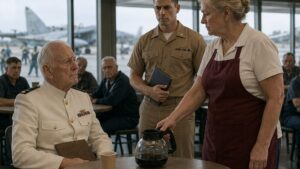
Samuel parked where directed, near a curb painted yellow. When he opened the truck door, it gave a dry metallic pop. For a moment, James thought the old man might need help climbing down. He shifted forward by instinct, then stopped himself.
Samuel placed one boot on the running board, gripped the door frame, and lowered himself slowly but without invitation. His shirt was clean, though worn pale at the elbows. The paper stayed in his left hand. He did not tuck it away. He did not wave it around. He held it the way a person held something that had outlived easier explanations.
Inside the visitor office, cool air and fluorescent light flattened the morning. A base security clerk looked up from a desk, then down at Samuel’s truck through the window, then back at James.
“Sir?”
“Temporary review,” James said. “Get us a quiet room.”
The clerk moved quickly.
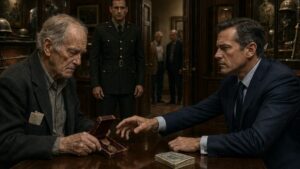
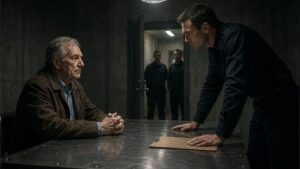
The quiet room was small, with a round table, four chairs, a wall clock, and framed photographs of previous commanders. A stack of clean ceremony programs sat near the door, bound with a rubber band. James picked one up without thinking.
On the cover was the memorial courtyard in soft focus. Beneath it, in blue letters:
Rededication Ceremony for the South Route Evacuation Memorial.
Inside were the names.
James had approved the final print the night before.
He had read the list twice. He had confirmed spellings with the archive office. He had signed off because that was what the records supported and because ceremony work did not wait for perfect history. There were always gaps. Always missing pages. Always names that came with initials instead of stories.
But now Samuel Wright sat across the table with a paper that looked older than the official record and less willing to be neat.
“Mr. Wright,” James said, “I need to understand what you’re asking.”
Samuel looked at the program in James’s hand. “Are the names in there?”
“Yes.”
“All of them?”
James did not answer quickly enough.
Samuel gave a small nod, as if the silence had told him more than the words could.
Brandon stood near the wall, hands clasped in front of him. He had removed one glove, then seemed to realize he did not know what to do with it and put it back on.
James opened the program to the list. “The ceremony recognizes confirmed personnel attached to the evacuation. There are also remarks acknowledging unverified support staff and local medical volunteers.”
Samuel’s gaze sharpened at the word unverified.
James felt it and continued more carefully. “If your concern is that your own service was not fully recorded—”
“It isn’t.”
The answer was not loud, but it cut through the room.
Brandon looked up.
Samuel unfolded the crumpled paper on the table. He pressed the corners gently with his fingertips, never forcing the creases flat.
James sat down opposite him.
The old document showed what Brandon had already seen: unit code, temporary gate authority, Samuel’s name, Andrew Robinson’s. There were stains at the center fold and a darker smudge along the bottom edge. James leaned closer.
“Andrew Robinson,” he said.
Samuel’s fingers stilled.
“Yes.”
James turned the ceremony program. He scanned the R section though he already suspected what he would find.
No Andrew Robinson.
There was an A. Robinson listed among unverified medical attachments in an internal note, but not in the public program. Not enough for a full line. Not enough for family seating. Not enough to be spoken by name from the platform.
James closed the program halfway.
“Mr. Wright, the archive did contain a Robinson initial. The issue is confirmation. We couldn’t establish full identity from the available record.”
“You had enough to print mine?”
“Your record had a matching driver entry.”
Samuel looked at him, not accusing, not pleading. That made it harder.
“I drove the truck,” Samuel said. “He kept the people in it alive.”
The wall clock clicked once.
James looked toward the door. The ceremony coordinator appeared through the glass panel, checking her watch, then disappeared again. Outside, vehicles moved through the gate in a steady procession. Families would already be arriving at the courtyard, some carrying flowers, some carrying photographs, all expecting the day to give shape to what they had been told was settled.
Nothing about the morning was settled now.
James stood. “I’ll ask the archivist to review it immediately.”
Samuel’s expression did not change. “Review before the names?”
“That may not be possible.”
“Then it’s the same as before.”
Brandon shifted. James saw him begin to speak, then stop. Good, James thought. Better to learn the weight of silence before using words to escape it.
James softened his tone. “Mr. Wright, I don’t want to make a promise I can’t keep in the next hour. We can admit you, seat you with honored guests, take a formal statement, and open a correction review after the ceremony.”
Samuel’s eyes moved to the clean program lying beside the old paper.
“After they read it wrong.”
“It may not be wrong. It may be incomplete.”
Samuel looked down at his hands.
For a moment, James saw only age there: veins, scars, a tremor trying to hide itself. Then Samuel’s right hand curled slightly, as if gripping a steering wheel that was not in the room.
“Incomplete is what people call it when they don’t have to hear the missing part,” Samuel said.
James had no immediate answer.
The door opened after a short knock. A woman in a dark blazer stepped in with a tablet under one arm and reading glasses hanging from a chain. Her hair was pinned back without softness, but her eyes went directly to the paper before they went to any rank in the room.
“Mary Roberts, records archive,” she said.
James gestured to the table. “Thank you for coming quickly.”
Mary approached, then stopped before touching anything. “May I photograph the document in place first?”
Samuel looked at James.
James said nothing.
Samuel nodded.
Mary took several photographs, then bent close without breathing on the paper. The room waited while she studied the stamp, the ink, the fold damage, the handwriting, the old unit code. Her face revealed nothing for nearly a minute.
Then she straightened.
“This may be authentic,” she said.
Brandon’s shoulders loosened slightly.
Samuel’s did not.
Mary looked at James. “But there is a problem.”
James felt the day tighten again. “What kind of problem?”
“The evacuation file we have lists a medical attachment under Robinson, A., but the surviving transfer summary places that person on a different route.”
Samuel lifted his eyes.
Mary’s voice stayed professional, but not cold. “If our copy is accurate, this paper conflicts with the archive.”
Samuel folded his hands beside the document, careful not to touch it now.
“The copy isn’t accurate,” he said.
Mary looked at him over her glasses. “That is what we would need to prove.”
Chapter 4: The Archive Drawer That Would Not Open
Mary Roberts trusted paper less when people loved it too much.
She had spent twenty-six years in rooms where families brought discharge forms, photographs, unit newsletters, newspaper clippings, folded flags, and memories that had hardened into certainty. Some were true. Some were partly true. Some were not lies at all, only grief trying to build a bridge over missing facts. Mary had learned to be gentle without surrendering the record.
The archive room sat two corridors behind the visitor office, behind a door that required two badges and an old metal key nobody had managed to replace because the lock belonged to a fire-rated file vault installed before half the base had been renovated. The air inside smelled faintly of cardboard, dust, toner, and the dry glue on aging labels.
Samuel Wright walked in last.
Brandon Allen offered to hold the door. Samuel paused long enough for the gesture to become awkward, then stepped through with a quiet nod. He had the crumpled paper inside a clear sleeve Mary had provided, though he had resisted it at first.
“It won’t seal it,” she had said. “It will only keep our hands off it.”
That had seemed to satisfy him.
Now the document lay on the long worktable beneath a low archival lamp. Its wrinkles made shadows across the faded typing. The clean copy of the ceremony program sat beside it, sharp-edged and bright, like something that had never been folded into a shirt pocket during rain.
Mary pulled up the digital index on a terminal that hummed as if annoyed to be awakened. James Campbell stood near the far end of the table, arms at his sides. Brandon waited by the door with his cap tucked under one arm, too attentive, too straight. Samuel lowered himself into a chair without asking permission, then immediately looked as though he regretted showing tiredness.
Mary noticed, filed it away, and did not comment.
“South Route Evacuation,” she said, typing. “Primary convoy file. Medical attachment supplement. Temporary clearance logs. Damaged transfer summaries.”
The screen gave her what she expected: fragments. The old operation had passed through too many hands, too many field offices, too many later reviews. Some documents had been scanned from carbon copies. Some existed only as summaries written by people who had not been there.
She opened the medical attachment supplement first.
“Robinson, A.,” she read. “Temporary medical support. Transfer route east corridor. Status unclear.”
Samuel said nothing.
Mary opened the transfer summary. “This places Robinson on the east corridor.”
“That copy does,” Samuel said.
Mary turned slightly. “You understand why that matters.”
“I understand why it stopped you.”
His tone carried no accusation. That made her more careful.
James stepped forward. “Is there any second source?”
“Possibly.” Mary moved to a row of gray file cabinets. “The digital file references a physical radio log box. It may not contain more than call signs.”
The cabinet drawer resisted when she pulled.
It moved one inch, then stopped with a hard scrape.
Brandon took a half step. “Ma’am, I can—”
“No.” Mary braced one hand on top of the cabinet and pulled again. “If you yank an archive drawer, you spend the afternoon picking history off the floor.”
The drawer gave another inch and stuck.
Samuel’s chair shifted softly behind her. She looked over her shoulder. The old man had stood. His eyes were on the lower left rail of the cabinet, not the drawer handle.
“May I?” he asked.
Mary nearly said no. Not because of pride, but because visitors did not repair archive furniture. Then she saw his hands. They had changed since the gate. Not steadier, exactly, but more purposeful.
James did not speak.
Mary stepped aside.
Samuel approached slowly, bent just enough to study the drawer track, and tapped the metal frame once with two fingers. “Left guide’s riding under the lip.”
He glanced toward Brandon. “There a flathead in that little emergency kit by the door?”
Brandon looked to Mary.
She gave a short nod.
He retrieved the kit and handed over a screwdriver. Samuel did not take the whole tool into his grip at once. He set the tip beneath the warped guide, lifted with a small controlled pressure, then used his other hand to pull the drawer by its lower edge instead of the handle.
The drawer slid open six inches.
No flourish. No smile. No little lesson.
Samuel stepped back and returned the screwdriver.
Mary found herself looking at him differently, and disliked that it had taken so little. A drawer, a paper, a unit code. People were always revealing themselves in fragments. The failure was thinking the first fragment was enough.
“Thank you,” she said.
Samuel sat down again.
Inside the drawer were narrow file boxes arranged by operation number. Mary found the South Route reference and lifted the box carefully to the table. The cardboard was soft at one corner. She opened it and removed a bundle wrapped in acid-free paper.
“Radio log fragments,” she said. “Some entries are partial. Some were water damaged before preservation.”
The room grew quiet except for the sound of paper moving.
Mary laid out the first sheet. Then the second. Then a third with blurred ink and a torn edge. She used gloved fingers and a magnifier. Call signs. Time marks. Short, clipped entries. Fuel shortage. Road blocked. Wounded transferred. Aid station compromised.
Samuel kept his hands folded.
Mary wondered whether he was reading the room or someplace else.
At 1047 hours, a line appeared:
MED ATT A.R. TO SOUTH GATE HOLD — WOUNDED LOAD 3 — DRIVER S.W. CLEAR THROUGH.
Mary stopped.
James came closer. “Read that again.”
Mary did not. She angled the sheet under the light.
The initials were there: A.R. Not Andrew Robinson. Not enough by itself. But the route was no longer east. South Gate Hold. Wounded load. Driver S.W.
Samuel’s breath changed.
Only slightly.
Mary looked at him. “This supports part of what you’re saying.”
“Part,” Samuel repeated.
“It does not give the full name.”
“No.”
“It does not prove the final action.”
“No.”
Brandon’s eyes moved between them, impatient now for the right reason. “But it proves Robinson wasn’t only on the east corridor.”
Mary turned the page slowly. “It suggests the transfer summary may have condensed or misplaced one movement. That is not the same as proving the ceremony program is wrong.”
Samuel leaned back, the chair creaking beneath him.
James rubbed one hand across his mouth. “How fast can we verify more?”
Mary did not like the answer before she gave it. “Not fast enough for the ceremony with full archival confidence.”
Brandon looked at the clock on the wall. “Families are already seated.”
Mary continued sorting. “There may be a personnel card. Or a casualty cross-reference. But if it exists, it may be boxed under medical attachments, not convoy operations.”
She went back to the cabinet. The next drawer opened cleanly. The one beneath it did not. She crouched, checked the labels, and felt dust cling to her gloves.
Samuel said, “A.R. was Andrew.”
Mary turned.
His eyes were on the radio log but not focused on it.
“He hated being called Andy,” Samuel said. “Said if a man could say penicillin, he could say Andrew.”
No one smiled. Not because it was not funny, but because the detail had entered the room too alive.
Mary lowered herself onto the chair opposite him. “Mr. Wright, did you know him before the evacuation?”
“Three days.”
“That is all?”
“That was enough.”
Mary’s skepticism did not vanish. It shifted shape. She still needed records. She still needed more than a memory, however vivid. But she had heard enough testimonies to know when someone was decorating the past and when someone was stepping carefully around it.
“Tell me only what helps the record,” she said.
Samuel looked at the paper in its sleeve. “He was attached after the first bridge washed out. Our medic had fever. Andrew climbed in with two bags and no seat. He wrote his name on this paper because the checkpoint clerk left him off. Said if he got stopped, he didn’t want to be counted as cargo.”
Mary wrote that down.
James closed his eyes briefly.
Brandon looked away.
Mary went back to the files with new attention. Not softer attention. Sharper. She checked the medical supplement again, then casualty references, then a box of temporary personnel cards so brittle they could not be removed from their sleeves. Twice she found Robinson. Once as A. Robinson. Once as Robinson, Andrew, attached field medical, transfer unknown.
Unknown.
The word stood there, better than wrong and still not enough.
Then, near the bottom of a thin folder misfiled under route security, Mary found a partial radio log on onionskin paper. The bottom had been damaged. The right edge was missing. But one line remained:
A.R. MED HOLDING SOUTH GATE FOR WOUNDED — S.W. MOVING LAST TRUCK — CONFIRM NAME LATER.
Mary held the page under the lamp.
The room seemed to draw closer around the table.
“It still doesn’t give the full surname on this line,” she said, though her voice had changed.
Samuel nodded once. “No, ma’am.”
“But the initials, role, route, and your driver initials align with your document.”
“Yes.”
Mary looked at the crumpled paper, then at the program, then at the file fragment. For the first time that morning, she touched the clean ceremony program with less confidence than the damaged sheet.
“This is enough to reopen the question,” she said.
James leaned forward. “Enough to alter today’s wording?”
Mary hesitated.
The archivist in her wanted another hour, another box, another verified chain. The human being in her looked at Samuel Wright and saw a man who had not come to be admired. He had come to stop a name from being buried again by tidy caution.
“It is enough,” she said slowly, “to state that the archive contains supporting evidence of Andrew Robinson’s attachment to the south route. It is not enough for final formal correction today.”
Samuel’s face did not fall. That somehow hurt more.
Mary looked down at the radio log again.
“But it is enough to stop pretending the record is complete.”
Chapter 5: The Granddaughter Who Wanted Him Home
Samantha Wright found her grandfather’s truck before she found him.
It sat crooked in the visitor lot, one back tire touching the yellow curb, the hood still warm under the afternoon sun. She stood beside it with both hands on her hips and stared at the rusted fender as if it had personally betrayed her.
He had promised he would not drive that far alone.
Not in those words, exactly. Samuel did not make promises that could be pinned to a wall. But when she had stood in his kitchen the night before and put the printed invitation beside his pill organizer, he had said, “I’ll think on it.” In Samuel Wright’s language, that could mean yes, no, or I have already decided and I am giving you time to catch up.
Now the printed invitation was still on his kitchen table, according to the neighbor she had called after Samuel did not answer his phone.
The phone was in the truck’s cup holder.
Dead.
Samantha closed her eyes and counted once before opening them again.
Inside the cab, on the driver’s seat, was a pale rectangular mark in the cracked vinyl, cleaner than the area around it. Something had rested there often enough to leave its absence behind. She knew what it was before she saw the clear sleeve on the visitor office table through the window.
The paper.
That old, folded, half-ruined paper he would not let her laminate, copy, frame, or throw away.
She had grown up with that paper appearing in small, strange ways. On the kitchen table on the anniversary of a date he never explained. In the top drawer beneath his service records. In the breast pocket of the suit he wore to funerals but not to church. Once, when she was eleven, she had unfolded it while he was asleep in his recliner, only to have him wake and say her name so sharply she cried before he even stood up.
He had apologized by making pancakes for dinner.
He had not explained.
Now she crossed the lot toward the visitor office with her purse banging against her side and anger carrying fear inside it like a stone.
The security clerk tried to stop her. “Ma’am, this area is—”
“I’m here for Samuel Wright.”
The clerk glanced at a screen, then at her face. “Are you family?”
“Granddaughter.”
A door opened before the clerk could answer. Brandon Allen stepped out. He had removed his white gloves. Without them, he looked younger.
“Ms. Wright?”
“Samantha.”
“Your grandfather is inside. He’s all right.”
People always said all right when they meant alive.
Samantha looked past him. “I want to see him.”
Brandon gave a small nod and led her down the corridor. He did not walk with the brisk authority she expected from the uniform. He slowed at corners, as if making room for the fact that she had been frightened.
That irritated her too, because she did not want to like anything about this place.
Samuel sat in a waiting room near a window, his hat on his knee, his hands resting over it. The clear sleeve with the paper lay on the chair beside him. James Campbell stood talking quietly with Mary Roberts near the far wall. They stopped when Samantha entered.
Samuel looked up.
For one second, he looked guilty.
That was almost enough to undo her.
“Granddad,” she said.
“Samantha.”
“You left your phone in the truck.”
“Battery’s no good.”
“The battery is fine if you charge it.”
He looked at the floor, then back at her. “Must have forgot.”
She walked to him and crouched, not caring who watched. “You drove almost three hours alone.”
“Two and a half.”
“That is not better.”
“No.”
“You left the actual invitation at home.”
“I had what I needed.”
She looked at the paper. “That?”
His hand moved to it, not touching, only checking.
Samantha stood. “This is what I was afraid of. Not the driving, not really. This. You come here with that thing, and they make you sit in rooms and prove something that hurts you.”
Samuel’s face closed slightly.
Mary Roberts looked away, giving them privacy inside a public room. James did the same. Brandon remained near the doorway, uncertain whether leaving would be worse than staying.
Samantha lowered her voice. “You don’t have to do this anymore.”
Samuel said nothing.
“You tried before. You wrote letters. You mailed copies. You called numbers that sent you to other numbers. You got nothing back except forms. Why do you have to let them do it to you again?”
His fingers tightened around the brim of his hat.
“Because they’re saying the names today.”
The anger in Samantha faltered.
Samuel looked through the window toward the memorial courtyard. From there, they could see the backs of chairs, the edge of a platform, the dark cloth still covering the stone. Families moved slowly in the distance. Some elderly, some middle-aged, some with children tugging at sleeves. The kind of gathering where grief wore good clothes and tried to behave.
Samantha sat beside him.
“They said they found something,” she said. “The officer told me.”
“Something.”
“Is it enough?”
Samuel’s mouth moved once before the words came. “Enough to make them careful. Not enough to make it easy.”
She hated how tired he sounded.
When she was little, Samuel had fixed everything. Bicycles, faucets, a broken porch step, the old station wagon, a toaster that should have been thrown out before she was born. He could listen to an engine and know whether it needed oil, belts, mercy, or a junkyard. He did not speak much, but the world around him had always seemed repairable if he had the right tool.
Now he looked like a man trying to fix paper with memory.
Samantha touched the edge of the chair between them. “Tell me what this is really about.”
He gave a faint, humorless breath. “You know.”
“I know pieces. I know the name Andrew Robinson because you say it in your sleep sometimes. I know you get quiet every year on the same week. I know you hate people calling you a hero. That’s not the same as knowing.”
Samuel’s eyes stayed on the courtyard.
Behind them, Mary and James remained silent. Samantha realized they were listening, but she no longer cared. Maybe they needed to.
Samuel said, “He was young.”
Samantha waited.
“Not like Officer Allen young. Younger in the face. Like he hadn’t had time to grow into what he was doing.” Samuel rubbed his thumb along the brim of his hat. “We were moving wounded from a field station after the road washed out. First truck got hit by mud and debris. Second overheated. Mine was last still moving.”
The waiting room seemed to lose its fluorescent hum.
“Andrew climbed in at the checkpoint,” Samuel continued. “No seat. Just stood braced between stretchers with one hand on the roof rail and one hand keeping pressure on a man’s side. Kept talking to everybody. Not loud. Just enough so they knew somebody saw them.”
Samantha swallowed.
“The gate at the south hold was jammed. Too many people, not enough road. Somebody had to stay and sort the wounded, keep the panicked from blocking the exit, keep the gate open long enough for the last truck.”
“Andrew,” she said.
Samuel nodded.
“He handed me this paper because my name and his were on it. Said if one of us got through, one of us could tell them the clerk missed his line.” Samuel’s eyes lowered. “Then he slapped the side of my truck and told me to drive.”
Samantha looked at the paper in its clear sleeve.
All the years she had seen it as the thing that kept him trapped. The thing he would not let go of. The thing that made him disappear into silence.
Now, for the first time, she saw it as something someone had handed him.
A task.
A trust.
“What happened to him?” she asked, though she knew enough to regret the question before it finished.
Samuel’s jaw worked slowly. “He died holding the gate open for others.”
No one in the room moved.
Samantha reached for her grandfather’s hand. He let her take it, but only after a second, as if he had to remember he was no longer bracing a wheel.
“I thought this paper was hurting you,” she whispered.
“It is.”
“Then why keep carrying it?”
Samuel looked at her then, and his eyes were wet but steady.
“Because it was never mine to put down.”
Chapter 6: The Man Who Was Not Asking for Himself
Samuel had spent most of his life knowing which noises meant trouble.
A belt squeal meant a man still had time if he eased off the load. A dry grind meant stop before the damage spread. A backfire could be nothing or could be the beginning of a long walk. In a convoy, silence could be worse than noise. Silence meant a truck had fallen out of line, or a radio had gone dead, or a man who had been talking to stay awake had stopped.
The side hall behind the memorial platform was full of small ceremony sounds: chairs scraping, programs shuffling, microphone feedback checked and cut short, low voices guiding families into rows. None of them sounded dangerous. Still, Samuel felt his body listening.
James Campbell stood near a side table with Mary Roberts and the ceremony coordinator. Brandon Allen waited a few steps back, holding a revised sheet he had printed from Mary’s notes. Samantha stood beside Samuel, close enough that her sleeve touched his.
The crumpled paper lay on the table, still inside the clear sleeve. Samuel had smoothed it with his palm until Mary gently told him the sleeve would hold it flat enough. Flat enough. He had heard those words all day in different forms.
Enough to enter.
Enough to review.
Enough to reopen.
Not enough to correct.
The ceremony coordinator spoke quietly but quickly. “We can add language to the remarks acknowledging newly reviewed archival material. We cannot alter the engraved display today, obviously, and the printed programs are already distributed.”
“I’m not asking about stone,” Samuel said.
The woman looked at James, then back at him. “The public reading of names follows the approved program.”
Mary held up the revised sheet. “We can responsibly add that the archive contains supporting evidence of Andrew Robinson’s attachment to the south route evacuation. I would phrase it as pending formal correction.”
Samuel looked at the paper.
Pending was a waiting room word. A word for drawers and stamps and people who had time.
James stepped closer. “Mr. Wright, I need you to hear me clearly. I believe you. Mary believes the record is incomplete. But I cannot present a final correction as if the full process has already happened.”
Samuel nodded. “I heard you.”
“What I can do,” James said, “is acknowledge the evidence today, seat you with the honored guests, and personally authorize a formal review. Your statement will be included. The document will be preserved. This will not disappear again.”
The offer was decent. Samuel knew it. He had lived long enough to recognize when a man was trying to do right inside a machine that did not move at the speed of conscience.
That made refusing harder.
Samantha’s hand brushed his elbow. Not pulling, just there.
James lowered his voice further. “You have done enough for today.”
Samuel almost smiled at that.
Enough.
He had been told that before.
Enough loads, Wright. Road’s gone.
Enough wounded, no room.
Enough risk, move out.
Enough remembering, let the dead rest.
His right hand drifted toward the paper. He did not remove it from the sleeve. He traced the air above the lower corner where Andrew’s name bent along the crease.
“I’m not asking you to call him what the file hasn’t proved,” Samuel said. “I’m asking you not to leave him where the file lost him.”
Mary looked down.
James did not answer.
The ceremony sounds outside grew clearer as someone opened the courtyard door. A flag rope tapped lightly against a pole in the wind. From where Samuel stood, he could see the edge of the memorial stone beneath the dark cloth.
For a moment, the hall was gone.
He was back behind the wheel with mud along the windshield and dust in his teeth. The truck bed rattled under the weight of stretchers. Someone was crying for water. Someone else was praying in a voice that kept breaking. Andrew Robinson stood braced in the back, one boot against the wheel well, one hand red around a bandage, his face pale but alert.
At the south hold, the gate had not been a gate like this one. It had been two metal barriers jammed between concrete blocks, half-open, crowded by men and civilians and vehicles trying to become a road. Samuel had leaned on the horn until Andrew shouted at him to stop wasting battery. Then Andrew had jumped down, medical bag swinging from his shoulder.
“You keep rolling when I tell you,” Andrew had said.
Samuel had shouted back that they were both getting through.
Andrew had grinned as if Samuel had said something foolish but kind. “Driver, if I wanted a vote, I’d ask somebody with better brakes.”
Then he had taken the paper from the checkpoint clerk, seen the missing line, and written his own name hard enough to nearly tear it.
Robinson, Andrew — medic attachment.
He slapped the paper into Samuel’s hand.
“Tell them neat later.”
Samuel had kept it in his shirt pocket while Andrew turned back into the crowd.
Tell them neat later.
Thirty-seven years had passed, and later had arrived with a clean program that still did not know how to say his name.
Samuel returned to the hall with his palm resting on the table.
“I drove out because he told me to,” he said. “I kept driving because there were men in the back who needed more road than I wanted to give them. I did that part. I made peace with that part as much as a man can.”
His voice stayed low. No one interrupted.
“But I told him I’d tell them. I did tell them. Field desk. Aid station. Debrief. Letter. Another letter. Copy of this. Then years went by, and the story got cleaner without him in it.”
James’s face tightened.
Samuel looked at the senior officer, not as a man begging, but as one tired man measuring another.
“If you read the program as printed, you don’t just leave him pending. You teach everybody sitting out there that the clean copy is the true one.”
Mary closed her folder.
James looked toward the courtyard door. “If we alter the spoken remarks, even carefully, there may be questions from families.”
“Good,” Samuel said.
The word surprised them.
He had not meant it sharply, but it stood sharp anyway.
“Let them ask,” he said. “Let somebody answer while there are still people alive who remember more than a summary.”
Samantha looked at him, and he felt the worry in her silence. He knew what she saw: his color not good, his breathing held too tight, his hands less steady than he wanted. She had come to take him home. Part of him wished she would.
James turned to Mary. “What exact wording can you stand behind?”
Mary did not hesitate this time. “The archive contains newly reviewed supporting evidence that Army medic Andrew Robinson was attached to the south route evacuation and was present at the south gate hold with Samuel Wright’s final convoy movement. Formal correction remains under review.”
Samuel closed his eyes.
Andrew Robinson.
Not A. Robinson. Not unverified support. Not a blurred initial left outside the sentence.
James repeated it quietly, testing each word.
The ceremony coordinator looked unsettled. “Sir, this will change timing.”
“By less than a minute,” James said.
“It may change the tone.”
James looked at Samuel. “It should.”
Brandon Allen stepped forward before anyone asked him to.
“Sir?”
James turned.
Brandon held the revised sheet in both hands. He was no longer wearing the white gloves. His fingers were bare, and the paper trembled just enough for Samuel to notice.
“I was assigned gate detail, not ceremony,” Brandon said. “But if there needs to be a correction read clearly, I’d like permission to do it.”
The hall went still.
Samuel looked at him.
Brandon did not rush to fill the silence. Good, Samuel thought. The young man was learning.
James studied the officer. “Why?”
Brandon swallowed. “Because I was the first one today who treated the paper like it was in the way.”
Samuel’s throat tightened unexpectedly.
Brandon faced him, not James. “Mr. Wright, I can’t fix that part. But if you allow it, I can make sure I don’t read his name like it’s a footnote.”
Samantha’s hand found Samuel’s sleeve.
Mary looked at the table.
James waited.
Samuel stared at the revised sheet in Brandon’s hands. For years, he had imagined someone in an office writing back. Someone stamping approved. Someone mailing a corrected page in a government envelope. He had not imagined a young gate officer, embarrassed and steady, asking permission to speak Andrew’s name in front of people who had come to hear history made clean.
It was not enough.
It was something.
Samuel picked up the clear sleeve with the crumpled paper inside. He held it for a moment, feeling the old folds through the plastic.
Then he looked at Brandon.
“Read it slow,” he said. “He hated being rushed.”
Chapter 7: The Correct Name at the Quiet Memorial
The memorial courtyard had been built to make silence feel orderly.
Stone paths crossed the grass in straight lines. Rows of folding chairs faced the covered monument. Flags stood along the rear wall, their edges snapping in the afternoon wind. On the platform, the microphone waited beside a lectern polished so brightly that the sky showed in it.
Samuel stood in the side shade and looked at the chairs.
Families filled most of them now. Older women with programs folded in their laps. Men in jackets despite the heat. A young child swinging his shoes until a hand settled gently on his knee. Veterans wearing caps with pins along the brim. People who had carried names for years, some in photographs, some in stories, some in silence.
Samantha stood beside Samuel, close but not holding him. She had learned something in the hallway. He could feel it in the way she gave him room.
James Campbell moved onto the platform first.
The crowd quieted by degrees. Paper stopped rustling. A cough was swallowed. The honor guard came to attention, and the sound of boots on stone moved across the courtyard with a precision that made Samuel’s chest tighten.
He did not sit in the front row.
James had offered. So had the ceremony coordinator, twice, each time more careful than the last. Samuel had looked at the reserved seats and then at the side row near the walkway.
“Back there,” he had said.
James had not argued.
So Samuel sat near the aisle, where he could see the platform and the memorial stone without being displayed beneath it. Samantha sat to his left. Mary Roberts sat two rows behind with a folder in her lap. Brandon Allen stood near the platform steps, holding a single revised page.
The crumpled paper was not with Samuel.
That was the strangest part.
For the first time in years, it lay somewhere else and had not been lost.
Mary had placed it, still inside the clear sleeve, on a small side table beside the clean ceremony program and the revised note. Not under the program. Not tucked into a folder. Beside it. The old paper looked fragile there, but not ashamed.
James began with the words expected of the day: welcome, gratitude, remembrance, service. He did not overdo them. His voice was measured, trained for courtyards and wind. Samuel listened without leaning forward. He had heard many official words. Some were necessary. Some floated above the ground and never touched what they named.
Then James paused.
Samuel saw the pause move through the crowd before anyone understood it. Heads lifted. Programs lowered. The ceremony coordinator stood very still near the rear of the platform.
“Before we proceed with the reading,” James said, “this command has received and reviewed additional archival material related to the south route evacuation.”
Samantha’s hand found the edge of her chair.
Samuel kept his eyes on the covered stone.
James continued. “The formal correction process will continue beyond today, as it should. Records require care. Names require care. But care also means acknowledging when the record before us is incomplete.”
A breeze crossed the courtyard. One of the programs in the front row fluttered against someone’s knee.
James looked toward Brandon.
“Officer Allen will read a supplemental acknowledgment based on archival material reviewed this afternoon.”
Brandon stepped up to the lectern.
He had put his gloves back on, but when he reached the microphone, he removed them and laid them flat beside the page. Samuel watched that small act more closely than anything else. Bare hands. Steady now.
Brandon adjusted the microphone lower, then looked once toward Samuel.
Not for permission. Samuel had already given that.
For responsibility.
Samuel nodded once.
Brandon looked down at the revised page.
“This afternoon,” he began, and his voice caught on the first word.
He stopped.
No one in the crowd shifted impatiently. Maybe they sensed what he did: that this was not an ordinary insertion into an ordinary ceremony.
Brandon took a breath and began again.
“This afternoon, supporting archival evidence was reviewed indicating that Army medic Andrew Robinson was attached to the south route evacuation and was present at the south gate hold with Samuel Wright’s final convoy movement.”
Samuel closed his fingers around his hat brim.
Andrew Robinson.
Not A. Robinson.
Not medical attachment.
Not unknown.
Andrew Robinson.
Brandon read slowly, exactly as Samuel had asked. “The formal record remains under review. Today, we acknowledge that the story of the south route was not fully held by the printed program in your hands.”
A murmur moved lightly through the chairs, not loud enough to break the ceremony, but enough to prove people were alive inside the words.
Brandon did not look away from the page.
“We honor those whose names have long been spoken, and we recognize the duty to listen for those whose names were nearly lost.”
Samuel heard Samantha take in a breath beside him.
Brandon lifted his eyes. He did not search the crowd for approval. He looked toward the old paper on the side table, then back at the page.
“Andrew Robinson,” he said again, slower, “Army medic attached to the south route evacuation, present at the south gate hold.”
The second time, the name did not sound like discovery.
It sounded like placement.
James stood behind him, expression held, but Samuel saw the senior officer’s hand close once at his side. Mary Roberts had lowered her eyes to her folder. In the front rows, an older man removed his cap. A woman pressed a program to her chest.
No one clapped.
Samuel was grateful for that.
Applause would have made the moment belong to the living too quickly.
Brandon stepped back from the lectern. He gathered the revised page, but left the gloves where they were until he remembered them. Then he picked them up carefully, almost embarrassed by their whiteness.
The ceremony continued.
Names were read. Some full, some with ranks, some with units. The memorial cloth was removed, revealing engraved lines Samuel could not read from his seat. A wreath was placed. The honor guard moved with solemn precision. The flag shifted and cracked once in the wind like distant canvas snapping loose from a truck bed.
Samuel heard all of it from a place inside himself that had gone strangely quiet.
For years, Andrew’s name had lived in him with weight. It had lived in drawers, in the worn crease of the paper, in the days Samuel could not answer Samantha’s questions, in letters mailed to offices that replied with references and case numbers. The name had not become lighter when Brandon spoke it. It did not float away. But it changed shape.
It no longer had to fit only inside Samuel’s chest.
When the ceremony ended, people did not rush him. Perhaps James had instructed them. Perhaps the day itself had taught restraint. A few families passed with careful glances, knowing he mattered but not knowing how to approach without making him an exhibit.
One elderly man stopped at the aisle.
“I didn’t know,” he said.
Samuel looked up.
The man held his program loosely. “About the medic.”
Samuel nodded. “Most didn’t.”
The man seemed to want to say more, then thought better of it. He placed his cap back on his head and moved on.
That was enough.
Mary Roberts came next. She held a folder against her side.
“I will begin the formal correction file before I leave today,” she said.
Samuel looked at her, measuring not the words but the person behind them.