The Old Man Sitting Alone Behind The Stadium Railing Was The General Who Saved The Academy Everyone Came To Celebrate
Chapter 1: The Invitation Nobody Wanted To Read
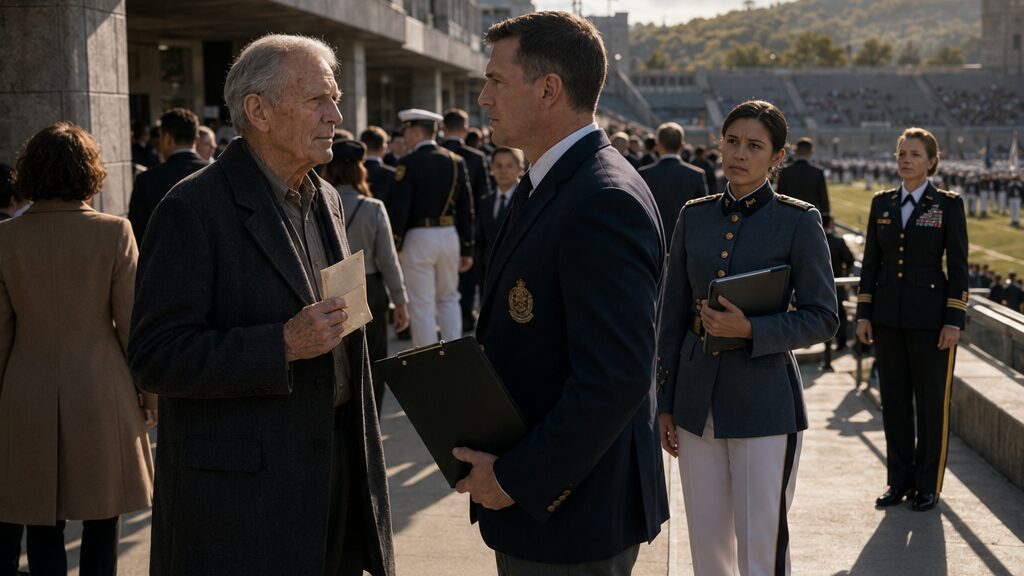
The security guard stepped in front of Jeffrey Harris before he reached the gate.
“Sir, this entrance is for invited guests.”
Jeffrey stopped without surprise. At seventy-eight, he had learned that most people looked at the coat before they looked at the man.
The coat was old. Brown wool, slightly faded at the cuffs. The kind of coat people kept because it still worked.
Around him, graduates in crisp uniforms streamed toward the stadium. Families carried flowers. Alumni wore academy pins and expensive jackets.
Nobody looked twice at Jeffrey except the guard blocking his path.
“I am invited,” Jeffrey said.
The guard offered a polite smile that carried no belief.
“Of course, sir. Do you have something showing that?”
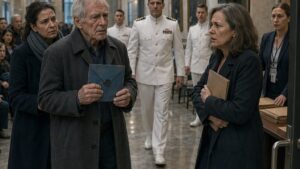
Jeffrey reached into his coat pocket and unfolded a cream-colored envelope that had softened from years of careful handling.
The invitation inside looked older than everything around it.
The guard examined it.
His expression changed.
Not to respect.
To confusion.
“Where did you get this?”
“It came in the mail.”
The guard turned the card over.
There was no QR code.
No event barcode.
No modern security markings.
Just a formal academy seal pressed into the paper.
An old seal.
The guard frowned.
“I need to call someone.”
Jeffrey nodded.
“I have time.”
The guard stepped aside and spoke quietly into a radio.
Jeffrey stood waiting while graduates and guests passed around him.
Some glanced at him.
Most did not.
The stadium beyond the gate rose into the bright morning sky. Flags moved lazily above the stands.
He had not attended an academy ceremony in nearly twenty years.
For a moment he wondered whether coming had been a mistake.
Then he touched the edge of the invitation.
Not because it mattered.
Because of who had wanted him to come.
A memory surfaced.
Laura sitting at a kitchen table years earlier.
Promise me one thing, Jeffrey.
What?
When they celebrate one hundred years, go back.
I doubt they’ll remember me.
Then go anyway.
The memory faded.
The guard returned with another man.
Younger.
Well dressed.
Expensive suit.
Official badge.
The kind of person who moved quickly because he believed important things depended on him.
“Mr. Joshua Taylor,” the guard said.
Joshua took the invitation.
His eyes narrowed.
“What exactly is this?”
“An invitation.”
Joshua did not smile.
“This isn’t a valid credential.”
Jeffrey looked at him.
“It arrived from the academy.”
“Maybe decades ago.”
“It arrived three weeks ago.”
Joshua checked the paper again.
Guests continued entering.
Behind them, staff hurried through preparations.
Joshua clearly had no time for problems.
Jeffrey had become one.
“Sir,” Joshua said carefully, “today we’re handling thousands of attendees. If you’re here for the public seating area, that’s on the north side.”
“I was told to use this entrance.”
“By whom?”
“The invitation doesn’t say.”
Joshua sighed.
The answer seemed to irritate him more than an argument would have.
“Do you know how many people show up to these events believing they have special access?”
“I imagine quite a few.”
“Then you understand.”
“No.”
Joshua blinked.
Jeffrey continued calmly.
“I don’t understand refusing to read the invitation.”
The guard shifted awkwardly.
Joshua unfolded the card again.
His eyes moved across the old academy seal.
For a brief second uncertainty appeared.
Then vanished.
“I’ve never seen this version.”
“Neither have I.”
“Then how do you know it’s real?”
Jeffrey met his gaze.
“You can check the name again.”
Joshua looked at the card.
Then at Jeffrey.
Then back at the card.
For reasons he could not explain, the old man’s confidence irritated him.
Not arrogance.
Something worse.
The certainty of someone who did not need approval.
Joshua checked the guest database on his tablet.
Nothing appeared immediately.
Guests were beginning to line up behind Jeffrey.
The delay itself was becoming embarrassing.
Joshua felt pressure building.
Donors.
Board members.
Military guests.
Media crews.
Everything needed to run perfectly.
The last thing he needed was an unidentified elderly man creating confusion at the front entrance.
Finally he made a decision.
“Fine.”
The guard looked surprised.
Joshua continued.
“You can enter. Public seating only.”
Jeffrey accepted the invitation back.
“Thank you.”
Joshua pointed toward the upper sections.
“Stay behind the marked areas.”
Jeffrey simply nodded.
That somehow made Joshua more uncomfortable than if the old man had argued.
As Jeffrey walked through the gate, Joshua turned away.
Problem solved.
At least he believed it was.
Jeffrey climbed the long concrete steps toward the upper seating.
The stadium opened before him.
Thousands of seats.
Military bands warming up.
Rows of graduating cadets.
The sight pulled old memories from places he rarely visited.
Young faces.
Impossible confidence.
Fear disguised as certainty.
He had once sat where those cadets sat now.
Long before most of them had been born.
He moved toward the highest section and paused near a railing overlooking the field.
Not the best seat.
Not even a comfortable one.
But it gave him distance.
Distance had become a habit.
As he settled into the seat, he noticed a young woman several rows away watching him.
Cadet uniform.
Academy historian patch on her sleeve.
A notebook balanced on her knee.
Amy Lopez.
Though Jeffrey did not know her name.
She had seen the invitation.
Seen Joshua’s reaction.
Seen the seal.
Something about it bothered her.
She had spent two years studying academy archives.
That seal belonged to another era.
An era almost nobody discussed anymore.
Amy waited until Jeffrey looked away.
Then she opened her phone and searched archived academy insignia.
One image appeared.
Old.
Rare.
Retired more than thirty years earlier.
Her eyes widened.
The seal matched.
Exactly.
She looked back toward the elderly man.
Jeffrey sat quietly behind the railing, watching cadets assemble below.
Nothing about him seemed important.
Nothing except that invitation.
Amy zoomed in on the archive image.
A note appeared beneath it.
Used during emergency restructuring period.
Authorized by special board directive.
Access restricted.
Amy stared at the words.
Then looked back at Jeffrey.
For the first time that morning, a question took hold and refused to leave.
Who was the old man nobody seemed to recognize?
Chapter 2: The Man Behind The Railing
The seat beside Jeffrey remained empty.
So did the five seats around it.
Thousands of people filled the stadium, yet somehow he sat alone.
He preferred it that way.
Below, cadets arranged themselves into perfect rows.
Parents searched for familiar faces.
Alumni exchanged stories that grew more impressive with each telling.
Jeffrey rested both hands on the railing.
The metal felt cool beneath his fingers.
He remembered leaning against this same section decades earlier when it had looked very different.
Smaller.
Less polished.
Less certain of its future.
A group of graduates nearby complained about assignments.
One mentioned a training facility built on the west side of campus.
Jeffrey smiled faintly.
That facility had almost never existed.
Nobody around him knew that.
The academy had many stories.
Most had lost their names.
A voice interrupted his thoughts.
“Excuse me, sir.”
Amy Lopez stood in the aisle.
Notebook in hand.
Curiosity in her eyes.
Jeffrey had seen that expression before.
Historians wore it the way soldiers wore uniforms.
“Yes?”
“Would you mind if I asked a question?”
“One question?”
She smiled.
“Maybe two.”
“That’s usually how it starts.”
Amy sat several seats away.
Not close enough to be rude.
Close enough to talk.
She glanced toward the invitation tucked inside his coat pocket.
“Where did you get that seal?”
Jeffrey looked toward the field.
“From an invitation.”
“I mean the seal itself.”
“I know what you meant.”
Amy waited.
Jeffrey remained silent.
She tried another approach.
“Most people have never seen it.”
“Most people shouldn’t need to.”
That answer only made her more interested.
“Were you stationed here?”
“Years ago.”
“Faculty?”
“No.”
“Administration?”
“No.”
Amy frowned.
“You know a lot about the academy.”
“It’s possible.”
The corners of Jeffrey’s mouth twitched.
Not quite a smile.
Amy realized he was gently refusing every direct path.
Yet he did not seem annoyed.
Only careful.
The opening music began below.
Conversation throughout the stadium softened.
Amy stood.
“Thank you.”
“I didn’t answer anything.”
“You answered enough.”
She walked away.
Jeffrey watched her disappear into the crowd.
Then returned his attention to the ceremony.
A few sections below, Amy entered a restricted hallway beneath the stands.
She knew exactly where she was going.
The academy archive office.
Officially closed during graduation events.
Unofficially accessible if one knew which clerk skipped lunch at the same time every year.
Amy slipped inside.
Rows of cabinets lined the room.
Photographs.
Yearbooks.
Administrative records.
Institutional memory stacked in gray metal drawers.
She searched the academy seal database first.
The old insignia appeared again.
Emergency Restructuring Period.
1987–1991.
Authorization level restricted.
Amy opened another file.
The screen displayed partial board records.
Many names.
Several redacted.
One caught her attention.
Harris.
No first name.
Just Harris.
Her pulse quickened.
She opened linked material.
Access denied.
Archive restriction.
“Come on,” she muttered.
She searched broader records.
Photographs appeared.
Old ceremonies.
Groundbreakings.
Leadership visits.
One image stopped her.
A black-and-white photograph from decades earlier.
Several officers standing beside academy officials.
The image quality was poor.
Faces partly obscured.
Yet one figure looked strangely familiar.
Older now.
Much older.
But familiar.
Amy enlarged the picture.
The resemblance was undeniable.
The jawline.
The eyes.
The posture.
The man behind the railing.
Her excitement grew.
Then abruptly stopped.
The image caption was damaged.
The central portion had been removed.
The name was missing.
Only fragments remained.
“…Harris”
Nothing else.
“Why would someone erase that?”
she whispered.
A voice behind her answered.
“Sometimes records disappear because people want credit.”
Amy turned.
An elderly alumnus stood in the doorway.
Silver hair.
Sharp posture.
Retired Colonel Timothy Johnson.
One of the academy’s most respected graduates.
“You’re not supposed to be in here,” he said.
Amy laughed nervously.
“Neither are you.”
“Fair enough.”
His gaze moved to the screen.
Then froze.
The photograph.
The partially erased name.
Something changed in his expression.
Not recognition.
Memory.
The kind that arrives all at once.
“Where did you find this?”
Amy pointed.
“Archive file.”
Timothy stepped closer.
His eyes narrowed.
“Interesting.”
“You know him?”
Timothy did not answer immediately.
Instead he studied the photograph.
Then the damaged caption.
Then Amy.
“What made you search this?”
“The old man in the stadium.”
Timothy looked up sharply.
“What old man?”
“The one sitting alone behind the upper railing.”
For the first time, genuine alarm crossed Timothy’s face.
He moved toward the door.
“Show me.”
Back in the stadium, Jeffrey sat exactly where he had been.
Still behind the railing.
Still alone.
The ceremony preparations continued below.
Then a movement near the field caught his eye.
A woman in formal command uniform had stepped onto the main stage.
Commandant Sarah Adams.
The academy’s highest-ranking officer.
The crowd applauded as she approached the podium.
Jeffrey watched politely.
Nothing more.
Or so it seemed.
Far below, Sarah unfolded her speech.
She glanced across the stadium.
Then stopped speaking before she had even begun.
Her eyes locked onto a solitary figure sitting behind the railing.
A figure she had not expected to see.
Not today.
Not ever again.
For one brief second, the entire ceremony vanished from her mind.
Only one question remained.
Why was General Jeffrey Harris sitting alone in the highest section of the stadium?
Chapter 3: The Commandant Leaves The Stage
The microphone waited.
Thousands of people watched.
Sarah Adams forgot every prepared word.
Across the stadium, beyond the rows of cadets and guests, an old man sat quietly behind a railing.
Most people would have seen only that.
An old man.
A worn coat.
An ordinary spectator.
Sarah saw something else.
She saw the reason she had attended this academy at all.
The reason half the campus existed.
The reason a scholarship fund carried no public name.
For a moment she wondered if she was mistaken.
Then Jeffrey shifted slightly.
The movement erased all doubt.
Her pulse quickened.
The audience waited for her opening remarks.
Instead, she stared.
An aide near the podium whispered, “Ma’am?”
Sarah blinked.
The ceremony returned.
The stadium returned.
The microphone returned.
She began speaking.
But not well.
Not by her standards.
Her thoughts remained fixed on the man behind the railing.
Three years earlier she had spent months researching forgotten academy history.
One name kept appearing.
Sometimes in records.
Sometimes only in footnotes.
Sometimes hidden entirely.
Jeffrey Harris.
The man who never attended reunions.
The man who declined awards.
The man who refused to allow buildings to be named after him.
The man many younger officers assumed was dead.
Yet there he was.
Watching quietly from the least important seat in the stadium.
Sarah finished the first section of her remarks.
Applause followed.
The program called for introductions.
Then ceremonial recognition.
Then graduation honors.
Instead she handed the microphone to another officer.
“Continue with section two.”
The officer looked startled.
“Ma’am?”
“Continue.”
She stepped away from the stage.
Confusion spread among event staff.
Joshua Taylor noticed immediately.
Nothing about this morning had gone according to plan.
First the invitation problem.
Now the commandant abandoning the ceremony schedule.
He hurried toward the field.
“Where is she going?”
Nobody knew.
Sarah moved across the stadium floor.
Past faculty.
Past cadets.
Past distinguished guests.
People stepped aside automatically.
Her dress uniform caught sunlight as she crossed the open space.
Conversations began to fade.
Heads turned.
The movement itself created curiosity.
Someone important was being approached.
The question was who.
Up in the stands, Jeffrey noticed her coming.
He sighed softly.
Not irritation.
Resignation.
“Good morning, General.”
Sarah stopped beside him.
Jeffrey looked up.
“Commandant.”
Neither moved for a moment.
The contrast drew attention from nearby spectators.
A decorated academy leader standing beside a man everyone else had ignored.
Sarah smiled first.
“You could have told someone you were coming.”
“I considered it.”
“And?”
“I preferred peace.”
“That explains the seat.”
Jeffrey glanced at the railing.
“It has a good view.”
Sarah laughed quietly.
Then her expression softened.
“I didn’t think you’d come.”
“Neither did I.”
The answer carried more weight than the words themselves.
Sarah understood.
She knew about Laura.
At least part of the story.
She sat beside him.
Ignoring protocol.
Ignoring the schedule unraveling below.
For several seconds neither spoke.
The ceremony continued in the background.
Music.
Announcements.
Applause.
All distant.
“You received the invitation?” Sarah asked.
Jeffrey nodded.
“You sent it.”
“I wasn’t sure it would reach you.”
“It did.”
“And yet you never responded.”
“I almost didn’t attend.”
Sarah looked toward the field.
“You should be down there.”
“No.”
“Jeffrey.”
“No.”
The firmness surprised her.
Not anger.
Pain.
A different thing entirely.
The silence that followed told her more than any explanation.
“You still blame yourself,” she said quietly.
Jeffrey’s eyes remained on the ceremony.
Neither confirming nor denying.
Sarah knew enough.
Old decisions.
Old casualties.
Old burdens.
Some people retired from service.
Others carried it forever.
A sudden voice interrupted them.
“Commandant?”
Joshua stood several rows below.
Breathing hard from climbing the stairs.
His confusion was obvious.
“Ma’am, we’re ready for the next presentation.”
Then he noticed who she was speaking to.
The old man.
The invitation problem.
Sarah’s expression changed instantly.
“Mr. Taylor.”
Joshua straightened.
“Yes, ma’am.”
“Did you speak with General Harris at the entrance?”
The color left his face.
Not because of the title.
Because of the respect attached to it.
General.
The word landed heavily.
Joshua looked at Jeffrey.
Then back at Sarah.
“General?”
Jeffrey said nothing.
Sarah studied Joshua carefully.
“Tell me exactly what happened.”
Joshua suddenly wished the conversation were happening anywhere else.
Below them, the ceremony continued.
Around them, curious spectators began listening.
And for the first time that morning, Joshua realized the old man he had dismissed might not be who he thought he was at all.
Chapter 4: The Academy Nearly Lost Everything
The archive file was locked.
Amy stared at the message on the screen while Timothy Johnson stood beside her.
ACCESS RESTRICTED.
BOARD AUTHORIZATION REQUIRED.
The retired colonel folded his arms.
“That file wasn’t restricted the last time I looked at it.”
“You’ve seen it before?” Amy asked.
“A long time ago.”
He kept looking at the damaged photograph.
The image seemed to bother him.
Not because it existed.
Because parts of it no longer did.
Someone had removed information.
Deliberately.
“Who would restrict academy history?” Amy asked.
Timothy let out a slow breath.
“Usually people who think they’re protecting something.”
“Or hiding something.”
“Sometimes those are the same thing.”
Amy turned toward him.
“You know who he is.”
“I know who I think he is.”
“That sounds like a yes.”
Timothy almost smiled.
“Historians are dangerous.”
Amy closed the archive window and opened another search.
“Jeffrey Harris.”
Hundreds of unrelated results appeared.
Retired officers.
Graduates.
Donors.
Faculty.
Nothing definitive.
Timothy watched quietly.
“Search restructuring records.”
Amy frowned.
“The academy restructuring?”
“Try it.”
She typed the phrase.
A handful of documents appeared.
Most were financial summaries from nearly forty years earlier.
One headline immediately caught her attention.
ACADEMY FACING POSSIBLE CLOSURE.
She blinked.
“That can’t be right.”
Timothy nodded.
“It can.”
Amy opened the article.
The academy she knew—expanding, celebrated, heavily funded—looked very different in the old reports.
Budget cuts.
Federal uncertainty.
Board disagreements.
Cancelled projects.
Enrollment concerns.
For nearly three years, closure had been considered a real possibility.
Amy sat back.
“Nobody talks about this.”
“No.”
“Why?”
“Because institutions prefer survival stories to near-death stories.”
Amy continued reading.
Then stopped.
A sentence near the bottom stood out.
Emergency restructuring task force appointed under military leadership.
The names had been redacted.
Every one except the chairman of the board.
“Who led it?” Amy asked.
Timothy’s eyes moved toward the screen.
“That’s the question.”
Amy opened another file.
Then another.
The pattern repeated.
Missing names.
Restricted pages.
Damaged captions.
References that pointed toward someone but never fully identified them.
It was like following footprints that vanished every few hundred feet.
“Someone erased him,” she said.
Timothy looked toward the stadium ceiling.
“No.”
“Then what?”
“Someone allowed him to disappear.”
The distinction mattered.
Amy could hear it in his voice.
Outside, applause rolled through the stadium.
The ceremony continued.
The academy celebrated itself while a large part of its own history sat hidden in forgotten files.
Timothy reached into a cabinet and removed a thin binder.
Dust rose from its cover.
“Try this.”
Amy opened it.
Inside were planning maps.
Construction proposals.
Budget recovery plans.
One page carried handwritten notes.
The handwriting was sharp and disciplined.
At the bottom sat initials.
J.H.
Amy stared.
“Jeffrey Harris?”
“Possibly.”
“Possibly?”
Timothy smiled faintly.
“You historians love certainty. Real history rarely offers it.”
Amy flipped pages rapidly.
The same initials appeared repeatedly.
Project approvals.
Cost reductions.
Expansion recommendations.
Most eventually became permanent parts of the academy.
Dormitories.
Training facilities.
Scholarship programs.
Entire sections of the modern campus traced back to these pages.
The old man behind the railing had known academy history intimately.
Now she understood why.
A knock sounded at the archive door.
A staff member stepped inside.
“Colonel Johnson?”
“Yes?”
“The commandant has been looking for you.”
Timothy nodded.
“We’ll be there shortly.”
The staff member left.
Amy closed the binder.
“Sarah knows about him too, doesn’t she?”
Timothy looked thoughtful.
“More than most.”
“How much more?”
“Enough to leave a graduation ceremony in the middle of her speech.”
Amy could not argue with that.
A few minutes later they crossed a service corridor beneath the stadium.
The sounds of the ceremony echoed through concrete walls.
As they walked, Amy noticed Timothy becoming quieter.
Not secretive.
Reflective.
“What are you remembering?” she asked.
He took several seconds before answering.
“The first time I met him.”
“Jeffrey?”
“Yes.”
“What was he like?”
Timothy laughed softly.
“Nothing like people imagined.”
“Meaning?”
“Everyone expected a man who enjoyed authority.”
“And?”
“He spent most of his time trying to avoid it.”
Amy thought of the elderly man sitting alone behind the railing.
The image fit perfectly.
They entered a small records office adjacent to the command center.
Sarah was waiting.
Her expression immediately sharpened when she saw the binder.
“Where did you find that?”
“The archives.”
Sarah took it carefully.
Like something fragile.
Amy noticed several pages marked with old classification stamps.
One document slipped partially free.
A faded heading appeared.
SPECIAL AUTHORIZATION ORDER.
Below it sat a signature.
Jeffrey Harris.
Amy’s pulse quickened.
“That’s him.”
Sarah looked at her.
“Yes.”
For the first time, nobody denied it.
A small payoff.
A small confirmation.
Yet the answer only created a larger question.
If Jeffrey Harris had signed academy rescue orders decades ago, why was he sitting alone in the stands while everyone celebrated the institution he had helped preserve?
Sarah opened another page.
Her expression changed.
Timothy noticed immediately.
“What is it?”
Sarah handed him the document.
The retired colonel read silently.
Then looked up.
Slowly.
“No.”
Sarah nodded.
“I’d forgotten about this.”
Amy stepped closer.
“What?”
Neither answered.
Timothy finally spoke.
“This wasn’t just about saving the academy.”
Amy waited.
Timothy stared at the signature again.
“There was a cost.”
“What cost?”
Sarah closed the binder.
“The answer isn’t here.”
Amy’s frustration showed.
“Then where is it?”
Sarah looked toward the stadium.
Toward the distant crowd.
Toward the old man who had spent years refusing recognition.
“In a classified order that should never have been connected to this academy.”
The room fell silent.
For the first time, Amy realized the academy’s survival story might only be half the truth.
And somewhere inside a classified record was the reason Jeffrey Harris had spent decades trying to disappear.
Chapter 5: The Cost Of Saving A Command
“You should have told them.”
Timothy’s voice carried across the conference room before Jeffrey even sat down.
The retired general closed the door behind him.
Outside, the ceremony continued.
Inside, only three people occupied the room.
Jeffrey.
Timothy.
Sarah.
The atmosphere felt less like a meeting and more like an intervention.
Jeffrey looked at his former subordinate.
“No.”
Timothy shook his head.
“You always do this.”
“Do what?”
“Carry everything alone.”
Jeffrey removed his coat and folded it over the back of a chair.
The worn invitation remained inside the pocket.
Visible.
Silent.
Timothy pointed at it.
“They nearly turned you away.”
“I got inside.”
“That isn’t the point.”
Jeffrey sat.
“It usually is.”
Sarah exchanged a glance with Timothy.
Both understood the real argument.
Not the invitation.
Not Joshua.
Not even the ceremony.
The argument was about forty years of silence.
Sarah broke it first.
“Why did you come?”
Jeffrey studied the conference table.
For a moment nobody thought he would answer.
Then he did.
“Laura asked me to.”
The room softened.
His wife had been gone six years.
Yet she remained present in certain conversations.
Certain decisions.
Certain promises.
Timothy leaned back.
“She always knew how to make you do things.”
A faint smile appeared.
“Unfortunately.”
The smile disappeared quickly.
Sarah placed a folder on the table.
“Most of the board doesn’t know the full story.”
“Good.”
“They should.”
“No.”
“They are celebrating an academy that almost vanished.”
Jeffrey said nothing.
Sarah continued.
“They deserve the truth.”
“Do they?”
The question surprised her.
Jeffrey looked older suddenly.
Not physically.
Emotionally.
As if the years he usually carried quietly had become visible.
“The academy survived,” he said. “That was the point.”
Timothy leaned forward.
“And what about the rest?”
Jeffrey’s jaw tightened.
The room became still.
A memory had entered before anyone spoke it aloud.
Timothy finally did.
“The deployment.”
Jeffrey looked away.
Sarah closed her eyes briefly.
There it was.
The thing that never left.
The thing hidden beneath every refusal.
Every absence.
Every declined invitation.
Every vanished year.
Jeffrey stood and walked toward the window.
Far below, cadets crossed the field.
Young.
Confident.
Unaware.
“Saving the academy wasn’t difficult,” he said quietly.
Neither Sarah nor Timothy interrupted.
“The academy had numbers. Budgets. Plans. Committees.”
His reflection stared back at him from the glass.
“The deployment had names.”
The silence deepened.
Timothy lowered his eyes.
He remembered.
Not details.
Not classified information.
Just consequences.
Families.
Funerals.
Letters.
Jeffrey remained at the window.
“I made a decision.”
“You made the best decision available,” Timothy said.
“I made a decision.”
The distinction mattered.
Sarah finally understood something she had never fully grasped.
The academy was not the reason Jeffrey disappeared.
The academy was the reminder.
Every recognition ceremony.
Every honor.
Every speech.
All of it existed beside memories he could never separate from command.
Saving institutions felt undeserved when people had been lost under his leadership.
Not because he was guilty.
Because he was human.
A knock interrupted the room.
An assistant entered carrying documents.
“Commandant.”
Sarah accepted them.
The assistant left.
She opened the folder.
Then stopped.
“What is it?” Timothy asked.
Sarah read silently.
A second time.
Then looked at Jeffrey.
“The board has changed the afternoon program.”
Jeffrey immediately understood.
“No.”
“Jeffrey—”
“No.”
“They found the archive records.”
“That doesn’t matter.”
“It matters to them.”
“It shouldn’t.”
Sarah stood.
For the first time that day, her patience disappeared.
“Do you know what people remember right now?”
Jeffrey remained silent.
“They remember buildings.”
She pointed toward the stadium.
“They remember ceremonies.”
Another step.
“They remember donors.”
One more.
“They do not remember the man who kept this place alive long enough for any of that to exist.”
Jeffrey looked tired.
Not defeated.
Tired.
Sarah softened her voice.
“You taught generations of officers that institutions survive because someone accepts responsibility.”
“Yes.”
“Then accept responsibility for this too.”
The words landed.
Not because they were harsh.
Because they were true.
Jeffrey sat again.
Neither agreeing nor refusing.
A dangerous middle ground.
Timothy glanced at the revised program.
His eyebrows rose.
“Well.”
Sarah looked up.
“What?”
“The board isn’t asking anymore.”
Jeffrey turned.
Timothy handed him the paper.
The new schedule contained one additional item.
Special Historical Recognition.
General Jeffrey Harris.
Jeffrey stared at the page.
For several long seconds he said nothing.
Then he folded the document carefully.
Exactly the way he folded the invitation.
Outside the conference room, the academy continued celebrating.
Inside, a decision had become unavoidable.
Chapter 6: The Name They Had Forgotten
The program changed without explanation.
At first only staff noticed.
Then faculty.
Then alumni.
By the time the revised schedule reached the front rows, rumors had already begun.
A special recognition ceremony.
Unexpected.
Unannounced.
No one seemed to know why.
Joshua Taylor stood near the command platform studying the updated agenda.
His stomach tightened.
One name appeared repeatedly.
Jeffrey Harris.
The same name from the invitation.
The same name Sarah had spoken with unmistakable respect.
The same old man he had dismissed at the gate.
He looked toward the upper stands.
The seat behind the railing was empty.
For reasons he could not explain, that worried him.
A technician hurried past carrying instructions.
“Historical presentation starts in ten.”
“What historical presentation?” Joshua asked.
The technician blinked.
“You haven’t heard?”
He kept walking before Joshua could stop him.
Across the stadium, giant display screens flickered to life.
The ceremony paused.
Confusion spread through the audience.
Sarah stepped back onto the stage.
This time she carried no prepared speech.
Only a thin folder.
The crowd settled.
“Before we continue today’s graduation,” she said, “there is a part of this academy’s history that should have been remembered sooner.”
A photograph appeared on the screens.
Black and white.
Decades old.
Several military officers standing beside academy leaders.
Murmurs spread.
Amy watched from the historian section.
Timothy stood nearby.
The damaged photograph from the archives had been restored.
Every missing section returned.
Every removed name restored.
At the center stood a younger Jeffrey Harris.
The audience stared.
Many looked from the screen toward the crowd, searching for the man himself.
Sarah continued.
“Forty years ago, this academy faced closure.”
The stadium grew quieter.
“Funding was collapsing. Facilities were deteriorating. Entire programs were scheduled for elimination.”
The image changed.
Old newspaper headlines appeared.
Budget crisis.
Closure review.
Emergency restructuring.
Amy saw astonishment spreading across faces.
Most had never heard any of it.
Sarah opened the folder.
“For years, the academy survived because a task force accepted responsibility for rebuilding it.”
More images appeared.
Construction plans.
Recovery documents.
Handwritten notes.
One signature appeared repeatedly.
Jeffrey Harris.
The crowd began reading the name aloud.
Whispers moved through the stands.
Joshua felt his chest tighten.
The old man.
The invitation.
The coat.
The railing.
Every memory returned simultaneously.
Sarah looked toward the front rows.
“Many of the facilities we use today exist because of decisions made during that period.”
Another image appeared.
The west training complex.
Scholarship records.
Dormitory expansions.
Programs still operating today.
Then came the final photograph.
Jeffrey standing among academy leaders.
Younger.
Straight-backed.
Unmistakably central.
Silence settled over the stadium.
Not applause.
Not excitement.
Recognition.
Something more powerful.
People realizing they had benefited from work they never knew existed.
Sarah’s voice softened.
“The man responsible never asked for recognition.”
The crowd followed her gaze.
A pathway opened through the audience.
Jeffrey Harris was walking toward the stage.
Still wearing the same coat.
Still carrying the folded invitation.
Nothing about him had changed.
Yet everything had.
Joshua felt suddenly exposed.
Not because Jeffrey was important.
Because Joshua remembered exactly how he had spoken to him.
The old man continued forward.
No escort.
No ceremony.
No display of authority.
Only quiet steps.
When he reached the edge of the stage, Sarah descended to meet him.
For a brief moment neither spoke.
Then Sarah extended her hand.
Not as a commandant.
As a former cadet.
Jeffrey accepted it.
The stadium watched in complete silence.
And for the first time in decades, the academy publicly welcomed home the man whose name it had almost forgotten.
Chapter 7: The Reason He Never Corrected Anyone
The entire stadium was waiting for him.
Jeffrey stood at the edge of the stage, looking out over thousands of faces.
Some were curious.
Some were embarrassed.
Many were trying to reconcile the old man they had barely noticed with the photographs that now filled the giant screens.
Sarah stepped aside and handed him the microphone.
Jeffrey stared at it for a moment.
He had spoken before crowds larger than this.
He had briefed presidents.
Addressed commanders.
Made decisions that affected people he would never meet.
Yet this felt harder.
Because this wasn’t about command.
It was about memory.
The applause began again.
Jeffrey raised a hand gently.
The sound faded.
Not instantly.
Gradually.
Like a tide retreating.
When silence finally settled, he looked down at the folded invitation in his hand.
The edges had softened from being carried all day.
Then he looked up.
“I wasn’t planning to be here.”
A few people smiled.
The line sounded almost humorous.
Jeffrey wasn’t joking.
“I received an invitation and spent three weeks deciding whether to ignore it.”
Soft laughter drifted through the crowd.
The tension eased.
Only slightly.
“Some of you have spent today learning things about me.”
He paused.
“Most of those things are true.”
More laughter.
Even Sarah smiled.
Jeffrey’s expression remained calm.
“But none of them explain why I almost stayed home.”
The stadium grew quiet again.
Jeffrey glanced toward the graduates seated below.
Young faces.
The same age his had once been.
The same confidence.
The same uncertainty hidden underneath.
“When people tell stories about service,” he said, “they usually talk about victories.”
His voice carried easily across the field.
“They talk about achievements. Promotions. Buildings. Programs. Important decisions.”
The screens behind him still displayed old photographs.
Images of a younger man.
A younger life.
Jeffrey looked at them briefly.
Then away.
“There is another part they don’t talk about.”
The crowd listened.
“The cost.”
No one moved.
“The names you remember.”
His fingers tightened slightly around the invitation.
“And the names you never stop remembering.”
A shadow crossed his face.
Small.
Brief.
Yet impossible to miss.
Amy watched from her seat.
For the first time she understood.
The silence.
The missing years.
The refusal of recognition.
It had never been modesty alone.
Jeffrey continued.
“Years ago, I made decisions that affected people’s lives.”
The statement sounded simple.
Yet everyone could hear the weight beneath it.
“Some of those decisions helped this academy survive.”
His gaze swept across the stadium.
“Others came at a price that no ceremony can repay.”
The crowd remained completely still.
No dramatic confession followed.
No details.
No classified stories.
Just truth.
The kind that needed no explanation.
Jeffrey took a breath.
“That is why I stopped attending events like this.”
Sarah lowered her eyes.
Timothy did the same.
Both had suspected.
Neither had heard him say it aloud.
“For a long time,” Jeffrey said, “I believed recognition belonged to people who carried fewer regrets.”
The admission settled over the stadium.
Not as weakness.
As honesty.
Then something changed.
Jeffrey looked toward the graduates again.
“Eventually I realized something.”
His voice strengthened.
“Regret is not proof that you failed.”
The words seemed to surprise even him.
“Sometimes it is proof that you understood the weight of responsibility.”
Silence.
Then deeper silence.
The kind that happens when people are listening for meaning rather than information.
Jeffrey unfolded the invitation.
The old academy seal caught the sunlight.
“When I arrived this morning, a young man questioned this invitation.”
Several heads turned toward Joshua.
His face immediately reddened.
Jeffrey noticed.
“Please don’t.”
The crowd stopped looking.
“Mr. Taylor was not the problem.”
Joshua stared at him.
Confused.
Jeffrey continued.
“He looked at an old coat and an old invitation and made assumptions.”
A faint smile touched his face.
“So did many others.”
A ripple of uncomfortable laughter moved through the audience.
“But the lesson isn’t that he should have known who I was.”
Jeffrey’s voice sharpened slightly.
“The lesson is that it shouldn’t have mattered.”
The stadium became completely still.
“There are people sitting in these stands right now whose names will never appear on a screen.”
His gaze moved across the crowd.
“People who served quietly. People who sacrificed quietly. People carrying burdens no one else can see.”
The invitation rested in his hands.
“If respect depends on titles, then it isn’t respect.”
No applause followed.
Not yet.
The audience was listening too closely.
“If kindness depends on rank, then it isn’t kindness.”
Jeffrey looked toward Joshua.
Not accusing.
Not angry.
Simply direct.
“Do not apologize because of who someone was.”
Joshua swallowed hard.
“Apologize because of who you thought they were.”
The words landed with more force than any public humiliation could have delivered.
Jeffrey lowered the microphone.
For a moment he appeared finished.
Then Joshua stood.
No one had asked him to.
No one had called him forward.
He simply stood.
Thousands of eyes turned toward him.
Joshua looked terrified.
Which made what happened next feel real.
“General Harris.”
His voice cracked slightly.
He cleared his throat.
“I owe you an apology.”
Jeffrey waited.
Joshua continued.
“And not because of your rank.”
A long pause.
“Because I stopped seeing people and started seeing categories.”
The admission cost him something.
Everyone could tell.
Joshua looked around the stadium.
“At some point I became more concerned with avoiding mistakes than treating people decently.”
No dramatic tears.
No grand speech.
Just an uncomfortable truth.
Jeffrey nodded once.
Acceptance.
Nothing more.
The moment passed.
Yet it changed the room.
Sarah stepped forward.
“We will be reviewing academy guest procedures after today.”
Light laughter moved through the crowd.
The tension eased again.
But Jeffrey raised a hand.
“One more thing.”
Sarah stepped back.
Jeffrey looked toward the graduates.
Toward the future officers.
The future leaders.
The future decision-makers.
“Institutions forget.”
His voice softened.
“Not because people are bad.”
He glanced at the restored photographs behind him.
“Because memory requires effort.”
He folded the invitation carefully.
The same way he had folded it at the gate.
The same way he had folded it in the conference room.
The same way he had carried it all day.
“If this academy remembers anything from today, let it be this.”
The crowd waited.
“Look twice.”
Nothing more.
No dramatic ending.
No slogan.
Just two words.
Look twice.
At the people around you.
At the stories you do not know.
At the sacrifices hidden behind ordinary faces.
The silence that followed felt complete.
Then the audience rose.
Not all at once.
Row by row.
Section by section.
Cadets.
Families.
Faculty.
Alumni.
No command had been given.
No instruction offered.
Yet the entire stadium stood.
Jeffrey looked uncomfortable with the attention.
Almost amused.
Almost embarrassed.
Exactly as Sarah expected.
When the applause finally came, it felt different.
Not celebration.
Recognition.
The distinction mattered.
Several minutes later, the ceremony resumed.
Graduates crossed the stage.
Diplomas were awarded.
Families cheered.
Life moved forward.
As it should.
The sun hung lower when Jeffrey finally left the stadium.
Most people remained inside.
The crowds were focused elsewhere now.
He preferred it that way.
At the exit gate, he paused.
The same gate where he had been stopped that morning.
The same gate where Joshua had doubted the invitation.
The same gate where everything had begun.
He slipped the folded card back into his coat pocket.
Not as proof.
Not as a trophy.
Simply where it belonged.
Behind him, footsteps approached.
Sarah.
For a moment neither spoke.
Then she asked, “Was Laura right?”
Jeffrey smiled.
A real smile this time.
Small.
Warm.
“Yes.”
Sarah looked toward the stadium.
“They won’t forget again.”
Jeffrey considered that.
Then shook his head slightly.
“They probably will.”
Sarah laughed.
“That’s a terrible answer.”
“It’s an honest one.”
He looked back at the building.
The academy still stood.
The academy would outlive all of them.
That was the point.
People were temporary.
Duty was temporary.
Recognition was temporary.
What mattered was what remained after.
Jeffrey turned toward the parking lot.
The same old coat.
The same quiet walk.
The same man who had arrived that morning.
Yet something had changed.
Not the academy.
Not his rank.
Not his history.
Only the weight he had carried alone for so long.
A little less of it belonged only to him now.
He nodded goodbye to Sarah and continued toward his car.
Behind him, the sounds of celebration drifted from the stadium.
Ahead of him waited an ordinary evening.
For the first time in many years, that felt enough.
The story has ended.