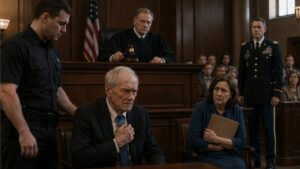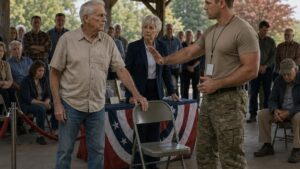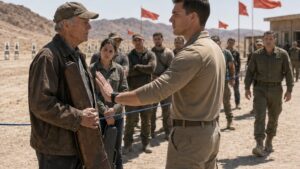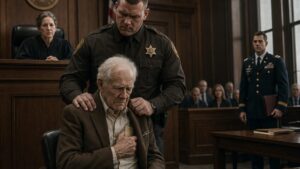
They Mocked The Old Veteran’s Hands Until The Target Paper Made The Whole Range Go Silent
Chapter 1: The Old Man At The Weathered Shooting Bench
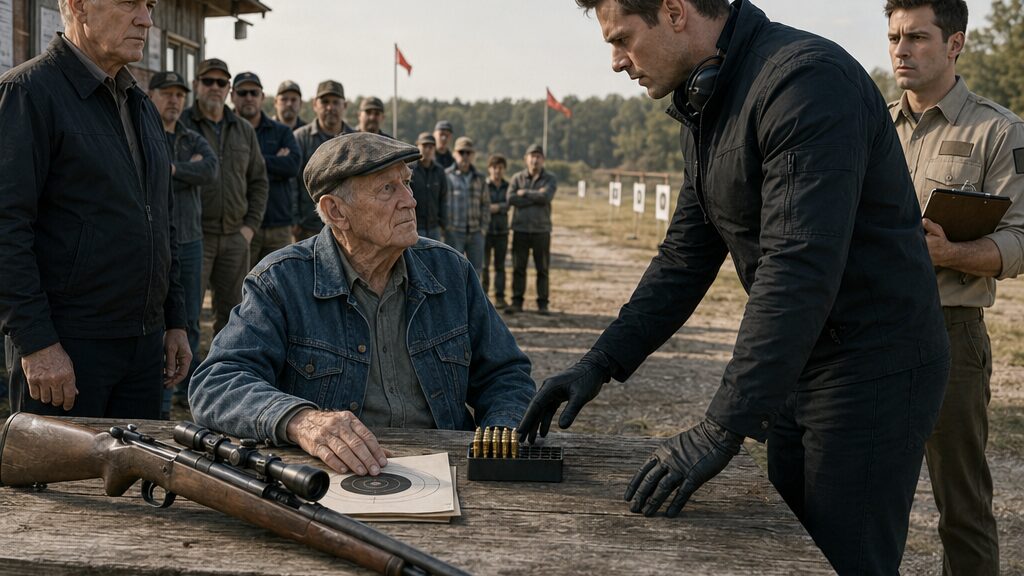
The young instructor’s shadow fell across Gary Roberts’s rifle before Gary had even opened the ammunition box.
It was a clean shadow, sharp at the shoulders, thrown by a man standing too close.
Gary kept his left hand flat on the weathered bench and let the morning settle. The boards were gray from years of sun and rain, softened along the edges where elbows had rested and nervous fingers had tapped before competition relays. Downrange, white target frames waited in two neat rows under a pale Saturday sky. Red range flags hung almost still. The line smelled of dust, gun oil, cut grass, and coffee from the veterans’ tent behind the office.
The rifle lay in front of him with its bolt open and chamber empty, pointed safely downrange. It was not new. The bluing had thinned at the corners. The scope had a small scratch along its tube. The sling had been replaced once and repaired twice. Beside it, Gary had placed a plastic ammunition tray, each cartridge sitting nose-forward in a straight line. Not one round was out of place.
He heard shoes stop behind him. Then a voice, young and bright with authority.
“Sir, this bench is for registered shooters.”
Gary did not look up right away. He finished setting the last cartridge into its slot, pressed his thumb lightly along the row to confirm the spacing, and closed the cardboard flap beside the tray.
“I registered,” he said.
The man leaned closer. Gary saw black gloves at the edge of the bench, expensive ones with textured palms and clean seams. The gloves were too new to have learned much.
“You registered for the charity event?” the man asked.
Gary turned his head.
Andrew Walker stood over him in a fitted dark range jacket with the club logo stitched over his chest. He was broad through the shoulders, clean-faced, and sure of his own outline. A pair of electronic muffs rested around his neck. A laminated instructor badge clipped to his zipper flashed each time he moved.
Behind him stood Timothy Johnson in a tan uniform shirt, holding a clipboard against his chest. Timothy was young enough that his posture still looked borrowed from someone stricter. He glanced from Andrew to Gary, then down to the rifle, then to the clipboard as if the paper could rescue him.
Gary reached into his jacket pocket and unfolded an old range card. The paper had softened at the creases. His hand trembled slightly before the fingers steadied.
Andrew noticed the tremor. He noticed it too quickly.
“Sir,” Andrew said, changing his tone just enough to make it worse, “we have observer seating behind the line. Plenty of shade. Coffee too.”
A few club members at the next bench looked over. One of them had been laughing at something a moment earlier. The laugh faded, but the smile stayed.
Gary placed the card on the bench.
“Gary Roberts,” he said. “Lane four.”
Timothy lowered his clipboard. His eyes scanned the names.
Andrew did not wait. “Lane four is assigned to competitors. This is a precision event, not a casual open range. We’ve got donors here, junior shooters, veterans, guests. Safety is tight today.”
Gary’s gaze moved to Andrew’s hands. One glove rested a few inches from the ammunition tray.
“Safety should be tight every day,” Gary said.
The line around them quieted by a degree.
Andrew smiled without warmth. “Exactly. Which is why I’m asking you to step back until we confirm.”
Gary looked past him toward the score table. A row of blank target papers had been clipped under a weight to keep the light breeze from lifting them. White sheets. Black circles. Empty centers waiting to be explained.
“I can wait,” Gary said.
“That’s not the issue.”
Gary folded his hands in his lap. The skin over his knuckles was thin, marked by sun and age. His right thumb rubbed once along the side of his index finger, slow and measured, as if counting something only he could feel.
Andrew looked down at those hands.
“Can you manage that rifle safely by yourself?” he asked.
The question carried across the nearest benches.
Timothy’s jaw tightened. He did not write anything.
Gary looked back at the rifle. Bolt open. Chamber empty. Muzzle downrange. Magazine well clear. Ammunition separate. Bench clean. Everything in its place. He had arranged it that way before Andrew arrived.
“Yes,” Gary said.
Andrew gave a short breath through his nose. “I’m not trying to embarrass you.”
That was when two men behind the benches turned fully toward them.
Gary heard the old sentence inside the new one. I’m helping you. I’m protecting everyone. I’m being reasonable. He had heard versions of it at grocery counters, medical desks, and parking lots from people who did not realize age was not confusion.
He did not answer.
Andrew picked up the range card. He glanced at it, then at Gary’s plain denim jacket, faded cap, and scuffed brown shoes.
“No gear bag?” Andrew asked.
Gary touched the old rifle case leaning against the bench leg. It was brown, hard-sided, and worn smooth near the handle.
“This is enough.”
“For a charity match with a long-distance stage?” Andrew said. “Most shooters here brought proper rests, wind meters, rear bags, match ammo, data books.”
Gary looked at his ammunition tray again.
“This is enough,” he repeated.
The club member at the next bench gave a low chuckle, not loud enough to own.
Andrew heard it and grew taller.
“Mr. Roberts, I respect that you want to participate. I do. But we have to be realistic. You look like you might be more comfortable watching today.”
Gary’s chest rose and fell once. He let the air leave slowly.
He had not come to be comfortable.
Past the firing line, a young woman in a shooting vest walked toward the junior staging area carrying a rifle case almost half her height. Dark hair tied back. Careful steps. Focused face. Gary watched her for only a second, but something old pulled at him. The name on the registration list had done that first. Seeing her made it worse.
Rebecca Martinez.
He lowered his eyes before anyone noticed.
Andrew turned to Timothy. “Mark him observer only until Donna clears this. We can’t have confusion on the line.”
Timothy hesitated. “His name is on the sheet.”
“Then put a note next to it.”
Gary reached for the blank target paper stacked beside the bench marker. His fingertips paused over the top sheet.
Andrew’s gloved hand came down lightly on the stack.
“Not yet.”
Gary looked at the glove, then at Andrew.
“I’ll need one target sheet,” Gary said.
“For what?”
Gary’s hand still rested near the paper. The tremor had disappeared.
“For the target,” he said.
Andrew stared at him for a moment. Then he smiled again, but this time there was irritation under it.
“Timothy,” Andrew said, without looking away from Gary, “observer only.”
Timothy lowered his pen to the clipboard.
Gary did not argue. He sat at the weathered bench with the rifle open, the ammunition lined in perfect order, and the blank target paper held beneath Andrew Walker’s gloved hand.
Chapter 2: The Young Instructor Owns The Firing Line
By ten o’clock, Andrew Walker owned the range without owning a single inch of it.
He moved from lane to lane with a bright, practiced confidence that made people turn before he spoke. He adjusted a shooter’s elbow at bench two, corrected a scope turret at bench six, joked with the donors near the coffee urn, and called the junior shooters by name. His voice carried well. Not harsh, not yet. Just loud enough to let the range know where authority stood.
Gary watched from the observer benches behind the firing line.
The chair was plastic, white once, now faded by sun. It wobbled under him when he shifted. His rifle remained in its case at his feet. The ammunition tray sat closed beside it, exactly where he had placed it after Andrew told Timothy to clear the bench.
Gary’s range card rested inside his jacket pocket.
At the score table, Donna Wright stood with a tablet in one hand and a radio clipped to her belt. She had the alert expression of someone counting problems before they reached her. Every few seconds she checked the donor tent, the parking area, the firing line, and Andrew.
Andrew came to her near the office door, speaking low enough that most people would not hear. Gary did not need every word. He understood posture. Donna’s shoulders tightened, then she looked toward him.
Gary looked away first.
He watched the junior shooters instead.
Rebecca Martinez stood with three others near the ready area. She listened hard. Some young shooters listened with their whole faces, wanting instruction to be a key that unlocked everything at once. Rebecca was like that. She held her rifle case upright with both hands and kept glancing at the targets as if they might move farther away when she blinked.
Andrew stepped in front of the juniors and clapped once.
“All right,” he said. “Charity match does not mean sloppy match. We run this clean, we run it sharp, and we make the club look good.”
The juniors straightened.
Gary heard the order of that sentence. Clean. Sharp. Look good.
Andrew lifted an unloaded training rifle from the rack and demonstrated quickly. “Position. Cheek weld. Sight picture. Breath. Break the shot. Reset. Don’t overthink it.”
He made the movements fast and smooth. He was not careless. That mattered to Gary. Andrew knew more than his arrogance suggested. He handled the rifle with basic competence, kept the muzzle safe, checked the chamber without being reminded. His stance was athletic. His words were clear. He had earned some of the confidence he wore.
That was what made him more dangerous.
Bad instructors were easy to dismiss. Good ones who mistook performance for discipline could teach a whole line to hurry.
Rebecca copied his movement without the rifle first. Shoulder, cheek, breath, finger position. She was quick. Too quick. Andrew saw the speed and nodded.
“That’s it,” he said. “Don’t freeze up. Matches reward decisive shooters.”
Gary’s right hand folded around the edge of the plastic chair.
A veteran in a ball cap lowered himself onto the bench beside Gary. “You shooting today?”
Gary looked toward the firing line. “Registered.”
The man followed his eyes to Andrew. “Ah.”
That single sound held more history than complaint.
Near the score table, target papers from the first sight-in relay came back on a pulley line and were clipped to a board. Some groups were wide. Some respectable. One, probably Andrew’s demonstration target, showed three holes tight enough to draw admiration from the donors.
Andrew did not brag about it. He did not need to. Others did it for him.
“That boy can shoot,” the man beside Gary said.
“Yes,” Gary said.
“You know him?”
“No.”
“You look like you know his type.”
Gary rested his hands on his knees. “Types change less than rifles.”
The man laughed softly, then stopped when Donna approached.
“Mr. Roberts?” she said.
Gary stood slowly, not because he wanted to show effort, but because standing had become something that required negotiation with the knees. He removed his cap.
“Ma’am.”
Donna’s expression softened at the courtesy, then tightened again around her task. “Andrew told me there was some confusion about your registration.”
“There wasn’t.”
She glanced at the rifle case at his feet. “We’re glad to have veterans here today. Truly. The event exists because of people like you. But the competition lanes have stricter requirements.”
Gary waited.
“Have you shot here recently?” Donna asked.
“No.”
“Are you currently certified through the club?”
“No.”
“Do you have a spotter?”
“No.”
“Match equipment?”
Gary looked down at the old case. “Rifle. Ammunition. Eyes. Ears.”
The veteran on the bench coughed into his hand to hide a laugh.
Donna did not laugh. “Mr. Roberts, please understand my position. We have families here. Donors. Junior shooters. Insurance rules. Andrew is our lead instructor for the event, and if he has concerns—”
“Then you should listen to him,” Gary said.
That stopped her.
He put his cap back on. “A range officer with concerns should speak.”
Donna studied him. “And do you agree with his concern?”
Gary looked to the firing line. Andrew was now beside Rebecca, correcting her stance. He moved her support elbow inward, then tapped the side of her shoulder.
Gary’s eyes narrowed slightly.
“I agree that people are watching the wrong things,” he said.
Donna followed his gaze but did not see what he saw. “I’m sorry?”
Gary shook his head once. “Nothing.”
Andrew’s voice rose across the line. “Rebecca, don’t baby it. Commit to the shot. Confidence first.”
Rebecca nodded. She lifted the training rifle again, trying to move with the same speed he had praised.
Her muzzle stayed safe. Her finger was indexed properly. Her feet were almost right.
Almost.
Gary saw the weight shift before the mistake existed. Too much forward pressure. Too much eagerness to be fast. She was learning to imitate confidence before she had built control.
Andrew looked pleased.
Donna’s radio crackled. She pressed it, answered a question about parking, then turned back to Gary.
“Would you be willing to observe the first half? We can revisit later.”
Gary sat again. “I can observe.”
Relief passed across her face.
Andrew looked over from the line and saw Donna walking away. He saw Gary seated behind the line and allowed himself the smallest satisfied nod.
Gary noticed it.
He did not mind the nod. Pride always announced itself before it understood the room.
The first relay began. Shots cracked in measured intervals. The sound moved through Gary’s bones the way distant thunder moved through a porch floor. He watched the shooters settle, rush, correct, miss, recover. He watched Andrew pace behind them, arms folded, chin high.
The target papers came back one by one. Andrew’s students clustered around the board. The donors praised. Donna smiled because the event looked smooth.
Rebecca’s first paper showed promise: two shots close, one pulled low and left. She stared at the mistake as if it had insulted her.
Andrew tapped the paper. “You hesitated. Trust yourself.”
Gary’s fingers tightened.
No, he thought. She rushed the breath and chased the trigger.
Rebecca nodded anyway. The second relay was called. She stepped back toward the ready table, face set harder than before.
Gary watched her pick up three rounds from the tray in front of her. One slipped slightly under her glove as another shooter brushed past. She recovered it quickly, embarrassed, and tried to reset the way Andrew had shown her.
Then she reached for her rifle too soon.
Gary’s feet shifted under the plastic chair.
No one else had seen it yet.
Chapter 3: The Salute That Stopped The Laughter
Gary was moving before the decision finished forming.
He did not hurry. Hurry made people look at the wrong thing. He rose from the observer chair, took two measured steps to the yellow boundary line behind the benches, and lifted one hand, palm down.
“Pause,” he said.
His voice did not carry like Andrew’s. It did not need to. Rebecca was close enough to hear, and she froze at the sound.
Andrew turned sharply. “Sir, stay behind the line.”
Gary stopped exactly where he was. His hand remained raised, not commanding, not dramatic. Just steady.
Rebecca looked from Gary to Andrew. Her rifle was angled safely downrange, but she had begun the sequence out of order. Ammunition on the bench. Bolt not yet checked the second time. Her attention split between Andrew’s last correction and her own frustration.
Gary looked only at Rebecca.
“Set it down,” he said.
She obeyed before Andrew could speak.
Andrew’s face tightened. “Mr. Roberts.”
Gary lowered his hand. “Good.”
Rebecca’s cheeks flushed. “Did I do something wrong?”
“Not wrong,” Gary said. “Early.”
Andrew stepped between them. “I’m running this line.”
Gary met his eyes for the first time since the bench.
“Yes,” he said.
The single word left Andrew with nowhere clean to put his anger.
A few shooters had stopped preparing. Timothy stood near the safety table, clipboard pressed against his side, watching with an expression caught between duty and curiosity. Donna appeared outside the office door, already frowning at the interruption. Club members turned. Donors looked over paper cups.
Andrew lowered his voice, but not enough. “You don’t step toward my firing line and instruct my juniors.”
Gary glanced at Rebecca’s rifle. “She was about to build speed on a missed step.”
“She was fine.”
“She would have been,” Gary said.
Andrew laughed once, short and public. “Would have been? You saw all that from the observer chairs?”
Gary did not answer.
Andrew’s eyes dropped to Gary’s hands. The right one trembled slightly now that it hung at his side.
“You can barely hold your own fingers still,” Andrew said. “Maybe don’t critique students who are actually shooting today.”
The words struck the range harder than the morning shots.
Rebecca looked down.
Timothy’s pen stopped moving.
Donna started toward them, but Andrew was already in full command of the moment, or thought he was.
He walked to Gary’s old bench, where the rifle case and ammunition tray still sat behind the line. He picked up the tray, not roughly, but without permission, and moved it aside as if clearing clutter.
“This is exactly why we have procedures,” Andrew said. “People get sentimental. They think because they used to shoot once, rules bend.”
Gary watched the tray leave its place.
That moved something in him more than the insult had.
He stepped to the bench, still behind the safe boundary, and placed the ammunition tray back where it had been. He turned it until the cartridges faced the same direction as before, each brass case aligned, each bullet seated in its row. His thumb passed lightly over the edge of the tray.
Then he checked the rifle without touching the trigger. Bolt open. Chamber empty. Muzzle downrange.
The range had gone quiet enough for the flag rope to tap against its pole.
Andrew folded his arms. “What are you proving?”
Gary looked at the blank target paper clipped beside the bench marker.
“The target will tell you,” he said.
Someone near the donor tent gave an uncomfortable laugh. Andrew seized it.
“The target?” he repeated. “Sir, with respect, you haven’t been cleared to fire a .22 warm-up, let alone compete.”
Gary nodded faintly, as if Andrew had made a procedural point worth keeping.
“That is true.”
Andrew blinked. He had expected resistance and received agreement.
Donna arrived beside Timothy. “What’s happening?”
Andrew turned toward her. “Mr. Roberts crossed into instruction during an active relay and interfered with a junior shooter.”
Rebecca spoke quickly. “He didn’t interfere. I think I—”
Andrew lifted a hand. “Rebecca, it’s all right.”
Gary said nothing.
Donna looked at him, then at the growing half-circle of spectators. “Mr. Roberts, I need you to return to the observer area.”
Gary nodded.
Before he could move, a voice came from behind the office.
“Gary Roberts.”
Not loud. Not surprised. Certain.
The gray-haired man walking toward them wore a dark jacket with no club logo and no need for one. Stephen Martin had the kind of posture that remained after uniforms were folded away. His face was lined, his hair silver, and his eyes fixed on Gary with recognition so direct that the range seemed to shift around it.
Gary closed his eyes for half a second.
Stephen stopped three paces from him.
Then he raised his right hand and saluted.
No one spoke.
The salute was not ceremonial. It was not for the donors, not for the club, not for the event photographer lowering his camera in confusion. It was personal and precise, held long enough to say what Stephen did not.
Gary’s jaw tightened. He returned the salute slowly.
“At ease, Stephen,” he said.
The name moved through the silence. Andrew’s expression changed first to confusion, then to calculation.
Stephen lowered his hand. “Instructor Roberts.”
The title reached farther than the salute.
Timothy looked down at the clipboard as if Gary’s name might have altered itself. Donna’s mouth parted slightly, then closed. Rebecca stared at Gary with new attention, not awe yet, but the beginning of a question.
Andrew’s arms dropped to his sides.
“Instructor?” he said.
Gary turned toward Stephen. “Don’t.”
Stephen looked at him for a moment. Something passed between them, old and disciplined.
Gary repeated softly, “Don’t explain me.”
Stephen’s face held a restrained sadness. “You should not be standing here being spoken to like this.”
Gary looked at the ammunition tray. “That’s not the worst thing a man can survive.”
Andrew flushed. The line was not aimed at him cruelly, which somehow made it worse.
Donna recovered first. “Stephen, do you know Mr. Roberts?”
Stephen kept his eyes on Gary. “Yes.”
“How?”
Gary’s hand touched the folded range card in his pocket.
Stephen did not answer immediately. Gary’s silence held him in place.
Finally Stephen said, “He taught me how to run a safe line before I knew how much I didn’t know.”
Andrew looked toward the spectators, then back at Gary. His voice came out tighter than before. “That doesn’t change today’s procedure.”
“No,” Gary said. “It shouldn’t.”
Stephen’s eyes flicked toward him.
Gary reached for the competitor sheet on Timothy’s clipboard. Timothy, uncertain, held it out. The paper shook a little, though not from Gary’s hand.
Andrew said, “Donna?”
Donna looked from Stephen to Gary to Rebecca, then to the donors watching from under the tent. “If Mr. Roberts is registered, and if Stephen vouches for prior qualification, he can be evaluated under event rules.”
Andrew’s jaw worked. “Evaluated.”
Gary took the pen Timothy offered.
His fingers trembled as he set the tip to the paper.
Andrew saw it. Everyone saw it.
Gary signed slowly: Gary Roberts.
The letters were uneven, but legible. He handed the clipboard back and looked at Andrew.
“No special lane,” Gary said. “No special story.”
Stephen seemed about to object.
Gary turned his head just enough to stop him.
Andrew watched this exchange, his embarrassment hardening into something defensive.
“Fine,” he said. “We’ll evaluate.”
Gary returned to the bench. He placed the target sheet beside the rifle, aligned it with the edge of the wood, then set his palm lightly over the paper as if holding down more than wind.
Rebecca was still watching him.
Gary did not look at her yet.
He looked downrange, where the empty target frame waited.
The line resumed slowly around him, but it did not sound the same.
Chapter 4: The Promise Hidden Behind The Range Card
During the afternoon break, the range tried to become ordinary again.
People moved because the schedule told them to move. Rifles were cleared, chambers shown, bolts opened. Target papers came down. Donors drifted back toward the tent for sandwiches and bottled water. Junior shooters compared groups in low voices, pretending not to stare at Gary Roberts as he closed his rifle case.
Andrew did not leave the firing line at first. He stayed near the bench where Gary had signed the competitor sheet, speaking to Timothy with his arms folded and his chin angled toward the targets. He was not loud now. That made him look more careful, which almost made him look more dangerous.
Gary took his ammunition tray and range card and walked behind the office.
There was a narrow strip of shade there where the building blocked the sun. Someone had set an old wooden bench against the wall. Paint peeled from its legs. A paper cup had been left on the ground beneath it, crushed but not thrown away. Gary lowered himself onto the bench and placed the ammunition tray beside him.
His knees complained. His hands did not.
For a few minutes, he listened to the range without looking at it. Voices softened by distance. A metal target stand being dragged. The flutter of paper at the score table. The hollow clack of an empty chamber being checked by someone who had learned the motion but not yet the meaning.
He removed the folded range card from his pocket.
The front was current enough: name, lane, event, signature. The back was older. Not the card itself, but the note he had tucked into its fold years ago and carried too long to call it a keepsake.
The handwriting was cramped, hurried, and familiar.
If she ever asks about shooting, teach her patience before accuracy.
No full name. No ceremony. No dramatic last line. Just that sentence, written by a man who had learned late that speed could be a mask for fear.
Gary kept his thumb at the edge of the note and did not read it again. He knew every tilt of every letter.
Footsteps stopped beside the office corner.
“Still hiding behind buildings when people want to thank you?”
Gary folded the card once and slid it beneath his palm.
Stephen Martin stood with two bottles of water, one in each hand. He offered one. Gary accepted it but did not open it.
“You got old,” Gary said.
Stephen smiled faintly. “You didn’t?”
Gary looked at the range beyond the corner. “I got quieter.”
“You were always quiet.”
“No,” Gary said. “I used to waste words.”
Stephen lowered himself onto the far end of the bench. For a while neither spoke. The silence between them had shape, the kind made by years that had not been shared but were still understood.
“That young instructor,” Stephen said at last.
“Andrew.”
“He’s good.”
“He is.”
Stephen looked at him. “That wasn’t where I expected you to start.”
Gary rested the water bottle between his knees. “Good shooters can still teach badly.”
Stephen took that in. “He embarrassed you.”
Gary’s mouth moved almost into a smile. “I have survived worse than embarrassment.”
“That doesn’t mean it was acceptable.”
“No.”
“Then let me explain who you are.”
Gary’s hand closed over the folded card.
“No.”
Stephen leaned forward, elbows on knees, bottle hanging from one hand. “Gary, half that range thinks I saluted you because you held rank over me.”
“That is their problem.”
“They don’t know you built half the safety standards they use.”
“They don’t need to.”
“They don’t know you trained instructors who trained instructors.”
Gary turned his head, and Stephen stopped.
The look was not sharp. It was tired, and that made it heavier.
“I came for one reason,” Gary said.
Stephen’s gaze dropped to the card beneath Gary’s hand.
“Rebecca,” he said.
Gary did not answer, which was answer enough.
Stephen’s face changed with recognition, then pain. “I saw the last name on the registration list. I wondered if you knew.”
“I knew.”
“She’s his daughter.”
“Yes.”
“Does she know you?”
“No.”
“Did he tell her?”
Gary looked across the gravel to where Rebecca stood with two junior shooters near the water cooler. She was holding her first target paper, still studying the low-left shot as if it might confess.
“I doubt it,” Gary said.
Stephen watched her too. “He was proud of her before she could hold a pencil.”
Gary looked down at the folded note.
He remembered Rebecca’s father as a young man with too much speed in his hands and not enough silence behind his eyes. He had been talented. Most troublesome shooters were. The untalented ones learned caution because the target punished them early. The talented ones sometimes mistook early success for permission.
Gary had taught him to wait. Not by shouting. Not by stories. By making him sit through wind he wanted to beat, breath he wanted to rush, rules he thought slowed him down. Years later, after deployments and injuries and a life Gary only heard about in fragments, the man had written that note.
If she ever asks about shooting, teach her patience before accuracy.
Gary had not expected the chance to come.
Stephen said, “You should tell her.”
“No.”
“She deserves to know.”
“She deserves to learn without carrying my name like a weight.”
Stephen shook his head slightly. “That is a very Gary Roberts answer.”
Gary opened the water bottle. The cap cracked loudly in the shade.
“I’m not here to be remembered,” he said.
“Then why sign up for the match?”
Gary took one careful swallow. “Because she listens to Andrew.”
Stephen understood the rest without being told.
Across the range, Andrew was showing a donor his rifle setup. His gestures were controlled, his smile restored. He turned a turret, pointed downrange, explained something about wind and glass and match-grade consistency. The donor nodded as if knowledge always wore new equipment.
“He has a following,” Stephen said.
“He has skill.”
“You said that before.”
“It is still true.”
“And the rest?”
Gary put the cap back on the bottle. “He wants the line to admire him. That is different from wanting the line safe.”
Stephen looked toward Rebecca again. “You think she’s in danger?”
Gary did not answer quickly. He would not give that word more size than it deserved.
“She is learning to hurry before she understands why to wait.”
Stephen’s jaw tightened.
A golf cart rolled past the office, carrying target stands. Dust rose and drifted through the shade. Gary watched it pass, then lifted his range card and tapped the folded note once against his knee.
“I promised her father if she came to a range, I’d teach her the first lesson.”
“Patience.”
Gary shook his head. “Respect. Patience comes after.”
Stephen sat back.
Around the corner, Donna’s voice called for competitors to gather near the score table. The afternoon challenge stages were being posted.
Gary folded the note into the range card again, smoothing the crease with a thumb. His hand trembled once, then stilled.
Stephen stood. “You know Andrew is going to make this harder now.”
Gary slipped the card into his jacket. “He already has.”
“No, I mean he’ll turn this into a show.”
Gary picked up the ammunition tray and rose slowly.
“Then we should keep it a range.”
When they returned to the front of the office, the crowd had formed around Andrew.
He stood beside the score table with a marker in his hand and a fresh sheet clipped to the board. Donna was beside him, looking uneasy but not stopping him. Timothy stood behind them with the clipboard.
Andrew’s voice was clear again.
“Since we have some experienced shooters joining late,” he said, eyes flicking toward Gary, “we’re adding an open challenge stage before final scoring. Long lane. Variable wind. Standard event rules. Any competitor may enter.”
A murmur moved through the crowd.
Rebecca looked at Gary.
Andrew smiled as if the idea had arrived from fairness itself.
“Let’s see what the target says.”
Chapter 5: The Wind Was Moving Before Anyone Spoke
Timothy Johnson had been told since his first day at the range to trust procedure.
Procedure was clean. Procedure gave him a place to put his eyes and hands. Verify open chambers. Check lane assignments. Confirm shooters. Mark relays. Repeat commands exactly. Do not improvise when a rule already existed.
But as the open challenge stage began to form on the long-distance lane, Timothy found himself watching the spaces between procedures.
He watched Andrew move fast.
Andrew had gathered attention the way some men gathered equipment: easily and with no apology. He set his rifle case on the staging table and opened it in front of the juniors. The inside was cut foam, custom fit. The rifle looked modern, precise, expensive without appearing decorative. His scope was large and clean, with turrets that clicked under his fingers like small locks.
“Long lane is where fundamentals matter,” Andrew said.
A donor asked something about distance.
“Three hundred yards for this stage,” Andrew answered. “Not extreme, but enough that mistakes show.”
Timothy marked the stage on his clipboard. The sun had shifted west. Heat lifted from the ground in faint ripples. The flags downrange no longer hung still. They lifted and drooped, lifted again, uncertain.
Gary Roberts stood apart from the crowd, his old rifle case resting on the bench near lane four. He had not opened it yet. His ammunition tray was already placed beside the mat, each round aligned.
Timothy noticed that Gary did nothing until he needed to.
Andrew did everything early.
He checked his scope. Checked the wind meter. Checked the rear bag. Checked his phone, then put it away when Donna looked over. He dry-set his position behind the rifle, rose, adjusted, lowered again. Each movement was competent, but each one also seemed aware of being seen.
Gary opened his case.
No one spoke, but several people leaned slightly to look.
The old rifle came out with none of the drama they seemed to expect. Gary placed it on the bench with the bolt open and chamber clear. He set the sling flat. He touched the scope, not adjusting yet, only confirming its place. Then he stood still.
Timothy looked at the flags.
They moved lazily from left to right. Then paused. Then one halfway downrange flicked opposite the others.
Gary watched that one.
Andrew was speaking to Rebecca. “Wind is information, but don’t worship it. Make your call and commit.”
Rebecca nodded. She had recovered some of her focus, but Timothy could tell she was divided now. Her eyes kept drifting to Gary.
Andrew saw it too.
“Rebecca,” he said, slightly sharper. “Your target doesn’t care who gets saluted. It cares who shoots.”
Her face colored. “Yes, sir.”
Gary did not react.
The first shooters in the open challenge took their turns. The lane was run one competitor at a time for clarity, with target retrieval after each string. Three shots. Time limit. Standard scoring ring. Enough pressure to make everyone look more confident than they felt.
The first club member rushed and printed wide. The second did better. A veteran with a heavy barrel rifle waited long, fired carefully, and earned approving murmurs when his target returned with a tight but low group.
Andrew clapped him on the shoulder. “Good shooting.”
It was good shooting. Timothy wrote the score.
The wind lifted.
Not much. Enough to move dust near the left berm. Enough to shift the hanging tape on a target frame before the flags agreed. Timothy glanced toward Gary and found him watching the dust, not the flags.
Andrew stepped to the line when his name was called.
The crowd settled. Even those who disliked his attitude seemed ready to admire him. There was comfort in seeing confidence justified.
Andrew moved beautifully behind the rifle. There was no denying it. He built his position quickly, found the target, checked the wind meter, adjusted, breathed, and fired.
The shot cracked clean.
He reset fast.
Second shot. Third.
He cleared the rifle, stood, and stepped back. The target retrieval line hummed as Timothy sent for the paper.
Andrew removed one glove and flexed his fingers. He did not smile openly, but the shape of the smile waited around his mouth.
The target came back.
A strong group. Not perfect, but strong. Slightly right of center, close enough that several people made appreciative sounds. Andrew nodded once, as if the result had merely confirmed what everyone already knew.
Timothy marked the score.
Rebecca’s shoulders lifted with renewed belief. She looked at Andrew as if he had returned the world to order.
Then Gary’s name was called.
It was Donna who called it, not Andrew.
“Gary Roberts, lane four.”
The name moved differently through the crowd now. Not with laughter, not with respect exactly, but with expectation. That was its own burden.
Gary stepped to the bench.
Timothy watched closely, partly because procedure demanded it, partly because something in him had begun to distrust the obvious.
Gary did not sit immediately. He looked downrange. The flags showed a mild left-to-right push. The dust near the berm had settled. The strip of tape near the second target frame hung limp.
Andrew, standing behind the spectators, said, “You’re on the clock once you load.”
Gary nodded.
He touched one cartridge in the tray but did not lift it.
Seconds passed.
Andrew looked toward Donna. “Is he waiting for a personal weather report?”
A few people chuckled, softer than before.
Gary remained still.
Timothy looked downrange again. Nothing obvious changed. The red flags stirred. The heat shimmer rose. A bird moved along the fence and disappeared.
Then Gary lowered himself behind the rifle but did not load.
Rebecca stepped closer to Timothy. “Why isn’t he starting?”
Timothy nearly said he did not know.
Before he could, Gary spoke without turning.
“Because the wind hasn’t arrived yet.”
Andrew exhaled through his nose. “The flags are right there.”
Gary placed a cartridge into the chamber, then paused with the bolt still open. His cheek had not touched the stock. His finger was nowhere near the trigger.
Timothy looked downrange.
The nearest flag still showed left-to-right. The second began to dip. The farthest one lifted, then snapped once toward them before settling at an angle that did not match the first.
Gary closed the bolt.
The line changed its breathing.
He settled behind the rifle. His right hand trembled before it touched the stock. Then the tremor disappeared into position. His shoulder found the butt gently, not muscling it. His cheek lowered. His left hand adjusted the rear support with a patience so small it almost looked like nothing.
Timothy noticed his breath.
Not deep. Not theatrical. A quiet inhale, a pause, a long release that seemed to make the rest of him heavier.
The shot broke.
It surprised Timothy because nothing in Gary’s body announced it.
Gary opened the bolt, caught the casing, placed it aside, and waited.
Andrew frowned. “Time is running.”
Gary did not answer.
The second cartridge slid into place.
Again he watched. Again he breathed. Again the shot came as if the rifle had decided without him.
The third took longer.
Now even Donna was watching the flags.
Andrew shifted his weight. “He’s burning time.”
Stephen, standing near the office, said nothing.
Gary waited.
The far target tape flicked once. The dust along the berm crawled, then flattened.
Gary fired.
He opened the bolt and showed clear before Timothy had to ask.
“Clear,” Timothy called, hearing his own voice come out quieter than usual.
The target line hummed.
No one made a joke while the paper traveled back.
Timothy told himself not to expect anything. Procedure did not care about drama. Procedure only recorded what arrived.
The paper reached the table.
Timothy unclipped it.
For a second, he thought there were only two holes.
Then he looked closer.
The three shots were not in the center. Not exactly. They sat just off it, but so close together the edges touched, a small dark clover cut into the paper.
Not a miracle. Not impossible. Better than Andrew’s group.
And different from it in a way Timothy did not know how to name.
Gary had not beaten the wind by overpowering it. He had waited until he could speak the same language.
Timothy looked up.
Gary was already placing his brass in a neat line beside the tray.
Rebecca stepped toward him before she seemed to know she had moved.
“How did you know?” she asked.
Gary looked downrange, where the flags now finally agreed with what he had seen earlier.
“Because the range has not finished speaking,” he said.
Chapter 6: The Safety Rule Everyone Forgot
Rebecca Martinez had spent most of her life being told she was careful.
Careful with her grades. Careful with her mother’s old dishes. Careful with the framed photograph on the hallway table. Careful when she carried her father’s folded jacket from one apartment to the next because her mother could not bring herself to pack it.
At the range, careful suddenly felt like another word for slow.
Andrew made speed look clean. He snapped into position, read numbers, made choices, fired with certainty. The adults praised it. The juniors admired it. Even when Gary Roberts outshot him in the open challenge, Andrew still looked like what the future was supposed to be: sharp equipment, sharp words, sharp movements.
Gary looked like something that had already survived being forgotten.
Rebecca did not know what to do with that.
The final stage was announced near the end of the afternoon. Competitors would run in small groups through a controlled sequence: load only on command, fire a timed string, clear, step back, wait for target confirmation. Nothing unsafe if everyone followed the commands. Nothing complicated unless nerves turned simple things into traps.
Rebecca stood in the ready area with her rifle case open on the table. Her earlier target paper was folded in her pocket. She had folded it so the bad shot stayed hidden.
Gary stood several feet away, not looking at her directly. He was checking his ammunition tray. One round at a time. Same spacing. Same direction. Same quiet.
Andrew walked past them with a clipboard he had borrowed from Timothy.
“Final stage decides the board,” he said. “No drifting, no second-guessing. When command comes, execute.”
Rebecca nodded.
Gary’s eyes remained on the tray.
Andrew noticed. “Mr. Roberts, anything to add?”
The question sounded polite enough for witnesses and sharp enough for its target.
Gary looked at the firing line. “Commands matter.”
Andrew smiled tightly. “That’s why we give them.”
“Then let them finish.”
A few people looked between them.
Andrew’s smile faded. “No one here is confused about commands.”
Gary did not answer.
Rebecca wished suddenly that he would. She wanted him to explain what he meant in a way that made the air less tense. But Gary had a way of leaving space around words, and other people kept filling it badly.
The first group was called forward.
Rebecca was in the second.
She watched the first shooters complete their string. One rushed and lost points. One moved smoothly. One had to be reminded to keep the bolt open while stepping back. Timothy caught that immediately, corrected it, and marked the sheet. Andrew glanced at Gary afterward as if to say procedure had worked without his help.
Then Rebecca’s group was called.
She carried her rifle to lane three. Gary was in lane four beside her, separated by the bench but close enough that she could hear the soft set of his case latch.
Timothy stood behind the line. Donna watched from near the score table. Stephen had moved closer without appearing to.
Andrew walked behind the shooters. “Remember, confidence. You know the sequence.”
Rebecca placed her rifle on the bench, muzzle downrange. She opened the bolt, checked the chamber, showed clear. Her hands were steady at first.
Gary did the same beside her. His movements were slower. Not uncertain. Complete.
“On command,” Timothy called, “shooters may prepare three rounds on the bench. Do not load.”
Rebecca set three rounds down. Her glove brushed one and rolled it a half inch. She caught it quickly.
Not wrong. Early.
Gary’s words from before returned without permission.
She drew a breath, embarrassed by a mistake no one had named. Andrew was behind her now.
“Don’t let the last target get in your head,” he said quietly. “You have the skill. Move with it.”
She nodded.
“Shooters,” Timothy called, “stand by for load command.”
Rebecca reached toward the rifle.
Not to load. She thought she was only setting her hand in place, only preparing, only being ready enough not to look slow.
But her fingers closed around the bolt handle before the command came.
Beside her, Gary’s palm rose.
Not fast. Not dramatic. Just there.
Rebecca froze.
Gary did not touch her. He did not touch her rifle. He did not raise his voice.
“Wait,” he said.
The word landed gently enough that no one panicked, firmly enough that everyone heard.
Andrew stepped forward. “What now?”
Rebecca pulled her hand back as if the bolt had burned her.
Timothy’s eyes snapped to her rifle, then to Gary, then to the ammunition. His face changed. He had seen it now.
Gary kept his palm raised for one more beat, then lowered it.
“Command had not finished,” he said.
Rebecca’s throat tightened. She looked at the bench, at the bolt, at the rounds waiting where they belonged.
“I wasn’t loading,” she said, though she knew how weak it sounded.
Gary’s voice stayed even. “You were beginning before you were allowed to begin.”
Andrew came close, controlled anger in every step. “She had an empty chamber and rounds on the bench. Don’t make this bigger than it is.”
Gary turned to him. “I am keeping it exactly the size it is.”
Silence spread outward.
Andrew’s jaw flexed. “You interrupted an active final stage.”
“I stopped a habit before it became one.”
Rebecca’s face burned. Tears threatened, which made her angrier than the correction. She did not want to be protected like a child. She did not want Andrew defending her if he was wrong. She did not want Gary to be right in front of everyone.
Timothy stepped forward. “Range pause remains in effect.”
Andrew looked at him. “Timothy.”
Timothy swallowed, but his voice held. “Shooter made early contact before load command. Mr. Roberts identified it before the line went hot.”
Donna crossed from the score table, expression tight. “Is there a safety violation?”
“No round chambered,” Timothy said. “No unsafe muzzle. But the correction was valid.”
Andrew stared at him as if betrayal could be entered on a clipboard.
Donna turned to Gary. “Mr. Roberts, you stepped into command again.”
Gary nodded. “Yes.”
“You understand that could disqualify you.”
“I do.”
Rebecca looked at him then.
He had not said it bitterly. He had not defended himself. He had simply accepted the consequence.
Andrew seized the opening. “Then disqualify him. We cannot run a final stage with a competitor overriding range staff.”
Stephen’s voice came from behind them. “He did not override command. He preserved it.”
Donna looked at Stephen, then at the spectators gathering again, then at Rebecca’s pale face. The event she had tried to keep polished had become something else entirely.
Gary stepped back from the bench and opened both hands at his sides.
“If I broke your rule,” he said, “mark it.”
Donna studied him. “And if you didn’t?”
Gary looked at Rebecca, but not with accusation.
“Then let her start again. Slowly.”
Rebecca’s eyes dropped to the rifle.
No one had said that all day. Not decisively. Not as permission instead of criticism.
Slowly.
Andrew’s face had gone red beneath the brim of his cap. His authority had not disappeared, but it had cracked where others could see through it.
Donna looked at Timothy. “Official call?”
Timothy straightened. “Pause was justified. No disqualification. Reset the stage.”
Andrew turned away, lips pressed thin.
Rebecca stood motionless behind the bench. Her hands were still trembling when Gary gently lowered his palm toward his own rifle, not hers, demonstrating without touching anything that belonged to her.
“First,” he said softly, “hear all of it.”
Timothy cleared his throat and raised his voice.
“Shooters, reset. On command only.”
Rebecca looked at Gary.
For the first time all day, she did not look toward Andrew for confirmation.
Chapter 7: The Target Paper Came Back Silent
By the time the final stage was ready again, the range had lost its easy noise.
People still spoke, but they did it close to one another now. The donors near the tent had stopped asking broad questions about rifles and scores. The club members who had laughed in the morning watched the firing line with their hands in their pockets. The junior shooters stood together behind the ready area, quiet enough to hear the target pulleys click when Timothy checked them.
Gary Roberts stood at lane four with his rifle open on the bench.
The sun had lowered behind the trees at the far edge of the property. Light ran sideways across the range, catching dust in the air and turning the target papers a dull white. The flags no longer agreed with one another. The closest one lifted and settled. The second pulled left. The far tape twisted, went still, then trembled again.
Gary placed three cartridges in the ammunition tray.
Not four. Not five.
Three.
Andrew watched from behind the line, his arms folded. His face had steadied after Donna’s ruling, but the steadiness looked forced. He had already fired his final string before the reset, and the target was strong. Very strong. Better than most shooters would manage on that lane in shifting wind. Good enough that if Gary failed, Andrew could still claim the day had been about procedure all along.
Gary knew that.
He also knew something else.
A shot fired for pride never landed in the same place as a shot fired for purpose.
Timothy stepped into position. His voice had changed since the morning. It carried less performance, more care.
“Final competitor on lane four. Shooter, confirm clear.”
Gary opened the bolt fully and angled the rifle so Timothy could see. “Clear.”
Timothy nodded. “Competitor may prepare three rounds on the bench. Do not load until command.”
Gary looked at the tray. The cartridges were already there. He did not touch them.
Behind him, Rebecca stood with her hands clasped around her folded target paper. He could feel her attention. Not because it was heavy, but because it was no longer pointed at Andrew.
That mattered more than the score.
Donna stood beside the score table. Stephen stood a few steps behind her, still as a fence post. Andrew shifted once, then stopped when no one looked at him.
Gary lowered himself into the chair behind the bench.
His knees burned. His back tightened. A faint pulse moved at the base of his thumb. He had learned long ago that the body did not have to be young to obey; it only had to be understood. You did not command it like a recruit. You negotiated. You listened. You found what was still steady and built from there.
He laid his right hand on the bench beside the rifle.
It trembled.
Someone behind the line whispered and then went silent.
Gary let the tremor happen. Fighting it only gave it importance. He watched the far tape. It flicked once, then sagged. The near flag lifted. The grass halfway downrange bent before the flag did.
Timothy called, “On command, load and make ready.”
Gary inserted the first cartridge and closed the bolt.
He did not bring his cheek to the stock.
Andrew’s voice came low, meant for the people close enough to hear but not loud enough to be called interference. “Clock’s running.”
Gary looked downrange.
The range was not ready.
Or maybe he was not.
For one thin second, the morning returned: Andrew’s gloved hand over the target paper, the smile at the tremor in his fingers, Donna’s careful worry, Timothy’s uncertain pen, Rebecca’s embarrassed face when she had nearly built a bad habit. Then the older memory came behind it: a young man with Rebecca’s eyes, rushing every first shot as if silence itself were an enemy.
If she ever asks about shooting, teach her patience before accuracy.
Gary breathed in.
Slowly.
He let the breath sit.
Then let it go.
The rifle settled into his shoulder like an old tool finding the same mark on the hand. His cheek touched the stock. His left hand adjusted the rear support by the smallest pressure. His right index finger came to rest where it belonged, not pulling, not waiting to pull, only present.
The shot broke.
No one moved.
Gary opened the bolt, caught the brass in his palm, and placed it beside the tray with the mouth facing away from him. He did not look at Andrew. He did not look at Timothy. He did not look at Rebecca.
The second cartridge went in.
This time the wind tempted him. The nearest flag said one thing. The heat shimmer said another. The far tape told the truth and then tried to take it back.
Gary waited.
Somewhere behind him, a chair creaked.
The second shot cracked across the range.
Andrew’s mouth tightened.
Gary cleared the casing, set it beside the first, and sat back half an inch. His shoulder ached now. His right eye watered from the dry air. He blinked once, slowly.
The third cartridge lay alone in the tray.
He picked it up between two fingers. His hand trembled before it reached the chamber. The cartridge touched the edge, hesitated, then slid into place.
“Come on,” someone whispered.
Gary heard it without accepting it.
He closed the bolt.
The range narrowed until there was only breath, paper, wind, and the long quiet before decision. He watched the target through glass. The black center swayed almost imperceptibly in the shimmer. Not moving, not truly. Appearing to move because air was a living thing between him and proof.
His finger rested.
The far tape twisted.
Gary did not fire.
It twisted back.
He breathed.
The tape stopped.
The third shot broke.
The sound went out and did not come back.
Gary opened the bolt and showed clear before Timothy’s command. Timothy checked anyway, because procedure mattered even when everyone wanted to look at the target.
“Clear,” Timothy called.
Gary rose carefully. He placed the third casing beside the other two. Three small brass pieces in a neat line beside the empty tray.
His work was finished before the paper arrived.
The target pulley started with a mechanical hum. All eyes turned downrange.
The paper came back slowly, too slowly for the crowd and exactly as fast as the machine allowed. It traveled along the line, growing larger with each second. From a distance it showed only the black scoring rings and a small wound in the paper.
Donna stepped closer.
Timothy unclipped the sheet.
He looked once.
His face changed.
Andrew saw that and moved forward before anyone invited him. “Let me see it.”
Timothy did not hand it over immediately. He held it flat against the board and stared as if the paper had asked him a question.
There were three holes, but the first glance did not find three. They had cut into one another just above center, a tight dark clover inside the scoring ring. Not magic. Not legend. Not a trick. Just three disciplined shots placed so close that argument had nowhere to stand.
The range did not erupt.
That was the strange thing.
It went silent.
No one clapped. No one shouted. The donors did not cheer. The juniors did not laugh. The silence was larger than applause would have been. It held Andrew, Donna, Timothy, Stephen, Rebecca, the veterans under the tent, and the old man at lane four in the same still air.
Andrew took the paper from Timothy.
He checked it once.
Then again.
His thumb moved near the holes but did not touch them. His jaw worked. He looked toward the targets, then back at the paper, as if distance itself might offer him an objection.
Gary began closing his rifle case.
Donna’s voice came out carefully. “Score?”
Timothy swallowed. “Top score.”
Andrew looked at him.
Timothy repeated, quieter but firmer. “Top score.”
The words moved through the range.
Gary lowered the rifle into the old case. He wiped nothing dramatically, inspected nothing for show. He closed the bolt only after confirming again that the rifle was clear and safe for casing. He set the ammunition tray inside its small compartment. The empty slots faced upward.
Stephen watched him with wet eyes he would not wipe.
Rebecca stepped closer to the score table. She looked not at Andrew, but at the target paper in his hand.
Gary closed the case latches.
The sound was small. Final.
Andrew held the paper out toward him, but not quite fully. His hand stopped halfway, caught between surrender and habit.
Gary took it gently.
For the first time all day, Andrew did not speak.
The prize table stood near the office, covered with ribbons, envelopes, and a polished plaque meant for photographs. Donna moved toward it automatically, perhaps grateful for any familiar ritual.
“Mr. Roberts,” she said, “we should—”
Gary walked past the table.
The crowd parted before he asked.
He carried the folded target paper in one hand and the old rifle case in the other. His steps were slow, but no one mistook them for uncertainty now.
Rebecca stood near the ready area, still holding her own folded target.
Gary stopped in front of her.
She looked at the paper in his hand, then at his face.
He did not give it to her yet.
Behind him, Andrew remained beside the score table, staring at the empty space where the target had been.
Chapter 8: The First Rule Was Never Accuracy
Evening settled over the range without ceremony.
The donors left first, carrying event programs and quiet versions of the story they had just seen. Club members packed rifles into cases, speaking in low tones. Junior shooters gathered brass under Timothy’s supervision, their earlier restlessness softened by the day’s weight. The red flags downrange hung still now, as if the wind had said everything it had come to say.
Gary sat alone at the weathered bench with his rifle case closed beside his leg.
The target paper lay flat in front of him.
Three holes touched near the center. The paper had already begun to curl slightly at the edges. It looked fragile now, too thin to carry what the range had placed on it. Proof. Shame. Wonder. Questions. None of those belonged to paper.
Rebecca approached slowly.
She had not changed out of her shooting vest. Her own folded target was still in her hand, creased across the bad shot. She stopped on the other side of the bench.
“Mr. Roberts?”
Gary looked up.
“Gary is fine,” he said.
She swallowed. “Did you know my father?”
Gary’s hand rested on the target paper.
For a moment, the range behind her disappeared. He saw a younger man sitting at a bench long ago, angry at a missed shot, pretending anger was ambition. He saw that same man years later, older in the eyes, folding a note with hands that had learned humility the difficult way.
“Yes,” Gary said.
Rebecca’s face changed, but she did not ask everything at once. That was a kind of discipline too.
“He never told me much,” she said.
Gary nodded. “Some men protect their children from the wrong parts of themselves and accidentally hide the good parts too.”
She looked down at the target. “Was he good?”
“At shooting?”
“At listening.”
Gary almost smiled.
“Eventually.”
Rebecca held her folded target tighter. “I wanted to be good today.”
“You were.”
She shook her head. “I made mistakes.”
“Yes.”
That answer surprised her enough to make her look up.
Gary touched the edge of her folded paper. “May I?”
She handed it to him.
He opened it carefully. The first two shots were close. The third sat low and left, the one she had tried to hide from herself all day.
Gary studied it without judgment.
“This one,” he said, touching near the low shot but not on the hole. “You wanted it too much.”
Rebecca gave a small, embarrassed breath. “Andrew said I hesitated.”
“You rushed.”
She looked toward the score table, where Andrew stood alone with Timothy. “He sounded so sure.”
“Sure is not the same as right.”
Gary folded her target again, but this time he did not hide the low shot. He left it visible on the outside.
“Your father rushed too,” he said.
Rebecca’s eyes lifted quickly.
“He thought speed proved courage,” Gary said. “It took him a while to learn that waiting can be braver.”
The words settled into her face slowly.
“Did he ask you to come here?” she said.
Gary took the range card from his pocket. He did not open the note fully. He only showed her the old handwriting on the back, enough for her to recognize the shape of a hand she might have seen on birthday cards, labels, old boxes in closets.
Rebecca’s mouth trembled.
Gary let her look. Then he folded it again and placed it beside the target paper.
“He asked me to teach you something if you ever came to a range,” Gary said.
“What?”
Gary looked toward the firing line, now empty.
“The first rule was never accuracy.”
Rebecca waited.
“It was respect.”
She wiped once under her eye with the heel of her hand, angry at the tear but unable to stop it. “Respect for what?”
“For the tool. For the line. For the person beside you. For the command. For what you don’t know yet.” Gary paused. “For yourself when you’re tempted to perform instead of learn.”
Behind them, footsteps approached.
Andrew stopped a few feet away.
He had removed his gloves. Without them his hands looked younger. Less certain. He held no clipboard, no rifle, no score sheet. Only his cap, twisted once in his fingers before he made himself stop.
Rebecca stiffened.
Gary did not.
Andrew looked at the target paper on the bench. Then at Gary. “Mr. Roberts.”
Gary waited.
Andrew’s throat moved. “I was out of line.”
The range around them remained quiet, but not empty. Donna watched from near the office. Timothy stood by the brass bu