The Elderly Veteran With The Cafeteria Tray Refused To Explain The Logbook He Mocked
Chapter 1: The Logbook Beside Her Paper Cup
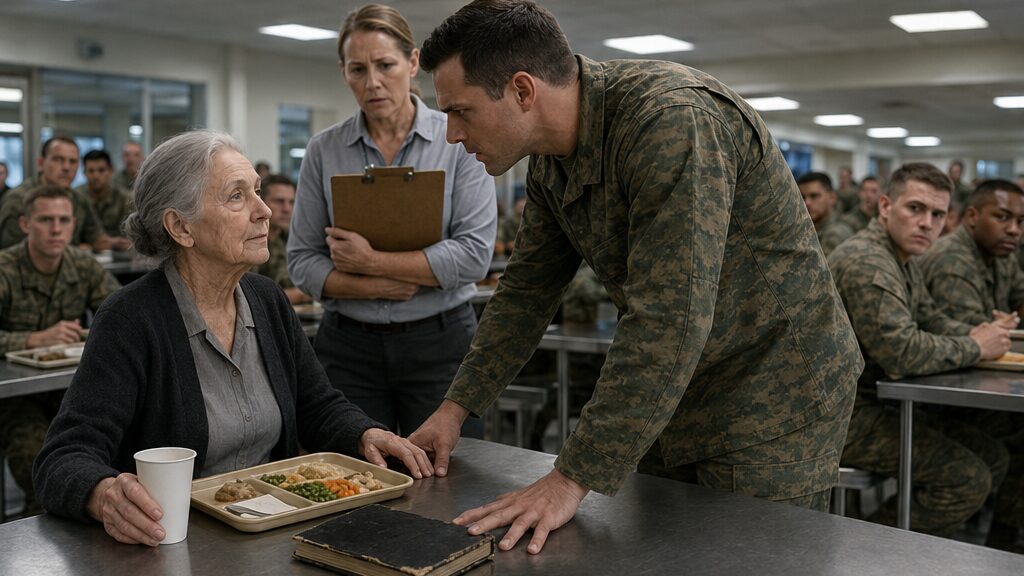
Tyler Green’s hand came down beside Barbara Hall’s tray before she had taken her first bite.
The paper cup trembled once. Not much. Just enough for the pale coffee inside to touch the rim and settle back. Barbara put two fingers around the cup, not to drink from it, but to steady it, the same way she had steadied soup bowls on rolling carts years ago when the dining hall floor had been slick from boots and rain.
The room did not go silent all at once. It changed by degrees. Forks slowed against trays. A chair scraped and stopped halfway back. Two young soldiers at the next table looked over, then looked down, then looked over again.
Tyler leaned across the end of her table in his camouflage uniform, shoulders squared, jaw tight, one palm still planted near her tray. His other hand pointed at the worn black logbook beside her napkin.
“Ma’am,” he said, though there was no respect in the word, “I asked you what this is.”
Barbara looked first at his hand. Clean nails. Strong wrist. Newer watch than regulation required. Then she looked at his face.
“It’s a book,” she said.
A faint smirk moved across his mouth. Behind him, Deborah Wright stood with a clipboard pressed to her chest. She had the dining facility keys clipped to her belt and the expression of someone who had been interrupted in the middle of something already going wrong.
“A book,” Tyler repeated, loud enough for the nearest tables to hear. “You write down names in a government dining facility and call it a book?”
Barbara kept her fingers around the paper cup. Steam had stopped rising from the coffee. She had known better than to take it too hot. Hot coffee made old hands less forgiving.
The dining hall lights were bright enough to flatten every face. Trays lined the tables in dull rows. A young soldier near the condiment station stood holding a packet of mustard, watching like he had forgotten why he had come there. On the far wall, the meal board listed baked chicken, green beans, rice, salad, and soup. Barbara knew the rice would dry out by twelve-thirty if no one stirred the pan. She knew the soup was too salty on Thursdays because the new kitchen hand always seasoned it before it reduced. She knew the table by the west window rocked if a heavy tray was set on the left corner.
Tyler knew none of that.
He tapped the logbook with two fingers. “Who authorized you to keep this?”
Barbara’s tray held chicken she had not touched, green beans, a roll, and the coffee. She had placed the logbook to the right, where she always placed it, far enough from spills but close enough to reach when someone stopped by. The cover had softened at the edges. The spine had been repaired twice with clear tape and once with black cloth tape from the supply drawer that no longer existed.
“No one uses that word for it,” she said.
“What word?”
“Authorized.”
The soldiers at the nearby table shifted. One of them hid a small smile, not at Tyler, not at her exactly, but at the clean little cut of the answer. Tyler noticed. His neck flushed.
Deborah stepped closer. “Mrs. Hall, Staff Sergeant Green is asking a reasonable question.”
Barbara turned her eyes to Deborah. “It’s Ms. Hall.”
Deborah’s mouth tightened. “Ms. Hall, then. We’re preparing for inspection. We cannot have unknown records being kept on personnel.”
“They aren’t personnel in there,” Barbara said.
Tyler picked up the logbook before she could lay her hand across it. The movement was quick, too quick for her old fingers. The cup trembled again. This time Barbara did not steady it right away. She watched the book lift from the table.
The room saw that. She could feel it in the pause around her, in the way the young soldiers suddenly had a scene to watch and no training for what to do with it.
Tyler opened the cover. The pages made a dry sound. He turned one, then another, scanning with impatience.
“Richard Green,” he read.
Barbara’s hand moved to the cup.
Tyler looked up, but not long enough to understand what had changed in her face. “Full name. Date. Meal notes.” He turned the book outward, as if presenting evidence to the room. “This is exactly what I’m talking about.”
“Put it down, please,” Barbara said.
Her voice was low. It did not carry to the serving line, but the tables nearest her heard it. So did Tyler. He did not put the book down.
“You have no badge visible,” he said. “Your volunteer card is expired in the system. You’re sitting here during active meal hours with a list of names. And when I ask you a basic question, you give me attitude.”
The word struck harder than his hand on the table had. Not because Barbara had never heard it. She had heard worse. In mess tents, in kitchens, in offices where young men came in loud and left quiet. But the word had an old trick in it. It made calm sound like defiance. It made dignity sound like trouble.
She looked down at her tray. The chicken had a line of gravy sliding toward the rice. She moved the roll one inch to stop it. That small, precise act drew Tyler’s eyes.
“Are you listening to me?” he asked.
“I am.”
“Then answer.”
Barbara breathed once through her nose. The room waited. It was not full silence. The ice machine coughed. A tray clattered in the wash area. Someone whispered near the salad bar and stopped when Deborah looked over.
Barbara had worn a gray blouse that morning and a dark cardigan because the dining hall vents always pushed cold air toward the middle tables. Her hair was pinned low. She had chosen the plain shoes with the rubber soles. She had told herself she was only coming for lunch, only checking on the inspection breakfast menu, only making sure the young kitchen hand remembered to set aside plain oatmeal for the soldiers who could not eat eggs.
She had not come prepared to explain a life.
“The names,” she said, “are not for getting anyone in or out.”
Tyler held the book higher. “Then what are they for?”
Barbara looked at the cover instead of his face. She knew every crack in that tape. She remembered the first page, the first name written in a hurry with a pencil that kept breaking. She remembered telling herself it would be temporary. Just a way not to forget who needed what. Who could not eat pork. Who had a mother in surgery. Who was turning nineteen and pretending not to care. Who sat alone too many mornings in a row.
“They’re people,” she said.
Tyler gave a short laugh through his nose. “People?”
“Yes.”
“That’s your answer?”
“It’s the only one that matters.”
His smile thinned. “No, ma’am. What matters is whether you’re keeping unauthorized records in a controlled facility.”
Barbara could have said she had served before he was born. She could have said she had fed soldiers in heat and mud and fluorescent rooms like this one until her knees gave out. She could have said the logbook had never been used to enter a building, never been used to get a favor, never been used to shame anyone. She could have said she knew the difference between memory and misuse.
Instead she sat with her hands around the paper cup.
Deborah shifted the clipboard from one arm to the other. “Staff Sergeant, maybe we should take this to the office.”
Tyler heard permission in that. He closed the logbook. “That’s exactly what we’re doing.”
Barbara looked at Deborah. “I haven’t finished my lunch.”
Deborah’s expression changed, only briefly. There was a flicker of discomfort, almost human and almost gone. “You can finish while we review the matter.”
“No,” Tyler said. “The book comes with me.”
Barbara’s fingers tightened on the cup.
At the nearest table, one of the young soldiers looked as if he might stand. Another touched his sleeve and shook his head. Barbara saw it. She knew that kind of warning. Don’t get involved. Don’t make trouble. Don’t interrupt rank. The old phrases had new faces, but they still knew where to sit.
Tyler tucked the logbook under his arm.
Only then did Barbara raise her eyes fully to him. She did not raise her voice. “If you carry that book like evidence, Staff Sergeant Green, you ought to remember it was written by hand.”
He hesitated.
She let the words sit there, plain and unadorned.
“Every line,” she added.
For one breath, his certainty seemed to misplace itself. Then he recovered, turned away, and nodded toward Deborah.
Deborah wrote something on her clipboard.
The dining hall resumed too quickly, which made the shame sharper. Forks started again. A chair slid back. Someone laughed near the drink machine, too loud and too late. Barbara looked at the empty rectangle on the table where the logbook had been. Dust from the old cover had left a faint dark mark beside her tray.
She picked up her fork. The chicken had cooled. She cut a small piece anyway, because leaving untouched food had always bothered her.
Before she could lift it, Deborah returned to the table and placed one hand lightly on the chair across from Barbara.
“Ms. Hall,” she said, quieter now, “we’ll need you to come to the office when you’re done.”
Barbara looked at the paper cup. The coffee had gone still.
Across the room, Tyler walked through the swinging office door with the logbook under his arm, and Barbara understood that whatever they found in it now would belong first to their suspicion.
Chapter 2: The Notice Under The Clipboard
Deborah already had Barbara’s name printed on the form before Barbara entered the office.
It sat on the desk under the clipboard, half-covered but not hidden. Barbara saw the bold letters upside down: BARBARA HALL. Under that, smaller type. Temporary Volunteer Access Suspension. Someone had printed it fast enough that the paper still held a slight curl from the machine.
Tyler stood near the file cabinet with the logbook in his left hand. He had not opened it again, but his thumb rested between the pages as if he had claimed a place.
Barbara remained in the doorway until Deborah noticed she had not sat.
“There’s a chair,” Deborah said.
“I see it.”
The office smelled of printer heat, floor cleaner, and the onion powder from the kitchen vents. On the wall hung a framed sanitation certificate, a calendar marked with inspection dates, and a laminated flowchart for reporting incidents. Barbara had once known every office that belonged to this building. None of those people were left. The desk had moved. The safe had moved. Even the old coffee maker was gone.
Only the hum of the refrigerator behind the wall sounded the same.
Deborah cleared her throat. “Ms. Hall, this is temporary.”
“Most permanent things start with that word.”
Tyler looked down.
Deborah pulled the form free from beneath the clipboard and turned it toward Barbara. “Your volunteer status in the current system is inactive pending verification. Until this is reviewed, you cannot access the dining facility in a volunteer capacity.”
“I came for lunch.”
“You used the volunteer entrance.”
“It’s the door closest to the ramp.”
“Your badge did not register correctly last month either.”
“No one told me.”
Deborah’s jaw tightened. “That’s part of the problem. A lot of informal arrangements were allowed to continue because people assumed someone else was keeping track.”
Barbara looked at the logbook in Tyler’s hand. “Someone was.”
Tyler exhaled sharply. “Ma’am, that is not an official tracking system.”
“No,” Barbara said. “It is not.”
The simple agreement seemed to irritate him more than an argument would have. He shifted his stance, then glanced toward the hallway, where the lunch crowd moved past in broken shadows through the wired glass.
Deborah sat, clicked her pen, and tried to sound gentler. “I understand you’ve been around this facility a long time.”
Barbara let the phrase pass. Around. As if she were dust in the corners.
“I served in Army food operations for twenty-two years,” Barbara said. “After that, I volunteered here when they asked for help with breakfast intake, dietary notes, and holiday meals.”
Deborah blinked. It was small, but Barbara saw it. Tyler saw it too.
“You’re retired Army?” Deborah asked.
Barbara looked at her. “Yes.”
The office changed around that one word, but not enough. Respect did not enter like a guest. It hovered outside, unsure if it had been invited.
Tyler’s mouth opened, then closed. Deborah glanced at him, then at the form.
“That may help verify your history,” Deborah said carefully. “But it does not resolve the current concern.”
Barbara nodded once. “No. It would not.”
Tyler frowned. “Then why didn’t you say that in the dining hall?”
Barbara turned to him. “You did not ask if I served.”
Color rose again at his neck. “I asked who authorized the book.”
“And I answered what it was.”
“No,” he said, the edge returning. “You avoided the question.”
Barbara looked at the paper on the desk. Her printed name seemed too clean there, stripped of every morning it represented. “I suppose I did.”
Deborah leaned forward, seizing the admission because it fit the shape of her form. “That avoidance is what concerns us. The logbook appears to contain names, personal details, meal restrictions, dates, possibly medical or family information. If an inspector sees records like that unsecured—”
“They are not unsecured when they are with me.”
“That is not how policy defines secure.”
Barbara nearly smiled. Not because it was funny. Because policy had always been a language that could make care sound careless.
Tyler opened the logbook now, not fully, just enough to expose the page his thumb had held. “There are notes like ‘no eggs,’ ‘call home after meal,’ ‘birthday,’ and names with dates. Some of these entries look recent.”
“They are.”
“Then it’s current personnel information.”
“It is current people information.”
Deborah’s pen stopped. “Ms. Hall.”
Barbara looked at her.
“I’m not trying to erase what you’ve done,” Deborah said. “But I have a contractor inspection in two days. If they flag uncontrolled records, volunteer access, or privacy violations, this facility takes the hit. My staff takes the hit. People who need these jobs take the hit.”
There it was—the first honest thing Deborah had said. Not kind, exactly. But honest. Barbara respected honest fear more than polite authority.
“Then you should have asked me before today,” Barbara said.
Deborah’s eyes flickered. “I should have.”
Tyler looked uncomfortable at that. He closed the logbook, then set it on the corner of the desk, but not within Barbara’s reach.
The distance stung more than she wanted it to.
Her right hand moved before she could stop it, searching the edge of the desk where her cup would have been if she were still in the dining hall. Her fingers found only smooth laminate. She curled them once and placed them in her lap.
Deborah noticed. So did Tyler.
Barbara hated that they had seen the reach.
Deborah slid the suspension notice closer. “You’re not barred from the base. You’re not being accused of wrongdoing at this stage. But you cannot return to the dining hall before the review.”
“The inspection breakfast is Thursday,” Barbara said.
“Yes.”
Barbara looked at the calendar. Thursday was circled in red. She knew what they would serve because she had corrected the order three weeks ago. Oatmeal without cinnamon on the side. Bananas not oranges because half the new recruits grabbed bananas on inspection mornings. Toast held back ten minutes so it would not go hard. Small things no one wrote into policy because small things only mattered when they were wrong.
“I need to be here Thursday,” she said.
Tyler folded his arms. “Why?”
Barbara looked at him a long moment. She could answer. She could say because inspection mornings made young soldiers too nervous to eat, and nervous soldiers made mistakes, and mistakes became discipline, and sometimes a piece of toast placed without a word did more good than a briefing.
Instead she said, “Because I said I would.”
Tyler’s face hardened again, but less completely this time.
Deborah opened a folder and placed the logbook inside. As she did, one loose photocopied page slipped from the stack beneath her clipboard. It turned halfway toward Barbara.
Barbara saw the handwriting first. Her own, darker then, steadier.
Richard Green — first breakfast after transfer. Sat alone. Asked for coffee, no sugar. Said his boy liked pancakes.
A circle had been drawn around the name in blue pen.
Barbara’s breath stopped in her chest.
Deborah quickly slid the page back under the clipboard, but not before Tyler looked down and saw the name too. His expression changed so fast it was almost not an expression at all.
Barbara lowered her eyes before either of them could read her face.
Deborah placed the suspension notice in front of her. “Please sign to acknowledge receipt.”
Barbara picked up the pen. The plastic felt too light. She signed her name where the form told her to sign.
When she stood, Tyler was still staring at the edge of the folder where the copied page had disappeared.
Barbara walked out without asking for the logbook back, because if she asked and they refused, something in her might show.
Behind her, in the office, Tyler said quietly, “Why is my father’s name in that book?”
Chapter 3: The Page That Looked Like Evidence
Barbara’s badge gave one weak red blink, and the access clerk said, “You’re not active in the system.”
The words came through the glass window with the flat patience of someone who had already repeated them that morning. Barbara stood in the base access office with her purse strap over one shoulder and her old volunteer badge lying in the metal tray beneath the slot. Behind the clerk, a printer chattered. Beside Barbara, a young soldier shifted his weight from one boot to the other, waiting for a temporary pass.
“My badge was active yesterday,” Barbara said.
The clerk looked at the screen. “Not according to this.”
“It opened the side door last week.”
“That doesn’t mean it was active. Sometimes old badges still trigger local locks even when the profile is inactive.”
Barbara looked through the office window toward the sidewalk leading to the dining hall. The building sat low and square, with its glass entrance reflecting the morning sun. Through the far doors she could see movement inside: kitchen staff rolling carts, soldiers lining up for breakfast, the familiar flash of stainless-steel pans.
She had not realized how much the building looked like itself when she could not enter it.
“I’m scheduled for a review,” she said.
The clerk typed. “With dining facility management?”
“And the senior enlisted liaison.”
“Then someone from that office needs to escort you.”
Barbara folded her hands over the top of her purse. “Could you call them, please?”
The clerk did. Barbara waited. The young soldier beside her received his pass and left. Another person came in, then another. The access office smelled of toner and damp uniforms. A wall-mounted television played a safety video with the sound too low to understand.
At last, the clerk hung up. “Someone will come get you.”
“Did they say who?”
“No, ma’am.”
The ma’am sounded kinder than Tyler’s had. Barbara nodded and stepped away from the window.
She had dressed carefully: same dark cardigan, clean blouse, shoes polished more out of habit than need. In her purse she carried nothing that could save her. No commendation folders. No photographs of herself younger and straighter-backed. No certificate with a seal. She had almost taken them. She had opened the drawer where they lay and touched the corner of a yellowed document. Then she had closed the drawer again.
If they only listened because paper said she had once mattered, then they would miss the point entirely.
The dining hall door opened across the sidewalk. Tyler Green came out.
Barbara saw the moment he saw her. His pace slowed, then resumed with purpose. He carried a folder under one arm. Not the logbook. A folder.
“Ms. Hall,” he said when he reached her. His voice was controlled. Less sharp than yesterday, but not soft.
“Staff Sergeant.”
“They asked me to escort you to the entrance area. The formal review isn’t until tomorrow.”
“I was told there was a preliminary question.”
“There is.” He looked toward the access office, then toward the dining hall. “Several.”
She waited.
He seemed to dislike that. “Your badge is inactive because volunteer records migrated to a new system six months ago. You didn’t complete the updated privacy training.”
“No one sent it to me.”
“It went by email.”
“I do not use the email they have on file.”
“That’s part of the issue.”
“Yes,” she said. “I expect it is.”
They began walking toward the dining hall. Tyler kept his pace slow enough for her but stiff enough to make the courtesy look reluctant. Barbara noticed anyway. She noticed most things people tried to hide inside procedure.
At the entrance, he stopped before the glass doors instead of opening them. Through the glass, the tray line moved. A kitchen worker lifted a pan of eggs. A young recruit stood at the end of the line looking uncertainly at the signs. Barbara’s eyes went to him by instinct. Too thin. New haircut. Holding his tray too tight. He picked up a carton of milk, put it down, then picked it up again.
“Ms. Hall,” Tyler said.
She drew her attention back.
He opened the folder and took out a photocopied page. Her handwriting faced her like a witness called by the wrong side.
“Deborah asked me to clarify some entries before the review.” He held the page between them. “This one says ‘no eggs—watch swelling,’ then a name. This one says ‘call home after meal.’ This one says ‘keep aside, birthday if he shows.’ Do you understand how this reads?”
Barbara looked at the page. The paper was too white. The copy had stripped the ink of age and pressure. Her handwriting looked exposed, almost suspicious, without the softness of the original pages around it.
“It reads like notes,” she said.
“It reads like you were tracking personal issues.”
“I was remembering what I needed to remember.”
“You can’t just decide that.”
“No.”
He stared at her. “That’s it? No?”
“I can’t just decide it. I did decide it.”
His mouth tightened. “That kind of answer is not going to help you tomorrow.”
The glass doors opened behind him and a warm smell of toast and coffee came out. The young recruit Barbara had noticed stood just inside, turning slowly as if searching for someone. He saw Barbara through the glass. Recognition crossed his face.
He stepped outside before Tyler could stop him.
“Ma’am,” the recruit said, looking at Barbara, not Tyler. “Sorry. Are you not working breakfast today?”
“No,” Barbara said. “Not today.”
His face fell. “Oh.”
Tyler turned to him. “Do you need something?”
The recruit straightened. “No, Staff Sergeant.”
Barbara looked at the carton of milk in his hand. “The oatmeal is safer than the eggs if your stomach is still troubling you.”
The recruit blinked. Then he looked embarrassed and grateful all at once. “Yes, ma’am. Thank you.”
Tyler looked from the recruit to Barbara. “You know him?”
“Not well.”
“She remembered,” the recruit said quickly. “Last week I had a reaction. She told the kitchen. I didn’t know who to tell.”
Tyler’s grip on the folder changed.
“Go eat,” Tyler said, but the edge had gone out of his voice.
The recruit nodded and slipped back inside.
For a few seconds, neither of them spoke. Behind the glass, the young man moved down the line and took a bowl of oatmeal. Barbara watched until he found a seat.
“That,” Tyler said finally, “still doesn’t make the book authorized.”
“No.”
“But it explains one entry.”
“Yes.”
He looked at the photocopy again. “There are hundreds.”
“Not all current.”
“Some are.”
“Yes.”
“And some include family information.”
Barbara said nothing.
Tyler exhaled, frustrated. “Christopher White is already asking why this wasn’t handled before the inspection cycle. Deborah filed the incident as a compliance concern. If this becomes a formal privacy issue, it’s not just about you.”
“I know.”
“Do you?” He lowered his voice. “Because from where I’m standing, you act like if you stay quiet long enough, everyone else has to guess noble reasons.”
That found its mark.
Barbara turned from the glass. For the first time since he had come outside, she looked at him not as a young man with authority, but as someone who had accidentally spoken the truth.
“You are not wrong,” she said.
Tyler seemed unprepared for that.
Barbara’s throat felt dry. She wished for her paper cup, even empty. “But some things become smaller when you explain them to someone determined to measure them wrong.”
His face changed. Not softened exactly. Shifted. The anger did not leave, but uncertainty entered beside it.
He put the photocopy back in the folder. “Christopher scheduled the review for tomorrow morning. Dining facility side room. Deborah will be there. I’ll be there. He said you can bring any proof of purpose.”
Barbara repeated the phrase silently. Proof of purpose. As if purpose sat in a drawer, signed and stamped.
“Any proof?” she asked.
“Yes.”
“Of why the book exists?”
“Yes.”
Barbara looked through the glass one more time. The young recruit sat alone at a table near the wall, eating oatmeal slowly, shoulders loosening bite by bite. In the tray line, no one noticed.
“No,” Barbara said.
Tyler frowned. “No, what?”
“No, I do not know how to prove that properly.”
His expression hardened again, but this time it looked less like contempt and more like fear.
“Then tomorrow may not go the way you want,” he said.
Barbara adjusted the strap of her purse on her shoulder. “It already has not.”
He walked her back toward the access office. At the door, he paused as if there was something else he meant to ask. The name, perhaps. The one on the copied page. The one Deborah had circled. But he did not ask it.
The clerk slid Barbara’s inactive badge back through the tray.
Barbara picked it up and held the little plastic card in her palm. Her younger photograph looked out from beneath scratched laminate, faded but still trying to belong.
Behind her, Tyler said, “Bring anything that shows why the book should exist.”
Barbara closed her fingers over the badge.
For the first time that morning, she wondered whether telling the truth would protect the logbook—or turn it into something they could file, lock away, and never understand.
Chapter 4: The Meal She Still Kept Waiting
Barbara opened the cupboard and found the paper cups stacked behind her plates like contraband.
There were twelve of them, maybe thirteen, pressed together in a white column at the back of the shelf. She had not meant to keep them. One had come home in her purse after a winter volunteer shift. Another after a holiday breakfast when she had been too tired to finish her coffee before the shuttle left. Over time they had gathered there, each one ordinary, each one carrying the faint waxy smell of the dining hall.
She stood in her small kitchen with the inactive badge on the counter and looked at the cups as if they had been waiting to testify.
The morning light touched the sink, the dish towel folded over the handle, the single bowl she had washed before bed. Everything in the kitchen had its place. Barbara liked places. Plates left. Bowls above. Mugs by the stove. Medicines in the narrow drawer, though she disliked admitting she needed a drawer for them. The order had once comforted her. That morning, it looked too much like disappearance.
She reached into the cupboard and took down one paper cup.
It weighed almost nothing.
Her phone lay on the counter with no messages. Deborah had not called. Christopher White had not called. No one from the volunteer office had called to say there had been a mistake, that her badge would be fixed, that the logbook had been returned, that the inspection breakfast still needed the old woman who knew how nervous soldiers forgot to eat.
Barbara set the cup beside the badge.
Then she opened the drawer beneath the counter.
Inside were the things she had almost brought the day before: old service papers, a folded photograph of herself in uniform beside a field kitchen, a certificate with her name typed stiffly across the middle. Barbara touched the photograph. The younger woman in it stood straight-backed, sleeves rolled, eyes narrowed against sun. A row of metal food containers stood behind her. She remembered the heat coming off them. She remembered telling a young cook not to waste steam by lifting lids too often. She remembered being listened to.
She closed the drawer.
“No,” she said aloud.
The kitchen answered with the refrigerator hum.
She had not refused the papers because she was humble. She knew that. Humility was too clean a word for the stubbornness in her. Some part of her wanted them to understand without being shown. Some part of her still believed that if the Army forgot her unless she produced proof, then maybe being forgotten was the truth she deserved to accept.
That thought made her angry, and the anger steadied her better than coffee.
She took her coat from the chair, put the paper cup in her purse without thinking, and left the apartment before she could change her mind.
The base sidewalk ran along the fence toward the dining facility. Barbara did not use the volunteer entrance. She did not go near the access office. She stayed outside the low building, where she could see the lunch line through the glass and smell coffee each time the door opened for someone else.
She told herself she had only come to walk. Then she told herself that was foolish. Old women did not need to lie to themselves when everyone else was already willing to do it for them.
Near the side entrance, a young recruit stepped out with a tray balanced awkwardly in one hand. He saw her and stopped.
“Ma’am?”
Barbara recognized him after one second. The oatmeal. The milk carton. The uncertain shoulders.
“You should not bring trays outside,” she said.
He looked down as if surprised to find it there. “I know. I just—” He glanced at the door. “I was looking for you.”
Barbara looked through the glass. No one seemed to have noticed him yet.
“You found me.”
He came a few steps closer. He was younger than she had first thought. Not a boy, but close enough to one that his serious face had not yet learned where to hide worry.
“They said you weren’t allowed in,” he said, then seemed to regret it. “I mean, someone said. Not officially.”
“People rarely wait for official before speaking.”
He gave a nervous smile. “Yes, ma’am.”
His tray held oatmeal, toast, and a banana. No eggs.
Barbara nodded toward it. “Better?”
“Yes, ma’am. No swelling this time.” He touched his throat, embarrassed. “I didn’t know I was supposed to report that stuff through medical before meals. You told me where to go.”
“Medical tells you what is safe. Kitchen needs to know what not to put on your tray.”
“Nobody else noticed.”
Barbara looked at the side door. “People are busy.”
“You noticed.”
The words landed softly, which made them harder to receive.
He shifted the tray. “I just wanted to say thanks. And… they’re wrong if they think that book was weird.”
Barbara’s hand tightened around the strap of her purse.
“What do you know about the book?”
“Not much. Just that you wrote things down so people didn’t have to explain everything twice.” He looked at his oatmeal. “Sometimes explaining is worse than the thing.”
Barbara studied him. There it was again, truth arriving from someone too young to know how much it cost.
“It can be,” she said.
He looked past her toward the sidewalk. “Are you coming back for inspection breakfast?”
“I don’t know.”
His face changed before he could hide it. “Oh.”
“It is not your concern.”
“No, ma’am.” But he did not move.
The door opened behind him. A kitchen worker looked out. “Tray stays inside.”
The recruit turned quickly. “Yes. Sorry.”
Barbara almost let him go. The old habit rose in her, practiced and sharp: let the young leave with what little help they asked for, keep the rest behind your teeth.
But her badge was inactive. Her logbook was in an envelope somewhere. Richard Green’s name had been circled by someone who did not know what the circle touched. And the inspection breakfast was two days away.
“Wait,” Barbara said.
The recruit turned back.
“If I am not there Thursday,” she said, “ask for plain oatmeal before the eggs are opened. The serving spoon gets mixed if they rush.”
He nodded.
“And if someone tells you to wait because they are busy, tell them you have a recorded dietary concern.”
“I don’t like making trouble.”
“No one does when trouble is already standing in their way.”
He looked at her for a moment, then nodded again, more firmly.
The kitchen worker called from inside. The recruit carried his tray back through the door. Before it closed, Barbara saw him say something to the worker and point to the oatmeal. The worker listened. Not long. Not warmly. But listened.
Barbara stood outside with her purse against her side and felt the paper cup inside it crush slightly under her hand.
She could disappear. She knew exactly how to do it. Stop coming. Let them review the book, file the notice, decide she had been a well-meaning risk. Someone might call in three months with an apology that sounded like a voicemail. Someone might mail the logbook back or say it had been archived. Eventually the dining hall would learn its own lessons the hard way. Young soldiers would still be fed. Most would be fine.
Most had always been a dangerous word.
Barbara walked home slowly.
This time, when she entered her kitchen, she did not open the drawer of old commendations. She took a legal pad from beside the phone and sat at the table. At the top of the page, she wrote: Why the book exists.
The phrase looked strange in her handwriting.
For ten minutes she wrote nothing under it.
Then she crossed out the words and wrote again: What I failed to say.
That was harder. Better.
She wrote about the first year after retirement, when she came back to help with holiday meals and found a young soldier sitting alone on Thanksgiving with his fork untouched. She wrote about breakfast lines where the quiet ones got missed because loud hunger was easier to serve. She wrote about allergies, grief, birthdays, transfers, first meals after bad news, last meals before flights. She did not write ranks unless necessary. She did not write medals. She did not write her own service record.
By afternoon, the page held less than she meant and more than she wanted.
A knock came at the door just as she folded it.
Barbara did not move at first. No one came to her door without calling. She looked at the clock, then at the badge on the counter.
The knock came again, firmer but not aggressive.
She opened the door with the chain still fastened.
Tyler Green stood in the hallway, uniform cap tucked under one arm. In his other hand he held a clear evidence envelope. Inside it, worn black cover visible through plastic, was the logbook.
His face looked different away from the dining hall. Younger. More tired.
“Ms. Hall,” he said. “I know I shouldn’t be here.”
Barbara looked at the envelope, then at him.
“Then why are you?”
Tyler swallowed. His hand tightened around the sealed plastic.
“Because before tomorrow,” he said, “there’s something in this book I need to ask you without Deborah Wright listening.”
Chapter 5: The Inspection Turned The Room Against Her
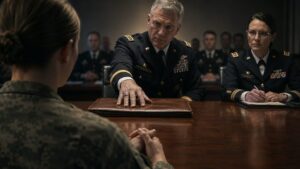
Barbara saw the logbook placed on the review table like contraband before anyone asked her to sit.
The clear evidence envelope had been removed, but not forgotten. It lay folded beside Deborah Wright’s clipboard, its red seal broken cleanly along the top. The logbook itself sat under the fluorescent light, old black cover exposed, edges worn, spine taped, a thing built by hands now being judged by forms.
Barbara stopped in the doorway of the dining hall side room.
Christopher White stood at the head of the table with a folder open in front of him. He was older than Tyler, younger than Barbara, with the practiced stillness of a man used to being the final voice in small rooms. Deborah sat to his left, pen ready. Tyler stood near the wall, shoulders tight, eyes not quite meeting Barbara’s.
A tray had been set for her on a small side table. Coffee in a white paper cup. Toast. Fruit. Someone had tried to be considerate.
The kindness made the room harder to enter.
“Ms. Hall,” Christopher said. “Thank you for coming.”
Barbara stepped inside. “I was escorted.”
Christopher accepted the correction with a small nod. “Please sit.”
She chose the chair across from the logbook. Not beside it. Across. If they meant to question the book, she would face it with them.
Deborah clicked her pen. “We have limited time before the inspection preparation meeting, so we need to be clear and efficient.”
Barbara looked at the clipboard. “Efficiency is why soup burns on the bottom.”
Deborah’s eyes lifted.
Christopher’s mouth almost moved. Tyler looked down.
Barbara regretted the sentence as soon as she said it. Not because it was untrue, but because it gave them another reason to call her difficult. She placed her hands in her lap.
Christopher folded his fingers. “The issue before us is not your past service. Staff Sergeant Green confirmed that you are a retired Army food-service veteran. The issue is the current status of your volunteer access and the nature of this logbook.”
Barbara nodded.
Deborah slid a photocopied packet forward. “These are selected pages.”
Selected. Barbara disliked the word. It meant someone else had decided which parts of a life mattered.
Deborah continued. “There are names, dietary notes, personal references, dates, and what appear to be family details. Some entries are historical. Some are recent. Regardless of intent, this creates privacy and compliance concerns.”
Tyler shifted near the wall.
Christopher looked at Barbara. “Can you explain the purpose of the book?”
Barbara had written that question and crossed it out. Still, hearing it from him made her throat tighten.
“It began as a kitchen aid,” she said. “Unofficial. Temporary. Those are usually dangerous words, but they are true.”
Deborah wrote something.
Barbara kept going before silence could reclaim her. “A soldier could not eat eggs. Another needed soft food after dental work. Someone had orders changed and missed dinner. Someone’s mother died and he sat in the corner for three mornings, pretending coffee was breakfast. The book helped me remember.”
Tyler’s eyes lifted at that.
Deborah looked at the packet. “This entry says, ‘No eggs—watch swelling.’”
“Yes.”
“That sounds medical.”
“It was practical.”
“It is medical enough to concern me.”
Barbara nodded. “It should concern you. It concerned me when his throat tightened in my line and no one knew who to tell.”
Deborah’s pen paused.
Christopher turned a page. “This same soldier spoke to Staff Sergeant Green yesterday.”
“He did.”
“You remembered him without the book.”
Barbara looked at the logbook. “The book taught me how.”
For the first time, Christopher looked at the cover not as a problem but as an object someone had held for a long time.
Deborah leaned forward. “No one is disputing that you cared. But care cannot override policy. If an inspector asks why a volunteer kept personally identifiable notes in an unsecured log, I cannot answer with ‘she cared.’”
“No,” Barbara said. “You cannot.”
Tyler looked at her sharply, as if expecting resistance and finding agreement instead.
Deborah’s shoulders loosened a fraction. “Then you understand.”
“I understand the risk,” Barbara said. “I do not understand why the risk was invisible until the book embarrassed someone.”
The room tightened again.
Christopher glanced at Tyler. Tyler’s jaw set, but he did not speak.
Deborah’s face flushed. “The book became visible because Staff Sergeant Green observed irregularities.”
“He observed an old woman with a book and chose the middle of lunch to make her answer for it.”
The words came out level. Not loud. That made them worse. Barbara felt Tyler flinch before she saw it.
Christopher did not rescue him. “Staff Sergeant Green’s handling of the matter will be addressed separately.”
“No,” Barbara said.
All three looked at her.
She had surprised herself too. Her hands, hidden in her lap, curled once.
“No?” Christopher asked.
“Not separately. That is how rooms like this stay clean while dining halls stay careless.” Barbara looked at Tyler, then Deborah. “If you discuss the book without discussing how it was taken, you will misunderstand both.”
Tyler’s face had gone still.
Deborah closed her lips tightly.
Christopher sat back a little. “Fair.”
The word changed the air. Not enough to save anything, but enough to let Barbara breathe.
He opened the logbook carefully. That, too, mattered. He did not flatten the spine. He did not lick his finger to turn pages. He moved through it as if someone might care how it survived.
“Staff Sergeant,” he said, “read the entry you flagged from last month.”
Tyler stepped forward. His hand hesitated above the page before touching it. Barbara noticed that he no longer handled the book like evidence.
He read, “Baker table, third seat. Hold tray if late from medical. No tomato. Says he forgets when nervous.”
Deborah looked up. “That sounds like preferential treatment.”
Barbara said, “It was a recruit with a tomato allergy who did not want to keep saying it in front of his group. He was late from medical because medical was confirming it. I held the tray so he would not skip the meal.”
Tyler did not look at Deborah. He looked at the page.
Christopher asked, “Was this coordinated with kitchen staff?”
“The allergy was,” Barbara said. “The embarrassment was not.”
The sentence settled quietly.
Deborah rubbed at the bridge of her nose. For the first time that morning, she looked less like a manager defending a form and more like a woman standing between a contractor, an inspection team, and a room full of human mess no form wanted.
“I believe you,” she said.
Barbara looked at her.
“I do,” Deborah repeated. “But believing you does not solve the problem. If the contractor team sees this, if command asks why a retired volunteer has unsupervised notes, if there is a privacy complaint—my staff pays for that. Not just me. The cooks. The line workers. The people washing trays. Good intentions don’t protect their jobs.”
Barbara did not answer quickly. She respected that fear. She had lived most of her working life near people whose mistakes were counted faster than their care.
“You are right,” she said.
Deborah seemed startled.
Barbara touched the edge of the table. “I should have asked for the book to be formalized years ago. Or stopped when the system changed. Or taught someone else what it was for before I became the only person who knew.”
Tyler looked at her then, really looked. Shame passed over his face, but she did not reach for it. Shame was not a handle she wanted.
Christopher closed the folder in front of him. “One option is to remove the book from use immediately, secure it, and allow Ms. Hall to continue volunteering after retraining.”
Deborah nodded too quickly. “That would be the safest immediate course.”
Barbara felt the false solution open in the room like a clean drawer. Put the troublesome thing away. Let the old woman come back if she agreed to stop carrying the past where anyone could see it. Everyone could call that respect and go home.
“No,” Barbara said softly.
Deborah’s pen stopped again.
Christopher waited.
Barbara looked at the logbook. “Not destroyed. Not hidden because it made you uncomfortable. Secured, yes. Reviewed, yes. But not treated like a spill.”
Tyler turned a page, perhaps to avoid looking at her. His fingers moved through the old entries, slower now. He stopped.
Barbara saw the change before he spoke.
His shoulders lowered half an inch. His eyes fixed on the page as if the words had moved under his hand.
Christopher noticed. “Staff Sergeant?”
Tyler did not answer.
Deborah leaned slightly forward. “What is it?”
Tyler’s thumb rested beside a name written years earlier in Barbara’s darker, steadier hand.
Richard Green.
The room seemed to narrow around that line.
Tyler swallowed once, but his voice, when it came, barely filled the space between them.
“What did you write about my father?”
Chapter 6: The Name Tyler Did Not Expect
“Why is my father’s name in your handwriting?”
Tyler did not sound like a staff sergeant when he asked it. He sounded younger than the uniform on his shoulders, younger than the anger he had worn in the dining hall, younger even than the man who had come to Barbara’s door the evening before and stood holding the sealed logbook like it might accuse him.
The side room had emptied after the question. Not immediately. Deborah had wanted to stay. Christopher had wanted procedure. But Barbara had looked at Tyler’s face and then at the dining hall beyond the interior window, where lunch was ending and trays were being stacked, and she had said, “Not in here.”
Now the main cafeteria sat between meals, hollowed out by quiet. A kitchen worker sprayed down the serving line behind the half wall. Chairs stood pushed in unevenly. The table where Tyler had confronted her the first day was clean, but Barbara could still see where her tray had been, where the logbook had lain, where his hand had landed.
She sat there because he needed to see it.
Tyler stood across from her with the logbook open between them. He had asked the question once in the review room. He asked it again now, softer and more dangerous.
Barbara placed one hand around the fresh paper cup Christopher had brought her before leaving them. She had not asked for it. He had simply set it down and walked away. The coffee inside was cooling.
“Your father ate here,” she said.
Tyler gave a short, humorless breath. “A lot of soldiers ate here.”
“Yes.”
“That’s all?”
“No.”
He looked down at the page. “Richard Green. First breakfast after transfer. Sat alone. Asked for coffee, no sugar. Said his boy liked pancakes.” His voice caught on the last word, and the catch angered him. “Why would you write that?”
“Because he said it.”
“That doesn’t answer me.”
“It is the answer I have.”
Tyler pressed both hands to the table, not near her tray this time, but near the book, as if holding himself upright. “My father never talked about this place.”
“Many soldiers do not talk about where someone was kind to them. They talk about where someone tested them.”
His eyes flashed. “You don’t know what he talked about.”
“No,” Barbara said. “I know what he did not say at breakfast.”
The words stopped him.
A tray cart rattled near the dish room. Someone laughed behind the kitchen door and was hushed. The sound disappeared quickly, leaving the two of them with the hum of the lights.
Barbara turned the logbook slightly. The page was old enough that the ink had softened at the edges. She did not touch Richard Green’s name. She touched the margin beside it.
“He came in before most of the line,” she said. “Not first. The ones who cannot sleep are never first. They wait where they can pretend they only arrived early.”
Tyler stared at her.
“He had transfer papers folded in his pocket. Kept touching them. Asked for coffee. No sugar. I asked if he wanted food. He said he would eat later.”
“That sounds like him,” Tyler said before he could stop himself.
Barbara let that small admission pass without reaching for it.
“I gave him pancakes anyway,” she said. “Not a stack. Two. He looked at them for a long time and said his boy liked pancakes. I asked how old. He said five.”
Tyler looked away.
Barbara knew enough not to ask if that boy had been him. The page had already asked.
“He ate one,” she continued. “Wrapped the other in a napkin like he was stealing it, though it was no good to anyone after sitting on his tray. Before he left, he said inspection mornings made young soldiers feel like a mistake before they had made one.”
Tyler’s face tightened.
“He asked me,” Barbara said, “not in a formal way, not as a grand thing. Just said if I saw one sitting alone on a morning like that, maybe I could put food in front of him before anyone made him ask.”
Tyler’s eyes returned to hers. The anger had not vanished. It had lost its target.
“And you wrote that down.”
“I wrote enough to remember.”
“You never told him?”
“That I wrote it? No.”
“Why?”
“Because some kindnesses embarrass people if you name them too loudly.”
He looked at the dining hall, at the tables, at the place where other young soldiers had watched him lean over her. His mouth moved once, but no words came.
Barbara lifted the paper cup and took a small sip. The coffee was lukewarm. She preferred it that way.
Tyler sat down across from her without asking.
It was the first time he had lowered himself to her level.
“My father said the Army forgot people,” he said. “Not in those words. He wasn’t dramatic. He just…” Tyler rubbed his hands together, then stopped when he noticed the movement. “He kept everything in boxes. Orders, patches, old meal cards, stupid things. After he died, I found half of it and none of it explained anything.”
Barbara did not soften her face too much. Pity could humiliate as quickly as contempt.
“He was not forgotten by everyone,” she said.
Tyler looked at the book. “And I stood over you in front of the whole room.”
“Yes.”
He shut his eyes briefly.
Barbara waited. She knew what he wanted. He wanted her to tell him grief made people careless. He wanted her to say he had been under pressure. He wanted forgiveness to arrive fast enough that he did not have to sit with the shape of what he had done.
She had given too many young soldiers quick comfort and watched them mistake it for repair.
When he opened his eyes, she said, “Your father’s name does not erase what happened.”
He nodded once, hard. “I know.”
“Do you?”
His jaw worked. “I thought you were using the book to get around rules. Deborah said inspection could fall apart over loose records. Christopher was already on me about access control. I saw an old badge, no current training, names written down, and I thought—”
“You thought the worst thing that fit your fear.”
He looked at her then, startled by the precision.
Barbara turned the cup slowly between both hands. “I have done that too.”
“You?”
“I thought if I explained the book, you would make it smaller. So I let you make it worse.”
He absorbed that. Not as absolution. As weight shared without being divided.
The kitchen doors opened. Deborah appeared at the far end of the dining hall, saw them, then stopped. Christopher stood behind her. Neither came closer.
Tyler noticed them. His spine straightened by habit.
Barbara said, “Do not perform remorse for them.”
His eyes flicked back to her.
“If you are sorry,” she said, “be sorry where it costs you something useful.”
“What does that mean?”
“It means tomorrow is inspection breakfast.”
“Christopher still needs a decision before then.”
“Yes.”
“Deborah wants the book secured and removed.”
“I heard her.”
“And you?”
Barbara looked toward the serving line. The young recruit from the day before was not there. Another soldier sat alone near the west wall, pretending to study a laminated card while his tray cooled.
“I will be at that table tomorrow morning,” she said.
Tyler’s face tightened. “Your badge is still inactive.”
“Then someone will decide whether an inactive badge matters more than an active promise.”
“Ms. Hall—”
“I will come with or without permission.” She closed the logbook gently, then slid it toward him. “But I will not come to embarrass you.”
He looked down at the book, then back at her. The sentence seemed to hurt him more than anger would have.
Across the dining hall, Deborah took one step forward, but Christopher stopped her with a small movement of his hand.
Tyler rested his palm on the logbook. Not claiming it now. Keeping it still.
“What are you going to say tomorrow?” he asked.
Barbara picked up the paper cup and stood carefully.
“The part I should have said before you took the book,” she answered. “And the part you will have to decide whether to hear.”
Chapter 7: The Breakfast Where Silence Changed Sides
Barbara was already sitting at the same table when the inspection team walked into the dining hall.
No one had escorted her to it. No one had announced her. She had come through the front entrance with Christopher White beside her, her inactive badge clipped where it had always hung, and the logbook held flat against her cardigan with both hands. The access clerk had looked at Christopher. Christopher had looked at the clerk. The door had opened.
That was all.
Now the room noticed her in pieces.
A kitchen worker stopped wiping the counter. Two young soldiers at the drink station lowered their voices. Someone near the tray return turned fully around. The dining hall did not go silent the way it had on the first day, when shame had spread like spilled coffee. This silence moved more carefully. It recognized the table first. Then the woman. Then the worn black book beside her fresh tray.
Barbara placed the logbook to the right of her napkin.
The white paper cup sat near her fingers.
She had not opened the book. She had not touched the coffee. She sat with her back straight enough to cost her and waited while the room decided whether to look at her or pretend not to.
Tyler Green stood near the serving line. His uniform was pressed, boots polished, face controlled. But when he saw her at the table, something in him faltered. Not enough for anyone to accuse him of weakness. Enough for Barbara to see.
Deborah Wright came out from the side office carrying her clipboard like a shield. Her eyes went straight to the logbook.
“Ms. Hall,” she said, too low for the room but sharp enough for the table. “We agreed the book would remain secured until the review decision.”
“We did not agree,” Barbara said. “You proposed.”
Deborah’s mouth tightened. “The inspection team is here.”
“I see that.”
“This is not the time to make a statement.”
Barbara looked at the tray in front of her. Toast, oatmeal, banana. No eggs yet. Someone had remembered.
“I am having breakfast,” she said.
Deborah glanced toward Christopher, who stood a few feet away, hands folded in front of him. He did not step in. That unsettled Deborah more than open disagreement would have.
The inspection team moved along the serving line with clipboards of their own. They examined temperatures, checked labels, watched food handling, asked questions that made kitchen staff stand straighter. The dining hall continued around them, but every movement seemed aware of Barbara’s table.
Tyler approached before Deborah could speak again.
He stopped on the opposite side of the table, in the same place where he had leaned over her before. The difference was that he did not put his hands down. He kept them at his sides.
“Ms. Hall,” he said.
The nearest tables quieted.
Barbara looked up. “Staff Sergeant.”
He swallowed. His eyes moved once to the logbook and back to her. “I owe you—”
“No,” Barbara said.
The single word stopped him like a hand on his chest.
His face went pale.
She did not let the room turn his apology into another public scene. She had seen that hunger already building in the surrounding eyes. People wanted reversal. They wanted the young man humbled in the same place he had humbled her. Some of them might have called that justice. Barbara knew better. A dining hall did not become kinder because one person learned to suffer where another had suffered.
Tyler’s mouth closed.
Barbara softened her voice, but not enough that he alone could hear. “Not here. Not like that.”
He looked at her, and for a moment the whole room could see he understood less than he wanted to.
She touched the paper cup. “Correction matters more than punishment.”
That sentence carried farther than she expected.
Deborah’s expression shifted. Christopher lowered his eyes briefly, as if the words had landed somewhere private. At the serving line, one of the inspectors stopped reading a label and looked over.
Tyler nodded once and stepped back.
Barbara stood.
The movement took effort, and because it took effort, no one missed it. The chair legs made a small sound against the floor. She kept one hand on the table until her knees steadied. Then she picked up the logbook.
“I need to say something about this book,” she said.
Deborah inhaled sharply. “Ms. Hall—”
Christopher raised one hand, not to silence Barbara, but to stop Deborah.
Barbara did not raise her voice. The room adjusted itself to hear her.
“This is not an official record,” she said. “It should have been handled better. I should have handled it better. I kept it because I thought memory was safer in my hands than in a system that changes passwords every six months and forgets old names every year.”
A few soldiers glanced at one another. The inspection team had fully stopped now. No one had planned for this. That was plain on Deborah’s face.
Barbara opened the logbook, not to a dramatic page, not to Richard Green’s name, not to any entry that could turn the moment into a spectacle. She opened it near the middle and rested her palm beside the lines.
“This book began with food,” she said. “No tomatoes. No eggs. Soft meal after dental. Coffee before a hard call home. A banana held back because a young soldier could not eat when people watched him choose. Those are not secrets. But sometimes ordinary needs feel like secrets to the person carrying them.”
Tyler looked down.
Barbara continued. “Some of these notes should now be in proper channels. Some should be removed. Some should be kept only as history. That is true. But if the only lesson from this week is that the old book was improper, then you will miss the larger mistake.”
She looked at Deborah then, not unkindly.
“The mistake is letting care depend on whoever happens to remember.”
Deborah’s grip tightened on the clipboard.
One of the kitchen staff stopped pretending to work and listened openly.
Barbara closed the book. “I am not asking to keep doing things the old way because I am old. I am asking you not to confuse old with useless, informal with careless, quiet with guilty, or efficient with respectful.”
The room held the words. No one clapped. Barbara was grateful for that.
Deborah stepped forward, professional again because professionalism was the ground she trusted. “Ms. Hall, I appreciate the sentiment. I do. But policy still requires an answer. We cannot maintain a personal log of service members’ needs outside approved systems. If this book remains active, it exposes the facility and the staff. If it remains accessible, it exposes the people in it.”
“She’s right,” Barbara said.
That seemed to surprise Deborah more than resistance would have.
Barbara placed the logbook on the table. “The book should stop being active today.”
Tyler looked up.
“But it should not be destroyed,” Barbara said. “And it should not be hidden in a cabinet until everyone forgets why it mattered.”
Christopher took one step closer. “What are you proposing?”
Barbara looked at him. She had expected the question. She had feared it too. It was easier to defend a thing than decide what should become of it.
“A protected archive,” she said. “Not public. Not passed around. Reviewed properly. Historical entries separated from current information. Current needs moved into approved channels. Volunteers trained before they serve. Older veterans and retirees checked in with dignity, not suspicion. If someone keeps notes for care, those notes belong to the facility, not one person’s purse.”
Deborah was listening despite herself. Barbara could see the calculations begin: training, forms, approvals, labor, risk. But beneath that, something else had opened. A way out that did not require pretending the book was either harmless or dangerous, sacred or trash.
“And the logbook?” Christopher asked.
Barbara looked down at its worn cover.
For years, carrying it had felt like carrying the part of the dining hall that did not appear on inspection sheets. To let it leave her hands felt like leaving a post before properly relieved. Her fingers brushed the taped spine.
“The original should be secured,” she said. “Not by me. Not by someone trying to make it disappear. By the facility, with access rules. It should be kept as memory, not used as current instruction.”
A young soldier near the west wall shifted. Barbara recognized him as the one who had watched Tyler take the book. This time, he did not look away.
Deborah said, “That would require command approval.”
“Then ask.”
“It would require review.”
“Then review.”
“It would require someone to take responsibility.”
Barbara let her gaze rest on the clipboard. “Yes.”
The word exposed the room more than any accusation could have.
Christopher turned to Deborah. “Can a temporary process be in place before the end of the inspection window?”
Deborah hesitated.
The inspection team lead, who had been standing near the serving line, spoke from several yards away. “A facility-initiated corrective action plan is generally viewed differently than an unmanaged finding.”
Deborah turned toward the inspector, startled.
The inspector gave a small shrug. “Especially if the issue is identified, contained, and converted into compliant process before we write it up.”
Deborah looked back at Barbara. There was no warmth yet, but the fear in her face had changed shape. It had found a task.
“I can draft a temporary sign-in and dietary referral sheet,” Deborah said. “Volunteers use it under staff supervision. No personal notes leave the office. Historical materials secured pending review.”
Christopher nodded. “Do it.”
Tyler stepped forward. “I can help with the access list.”
Barbara turned to him. The room noticed that too.
He did not look away. “Properly,” he added.
Barbara accepted the word with a small nod.
Deborah opened her clipboard, then paused. “Ms. Hall, if you continue as a volunteer after retraining, you would have to follow the new process.”
“I know.”
“No exceptions.”
“Good,” Barbara said.
Deborah blinked.
Barbara sat down again, slowly. Her legs were tired. Her coffee had cooled. She took the paper cup in both hands, not to hide trembling this time, but because it was warm enough to hold.
Christopher moved closer to her table. His voice lowered, but not so low the others could not hear.
“Ms. Hall,” he said, “what should happen to the logbook right now?”
The question stood in the room with more weight than command.
Barbara looked at the book, at Tyler, at Deborah’s clipboard, at the young soldiers waiting for the answer to teach them what kind of place they were in.
Then she placed her palm flat on the worn cover one last time before sliding it toward Christopher.
Chapter 8: The Seat No One Had To Defend
Barbara’s badge worked before anyone had to explain who she was.
The reader flashed green. The small sound it made was ordinary, almost cheap, but Barbara stood still for half a breath after hearing it. No clerk looked over Christopher’s shoulder. No one frowned at a screen. No young soldier stepped in front of her to ask why she was there. The door opened, and the dining hall air came out warm with coffee, toast, and floor cleaner.
A laminated card had been clipped beneath her badge.
Volunteer — Dining Facility Support.
Not handwritten. Not temporary. Not perfect. Enough.
Barbara stepped inside.
The first thing she saw was not the serving line or the tables. It was the small glass-fronted case near the entrance where a bulletin board had once held outdated flyers. The board was gone. In its place sat the worn black logbook, closed, spine repaired properly with archival tape. A small printed note stood beside it.
Historical Dining Hall Volunteer Log. Secured review copy available through facility management. Current needs must be recorded through approved staff process.
Barbara read the note twice.
It did not say what the book had meant. It did not say what it had cost. It did not say Richard Green had once wrapped a pancake in a napkin for a five-year-old boy he missed. It did not say a quiet recruit could get fed without explaining his fear to three different people.
But it also did not call the book evidence.
That was something.
“Ms. Hall.”
Deborah Wright stood by the host station with a clipboard in one hand and a new binder in the other. She looked tired in a way Barbara understood. Tired from doing something properly after years of doing it around the edges.
“Good morning,” Barbara said.
Deborah held out the binder. “Volunteer sign-in is here now. Dietary concerns get referred through the staff lead. Memory or morale notes are not written with personal identifiers unless approved. Historical log stays secured. Christopher signed off on the temporary process. Command review is pending.”
Barbara looked at the binder. Its cover was clean, its labels too white. It had no softened edges, no tape, no weight of hands. She touched the corner.
“You made room,” Barbara said.
Deborah’s face moved around the words before settling. “I should have done it before someone had to make me.”
Barbara did not rescue her from that. “Yes.”
Deborah nodded. The honesty cost her; Barbara respected the payment.
“Your retraining is scheduled after lunch,” Deborah said. “Until then, you’re cleared to eat. If you choose to volunteer afterward, staff lead will brief you.”
“If I choose?”
Deborah’s eyes lifted. “Yes.”
It was the first time anyone had put the choice back in Barbara’s hands.
Barbara signed the new sheet. The pen was attached to the binder with a thin cord. She almost smiled.
At her usual table, a tray was already set down.
Tyler Green stood beside it.
He did not call attention to himself. He did not stand at attention. He did not ask the room to look. He had placed oatmeal, toast, a banana, and a white paper cup of coffee exactly where Barbara would have placed them herself. Then he stepped back as if leaving was part of the apology.
Barbara walked to the table.
“You don’t have to serve me breakfast,” she said.
“No, ma’am.”
“But you did.”
“Yes, ma’am.”
She looked at the tray. The coffee sat to the right, far enough from the edge. The napkin was folded under the spoon. No eggs.
“You remembered.”
Tyler’s jaw tightened once. “I wrote it on the approved sheet.”
Barbara looked up at him.
He did not smile. That was better. Smiling would have tried to make it easy.
“I’m scheduled for privacy training too,” he said. “Christopher said anyone who mishandled the situation gets it.”
“And did you mishandle the situation?”
“Yes, ma’am.”
The answer came without defense. Barbara let it stand.
Around them, the dining hall moved with its ordinary morning rhythm. Trays slid. Chairs scraped. Someone complained about toast. Someone laughed too loudly near the drink machine. Life, Barbara had learned, did not pause long for lessons. It returned and tested whether the lesson could survive noise.
Tyler looked toward the glass case. “I read the copy of my father’s entry again.”
Barbara set her purse on the chair beside her. “Did you?”
“He never told me that story.”
“No.”
“He probably would have hated that you wrote it down.”
“Probably.”
Tyler looked back at her then, and for the first time there was no demand in his face. Only grief, more disciplined now, no longer searching for someone convenient to strike.
“I’m glad you did,” he said.
Barbara pulled out the chair and sat. Her knees complained. She ignored them. “So am I.”
He took that as dismissal and turned to go.
“Staff Sergeant,” she said.
He stopped.
Barbara touched the edge of the tray. “There is a difference between rules that protect people and rules people hide behind.”
He nodded slowly. “I’m learning.”
“Do not learn it only from shame.”
His eyes held hers. “No, ma’am.”
He left her table then, not hurried, not slow. At the serving line, he stopped beside a young soldier who was staring at the signs with a tense, lost expression. Tyler did not point, did not bark, did not assume. He leaned slightly and asked a question Barbara could not hear.
The young soldier answered. Tyler nodded and called over a kitchen worker.
Barbara picked up the paper cup.
The coffee was warm.
She looked toward the glass case again. For one moment, she felt the old pull to stand, open it, take the logbook back into her own keeping. The book had been hers so long that seeing it behind glass felt like seeing a part of herself made public and unreachable.
Then a recruit approached the new binder near the entrance.
He stood there uncertainly until Deborah came over. She pointed to the sign-in line, then to a smaller section below it. The recruit bent and wrote carefully. Not in the old logbook. Not in Barbara’s hand. In the new place made because the old one had refused to vanish quietly.
Barbara could not read his name from where she sat.
That was all right.
Deborah glanced across the room at her. Not asking permission. Not seeking praise. Just acknowledging that the line had been written.
Barbara lifted the paper cup and took one quiet sip.
The story has ended.