They Called the Rusted Piece Trash Until a Navy Officer Asked His Name
Chapter 1: The Rusted Piece They Wanted Removed
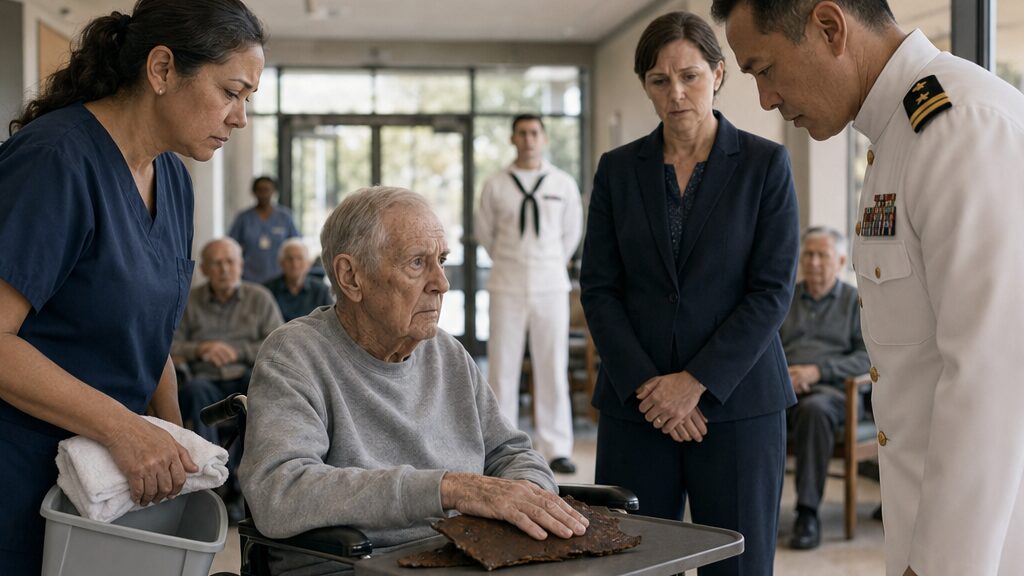
The rusted metal had left a brown stain on Stephen Carter’s tray, and the nurse was trying not to look annoyed.
“Mr. Carter,” Janet Perez said, keeping her voice low because the hallway had been waxed, the chairs had been straightened, and visitors in clean uniforms were expected any minute. “We talked about this yesterday.”
Stephen kept his left hand over the object.
It was no larger than a book, jagged on one side, curled inward on the other as if heat had once tried to fold it in half. The rust was not the clean orange of a garden tool left outside. It was darker, almost black in the cracks, with a rough blistered skin that caught on the sleeve of his gray sweatshirt when he moved. It did not belong on a wheelchair tray in a VA care facility hallway, not on a morning when the lobby smelled faintly of floor polish and coffee, and not when someone had taped little paper flags along the check-in desk.
Janet stood beside his wheelchair with a folded towel in one hand and a plastic belongings bin in the other.
“We just need to put it in your room for now,” she said. “Nobody’s throwing anything away.”
Stephen looked past her to the glass doors at the end of the corridor. Beyond them, sunlight brightened the lobby floor. A young sailor in dress whites stood near the reception desk, checking something on a clipboard. Another staff member moved chairs into a neat row.
He knew the choreography of visits. The facility did it every few months. Veterans’ breakfasts. Holiday cards. A visiting officer shaking hands. Photographs taken where the light was good. Smiles for the newsletter. The day after, the hallway returned to squeaking wheels, pill cups, lowered voices, and the sound of televisions left on in rooms where no one was watching.
Janet shifted the bin against her hip.
“Please,” she said. “It has sharp edges.”
Stephen’s fingers tightened. The knuckles rose pale under thin skin.
He had not always had hands like that. Once, his hands had been square and quick, blackened under the nails no matter how hard he scrubbed. Once, his palms had known ladders, valves, wet steel, and the heat of a compartment breathing wrong. Now, his hands trembled when he lifted a paper cup too quickly. People noticed the trembling first.
Janet crouched slightly so she could meet his eyes. She was not unkind. That made it harder.
“You can have it back after the visit,” she said. “I promise.”
Stephen did not answer.
He had learned over the years that speech changed a room. A quiet old man could be managed. A speaking old man became a problem to solve. If he said too much, someone wrote it down wrong. If he said too little, someone guessed. If he said nothing, at least the thing under his hand remained what it was.
Janet sighed through her nose, then softened her face. “Mr. Carter, I know it matters to you. But we have families coming through this hall, and Navy guests, and Administrator Young is already walking the floor. I don’t want anyone saying we let you keep something unsafe.”
The object rasped against the tray as Stephen pulled it closer by less than an inch.
That small sound stopped her.
It had stopped people before. Rachel had heard it once in his room and come quickly from the doorway, thinking he had dropped something. A physical therapist had asked if it was part of an old machine. An orderly had offered to clean it, then backed away when Stephen’s eyes sharpened.
Janet noticed the change now. Her hand lowered, towel hanging loose. For a moment she looked less like a nurse following a rule and more like a woman wondering what rule she was missing.
Then a voice came from behind her.
“Janet? Is everything all right?”
Nicole Young approached in a navy blazer with a facility badge clipped straight near her lapel. She moved quickly but not hurriedly, the way administrators did when they wanted urgency to look like calm. Her gaze flicked first to Stephen, then to the tray. The rusted piece changed her expression.
“Oh,” she said.
One syllable. Not disgust exactly. More like inconvenience given shape.
Janet stood. “I was just going to store it until after the outreach visit.”
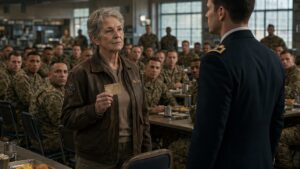
Nicole looked down the hallway toward the lobby. The young sailor had stepped aside as two men in white uniforms entered through the glass doors. One was older, upright, decorated, his cap tucked under his arm. His uniform looked almost painfully white under the fluorescent lights.
“We need this hall clear,” Nicole said quietly.
Stephen heard the words as if they had been spoken from far away. Clear. Not safe. Not respectful. Clear.
He moved his thumb over the fragment’s ridged surface. There was a place near the middle where a line of stamped markings had been eaten almost smooth. He could find them without looking. His thumb knew each shallow rise, each break in the metal, each place where fire had turned a straight edge into a warped lip.
“Mr. Carter,” Nicole said, using the careful voice people used when they wanted obedience to feel voluntary. “This is not about taking anything from you. It’s about presentation and safety.”
Stephen finally looked at her.
Presentation.
The word settled on the tray beside the fragment like another piece of metal.
Janet reached forward with the towel. “I’ll wrap it carefully.”
Stephen’s hand moved before hers could touch the object. Not fast, but with finality. He laid his palm over it, his fingers spread across the rust as though covering a wound.
“No.”
The hallway seemed to narrow around the word.
Janet froze. Nicole’s mouth tightened, then relaxed into professionalism. Two other patients in wheelchairs turned their heads. The young sailor by the lobby glanced down the corridor.
Stephen did not look at any of them.
The effort of that one word had cost him more than they would know. His chest felt tight. His breath came shallow, caught somewhere behind his ribs. He kept his palm where it was, feeling the roughness bite gently into his skin.
Nicole stepped closer. “Mr. Carter, I understand you feel strongly—”
“No,” he said again, quieter.
This time there was no force in it. Only a line.
Janet looked embarrassed now, not for herself, but for him. Stephen recognized it. People were often embarrassed when an old man made his need visible. They wanted dignity for him, but only the kind that fit neatly inside routines.
At the far end of the corridor, the group from the lobby began moving toward the therapy waiting area. The decorated Navy officer walked beside the young sailor, listening as Nicole’s assistant pointed out the facility’s new memory-care wing. His shoes made a clean, measured sound on the floor.
Nicole saw them coming. “Janet,” she said under her breath, “please.”
Janet lowered the towel again, her face caught between duty and discomfort.
Stephen looked down at his hand. A crescent of rust had marked the side of his thumb. He had washed that stain off a thousand times in his life and never once removed it.
The officer’s footsteps slowed.
At first Stephen thought the man had paused for the crowd of chairs. Then the polished shoes stopped beside his wheelchair. White trouser legs entered the edge of Stephen’s sight. A shadow fell across the tray.
No one spoke.
Stephen did not lift his hand.
The officer stood very still. The hallway, which had been full of small institutional sounds, seemed suddenly to hold its breath.
When Stephen finally raised his eyes, the officer was not looking at him.
He was staring at the rusted metal beneath Stephen’s hand.
Chapter 2: The Officer Who Asked Permission First
The officer’s face changed so slightly that most people in the hallway missed it.
Stephen did not.
Men who had served long enough learned to read small changes. A jaw settling. A breath held half a second too long. A set of shoulders that stopped being ceremonial and became alert. The officer had arrived wearing the public expression of a man on a scheduled visit. Now that expression had fallen away.
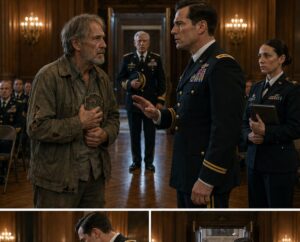
Nicole stepped forward quickly. “Commander Lee, I’m sorry. We’re just resolving a small personal-belongings issue.”
The officer did not answer at once.
His eyes remained on the fragment. Not on the rust. Not on the stain. On the broken inner curve where the metal had once been fitted to something larger. His gaze moved along the warped edge, then stopped near Stephen’s thumb.
“May I ask,” he said, his voice lower than before, “where that came from?”
Janet’s hand tightened around the towel. Nicole smiled, but it was uncertain now.
Stephen looked at the officer’s uniform. The ribbons, the pressed seams, the clean white cover under one arm. He had seen dress whites before in places where brass railings shone and names were read from programs. He had also seen uniforms gray with smoke, soaked through, torn at the cuffs, worn by boys too young to understand the sounds they would remember.
He said nothing.
Nicole answered for him. “We’re not completely sure. Mr. Carter keeps it with him. We’ve been trying to determine the safest way to—”
The officer lifted one hand, not sharply, but enough to stop her.
He looked at Stephen then.
“Sir,” he said, and the word landed differently than Mr. Carter had. “May I come closer?”
The young sailor behind him looked surprised. Janet looked down.
Stephen studied the officer’s face. He saw no performance there. No smile arranged for a photograph. No impatience hidden under courtesy. Only attention.
After a moment, Stephen moved his hand back.
The fragment lay exposed on the tray.
The officer did not touch it.
That was the first thing.
He leaned slightly, bringing himself nearer to Stephen’s seated height, and examined the metal where it rested. His gloved hand hovered near the tray, then withdrew. He turned to Janet.
“Is it all right if he keeps the tray level?”
Janet blinked. “Yes. Of course.”
The officer looked back to Stephen. “May I touch it?”
A small pressure moved through the hallway. People were waiting for Stephen to nod, or object, or reveal himself. He disliked that waiting. It made him feel as if his silence had become a door everyone wanted open.
Still, the question mattered.
Not “Can I see that?” Not “What is this?” Not “Hand it here.”
May I.
Stephen gave one slow nod.
The officer removed a white glove from his right hand and tucked it under his cap. He took a folded handkerchief from his pocket, laid it across his palm, and only then lifted the fragment. He used both hands, though the piece was not heavy.
Janet drew in a breath.
The rusted metal looked stranger against the officer’s dress uniform. Dirtier, older, almost offensive in its refusal to shine. A brown flake fell onto the handkerchief. Nicole’s eyes flicked to it.
The officer tilted the fragment toward the light.
“There,” he murmured.
He was looking at the faint stamped marks near the inner curve. Stephen’s thumb had worn that place clean over years of touching it, but not completely. Three broken characters remained, then a gap, then part of another line. The officer brought it no closer to his face. He did not need to.
The young sailor leaned in, curious.
“Sir?” the sailor asked.
Commander Jack Lee did not answer him. He looked at the blistered underside, the scorched seam, the way one edge had folded under heat rather than impact.
Then he stood straighter.
Not dramatically. Not for the hallway. Something in his body simply rearranged itself.
Nicole spoke carefully. “Commander?”
Jack turned the fragment in the handkerchief, then looked at Stephen. This time, when he spoke, his voice had lost every trace of visitor-polish.
“This is from a naval damage-control assembly,” he said.
The words moved through the small group with no immediate meaning. Janet glanced at the metal as if it had become heavier. Nicole’s smile disappeared.
Stephen looked at the floor.
Jack continued, still to Stephen, not the others. “Older shipboard construction. Heat-warped. Not decorative.”
One of the patients nearby whispered something to another. A visiting family member fell quiet. The hallway had become too still.
Nicole recovered first. “That may be, but we still have to follow safety protocol.”
“Yes, ma’am,” Jack said. “You do.”
He turned his head toward her then, and the respect in his voice made the correction sharper, not softer.
“But if this belongs to Mr. Carter, we should not handle it as trash.”
Janet’s face flushed.
“I didn’t call it—” she began, then stopped.
No one had needed to call it trash directly. The bin had said it. The towel had said it. The hurry before visitors arrived had said it.
Stephen kept his eyes on the fragment in Jack’s hands. He could feel the tray before him now as if the metal were still there. Empty space had weight too.
Jack lowered himself slightly, not fully kneeling, but enough that he was no longer towering over the wheelchair.
“Mr. Carter,” he said, “were you Navy?”
Stephen’s mouth went dry.
There were many answers. Yes. Once. Long ago. Damage control. Below decks. Too young. Too slow. Still there. Never left.
He looked past Jack to the sunlight near the lobby.
Janet waited. Nicole waited. The young sailor waited, his clipboard forgotten at his side.
Stephen’s hand moved to the tray. His fingers touched the rust stain left behind. He rubbed once, slowly, but it did not come away.
“I was assigned,” he said, and his voice scraped with disuse, “where they sent me.”
Jack held that answer with care. He did not push.
“What rating, sir?”
Stephen’s lips pressed together. For a moment the hallway slipped, and the polished floor became steel plate under his boots. The smell of floor wax twisted into smoke and hot paint. Someone shouted for water pressure. Someone else shouted a name.
He brought himself back by touching the tray.
“Damage control,” he said.
The young sailor’s posture shifted. Janet looked at Stephen as though the gray sweatshirt had changed shape around him.
Jack lowered his eyes briefly. When he looked up, he did not salute. Not in the hallway, not with the fragment in his hands, not for display. Instead, he placed the rusted piece back on the tray exactly where it had been, still on the handkerchief, and waited until Stephen’s fingers returned to it.
Only after Stephen touched it did Jack release the cloth.
“Thank you,” Jack said.
Stephen’s jaw tightened.
Those two words had followed him through enough rooms to know they were often easy for the person saying them and difficult for the person receiving them. He did not want thanks from a stranger who had not heard the screaming behind the steel.
Nicole cleared her throat softly. “Commander Lee, we appreciate the context. We can document the item and perhaps arrange—”
“With Mr. Carter’s permission,” Jack said.
Nicole stopped.
Jack did not look away from Stephen. “Only with his permission.”
Janet took one step back from the tray. Her towel was still in her hand, but now she folded it once, then again, as if embarrassed by its earlier purpose.
Stephen looked at the rusted fragment. Jack had placed it slightly turned from its usual angle. He adjusted it with two fingers until the warped edge faced him. The motion steadied him.
Jack noticed but said nothing.
Nicole’s assistant appeared near the lobby and gestured helplessly toward the waiting visitors. The outreach schedule was failing in small, visible ways.
Jack looked at the young sailor. “Go ahead without me for a few minutes.”
The sailor hesitated. “Yes, sir.”
Nicole began, “Commander, we have a planned—”
“I’ll join you,” Jack said. Then, more quietly, “This will take precedence.”
The words were not loud, but they altered the hallway more than a command would have. Janet lowered her eyes. Nicole’s shoulders settled into a different kind of attention.
Stephen felt irritated by it, and worse, afraid of it. Recognition was a light. It warmed nothing before it exposed everything.
Jack angled his body so he blocked the hallway’s view of the tray, giving Stephen a small privacy inside the public space.
“I’ve seen metal fail like this in training,” he said. “I’ve seen photographs from accident boards. But this piece—”
He stopped, not because he did not know how to continue, but because he did.
Stephen looked at him.
Jack’s voice dropped further. “This didn’t come from a souvenir case.”
The rusted fragment lay between them.
Jack looked from the scorched seam to Stephen’s hand.
“It came from a place men were trying to survive.”
Chapter 3: The Name Behind the Scrap
By the afternoon, the whole building had learned how not to look at Stephen Carter.
That was worse than being looked at.
In the dining room, voices lowered when Rachel wheeled him past. Near the nurses’ station, a physical therapist paused mid-sentence and turned away too late. The young sailor from the morning had returned once with Commander Lee, carrying no clipboard now, and stood at a respectful distance while the officer asked if Stephen needed anything. Stephen had said no.
People accepted no more easily when it came from a man they had decided to honor.
Rachel arrived after lunch with her work badge still clipped to her blouse and her hair pulled back in the tired way she wore it when she had driven too fast. She kissed the top of Stephen’s head before she saw the tray.
The rusted fragment sat on a folded facility towel now. Janet had brought it herself, clean and white, and placed it beneath the metal without touching the metal at all. Stephen had noticed.
Rachel noticed too.
“Oh, Dad,” she said.
He looked toward the window. His room faced a courtyard with two benches and a flagpole. The flag snapped lightly in the afternoon wind, bright against the flat sky.
Rachel closed the door behind her. “They called me.”
Of course they had.
She set her purse in the chair, then stood with both hands on the strap as if she might pick it up again and leave if the room became too much. She was not angry yet. That would come after worry failed.
“Nicole said there was an incident this morning.”
Stephen rubbed his thumb along the edge of the tray.
“It wasn’t an incident,” he said.
“You refused to let a nurse move a piece of metal before an official visit.”
He said nothing.
Rachel came closer. She looked down at the fragment. He watched her face carefully, though he pretended not to. He knew its stages. Concern. Sadness. The small tightening around the mouth that meant she was trying not to speak to him like a child.
“It’s getting worse,” she said softly.
Stephen’s hand stilled.
“The way you hold on to it,” she continued. “The way you get when anyone touches it. Dad, I’m not saying it doesn’t matter. I know it matters to you.”
No, he thought. You know that it matters. You do not know what it is.
Rachel sat on the edge of his bed. “Commander Lee told Nicole it may be from a ship. He was very respectful. Everyone was. That doesn’t mean it should stay on your tray all day.”
Outside, a bird landed on the courtyard bench and lifted away again.
“They want to document it,” Rachel said. “Maybe put it somewhere safe. Maybe even display it, if that’s what you want.”
Stephen gave a dry, humorless breath.
Rachel heard it. “What?”
“Display,” he said.
“It might be good,” she said carefully. “For people to know.”
He looked at her then.
Rachel had her mother’s eyes, though Stephen had never told her that enough while her mother was alive. She had inherited the same steady look when she believed love required an argument. She had been a child when he stopped sleeping well, a teenager when she learned not to knock too suddenly, a grown woman by the time she understood there were years of his life he had folded shut and placed somewhere no one else could reach.
“What should they know?” he asked.
She opened her mouth, then closed it.
He looked back at the tray.
Rachel leaned forward. “That you served. That you kept something important. That you’re not just—”
She stopped before she said old.
Stephen finished it for her in his mind anyway.
Not just a patient. Not just a wheelchair. Not just a man whose hands shook when soup was too hot and whose name appeared on a medication chart.
Rachel’s eyes shone with frustration now. “I don’t want them treating you like you’re difficult.”
“I am difficult.”
“You’re private.”
“That too.”
“Dad.”
He disliked the pleading in her voice because it made him want to spare her, and sparing people was how silence became a locked room.
Rachel stood and crossed to the small dresser. A framed photograph sat there, turned slightly toward the bed. It showed Stephen decades younger, standing beside Rachel and her mother at a backyard picnic. No uniform. No ship. Nothing rusted. Rachel picked up a stack of folded undershirts and opened the top drawer to put them away.
Stephen turned sharply.
“Leave that.”
She froze with the drawer half-open.
“I’m just putting these—”
“Leave it.”
His voice was not loud, but it was hard enough that she stepped back.
The room changed.
Rachel stared at him, hurt first, then wary. The open drawer showed white undershirts, a shaving kit he no longer used, a small box of batteries, and beneath them the corner of an old envelope browned at the fold.
Stephen looked away too late.
Rachel followed his glance.
“Dad,” she said quietly.
He closed his eyes.
He heard the drawer slide a little farther. Paper moved. Rachel did not dig; she lifted the envelope because it was already visible, because daughters who had been called by administrators learned to look for reasons, because love could trespass while calling itself help.
Inside was one folded note.
Not a letter. Not a record. Just a piece of paper Stephen had carried through moves, hospital stays, and the slow surrender of his house. The handwriting was his own, older and firmer.
Rachel read the name aloud before she understood she should not.
“Ronald Smith.”
The room seemed to lose air.
Stephen’s hand went to the fragment. His thumb found the worn place near the markings and pressed until rust darkened his skin.
Rachel turned the paper over. There was nothing else on it. Only the name, written once.
“Who is he?” she asked.
Stephen kept his eyes on the courtyard flag. The wind had changed. The cloth pulled tight, then loosened.
“No one you knew.”
“That’s not what I asked.”
The metal under his hand felt cold though the room was warm.
For years Rachel had asked him about ships the way children asked about weather in places they had never visited. Later, she stopped asking. Then his wife died, and Rachel asked again, more gently. He gave her safe fragments. Ports. Food. Bad coffee. Men who snored. Nothing with heat in it. Nothing that smelled of paint burning.
Now the wrong fragment had reached the surface.
Rachel came back to the bed, the note held loosely in her hand.
“Was he on the ship?”
Stephen’s throat worked.
The rust stain on his thumb looked darker than before, almost fresh.
“Put it back,” he said.
Rachel looked down at the paper, then at the rusted metal, then at him. Understanding had not arrived yet, but fear had. Not fear of him. Fear of how much of him she had never been allowed to know.
Slowly, she folded the note along its old crease.
“I’ll put it back,” she said. “But I’m not going to pretend I didn’t see it.”
Stephen looked at her then, and for the first time since she had entered the room, she did not see stubbornness in his face.
She saw shame.
The note trembled once in her hand.
“Dad,” she whispered, “what happened to Ronald Smith?”
Stephen lowered his eyes to the rusted piece on the tray.
His thumb moved over the old markings, wiping at dust that would never fully leave.
He did not answer.
Chapter 4: The Rule That Almost Erased Him
Rachel did not sleep much that night.
The name Ronald Smith stayed in her mind the way a sound stayed after a door slammed. She saw it in her father’s old handwriting every time she closed her eyes. Not a letter. Not a date. Not an explanation. Just a name, folded away under undershirts like something too heavy to leave in the open.
By morning, the facility had made the matter official.
Rachel arrived just before ten and found Stephen’s room empty. His bed was made. His sweater lay folded across the chair. The framed photograph on his dresser had been turned straight. The top drawer was closed.
For one sharp moment, she was a child again, afraid a quiet room meant something irreversible.
Then she heard voices down the hall.
Nicole Young’s office had a glass panel beside the door and a plant that looked too perfect to be real. Rachel saw her father through the glass, seated in his wheelchair near the wall. His tray was attached, but the rusted fragment was not on it.
That was what made Rachel push the door open without knocking.
Stephen looked up.
The fragment sat on Nicole’s desk inside a clear plastic bag with a white label stuck to one corner. The bag made it look smaller. Worse, it made it look collected.
Janet Perez stood near the window with her arms folded loosely, one hand tucked against her elbow. She gave Rachel a look that was part apology, part warning.
Nicole rose from behind her desk. “Rachel. Thank you for coming.”
“What is this?” Rachel asked.
“We’re reviewing a personal item concern.”
Rachel looked at the plastic bag. The rust had dusted the inside, leaving reddish smears where the object had shifted. Her father’s tray had an empty rectangular mark where the towel had been.
Stephen’s hands rested in his lap. He was looking at the bag, not at Rachel.
“Who put it in there?” Rachel asked.
Nicole’s professional calm held, but only just. “It was transferred with care. Janet wrapped it first.”
“I didn’t touch it bare,” Janet said quietly.
Stephen said nothing.
Rachel felt anger rise, quick and protective, but underneath it was the same worry that had made her ask whether the object should be stored away. She hated that the facility had done what part of her had wanted. She hated more that seeing it done this way made her understand her father’s refusal.
Nicole gestured toward the chair. “Please sit.”
Rachel remained standing.
Nicole folded her hands on the desk. “We have a policy for sharp, corroded, or unidentified objects in resident areas. Until we can determine whether this is safe, we can’t allow it to remain on a wheelchair tray in common spaces.”
“It’s his,” Rachel said.
“We are not disputing ownership.”
“You put it in an evidence bag.”
“It’s a containment bag.”
Rachel almost laughed. “That’s worse.”
Nicole’s face softened slightly. “I understand how it looks. But if a visitor cuts themselves, or if rust flakes get into a wound, or if another resident picks it up—”
“She’s not wrong,” Janet said.
Rachel turned on her, then stopped. Janet looked tired, not triumphant. This was not a woman trying to win. This was a woman who had probably spent years keeping frail people safe from corners, cords, loose rugs, hot coffee, and the hard edges of ordinary objects.
Rachel looked at her father. “Dad?”
Stephen moved his thumb against his index finger as though searching for a texture that was no longer there.
Nicole sat back down and opened a folder. “There is an exception process for service-related personal effects. If an item has documented historical, therapeutic, or ceremonial value, we can create a care plan around it. Safe handling. Display parameters. Storage. That kind of thing.”
Rachel heard the trap in the kindness. “And if there isn’t documentation?”
Nicole looked at Stephen. “Then we store it with family or remove it from daily use.”
Stephen’s eyes remained on the bag.
Rachel pulled the chair closer to him and sat. “Dad, did you hear that?”
“I heard.”
“Is there documentation?”
He did not answer.
Nicole glanced down at the folder. “Commander Lee said he would see what he could find, but without vessel identification, year, unit, or paperwork, there may not be much.”
Rachel remembered the note. Ronald Smith. She had not told anyone about it. She did not know whether protecting her father meant keeping it private or speaking it aloud.
“Dad,” she said softly, “the name in your drawer. Would that help?”
His face changed so quickly that she wished she could take the words back.
Janet looked away.
Nicole’s attention sharpened. “What name?”
Stephen turned his head toward Rachel. Not angry. Worse. Wounded.
Rachel lowered her voice. “I’m trying to help you keep it.”
His mouth tightened. “Not that way.”
“What way?”
“By handing out pieces.”
Nicole leaned forward. “Mr. Carter, no one is asking you to share anything you don’t want to share. But we need some basis for an exception.”
Stephen looked at her then. “You need a form.”
Nicole absorbed that. “I need a way to protect you and everyone else.”
“No,” Stephen said. “You need it to fit.”
The room went quiet.
Rachel had heard her father refuse before. She had heard no in doctor’s offices, no at the kitchen table after her mother died, no when she offered to sell the house for him before he was ready. This was different. It had the flat sound of steel laid across a threshold.
Nicole closed the folder slowly. “If we can’t document the item by tomorrow, I’ll have to require that it be stored off the floor or released to Rachel.”
Stephen’s hands closed around the edge of his tray.
Rachel wanted to argue, but a small, unwelcome truth stopped her. If he kept refusing to explain, the facility would win by procedure. Not cruelty. Procedure. That was what made it so hard to fight.
A knock came at the open door.
Commander Jack Lee stood outside, no longer in dress whites. He wore a dark service uniform, less ceremonial, more subdued. The young sailor was not with him. In one hand Jack held a thin folder. In the other, his cap.
Nicole stood. “Commander.”
Jack looked first at Stephen, then at the bag on the desk. Something passed across his face, tightly controlled.
“Mr. Carter,” he said.
Stephen did not answer, but his gaze lifted.
Jack stepped inside only after Nicole nodded. He did not approach the desk immediately.
“I don’t have everything,” he said. “Not yet.”
Nicole’s posture straightened. “But you found something?”
Jack opened the folder. Inside was a photocopy of an old typed report, blurred at the edges, with lines blacked out by age or copying. Beside it was a grainy photograph of damaged metal, circled in pen.
Rachel rose without realizing it.
Jack placed the paper on Nicole’s desk, but not over the bag. “A shipboard emergency report from decades ago. Damage-control section. Fire and structural compromise near a hatch assembly. The full record is archived, but the marking sequence here—”
He pointed to the photograph.
Nicole leaned closer. Janet did too.
Jack then looked at Stephen. “It appears to match the partial stamping on Mr. Carter’s fragment.”
Rachel’s breath caught.
Nicole touched the edge of the photocopy, not the plastic bag. “You’re saying this object may be from that incident?”
“I’m saying it resembles a documented component from that incident,” Jack said. “I won’t say more than the record supports.”
That carefulness mattered. Rachel saw Stephen hear it.
Nicole looked at the old report, then at the bag. Her confidence had not vanished, but it had changed shape.
“Can this serve for the exception process?” Rachel asked.
“For review,” Nicole said.
Stephen’s eyes remained on the photocopy. From where he sat, he could see the circled shape but not the text. Rachel almost lifted it for him, then stopped herself.
Jack noticed.
He picked up the photocopy and turned it toward Stephen.
“May I show you?”
Stephen stared at the page a long moment before nodding.
Jack held it at tray height, steady enough for Stephen’s eyes to find the blurred metal in the old image.
Stephen did not reach for the paper.
His right hand moved instead toward the empty place on his tray.
Rachel watched his fingers close on nothing.
Chapter 5: The Door He Never Forgave Himself For
Rain came against the window after dinner, first as a soft ticking, then as a steady pressure. The courtyard flag hung dark and restless under the lights. Every few minutes the wind drove water against the glass hard enough to make Stephen blink.
The fragment was back in his room, but not back on his tray.
Nicole had allowed it temporarily, pending review, which meant it sat on the rolling bedside table inside the clear bag. The bag was unsealed now, folded open at the top, but it still made the metal look imprisoned.
Stephen sat in his wheelchair facing it.
Rachel had gone home to feed a cat that no longer liked anyone but her. Janet had checked his evening medication, adjusted the blanket over his knees, and asked if he needed anything else. She had not mentioned the fragment. Before leaving, she had looked at it once and said, “I’m sorry about the bag.”
Stephen had not answered, but he had looked at her long enough for her to know he heard.
Now the room held only the rain, the low hum from the hall, and the metal sound memory made when the world got quiet.
A knock came at the door.
Stephen knew who it was before Jack Lee stepped in. The officer had changed again, this time into a plain dark jacket over his uniform shirt, as if he had tried to make himself less official and failed.
“I can come back,” Jack said.
Stephen looked at the fragment.
Jack followed his gaze. “I brought copies of what I found. Not to leave unless you want them.”
Stephen moved one finger on the armrest.
Jack took that for permission and entered. He did not sit until Stephen glanced toward the chair. Even then, he lowered himself slowly, placing the folder on his own knees, not on Stephen’s table.
The rain thickened.
For a while neither man spoke.
Stephen found that easier. Silence with Jack was not empty in the way facility silence could be. It was held. On ships, men had known how to be near one another without filling every space. A man could sit beside you with coffee gone cold and never ask the question that had no clean answer.
Jack looked at the open bag. “Would you like it out?”
Stephen’s breath caught before he could stop it.
Jack stood. “May I?”
Stephen nodded.
The officer washed his hands at the small sink first. That surprised Stephen more than the question. Jack dried them carefully, then came back and opened the bag wider. He did not tip the fragment out. He slid one hand beneath the plastic and eased the metal onto the towel Janet had left folded beside it.
The sound it made was small.
Stephen heard another sound inside it.
A strike. A buckle. Men shouting over alarms. Steam or smoke. His own breath inside a mask. Ronald Smith somewhere beyond a door he could still feel through his gloves.
Jack sat again.
Stephen closed his eyes.
“Mr. Carter,” Jack said, “the report lists casualties, but parts of the page are hard to read. There’s a Ronald Smith.”
The room did not move, but Stephen felt the floor fall.
Jack’s voice stayed quiet. “I don’t need you to tell me anything.”
Stephen opened his eyes.
The rusted fragment sat on the towel, dull under the bedside lamp. It had no power by itself. Metal did not remember. Men did that for it. Men gave objects their weight and then pretended the objects were heavy.
“He was faster than me,” Stephen said.
Jack did not shift.
Stephen’s voice came rough, but it came. “Smith. Ronald. Everybody called him Smith, like there weren’t six others. He could get through a passage before you finished turning your head. Thin as a rail. Always hungry.”
The corner of Jack’s folder bent slightly under his hand, but he said nothing.
Stephen looked toward the window. Rain streaked the courtyard lights into long pale lines.
“We were told it was contained,” he said. “Then it wasn’t. That’s how it goes. You think the ship is one thing, then it becomes a hundred small things trying to kill you. Smoke. Heat. Noise. Men going the wrong direction because there is no right one.”
He paused to breathe.
Jack waited.
Stephen’s right hand lifted and settled near the fragment but not on it.
“The hatch was warped. Wouldn’t seat. We had men behind us, and we had men forward. Fire wanted air. Everything wanted air.” His mouth tightened. “Smith went through to check a line. He shouldn’t have. I told him to. No, that’s not right.”
The correction hurt more than the first version.
Stephen swallowed.
“I didn’t tell him not to.”
Jack lowered his eyes.
“There’s a difference,” Stephen said. “People like to clean that up. They say you made the only call you could. They say you saved who you saved. They say a ship doesn’t give you time to be fair.”
Rain tapped hard against the glass.
Stephen saw it again in fragments. Ronald’s sleeve disappearing through the hatch. A shout swallowed by the alarm. Stephen’s gloved hands on the wheel. The heat pushing against his face. Someone behind him screaming to secure it. The metal not wanting to move. Then moving. Then the sound after.
His fingers curled.
“We dogged it down,” Stephen said. “Held position until pressure dropped. Men behind us lived.”
Jack’s voice was barely above the rain. “And Ronald Smith?”
Stephen stared at the fragment.
The rusted edge had come from that hatch assembly, or from what was left of the frame near it. He had no business keeping it. No regulation had allowed grief to be pocketed. But later, when the damage was cut away and replaced, a piece had fallen near his boot. He picked it up before thinking. Or maybe he had thought of nothing else.
“They found him after,” Stephen said.
Jack closed his eyes for a moment.
Stephen looked at him sharply. “Don’t do that.”
Jack opened them.
“Don’t make him a moment.”
“I won’t.”
“Don’t make me one either.”
Jack nodded once.
Stephen’s breath shook. He hated that. He hated the old body’s betrayal, the way emotion climbed out through lungs and hands whether invited or not.
“I kept that piece because I thought someone should know where the door was,” he said. “Not the ship. Not the report. The door. Where he went through. Where I stayed. Where other men came out because he didn’t.”
The room’s small lamp buzzed faintly.
Jack’s hands were still.
“They’ll want to say I saved lives,” Stephen said.
“You did.”
Stephen’s eyes hardened.
Jack accepted the correction before it was spoken. “And Ronald Smith gave his.”
The rain softened.
Stephen looked at the officer then. He had expected politeness. Gratitude. A careful arrangement of words that made the living comfortable. Instead Jack had let the sentence stand with its weight uneven.
Stephen’s shoulders lowered a fraction.
“There were others,” he said. “Names I remember when I don’t mean to. Men who came through. Men who didn’t. But Ronald’s the one who looks back.”
Jack did not ask from where.
The hall lights dimmed for the evening cycle, making the room feel smaller. Stephen reached toward the fragment and stopped short of touching it. The rust had marked him enough for one day.
Jack opened the folder slowly. “Nicole asked for documentation. I can write a statement based on records, but it won’t be enough without your consent. And if you choose to say nothing, I’ll tell her that too.”
Stephen gave a faint, bitter smile. “That won’t help your exception form.”
“No,” Jack said. “It won’t.”
For the first time, Stephen almost laughed.
The sound did not make it out.
He leaned back, tired down to the bone. The storm had moved past the hardest rain; now water ran steadily through the gutters.
“If you write it down,” Stephen said, “write his name first.”
Jack looked at the fragment, then at Stephen.
“Yes, sir,” he said.
Stephen closed his eyes again, but this time the room did not become the ship. It remained a room. Rain. Lamp. Towel. Metal. A man waiting with a folder, not to take the story, but to receive only what Stephen chose to give.
Chapter 6: The Statement He Chose to Give
Two days later, Stephen asked to be taken to the records room.
Rachel arrived early and found him already dressed, his gray sweatshirt replaced by a button-down shirt she had not seen him wear in months. Janet had combed his hair. The effort showed in small, stubborn ways: the collar slightly crooked, the blanket folded clean over his knees, the tray wiped until only a faint rust ghost remained near the center.
The fragment was not on the tray.
Stephen noticed Rachel noticing.
“Jack has it,” he said.
She nodded, though the sentence startled her. He had not called Commander Lee by his first name before.
The records room was small and underused, tucked behind administrative storage where old binders shared shelves with boxes of printer toner. A narrow window looked onto the parking lot. Someone had cleared the table and set three chairs around it, though Stephen remained in his wheelchair.
Jack stood when they entered. Nicole stood too. Janet hovered near the door until Stephen glanced at the empty chair beside Rachel.
“You can sit,” he said.
Janet did.
On the table lay the fragment, not in the plastic bag. Jack had placed it on a folded white towel. Its jagged edge faced Stephen. Beside it were the photocopied report, a blank statement form, and a small digital recorder that had not yet been turned on.
Stephen looked at the towel first.
Jack noticed. “Janet brought it.”
Stephen shifted his eyes to her.
Janet folded her hands. “I thought bare table wasn’t right.”
No one made more of that sentence than it could hold. That was why Stephen accepted it.
Nicole opened a pen and set it near the form. “Mr. Carter, this is voluntary. We can document only what you’re comfortable sharing.”
Stephen looked at her until she added, “And what you approve.”
Rachel watched her father’s face. Something in him eased, but not enough to be seen by anyone who had not spent years reading him from across hospital beds and kitchen tables.
Jack sat opposite Stephen. “I found enough to confirm the emergency existed. Enough to show the marking sequence is consistent. Not enough to identify the fragment beyond question without your account.”
Stephen looked at the rusted piece.
It seemed smaller in the records room than it had in the hallway. Less mysterious. More damaged. It bothered him that others could now see it without knowing how loud it had been.
Rachel touched the edge of her own chair but did not reach for him.
Jack gestured to the recorder. “May I record, or would you prefer written notes only?”
Stephen looked at the device. A small red button waited at its center.
“Written,” he said.
Jack moved the recorder aside without comment.
Nicole watched that movement. Rachel saw her see it.
Jack picked up his pen. “Where would you like to start?”
Stephen almost said nowhere.
Then he looked at Rachel.
She was holding herself still. Not demanding. Not forgiving him for things she did not understand. Just there. Her eyes moved once to the old report, then back to him. She was waiting in a way he had not allowed her to wait before.
“With his name,” Stephen said.
Jack wrote: Ronald Smith.
The pen made a small sound on the paper.
Stephen kept his eyes on the fragment. “He was assigned near me during the emergency. He crossed through the hatch area before it was secured.”
Jack wrote slowly. “Do you know why he crossed?”
Stephen’s mouth tightened. “To check the line.”
“On whose order?”
The room tightened around the question.
Rachel looked at Jack, alarmed.
Stephen lifted one hand from his blanket, just enough to stop her. “No. Ask it.”
Jack’s eyes remained steady. “On whose order?”
Stephen stared at the fragment until the rust blurred. “No written order. No formal one. There was confusion. I told him the line needed eyes. He went. I did not stop him.”
Jack wrote, but did not soften the words.
Nicole’s pen remained untouched on the table.
Stephen continued, haltingly at first, then with a plainness that hurt less than trying to make it painless. He described heat and visibility, the hatch that would not seat, the men behind him who had to be shielded from air feeding the fire. He did not give the ship a grand name in his telling. He did not make the scene heroic. He named functions. Pressure. Smoke. Water. Steel. A handle that had to turn when turning it meant someone was still forward of it.
When his breath shortened, Janet asked if he wanted water.
Stephen looked at her.
“Would you like me to move the cup closer?” she corrected.
He nodded.
She moved it to the edge of his tray and waited. He lifted it himself, shaking slightly, and drank. No one reached to help. Rachel’s hands stayed clasped until the cup was down again.
That restraint cost her. He could see it. He loved her for paying it.
Jack read back what he had written in sections, not as a performance, but as confirmation.
Stephen corrected him twice.
“Not sealed,” he said once. “Secured. Sealed sounds clean.”
Jack crossed out the word.
Later, Stephen stopped him again. “Don’t write that I chose to save the others.”
Jack paused. “How would you say it?”
Stephen looked at the metal. “I held position because if I left, more men might die. That’s not the same as choosing.”
Jack wrote exactly that.
Rachel turned her face toward the window.
The statement took less than an hour, though Stephen felt as if it had taken all the years between then and now. By the end, the paper held Ronald’s name first, Stephen’s account second, and the fragment described not as a souvenir, not as a trophy, but as a recovered piece associated with the hatch area Stephen had identified.
Nicole read the statement silently. Her face had changed since the office meeting. Not softened exactly. Sharpened into responsibility.
“This is enough for the care exception,” she said. “And perhaps for a small historical display, if you want that.”
Stephen did not answer.
Nicole glanced at Jack, then back to Stephen. “We have a recognition event scheduled tomorrow in the lobby. Navy outreach, resident service wall, families invited. If you were willing, we could place the fragment there with your name. Temporarily. A centerpiece.”
Rachel closed her eyes briefly.
Jack looked down at his pen.
The word centerpiece stayed in the room longer than Nicole seemed to expect.
Stephen looked at the fragment on the folded towel. For two days they had learned to ask before touching it. Now they wanted to put light on it.
Nicole spoke more carefully. “Only with your permission, of course. I think people should understand what it means.”
Stephen’s hand moved slowly across the tray until his fingers rested near, but not on, the towel.
“What it means,” he said, “to whom?”
Nicole had no quick answer.
Outside the narrow window, cars moved through the lot under a pale sky. Inside, the rusted piece waited between them, no longer trash, not yet testimony, and not willing to become a decoration just because people had finally learned to look.
Chapter 7: The Display He Refused to Become
By the next morning, the lobby had been arranged around a table Stephen had never seen used for anything but cookies, pamphlets, and sign-in sheets.
Now it stood under the brightest ceiling light.
A dark cloth covered its surface. A small easel held a printed card with his name in bold letters. Beside the card was an empty acrylic stand, angled to catch attention from anyone entering through the glass doors. Two flags had been placed behind it, one American, one Navy. Someone had moved the visitor chairs into a half circle.
Stephen stopped his wheelchair at the edge of the hallway.
Rachel, pushing him, felt the change in his body through the handles. He had gone still.
Nicole stood near the table with a clipboard against her chest. She was speaking with Janet, pointing at the stand, then at the space beside it. Jack stood farther back near the service wall, his hands clasped in front of him, watching without interfering.
On the printed card, Stephen could read only the largest words from where he sat.
STEPHEN CARTER
NAVY VETERAN
SHIPBOARD HERO
The last word struck him before he could prepare for it.
Hero.
It was such a clean word. Four letters, polished smooth by people who needed stories to fit in their mouths. It left no room for a door that closed, no room for Ronald Smith forward of it, no room for men coughing behind Stephen while he turned the wheel with both hands and felt the ship fight him.
Rachel leaned down. “Dad?”
He did not answer.
Nicole saw them and walked over quickly, her face bright with relief. “Mr. Carter. Rachel. I’m glad you came down. I wanted you to see the draft setup before tomorrow.”
Stephen looked past her at the card.
Nicole followed his gaze. Her smile faltered a little. “It’s just a placeholder. We can adjust wording.”
“Take it down,” Stephen said.
The lobby noises softened around them. A television near the waiting area played the morning news with the sound low. Somewhere behind the desk, a printer clicked and hummed.
Nicole held the clipboard closer. “Of course. If there’s a correction—”
“Take it down.”
Rachel moved around to face him. “Dad, maybe we can just change the word.”
He looked at her then, and she stopped.
Janet had come closer but stayed several feet away. Jack remained near the wall. Stephen noticed that. He noticed who moved in and who waited.
Nicole removed the card from the easel. “I apologize. I should have asked before printing anything.”
“Yes,” Stephen said.
There was no anger in it. That made the word harder.
Nicole lowered the card against her clipboard, hiding the bold letters. “I was trying to make sure people understood the significance.”
Stephen looked at the empty acrylic stand.
“They won’t,” he said.
Rachel crouched slightly beside his chair, careful not to touch his arm without warning. “What do you want them to understand?”
He looked around the lobby. Other residents had begun to gather for morning coffee. A few watched openly. Others pretended not to. The same hallway where Janet had tried to remove the metal now smelled of brewed coffee and furniture polish. The table waited like a stage.
Stephen had spent years avoiding stages.
He pointed toward the stand. His hand trembled, but his finger did not drop. “That makes it a prize.”
Nicole looked at the acrylic piece. “It’s just to support the fragment.”
“It makes people look up at it,” Stephen said. “Like it climbed there.”
Jack’s eyes lowered, not in shame exactly, but recognition.
Nicole was listening now, truly listening, and that made Stephen more tired than resistance. “What would you prefer?”
He wanted to say nothing. He wanted to ask Rachel to take him back to his room and close the door. He wanted the rusted piece on his tray where it belonged, close enough for his thumb to find the old markings, far enough from words no one had earned.
But the statement had been written. Ronald’s name had been spoken. The door was open now, not because others had forced it but because Stephen had turned the wheel himself.
“The table is too high,” he said.
Nicole glanced at it. “Too high?”
“For me.”
The words settled quietly.
Rachel looked at the table, then at her father’s wheelchair tray. She understood before Nicole did.
“Tray height,” Rachel said.
Stephen kept looking at the dark cloth. “If people look at it, they look where I looked.”
Janet’s mouth tightened. She turned away for a moment, then back.
Nicole nodded slowly. “We can arrange that.”
“And no hero.”
“No hero,” Nicole said.
“No centerpiece.”
Nicole held the clipboard lower. “No centerpiece.”
Stephen’s breath moved in him, shallow but steady. “Ronald Smith’s name first.”
Rachel’s eyes filled, but she kept still.
Nicole nodded again. This time she did not speak immediately. She looked down at the card she had printed, then slid it behind the clipboard as if removing it from the room.
“I’ll rewrite it with you,” she said. “If you’re willing.”
Stephen looked at Rachel.
She did not smile at him. She did not nod hard or try to encourage him into goodness. She only waited.
That waiting was new between them. Or maybe it had always been there, and he had never trusted it enough to see.
“Not now,” he said.
Nicole accepted it. “When you’re ready.”
Stephen’s hand moved toward his tray. The fragment was not there; Jack had secured it in the records room until a safe arrangement was made. The absence still pulled at him.
Jack stepped forward then, stopping at a respectful distance.
“Mr. Carter,” he said, “would you like the fragment brought here so we can decide the placement with you?”
Stephen looked at him.
“Not displayed,” Jack added. “Placed.”
The difference was small. It was everything.
Stephen nodded once.
Janet turned before anyone asked. “I’ll get the towel.”
Nicole looked at her. “I can—”
“I’ll get it,” Janet said.
She left quickly down the hall.
Stephen watched the space she left behind. In the morning light, the polished lobby seemed less prepared, less certain. The little flags on the desk fluttered faintly when the doors opened for a visiting family. A child glanced at Stephen’s wheelchair, then at the empty table, then moved on.
Rachel touched the back of his chair. “Do you still want to come tomorrow?”
Stephen looked at the hallway, the lobby, the service wall, the place where the fragment would not sit above him like an award.
“No,” he said.
Rachel’s shoulders lowered.
Then Stephen added, “But bring me.”
She looked down at him.
He kept his eyes forward. “And bring the tray.”
Chapter 8: The Object Handled With Both Hands
On the morning of the recognition event, Janet Perez stopped outside Stephen Carter’s room and knocked with the towel folded over her arm.
The door was open. Stephen sat in his wheelchair facing the window, dressed in the same button-down shirt he had worn for the statement. Rachel stood beside him, smoothing nothing from his shoulder, her hand hovering once before she let it fall.
The tray was attached to his chair.
It had been cleaned again, but the faint rust shadow remained, a dull brown memory near the center. Stephen had asked that it not be scrubbed harder. Rachel had not argued.
Janet stepped inside. “Mr. Carter?”
Stephen turned his head.
She held up the towel slightly. “Commander Lee has the fragment in the records room. Before I bring it down, I wanted to ask if you’d like me to carry it, or if you’d prefer someone else.”
Rachel looked at her, surprised.
Stephen studied Janet’s hands. They were capable hands. Hands that had changed dressings, opened pill packs, steadied elbows, lifted blankets over knees. Yesterday they had folded towels instead of taking. Today they waited.
“You carry it,” he said.
Janet nodded. “Do you want it in the towel?”
“Yes.”
“Do you want the bag?”
“No.”
She nodded again. “I’ll bring it straight to you.”
After she left, Rachel moved behind the chair. “Ready?”
Stephen looked at the tray.
“No.”
She gave a small breath that might have become a laugh in another room. “We’ll go anyway?”
“Yes.”
The lobby had been changed.
The high table was gone. In its place, near the hallway where the first argument had happened, Nicole had arranged a low rolling table almost level with Stephen’s tray. It was covered not in dark ceremonial cloth but in a plain white sheet folded flat. No acrylic stand waited. No bright card announced him.
A smaller card lay face down beside an empty space.
Jack Lee stood near it in dress whites again, but there was no photographer beside him, no staged handshake line. The young sailor remained near the service wall with other staff and residents. A few families had gathered. The room was attentive without being crowded.
Nicole approached Stephen with the face of someone who had practiced many sentences and chosen none of them.
“Good morning, Mr. Carter,” she said.
“Morning.”
She held up the face-down card. “Rachel helped me with the wording after you approved the notes last night. Would you like to look once more before it’s placed?”
Stephen nodded.
Nicole gave the card to Rachel, who held it low enough for him to read.
Ronald Smith
and the men of the damage-control crew
remembered through a recovered ship fragment
kept by Stephen Carter with permission for display
Stephen read it twice.
No hero. No centerpiece. His name was there, but not first. The fragment was not explained beyond what the record could hold. The rest remained where it belonged, in the spaces between words.
He nodded.
Rachel placed the card beside the empty space on the low table.
From the hallway, Janet appeared with Jack walking beside her. Jack was not carrying the fragment. Janet was. The metal rested in the folded towel across both her palms, the way someone might carry something fragile enough to break and heavy enough to deserve both hands.
She stopped in front of Stephen.
“May I place it?” she asked.
The lobby seemed to draw inward.
Stephen looked at the towel, then at Janet. He remembered her standing with the plastic bin, trying not to be annoyed. He remembered the word clear. He remembered her apology by the bedside. He remembered the cup moved closer, not lifted for him.
“Yes,” he said.
Janet turned to the low table and lowered the fragment onto the white sheet. She did not drop it, slide it, or adjust it after release. She waited with her hands still open until Stephen looked at the angle.
He lifted two fingers.
Rachel leaned close. “Do you want it turned?”
Stephen looked at Janet. “A little. Toward me.”
Janet did not move.
“May I?” she asked.
Stephen nodded.
Only then did she touch the edge through the towel and turn the fragment so the worn markings faced his chair. The rusted piece settled into place with a faint sound.
It was not beautiful. The light did not make it noble. It remained warped, blistered, corroded, and stubbornly itself.
Stephen felt something in him loosen because no one had tried to improve it.
Nicole stepped beside the table. She looked at Stephen before addressing the small gathering.
“This object is here today with Mr. Carter’s permission,” she said. “It is not here as decoration. It is here because he chose to let us understand a little of what it carries.”
She stopped there.
Stephen was grateful for the stop.
Jack stepped forward, but not to center himself. He stood at the side of the low table, angled toward Stephen.
“The record confirms a shipboard emergency,” Jack said. “The full history belongs to those who lived it and those who did not return from it. Today, we recognize the names Mr. Carter asked us not to separate.”
He looked down at the card.
“Ronald Smith,” he said.
The name moved through the lobby quietly.
Stephen closed his eyes.
For years, Ronald’s name had lived in a drawer, folded once, held where no one could mispronounce it, praise it, misuse it, or take it away. Now it had crossed the room in another man’s voice and had not been made smaller.
Rachel’s hand came to the back of Stephen’s chair. She did not touch his shoulder. She simply rested her fingers on the handle.
A resident near the coffee cart bowed his head. Someone in the back shifted softly. No one applauded.
Jack turned toward Stephen then. His posture straightened, not for the crowd and not for the uniform. He gave one restrained salute, held only a moment, directed not at spectacle but at the old man seated beside the tray-height table and the name printed first.
Stephen looked at him through tired eyes.
He did not return the salute. His hands were too unsteady, and besides, that was not what the moment asked of him.
Instead, he moved his right hand onto the tray and placed his fingers over the rust shadow left there.
Jack lowered his hand.
Rachel bent close. “Dad?”
Stephen looked at the fragment, then at the card. The metal no longer sat under his palm. That frightened him. It also freed his hand to rest open.
“He would’ve hated this,” Stephen said.
Rachel blinked.
Stephen’s mouth moved toward the smallest smile, then away from it. “Smith. Standing still. People looking.”
Jack heard and let out a quiet breath that was almost a laugh, almost not.
Rachel looked at the card again, and something in her face changed. Not discovery. Acceptance of what discovery could not fix.
“He was real,” she said.
Stephen nodded.
After the short gathering ended, people approached slowly. No one touched the fragment. Janet had placed a small note beside it that read: Please ask before handling. Stephen saw it and said nothing, but his eyes remained on it longer than on anything else.
Nicole came last.
“I’ve updated the care plan,” she said. “The fragment stays with you unless you request storage. Staff will ask before moving it. If it’s displayed, the wording comes through you.”
Stephen looked at her badge, then at her face.
“All right,” he said.
Nicole nodded, and for once she did not add anything.
When the lobby began to clear, Rachel wheeled him closer to the low table. The fragment and his tray sat nearly level, separated by only a few inches of air. It looked, for a moment, as if the object had not been taken from him but given room to breathe.
Jack remained nearby, hands behind his back.
Stephen looked at the officer. “You wrote it down?”
“Yes, sir,” Jack said. “His name first.”
Stephen nodded once.
Outside the glass doors, the flag lifted in a light wind, then settled. Inside, Janet stood by the hallway with the folded towel over her arm, waiting in case Stephen asked for the fragment to be moved back.
He did not ask yet.
He sat beside it, his hand open on the tray, while people passed more carefully than they had before.
Jack stood straighter beside the low table, not for the room, not for the uniform, but for Stephen Carter and the names beside the rusted piece.
The story has ended.