They Rejected Her Old Red Credential Before Learning Why She Still Carried It
Chapter 1: The Scanner Rejected the Red Strip
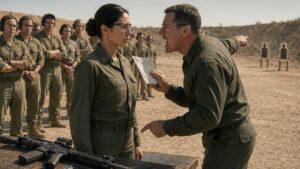
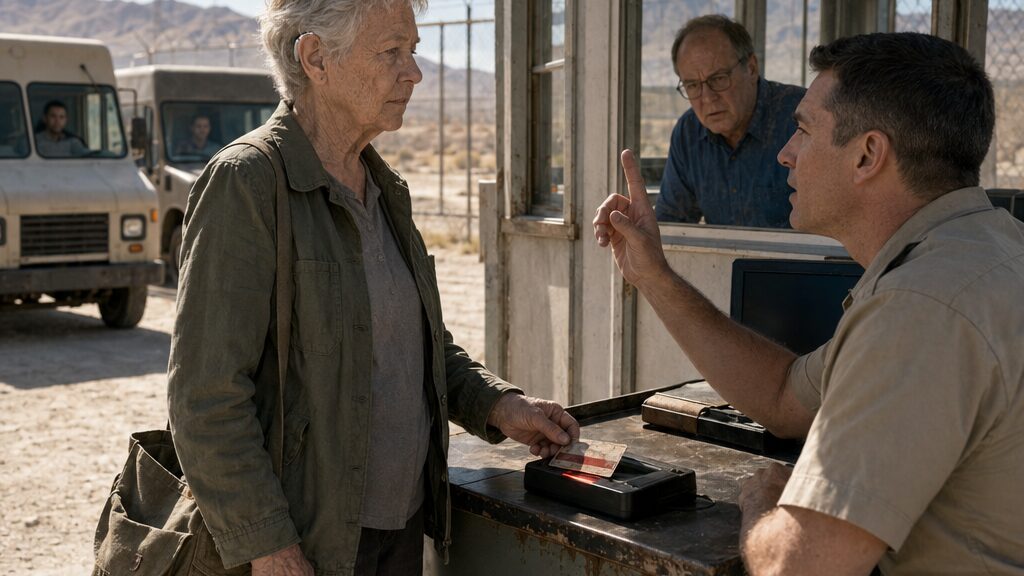
The scanner rejected Ruth Allen’s credential before the man behind the desk looked at her face.
A flat electronic tone cut through the checkpoint booth. Red light washed over the worn card, then vanished. Outside, heat trembled above the pale road leading into the installation. Two delivery trucks idled behind Ruth’s sedan, their engines pushing diesel fumes against the chain-link fence.
The gate supervisor lifted the card from the black scanner as though it had left something dirty behind.
“This isn’t valid.”
Ruth kept one hand on the strap of her canvas shoulder bag. “It won’t read on that system.”
The man glanced at the faded red strip crossing the lower corner of the card. He was young enough that the gray beginning at his temples looked premature. His badge read DANIEL MOORE. He sat tilted back in a metal chair, one boot hooked beneath the desk.
“That’s usually what invalid means.”
“It predates the current reader.”
Daniel turned the card over. The photograph showed Ruth at forty-five, dark-haired, straight-backed, unsmiling. The plastic had clouded around the edges. A small crease ran through the red strip without breaking it.
Ruth’s left knee had stiffened during the drive. Standing at the window made the joint throb, but she did not shift her weight. Movement invited assumptions.
“I have an appointment with records,” she said. “The casualty-history room.”
Daniel raised one finger.
The gesture was casual. That made it worse.
“Ma’am, let me finish.”
Ruth removed her hand from the edge of the desk.
Behind Daniel, through the interior window, a broad-shouldered civilian in a blue work shirt looked up from a computer terminal. His glasses reflected the monitor. He watched Daniel examine the card, then looked toward Ruth, not with recognition exactly, but with unease.
Daniel tapped the credential against his palm. “This card expired years ago. There’s no current access chip, no scannable code, and the photograph doesn’t help me verify who you are now.”
“My driver’s license is behind it.”
He slid the license out, compared the dates, then looked at her face at last.
His eyes paused on her white hair, the lines around her mouth, the hearing aid tucked behind one ear. He checked the license again as if age itself might be a discrepancy.
“You’re seventy-two.”
“Yes.”
“Were you driven here?”
Ruth heard one of the truck engines drop to idle. Someone in line had lowered a window.
“I drove.”
Daniel leaned slightly toward the opening. “I’m asking because people take the wrong turn at the highway junction all the time. The veterans’ clinic is forty miles south.”
“I am not looking for the clinic.”
“You said casualty records.”
“I said the casualty-history room.”
His expression changed by a degree—patience becoming performance.
“Do you have a current appointment confirmation?”
Ruth took a folded page from the outer pocket of her bag. The bag shifted, and for one moment the corner of a brown-paper parcel showed beneath the flap. It was bound with red thread, faded almost pink.
Daniel noticed it but reached for the appointment notice instead.
The page bore the installation letterhead and a printed message confirming that historical materials would be available for scheduled review before relocation. Ruth had circled the date in blue ink.
Daniel checked his computer.
“I don’t see you.”
“The confirmation came from archives.”
“There is no archives department on the visitor list.”
“The office used to be called records preservation.”
“That office doesn’t exist either.”
“It exists until five o’clock.”
Daniel looked through the interior window. “Thomas?”
The civilian hesitated before coming closer.
“You know anything about a casualty-history room appointment?”
The man’s eyes went first to Ruth, then to the card in Daniel’s hand.
“The room’s being cleared today,” he said. “Operations authorized a few final reviews.”
Daniel turned back to the monitor. “She’s not listed.”
Ruth placed two fingertips on the red strip of the credential.
“Call records verification and give them code C-T-Seven-Four.”
Daniel’s mouth tightened. “Codes that old aren’t in our system.”
“They don’t need to be in your system. They need to be in the index.”
“I said let me handle it.”
Again, the raised finger.
This time the young sentry at the lane entrance looked over. So did the nearest driver. Ruth felt the attention gather—not sympathy, exactly, but the public curiosity reserved for someone slowing down a line.
Daniel spoke louder than necessary.
“Expired cards don’t become valid because somebody remembers wearing a uniform.”
The words settled between the desk and the window.
Ruth looked at him.
There were several things she could have said. She could have named the unit she served with, the years she worked that installation, the nights she went without sleep while casualty manifests changed faster than printers could produce them. She could have told him that the red strip had once opened doors no rank insignia could open because the people carrying it were responsible for moving the wounded and identifying the dead.
Instead, she drew her hand away.
Daniel seemed to take her silence as concession. He placed the credential on the scanner again.
The same rejection tone sounded.
Behind him, Thomas moved closer to the glass.
Ruth kept her eyes on Daniel. “The code is C-T-Seven-Four. The name is Allen, Ruth. The appointment concerns materials scheduled for removal today.”
Daniel typed with two fingers.
“No current record.”
“Search the legacy index.”
“I’m not opening restricted databases based on an expired card.”
“You asked how to verify it.”
“And I’m telling you I can’t.”
“You’re telling me you won’t.”
The line behind her shifted. A horn gave one brief, irritated tap.
Daniel’s face hardened. “Do you have any idea how many people come through here with old papers and stories?”
“Yes.”
“Then you understand why we don’t make exceptions.”
“I have not asked for one.”
He stared at her, then clicked through several fields on the screen.
Ruth saw the moment he made the decision. His shoulders squared, not from certainty but from the need to appear certain in front of the sentry, the drivers, and Thomas.
He selected a menu item.
“What are you entering?” she asked.
“Questioned credential.”
“My driver’s license is current.”
“The military identification is not.”
“It is obsolete. That is not the same as false.”
Daniel picked up a transparent evidence sleeve from a drawer.
Ruth’s fingers tightened around the bag strap.
“You are not keeping my card.”
“If a document is presented for installation access and appears altered or fraudulent, procedure allows temporary retention.”
“It is neither.”
“The red strip isn’t in any current format.”
“It was placed there by this installation.”
“Thirty years ago?”
“Twenty-seven.”
Daniel stopped.
The exactness unsettled him more than anger would have.
Thomas stepped through the interior doorway. He did not look at Ruth. He looked at the card.
“Let me see the back.”
Daniel angled it away. “I’ve got it.”
Thomas’s jaw moved once. “The code she gave you—did you run it in legacy access?”
“There’s no reason to.”
“There might be.”
Daniel glanced toward the waiting vehicles. “We have a line.”
“That code,” Thomas said, quieter now, “was never issued to dependents.”
The booth seemed to contract around the words.
Daniel looked down at the faded red strip.
For the first time since Ruth arrived, he did not have an answer ready.
Chapter 2: The Room Scheduled to Disappear
Daniel sealed Ruth’s credential inside a plastic pouch marked QUESTIONED DOCUMENT while she watched from a molded chair bolted to the gatehouse floor.
He pressed the adhesive strip flat with his thumb.
“That label is inaccurate,” Ruth said.
“It’s a temporary classification.”
“It says questioned.”
“The scanner rejected it.”
“The scanner did not serve here when the card was issued.”
Daniel wrote the time across the top of the pouch. “That’s why we’re verifying.”
Ruth looked through the front window at the road. Her sedan had been moved into a gravel inspection bay. The two trucks had gone through without her. Heat struck the roof in dry little clicks.
Thomas stood at a terminal in the adjoining office, searching an older database. He had introduced himself only after Daniel asked Ruth to wait inside.
Thomas Wilson. Records technician.
His name tugged at nothing in her memory.
That was almost a relief.
Ruth adjusted the strap of her bag so the wrapped notebook remained beneath the flap. The red thread around it had faded unevenly where her fingers had touched it over the years. She had retied the knot three times that morning before leaving home.
Daniel noticed her looking at the evidence pouch.
“You’ll get it back when operations clears it.”
“And when will that be?”
He checked the wall clock. “Depends.”
“My appointment was at eleven.”
“It’s eleven forty-three.”
“The materials are being removed today.”
“That isn’t a security issue.”
“No. It is only the reason I drove two hundred miles.”
Daniel’s face tightened, but before he could respond, the inner door opened.
A woman in a slate-gray blouse entered carrying a tablet and a paper folder. Her dark hair was pinned at the nape of her neck. She moved quickly without appearing rushed.
“Ruth Allen?”
Ruth stood.
The woman’s eyes flicked toward Ruth’s knee when it took an extra second to straighten. She waited without offering help, which Ruth appreciated.
“I’m Sandra King, operations director. I understand there’s a problem with your access.”
“There is a problem with your scanner,” Ruth said.
Daniel looked away.
Sandra gestured toward the adjoining office. “Let’s sit somewhere quieter.”
The office was hardly quieter. Radios crackled from the gate desk, and each time the exterior barrier rose, machinery groaned beneath the floor. But the door closed on the waiting area and removed Ruth from view.
Sandra took the chair opposite her. Thomas remained at the computer.
Daniel stood near the wall with his arms crossed.
Sandra opened the folder. “You requested access to the casualty-history room.”
“Yes.”
“For what purpose?”
“The confirmation did not require a purpose.”
“It did require valid identification.”
“My driver’s license is valid.”
“For general entry, perhaps. The room contains restricted historical records.”
“Then verify the card.”
“We are trying.”
Thomas cleared his throat. “The legacy index is slow.”
Sandra turned to him. “What have you found?”
“A code family. C-T designations.”
Daniel said, “That doesn’t make her card legitimate.”
Thomas’s hand settled on the mouse. “It means the strip wasn’t decorative.”
Ruth watched Daniel’s expression. He had not apologized, but embarrassment had begun to compete with suspicion.
Sandra leaned forward. “What was C-T?”
“Casualty transfer,” Thomas said. “Support access. Temporary authorization across medical, transportation, and records zones.”
“Temporary?” Daniel repeated.
“The program ran for years. Cards were renewed manually before integrated chips.”
Sandra looked at Ruth. “You worked in casualty transfer?”
“I did.”
“At this installation?”
“Yes.”
Thomas typed her surname.
The monitor filled with a narrow column of names and dates. Ruth could not read the text from her chair, but she saw him pause.
Sandra saw it too. “What?”
“There’s an Allen, Ruth M. Personnel verification, logistics assignment, casualty support access.” Thomas scrolled. “Service dates align with her license information.”
A small current of relief moved through the room—not enough to release Ruth, only enough to shift the burden.
Sandra closed the folder halfway. “That confirms prior service.”
“It confirms more than that,” Ruth said.
Daniel spoke from the wall. “It doesn’t confirm current access.”
Ruth turned to him. “I never said it did.”
The answer left him with nowhere easy to stand.
Sandra looked at the appointment page. “The review notice came from our historical preservation team before the consolidation order. That team has been dissolved.”
“The room remains.”
“Until this afternoon.”
“What time?”
“Contract movers arrive at three. Materials go to regional storage. Items not accepted for transfer will be destroyed under disposition rules.”
Ruth’s hand tightened around the edge of the bag.
Sandra noticed. “Is there a particular file you need?”
“Yes.”
“Which one?”
Ruth looked toward Thomas’s monitor. “A casualty movement set from October twenty-seven years ago.”
Thomas stopped scrolling.
Sandra asked, “Name?”
“Not yet.”
Daniel gave a short breath through his nose. “That’s not how records requests work.”
Ruth ignored him.
Sandra’s voice remained even. “Mrs. Allen—”
“Ms.”
“Ms. Allen, I can’t authorize entry to a restricted room based on partial information.”
“I have already provided my identity, my assignment, my access code, and your own appointment confirmation.”
“And the credential you used has been flagged.”
“By him.”
Daniel uncrossed his arms. “Because it failed authentication.”
“Because you did not recognize it.”
Sandra lifted a hand—not sharply, but enough to stop both of them.
“I can approve temporary escorted access if there is no security hold. Thomas, is there a hold?”
He did not answer.
His screen had changed. A second window sat over the access index. At the top was a line of small red text.
Sandra stood and moved beside him.
“What did you open?”
“Linked incidents.”
Ruth felt something cold pass beneath her ribs despite the heat trapped in the building.
Thomas read without speaking. His eyes moved across the screen, then returned to one line.
Sandra’s voice hardened. “Mr. Wilson.”
“There’s an administrative incident attached to her personnel record.”
Daniel came away from the wall. “What kind?”
Thomas clicked, and an old scanned index card appeared, its edges blackened by poor copying.
Ruth could not read the body, but she recognized the format. Date. Unit. Category. Responsible personnel.
She had filled out hundreds.
Sandra read the heading.
“Movement irregularity.”
Daniel looked at Ruth.
Thomas scrolled lower. “Cross-reference says casualty transfer event. Eleven-minute convoy interruption. Review unresolved.”
Ruth’s knee had stopped aching. She could feel nothing below the desk.
Sandra straightened slowly. The respectful uncertainty in her face gave way to administrative caution.
“Ms. Allen, did you know this record was here?”
“Yes.”
“Is this why you requested access before the files were moved?”
Ruth did not answer quickly enough.
Daniel’s expression changed—not triumph, exactly, but confirmation. He believed the silence had finally explained her.
Sandra opened a new page on her tablet.
“Until we understand the linked incident, I cannot clear you for entry.”
“The room will be emptied in three hours.”
“I understand.”
“No,” Ruth said. “You understand the schedule.”
Thomas stared at the scanned card.
Sandra turned the monitor slightly, bringing the old label into Ruth’s view.
The words were faded but legible.
UNAUTHORIZED CONVOY DELAY—ALLEN, RUTH.
Chapter 3: The Report That Remembered Only Delay
Ruth read the old report twice before she spoke.
“The eleven minutes are correct.”
Daniel, seated against the wall of the administrative interview room, shifted as if her admission had released him from doubt.
Sandra remained across the table with the copied report between them. Thomas stood near a filing cabinet, holding a photocopied procedures manual thick enough to bend under its own weight.
The room had no windows. Air-conditioning pushed cold air across Ruth’s hands, but the skin beneath her wedding-ring finger—a ring she had not worn in thirty-one years—felt suddenly hot.
Sandra touched the first page.
“You stopped a casualty convoy without authorization.”
“I stopped it.”
“That was not my question.”
“It is the accurate answer.”
Daniel leaned forward. “You presented a questionable credential to access the very records connected to an unresolved incident.”
Ruth looked at him. “My credential is not questionable.”
“It is currently classified that way.”
“Because you classified it.”
Sandra said, “Mr. Moore.”
He sat back, but his face remained alert. At the gate he had been embarrassed. Now he believed the past had rescued his judgment.
Sandra turned to Ruth. “Were you trying to change this report before transfer?”
“No.”
“Remove it?”
“No.”
“Challenge it?”
Ruth looked down at the copied page.
It recorded a convoy departure time, a revised departure time, and an officer’s notation that the delay occurred at Ruth’s direction. It did not record the shouting at the transfer point, the dust, the stretcher left beneath a canvas awning, or the blood seeping through a field dressing without a name attached to it.
“I came for a different record,” she said.
“What record?”
“A movement manifest and supporting dispatch sheets.”
“Connected to the same date?”
“Yes.”
Sandra folded her hands. “Then help me understand why.”
Ruth glanced toward the door.
Her bag sat on a chair just outside, where security had placed it after the secondary screening. She could picture the red thread beneath the flap. She had carried the notebook through six homes, two retirements, a flood evacuation, and one winter when the furnace failed and she burned old furniture in the fireplace.
She had not opened it.
That fact had once felt like honor.
Now it felt less clean.
Thomas laid the procedures manual on the table and opened it to a marked page.
“The red-strip cards were issued under casualty-support directive four-seventeen,” he said. “Personnel carrying them could cross medical, transport, and documentation zones during declared surge operations.”
Daniel looked at the page. “Could they stop convoys?”
Thomas scanned the text. “Under specific conditions.”
“What conditions?”
“Manifest discrepancy. Identity conflict. Unassigned casualty. Destination uncertainty.”
Sandra looked at Ruth. “Which condition applied?”
Ruth’s mouth went dry.
“Unassigned casualty.”
Thomas found another paragraph. His finger moved down the page. “The directive says transfer personnel could delay movement when an injured person had no confirmed receiving location.”
Daniel said, “Then why isn’t that in the report?”
No one answered.
The question entered the room and changed it.
Sandra pulled the old report closer. “There’s no unidentified patient listed.”
“There was one,” Ruth said.
“Name?”
“He did not have one then.”
“Temporary number?”
Ruth closed her eyes briefly.
There should have been a number.
Every body moved through the system with a number if a name could not be established. The number tied the stretcher to the treatment notes, the treatment notes to the transport slot, and the transport slot to the receiving facility. Without it, a person could become an error passed between desks.
“He was brought in after the manifest closed,” Ruth said. “No tags. No paperwork. His uniform had been cut away.”
Daniel’s certainty faltered but did not disappear.
“Why wasn’t he added?”
“The clerk assigned to intake had left the transfer point to correct another load.”
“So you delayed everyone?”
“I delayed departure.”
“For eleven minutes.”
“Yes.”
Sandra studied Ruth. “What happened to the unidentified casualty?”
“He was assigned a destination.”
“And the convoy left?”
“Yes.”
“Then why was your action classified as unauthorized?”
Ruth looked at the bottom of the copied report, where a signature should have been. The original investigator’s name was illegible.
“Because the corrected manifest never reached the review file.”
Thomas turned toward the terminal in the corner. “Or because it wasn’t retained.”
Daniel stood. “That sounds convenient.”
Ruth’s gaze lifted to him.
He stopped, but only for a moment.
“You admit you delayed the convoy,” he said. “The report says there was no authorization. The supporting record you claim existed is missing. And today, before the files are relocated, you show up with an obsolete card and refuse to identify what you’re looking for.”
Each fact was accurate enough to be dangerous.
Sandra did not rebuke him this time.
Instead, she asked Ruth, “Why did you wait twenty-seven years?”
Ruth’s hand moved toward the place where the bag strap had rested on her shoulder. It found only the seam of her jacket.
“I did not come to correct what the report says about me.”
“Then why come?”
“To finish something.”
Sandra watched her for several seconds. “That answer is not sufficient for restricted access.”
“It is the only one I can give you now.”
Daniel gave a humorless laugh. “And we’re supposed to trust that?”
Ruth turned her head.
“At the gate, you asked whether I was lost. Then you asked whether somebody had driven me. Then you told strangers I was trying to make an expired card valid with a story about service.”
Daniel’s face reddened.
“I was enforcing procedure.”
“You were deciding what I was before procedure had finished.”
The room went still.
Ruth had not raised her voice. She regretted saying even that much, not because it was untrue, but because anger made truth easier to dismiss.
Sandra pushed the copied report aside.
“Mr. Moore, return to the gate.”
He looked at her. “Ma’am, I think I should stay. I initiated the credential flag.”
“And now operations is reviewing it.”
Daniel’s jaw tightened. He stood, straightened his uniform shirt, and moved toward the door.
Before he reached it, a young sentry entered carrying Ruth’s canvas bag in both hands.
“Secondary inspection is complete.”
Ruth stood too quickly. Pain caught in her knee and forced one palm onto the table.
The sentry hesitated. “There’s an item inside that wasn’t listed on the visitor request.”
Daniel stopped at the door.
Sandra looked at Ruth. “What item?”
The sentry placed the bag on the table and lifted the flap.
The brown-paper parcel lay inside, wrapped tightly with faded red thread.
Ruth reached for it.
The sentry moved first, taking it out and setting it beside the old convoy report.
For a moment, the red thread and the copied red strip in Thomas’s manual seemed like parts of the same line crossing twenty-seven years.
Sandra touched the edge of the parcel but did not open it.
“What is this?”
Ruth kept her hand flat on the table until the shaking in her fingers passed.
“A field notebook.”
“Whose?”
Ruth looked at the parcel.
When she answered, her voice was quieter than anyone else’s in the room.
“It belonged to Jonathan Rivera.”
Chapter 4: The Notebook She Never Delivered
Sandra’s fingers remained on the edge of the parcel.
“May I open it?”
“No.”
Ruth’s answer came quickly enough to surprise everyone in the room.
Sandra withdrew her hand. “Security found it during an authorized inspection.”
“They were authorized to inspect my bag. They were not authorized to read private property.”
“If it contains material connected to an installation record—”
“It does not belong to the installation.”
Daniel had stopped at the doorway. “You just said it belonged to Jonathan Rivera. Was he assigned here?”
“Yes.”
“Then it may be government property.”
Ruth turned toward him. “A man’s last private words do not become government property because he wrote them while wearing a uniform.”
The young sentry looked down.
Sandra considered the parcel again. The brown paper had softened along its folds. The red thread crossed it twice and was tied in a square knot Ruth could have undone in darkness.
“Who was Jonathan Rivera?” Sandra asked.
“A transportation specialist.”
“Under your supervision?”
“Sometimes.”
“Was he part of the delayed convoy?”
Ruth looked at the copied report.
“He was assigned to the transfer point that day.”
“That isn’t an answer.”
“It is the answer I can give until the notebook reaches his family.”
Sandra’s expression remained controlled, but the schedule on her tablet had begun to matter. Three o’clock was approaching. Movers would arrive, files would be boxed, and anything uncertain would become someone else’s problem in another building.
“You said you came to finish something,” Sandra said. “Is this it?”
“In part.”
“Why bring the notebook here instead of delivering it to the family?”
Ruth’s gaze went to the red thread.
“Because there is a record in that room that belongs with it.”
“What record?”
“A dispatch set.”
“The one you believe proves there was an unidentified casualty?”
Ruth said nothing.
Daniel shifted his weight. “She won’t identify the file, won’t explain the notebook, and admitted the incident report is accurate.”
“The report is incomplete,” Ruth said.
“So is everything you’re telling us.”
Sandra gave him a warning glance, but Ruth had already heard the truth inside his accusation.
She had spent years giving people only the portions she could bear to release. A changed address. A disconnected telephone. A returned letter marked undeliverable even after she had read the name on the envelope three times.
Matthew Rivera.
The first letter had come thirteen years after Jonathan’s death. The second had arrived two years later. Then an email, printed and folded into the same metal box where Ruth kept the notebook.
She had answered none of them.
A radio crackled outside. A maintenance worker passed the open door carrying a hand truck. The ordinary sound of wheels over tile made Ruth think of crates already moving from the history room.
Sandra checked her tablet. “I can call the next of kin listed in the old personnel file.”
“There may not be one living.”
“You know there is.”
Ruth looked up.
Sandra had seen it.
Not in a database. In Ruth’s refusal.
“There is a nephew,” Ruth said.
“Name?”
“Matthew Rivera.”
“Have you contacted him?”
Ruth’s hand settled over the parcel. “This morning.”
“And?”
“I left a message.”
Daniel gave a quiet, disbelieving breath. “This morning?”
Ruth ignored him.
Sandra asked, “After twenty-seven years?”
“Yes.”
The word was small. It did not deserve to be.
Thomas moved away from the filing cabinet. He had been silent since the notebook appeared, but now he looked at Ruth with something more difficult than suspicion.
“Did the family know you had it?”
“No.”
Daniel stared at her. “Then what exactly are we doing here?”
Ruth’s composure thinned.
She could tolerate being mistaken for confused. She could tolerate Daniel’s finger, the scanner, the evidence pouch. Those belonged to the present. They were shallow injuries.
This question reached the place she had protected.
“We are waiting for me to do something I should have done years ago.”
No one spoke.
Sandra pulled out the chair beside Ruth rather than returning to the opposite side of the table.
“Call him again.”
Ruth looked at her.
“If this is private family property, he can confirm it. If he wants it opened, that is his decision. If he does not, I will not authorize anyone here to open it.”
Daniel objected. “The package came through a restricted checkpoint.”
“And it has been inspected for prohibited contents.”
“We don’t know what’s written inside.”
Sandra’s eyes shifted toward him. “Neither do you.”
For the first time, Daniel looked away first.
Ruth took her phone from her coat pocket. The screen showed one missed call from a number she had stored without a name. She had known the digits immediately.
Her thumb hovered above it.
Sandra noticed. “He called back.”
Ruth stood.
“I need air.”
The exterior shade structure stood beside the operations building, four steel posts supporting a sun-bleached roof. Heat pressed in from every open side. Beyond the fence, the desert stretched flat and pale toward low brown ridges.
Ruth dialed.
The call connected before the second ring.
“Ruth Allen?”
The man’s voice was younger than Jonathan’s had ever become in her memory.
“Yes.”
“This is Matthew Rivera. You called me about my uncle.”
Ruth gripped the phone.
“I did.”
“You said you were at the installation.”
“I am.”
“What did you find?”
She looked through the glass door. Sandra stood inside. Daniel had returned to the gate, but Thomas remained near the interview room.
“I brought something that belonged to him.”
Silence.
“What?”
“A field notebook.”
The breath on the other end changed.
“You have his notebook?”
“Yes.”
“How long?”
Ruth looked down at the concrete.
“Since he died.”
The call went quiet enough that she checked the screen.
Then Matthew said, “I’m thirty minutes away.”
“You’re here?”
“I came when I heard they were closing the room. I’ve been trying to get access to his transfer records for months.”
Ruth’s fingers tightened around the phone. “Matthew—”
“I’m coming to the operations building.”
The call ended.
He arrived twenty-seven minutes later in a dust-coated pickup. Ruth saw him through the glass before he saw her. He was tall, broad through the shoulders, with Jonathan’s habit of closing one hand before speaking.
Sandra met him at the entrance and checked his identification. Ruth remained beside the table.
Matthew walked in quickly, anger keeping his movements precise.
His eyes found Ruth, then moved to the parcel.
He stopped.
For several seconds, no one spoke.
“That’s his,” he said.
Ruth nodded.
Matthew came closer but did not touch it. His gaze followed the red thread, the softened paper, the faint pencil mark visible beneath one fold.
“He wrote his sevens like that,” Matthew said.
Ruth had never noticed. She had known Jonathan’s handwriting by rhythm, by the way his lines sloped downward when he was tired.
Matthew looked at her.
“My grandmother died asking whether he left anything.”
Ruth’s mouth opened, but no answer arrived.
“My mother wrote to people in his unit,” he continued. “She wrote to you.”
“I received the letters.”
His face changed.
“You received them.”
“Yes.”
“And you kept this.”
Ruth pressed her palm against the table. “Yes.”
“Why?”
Because she had seen Jonathan alive before the transfer. Because he had pushed the notebook into her hands and said, If this turns bad, don’t let my sister get the official version first. Because Ruth had promised without imagining the promise would survive him.
Because after the convoy delay, after the investigation, after the unanswered questions, every route to the Rivera family seemed to pass through the possibility that they would blame her.
“I was afraid,” she said.
Matthew’s anger sharpened. “Of what?”
“That you would ask me what happened.”
“I am asking now.”
Sandra moved toward the door, signaling Thomas to give them space, but Matthew did not lower his voice.
“Did my uncle die because of that delay?”
Ruth felt the room narrow around the notebook.
Matthew pointed to the copied incident report.
“Did he die waiting because you stopped that convoy?”
Chapter 5: Eleven Minutes in the Dust
“The missing name mattered more than the convoy clock,” Ruth said.
Matthew stood across from her in the casualty-history room, where Sandra had finally authorized a supervised review. Half the shelves were empty. Cardboard boxes lined one wall, each labeled for transfer or destruction. The room smelled of paper, dust, and the faint metallic heat of the ventilation system.
The notebook remained wrapped on the table between them.
Thomas sat at a terminal. Sandra stood near the closed door. Daniel had returned from the gate after his shift coverage arrived, though no one had asked him to speak.
Matthew’s question still hung in the room.
Ruth rested both hands on the back of a chair.
“Jonathan did not die because I stopped the convoy.”
Matthew’s jaw tightened. “Then tell me why you stopped it.”
Ruth looked toward the boxes.
Twenty-seven years collapsed into white canvas, diesel exhaust, and grit between her teeth.
“The transfer point was overloaded,” she said. “A training accident had filled the aid station before noon. Then two vehicles came in from a separate incident. We had more casualties than the first manifest showed.”
Thomas’s fingers moved over the keyboard.
Ruth continued.
“The convoy had seven transport spaces. Six were assigned. The seventh was reserved for a soldier whose receiving hospital had already been notified.”
“What happened to him?” Sandra asked.
“He was loaded.”
“Then who was missing?”
“A man brought in on the back of a utility truck. No identification. His uniform had been cut off above the waist. No tags, no wallet, no unit patch. The people who brought him said they had found him near the secondary range road.”
Matthew glanced at the report. “Was he alive?”
“Yes.”
“How bad?”
“Bad enough that leaving him was not an option.”
Daniel folded his arms. “Why wasn’t he entered on the manifest?”
“The intake clerk had gone to correct another vehicle’s paperwork. The medical officer was working on two patients at once. Everyone assumed someone else had assigned him a number.”
Ruth could see the stretcher under the awning. A strip of red cloth had been tied to the frame, the improvised marker used when identity or destination was unresolved.
“In casualty transfer,” she said, “the most dangerous person in the system is the one everybody can see but nobody has written down.”
Thomas stopped typing.
Ruth looked at the old photocopy beside the notebook.
“The convoy commander ordered departure. I counted six documented patients and saw seven stretchers. The unidentified man had no destination. If the convoy left, he would remain behind without a place in the next movement cycle.”
“So you stopped it,” Matthew said.
“I stood in front of the lead vehicle.”
Daniel’s arms lowered.
Sandra asked, “Physically?”
“Yes.”
The memory returned with sound now: the engine, the driver shouting, the convoy commander telling her to clear the lane.
“The commander said the schedule came from operations. I said the manifest was wrong. He told me the unidentified casualty was not his responsibility until paperwork existed.”
Matthew looked at her. “What did you do?”
“I made him my responsibility.”
For eleven minutes, Ruth had moved between the aid station, the transfer desk, and the lead vehicle. She had forced the intake clerk back to the table, obtained a temporary casualty number, found a hospital willing to accept an unknown patient, and changed the seventh transport destination.
The red-strip directive gave her authority to halt movement when identity or receiving status was unresolved.
But authority written in a manual did not feel like authority when an engine revved six feet from your body.
“The corrected manifest was produced,” Ruth said. “I signed it. The convoy left with seven patients.”
Thomas searched another index.
“And Jonathan?” Matthew asked.
“He was not a patient on that convoy.”
Matthew looked up sharply.
“He was working the transfer point with me,” Ruth said. “He drove between the aid station and dispatch. He carried the destination confirmation that allowed the unidentified man to leave.”
“Then how did he die?”
The question was quieter now, which made it harder.
“Later that afternoon, Jonathan volunteered for a separate transport run. One of the assigned drivers had collapsed from heat. Jonathan took his place.”
Ruth could see him at the edge of the loading lane, drinking water too quickly, his sleeves rolled above the elbows.
Before leaving, he had handed her the notebook.
He had tried to make the gesture casual.
“You hold this,” he had said. “My sister gets it if I don’t come back.”
Ruth had told him not to talk like that.
He had smiled. “Then give it back tonight.”
She had put it into her field bag without opening it.
“The second transport encountered a delay at another receiving point,” Ruth said. “Jonathan became ill during the return trip. The report listed heat injury complicated by an undetected cardiac condition.”
Matthew’s face remained fixed. “Did your eleven minutes put him on that second run?”
“No.”
“Are you certain?”
“Yes.”
“How?”
“His assignment was entered before the first convoy stopped.”
Thomas turned from the screen. “I found the duty roster. She’s right. Rivera was listed as relief transport at ten forty-two. The convoy delay began at eleven seventeen.”
Matthew looked at the times.
The anger in him did not disappear. It lost one target.
Sandra asked, “What happened to the unidentified soldier?”
“He survived.”
Everyone turned toward Ruth.
She had learned that months later from a medical follow-up routed through casualty records. The man’s name had been restored after fingerprints matched him to a maintenance unit. He had returned home with lasting injuries but alive.
Daniel stared at the faded red strip on the copy of Ruth’s credential.
“The delay saved him,” he said.
“It gave him a place to go,” Ruth replied. “The medical team saved him.”
The distinction mattered to her. It always had.
Matthew sat down slowly.
“So the report blaming you was wrong.”
“No.”
His eyes lifted.
Ruth pulled out the chair opposite him but did not sit.
“I stopped the convoy. I did it without waiting for written confirmation from the commander. The report is correct about that.”
“But you had authority.”
“I believed I did. The directive supports it. The missing manifest would have shown why.”
“Then you were right.”
Ruth looked at the wrapped notebook.
“About the convoy.”
The words made Matthew’s face close again.
Sandra seemed to understand first. “But not about the notebook.”
Ruth sat.
“Jonathan died that evening. By morning, the delay report had begun. I was told not to contact families while facts were under review.”
“For how long?” Matthew asked.
“Six days.”
“And after six days?”
“I told myself I should wait until the report was complete.”
“How long?”
“Four months.”
Matthew’s voice hardened. “And after four months?”
“The report was still unresolved.”
“What about after a year?”
Ruth had no procedural answer left.
“I was afraid your family would believe the delay caused his death.”
“So you let us believe he left nothing.”
“I told myself I was protecting you from an uncertain account.”
“You were protecting yourself.”
Ruth met his eyes.
“Yes.”
The admission changed the room more than the dispatch history had.
Daniel looked down. Sandra’s hand relaxed around her tablet. Thomas removed his glasses and cleaned them though they were not dirty.
Matthew touched the notebook’s paper wrapping.
“You could have mailed it.”
“Yes.”
“You could have called.”
“Yes.”
“You could have answered my mother.”
“Yes.”
Each answer cost more because none could be defended.
Ruth had thought silence was a container strong enough to hold responsibility. Instead, it had held everyone apart.
Matthew drew his hand back before reaching the thread.
“I don’t want to open it here.”
“You should not have to.”
“Did you read it?”
“No.”
He searched her face for evidence of another omission.
“I promised it would go to his sister unopened.”
“My mother.”
“Yes.”
“She died eight years ago.”
Ruth’s fingers tightened beneath the table.
“I know.”
Matthew stood and walked toward the shelves. Empty metal brackets marked where boxes had already been removed.
“You knew that too.”
“I saw the notice.”
“And you still waited.”
Ruth did not answer. There was nothing left to say that would not sound like another wall.
Thomas broke the silence.
“The corrected manifest should be here.”
He had opened three linked catalog entries. One showed the convoy report. Another showed the duty roster. The third displayed a blank scan with a notation: attachment unavailable.
“Supporting dispatch sheets were logged separately,” he said. “Old carbon copies. Red-line forms.”
Sandra moved beside him. “Where?”
Thomas looked toward a framed photograph hanging above the rear worktable. It showed the old transfer staff standing beside a line of vehicles. Ruth was among them, younger than the woman on her credential, one hand raised against the sun.
Thomas’s expression changed.
“What?” Sandra asked.
He did not answer immediately.
“I kept something,” he said.
Daniel frowned. “Kept what?”
Thomas rose from the terminal.
“One dispatch sheet that never entered the official archive.”
Chapter 6: The Page Thomas Was Afraid to File
Thomas removed the photograph from the wall and laid it face down on the worktable.
The backing board had been fixed with small metal tabs. He bent them upward one by one, his hands unsteady enough that Sandra finally held the frame still.
“You hid an official document inside this?” she asked.
Thomas did not look at her. “I preserved it.”
“That is not the same thing.”
“No.”
The answer carried no defense.
He lifted the backing board. Between it and the photograph lay a thin yellow sheet folded twice. A red carbon-copy line ran along one edge.
Ruth recognized the form before Thomas opened it.
Casualty dispatch correction.
The red line matched the faded strip on her old credential—not in color exactly, but in purpose. Both had marked cases the ordinary system could not safely process without someone stopping to look.
Thomas unfolded the page.
The writing had faded to brown. Ruth’s signature remained visible at the bottom, beside the temporary casualty number and the notation AUTHORIZED HOLD—DESTINATION UNCONFIRMED.
Daniel stepped closer.
“There’s the casualty,” he said.
Thomas pointed to the receiving code and corrected departure time. “And the eleven-minute hold.”
Sandra read the authorization line twice. “Why wasn’t this filed?”
“It was,” Thomas said. “Then it came back.”
“To you?”
“I was a junior records clerk. The investigation packet was being reduced before transfer to regional command. Someone marked this as duplicative because the final manifest already existed.”
“Where is the final manifest?” Ruth asked.
“Missing.”
Sandra’s voice sharpened. “So you concealed the carbon copy.”
“I thought if I left it loose, it would be destroyed.”
“You had an obligation to report the discrepancy.”
“I was twenty-three. The review had already closed. My supervisor told me not to create problems in a finalized packet.”
“And you obeyed.”
Thomas looked at Ruth.
“Yes.”
Ruth studied the page. For years she had imagined finding it. In those private scenes, the document had been clean, decisive, almost luminous. It would explain the eleven minutes. It would correct the report. It would separate Jonathan’s death from her choice.
Now it looked frail enough to tear under a careless thumb.
Daniel read the notation again.
“She told the truth at the gate.”
No one answered him.
He looked toward the evidence pouch holding Ruth’s credential. His face carried the same sober change she had seen begin when Thomas recognized the code, but this time there was nowhere for him to retreat into procedure.
Sandra photographed the dispatch sheet without touching it.
“This is uncatalogued material removed from an official file,” she said. “If we introduce it into a formal correction, regional archives may classify the entire collection as compromised.”
Thomas went pale. “Compromised how?”
“They could suspend transfer and order disposal of any records without verified chain of custody.”
“The casualty room would be destroyed?” Matthew asked.
“Potentially.”
He looked at Ruth. “Then don’t use it.”
The request surprised her.
Matthew stood beside the notebook, one hand resting near the red thread.
“You know what happened,” he said. “I know the delay didn’t kill him. Isn’t that enough?”
For Ruth alone, it might have been.
Sandra seemed to see the possibility. “We can correct your access status privately. Restore your credential record, note the obsolete code, and permit you to review the files before removal.”
“And Daniel’s report?” Ruth asked.
Daniel stiffened.
Sandra looked at him. “What about it?”
“He wrote that I presented suspected fraudulent identification.”
“That can be amended.”
“Did he write that he asked whether I was lost?”
Daniel’s mouth opened.
Sandra turned to him.
“Did you?”
He looked toward the floor. “I was trying to determine whether she had the correct destination.”
“Did you write that in the incident report?”
“No.”
“Did you write that you said an expired card does not become valid because someone remembers wearing a uniform?”
Silence answered first.
Sandra’s face cooled.
Daniel said, “No.”
The easiest path lay open before Ruth. Her name could be cleared. Her card returned. The notebook delivered. The room entered before the movers finished.
She could leave Daniel to Sandra. Leave Thomas to the archive rules. Leave the next person with old papers to the same scanner.
That had been her method for years: carry what belonged to her, remain silent about the rest, call it discipline.
“No private correction,” Ruth said.
Sandra looked at her. “Ms. Allen, a broader review risks the collection.”
“The collection is already at risk because people decided inconvenient records were safer unseen.”
Thomas flinched, but Ruth did not soften the statement.
She turned to Matthew.
“I will not use this page to ask you to forgive me.”
His expression shifted.
“The page explains the convoy,” she continued. “It does not explain twenty-seven years. I do.”
Then she faced Daniel.
“And I will not ask that you be humiliated. But what happened at the gate must be recorded as it happened.”
Daniel’s face tightened. “That could cost me my position.”
“Yes.”
“I have a family.”
“So did Jonathan.”
The words landed harder than Ruth intended. She saw it immediately.
Daniel stepped back as if struck.
Ruth closed her eyes for one second.
“That was unfair,” she said. “Your family is not part of this.”
Daniel stared at her.
She had offered him what he had not offered her at the gate: a correction spoken before silence could harden into record.
Sandra set down her tablet.
“What are you asking for?”
“A formal access review tomorrow morning.”
“The regional manager will attend.”
“Good.”
“He will argue that the scanner functioned correctly.”
“It did.”
Sandra frowned.
“The machine rejected an obsolete format,” Ruth said. “The failure came after that.”
Thomas looked at the red-lined dispatch sheet.
Ruth continued. “Include the disputed report, this page, Daniel’s incident statement, and the legacy credential directive.”
Sandra asked, “Who else?”
“Matthew. Thomas. Daniel.”
Daniel looked up.
“And you?” Sandra asked.
Ruth placed her fingertips on the faded red strip inside the evidence pouch.
“I will tell them why I came, what I withheld, and what was done to me at that desk.”
The room had grown quiet enough that the ventilation fan seemed loud.
Sandra studied her for a long moment, then entered the meeting request.
“What outcome do you want?”
Ruth looked at the black scanner visible through the distant gatehouse window.
“I want the next person with old papers to be allowed to finish a sentence.”
Sandra sent the notice.
The review was scheduled for eight the next morning.
Chapter 7: One Minute Without Interruption
“No disrespect can be proven from the available record,” the regional manager said.
He sat at the head of the review table with Daniel’s incident report open before him. Ruth’s credential lay beside it in the transparent evidence pouch, the faded red strip visible through the plastic. The recovered dispatch sheet rested beneath a clear archival cover at the opposite end of the table.
The arrangement made Ruth uneasy. One document had been treated as suspicious because it was old. Another had been treated as dangerous because it had survived.
The regional manager tapped Daniel’s report.
“The scanner rejected an obsolete access format. The gate supervisor attempted to determine the visitor’s identity and destination. Operations then conducted a secondary review. That is normal procedure.”
Ruth sat with her hands folded.
Daniel occupied the chair nearest the wall. He had shaved closely, but a dark shadow remained beneath his eyes. Thomas sat beside Sandra with the recovered dispatch sheet in front of him. Matthew was at Ruth’s right, the wrapped notebook held between his feet.
No one had opened it.
Sandra said, “The question is not whether verification was required. The question is how that verification was conducted and whether the incident report accurately describes it.”
The manager glanced at her. “The report states Ms. Allen became resistant when asked for current identification.”
“I provided a current driver’s license,” Ruth said.
“And an expired military card.”
“An obsolete card.”
He gave a professional smile that did not reach his eyes. “The distinction is historical, not operational.”
Ruth looked at the red strip.
“That distinction is why we are here.”
The manager leaned back. “Ms. Allen, your service has now been confirmed. Your former access category has been identified, and the convoy issue appears to have additional context. The installation is prepared to return your credential, restore your visitor status, and issue a formal apology for the inconvenience.”
“Inconvenience,” Matthew repeated quietly.
The manager ignored him.
“We can also arrange supervised access to the records room before the transfer resumes.”
Sandra said, “The transfer is currently suspended.”
“Temporarily.”
Thomas adjusted his glasses. “The dispatch page establishes that the unidentified casualty existed.”
“It establishes that a page existed outside the approved chain of custody.”
Thomas’s shoulders tightened.
Ruth watched him. The manager’s words had given him exactly what he feared: a way to turn preservation into misconduct and misconduct into silence.
The manager continued. “The practical solution is to correct Ms. Allen’s access file, document the scanner limitation, and address archival handling separately. There is no need to enlarge a misunderstanding into a contract matter.”
Daniel looked up.
The manager turned a page. “Mr. Moore’s report indicates he remained professional throughout.”
Daniel’s hand closed around the edge of his chair.
Ruth saw the movement before anyone else did.
The manager said, “There is no corroborated evidence of insulting language.”
Daniel stood.
The chair legs scraped sharply across the floor.
“I need to correct the report.”
The manager’s expression hardened. “Sit down.”
Daniel remained standing.
“I asked whether she had been driven there because I thought she was confused. I said old cards didn’t become valid because somebody remembered wearing a uniform.”
The silence afterward was different from the silences Ruth had kept. This one did not hide anything. It exposed it.
The manager looked at him. “Why is that not in your report?”
Daniel swallowed.
“Because it made me look bad.”
Sandra’s eyes lowered briefly to the paper.
Daniel continued before fear could stop him.
“I marked the credential as suspected fraudulent even after Mr. Wilson said the code was real. I told myself I was protecting the gate. But by then I was protecting my decision.”
The regional manager closed the report.
“You understand that you are making a statement against your own employment interests.”
“Yes.”
“You have a recent performance warning.”
“Yes.”
“And you are currently being considered for supervisory advancement.”
Daniel’s face went pale. “Yes.”
“Then I suggest you consider whether fatigue affected your recollection.”
Daniel looked toward Ruth.
At the gate, he had raised one finger and expected silence. Now his hands hung open at his sides.
“I remember what I said.”
The manager’s mouth flattened.
Ruth felt no triumph. Daniel’s admission did not return the years to Matthew’s mother. It did not put the missing manifest back in the file. It did not make the checkpoint disappear.
But it changed the room.
Daniel sat.
The manager turned to Ruth. “Then the installation will amend the incident report and issue a written apology.”
“And the verification process?” she asked.
“We will remind staff to remain courteous.”
“That is not a process.”
“The current security protocol is adequate.”
“It failed after the machine did exactly what it was designed to do.”
He frowned. “The scanner rejected an invalid format.”
“Yes. Then a person had to decide what the rejection meant.”
“We cannot create special rules for every outdated document a visitor brings to the gate.”
“No.”
Ruth raised one finger.
Daniel saw it. His eyes fixed on the gesture.
The manager stopped speaking.
“I am asking for one minute without interruption,” Ruth said.
No one objected.
She lowered her hand.
“At the checkpoint, Mr. Moore saw an old woman, an old card, and a line waiting behind her. He made those facts mean I was confused before he completed verification. Yesterday, I saw a young man defending a report and made his family part of my anger. I corrected myself because truth does not become less necessary when it embarrasses us.”
Daniel looked down.
Ruth placed her palm beside the evidence pouch.
“This credential does not prove I deserve respect. My service does not prove it. The dispatch page proves why I delayed a convoy, but it does not excuse what I did afterward.”
Matthew’s gaze shifted toward her.
“Jonathan Rivera gave me his notebook before his final transport. He asked me to deliver it to his sister if he did not return. I did not.”
The manager glanced at the notebook.
Ruth continued.
“For six days, procedure prevented me. After that, fear did. I feared his family would believe my convoy decision caused his death. I told myself silence was discipline. It was not. It was protection for me, paid for by people who were owed the truth.”
Matthew’s hand tightened against his knee.
Ruth did not ask him to soften.
“The installation forgot the unidentified soldier because one supporting page vanished. I allowed Jonathan’s family to believe nothing remained because I kept one notebook hidden. Institutions and people do the same kind of harm when they decide inconvenient history is safer unopened.”
Thomas looked at the dispatch sheet.
Ruth faced the manager.
“I am not requesting special access for old cards. I am requesting a verification path when current systems cannot read legitimate historical credentials. A legacy contact. Manual review before fraud classification. Time for a visitor to finish explaining why they came.”
“That creates delay at an active security point.”
“So does correcting a false incident report.”
The manager’s expression tightened.
Ruth sat back. Her minute was over.
Sandra opened the folder before her.
“I am postponing the records transfer pending archival review,” she said. “The casualty collection will remain intact until chain-of-custody questions are resolved.”
The manager turned toward her. “You do not have regional approval.”
“I have local preservation authority for seventy-two hours. I am using it.”
Thomas let out a breath.
Sandra continued. “Mr. Moore will be removed from supervisory gate duty during review and retraining. His report will be amended with his statement.”
Daniel nodded once.
“And the access procedure?” Ruth asked.
Sandra looked at the red-striped credential.
“We will draft an interim legacy-verification protocol today.”
The manager gave a quiet, incredulous laugh. “Based on one visitor?”
“Based on one failure we can see,” Sandra said.
Then she turned to Ruth and slid a blank sheet across the table.
“At the gate, you knew what the system should have done before any of us did.”
Ruth looked at the empty page.
Sandra placed a pen beside it.
“Write the first line.”
Chapter 8: The Next Person at the Gate
Matthew opened the notebook two weeks later while Ruth sat across from him in the preserved casualty-history room.
The red thread lay unknotted beside his hand. Ruth had removed it from the brown paper but had not touched the notebook itself. Its green cover was worn pale at the corners. Jonathan’s name appeared inside in block letters that leaned slightly to the right.
Matthew turned the first page.
Ruth looked toward the shelves.
The transfer labels had been removed. The boxes marked for destruction now carried review slips. Thomas had spent ten days rebuilding the chain of custody, beginning with the dispatch sheet he had hidden and ending with an inventory of every document that had survived because someone had been too cautious, too frightened, or too stubborn to discard it.
Ruth waited without asking what Matthew read.
His eyes moved down one page, then another. Once, his mouth tightened in a way that made him resemble Jonathan so closely that Ruth had to look away.
Finally, Matthew closed the cover halfway.
“He wrote about you.”
Ruth kept her hands in her lap.
“What did he say?”
Matthew studied her before answering.
“He said you were the reason nobody at the transfer point got treated like a number.”
Ruth’s throat tightened.
“He also wrote that if something happened to him, his family would probably hear about the paperwork before they heard about the people.” Matthew looked down at the page. “He was afraid we would remember only how he died.”
The room’s ventilation clicked on.
Ruth stared at the empty brown wrapping.
“I made that fear come true.”
“For a long time.”
“Yes.”
Matthew closed the notebook.
“I don’t know how to forgive twenty-seven years.”
“I know.”
“My mother should have had this.”
“Yes.”
“She should have known he was thinking about her.”
“Yes.”
Ruth did not reach across the table. She had spent too many years treating possession as responsibility. The notebook was his now. So was his anger.
Matthew placed both hands over the cover.
“But I want to know what he was like here.”
Ruth looked up.
“Not today,” he said. “I can’t do both today.”
A small pressure released inside her chest.
“Another day, then.”
He nodded.
It was not absolution. It was a door left unlocked.
When they left the records room, Thomas was attaching a new catalog label to Ruth’s old credential. It would remain with the casualty-support directive and the recovered dispatch page—not as an honor, but as part of the record of how obsolete systems had once worked.
Ruth paused beside him.
“You kept it safe,” she said.
Thomas looked embarrassed. “I kept it hidden.”
“There is a difference.”
“I know that now.”
He pressed the label flat.
Ruth left the credential behind.
The empty paper wrapping fit beneath her arm. The red thread was looped around two fingers, light enough that she barely felt it.
At the main checkpoint, a line of three vehicles waited beneath the afternoon sun. Ruth and Matthew crossed the pedestrian lane toward the visitor lot.
Daniel stood inside the booth in a plain security shirt without the supervisor tab. He was speaking to an elderly man at the desk. The visitor wore a tan cap and held several folded pages that looked as though they had been carried in a pocket for years.
Daniel examined one page, then looked toward the line.
His hand began to rise.
Ruth stopped walking.
Daniel saw the visitor’s mouth close.
He lowered his hand.
“Go ahead, sir,” he said. “Finish what you were telling me.”
The man unfolded another page and pointed to an old unit number.
Daniel listened.
He did not pretend to recognize it. He did not classify it before checking. He turned to the laminated legacy-verification guide posted beside the black scanner. A narrow red line ran along its left margin.
The first instruction read:
WHEN A CURRENT SYSTEM CANNOT READ A HISTORICAL CREDENTIAL, VERIFY THE PERSON BEFORE JUDGING THE DOCUMENT.
Daniel called Thomas.
The waiting line moved slowly, but no one sounded a horn.
Matthew watched through the booth window.
“Is that enough?” he asked.
Ruth looked at Daniel bent over the old papers, then at the scanner that had rejected her before anyone looked at her face.
“No,” she said. “But it is different.”
They continued toward the parking lot.
At the fence, the red thread slipped loose from Ruth’s fingers. She caught it before the wind could carry it beneath the gate.
For twenty-seven years, she had kept it tied around something she was afraid to surrender.
Now she folded it into the empty wrapping and carried only that through the open barrier.
The story has ended.