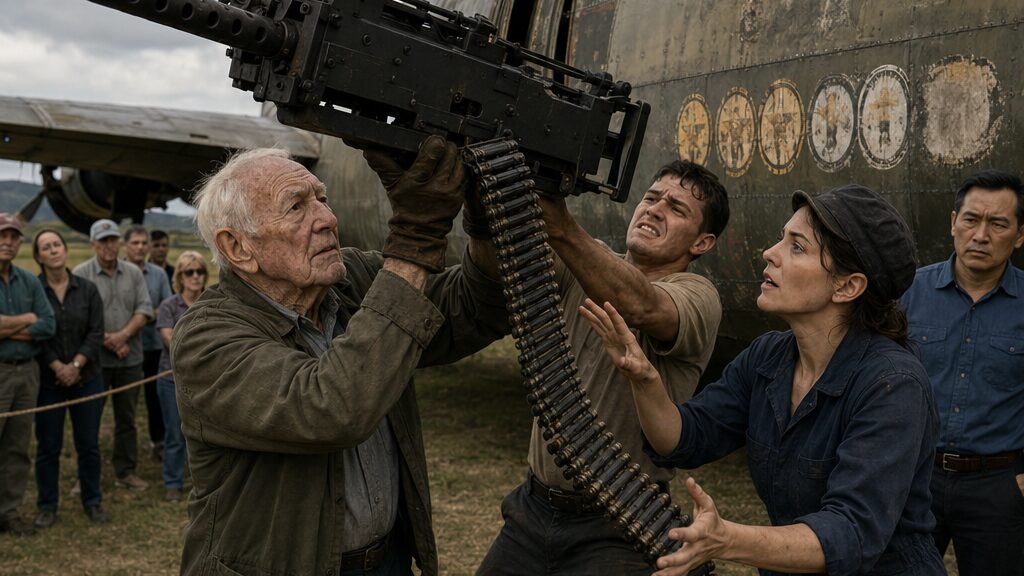
They Ordered the Old Man Away From the Bomber Until He Touched the Missing Mark
Chapter 1: The Old Man Beneath the Hanging Ammunition Belt
The ammunition belt slipped before anyone noticed the old man beneath it.
A junior mechanic had both arms around the receiver of the aircraft gun, trying to force its mounting pins into place, while another volunteer fed the linked brass cartridges through the open waist position of the bomber. The belt sagged in a long curve, caught against the edge of the feed tray, and twisted.
Raymond Clark saw the first link rise sideways.
He stepped across the visitor rope.
“Stop lifting,” he said.
The junior mechanic did not hear him over the scrape of metal and the portable generator coughing beside the aircraft. He shoved again. The receiver tilted outward. Nearly a hundred pounds of dark steel rolled against his forearms, and the ammunition belt began sliding toward the grass.
Raymond moved under it.
His left shoulder took the belt. His gloved hands found the underside of the receiver, one at the cooling jacket and one beneath the rear plate. The weight struck through his wrists and into his elbows. For one sharp second his right knee threatened to fold.
“Hey!” a woman shouted. “Sir, let go of that.”
Raymond planted his boot beside the bomber’s wheel chock.
The aircraft towered over him in dull green and bare aluminum, its panels patched in three shades from three different decades. The exposed engine on the far wing showed rows of blackened cylinders. Grass had grown high around the tires. Above Raymond’s head, painted mission symbols ran in a faded line beneath the waist window.
One space in that line was empty.
“Sir,” the woman repeated, closer now. “You cannot be inside the work area.”
The junior mechanic looked past the gun at Raymond. Sweat darkened the collar of his tan shirt.
“I’ve got it,” he said.
“No, you don’t.”
A few visitors had stopped near the rope. A child sat on a man’s shoulders. Two donors in pressed shirts stood beside a folding table with coffee cups, watching with the polite concern people reserved for preventable embarrassment.
The woman reached Raymond. She was young enough to be his granddaughter, with dark hair pinned beneath a grease-marked cap. Her name patch read EMILY JACKSON.
“Release the receiver,” she said. “Slowly.”
Raymond looked at the belt where it entered the tray.
“It’s feeding backward.”
“We’re not feeding it. It’s inert.”
“The belt doesn’t know that.”
The junior mechanic gave a strained laugh. “We can’t let somebody’s grandfather test military hardware.”
Emily’s face tightened, but she kept her eyes on Raymond. “Sir, step behind the rope. We have trained staff.”
From the folding table, a man in a blue work shirt called, “Emily, we need the gun in for the donor photographs. Just reset it.”
Raymond recognized the voice of someone accustomed to being obeyed without raising it. The man held a paper cup in one hand and a phone in the other.
Emily glanced toward him. “The belt’s bound.”
“Then unbind it.”
The receiver shifted again. The junior mechanic’s fingers slid toward the open mounting bracket.
Raymond saw what would happen next: the gun would roll, the bracket would catch the man’s glove, and the belt would drag his other hand into the tray.
He had seen machinery punish impatience before.
“Take the weight before the feed,” Raymond said.
The words came out lower than he intended.
His hands moved without waiting for agreement. He released the rear grip, turned his hip against the fuselage brace, and let the receiver settle into the angle his body remembered. Not the angle shown in display photographs. Not the angle that made the gun look level and handsome for visitors.
The angle that allowed one frightened man to clear a jam in darkness.
The weight transferred from Raymond’s wrists into the curved brace. The twisted belt loosened half an inch.
“Hold there,” he told the junior mechanic.
The younger man obeyed.
Raymond reached beneath the feed cover and pressed the reversed pawl with two fingers. It resisted. He shifted the receiver another fraction until the metal stopped grinding against itself.
The pawl snapped free.
The belt dropped straight, links clicking softly against one another.
No one spoke.
Raymond guided the receiver inward. The mounting pins aligned without force. The junior mechanic stared as they slid home.
Emily crouched beside the feed tray. Her hand hovered above the mechanism but did not touch it.
“May I?” she asked.
The change in her voice was small. Raymond heard it anyway.
He stepped back. “Check the front pawl. They’ve put it in from the wrong side.”
Emily lifted the cover and looked. Her mouth flattened.
The man in blue had crossed the grass toward them. “What’s wrong?”
“The feed assembly is reversed,” she said.
“That’s how it arrived from storage.”
“That doesn’t make it correct.”
He looked at Raymond for the first time as if the old man had acquired edges. “And you are?”
“Raymond Clark.”
“Jonathan Lee. Operations director.” He glanced at the watching visitors. “Mr. Clark, this is an active restoration site. However helpful that was, you cannot cross barriers and handle equipment.”
Raymond removed his gloves one finger at a time. His hands trembled after the load, though he kept them low beside his jacket.
“I told them to stop.”
Jonathan lowered his voice. “You also created a liability issue in front of our donors.”
Emily was still examining the feed mechanism. “He prevented one.”
The junior mechanic flexed his hand and looked at the bracket that would have trapped it. His amusement had gone.
Jonathan noticed the audience growing along the rope. “Let’s clear the area.”
Emily closed the feed cover but left the gun untouched. “Mr. Clark, how did you know the mounting angle?”
Raymond looked past her to the bomber’s skin.
The aircraft had another name now, painted neatly beneath the cockpit. The museum had polished the nose art and replaced whole sections of corroded aluminum. Yet the waist position still carried shallow dents where boots and ammunition boxes had struck it. The old machine had forgotten less than the people restoring it.
“You don’t balance that gun by the grips,” Raymond said. “You carry it under the jacket until the brace takes hold.”
Emily studied him, then looked toward the restoration office. “Wait here.”
Jonathan followed her inside the temporary building, speaking close to her shoulder. Raymond could not hear the words, but he saw Jonathan look back twice.
The junior mechanic approached the rope with Raymond’s gloves.
“Sir,” he said, no trace of the earlier joke in his voice. “You dropped these.”
Raymond accepted them.
“Were you an armorer?”
Raymond rubbed the worn leather between his fingers. “Among other things.”
Emily returned carrying a thick binder protected by a clear plastic sleeve. She opened it on the folding table. The pages were copies of wartime maintenance logs, enlarged and annotated in modern handwriting.
Her finger moved down a column.
“Here,” she said.
Jonathan leaned over the page. Raymond remained where he was until Emily turned the binder toward him.
The entry described a modification to the waist-gun brace after repeated feed failures. Most of the notation was cramped and faded. At the bottom, beside a grease-darkened sketch, were three initials.
R.C.C.
Emily looked from the initials to Raymond.
“Raymond C. Clark?”
He nodded.
The junior mechanic stood straighter.
Jonathan’s expression did not soften. It became more careful. “This log came from the Army Air Forces archive.”
“I know where it came from.”
“You worked on this aircraft?”
Raymond put his gloves into his pocket. “I flew in it.”
The visitors behind the rope had gone quiet enough for him to hear the metal buckle of the ammunition belt tapping against the fuselage.
Emily removed her cap.
She did not salute. Instead, she stepped aside, opening the space between Raymond and the bomber.
“I’m sorry, Mr. Clark,” she said. “We should have listened before we touched it.”
Raymond had waited many years to hear someone say that near this aircraft. The words did not feel the way he had imagined. They brought no warmth. They only made the empty place beneath the waist window harder to ignore.
He walked toward the fuselage.
The mission symbols were small painted shapes, pale from age and careful cleaning. Twenty-three remained visible. Between the last two, the aluminum showed a narrow patch of different weathering.
Raymond raised one hand but stopped before touching it.
Emily came beside him. “Is something missing?”
Jonathan watched from a few feet away. “The official restoration plan matches the documented mission count.”
Raymond’s fingers curled against his palm.
Emily looked at the blank patch, then back at him.
“Did you serve on this exact bomber?”
Raymond kept his eyes on the place where a brush had once begun a stroke and failed to finish it.
“Not on the mission they left off.”
Chapter 2: One Empty Place Among the Faded Marks
Emily’s cleaning cloth came away gray with oxidation.
Beneath it, at the edge of the blank patch, a thin arc of dark paint appeared.
She stopped rubbing.
Jonathan had ordered the visitors moved toward the engine exhibit while the restoration crew secured the gun. The grass beside the bomber was nearly empty now, except for Raymond, Emily, Jonathan, and the junior mechanic standing several yards away with his hands buried in his pockets.
Emily leaned closer to the fuselage. “There’s definitely something under the surface.”
“Old primer,” Jonathan said.
“No.” Raymond could see the curve from where he stood. “Primer doesn’t start with a hook.”
Emily wiped once more, gently. The exposed line widened into the beginning of a painted symbol no longer than her thumbnail.
Jonathan looked toward the temporary office. “Nothing else comes off until conservation reviews it.”
Raymond reached inside his jacket and removed a narrow paintbrush wrapped in cloth.
The handle was smooth from use. The metal ferrule had darkened, and three bristles bent away from the others. He had carried it in the inner pocket of the jacket from his truck, though he had told himself he would leave it there unless the mark remained visible.
Emily’s gaze dropped to it.
“You brought that with you?”
“I brought what was needed.”
Jonathan’s eyes sharpened. “You came intending to paint the aircraft.”
“I came intending to finish something.”
“You cannot alter a museum artifact because you remember it differently.”
Raymond unwrapped the brush. “It was not an artifact when the mark was earned.”
Jonathan stood between him and the fuselage. He did not raise his voice. “That distinction matters to you. It also matters to us that this aircraft has an approved conservation plan, an insurance policy, and an opening date.”
Emily rose from her crouch. “We have physical evidence of an earlier mark.”
“We have a line of paint.”
“Exactly.”
“We don’t know what it represents.”
Raymond knew. The knowledge pressed against the back of his teeth.
Emily turned to him. “What was the missing mission?”
He looked at the row of faded symbols instead of her face.
The last completed one had been painted after a flight they nearly failed to return from. Benjamin had complained that the symbol leaned left. He had threatened to repaint the whole row when the crew chief was not looking.
The next mark had never been completed.
“Final operational flight,” Raymond said.
Jonathan folded his arms. “The aircraft’s official record lists twenty-three credited missions.”
“It flew twenty-four.”
“With your crew?”
“Yes.”
“And the twenty-fourth was not credited because?”
Raymond ran his thumb along the brush handle. “Because the report said the mission ended before the objective.”
Jonathan gave a small nod, as if the answer settled the matter. “Then it was not counted.”
“The crew still went up.”
“That is not how mission markings were always authorized.”
“No,” Raymond said. “It’s how men decided what they were willing to remember.”
Emily glanced between them. “Who was supposed to paint it?”
“Benjamin Brown.”
The junior mechanic looked toward the temporary office, where display boards leaned against the wall. “Brown’s on the crew panel, isn’t he?”
Jonathan did not answer.
Emily did. “I don’t remember that name.”
Raymond wrapped the brush again, more tightly than before.
Jonathan motioned toward the office. “Let’s check the records before this becomes a public argument.”
Inside, folding tables held binders, photographs, paint samples, and donor brochures showing the restored bomber against a digitally brightened sky. A portable air conditioner rattled in one corner but failed to cool the room.
Jonathan opened a file drawer and removed the approved mission history.
“We compiled this from Air Force records, squadron logs, and the aircraft’s transfer documents,” he said. “Not from guesses.”
“Memory isn’t always a guess,” Emily said.
“It isn’t always evidence either.”
He laid a typed mission list on the table. Twenty-three dates appeared in a clean column. Beneath them was a final entry marked incomplete—no credit authorized.
Jonathan turned another page.
Raymond saw Benjamin’s name before anyone read it aloud.
Benjamin Brown, waist gunner and assistant crew chief. Left assigned defensive station without authorization during emergency return. Action contributed to loss of defensive coverage. Conduct referred for review.
The room narrowed.
The air conditioner’s rattle became the vibration of an engine struggling under load. Raymond smelled scorched insulation and hydraulic fluid. Somewhere behind him, a man was calling that the cable would not move.
Emily read the entry twice.
“This says he abandoned his post.”
“It says he left it,” Raymond replied.
Jonathan tapped the paper. “That is the official explanation for why the crew’s final mission was not credited.”
“The explanation was written by a man who wasn’t in the fuselage.”
“Was Benjamin?”
Raymond looked at him.
Jonathan’s expression held no mockery now. Only pressure. The museum director had moved from dismissing an old visitor to questioning a witness, but the effect on Raymond was not gentler.
“Was he in the aircraft?” Jonathan repeated.
“Yes.”
“Did he leave his gun?”
“Yes.”
Emily waited.
Raymond could have said more. He could have told her the difference between leaving a station and abandoning it. He could have described Benjamin unhooking his harness while the bomber dropped through cloud, his mouth moving around words no one could hear over the damaged engines.
Instead Raymond set the wrapped brush on the table.
The junior mechanic entered carrying the maintenance binder. “Ms. Jackson, you wanted the brace log.”
Emily took it from him. “Thank you.”
He lingered.
Jonathan said, “That will be all.”
Emily looked at the young man. “Before you go—this is Raymond Clark. He served as this aircraft’s waist gunner and worked on its armament systems. What he did outside prevented an injury.”
The junior mechanic’s face reddened.
“Yes, ma’am.”
“And we will not refer to visitors as somebody’s grandfather.”
“No, ma’am.” He turned to Raymond. “I apologize, Mr. Clark.”
Raymond gave a single nod.
The young man left.
It was a modest correction, but Raymond watched Emily make it in front of Jonathan, without waiting for approval. Respect had altered her posture. It had not yet altered the record spread across the table.
Jonathan closed the file. “I am not questioning your service, Mr. Clark. But we cannot paint a mission symbol that contradicts the documented history.”
“The documented history is why the symbol is missing.”
“Then bring us documentation that corrects it.”
Emily touched the edge of the report. “Are there crew statements?”
Jonathan searched the index. “Two partial statements. One from the pilot. One unsigned maintenance memorandum.”
“There was another,” Raymond said.
Both of them looked at him.
He wished immediately that he had remained silent.
“A crew statement?” Emily asked.
Raymond picked up the brush.
“At my house.”
“Written when?”
“After the flight.”
“By whom?”
“Me.”
Jonathan’s caution returned. “And you have had it all these years?”
Raymond slid the brush into his jacket. “I kept what they sent back.”
Emily stepped closer to the table. “Will you bring it?”
The answer should have been simple. He had driven here because he wanted the mark restored. He had crossed the rope because he could not watch them repeat an old mistake. Yet in his workshop, inside a logbook no one had opened for decades, one page carried more than Benjamin’s truth.
It carried Raymond’s.
“I’ll bring the statement,” he said.
He did not tell them that one page would not be coming with it.
Chapter 3: The Page Raymond Chose Not to Bring
The folded statement slipped from Raymond’s logbook and opened at Emily Jackson’s feet.
He moved faster than his knees allowed.
His shoe came down on the final page just as she bent to retrieve the others.
“Let me,” he said.
Emily straightened, surprised by the sharpness in his voice.
They stood in Raymond’s workshop two days after the airfield incident. Metal drawers lined one wall, each labeled in his block handwriting: gauges, taps, rivets, springs, cotter pins. A bench vise occupied the center table. Beside it lay the narrow brush from the bomber, cleaned and wrapped again.
The fallen pages rested on the concrete floor. Raymond kept his right shoe over the last sheet while he lowered himself with one hand braced against the workbench.
Emily gathered the visible pages and passed them to him.
“Is that the statement?”
“Part of it.”
She glanced at his shoe. “There’s another page.”
Raymond stooped, gripped the hidden sheet by one corner, and folded it against his palm before rising.
“Duplicate.”
The lie was small enough to fit in his pocket.
Emily turned toward the shelves, giving him privacy he had not earned. She had arrived carrying a portable scanner, cotton gloves, and two cups of coffee. Since recognizing his initials in the maintenance log, she had treated every object in the workshop as if it might answer a question the museum had failed to ask.
Raymond placed the withheld page inside a drawer beneath a row of calipers.
“Here,” he said, handing her the rest.
The statement had been typed on thin military paper. Time had browned the edges. His younger signature appeared at the bottom of the second page, rigid and overlarge.
Emily read in silence.
Raymond busied himself with the logbook. Inside the cover, someone had written in pencil: TAKE THE WEIGHT BEFORE THE FEED. Benjamin’s handwriting slanted hard to the right.
Below it was a dark thumbprint that no amount of handling had erased.
“This says Brown left the waist position after the second control failure,” Emily said.
“Yes.”
“And entered the passage beneath the gun deck.”
Raymond adjusted a drawer that did not need adjusting.
“That passage was barely wide enough for a man.”
“Benjamin was narrow.”
“Why would he go in there?”
“The report doesn’t say.”
She looked at him. “But you know.”
Raymond met her gaze for a moment, then turned to the workbench. “Knowing and proving aren’t the same.”
Emily set the pages beside the brush. “Jonathan will say the same thing.”
“That doesn’t make him wrong.”
Her expression changed. She had expected resistance from Jonathan, not agreement from Raymond.
“Then why are we doing this?”
Raymond lifted the brush and examined its bent bristles. “Because wrong records don’t become right by surviving longer.”
Emily softened, but only slightly. “And incomplete records?”
He wrapped the brush.
“Those too.”
They spent the next hour opening boxes of photographs, maintenance slips, ration cards, and letters Raymond had never intended anyone else to handle. In one photograph, the crew stood beneath the bomber’s wing. Benjamin was at the far end, one hand resting on a toolbox, his expression impatient with the camera.
Emily scanned the back.
The names had been written in Raymond’s hand. Benjamin Brown was listed last.
“He looks difficult,” she said.
“He was.”
“That sounded almost affectionate.”
“It wasn’t always.”
Raymond found a maintenance memorandum folded inside a parts catalog. The paper described intermittent control resistance during steep evasive turns. A handwritten notation had been added below the typed warning:
Brown entered lower passage to inspect cable run after landing. Found ammunition-box bracket displaced three-eighths inch.
Emily read it aloud.
“This was before the final flight.”
“Three days.”
“So he knew the cable could jam.”
“He told them to ground the aircraft.”
“Who refused?”
“The squadron needed every machine that could lift.”
Emily laid the memorandum beside the statement. “Then on the final flight, when the controls jammed, he went back to the same place.”
Raymond said nothing.
Her voice quickened. “This changes the meaning of the report. He didn’t simply leave his gun. He may have been trying to repair a known fault.”
“May have.”
“You saw him go.”
“Yes.”
“You knew about the earlier inspection.”
“Yes.”
“Then why isn’t this in your statement?”
Raymond tapped the first page. “It says he entered the passage.”
“It does not say why.”
The portable scanner beeped as if objecting to the silence.
Raymond remembered the officer who had taken his statement. The man had kept asking where each crew member was assigned, who had given orders, whether Benjamin had been authorized to move. Raymond had answered exactly what was asked. Exact answers could conceal almost anything.
Emily turned to the second page.
“According to this, you remained at your gun.”
Raymond’s hand tightened around the edge of the bench.
“That is what it says.”
“But when I asked why Brown went in your place—”
“You didn’t ask that.”
“I’m asking now.”
He looked at the photograph instead of her. Benjamin’s face was no larger than a thumbnail. Even there, he seemed ready to interrupt.
Emily waited, then exhaled through her nose.
“All right. Not today.”
Relief came too quickly and tasted like shame.
She gathered the documents into archival sleeves. Beneath the crew photograph, a stack of old greeting-card receipts slid from an envelope. Each bore the same destination in Ohio.
Emily examined one. “Carol Sanchez?”
Raymond reached for it, but she had already seen the dates. One every few years. Birthdays. Christmases. No return address.
“Benjamin’s daughter,” he said.
“You stayed in contact?”
“No.”
“These are mailing receipts.”
“I sent cards.”
“For how long?”
Raymond counted without wanting to. “Forty years. Maybe more.”
“Did you sign them?”
“No.”
Emily looked at him as if the unsigned cards troubled her more than silence would have.
“Why send them at all?”
He closed the envelope. “A child should know someone remembered the date.”
“But not who?”
“She had a mother.”
“That isn’t what I asked.”
Raymond placed the envelope in the box. “The documents are what Jonathan needs.”
Emily’s jaw shifted, but she let him redirect her.
At the museum archive that afternoon, the archivist compared the maintenance memorandum with the squadron’s surviving engineering reports. A matching notation appeared in a microfilmed repair ledger: control cable inspected after complaint by B. Brown.
Emily leaned back from the reader.
“This is enough to reopen the interpretation.”
“Not enough to add the mark,” the archivist cautioned. “It confirms Brown moved into the control passage. It does not establish what occurred during the final flight.”
Jonathan, standing near the door, folded his arms. “And the official statement still says he left his defensive station without authorization.”
Emily pointed to the repair ledger. “Because he recognized a fault no one else acted on.”
“That is an inference.”
“A strong one.”
Jonathan looked at Raymond. “Your statement says you remained at your assigned position throughout the emergency.”
Raymond felt the folded final page against the lining of his jacket.
“Yes.”
“Then you did not witness what Brown did inside the passage.”
“I saw him enter.”
“But not the repair.”
“No.”
Jonathan closed the file. “We can revise the internal research notes. We cannot repaint the aircraft on this basis.”
Emily turned toward Raymond. “Carol may have family papers. Letters. Something Brown told his wife.”
Raymond’s first instinct was to refuse. The cards in his workshop seemed suddenly less like kindness and more like a trail he had foolishly left.
Emily had already opened her laptop.
“Do you have current contact information?”
“No.”
“The museum can search the donor and genealogy databases.”
Jonathan hesitated. “Contacting a family about a disputed conduct report requires care.”
“So does displaying the report without them,” Emily said.
She found Carol within twenty minutes through a public memorial notice for Benjamin’s wife. The message she drafted was brief: the museum was restoring an aircraft associated with her father and wished to discuss newly located maintenance records.
Before sending it, Emily added Raymond’s name.
He watched the cursor blink beside it.
“You should leave me out.”
“She deserves to know who is asking.”
Emily pressed Send.
The reply arrived before the archive closed.
She read it once without speaking, then turned the screen toward Raymond.
I know exactly who Raymond Clark is. Ask him why he waited until now.
Chapter 4: The Daughter Who Refused the Honor
Carol Sanchez placed the cards on the conference table one at a time.
There were nineteen of them.
Some were faded at the folds. Two still carried Christmas stamps that cost less than the coffee in Jonathan’s paper cup. The earliest envelope had been addressed in dark blue ink to Miss Carol Brown. Later ones bore her married name. None had a return address.
“All yours?” Carol asked.
Raymond remained standing because sitting felt too much like preparing to stay.
“Yes.”
Emily sat across from Carol with the museum’s copied records arranged in careful stacks. Jonathan had taken the chair at the end of the table, near the door. He had arranged this meeting as if distances could keep it orderly.
Carol pushed the oldest card toward Raymond.
Inside, a printed candle leaned over a birthday cake. Beneath it, in small block letters, someone had written:
Your father remembered every bolt he tightened. People should remember him that carefully.
“My mother knew the handwriting,” Carol said. “The first year it arrived.”
Raymond touched neither card nor chair.
“She kept waiting for you to sign one.”
“I didn’t know what name would help.”
“Yours would have.”
The portable air conditioner rattled in the window. Outside, beyond the conference room glass, volunteers moved around the bomber with tarps and tool carts. The waist gun remained removed from its mount.
Emily spoke gently. “Mrs. Sanchez, we contacted you because we found maintenance records suggesting your father entered the lower control passage during the aircraft’s final mission.”
“I read your message.”
“We believe his conduct may have been misrepresented.”
Carol looked at Raymond. “He has believed that for eighty years.”
Raymond lowered himself into the chair at last.
Carol was sixty-four, but certain expressions belonged to Benjamin. The slight narrowing of one eye when someone offered an answer too polished. The impatience with sympathy. Even the way she kept one thumb pressed against the edge of a paper, as if testing whether it might cut.
Jonathan opened the official report.
“We want to establish what can be supported before changing the exhibit.”
Carol’s mouth tightened. “You want permission to use my father’s name.”
“We want to correct the record if correction is warranted.”
“And paint a little symbol on the airplane.”
Raymond took the narrow brush from his jacket and set it beside the cards.
Carol looked at it for a long moment.
“That’s what this is about?”
“It is part of it,” Raymond said.
“My father spent the last months of his life under review for cowardice. My mother was told not to expect a favorable finding. Then he died before anyone finished deciding what kind of man he had been.” She touched the brush with one finger. “And now you want to settle it with paint.”
“No.”
“You came carrying a brush.”
“I came too early.”
That stopped her.
Emily looked at Raymond but did not rescue him.
Carol picked up the brush. She examined the bent bristles, then turned it around and held the wooden handle toward him.
He accepted it that way.
“My mother told me you attended the funeral,” she said.
Raymond nodded.
“She said you stood behind the last row. You left before she could reach you.”
“Yes.”
“Did you know what the Army had told her?”
“Yes.”
“Did you know people in town repeated it?”
“Yes.”
“Did you know she spent years believing he had endangered the crew?”
Raymond’s fingers closed around the brush handle. “Yes.”
Carol leaned back.
Jonathan shifted in his chair. “Mrs. Sanchez, the surviving records are contradictory. Mr. Clark’s statement confirms your father moved into the control passage—”
“His statement,” Carol interrupted. “The one he kept in a workshop while my mother died thinking her husband ran from his post?”
Raymond looked at the cards.
They had seemed different when he mailed them. A quiet duty. Proof that Benjamin had not vanished from every living mind. Now they lay exposed as nineteen small substitutes for one act of courage Raymond had never performed.
“I thought writing would hurt her,” he said.
Carol gave a short breath that was not laughter. “So you decided silence would be kinder.”
“I decided I had no right to open it again.”
“You had no right to close it.”
Emily’s eyes lowered to the table.
Raymond could have told Carol about orders, reviews, officers who warned young airmen against changing signed statements. He could have said he had been twenty-one, that he had believed time would produce a fair ruling without him. All of it was true.
None of it answered her.
“The cards were mine,” he said. “Every one.”
Carol’s anger did not ease, but something inside it shifted. She pulled the most recent envelope closer.
“Why birthdays?”
“Benjamin knew everybody’s.”
“He was terrible with mine.”
“He remembered the date. He forgot to buy anything until the morning of.”
A flicker crossed her face and disappeared.
“He used to bring peaches,” she said. “Even in winter. Canned peaches from the base store.”
Raymond remembered Benjamin carrying two dented tins beneath his jacket, swearing they had been issued as surplus.
“He said cake was unreliable.”
Carol looked down at the cards. For a few seconds, her hand rested flat over them.
Then she turned to Jonathan. “What exactly do you plan to display?”
Jonathan opened a draft exhibit sheet. “If the new evidence withstands review, we could add language stating that Benjamin Brown may have entered the lower passage to address a mechanical failure.”
“May have.”
“That is the strongest wording currently supported.”
“And the mission mark?”
“We would need board approval.”
Carol looked at Raymond again. “What do you want it to say?”
“That he did not abandon us.”
“Is that all?”
The question landed more heavily than accusation.
Raymond heard again the broken rhythm of the bomber’s engines. Saw the ammunition box jump against its bracket. Felt the controls resist while someone forward shouted for movement that did not come.
He said, “It is what the record got wrong.”
Carol’s gaze sharpened. “That was not my question.”
Emily unfolded the maintenance memorandum. “Your father had identified the cable hazard before the flight. The final report says he left his gun at the moment the controls jammed. That suggests he understood what was happening.”
“Suggests,” Carol said.
“We need to inspect the actual cable path,” Emily replied. “The restoration has the same gun-deck layout.”
Jonathan sat forward. “We are not opening additional sections of the aircraft until the board authorizes it.”
“You mounted the gun before conservation signed off on the feed assembly,” Emily said.
“That was a reversible installation.”
“It nearly reversed onto someone’s hand.”
Jonathan’s jaw tightened. “This meeting is about historical interpretation, not staff procedure.”
“The two may be connected.”
Carol gathered the cards into a single stack.
“If you turn my father into a heroic mystery before you know what happened, I will oppose the exhibit publicly.”
Jonathan looked at her. “The unveiling is in ten days.”
“Then you have ten days to decide whether you want history or decoration.”
She stood.
Raymond rose more slowly.
Carol picked up the brush again, this time by the ferrule, and placed the wooden handle against his palm.
“Do not paint anything yet.”
“I won’t.”
“Not until the record includes what it cost him. And what it cost us.”
Raymond nodded.
She moved toward the door, then stopped beside him.
“The report says you remained at your assigned gun throughout the emergency.”
Raymond felt Emily and Jonathan waiting behind him.
Carol’s voice lowered.
“If that was true, why did my father have to leave his station and go in your place?”
Chapter 5: The Control Cable Beneath the Gun Deck
The groove beneath the restored gun mount was deep enough to catch Emily’s thumbnail.
It ran diagonally across the aluminum channel, hidden until she removed a modern cover plate from the bomber’s waist compartment.
“That should not be there,” she said.
Raymond crouched beside her inside the fuselage. The narrow space pressed his knees toward his chest. Sunlight entered through the open waist window and struck floating dust, but below the gun deck the metal remained dark.
He touched the groove.
It was not corrosion. Something hard had dragged against the channel under load.
“The cable,” he said.
Emily aimed her work light farther into the passage. A steel control cable ran beneath the deck toward the tail, held in place by rollers and brackets. Above it sat the frame supporting the ammunition box.
The new frame shone with fresh black paint.
Too low.
Raymond placed two fingers between the box bracket and the cable.
“Three-eighths of an inch,” he said.
“The same displacement in Brown’s maintenance note.”
“Yes.”
Emily looked up at the gun receiver hanging above them. “We recreated it.”
Jonathan stood outside the waist opening, his face framed by the aircraft skin.
“You have twenty minutes,” he said. “The photographer arrives at noon.”
Emily did not turn. “Cancel the photographs.”
“We have donors driving three hours.”
“Then show them the engine.”
“The engine is missing half its cowling.”
“That is what restoration looks like.”
Jonathan gripped the edge of the opening. “What have you found?”
Raymond shifted to make room, though Jonathan did not climb inside.
“The ammunition-box frame sits over the control cable,” Emily said. “Under vibration or a hard turn, the box can drop against it.”
“Can or did?”
Raymond pointed to the scar in the channel. “Did.”
Jonathan looked at the groove. “That damage could be decades old.”
“It is decades old,” Emily said. “That is the point.”
The heavy gun blocked access to the forward section of the passage. To see the complete cable route, they would have to remove it again.
Jonathan shook his head. “The mount has been fitted and aligned.”
“Incorrectly.”
“It passed the display inspection.”
“The feed was backward and the support frame is low.”
“Neither matters if visitors cannot operate it.”
Raymond looked at him. “The weight matters whether the gun fires or not.”
Jonathan’s eyes moved to Raymond’s hands, perhaps remembering the receiver settling against the brace.
Emily climbed out and signaled the junior mechanic. Together they attached a hoist strap around the cooling jacket.
Jonathan stepped between the hoist and the aircraft.
“I said twenty minutes, not a new teardown.”
Emily removed her cap and wiped her forehead with her sleeve. “If the cable is being pinched, we document it now.”
“This aircraft does not fly.”
“No. It carries school groups beneath a suspended weapon system we mounted using the wrong geometry.”
Jonathan lowered his voice. “The insurance inspection is next week. If you record a structural hazard now, the exhibit may not open.”
“If I do not record it, I am falsifying the condition report.”
“You are interpreting a scratch.”
Raymond watched Emily’s expression close. He had seen mechanics wear that look when officers demanded certainty from machines without allowing examination.
He climbed out of the fuselage.
“Take the gun down,” he said.
Jonathan turned. “Mr. Clark, this is not your decision.”
“No.”
Raymond reached for the hoist chain.
“It is hers.”
Emily met his eyes, then nodded to the junior mechanic.
They lifted.
The receiver rose slowly from the brace. Its weight pulled the hoist arm downward, and the ammunition belt swayed beneath it. Raymond guided the jacket clear of the mount. His shoulder protested, but he kept one palm against the steel until the gun hung free.
With the receiver removed, the dark passage opened.
Emily crawled inside with the light. Raymond followed until his ribs met the edge of the deck.
“Here,” she said.
The cable bore a flattened section where the ammunition-box bracket had pressed against it. Old grease had hardened around the damaged strands. Beside it, nearly hidden beneath primer, were two narrow tool marks.
Raymond laid his fingers against them.
Benjamin had hated confined spaces. He had once refused to crawl beneath the deck for a dropped socket until Raymond wagered a week’s cigarette ration. On the final flight he had gone in without being asked twice.
Emily measured the clearance.
“Under a hard turn, this box would shift left.”
“Then the bracket takes the cable.”
“The pilot loses tail control.”
“Or thinks he has.”
Jonathan had climbed into the opening now. His voice came from behind them.
“How would Brown have reached it in flight?”
Raymond pointed to the lower access panel.
“He would unhook, go feetfirst, turn on his side, and pull the ammunition box upward with his shoulder.”
“In turbulence?”
“There wasn’t another way.”
Emily studied the tool marks. “He used something to lever the bracket.”
“Feed-cover handle, maybe.”
“And that freed the cable?”
“For a while.”
Jonathan was quiet.
Raymond could feel the question waiting. If Benjamin had known what to do, why had no one else gone?
He moved deeper into the passage, pretending to inspect the roller.
Emily found a small deformation near the bracket bolt. “This was forced upward from below.”
She backed out enough to face Jonathan.
“Benjamin Brown did not leave his gun to hide. He entered this passage to release the controls.”
Jonathan looked at Raymond. “You can verify that?”
Raymond’s mouth went dry.
“I saw him enter.”
“That is not the same as seeing what he did.”
“The damage matches his earlier report,” Emily said. “The repair ledger confirms he knew the hazard.”
“It establishes a plausible explanation,” Jonathan replied. “Not a complete one.”
His caution was reasonable. That made it harder to hate.
Emily emerged from the passage and stood beneath the hanging gun.
“We need to issue a correction to the restoration file and notify conservation.”
Jonathan rubbed one hand over his face. “Do you understand what that means?”
“That we fix it.”
“It means admitting the museum approved an inaccurate mount. It means the insurer may suspend public access. It means the donor grant tied to the unveiling may be reviewed.”
“You want to leave it wrong?”
“I want forty-eight hours to determine whether the discrepancy is cosmetic or hazardous.”
“You ignored my feed concern last month.”
Jonathan glanced at the junior mechanic.
Emily did not lower her voice. “I wrote that the tray alignment needed verification before installation.”
“And I sent it to the volunteer armament adviser.”
“Who copied the storage configuration without checking the original log.”
Jonathan looked toward the bomber’s open side. Beyond it, workers were arranging chairs for the unveiling.
“My job is not only preserving metal,” he said. “It is keeping this program alive. If the opening fails, three restoration positions disappear. The county takes back the hangar. This aircraft goes into outdoor storage again.”
Emily’s anger faltered, though she did not step back.
Jonathan continued. “I am not asking you to lie. I am asking you not to declare a crisis before we know what we have.”
Raymond looked at the lowered frame, the scarred cable, the suspended gun.
“You have the same thing we had,” he said.
Jonathan’s attention returned to him.
“A machine someone needed too badly to stop using.”
The words settled inside the fuselage.
Emily placed a red tag on the mounting bracket.
UNSAFE PENDING REVIEW.
Jonathan stared at it.
Then tires crackled over the gravel outside.
A white sedan stopped beside the restoration office. A woman wearing a dark blazer stepped out carrying a hard case and a clipboard.
Jonathan checked his phone. His face lost color.
“The insurance inspection is next week.”
The woman looked up at the bomber, then at the gun hanging from the hoist.
“Mr. Lee?” she called. “I received a safety report requesting immediate review.”
Chapter 6: A Correct Machine and an Incomplete Truth
By nine the next morning, red inspection tags hung from the bomber like wounds no one could cover.
One crossed the waist-gun mount. Another sealed the lower access panel. A third had been tied to the ladder leading into the fuselage. The donor photographer stood near the restoration office, arguing into his phone while volunteers carried the unveiling chairs back to storage.
Raymond watched from beneath the wing.
The insurance inspector had worked until dusk, photographing the cable damage and measuring the ammunition-box clearance. She had not closed the entire site, but public entry into the bomber was suspended until the mount was corrected and independently reviewed.
Jonathan came across the grass holding two folders.
“We can fix the installation in four days,” he said.
Emily looked up from the work cart. “If the replacement bracket is fabricated today.”
“It will be.”
“You found a machine shop?”
Jonathan held one folder out to Raymond.
“We found a consultant.”
Inside was a draft agreement bearing Raymond’s name. Historical Armament Adviser. A modest fee. His wartime maintenance entry reproduced beneath the museum logo.
Raymond read the first paragraph twice.
Jonathan said, “Your procedure will be added to the handling manual. The mount will be rebuilt to the original geometry. Emily will supervise.”
Emily’s eyes moved from the agreement to Jonathan. “And the historical display?”
“We leave it unchanged for the unveiling.”
The red tags stirred in the wind.
Jonathan opened the second folder. “After the event, we establish a formal research review concerning Benjamin Brown. We invite Carol to participate. No language changes until that process concludes.”
“You mean no Brown,” Emily said.
“I mean no unsupported conclusion.”
“You have physical evidence.”
“We have evidence of a mechanical fault and evidence that Brown entered the passage. We do not have proof of his actions inside it.”
Raymond looked toward the row of mission marks. The empty place remained pale beneath the morning sun.
Jonathan lowered his voice. “This is a responsible compromise. We fix the machine now. We investigate the history properly.”
“And honor Raymond at the opening,” Emily said.
Jonathan did not deny it.
The agreement included a short introduction for the unveiling. Former gunner and armorer returns to guide restoration team. It would satisfy donors. Give the local reporter a clean story. The old man they had ordered behind the rope would stand beside the corrected gun while cameras recorded the museum listening to him.
Benjamin’s name appeared nowhere.
Jonathan watched Raymond read.
“You stopped us from making a serious mistake,” he said. “That deserves acknowledgment.”
Raymond imagined himself beneath the bomber’s wing while the audience applauded. He imagined the gun mounted correctly, its belt hanging straight. He imagined the blank patch remaining in the painted row.
For an instant, the offer felt like relief.
He had wanted the machine corrected. It would be corrected.
He had wanted people to recognize what he knew. They did.
The rest could wait, as so many things had waited before.
Emily took the agreement from his hands.
“No.”
Jonathan’s expression hardened. “This is Mr. Clark’s decision.”
“It is also my restoration file. You knew I had concerns about the mounting alignment.”
“I forwarded your note.”
“You marked it noncritical.”
“Because the display was inert.”
“The inspector disagrees.”
“The inspector received an anonymous report framed as an immediate public hazard.”
The junior mechanic stopped sorting tools.
Emily folded the agreement and gave it back to Jonathan.
“I sent the report.”
No one spoke.
Jonathan’s face became still. “You went outside the chain of review.”
“The chain stopped at your desk.”
“You could have closed this program.”
“I could have let a suspended receiver hang over visitors from a bracket I did not trust.”
“You had not inspected the cable damage yet.”
“I had watched it nearly crush his hand.” She nodded toward the junior mechanic. “And I had watched you call that a donor inconvenience.”
Jonathan glanced at the workers nearby. His voice dropped.
“You are lead mechanic because I defended your judgment when half the board wanted a retired contractor in this position.”
“And yesterday you asked me not to use it.”
Something painful passed across his face, quickly controlled.
“I asked you to give me time.”
“You had a month.”
Jonathan looked at Raymond as though expecting age to provide moderation.
Raymond folded the consultant agreement along its existing crease.
“She carried the weight,” he said.
Jonathan’s mouth tightened. “That phrase does not resolve every institutional problem.”
“No. But it tells you who should speak before the feed starts pulling.”
For a moment, Jonathan appeared ready to argue. Instead he placed both folders beneath his arm.
“The insurance review stays. The bracket is corrected. The unveiling decision goes to the board this afternoon.”
“And Brown?” Emily asked.
“Remains under historical review.”
A vehicle door closed behind them.
Carol walked across the grass carrying a large envelope.
She had not said she was returning.
Jonathan straightened. “Mrs. Sanchez.”
“I went through my mother’s papers.”
Raymond felt the folded final page inside his jacket. He had carried it all morning, intending first to put it back in the workshop, then to give it to Emily, then to decide later.
Carol stopped beside the work cart.
“I found photographs, two letters from my father, and the final Army notice sent after his death.” She opened the envelope. “Nothing says what he did in the passage.”
Jonathan’s shoulders eased slightly.
Carol noticed.
“But I found something else.”
She removed a crew photograph identical to the one in Raymond’s workshop. The men stood beneath the bomber’s wing, Benjamin at the edge with one hand on his toolbox.
Carol turned it over.
A yellowed sheet had been folded behind the photograph and secured with old tape.
Raymond stopped breathing.
“My mother framed this after the funeral,” Carol said. “She never removed the backing. I did last night.”
Emily looked at Raymond.
He knew the crease running through the sheet. Knew the dark mark where the officer’s fountain pen had leaked. Knew the sentence near the bottom.
Carol unfolded the paper.
Jonathan stepped closer. “What is it?”
“The last page of Raymond’s statement.”
Emily’s face changed, not with surprise alone. She remembered his shoe over the fallen sheet. His claim that it was a duplicate.
Carol looked directly at him.
“You sent my mother the photograph.”
“Yes.”
“Did you know this was behind it?”
Raymond reached inside his jacket.
The duplicate page shook in his hand.
He placed it on the work cart beside Carol’s original.
No one needed to compare them for long.
Emily stared at the two sheets.
“You had it.”
Raymond could not make the answer sound better.
“Yes.”
Jonathan’s attention moved from Raymond to the consultant agreement beneath his arm. Whatever trust had begun at the gun mount withdrew behind his professional caution.
Carol held the original page by its edges.
“Read it,” she said.
Raymond did not move.
“You wanted the museum to correct my father’s record. Read the part you left out.”
The workers nearby had gone silent. Even the donor photographer had stopped speaking.
Carol handed the page to Emily.
Emily’s eyes moved down the typewritten lines. When she reached the final paragraph, her lips parted.
She read aloud.
“I could not move, so Brown left his gun and went in my place.”
Chapter 7: Before the Mark, He Gave Them His Failure
Jonathan introduced Raymond as a decorated veteran consultant, and Raymond stopped him before the first clap could finish.
“No,” he said.
The word did not carry far in the hangar, but the microphone did.
A row of folding chairs faced the bomber. Museum board members occupied the front seats, with donors and volunteers behind them. The local reporter stood near the wing with a recorder raised. Above the audience hung the unveiling banner, its white fabric stretched between two steel beams.
Raymond stood beneath it beside a lectern he had not asked for.
On the table behind him lay the restored brush, the complete statement, and the proposed exhibit text. The museum had arranged them like artifacts from a solved problem.
Nothing had been solved.
Jonathan remained beside the microphone.
“Mr. Clark,” he said quietly, “you will have time to speak.”
“I’m speaking now.”
The last scattered applause died.
Raymond looked toward Carol. She sat at the end of the front row with her father’s photograph on her lap. Emily stood near the waist-gun position, arms folded over her work shirt. The receiver had been removed again. Red inspection tags still crossed the mount.
Jonathan stepped away from the lectern.
Raymond placed both hands on its edges. He had carried aircraft guns heavier than this piece of wood. Still, his fingers would not remain steady.
“The word decorated is not needed,” he said. “And consultant is not the reason you are here.”
A board member shifted in his chair.
The draft plan had been explained to Raymond that morning. The museum would postpone public access to the bomber’s interior but preserve the unveiling as a presentation of ongoing restoration. A temporary panel would mention “new questions” concerning Benjamin Brown. Raymond would be thanked for his technical guidance. The disputed mark would remain unpainted until review.
It was careful.
It was incomplete.
Raymond reached for the narrow brush. For eighty years he had imagined placing its tip against the fuselage. Instead, he laid it across the full statement page.
“I came here to put back one mark,” he said. “I thought the mark belonged to Benjamin Brown. I was wrong about that.”
Carol’s chin lifted.
“It belongs to the truth about all of us who were inside that aircraft.”
He unfolded the final page.
The paper whispered against the microphone.
Jonathan stood several feet away, his face unreadable. He had warned Raymond that public discussion of an unresolved wartime conduct review could create legal and archival problems. He had not forbidden it. Perhaps he understood that forbidding it would prove too much.
Raymond read the line Emily had read on the field.
“I could not move, so Brown left his gun and went in my place.”
The hangar seemed to contract around the words.
Raymond looked up.
“That sentence was mine. I signed it after the flight. Then I spent the rest of my life behaving as if keeping it private was loyalty.”
The bomber’s bare metal reflected the overhead lights in broken strips.
He did not describe the final mission from the beginning. He gave them only what mattered.
The aircraft had taken damage before reaching the objective. One engine failed, then another began losing power. During the turn home, the tail controls stiffened. The pilot called for movement through the intercom. Raymond heard the order but also heard a cry from forward in the fuselage and believed another crewman had been killed.
The gun remained in his hands.
His body did not.
“I was at my station,” Raymond said. “The report was correct about that. It did not say that I was useless there.”
No one shifted now.
“Benjamin knew the cable problem. He had reported it. He had argued with officers about it. He was not easy about machinery, and he was not polite when someone ignored a danger.”
A faint sound came from Carol. Not laughter, but recognition.
“He unhooked his harness. I told him the passage was too tight. He said, ‘Then you should have eaten less breakfast.’”
Carol lowered her eyes to the photograph.
“He went feetfirst beneath the gun deck. The ammunition box had dropped against the control cable. He lifted the box with his shoulder and worked the bracket loose with a feed-cover handle.”
Raymond paused.
“He freed the controls long enough for the pilot to bring us home.”
A board member asked, “Did you see him make the repair?”
“No. I saw him enter. I heard him beneath the deck. I saw the controls respond. After landing, I saw the bruising across his back and the handle bent in his hand.”
“Why was that not in the official report?”
“Because I answered the questions I was asked. Where was Brown assigned? At the waist gun. Did he leave it? Yes. Was he ordered to enter the passage? No.”
Raymond looked down at the page.
“I was asked whether I remained at my post. I said yes because it sounded better than saying I froze.”
The reporter’s recorder remained raised. Raymond could see its red light.
Jonathan spoke from beside the chairs.
“You were twenty-one.”
Raymond looked at him. “So was Benjamin.”
The defense ended there.
Raymond continued. Benjamin had been injured during the emergency landing when the loosened ammunition box broke free. He survived long enough for the conduct review to begin, but not long enough for it to end. His earlier arguments with maintenance officers made the accusation of insubordination easy to preserve.
Raymond had believed the investigators would discover the truth from the damage.
They did not.
He had believed his statement would be reconsidered.
It was filed.
He had believed Benjamin’s family would be spared by silence.
They were left alone with shame.
Carol stood.
Raymond stopped speaking.
She carried the photograph to the table and placed it beside the statement.
“This is the first time,” she said, facing the board, “that anyone has told my family the whole account.”
Her voice remained level.
“It is also the first time Raymond Clark has admitted that my father’s courage exposed his failure.”
Raymond nodded.
“Yes.”
Carol turned toward him. “You do not get absolution because you finally said it.”
“I know.”
“You do not get to make my father perfect.”
“I know that too.”
She looked at the brush lying across the page.
“My father was angry most of the time.”
“He was.”
“He could be cruel when he thought someone was careless.”
“Yes.”
“He frightened my mother when he came home from flights and would not speak for days.”
Raymond said nothing.
Carol faced the audience again.
“If you correct the exhibit, write all of that. Do not polish him into a man I never knew.”
Jonathan approached the lectern.
“The board’s proposed language can be revised.”
Raymond lifted the statement.
“Not only revised.”
Jonathan stopped.
“The museum wants to say Benjamin may have acted to correct a mechanical problem. That lets the old accusation remain in place while sounding generous.”
“We must distinguish evidence from testimony.”
“Then display both.”
A murmur passed through the chairs.
Raymond pointed toward the removed gun.
“Show the incorrect bracket. Show the damaged cable. Show his maintenance warning. Show the report that called him a deserter from his station. Show my statement. Let people see where the record failed.”
Jonathan’s jaw tightened. “That would require postponing the unveiling entirely.”
“Yes.”
“The grant review is next month.”
“I know.”
“Staff positions depend on this opening.”
Emily left the waist station and came forward.
“Then the grant should see what restoration actually requires.”
Jonathan looked at her. “You may lose your job.”
“So may you.”
The words held no triumph. Only fact.
Raymond picked up the brush.
“I will not paint the mark while the exhibit hides why it was missing.”
A board member leaned toward another. Quiet discussion began in the front row.
Jonathan stepped beneath the bomber and looked up at the mission symbols. For the first time since Raymond met him, he seemed less like a director defending an institution than a man standing inside the cost of his own decision.
He had ignored Emily’s warning. He had approved the incorrect mount. He had tried to preserve an opening because losing it might destroy the restoration program.
He had also listened now.
Not enough. Not yet.
Jonathan reached for the unveiling banner’s release cord.
One of the donors stood. “What are you doing?”
Jonathan pulled.
The banner dropped from one side and sagged across the hangar, hiding the polished museum logo.
“We cannot unveil an aircraft under a history we know may be false,” he said.
He removed the other end himself.
“There will be no opening next week.”
Chapter 8: The Mark They Finished Without Hiding Anything
Raymond arrived expecting chairs and found the field empty.
The visitor gate remained locked. No reporter waited beside the wing. No donor table stood in the grass. A small sign at the entrance read CLOSED FOR HISTORICAL AND SAFETY REVISION.
Emily met him beside the bomber.
“Jonathan thought you might prefer it this way,” she said.
Raymond looked toward the aircraft. The gun had been mounted again, this time with the ammunition-box bracket lifted clear of the control cable. A transparent inspection panel beneath the deck allowed visitors to see the scarred channel and repaired cable route.
Carol stood near the fuselage holding the narrow brush.
The restoration team had gathered behind her. Jonathan was among them, carrying no microphone.
“Is the exhibit finished?” Raymond asked.
“Almost,” Emily said. “Carol found a word she dislikes.”
Inside the bomber, new panels had been installed along the waist section. One displayed the original conduct report. Another showed Benjamin’s maintenance warning and photographs of the damaged cable channel. Raymond’s complete statement appeared beside them, including the sentence he had hidden.
Nothing had been removed to protect him.
At the center hung the crew photograph.
Beneath Benjamin’s name, the draft text read:
Though fearless in the emergency, Brown had a history of conflict with superiors over maintenance standards.
Carol tapped the word with one finger.
“He was afraid of confined spaces,” she said.
Jonathan stood behind her. “The board thought ‘fearless’ conveyed courage.”
“It conveys something easier.”
Raymond read the sentence again.
Benjamin had joked when afraid. Argued when afraid. Made other men angry so they would not notice his hands shaking.
“He wasn’t fearless,” Raymond said.
Emily held a pencil over the editing copy. “What should it say?”
Raymond looked at Carol.
She answered first. “Afraid.”
The restoration team waited.
Raymond added, “Difficult.”
Carol’s mouth shifted.
“And willing to act,” she said.
Emily wrote the phrase.
Benjamin Brown, afraid, difficult, and willing to act, left his assigned gun station to address a known control-cable hazard.
Jonathan read it twice.
“That is less ceremonial.”
“It is more accurate,” Carol said.
He nodded. “Then it stays.”
They moved outside.
The row of faded mission marks had been stabilized but not repainted. Conservation had preserved the thin arc beneath the blank patch—the beginning of the mark once covered during an earlier restoration. Beside it, a small removable label explained why the final symbol had remained unfinished.
Carol opened the paint container.
Raymond took the brush from her.
The handle felt lighter than it had in his workshop. He dipped the bent bristles into the dark paint, wiped the excess against the rim, and climbed the short maintenance platform.
From there he could see across the grass field to the low hills. The bomber’s skin held the warmth of the afternoon sun beneath his palm.
Carol climbed beside him with the paint cup.
“You said he was supposed to do this,” she said.
“Yes.”
“Did he paint the others?”
“Most. He complained when anybody else tried.”
“That sounds right.”
Raymond raised the brush.
The empty place waited at eye level. He positioned the tip at the faint surviving curve.
His hand trembled.
He tightened his fingers. The tremor worsened, pulling the bristles away from the line.
No one below spoke.
Raymond tried again. Paint gathered heavily at the tip.
For years he had believed finishing the mark was his last duty to Benjamin. The act had remained clean in his mind: one steady hand, one restored symbol, one debt finally paid.
His hand was no longer steady.
The debt had never been his alone to settle.
Carol placed the paint cup on the platform and reached toward the brush.
“May I?”
Raymond looked at her hand.
It carried Benjamin’s long fingers.
He gave her the brush.
Carol held it awkwardly. “You will have to show me.”
Raymond stood behind her and placed two fingers beneath her wrist.
“Take the weight before the feed,” he said.
She glanced at him. “That applies to painting?”
“It applies to anything that pulls harder once it starts.”
Together they touched the bristles to the old curve.
Raymond guided only the first inch. Carol followed the shape, slow and uneven at first, then firmer. The symbol took form beside the others—not brighter than conservation allowed, not disguised as original paint, but distinct enough to show that memory had been corrected rather than manufactured.
Halfway through, Raymond removed his hand.
Carol finished it herself.
She stepped back.
The mark was not perfect. Benjamin would have complained about the lower edge.
Raymond smiled before he could stop himself.
“What?” Carol asked.
“He would say it leans.”
“Then he can come fix it.”
Below them, no one applauded.
Emily lowered her head. The junior mechanic removed his cap. Jonathan stood with his hands at his sides, looking not at Raymond but at the completed row and the woman holding the brush.
Carol wrapped the brush in its cloth.
“This stays with the exhibit,” she said.
Raymond had expected to take it home.
He nodded. “It should.”
They climbed down.
Inside the waist section, the corrected gun hung securely in its brace. The ammunition belt entered the tray without twisting. Beneath it, the clear panel showed exactly how the displaced bracket had once reached the cable.
A training card had been attached beside the mount.
TAKE THE WEIGHT BEFORE THE FEED.
Below the phrase were inspection steps, load limits, and a requirement that concerns from any restoration worker be documented before installation continued.
Emily handed Raymond a clipboard.
“This is the revised procedure,” she said. “Jonathan approved it this morning.”
Jonathan stood near the hatch.
“I also released the earlier internal notes,” he said. “The grant board will receive the full revision history, including my decision to classify Emily’s warning as noncritical.”
Raymond looked at him.
“That may cost you.”
“It may.”
Jonathan did not ask to be forgiven. Raymond respected that more than an apology offered for display.
Carol remained beside the exhibit panel. Her eyes moved between her father’s photograph and Raymond’s statement.
“They left the cards out,” she said.
Raymond looked at the empty section beneath the photograph.
“I asked them to,” Jonathan said. “They belong to your family unless you decide otherwise.”
Carol considered this, then slipped the oldest birthday card from her bag and placed it temporarily beneath the photograph.
“Maybe one,” she said. “Not to make him sentimental. To show how long silence lasts.”
Emily turned to Raymond.
She removed her cap and stood straighter.
The salute was brief, precise, and private enough that no one mistook it for the purpose of the day.
Raymond returned it with a hand that still trembled.
When Emily lowered hers, she tapped the clipboard.
“Will you teach us how to carry the weight?”
Raymond looked at the corrected gun, the visible cable, the completed mark, and Carol standing beneath her father’s unpolished history.
Then he took the clipboard.
“Start by removing that belt,” he said. “You inspect every link before you trust the first one.”
Emily called the junior mechanic over.
Raymond waited until both of them had placed their hands correctly beneath the receiver.
Then he began.
The story has ended.