They Ordered the Quiet Old Man Out of the Interview Room, Then Read the Name on His Folder
Chapter 1: The Old Man Beneath the Red Light
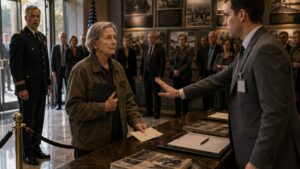
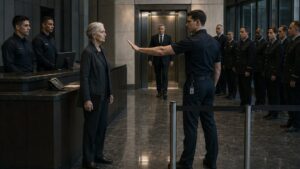
The security officer held out one hand before William Adams reached the scanner.
“Sir, step to the side, please.”
William stopped without protest. Behind him, two captains in pressed uniforms shifted lanes and passed through the checkpoint, their badges flashing green against the reader. Neither looked at him. One carried coffee. The other was laughing at something on his phone.
William moved where the officer pointed.
The headquarters lobby had changed since he last entered through its public doors. The old terrazzo floor was gone, replaced by gray tile that showed every wet footprint. The glass security partitions were higher. The visitors’ desk now stood where a wooden display case had once held unit colors from campaigns no one under forty seemed likely to remember.
His own reflection looked back at him from the partition: seventy-six, shoulders still square beneath a faded olive field jacket, white hair cut short, dark folder tucked beneath one arm. His visitor badge read:
WILLIAM ADAMS
RECORDS CONSULTANT
The security officer examined it twice.
“Restricted floor requires an escort.”
“I was told one would meet me.”
“Name?”
“Michelle Lee.”
The officer typed, waited, then frowned at the screen. “No answer.”
William could have given him the direct number. He could have mentioned the Inspector General’s office. He could have said the building’s original security corridor had been designed with two blind angles, one of which still existed ten feet behind the officer’s chair.
Instead, he said, “Then I’ll wait.”
The officer glanced at the dark folder. “You here for archives?”
“In part.”
“That floor is busy today.”
“So I understand.”
The officer seemed irritated by the lack of explanation. He pointed to a metal chair beside the wall. “Have a seat.”
William sat.
From there he could see the bank of elevators and the restricted corridor beyond the glass. Personnel moved quickly through it, heads lowered, folders pressed close to their sides. A legal clerk hurried past carrying three binders marked INCIDENT REVIEW. A technician followed with a coil of cable and a small equipment case.
William watched the elevator numbers.
The invitation had said nine hundred hours. It was eight thirty-six.
At eight forty-two, a young woman in a dark green uniform stepped from the far elevator between two officers. Captain Laura Rivera’s photograph had been clipped to the top sheet in William’s folder, but the photograph had not shown the stiffness in her hands.
She held them close to her belt as she walked.
No handcuffs. No formal escort order. Yet the two officers stayed half a pace behind her, close enough to make the arrangement look compulsory.
William rose.
The security officer looked up sharply. “Sir.”
“That officer is scheduled for an interview at nine.”
The officer followed his gaze. “You know her?”
“I know the schedule.”
“That’s not your concern.”
Laura passed through the restricted door without seeing him. One of the officers with her checked the corridor clock. The second carried no counsel packet, no recording acknowledgment form, and no advisement sheet.
William looked toward the visitors’ desk.
“Was her attorney brought up earlier?”
The receptionist blinked. “I wouldn’t know.”
“The interview log will.”
The security officer folded his arms. “You need to sit down.”
William did not move.
A door opened beyond the glass, revealing a narrow strip of corridor and, at the far end, a square window set into an interview-room door. Above it glowed a small red light.
Recording active.
William checked his watch.
Eight forty-five.
Too early.
The old unease came without warning—not panic, not even surprise, but a pressure beneath the ribs he remembered from command posts when a report looked orderly and the facts beneath it did not.
A man in a decorated dark uniform entered the corridor from the opposite end. Brigadier General Richard Campbell did not hurry. People moved for him before he reached them. His jacket was immaculate, his ribbons arranged in exact rows, his expression already fixed in the narrowed concentration of a man who believed the room ahead belonged to him.
He paused outside the interview door and spoke to one of the junior officers.
The officer handed him a thin document.
Richard read the first page, tapped one paragraph with a finger, and entered.
The red light remained on.
William returned to the desk.
“I need access to the interview-floor log.”
The receptionist looked at the security officer, then back at him. “Consultants don’t receive operational logs.”
“This one should.”
“On whose authority?”
William considered answering.
For years, his name had opened doors before he reached them. Later, it had produced a different reaction: recognition softened by distance, as though the person hearing it were being reminded of a monument rather than a man.
He had asked Michelle not to announce him.
A title altered conduct. He needed to see what happened when no one thought history was watching.
“Please call Ms. Lee again,” he said.
The receptionist exhaled through her nose. “I already sent the notice.”
William looked back toward the red light. “Then note that the subject entered the room fifteen minutes before the scheduled time and without counsel present.”
The security officer’s face changed slightly. “How do you know counsel isn’t there?”
“No advisement packet. No second visitor authorization. No legal escort.”
The officer glanced toward the corridor.
William added, “And the room log display outside the door is still amber. Formal interview status would show blue.”
The receptionist turned to her monitor as if seeing it for the first time.
“Where did you learn that?” the officer asked.
William looked at the scanner, then at the corridor geometry beyond it.
“An older version of the same place.”
The restricted door opened again. One of the junior officers stepped into the lobby.
“Mr. Adams?”
William picked up the dark folder.
The officer gave the security desk a strained smile. “General Campbell says the records consultant can observe from the rear, as long as he doesn’t interrupt.”
The phrase was delivered carefully, as though it had already been repeated once and disliked both times.
William walked through the scanner. It beeped at the metal clip on his folder.
The security officer searched it without apology. Inside were photocopied timelines, old procedural directives, a sealed envelope, and several pages covered in William’s narrow handwriting.
“No classified material?” the officer asked.
“Not yet.”
The officer handed it back.
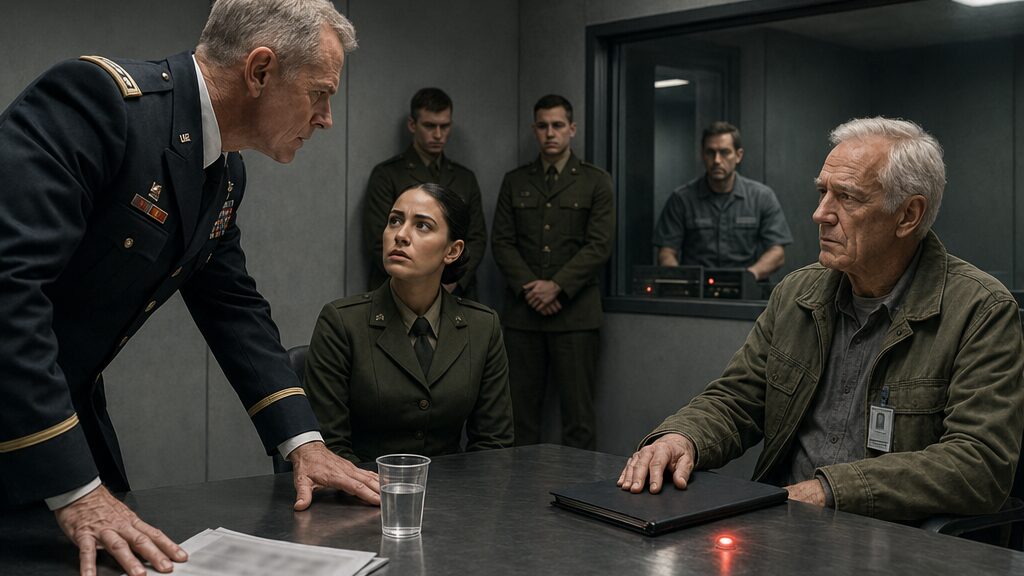
At the interview-room door, William paused beneath the red light. Through the square window he saw Laura seated at a stainless-steel table. A clear plastic cup stood untouched before her. Richard stood across from her, one palm flat on the metal.
There should have been an attorney beside Laura.
There should have been a formal opening statement.
There should have been a recorded confirmation that she understood the purpose of the interview.
Instead, Richard was speaking in a low voice while one of the junior officers adjusted a camera in the corner.
William entered quietly.
Richard glanced at him only once.
“Back wall,” he said.
William took the chair indicated. It was smaller than the others and placed near the control panel, outside the camera’s most obvious frame.
Laura looked at him.
Her expression held no recognition. Only a quick, disappointed assessment: old man, plain jacket, visitor badge, no help.
William set the folder across his knees.
Richard slid a page toward her.
“This is not punitive,” he said. “This is an opportunity to correct language that was written under stress.”
Laura did not touch the paper.
Richard leaned closer.
“The phrase ‘command delay’ creates an implication unsupported by the complete operational picture.”
“It is supported by the radio record,” she said.
“The radio record is incomplete.”
“So is the statement you want me to sign.”
One junior officer shifted beside the wall. The other kept his eyes on his notes.
Richard’s hand flattened harder against the table.
William looked at the red light reflected in the steel surface. The old device had been replaced, but the color was the same.
Laura’s cup trembled slightly when Richard’s knuckles struck the table.
“Captain,” he said, “we can correct your memory before this becomes official.”
William’s fingers tightened around the edge of the folder.
Chapter 2: The General Who Mistook Silence for Weakness
Richard Campbell planted his palm beside Laura’s untouched cup and pushed the rewritten statement across the table until it touched her wrist.
“Read the final paragraph.”
Laura kept her hands in her lap.
“I have read it.”
“Then you understand the correction.”
“It isn’t a correction.”
The fluorescent lights gave the room no shadows. Every movement appeared exposed: the pulse at Laura’s throat, the bend in Richard’s fingers, the slight rise of the folder against William’s knees when he breathed.
Richard tapped the page.
“The evacuation alarm was delayed because the assigned operator failed to act within the expected decision window.”
Laura raised her eyes. “The assigned operator received two conflicting orders.”
“One of which came through an unverified channel.”
“One came from range control. The other came from command operations.”
“The command message was advisory.”
“It said hold.”
Richard straightened. “It said confirm before execution.”
“It said hold pending confirmation.”
A silence passed through the room.
William watched the two junior officers. The one nearest the camera stared down at his notes. The other looked briefly toward the red light.
Richard noticed.
“Let’s keep our attention where it belongs,” he said.
Laura’s gaze moved to William.
It was not an appeal exactly. There was too much discipline in it for that. But something had changed since he entered. At first she had dismissed him. Now she seemed to be asking why a witness who recognized the shape of the pressure was allowing it to continue.
William felt the question land where accusation would have been easier.
Richard pulled the page back and uncapped a pen.
“We are not changing the event,” he said. “We are clarifying responsibility.”
Laura gave a small, humorless breath. “By moving it.”
Richard’s face tightened. “Captain Rivera, a soldier is dead.”
“I know.”
“His family will read this report.”
“I know.”
“And you are prepared to state that command indecision caused his death?”
“I am prepared to state what happened.”
Richard leaned over her.
“What happened is that you waited.”
Laura’s jaw moved once.
William noticed it.
Not denial. Not agreement. Something held behind the teeth.
Richard saw it too.
“How long?” he asked.
Laura looked at the page.
“How long did you wait, Captain?”
“That is in my statement.”
“It is not in this statement.”
William lowered his eyes to the dark folder. The top page contained three versions of the incident timeline. The official draft marked the evacuation alarm at 14:07:42. Laura’s preliminary note listed the conflicting messages but gave no second-by-second interval.
Richard was not inventing every weakness.
That made his method more dangerous, not less.
William spoke.
“Has the formal advisement been completed?”
Richard turned slowly.
The room seemed to contract around that movement.
“I was told you were here to review archived procedures,” he said.
“I asked whether the advisement was completed.”
Richard looked toward the junior officer nearest the door. “It will be attached.”
“Attached later?”
“This is a preliminary clarification.”
“The recording light is active.”
“Routine room capture.”
“Then it is an interview.”
Richard’s expression lost its thin layer of professional patience.
“Mr. Adams, you were permitted to observe as a courtesy.”
William glanced at his visitor badge. “Courtesy was not listed in the invitation.”
“I don’t know who issued your invitation.”
“Then you should verify it.”
Richard gave a short laugh without amusement. “What I should do is complete an operational review before people unfamiliar with modern command environments turn one imperfect phrase into a career-ending accusation.”
William let the words settle.
He had heard versions of them in other rooms, spoken by other men, some of whom had believed completely that protecting the institution meant controlling what the institution was allowed to admit.
“Directive twelve requires the subject to confirm counsel status before substantive questioning begins,” he said.
Richard stared at him. “Which directive twelve?”
“The interview-integrity series.”
“That series was replaced.”
“Parts of it.”
“Twenty years ago.”
“Seventeen.”
One of the junior officers looked up.
Richard’s eyes narrowed. “You’ve done your reading.”
“Some of it.”
“The current regulation allows command clarification before a formal investigative session.”
“Not while recording under evidentiary retention.”
The interview-room technician sat behind a narrow pane of glass in the control booth. Until then, he had kept his head bent over the console.
Richard pressed a button on the table.
“Pause room capture.”
The red light remained on.
He pressed again.
Nothing changed.
The technician’s voice came through the wall speaker. “Sir, I need an authorization code.”
“You have my authorization.”
“For a scheduled review session, the system requires a procedural basis.”
Richard looked at William.
William placed the folder on the table. Two fingers rested on its closed cover directly beneath the red glow.
Laura watched him.
Richard said, “You are interfering with an active command matter.”
“I am asking that your own rules be followed.”
“My rules?”
“The command’s.”
“You walked in here wearing a temporary badge and a field jacket older than half the officers in this building. You have no clearance displayed, no legal designation, and no operational role. Whatever familiarity you have with retired procedures does not give you standing in this room.”
William’s face remained still, but the word retired struck with more accuracy than Richard intended.
Not because it insulted him.
Because it named the excuse William had used for years to remain outside questions he still understood too well.
Richard pointed toward the door.
“You may return to the archive office.”
William did not move.
“Mr. Adams.”
Laura lowered her eyes, but not before William saw the final loss of expectation in them.
That was the moment he understood the cost of waiting.
He had told himself that silence allowed people to reveal themselves. Sometimes it did.
Sometimes silence merely gave power more room.
William looked toward the control booth.
“Before you remove me, General, ask the technician why that light never went dark.”
Richard’s chin lifted. “Security.”
The junior officer nearest the door hesitated.
Richard raised his voice. “Call security.”
The officer reached for the wall phone.
The technician’s voice came through the speaker first.
“Sir.”
Richard did not turn. “Suspend recording.”
“I can’t.”
“Then override the lock.”
“I pulled the governing protocol.”
William heard paper moving behind the glass.
The technician continued, “Continuous capture applies from first entry until release whenever an interview concerns command-action chronology.”
Richard’s face changed only slightly, but the change was enough. His eyes moved from the red light to William’s folder.
“Under what authority?” he asked.
The technician paused.
“Directive W.A.-12.”
No one spoke.
Laura looked at William’s visitor badge.
The junior officer’s hand remained suspended over the phone.
Richard stepped away from the table. “W.A.?”
The technician sounded uncertain now, aware that he had said something larger than he understood.
“That’s how it’s indexed, sir. Original issuing authority initials. The directive requires recording of pre-interview instructions, breaks conducted in the room, and any request to alter or suspend capture.”
Richard looked at William again.
William’s two fingers remained on the folder.
“And this man?” Richard asked.
The speaker crackled.
The technician answered, “Mr. Adams asked me before entry not to suspend it.”
Chapter 3: The Initials Hidden Inside the Old Directive
“Erase the minutes before the formal time stamp.”
Richard spoke toward the control-booth glass, each word separate and measured.
The technician did not answer immediately.
William saw the young man’s outline shift behind the pane. A hand moved across the console, stopped, then withdrew.
“Sir,” the technician said, “the system has already assigned the segment to evidentiary retention.”
“This was not an evidentiary interview.”
“The room was booked as one.”
“It began early.”
“The directive covers first entry.”
Richard turned from the glass. “Then classify the opening as administrative preparation.”
William remained seated.
“Administrative preparation does not include directing a witness to alter causal language.”
Richard’s eyes sharpened. “You have made your objection.”
“No. I have identified the record.”
“The distinction is irrelevant.”
“It will not be to whoever reviews it.”
Laura sat very still. The rewritten statement remained near her elbow, Richard’s pen lying across it like a bar.
The junior officer at the door lowered the wall phone.
Richard pointed to him. “Clear the room. Captain Rivera remains.”
William said, “She should not.”
“This is my command.”
“And the record now concerns your conduct.”
Richard’s mouth tightened. “You still have not established who you are.”
“That is not required for the rule to apply.”
For the first time, Richard looked uncertain whether William’s refusal was weakness or leverage.
He chose anger.
“Control booth. Now.”
The door opened. The red light above it remained on as they moved into the narrow adjoining booth. Laura was escorted to a consultation room across the corridor. She glanced back once, not at Richard but at William.
The look had changed again.
Not trust.
Calculation.
The booth smelled of warm electronics and stale coffee. Three monitors showed different angles of the steel table. On one screen, the empty chair where Laura had sat faced the camera directly. On another, William’s smaller chair appeared near the edge, half cut from the frame.
The technician pulled up the directive.
Its header had been reformatted several times, but the original scanned page appeared beneath the current text. Yellowed paper. Typewritten sections. Corrections in dark ink.
At the bottom of the first page:
W.A.-12
Continuity and Integrity of Recorded Command Interviews
Richard leaned over the console.
“Show revision history.”
The technician opened a side panel.
“Original issue date was twenty-eight years ago. Updated seventeen years ago. Incorporated into current policy six years after that.”
“Original authority?”
“The archive link is incomplete.”
Richard gave William a flat look. “Convenient.”
William ignored him. “Section four.”
The technician scrolled.
“Read paragraph C,” William said.
Richard folded his arms.
The technician read aloud. “No distinction shall be made between formal testimony and preparatory clarification when a subject’s description of command action, timing, responsibility, or sequence is discussed in the interview environment.”
A memory surfaced in William with the shape of the sentence.
Not the room where he had written it. The officer whose testimony had made it necessary.
A young major sitting beneath a different red light, hands trembling only after the camera had been turned off.
William had corrected the procedure. He had believed that was enough.
Richard said, “Who wrote the original?”
The technician clicked the archive link again. “The issuing signature page isn’t in the local file.”
“It should be,” William said.
Richard heard the certainty.
“You know where it is?”
“Command history archive. Pre-digital directives were transferred by series, not subject.”
“How would a records consultant know that?”
“Because your current archive labels are copied from the old accession system.”
Richard stared at him for a moment, then turned to the junior officer.
“Find the historian.”
They waited six minutes.
Richard used four of them to make calls from the corridor. He kept his voice low, but William heard the phrases headquarters review, uncontrolled recording, and unauthorized observer.
On the fifth minute, Laura’s consultation-room door opened. She stood in the doorway with the escort officer behind her.
Her eyes went to the scan on the monitor.
“W.A.,” she said quietly.
Richard turned. “Captain, return inside.”
She did not.
“Does that directive protect the recording?” she asked William.
“It protects whatever happened in the room.”
“That isn’t what I asked.”
William understood her meaning. A recording could preserve coercion. It could also preserve omission, hesitation, contradiction.
“It protects the whole record,” he said.
Laura’s expression hardened, as if honesty from him had cost more than reassurance would have.
Footsteps sounded from the corridor.
Joseph Roberts entered carrying two archival boxes. He was broad through the shoulders, though age had softened his movement. His civilian shirt bore a small command-history badge at the pocket. He set the boxes on the technician’s counter and nodded to Richard.
“General Campbell.”
Then he saw William.
His hands stopped on the cardboard lid.
The room changed, though no one else yet knew why.
Joseph looked first at William’s face, then at the faded olive jacket, then at the dark folder tucked beneath his arm.
William gave the slightest shake of his head.
Joseph’s mouth closed.
Richard noticed.
“You know Mr. Adams?”
Joseph took a breath. “I know the archive series.”
“That was not my question.”
Joseph looked at William again. Loyalty moved across his face before discipline covered it.
“I may have seen him in connection with historical materials.”
Richard seemed unconvinced. “Open the box.”
Joseph removed a thick binder wrapped in gray paper. Inside were carbon copies of directives, command memoranda, and handwritten drafts. The paper smelled faintly of dust and binding glue.
The technician displayed the scanned W.A.-12 page on the central monitor.
Joseph laid the physical copy beside William’s folder.
A handwritten correction curved through paragraph C:
Include preparatory questioning. Coercion does not become harmless because someone calls it informal.
Joseph looked at the note.
Then at the markings visible on the top page inside William’s folder.
The same narrow letters. The same hard downward stroke on the letter g. The same compressed spacing between words.
His face lost color.
Richard saw it.
“What?”
Joseph touched the old page with one finger. “These corrections were made by the issuing authority.”
“Who?”
Joseph did not answer.
William closed the folder.
Richard stepped closer. “Who issued it?”
Joseph’s gaze stayed on William.
“A former commander,” he said carefully.
“What rank?”
“The directive file does not require that information to remain valid.”
Richard’s voice cooled. “You are an installation employee, Mr. Roberts. I asked you a direct question.”
Joseph straightened. For an instant, William saw the command sergeant major he had once known—the man who could make a room of colonels reconsider their posture without raising his voice.
But Joseph honored the warning in William’s earlier glance.
“He was senior enough to issue it,” he said.
Richard turned toward William. “And you just happen to write exactly like him.”
William did not respond.
The partial answer had done what partial answers always did. It had not settled the room. It had made every uncertainty sharper.
Richard reached into the papers he carried and removed a single sheet.
“Perhaps we should stop discussing ancient handwriting and return to the current record.”
He placed the page on the counter.
Laura’s preliminary statement.
William read the incident chronology. Conflicting messages at 14:07. Smoke observed. Range-control warning. Command hold. Evacuation alarm.
Then he saw the problem.
The radio system had logged the hold message at 14:07:24.
The alarm began at 14:07:42.
Eighteen seconds.
Laura’s statement described the conflicting orders. It described her confusion. It described the alarm.
It did not describe the interval between them.
Richard watched William find it.
“Captain Rivera’s public claim is that command delay caused the failed evacuation,” he said. “Her private draft does not mention that she sat on the alarm for eighteen seconds.”
Laura stepped into the booth.
“I did not sit on it.”
“You omitted the interval.”
“I reported both orders.”
“You reported everything except what you did between them.”
The accusation landed differently now. Not as pure manipulation. Not as truth either.
William read the page again.
Laura had written with care everywhere else. Times. Channels. Names of posts. Exact phrases where she could remember them.
At the point that concerned her own action, the language became broad.
He opened the dark folder to the original timeline Michelle had sent him.
There, beside the alarm entry, was a blank space where an explanatory note should have been.
William looked at Laura.
For the first time since entering the building, he could not tell whether the person under pressure was protecting the truth, protecting herself, or trying desperately to do both.
Chapter 4: Eighteen Seconds No One Wanted Recorded
“He is lying about the order,” Laura said. “But I did lose eighteen seconds.”
The consultation room was scarcely larger than a storage closet. A narrow table filled most of it, leaving William and Laura opposite each other with barely enough space for their knees. Through the small window in the door, the red recording light across the corridor was no longer visible.
William set the dark folder between them.
“Lose them how?”
Laura looked at the sealed plastic cup the escort officer had brought from the interview room. She had not opened it.
“At 14:07:24, range control said smoke had crossed the inner marker. Their voice was breaking up. I reached for the alarm.”
“And command operations?”
“Came over the second channel. ‘Hold pending confirmation.’”
“You recognized the voice?”
“Yes.”
“Whose?”
She hesitated.
William waited.
“General Campbell’s operations officer.”
“Not General Campbell.”
“No.”
“Then when General Campbell says the message was advisory—”
“He wasn’t on the radio. He can call it whatever he wants now.”
William opened the folder to the preliminary chronology.
“Tell me what happened during the interval.”
Laura pressed her lips together.
“The range-control channel dropped. I called back. Nothing. Command operations repeated the hold. My team leader asked which order controlled. I looked at the board.”
“For eighteen seconds?”
“For maybe five.” She shook her head. “No. That’s not true. Longer.”
William watched the shame settle over her face.
“I thought if I sounded uncertain, everyone else would freeze. So I told them I was confirming. I wasn’t confirming. I was trying to decide which failure I could survive.”
“And then?”
“The smoke sensor jumped. I triggered the alarm.”
“At 14:07:42.”
“Yes.”
William made no note.
Laura noticed. “You should write it down.”
“It is already written.”
“Not in my statement.”
“No.”
She looked toward the door. “Campbell wants those eighteen seconds to become the whole incident.”
“They are part of it.”
“I know.”
“Do you?”
Her eyes sharpened.
William regretted the edge in the question as soon as he heard it. Not because it was unfair, but because it carried an old tone he recognized—certainty used to force confession faster than truth could bear it.
Laura leaned back.
“You sat there while he pushed that paper at me.”
“Yes.”
“You knew he was violating the rule.”
“Yes.”
“And you waited.”
William rested both hands on the folder.
“Yes.”
Her anger did not rise. It became quieter.
“Why?”
“I believed observation would show me what he intended.”
“It showed me what you intended too.”
The words struck cleanly.
William had no defense that did not sound like rank, experience, or strategy. None of those altered the fact that she had looked at him and found another man willing to let the pressure continue.
“I waited too long,” he said.
Laura studied him, perhaps expecting qualification.
He gave none.
The door opened before she could answer. Richard stood in the corridor without his cap, his uniform still exact but his face less controlled.
“This private consultation was not authorized.”
William looked past him. The red light above the interview-room door had gone dark.
“Who suspended the system?”
“It is a scheduled break.”
“The room is empty.”
“Then nothing is being lost.”
William felt relief before he felt concern.
For one breath, the absence of the light eased the pressure in his chest. No record. No audience. No permanent account of whatever he might say next.
The relief shamed him.
Richard stepped inside and closed the door.
“Captain Rivera,” he said, “your counsel has been notified. Until arrival, you are not to discuss substantive facts with an unauthorized reviewer.”
Laura looked at William. “Is he unauthorized?”
Richard answered for him. “At present, he has established nothing except familiarity with obsolete paperwork.”
William said, “The recording should resume.”
Richard ignored him.
“Captain, the man who died at Range Seven was Staff Sergeant James Lewis.”
The first name carried no meaning to William. Laura’s expression showed that it did.
Richard continued. “He served under me before he became range safety officer. Three deployments. Two children. His wife received the preliminary notification yesterday.”
Laura’s eyes lowered.
Richard’s voice changed. The force remained, but grief had entered beneath it.
“If your language stands as written, the report will say his failure to escalate caused the evacuation delay. He cannot answer that. He cannot explain the damaged radio, or what he believed the smoke line was doing, or why he waited to clear the outer lane.”
“I didn’t write that he caused it,” Laura said.
“You wrote ‘range and command delay.’ His name is the range.”
“The channel failed.”
“And his family will read that as his failure.”
Laura’s hands closed around each other.
William saw the truth beneath Richard’s argument and the manipulation built around it. Grief did not require a false chronology. Loyalty did not authorize coercion. But Richard was not protecting only himself.
That made the room harder.
“Why did you alter the command message in the revised draft?” William asked.
Richard turned.
“I clarified its intent.”
“You changed ‘hold pending confirmation’ to ‘confirm receipt.’”
“The operations officer used imprecise language under stress.”
“So did Captain Rivera.”
Richard’s eyes narrowed. “That is precisely the point.”
“No. Your point is that uncertainty is acceptable when it protects command and unacceptable when it belongs to a junior officer.”
A muscle moved in Richard’s jaw.
Laura looked from one man to the other.
Richard said, “You do not understand what happens when headquarters needs a clean answer before a readiness inspection.”
William did understand. Too well.
“Clean answers are often obtained by washing away the people who cannot refuse.”
Richard stepped closer. “And broad accusations destroy families, careers, and commands before facts are complete.”
“Then complete the facts.”
“I am trying to.”
“No. You are arranging them.”
For a moment, Richard’s grief vanished beneath authority.
“The revised chronology has already gone to headquarters.”
Laura stood.
“You sent it?”
“It was due at noon.”
“Before my interview?”
“It was preliminary.”
“With my name on it?”
“With the command’s assessment.”
Laura’s face went still in the way William had already learned meant she was closest to losing control.
“You were never asking me to clarify,” she said. “You were asking me to agree with what you had already sent.”
Richard did not answer.
The corridor door opened sharply.
A woman in a dark suit entered carrying a sealed envelope and a legal case. Michelle Lee looked first at the unrecorded room, then at Richard, then at William.
Her disappointment settled on William longest.
“I was delayed at headquarters,” she said. “That delay appears to have been used poorly.”
Richard straightened. “Ms. Lee, your consultant has exceeded his role.”
Michelle held up the envelope.
“The review is no longer private.”
William saw his name beneath the seal before she broke it.
Michelle’s voice lowered.
“Headquarters wants your name on the finding.”
Chapter 5: The Commander in the Faded Photograph
“General Adams.”
Joseph Roberts spoke the title beneath a row of faded command photographs, and every person in the archive gallery stopped moving.
William had asked him not to.
Joseph’s face showed that he knew it. His hands hung at his sides, caught between old discipline and present necessity.
Richard stood several feet away with Michelle and the two junior officers. Laura had been brought from consultation after counsel arrived and now waited beside the conference-room door.
Her gaze moved from Joseph to William.
“General?” she said.
William looked up at the photograph above him.
It had been taken twenty-seven years earlier. He stood beside an interview-room technician, one hand resting on a metal control cabinet. His hair was dark, his shoulders broader, his uniform carrying four stars. Above the door behind him glowed the first red continuous-recording indicator installed under Directive W.A.-12.
Time had softened the photograph but not enough to hide his face.
Richard looked from the image to William’s visitor badge.
The silence that followed was not respect. Not yet. It was the sound of people rearranging everything they thought they understood.
Joseph recovered first.
“Retired General William Adams,” he said, more quietly. “Former commander of the regional force structure that preceded this headquarters.”
One junior officer began to raise his hand.
William stopped him with a slight movement.
“No salute indoors, and none required.”
The officer lowered it, embarrassed.
Richard did not move.
“You entered my headquarters under a consultant badge.”
“It was the designation provided.”
“You concealed your identity.”
“I withheld my title.”
“That distinction seems important to you.”
“It should be important to everyone.”
Richard’s color had changed, but his voice remained controlled. “Why?”
Michelle opened the sealed envelope.
“Because the Inspector General authorized General Adams as an independent special reviewer of command-interview integrity and historical procedure.”
She unfolded the directive and read the relevant lines. William heard his own name, former rank, scope of review, and authority to preserve materials. Each phrase seemed to make the room more formal and less truthful.
Richard waited until Michelle finished.
“He has no active command authority.”
“No,” William said. “I do not.”
“Then you cannot countermand me.”
“I have not.”
“You prevented the suspension of a recording.”
“The directive did.”
“You challenged the classification of the interview.”
“The facts did.”
“You allowed everyone in that room to believe you were an ordinary records contractor.”
William looked at Laura.
“That should not have changed how I was treated.”
Richard’s face hardened, perhaps because the answer gave him no useful ground.
Michelle closed the authorization. “General Campbell, headquarters requires the original recording, both chronology drafts, and the command-channel traffic. No further interview will occur without counsel.”
Richard nodded once.
The reversal was visible now. The junior officers no longer watched William as an inconvenient elder. The legal clerk at the far end of the gallery had stopped arranging folders. Joseph stood straighter, almost proud.
William disliked it.
Ten minutes earlier, his questions had been valid because the rules were valid. Now the same questions seemed wiser because stars had once rested on his shoulders.
“Bring Captain Rivera back to the table,” he said.
Richard’s eyes flashed. “You just said you could not countermand me.”
“I am requesting it.”
“And if I decline?”
“Then the report will state that you declined.”
Richard looked at Michelle.
She said, “That is within his review authority.”
Laura entered the command conference room first. The steel interview table was not there; this room had polished wood, leather chairs, and framed photographs of exercises conducted under clear skies. William chose the plain chair nearest the wall.
Joseph placed the original directive before him.
Laura sat opposite. Richard remained standing.
William said, “Recognition does not settle the chronology.”
Laura gave a faint nod.
Richard folded his arms. “At least we agree on something.”
“The recording establishes what happened in the interview,” William continued. “It does not establish why the evacuation failed.”
Richard glanced at Laura. “Her omission does.”
“No. It establishes that she omitted eighteen seconds.”
“Eighteen seconds in an emergency can be the difference between evacuation and entrapment.”
“Yes.”
Laura flinched, but William did not soften the answer.
Richard seemed surprised.
William turned to her. “Your hesitation belongs in the report.”
“I know.”
“The conflicting orders belong there too.”
“Yes.”
“The revised command message cannot stand.”
Richard stepped forward. “You are treating uncertainty as if it excuses action.”
“I am treating it as fact.”
“Fact without responsibility is evasion.”
“And responsibility without context is scapegoating.”
The two men held each other’s gaze.
Richard looked older than he had in the interview room. Not weaker. More exposed.
“The dead officer’s family has already been told his actions are under investigation,” he said. “His wife called me last night. She asked whether his final day would become the only thing anyone remembered about him.”
Laura’s expression shifted.
Richard continued, “James Lewis was not careless. He had been reporting radio failures for three months. Maintenance closed two tickets without replacement because the range remained operational.”
Michelle looked up. “Those tickets were not in the packet.”
“They were local.”
“Why?”
“Because if they enter the formal record, the readiness rating becomes inaccurate retroactively.”
“Meaning false,” William said.
Richard’s mouth tightened. “Meaning incomplete.”
“And your promotion review?”
The question landed harder than William intended.
Richard looked toward the photographs on the wall. “Scheduled next month.”
No one spoke.
There it was: grief, loyalty, institutional fear, and ambition, tied so tightly that Richard could no longer separate one from another.
William understood the knot because he had tied similar ones himself.
Richard faced him again.
“You think this is simple because you are retired.”
“No.”
“You can leave after your finding. The rest of us remain with the consequences.”
William’s hand rested on the dark folder.
“I know what it means to remain.”
Richard gave a bitter laugh. “Do you?”
He pointed toward the faded photograph visible through the conference-room glass.
“You wrote the doctrine they still teach. You built the review system. You trained commanders to speak with certainty, protect cohesion, and never let hesitation travel farther than the room where it happened.”
Joseph shifted uncomfortably.
Richard went on.
“Now you arrive in a worn coat, watch me handle the institution you left behind, and act surprised that officers learned your lesson.”
William felt the room turn again.
Not away from Richard.
Toward him.
The title that had restored his authority now held him in place.
Richard’s voice lowered.
“You wrote the culture that taught officers never to put hesitation on paper.”
Chapter 6: What William Adams Never Put in His Report
William found his own signature on the final page of a report that declared the problem resolved.
The interview room was empty. Tuesday afternoon light did not reach it; the fluorescent panels cast the same hard brightness at every hour. The steel table had been wiped clean. A fresh plastic cup stood at Laura’s place, still sealed.
William sat where she had sat and read the old report again.
Twenty-eight years earlier, a major had changed testimony after a commander questioned him off camera. The altered statement had protected a training schedule and shifted responsibility to a maintenance team. When the truth emerged, William had ordered continuous recording and removed the interrogating officer from review duties.
The corrective-action section filled three pages.
The cultural finding filled one sentence:
No evidence indicates broader command influence.
William remembered writing it.
At the time, he had called it precision. He had refused to accuse an entire command based on one documented case. He had believed punishing the individual and fixing the procedure demonstrated fairness.
Now the sentence looked like a locked door.
Michelle stood near the control panel, reading the headquarters message on her tablet.
“They want the current matter kept separate from historical review.”
“Of course they do.”
“They are not entirely wrong.”
William looked up.
Michelle chose her words carefully. “General Campbell’s conduct can be evaluated from the recording and document changes. Captain Rivera’s omission can be evaluated from the timeline. Expanding the finding across three decades may weaken the actionable case.”
“Or explain it.”
“Explanation is not always jurisdiction.”
“That is a phrase institutions use when memory becomes inconvenient.”
Michelle’s expression tightened. “And history is sometimes used to blur present responsibility. Campbell made his own choices.”
“Yes.”
“He cannot place those choices on you.”
“No.”
“Then do not place them there yourself.”
William closed the old report.
He had asked Michelle to keep his identity private because he wanted unguarded behavior. That had been partly true.
The other part was less respectable.
A consultant could observe failure. A former commander had to answer for inheritance.
The door opened. Joseph entered carrying a second archive box. He glanced at the old report and seemed to understand immediately.
“That case,” he said.
“You remember it.”
“I remember what came after.”
“The recording rule.”
Joseph set the box down. “More than that.”
He removed training notes, command speeches, and evaluation guidance from William’s tenure. Several passages had been underlined by instructors over the years.
Decisive leadership prevents uncertainty from spreading.
A commander must absorb ambiguity and present direction.
Confidence is a force multiplier.
William recognized every sentence.
Joseph sat across from him.
“You were trying to keep frightened people moving,” he said.
“That does not make the words harmless.”
“No.”
“You taught them?”
“I taught what command gave us.”
“That is not an answer.”
Joseph’s eyes lifted. “Then yes. I taught them.”
The admission cost him.
“We had young officers who believed uncertainty was confession,” Joseph continued. “They learned to clean up hesitation before it reached the next level. Not because you told them to falsify anything. You never did. But they knew what kind of leader got praised.”
William looked at the sealed cup.
“And what kind did not.”
Joseph nodded.
The red light above the door was dark.
William stood and crossed to the control panel.
Michelle said, “What are you doing?”
He pressed the activation switch.
The light came on with a faint click.
For years, it had represented protection to him. A mechanical witness that could not be intimidated, promoted, or persuaded.
But a camera recorded only what people allowed themselves to say beneath it.
William returned to the table.
“Begin a supplemental statement.”
Michelle did not move.
“About the current interview?”
“About the reviewer.”
“William.”
He heard the warning in her use of his first name.
“Headquarters has already drafted a recommended finding,” she said. “Campbell violated interview-integrity procedure, attempted to influence witness language, and submitted an unsupported chronology. They will accept that.”
“And close the case.”
“They will order corrective action.”
“Against one man.”
“One man made the decision.”
“One captain omitted eighteen seconds. One dead officer worked with failed radios. One operations channel gave a contradictory order. One commander altered the record. And one former commander wrote that the culture producing an earlier case did not exist.”
Michelle set down the tablet.
“If you broaden this too far, they may reject everything.”
“Then the record will show what they rejected.”
Joseph looked at William with something close to pain.
“They’ll put your old report beside this one.”
“They should.”
“People will say you are rewriting your legacy.”
“I am correcting an omission.”
Joseph’s loyalty resisted the answer. William could see it in the set of his shoulders.
“You changed this command for the better,” Joseph said.
“And left part of the damage unnamed.”
“You cannot be responsible for every officer who misused what you taught.”
“No. But I am responsible for what I refused to examine when I had the authority.”
The wall speaker clicked.
The technician’s voice came through. “Recording active. Please identify the statement.”
William opened the dark folder fully for the first time.
Inside the sealed envelope lay his independent-review authorization. Beneath it were the old report, the current chronology, Laura’s incomplete statement, and Richard’s revised version. Four records. Four attempts to make uncertainty manageable.
Michelle’s tablet chimed.
She read the message, then turned the screen toward William.
PROPOSED DISPOSITION: COMMANDER-SPECIFIC FAILURE. EXPEDITED CLOSURE AUTHORIZED UPON REVIEWER CONCURRENCE.
“They want your signature tonight,” she said.
William read the language twice.
A narrow finding would hold Richard responsible. It would preserve Laura’s career if her omission remained secondary. It would protect headquarters from questions about doctrine, maintenance, and evaluation culture.
It was not entirely false.
That was what made it tempting.
William picked up a pen.
Joseph watched him. Michelle did not speak.
On a blank page, William wrote slowly, making each letter clear enough for the camera to capture when the page was lifted.
The record must begin with the failure of command, including mine.
Chapter 7: Every Word Beneath the Red Light
William took the least prominent chair in the interview room and ordered the door left unlocked.
Richard stood just inside it.
“That compromises the session.”
“No,” William said. “Closing it did.”
The two junior officers waited along the wall. Laura sat at the steel table with counsel beside her. Michelle occupied the chair nearest the control panel. Through the narrow glass, the technician raised one hand to indicate that recording had begun.
The red light came on.
William placed the dark folder beneath it but did not open it.
Richard remained standing.
“There are only three acceptable outcomes left,” he said. “A private correction, an administrative finding against me, or a formal inquiry that damages everyone in this room.”
“There is another,” William said.
Richard looked at him.
“A complete record.”
“That is not an outcome. It is a slogan.”
Laura’s fingers rested against the new plastic cup. Its seal remained unbroken.
William looked toward the open doorway. Personnel passing in the corridor could not hear the conversation, but the visible opening changed the room. No one appeared trapped inside it.
Michelle activated the formal statement.
“For the record, identify the reviewing official.”
William had hoped to avoid the sentence, though the authorization required it.
“William Adams. Retired general, United States Army. Former regional commander. Independent special reviewer by Inspector General appointment.”
Richard’s gaze stayed on the table.
William continued before the title could settle over the room.
“I also served as issuing authority for Directive W.A.-12 and signed the historical report that declared the coercive practices preceding that directive to be an isolated failure.”
Joseph stood beyond the doorway, present as archive custodian. His head lifted.
Michelle said, “General Adams, the historical case is outside the stated factual period.”
“The current finding cannot be understood without it.”
Headquarters counsel appeared on a secured monitor mounted beside the control glass. The image lagged by half a second.
“We object to expansion beyond the present incident.”
William looked at the camera.
“Noted.”
“You do not have authority to assign institutional liability across prior commands.”
“I am not assigning it. I am identifying it.”
Richard pulled out a chair but did not sit.
William opened the folder.
The old report lay on top. Beneath it were Laura’s preliminary statement, Richard’s revised chronology, the maintenance tickets, and the communications transcript.
“The earlier case produced a recording rule,” William said. “It did not produce an honest finding about command culture. I wrote that no broader influence existed because I could not prove one to the standard I preferred.”
Headquarters counsel interrupted. “That admission is personal interpretation.”
“Yes.”
“Then it should be submitted separately.”
“No.”
The word changed the room more than his title had.
William turned to Laura.
“Captain Rivera, describe the eighteen seconds.”
Her counsel leaned close and whispered to her. Laura listened, then shook her head.
“At 14:07:24,” she said, “range control reported smoke crossing the inner marker. Their transmission failed before they confirmed whether personnel had cleared the outer lane.”
Her voice was level, but her thumb pressed into the rim of the cup.
“Command operations transmitted, ‘Hold pending confirmation.’ My team leader asked whether to activate the evacuation alarm. I looked at the board and tried to restore range contact.”
“How long?” William asked.
“Eighteen seconds.”
“What were you doing during that time?”
“Trying to decide which order I could disobey without making the situation worse.”
The junior officer nearest the door lowered his eyes.
Laura continued.
“I told my team I was confirming. That was not accurate. I was uncertain, and I did not want them to hear it.”
“Why was the interval absent from your first statement?”
“Because I was ashamed.”
Richard watched her without triumph.
William asked, “Did command cause your hesitation?”
“It contributed to it. It did not move my hand. I delayed the alarm.”
The answer remained in the room, neither confession nor absolution.
William turned to Richard.
“Did you alter the chronology submitted to headquarters?”
Richard looked at the red light.
“Yes.”
Michelle’s pen stopped.
Richard sat.
“I changed ‘hold pending confirmation’ to ‘confirm receipt.’ I removed the maintenance tickets from the initial packet. I described Captain Rivera’s delay as the primary causal event.”
“Why?”
Richard rubbed one thumb across the edge of his academy ring.
“Because Staff Sergeant Lewis was dead. Because his wife had already been told his conduct was under review. Because the failed radios had been accepted as operational through two inspections. Because the readiness board was arriving in six days.”
“And your promotion?”
Richard’s jaw tightened.
“That too.”
The admission seemed to age him more than the last two days had.
“I believed,” he said, “that if the report spread responsibility across command, maintenance, range control, and operations, no one would be accountable. I chose the clearest failure.”
“You chose the lowest surviving rank,” Laura said.
Richard looked at her.
“Yes.”
It was the first answer he had given her without arranging it.
Headquarters counsel leaned toward the monitor.
“The record now supports a commander-specific finding. We recommend concluding the session and processing administrative action.”
William removed the proposed disposition from the folder.
It placed Richard at the center, Laura in a subordinate footnote, and the equipment failures under corrective maintenance. It was neat. Actionable. Defensible.
Incomplete.
“The failure began before General Campbell entered the interview room,” William said.
Counsel’s expression hardened. “Do not dilute misconduct by making it cultural.”
“I am doing the opposite.”
William placed his old report beside Richard’s revised chronology.
“These documents were written twenty-eight years apart. Both reduce a system failure to the conduct of one person. Mine did it to preserve confidence in command. His did it to preserve readiness and reputation.”
Richard looked at William for the first time since the admissions began.
William felt no relief in saying it. Only the weight of how late the words had come.
“I taught officers that commanders absorb ambiguity and present certainty,” he continued. “I intended to prevent confusion during crisis. I did not account for what happens when certainty becomes a performance maintained after the crisis is over.”
Joseph shifted at the doorway.
William looked toward him.
“We taught that.”
Joseph’s face tightened, then he nodded once.
Headquarters counsel said, “This statement could implicate multiple retired and active leaders without individual findings.”
“It implicates a habit.”
“Habits are not actionable.”
“Procedures are.”
William drew the final recommendation from the folder.
“All command-action interviews will begin upon room entry, not formal declaration. Continuous recording may not be suspended by the command under review. Subjects will receive counsel confirmation before substantive discussion. Conflicting operational orders will be preserved in original language. Findings will separate individual action from system contribution.”
Michelle read the first page.
Counsel said, “That exceeds your mandate.”
“My mandate allows recommendations.”
“It does not require adoption.”
“No.”
William signed the bottom.
“But rejecting it will also be part of the record.”
The room went quiet.
Richard looked at the document.
“If I sign the complete chronology, the finding against me remains.”
“Yes.”
“My promotion is over.”
“Probably.”
“And Lewis’s family reads that he did not escalate.”
“They also read that he reported the radio failures three times and was left with defective equipment.”
Richard looked toward Laura.
“And she remains responsible for the eighteen seconds.”
Laura answered before William could.
“Yes.”
The red light reflected in the untouched water.
Richard reached for the pen.
He paused over the signature line.
“You are putting your own report into the appendix?”
William placed the historical document beneath the recommendation.
“Unredacted.”
Richard signed.
Laura unsealed the plastic cup. The crack of the lid was small, but everyone heard it. She drank once, set it down, and signed her complete statement.
Michelle gathered the pages in order.
For a moment, William believed the hardest part had been done.
Then her tablet chimed.
She read the incoming notice, and the controlled expression she had carried through the session disappeared.
“What is it?” William asked.
Michelle turned the screen toward him.
The command board had accepted the factual chronology for immediate publication.
His procedural recommendation had been removed.
Chapter 8: The Door They Could No Longer Close
Three weeks later, William returned to headquarters and found his final recommendation missing from the published report.
The document lay open on the security desk.
The factual findings remained: conflicting orders, failed radios, Laura’s eighteen-second delay, Richard’s altered chronology, and improper interview pressure. The appendix included William’s old report and his admission that it had failed to examine command culture.
But the last section ended before the safeguards.
No automatic recording upon entry.
No independent authority over suspension.
No mandatory counsel confirmation before substantive questioning.
No preservation rule for original command language.
The security officer who had stopped William on his first visit recognized him immediately.
“General Adams.”
William placed his visitor badge on the scanner.
It still read RECORDS CONSULTANT.
“Sir, you don’t need to use this line anymore.”
“Does the scanner work?”
“Yes, sir.”
“Then I do.”
The officer looked toward a side gate that had been unlocked for him. William remained where he was until the reader flashed green.
Michelle met him beyond the checkpoint.
“They approved the findings,” she said.
“They approved the past tense.”
“The board believes current regulations already address most of your recommendations.”
“They believed that before the interview too.”
Michelle walked beside him toward the archive gallery.
“Richard has been removed from the review chain pending administrative action. He submitted a full statement and did not contest the recording.”
“And Laura?”
“Retained. Formal counseling for the omission. No adverse action on the command accusation.”
“That is not nothing.”
“No.”
“But it is not the safeguard.”
Michelle stopped beneath the command-history photographs.
“They are concerned your proposal creates an automatic presumption of coercion whenever a senior commander speaks to a subordinate before counsel arrives.”
“It creates a record.”
“They call that operational inflexibility.”
“Of course they do.”
Joseph waited inside the archive office with the original W.A.-12 binder and a newly printed copy of the public report. He had marked the missing section with a yellow tab.
“I argued for historical inclusion,” he said. “They told me the archive is not a policy office.”
“They are correct.”
Joseph looked surprised.
William removed his field jacket and laid it over the back of a chair.
“The archive records what happened. So record what happened.”
Michelle understood first.
“Your supplemental statement.”
“All of it.”
She shook her head. “The public archive version has not been cleared.”
“My statement concerns my conduct and my report.”
“It names command doctrine.”
“Doctrine already in the record.”
“It admits that senior leadership knowingly closed an earlier case too narrowly.”
“I signed it.”
Michelle lowered her voice. “Once it enters the public historical collection, headquarters cannot treat it as privileged review material.”
“That is why it belongs there.”
Joseph opened the archive ledger but did not write.
For decades, he had protected William’s history as carefully as other men protected medals. William could see the resistance in his face.
“They will attach your name to the failure,” Joseph said.
“They should.”
“People who never served under you will read one admission and believe it explains everything.”
“That is the risk of a record.”
“You did more good here than that report will show.”
“Then the rest of the archive can show it.”
Joseph looked at the faded photograph in the gallery—the younger William standing beside the first red recording light.
“I wanted that picture to mean you fixed the problem,” he said.
“So did I.”
William placed the signed statement on the desk.
“It means we noticed part of it.”
Joseph’s hand remained above the ledger for several seconds. Then he entered the accession date.
Michelle watched the number appear beside William’s name.
Her tablet rang before Joseph finished.
She answered, listened, and said little. When the call ended, she looked at William.
“The board has requested a delay in public accession.”
“On what basis?”
“They are reviewing whether your statement contains protected deliberative material.”
“It does not.”
“They know.”
The three of them understood what the request meant. Once William’s confession entered the archive, removing the safeguards would look less like a policy disagreement and more like a second attempt to narrow the record.
Michelle’s tablet chimed again.
This time she read silently for longer.
“The recommendation is being restored,” she said.
Joseph exhaled.
William did not.
“All of it?”
“With one modification. The board wants the reform named after the issuing authority to preserve continuity with W.A.-12.”
Joseph’s face brightened despite himself.
“The Adams Protocol.”
“No,” William said.
Michelle looked up. “That is the proposed title.”
“Reject it.”
“William, naming may be the condition for adoption.”
“Then call it Continuous Interview Integrity.”
Joseph gave a small, disappointed shake of his head.
William met his gaze.
“A rule that protects unknown people should not require a famous name to survive.”
Michelle typed the response.
By afternoon, the technicians had reopened the interview suite.
The changes were modest enough that someone passing through the corridor might not notice them. The small window in the door was no longer covered by an internal shutter. The recording system activated when the first badge opened the room and could be suspended only from an independent control station. A panel beside the entrance displayed counsel status and interview classification.
The red light came on the moment William stepped inside.
No one had pressed a switch.
Laura stood beside the steel table in a service uniform without a jacket. She looked less guarded, though not relieved. Relief would have been too simple for what remained.
A new plastic cup sat at each place.
“They asked me to test the subject notification display,” she said.
“And?”
“It works.”
William examined the panel.
COUNSEL STATUS: CONFIRMED
RECORDING: CONTINUOUS
COMMAND REVIEW AUTHORITY: EXTERNAL
Richard’s chair was empty.
“He submitted another statement,” Laura said. “About Staff Sergeant Lewis.”
William waited.
“He wrote that Lewis reported the radio problem and that command accepted the risk.” She touched the edge of the table. “He asked that it be delivered to the family before the public report.”
“Was it?”
“This morning.”
William nodded.
Laura studied him.
“Do you think he apologized?”
“To whom?”
“To me.”
“I don’t know.”
“He said he had confused protecting people with deciding which truth they could survive.”
“That sounds like an admission.”
“It did not sound like an apology.”
“Perhaps he is not ready to offer one that is about you rather than himself.”
Laura considered that.
“Will you forgive him?”
William looked at the red light.
“That is not mine to do.”
She nodded, accepting the boundary.
Joseph entered carrying a small brass plaque. William saw the engraved words before he reached the table.
CONTINUOUS INTERVIEW INTEGRITY
ADOPTED FOLLOWING THE RANGE SEVEN REVIEW
No name.
Joseph fixed it beside the door.
“I still think history should identify who forced the change,” he said.
“History has enough names.”
“It also has enough people who escaped them.”
William looked at him.
“That is true.”
Joseph’s expression softened. “Then I’ll keep the full accession.”
“Good.”
No ceremony followed. No formation gathered in the corridor. The technicians tested the audio. Michelle checked the authorization controls. Laura read the subject advisement aloud and corrected one sentence that implied counsel could be confirmed after discussion began.
The correction was entered before anyone left.
At the security desk later, the side gate stood open again.
The officer smiled awkwardly. “General Adams, the honored entrance is available whenever you visit.”
Laura had walked down with him. She glanced toward the side gate, then at the ordinary line where contractors, family members, and delivery personnel waited to be screened.
“Would you like to use it?” she asked.
William put on his faded field jacket.
“No.”
They joined the line.
Ahead of them, an elderly man struggled to remove a belt at the scanner while the people behind him shifted impatiently. The security officer stepped forward, not with irritation but with a chair.
“Take your time, sir,” he said.
William watched without speaking.
When his turn came, he placed the dark folder on the conveyor and waited for the scanner to turn green.
The story has ended.