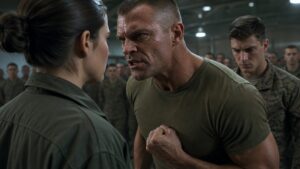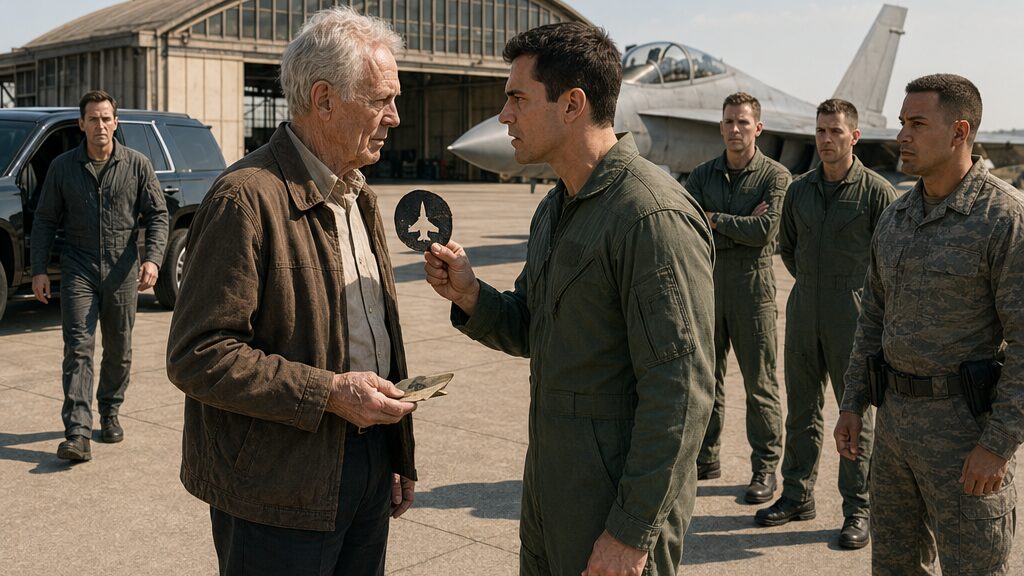
The Young Pilot Accused an Old Stranger Until the Burned Patch Revealed Who Had Commanded Them
Chapter 1: The Old Man Beside the Restricted Hangar
The fighter had not yet left the ground when David Mitchell heard the sound that had followed him for thirty-eight years.
It was barely there beneath the rising turbine howl—a soft, uneven pulse, like a coin spinning down on a steel table.
David stopped under a red sign that read RESTRICTED FLIGHT LINE. His right hand tightened around the plain envelope inside his coat.
Across the concrete, a crew chief crouched beside the gray fighter as heat trembled behind its exhaust. Two maintainers stood clear of the intake. The pilot waited beneath the raised canopy while the engine climbed through its checks.
The pulse came again.
David stepped to the painted boundary.
“You have a fuel-control oscillation,” he called.
The crew chief glanced over. He was young enough to be David’s grandson and busy enough to resent the interruption.
“Sir, stay behind the line.”
“Watch the pressure on the next increase.”
The crew chief looked toward the cockpit, perhaps because the old man’s tone had carried farther than his faded brown jacket suggested it should. The pilot advanced the throttle.
The engine note wavered.
One maintainer looked down at his instrument panel. The crew chief’s expression changed, but only for a second.
He signaled for shutdown.
As the whine descended, he walked toward David, wiping one hand on his trousers.
“You work engines?”
“Not anymore.”
“Then that was a good guess.”
David looked past him at the fighter. The silence after shutdown felt larger than the noise had.
“It was not a guess.”
The crew chief studied him, then noticed the temporary visitor badge clipped crookedly to David’s chest. Rain had blurred part of the printed name. Only the final letters remained clear.
“Visitor route is around the east side,” he said. “You can’t cut through here.”
“I was told the old hangar entrance would be open.”
“Not today. Inspection team closed it.”
David looked toward the low concrete building beyond the active aircraft shelters. Hangar Twelve had once held unfinished machines behind guarded doors. Now banners hung across its restored facade.
HERITAGE AND TRAINING CENTER DEDICATION.
Beneath the words was a gold emblem David did not recognize.
He had asked to arrive quietly, before the chairs were filled and before anyone thought to introduce him. He had asked that his name be removed from the printed schedule. He had not anticipated the east visitor route being sealed.
The crew chief pointed back toward the main road. “Return to the gate. They’ll redirect you.”
“That will take forty minutes.”
“That’s the route.”
David’s knees had already begun to ache from the walk from the visitor lot. He did not mention it.
“Is the maintenance passage behind Shelter Four still connected to the hangar?”
The crew chief’s eyes narrowed. “That passage hasn’t been marked on base maps in twenty years.”
“It was there before the maps.”
The young man almost smiled, then decided not to.
“Sir, go back to the gate.”
A security vehicle turned between the shelters. David moved away before the crew chief could summon anyone. He followed the painted pedestrian line until it disappeared beside a row of equipment carts, then took the narrow service lane running behind Shelter Four.
The base had changed in all the ways institutions changed when they wanted to prove they had not forgotten. New fencing. New signs. New glass over old photographs. Yet the concrete joints remained where he remembered them, and the desert dust still gathered in the corners of doors no one used.
At the maintenance passage, a temporary barrier blocked half the opening. A paper notice directed contractors toward the front exhibit entrance.
David turned sideways and passed through.
The envelope pressed against his ribs.
Inside it lay a scorched black patch, its edges hardened and uneven. The center contained an empty shape where the silhouette of a swept-wing aircraft should have been.
The missing piece rested in David’s trouser pocket.
He reached the rear of Hangar Twelve without meeting another person. Through an open service door he saw display cases, suspended aircraft parts, and polished panels waiting beneath white cloths. Staff voices drifted from the front.
He should have found the archivist.
Instead, he saw the title mounted on the central wall.
COMMAND COURAGE: THE DECISION THAT SAVED THE TEST WING.
David stood beneath it until the letters blurred.
A photograph had been enlarged behind the title. It showed a much younger man at a command console, one hand lifted toward a headset. The face was partly shadowed, but David knew the posture. He knew the precise instant.
Below it, a paragraph described “decisive command intervention” during a prototype failure. It credited a single senior leader with preventing disaster and creating the doctrine still used by the wing.
Mark Jones’s name appeared in the final line.
Pilot lost during aircraft recovery.
Nothing about the housing beyond the south boundary.
Nothing about the maintainers who had warned them.
Nothing about the extra test run David had approved.
The envelope trembled in his hand.
He had brought the patch to correct one omission. He had not understood how many others had grown around it.
Footsteps sounded near the front of the hangar. David slipped behind a partition and followed the wall toward a display case marked SQUADRON ORIGINS. One mounting space was empty. A small brass label beneath it read:
ORIGINAL TEST FLIGHT PATCH—DESTROYED IN ACCIDENT.
David stared at the words.
Destroyed.
He opened the envelope.
The patch was darker than the foam backing inside the case, but its outline matched the empty mounting space. For a moment he imagined leaving it there and walking away. No introduction. No explanation. The object would contradict the label even if he never did.
He lifted it toward the glass.
“Put that down.”
The voice came from behind him, sharp enough to halt movement across a flight line.
David turned.
A pilot in a green flight suit stood in the service doorway. He was tall, fit, and no more than his early thirties. Two other pilots had stopped behind him. His name tape read RAMIREZ.
His eyes moved from David’s faded coat to the open envelope, then to the empty display mount.
“Set the stolen property on the case,” he said. “Slowly.”
David lowered his hand, but he did not release the patch.
“I did not steal it.”
The pilot stepped closer.
“That is exactly what we’re going to determine.”
Chapter 2: The Patch With an Aircraft Missing
“Why did you cut the aircraft out of government property?”
Kevin Ramirez held the patch by one scorched corner as if it might contaminate his glove.
The old man stood in front of him with both hands visible. He had surrendered the patch without resistance, but that did not make Kevin less suspicious. People who knew they had been caught often became cooperative.
Behind Kevin, the two pilots had moved closer. A security airman approached from the service lane. Beyond them, the gray fighter sat under the desert sun while its maintenance team investigated the engine fluctuation that had already delayed the inspection schedule.
Everything that morning was slipping.
Kevin turned the patch toward the light. Its center had been burned into the clean outline of an old swept-wing aircraft.
“This belonged in the exhibit,” he said.
“It belonged to a man.”
“That isn’t an answer.”
“It is the beginning of one.”
Kevin disliked the calmness in the old man’s voice. It sounded practiced, almost supervisory. The visitor badge was damaged, his clothes carried road dust, and he had entered through a restricted maintenance passage. Yet he spoke as though Kevin were the one failing an inspection.
“What’s your name?”
“It is on the invitation.”
“Give it to me.”
The old man removed a folded card from his inner pocket. One edge was softened by water, and the ink across the guest line had bled into a blue-gray stain.
Kevin opened it.
The old man said, “Careful.”
The card tore along the wet fold.
One of the observing pilots shifted uncomfortably.
Kevin looked at the two halves. The wing seal appeared genuine, but a copied seal was not difficult to produce. The readable portion of the name ended in “chell.”
“Convenient,” Kevin said.
“No.”
“What?”
“It is damaged. That is not the same as convenient.”
Kevin felt the security airman arrive at his shoulder. The inspection officer was due within an hour. A missing artifact, an unverified visitor, and an unauthorized route could end Kevin’s temporary assignment before it became the line on his record he needed.
He had been given responsibility because the squadron had suffered a tool-accountability failure two months earlier. No aircraft had launched with loose equipment inside it, but they had come close enough for the story to travel through every briefing room on base. Kevin had hesitated before stopping operations. He had promised himself he would never hesitate again.
He raised the patch.
“You entered through an unapproved passage. You were found beside an empty display mount. You had this in your hand. So I’ll ask once more: why did you remove the aircraft from it?”
The old man’s gaze dropped to the burned opening.
“I did not remove it.”
“Who did?”
“Fire.”
“That shape is too clean.”
“Fire can be precise when metal covers cloth.”
The answer sounded technical. Kevin decided it was rehearsed.
“Sir, do you know where you are?”
The old man’s expression altered—not confusion, but hurt held under control.
“Yes.”
Kevin spoke more slowly. “This is an active military installation. You cannot wander into restricted areas because you remember an old entrance.”
“I did not wander.”
A few maintainers had begun watching from beside the grounded fighter. Kevin was aware of them. He was also aware that they had watched him take charge after the engine issue. Letting the old man draw him into an argument would weaken the lesson.
“Check the name again,” the old man said.
Kevin held up the torn invitation. “There isn’t enough name left to check.”
“Then contact the ceremony office.”
“They’re preparing for a senior delegation.”
“They are expecting me.”
One of the pilots behind Kevin exhaled softly.
Kevin heard it as doubt.
He turned to the security airman. “Escort him to holding while we verify the card.”
The old man did not move.
“Is that necessary?” he asked.
“You made it necessary when you crossed a restricted boundary.”
“I asked you to verify my name.”
“And I asked you to explain the patch.”
For the first time, irritation showed in the old man’s face.
“You decided what I was before you asked either question.”
Kevin stepped closer and held the patch inches from him.
“What I see is a civilian with damaged credentials holding an unlogged artifact.”
The old man opened his right hand.
A black metal shape lay in his palm.
It was small enough to conceal beneath two fingers. Its edges were smoke-darkened, and one side still carried a thread of charred cloth. It matched the aircraft-shaped gap in the patch exactly.
The watching pilots fell silent.
Kevin lowered the patch toward it, unable to stop himself. The metal silhouette settled into the burned opening with no space around its edges.
The old man closed his fingers before Kevin could take the piece.
“Where did you get that?” Kevin asked.
“From where the patch came.”
“That still isn’t an answer.”
“It is the only one you are prepared to hear.”
Kevin felt heat climb his neck.
He signaled the security airman forward.
A black command SUV turned onto the flight line.
Its speed was controlled, but it did not follow the marked visitor lane. It came directly toward the group and stopped beside the heritage hangar. The rear door opened before the driver could circle around.
Colonel Andrew Scott stepped out in a dark flight suit.
Kevin straightened. The other pilots came to attention.
Andrew took two steps toward them, his expression set in the impatient way it became when a schedule had been disturbed. Then he saw the old man.
He stopped.
The change in him was immediate. His shoulders squared. His hand started upward in a formal salute.
The old man gave the smallest shake of his head.
Andrew’s hand halted near his chest. He lowered it, but his posture remained rigid.
“Sir,” he said.
The word passed through the group like a pressure change.
Kevin looked from Andrew to the torn invitation in his own hand.
Andrew’s eyes found the patch.
“What happened here?”
Kevin answered before uncertainty could enter his voice.
“Unverified visitor in a restricted area, sir. Possible removal of an exhibit artifact.”
Andrew stared at him.
“Possible what?”
“The patch was found in his possession.”
“It should be in his possession.”
Kevin felt the watching aircrew behind him.
Andrew moved closer to the old man. “Why wasn’t I told you had arrived?”
“I asked not to be announced.”
“You were supposed to use the main entrance.”
“It was closed.”
Andrew glanced toward the maintenance passage, then back to Kevin.
“Captain Ramirez, why is the former commander of this entire test wing being detained on my flight line?”
No one moved.
Kevin’s fingers loosened around the patch.
Former commander.
The old man took it from him with careful hands. He slid it back into the plain envelope, but kept the aircraft-shaped fragment in his palm.
Andrew’s question had changed every face around them. The security airman stepped back. One of the pilots looked at the ground.
Kevin tried to speak. “Sir, I didn’t have a complete name.”
“You had a ceremony office.”
“The route was restricted.”
“You had a telephone.”
Kevin looked at the old man. “Why didn’t you identify yourself?”
Andrew’s jaw tightened.
The old man answered before he could.
“That is not the question he should be asking.”
Andrew turned toward him. “Then what is?”
The old man looked at the torn card in Kevin’s hand, then at the maintainers and pilots who had gathered to watch.
“He should be asking why he believed a man without a title could be treated this way.”
Chapter 3: The Commander Who Refused the Honored Seat
Andrew closed his office door, came to attention, and raised a full salute.
David remained standing beside the conference table.
“Lower your hand,” he said. “If Captain Ramirez sees that now, he will think the salute is the reason he should be ashamed.”
Andrew held the salute one second longer, as if thirty years of instinct resisted the instruction. Then he let his arm fall.
“You commanded me to salute senior officers.”
“I also taught you to understand the purpose of an action.”
Andrew’s office overlooked the active ramp. Through the broad window, Kevin stood beside the security vehicle while the inspection officer spoke to him. His posture was stiff, his face unreadable from the second floor.
The patch lay on the conference table between David and Andrew. Beside it rested the invitation Kevin had torn.
“I will handle Ramirez,” Andrew said.
“That depends on what you mean by handle.”
“He publicly humiliated a retired major general.”
“He publicly humiliated an old man. Do not reduce the offense by making my rank the important part.”
Andrew drew a breath through his nose. He had once been a young lieutenant who filled silence too quickly. Command had taught him to wait, though not always to listen.
“You could have told him.”
“Yes.”
“Why didn’t you?”
David looked at the envelope.
“Because I did not come here to be treated like a general.”
A knock interrupted them.
Michelle Baker entered carrying a tablet and a binder thick with inventory sheets. Her attention moved first to Andrew, then to David, then to the patch.
She stopped.
“That can’t be the original.”
“It is,” David said.
Michelle placed the binder on the table and opened it to a marked page.
“The exhibit inventory lists the original patch as destroyed in the accident. No recovered textile was transferred to the archive.”
“It was not transferred.”
“Then how—”
“It was given to me.”
“By whom?”
David did not answer.
Andrew stepped in. “Ms. Baker, we need to confirm General Mitchell’s access authorization and determine whether the dedication can proceed.”
The title struck the room harder than Andrew seemed to intend.
Michelle looked again at David. Recognition did not arrive immediately. It assembled itself from smaller facts: the damaged surname on the invitation, the old photograph used in the exhibit, the unannounced guest Andrew had insisted be accommodated.
“You’re David Mitchell.”
“I am.”
“The David Mitchell.”
“There has always been only one of me.”
Michelle’s eyes drifted to the patch. “The central gallery is built around your command decisions.”
“That is what concerns me.”
She opened another section of the binder. “The artifact problem is not our only issue. The inspection officer found a discrepancy between the guest-access log and the approved ceremony roster.”
Andrew said, “General Mitchell requested privacy.”
“I know that now. But his name was removed from every public-facing document and retained only in a sealed planning note. When the main route closed, nobody at the visitor gate had authority to open that note.”
David touched the torn invitation.
“That part is mine.”
Andrew looked at him. “Sir—”
“I made secrecy more important than clarity.”
It was a small admission, but Andrew heard it. His expression softened before tightening again.
A call sounded on his desk. He placed it on speaker.
The inspection officer’s voice filled the room.
“Colonel, until the access discrepancy and artifact status are resolved, I recommend suspending tonight’s dedication. We cannot open a heritage facility with an unlogged original object and a visitor entering through an unapproved passage.”
Andrew looked toward David.
“Give us one hour.”
“You have forty-five minutes before the delegation briefing.”
The call ended.
Michelle turned the binder around. “There may be a way to document the patch as a late private donation.”
“It is not a donation,” David said.
“What is it?”
“A correction.”
She waited.
David did not continue.
Silence had served him for decades because people often mistook it for strength. Sometimes it was strength. Sometimes it was simply a locked door no one had the authority to open.
Andrew reached for a ceremony program from his desk and placed it beside the torn invitation.
“We can correct the paperwork after the dedication. For tonight, you take the honored seat, we document the patch as temporarily loaned, and I explain the route issue to the inspection team.”
David opened the program.
His photograph occupied half the first page. The text beneath it called him the architect of the decision that saved the test wing and transformed emergency doctrine throughout the service.
Mark Jones appeared on page six in a list of personnel lost during the wing’s developmental era.
One line.
Test pilot.
David closed the program.
“No.”
Andrew looked genuinely startled. “No to which part?”
“The seat. The loan. The explanation that makes this an administrative problem.”
“This event has been planned for eleven months.”
“Then you had eleven months to get the story right.”
Michelle stepped closer. “What is wrong with it?”
David reopened the program and placed one finger on the paragraph praising his decisive continuation of the test sequence.
“This language.”
“It came from the approved historical summary,” she said.
“Approved by whom?”
“The archival file includes multiple command endorsements.”
“Mine among them?”
Michelle hesitated. “I haven’t reviewed the original routing pages.”
Andrew moved beside David. “Sir, the ceremony is intended to honor what you built here.”
“What I built included men who told me when I was wrong.”
His finger traveled down the page until it reached Mark’s name.
Outside the window, Kevin had been left alone beside the vehicle. He held himself as if the entire flight line were still watching.
Andrew lowered his voice.
“What happened that is not in this program?”
David stared at Mark’s printed name.
He could still hear the uneven engine pulse. Could still see the warning light appear on the console. Could still remember choosing one more test run because delay carried its own risks, because careers and funding and years of engineering work pressed invisibly against the decision.
He had told himself he was balancing consequences.
Mark had paid for the balance.
David tapped the line beneath the photograph.
“He was still in the aircraft,” he said, “when I made the decision they are praising.”
Chapter 4: The Photograph Behind the New Display
Michelle pulled the lower edge of the new display panel away from the wall and heard something slide behind it.
A frame struck the floor faceup.
Dust clouded the glass, but the men in the photograph remained visible: twelve pilots and maintainers standing beneath the nose of an unfinished fighter. Their flight suits carried the same black patch that now lay in David’s envelope. At the center stood a younger David Mitchell, lean and unsmiling, with Mark Jones beside him.
Mark’s patch was whole.
The swept-wing aircraft filled the center where David’s patch held only an empty shape.
Michelle crouched, but did not touch the frame.
“This was behind the panel.”
Andrew looked from the photograph to the polished exhibit wall. “Why?”
“The contractors may have covered it accidentally.”
“No,” David said.
His voice was quiet, yet everyone turned.
He had remained near the mezzanine railing while Michelle searched the old installation records. Now he came down the narrow steps, one hand sliding along the rail. His pace was slower than it had been on the flight line, but his eyes never left the photograph.
“That frame used to hang beside the mission board,” he said. “Someone moved it before the wing closed the hangar.”
Michelle lifted it carefully. A typed card had been taped to the back.
TEST OPERATIONS GROUP, YEAR THREE.
Below the roster, one name had been underlined in faded ink.
MAJOR GENERAL DAVID MITCHELL, COMMANDER.
Kevin stood near the archive-room door under the watch of the security airman. Andrew had allowed him to remain because his report was part of the access review, though no one had invited him into the conversation.
He stared at the face in the photograph.
The old man’s hair had been dark then. His shoulders were broader. The expression, however, was unchanged: controlled, watchful, as though he had already heard every argument in the room and was waiting to learn which one mattered.
Michelle turned the frame toward the wall display. The enlarged command-console image was the same man from a different angle.
There could be no mistake now.
Kevin swallowed. “General Mitchell.”
David looked at him.
The title sounded wrong in Kevin’s mouth—not because it was inaccurate, but because it had arrived too late.
Kevin straightened. “Sir, I owe you an apology.”
“Would you?”
Kevin hesitated.
David nodded toward the photograph. “Would you owe one if the man standing there were an unknown mechanic?”
The security airman lowered his gaze.
Kevin’s mouth opened, then closed. The answer he had prepared depended on rank. David had removed it with one question.
Michelle set the photograph on a worktable and opened the archive binder to the doctrine section.
A quotation appeared beneath David’s command portrait:
AUTHORITY IS RESPONSIBILITY BEFORE PRIVILEGE.
Kevin leaned closer.
“I know that line.”
Andrew looked at him.
“It’s in the emergency leadership course,” Kevin said. “They don’t use an author’s name. They call it the Mitchell principle.”
David’s expression tightened almost imperceptibly.
Kevin continued, no longer speaking to defend himself. “I’ve quoted it to junior pilots.”
“Did it help?” David asked.
Kevin looked toward the torn invitation on the table.
“Not this morning.”
Michelle traced the paragraph below the quotation. “The doctrine was approved after the accident.”
“It was written because of it,” David said.
The room quieted.
Outside, equipment rolled across the ramp. A warning horn sounded as a tug reversed. The ordinary life of the base continued while the people inside the archive stood around a photograph that had been hidden behind a cleaner version of history.
Michelle examined Mark’s image. He stood with one boot turned outward, grinning slightly while everyone else maintained formal expressions.
“The patch was his?”
“Not only his,” David said. “The unit wore it.”
“But this one came from his aircraft?”
David’s fingers touched the envelope without opening it.
“Yes.”
“Then why does the inventory say it was destroyed?”
“Because no one knew I had it.”
Andrew moved closer. “How did you get it?”
David looked at the glass over Mark’s face.
“After the recovery team finished, Mark’s wife gave me what they had returned to her. She kept his watch and identification tags. She wanted me to take the patch.”
“Why?”
“She said the wing would eventually tell the story in a way it could live with.”
Michelle heard the warning beneath the words.
She returned to the inventory sheets. The original mishap record had been broken into several transfers—technical reports, casualty records, command correspondence, public summaries. At the bottom of one page, a notation referred to a sealed addendum stored under restricted historical review.
She found the numbered envelope in a gray archival box.
Andrew checked the time. “The inspection team will want that logged before we open it.”
“The dedication may be suspended anyway,” Michelle said.
He looked toward the hangar floor, where staff were arranging chairs.
“Open it.”
The seal released with a dry crack.
Inside were four pages. The first listed corrections to the public mission summary. The second contained instructions to remove references to housing beyond the south boundary. The third recommended emphasizing command decisiveness and minimizing unresolved technical disputes.
The final page held the approval routing.
Michelle read the signatures from the bottom upward.
Public affairs.
Safety review.
Wing legal office.
Then the commanding officer.
David Mitchell.
The room seemed to narrow around the paper.
Kevin looked at David as if the photograph had just changed again.
Andrew took the page from Michelle and read it himself. “You approved the revision.”
David did not deny it.
“You knew Mark’s final action had been removed,” Michelle said.
“I knew it had been shortened.”
“That is not the same thing.”
“No.”
Andrew set the page down. “Sir, was headquarters protecting the program?”
“In part.”
“Were you ordered to sign?”
“I was advised.”
“That wasn’t my question.”
David looked at him.
Andrew had once followed him through decisions that left no clean options. The old loyalty remained, but now it pressed against command responsibility.
“No,” David said. “I was not ordered.”
Michelle studied the signature. The ink had faded to brown, but the shape was firm. There was no hesitation in it.
“Then why did you approve a version you knew was incomplete?”
David opened the envelope and placed the patch beside the page.
The burned aircraft-shaped absence aligned with Mark’s whole insignia in the photograph.
“Because the wing was days from cancellation,” he said. “Because four hundred people would have lost their work. Because everyone around me said Mark’s family needed certainty, not another investigation. Because the full truth included my decision.”
Kevin’s eyes lifted.
David’s hand rested beside his old signature.
“And because silence was easier to call duty than cowardice.”
Chapter 5: The Order David Signed in Silence
“If I turn now, it comes down on the houses.”
Mark Jones’s voice emerged from the archive speaker through a layer of static.
David’s hand closed around the edge of the table.
The listening room was small and windowless, built years earlier for reviewing cockpit recordings without interruption. Michelle sat beside the audio console. Andrew stood behind her. Kevin remained near the door, no longer guarded but not free of the consequences waiting outside.
The recording counter advanced.
A younger David answered from the command channel.
“Mark, climb if able. Turn north.”
“Negative climb.”
A warning tone pulsed beneath Mark’s breathing.
David remembered that tone more clearly than voices from the previous week. He had heard it in sleep, in elevators, in the rising whine of kitchen appliances. Memory had changed its pitch over the years, but the recording had not.
Michelle paused the audio.
“There are earlier transmissions,” she said.
“Play them,” David replied.
Andrew looked at him. “You don’t have to do this with everyone present.”
“Yes, I do.”
Michelle moved the recording back eleven minutes.
The first warning was almost casual.
A maintainer reported an irregular fuel-pressure response during the preflight run. Mark acknowledged it. Engineering believed the sensor might be drifting rather than the system itself.
Then David’s younger voice entered.
“Continue to the next test point. Hold within recovery radius.”
Andrew shifted behind the console.
The recording advanced through technical calls. Pressure stabilized, then fluctuated again. Mark asked whether command wanted to terminate.
There was a pause of four seconds.
David remembered those seconds as an hour.
On the recording, his answer came evenly.
“Complete the current data pass, then recover.”
Kevin looked toward him.
David kept his eyes on the counter.
The test program had already lost two months. A cancellation review was scheduled. Engineers needed one complete data set to prove the redesign worked. David had weighed the warning against thousands of successful readings and chosen one more pass.
At the time, it had felt disciplined.
On the recording, it sounded like what it was: a man accepting risk on behalf of someone else.
The fuel-control failure came forty-three seconds later.
Mark’s aircraft lost stable thrust south of the base. The nearest turn toward the runway crossed a cluster of military family housing. The north route led over empty desert, but the fighter lacked altitude.
David’s voice sharpened.
“Abort test. Mark, eject now.”
Static.
“Mark, eject.”
Mark answered, “If I turn now, it comes down on the houses.”
“Do not turn. Eject where you are.”
“I’ve got partial control.”
“Mark, that is an order. Eject.”
The breathing on the channel grew heavier. A second voice from the control room called out decreasing altitude.
Mark said, “Moving impact north.”
David’s younger voice broke through.
“Eject now.”
The warning tone ceased.
For two seconds there was only static.
Then the recording ended.
Michelle removed her hand from the console.
No one spoke.
David had spent decades remembering a different final exchange. In his memory, he had commanded Mark to hold the aircraft through the turn. He had believed the authority in his own voice had kept Mark inside the cockpit.
But the recording was plain.
He had ordered ejection.
Mark had refused—not from confusion, and not because David told him to stay, but because the aircraft still threatened the housing below.
Andrew spoke first.
“You did not order him to continue.”
“I ordered the test to continue.”
“That was before the failure.”
“After a warning.”
“A warning engineering believed might be a sensor.”
“I was in command.”
The words landed without force, because David had used them against himself too many times.
Kevin stepped away from the door.
“Sir, the doctrine changed after this.”
David looked at him.
Kevin continued carefully. “The rule about treating repeated uncertain indications as one confirmed warning. That came from this mission.”
“Yes.”
“And the command rule requiring the pilot to make the final call on continuation when the risk sits in the cockpit.”
“Yes.”
“You wrote that because you waited too long.”
David did not object to the bluntness.
“I wrote it because no commander should turn another person’s uncertainty into obedience merely by sounding certain.”
Kevin looked down.
The line had lived in his training materials for years. He had admired its severity. That morning, when an old man presented uncertainty, Kevin had answered by sounding more certain.
Michelle opened the mishap inventory. A photograph showed recovered fabric beside a twisted section of fuselage. The scorch marks spread outward from a metal squadron emblem.
She placed David’s patch over the photograph without touching the page.
“The burn pattern matches,” she said. “The aircraft-shaped piece shielded the cloth beneath it.”
David opened his palm.
The small dark silhouette caught the room’s weak light.
“Mark’s wife separated it before she gave me the patch,” he said. “She said she could not bear to see the aircraft still sitting in the middle as if nothing had happened.”
“Why bring it back now?” Andrew asked.
“Because she asked me to when the wing was ready to tell the truth.”
“And you decided today was that day?”
“No. She died last winter. I decided I had delayed long enough.”
A knock sounded. The inspection officer entered with a public-affairs staff member carrying a laptop.
“Colonel, headquarters has approved the dedication to proceed with a modified program. They want the access incident excluded from remarks.”
Andrew’s expression hardened. “Of course they do.”
The staff member opened the laptop. “We also located the approved audio excerpt for the presentation.”
Michelle pressed play.
David heard his own command voice say, “Abort test. Mark, eject now.”
The excerpt jumped forward.
A narrator began: “The commander’s decisive intervention prevented a wider tragedy and formed the foundation of modern emergency doctrine.”
Mark’s refusal was gone.
The maintainer’s warning was gone.
David’s decision to continue was gone.
Andrew stopped the playback.
“They intend to use this tonight?”
“It was cleared by headquarters and legal.”
David looked at the screen. For years he had believed the official version punished him by forcing him to live with undeserved praise. Now he understood the vanity inside that belief. He had made himself the center even of his guilt.
The false account had not merely absolved him.
It had taken Mark’s final decision away from him.
It had erased the maintainers who had noticed the warning.
It had made command the hero because command was easier to put on a plaque.
The inspection officer folded his arms. “Changing the program now will create review problems.”
“Then let it create them,” David said.
Andrew turned. “What are you asking?”
“The ceremony proceeds.”
Relief flashed across the public-affairs staff member’s face.
David closed the laptop.
“But that recording is not played.”
The relief vanished.
Andrew studied him. “Headquarters will expect the approved remarks.”
“They can expect them.”
“You requested no public role.”
“I was wrong.”
The admission cost him more than the room could see.
David placed the aircraft-shaped fragment beside the patch.
“I spent thirty-eight years letting that page speak because I told myself silence protected the wing and Mark’s family. It protected me from saying what I had done.”
The inspection officer glanced toward Andrew. “Colonel, this could become a command-level issue.”
“It already was,” David said.
He looked at Andrew.
“Let the ceremony proceed. But if you place me in that chair, I will replace the prepared speech with the complete account.”
Andrew’s jaw tightened. Beyond the listening-room wall, workers tested the hangar sound system. A burst of ceremonial music came through, then stopped.
“You are asking me to risk the wing’s reputation,” Andrew said.
“No.”
David slid the edited transcript across the table.
“I am asking whether its reputation is worth more than the truth.”
Chapter 6: The Pilot Who Knew the Rules but Not Their Meaning
Kevin typed, “General Mitchell, I apologize for—”
Then he deleted the title.
The blank screen waited.
He sat alone in the flight-line operations room while the dedication staff moved through the corridor outside. His removal order lay beside the keyboard. Effective immediately, he was relieved of temporary security authority and restricted from flight-line duties pending review.
The decision was not final punishment, but it felt final enough.
He began again.
“Mr. Mitchell—”
Deleted.
“Sir—”
Deleted.
Every opening tried to establish David’s status before Kevin admitted what he had done.
He folded the laptop shut.
On the desk lay the torn invitation. Michelle had given him clear archival tape and told him not to touch the ink. Kevin had spent twenty minutes aligning the wet fibers. The repair was visible. It would always be visible.
The door opened.
David stood in the corridor with a retired crew chief beside him. The crew chief wore a plain tan shirt and carried no visible credentials.
“I need assistance at the west checkpoint,” David said.
Kevin rose automatically. “I’m no longer authorized for flight-line duty.”
“This is not flight-line duty.”
“What is it?”
“A man needs help entering the ceremony.”
Kevin looked at the crew chief. Older than David by appearance, perhaps, with one cloudy eye and hands bent by arthritis.
“Does he have identification?”
The crew chief searched his pockets, producing a wallet and a folded base letter. The photograph on his state identification was ten years old. The ceremony letter contained no rank or former position, only a guest code.
Kevin felt the shape of the test immediately.
“Who is he?” he asked.
David’s expression did not change.
“A visitor.”
Kevin picked up the telephone and called the west checkpoint.
“This is Captain Ramirez. I’m assisting with a guest verification.”
The guard on duty began to object that Kevin had been removed from security authority.
“I’m not overriding procedure,” Kevin said. “I’m asking you to follow it.”
He read the guest code, confirmed the state identification, and requested the ceremony office check the sealed list. While they waited, he brought the crew chief a chair.
The old man lowered himself slowly.
“You don’t have to stand over me,” he said.
Kevin stepped back.
The ceremony office confirmed the invitation.
At the checkpoint, Kevin walked the crew chief through the metal detector, explained why his pocketknife had to be secured, and waited while the guard logged it. He did not raise his voice when the process slowed. He did not speak to the man as if age had reduced his understanding.
Only after they entered the hangar did Andrew approach.
He gripped the crew chief’s shoulder.
“You made it.”
“Nearly didn’t. Your people hide the doors now.”
Andrew smiled. “General Mitchell told me you were coming.”
The crew chief nodded toward David. “He still giving orders?”
“Only when everyone else runs out of sense.”
Kevin watched Andrew escort the man toward a row reserved for former maintainers.
“He warned you about the fuel system,” David said.
Kevin turned.
“The day of Mark’s flight?”
“Yes.”
The crew chief had been one of the overlooked voices in the recording.
Kevin looked toward the checkpoint. “You could have told me.”
“That would have changed why you helped him.”
Kevin had no answer.
An inspection officer entered the operations room carrying a folder.
“Captain Ramirez, sign acknowledgment.”
Kevin read the removal order again. Delayed promotion review. Temporary reassignment. Formal inquiry into his handling of an unverified visitor and failure to use available verification procedures.
His eyes moved to David.
“So this is what you wanted.”
David’s face hardened.
“No.”
“You told Colonel Scott what happened.”
“I answered his questions.”
“And now my promotion is delayed.”
“Your promotion is not my decision.”
“You could have said the matter was resolved.”
“It is not.”
Kevin felt the old anger rise—not the certainty from the flight line, but the fear beneath it.
“You said rank should not matter. Yet the moment they learned yours, every officer on this base started examining my conduct.”
“That is true.”
“Then it mattered.”
“It revealed the problem. It did not create it.”
Kevin glanced at the order.
David continued, “Consequences are not revenge, Captain. And mercy is not pretending harm did not occur.”
The inspection officer held out a pen.
Kevin signed.
When the officer left, David moved toward the door.
Kevin stopped him.
“I repaired your invitation.”
He retrieved the card and offered it with both hands.
David examined the tape crossing the torn fold.
“The damage remains visible,” Kevin said.
“Yes.”
“I thought about writing an apology.”
“Why didn’t you?”
“Because every version started with who you were.”
David waited.
Kevin forced himself not to look away.
“I had the ceremony office number. I had a security desk. I had people watching, and I wanted them to see me take control. I told myself I was protecting the base.”
“You were responsible for protecting it.”
“I know.”
“That part was not wrong.”
Kevin nodded once. The distinction hurt more than complete condemnation would have.
“I never checked the guest list,” he said. “Not because I couldn’t. Because by then I had already decided what kind of man you were.”
The hangar sound system came alive beyond the corridor. Guests were being directed to their seats.
David slipped the repaired invitation into his coat.
“Come to the ceremony.”
Kevin looked at the removal order. “I’m not assigned.”
“I did not ask whether you
Chapter 7: The Ceremony Built Around the Wrong Hero
The announcer called David Mitchell “the man who single-handedly saved the wing.”
David remained seated.
A spotlight waited on the empty chair at the center of the stage. Behind it, a screen displayed his younger face above the words COMMAND COURAGE. Rows of pilots, maintainers, retired personnel, and invited families turned toward him.
Andrew stood near the lectern, one hand resting against the prepared program. His eyes met David’s across the hangar.
The agreement between them had been clear.
The ceremony could proceed.
The approved story could not.
When David did not rise, the applause thinned into scattered claps and then silence.
The announcer leaned away from the microphone. A public-affairs staff member hurried toward Andrew, whispering behind a raised folder.
David stood at last.
His knees resisted after the hours spent on concrete and in hard chairs. Kevin, seated at the end of the rear row, moved as if to help. David steadied himself on the chair back before assistance became necessary.
He walked toward the stage in the same faded coat he had worn on the flight line.
No uniform.
No ribbons.
No visible proof that the room had been built around his name.
As he passed the front row, he stopped beside Mark Jones’s daughter. She held the ceremony program closed across her lap. The retired crew chief sat two seats away, his bent hands resting on a cane.
David looked at both of them.
“Would you come with me?”
Mark’s daughter stared at the stage. “They didn’t give me a speaking role.”
“I did not ask whether they did.”
The crew chief pushed himself upright.
David waited until they stood, then walked between them toward the light.
The honored chair remained empty.
At the lectern, Andrew removed the prepared speech and set it facedown. A murmur moved through the public-affairs staff.
David placed the scorched patch on the lectern.
The aircraft-shaped fragment remained in his palm.
“My name is David Mitchell,” he began. “I retired as a major general. I once commanded the test wing that occupied this hangar.”
The room settled.
“That information is true. It is also the least important reason you should listen.”
The screen behind him still carried the phrase single-handedly.
David turned and read it.
“No one saves a wing single-handedly.”
Andrew moved toward the projection controls, but David raised one finger.
“Leave it.”
The words remained visible behind him as evidence.
David invited Mark’s daughter and the retired crew chief to stand beside the lectern. Neither looked comfortable under the lights. That was part of the truth too. Institutions often placed people in ceremonies only after making their contributions difficult to recognize.
“The man beside me reported an unstable fuel response before the last flight of the prototype,” David said. “His warning was recorded. It was reviewed. I authorized the test to continue for one more data pass.”
The retired crew chief’s jaw tightened.
David faced him. “You were right.”
The man looked toward the audience rather than David.
“I wanted to be wrong.”
“So did I.”
A public-affairs staff member reached toward the sound console. Andrew intercepted her and spoke too quietly for the audience to hear.
David continued.
“Mark Jones was in the cockpit. He asked whether we wanted to terminate the test. I delayed that decision. When the system failed, I ordered him to eject.”
He opened his palm.
The dark aircraft-shaped fragment lay against his skin.
“Mark did not eject immediately. He believed the aircraft would come down on family housing if he abandoned it where it was. He used the control he had left to move the impact north.”
Mark’s daughter closed her eyes.
The large screen changed unexpectedly. Michelle stood at the projection station with the original unit photograph open behind David. Mark appeared in the center wearing the intact black patch.
David held up the fragment.
“This piece covered the cloth when the rest of the patch burned. His mother received it with the effects returned to the family. Years later, his wife separated the aircraft from the patch because she could not look at it sitting untouched in the center.”
He placed the fragment into the burned opening.
For the first time in decades, the aircraft shape was whole.
The public-affairs staff member pulled a cable from the secondary console.
The microphone went dead.
A few people murmured.
David looked toward Andrew.
Andrew crossed the stage, unplugged the ceremonial music feed, and connected the lectern microphone directly to the hangar system.
A sharp burst of feedback cut through the room.
Then David’s voice returned.
“I also approved the report that removed the maintainer’s warning, Mark’s final choice, and my delayed decision.”
The silence changed.
Before, the room had listened to a distinguished commander correcting a tribute. Now it listened to a man confessing that he had helped construct it.
“I told myself the shortened account protected the program and the people whose work depended on it. That was partly true. I also knew the complete record would expose my judgment.”
He looked at Mark’s daughter.
“I allowed your father to be described as a pilot lost during recovery. I allowed myself to be described as decisive.”
She did not release him from the weight of it. She gave a single, restrained nod that meant she had heard.
That was enough.
David removed the fragment from the patch again.
“The aircraft does not belong in that opening as though nothing was lost.”
He set the fragment beside Mark’s photograph on the lectern.
“Neither does blame belong to one person simply because that makes history easier to display. Mark chose to protect the people below him. The maintainers recognized the danger. Emergency crews kept the failure from becoming a second disaster. I made a decision that narrowed Mark’s options, and then I remained silent when the record narrowed his life.”
Kevin rose from the rear row.
He came forward slowly, stopping below the stage.
“General Mitchell,” he said.
David looked down at him.
Kevin’s face had lost the certainty it carried on the flight line. “I owe you an apology.”
“Do not use my rank.”
Kevin’s throat moved.
“I accused you without checking. I spoke to you as though being old made you confused and being unknown made you unworthy of patience.”
David waited.
Kevin continued. “I wanted the people watching to see me take control. I cared more about appearing certain than learning whether I was right.”
There was no applause.
David was grateful for that.
“Then remember it when no one important is watching,” he said.
Kevin nodded and returned to his place.
Andrew stepped to the wall beside the stage. The original dedication plaque had been mounted beneath the screen beneath a cloth edged in gold.
He pulled away the cloth.
DAVID MITCHELL COMMAND HERITAGE CENTER.
Andrew removed the screws with a multitool borrowed from the retired crew chief. The plaque came free in his hands.
He carried it to David and placed it facedown beside the prepared speech.
“What should replace it?” he asked.
David looked at Mark’s daughter, the crew chief, Michelle, Kevin, and the rows of people waiting for a sentence clean enough to put on metal.
He touched the empty shape in the patch.
“Nothing tonight,” he said. “This time, check every name.”
Chapter 8: The Empty Shape Finally Given a Name
The new display case was unlocked.
A note lay inside beneath the scorched patch.
General Mitchell—
We could not decide whether the aircraft belongs in the opening. That decision should be yours.
David read the note twice.
Several weeks had passed since the dedication. The gold-edged banners were gone. Ordinary training schedules now occupied the entrance board, and a class of young maintainers crossed the hangar floor carrying tablets and tool bags.
The revised display stood where the old tribute had been.
Its title was smaller.
THE FINAL TEST: WARNING, COMMAND, CHOICE, AND CONSEQUENCE.
No single face dominated the wall.
Mark’s photograph appeared beside the maintainer reports, the emergency crew roster, excerpts from the complete recording, and David’s signed authorization of the revised public account. The text did not call anyone flawless.
David opened his hand.
The aircraft-shaped fragment rested there, dark and surprisingly heavy.
Michelle approached carrying archival gloves.
“You left the case open,” he said.
“Deliberately.”
“That is usually considered poor archival practice.”
“So is asking an object to settle a moral argument.”
David almost smiled.
She pointed to a shallow mount beside the patch. “We can secure the fragment in the center. Or display it separately. Mark’s daughter preferred to wait for you.”
David examined the burned opening.
For years he had believed putting the fragment back would repair something. Now the precise fit seemed almost dishonest. Cloth did not regrow because metal covered the absence.
Footsteps crossed the hangar.
Kevin arrived in an ordinary flight suit without the temporary security badge or the polished posture of ceremony duty. He stopped several feet away.
“Mr. Mitchell.”
It was the first form of address he had used that did not lean on rank.
David nodded.
Kevin held out a copy of the completed review.
“My promotion board was delayed six months. I accepted the findings.”
“Did you agree with them?”
“Not all of them.”
“Acceptance and agreement are different.”
“I know.”
Kevin glanced at the open case. “I also requested that my statement remain in the access-training file.”
Michelle raised an eyebrow. “That was not required.”
“No.”
“Why do it?”
Kevin looked at David. “Because the procedure did not fail. I did.”
Before David could answer, Mark’s daughter entered from the archive room. She carried her father’s old watch in one hand, its band replaced but its face still scratched.
She saw the fragment poised above the patch.
“Are you going to put it back?”
“I have not decided.”
She stood beside him.
“My mother kept them apart for a reason.”
“I know.”
“She also asked you to return them.”
“Yes.”
Mark’s daughter studied the revised wall. “Returning them does not have to mean pretending they were never separated.”
David lowered his hand.
That was the sentence he had been unable to find.
Michelle adjusted the mount. Instead of setting the fragment in the center, she placed it beside the patch on a narrow support. A transparent line connected the metal aircraft to the burned silhouette, showing where it belonged without hiding what the fire had done.
David closed the case.
The lock clicked.
A group entered through the west checkpoint. At its center was an elderly visitor wearing a loose gray jacket and carrying an expired identification card. A young guard held the card under the scanner.
“This isn’t valid,” the guard said.
“I renewed it,” the visitor replied. “The new one hasn’t come.”
“You’ll need to return when you have current identification.”
“I have an invitation.”
The guard glanced at the long line forming behind him.
“Sir, please step aside.”
The visitor’s shoulders folded slightly. He searched his pockets with hands that moved slowly under pressure.
Kevin heard the exchange.
He walked to the checkpoint but did not take the card from the guard.
“What verification have you tried?”
“The ID is expired.”
“That is the problem. It is not the end of the procedure.”
The guard lowered his voice. “Captain, there’s a line.”
“Then move the line through the second station.”
Kevin asked the visitor for his invitation, called the ceremony office, and checked the guest code. He did not ask what rank the man had held or why he mattered. He brought him a chair while they waited.
The verification took four minutes.
The visitor entered without anyone saluting him.
David watched him pause before the display and remove his cap.
Kevin returned to the case.
“I don’t know who he is,” he said.
“You did not need to.”
“No.”
Mark’s daughter looked through the glass at the fragment.
“What will the plaque say?”
Andrew had asked the same question on ceremony night. The answer now appeared beneath the display in plain black lettering:
NO DECISION STANDS ALONE. NO SERVICE SHOULD BE ERASED TO MAKE HISTORY EASIER.
Below it were the names of the pilots, maintainers, controllers, engineers, emergency crews, and families connected to the final test.
David’s name appeared once, in the same size as the others.
He had expected to feel diminished by that.
Instead, he felt accurately placed.
Michelle led him to a small recording room at the rear of the hangar. A microphone waited on the table, along with the original report and an empty transcript folder.
“We can stop whenever you choose,” she said.
David sat.
For a moment he considered giving her the disciplined version: times, technical sequence, command decisions, corrective actions. Facts arranged so cleanly that no one could see the man hiding among them.
Then he looked through the window at the patch and its missing aircraft.
“My name is David Mitchell,” he began. “I commanded this wing, and for many years I allowed silence to be mistaken for honor.”
Michelle did not interrupt.
David described the warning he discounted, the pressures he allowed to influence him, the order to eject, and Mark’s refusal to leave the aircraft over the housing. He spoke of Mark’s pride and stubbornness as well as his courage. He described the maintainers who had been right and the commander who had not listened soon enough.
When his voice failed, he stopped.
When it returned, he continued.
By the time he finished, afternoon light had shifted across the hangar floor.
At the active checkpoint outside, another guard examined an old visitor badge and began to wave its owner away.
Kevin stepped beside him.
“Check the name again,” he said.
The guard reached for the telephone.
Kevin looked at the elderly visitor waiting silently on the other side of the barrier.
“But treat him decently before you do.”
The story has ended.