The Young Officer Thought Rebecca Was Lost Until He Read the Name Written Inside Her Worn Visitor Card
Chapter 1: The Woman Standing Beside Table Seven
The first thing Ryan Allen noticed was that the elderly woman wasn’t eating.
Everyone else in the dining facility was.
Soldiers sat at long rows of tables beneath bright fluorescent lights. Trays clattered. Conversations rose and fell in waves. The smell of coffee, eggs, and toast drifted through the room.
But the woman stood beside Table Seven.
Still.
Waiting.
As if she belonged to a moment nobody else could see.
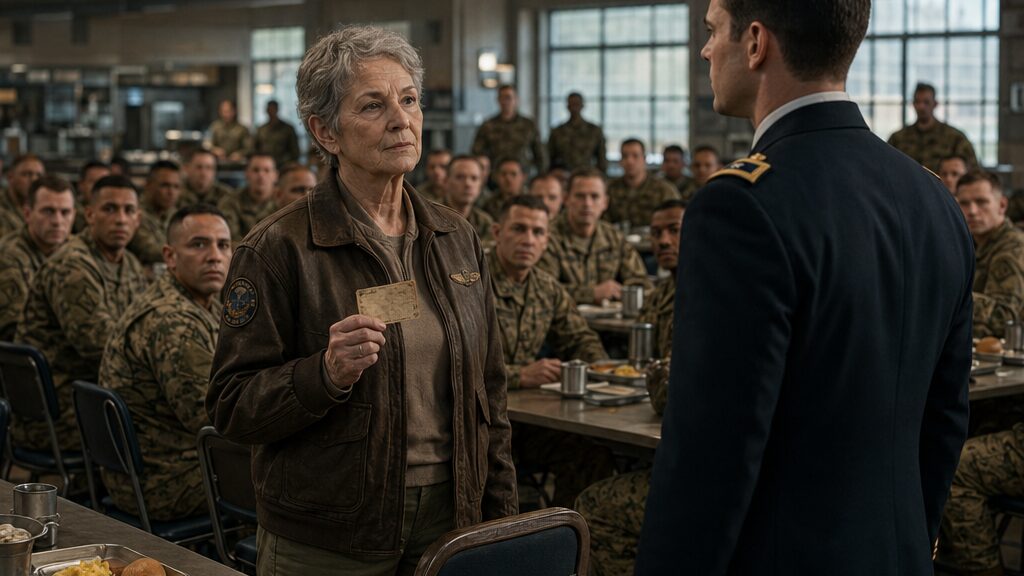
Rebecca Moore held a small visitor card in one hand. The edges were worn soft from years of handling. Her gray hair was tucked behind her ears. She wore a plain brown jacket, faded jeans, and walking shoes that had clearly seen thousands of miles.
Most people would have glanced at her and moved on.
Ryan didn’t.
As officer of the day, he was responsible for security procedures throughout several sections of the base.
And an unfamiliar civilian standing quietly inside the dining facility caught his attention.
He watched her from across the room.
She wasn’t speaking to anyone.
Wasn’t eating.
Wasn’t sitting.
Just standing beside Table Seven.
Looking at an empty chair.
A dining facility manager approached her.
“Ma’am, can I help you?”
Rebecca smiled politely.
“No, thank you.”
The manager hesitated.
“Are you waiting for someone?”
“No.”
Then she looked back at the chair.
The answer only made the interaction stranger.
The manager left.
Rebecca remained.
Ryan checked his watch.
Three minutes.
Five minutes.
Eight.
She never moved.
Finally he crossed the room.
Several soldiers noticed.
The room didn’t become silent, but conversations softened.
Ryan stopped a few feet away.
“Ma’am.”
Rebecca turned.
Her eyes were calm.
“Good morning.”
“Can I see your identification?”
There was no anger in his voice yet.
Just procedure.
Rebecca nodded.
She handed him the visitor card.
Ryan examined it.
Temporary visitor authorization.
Issued that morning.
Valid.
Nothing unusual.
Except the back.
Several names were written there in faded ink.
Old handwriting.
Dates.
Initials.
Some so faded they were almost unreadable.
Ryan flipped it over.
Then back again.
“What are these?”
Rebecca glanced at the card.
“Names.”
He waited.
She didn’t elaborate.
“Friends?”
“Some of them.”
Ryan looked around.
Several nearby soldiers had begun watching openly.
The attention irritated him.
It made him feel responsible for resolving whatever this situation was.
“Why are you standing here?”
Rebecca looked at Table Seven again.
The empty chair.
The untouched place setting.
The sunlight coming through the windows.
“Just remembering something.”
Ryan frowned.
“This is an active dining facility.”
“I know.”
“You can’t remain here indefinitely.”
“I won’t.”
The answer sounded reasonable.
Yet somehow unsatisfying.
Ryan felt as though he was missing information.
But instead of slowing down, he pushed forward.
“Do you have family stationed here?”
“No.”
“Were you scheduled for an event?”
“No.”
“Then why are you here?”
A few nearby soldiers exchanged glances.
Rebecca studied him for a moment.
Not challenging.
Not defensive.
Just studying.
Finally she said softly:
“I come every year.”
Ryan blinked.
“Every year?”
“Yes.”
“For what?”
A small smile touched her face.
“For the same reason.”
The answer irritated him more than it should have.
Not because she was rude.
Because she wasn’t.
She simply wasn’t explaining herself.
The room seemed to lean toward them.
Waiting.
Rebecca glanced again at the empty chair.
Ryan followed her gaze.
“What happened at this table?”
Her fingers tightened around the visitor card.
Only slightly.
But he noticed.
For the first time, something moved behind her calm expression.
A shadow.
A memory.
Then it disappeared.
“Long time ago.”
Ryan crossed his arms.
“Ma’am, I need a clearer answer than that.”
She nodded.
“I understand.”
But she gave none.
Across the room, Amy Jones watched from her breakfast tray.
The young private had noticed the woman earlier.
Now she couldn’t stop watching.
The older woman wasn’t acting confused.
Wasn’t lost.
Wasn’t causing trouble.
She simply looked like someone standing in a place that mattered.
And somehow that made the questioning uncomfortable.
Ryan looked again at the visitor card.
The names.
The dates.
One line was almost unreadable.
Another appeared to have been written decades earlier.
Why would somebody carry a visitor card around long enough for ink to fade?
Unless the card itself wasn’t important.
Unless what was written on it was.
“Ma’am,” Ryan said, lowering his voice. “Are those people connected to this base?”
Rebecca’s eyes settled on the names.
“Very much.”
Something in her tone gave him pause.
Not pride.
Not sadness.
Something deeper.
Like responsibility.
Before he could ask another question, a voice called from behind him.
“Lieutenant Allen.”
Ryan turned.
Command Sergeant Major Samuel Wilson stood near the entrance.
Ryan straightened instinctively.
“Sergeant Major.”
Samuel glanced between them.
Then toward Rebecca.
Recognition flickered briefly across his face.
Not surprise.
Recognition.
It lasted less than a second.
Then vanished.
“You have an issue?”
Ryan held up the card.
“Just trying to determine why our visitor is remaining inside the facility.”
Samuel studied Rebecca.
She nodded politely.
He returned the nod.
Nothing more.
The exchange lasted only moments.
Yet Ryan suddenly felt as though everyone knew something he didn’t.
Samuel said, “Carry on.”
Then walked away.
The strange feeling deepened.
Rebecca watched the senior enlisted leader leave.
Her expression softened briefly.
Then she looked back at Table Seven.
Ryan followed her gaze again.
The empty chair.
Always the empty chair.
“Who sat there?” he asked.
This time she answered.
“My crew chief.”
The words landed quietly.
Ryan waited for more.
None came.
Rebecca checked her watch.
“I’ll leave soon.”
“You can’t just—”
She smiled.
“I know.”
Again that same calm answer.
No argument.
No resistance.
No apology.
Just certainty.
Ryan found himself strangely frustrated.
He was used to people explaining themselves.
Defending themselves.
Getting nervous.
Rebecca did none of those things.
She simply stood there carrying memories nobody else could see.
And somehow that felt harder to manage than open defiance.
When she finally turned toward the exit, she paused beside the empty chair.
Her fingers brushed the top of it.
A gesture so small most people missed it.
Not Ryan.
Not Amy.
Then Rebecca walked away.
The worn visitor card remained in her hand.
And for reasons he couldn’t explain, Ryan found himself staring at the faded names long after she disappeared through the doorway.
Chapter 2: The Card She Refused to Explain
Ryan expected to forget about her.
Instead, he spent the next two hours thinking about the visitor card.
By lunchtime it sat on his desk in memory more clearly than the reports stacked beside him.
The faded names.
The dates.
The strange way Rebecca had answered every question without actually answering.
Most of all, the way Samuel Wilson had looked at her.
That brief moment of recognition bothered him.
Not because the command sergeant major had interfered.
Because he hadn’t.
If Samuel knew something important, why leave Ryan in the dark?
The question lingered.
By early afternoon Ryan found himself pulling up visitor records.
Rebecca Moore.
Age seventy-two.
Retired Army.
No active security concerns.
No special authorization.
Nothing remarkable.
He leaned back.
“Then what’s the story?”
A knock sounded.
The reception clerk stepped inside.
“Lieutenant, that woman from this morning is waiting in the administrative office.”
Ryan stood immediately.
“Why?”
“She requested directions to the base archives.”
The archives.
That was unexpected.
Ryan walked down the hallway.
When he entered the administrative waiting area, Rebecca sat quietly in a chair near the window.
The same visitor card rested in her lap.
She looked up.
“Lieutenant.”
Ryan nodded.
“Ms. Moore.”
Neither spoke for a moment.
Then Ryan gestured toward the card.
“Mind if I ask something?”
“You usually do.”
The answer was so dry and unexpected that he almost laughed.
Almost.
“Those names.”
Rebecca glanced down.
“Yes?”
“Why write them there?”
She considered.
Then carefully turned the card over.
Ryan saw the names again.
Some written neatly.
Others hurried.
Different handwriting styles.
Different years.
The card itself wasn’t old.
But the names had clearly been transferred from previous cards.
Copied forward again and again.
Preserved.
Rebecca touched one gently.
Not dramatically.
Simply familiar.
Like touching a photograph.
“I didn’t want to lose them.”
Ryan frowned.
“Lose who?”
She looked up.
But instead of answering, she handed him the card.
For the first time.
Willingly.
Ryan studied it more closely.
There were six names.
Beside each one sat a year.
The oldest was nearly fifty years old.
His eyes narrowed.
One name felt oddly familiar.
Not because he knew it.
Because he’d seen it somewhere.
Recently.
On base.
He couldn’t place it.
“Who were they?”
Rebecca reclaimed the card.
“My crew.”
The same answer.
Only now it carried more weight.
Ryan sat across from her.
“You flew here?”
“Once.”
“Stationed here?”
“For a while.”
“And every year you come back?”
“Yes.”
Again she stopped.
The silence stretched.
Ryan realized she wasn’t refusing to answer.
She was choosing exactly how much to answer.
There was a difference.
A difficult difference.
Across the hallway, footsteps approached.
A woman carrying folders stopped abruptly.
“Rebecca?”
Rebecca looked up.
Surprise appeared for the first time all day.
“Deborah?”
The two women stared at each other.
Then smiled.
Not the smile of strangers.
The smile of people connected by old memories.
Deborah Hall crossed the hallway.
“I can’t believe you’re here.”
“I come every year.”
“I know. But I usually miss you.”
Deborah looked at Ryan.
“Everything okay?”
Ryan nodded.
“Just trying to understand why everybody seems to know Ms. Moore except me.”
Deborah laughed softly.
Rebecca looked mildly embarrassed.
“That isn’t true.”
“It feels true.”
Deborah sat beside Rebecca.
Her eyes landed on the visitor card.
Immediately her expression changed.
Not dramatically.
Just enough for Ryan to notice.
Recognition.
The same recognition Samuel had shown.
There it was again.
“What?” Ryan asked.
Deborah looked up.
“Where did you see this?”
“The dining facility.”
“Table Seven?”
Ryan stared.
“How did you know that?”
Deborah exchanged a glance with Rebecca.
Neither answered.
And somehow that silence felt heavier than any explanation.
Ryan looked again at the names.
Then suddenly remembered.
One of them.
A plaque.
A hallway display near the archives.
The same name.
His pulse quickened slightly.
Not because he had discovered anything important.
Because he had discovered how little he knew.
Rebecca stood.
“I should go.”
Deborah rose with her.
“I’ll walk you over.”
Ryan remained seated.
Watching.
As Rebecca turned toward the doorway, sunlight crossed the visitor card in her hand.
For an instant one faded line became visible.
A date.
Forty-seven years earlier.
The year struck him.
The same year as an aviation memorial display near the archives.
Rebecca disappeared into the hallway.
Deborah followed.
Ryan remained frozen.
Then slowly reached for his computer.
Whatever story he thought he understood that morning was wrong.
And somewhere inside the archives, the answer was waiting.
Chapter 3: The Empty Seat She Always Saved
Amy Jones had heard six different versions of the story before dinner.
According to one soldier, the old woman had been a retired colonel.
Another claimed she had flown combat missions.
A third insisted she was somebody’s grandmother who kept getting lost.
Each version grew less believable.
Amy ignored all of them.
She preferred facts.
The problem was there weren’t many.
Only observations.
An elderly veteran.
A visitor card.
Table Seven.
And Lieutenant Allen suddenly spending a lot of time asking questions.
That afternoon Amy volunteered to help reset the dining facility before evening service.
Mostly because she wanted another look at Table Seven.
The manager pointed toward a stack of trays.
“Need those moved.”
Amy nodded and went to work.
As she passed the table, something caught her attention.
The chair.
One specific chair.
Its position was slightly different from all the others.
Not by much.
Just enough to suggest someone always moved it.
She crouched beside it.
The chair legs had worn marks on the floor beneath them.
Repeated use.
Repeated placement.
The manager noticed her looking.
“Funny thing about that seat.”
Amy stood.
“What?”
He shrugged.
“Every year somebody asks us not to put anyone there until noon.”
Amy blinked.
“Who?”
“Same older woman.”
Rebecca.
The answer arrived instantly.
“Why?”
The manager smiled.
“Never asked.”
Amy stared at the empty chair.
The room suddenly felt different.
Not mysterious.
Personal.
Like there was a story hidden inside ordinary things.
A chair.
A table.
A routine.
People often imagined history as monuments and speeches.
Maybe it was actually this.
Showing up.
Year after year.
Keeping a promise nobody else could see.
The thought stayed with her.
Later that afternoon she spotted Deborah Hall entering the dining facility carrying folders.
Amy approached carefully.
“Ma’am?”
Deborah smiled.
“You need something?”
Amy hesitated.
“Can I ask about Rebecca Moore?”
The smile faded.
Not from irritation.
From caution.
“Why?”
Amy glanced toward Table Seven.
“Everybody’s talking.”
Deborah followed her gaze.
Then looked back.
“What are they saying?”
Amy repeated several rumors.
Deborah listened quietly.
When Amy finished, Deborah sighed.
“Most of that is nonsense.”
“I figured.”
Deborah stepped toward the table.
Her fingers touched the back of the empty chair.
A familiar gesture.
Almost identical to Rebecca’s.
“You know what’s funny?” Deborah asked.
Amy shook her head.
“People always want dramatic stories.”
“Don’t they?”
“They want secret heroes. Hidden generals. Famous names.”
Amy smiled.
“That’s true.”
Deborah looked down at the chair.
“The truth is usually smaller.”
“Smaller?”
“And heavier.”
Before Amy could ask what that meant, Deborah opened one of her folders.
Inside were copies of old documents.
Flight records.
Maintenance sheets.
Personnel rosters.
Amy only caught a glimpse.
But one name stood out.
A name she had heard earlier.
One of the names written on Rebecca’s card.
Deborah froze.
For a long second she simply stared.
Amy noticed.
“What is it?”
Deborah didn’t answer immediately.
Her eyes moved across the page.
Then widened slightly.
Not with surprise.
Recognition.
The kind that changes understanding.
Finally she whispered, almost to herself:
“Oh, Rebecca.”
Amy stepped closer.
“What?”
Deborah looked up slowly.
“One of these names.”
“Yeah?”
“I think I know who he was.”
Amy felt a chill she couldn’t explain.
Not fear.
Anticipation.
The sense that the story everybody thought they understood was only beginning to reveal itself.
Deborah carefully closed the folder.
Then looked once more at the empty chair.
The chair nobody sat in until noon.
The chair Rebecca touched before leaving.
The chair waiting for someone who would never arrive.
And suddenly Amy realized the chair wasn’t being saved.
It was being remembered.
Deborah turned toward the door.
“I need to check something in the archives.”
“What did you find?”
Deborah paused.
Then gave the only answer she seemed willing to give.
“A name.”
She walked away.
Leaving Amy staring at Table Seven.
At the empty chair.
At a story still hidden beneath ordinary things.
And somewhere inside the archives, Deborah Hall had just found the first piece of it.
Chapter 4: Names Written Before the Storm
The archive room occupied the oldest building still in regular use on the base.
Deborah Hall loved it for exactly that reason.
The walls carried history in ways computers never could. Metal filing cabinets lined the room. Shelves held binders that stretched back decades. Boxes labeled in fading marker sat stacked beside photographs and maintenance records.
By evening the building was quiet.
Most personnel had gone home.
Deborah sat alone beneath a desk lamp.
The folder lay open before her.
Rebecca Moore.
Army Aviation.
Forty-seven years earlier.
Deborah slowly turned another page.
Flight manifests.
Maintenance logs.
Mission summaries.
A familiar name appeared.
Then another.
Then another.
The same names written on Rebecca’s visitor card.
Her pulse quickened.
Not because she had discovered anything dramatic.
Because she was beginning to understand what the card really was.
Not a list.
A roll call.
A way of carrying people forward.
The room felt smaller suddenly.
Deborah reached for another box.
Inside were old photographs.
Most were unlabeled.
Young men and women standing beside helicopters.
Crew members laughing during training.
Mechanics crouched beneath engines.
Faces frozen in ordinary moments.
Then she found one.
Rebecca.
Much younger.
Dark hair.
A flight helmet tucked beneath one arm.
Standing beside five others.
The names matched the card.
Deborah stared at the photograph.
All six were smiling.
Not posing for history.
Just standing together after what looked like a long day.
She turned the photo over.
A handwritten note covered the back.
Crew Seven.
Spring rotation.
The words tightened something in her chest.
Crew Seven.
Table Seven.
The connection was immediate.
Deborah leaned back slowly.
For years Rebecca had returned to that dining facility.
For years she had stood beside that chair.
Not because she was confused.
Not because she was lost.
Because she remembered.
A soft knock interrupted her thoughts.
She looked up.
Rebecca stood in the doorway.
For a moment neither woman spoke.
Then Deborah held up the photograph.
“I found them.”
Rebecca’s eyes settled on the image.
The room became very quiet.
She walked over slowly.
When Deborah handed her the picture, Rebecca took it with both hands.
Like something fragile.
Like something alive.
For several seconds she simply looked.
A small smile appeared.
Then disappeared.
“Where did you find this?”
“Personnel archive.”
Rebecca nodded.
“Thought it was gone.”
Deborah studied her.
“You’ve been carrying their names all these years.”
Rebecca ran a finger across the photograph.
One face.
Then another.
“Somebody should.”
The answer sounded simple.
It wasn’t.
Deborah looked toward the visitor card tucked inside Rebecca’s jacket pocket.
“The names are always in the same order.”
Rebecca smiled faintly.
“Of course they are.”
“Why?”
For a moment Rebecca remained silent.
Then she pointed to each face.
“The pilot.”
Another.
“The crew chief.”
Another.
“The mechanic.”
Her finger moved carefully.
Each name spoken softly.
Each role remembered.
The last face received the longest pause.
Rebecca’s smile vanished.
“He was twenty-one.”
Deborah waited.
“He never came home.”
The words settled heavily between them.
Not dramatic.
Not loud.
Just true.
Deborah looked back at the photograph.
Young faces.
Easy smiles.
No one looking toward the future.
No one knowing what was waiting.
“What happened?” she asked quietly.
Rebecca’s eyes remained on the picture.
“A storm.”
The answer arrived almost automatically.
Like something repeated many times over many years.
But Deborah sensed the story was larger.
More painful.
And still guarded.
Outside, evening sunlight faded from the windows.
The archive room grew dimmer.
Rebecca finally sat down.
For the first time all day she looked tired.
Not physically.
Emotionally.
Like carrying memory required effort.
Deborah closed the file.
“I don’t want to pry.”
Rebecca laughed softly.
“That’s exactly what historians do.”
Deborah smiled.
“Fair point.”
Silence settled again.
Comfortable this time.
Rebecca studied the photograph.
Then carefully removed the visitor card from her pocket.
Deborah watched as she flipped it over.
The names.
The dates.
The fading ink.
“Every year?” Deborah asked.
“Every year.”
“Why keep rewriting them?”
Rebecca looked down.
“So I don’t get lazy.”
Deborah frowned.
“What does that mean?”
Rebecca touched one of the names.
“If I stop writing them, one year becomes two.”
Her finger moved to another.
“Then five.”
Another.
“Then ten.”
The room seemed to hold its breath.
Rebecca folded the card closed.
“And eventually nobody remembers they existed.”
Deborah felt her throat tighten unexpectedly.
Not because of tragedy.
Because of devotion.
Because someone had quietly carried responsibility for nearly half a century without asking anybody to notice.
The archive door opened suddenly.
Ryan Allen stepped inside.
Both women looked up.
Ryan stopped when he saw them together.
“I didn’t realize—”
His voice trailed away.
His eyes found the photograph.
Then the visitor card.
Then Rebecca.
Something had changed in him since morning.
The certainty was gone.
Not replaced by understanding.
Only questions.
More questions than before.
Deborah saw it immediately.
Ryan glanced at the file on the table.
“I found references to one of the names.”
Rebecca looked at him.
Neither encouraging nor discouraging.
Just waiting.
Ryan hesitated.
“That crew was stationed here.”
Rebecca nodded.
“Yes.”
“One of the names is on a memorial display.”
Another nod.
The silence made him continue.
“I think I’ve been asking the wrong questions.”
For the first time, Rebecca smiled fully.
A small smile.
But genuine.
“Most people do.”
Ryan almost smiled back.
Almost.
Instead he looked at the photograph.
At the six young faces frozen in time.
And for the first time he realized he wasn’t looking at history.
He was looking at people Rebecca still carried with her.
The realization unsettled him.
Because suddenly the visitor card didn’t seem strange anymore.
It seemed necessary.
And that frightened him more than mystery ever had.
Because it forced him to ask a different question.
Not who Rebecca had been.
But who those names were.
And why one of them never came home.
Chapter 5: The Reason She Returned Every Year
The memorial stood near the far edge of the base.
Most people passed it without stopping.
A simple stone wall.
Several plaques.
A row of carefully maintained trees.
Nothing designed to draw attention.
Rebecca preferred it that way.
The next morning she arrived before sunrise.
The air carried a faint chill.
The base remained quiet.
For a few precious minutes she was alone.
She walked slowly toward the memorial wall.
The visitor card rested in her pocket.
The photograph remained folded carefully inside her jacket.
The same routine.
The same path.
Year after year.
She stopped before a plaque and rested one hand against the cool stone.
Names.
Dates.
Memories.
Some familiar.
Some belonging to people she had never known.
All connected by absence.
Rebecca closed her eyes.
The silence allowed old sounds to return.
Rotor blades.
Radio chatter.
Laughter inside cramped aircraft.
The sound of boots striking metal flooring.
Young voices.
Young confidence.
A lifetime away.
When she opened her eyes again, she removed the visitor card.
The names stared back at her.
Crew Seven.
The last crew.
Her crew.
A promise had begun there.
Not during service.
Not during deployment.
After.
In the terrible stillness that follows loss.
A promise made because nobody else knew how to make it.
Nobody else had been left.
Rebecca sat on a nearby bench.
The morning light slowly strengthened.
She remembered the day she first wrote the names.
Not on a visitor card.
On a scrap of paper.
Temporary.
She had intended to throw it away later.
Instead she copied it.
Then copied it again.
Years passed.
The paper changed.
The names remained.
A voice broke the silence.
“You really do come every year.”
Rebecca looked up.
Samuel Wilson approached slowly.
Coffee cup in hand.
She smiled.
“You spying on old veterans now?”
Samuel chuckled.
“Only the stubborn ones.”
He sat beside her.
For several minutes neither spoke.
The kind of silence shared by people who didn’t need to fill it.
Eventually Samuel nodded toward the card.
“Still carrying them.”
“Of course.”
“You ever get tired?”
Rebecca considered the question honestly.
“Sometimes.”
Samuel waited.
“Not tired of remembering,” she said. “Tired of being the only one left who can.”
The answer lingered between them.
Samuel stared toward the memorial.
“I understand that.”
Rebecca believed him.
That was enough.
After a while Samuel stood.
“There’s a ceremony this afternoon.”
“I know.”
“You staying?”
Rebecca looked toward the plaque.
Then toward the distant buildings of the base.
“Maybe.”
Samuel nodded.
No pressure.
No persuasion.
Just understanding.
He walked away.
Rebecca remained.
Watching sunlight creep across the memorial stone.
Hours later she was still there when voices drifted from the nearby path.
Several younger soldiers.
A few veterans.
Conversations.
Laughter.
Life continuing.
Rebecca didn’t mind.
She never came for silence.
She came because promises mattered.
The voices moved closer.
Then one stood out.
Ryan Allen.
She recognized it instantly.
He wasn’t speaking loudly.
Just walking with Deborah.
Their conversation carried across the quiet morning.
“…don’t understand why she never says it directly.”
Deborah answered.
“Maybe because it isn’t about being understood.”
Ryan fell silent.
They rounded the path.
Neither noticed Rebecca immediately.
She remained seated beneath the tree.
Listening.
Ryan finally spoke again.
“I embarrassed her.”
“No.”
Deborah looked toward the memorial.
“You embarrassed yourself.”
Ryan sighed.
“That’s not what I meant.”
“I know.”
They continued walking.
Closer now.
Close enough for Rebecca to see Ryan’s expression clearly.
Confused.
Thoughtful.
Uncomfortable.
Good.
Those were useful emotions.
Far better than certainty.
Ryan stopped suddenly.
He had finally noticed her.
The conversation ended instantly.
Deborah smiled.
Ryan looked embarrassed.
Rebecca saved him.
“Morning, Lieutenant.”
“Morning.”
He hesitated.
Then nodded toward the memorial.
“Was this why you came?”
Rebecca looked at the wall.
“Partly.”
The answer surprised him.
“Partly?”
She folded the visitor card.
“There are lots of reasons to remember people.”
Ryan seemed ready to ask another question.
Then stopped himself.
For the first time since meeting her, he allowed silence to exist.
Rebecca noticed.
So did Deborah.
The change was small.
But real.
They stood together for several moments.
No confrontation.
No explanations.
Just the memorial.
The names.
The morning.
Eventually Rebecca spoke.
Almost to herself.
“I promised I’d keep showing up.”
Ryan looked at her.
“A promise?”
She nodded.
Then realized she had said more than intended.
The memory surfaced before she could stop it.
Rain.
Rotor blades.
A young man laughing before boarding a flight.
A promise made casually because nobody expected it to matter.
Her eyes drifted toward the names on the card.
“When you’re young,” she said quietly, “you think there will always be another year.”
Nobody answered.
Because nobody needed to.
Ryan followed her gaze to the visitor card.
And for the first time he understood that the card wasn’t a keepsake.
It was a responsibility.
A burden willingly carried.
The realization hit harder than any dramatic revelation could have.
Rebecca stood.
She slipped the card back into her pocket.
The conversation was over.
But as she walked away, she missed something.
Ryan remained staring at the memorial.
And for the first time, he truly wanted to know the names she had spent forty-seven years protecting.
Chapter 6: What Ryan Finally Understood
Ryan attended the memorial ceremony because it was expected.
He stayed because of Rebecca.
The event itself was modest.
Several rows of chairs.
A small podium.
Veterans and active-duty personnel gathering beneath a clear afternoon sky.
Nothing grand.
Nothing theatrical.
Exactly the kind of ceremony most people forgot within a week.
Ryan stood near the back.
Watching.
Listening.
Thinking.
Rebecca sat alone near the side rather than with the honored guests.
That didn’t surprise him anymore.
What surprised him was how many people quietly greeted her.
A retired mechanic.
An elderly widow.
A former nurse.
None treated her like a celebrity.
They treated her like someone they knew.
Someone who remembered.
The distinction mattered.
As the ceremony progressed, speakers discussed service, sacrifice, and history.
Ryan listened politely.
But his attention kept returning to Rebecca.
The worn visitor card emerged once.
Only briefly.
She checked it.
Touched the names.
Returned it to her pocket.
A habit.
A ritual.
A conversation with people nobody else could hear.
When the formal ceremony ended, groups formed naturally across the grounds.
Conversations began.
Stories resurfaced.
Ryan noticed Rebecca walking toward a display board set beside the memorial.
He followed at a distance.
Not intentionally.
At least that’s what he told himself.
The display contained photographs from different eras of the base.
One image stopped her.
Ryan stopped too.
The same photograph from the archives.
Crew Seven.
Six smiling faces.
Rebecca stood motionless.
After several moments another veteran approached.
“That’s your crew, isn’t it?”
Rebecca nodded.
The veteran pointed toward one face.
“Forgot his name.”
Without hesitation Rebecca supplied it.
Then another.
And another.
Every name.
Every role.
Every detail.
As if no time had passed.
The veteran smiled sadly.
“You always remember.”
Rebecca answered softly.
“Someone should.”
The words struck Ryan harder now than they had in the archive room.
Because he finally understood what they meant.
Not pride.
Not nostalgia.
Responsibility.
The veteran eventually walked away.
Ryan remained.
Watching.
Learning.
Then Deborah appeared beside him.
“You see it now?”
Ryan didn’t pretend ignorance.
“I think so.”
“No.”
Deborah shook her head gently.
“I don’t think you do.”
Ryan frowned.
Deborah pointed toward Rebecca.
“Look.”
He did.
Rebecca stood before the photograph alone.
No audience.
No recognition.
No reward.
Just memory.
Then Deborah asked the question that changed everything.
“What would happen if she stopped coming?”
Ryan opened his mouth.
Then closed it.
Because he knew.
Eventually the names would fade.
The stories would disappear.
The people would become photographs without context.
Records without voices.
History without witnesses.
The realization settled slowly.
Painfully.
For the first time Ryan understood that Rebecca had never been protecting her own legacy.
She had been protecting everyone else’s.
Hours later, as the crowd thinned, Ryan found himself standing beside the memorial wall.
Rebecca approached.
The visitor card remained in her hand.
Neither spoke immediately.
Finally Ryan said, “I owe you an apology.”
Rebecca smiled faintly.
“You don’t owe me anything.”
“That’s not true.”
She waited.
Ryan stared at the stone names before continuing.
“I thought you were lost.”
“I know.”
“I thought you didn’t belong there.”
“I know that too.”
The honesty made the apology harder.
Ryan swallowed.
“I never asked what mattered to you. I only asked whether you belonged.”
Rebecca looked toward the memorial.
A breeze stirred the trees overhead.
Then she nodded.
“That’s a better apology.”
Ryan laughed softly despite himself.
For the first time since meeting her, the tension eased.
Not gone.
But changed.
Rebecca held out the visitor card.
Ryan looked surprised.
Carefully, he accepted it.
The faded names.
The years.
The handwriting.
The evidence of decades.
Now he saw what had always been there.
Not mystery.
Commitment.
When he handed it back, his voice was quieter.
“Thank you for remembering them.”
Rebecca slipped the card into her pocket.
Neither spoke again for several moments.
Then Ryan gathered his courage.
“There was something else.”
Rebecca looked at him.
“What?”
“I’d like to talk more.”
She studied him.
Not suspiciously.
Thoughtfully.
Ryan suddenly felt like a much younger man than his uniform suggested.
Finally Rebecca nodded.
“Maybe this evening.”
And for reasons he couldn’t fully explain, that simple answer felt more important than any formal forgiveness.
Chapter 7: A Different Kind of Salute
The dining facility was quieter that evening.
Not empty.
Just settled.
The rush of breakfast and lunch had passed. Most soldiers had finished their meals and returned to duty. Conversations drifted softly between tables.
Rebecca entered carrying nothing except her jacket and the worn visitor card.
For a moment she stood near the doorway.
The room looked almost exactly as it had the previous morning.
The same lights.
The same tables.
The same smell of coffee lingering in the air.
Yet everything felt different.
Or perhaps she did.
She walked slowly toward Table Seven.
The chair remained where it always had.
Waiting.
Rebecca rested a hand on its back.
The familiar gesture came automatically.
For forty-seven years she had repeated it.
Sometimes on different bases.
Sometimes in different states.
But always on this day.
Always for the same reason.
The chair had never belonged to the dead.
It belonged to memory.
And memory required care.
She pulled the chair out slightly and sat beside it rather than in it.
The way she always did.
The visitor card emerged from her pocket.
The names looked even fainter now.
Age had touched the ink the same way it had touched her hands.
Rebecca smiled.
“You boys are getting hard to read.”
The words disappeared into the quiet room.
She wasn’t sad.
Not exactly.
The grief had changed over the years.
The sharp edges were long gone.
What remained was responsibility.
Love.
Habit.
A promise that had become part of who she was.
A shadow appeared beside the table.
Rebecca looked up.
Amy Jones stood there holding a tray.
She seemed nervous.
“Mind if I sit here?”
Rebecca glanced at the chair across from her.
“Of course.”
Amy sat carefully.
For a moment neither spoke.
The young soldier kept glancing toward the visitor card.
Finally she said, “I think I understand now.”
Rebecca smiled.
“Do you?”
Amy laughed softly.
“Maybe not completely.”
“That’s honest.”
Amy looked around the dining facility.
At the people eating.
Talking.
Living ordinary lives.
Then back at Rebecca.
“I kept wondering why you came every year.”
Rebecca waited.
Amy shrugged.
“I thought there had to be some huge story.”
“There usually isn’t.”
“But there is.”
Rebecca considered.
Then shook her head.
“No.”
Amy frowned.
Rebecca tapped the card gently.
“The story isn’t what happened.”
“What is it?”
“That somebody remembers.”
Amy sat quietly after that.
The answer seemed too simple.
Yet the older woman clearly believed it.
Eventually Amy stood.
Before leaving she hesitated.
Then offered her hand.
Rebecca shook it.
No speeches.
No dramatic declarations.
Just a brief gesture of respect.
When Amy walked away, Rebecca found herself smiling.
Perhaps that was enough.
One person understanding.
Then another.
Not because they were told to.
Because they chose to.
The dining facility door opened.
Ryan entered.
He spotted Rebecca immediately.
For a second he looked uncertain.
Then crossed the room.
His uniform remained crisp.
His posture remained formal.
Yet something about him seemed less rigid than before.
He stopped beside the table.
“Mind if I join you?”
Rebecca gestured toward the seat Amy had vacated.
Ryan sat.
The silence between them felt different now.
No longer uncomfortable.
Simply thoughtful.
After a moment he reached into a folder tucked beneath his arm.
“I wanted to show you something.”
Rebecca raised an eyebrow.
Ryan removed several papers.
Archive copies.
Photographs.
Flight records.
The same materials Deborah had uncovered.
Rebecca studied them.
Then looked up.
“What am I looking at?”
Ryan smiled slightly.
“A project.”
She waited.
“I spoke with Deborah.”
Rebecca nodded slowly.
That explained a great deal.
Ryan continued.
“The archive has most of the records.”
“Most?”
“Not all.”
His eyes moved to the visitor card.
“The names fill in gaps.”
Rebecca became very still.
Ryan noticed.
So he chose his next words carefully.
“We want to preserve the crew history properly.”
Not a monument.
Not a ceremony.
Not a plaque.
Something quieter.
Something lasting.
“The archive is creating an oral history collection,” he said.
“Deborah mentioned it.”
“She wants your help.”
Rebecca looked down at the papers.
The names.
The photographs.
The records.
For years she had worried about what would happen when she stopped coming.
Not because of herself.
Because memory disappears when nobody carries it.
Ryan seemed to sense her hesitation.
“We don’t need everything.”
Rebecca smiled.
“Good.”
A faint laugh escaped him.
“We just need what you’re willing to share.”
The distinction mattered.
Rebecca studied him.
This young officer who had once assumed she was lost.
Who now sat asking permission rather than demanding answers.
The change was real.
Not dramatic.
Real.
And that made it meaningful.
She looked toward the empty chair.
Toward the place she had guarded every year.
Then back at Ryan.
“What made you change your mind?”
Ryan didn’t answer immediately.
When he finally spoke, his voice was quiet.
“My grandfather used to tell stories.”
Rebecca listened.
“After he died, nobody remembered most of them.”
The admission surprised them both.
Ryan looked away briefly.
“I thought history lived in records.”
He glanced at the visitor card.
“Turns out sometimes it lives in people.”
Rebecca nodded.
That answer felt true.
Outside, evening sunlight stretched through the windows.
Golden light crossed the table.
For a moment it illuminated the visitor card.
The fading names.
The years.
The decades.
Ryan noticed.
“So that’s really the original list?”
Rebecca smiled.
“No.”
He looked confused.
She opened the card.
Then pointed.
“I’ve rewritten it dozens of times.”
Ryan stared.
The realization settled slowly.
Every few years the paper changed.
Every few years the names were copied forward again.
A deliberate act.
Repeated for nearly half a century.
Rebecca folded the card closed.
“I was afraid I’d lose it.”
Ryan looked at her.
“You never did.”
“No.”
She smiled faintly.
“I never did.”
The dining facility manager approached carrying a fresh pot of coffee.
He paused beside the table.
“Refill?”
Rebecca nodded.
Ryan did too.
The manager filled both cups.
Then surprised Rebecca by glancing toward the empty chair.
“Leave that one open tomorrow too?”
Rebecca looked up.
The question caught her off guard.
The manager shrugged.
“Just figured I’d ask.”
For a second she couldn’t speak.
Not because it was important.
Because it was kind.
A small thing.
An ordinary thing.
Exactly the sort of thing people remembered.
Finally she nodded.
“If that’s okay.”
“Of course.”
The manager smiled and walked away.
Rebecca stared at the chair.
Then at the visitor card.
Then at the room around her.
Life continued.
People came and went.
Years passed.
Nothing stayed the same.
Yet somehow the names had survived.
Not because they were famous.
Not because they were written in stone.
Because somebody cared enough to keep writing them.
Ryan stood.
“So.”
Rebecca looked up.
“So?”
“We should probably schedule those interviews.”
Rebecca laughed.
The sound surprised both of them.
“Probably.”
Ryan smiled.
Then, after a brief hesitation, extended his hand.
Not as an officer.
Not as a correction.
Not as a performance.
Simply as himself.
Rebecca stood and shook it.
The gesture lasted only a moment.
Yet it carried more meaning than any formal salute could have.
When Ryan left, Rebecca returned to her seat.
The room slowly emptied.
The evening grew quiet.
At last she picked up the visitor card.
Carefully she opened it.
The names greeted her once more.
Friends.
Crewmates.
Young faces frozen in memory.
She traced the faded ink lightly.
Not because she feared forgetting.
Because she wanted them to know she was still here.
The empty chair remained beside her.
No longer lonely.
No longer waiting.
Simply remembered.
Rebecca folded the card and slipped it into Ryan’s folder before leaving.
A copy already rested in her pocket.
The newer one she carried now.
The old card belonged in the archive.
Where the names could continue after her.
When she reached the doorway, she looked back one final time.
Table Seven.
The chair.
The fading sunlight.
Then she smiled and walked out into the evening.
For the first time in many years, she felt lighter.
Not because the burden was gone.
Because it would no longer belong to her alone.
The story has ended.