They Laughed When the Old Veteran Told Them the Radio Was Still Breathing
Chapter 1: The Old Man No One Wanted Speaking
“We are not stopping because maintenance got nervous.”
Daniel Martinez said it loud enough for the whole staging line to hear.
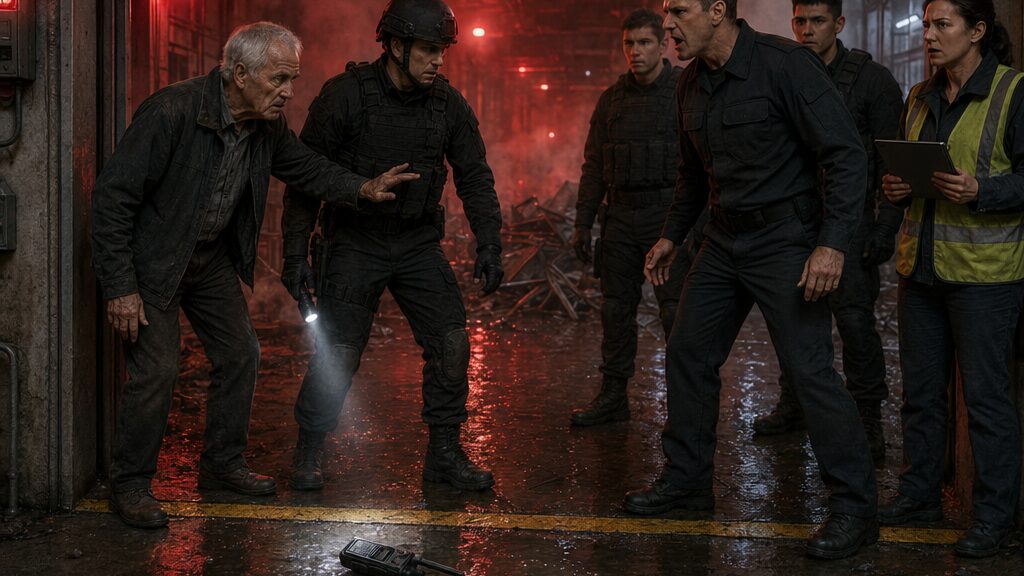
A few of the trainees turned their faces away, not quite laughing, but close enough. The red alarm lights washed over their helmets and cheekbones in pulses, making their half-smiles appear and vanish like something mechanical. Beyond them, the east service corridor breathed smoke through the open blast door. Every few seconds the haze rolled low across the wet floor, crawled over a dropped handheld radio, and pulled back again as if the building itself had lungs.
David Thompson stood just outside the yellow line with his old jacket zipped crookedly and his hands hanging at his sides.
He had not meant to speak.
That was what he had told himself when the first alarm hit, when the facility lights shifted from white to red, when the young tactical team came running past with flashlights clipped to their vests and confidence in their shoulders. He was there on a three-day maintenance consultation, nothing more. Check the old cable chases. Flag corrosion around the unused access doors. Sign the forms Kathleen White had placed in a folder that morning.
Retirement had rules. Stay useful, but not in the way. Notice things, but do not become a problem.
Then the radio on the floor hissed.
Not the clean burst of a dead channel. Not feedback. Not battery decay.
It opened, closed, opened again.
David took one step forward before he realized he had moved.
Daniel turned on him with his jaw tight. The commander wore the hard, controlled expression of a man who knew he was being watched by evaluators, cameras, trainees, and whoever would read the after-action report. His gloved hand pointed toward the floor, but his eyes stayed on David.
“That radio belonged to the technician who cleared out before the door jammed,” Daniel said. “It’s been down for eight minutes.”
“It is still carrying,” David said.
The words came rougher than he wanted. Age did that sometimes. So did smoke. So did old memories that pressed up under the ribs when a corridor sounded wrong.
Daniel’s mouth flattened. “Mr. Thompson, we appreciate your concern.”
The title landed worse than an insult. Not because it was disrespectful on its face, but because of how neatly it removed everything Daniel did not know. Sergeant. Instructor. Communications lead. Tunnel-safety evaluator. Man who had spent half his adult life teaching young soldiers that the first thing to fail in smoke was not the radio, but the listener.
David looked past Daniel to the wet threshold.
The dropped radio lay faceup, black casing slick under the emergency lights. Its antenna pointed toward the debris field, where a collapsed section of ceiling panel and insulation blocked the corridor at a slant. The red alarm spun above it. Water spread across the concrete in a thin sheet, reflecting the light in broken strips.
Jeffrey Carter stood nearest the opening with a flashlight in one hand and his shoulders squared too high. Young. Focused. Trying not to look uncertain. His gloved thumb kept tapping once against his vest buckle.
David knew that kind of tapping. A man telling his own body not to tremble.
“Don’t send him across that water,” David said.
Now one trainee did laugh. A small breath through the nose, quickly swallowed.
Daniel heard it. Everyone heard it.
His face hardened.
“That water is from the overhead suppression line,” Daniel said. “The power to that section has been cut. We have an injured maintenance worker unaccounted for, a blocked service passage, and a closing window. I am not delaying entry because you heard static.”
David swallowed. The alarm strobed across Daniel’s face, then Kathleen’s.
Kathleen White stood at the control station with a tablet clutched in both hands. Her safety vest was bright enough to catch every red flash. She glanced between Daniel, David, and the corridor display mounted on the wall. She looked uneasy, but not yet ready to be the first person to say the old man might be right.
“It cut twice,” David said.
Daniel blinked. “What?”
“The carrier.” David pointed at the radio, not at the commander. “It opened twice inside the last twenty seconds. Same interval as the smoke draw.”
“That is not how this facility communicates.”
“No,” David said. “That is how someone trapped under metal keys a mic by pressure.”
The room went quiet for less than a second.
Then Daniel gave a humorless smile, the kind a younger officer used when he wanted everyone behind him to understand that doubt had been handled.
“With respect, sir,” he said, and the sir made it worse than Mr. Thompson had, “this is a modern integrated facility. We have sensor panels, route overlays, personnel tags, oxygen monitors, and a live command net. We are not reading ghost messages from a dropped radio.”
The trainees shifted. One looked down at the radio, then away. Another checked the evaluator standing near the outer door, as if trying to know which expression belonged in the report.
David heard none of them clearly.
The radio hissed again.
Not loud. The corridor swallowed most of it under the alarm and the ventilation rumble. But the rhythm was there, thin and stubborn. Open. Drag. Close. Open.
David’s right hand curled once, then relaxed.
He had promised himself years ago that he would never again snatch a young man by the gear unless there was no other way. Grabbing made people angry. It humiliated them. It invited resistance before understanding. A hand on a vest could look like panic from an old man who should have stayed behind the tape.
Jeffrey looked over.
Not long. Just long enough for David to see the question in his face.
You really hear something?
David gave the smallest nod he could.
Jeffrey’s thumb stopped tapping.
Daniel turned and caught that exchange. His voice sharpened. “Carter.”
Jeffrey straightened. “Sir.”
“Light high, left shoulder to the wall, stay on my count. You reach the obstruction, check under the panel line, and retrieve that radio if it’s in your path. No improvising.”
“Yes, sir.”
Kathleen stepped closer to the control display. “Daniel, the east alarm is cycling a little unevenly.”
“It’s cycling because there’s smoke in the corridor,” Daniel said. “That is what alarms do.”
“It’s not matching the panel interval.”
He glanced at her, impatient but not dismissive in the same way. Kathleen had a badge, a tablet, a role the facility recognized. “Log it. We move.”
David took another step. His left knee gave a small warning pulse, the old kind that reminded him he could not move like the men in vests anymore. The body had its own rank structure. Pain outranked pride. Balance outranked urgency.
He stopped at the yellow line anyway.
“Listen to it first,” he said.
Daniel’s head turned slowly back.
For a moment the commander did not speak. Smoke pushed from the corridor again and brushed the toe of Jeffrey’s boot. The radio crackled under the red light.
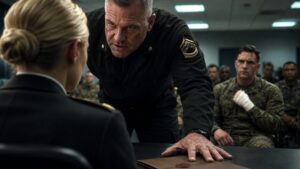
“Mr. Thompson,” Daniel said, voice low now, which made the room lean in, “you are a civilian contractor inside an active emergency. If you interfere again, security will remove you.”
The base security guard near the outer door shifted uncomfortably.
David looked at him and saw a boy in an older uniform. Then he looked at Jeffrey and saw a different boy, one who had not yet learned that orders could be clean and wrong at the same time.
Daniel raised his hand.
“On my count.”
The alarm pulsed red over the corridor.
“One.”
Jeffrey lifted his flashlight.
“Two.”
The radio hissed again, longer this time.
David heard the break inside it. Not a word. Not yet. A pressure. A human interruption.
“Three.”
Jeffrey stepped toward the wet threshold.
Chapter 2: The Dropped Radio Was Not Silent
David’s hand closed on Jeffrey Carter’s vest just before the young man’s boot crossed the waterline.
The motion was not graceful. Age took the speed from it, and desperation took the polish. His fingers caught the lower strap of Jeffrey’s tactical vest and pulled hard enough to twist the young man half sideways. The flashlight beam jumped up the wall, slid across red smoke, and struck the ceiling where beads of water trembled on a cable tray.
“Hey!” Jeffrey snapped, more startled than angry.
Daniel moved at once. “Get your hands off him.”
David did not let go.
“Don’t cross that water until you hear the radio.”
The words came quiet, but something in them cut through the alarm. Jeffrey froze with one foot planted, the other still behind the yellow line. His face was inches from David’s, close enough for David to see the sweat caught under the edge of his helmet.
Behind them a trainee muttered, “Is he serious?”
Daniel shoved forward between two bodies. “Remove him.”
The security guard hesitated.
David’s grip tightened, not higher, not at the throat, not in anger. Low on the vest. Anchoring. Holding Jeffrey back from motion, not pushing him into fear.
“Listen,” David said.
Daniel’s hand came down on David’s wrist. “This is an order.”
“You don’t command me,” David said.
The sentence made the air change.
Not because it was loud. It was not. But everyone heard the line beneath it. David had taken plenty of orders in his life. He had given some. He knew the difference between command and noise.
Daniel’s eyes narrowed. “No. But I command him.”
“Then command him to listen.”
For one suspended second, only the alarm filled the staging area.
Then Jeffrey spoke. “Sir.”
Daniel did not look away from David. “Carter, step back into position.”
“Sir,” Jeffrey repeated, softer, “I hear it.”
That stopped more than David’s hand had.
The radio lay five yards ahead on the wet floor. Its small speaker crackled beneath the alarm, easy to dismiss until the room bent itself toward it. The hiss came in waves. A rough shiver. A thin open line. Then a break.
David raised his free hand, palm low.
Nobody move.
The gesture was old before he made it. He had used it in training tunnels, in culverts, in half-collapsed rooms where men wanted to rush toward sound because rushing felt more like courage than waiting. Palm down. Steady. Make the room borrow your calm until it found its own.
The trainees stopped shifting.
Kathleen slowly lowered her tablet.
The radio breathed again.
Open. Drag. Close.
Jeffrey’s mouth parted. “That’s not static.”
Daniel looked at the radio, then back at David, as if refusing to let the object become more important than his authority. “Could be pressure on the transmit key.”
“Yes,” David said. “That is what I said.”
“That doesn’t mean anyone is alive.”
“No.”
The honesty startled Jeffrey more than any certainty would have.
David released the vest.
Jeffrey did not move forward.
The young man’s flashlight trembled a fraction in his hand, just enough for the beam to shake against the smoke. He looked down at the water, then at the radio, then at Daniel.
“Sir, permission to retrieve it from here.”
Daniel’s nostrils flared. “From here?”
“Hook pole,” Jeffrey said. “Or drag line. We don’t have to step in.”
A minute earlier, he would not have suggested it. David could hear the cost in his voice: the embarrassment of slowing down after being told to move, the risk of seeming afraid in front of men who had nearly laughed at David.
Daniel heard it too.
“Fine,” he said. “Thirty seconds.”
Kathleen snapped her fingers at one of the trainees. “Fiberglass pole by the panel cabinet. Now.”
The trainee moved.
David stepped back half a pace, not because Daniel had won, but because Jeffrey had begun to listen. His own knee throbbed. His hand remembered the vest strap after letting it go.
Daniel leaned toward him. “If you ever grab one of my men again—”
“If I’m wrong,” David said, “put it in the report.”
Daniel’s jaw worked. “And if you’re right?”
David watched the smoke draw inward, low and fast, around the dropped radio. “Then put that in too.”
The trainee returned with a collapsible fiberglass hook pole. Jeffrey took it, crouched carefully, and extended it across the wet floor. The pole tip scraped once against concrete. The radio spun slowly, smearing water in a crescent. Its casing bumped a small piece of ceiling tile.
The hiss changed.
Everyone heard it now.
Not words. Not yet.
A faint pattern, buried under the open carrier.
Tick. Tick-tick. Pause.
Kathleen whispered, “What is that?”
Daniel said nothing.
Jeffrey hooked the radio’s belt clip and dragged it toward the threshold inch by inch. Water curled around it. The speaker crackled as it crossed a shallow groove in the floor. David lowered himself with care, one hand braced on his knee, and pointed to the side button.
“Do not touch the transmit key.”
Jeffrey stopped. “Why?”
“If someone is under pressure on the other end, you may cover them.”
Daniel exhaled sharply. “Or it’s a broken mic.”
David looked at him. “Then we lose nothing by listening.”
Jeffrey pulled the radio over the yellow line.
The moment it reached dry concrete, he picked it up with both hands as if it were hotter than it looked. The speaker popped, then settled into a long, thin hiss.
David held out his hand, not to take it, only to guide its angle.
“Speaker away from the alarm. Not against your vest. Let it breathe.”
Jeffrey obeyed before checking Daniel’s face.
That mattered.
Daniel noticed. His face darkened.
David bent close, his ear angled toward the radio, but not touching it. The old habit returned with painful clarity: one ear for the channel, one for the room. Hear the machine. Hear the building. Hear the men trying not to show fear.
“Kill the nonessential alarms in this zone,” he said.
Kathleen looked at Daniel.
Daniel’s answer came too quickly. “No.”
“Audio only,” Kathleen said. “Visual stays. We can drop the local tone for ten seconds without compromising evacuation.”
Daniel stared at her. “You’re taking his side?”
“I’m taking the side of hearing,” she said.
That landed differently from David’s words.
Daniel’s expression shifted, not into agreement, but into calculation. He looked toward the evaluator near the outer door, then back at the corridor. “Ten seconds.”
Kathleen entered a command.
The local alarm tone cut out.
The red lights kept spinning.
The silence underneath the smoke was worse.
The radio hissed in Jeffrey’s hands.
David raised three fingers, then closed them slowly into a fist. He turned toward the corridor and struck the metal doorframe three times with the heel of his hand.
Knock. Knock. Knock.
The sound traveled down the corridor, flat and dull against smoke and debris.
Nothing answered.
One of the trainees released a breath.
Daniel began, “That’s enough—”
The radio clicked.
Once.
Then twice.
Then once more, weaker than the others.
Jeffrey’s eyes lifted to David’s, wide now, stripped of embarrassment.
From somewhere beyond the debris, through water, metal, smoke, and a dropped radio nobody had wanted to hear, something had answered.
Chapter 3: Static That Sounded Like Breathing
“No one should be transmitting from that blocked section,” the dispatcher said over the command channel.
The sentence came from the wall speaker in the control room, clean and official and worse than any scream. Everyone in the staging area heard it. Even Daniel stopped moving.
Kathleen pressed the headset tighter against one ear. “Confirm personnel status.”
“Maintenance team logged clear except one unconfirmed badge. Last assigned to east service crawl near Junction E-Seven.”
Jeffrey looked down at the radio in his hands.
The speaker hissed softly, almost politely now, as if it had not just divided the room into people who had laughed and people who had listened.
Daniel recovered first. “Badge can lag in smoke interference. We proceed with standard access.”
David turned from the corridor. “Not through the center line.”
Daniel’s patience broke visibly. “You have had your moment.”
“It was not a moment.”
“You heard a signal. Fine. We confirmed possible contact. That does not make you incident command.”
“No,” David said. “It makes the corridor still dangerous.”
Daniel pointed toward the blocked passage. “Every corridor in there is dangerous. That is why trained personnel go in.”
David looked at the wet floor. The water was spreading wider now, but not evenly. It pooled near the left wall, then thinned across the center before collecting again near the dropped ceiling debris. Smoke moved over it in pulses, tugged low toward the blockage instead of rising toward the vents.
He heard old instruction in his own head, not as memory exactly, but as muscle.
Smoke tells you where air is lying.
Water tells you where power or pressure has changed.
Radios tell you who still has a hand free.
He kept most of that inside.
That was his mistake.
Instead he said only, “The air is pulling wrong.”
Daniel gave a short laugh, sharp enough to wound because it was meant for the room. “The air is pulling wrong.”
A trainee’s eyes dropped.
Jeffrey’s did not.
David saw that and hated that the young man had to choose so soon, in public, with smoke in his lungs and command in his ear.
Kathleen moved to the wall panel. “Daniel, the east exhaust is showing active.”
“It should be active.”
“The rhythm is off.”
“Everything is off. We had a pressure alarm, panel failure, and a jammed fire door.”
She tapped the screen twice, then stopped. “Local alarm cycle is six seconds behind the panel.”
Daniel looked at her. “Meaning?”
“I don’t know yet.”
David did. Or thought he did, which was not the same thing. The distinction sat heavy in his chest.
He stepped closer to the wall display. The digital map showed the corridor as a clean blue line broken by an orange obstruction marker. It made the building look honest. Buildings never were. They aged under paint, behind panels, above drop ceilings. They kept old wounds under new diagrams.
“East service has an old bypass behind that wall,” David said, pointing not at the screen but at the concrete beyond it. “If the bypass damper is open, smoke will draw low before the overhead vent catches up.”
Kathleen turned. “That bypass isn’t in the current system.”
“It used to be.”
Daniel spread his hands. “There. Used to be. That is the problem.”
David felt the words hit. Not because they were unfair. Because they were partly true.
He had not walked every inch of the updated east side since the renovation. Kathleen’s inspection folder had been full of revised schematics he had meant to review after lunch. The alarm had come first.
Jeffrey adjusted the radio. “Sir, with respect, he heard the signal before we did.”
Daniel’s head snapped toward him.
Jeffrey swallowed but did not look away. “He did.”
The room changed again.
Not enough to free David from doubt. Enough to put Jeffrey under Daniel’s eye.
Daniel stepped closer to the young man. “Your job is not to validate civilians. Your job is to execute.”
“Yes, sir.”
“Then execute.”
Jeffrey’s grip tightened around the radio, but he stayed still.
David saw the cost of that too. A small resistance, but real. The first time a young man learned that obedience and judgment could pull in different directions, something in him either strengthened or cracked.
Kathleen’s tablet chimed.
She frowned down at it. “I have the unconfirmed badge.”
Daniel turned. “Location?”
“Unstable. It pinged east crawl, then disappeared. Last manual entry was service inspection by one maintenance technician at E-Seven.”
“Name?”
Kathleen shook her head. “Badge file isn’t loading.”
The radio clicked in Jeffrey’s hands.
Everyone froze.
David raised his palm low again.
This time, no one laughed.
He leaned close. The hiss carried a faint scrape beneath it. Then a sound that might have been fabric dragging against metal. Then nothing.
“Can we transmit?” Kathleen asked.
David shook his head. “Not yet.”
Daniel’s voice sharpened. “Why not?”
“If that mic is being held open by weight or pressure, a transmission might block what little sound we have. We need a receive discipline.”
Daniel looked as if the phrase annoyed him because it sounded official enough to be difficult to dismiss.
“Receive discipline,” he repeated.
David nodded once. “Quiet channel. No chatter. No touching the key. Three knocks for yes if they can hear through structure. One for no. If they can move.”
“And if they can’t?” Jeffrey asked.
David did not answer immediately.
The silence answered for him.
Kathleen’s screen chimed again, this time with a sharper tone. Her face drained of color beneath the red flash. “Daniel.”
“What?”
“The alarm pattern is not coming from the overhead suppression line.”
Daniel crossed to her. “Show me.”
She angled the tablet. “Panel says suppression. But the pressure fluctuation is below floor level. East trench.”
David closed his eyes for half a second.
Not long enough to disappear. Just long enough to feel the shape of the building under his boots.
Cable trench under the corridor. Old drainage channel beside it. Renovated panels above. Water where it should not be. Smoke pulling down instead of up.
“Do not send anyone through the center,” he said.
Daniel turned on him. “You do not know the updated layout.”
“No,” David said.
The admission came out before pride could stop it.
Kathleen looked up.
Daniel seized on it. “You just said no.”
“I know enough to know I do not know the center anymore.”
“That is not useful.”
“It is more useful than pretending the map is the floor.”
For a moment Daniel had no answer.
Then he found one in the place people often found answers when fear was watching them: authority.
“We will use the standard left-wall approach,” he said. “Carter retrieves contact point. Two trainees behind. Kathleen, keep trying to pull the updated trench schematic. Mr. Thompson, step back.”
Jeffrey did not move.
Daniel’s voice dropped. “Carter.”
The young man looked from Daniel to David, and the radio crackled between them like a third person trying to breathe.
David could feel the room pressing toward a decision. Too many eyes. Too much smoke. Too little time. If he pushed too hard without proof, Daniel would remove him. If he said too little, Jeffrey would walk.
He pointed at the floor, at the place where the water thinned and then gathered again.
“There is a pull under that center seam,” he said. “If he steps there and the panel shifts, you may lose the route and the contact.”
Daniel stared at the seam.
For the first time, he seemed to see it.
Then the door behind them opened and a facility evaluator stepped in with a rolled document tube under one arm. Kathleen moved to intercept him, took the tube, and unrolled the long updated corridor plan against the wall with shaking hands.
The new map covered the old emergency diagram in a clean white sheet.
David stared at the lines.
A wall stood where his memory had kept a passage.
A sealed utility barrier crossed the bypass he had been counting on.
Kathleen found the revision stamp and looked at him with something like apology.
“This wing was renovated after your last inspection,” she said.
The radio hissed in Jeffrey’s hands.
Daniel looked from the new map to David, and the room waited to see whether the old man who had heard the truth in static had just become wrong about the building itself.
Chapter 4: The Map In His Head Was Wrong
Daniel slapped the updated corridor plan over the older emergency diagram so hard the magnets jumped against the board.
“There,” he said. “That bypass you keep talking about doesn’t exist.”
The white sheet trembled under the ventilation draft. New blue lines crossed old gray ones. A heavy black mark labeled SEALED UTILITY BARRIER cut through the path David had carried in his head for years, straight across the place where he had expected air to move.
For a moment, the red alarm light washed the paper clean, and David could not read either map.
Then the lines settled back into meaning.
Daniel turned toward the room. “We are done treating memory like infrastructure.”
No one laughed this time. That made it worse.
David felt Jeffrey looking at him. Kathleen, too. The security guard near the door. The trainees. The evaluator pretending not to measure every second. The radio in Jeffrey’s hands hissed with a faint, uneven crackle, as if it were waiting to see whether David would defend a route that the paper had just erased.
He wanted to say the map was wrong.
He wanted to say buildings lied. Contractors sealed things without telling the people who would have to survive them. Renovation stamps did not crawl through smoke. Ink did not hear air moving behind concrete.
But the wall was there in black. The revision date was three years after his last full inspection. Kathleen’s signature sat in the approval chain, small and neat.
David had missed it.
Daniel saw the pause and took it for surrender. “Kathleen, escort Mr. Thompson to the outer staging area.”
Kathleen did not move. “Daniel—”
“That was not a suggestion.”
David kept his eyes on the map. “There is still a draw.”
Daniel laughed once, without humor. “The invisible bypass?”
“No.”
“Then what?”
David listened.
The room did not want silence. Emergency rooms never did. Silence made trained people feel useless. It exposed what they could not control. So they filled it with panel tones, radio checks, clipped orders, boots shifting, Velcro pulled open and pressed shut again.
David sorted through all of it.
The local alarm strobed. The wall panel hummed behind its plastic face. Water dripped from somewhere inside the corridor. The radio hissed against Jeffrey’s gloves.
And beneath all that, not on the map, not on the panel, not in anyone’s command voice, something thudded softly through the wall every six seconds.
Not mechanical enough to be a pump.
Not random enough to be debris.
A damper? No. Too low.
A flexing plate.
David stepped closer to the wall beside the updated plan.
“Sir,” Jeffrey said, and David could not tell whether the word was meant for Daniel or him.
Daniel blocked David’s path with one arm. “You do not get to wander around my emergency.”
“I am not wandering.”
“You just admitted you don’t know the layout.”
“I said I don’t know the center anymore.”
“That is enough.”
“No,” David said, and hated how old the word sounded in his throat. “It is not.”
Daniel’s face tightened. “You want to be responsible for the delay? Say it clearly. In front of everyone.”
That was the trap. David knew it. Daniel was building the record out loud. If the rescue failed, the minutes spent listening would belong to the old contractor. If Daniel moved fast and something went wrong, at least he had followed procedure. Forms protected action better than caution.
David looked at Jeffrey.
The young man held the radio against his chest now, speaker outward the way David had shown him. His fingers were white along the casing. He had stopped looking like someone waiting for permission to be brave. He looked like someone trying to decide whose fear was telling the truth.
David touched the updated map with one finger. The paper was slick under his skin.
“That wall wasn’t there when I knew this place.”
The room held still.
Daniel’s expression sharpened with victory, but David did not look at him. He looked at Kathleen.
“That means my route is wrong. It does not mean the sound is wrong.”
Kathleen swallowed. “What sound?”
David turned his head toward the corridor junction, away from the map, toward the concrete wall that formed the outer edge of the service bay. “That.”
They listened because he had admitted the flaw. Not because they trusted him fully. Not because Daniel had yielded. Because a man who could say he was wrong about one thing made it harder to dismiss what he still insisted on.
Six seconds passed.
A low metal knock moved through the wall.
Jeffrey’s eyes flicked toward it. “I heard that.”
Kathleen did too. David saw her face change before she spoke. She turned back to her tablet and began pulling overlays with quick, nervous gestures.
Daniel remained still.
“What is it?” he asked.
“I don’t know yet,” David said.
“Convenient.”
“It is honest.”
Daniel looked ready to strike back, but Kathleen interrupted.
“Old cable trench,” she said. “Not the bypass. Separate system. It runs below the renovated wall.” Her fingers moved faster. “It was supposed to be capped during the upgrade.”
“Supposed to be?” Daniel asked.
Kathleen did not answer immediately.
The radio crackled. A burst of static lifted and collapsed.
David moved close to Jeffrey, not touching him this time. “Hold it lower.”
Jeffrey lowered the radio toward the floor.
The hiss changed.
Not louder. Sharper.
David pointed to the wet seam where the water thinned across the concrete. “There is your connection.”
Daniel stared down. “A cable trench?”
“Or what used to be one.”
“That helps us how?”
“It may carry sound. Air. Water.” David looked toward the sealed wall. “If someone is under that floor, a direct breach through the left approach may shift the cover plates.”
Kathleen’s face had gone pale. “The current rescue plan uses the left approach.”
Daniel took two steps toward the corridor and stared into the smoke as if he could force it into obedience. The red alarm swept across his helmet and jaw. “What are you suggesting?”
David did not answer quickly enough.
Because the truth was that he did not have a full plan. He had pieces: sound, static, water, a wall that should not have been there, an old trench that should have been capped. He had instincts built from years of ugly spaces, but instincts were not maps. He had told men that once. He had made them repeat it.
Now those same words accused him.
He felt his pride rise anyway, wanting to cover the gap.
Kathleen’s tablet chimed with an incoming file. “I found the renovation note.”
Daniel snapped, “Read it.”
“East trench retained for emergency cable redundancy.” She frowned. “But the access hatch was relocated to the side maintenance bay.”
David turned toward the side corridor.
Daniel saw him do it. “No.”
“The hatch may give us a route that does not cross the center seam,” David said.
“May.”
“Yes.”
“You are gambling.”
“So are you.”
Daniel stepped close enough that the red light threw his shadow across David’s jacket. “I have an injured or trapped person behind that wall, a team waiting on my order, and a civilian consultant who has been right once and wrong once.”
David met his eyes. “Then stop keeping score and listen to the building.”
Daniel’s face flushed.
For the first time, David saw something behind his anger that was not contempt. Fear. Not of smoke or paperwork, but of being seen failing by men he needed to lead.
That did not absolve him. It explained the force of him.
Kathleen moved between them with the tablet held up. “The side maintenance bay is accessible from here. We can verify the hatch in under two minutes.”
Daniel’s jaw worked.
The radio hissed again.
Jeffrey flinched and lifted it closer to his ear. “There’s something.”
The room quieted by instinct now.
The static dragged long, broke once, then formed around a sound that could have been breath pressed through clenched teeth. David leaned in. His back hurt. His knee pulsed. His heart had found the old rhythm he hated, the one it used when time thinned and every wrong choice waited to become permanent.
“Say again,” Jeffrey whispered, though no one had transmitted.
The radio popped.
A voice came through for less than a second, shredded by interference and distance.
“Wa—”
Static swallowed it.
Kathleen froze.
Jeffrey held the radio away from himself as if the word had burned through the casing. “Was that—”
David raised his hand.
The radio clicked once more.
This time the word arrived clearer, small and broken and terrified.
“Water.”
Chapter 5: The Door That Should Have Stayed Open
The three-beat tap came again before anyone reached the side maintenance bay, and David felt thirty years fold shut inside his chest.
Tick. Tick-tick.
Not loud. Not even definite to anyone who had not spent years teaching frightened hands to make meaning through pipe, wall, radio, boot heel, rifle stock, anything the dark would carry. To the trainees it was probably just noise under the alarm. To Kathleen, data not yet labeled. To Daniel, another delay clawing at his authority.
To David, it was a young soldier’s knuckles on a bent field radio, long ago, after the smoke had turned every corridor into the same corridor.
He stopped walking.
Jeffrey nearly bumped into him. “Mr. Thompson?”
David’s hand found the wall. Not for drama. For balance.
The side maintenance bay door stood twenty feet ahead, painted gray, half hidden behind a rack of folded barricades. Red light bled through the smoke behind them and made the bay sign pulse like a warning. Kathleen was already at the keypad, pulling up access authorization. Daniel stood behind her, helmet tucked under one arm now, as if removing it might let him hear better.
“Move,” Daniel said.
David did not.
The radio hissed in Jeffrey’s hands.
Tick. Tick-tick.
David saw another hallway under another color of light. He smelled dust baked by heat. He heard a boy not much older than Jeffrey saying, “I can make it, Sergeant,” because boys always thought courage meant making it, and older men sometimes let them believe it for one second too long.
“Why did you grab me?” Jeffrey asked.
The question cut through the memory cleanly.
David looked at him.
The young man’s face was streaked with sweat and soot at the jawline. His earlier embarrassment had not vanished; it had changed shape. He was no longer ashamed of being stopped. He was afraid of why he had needed stopping.
David almost gave him the easy answer.
Because the floor was wrong.
Because the radio was live.
Because command was rushing you.
All true. None enough.
Kathleen’s keypad beeped red. She cursed under her breath and tried again.
Daniel glanced back. “This is not the time.”
“It is exactly the time,” Jeffrey said.
The words surprised everyone, including Jeffrey.
Daniel’s eyes narrowed. “Carter.”
Jeffrey did not look at him. “If I’m going back in there, I want to know what he saw.”
David’s throat tightened.
He had built a life around not telling this part. He could lecture on communications discipline for six hours without saying the name he no longer used out loud. He could teach soldiers to wait between transmissions, to listen for stress breathing, to read static bursts and relay discipline. He could make them good. He could make them careful. He could not tell them that the lesson had a body attached to it.
Kathleen got the door open.
The side maintenance bay yawned beyond it, dark except for a line of emergency strip lighting along the floor. Metal shelving ran along one wall. A dusty service panel sat near the far corner, half obscured by a portable pump and coiled hoses. Beneath the alarm, water could be heard moving somewhere below the floor.
David stepped inside.
The air was cooler in the bay, but heavier. It carried a metallic dampness that settled on the tongue. He moved toward the service panel, each step slower than he wanted. Jeffrey followed with the radio. Daniel and Kathleen came behind.
The tapping came again.
Tick. Tick-tick.
David closed his eyes for one breath. Then he opened them and put his knuckles against the panel.
Knock. Knock. Knock.
Everyone waited.
The radio crackled.
A faint click answered. Then another two, uneven but deliberate.
Jeffrey whispered, “That’s yes?”
David nodded.
Daniel moved closer. “Ask if injured.”
David looked at him.
“Can you do that?” Daniel demanded.
“If they can count. If they can move. If they can hear.”
“Then do it.”
There it was again. Command trying to occupy listening.
David raised his hand, palm low, and Daniel stopped. Not because he wanted to. Because the gesture had begun to carry weight even he could feel.
David tapped once on the panel, paused, then tapped twice. He spoke softly, for Jeffrey more than for the wall. “One for no. Two for yes. Three means repeat.”
Jeffrey nodded.
David tapped a slow question against the panel.
Are you injured?
The answer took too long.
One click came through the radio.
Then, after a wet scrape, a second.
Kathleen shut her eyes briefly. “Yes.”
Daniel turned to her. “Get medical staged.”
She relayed the order quickly.
David tapped again.
Water rising?
This time the answer came faster.
Two clicks.
The radio hissed after it, ragged and wet.
Daniel’s face changed. Not softened. Sharpened. “We breach the hatch.”
David turned to the service panel. “Not until we know what is behind it.”
“It’s an access hatch.”
“It was relocated.”
“That is what the map says.”
“The map also said the trench was capped.”
Kathleen looked away.
Daniel saw it and seized on the wrong target because that was easier. “Kathleen?”
“The trench should have been dry,” she said. “If water is rising, something below the floor is compromised.”
“Then we open it faster.”
David turned from the wall. “Or we flood the pocket he is breathing in.”
The bay went silent except for the radio.
Jeffrey looked at David. “You’ve seen that before.”
David’s hand remained against the metal panel. The cold came through his palm.
“Yes.”
Daniel’s voice was quieter now, but no less hard. “Where?”
David could have refused. Every muscle trained by old shame wanted to. He could have said it did not matter. He could have kept the wound private and still maybe saved the man. But Jeffrey’s question hung between them, and beyond it the faint breath in the radio, and beneath both a truth David had spent years turning into technique so he would not have to call it grief.
“Overseas,” he said. “Long time ago.”
No one moved.
“We had smoke in a passage. Communications broken. Young soldier heard someone past a partial collapse and wanted to go before the air changed again.” David kept his eyes on the panel. “I heard the carrier open. I heard something in it. I thought I needed one more confirmation before I stopped him.”
His knuckles rested against the metal.
“I waited too long.”
Jeffrey lowered the radio by an inch.
Daniel said nothing.
David hated the quiet pity that tried to enter the room. He pushed it back with work.
“So we do not make this about bravery,” he said. “We make it about air, water, sound, and time.”
Kathleen gave one sharp nod, grateful for instruction she could stand inside. “What do you need?”
“Confirm whether the hatch opens inward or upward.”
She checked the renovation file. “Upward.”
“Any pressure release?”
“Manual latch.”
“Any secondary drain?”
Her fingers moved. “Connected to the old cable trench.”
David looked at the floor. “Then water may be using the trench as a channel. If we breach fast, pressure changes.”
Daniel spoke into his command mic. “Hold breach team.”
David glanced at him.
Daniel did not look back.
It was not an apology. It was something more useful.
Jeffrey crouched near the hatch seam and angled the radio down. The hiss sharpened again. He looked up. “What do I ask?”
David lowered himself with difficulty beside him. The knee protested. The floor was wet enough to soak through the fabric at once. Jeffrey noticed, but did not offer help. That, too, was respect.
“Ask if he can move away from the hatch,” David said.
Jeffrey tapped the panel, copying David’s rhythm too fast.
David caught his wrist gently.
“Slow. Give him room to answer.”
Jeffrey swallowed, then tapped again.
Can you move away?
The radio answered with one weak click.
No.
Kathleen turned toward Daniel. “If he’s against the hatch—”
“I know,” Daniel said.
But his voice had shifted. The certainty was not gone; it had lost its shine.
A trainee appeared at the bay entrance. “Sir, breach team ready on your order.”
Daniel stared at the hatch, then at the updated map, then at David kneeling with one hand on wet concrete and the other near the radio.
For a moment, he looked like a man standing between two kinds of failure: act too late and lose the trapped technician; act too fast and make the old man’s warning come true.
His fear chose for him.
“Prepare forced breach,” Daniel ordered. “Low pressure, controlled lift. On my count.”
David rose too quickly and nearly stumbled. Jeffrey caught his elbow. This time David did not pull away.
“No,” David said.
Daniel’s eyes flashed. “We are out of time.”
“If you lift that hatch while he is against it, you may drown him.”
“If we don’t lift it, he may drown anyway.”
“Then we get him to move first.”
“He said he can’t.”
“Then we find why.”
Daniel stepped toward the breach team gathering outside the bay. “Set pry tools.”
Kathleen’s face went white. “Daniel—”
“Now.”
The first tool struck the hatch seam with a metallic bite, and the radio in Jeffrey’s hands burst into panicked static.
Chapter 6: The Order Nobody Could Laugh Away
“Three minutes,” Daniel said, and the breach team set their pry bars into the hatch seam.
David stepped in front of them.
He did not square his shoulders like a younger man. He did not raise his voice or make a grand shape of himself. He simply put his old body between the tools and the hatch, one hand low, palm down, the other braced against the service panel.
For one terrible second, the room saw exactly how easy it would be to move him.
Daniel saw it too.
“Mr. Thompson,” he said, “step aside.”
The radio shrieked with a burst of static in Jeffrey’s hands, then fell back to that wet, open hiss.
David did not move. “Not until he answers why he cannot get clear.”
“His answer was no.”
“No is not a reason.”
“He may not be able to give us one.”
“Then we ask smaller.”
Daniel stared at him. Smoke drifted through the open bay door and curled around the red floor lights. The breach team waited, tools set, faces hidden behind shields. Kathleen stood with the tablet pressed against her vest, every rule she trusted suddenly too thin to stand on by itself.
Jeffrey lifted the radio. “Tell me what to ask.”
Daniel turned sharply. “Carter.”
Jeffrey’s throat moved. “Sir, if we’re wrong, the breach still happens. If he’s right, we don’t get another chance.”
The words landed harder because they came from one of Daniel’s own.
David looked at Jeffrey and saw the trembling thumb was gone.
Daniel’s face tightened. “Thirty seconds.”
David shook his head. “No countdown.”
“You do not set command conditions.”
“No countdown,” David repeated. “He may be timing his breathing to the noise. You start counting loud, he may panic and spend what air he has left.”
Daniel looked as if he wanted to argue and could not find the part of himself that believed it.
He made a short gesture to the breach team. Hold.
David turned to Jeffrey. “Radio low. Speaker away from your vest. One question at a time. If he answers one click, stop. If two, stop. If nothing, we change the question, not the volume.”
Jeffrey nodded.
David pointed toward the panel. “Ask if his arm is pinned.”
Jeffrey tapped slowly.
Arm pinned?
The radio hissed.
One click.
No.
“Leg,” David said.
Jeffrey tapped.
Leg pinned?
Two clicks.
Kathleen whispered, “Yes.”
David closed his eyes briefly, not to retreat, but to build the shape of the unseen space. Trapped technician near hatch. Leg pinned. Water rising. Cannot move away. Radio possibly under hand or chest pressure. Hatch opens upward. Forced lift might change pressure or strike him. The trench carried sound.
“Ask if water is above his knee.”
Jeffrey tapped.
The answer came as two quick clicks.
Daniel looked at the hatch.
David said, “Ask if he can reach pipe.”
“What pipe?” Daniel demanded.
“The one he’s been tapping.”
Jeffrey tapped.
Can you reach pipe?
Two clicks.
Good. Not enough.
David lowered himself again, slower this time. Pain flashed up his knee, clean and white. He stopped halfway down, and for the first time, had to grip Jeffrey’s forearm to finish kneeling.
Jeffrey steadied him without making a show of it.
David hated needing it. Then he let himself need it.
“Put your ear near the seam,” David said.
Jeffrey knelt beside him.
Daniel started forward. “Carter is not going under that hatch.”
“He is not going under. He is listening.”
Jeffrey angled his head near the floor seam. The radio lay between his knees, hissing. Water crept along the concrete toward his glove.
David tapped three times on the panel.
Knock. Knock. Knock.
Through the floor came an answer, faint but clearer than before.
Tick. Tick-tick.
“There,” Jeffrey said. “Left side.”
“No,” David said. “Hear the echo.”
Jeffrey went still.
David tapped again. The answer came back, but the third tick rang duller, as if passing through liquid before metal.
Jeffrey’s brow furrowed. “It’s lower than the hatch.”
David nodded. “He is not at the hatch. He is beside the trench cover.”
Kathleen dropped to one knee with the tablet. “The trench cover has inspection screws every six feet.”
“Can we remove one section?” Daniel asked.
Kathleen scanned the overlay. “Not with standard tools from above. Unless—” She stopped.
“What?”
“There’s a narrow crawl from the old cable access. It’s not rescue-rated.”
Daniel looked toward the dark recess behind the portable pump. “How narrow?”
Kathleen hesitated. “Too narrow for full gear.”
The room seemed to turn toward Jeffrey before anyone said his name.
Daniel said it first, too quickly. “No.”
Jeffrey looked at the recess. His face went pale under the soot, but he did not step back.
David knew that look. Courage arriving before judgment, asking to be used.
“No full gear,” Daniel repeated. “No blind crawl into an unverified trench.”
David pointed to the radio. “Not blind.”
Daniel turned on him. “You cannot crawl it.”
“No.”
The word hurt more than David expected.
His body had become a fact in the room. Not shameful. Not useless. But real. The crawl was not his to make. There had been a time when he could have folded himself into that space with a radio clipped to his shoulder and a knife between his teeth if needed. That time was gone, and pretending otherwise would kill the very person he meant to help.
He looked at Jeffrey.
“I can teach him how to hear it.”
Jeffrey held his gaze.
Daniel said, “Absolutely not.”
The radio clicked twice without anyone tapping.
Everyone froze.
Then a faint scrape carried through the speaker, and a sound like breath breaking against water.
The trapped technician was trying to speak.
David leaned close. “Save air,” he said, though the man could not hear unless the mic carried both ways, and they had not keyed it. Habit spoke anyway.
Kathleen checked the radio battery indicator. “This unit is almost dead.”
Daniel’s eyes closed for half a second.
There it was: time made visible.
David turned to Jeffrey. “If you go in, you do not chase sound. Sound bends. You stop at every marker. You listen for air moving across your face. You keep one hand on structure, one on the guide line. If you feel warm air from below, you back out. If the radio opens solid, you stop speaking.”
Jeffrey nodded once.
“No hero work,” David said.
That brought Jeffrey’s eyes up.
David’s voice softened. “Hero work is what men call panic when they survive it.”
Daniel heard that. His face shifted, almost imperceptibly.
Jeffrey took a guide line from a trainee and tied it under David’s direction. Not around the wrist. Around the harness. Not tight enough to trap. Tight enough to find. He removed his outer gear piece by piece, leaving only what the crawl would allow. Each item placed on the floor made him look younger.
Daniel stood beside him. “You do not move without my order.”
Jeffrey said, “Yes, sir.”
Then he looked at David.
David did not give an order. He gave the method.
“Three taps if you stop. Two if you hear him. One if you need pullback.”
Jeffrey repeated it. “Three stop. Two contact. One pullback.”
“Slow is smooth.”
“Smooth is fast,” Jeffrey said.
The old phrase came out of him like he had known it all his life.
David felt something inside him loosen and hurt at the same time.
Daniel stepped back from the crawl opening, then spoke into the command channel. “Hold forced breach. Carter entering old cable access on guide line. Breach team stands by. No one moves the hatch without my order.”
Kathleen looked at him quickly.
He did not look back.
Jeffrey lowered himself into the dark crawl.
The opening swallowed his shoulders, then his helmet, then the soles of his boots. The guide line slid through David’s gloved hand. He held it lightly, not gripping too hard, feeling for tension the way he once felt radio silence for meaning.
The room listened.
At first there was only Jeffrey’s breathing on the command channel.
Then a tap came through the guide line, felt more than heard.
Three.
He had stopped.
David leaned toward the opening. “Listen low.”
A pause.
Two taps.
Contact.
Kathleen covered her mouth.
Daniel stepped closer but said nothing.
The radio in David’s hand crackled, then dimmed. The battery light blinked red, weaker each time. Static thinned into a thread.
Jeffrey’s voice came over the line, tight and controlled. “I hear him. Left side. Water moving. He’s pinned below the knee. I can reach the trench cover.”
David closed his eyes.
Not in relief. Not yet.
“Do not pull until he answers,” he said.
The radio clicked once, twice, then dissolved into static.
Jeffrey’s breathing sharpened. Metal scraped. Somewhere beneath the floor, a trapped man tapped with what strength he had left.
Then the radio went silent.
The guide line jerked hard in David’s hand.
Jeffrey’s voice burst through the command channel, rough and close. “I’ve got him.”
Chapter 7: The Quiet After the Alarm Finally Listened
The corridor was finally quiet, but David still heard static.
It sat behind the scrape of stretcher wheels, behind the clipped voices of the outside fire crew, behind the soft hiss of portable fans clearing smoke from the east wing. Red alarm lights no longer spun across the walls. The wet floor had gone dull under work lamps. The dropped radio, the one everyone had laughed off, lay on a folding table in the after-action room with its battery removed and its casing open.
It should have looked dead.
David knew better than to trust appearances.
Across the room, the rescued maintenance technician sat wrapped in a thermal blanket while a medic checked his leg. He was pale, coughing, alive. Jeffrey stood near him with one shoulder dark from the crawl space and a streak of grease across his cheek. He had said little since they pulled him and the technician out together, both soaked, both shaking, both blinking under the sudden brightness of the bay lights.
Daniel Martinez had not spoken to David at all.
That, too, was a kind of noise.
Kathleen White stood at the front of the after-action room with the updated corridor plan spread beside the old one. The sealed utility barrier, the retained cable trench, the relocated access hatch, the water channel—every line looked clear now, as if the paper had always been willing to tell the truth. David kept his hands folded in his lap so no one would see that they still trembled.
The facility evaluator clicked a pen. “Commander Martinez, we need your incident sequence.”
Daniel looked at the table.
For a moment David thought he would choose the clean version. Badge lag. Radio anomaly. Standard response adapted under pressure. Young operator executed rescue successfully. Facility plans require review.
It would not even be entirely false.
Daniel lifted his eyes. “Initial command dismissed a live radio carrier as discarded equipment.”
No one moved.
The pen stopped.
Daniel’s jaw flexed, but he continued. “Mr. Thompson identified the carrier before my team did. He also identified sound transmission through the old cable trench and warned against center-line entry and forced hatch breach. My public dismissal of his warning delayed proper listening discipline and created confusion inside the team.”
Kathleen looked down.
Jeffrey looked at Daniel.
David looked at the radio.
He had expected vindication to feel warmer. It did not. It felt like standing in a room after a storm and noticing the roof still needed repair.
The evaluator wrote something. “You are stating that the civilian consultant’s assessment prevented further injury?”
Daniel’s eyes shifted to David for the first time since the rescue. “I am stating that David Thompson heard what I should have ordered everyone to hear.”
The use of his full name landed quietly.
Not Sergeant. Not sir. Not old man. Not maintenance.
David Thompson.
It was enough and not enough, both at once.
The medic helped the maintenance technician stand. The man winced, then looked across the room. “Which one of you kept knocking?”
Jeffrey started to answer, but David shook his head once.
Jeffrey understood. “We all did, after he showed us how.”
The technician nodded toward the table. “I thought nobody heard me.”
Nobody spoke for a few seconds.
David felt the old corridor rise in him again, the one from years before, the one where a younger voice had disappeared before anyone could teach the room to wait. He pressed his thumb against the side of his hand until the memory loosened.
Daniel stepped away from the wall and came to stand beside the table. He did not offer a handshake. Good. David did not know whether he would have taken it yet.
“I laughed because I thought you were costing me time,” Daniel said.
David looked up.
Daniel’s face had lost the hard shine it wore under the alarm lights. Without helmet, smoke, and command posture, he looked younger. Not young like Jeffrey, but young enough to still be afraid of what a single bad call could do to a career and a conscience.
“I thought if I let the room see me hesitate,” Daniel continued, “I’d lose them.”
“You nearly did,” David said.
Daniel accepted it with a small nod. “I know.”
The answer carried more weight than apology would have.
Kathleen closed her tablet. “The retained trench should have been marked in the active rescue overlay. That is on my department.”
“Not only yours,” Daniel said.
“No,” she agreed. “But mine enough.”
David heard in her voice the same thing he had heard in Daniel’s: the beginning of responsibility, not the performance of it.
Jeffrey crossed the room with the damaged radio in both hands. He set it carefully between David and Daniel, speaker facing upward. The casing was cracked near the transmit key. Mud and water clung to the seams.
“It’s dead now,” Jeffrey said.
David glanced at it. “It did its work.”
Jeffrey did not smile. “Would you teach the next safety briefing?”
The question struck harder than Daniel’s report.
David’s first instinct was refusal. It came up clean and fast. No. Let the manuals handle it. Let Kathleen revise the overlay. Let Daniel brief his team. David had done enough. He had stepped into the corridor, spoken in front of younger men, opened the old room in his chest where the dead still knocked.
Teaching meant returning there by choice.
He looked at the radio.
Once, he had thought his failure was waiting too long. Over the years, the story had hardened into something simpler and crueler: he had failed because he had heard and not stopped the boy in time.
But that had not been the whole truth either. He had spent decades turning grief into rules, rules into habits, habits into quiet competence. Then he had carried that competence alone so long that it nearly became another kind of silence.
Jeffrey waited.
Daniel waited.
Kathleen waited.
No one laughed.
That absence should not have mattered as much as it did.
David put one hand on the edge of the table and pushed himself upright. His knee complained. Jeffrey shifted as if to help, then stopped before touching him. David saw the choice and nodded once.
“Not a speech,” David said.
Jeffrey’s eyes brightened with something restrained. “No, sir.”
David glanced at Daniel. “Not a ceremony.”
Daniel shook his head. “No ceremony.”
“And not a lesson about old men being right.”
The room stayed still.
David picked up the radio. It was lighter without the battery, but the weight of it sat in his palm as if the trapped technician’s breath were still inside. He turned it over once, thumb brushing the broken transmit key.
“It is a lesson about what gets missed when everybody is trying to prove they are not afraid.”
Daniel lowered his eyes.
Kathleen took a quiet breath.
The evaluator wrote nothing. For once, the pen rested.
David set the radio back on the table, speaker up, where everyone could see the ordinary black plastic that had nearly been stepped over.
“First lesson,” he said. “Nobody moves until somebody listens.”
The story has ended.