They Restrained the Old Man Beside the Aircraft Until the Base Found His Final Command
Chapter 1: The Name Missing From the Flight Line
The aircraft rolled into view, and William Harris knew at once that someone had removed Larry Campbell’s name.
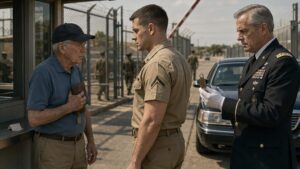
He stopped before the visitor checkpoint, one hand resting on the rail, while the gray reconnaissance prototype crossed the distant flight line under the guidance of two orange-vested crewmen. Its nose was sharper than the first test model’s. The engine housings had been widened. The skin around the canopy carried the dull, light-drinking finish the new briefings had promised.
But beneath the rear cockpit, where a narrow black nameplate should have caught the morning sun, there were only two empty screw holes.
A transport cart honked behind him.
“Sir, you need to keep moving.”
William stepped forward. His right shoulder pulled beneath his faded brown jacket. He let the pain pass before placing a worn paper authorization beneath the checkpoint glass.
The clerk glanced at it, then at him.
The paper had been folded twice and carried so long that the fibers had gone soft along the creases. A faded Meridian seal sat above William’s name. Beneath it was a block of letters and numbers no current printer would have produced.
The clerk scanned the code.
Her monitor gave a flat denial tone.
“Do you have a digital invitation?”
“This is the invitation.”
“I mean one on your phone.”
“I don’t carry one.”
She examined his plain gray shirt, dark work trousers, and old shoes. Her eyes paused on the paper again, as though deciding whether it was an antique or a forgery.
“Today’s access is restricted,” she said. “Rollout guests were issued current credentials.”
“I was told this remained current.”
“By whom?”
William looked past her toward the aircraft.
A maintenance chief stood beneath the left wing, one hand raised. Before the crewman beside him moved, William saw the slight tremor in the stabilizer.
“Tell them not to cycle the auxiliary actuator yet,” he said.
The clerk frowned. “Excuse me?”
The maintenance chief snapped both arms across his chest. The crew beneath the aircraft backed away. A moment later, a hydraulic panel dropped half an inch and stopped.
William watched until the chief signaled the line safe.
The clerk had turned toward the window.
“How did you know that?”
“The left stabilizer was lagging.”
“You can see that from here?”
“You can see it if you know what should move first.”
Her suspicion did not disappear. It sharpened.
She called a technical sergeant from the secondary desk. He was young, narrow-faced, and carried a tablet against his chest. His name strip read RIVERA.
“Anthony,” the clerk said, “this gentleman has a legacy credential that won’t scan.”
Anthony accepted the paper with care. Unlike the clerk, he did not smile at its age.
“Where did you get this, sir?”
“It was issued here.”
“When?”
“The date is printed beneath the seal.”
Anthony read it. His eyebrows lifted.
“This predates the current base-access system.”
“It predates three of them.”
Anthony entered William’s name. The tablet processed for several seconds, then displayed no active credential.
“Do you have military identification?”
“Not one that grants access here.”
“Were you assigned to Meridian?”
“Yes.”
“In what capacity?”
William looked through the glass again. The aircraft had stopped near the marked presentation area. Workers began positioning stairs beside the forward cockpit.
The missing name had not been painted over. The mounting holes remained, clean and deliberate.
“I came to replace something that should not have been removed.”
Anthony followed his gaze. “From the aircraft?”
“Yes.”
“What?”
“A name.”
The clerk shifted uneasily.
Anthony lowered his voice. “Sir, you understand how that sounds.”
William took the authorization back before the young man could crease it.
“I understand how most true things sound when the record has been cleaned up.”
A radio crackled behind the desk. The clerk listened, then glanced at William with a new expression—not recognition, but concern softened into condescension.
“Event security received a call about you,” she said.
William’s fingers tightened around the paper.
“From whom?”
“A family member. She said you might try to approach the aircraft without assistance.”
“My daughter had no authority to make that call.”
“She said you have a heart condition.”
“She is an engineer. She believes every risk can be removed if enough people are denied access to it.”
Anthony did not smile.
“She also said you intended to enter the cockpit.”
“That is correct.”
“Alone?”
“That was the intention.”
The clerk pressed a button beneath the desk. A side gate clicked but did not open.
“Sir, until we verify who you are, you’ll need to wait in the visitor room.”
William looked at the small room behind tinted glass. Two plastic chairs faced a screen playing a silent base-history video. On the screen, photographs changed every few seconds—aircraft, commanders, crews, ribbon cuttings, retirements.
History made harmless by sequence.
“The rollout begins in less than an hour,” he said.
“Then you should have brought the right credential.”
Anthony looked at her, but William raised a hand before he could intervene.
“The credential is right. Your system is younger than the promise attached to it.”
The clerk’s face hardened. “That is not how access works.”
“No,” William said. “It is how memory works.”
Boots approached from the secure side.
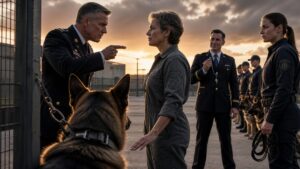
The man who entered wore blue service dress with the controlled precision of someone who had inspected himself twice before leaving his office. Silver eagles marked his shoulders. His hair was close-cut, his expression composed, and the people behind the counter straightened before he said a word.
Colonel Jonathan Miller glanced first at the clerk, then at Anthony’s tablet, and finally at William.
“What’s the issue?”
“Unverified legacy credential,” Anthony said. “The code format is authentic, sir, but it doesn’t map to the active system.”
Jonathan took the paper.
His eyes moved over the faded seal and stopped at the name.
William saw the pause.
It was too brief for recognition, but too long for indifference.
“Harris,” Jonathan said.
“Yes.”
“Your daughter contacted us.”
“So I’ve been informed.”
“She believes you may place yourself in danger.”
“That is a family disagreement, Colonel. Not a security determination.”
Jonathan’s gaze rose sharply at the correct identification of his rank.
“Have we met?”
“No.”
“Then how do you know who I am?”
“Your photograph is on the command board.”
Jonathan turned slightly. The board was behind William and twenty feet to his left. William had passed it on the way in.
The answer was ordinary enough to disappoint him.
“You claim this paper permits you onto a restricted flight line.”
“It did when it was issued.”
“That was decades ago.”
“The obligation was not given an expiration date.”
“What obligation?”
William glanced toward the aircraft.
Jonathan followed his eyes and saw only the machine.
“I need to reach the rear cockpit before the presentation,” William said.
“No.”
“Check the authorization properly.”
“We did.”
“You checked my name in the current personnel system.”
“That is how identity is verified.”
“Not this identity.”
Jonathan’s face changed by a degree.
Behind them, the event coordinator appeared at the far end of the corridor, speaking urgently into a headset. Visiting cadets had begun gathering near the observation barrier. A public-affairs camera crew moved into position beside the aircraft.
Jonathan folded the authorization once along its existing crease.
“You will remain outside the secure area.”
“The aircraft is missing something required by its original command order.”
“You are not in a position to inspect my aircraft.”
William’s voice stayed level. “It was never yours in that sense.”
The clerk looked down. Anthony stared at his tablet.
Jonathan stepped closer.
“You arrive without current identification. You present an obsolete document. You know restricted maintenance details, and you insist on reaching a prototype cockpit during a controlled event. I have more than enough reason to deny access.”
“You have reason to verify me.”
“I have.”
“No. You have asked a new system whether it remembers an old promise.”
Jonathan handed the paper back.
“Escort him to the public side of the barrier.”
Two security airmen entered through the gate. Neither touched William immediately. One gestured toward the exit.
William did not move.
Beyond the glass, the aircraft canopy began to rise. Sunlight struck the empty place beneath the rear seat.
Jonathan’s patience thinned.
“Sir, leave voluntarily.”
William looked at the two clean screw holes where Larry’s name had been.
Then he faced Jonathan.
“Before you remove me,” he said quietly, “ask Sergeant Rivera to search Nightglass Seven under its sealed test designation.”
Anthony’s head came up.
Jonathan’s expression went still.
The name had not appeared on any public board, program, or invitation.
It had not been spoken at Meridian in nearly thirty years.
Chapter 2: Search the Aircraft, Not My Name
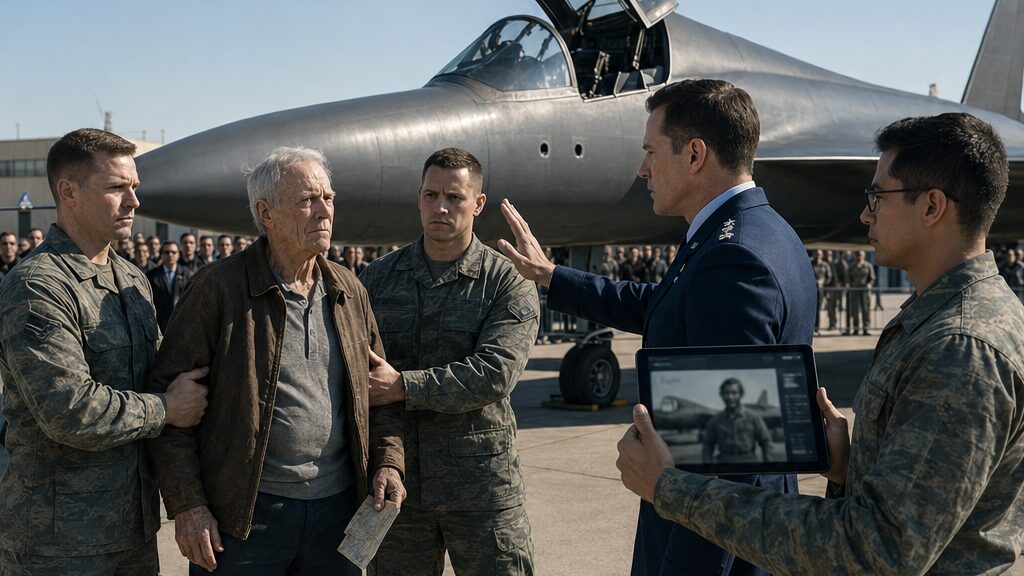
The security airmen took William by both arms just as the aircraft canopy locked open behind him.
His right shoulder flared hot beneath the first man’s grip. William drew one careful breath and kept his feet planted.
“Don’t twist that shoulder,” he said.
The airman loosened slightly, but did not release him.
Jonathan had moved the confrontation through the side gate and onto the edge of the flight line, away from the visitor desk but not away from witnesses. Civilian contractors paused beside equipment cases. Cadets watched from behind the barrier. A public-affairs officer lifted a camera.
Jonathan pointed at him.
“Turn that off.”
The officer lowered it.
William noticed. It was the first decent choice the colonel had made since arriving.
Anthony stood several steps away, tablet in hand. Wind pushed at his uniform sleeves as he entered the sealed designation.
NIGHTGLASS 7 returned no active aircraft.
“Nothing,” Jonathan said.
Anthony frowned. “It may be indexed differently.”
“Or the phrase came from compromised material.”
William looked at the aircraft. From this distance he could see a pale rectangle where the nameplate had protected the finish from years of exposure.
“The designation belongs to the airframe lineage, not the current tail number.”
Jonathan’s jaw tightened. “You will stop providing instructions.”
“Then you will keep searching the wrong place.”
One of the guards adjusted his hold. Pain moved down William’s arm into his fingertips.
Anthony hesitated.
William met his eyes.
“Search the authorization under the aircraft,” he said. “Not under me.”
The young sergeant looked at Jonathan.
For several seconds, no one moved. The prototype’s auxiliary systems hummed behind them. Somewhere near the hangar, a metal tool struck concrete and rang once.
Jonathan said, “Do it.”
Anthony opened the engineering registry and entered the current airframe number. Rows of specifications appeared: dimensions, program office, maintenance authority, active restrictions.
“Legacy attachments,” William said.
Jonathan stepped between them. “You will not direct this search.”
Anthony’s thumb had already stopped over a small archive symbol.
“There are six sealed attachments, sir.”
“Classification?”
“Mixed. Two historical, three technical, one command-linked.”
Jonathan stared at William.
“What did you do here?”
William’s answer came after a moment.
“I made decisions.”
“That is not an answer.”
“It is the only one you are prepared to hear.”
Jonathan turned back to Anthony. “Open the command-linked attachment.”
The tablet requested an authorization phrase.
Anthony showed the screen.
William read the prompt from where he stood.
“Continuity through absence.”
Anthony entered it.
A gray banner replaced the request.
LEGACY RECORD AVAILABLE
IDENTITY CHAIN INCOMPLETE
COMMAND AUTHORITY SEALED
Beneath it appeared a code:
MRA-01 / PERMANENT MEMORIAL ACCESS
The airman holding William’s injured side released enough pressure that William’s sleeve slackened.
Anthony noticed.
“So did you,” William said.
The young man looked embarrassed but did not tighten his grip again.
Jonathan read the banner twice.
“This confirms that someone had memorial access,” he said. “It does not confirm that person is you.”
“No.”
“Anyone with the phrase could trigger this.”
“Possibly.”
“Then why should this help you?”
“Because now you know the paper was not invented.”
Jonathan’s gaze dropped to the authorization in William’s hand.
Around them, the tone of the watching crowd had shifted. The first glances had carried mild amusement and pity. Now the cadets leaned toward one another without speaking. A contractor slowly closed the lid of his case.
An old man who knew nothing was inconvenient.
An old man who knew sealed access language was dangerous.
Jonathan seemed to feel that change.
“Where did you get the phrase?”
“I was present when it was written.”
“In what capacity?”
William looked again at the empty nameplate position.
“The capacity is not what needs correcting.”
Jonathan followed his gaze this time. His eyes settled on the two holes.
“What is missing?”
“Larry Campbell.”
The name altered nothing in the younger faces around them.
But one maintenance chief near the aircraft stopped walking.
William saw him turn.
Jonathan did not.
“Who is Larry Campbell?” the colonel asked.
“The man assigned to that seat before the first airframe had a public name.”
Jonathan looked toward the rear cockpit. “There is no assigned crew name on this configuration.”
“There was.”
“The modernization package removed historical markings.”
“It removed a requirement.”
“Based on what authority?”
“The order attached to the access code.”
Jonathan’s restraint finally broke.
“You keep claiming orders, requirements, permissions, and sealed records, but you will not identify yourself. That is not humility. It is obstruction.”
The accusation struck nearer than Jonathan knew.
William could have ended the question. Four words would have done it. He could have given his retired rank and former command. Anthony would have searched a different archive. Calls would have been made. Doors would have opened.
Larry’s name would vanish behind William’s title before they ever reached the aircraft.
“No one should have to be important before you stop hurting them,” William said.
Jonathan glanced at the guard’s hand on William’s arm. “They are using approved restraint.”
“Approved does not mean necessary.”
“You refused lawful direction.”
“I asked for verification.”
“You withheld information.”
“Yes.”
The honesty seemed to unsettle Jonathan more than denial would have.
William continued, “You had a choice after the record appeared. You could pause. You could check the archive. Or you could decide that uncertainty itself made me disposable.”
Jonathan’s eyes hardened, but there was color high in his cheeks.
“This is a classified flight line. Uncertainty is a threat.”
“Only when command becomes afraid of questions.”
The maintenance chief had reached the edge of the group.
“Colonel,” he said carefully, “Campbell was a Nightglass test name.”
Jonathan turned. “You recognize it?”
“From the old hangar logs. Before my time, but the name used to be stenciled beneath the rear station.”
William watched the colonel absorb this unwilling support.
The maintenance chief pointed toward the aircraft. “Those holes match the old plate spacing.”
Jonathan looked at them again.
“Why was it removed?”
“Modernization directive,” the chief said. “All noncurrent markings came off.”
“Whose directive?”
The chief’s silence answered.
Jonathan had signed it.
The colonel straightened, as if posture could restore control.
“Sergeant Rivera, transmit the legacy code to records. Request full identity-chain review.”
Anthony tapped rapidly.
A red lock appeared.
“Records requires archive-level approval.”
“Call wing headquarters.”
“The archive liaison is at the rollout briefing.”
“Then bring him here.”
The event coordinator approached at a near run.
“Sir, the visiting delegation arrives in twelve minutes. We need to clear the presentation area.”
Jonathan glanced toward the line of black vehicles gathering beyond the hangar.
The timetable pressed against him. William could see it in the calculation behind his eyes: delay the rollout, explain an unverified civilian, risk another procedural failure—or remove the problem and let records catch up later.
Jonathan chose.
“Take him to security.”
Anthony looked up. “Sir, the memorial code is valid.”
“The identity chain is not.”
“The system says the authorization is permanent.”
“It says someone’s authorization is permanent.”
William felt the grip return to his right arm.
The maintenance chief stepped forward. “Colonel, maybe we should hold the event until—”
“We are not delaying a national program rollout because an unknown civilian knows an archival phrase.”
He turned to the guards.
“Remove him.”
They began walking William toward a service vehicle. The crowd opened around them.
He did not resist. Resistance would become the only image anyone remembered.
Anthony stayed beside Jonathan, tablet still glowing. As William passed, the young sergeant enlarged the legacy attachment and found a thumbnail buried beneath the warning banner.
“Sir,” Anthony called.
The guards stopped.
On the tablet was a grainy photograph taken on this same flight line decades earlier. A younger William stood beneath the open canopy of the first Nightglass airframe. His hair was dark, his shoulders squared, one hand raised toward a formation beyond the edge of the image.
Larry Campbell stood beside him in a flight suit.
The plate beneath the rear cockpit carried Larry’s name.
A black classification bar covered the rank line under William’s photograph.
But his face was clear.
Anthony looked from the screen to the old man held between the guards.
Then Jonathan did the same.
Chapter 3: The Order Everyone Remembered Wrong
The bruise beneath William’s shoulder had already darkened by the time the medical attendant cut away the edge of his undershirt.
“You’re fortunate nothing tore,” she said.
William sat on the examination table in the small room adjoining base security. The fluorescent lights flattened everything—the steel cabinets, the white walls, the old scars on his forearm.
“I asked him not to twist it.”
“He says he loosened his grip.”
“He did.”
“Do you want the incident documented?”
“It is being documented.”
“I mean as a complaint.”
“No.”
The attendant pressed two fingers near the joint. William’s hand tightened against his knee.
“That hurts.”
“Yes.”
“You should have said more clearly that you had an existing injury.”
“I said enough.”
The door opened before she could answer.
Jonathan entered, followed by Anthony carrying the tablet. Neither man wore the confidence he had brought onto the flight line.
The guards remained outside.
The attendant pulled William’s jacket back over his shoulders without forcing his right arm into the sleeve. “No climbing today.”
William looked at her.
“That was not a suggestion.”
“It sounded like one.”
She stared until he nodded, though neither of them believed the nod settled anything.
Jonathan waited for her to leave.
The room became very quiet.
Anthony placed the tablet on the counter and enlarged the archive photograph. Time had blurred the edges, but not enough to hide William’s younger face.
“Is this you?” Jonathan asked.
“Yes.”
“What was your assignment?”
William looked at the sealed rank line.
“You already know I belonged here.”
“That is not what I asked.”
“It is what matters for the access question.”
Jonathan’s voice remained controlled. “You were found beside a restricted airframe using sealed program terminology. The archive photograph places you in the original Nightglass program. Your rank and authority remain blocked. Until I know precisely who you were and why the file is restricted, you are not going near that aircraft.”
William adjusted his injured arm.
“You have confirmed the memorial authorization.”
“We have confirmed that the authorization exists.”
“And the photograph confirms the person attached to it.”
“The photograph confirms resemblance.”
Anthony shifted beside the counter.
Jonathan heard it. “You disagree, Sergeant?”
Anthony chose his words carefully. “Facial-aging comparison returned a ninety-seven percent match, sir.”
“Then say that first.”
“I was trying not to overstate an automated result.”
Jonathan looked back at William. “You see the difficulty. My personnel are required to be precise. You are choosing not to be.”
William almost admired the argument. It was clean, defensible, and pointed away from the place where Jonathan had made his choice.
“You had partial confirmation on the flight line,” William said. “You continued the removal.”
“I had a possible breach connected to a sealed command record.”
“You had an old man asking you to check an aircraft archive.”
“You had classified knowledge.”
“I had memory.”
Jonathan’s mouth tightened.
The word Harris had been working inside him since the checkpoint. William had seen it there. Not recognition exactly. Inheritance.
“Who told you about me?” William asked.
Jonathan did not answer at once.
“My father served in the Nightglass test squadron.”
William searched the younger man’s face more carefully.
There was something in the brow, in the fixed way he held anger behind the eyes.
“What was his call sign?”
Jonathan gave a humorless laugh. “You don’t get to question me.”
“What was it?”
“Rook Two.”
William looked down.
He remembered a pilot with quick hands and a habit of tapping the canopy twice before every taxi. He remembered the man younger, furious, standing in a briefing room after the grounding order.
“Jerry Miller,” William said.
Jonathan’s expression changed.
“So you remember him.”
“Yes.”
“He remembered you too.”
Anthony’s attention moved between them.
Jonathan stepped closer to the examination table.
“My father said General Harris ended the careers of an entire test squadron because he lost his nerve after one accident.”
The title entered the room without ceremony.
Anthony went still.
William did not look at him.
Jonathan continued, “He said Harris grounded the program permanently, buried the investigation, and let everyone else carry the consequences.”
William’s shoulder throbbed under the cooling pack.
“Did your father tell you why the aircraft was grounded?”
“He said command panicked.”
“That was not my question.”
“He said the mission could have been recovered.”
“Did he tell you where?”
Jonathan’s certainty faltered, but only for a moment.
“You are General Harris.”
William looked at the photograph on the tablet.
“I was.”
Anthony drew a breath.
Jonathan ignored him. “Lieutenant general?”
William’s silence confirmed enough.
The room’s balance altered. Jonathan’s shoulders remained squared, but the force behind them no longer filled the space. Anthony’s hand moved almost imperceptibly toward attention, then stopped when William glanced at him.
“No,” William said.
Anthony lowered it.
Jonathan saw the exchange and flushed.
“You allowed my people to treat you as an unknown civilian.”
“I was an unknown civilian.”
“You commanded this base.”
“Not today.”
“That distinction is convenient.”
“It is essential.”
Jonathan stared at him. “You could have ended this at the checkpoint.”
“Yes.”
“Instead, you withheld your identity and created a security incident.”
“Yes.”
The second admission struck harder.
William continued, “And you could have paused after the memorial code appeared.”
Jonathan’s jaw flexed.
Neither man had the clean position he wanted.
Anthony touched the tablet. “Sir, I found another layer in the photograph metadata.”
He enlarged the aircraft canopy. Beneath the rear cockpit, the original nameplate became readable.
LARRY CAMPBELL
TEST OPERATIONS
William’s attention fixed on the letters.
For one second the medical room disappeared, replaced by sun on older concrete and Larry leaning against a ladder, complaining that his name had been mounted crooked.
Jonathan noticed William’s face.
“Campbell was the fatality?”
William said nothing.
“The accident my father blamed on you?”
“The mission was not an accident in the way he meant.”
“What does that mean?”
“It means a machine can fail without the decision afterward being mechanical.”
The door opened sharply.
Emily Harris entered with an event-security escort behind her. She wore a dark work jacket over an engineer’s blouse, her hair pulled back, anger holding her upright.
Her eyes found William’s unfinished sleeve and the cooling pack beneath it.
“What happened?”
“I am fine.”
“That phrase stopped meaning anything when I was twelve.”
She turned on Jonathan. “Was he restrained?”
Jonathan answered before William could.
“Yes.”
Emily’s face drained.
“He has damage in that shoulder from surgery. I told your office he might attempt to enter the cockpit, not that he was dangerous.”
“The message was summarized as concern for his judgment,” Jonathan said.
“I was concerned about his heart and the ladder.”
William looked at her. “You had no right to call them.”
“And you had no right to drive here alone and hide your plan.”
“It was mine to complete.”
“That is what you say whenever you want grief to become private property.”
Anthony looked down at the tablet.
Jonathan did not.
Emily’s words had opened something he could use.
“You intended to climb into the aircraft despite medical restrictions,” he said to William.
“I intended to replace the plate.”
“Alone?”
“Yes.”
Emily stepped nearer. “He has done this every year with earlier airframes. He never told me until the previous model was retired.”
Jonathan looked from her to William. “Why?”
William’s voice lowered.
“Because a promise is not improved by an audience.”
Emily shook her head. “No. Because an audience might ask what the promise cost.”
The tablet chimed.
Anthony turned toward it.
A new archive result had appeared beneath Larry’s photograph.
NIGHTGLASS FLIGHT 7
CAMPBELL, LARRY
CASUALTY RECORD—RESTRICTED
COMMAND DECISION AUDIO ATTACHED
A second line showed the authority that had sealed it.
W. HARRIS, COMMANDING
Jonathan read the screen, then looked at William.
“What happened on that flight?”
William’s injured hand closed slowly around the edge of the examination table.
Anthony selected the file.
A warning filled the display.
FAMILY CONSENT OR FORMER COMMAND AUTHORIZATION REQUIRED.
No one spoke.
For nearly thirty years, William had carried the answer in silence.
Now the base had found the door he had sealed around it.
Chapter 4: A Grounding Order Written in Silence
The archive door refused Jonathan’s credentials three times.
Each denial flashed red across Anthony’s tablet while the steel door beneath wing headquarters remained sealed. The corridor smelled of concrete dust and chilled air. William stood with his injured arm resting inside his unfastened jacket, watching Jonathan press his thumb to the reader again.
ACCESS LEVEL INSUFFICIENT.
Jonathan stepped back. “This room belongs to my command.”
“It belonged to several commands before yours,” William said.
Jonathan turned. “Can you open it?”
“Yes.”
“Then do it.”
William studied the old keypad beside the modern reader. Most of its lettering had worn smooth. The replacement access panel covered half of the original brass plate, but the emergency speaker remained where he remembered it.
Emily stood near the elevator with her arms folded. She had argued against moving William from the medical room. The medical attendant had argued more loudly. William had won by promising not to lift anything and by allowing Emily to carry the paper authorization.
He regretted the second condition more.
Anthony held the tablet beneath the keypad. “The records index says voice continuity may still be active.”
Jonathan looked at William. “What phrase?”
“It was not a phrase.”
William pressed the speaker button. Static answered.
He leaned closer.
“Meridian command emergency continuity. Nightglass grounded. Preserve crew record pending family release.”
The lock clicked.
No one spoke.
The door drew inward with a slow mechanical pull. Cold air rolled into the corridor, carrying the dry smell of old paper, magnetic tape, and equipment that had outlived the people trained to repair it.
Jonathan entered first.
William caught the edge of the door before it closed, and pain shot from his shoulder to his wrist. Emily moved immediately.
“I said I would handle doors.”
“I forgot.”
“You do not forget. You decide.”
She held the door while he passed.
Rows of compact shelving filled the archive room. Newer records had been transferred to digital systems, but the Nightglass files occupied two locked cabinets at the rear beneath a faded program emblem. The image showed a black aircraft crossing a white horizon.
Anthony’s tablet connected to the archive terminal by cable. The device searched for translation software, stalled, then displayed fields of symbols and empty boxes.
“The old authorization tables aren’t mapping,” he said.
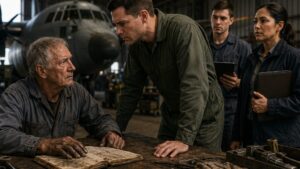
William moved beside him.
“Column four is command disposition. Column six is recurring obligation.”
Anthony zoomed in. “There’s no header.”
“There was on the paper version.”
Jonathan watched him. “You remember database columns from thirty years ago?”
“I remember what we hid inside them.”
William regretted the word as soon as it left him.
Jonathan heard exactly what he feared.
“Hidden from whom?”
“From systems designed to delete anything they could not classify.”
“That is not what you meant.”
William did not answer.
Anthony opened the memorial-access entry. The permanent code appeared beside a scanned order bearing William’s signature. Much of the text remained readable.
All successor airframes retaining rear operational station shall preserve permanent crew acknowledgment for Lt. Col. Larry Campbell, Test Operations.
Below it, in different ink, someone had written:
Plate remains with aircraft lineage. No ceremonial substitution.
Anthony read the line twice.
“The current aircraft is a direct successor,” he said.
“Yes.”
“Then the plate should still be mounted.”
“Yes.”
Jonathan’s attention moved to a maintenance-history tab.
Anthony opened it.
A list of modernization actions filled the tablet. New avionics. Modified canopy. Revised cooling system. Surface treatment. Removal of obsolete exterior identifiers.
At the bottom appeared the approving authority.
J. MILLER, COMMANDING.
Jonathan’s face lost color.
“The directive covered all historical markings,” he said.
William looked at him. “Larry was not a marking.”
“I did not know what the plate represented.”
“You did not ask.”
“The aircraft carried eleven outdated labels.”
“One had a permanent preservation order attached.”
“That order was buried in an untranslated field.”
“So you signed without translating it.”
Jonathan straightened. “We were preparing the program for congressional review. The aircraft needed a consistent public identity. Every office involved approved the modernization package.”
“Every office read the summary you gave them.”
A hard silence settled over the room.
Emily set William’s authorization on the archive table. “Was the plate destroyed?”
Jonathan looked toward Anthony.
The sergeant searched the maintenance disposition. “Removed items were sent to heritage storage unless classified as waste.”
“Which was it?” William asked.
Anthony opened another record.
“Heritage storage. Box M-Seventeen.”
William breathed again.
The relief was small but visible. Emily saw it and looked away, granting him the privacy he had not granted her.
Jonathan moved closer to the table.
“You came here to replace a nameplate.”
“I came here to keep a promise.”
“You could have sent a letter.”
“I sent three.”
Jonathan’s head lifted.
William nodded toward the records. “One to wing heritage. One to maintenance command. One to your office.”
“I never saw them.”
“You signed the final denial.”
Jonathan’s expression tightened. “My staff processes heritage requests.”
“Your signature was still at the bottom.”
“That is how command administration works.”
“I know.”
The two words carried more weight than accusation.
Anthony found the correspondence. Each request described the plate as a protected crew acknowledgment but did not identify William’s former rank. The latest response classified the request as unsupported historical preference.
Jonathan read his own digital signature.
For the first time since the checkpoint, he appeared less angry than tired.
“I receive hundreds of routed actions.”
“And the people denied by them receive one.”
Emily glanced at William. The line was precise, almost cruel. He had delivered it without raising his voice.
Jonathan deserved part of it.
Not all.
William moved toward the locked cabinet. “The access question is settled. The memorial order is valid.”
“The identity question is not fully settled,” Jonathan said, though the resistance had weakened.
Anthony examined the archive index. “There’s enough to confirm that General Harris held command authority over the order.”
Jonathan looked sharply at him.
Anthony corrected himself. “Former General Harris.”
William said, “William will do.”
The young sergeant nodded.
Jonathan did not.
“What remains sealed?” he asked.
Anthony opened the casualty index. “Flight Seven command audio, investigation annex, family correspondence, and the final cockpit recording.”
William’s stomach tightened.
Emily noticed. “You knew all of that was here.”
“Yes.”
“And you never opened it?”
“I opened what I needed for the inquiry.”
“That was not my question.”
William studied the cabinet’s brass handle. “Some records belonged to Larry’s family after the investigation ended.”
Jonathan moved beside him. “Then why did you retain command control?”
“To prevent release without consent.”
“Or to prevent anyone from challenging your version?”
William turned.
The accusation was not entirely Jonathan’s. Jerry Miller’s voice lived inside it, along with years of inherited anger.
“The grounding order was mine,” William said. “The casualties attached to it were not a version.”
Jonathan held his gaze. “My father spent the rest of his career saying the squadron could have flown again.”
“It could not.”
“Because you were afraid?”
William’s restraint tightened until it felt like wire.
“Because one aircraft went down and fourteen others carried the same uncorrected failure.”
“That is not what he believed.”
“Your father was wrong.”
Jonathan took a step forward.
Emily moved between them before either man could make the room smaller.
Anthony’s tablet chimed.
“Lisa Campbell answered.”
William looked at the screen but did not approach.
Anthony put the call on speaker.
A woman’s voice came through, older than William remembered but steady.
“Who is asking to open Larry’s file?”
Anthony gave his name and role, then explained that William was present.
The silence on the line lasted several seconds.
“Is he hurt?” Lisa asked.
William looked at Emily.
Emily answered. “His shoulder is bruised. He will recover.”
“Of course he let someone else answer.”
William closed his eyes briefly.
“Lisa.”
“Do not use my name as though we spoke last week.”
“I did not call to ask you to rescue me.”
“No. You called because the base found a door you kept locked.”
Jonathan watched William carefully.
Anthony said, “Ma’am, we need family consent to release the casualty section.”
“You may have it under one condition.”
William already knew what she would ask.
Lisa continued, “No edited summary. No command excerpt. No clean version for the rollout. If that file opens, it all opens.”
Jonathan looked at William.
Emily did too.
Lisa’s voice softened, but not enough to spare him.
“Tell him I will come. Tell him I am not coming to prove he was right.”
The call ended.
On the archive terminal, the casualty file changed from red to amber.
FAMILY CONSENT PENDING ARRIVAL.
William stared at the line.
For thirty years he had protected Larry’s record from partial disclosure.
Now Larry’s widow had agreed to open it only if William surrendered the shelter of silence completely.
Chapter 5: The Commander Inside the Sealed Record
The first image on the briefing-theater screen showed William giving the order that had ended Larry Campbell’s flight.
The footage was grainy, recorded from an overhead camera in the old command center. A younger William stood over a console in shirtsleeves, one hand pressed to a headset. Men and women moved behind him in bursts of controlled urgency. A mission clock burned red in the corner.
The image froze before the audio began.
Jonathan stood at the side of the theater, facing rows of personnel who had been pulled from the delayed rollout. The public delegation had been moved to a reception hangar under the explanation of a technical hold. The cadets, maintenance crew, security staff, and event personnel who had witnessed William’s removal now occupied the back rows.
William sat near the aisle with Emily beside him. His shoulder had stiffened. The medical attendant had secured his arm in a sling he disliked and could not ignore.
Anthony worked at the control station.
Lisa Campbell had not yet arrived, but her electronic consent had unlocked the identity and command portions of the record. The casualty audio remained sealed until she entered the building.
Jonathan had argued for a private review.
William had refused.
“You were willing to remove me in public,” he had said. “You can verify me in the same light.”
Now Jonathan looked at the frozen younger face on the screen.
“Proceed,” he told Anthony.
The footage resumed.
A younger William spoke into his headset.
“Nightglass Seven, hold eastern track. Do not initiate return turn.”
Static followed.
Then a pilot’s voice, calm and strained.
“Meridian, Seven copies eastern track.”
The recording stopped. The casualty section remained locked.
Anthony opened the command index.
Text populated the screen beside the frozen image.
HARRIS, WILLIAM
COMMANDER, MERIDIAN FLIGHT TEST WING
LIEUTENANT GENERAL, UNITED STATES AIR FORCE, RETIRED
PROGRAM AUTHORITY: NIGHTGLASS
CIVILIAN-PROTECTION DOCTRINE—ORIGINATING COMMAND
The theater changed without sound.
A maintenance officer in the second row straightened. One of the security airmen who had restrained William lowered his eyes. The event coordinator pressed both hands around her headset.
Jonathan read the record as though repetition might produce a different answer.
The former commander he had accused of exploiting an old military name had once held authority over the entire program, the wing, and several commands above Jonathan’s present reach.
Anthony turned from the screen.
“General Harris.”
William looked at him.
“William.”
Anthony swallowed. “Yes, sir.”
The title had already moved through the room. People rose in scattered uncertainty—some from habit, some from embarrassment, some because others had begun to stand.
William remained seated.
“Sit down,” he said.
The command in his voice came too naturally.
Every person sat.
The silence afterward was worse.
William looked at the guards in the back row. Neither met his eyes.
“This confirms identity,” Jonathan said, addressing the room. “The earlier security determination is withdrawn.”
The words were technically correct and morally empty.
William waited.
Jonathan’s hand tightened around the edge of the podium.
“Mr. Harris was authorized to access the aircraft under a permanent memorial provision.”
“Was?” William asked.
Jonathan corrected himself. “Is authorized.”
Anthony displayed the full memorial order. William’s old signature appeared beneath the requirement preserving Larry’s nameplate across successor airframes.
The maintenance chief leaned toward a colleague. The whisper moved no farther, but Jonathan saw it.
He knew what came next.
“The plate was removed during the modernization program under my authority,” he said. “The preservation instruction did not transfer correctly into the current maintenance system.”
William watched him choose each word.
Not false.
Not complete.
Jonathan continued, “The plate has been located in heritage storage. It can be restored before the rollout.”
A small release passed through the room. Here was the easy ending: the old commander recognized, the mistake corrected, the ceremony resumed.
The public-affairs officer near the wall was already calculating photographs.
William stood.
Emily rose to steady him, but he shook his head and used the seatback instead.
“No,” he said.
Jonathan stopped.
“You do not want it restored?”
“I do not want it screwed back onto the aircraft between a press photograph and the opening remarks.”
“We can provide private access first.”
“No.”
Jonathan lowered his voice. “General, I am trying to correct this.”
“Do not call me that to make correction easier.”
The theater became completely still.
Jonathan’s face tightened under the rebuke.
William continued, “You had a valid reason to verify an unidentified person near a restricted aircraft. You did not have a valid reason to decide that an unidentified person could be handled without patience.”
“I ordered approved restraint after you refused direction.”
“You saw evidence that your system might be incomplete.”
“I also saw evidence that you possessed sealed information.”
“And because you could not place me, you treated me as though I had no place.”
Jonathan looked toward the audience, painfully aware of every witness.
“This discussion should continue privately.”
“That is where most lessons about public conduct go to disappear.”
Emily glanced at William. There was no approval in her face, but there was recognition. He was not hiding now.
Jonathan took a breath.
“I apologize for the injury.”
William looked at the sling.
“If I had been a confused old man, would you still apologize?”
Jonathan did not answer.
“That is the question,” William said. “Not whether you should have recognized a retired lieutenant general.”
The guard who had held William’s right arm raised his eyes at last.
William addressed him, not unkindly. “You loosened your grip when you understood I was in pain.”
“Yes, sir.”
“Before you knew who I was.”
The airman nodded.
“That mattered more than what appeared on the screen.”
Jonathan stepped away from the podium. His control had not disappeared, but its shape had changed. He seemed less like a commander containing a problem and more like a man standing inside one.
“My offer of access remains,” he said. “No cameras. No audience. You may restore the plate yourself.”
William thought of the rear cockpit and the two empty holes waiting in the aircraft’s skin.
For years he had imagined doing exactly that—alone, before anyone arrived, his hands steady enough to turn the final screw.
It was what he wanted.
That did not make it right.
“The plate was not removed in private,” he said. “Larry’s history was removed by an official order. Restoring the metal without restoring the truth would be another quiet correction no one has to learn from.”
Jonathan’s eyes sharpened. “What truth?”
William looked at the frozen image of his younger self.
The command record had established his rank. It had not established whether his final order deserved respect.
Behind the classification banner lay the reason Jerry Miller had blamed him, the reason Lisa had stayed away, and the reason William had allowed Larry’s name to survive only as a plate rather than a complete account.
Anthony touched his headset.
“Colonel, we have an additional archive match.”
A second audio waveform appeared beneath the command footage. Metadata listed several call signs from the Nightglass squadron.
Jonathan moved toward the screen.
One line read:
ROOK TWO—J. MILLER.
His father’s voice entered the theater.
“Command, this is Rook Two. Seven’s control failure matches the simulator cascade. Recommend immediate fleet grounding.”
Jonathan did not move.
The recording continued.
A younger William answered, “Concur. All Nightglass aircraft remain grounded until structural review.”
Jerry Miller’s voice returned.
“Understood. It’s the right call.”
The audio ended.
Jonathan stared at the blank waveform.
“My father said you ended his career.”
William watched the years rearrange themselves behind Jonathan’s eyes.
“He opposed the permanent closure after the investigation,” William said. “He supported the immediate grounding that day.”
“He never told me that.”
“People do not always repeat the parts of history that make their anger less clean.”
The line struck William as much as Jonathan.
Emily heard it.
So did Lisa Campbell, standing in the open theater doorway.
She wore a simple navy coat and carried a small padded case in both hands.
Everyone turned.
Lisa looked first at the screen, then at William’s sling.
“You still make other people drag the whole truth into the room,” she said.
William could not answer.
She walked down the aisle and placed the case on the table beside Anthony’s tablet.
“The family consent is complete,” she said. “Open the casualty record.”
Anthony looked to Jonathan.
Jonathan looked at William.
Rank, command, and old authority waited for him to decide.
William understood then how easily the theater could become another place where everyone obeyed him and no one heard Larry.
He nodded once.
“Open it.”
The warning vanished.
The frozen mission clock began to move.
William faced the screen as Larry’s final flight returned to the room.
“The order saved people on the ground,” he said. “It did not save Larry.”
Chapter 6: The Turn He Would Not Authorize
“Meridian, Seven requesting permission to turn home.”
Larry’s voice filled the darkened theater.
The sound was clearer than William remembered. Not because the archive had preserved it well, but because memory had worn away the ordinary parts—the breath between words, the faint vibration of the cockpit, the trace of impatience Larry always carried when asking permission for something he had already decided was necessary.
On the screen, a map displayed the aircraft’s eastern track.
A red line marked the direct return turn.
It crossed the city.
Jonathan stood near the aisle, his father’s earlier voice still visible as a waveform on Anthony’s console. Lisa remained beside the table. She had not sat.
The archived controller answered Larry.
“Seven, stand by.”
Then the younger William spoke.
“Nightglass Seven, maintain eastern heading.”
“Command, I have intermittent pitch authority and rising temperature in the rear control bus. Eastern track gives me six minutes before total loss.”
William’s hands went cold.
He had remembered the words every night for years.
Hearing them aloud made them belong to the room.
The map enlarged. The aircraft’s current path led toward open desert. The return turn crossed a school district, two residential developments, and the city hospital approach.
Anthony brought up the simulator projection attached to the investigation.
“If he initiated the turn,” Jonathan said, “could he have reached the runway?”
William answered without looking at him.
“Possibly.”
The room shifted.
Jonathan’s voice sharpened. “Possibly?”
“If the remaining controls held through the first ninety degrees. If the rear bus did not ignite. If he maintained enough lift to clear the ridge.”
“And if he did?”
“He might have landed.”
The guards in the back row watched William differently now. The title on the screen no longer promised a simple hero.
Larry’s voice returned.
“Meridian, I can make the field if I turn now.”
The younger William answered, “Negative. Hold eastern track.”
A pause.
“Confirm negative turn?”
William’s recorded voice remained steady.
“Confirmed.”
Lisa closed her eyes.
Emily’s hand found the back of William’s chair, though she did not touch him.
On the mission map, the red return line pulsed over the school district.
The archive played cockpit telemetry beneath the voices: warning tones, clipped technical calls, the thin mechanical alarm of a system reaching failure.
Larry spoke again.
“Understood. Staying east.”
No argument. No accusation.
That had always made it worse.
Anthony paused the recording when the theater doors opened for a staff officer. Jonathan told the officer to leave them undisturbed, then faced William.
“You denied the turn because of the population corridor.”
“Yes.”
“Was there no alternate route?”
“Not with the control authority he had left.”
“Could you have ordered an ejection?”
“The canopy system had faulted during the power cascade.”
Jonathan looked at the map. “So you chose the aircraft’s impact area.”
“I chose where it would not come down.”
“Knowing he might survive the turn.”
“Yes.”
The word left no place to hide.
William had spent decades refusing the language of sacrifice because it made the decision sound noble. It had not felt noble in the command center. It had felt like using a man’s remaining minutes to protect strangers who would never know his name.
Jonathan walked toward the screen.
“My father knew this?”
“He was in the airborne chase element. He saw the telemetry.”
“And afterward he still blamed you.”
“He believed the design should have been repaired and the program resumed.”
“That is not what I asked.”
William looked at him.
“Yes. He knew why I denied the turn.”
Jonathan’s face tightened with something deeper than anger.
“He came home and said command had frozen. He said you let fear decide.”
“Grief chooses its evidence.”
“You let me believe him.”
“I did not know you.”
“You knew his family existed.”
William accepted the blow.
Across the aisle, Emily looked at him with the same accusation in another form. How many people had he allowed to live inside incomplete stories because correcting them would require him to speak?
Anthony reopened the investigation annex.
A signed statement appeared.
J. MILLER, CALL SIGN ROOK TWO.
Jonathan read silently. His father had supported the emergency grounding, confirmed the city risk, and stated that the command decision had followed established civilian-protection doctrine.
The final paragraph recommended redesign and eventual return to flight.
Jonathan sat for the first time.
“He told the truth in the record,” William said.
“And something else at home.”
“Yes.”
“Which one did you believe?”
William considered.
“Both.”
Jonathan looked up.
“A man can know an order was necessary and still hate the person who gave it.”
The answer did not comfort him. It was not meant to.
Anthony restarted the audio.
Larry’s breathing grew louder. The aircraft was losing control.
“Command, I’ve got the dry lake in sight.”
The younger William leaned over the console in the video.
“Seven, rescue is moving.”
“They won’t reach me in time.”
No one in the theater moved.
Then Larry gave a short laugh.
“Tell maintenance they mounted my plate crooked.”
Several people looked toward the padded case Lisa had carried in.
William remembered the first rollout: Larry under the canopy ladder, tilting his head at the new plate and insisting one corner sat lower than the other. He had threatened to file a formal discrepancy. William had told him the enemy would never notice.
The joke in the recording broke something the investigation language never had.
Larry continued, “Leave it there. Gives them something to fix after I’m gone.”
The line had been dismissed in the official transcript as stress humor.
William had turned it into an order.
The aircraft warning became continuous.
“Meridian,” Larry said. “Eastern track clear of the city.”
William’s younger voice answered, “Confirmed.”
“Then we did what we came to do.”
The screen displayed a burst of static.
The mission clock stopped.
No one spoke for several seconds.
The sound system hummed into the absence.
Jonathan turned toward William. “You ordered the plate retained because of that line.”
“Yes.”
“And you sealed the casualty audio.”
“At Lisa’s request until the investigation ended. Afterward, I kept the restriction because the program office wanted to use the recording in recruitment and public hearings.”
Lisa’s expression hardened. “That was true for the first year.”
William looked at her.
“It remained true.”
“No. After that, they asked for a factual release with the personal cockpit section removed.”
“It would have turned him into a doctrine.”
“He helped write the doctrine.”
“He was more than that.”
“Yes,” Lisa said. “And you made him less by allowing only a nameplate to remain.”
William felt the room narrow around her words.
“I protected his privacy.”
“For a while.”
“I protected you.”
“You never asked whether I still needed protecting.”
Emily lowered her eyes.
Lisa opened the padded case. Inside lay a small recording device in a clear preservation sleeve. Its casing was scratched, one corner darkened from heat.
“This was recovered from his personal equipment package,” she said. “A message recorded before launch. Addressed to you.”
William knew the object.
He had received it after the inquiry. He had played the first sentence in his office late one night.
Will, if this test goes badly—
He had stopped it.
He had returned the device to Lisa with a note saying the message belonged to the family.
“You listened,” Lisa said.
“To the beginning.”
“You told me you could not.”
“I could not.”
“That is different.”
William stared at the device.
The distinction was merciless and exact.
Jonathan rose slowly. Whatever satisfaction he might once have imagined in seeing General Harris exposed had disappeared. He was watching an old man confronted not by accusation, but by a choice he had postponed for thirty years.
Lisa held the recorder out.
William did not take it.
She stepped closer.
“You built a life around carrying the decision alone,” she said. “It made you look loyal. It made everyone else helpless.”
“That was not my intention.”
“No. It was your habit.”
His injured arm rested uselessly in the sling. He reached with his left hand.
The preservation sleeve was lighter than he expected.
“Larry did not ask to be turned into a hero,” Lisa said. “But he did not ask to be hidden.”
William looked at the small play button beneath the plastic.
For decades he had believed silence was the last duty he could perform for his friend.
Now the unopened message sat in his palm like evidence that the duty had become an excuse.
Chapter 7: Do Not Apologize to My Rank
William removed the prepared speech from the podium and folded it shut before the public-affairs officer could stop him.
Across the front page, beneath the Meridian seal, someone had printed his former title in letters large enough to be read from the back of the hangar.
LIEUTENANT GENERAL WILLIAM HARRIS
FORMER COMMANDER, MERIDIAN FLIGHT TEST WING
He placed the pages facedown.
The open hangar framed the flight line behind him. The gray aircraft waited under the lowering sun, its canopy closed now, the two empty screw holes still visible beneath the rear cockpit. Rows of chairs faced the podium. The delayed rollout guests had been brought in without explanation, joining the maintenance crews, cadets, security personnel, veterans, and families who had watched the day change shape around an elderly man in a worn jacket.
On the podium rested three objects.
Anthony’s tablet.
Larry’s scorched recording device.
The recovered nameplate from heritage storage.
Its black surface had been cleaned but not polished. LARRY CAMPBELL remained stamped into it in plain white letters. The lower line read TEST OPERATIONS. Nothing mentioned sacrifice.
The public-affairs officer leaned toward William.
“Sir, the statement has been cleared by wing legal and command.”
“That is why it sounds as though no one made a choice.”
“It acknowledges the access error, your service, and Colonel Miller’s corrective action.”
“It does not acknowledge Larry.”
“The memorial restoration is included near the end.”
William looked at her.
“A man’s name should not appear near the end of the explanation for why it disappeared.”
She stepped back.
Emily stood near the side of the platform, close enough to intervene if his shoulder failed and far enough to let him begin alone. Lisa sat in the first row with the recording device’s preservation sleeve folded in her lap.
Jonathan waited beside the podium in full service dress.
During the hour since the archive review, his staff had offered him several ways to contain what had happened. A technical failure. An outdated authorization. Excess caution after a recent security breach. Each explanation contained a portion of truth.
Jonathan had refused them.
William did not know whether that was courage or because the evidence had left him no useful alternative. The difference would be found in what he did next.
The hangar settled.
William opened Larry’s message on the tablet.
He had listened to it only once, in a small office behind the briefing theater, with Lisa and Emily beside him. Larry’s voice had sounded younger than the mission recording because the message had been made before takeoff, before alarms and smoke narrowed the world.
Will, if this test goes badly, do not let them turn me into a statue. Keep the doctrine. Keep the crew names. And stop acting like every hard choice belongs to the man at the top. We all signed for this flight.
William had listened through the final sentence.
Then he had asked Anthony to load the message for the hangar.
Now he looked at the people waiting for the old general to speak.
“I was given a statement,” he said. “It tells you who I was.”
His voice carried without effort. Years of command had left habits the body could not retire.
“It explains that I once held authority here. It says the officers at Meridian regret failing to recognize me. It says my access has been restored.”
He rested his left hand on the closed pages.
“All of that is true. None of it is the reason we are here.”
A murmur moved through the rear rows and died.
“This morning, security stopped a man without current identification from approaching a restricted aircraft. That decision was reasonable.”
Jonathan’s head lifted slightly.
William continued, “The man would not explain himself fully. He carried an obsolete authorization. He knew sealed information. He made the work of verification harder because he believed silence was more honorable than disclosure.”
Emily watched him without blinking.
“That man was me,” William said. “And I was wrong.”
The admission altered the room more deeply than his rank had.
William felt the old reflex to qualify it. To explain that Larry’s privacy had mattered. That public institutions consumed private grief and returned it as slogans. Every defense remained true.
He let them remain unspoken.
“I believed I was protecting a friend from being used,” he said. “For a time, I was. Then silence became easier than admitting what his last mission had cost. I preserved his name on a piece of metal and allowed the complete man to disappear from the record.”
He touched the nameplate.
“Larry Campbell was not only the pilot who obeyed a fatal order. He helped write the rule behind that order. He understood the civilians beneath his flight path. He understood the risk before he launched. He also made bad coffee, argued with maintenance over measurements no one else could see, and believed every nameplate was mounted crooked.”
A small sound came from Lisa—not quite laughter, not quite grief.
William turned toward Jonathan.
“Colonel Miller has something to say.”
Jonathan approached the podium. The prepared apology waited on a separate sheet. He left it untouched.
His gaze moved over his officers, then found the two security airmen near the aisle.
“This morning I received incomplete proof that Mr. Harris had a legitimate connection to the aircraft,” he said. “I continued his removal.”
No title.
William noticed.
Jonathan continued, “I told myself I was protecting the mission. That was partly true. I was also angry.”
The room tightened.
“My father flew in the Nightglass program. I grew up believing General Harris had ended his career through fear and unaccountable command. When the Harris name appeared, I treated my resentment as professional judgment.”
His voice roughened but did not break.
“The security rules did not require me to humiliate anyone. They did not require me to ignore evidence because it complicated my decision. I chose to do both.”
One of the guards looked down.
Jonathan faced William.
“I apologize.”
William waited.
Jonathan’s shoulders stiffened beneath the silence.
William said, “To whom?”
The question landed without cruelty.
Jonathan turned from him toward the gathered personnel.
“To William Harris, for the injury and for refusing to pause when the record became uncertain. To my airmen, for placing them inside a decision shaped by something I did not disclose. And to every person who has been treated as a problem simply because our system failed to recognize them.”
He looked back at William.
“I am sorry.”
William studied him.
“Do not apologize to my rank,” he said. “It was never the injured part.”
Jonathan nodded once.
Anthony brought the tablet forward. The same device that had displayed LEGACY RECORD UNAVAILABLE now showed William’s command history, the memorial authorization, and a draft procedure requiring human review when legacy records failed.
The public-affairs officer moved toward the podium, perhaps sensing a clean conclusion.
William raised a hand.
“There is one decision left.”
He placed the inactive tablet beside Larry’s nameplate.
“An institution can correct a database. It cannot decide what another family’s dead should become.”
He looked at Lisa.
The entire hangar followed his gaze.
She did not rise immediately.
For years, William had made choices concerning Larry’s memory because command had once made choices concerning Larry’s life. Even when his motives were protective, he had kept the position of decision for himself.
He stepped away from the nameplate.
“Lisa,” he said, “should his name return to the aircraft?”
She looked at the plate, then beyond it to the empty rear seat beneath the canopy.
When she stood, no one applauded.
Her answer had not yet been earned.
Chapter 8: The Empty Seat Kept His Name
William reached for the cockpit ladder, then withdrew his hand.
The first step was narrow and higher than it had looked from the ground. His right arm remained secured in the sling. The bruise beneath his jacket had spread into a deep ache that made every movement deliberate.
Lisa stood beside him holding Larry’s nameplate.
“You should go first,” William said.
She looked at the ladder, then at him.
“For thirty years you intended to do this alone.”
“I was wrong for at least twenty of them.”
“That leaves ten.”
“I am willing to negotiate.”
A faint smile touched her face.
She placed one foot on the ladder.
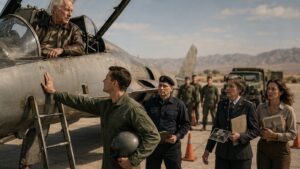
The rollout crowd remained near the hangar under instructions from the maintenance chief. No press cameras had been permitted on the flight line. Only those necessary for access and installation had approached the aircraft: Lisa, William, Emily, Jonathan, Anthony, the maintenance chief, and the two security airmen.
The aircraft’s gray skin held the last light of evening. Its rear cockpit canopy stood open. The empty seat waited beneath it, dark and ordinary.
Lisa climbed slowly.
One of the guards stepped toward William. It was the airman who had held his injured arm that morning.
“Sir, may I assist?”
There was no salute in the question, no exaggerated deference.
William nodded.
The airman positioned himself on William’s left side and offered a forearm rather than gripping him. William used it to mount the first step.
“Thank you,” he said.
The young man looked relieved.
At the base of the ladder, Anthony held the tablet while Jonathan presented his identification badge to the maintenance chief.
The chief glanced at him. “Colonel, you are cleared.”
Jonathan kept the badge extended.
“Run it.”
“Sir?”
“Everyone entering the controlled area follows the same verification.”
The chief scanned it.
A green authorization appeared.
Jonathan stepped through only after Anthony logged the result.
William saw the exchange from halfway up the ladder. It was a small act, procedural and almost invisible.
It mattered.
At the rear cockpit, Lisa sat on the edge of the service platform with the nameplate across her knees. Her fingers traced the stamped letters.
“I do not want the rank added,” she said.
William eased himself beside her.
“It was never on the original.”
“Public affairs suggested ‘fallen test hero.’”
“Larry would object to every word except test.”
“He would object to that too if the aircraft failed.”
William looked into the empty seat.
For years he had imagined Larry preserved at the final moment—steady voice, failing controls, desert ahead. The archive had returned other things: the crooked-plate joke, the impatience, the shared authorship of the doctrine, the refusal to let William carry the decision alone.
A person, not a final transmission.
Lisa held out the plate.
“His name and crew position,” she said. “Nothing else.”
William accepted it with his left hand.
“Nothing else.”
The maintenance chief had prepared the mounting surface but left the two original holes untouched. The plate aligned over them perfectly.
Not crooked.
William held it in place while the chief offered Emily a short-handled screwdriver.
Emily looked at her father.
“You planned to do this with one arm?”
“I had not included the arm in the plan.”
“You never include the body in your plans.”
“That has been mentioned.”
She climbed onto the platform.
The chief placed the first screw through the plate. William tried to turn it with his left hand. The tool slipped.
Pain tightened his face.
Emily reached for the screwdriver.
He held it another second.
The old impulse returned: finish the promise himself, bear the weakness privately, accept help only after the task could no longer be shared.
He released the tool.
Emily tightened the first screw.
William steadied the plate while Lisa placed the second.
“Together?” Emily asked.
William laid his left hand over hers on the screwdriver handle. Lisa braced the plate at its edge.
They turned.
The screw seated with a quiet metal click.
No music played. No officer called the group to attention. The empty rear seat remained empty.
Larry Campbell’s name returned beneath it.
William kept his hand against the plate.
The aircraft’s skin was cool now.
“I am sorry,” he said.
Lisa stood close enough to hear.
“For the order?” she asked.
“For deciding your grief needed my permission to change.”
She looked at Larry’s name.
“I let you,” she said. “It was easier to be angry at your silence than to decide what I wanted said.”
William turned toward her.
Neither absolved the other.
That, too, felt honest.
Below them, Anthony connected the tablet to the aircraft’s maintenance record. The old memorial authorization appeared beside a newly entered acknowledgment:
LARRY CAMPBELL
TEST OPERATIONS
CO-AUTHOR, CIVILIAN-PROTECTION CONTINGENCY
Attached beneath it was the full historical record, including the mission decision, the crew’s role, and the prohibition against using Larry’s cockpit audio without family consent.
The tablet no longer remembered only William.
It remembered Larry.
Emily descended first, then helped Lisa. William remained a moment longer beside the rear seat.
He had once believed leaving command meant surrendering the right to shape what came after. In truth, he had continued shaping it through absence—through sealed files, unanswered letters, and promises no one else was allowed to carry.
He touched the edge of the restored plate once.
Then he climbed down with the airman’s help.
At the foot of the ladder, Jonathan waited.
“The rollout will be rescheduled,” he said. “The program office agreed the historical record should be included in the aircraft presentation.”
“Not as an opening spectacle.”
“No. As part of the permanent program archive.”
William nodded.
Jonathan glanced toward the hangar. “There will be a formal review of my decision.”
“There should be.”
“I may lose command.”
“That is not mine to decide.”
Jonathan accepted the answer.
After a moment he said, “My father was wrong about you.”
William looked toward the darkening horizon.
“Your father was right about some things and wrong about others. Do not flatten him to make peace with me.”
Jonathan’s eyes lowered.
“I do not know how to remember him now.”
“Start by remembering what he said in the official record and what he said at home. A man can contain both.”
Jonathan looked back at the aircraft.
“So can a commander.”
“Yes.”
The crowd began leaving the hangar in quiet groups. No one approached William for a photograph. The public-affairs officer had understood enough to keep them back.
Emily came to stand beside him.
“You are not driving home.”
“I assumed that decision had already been made without me.”
“It has.”
He looked at her.
“I should have told you why I came.”
“Yes.”
“I believed it was mine to finish.”
“I know.”
“It was not.”
Emily took his uninjured arm.
“No,” she said. “But part of it was yours to start.”
They walked toward the access gate together.
Anthony remained near the aircraft, reviewing the revised procedure on his tablet. Before closing the record, he added one final instruction to the base-access system.
The words appeared beneath the field that had rejected William that morning:
UNVERIFIED IDENTITY REQUIRES HUMAN REVIEW BEFORE REMOVAL.
Anthony saved the change.
Behind him, Larry’s plain name rested beside the empty seat, held by the same two holes that had waited all day for someone to remember what they were for.
The story has ended.