The Elderly Veteran They Tried to Remove From the Ceremony Until One Name Changed Everything
Chapter 1: The Veteran Standing Outside the Barrier
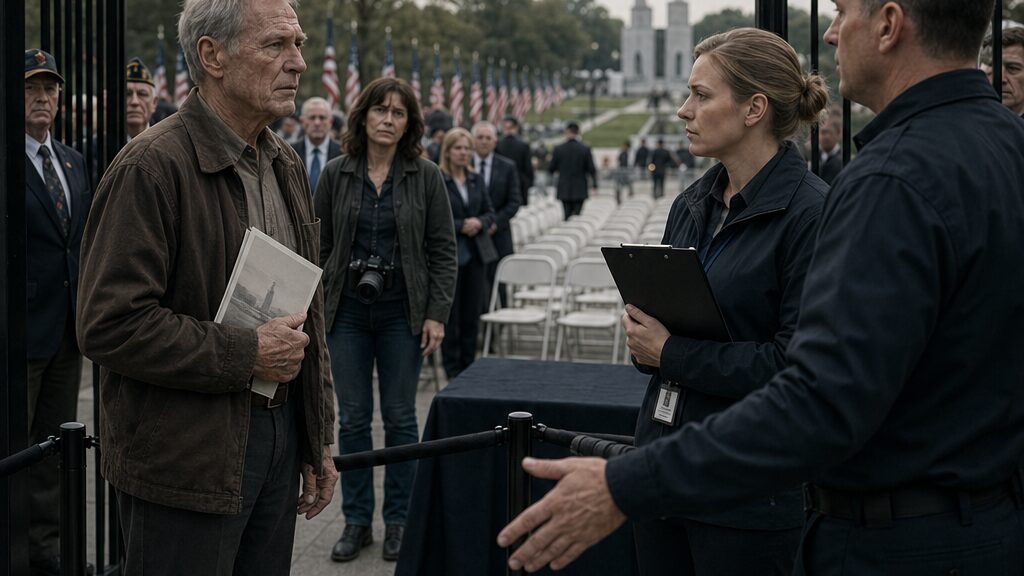
The security officer stepped in front of Patrick Walker before he could reach the registration table.
“Sir, I need to see your participant badge.”
Patrick stopped.
The morning air carried the smell of damp grass and freshly cut wood from the temporary stage erected beside the memorial grounds. Rows of folding chairs stretched across the lawn. Volunteers hurried between tents. Veterans in jackets decorated with patches and pins moved toward the entrance.
Patrick reached into his coat pocket and pulled out a folded program.
The paper was worn soft from handling.
The security officer glanced at it.
“That’s not a badge.”
“No,” Patrick said quietly. “It isn’t.”
The officer waited.
Patrick did not elaborate.
Behind them, people began to slow down. Not enough to gather. Just enough to notice.
The officer pointed toward the registration tent.
“If you’re participating, your name should be on the list.”
Patrick nodded.
“Then let’s check.”
Together they approached the table.
A volunteer typed on a laptop.
“What name?”
“Patrick Walker.”
Her fingers moved quickly.
She searched again.
Then again.
Finally she shook her head.
“I’m sorry, sir. You’re not listed.”
Patrick looked at the screen without leaning closer.
“Could you check one more time?”
She did.
The answer remained the same.
“No participant badge. No guest pass either.”
The security officer shifted his stance.
“You’ll need to remain outside the restricted area.”
Patrick looked beyond them.
The stage stood beneath a line of flags moving softly in the wind.
Workers were arranging microphones.
A large banner hung behind the podium.
Today’s ceremony honored local service members who never returned home.
His eyes found one name near the center of the banner.
Even from a distance he recognized it instantly.
The same name he had carried for forty-seven years.
The same name written three times inside the folded program in his hand.
He looked away.
“Understood.”
The officer seemed surprised by the lack of resistance.
Most people argued.
Most demanded a supervisor.
Patrick simply stepped aside.
“There’s seating beyond the barrier if you’d like to watch from there.”
“Thank you.”
The officer gave a short nod and returned to his position.
Patrick walked toward an empty bench near the edge of the grounds.
Around him people arrived in groups.
Families.
Veterans.
Officials.
Everyone appeared to belong somewhere.
Patrick unfolded the program.
The paper trembled slightly in his hands.
Not from anger.
Not from fear.
Age did that sometimes.
Inside, among the printed schedule, one handwritten name appeared three times.
Written in blue ink.
Carefully.
Deliberately.
As though he had been afraid he might forget.
Not that forgetting had ever been possible.
A shadow crossed the paper.
Patrick looked up.
A woman stood nearby holding a camera.
Local press.
He had seen the logo before.
She smiled politely.
“You here for the ceremony?”
“Yes.”
“You participating?”
“No.”
The answer was simple.
The woman glanced toward the registration area where the earlier exchange had occurred.
Something in her expression suggested she had seen enough to understand what happened.
“That’s unfortunate.”
Patrick folded the paper again.
“It happens.”
The woman studied him.
There was no bitterness in his voice.
That seemed to puzzle her.
Most people carried their disappointment loudly.
Patrick carried his quietly.
The woman eventually moved away.
Patrick watched the ceremony preparations continue.
An hour passed.
Then another.
The crowd thickened.
The empty bench around him filled and emptied several times.
Nobody spoke to him for long.
He preferred it that way.
At noon a black SUV arrived.
Several organizers hurried toward it.
A tall man stepped out.
Even at a distance Patrick recognized authority when he saw it.
The man’s posture announced it before anyone spoke.
William Miller.
Retired colonel.
Chairman of the memorial committee.
Patrick had seen his photograph in newspaper articles.
William moved through the grounds with practiced confidence.
People deferred to him automatically.
Questions followed him.
Problems disappeared when he approached.
Patrick watched for a moment before lowering his gaze.
The folded program remained in his hands.
A volunteer passed nearby.
“Excuse me, sir.”
Patrick looked up.
“Yes?”
“You can’t sit on this bench during the ceremony. It’s reserved seating.”
Patrick stood immediately.
The volunteer softened.
“Oh. I didn’t mean—”
“It’s fine.”
He stepped away.
The volunteer looked almost embarrassed.
Patrick wasn’t.
Rules were rules.
He had spent most of his life following them.
He moved to a standing area near a row of trees.
No complaints.
No arguments.
No demands.
Just another adjustment.
The ceremony began shortly afterward.
Music drifted across the grounds.
People stood.
Flags moved.
Names were read.
Patrick listened carefully.
His attention never wandered.
Not once.
When the honored name finally echoed through the speakers, something tightened behind his eyes.
For a moment the crowd disappeared.
The years disappeared.
The memorial disappeared.
There was only the sound of that name carried across open air.
Patrick lowered his head.
A memory threatened to surface.
He pushed it back.
Not here.
Not yet.
When he looked up again, he noticed someone watching him.
The journalist.
The same woman with the camera.
She stood near the media section.
Observing.
Not the stage.
Him.
Patrick folded the program once more.
The handwritten name disappeared inside the paper.
But the question remained.
Why had he come all this way for one name?
And why had he never told anyone the answer?
Chapter 2: The Name Written Three Times
Melissa Moore lowered her camera.
The ceremony continued in front of her.
Veterans stood.
Families wiped tears.
Officials delivered speeches.
Yet her attention kept drifting back toward the elderly man near the trees.
Patrick Walker.
The name lingered in her notebook.
Not because it was important.
Because nobody seemed to know who he was.
That bothered her.
She had spent years covering community events.
People belonged somewhere.
Someone always knew someone.
Especially at military ceremonies.
Yet every time she casually asked about Patrick, she received the same answer.
Never seen him before.
Not on the committee.
Not a sponsor.
Not a family member.
Not on the guest list.
Just an old man standing alone.
Melissa looked toward him again.
He hadn’t moved much in the last hour.
He wasn’t wandering.
He wasn’t confused.
He wasn’t causing problems.
If anything, he seemed determined not to attract attention.
Which made the situation stranger.
The journalist in her disliked unanswered questions.
She slipped away from the media section.
Near the registration tent, Nicole Adams was reviewing paperwork.
Melissa approached.
“Busy day?”
Nicole laughed tiredly.
“You have no idea.”
“Can I ask about someone?”
Nicole followed Melissa’s gaze.
Recognition appeared immediately.
“The gentleman from this morning?”
“Patrick Walker.”
Nicole nodded.
“He tried getting into the participant area.”
“Tried?”
“He wasn’t on any list.”
Melissa waited.
Nicole shrugged.
“Look, I felt bad for him. But we have procedures.”
“Did he argue?”
“No.”
The answer came instantly.
That surprised Nicole even now.
“He just accepted it.”
Melissa glanced back toward Patrick.
“He doesn’t seem upset.”
“No.”
Nicole frowned.
“Honestly, that’s part of why I keep thinking about it.”
The conversation was interrupted by another volunteer.
Nicole returned to work.
Melissa wandered toward a refreshment table.
From there she had a clear view of Patrick.
He finally sat down beneath a tree.
The folded program emerged again.
He opened it carefully.
Not casually.
Not like someone checking a schedule.
Like someone handling a letter.
Melissa zoomed her camera lens.
Not close enough to invade privacy.
Just enough to see.
There.
Blue ink.
One handwritten name.
Written once.
Then again.
Then a third time.
Circled.
She lowered the camera.
Now she was genuinely curious.
Why would someone write the same name repeatedly?
The ceremony paused between speakers.
People moved around.
Patrick remained seated.
A young volunteer approached him carrying bottled water.
Melissa watched.
The volunteer offered one.
Patrick smiled.
Accepted it.
Said something.
The volunteer laughed.
A simple exchange.
Normal.
Human.
Nothing about him suggested confusion.
Nothing suggested he had wandered in by mistake.
Melissa walked toward the memorial banner.
Hundreds of names covered its surface.
She scanned the list.
Then stopped.
The name matched what she had glimpsed inside the program.
Exactly.
A coincidence seemed unlikely.
She wrote it down.
Nearby, two older veterans discussed ceremony details.
Melissa approached.
“Excuse me.”
They turned.
“Do either of you know Patrick Walker?”
Both shook their heads.
“No.”
“What about this name?”
She showed them her notebook.
One veteran looked thoughtful.
“That’s today’s primary honoree.”
“Why?”
“He was lost during a training incident decades ago.”
Melissa blinked.
Training incident.
Not combat.
Interesting.
“What happened?”
The veteran spread his hands.
“Before my time.”
That answer led nowhere.
But it gave her something.
A thread.
She looked across the grounds again.
Patrick sat alone beneath the tree.
Watching.
Waiting.
Not once had he attempted to force his way inside.
Not once had he complained.
Most people excluded from an event spent their energy proving they belonged.
Patrick seemed content carrying the knowledge privately.
As though attendance mattered more than recognition.
The realization unsettled her.
Late in the afternoon she saw William Miller walking toward the operations tent.
Melissa intercepted him.
“Colonel Miller.”
He smiled politely.
“Melissa.”
“Quick question.”
William sighed.
“That phrase always means trouble.”
She smiled.
“Who’s Patrick Walker?”
The amusement disappeared.
“Should I know?”
“The gentleman denied entry this morning.”
William thought briefly.
“No.”
Melissa studied him.
“You’ve never heard the name?”
“No.”
The answer appeared genuine.
Yet something about it felt incomplete.
William checked his watch.
“Excuse me.”
Then he was gone.
Melissa looked toward Patrick again.
The old veteran had risen from his seat.
For the first time all day he was moving toward the memorial wall itself.
Slowly.
Deliberately.
As if approaching something sacred.
Melissa followed at a distance.
Patrick stopped before the engraved names.
His hand touched one.
Just one.
The same name.
He stood there a long time.
No speech.
No tears.
No dramatic gesture.
Just a hand resting against cold stone.
When he finally stepped away, Melissa noticed something else.
His expression had changed.
Not sadness.
Not exactly.
Recognition.
Like a man who had found what he came searching for.
Yet he still remained outside every official part of the ceremony.
Melissa opened her notebook.
Beneath the name she wrote a single question.
Who was Patrick Walker to him?
Chapter 3: What Patrick Never Explained
The first time Patrick met him, they nearly got into a fight.
Forty-seven years earlier, the summer heat had settled over the training grounds like a blanket.
Young soldiers moved between barracks carrying gear and bad attitudes.
Patrick was twenty-five.
Stubborn.
Competitive.
Convinced he knew more than he did.
The other man arrived two days later.
Tall.
Quiet.
Observant.
Patrick noticed him immediately because he spoke so little.
Most recruits filled silence with noise.
This one didn’t.
They ended up assigned to the same training unit.
For three days they barely exchanged words.
Then came an obstacle course.
Patrick finished first.
The newcomer finished second.
Close enough to irritate both of them.
“You missed the wall transition,” Patrick told him afterward.
The other man looked over.
“You still beat me.”
“Could’ve been faster.”
A pause.
Then a small smile.
“You always coach strangers?”
Patrick laughed.
That was the beginning.
Friendship arrived gradually.
Shared meals.
Shared duties.
Shared complaints about weather and officers.
The kind of friendship built through repetition rather than grand moments.
Eventually Patrick learned the man’s name.
The same name written now inside the folded program.
The same name engraved on the memorial wall.
The same name honored at today’s ceremony.
Back then, however, he had simply been a friend.
Nothing more.
Nothing less.
They trained together for nearly two years.
One winter evening they sat outside a barracks watching snow gather beneath floodlights.
The conversation drifted toward home.
Family.
Future plans.
Ordinary things.
“What happens after this?” Patrick asked.
His friend shrugged.
“Depends.”
“On what?”
“Whether life cooperates.”
Patrick laughed.
“That’s not an answer.”
“It’s the only honest one.”
Patrick remembered that line for decades.
Because it turned out to be true.
Life rarely cooperated.
Years passed.
Assignments changed.
People transferred.
Yet somehow they remained connected.
Not always stationed together.
Not always nearby.
But connected.
Letters arrived.
Phone calls happened.
Visits occurred when schedules allowed.
Then came the training exercise.
The one nobody expected to matter.
The one discussed later in reports and investigations and meetings.
The one that changed everything.
Patrick still remembered the morning.
Gray clouds.
Cold wind.
Equipment checks.
Routine.
Nothing unusual.
Nothing dramatic.
Nobody woke expecting tragedy.
His friend joked during breakfast.
Complained about coffee.
Borrowed a pen.
Normal things.
That memory hurt most.
Not the accident itself.
The normality before it.
Hours later everything was different.
The official reports explained events in technical language.
Timelines.
Procedures.
Findings.
Patrick never cared about those pages.
What remained with him was a single conversation shortly before the exercise began.
His friend had handed back the borrowed pen.
“Don’t lose this.”
Patrick laughed.
“It’s a pen.”
“You lose everything.”
“Not everything.”
The other man smiled.
“Keep telling yourself that.”
They parted.
The exercise began.
And before sunset one of them was gone.
Years afterward Patrick replayed countless moments.
Different choices.
Different paths.
Different possibilities.
None changed the outcome.
Yet guilt ignored logic.
It always had.
During the memorial service held months later, Patrick stood among grieving families and fellow soldiers.
He listened.
Watched.
Said little.
Near the end he made a promise no one else heard.
A private promise.
Simple.
Someday he would make sure the man’s name was remembered correctly.
Not as a line in a report.
Not as a ceremony.
Not as a tragedy.
As a person.
The promise seemed easy then.
Years stretched.
Life intervened.
Marriage.
Work.
Distance.
Loss.
Regret.
His son grew older.
Relationships fractured.
Time accumulated.
And somehow the promise remained unfinished.
Until now.
Standing outside the ceremony decades later, Patrick still carried that burden.
Not because anyone demanded it.
Because he had demanded it of himself.
Back in the present, the evening light faded across the memorial grounds.
Patrick sat alone on the edge of the property.
The folded program rested in his lap.
His thumb traced the handwritten name once.
Then again.
Then a third time.
Just as he had written it.
A promise repeated until it became part of him.
Across the lawn, workers began preparing for the final events scheduled tomorrow.
Patrick watched quietly.
Unaware that questions about him were spreading through the committee.
Unaware that missing records were about to surface.
Unaware that someone had finally started looking for answers.
He only knew one thing.
After forty-seven years, he had come too far to leave before finishing what he started.
Chapter 4: The Chairman’s Decision
William Miller removed his reading glasses and rubbed the bridge of his nose.
The operations tent was finally quiet.
Most volunteers had gone home.
The final ceremony events would take place tomorrow, and for the first time all day there were no immediate problems demanding his attention.
Stacks of paperwork covered the folding tables.
Schedules.
Attendance records.
Security reports.
Expense forms.
The familiar chaos of organizing a large public event.
William reached for a binder.
A volunteer had left a yellow note attached to the front.
Question about participant list.
He opened it.
Inside was a brief report from Nicole Adams.
The elderly veteran denied entry that morning.
Patrick Walker.
William frowned.
He vaguely remembered Melissa asking about the man earlier.
At the time, the question had seemed insignificant.
Now it had found its way onto his desk.
He skimmed the report.
No badge.
No registration.
No authorization.
No incident.
That last part stood out.
Most access disputes created arguments.
Complaints.
Raised voices.
Patrick Walker had done none of those things.
William set the report aside.
Then picked it up again.
Something bothered him.
He couldn’t immediately identify what.
A knock sounded against the tent frame.
Nicole entered carrying a folder.
“You still here?”
William smiled tiredly.
“Unfortunately.”
She placed the folder down.
“Final attendance numbers.”
He nodded.
Nicole hesitated.
“Can I ask something?”
William already knew.
“The old veteran.”
She looked surprised.
“Yes.”
William leaned back.
“What about him?”
Nicole folded her arms.
“I keep thinking I handled that wrong.”
“You followed procedure.”
“I know.”
Her answer came too quickly.
William studied her expression.
Nicole wasn’t upset because she had violated policy.
She was upset because she wasn’t sure policy had been enough.
William understood the feeling.
Leadership often lived inside that uncomfortable space.
“Did he say why he came?” William asked.
“No.”
“Family member?”
“He never claimed to be.”
“Participant?”
“No.”
William glanced toward the report.
“What exactly did he do after being denied?”
Nicole looked confused.
“Nothing.”
“Nothing?”
“He thanked us.”
William blinked.
“That’s all?”
“He moved away.”
The tent fell quiet.
Nicole eventually left.
William stared at the paperwork.
Then at Patrick’s name.
Finally he opened the master registration database.
Hundreds of entries appeared.
He searched.
No Patrick Walker.
The result should have ended the matter.
Instead it deepened it.
William spent enough years in uniform to recognize unusual behavior.
People denied access usually fought for access.
Patrick hadn’t.
People seeking attention usually made noise.
Patrick hadn’t.
The old veteran had simply remained nearby.
Watching.
Waiting.
As though being present mattered more than being recognized.
William closed the database.
Then reopened it.
A different thought had surfaced.
Administrative mistakes happened.
Not often.
But they happened.
He searched archived submissions.
Volunteer records.
Email confirmations.
Nothing.
Still, something felt unfinished.
A shadow appeared outside the tent.
Melissa Moore stepped inside holding a notebook.
William sighed.
“I was hoping journalists slept at night.”
Melissa smiled.
“Not the curious ones.”
He pointed toward a chair.
“What now?”
She sat.
“The veteran.”
William laughed softly.
“Apparently everyone wants to talk about him.”
“Because nobody knows who he is.”
William folded his hands.
“And?”
Melissa opened her notebook.
“The name written inside his program matches the primary honoree.”
That caught his attention.
“What?”
“I saw it.”
William straightened.
“You’re certain?”
“Three times.”
The chairman looked away.
Outside, workers dismantled temporary equipment.
The sounds drifted through the canvas walls.
Neither spoke for several seconds.
Finally William asked, “Did he tell you why?”
“No.”
“Then we don’t know anything.”
“Not yet.”
Melissa stood.
“But I’m going to find out.”
After she left, William remained alone.
He stared again at Patrick Walker’s name.
Then at the event database.
Finally he accessed a much older archive connected to the memorial committee.
Past ceremonies.
Past nominations.
Past correspondence.
Years of records.
He expected nothing.
Instead, twenty minutes later, he found something.
A damaged digital file.
Incomplete.
Poorly scanned.
Partially corrupted.
Yet still readable.
One line remained visible.
Submitted by Patrick Walker.
William sat motionless.
The date attached to the document was decades old.
Far older than he expected.
The rest of the file refused to open.
But the name remained.
Patrick Walker.
Not a stranger.
Not entirely.
William leaned closer.
The realization unsettled him.
If Patrick had been connected to the memorial committee’s history, how had nobody remembered?
And how many other records were missing?
Outside, the memorial grounds grew darker.
Inside the operations tent, William stared at the screen.
For the first time since the ceremony began, doubt entered the space where certainty had been.
And once it arrived, it refused to leave.
Chapter 5: The Story Hidden in the Program
The archive room smelled of dust and old paper.
Melissa Moore sneezed twice before giving up on appearing professional.
The volunteer helping her laughed.
“Everybody does that.”
Rows of filing cabinets stretched across the room beneath fluorescent lights.
The memorial committee maintained decades of records here.
Photographs.
Correspondence.
Newspaper clippings.
Nomination packets.
Memorial submissions.
Melissa stood beside a cart stacked with boxes.
“Where do I start?”
The volunteer pointed.
“Probably with the training incident.”
It took nearly an hour.
Most files contained routine information.
Meeting notes.
Budget requests.
Program drafts.
Nothing connected directly to Patrick Walker.
Nothing explained why an elderly veteran had spent an entire day standing outside a ceremony meant to honor someone else’s memory.
Melissa refused to leave.
Questions had momentum.
This one refused to stop moving.
She opened another box.
Inside sat a collection of handwritten letters.
Many were decades old.
Family statements.
Personal memories.
Stories submitted by friends.
One envelope immediately caught her attention.
The handwriting looked familiar.
Careful.
Deliberate.
She opened it.
The letter inside was signed by Patrick Walker.
Melissa slowly sat down.
The letter wasn’t long.
Just a few pages.
A memory submission prepared years earlier for a memorial project.
Most of it described ordinary moments.
Shared training exercises.
Bad coffee.
Snowstorms.
Jokes.
Mistakes.
The details felt remarkably personal.
Not heroic.
Human.
Near the end, one sentence stopped her.
He was the kind of man people remembered correctly only if someone took the time to tell the truth about him.
Melissa read it twice.
Then a third time.
The room seemed quieter afterward.
She continued searching.
Another file appeared.
Then another.
Each contained traces of the same connection.
Patrick had submitted information repeatedly over the years.
Not seeking attention.
Not asking for recognition.
Trying to preserve memory.
The realization changed everything.
The folded program.
The handwritten name.
The long hours spent waiting outside.
None of it was random.
Melissa leaned back.
For the first time she understood something important.
Patrick hadn’t come to be honored.
He had come because he believed somebody else should be.
A volunteer approached carrying additional folders.
Melissa accepted them.
Inside one folder she discovered a photograph.
A faded image of young soldiers standing shoulder to shoulder.
The quality was poor.
Names were written on the back.
One name belonged to the ceremony’s honoree.
Another belonged to Patrick Walker.
Melissa stared at the photograph.
Young faces.
Ordinary faces.
No indication of future grief.
No indication of decades passing.
Just two men standing beside each other.
Friends.
The simplicity of it hit harder than she expected.
A sound behind her interrupted the moment.
William Miller entered the archive room.
“You found something.”
It wasn’t a question.
Melissa handed him the photograph.
William examined it quietly.
Then she showed him the letters.
The chairman read in silence.
His expression changed gradually.
Not dramatically.
Just enough.
The same way certainty had disappeared from him the night before.
“We denied him entry,” William said softly.
Melissa nodded.
Neither spoke for several moments.
The archive room felt different now.
Not because they had uncovered a secret.
Because they had uncovered a person.
William carefully returned the photograph.
“We need to speak with him.”
Melissa expected agreement.
Instead she found herself shaking her head.
“Why?”
William looked surprised.
“Because we made a mistake.”
“Maybe.”
She closed the folder.
“But I don’t think that’s why he came.”
The chairman considered that.
Eventually he nodded.
Reluctantly.
Because she was right.
Everything they had found pointed toward the same conclusion.
Patrick wasn’t seeking acknowledgment.
He wasn’t demanding correction.
He wasn’t trying to prove anything.
The ceremony mattered.
The attention didn’t.
Later that evening Melissa left the archive building.
The memorial grounds were nearly empty.
The stage stood silent beneath security lights.
She noticed a figure sitting alone on a distant bench.
Patrick.
The folded program remained in his hands.
Melissa considered approaching him.
Instead she watched.
The old veteran unfolded the paper.
Looked at the handwritten name.
Then folded it again.
The motion felt familiar.
Almost ritualistic.
As though every fold preserved something.
Every crease carried memory.
Melissa finally understood why the program looked worn.
It wasn’t from a single day.
Patrick had been carrying it for much longer.
She stood there for several moments before turning away.
Behind her, Patrick remained alone beneath the lights.
Still refusing attention.
Still guarding the story everyone else was only beginning to understand.
And tomorrow, whether he wanted it or not, that story would finally reach the ceremony itself.
Chapter 6: The Quiet Truth Before the Ceremony Ends
The final morning arrived beneath clear skies.
Patrick reached the memorial grounds before sunrise.
The gates were still closed.
Workers moved quietly between equipment trucks.
Flags hung motionless in the cool air.
He sat on a bench and waited.
The folded program rested inside his coat pocket.
The paper felt thinner than it had yesterday.
Or perhaps his hands felt older.
He wasn’t sure.
Time blurred details like that.
As the grounds slowly awakened, Patrick watched volunteers prepare for the closing ceremony.
People carried chairs.
Tested microphones.
Reviewed schedules.
Normal activity.
Comforting activity.
Life continuing through routine.
A voice interrupted his thoughts.
“Mr. Walker?”
Patrick looked up.
Nicole Adams stood nearby.
She appeared nervous.
Far more nervous than she had during their first meeting.
Patrick rose.
“Good morning.”
Nicole hesitated.
“I owe you an apology.”
Patrick’s expression remained calm.
“For what?”
The question caught her off guard.
“For yesterday.”
Patrick glanced toward the ceremony grounds.
“You were doing your job.”
“That doesn’t mean I handled it well.”
For a moment neither spoke.
Then Patrick smiled faintly.
“You’re not the first person who’s made a decision with incomplete information.”
Something softened inside Nicole.
The apology she had rehearsed suddenly seemed unnecessary.
Not because she was forgiven.
Because forgiveness had apparently arrived before she asked.
Footsteps approached.
William Miller joined them.
The chairman looked considerably less certain than he had two days earlier.
“Mr. Walker.”
Patrick nodded.
“Colonel.”
William almost smiled.
“Retired.”
“So am I.”
For the first time, the tension between them eased.
William reached into a folder.
“We found some records.”
Patrick said nothing.
“We should have found them sooner.”
Still Patrick remained silent.
The chairman exhaled slowly.
“Would you be willing to join us today?”
The invitation hung between them.
Patrick looked toward the stage.
Rows of chairs.
Flags.
The memorial banner.
The same name.
Always the same name.
He considered the question carefully.
Then shook his head.
“No.”
Nicole blinked.
William looked surprised.
“You don’t want to participate?”
“I came to attend.”
Not to be recognized.
Not to be placed on stage.
Not to become part of the ceremony.
The answer carried no bitterness.
Only certainty.
William understood.
Or at least he began to.
The closing events started an hour later.
This time nobody stopped Patrick when he entered.
No barriers.
No questions.
No badges.
He chose a seat near the back.
Far from the stage.
Exactly where he wanted to be.
Melissa spotted him immediately.
She remained in the media section but kept watching.
The ceremony unfolded.
Names were read.
Families were acknowledged.
Stories were shared.
Then came the final segment.
The primary tribute.
The moment dedicated to the man whose name Patrick had carried for nearly half a century.
William stepped to the podium.
His prepared remarks sat before him.
For several seconds he stared at them.
Then he looked up.
And set them aside.
Patrick noticed.
So did Melissa.
So did Nicole.
William spoke quietly.
Not to the crowd.
To the memory being honored.
He talked about service.
Friendship.
The people history often forgot.
Then he paused.
His gaze moved through the audience.
Until it found Patrick.
Not spotlighting him.
Not exposing him.
Simply acknowledging his presence.
“There are individuals who spend years protecting memories that don’t belong to them alone.”
The audience listened.
“Sometimes they do it without recognition. Without titles. Without anyone noticing.”
Patrick lowered his eyes.
William continued.
“And because of that, names survive. Not as records. As people.”
Silence settled across the grounds.
A respectful silence.
Nothing theatrical.
Nothing dramatic.
William looked away from Patrick.
Back toward the audience.
The moment passed naturally.
Exactly as Patrick would have wanted.
Afterward, people rose from their seats.
The ceremony concluded.
Families gathered together.
Volunteers began cleanup.
The crowd slowly dispersed.
Patrick remained seated.
The folded program rested in his lap.
A shadow appeared beside him.
He looked up.
Mark Hall stood there.
His son.
Older now.
Grayer than Patrick remembered.
Neither moved immediately.
The years between them felt strangely present.
Mark glanced toward the stage.
Then toward the folded program.
“I saw your name in one of the committee records.”
Patrick looked back down.
“I didn’t know you were coming.”
“I wasn’t.”
Mark hesitated.
“Melissa called me.”
Patrick absorbed that quietly.
His son sat beside him.
Neither spoke for several moments.
The silence wasn’t comfortable.
But it wasn’t hostile either.
For the first time in years, it felt possible.
Mark looked toward the memorial banner.
“Was he really your friend?”
Patrick nodded.
“Yes.”
A long pause followed.
Then Mark asked the question that mattered.
“Why didn’t you ever tell me?”
Chapter 7: The Man Who Came for One Name
Patrick looked at the memorial banner before answering.
The crowd continued thinning across the grounds. Volunteers stacked chairs. Families drifted toward parking lots. The ceremony that had occupied months of planning was already becoming a memory.
“I thought I had more time,” Patrick said.
Mark stared ahead.
“More time for what?”
“To explain things.”
His son’s jaw tightened slightly.
“You always said that.”
Patrick nodded.
The criticism was fair.
Years ago he would have defended himself.
Today he didn’t.
The folded program rested between his hands.
Its edges were worn white.
The paper had survived weather, moving boxes, and decades of storage.
Somehow it had lasted longer than many conversations that should have happened.
Mark watched him.
“You never talked about any of this.”
“No.”
“Why?”
Patrick considered the question.
Not because he didn’t know the answer.
Because he did.
And because the answer wasn’t flattering.
“When you were young,” Patrick said quietly, “I told myself there would be a better time.”
Mark laughed once.
Not humor.
Recognition.
“I remember.”
“When you got older, I told myself the same thing.”
The wind stirred the flags above them.
Patrick continued.
“Then years started passing faster.”
Mark looked away.
For a while neither spoke.
Nearby, workers loaded equipment into a truck.
The metallic sounds echoed across the nearly empty grounds.
Patrick finally unfolded the program.
Inside, the handwritten name remained visible.
Mark studied it.
“So that’s him.”
Patrick nodded.
“My friend.”
“The one from the ceremony.”
“Yes.”
Mark looked at the name for a long moment.
Then something unexpected happened.
The resentment left his face.
Not completely.
But enough.
Enough for curiosity to replace it.
“You really carried this around all these years?”
Patrick smiled faintly.
“Not every day.”
“Still.”
Mark shook his head.
“I don’t think I’ve ever cared about anything that long.”
Patrick folded the paper again.
“Sometimes that’s a good thing.”
Mark looked at him.
For the first time in years, the conversation wasn’t about old arguments.
Not about disappointments.
Not about distance.
Just two men sitting beside each other.
The simplicity felt unfamiliar.
And valuable.
A few minutes later footsteps approached.
William Miller stopped nearby.
He held a folder beneath one arm.
Patrick stood automatically.
Old habits.
William almost objected, then stopped himself.
The gesture wasn’t submission.
It was simply Patrick being Patrick.
“Mr. Walker.”
Patrick nodded.
“Colonel.”
William smiled.
“I think we’re beyond that.”
“Probably.”
The chairman glanced toward Mark.
Then back to Patrick.
“I wanted to give you something.”
He handed over the folder.
Patrick opened it.
Inside were copies of the archive documents Melissa had discovered.
The letters.
The submissions.
The photographs.
Years of efforts Patrick barely remembered making.
William spoke carefully.
“We recovered additional files this morning.”
Patrick looked through them.
A younger version of himself stared back from faded photographs.
Beside him stood the friend whose name had brought him here.
For a moment neither image felt real.
Just fragments preserved by paper.
“We should have found these sooner,” William said.
Patrick closed the folder.
“Maybe.”
William frowned.
“You don’t seem angry.”
Patrick considered that.
Then shook his head.
“No.”
The chairman looked genuinely puzzled.
Patrick understood why.
People expected anger after being dismissed publicly.
Expected demands.
Expected blame.
But none of those things seemed useful anymore.
“The ceremony happened,” Patrick said.
“The name was remembered.”
William’s expression softened.
“Still.”
Patrick gave a small shrug.
The conversation ended there.
Not because William had nothing left to say.
Because both men understood enough.
The chairman offered his hand.
Patrick shook it.
Then William quietly walked away.
No public correction.
No grand announcement.
Just a changed understanding.
Exactly enough.
The following morning, Patrick returned to the memorial grounds one final time.
The place felt different without crowds.
Without speeches.
Without microphones.
Only the memorial wall remained.
And the silence.
He carried the folded program with him.
The grass still held traces of morning dew.
Sunlight reflected softly from the engraved stone.
Patrick approached the wall.
The familiar name waited there.
As it always had.
As it always would.
For a long time he stood without speaking.
The years seemed strangely close.
Not gone.
Not healed.
Just closer.
He thought about training fields.
Shared jokes.
Snow beneath floodlights.
A borrowed pen.
Ordinary memories.
The kind people rarely place inside official ceremonies.
Yet those were the memories that mattered most.
Eventually he removed the folded program from his pocket.
Carefully, he opened it.
The handwritten name appeared once more.
Three times.
Each written by his own hand.
Each written years apart.
As though he had been reminding himself not to let memory fade.
Patrick studied the paper.
Then he looked at the wall.
A promise made decades ago.
A promise carried across most of a lifetime.
Not perfectly.
Not elegantly.
But carried nonetheless.
He folded the program one final time.
Then placed it on the small bench facing the memorial.
Not discarded.
Not forgotten.
Left behind.
The way a person leaves flowers.
Or a note.
Or gratitude.
A quiet offering.
The wind shifted gently across the grounds.
Patrick stepped back.
For the first time in years, the weight inside him felt different.
Lighter.
Not because the past had changed.
Because he no longer felt responsible for carrying it alone.
A voice spoke behind him.
“Dad.”
Patrick turned.
Mark stood several yards away holding two cups of coffee.
Patrick blinked.
His son lifted one cup.
“I figured you might be here.”
Patrick smiled.
A real smile this time.
Not large.
But real.
Mark walked over and handed him the coffee.
They stood together facing the memorial wall.
Neither rushed to fill the silence.
The silence no longer needed fixing.
After a while Mark nodded toward the bench.
“The program?”
Patrick followed his gaze.
“It can stay.”
Mark looked at the folded paper resting beneath the morning sun.
Then he nodded.
They remained there a little longer.
Two men.
One memory.
No speeches.
No ceremony.
No audience.
Just understanding arriving quietly after years of delay.
When they finally turned to leave, Patrick glanced back one last time.
The folded program remained on the bench.
The handwritten name hidden inside.
No longer a burden.
Simply a remembrance.
And for the first time since making that promise so many years ago, Patrick walked away in peace.
The story has ended.