They Called His Notebook Outdated Until The Old Veteran Found The Flaw Everyone Missed
Chapter 1: The Old Man At The Wrong Bench
The weapon made a sound no one else turned toward.
It was small, almost polite, hidden beneath the breathing of the ventilation ducts and the metallic clatter of Monday morning work. A dry click. Not the bright snap of a clean part settling where it belonged, but a tired sound, like a hinge catching on old paint.
Edward Mitchell stopped with one hand inside the pocket of his olive jacket.
Across the armory floor, a technician had just set a long training weapon assembly onto the main bench. Its dark body rested under white shop lights, half opened, tagged for final inspection. Around it, younger hands moved with practiced confidence. Tablets glowed. Bar codes chirped. A rolling cart carried trays of labeled parts toward the certification line.
No one looked uneasy.
Edward did.
“Mr. Mitchell?”
Brandon Scott’s voice came from beside him. The floor supervisor stood with a tablet tucked against his ribs and a visitor badge clipped to his belt, though he was not the visitor. Edward was. The badge on Edward’s own chest had been printed in large black letters that seemed to explain him before he spoke.
GUEST.
Edward let go of the notebook in his pocket.
“Yes,” he said.
“This way. I can give you ten minutes before the line gets too crowded.” Brandon smiled the careful smile people used when they were trying to be respectful and efficient at the same time. “The procurement clerk said you asked to see the Model Fourteen assemblies.”
“I asked to see the last batch before certification.”
“That’s what I mean.”
Edward did not correct him. He followed Brandon past racks of sealed crates and workstations where technicians moved under hanging task lamps. He was aware of his own pace, the slight delay in his right knee, the way the polished floor reflected his old shoes. He had dressed neatly because that was what you did when walking into a place that handled responsibility. Clean shirt. Jacket brushed. Hands washed twice, though age had left oil in the lines of his fingers that no sink could fully remove.
A security guard glanced at him, then at Brandon. Two technicians looked up and then away.
Edward knew that look. Not hostile. Worse, sometimes. Already decided.
Brandon led him to the main bench. “This is the line we’re closing out. Decommissioned training units, refurbished for supervised use. No live issue here. Everything goes through automated inspection, manual check, and external review.”
Edward rested his fingertips against the bench edge. The metal was cold. Familiar.
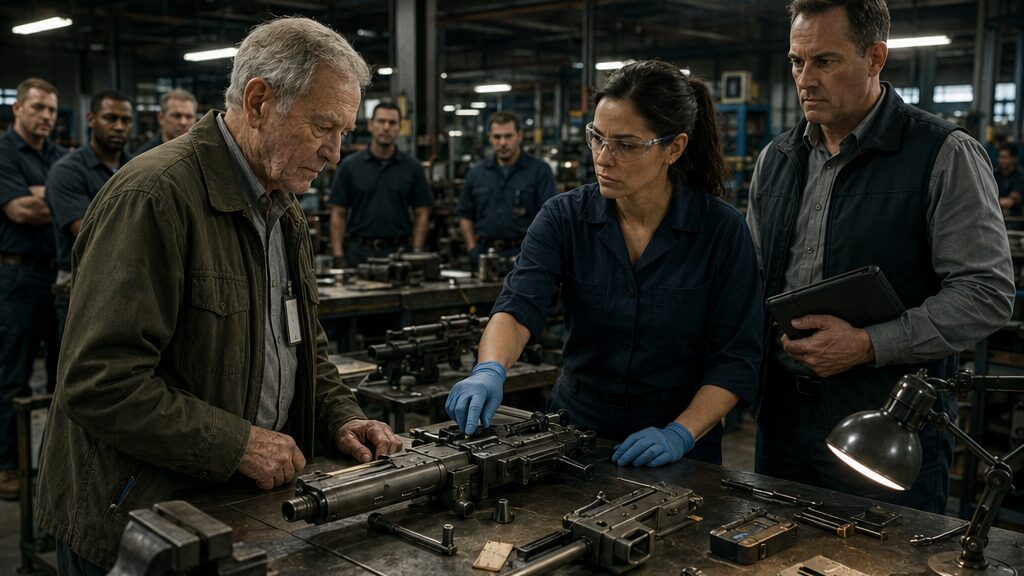
Maria Wilson stood on the other side with safety glasses pushed high on her nose. Her dark hair was tied back, and there was a precise crease between her brows. She was examining a component under a magnifying lamp, her blue-gloved hands steady.
“Maria,” Brandon said, “this is Edward Mitchell. He used to work on these systems.”
Maria looked up. “Used to?”
Edward gave her a small nod. “A long time ago.”
“Army?” she asked.
“Yes.”
Her expression did not change much, but Edward saw the calculation happen. Old Army. Old model. Old man. There were worse combinations in a modern shop.
Brandon added, “He had some questions about the batch. I told the front desk we could let him take a look as long as we don’t interrupt the certification flow.”
Edward looked at the assembly on the bench. The sound had come from there. He knew it by the way the part had settled, by the tiny drag before rest. His eyes moved over the housing, the pins, the places where hands had cleaned away old carbon and left the metal too bright.
“May I?” he asked.
Maria hesitated just long enough to make the answer clear before she gave it. “It’s already cleared pre-check.”
“I’m not asking to clear it.”
Brandon shifted. “Go ahead, but please don’t disassemble anything.”
Edward’s mouth almost moved toward a smile. He did not let it. He had been told not to touch things he had once taught others to respect. That was not an insult unless he chose to make it one.
He lifted the assembly carefully, not with strength but with memory. His thumb found the balance point. His left hand supported the underside. The weight was different from the old service units, lighter in places, but the shape still spoke the same language.
Maria watched his hands.
Edward tilted the assembly a few degrees and listened.
There it was again. A dry, reluctant click.
He set it down gently.
“Something wrong?” Brandon asked.
Edward looked at the part nearest the rear of the assembly. A crescent mark sat where no mark should have mattered. It was faint enough that a rushed eye would call it normal wear. It had the soft polish of repetition, not damage. That was what made it worse.
“Could be nothing,” Edward said.
Maria’s face tightened. “It passed tolerance.”
“I heard you.”
“No, I mean it passed. The report is clean.”
Edward nodded once. “Clean reports are good.”
Brandon gave a short laugh meant to loosen the room. “We like clean reports around here.”
The technicians nearby smiled without looking up.
Edward reached into his jacket pocket. His fingers touched the worn spine of the notebook. He could feel the cracked cover, the bent corner, the rubber band wrapped around it. For a moment he kept it there, half in shadow, half visible.
He had promised himself he would not be that kind of old man. The one who arrived carrying yesterday like a weapon. The one who told strangers how things had been done before they were born. The one who made rooms smaller with memory.
But the mark was still on the part.
“What station ran this check?” Edward asked.
Maria pointed with her chin. “Three. Optical, fit, dry-cycle. Twice.”
“And the same tech?”
“No. Rotating assignments.”
“Good.”
That seemed to annoy her more than if he had criticized the process. “Good?”
“It removes one easy answer.”
Brandon’s tablet chimed. He glanced down, then back up. “Mr. Mitchell, I appreciate the attention, but we are on a schedule. The external review is Thursday. This batch has to be sealed by Wednesday afternoon.”
Edward looked beyond him to the sealed crates stacked against the far wall. Each one had a white tag. Each tag had a number, a clean barcode, a printed line where someone had already made the thing official.
He thought of the dry click. He thought of the crescent mark. He thought of a younger man’s voice years ago saying, It’s probably just wear, Sergeant.
His hand closed around the notebook.
Maria noticed. “You have paperwork?”
“No,” Edward said. “Notes.”
“From this facility?”
“No.”
“Then they won’t help the certification.”
Brandon’s smile thinned. “Maria.”
Edward slid the notebook out only far enough that the top half showed. The cover had gone soft from years of pockets and benches. A blue pen was clipped to the rubber band, its plastic cloudy with age.
He did not open it yet.
“I don’t want to slow your line,” he said.
“That’s appreciated,” Brandon replied.
“I do want to compare this part with three others from the same batch.”
Maria lowered the tool in her hand. A technician at the next bench stopped moving. Somewhere behind them, the barcode scanner chirped again, too cheerful for the silence that followed.
Brandon blinked. “Three others?”
“Yes.”
“Why?”
Edward looked at the assembly on the bench. He could feel the notebook’s weight in his hand, small as it was. It had become heavier the moment he brought it out.
“Because if I’m wrong,” he said, “you lose fifteen minutes.”
Maria crossed her arms. “And if you’re not?”
Edward finally looked at her.
No one in the room moved.
Chapter 2: The Notebook Everyone Called Obsolete
Maria Wilson had built her reputation on not rolling her eyes.
In a shop full of older men who liked to explain tools to her while holding them backward, that discipline had served her well. She could keep her face still while someone misnamed a part, misread a test screen, or told her that experience was the same thing as accuracy. She could answer with data, not irritation. She could let the work correct people.
So when Edward Mitchell asked for three more assemblies from the same batch, Maria did not roll her eyes.
She did, however, look at Brandon.
The look said what she would not say in front of a visitor: We do not have time for this.
Brandon rubbed his thumb along the edge of his tablet. “Pull three,” he said at last. “Random from the cleared rack. Then we move on.”
Maria turned away before the old man could thank anyone. She did not want gratitude. Gratitude would make this feel personal, and she wanted it kept procedural. A guest had raised a concern. The supervisor had allowed a limited comparison. She would document the absence of a problem and return the line to schedule.
She selected three cleared units herself.
Not because she trusted Edward, but because she did not want anyone saying she had chosen easy ones.
The assemblies landed on the main bench one after another, each tagged, scanned, and already marked as passed. Edward waited with his hands folded loosely in front of him. He did not hover. That bothered Maria more than hovering would have. Men who were bluffing usually filled silence with credentials.
He just watched.
“Before we begin,” she said, “I want to be clear. These are training units. They’ve been cleaned, inspected, and checked against current standards. If you’re hearing some variation in dry movement, that’s expected within age and refurbish range.”
Edward nodded. “Expected isn’t the same as repeated.”
Maria felt the nearest technician glance over.
She kept her voice level. “Repeated variation is also expected in legacy equipment.”
“That’s true.”
The answer was so calm that she had nowhere to put her annoyance.
Brandon stood at the end of the bench, half present, half trapped by the messages on his tablet. “Let’s make this quick.”
Edward placed his old notebook on the metal surface.
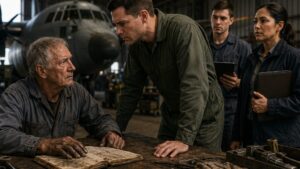
It looked wrong there. Everything else on the bench belonged to the facility: clean trays, yellow tags, digital calipers, a tablet mounted on a flexible arm, sealed parts bags with printed labels. The notebook belonged in a garage drawer or a coat pocket at a bus stop. Its cover had softened at the corners. A rubber band held it closed. The blue pen clipped to it looked like something taken from a bank counter.
Maria stared at it despite herself.
Edward unwrapped the rubber band and opened the book.
The first pages were not what she expected. She had expected shaky reminders, maybe old part numbers, maybe sentimental notes from a man who missed being useful. Instead she saw diagrams drawn in tight, controlled lines. Dates. Unit codes. Weather conditions. Short observations written in compact handwriting. Some pages had been taped at the edges. Others carried arrows and circles in blue ink layered over older black pencil.
The handwriting was old-fashioned but not messy.
Edward turned to a page near the back. He did not search long. That, too, bothered her.
“This one,” he said.
Maria leaned closer despite herself.
The page showed a simplified outline of a part like the one resting under her lamp. Not exact to the refurbished model, but close enough that her eyes moved from paper to metal before she told them not to.
Edward unclipped the blue pen and circled a small point on the drawing.
“There.”
Maria looked at the assembly. “That area gets normal contact polish.”
“It can.”
“It does.”
Edward did not argue. He lifted the first cleared unit and tilted it with both hands. His fingers were slow but certain, thumbs staying away from places they should not cover. He rotated it a few degrees, then stopped.
“May I have the lamp?”
Maria pulled it closer.
He did not take it from her. He simply waited until she adjusted the light. That small courtesy unsettled her more than if he had demanded space.
“There,” he said again.
Maria bent over the part. At first she saw nothing but reflection. Then the light caught the mark.
A faint crescent. Small. Clean. Easy to dismiss.
She straightened. “That’s not a failure.”
“No.”
“It’s not even outside reportable wear.”
“No.”
Brandon exhaled. “Then we’re good?”
Edward looked at the second unit.
Maria hated that she reached for it before he asked.
They checked the second. The mark was there.
On the third, it was fainter, but present.
On the fourth, the original unit, it seemed deeper now that Maria knew where to look. She told herself that was only attention changing the image, not the part changing under her eyes.
Edward opened his notebook wider. The spine gave a tired crack. He turned one page back, then another. There were more circles, more dates, older versions of the same shape marked again and again. Some entries were crossed out. Some had short words beside them: watch, repeat, compare, do not assume.
Maria felt heat rise in her face, not from embarrassment exactly. From the unwelcome sensation of a door opening in a wall she had believed was solid.
“You kept all this?” she asked.
Edward’s thumb rested on the page. “I kept what taught me something.”
Brandon shifted. “But these notes aren’t from our refurbishment standard.”
“No,” Edward said.
“Then officially, they’re not evidence.”
Maria expected Edward to bristle. He did not.
“Officially,” he said, “they are notes.”
The nearest technician gave a soft laugh, then stopped when Maria looked at him.
She took the first assembly and placed it under the magnifying lamp again. “What are you claiming the mark indicates?”
“I’m not claiming yet.”
“That’s not helpful.”
“It’s honest.”
Her patience thinned. “Mr. Mitchell, with respect, we can’t hold a certification line because something reminds you of something.”
Edward looked down at the notebook. For the first time, the quiet around him seemed less like confidence and more like effort.
“I’m asking you to compare the mark across the batch before you call it normal.”
“We did compare through optical.”
“Optical looked for what it was told to find.”
Maria’s jaw tightened. “Our system isn’t blind.”
“No,” Edward said gently. “Neither are you.”
That stopped her.
It was not flattery. It was worse. It was an invitation to look without defending herself.
Maria turned back to the bench. She adjusted the lamp lower, changed the angle, and pulled the first two parts side by side. The mark lined up in a way she had not expected. Not identical, not severe, but placed with an uncomfortable consistency.
She opened the diagnostic report on the mounted tablet and scrolled through the images. Clean. Pass. Within range. No alert.
She looked again at Edward’s page.
The blue circle sat around the same place.
“What happened when you saw this before?” she asked.
Edward’s hand stilled on the notebook.
For a moment, Maria thought he had not heard her. Then she saw his eyes lower, not to the part, but to the page beneath his thumb.
“Enough,” he said, “that I learned not to call it nothing too early.”
Brandon’s tablet chimed again. “We’re not going into old field stories right now.”
Edward closed his mouth.
Maria did not know why that bothered her.
She picked up the component from the first cleared unit and ran the standard manual movement check. Smooth enough. She ran it again slower. Still smooth. She changed the angle slightly, listening for the dry click Edward had heard.
Nothing.
She felt Brandon’s attention sharpen, ready to end this.
Then she checked the original unit.
A faint catch passed through her glove.
Not failure. Not even close. But there.
She repeated the motion.
There it was again.
Edward did not lean in. He did not say anything.
Maria set the part down and looked at the old diagram, then at the metal under the lamp. The part had not failed. The report had not lied. The certification was not suddenly invalid.
But the mark was exactly where the old man had drawn it.
Chapter 3: The Deadline Brandon Refused To Move
By Tuesday morning, Brandon Scott had decided the notebook would not become a problem.
He made the decision in his office before the first shift settled in, with the door half open and his tablet propped against a stack of inspection folders. Outside, the armory floor was waking in layers: carts rolling, scanners chirping, a compressor kicking on and fading under the ventilation system. Normal sounds. Productive sounds.
The kind of sounds that told visitors everything was under control.
Brandon needed that to remain true.
He enlarged the photograph he had taken of Edward Mitchell’s notebook page. The image was sharp enough to show the blue circle, the old diagram, and a row of dates written in cramped script. It was not sharp enough to make the page official. That was the distinction Brandon held onto.
A handwritten note from a retired Army armorer was not part of the certification packet.
A repeated mark within tolerance was not a failure.
A technician’s unease was not a reason to risk a contract.
He locked the tablet screen and rubbed both hands over his face.
The facility had three days to close the batch. The external review had been scheduled for Friday at first, then moved to Thursday by a client office that never seemed to understand that metal did not care about calendars. Brandon had already promised the procurement clerk the paperwork would be ready. He had already told the regional office there were no major concerns. He had already put his name on too many messages containing the word on-track.
He was not a careless man. That was what irritated him most about the old veteran’s presence. Edward’s silence made everyone else feel careless.
Brandon stepped onto the floor with the tablet under his arm.
Maria was already at the main bench. She had the original four assemblies laid out in a clean row, each with a small temporary tag beside it. Her safety glasses were on. Her hair was tied tighter than usual.
Brandon stopped walking.
“Why are those still out?”
Maria did not look up. “I wanted a better comparison before we reseal them.”
“They were supposed to go back to the cleared rack yesterday.”
“I know.”
“Maria.”
Now she looked at him. There was no defiance in her face, which made it harder to dismiss. “The marks are consistent.”
“Consistent within acceptable wear.”
“Yes.”
“Then?”
“Then I want to know why they’re consistent.”
Brandon glanced toward the far end of the bench. Edward stood there in the same olive jacket, his visitor badge clipped neatly to his chest. He had arrived earlier than Brandon expected. The old notebook was not open. It rested in both of his hands, held low, as if he knew better than to place it on the bench without permission.
That irritated Brandon too. The man kept making restraint look like accusation.
“You came back,” Brandon said.
Edward nodded. “The receptionist called procurement. Procurement said the floor opened at seven.”
“I didn’t approve an extended review.”
“No.”
The single word sat there without apology.
Brandon turned to Maria. “Did you ask him to come in?”
“No.”
“Did you ask him to stay?”
Maria’s gaze moved to Edward, then back. “I asked him where in the sequence he heard the catch.”
Brandon’s mouth tightened. “That sounds like asking him to stay.”
A technician nearby suddenly found a reason to move a cart away from the bench.
Brandon lowered his voice. “We cannot run this floor by hunch.”
Edward spoke quietly. “No one should.”
Brandon faced him. “Mr. Mitchell, I respect your background. I do. But this facility has a process. We have current standards, calibrated equipment, documented checks. We cannot reopen a cleared batch because of unofficial notes.”
Edward’s thumb moved along the notebook’s edge. “Then don’t reopen it because of my notes.”
“Good.”
“Reopen it because the mark repeated.”
Maria looked down at the bench.
Brandon felt the morning slipping. Not dramatically. That would have been easier. It was slipping in small increments: one comparison, one question, one old man making reasonable statements in a room built to punish delay.
“Andrew Hill moved the review to Thursday morning,” Brandon said. “That gives us today and half of tomorrow to close documentation.”
Maria’s eyes sharpened. “Thursday?”
“Client request.”
“That’s not enough time to compare the whole batch.”
“That’s exactly my point.”
Edward looked toward the sealed crates along the wall. His gaze lingered there, and Brandon followed it despite himself. White tags. Clean labels. Completed work. Revenue, reputation, relief.
“Mr. Mitchell,” Brandon said, “what would satisfy you?”
Edward took a moment to answer. “Six from the cleared rack. Six from the sealed crates. Same angle. Same light. Same movement. If the mark doesn’t repeat beyond the four, I’ll leave you to your process.”
“And if it does?”
“Then it was never just a mark.”
Brandon laughed once, too sharply. “That is exactly the kind of statement I can’t put in a report.”
“You don’t have to.”
“I do have to put something in a report. That’s the point.”
Edward’s face remained still, but his fingers tightened on the notebook.
Brandon saw the age in his hands then. Not weakness exactly, but cost. The knuckles had thickened. The skin had thinned. The hands were careful because careless would hurt. For a second, Brandon felt a flicker of shame for noticing it only as an argument against him.
Then his tablet chimed again.
He looked down. A message from the regional office asked for confirmation that Thursday’s review would proceed without delay.
He typed: On track.
When he looked up, Maria was watching him.
“I’ll allow two more,” Brandon said. “From the cleared rack only. No sealed crates.”
Edward’s eyes moved back to the wall.
“Mr. Mitchell,” Brandon said, “that is the compromise.”
Edward nodded once, though it did not look like agreement. It looked like a man marking the shape of a locked door.
The two additional assemblies showed the same faint crescent.
Brandon watched Maria find them. He watched her shoulders settle lower each time, not in victory, but in concentration. Edward said almost nothing. He only adjusted the lamp once with permission and pointed, not at the mark itself, but at how the light needed to fall.
By noon, Brandon had photographed the notebook page and Maria’s temporary comparison tags. He saved the images in a private folder on his tablet, then stood in his office staring at their thumbnails.
Unofficial, he told himself.
Unverified.
Incomplete.
He walked back onto the floor to tell Maria the comparison was over.
He found Edward alone near the sealed crates.
The old man was not opening anything. He was not touching the locks or breaking tape. He stood with his hands behind his back, bent slightly forward, reading the printed tags as if they were headstones.
“Mr. Mitchell,” Brandon said carefully, “you can’t be over here without an escort.”
Edward turned. “I didn’t cross the line.”
His shoes were indeed just outside the yellow boundary stripe.
Brandon exhaled through his nose. “What are you doing?”
Edward looked at the nearest crate. “This one came from the same refurbishment lot as the six on the bench.”
Brandon glanced at the label despite himself. “You can read that from there?”
“The lot number is large.”
“The crate is sealed.”
“Yes.”
“That means cleared.”
Edward’s eyes stayed on the tag. “It means no one wants to open it again.”
Brandon felt his patience fray. “We are done for today.”
Edward reached into his jacket and took out the notebook. He did not open it. He only held it against his chest, the rubber band stretched around the worn cover, the blue pen clipped along the side.
Then he looked at the second crate in the stack.
“That one too,” he said.
Maria had come up behind Brandon without him noticing. “What?”
Edward pointed with two fingers, not crossing the stripe. “Same lot. Same station rotation. Same date code as the original four.”
Brandon looked from crate to crate, then at the printed schedule clipped to the rack.
The crates Edward had named were marked for final inspection Thursday morning.
The old man lowered his hand.
“I’d like to see one from there,” Edward said.
The armory floor seemed to quiet around them, though no machine had stopped.
Chapter 4: The Page Edward Never Showed Anyone
Edward’s kitchen light hummed louder than it used to.
It was the same fixture that had hung above the small table for years, a pale rectangle of light over a surface worn smooth at the edges. Bills sat in one corner under a ceramic mug. A folded dish towel rested beside the sink. The refrigerator clicked on, shuddered, then settled into its tired rhythm.
Edward sat with his notebook closed in front of him.
He had not opened it since leaving the facility.
The ride home had been quiet except for the bus brakes and a child two rows behind him tapping a plastic toy against the window. He had kept the notebook on his lap with both hands over it, feeling the rubber band press against his palm each time the bus turned. Twice he had almost put it back into his jacket pocket. Twice he had left it out.
Now, in his kitchen, it looked smaller.
Under the shop lights, the notebook had seemed almost accusing. Here, beside the mug and the folded towel, it looked like what it was: paper, cardboard, ink, age.
Edward unwrapped the rubber band.
The cover opened with a soft crack. He did not turn to the marked diagram at first. His hands knew another place. Near the middle, beneath pages that had been reread and avoided in equal measure, a folded sheet waited between two taped edges.
He lifted it carefully.
The paper had yellowed more than the rest. It had been folded into quarters once, then flattened, then folded again years later in a different direction. At the top was a date from another decade. Beneath it, in handwriting sharper than his own now, were three lines of notes about a training unit that had come back from field use with a mark everyone had called ordinary.
Edward stared at the page until the kitchen blurred.
He remembered the room where he had first written those notes. Not the whole room. Memory rarely returned whole. It came as fragments: a fan turning too slowly, sand in the corner of a metal case, someone laughing at a joke that had not been funny enough to survive. A younger version of himself standing beside a bench, arms still strong, voice still trusted by some and inconvenient to others.
It’s probably just wear, Sergeant.
He could still hear the former unit trainee who had said it. Not careless. Not arrogant. Just young enough to believe that if a thing passed once, it would pass again.
Edward had not pushed hard enough.
That was the truth he allowed himself only at night.
He had mentioned the mark. He had asked for another check. He had accepted the answer when a senior voice said the schedule would not move for a blemish. Later, when the failure came, everyone found softer words. Unexpected. Unusual. No single cause. Nobody’s fault.
Edward had learned that language could sand the edges off responsibility until no one’s hand bled from holding it.
He folded the old page open flat.
At the bottom, written after the incident, were words he had not shown Maria, Brandon, or any inspector in any room.
Small signs become large when men are tired.
He ran his thumb beneath the sentence.
His hands hurt tonight. Not badly. A dull ache had settled into the joints after standing too long on the repair floor. He flexed his fingers once, slowly. The blue pen lay beside the notebook, and for a moment he resented it. A pen could make a line look certain. It could not make a man certain.
What if Brandon was right?
What if Edward had carried one old failure so long that every mark became a warning? What if he had walked into that facility needing the past to matter, and had made Maria see danger because he could not bear to see ordinary wear?
The thought sat heavily.
Edward pushed back from the table and stood. His knee protested. He crossed to the sink and filled a glass of water. Outside the kitchen window, the street was dark except for a porch light across the way. Someone’s television flashed blue behind curtains. The world had gone on after every mistake he had ever made. That had always seemed both merciful and cruel.
He drank half the water and left the rest beside the sink.
When he returned to the table, he opened the notebook to the newer diagram, the one Maria had seen. Blue circles marked the point where the repeated crescent appeared. He placed the old folded page beside it.
The shapes were not identical. Years had changed the equipment. Refurbishment had changed materials, procedures, standards. He could hear Maria’s voice if she were there: Similar is not the same. He respected that. Similar was not evidence.
But repetition was not nothing.
Edward took the blue pen and uncapped it.
His first attempt at writing cramped his fingers. He paused, rolled his thumb against the side of the pen, then tried again below the old sentence.
He wrote slowly.
Do not let them call it minor.
The words looked darker than the rest, too new for the old page. He disliked that. They looked like an old man trying to shout in ink.
He capped the pen and sat back.
The facility did not owe him trust. Maria did not owe him belief. Brandon did not owe him a stopped line because of guilt Edward had carried from a different place, under different lights, with different hands on the bench.
But the men and women who would train with those refurbished units were owed caution.
That was simpler.
Edward folded the page along its old crease and slid it back into the notebook. He wrapped the rubber band around the cover, then unwrapped it again.
Not yet.
He turned to a blank page near the back and wrote three crate numbers from memory. The sealed crates along the yellow line. The ones Brandon had not wanted opened. The ones scheduled for review Thursday morning.
His handwriting wavered on the last digit. He crossed it once, corrected it, and stared at the correction longer than he should have.
Then he closed the notebook and set the blue pen on top.
In the morning, he would go back.
Not because he was sure.
Because he was not sure enough to stay away.
Chapter 5: Maria Tests The Detail In Silence
Maria arrived before the overhead lights had warmed to full brightness.
The repair floor always felt different before the first shift filled it. Larger. Less defended. Carts stood in their lanes like animals waiting to be harnessed. The main bench held yesterday’s cleared assemblies beneath soft gray light from the high windows. No scanners chirped. No one asked for updates. No one said on track as if the words themselves could pull weight.
She signed in with the security guard and did not explain why she was early.
At the bench, she set down her coffee, untouched, and pulled on gloves. Then she opened the temporary comparison file she had saved late the night before. Six units. Six marks. None reportable. All consistent.
That was the phrase that had followed her home.
All consistent.
She had stood in her apartment with dinner cooling on the counter, replaying Edward’s voice. Expected isn’t the same as repeated. Not dramatic. Not accusing. Just a sentence that kept returning whenever she tried to dismiss it.
Maria believed in systems. She believed in documented checks because undocumented confidence had hurt people in every industry that handled dangerous things. She believed in standards because standards kept ego from becoming procedure.
But she also knew a standard could only look for what someone had taught it to notice.
That thought had irritated her so much she had opened her laptop after midnight and reviewed the imaging reports again.
Now she stood alone at the bench, staring at the sealed-crate schedule Brandon had left clipped to the rack.
She was not authorized to break a seal without supervisor approval.
She was authorized to review documentation.
She was authorized to run non-invasive visual comparisons.
She was authorized, if she was honest, to make someone uncomfortable.
Maria walked to the sealed crates and copied the lot numbers from the tags. Edward had been right about the first two. Same lot. Same station rotation. Same date code. She checked the next crate. Same again.
Her stomach tightened.
She returned to the bench and pulled up the line history. No alerts. No incident flags. No reason for anyone to worry unless they had already begun worrying.
At 6:42, Edward Mitchell appeared near the entrance.
He wore the same olive jacket. His visitor badge had been reprinted by the receptionist and hung slightly crooked. He carried the notebook in one hand, not tucked away this time. He stopped when he saw Maria at the bench.
“You’re early,” he said.
“So are you.”
“I’m old. Sleep negotiates poorly.”
She did not smile, though she almost did. “I didn’t open the sealed crates.”
“No.”
“I copied the lot numbers.”
He walked closer, but stopped on the visitor side of the yellow line until she nodded him in. That small pause landed somewhere inside her.
“I want to run a broader comparison,” she said. “Without breaking seals. Documentation first, then cleared rack, then station history.”
Edward set the notebook on the edge of the bench. “Good.”
Maria looked at him. “Don’t say it like you expected me to.”
“I hoped you would.”
That answer left her with nothing sharp to return.
They worked quietly. Or rather, Maria worked and Edward watched in the exact way that made her aware of her own habits. He did not reach over her. He did not tell her where to click on the tablet. He did not correct her grip. When she moved too quickly from one unit to the next, he only asked, “Same light?”
She stopped.
Adjusted the lamp.
Checked again.
The mark appeared.
Not always with the same strength. Not always with the same finish. But once Maria knew where and how to look, the pattern had a patience of its own. It waited in the metal until the angle admitted it.
She made a new comparison sheet, separate from the official report. At first she used the facility stylus. Then she needed to mark a printed diagram and found herself looking toward Edward’s notebook.
He noticed.
Without a word, he unclipped the blue pen and offered it.
Maria hesitated before taking it. The plastic was warm from his hand.
“Thanks,” she said.
Edward nodded.
She circled the first mark, then the second, then the third. Her circles were cleaner than his, more even, but she understood suddenly that his had been made in places less comfortable than a climate-controlled repair floor. On folding tables. In storage rooms. Under pressure. After long days. Maybe after days when no one wanted another reason to delay.
“What exactly am I looking for in the movement?” she asked.
Edward was silent long enough that she glanced up.
“Not failure,” he said. “Don’t look for failure.”
“That’s not usually how inspection works.”
“It is when the thing hasn’t failed yet.”
Maria absorbed that. “Then what?”
“A hesitation that happens in the same family of motion. It may not repeat every time. If you force it, you can miss it.”
She tried the check on the next assembly. Smooth. She tried again, slower. Nothing. She changed angle.
A faint catch passed through her glove.
She did not look at Edward. She wrote it down.
They moved through every cleared unit Brandon had allowed. Then Maria compared the station images from the sealed batch. Digital images, limited angles, not enough to prove anything. But in seven of them, at the edge of the inspected region, she saw a shadow where the crescent would be if the part were turned under the lamp.
Her mouth went dry.
“This doesn’t prove the sealed units have it,” she said.
“No.”
“It does justify opening a sample.”
“Yes.”
She took off her safety glasses and rubbed the bridge of her nose. “Brandon is going to hate this.”
Edward closed his notebook halfway. “He has a schedule to protect.”
“So do I.”
“I know.”
Maria looked at him then. Really looked. The tired eyes, the careful shoulders, the hands resting near the notebook as if prepared to take it back at the first sign it was unwelcome. He had not come in to win. That made the whole thing harder to argue with.
“Why didn’t you tell us yesterday?” she asked.
“Tell you what?”
“What happened before.”
His face closed slightly. Not rudely. Like a door kept from slamming.
“Because if the mark matters, it should matter without my wound attached to it.”
Maria lowered her gaze to the comparison sheet.
That was the first moment she respected him.
Not for being right. He might still be partly wrong. Not for being a veteran, or old, or calm under pressure.
For refusing to use pain as proof.
The main floor doors opened at the far end. Voices entered before bodies did. First shift.
Maria capped the blue pen and realized she was still holding it.
Edward looked toward the sound.
Brandon Scott walked in with his tablet under his arm and stopped three steps past the entrance.
The main bench was covered with cleared assemblies, printed station images, Maria’s comparison sheets, and Edward’s open notebook. Tags had been moved. Lamps had been adjusted. Nothing was sealed the way it had been the afternoon before.
Brandon’s eyes moved from the bench to Maria, then to Edward.
“What,” he said quietly, “is all this?”
Maria set Edward’s blue pen down beside her circles.
“A reason,” she said, “to open one crate.”
Chapter 6: The Review Room Hears No Speech
On Thursday morning, Edward wore a tie he had not worn in seven years.
He tied it twice. The first knot sat crooked against his collar, and his fingers fumbled when he tried to loosen it. He stood before the bathroom mirror, looking at the old man framed there: pale shirt, olive jacket brushed clean, visitor badge absent for now, hair combed back with water, eyes that had slept little and remembered too much.
The second knot held.
He almost removed the tie anyway. It made him look as if he had come to ask for something.
Then he thought of the sealed crate Maria had opened Wednesday afternoon under Brandon’s stiff approval. One sample. One unit. One mark under the lamp.
Then another from the same crate.
Then the way Brandon had stopped speaking for nearly a full minute.
Edward left the tie on.
The review room smelled of coffee and printer heat. Its glass wall looked out onto the repair floor, where the main bench had been cleared except for the demonstration set Maria had prepared. The old notebook lay closed in Edward’s hands. Beside Maria’s seat sat a folder of comparison sheets marked in blue, copied, dated, and signed. Brandon stood near the screen at the front with his tablet, shoulders squared for impact.
Andrew Hill arrived exactly on time.
He was not severe, which Edward appreciated. Severity often wasted energy. Andrew carried a slim folder and asked for coffee only after greeting every person in the room. His suit jacket hung neatly. His eyes moved over the table, the window, the bench beyond it, then Edward.
“Mr. Mitchell,” he said. “I understand you’re consulting informally?”
Edward stood. “I raised a concern.”
“That’s not exactly the same thing.”
“No.”
Andrew’s mouth twitched, almost a smile. “I appreciate precision.”
Brandon cleared his throat. “We have prepared an update to the packet. The issue remains within non-failure parameters, but we opened a sample from the sealed batch for comparison.”
Andrew sat. “And?”
Brandon looked at Maria.
Maria did not flinch. “The repeated mark appears across enough units to justify a temporary hold.”
The room changed temperature without the thermostat moving.
Andrew opened his folder. “Temporary hold is a formal recommendation.”
“Yes,” Maria said.
Brandon’s jaw tightened. “Maria’s recommendation is cautious. My position is that conditional approval remains possible if the affected lot is separated and monitored.”
Andrew looked up. “Affected lot?”
Brandon hesitated.
Maria slid the comparison packet forward. “Potentially affected lot.”
Andrew took the papers and began reading.
Edward remained standing until he realized everyone else had sat. He lowered himself into the chair carefully, annoyed by the small sound his knee made. The notebook rested on the table before him. He kept one hand on it.
Andrew read without performing concern. He turned pages, compared images, checked dates. Maria had done clean work. She had separated observation from conclusion. She had not exaggerated. She had included the limits of the review.
Edward respected her more for every careful absence.
At last Andrew looked toward the glass wall. “Show me.”
They moved to the adjacent bench.
No one gathered beyond those required. Brandon had made sure of that. Edward was grateful. Public correction did not make metal safer.
Maria had set three assemblies under separate lamps. The opened sample from the sealed crate sat in the middle. Beside it lay her modern report, printed and clipped. Edward’s notebook remained closed until Andrew asked for it.
“May I?”
Edward’s hand stayed on the cover.
For a brief second, all his certainty left him.
He had brought the notebook into shops, storage rooms, kitchens, buses, and waiting rooms. He had written in it when younger men had trusted him, and when older men had dismissed him, and when someone’s absence had made an entire page impossible to finish. It was not official. It was not calibrated. It was not clean. It was the place where he had kept the things that did not fit inside reports.
Letting Andrew open it felt like allowing a stranger to handle a scar.
Maria seemed to sense the pause. She did not speak for him.
Edward removed his hand.
Andrew opened the notebook carefully.
He did not flip through it like clutter. He read the visible page, then looked at the diagram Maria had copied. “This is your earlier observation?”
“Yes,” Edward said.
“How much earlier?”
“Some years.”
Andrew glanced at him. “Related incident?”
Edward felt Brandon look over. Maria too.
He could keep it sealed. He could say only that the circumstances were different. He could protect the old page and still make the technical case.
But the room was no longer dismissing the mark. The question now was not whether the notebook mattered. The question was what kind of responsibility it carried.
“Yes,” Edward said.
Andrew waited.
Edward looked through the glass wall at the repair floor. A technician pushed a cart past the far aisle. The wheels rolled smoothly over the polished floor.
“A small sign was treated as ordinary,” Edward said. “It wasn’t ordinary enough.”
No one asked for more.
He was grateful for that too.
Maria demonstrated first. She showed the report images, then the live mark under the lamp. She moved with the care of someone who knew both sides of the argument. When she reached the motion check, she paused.
“Mr. Mitchell noticed that if the part is tested too quickly, the hesitation may not appear,” she said.
Brandon looked down.
Andrew turned to Edward. “Can you reproduce what you heard?”
Edward almost said, My hearing is not what it was. He almost said, Maria can do it. He almost retreated into the politeness of being unnecessary.
Instead he stepped forward.
His hands were slower under everyone’s eyes. That was the truth of it. His fingers did not like the cool air in the review room. His right thumb resisted the first adjustment. He took a breath and set the assembly at the angle he had used Monday.
Not force. Not drama. Same light. Same motion. Same patience.
The dry catch passed through the part.
It was barely audible.
But this time, everyone was listening.
Andrew leaned closer. “Again.”
Edward did it again. The hesitation did not come.
Brandon exhaled, almost in relief.
Edward waited. Changed nothing except the time he gave the movement to settle.
On the third pass, the catch returned.
Maria marked it on her sheet.
Andrew straightened. “That would not trigger the current automated threshold.”
“No,” Maria said.
“But it correlates with the repeated mark.”
“Yes.”
“And the same indication appears in sealed-batch samples?”
“In the sample opened,” Maria said. “Documentation suggests more may carry it, but we have not opened enough to quantify.”
Andrew turned to Brandon. “Why was this not escalated Monday?”
Brandon’s face reddened, but he did not look away. “Because the units passed. Because the mark was inside tolerance. Because the source of the concern was informal.”
Edward looked at him then.
Brandon swallowed. “And because I didn’t want to lose two days on something I thought we could monitor.”
Andrew closed the folder. “Conditional approval is not appropriate.”
The words landed softly. They still ended something.
Brandon stared at the bench.
Maria’s shoulders lowered, not in triumph, but release.
Andrew continued, “The lot is held pending expanded review. The packet will note that the existing standard did not capture a repeated physical indication identified through manual comparison. I’ll need a supplemental procedure by close of business tomorrow.”
Brandon nodded once. “We’ll prepare it.”
Andrew looked at Maria. “You’ll write the technical basis?”
“Yes.”
Then he turned to Edward. “And you, Mr. Mitchell. Will you help rewrite the inspection standard?”
Chapter 7: The Bench Left Room For Two
One week later, Maria Wilson found Edward’s notebook on the main bench before she found Edward.
For one sharp second, she thought he had left it behind by mistake. The old cover sat beside the mounted tablet, its rubber band wrapped neatly around it, the cloudy blue pen clipped along the edge. Under the white shop lights, it no longer looked like an object that had wandered in from another life. It looked like it had been expected.
Maria stopped at the yellow line and stared at it.
The repair floor had changed in small ways that only someone who worked there every day would notice. The sealed crates from the affected lot had been moved to a separate inspection lane. New temporary tags hung from them, not accusing, not cleared, simply held. The lamps at the main bench had been adjusted lower. A printed sheet lay beside each station with a new line added beneath the standard movement check: compare repeated contact pattern under angled light before final clearance.
Maria had written the first draft of that sentence three times.
The first version sounded too much like Edward.
The second sounded too much like policy.
The third had passed because it told the truth without trying to win an argument.
She set her bag down and reached toward the notebook, then stopped before touching it. It still felt private, even after the scans.
Behind her, Brandon’s voice came from the aisle. “He’s in the review corner.”
Maria turned.
Brandon stood with his tablet under one arm and a paper cup in his other hand. He looked tired in a way he had not allowed himself to look during inspection week. Less polished. More human.
“He left it there?” she asked.
“He said you’d know what to do with it.”
Maria looked back at the notebook. “That sounds like something he’d say when he knows I don’t.”
Brandon gave a small, humorless breath that might have become a laugh on a different morning. “The supplemental standard went through.”
“I saw the approval.”
“Andrew wants the expanded review closed by next month. No penalty if we document the hold properly.”
“That’s good.”
“Yes.” Brandon looked toward the separated crates. “Good is not the same as comfortable.”
Maria waited.
He shifted the cup from one hand to the other. “I should have opened the crate Monday.”
“You had reasons.”
“I had pressure.”
“Those aren’t always different.”
He looked at her, and for once he did not answer quickly. “No. But sometimes pressure makes a bad reason look professional.”
Maria accepted that with a nod. She had no interest in making him kneel in the middle of the repair floor. Edward had not done that, and she would not either.
“Is he staying today?” she asked.
“He said he’d stay through the first training run. Not as a consultant.” Brandon’s mouth bent faintly. “As a guest.”
The word did not sound the same now.
Maria found Edward in the review corner, where a small side bench had been cleared beside a scanner and a document tray. He stood with the procurement clerk, pointing to a page on the screen. His olive jacket hung over the back of a chair. Without it, he seemed older. His shoulders showed more plainly beneath his shirt. The tie was gone. His sleeves were buttoned at the wrists.
He looked up when Maria approached.
“Morning,” he said.
“Morning.”
The procurement clerk thanked him and carried a stack of pages away. Edward watched the clerk go before turning back to Maria.
“You approved the scan order?” she asked.
“I approved copying the pages related to the inspection standard.” He leaned one hand on the chair back. “Not the whole notebook.”
“I wouldn’t have asked for the whole notebook.”
“I know.”
That softened something in her more than a compliment would have.
They walked back to the main bench together. Maria kept her pace close to his without making it obvious. The first time she had seen him cross the floor, she had noticed his slowness. Now she noticed the way he used it: every step chosen, no wasted hurry, no apology.
At the bench, two technicians were preparing the first training run under the revised procedure. They made room when Edward approached. Not dramatically. No one stopped work. No one clapped, smiled too broadly, or made a speech about respect. They simply moved a tray so he could stand where the light was best.
Maria saw him notice.
He did not show it except by touching the bench edge with two fingers before letting go.
“I added your principle to the station sheet,” she said.
“My principle?”
“Same light. Same motion. Same patience.”
Edward looked at the paper. For a moment, his face gave nothing away.
“That last part isn’t technical,” he said.
“No,” Maria said. “But it changes the first two.”
He read the line again.
The old notebook waited between them. Maria picked it up carefully and placed it beside the printed procedure, not on top of it. Edward unwrapped the rubber band and opened to the scanned section. Several pages now carried small removable tabs, none placed over the writing.
“I didn’t know whether to tab this one,” Maria said, pointing to the repeated diagram.
“That one is useful.”
“And this one?”
Her finger hovered near the folded page, still closed inside the notebook.
Edward’s hand moved over it, not covering hers, but close enough to stop the question.
“Not that one,” he said.
Maria withdrew her hand. “Understood.”
For the first time, she understood more than the words. Sharing knowledge did not mean surrendering every private place it had come from. A wound could shape a standard without being displayed beneath a shop light.
The morning’s run began.
Maria took the first assembly and completed the standard checks. Then, with Edward beside her and the newer technicians watching, she changed the lamp angle and repeated the movement more slowly. No catch. She marked the sheet clean.
She handed the next assembly to a technician. “Same light. Same motion.”
The technician glanced toward Edward, then corrected himself and looked back to Maria. “Same patience.”
Edward lowered his eyes to the bench, but Maria saw the corner of his mouth move.
They worked through six units. Two carried questionable marks and were routed for additional review. Four cleared. No drama. No panic. The procedure held.
Brandon passed once, paused long enough to see the tags sorted properly, and continued without interrupting. That, too, felt like an apology of a kind.
Near noon, Maria printed the final training copy of the revised inspection routine. The bottom of the page had a blank section for field notes and update history. She carried it to the bench with a pen from the supply drawer, then stopped.
Edward’s blue pen lay clipped to the notebook.
“May I?” she asked.
Edward looked at the pen, then at the page. “For the procedure?”
“For the first dated note.”
He unclipped it and handed it to her.
The pen dragged slightly before the ink flowed. Maria wrote the date, then one short line: repeated minor signs require comparison before conclusion. She initialed it, then turned the page toward him.
Edward read it.
“You want me to sign?” he asked.
“Only if you want to.”
He took the pen. His hand hovered above the paper. Maria saw the tremor in his fingers, small but real. She looked away, not because it embarrassed her, but because she had learned that respect sometimes meant not watching too closely.
When she looked back, his initials sat beside hers.
He capped the pen and placed it on the bench between the notebook and the new procedure.
The afternoon shift began filtering in. The floor grew louder. Scanners chirped again. The ventilation hummed above them. The work continued, but the bench no longer felt like a place where Edward had to prove he belonged.
He wrapped the rubber band around the notebook and slipped it into his jacket pocket. The blue pen remained on the metal surface.
Maria noticed. “You forgot this.”
Edward put on his jacket slowly. “No.”
She looked from the pen to him.
“I have others at home,” he said.
The lie was gentle enough that she let it stand.
Maria picked up the pen and clipped it to the top of the revised procedure sheet, where every technician on the line would see it before beginning the check. Not as a relic. Not as a trophy. Just a tool left where it could still do work.
Edward watched her do it.
Then he gave the bench one last glance and turned toward the exit.
At the yellow line, he paused while a technician rolled a cart through. The technician stopped first and moved the cart back to give him room.
Edward nodded his thanks and crossed without hurry.
Maria returned to the bench. The next assembly waited under the lamp. She adjusted the angle, listened to the quiet inside the metal, and let the motion take the time it needed.
The blue pen rested above the page.
The story has ended.