They Ignored the Old Navy Veteran’s Log Until the Storm Proved Him Right
Chapter 1: The Old Man at the Storm Glass
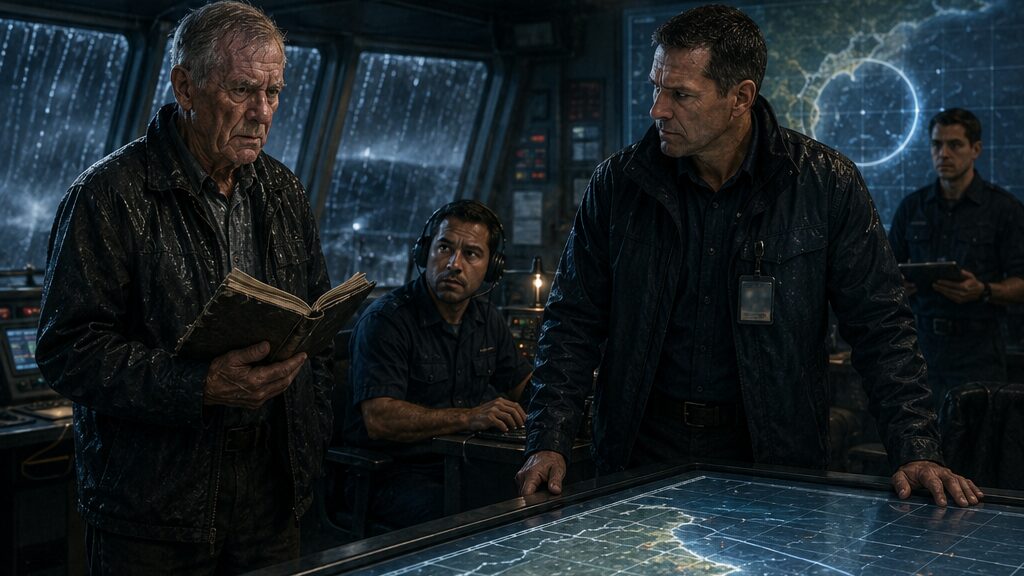
The first thing Samuel Mitchell saw when the command room doors opened was the search circle glowing in the wrong water.
It hung on the wall map in hard blue light, a clean shape drawn over a black, heaving stretch of coast as if the sea had ever obeyed clean shapes. Rain struck the storm glass behind the command tables so hard it sounded like handfuls of gravel thrown against the building. Every screen in the room gave off a cold shine. Every voice had the clipped edge of people who had already been awake too long.
Samuel stood in the doorway with his old logbook tucked against his ribs.
No one moved to take his coat.
A young dispatcher glanced up first, then away. A junior analyst near the map pressed two fingers to his headset and called out a bearing. Behind him, three people bent over a glowing table where a digital model moved colored lines over the dark coastline. The room smelled of wet rubber, burnt coffee, and warm electronics.
Samuel’s shoes left two small half-moons of rainwater on the floor.
“Sir,” the dispatcher said without looking at him again, “this area is restricted.”
“I know,” Samuel said.
His voice came out softer than the room needed. He had to clear his throat before the second word.
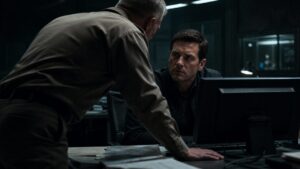
A man in a dark waterproof jacket looked over from the table. He was younger than Samuel by four decades, perhaps more, with tired eyes and the hard stillness of someone trying to hold a room together by force of posture. His name tag read Matthew Allen.
“Who let him in?” Matthew asked.
The question was not cruel. That made it worse somehow. It treated Samuel as a misplaced object.
The station chief, standing near the far screen with one hand around a paper cup, said, “He used to advise the harbor authority. Mitchell. Retired Navy.”
Matthew’s gaze changed only slightly. Not respect. Not yet. Just a quick reassessment, the kind given to old equipment that might still have a part number.
Samuel stepped in far enough for the doors to close behind him. The wind thudded against them as if it had followed him up from the dock.
“You’re searching for the White Gull,” Samuel said.
Matthew turned back to the table. “Everyone in this building is searching for the White Gull.”
“Melissa White captains her.”
At the sound of the name, one of the radio officers looked up. Samuel saw a headset, one hand cupped over an ear, a face drawn tight by static. Paul Sanchez. Samuel remembered him from a training day years ago, though Paul had been young then and Samuel had been asked to speak for ten minutes between slide decks. Most of them had looked at their phones. Paul had not.
“She missed her check-in forty-one minutes ago,” Paul said. “Last transmission broken. Engine trouble possible. Two aboard confirmed.”
“Three,” Samuel said. “She carries a deckhand on night runs when the barometer falls that fast.”
Paul glanced at Matthew.
Matthew’s jaw tightened. “We have the manifest.”
“Then the manifest is wrong tonight.”
The room did not stop. Rooms like this never stopped. They only changed pressure. Samuel felt it in the way shoulders shifted, in the way no one wanted the old man to be right about even that small thing.
Matthew came around the table. “Mr. Mitchell, we appreciate your concern, but this is an active rescue operation.”
Samuel held the logbook more tightly. Its cloth cover was dark with rain at the corners. The binding had been repaired twice with brown tape and once with stitching Carolyn had done after telling him he should scan the pages and be done with it. The paper inside held pencil marks, tide notes, old coordinates, dates, and the handwriting of a man who did not trust memory unless it had been written down before pride could polish it.
“I’m not here because I’m concerned,” Samuel said. “I’m here because that circle is too far north.”
That time the room did hesitate.
Only half a second. A few eyes turned to the wall map, then to Matthew. The search circle pulsed over a sector beyond the shoals, where the model believed the White Gull would drift if she had lost engine power after her last known transmission. Samuel could see why it had chosen there. He could see the logic. He could also see the error sitting beneath it like a reef under dark water.
Matthew looked at him with professional patience. “The circle is based on last contact, wind field, tide tables, buoy reports, and live drift estimates.”
“Yes.”
“Then unless you have new data—”
“I have old data.”
The words landed poorly. Samuel heard it as soon as he said it. Old data. Old man. Old book. Old habit. He could almost hear Carolyn’s tired voice from the car an hour earlier: Dad, don’t make them treat you like you’re wandering.
Matthew’s eyes dropped to the logbook.
“That’s what this is?” he asked.
Samuel laid one hand over the cover. He did not open it yet. The room was too bright, too full of people waiting to be unconvinced.
“This coast has a reversal seam when a southeast gale hits a falling tide within two hours of low water,” Samuel said. “Not every time. But when it does, anything disabled near the outer marker gets shouldered west before it drifts north.”
The junior analyst frowned at his screen.
Matthew did not turn. “Our model accounts for tidal reversal.”
“Not this one.”
“Mr. Mitchell—”
“Samuel.”
Matthew paused.
Samuel held his gaze. He had been called Commander once, lieutenant before that, sir by men who needed something from him, old-timer by men who thought they were being kind. Tonight the name mattered because the room had already begun to put him somewhere harmless.
Matthew gave a brief nod. “Samuel. We’re not going to freeze a search pattern because of a handwritten note.”
A flash lit the storm glass. For a moment the entire room appeared in negative: faces pale, windows white, the sea beyond invisible. Then thunder rolled over the roof.
Paul’s radio cracked.
“White Gull, Coast Station, repeat last transmission. White Gull, do you copy?”
Only static answered, thin and torn.
Samuel looked past Matthew to the map again. The glowing circle touched water that would be empty if the seam had opened. Too clean. Too confident. Too far north.
He felt, absurdly, the weakness in his knees. Not fear. Not exactly. He had walked from the parking lot through wind that shoved rain under his collar, and age collected its taxes without apology. His hand trembled once against the logbook cover. Matthew saw it.
There it was.
The small softening around the younger man’s mouth. Not mockery. Concern. Almost worse. The look of someone deciding the old man might need a chair more than an answer.
“Can someone get him some coffee?” Matthew said.
Samuel closed his fingers until the tremor stopped.
“I don’t need coffee.”
The station chief said, “Let him show you what he came to show you.”
Matthew inhaled through his nose, held it, then looked back to the digital table. “Two minutes.”
Samuel walked forward.
No one moved aside quickly. He had to edge between a chair and a wet duffel bag, the logbook against his chest, while younger bodies leaned around him toward screens that did not remember storms before their software version. He reached the glowing table and saw his reflection faintly in the glass: gray hair flattened by rain, deep lines beside his mouth, old jacket shining at the shoulders.
He opened the logbook.
The pages gave off the dry, faint smell of paper kept too long in rooms with salt air. His fingers found the section before his eyes did. They always did. The same thumb-worn corner. The same page he wished he had never needed to write.
But before he turned to it, he looked at the wall map once more.
The search circle brightened, refreshed by the model, and slid half a mile farther north.
Samuel placed his palm flat on the open book, holding the page down against the air blowing from the vents.
“That,” he said quietly, “is the wrong water.”
Chapter 2: The Page Matthew Would Not Read
Matthew Allen had learned that command was mostly the art of deciding which voices not to hear.
The storm brought too many of them. Dispatchers repeating fragments. Analysts arguing with models. Crew families calling the front desk. Reporters leaving messages. Volunteers offering boats that should not leave their slips. Retired men with old credentials and wet jackets arriving at the worst possible minute with paper proof of something no one had time to verify.
Samuel Mitchell stood at the center of the room as if he had been carved there by weather.
Matthew wanted to be fair. That was the inconvenient part. The old man was not ranting. He was not demanding the room bow to his service record. He had not even raised his voice. But the search clock did not slow for dignity.
“Show me,” Matthew said.
Samuel turned the logbook so the page faced the glowing table. Its paper had yellowed at the edges. Pencil marks ran in columns: dates, tide times, wind direction, buoy numbers, notes in tight handwriting. Some entries had small arrows beside them. Others had circles so dark the pencil had bitten into the paper.
Matthew saw work. He also saw age. Age in the softened corners. Age in the old abbreviations. Age in the way Samuel’s finger moved carefully down the page before stopping.
“Here,” Samuel said.
Matthew leaned closer despite himself.
The entry was dated years earlier. A southeast gale. Falling tide. Outer marker. The coordinates were written twice, once neatly and once with a harder hand below. Beside them were three words: reversal seam opened.
“This isn’t current data,” Matthew said.
“No.”
“It predates two channel dredges, one buoy replacement, and the new tide array.”
“Yes.”
Matthew straightened. “Then you understand the problem.”
Samuel looked up at him. “I understand the coast did not sign off on your upgrades.”
A junior analyst gave the smallest breath through his nose, not quite a laugh. Matthew shot him a look and the young man bent back over his screen.
The old man was not wrong in principle. Matthew knew enough to know that water held grudges against confidence. But a command room could not operate on sayings. It needed traceable inputs, defensible decisions, reasons that could survive review if the White Gull did not.
Paul Sanchez’s voice cut across the room. “Still no clean response. I’m getting intermittent carrier noise on sixteen, but nothing usable.”
“Keep calling,” Matthew said.
Paul nodded, one hand pressed to his headset.
Samuel’s gaze moved toward him. “Does it break in threes?”
Paul looked back. “What?”
“The carrier noise. Does it break in three short tears, then a longer scrape?”
Matthew closed his eyes for half a second. He could feel the room being pulled toward the old man’s gravity.
Paul adjusted the dial. “It’s static.”
“Static has shape,” Samuel said.
Matthew stepped between them. “No. We are not diagnosing a vessel location by describing static.”
Samuel did not flinch. “I’m asking him to listen.”
“And I’m telling you we have a procedure.”
“You have a procedure for what usually happens.”
Matthew put both hands on the edge of the table. On the wall map, the search circle pulsed northward, supported by wind vectors and buoy data. A rescue craft icon moved along the lower edge of the sector. The station chief stood near the back, saying nothing. That silence felt like weight.
“Mr. Mitchell,” Matthew said, keeping his tone even, “do you know how many retired captains, old deckhands, and dockside experts call during a storm? Every one of them knows a current, a shoal, a shortcut, a story. Some of them are right about yesterday. Some about thirty years ago. I can’t move boats based on a notebook.”
Samuel’s face settled into something Matthew could not read.
“I’m not asking you to move boats yet.”
“Then what are you asking?”
Samuel reached into his jacket pocket and took out a pencil worn almost to half-length. He did not lick the tip. He did not dramatize the gesture. He placed it gently on the map glass below the projected coastline and tapped one buoy marker.
“This buoy was repaired last month.”
Matthew glanced at the junior analyst.
The analyst checked his station. “Outer marker seven had a sensor housing replacement, yes.”
Samuel nodded once. “The housing sits higher now.”
Matthew waited.
“In this wind, it reads surface push clean. Looks north. But underneath, when the tide falls against the gale, the old seam opens here.” He drew a short, slanted line away from the official drift path. “It shoulders a dead vessel west first, then bends it under the shoal line.”
“You’re describing subsurface drift.”
“I’m describing where Melissa White’s boat will be if she lost engine power after her last call.”
The use of Melissa’s full name tightened something in Matthew’s chest. He had never met her, but her license file was on his screen. Forty-six. Twenty years on the water. Good inspection record. No reckless violations. A person reduced by emergency procedure to a call sign, length, hull color, last known location.
Matthew looked at the pencil line. It was simple. Too simple. A small gray scar across the clean digital glow.
“Erase that,” he said.
Samuel’s hand remained on the pencil.
“Matthew,” the station chief said from the back.
Matthew did not turn. “If that line stays there, people start seeing it as an option.”
“It is an option,” Samuel said.
“It is not validated.”
Samuel’s eyes were steady. “Then validate it.”
The storm punched the windows again. Rainwater chased itself down the glass in silver ropes. Somewhere outside, a metal sign clanged against its bracket.
Paul spoke from the radio station. “Command, I’m getting that carrier again.”
Matthew did not answer at once.
Paul turned slightly in his chair. His headset cord pulled against his shoulder. “It does have a pattern.”
The junior analyst stopped typing.
Matthew felt every person in the room waiting for his face to decide what the room believed.
“What pattern?” he asked.
Paul listened. Static hissed faintly from the speaker, then dropped, then hissed again. To Matthew it was weather noise. Broken signal. Useless breath from a storm that wanted them all guessing.
Paul lifted one finger.
The speaker spat three short bursts.
Then one longer scrape.
Samuel did not move, but something in his expression changed, not victory, not relief. Recognition. The kind that did not make a man happier.
“That’s mast shadow,” Samuel said.
Matthew turned on him. “You cannot know that.”
“Not alone. Not from one sound.”
“Good.”
Samuel touched the logbook page. “But with this tide, this wind, her last heading, and that break, she is not above the circle. She is below it, west of your line.”
The junior analyst whispered, “That’s outside the primary sector.”
“I know where it is,” Matthew said.
He stared at the map until the blue circle seemed to burn into the back of his eyes. If he redirected too early and Samuel was wrong, he would scatter resources into dark water while the model’s strongest probability zone went thin. If he ignored Samuel and the old man was right, the White Gull would drift through a seam that no screen had marked.
He hated that the old man had given him doubt without giving him certainty.
“Run a comparison,” Matthew said to the analyst. “Manual drift, alternate seam, using his line as a hypothetical only.”
The analyst began typing.
Samuel lifted his pencil from the glass, but the faint trace remained. A gray line crossing the blue.
“Thank you,” Samuel said.
Matthew’s frustration sharpened. “I haven’t accepted it.”
“No,” Samuel said. “You listened.”
The words should have sounded grateful. Instead, they made Matthew feel exposed.
The analyst’s screen refreshed. “Hypothetical drift places the vessel here if engine loss occurred four minutes after last transmission.” He pointed to a spot near the lower edge of the map. “But it requires the buoy input to be overstating northward surface movement.”
Matthew seized that. “Which we don’t know.”
“No,” the analyst said. “We don’t.”
Paul leaned closer to his radio. “White Gull, Coast Station, if you copy, transmit any sound. Key your mic twice.”
The room held still.
Static.
Then a burst so jagged it made the speaker crackle.
Paul’s head lifted.
Again came three short tears of sound.
Then the longer scrape.
Samuel’s hand closed slowly over the edge of the logbook page.
Matthew looked from Paul to the map, then to the old pencil line cutting quietly through the official glow.
For the first time since Samuel had entered the room, Matthew was not certain enough to dismiss him.
But he was still certain enough to be afraid of following him.
“Keep the primary search,” Matthew ordered. “No redirection yet. Continue monitoring the alternate.”
Samuel lowered his eyes to the logbook.
He said nothing.
That silence stayed with Matthew longer than an argument would have.
Chapter 3: The Static That Sounded Like Memory
Paul Sanchez had spent enough nights inside storm radio to know that panic often arrived disguised as noise.
A frightened caller breathed too close to a mic, and the storm became a monster. A damaged antenna dragged each word into a metallic groan. A hand shaking on a transmit button could turn a position report into broken taps and ghosts. Most of Paul’s job was to strip feeling out of sound until only usable information remained.
Samuel Mitchell was asking him to do the opposite.
Listen to the shape, the old man had said without saying it that way. Listen to what the storm does to the signal before you decide it is empty.
Paul adjusted the gain and leaned toward the console. Around him, the command room had resumed its motion, but not its confidence. Matthew stood behind the junior analyst, arms folded, watching a comparison model build itself on the side screen. The station chief spoke quietly into a phone near the windows. Samuel stood near the end of the table, logbook open but hands off it now, as if he had offered what he could and would not force the room to take more.
The radio hissed.
Paul closed his eyes.
There were layers inside the sound: high rain scatter, low electrical hum, the slap of atmospheric interference. Beneath that came the carrier break from the White Gull, weak and partial. Three torn bursts. A scrape. Nothing like speech.
He opened his eyes. “White Gull, Coast Station. If you hear me, key once for yes.”
Nothing.
“White Gull, Coast Station. Key once if you are disabled.”
A burst of static rose, fell apart, then vanished.
Paul’s fingers tightened over the dial.
Samuel’s voice came from beside him, closer than expected. “May I?”
Matthew’s answer came fast. “Don’t touch the console.”
“I wasn’t going to.”
Paul glanced up. Samuel had stopped at a respectful distance, one hand resting on the back of an empty chair. His face looked pale under the overhead lights. Rain had dried in salt-like marks along his jacket sleeves.
“What are you listening for?” Paul asked.
Samuel did not look at Matthew before answering. “Whether the mast is swinging clean or dragging through the signal.”
Paul waited.
Samuel pointed toward the speaker, not touching anything. “A clean swing breaks even. Same gap, same tear. Dragging makes the third break late. Then the long scrape comes when the antenna turns away behind the cabin or water on the line.”
Paul listened again.
Three bursts.
The third was late.
He felt the small hairs rise at the back of his neck.
“That could be movement,” Paul said.
“It is movement.”
Matthew came closer. “Or damage.”
Samuel nodded. “Yes.”
Paul looked at him. “You said mast shadow.”
“I said that because the longer scrape is too wide for handheld interference and too regular for open static. If she has lost engine and is beam-on to that seam, she would roll the same way every few seconds.”
Paul turned back to the console. “You learned that in the Navy?”
Samuel’s eyes stayed on the radio, but his face moved, barely. “I learned not to ignore ugly sound.”
It was not the answer Paul expected.
He remembered the training day years ago now with sudden clarity. A smaller room, coffee in paper cups, younger officers pretending not to be bored. Samuel at the front, already old but not as stooped, drawing tide arrows on a whiteboard after the slideshow remote failed. The lesson had not been dramatic. No war story. No medals. He had talked about writing things down before sleep changed them. He had said, If the sea teaches you something twice, record it before it charges you a third time.
Paul had written that line in a notebook he later lost.
“Can you show me the entry again?” Paul asked.
Samuel’s gaze flicked to Matthew.
Matthew’s mouth tightened, but he gave one short nod.
Samuel brought the logbook over. He did not place it on the console. He held it in both hands and angled it toward Paul, careful of the wires and coffee rings. The page was dense with old marks, but Samuel tapped only one corner.
“Here. Gale from southeast. Falling tide. Outer marker seven. Carrier distortion from a trawler with a bent mast. We heard three breaks and a drag. Thought she was north because the surface report said north. Found her west, below the shoal line. Too late for one of them.”
Paul looked at the words. The final sentence on the entry was written darker than the rest.
Do not trust the clean drift when the seam opens.
The command room seemed to recede. Paul heard rain, radio, the faint tap of the analyst’s keyboard. But the page held him. Not because it proved everything. It did not. It was one man’s record, one storm’s lesson, one coastline’s old cruelty written in pencil. But it was not sentimental. It was not rambling. It was exact.
“How often does the seam open?” Paul asked.
Samuel closed the book slightly, then stopped himself and left it open. “Rarely.”
“How rarely?”
“Rare enough to look foolish when you warn about it.”
That answer slipped under Paul’s defenses.
Matthew said, “Rare also means unlikely.”
“Yes,” Samuel said. “But unlikely is not the same as impossible.”
The junior analyst spoke from across the table. “Alternate model is weak. It only aligns if we discount the buoy housing.”
Samuel turned. “Discount the surface push, not the buoy.”
The analyst blinked. “What’s the distinction?”
“The buoy is telling you what the top of the water is doing. I’m telling you what the boat will do once she loses steerage and sits low enough for the lower set to catch her.”
Matthew rubbed both hands over his face. For a moment he looked less like a commander than a man trying to keep too many doors closed in a storm.
“Paul,” he said, “can you clean the signal?”
“I can try narrowing the band.”
“Do it.”
Paul worked the controls. The speaker hiss thinned, sharpened, thinned again. He called the White Gull twice more. On the second call, he thought he heard something under the static—a human sound, not a word, more like a breath caught behind water and metal.
“White Gull, if you copy, key twice for your captain conscious.”
They waited.
One burst.
Then another, faint.
Paul’s throat tightened. “Two keys. Weak, but I heard two.”
Matthew stepped closer. “Confirmed?”
“No. Not clean enough.”
Samuel stared at the speaker as if it were a horizon.
“Ask if they can see the harbor light,” he said.
Matthew shook his head. “If they could see the harbor light, they’d be in a different sector.”
“Ask.”
Paul did not wait for permission. “White Gull, Coast Station. If you can see the harbor light, key once.”
Static blew through the room. Someone cursed softly near the back when a gust rattled the windows.
No response.
Matthew looked at Samuel.
Samuel did not look embarrassed. He looked more worried.
“Now ask if they see it disappear and return,” Samuel said.
Paul repeated the question.
For several seconds there was nothing.
Then one burst came through, so faint Paul almost missed it.
He sat very still.
Matthew said, “What does that mean?”
Samuel closed his eyes.
“It means she’s not looking at the harbor light directly,” he said. “She’s seeing it cut by the old breakwater arm. Low angle. West of your circle.”
The junior analyst started typing before Matthew told him to.
Paul watched Samuel’s hand. The old man had set it on the back of the chair again, and the fingers trembled with fatigue. Not fear. Not uncertainty. Just the cost of standing too long in a room that had asked him to prove the weight of every word.
Paul lowered his voice. “You should sit.”
Samuel looked at him, and for one second Paul thought he had insulted him. Then Samuel gave the smallest nod and took the chair without ceremony.
That, more than anything, made Paul trust him. The old man did not pretend his body was young. He did not need to. His attention had not aged the same way.
A tone sounded from the junior analyst’s station.
“Model update coming in,” the analyst said. “New buoy packet. Wind correction.”
Matthew turned toward the wall.
The glowing search circle flickered, recalculated, then slid across the map.
Paul stood slowly.
It moved north.
Farther north.
Away from Samuel’s pencil line. Away from the broken light. Away from the static that now sounded, to Paul, like memory trying to speak through rain.
Chapter 4: Carolyn Wanted the Book Closed
Carolyn Lee found her father sitting in a plastic chair under a humming hallway light, his wet jacket still on, his hands folded over the old logbook as if someone might take it from him while he breathed.
The command room doors were open just enough for sound to leak out. Radio static. Wind hitting glass. Short voices calling numbers she could not assemble into meaning. On the far wall beyond the doorway, she could see part of the map, the blue circle glowing like a bruise.
Samuel did not look up when she stopped in front of him.
“You said you were only going to tell them at the front desk,” Carolyn said.
His thumb moved once along the book’s taped spine. “I did.”
“And then you walked into the command room.”
“They let me in.”
“That is not the same as being wanted there.”
He gave a small, tired breath. Not quite a laugh. Not quite agreement.
Carolyn took the chair beside him. The hallway smelled of floor cleaner and rain-soaked wool. A vending machine buzzed near the corner, its bright rows of snacks absurd against the night pressing at the windows. She had driven him because he had handed her the keys and said the wind was too sharp for his eyes. She had thought that was surrender. She should have known better.
His trousers were damp at the cuffs. One shoe tapped faintly, not with impatience, but with the tremor that came when he stood too long and refused to call it pain.
“Dad,” she said, softer. “They are in the middle of a rescue. If this goes wrong, they’ll need someone to blame. Don’t make yourself available.”
Samuel watched the opposite wall.
Carolyn looked at the book. She had seen it on kitchen tables, nightstands, hospital trays, and once tucked under his arm at her mother’s funeral, as if grief itself might misplace a coordinate. She had hated it at different strengths for years. Hated the smell of old paper in his house. Hated the way he opened it on storm nights and left coffee untouched until morning. Hated most of all that it seemed to receive the truth from him when people did not.
“You told them,” she said. “You did what you came to do.”
“They haven’t moved the search.”
“Maybe they can’t.”
“They can.”
“Maybe they shouldn’t because one old entry says so.”
He looked at her then. The hallway light sharpened the lines around his eyes. He looked older than he had that afternoon, and she felt a sudden anger at the storm for dragging time across his face so visibly.
“It isn’t one old entry,” he said.
Carolyn held out her hand, palm up. “Let me see.”
Samuel looked down at the logbook.
For a moment she thought he would refuse. Then he laid it across her palm with both hands, as carefully as if it were something injured.
The weight surprised her. She had handled it before, but never like this, never while a vessel was missing and people were speaking in clipped codes beyond a half-open door. The cloth cover was cold and damp along one edge. A corner had softened from rain. Her own stitching showed near the spine, uneven but firm.
She placed her fingers on the cover.
She did not open it.
Samuel noticed. Of course he did.
“You used to read over my shoulder,” he said.
“When I was ten. I thought it was treasure maps.”
“In a way.”
“No.” Carolyn slid her thumb over the worn tape. “Treasure maps lead somewhere happy.”
The doors opened wider behind them. Paul Sanchez stepped into the hallway, headset around his neck. He stopped when he saw Carolyn with the book.
“Sorry,” he said. “I was looking for—”
“He’s here,” Carolyn said.
Paul nodded to Samuel. “The alternate model is still running. It’s not being used for deployment.”
Samuel stood too quickly. His hand went to the chair back, and Carolyn rose with him.
“Dad.”
“I’m all right.”
Paul saw the movement. His face changed the same way Matthew’s had earlier—concern first, then caution about showing it.
“The official update shifted north,” Paul said. “Commander Allen is keeping primary assets in that sector.”
Samuel absorbed it without visible surprise.
“And the radio break?” he asked.
“Intermittent. Still matches what you described, but not enough to log as confirmed.”
Samuel nodded once. “That’s honest.”
Paul looked at the book in Carolyn’s hands. “There’s something in there, isn’t there?”
Carolyn’s fingers tightened.
“There is a lot in here,” she said. “That’s the problem.”
Samuel reached for the book, but she did not release it immediately.
“No,” she said. “Not yet.”
His hand stopped in the air.
She hated the way that hurt him. She hated that she had done it anyway.
“When Mom was sick,” Carolyn said, “you sat beside her bed with this thing. When the pipes froze, you opened this before calling a plumber. Every storm, every siren, every news story about somebody missing on water—you go back to it. You think I don’t know what page?”
Samuel’s eyes lowered.
Paul took a step back, but the hallway was too narrow for privacy.
Carolyn turned the book in her hands. The edge of one page stuck out farther than the others, darkened by years of handling. She knew that page. She had seen its shape without reading its words. She had watched her father open to it and become unreachable.
“What happened that night was not yours alone,” she said.
Samuel’s mouth tightened. “I was the navigator.”
“You were one man.”
“I was the one who saw it after.”
“After,” she said. “That word has been eating you alive for twenty years.”
The command room called out behind them. A burst of static pushed through the doorway, followed by Paul’s station speaker repeating White Gull into the storm. Samuel turned his head toward the sound with the instinctive pull of an animal hearing its young.
Carolyn saw then that she had lost the argument before she began.
Not because he was stubborn. Stubbornness had edges. This was quieter. Worse. He was still listening for someone he could not see.
She opened the logbook at last.
The page did not look dramatic. No red ink. No pasted photograph. Just pencil pressed harder than elsewhere, coordinates written twice, weather shorthand, a few slanted arrows, and a final line so dark it seemed less written than carved.
Do not trust the clean drift when the seam opens.
Carolyn touched the margin but not the words.
“This is why you came.”
Samuel did not answer.
“Not to prove them wrong.”
“No.”
“To keep it from happening twice.”
His face folded for the briefest moment. Then the old discipline returned, but not fast enough to hide what had been underneath.
Paul’s radio crackled from inside the command room, loud enough to make all three of them turn.
The station chief’s voice followed, low and hard. “Matthew, if we do not have a confirmed location in the next cycle, prepare a public loss assessment. Families need something before dawn.”
Carolyn looked at her father.
The book remained open in her hands, and this time she did not close it.
Chapter 5: The Circle Moved Where It Shouldn’t
Matthew Allen watched the blue search circle move north and felt the room accept it before he did.
The update arrived with the authority of clean numbers. Fresh buoy packet. Wind correction. Surface drift adjusted. Probability strengthened. On the side panel, the model’s confidence line climbed just enough to make the junior analyst exhale, as if the storm had finally offered a handhold.
“Primary sector tightened,” the analyst said. “Search craft can sweep the upper grid with better overlap if we pull the lower standby north.”
Matthew looked at the map. The circle had drawn itself away from Samuel Mitchell’s pencil line, away from the alternate seam, away from the strange radio breaks and the old man’s quiet certainty.
It should have reassured him.
Instead, it irritated him that relief did not come.
Behind him, the station chief ended a call and stood with his arms crossed. Near the radio station, Paul had returned to his console but kept glancing at Samuel’s logbook. Carolyn Lee stood just inside the door now, no longer in the hallway, holding herself as if she wished she could remove her father from the room by will alone.
Samuel sat near the end of the table, the open book before him. He had not protested when the model shifted. He had only looked at the map with an expression that made Matthew want to say something sharper than he should.
“Commander,” the junior analyst said, “do we redeploy the lower standby?”
Matthew forced himself back into the chain of decision. “Status of primary craft?”
“Two in sector. One approaching the north sweep. Visibility poor but manageable.”
“Fuel?”
“Still within safe range.”
“Then move the standby north.”
Samuel’s eyes closed.
Matthew saw it and felt his patience thin. “Say it.”
Samuel opened his eyes. “You’re pulling the only boat close enough to the seam.”
“I’m strengthening the highest probability zone.”
“No. The model is strengthening itself around a bad read.”
The junior analyst stiffened. Matthew lifted one hand before the young man could answer.
“Explain,” Matthew said. “Briefly.”
Samuel rose slowly. Carolyn moved as if to help him, then stopped when he touched the table and steadied himself. He took the pencil but did not mark the glass yet.
“Outer marker seven,” he said.
“We’ve covered this.”
“No. We named it. We didn’t cover it.”
Matthew felt every second. The clock above the main screen rolled past another minute. Somewhere out there, Melissa White’s vessel was either drifting, sinking, or already gone. He did not let himself picture the faces. That was another lesson of command: imagine too much and you become useless.
Samuel pointed to the buoy icon. “The housing was replaced.”
The analyst said, “The sensor passed inspection.”
“I’m not questioning the sensor.”
“Then what?”
“The new housing sits higher and cleaner above chop. In a southeast gale, it gives you a stronger surface push than the old assembly would have. The model reads that and believes the upper water owns the vessel.”
Matthew stared at the map. “And you believe the lower set owns it.”
“If she lost engine and turned beam-on, yes.”
“That is a chain of assumptions.”
“So is yours.”
The room went quiet enough for the rain to fill it.
Matthew stepped closer to Samuel. “Here is what I know. I know the last confirmed transmission. I know the current buoy packet. I know the model. I know where my crews are. You’re asking me to weaken a search based on a theory, a sound pattern, and a log entry from a storm before half this room was hired.”
Samuel took that without blinking. “Yes.”
The honesty landed harder than a defense.
Carolyn said, “Dad.”
He did not look back.
Matthew leaned over the table. “Do you understand what happens if I move them and you’re wrong?”
“Yes.”
“Do you understand what happens to the people in this room? To the report? To the family waiting for us to say we did everything we could?”
Samuel’s hand tightened around the pencil. “I know exactly what a report can say while leaving out the thing that mattered.”
Matthew froze.
For the first time, anger showed in Samuel’s face. Not hot. Not directed at Matthew alone. Old anger, buried so long it had become part of his posture.
The station chief took one step forward. “Samuel.”
Samuel lowered the pencil. The anger disappeared, leaving fatigue behind.
Matthew did not like the way the room had shifted toward him, as if he had stepped on a bruise he could not see.
“Enough,” he said. “Mr. Mitchell, you’ve made your point. If you continue interfering with active decisions, I’ll have to ask you to wait outside.”
Carolyn’s face tightened. Paul looked down at his console.
Samuel nodded once. “That is your authority.”
“Good.”
“It does not change the water.”
Matthew turned away before he answered.
“Redeploy the standby north,” he said.
The dispatcher relayed the order. The icon on the map shifted, beginning its slow crawl toward the official circle. For several minutes, the command room operated the way it was supposed to operate. Clean calls. Recorded decisions. The primary craft reported rough seas but continued the sweep. The model refreshed, holding its confidence. The station chief prepared language for the family notification, not yet a loss assessment, but close enough that everyone knew what it meant.
Matthew moved through it all by habit. He checked fuel, crew safety, grid coverage. He approved a narrowed sweep and requested another attempt to raise the White Gull. His body performed command while his attention kept dragging to the lower edge of the map where Samuel’s pencil line had been wiped away but not forgotten.
Paul called twice more.
“White Gull, Coast Station. If you copy, key your mic.”
Static.
No three breaks. No scrape. Nothing useful.
Matthew hated the small relief that came with that.
Then the north craft reported debris.
“Repeat,” Matthew said, stepping toward the radio.
Paul routed the channel to the room speaker.
A rescue crew voice came through, warped by storm. “We have debris in primary north sweep. Possible vessel material. White fiberglass fragment. Stand by for marking.”
The junior analyst’s face fell into grim validation. “That supports north drift.”
Matthew looked at Samuel.
The old man had gone very still.
Carolyn’s hand moved toward his shoulder, then stopped inches away.
Paul asked, “Can they identify it?”
“Ask,” Matthew said.
Paul transmitted. The response came back in pieces. White fiberglass. Torn canvas. No visible registration. Heavy weather. Recovering small sample unsafe. Marking location.
The station chief said quietly, “Matthew.”
“I know.”
This could be the beginning of the end. Debris in the north sector. Weak radio. No confirmed sighting. The story the model had been telling now had an object floating inside it.
Matthew turned to Samuel, prepared for argument.
Samuel was looking not at the debris marker, but below it.
“No,” Samuel said.
Matthew’s jaw hardened. “Don’t.”
“The debris is not where your vessel is.”
“Debris from the vessel was found in the search sector.”
“The debris is light.”
“You don’t know that.”
“Canvas and fiberglass. Light. High surface. It would go north with the top water.”
The junior analyst whispered, “That’s consistent.”
Matthew shot him a look. “Consistent with what?”
“With both, technically,” the analyst said, voice thin. “If heavier vessel drift diverged from lighter debris.”
Samuel stepped toward the map. “Debris can lie because it floats clean.”
Matthew felt the room slipping again, not toward Samuel, not fully, but away from certainty.
He pointed at the screen. “That is evidence.”
“Yes,” Samuel said. “Of the surface.”
Paul suddenly straightened at the radio. He pressed one hand hard against his headset.
“What?” Matthew asked.
Paul lifted a finger.
The speaker hissed, then snapped with three short breaks.
A longer scrape followed, fainter than before.
Paul’s eyes moved to Samuel.
Samuel did not speak. He simply took the pencil and drew in the air, not touching the glass: down from the debris, west beneath the shoal line, toward the place where the standby boat had been before Matthew moved it north.
The dispatcher turned from her station. “Rescue craft lower grid reports visual on additional debris.”
Matthew spun toward her.
“Location?”
She read it out.
The junior analyst entered the numbers.
A small marker appeared on the wall map.
It sat almost exactly on the path Samuel had drawn by hand.
Chapter 6: The Note He Never Entered
Samuel Mitchell had spent twenty years making the same page look smaller than it was.
He had folded other papers over it. Written later entries around it. Repaired the spine. Changed the cover tape. Added tide notes, buoy numbers, names of storms that came and went without keeping anyone. But whenever he opened the logbook in bad weather, the book found its own way back to that page.
Now the page lay under the command room lights while strangers waited for him to explain why his old wound should be allowed to touch their live rescue.
Matthew had not ordered him out. Not after the second debris marker appeared near Samuel’s line. Not after Paul caught the same broken carrier again, thinner now, almost gone. But not ordering him out was not the same as trusting him.
The station chief pointed toward a side briefing room with glass walls and a smaller copy of the map screen. “Five minutes. We need a decision, not a debate.”
Samuel carried the logbook himself.
Carolyn followed him in. Paul came with his headset around his neck, one ear still uncovered so he could hear the console if it called. Matthew entered last and closed the door. The storm became muffled behind the glass, though the windows still shivered with every gust.
The smaller room had a table, four chairs, a dry-erase board stained by old markers, and a pot of coffee no one touched. Samuel stood rather than sit. If he sat now, he was not sure he would rise quickly enough when the next call came.
Matthew did not waste time.
“What have you not said?”
Samuel looked down at the logbook. The dark entry waited.
Carolyn stood near the door, arms folded tightly. He felt her watching not the page but his face. She knew some of it. Not all. He had given her facts over the years like coins under a closed door, one at a time, never enough to open the room.
Samuel turned the book toward Matthew and Paul.
“This storm was twenty-one years ago,” he said. “Different vessel. Different crew. Same tide window. Same wind direction. Same outer marker, before the housing was changed.”
Matthew leaned over the page but did not touch it.
“You were Navy then?”
“Recently retired. Advising harbor rescue. They called me in because I knew the shoal line.”
Paul said nothing, but his eyes stayed on the hard-written sentence.
Samuel tapped the coordinates. “A trawler lost power after reporting north drift. Surface reports agreed. We searched north. Clean pattern. Defensible.”
His mouth dried around the word.
Defensible.
He could still see the report. White paper. Black lines. Proper sequence of decisions. Weather factors. Equipment limits. No negligence found. No single point of failure. A clean document for an unclean night.
Matthew’s voice was lower now. “What happened?”
“We found them west.”
No one spoke.
“Too late for one deckhand,” Samuel said.
Carolyn turned her face toward the glass.
Samuel kept his hand on the page because if he lifted it, they might see it shake.
“I had noticed the signal drag,” he continued. “Not enough to be certain. I mentioned it. They asked whether I would contradict buoy data on a guess. I said no.”
The room held that no like a stone dropped in deep water.
Paul’s expression changed first. Not pity. Samuel was grateful for that. It was recognition of a different kind—the look of a man hearing how a small professional hesitation can become a life sentence.
Matthew stood very still. “And afterward you wrote this.”
“Afterward I wrote everything. Weather. Sound. Drift. What we trusted. What we should have questioned. Then I wrote it again the next time I saw a similar seam. And again.”
“Why wasn’t it entered into the system?” Matthew asked.
Samuel gave him a tired look. “I tried.”
The answer was too simple, and Matthew seemed to dislike that.
“What does that mean?”
“It means I filed a memorandum. It means I made calls. It means a pattern that rare becomes anecdotal when it embarrasses a model and inconvenient when budgets are closed.” Samuel’s voice stayed even, but the old anger pressed at the edges. “It means no one wanted a warning that could not be turned into a clean rule.”
Matthew looked at the wall monitor, where the official circle still glowed north. “We can’t run rescue on guilt.”
“No.”
“We can’t run it on regret.”
“No.”
“What are you asking me to run it on?”
Samuel looked through the glass at the command room. Paul’s empty radio chair waited under its lamp. The blue map threw light over young faces working too hard to be calm. Somewhere beyond the windows, Melissa White and whoever had trusted her boat were being moved by water that did not care what anyone could defend afterward.
“On the live facts that match the old warning,” Samuel said. “Not the wound. The facts.”
Matthew held his gaze.
Samuel turned the logbook back toward himself and touched each point with the pencil.
“Last transmission west of the outer marker. Engine trouble likely. Southeast gale. Falling tide. Buoy reading strong north at surface. Radio carrier breaks in three and drags long. Harbor light visible only when cut by the breakwater arm. Light debris north. Secondary debris near the lower line. None of that alone is enough.”
He stopped.
“All of it together is not nothing.”
Carolyn closed her eyes.
Paul’s headset gave a faint burst where it hung against his shoulder.
He grabbed it and pressed one side to his ear. “Say again?”
The briefing room froze.
Paul opened the door and stepped halfway out, listening. “Patch it in here.”
The small monitor speaker crackled alive.
Static filled the room, rough and uneven.
Paul bent toward it. “White Gull, Coast Station, if you copy, key twice.”
For a moment, nothing answered.
Then came one faint burst.
A pause.
A second, weaker burst.
Paul looked at Matthew. “That’s them.”
“Location?” Matthew asked.
“No voice. Carrier too weak.”
Samuel whispered, “Ask about the light again.”
Paul did. “White Gull, if you see the harbor light disappear and return, key once.”
Static rolled long enough for Samuel to feel his age in every joint.
One burst came through.
Paul’s face tightened. “One.”
Samuel moved closer to the screen. His pencil hovered above the smaller map. “Ask if they hear surf on their port side.”
Matthew stared at him. “How would they answer that?”
“One key yes. Two no.”
Paul transmitted the question.
The answer took so long that Samuel thought they had lost them.
Then one broken key came through, barely there.
Samuel drew one short mark below the official circle, near the old seam.
Paul did not wait for another instruction. He turned to Matthew.
“That signal is outside primary,” he said. “It has to be.”
Matthew looked through the glass at the main room, where the search craft icons moved under orders he had given. His face had lost its defensive hardness. What replaced it was worse: the naked weight of decision.
The station chief opened the briefing room door. “We need the assessment language now or a corrected deployment.”
Matthew did not answer him.
Samuel set the pencil down beside the logbook.
“I was afraid of being wrong then,” he said. “I am afraid now. But I am more afraid of making the same safe mistake.”
Paul’s headset crackled again.
He pressed it tight, listened, and turned sharply toward the map.
“Second signal break,” he said. “Bearing estimate from the lower relay puts it west of the official circle.”
Samuel’s breath caught once, quietly.
Paul looked at Matthew.
“Exactly where he said the seam would carry her.”
Chapter 7: The Search Line Samuel Drew by Hand
For a moment after Paul spoke, the command room did not move.
The storm moved for them. It struck the glass with a white burst of rain. It pressed wind into the seams of the building. It shook the hanging lights over the map table until their reflections trembled across the polished surface like loose signals.
Matthew Allen stood in the briefing room doorway with one hand still on the frame.
“Say that again,” he said.
Paul kept the headset pressed to one ear. “Lower relay caught the carrier break. Bearing estimate puts the signal west of the official circle, close to Mr. Mitchell’s seam line.”
“Estimate,” Matthew said.
“Yes.”
“How wide?”
“Wide enough to be ugly.” Paul swallowed. “Not wide enough to ignore.”
Samuel stood beside the smaller map with his logbook open before him. His body wanted the chair. His knees had begun their dull argument with the hour, the storm, the long walk in, the old pride that had refused coffee and then refused rest. He kept one hand on the table and the other near the pencil.
Matthew looked at the main room. The primary search craft icons crawled north inside the glowing circle. The lower standby, redirected earlier, was halfway through its move away from the seam. There were only so many boats, so much fuel, so many safe passes before the storm made courage indistinguishable from foolishness.
“Can the lower standby reverse?” Matthew asked.
The dispatcher checked. “They can, but they’ll lose time turning through the chop.”
“How much?”
“Seven minutes minimum to regain the lower line. More if visibility drops.”
The junior analyst said, “Primary probability still favors north.”
Paul turned. “The live signal doesn’t.”
The analyst’s face flushed. “The live signal is barely a signal.”
“Barely alive is still alive,” Paul said.
No one answered that.
Matthew stepped back into the command room. He did not look at Samuel yet. That told Samuel more than an apology would have. The younger commander was not performing doubt now. He was inside it, measuring it, feeling where it might break.
“Bring the lower sector up,” Matthew said. “Full display.”
The wall map changed. Layers vanished. The coastline sharpened. The official blue circle remained north, bright and confident. Below it, the debris markers sat like small warning lights. The alternate bearing Paul had caught appeared as a faint wedge crossing the lower water. It did not point to certainty. It pointed to a place where certainty had failed to look.
Samuel picked up the pencil.
Matthew saw and said, “If you draw on my table again, make it count.”
Samuel nodded.
He moved slowly to the main glass table. Carolyn followed close enough to catch him if he stumbled but far enough not to make that fact visible. He knew what she was doing. He loved her for pretending not to.
The room parted this time.
Not dramatically. No one stepped back in awe. No one whispered. But chairs shifted. A junior analyst moved a cable with his foot. The dispatcher leaned away from the corner of the table. Paul came around from the radio station, carrying Samuel’s logbook open with both hands.
That was the image that quieted Samuel’s breath: the headset officer, the young man with storm static still in one ear, holding the old book not like a relic, but like an instrument.
Paul placed it beside the glowing map.
Samuel set his left palm on the page to keep it open. With his right, he touched the pencil to the glass.
“Last usable signal,” he said.
The analyst marked it.
“Engine trouble likely four to six minutes after.”
“Based on?” Matthew asked.
“Transmission break, no second course correction, and how fast the carrier weakened after the first call.”
Matthew looked to Paul.
Paul said, “That matches what I heard.”
Samuel drew a short line south of the official drift. “Wind takes the light debris north. The disabled hull drops lower once she loses way. She turns beam-on here.”
His pencil stopped at the buoy icon.
“The surface report pulls your model north,” he continued. “But the seam shoulders the boat west before the north set can own her.”
The line angled away from the blue circle.
It looked wrong against the digital map. Too human. Too plain. A hand-drawn mark through layers of satellite weather, buoy readings, tide software, official probability. Yet the longer Samuel drew, the more the room leaned in.
Matthew said, “How far west?”
Samuel looked at the logbook. The page waited with its old dark sentence. He did not let himself fall into the memory. Not now.
“Far enough to see the harbor light cut in and out behind the old breakwater arm,” he said. “Not far enough to clear the shoal.”
The analyst typed. A narrow band appeared on screen, aligned with Samuel’s pencil.
“Search craft lower standby can intercept this band,” the analyst said. “But only if redirected now.”
Matthew looked at the station chief.
The station chief did not rescue him. “Your call.”
That was command. Not the clean authority people imagined. Just a room full of eyes, a storm full of consequences, and no place to put the decision except inside your own name.
Matthew turned to Samuel. “If I split the resources and she is north, we may weaken the only good grid.”
“Yes,” Samuel said.
“If I keep them north and you’re right—”
“We may lose the last light.”
Matthew stared at him. “You say that like you’ve already accepted the blame.”
Samuel’s hand tightened on the pencil. “No. I say it like blame will not keep anyone afloat.”
Something in Matthew’s face shifted. The defensive hardness did not disappear, but it lost its grip.
He turned to the dispatcher. “Redirect lower standby to alternate seam line. Maintain primary craft north. I want a split pattern: one sweep inside current official, one sweep along Mitchell’s line. Mark that as commander-directed based on live signal correlation and debris divergence.”
The dispatcher repeated the order at once.
The room moved.
Paul hurried back to the console. The junior analyst expanded the lower map and began feeding coordinates. The station chief stepped to the rear phone. Carolyn closed her eyes for one second, then opened them before Samuel could see too much.
Samuel did not feel victory. He felt the terrible start of responsibility.
The lower standby icon slowed, pivoted, and began crawling back toward the hand-drawn line.
“Lower standby, Coast Station,” Paul said. “New search leg follows alternate drift seam. Coordinates incoming. Watch for vessel low in water near shoal edge. Possible intermittent light. Possible weak carrier.”
The rescue craft answered through chopped static. “Copy alternate seam. Turning now.”
The next minutes stretched thin.
Samuel remained standing beside the table because sitting felt too much like surrendering the line. Twice Carolyn touched his elbow. Twice he gave her a small nod that meant not yet. Paul kept calling the White Gull, asking for key responses, receiving nothing and then almost nothing and then something too faint to trust. Matthew stood at the map wall, arms no longer folded, one hand resting against the table as though he had finally stopped holding the room at a distance.
“Lower standby entering alternate band,” the dispatcher called.
On the wall, the icon touched Samuel’s line.
The storm outside seemed to pull back all at once, though Samuel knew it had not. It was only the room listening harder.
Paul transmitted again. “White Gull, Coast Station. Rescue craft approaching possible position. If you see any light, key once.”
Nothing.
Samuel stared at the map until the blue and gray blurred.
Then the lower craft radio broke through.
“Coast Station, lower standby. We have intermittent visual. Faint light, low on the water. Bearing west-southwest of our bow.”
Paul stood halfway out of his chair. “Repeat visual.”
“Faint light. Comes and goes with swell. We are adjusting.”
Matthew stepped closer to the wall map. “Position?”
The numbers came in broken. The analyst entered them with shaking hands.
A marker appeared.
It sat beyond the official circle, just past the end of Samuel’s hand-drawn line.
Carolyn made a sound behind him, small and unfinished.
Samuel looked at the glowing point. His chest hurt in a way that was not illness, not age. The old page under his palm seemed suddenly lighter and heavier at once.
Paul’s voice softened without losing procedure. “White Gull, Coast Station. Rescue craft has possible visual. If that is you, key once.”
Static.
A pause.
One faint burst.
The room did not cheer. No one dared. Not yet.
Matthew leaned toward the radio speaker. “Lower standby, proceed with caution. Confirm vessel before approach. Shoal risk high.”
Samuel said, “Tell them not to come straight down on her.”
Matthew looked over.
Samuel pointed to the map. “The seam will push their stern toward the rocks if they approach from east. Have them pass north and fall back across the drift.”
Matthew did not ask for a second explanation.
“Relay that,” he said.
Paul did.
The rescue craft acknowledged.
Samuel stepped back from the table. His legs had begun to shake openly now. Carolyn put a hand under his arm, and this time he let her.
On the wall, the rescue icon curved north of the faint-light marker, then eased down in an arc that matched the line Samuel had drawn not as proof, but as warning.
The radio crackled again.
“Coast Station, lower standby. Confirm vessel. White Gull located. Taking water. Two visible on deck. Third unknown. Preparing recovery.”
Paul gripped the edge of his console.
Matthew bowed his head once, very briefly, then lifted it. “Continue coordination. Get them home.”
Samuel looked at the map, at the blue circle still glowing in the wrong place, at the gray pencil mark that had crossed it without permission.
He did not say I told you.
The sea had never cared for that sentence.
Chapter 8: The Book Stayed Open
By dawn, the command room looked less like a place of rescue than a place the storm had used and left behind.
Empty coffee cups stood beside keyboards. Rainwater had dried in dull patches on the floor. Someone’s wet gloves lay forgotten near the wall map. The blue search circle had been dimmed, replaced by a final track line that curved below it, crossed Samuel’s pencil mark, and ended near the harbor approach where the rescue craft now moved slowly home.
The storm had not vanished. It had weakened into gray rain and tired wind. Beyond the glass, the harbor showed itself in pieces: pilings, ropes, the pale flank of a docked vessel, gulls lifting and settling as if the night had been no concern of theirs.
Samuel sat in the chair Paul had brought him. The logbook lay open on the table beside him, its damp edges curling slightly in the warmer air. He had tried once to close it, then stopped with his fingers on the cover.
Across the room, Matthew stood at the radio station, listening while Paul confirmed the recovery details.
“Captain Melissa White conscious,” Paul said, repeating into the log. “Deckhand conscious. Third crew recovered from cabin, hypothermic but responsive. Vessel taking water, tow under evaluation.”
He stopped writing for half a second.
Then he added, “All persons accounted for.”
No one cheered.
A few shoulders dropped. The dispatcher put one hand over her mouth and turned toward the window. The junior analyst sat back as if his spine had been cut loose. The station chief closed his eyes, then opened them and reached for the phone that would call the waiting family with words different from the ones he had prepared.
Carolyn stood behind Samuel’s chair. Her hand rested lightly on his shoulder, not holding him there, just letting him know she had not left.
Samuel watched the final track line.
All persons accounted for.
The words should have lifted something cleanly from him. Instead they settled with weight. Relief had weight. So did mercy when it arrived too late for one memory and in time for another.
Matthew came over after the calls began to thin.
He looked older than he had at midnight. Not as old as Samuel. Just old enough for the night to have taken something from his certainty.
“Melissa White is asking who drew the line,” Matthew said.
Samuel looked at the logbook. “Tell her the room did.”
Matthew did not smile, though his mouth moved as if he nearly had. “That is not what happened.”
“It is close enough.”
“No.” Matthew pulled out the chair opposite him but did not sit. “It matters that it is accurate.”
Samuel ran one thumb along the page edge. “Accuracy can become vanity if you use it wrong.”
Matthew accepted that quietly.
For a few seconds they listened to Paul’s voice at the radio, calm now, guiding the tow channel through rain-softened reception. The command room no longer ignored the old logbook. That was clear in the way people avoided placing cups near it, the way the junior analyst glanced at it as though it might correct him, the way Paul had turned one corner of the map display so the hand-drawn line remained visible beside the final digital track.
Matthew looked at the page. “Why didn’t you leave when I asked you to?”
“You didn’t ask. You warned me you might.”
“Fine. Why didn’t you leave when you knew I wanted you to?”
Samuel thought of the hallway light, Carolyn’s hand holding the book closed, the old page waiting for him to stop being afraid of it. He thought of the first storm twenty-one years ago, of a report that had made sense and a family that had received sense instead of a person.
“Because I knew what safe silence costs,” he said.
Matthew sat then.
The answer seemed to take the strength out of his legs the way the night had taken it from Samuel’s.
“I was wrong to dismiss you,” Matthew said.
Samuel looked at him.
The younger man’s face held no performance. No grand shame. No easy transformation. Just fatigue and an honest discomfort with his own mistake.
“I was not wrong to ask for verification,” Matthew added.
“No,” Samuel said. “You weren’t.”
Matthew blinked, as if he had expected a harder answer.
Samuel closed the logbook halfway, then opened it again to the marked page. “A room like this cannot run on old men being offended.”
“No.”
“And it cannot run on clean screens alone.”
Matthew’s gaze moved to the wall map. “No.”
That was enough.
Carolyn’s hand tightened once on Samuel’s shoulder. When he looked up, her eyes were wet, but she did not let the tears fall. She had always hated being watched while feeling too much. She had inherited that from him, though neither of them had ever said so.
“You scared me,” she said.
“I know.”
“You always know after the fact.”
He almost laughed. The sound caught in his throat.
“I knew during, this time.”
She looked at the open book. “Are you taking it home?”
Samuel placed his palm over the page. For years the question would have insulted him. The book belonged in his house, near his chair, close enough to reach when rain started against the windows. It was his record, his burden, his proof that he had not forgotten the shape of one mistake.
Paul approached before he could answer. His headset hung around his neck now. Without it, he looked younger.
“Mr. Mitchell,” he said.
“Samuel.”
Paul nodded. “Samuel. The station chief wants to scan the entry. The buoy note, the seam pattern, the signal description. Not as a rule,” he added quickly. “As a flag. Something to check when the conditions match.”
Samuel watched him.
Paul did not rush to fill the silence.
That helped.
“You understand it may not happen again for years,” Samuel said.
“I understand.”
“And when it does, the book won’t tell you what to do.”
“No,” Paul said. “But it might tell us what to question.”
Samuel looked down at the page.
For the first time in a long while, the dark sentence did not look like punishment. It looked like work left unfinished.
He tore no page out. He did not hand over the book like a relic in a ceremony. He simply took a clean notepad from the table, copied the entry in a slow, careful hand, and added what the night had taught them: the repaired buoy housing, the carrier break, the broken harbor light, the light debris lying north while the hull rode lower west.
His hand cramped before he finished. Carolyn silently placed a pen with a wider grip beside him. He switched without comment.
When he was done, he dated the new note.
Then he slid it to Paul.
“Do not make it gospel,” Samuel said.
Paul took the paper with both hands. “No.”
“Make it a question.”
“I will.”
Matthew stood and carried the note to the station chief himself.
Outside, a rescue craft appeared through the dawn rain, moving slowly toward the dock with the White Gull behind it. The vessel looked smaller than the night had made it, battered and low, but present. People gathered along the harbor rail. No one in the command room rushed out. There were still calls to make, reports to write, crews to bring in safely.
Samuel rose anyway.
Carolyn took his arm, and this time he did not pretend he did not need it.
At the window, he could see figures moving on the deck of the rescued boat. One lifted an arm, maybe to wave, maybe to steady herself. From this distance, Melissa White was only a shape in foul-weather gear, but Samuel saw enough.
Alive was not dramatic from far away.
Alive was a person standing where absence had been expected.
Paul came to stand beside him. “When the next storm comes,” he said, “would you show me how to read the break before it gets this bad?”
Samuel kept his eyes on the harbor.
The old answer rose first: there are manuals, ask your commander, I’m retired, I’m tired, I am not the man you think you need. He let all of them pass.
Behind him, the logbook remained open on the table, drying in the pale light beside the quiet map.
Samuel nodded once.
“Bring a pencil,” he said.
The story has ended.