The Old Man at the Battleship Gangway Carried the Name the Navy Forgot
Chapter 1: The Old Man Stopped Before the Gangway
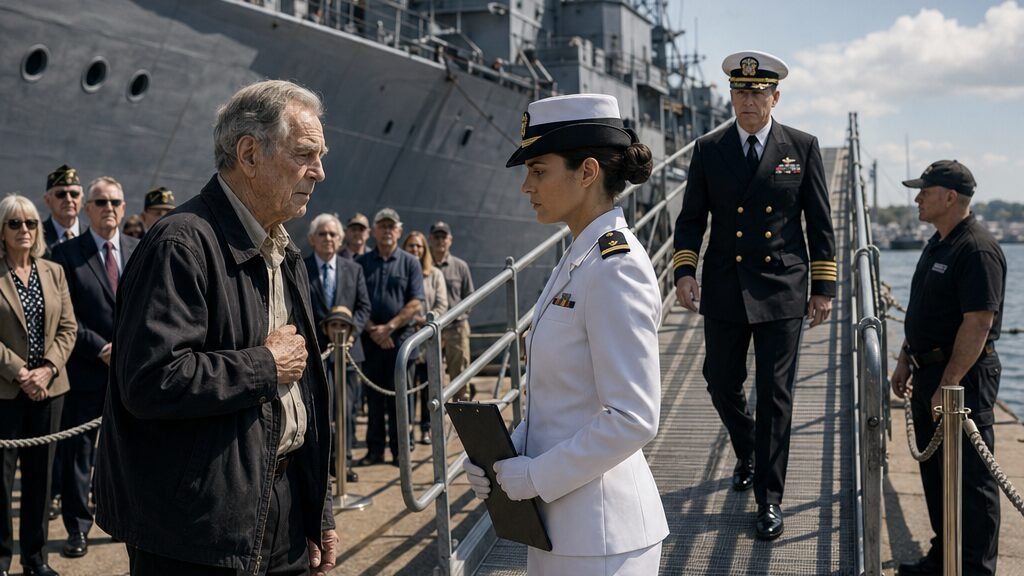
The young officer’s white-gloved hand came up before Joseph Campbell’s shoe touched the first strip of painted metal.
“Sir, this gangway is closed until I verify your access.”
Joseph stopped with one foot on the dock and one hand inside his jacket, fingers resting against folded paper so thin it felt more like cloth than record. Above him, the battleship rose broad and gray against the morning sun, its hull throwing a hard shadow over the water. Flags snapped from the mast. A speaker somewhere on deck tested a microphone, sending a dull pop across the dock.
Joseph had imagined this moment differently.
He had imagined the gangway empty. He had imagined placing his palm on the rail, feeling whether the metal still held morning cold. He had imagined taking the stairs slowly, one at a time, with no one rushing him, no one asking him to explain why his breath had shortened before he even reached the ship.
Instead, a line of ceremony guests waited behind a rope stanchion, holding clean invitations and folded programs. Their shoes shone. Their voices stayed low in the way people spoke near memorials and officers. Some wore veteran caps. Some wore black dresses or pressed suits. A few younger sailors stood along the dock, straight-backed, their faces serious and polished by duty.
Joseph wore a dark jacket that had grown loose at the shoulders, a pale shirt buttoned wrong at the cuff, and shoes he had cleaned twice before leaving home. His invitation, once cream-colored, had curled at the edges after a leak from the kitchen sink found it on the table two nights before. He had dried it under a book, but the ink had bled into faint blue ghosts.
The officer looked at it now without taking it from his hand.
Her nameplate read TORRES.
She was young enough to be his granddaughter, though Joseph had no granddaughter. Her white uniform was exact in a way that made the morning seem careless around her. She held a clipboard against her side. Her eyes moved from the warped invitation to his face, then to the line forming behind him.
“Your name, sir?”
“Joseph Campbell.”
She scanned the page clipped to her board. Her lips moved once without sound. Then again.
“I don’t see you listed.”
Joseph nodded, as if she had told him the tide was coming in. “It may be under crew guests.”
“This sheet includes veterans’ guests, former crew representatives, and registered family attendees.”
“Then maybe it was missed.”
The answer came too quietly. He heard it himself and disliked how old it sounded, not weak exactly, but worn down by having to cross too many rooms.
Officer Torres glanced at the dock security assistant beside the rope. “Do you have another form of confirmation?”
Joseph looked down at the invitation. It had arrived three weeks late, forwarded twice, the envelope soft from rain, his apartment number written in someone else’s hand. He had kept it beside his chair until this morning. He had touched it before leaving, then touched the other paper hidden inside his jacket.
“This was what they sent.”
“I understand, sir, but it’s damaged. I can’t read the full barcode.”
“I didn’t come for the barcode.”
The words left him before he could stop them.
Officer Torres’s expression shifted, not into anger, but into the careful patience of someone trained to handle difficulty in public. It was worse than anger. Anger meant she saw him as a man. Patience meant she saw him as a problem that might wander.
“Sir,” she said, lowering her voice, “we have a security protocol. The ceremony begins in less than an hour. If you’ll step to the side, we can try to contact registration.”
Behind Joseph, someone sighed softly. He did not turn. He had learned long ago that a sigh could become a crowd if you let it.
The gangway stood two steps away.
Its rails were freshly painted, the gray a little brighter than the hull, the non-skid strips new enough to show no wear. At the top, a sailor checked badges and guided guests toward the main deck. The ship’s name was painted near the brow, sharp and official. Joseph looked at the letters only once, then away. The name was not the one he carried.
A gull cried overhead.
His right hand remained inside his jacket. Beneath the lining, inside a flat envelope taped twice along one side, lay the folded log page. He had wrapped it in wax paper years ago, then in a plastic sleeve after a storm flooded his basement. The paper had once smelled of smoke and salt. Now it smelled faintly of old drawers, but when Joseph held it too long, the ship came back through his fingers.
“Mr. Campbell?” Officer Torres said.
Joseph blinked. “Yes.”
“You’ll need to step aside for the registered guests.”
He looked back at her then. Her jaw was firm, but not cruel. That mattered. Cruelty was easy to answer with silence. Firmness left a man standing in the wrong place with nothing to fight but procedure.
“I came early,” he said.
“I can see that.”
“Train came in before seven. I sat by the pier until they opened the gate.”
Her eyes softened for half a second, then tightened again around duty. “I’m sorry for the inconvenience.”
Inconvenience.
Joseph had heard that word in waiting rooms, offices, and phone calls where no one wanted to say no. It was a small word with clean shoes. It stepped around what mattered.
He folded the damaged invitation once and slipped it into his breast pocket, not the inner one. The inner pocket was for the other page.
The guests behind him began moving. A museum volunteer opened the rope for a group whose badges were already checked. A man in a navy blazer guided an elderly woman past Joseph with a hand at her elbow. She gave him an apologetic glance, as if he had dropped something and she could not help him pick it up.
Joseph stepped aside.
Only three feet. Just enough to clear the path. He stood near a mooring bollard painted black, the sun warming one side of his face while the ship’s shadow cooled the other.
The first guests climbed the gangway.
Their shoes made hollow sounds on the metal. Each footstep struck Joseph in the chest. He watched the rail take their hands. He watched the deck receive them. He watched strangers cross into a place where Benjamin Hill’s name would not be spoken.
Officer Torres checked badges with efficient movements. “Welcome aboard. Please proceed to the main deck. Programs are available near the memorial plaque.”
Programs.
Joseph looked toward a table beneath a white canopy. Stacks of folded paper sat in neat rows. The ceremony program showed the ship’s silhouette printed in dark blue. A young sailor handed one to a guest, who opened it and scanned the list inside.
Joseph knew Benjamin’s name would not be there.
He had called twice to ask. The first person had said all official names had been taken from the museum record. The second had said changes could not be made on the day of the ceremony. Neither had said Benjamin Hill. Not once.
He slid his fingers into his jacket again and touched the old page through its sleeve.
The paper did not accuse him. That was the worst of it.
It simply remained.
“Sir,” Officer Torres called, not sharply, but with warning.
Joseph looked up. He had taken one step toward the gangway without realizing it.
“I asked you to wait to the side.”
He lowered his foot back to the dock.
“I know.”
“If registration confirms your access, we’ll bring you forward.”
“And if they don’t?”
She hesitated. “Then I’m afraid you won’t be able to board.”
The ship groaned softly against its lines. Metal, rope, water. The old sounds arranged themselves under the morning noise, and for a moment Joseph was not on the museum dock but inside a passageway where heat pressed low and alarms split the air into pieces.
He closed his eyes once. Opened them.
A child near the rope asked an adult why the old man was standing there. The adult murmured something Joseph could not hear.
He could still leave. That thought came with a calmness that frightened him. He could turn around, walk back past the souvenir stand, past the parking lot, past the flags, and no one would know what he had failed to do except a man whose name was already missing.
Officer Torres accepted another badge. The line moved. The gangway swallowed one guest after another.
Joseph stood very still, his hand over the inner pocket of his jacket.
At the top of the gangway, someone tested the microphone again.
“Memorial roll call will begin at eleven hundred hours.”
The words drifted down bright and clear.
Joseph’s throat tightened, but his face did not change.
Officer Torres glanced toward him once more, then gestured to the open space near the bollard.
“Please remain there, sir. The ceremony guests need to board now.”
Chapter 2: The Officer Who Saw the Old Hull Number
Nicole Torres had been trained to watch hands.
Hands showed hesitation before voices did. Hands reached for phones, badges, pockets, railings, excuses. On a crowded ceremonial morning, when families came with grief folded into programs and old sailors came with memories they expected the ship to honor, hands told her who needed help and who might become a problem.
Joseph Campbell’s hand kept going to the same place inside his jacket.
Not fast. Not hidden. Just constant.
That was what made Nicole uneasy.
She had already asked the dock security assistant to contact registration. The reply had come back in the same flat way all inconvenient answers came back through radios: no Campbell on confirmed access list. Possible late invitation error. Hold at entry. Do not delay boarding.
Do not delay boarding.
She had repeated those words to herself while checking badges. She had learned that respect inside a uniform sometimes meant refusing to be moved by every trembling voice, every missing paper, every person who believed their reason was more important than the line behind them.
Still, the old man did not behave like the usual angry guest.
He did not argue about taxpayer money. He did not mention knowing someone important. He did not say he had served, though half the men on the dock had found a way to mention it before showing their badges. He simply stood where she told him, close enough to see the gangway, far enough to be excluded.
The ceremony guests thinned. The dock widened around him.
Nicole checked the last family group and signaled them through. “Main deck, port side. Please keep the passage clear.”
The mother thanked her. The child stared openly at Joseph as they passed.
Joseph did not seem to notice. His gaze stayed fixed on the ship.
Nicole looked at the schedule clipped beneath her access sheet. Senior officer arrival: 1010. Memorial rehearsal: 1025. Public remarks: 1100. She had twelve minutes before the dock needed to be clear.
She walked toward Joseph.
“Mr. Campbell.”
He turned slowly, as though returning from somewhere farther away than the bollard.
“Registration couldn’t confirm your access.”
He nodded once.
“I’m sorry.”
“I heard your radio.”
Nicole had kept the volume low. She glanced at the security assistant, then back at him. “Then you understand.”
“No,” he said. “I understand what they said.”
The distinction landed harder than she expected.
She drew a breath. “Sir, I can ask someone from museum administration to speak with you after the ceremony.”
“After?”
“The program is already set.”
His mouth moved almost into a smile, but it did not reach his eyes. “That’s what they told me on the phone.”
Nicole kept her voice even. “What exactly were you hoping to do aboard?”
The old man looked at the gangway. “Stand where I said I would stand.”
“To whom?”
He did not answer.
The wind lifted the corner of his jacket. Nicole saw the edge of a plastic sleeve in the inner pocket, browned paper inside it, folded and refolded until its creases looked permanent.
“Sir,” she said, gentler now, “may I see what you keep reaching for?”
His hand stilled over the pocket.
For the first time since she had stopped him, something like alarm crossed his face. Not fear of her. Fear of losing whatever the paper held.
“I won’t take it from you,” Nicole said.
He studied her for a long moment. The ship creaked behind them. From above came the muffled scrape of chairs being arranged on deck.
Joseph reached inside his jacket and drew out the sleeve.
He held it with both hands.
The plastic was old and slightly clouded. Inside lay a sheet of paper stained brown at one edge, the writing faded into uneven lines. It was not a certificate. Not an invitation. Not anything Nicole had expected. It looked like something rescued from a damp drawer or a fire-damaged file.
He did not hand it to her. He turned it just enough for her to see.
Nicole leaned closer.
Across the top, in block letters almost eaten by time, was an old hull number. Beneath it were columns of times and compartments. Damage-control entries. Handwritten additions. A smeared notation beside one line.
She could make out only pieces.
Forward passage.
Valve team.
B. Hill.
Her eyes moved to the margin.
There, in a different hand, faint but legible, was another name: J. Campbell.
Nicole looked up.
Joseph folded the sleeve back toward himself before she could ask.
“You were crew,” she said.
He did not correct her. He did not confirm it either.
“I came for a name,” he said. “Not a seat.”
The words changed the dock around her.
Nicole felt the back of her neck warm. She looked toward the canopy where the printed programs lay in neat stacks. She had read one during briefing. Former crew. Lost shipmates. Donor acknowledgments. Scheduled remarks. Everything clean and centered.
“Whose name?” she asked.
Joseph’s jaw tightened, almost imperceptibly.
Before he could answer, boots sounded on the gangway above them.
Nicole turned.
Patrick Moore descended from the ship in dark dress uniform, one hand near the rail but not using it. Even before she saw his face clearly, Nicole straightened. The dock security assistant did the same. Patrick had the kind of presence that made a space organize itself: not loud, not hurried, but weighted.
He paused halfway down when he saw Joseph.
For one second, nothing moved except the flags.
Then Patrick continued down the gangway more slowly.
“Lieutenant Torres,” he said, though his eyes remained on Joseph.
“Sir,” Nicole answered. “This guest’s access could not be verified. Registration has no confirmed listing, but he has a damaged invitation and an old document related to the ship. I was just—”
Patrick raised one hand, not to silence her harshly, but to stop the procedure from filling the air.
He stepped onto the dock.
Joseph put the plastic sleeve back inside his jacket.
Patrick saw the movement. His gaze sharpened.
“Mr. Campbell,” he said.
Nicole looked from one man to the other.
Joseph’s face did not change, but something in him seemed to brace. “Captain.”
Patrick came closer. “Joseph Campbell?”
“Yes.”
“Damage control, forward repair party?”
Joseph’s eyes lowered.
Nicole’s stomach tightened. The dock seemed suddenly too bright, the white of her gloves too visible.
Patrick removed his cover.
It was a small gesture, but it stripped the moment of ceremony and made it personal. He held the cover at his side.
“I saw your name in the oral history files when I was assigned here,” Patrick said. “There were only three surviving statements from that night.”
Joseph looked past him at the gangway. “Statements leave things out.”
“Yes,” Patrick said quietly. “They do.”
Nicole waited for Joseph to say more. He did not.
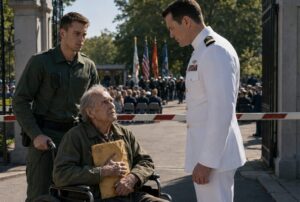
Patrick’s posture changed. His shoulders squared, his heels drew together, and the morning noise seemed to fall away from him. He raised his right hand in a formal salute.
Not to the crowd. Not for the guests. Not as a performance.
To Joseph.
The old man looked at him for half a heartbeat as if he wished Patrick had not done it, as if honor could be too heavy when it arrived late. Then Joseph lifted his own hand, slower, less crisp, the fingers not quite as straight as they must once have been. He returned the salute.
Nicole stood still.
She had seen salutes a thousand times. At gates. On decks. In ceremonies. Across parking lots and office corridors. But she had never watched one rearrange a person in her mind.
Minutes ago, Joseph Campbell had been an access problem with a damaged invitation. Now the same jacket, the same shoes, the same careful hands seemed to hold a room she had not known existed.
Patrick lowered his salute first.
“Mr. Campbell,” he said, “you should have been brought aboard.”
Joseph’s answer came softly. “That depends why.”
Patrick’s face tightened with confusion.
“I’m not here to be brought anywhere special,” Joseph said. He took the plastic sleeve out again, not fully, only enough for the top edge to show. “I called because the roll is wrong.”
Nicole found herself speaking before she meant to. “The memorial roll?”
Joseph looked at her then. Not with accusation. That made it worse.
“There’s a man missing.”
Patrick’s voice lowered. “From today’s program?”
“From more than today.”
The ship bell rang once above them, part of some rehearsal cue, the sound clean and deep over the dock.
Joseph held the sleeve against his chest as if it were not evidence but a wound he had learned to cover.
“Benjamin Hill,” he said. “His name is not on the program.”
Chapter 3: A Salute Was Not the Same as Listening
Patrick Moore knew the difference between a ceremony running late and a ceremony going wrong.
Running late could be repaired with shorter remarks, quicker seating, a look passed to the announcer. Going wrong was quieter. It happened when the words prepared for honor failed the person standing in front of them.
He led Joseph Campbell through a side entrance beneath the visitor banner instead of up the main gangway. It was not the entrance Patrick wanted to use, but it kept them out of the line of guests now settling on the deck. Nicole followed two steps behind, carrying her clipboard as if it had become heavier since the salute.
Inside the museum office, the air changed. The room smelled of old paper, coffee left too long on a warmer, and the faint metallic dampness that every ship seemed to keep somewhere inside its walls. A framed photograph of the battleship during active service hung above a file cabinet. In the photograph, the ship cut through open water, young and hard-edged, its guns pointed toward a horizon no museum visitor had to fear.
Joseph stood just inside the door.
Patrick gestured to a chair. “Please.”
Joseph looked at it, then sat carefully, not because he wanted to, Patrick thought, but because refusing would have made people fuss.
Nicole remained near the wall.
Patrick removed his cover and placed it on the desk. “Mr. Campbell, I owe you an apology.”
Joseph’s hands rested on his knees. “You don’t owe me one.”
“My officer stopped you from boarding.”
“She did her job.”
Patrick glanced at Nicole. Her face held steady, but color had risen beneath her cheekbones.
“Still,” Patrick said, “the situation should have been handled with more care.”
Joseph looked toward the closed office door. Through it came faint ceremony sounds: footsteps, a microphone check, a volunteer’s laugh quickly hushed.
“Care is what I came about.”
Patrick sat across from him. “Tell me about Benjamin Hill.”
For the first time, Joseph’s fingers moved. Not to the invitation. Not to his knee. To the inner pocket.
He drew out the plastic sleeve and held it across his lap.
Patrick did not reach for it.
That restraint seemed to matter. Joseph watched his hands for a moment before sliding the sleeve across the desk. The paper inside rasped faintly against plastic.
Patrick took it at the edges.
The document was more fragile than it had looked on the dock. Salt had bloomed into pale stains along one side. Part of the upper corner was gone. The handwriting changed in places, some entries printed by regulation, others written fast and slanted, the kind of writing done while a ship still demanded more from a man than neatness.
Nicole stepped closer despite herself.
Patrick read the old hull number, the date, the compartment notations. Some terms had become museum language now, labels on plaques and diagrams. On this page they were not labels. They were orders, movements, heat, breath.
Beside a time entry, someone had written: Hill to forward valve with Campbell. Smoke heavy. Return uncertain.
Below that, another hand: Campbell recovered. Hill unconfirmed.
Patrick looked up. “Where did you get this?”
“From a locker that should have burned worse than it did.”
“That is not an official chain of custody.”
Joseph nodded. “No.”
Patrick waited.
Joseph’s gaze dropped to the page. “A chief gave it to me before I transferred off. Said if the Navy ever forgot the small parts of the night, I should remember them.”
“And did you submit it?”
“Once.”
“When?”
“Long time ago.”
Patrick leaned back slightly. He knew what that meant. A letter sent to an office. A copy mailed to a records center. A reply that thanked the sender and changed nothing. The military could move mountains when ordered and misplace a man inside a folder when not.
“We have Benjamin Hill listed in the casualty summary,” Patrick said carefully.
“Not today.”
“In the general record, I mean.”
“As what?”
Patrick did not answer immediately.
Joseph looked at him then, and the old man’s eyes were clear enough to make evasion useless.
Patrick opened the ceremony folder on the desk. He had reviewed it twice that morning. Names of honored crew representatives. Names of deceased personnel being read aloud. Names connected to the specific incident being memorialized.
Benjamin Hill was not there.
“I don’t know why he wasn’t included in the roll call,” Patrick said.
Joseph’s mouth tightened. “Because the summary says he was unconfirmed in compartment loss.”
Nicole’s head turned sharply.
Patrick looked back at the page.
Joseph continued, “That makes it sound like he was found by the fire. Like he was just where the fire reached him.”
Patrick heard the strain beneath the old man’s controlled voice.
“He was not,” Joseph said.
The office went quiet.
A radio cracked on the desk. Patrick turned the volume down without taking his eyes off Joseph.
“What are you asking us to do?” Patrick asked.
Joseph folded his hands. The plastic sleeve lay between them like a third presence.
“Say his name where you’re saying the others.”
“That may require verification.”
“I know.”
“The printed program is already distributed.”
“I know that too.”
“And if the official record does not support a change today—”
Joseph nodded again, almost kindly, as if Patrick were the one who needed help bearing the sentence. “Then I’ll have come too late.”
Patrick felt the words land in the room.
He had saluted the man on the dock. It had been correct. Earned. Instinctive. But now he understood how easy it had been. A salute took three seconds and cost nothing but posture. Listening threatened the schedule, the file, the institution’s clean language, and the comfort of everyone who had come expecting honor without complication.
Nicole spoke from near the wall. “Sir, the archive coordinator is on board. Sharon Roberts. She has access to the incident file.”
Patrick looked at her. Her voice was quieter than it had been at the gangway. Not uncertain. Changed.
“Get her,” he said.
Nicole left immediately.
Joseph reached for the sleeve, then stopped. Patrick slid it back toward him carefully.
“I can have you seated with the former crew representatives,” Patrick said.
Joseph’s eyes stayed on the document. “That’s not why I came.”
“You are entitled to be there.”
“I was entitled to leave that night too,” Joseph said.
Patrick said nothing.
Joseph seemed to regret the words as soon as they came out. He put the sleeve back inside his jacket, buttoned the pocket with slow fingers, and looked toward the framed photograph above the file cabinet.
“She looked different then,” he said.
“The ship?”
Joseph nodded. “Everything looks braver from far away.”
The door opened before Patrick could answer.
Nicole entered with Sharon Roberts, the museum archive coordinator, a woman in a dark blazer with reading glasses hanging from a cord at her neck. She carried a tablet and a thin folder marked with the ship’s insignia.
Her eyes moved from Patrick to Joseph, then to the chair, the pocket, the old invitation now lying on the desk.
“Captain,” she said, “Lieutenant Torres said there is a disputed memorial entry.”
Patrick stood. “A possible omission.”
Sharon’s expression sharpened into professional caution. “For today’s ceremony?”
“For the fire-response roll.”
She opened the folder. “That list was cross-checked against the official casualty summary and prior memorial records.”
Joseph looked at her but did not speak.
Patrick said, “The name is Benjamin Hill.”
Sharon scanned her tablet. Her finger stopped once, then moved again. “Benjamin Hill is in the general incident file.”
“Not on the roll,” Nicole said.
Sharon glanced at her. “Because his classification is unresolved in the surviving record.”
Joseph’s hand closed over the inner pocket of his jacket.
Patrick heard the smallest sound from the plastic sleeve inside.
Sharon’s face softened in the way people soften before delivering an answer they do not intend to change. “I’m sorry. Without stronger documentation, the official file does not support changing the memorial roll.”
Chapter 4: The Clean File and the Burned Page
Sharon Roberts trusted paper most when it had been kept properly.
The archive room sat below the public exhibit deck, sealed away from the bright flags and polished announcements above. Its light was soft and colorless. Metal shelves ran wall to wall, each labeled with clean white tags. Flat boxes held photographs, ship diagrams, maintenance logs, casualty summaries, oral history transcripts, and donation records from families who wanted some part of their dead kept near the ship.
Here, grief had accession numbers.
Sharon placed the official incident file on the center table and opened it with both hands. She did not do this for drama. She did it because the file was old, and old things deserved to be handled without performance.
Joseph Campbell sat across from her, his back straight despite the chair being too low. Patrick Moore stood near the end of the table. Nicole Torres remained by the closed door, as if she still had a post to hold, only now the threshold was not a gangway but the distance between official memory and one man’s hands.
Sharon set her tablet aside. “I want to be clear before we begin. I’m not saying Mr. Campbell is wrong. I’m saying I cannot alter a memorial roll based on a loose page unless I can connect it to the existing record.”
Joseph nodded.
He had done that often since she entered the office. Sharon noticed it. He nodded as if every obstacle had been expected. Not accepted. Expected.
“May I see the page again?” she asked.
Joseph’s fingers went to the inner pocket, then paused.
Patrick saw it too. “We can photograph it without removing it from the sleeve.”
Joseph looked at Sharon.
She lowered her voice. “I will not take it out of your sight.”
Only then did he slide the plastic sleeve across the table.
Sharon received it gently, but she kept her face neutral. She had learned not to reward every dramatic artifact with belief. Museums drew stories the way ships drew barnacles. Some were true. Some were half-remembered. Some had grown around objects until the object itself no longer knew where history ended and longing began.
The page was fragile, salt-stained, browned on the left edge, torn at one corner. It was not impossible that it came from the ship. It was also not proof enough.
She angled it under a desk lamp.
The hull number matched. The date matched the night of the fire-response incident. The compartment codes were period-correct. The handwriting appeared consistent with hurried watch entries from the era, though she would need comparison samples to say more. The line concerning Hill and Campbell was partly obscured where salt had blurred the ink.
“Forward valve,” she read softly.
Joseph’s gaze fixed on the table.
Sharon opened the official folder and drew out a copied casualty summary. The page was clean, flattened, preserved in a protective sheet. She turned it toward Patrick, then Joseph.
“The museum’s current roll was built from this summary, the later crew roster, and two prior ceremony lists,” she said. “Benjamin Hill is present in the general casualty file, but not listed under confirmed rescue or fire-response action.”
“He was not rescue,” Joseph said.
Sharon looked up.
“He was repair party,” Joseph said. “We weren’t rescuing anyone. We were trying to keep her from taking more with her.”
The words were plain. That made them harder to place in the room than if he had spoken with anger.
Sharon searched the official page. “The classification here says ‘unconfirmed compartment loss during secondary smoke event.’”
Joseph’s eyes closed once.
“That’s a clean sentence,” he said.
Nicole shifted near the door.
Patrick leaned forward. “What should it say?”
Joseph did not answer.
Sharon watched his right thumb press against the seam of his jacket. The motion was small, repeated, controlled. He was not a man eager to tell a story. He was a man standing with his hand over a door he had kept shut for most of his life.
She softened her tone but not her standards. “Mr. Campbell, I need details that connect your page to the incident record. Not feelings. Not general memory. Details.”
Patrick frowned slightly, but Joseph lifted one hand, stopping him.
“She’s right,” Joseph said.
Sharon felt no satisfaction in that.
She pulled a notepad closer. “The incident began at 0217 according to the summary. Electrical fault, followed by smoke spread through the forward passage. Do you dispute that?”
“No.”
“The first alarm was logged at 0218.”
Joseph looked at the official paper. “No.”
Sharon’s pen paused.
“The first alarm bell struck before the phone talker got it through,” Joseph said. “Four short. Then one long. Then four short again because the circuit skipped.”
Sharon stared at him.
Patrick’s expression changed, not to recognition this time, but to attention sharpened by unease.
“That isn’t in the public summary,” Sharon said.
“No.”
“Is it in your page?”
Joseph shook his head. “No need to write down a bell when everyone heard it.”
Sharon turned to the official file and began looking through the supporting material. She knew the summary well enough to know the alarm sequence was not there. She opened a scanned transcript from a crew interview. Nothing. Another damage diagram. Nothing. A maintenance note about faulty circuits two weeks before the fire. There, in the margin of a photocopy, an engineer had written: intermittent signal repeat reported, forward alarm panel.
She did not say anything yet.
Joseph watched her find it.
“Forward alarm panel,” he said. “It had been acting up since drills in March. Chief said we’d fix it properly after inspection. We said that about everything.”
Sharon looked at him for a long moment.
The archive room seemed to settle around them, the metal shelves holding their breath. Above, through the ceiling, came faint movement from guests gathering on deck. Chairs scraped. A microphone hummed. The ceremony was getting closer while the past refused to fit into its allotted place.
Sharon turned another page. “The casualty summary says the valve was secured before evacuation.”
“Yes.”
“By whom?”
Joseph looked down.
The silence lengthened.
Nicole’s face tightened as if she wanted to step forward but knew she had not earned the right.
Patrick asked quietly, “Mr. Campbell?”
Joseph lifted his eyes to the official summary. Not to Sharon. Not to Patrick. To the clean line where Benjamin Hill had been made smaller.
“Benjamin,” he said.
Sharon wrote the name carefully.
Joseph reached toward the old page but did not touch it. “He had smaller hands than mine. There was a wheel jammed half-open. Heat made it swell. I couldn’t get enough turn on it. He could.”
Sharon glanced at the log page. Hill to forward valve with Campbell. Smoke heavy. Return uncertain.
“You were with him?” she asked.
Joseph nodded.
“And you survived.”
The pen stopped in Sharon’s hand the moment she said it. She had meant only to confirm sequence. The words came out too clean, too close to accusation.
Joseph did not flinch. That made her feel worse.
“Yes,” he said.
Patrick looked away toward the shelves.
Sharon turned back to the files, searching faster now but still carefully. She found a compartment diagram and rotated it so Joseph could see.
“Show me where.”
His hand hovered over the map. Age had bent two fingers slightly inward. The nail of his index finger was clipped too close. He traced the passage without touching the paper at first, then placed one fingertip near a small marked hatch.
“Here.”
Sharon compared the spot to the summary.
“That hatch was reported blocked.”
“It was.”
“But you came through it?”
Joseph’s mouth tightened. “Not by myself.”
The room grew very still.
Sharon felt her skepticism change shape. It did not disappear. It became something more careful. The clean file remained clean. The burned page remained damaged. But between them stood an old man naming alarm patterns, faulty panels, hatch locations, and a valve no ceremony program had bothered to understand.
She closed the folder halfway, not as refusal, but as respect for what it did not contain.
“I can’t officially revise the roll from this alone,” she said.
Joseph nodded again, but this time she saw the cost of it.
“But,” Sharon continued, “I can say there is enough here to question the omission. Enough for a spoken acknowledgment, if Captain Moore authorizes it as a pending correction rather than a finalized record change.”
Patrick’s gaze lifted.
Nicole took one small breath.
Joseph did not move.
Sharon looked at him directly. “I need one more thing from you. Not for the file. For me.”
His eyes sharpened.
“The bell pattern,” she said. “Say it again.”
Joseph’s face changed then, not dramatically, not for anyone else to notice unless they were watching as closely as she was. His expression emptied, as if the archive table had dropped away and the ship had tilted beneath him.
When he spoke, his voice was lower.
“Four short,” he said. “One long. Four short. Then the general alarm caught up and swallowed it.”
Chapter 5: The Name He Would Not Say Twice
Joseph had not gone below deck to remember.
He had gone because Patrick asked whether he could identify the passage from the diagram, and Sharon said the lower exhibit level still preserved enough of the original layout to compare against his statement. Nicole walked behind them with the log page secured in a temporary archival folder, the plastic sleeve still visible through the clear cover. Joseph had watched Sharon place it there. He had watched her hands. They were careful hands. That helped and did not help.
The passageway below the public deck was cooler. The museum had painted the pipes, mounted safety signs, and placed low barriers where visitors should not step, but the bones of the ship remained. Narrow overhead. Hard turns. Metal that remembered being useful before it became educational.
Joseph moved slowly.
No one rushed him.
That was new.
Patrick walked ahead just enough to guide, not enough to lead. Sharon carried a printed compartment map against a clipboard. Nicole said nothing. Her silence was no longer the polished silence of duty. It had weight in it.
At the first turn, Joseph stopped.
The passage narrowed toward a hatch rimmed in red paint for visitors. A small plaque explained damage-control procedures in simple language. Children on field trips probably read it and imagined brave men with hoses and helmets. The plaque did not mention smoke moving like something alive. It did not mention how metal could sweat. It did not mention how a man’s voice changed when he tried not to cough because the man beside him needed to hear.
“This isn’t exact,” Sharon said gently. “Some sections were restored.”
Joseph nodded. “Paint’s wrong.”
Patrick looked at the bulkhead. “The paint?”
“Too clean.”
No one answered.
Joseph stepped closer to the hatch. His hand rose, then stopped before touching the rim. Museum rules said not to touch. He had broken bigger rules, once. He did not break this one.
“It was darker,” he said. “Not because the lights were out. Because the smoke took the light and kept it.”
Sharon made a note, then stopped writing, as if the motion suddenly felt too loud.
Patrick said, “You don’t have to continue.”
Joseph almost smiled. “That’s what everybody says just before they need you to.”
The words were not bitter. They were tired.
Nicole lowered her eyes.
Joseph looked through the hatch.
For a moment, the red museum paint thinned into scorched steel. The safety chain disappeared. The polished air turned hot and bitter.
He was young again, younger than Nicole, younger than Patrick, with gloves stiff from water and smoke, a rag tied wrong across his mouth, one shoulder bruised from striking a frame he could not see. Benjamin Hill was ahead of him, smaller and quicker, laughing earlier that night about coffee strong enough to float a wrench.
Not laughing now.
“Campbell, wheel’s stuck.”
“I’ve got it.”
“You don’t.”
“I said I’ve got it.”
“You’ve got arms like a crane and hands like a damn anchor. Move.”
Joseph closed his eyes in the museum passage.
The memory did not come as a story. It came as heat under his collar. A bell pattern. A glove slipping. Benjamin’s shoulder pressed against his ribs in the cramped dark. The valve wheel refusing them both until Benjamin found an angle Joseph could not.
“Mr. Campbell?”
Nicole’s voice came from behind him.
He opened his eyes.
“I’m here,” he said.
Patrick stepped closer but did not touch him. “What happened at the valve?”
Joseph kept looking through the hatch.
“We were sent to secure it before the fire reached the line. If it stayed open, pressure fed where it shouldn’t. That’s what we were told. Maybe there were better words for it later.”
Sharon said, “The report says the valve was found closed.”
“It was.”
“By Benjamin Hill?”
Joseph’s fingers curled.
He had said the name once in the archive room. He had said it on the dock when he had to. Each time, something in him had pulled back, as if the name were attached to a hatch he could not keep shut.
“Yes,” he said.
“Can you describe how you know?”
Joseph turned from the hatch then.
Sharon’s face was cautious but not cold. Patrick’s was grave. Nicole’s was open in a way it had not been at the gangway. Joseph wished they would all look away. A man could carry a page for decades and still not want witnesses when it opened.
“He was in front of me,” Joseph said. “He got the wheel moving. We heard the line change. You could feel it in the deck. Like a throat clearing.”
Sharon wrote that down.
Joseph watched the pen move and nearly asked her not to.
“Then?” Patrick asked.
“The smoke dropped.”
Nicole frowned slightly. “Dropped?”
“It had been high enough we could work bent over. Then something shifted. Door opened somewhere, fan pulled wrong, I don’t know. It came down on us.”
He remembered Benjamin’s hand at the back of his coat. Not dramatic. Not heroic. Angry, almost.
“Move, Joe.”
“I can finish it.”
“It’s done.”
“I can—”
“You can tell them.”
Joseph’s mouth went dry.
He had not told them. Not properly. Not then. Not when it would have mattered cleanly. He had woken in a medical bay with his throat raw and his hands bandaged and a chief telling him Hill was unconfirmed. Unconfirmed had sounded temporary. Then temporary became record. Record became program. Program became omission.
Patrick’s voice was low. “He pushed you through?”
Joseph looked at the hatch.
“There was a rim,” he said. “I caught it wrong. Couldn’t get my foot. He put his shoulder under me. I told him to stop. He said—”
The words failed.
He did not want to say what Benjamin had said. It belonged to the smoke, not this painted corridor.
Nicole stepped forward one pace. “You don’t have to repeat it.”
Joseph looked at her.
At the gangway, she had told him to step aside. Now she was offering him a place not to go.
That small change hurt him more than her dismissal had.
“He said, ‘Tell them I closed it,’” Joseph said.
No one moved.
Joseph pressed his hand flat against his jacket pocket, though the page was with Nicole now. For the first time all morning, his hand found nothing there.
“I thought I had,” he said. “Maybe I did badly. Maybe I was young and half full of smoke and said it to the wrong man. Maybe the chief knew and the paper went missing after. Maybe nobody wanted another sentence in a report already full of losses.”
Patrick’s jaw tightened.
Joseph looked at him, then at Sharon. “I let ‘unconfirmed’ stand because every time someone asked me, they called me the survivor.”
The word hung in the passageway.
Survivor.
It sounded like praise when other people said it. To Joseph, it had always sounded like a question with no decent answer.
Sharon lowered her clipboard.
“The record says you were recovered near the hatch,” she said.
Joseph nodded. “He made sure of that.”
“And Hill?”
Joseph looked back through the hatch. The museum light caught the red paint and made it too bright.
“He stayed where the work was.”
Nicole stood near the wall, one hand against her clipboard, though she no longer looked at the paperwork. She looked at Joseph as if seeing the whole scene from the dock again: his hand in his jacket, his damaged invitation, his refusal to leave, his quiet sentence about coming for a name.
Patrick said, “Mr. Campbell, what do you want said today?”
Joseph had expected the question. He had feared it anyway.
He could ask for a correction. A phrase. A line. He could give them the clean version: Benjamin Hill secured the valve and saved lives. It would be true enough. It would also leave out the sound of Benjamin’s breathing, the shove at his back, the shame of waking up without him.
“I don’t want them to make him bigger than he was,” Joseph said.
Sharon’s eyes softened.
“He was nineteen,” Joseph said. “He cheated at cards badly. Sang worse. Kept a picture of a dog that wasn’t his because he missed home and didn’t want to say so.”
A faint, broken warmth moved through his voice and vanished.
“He closed the valve,” Joseph said. “He got me out. Then he didn’t get out. That’s all.”
Patrick was silent.
Joseph looked down at his hands. They seemed older than they had that morning. Perhaps they had always been and he had refused to notice.
“I should have said it better when it mattered.”
“You’re saying it now,” Nicole said.
Joseph turned.
She stood partly behind a bend in the passage, as if she had stopped herself from coming too close. Her face was pale. Her voice did not carry the crispness from the dock.
“I almost kept you from saying it at all,” she said.
Joseph looked at her for a long moment.
Then he shook his head once. “No. You kept a gangway. I kept a silence.”
Nicole had no answer.
From above, the public announcer’s voice filtered through the ship.
“Ladies and gentlemen, the memorial ceremony will begin shortly. Please take your seats on the main deck.”
Patrick looked toward the overhead, then back at Joseph.
Time had found them again.
Sharon closed her folder. “We can support a pending spoken acknowledgment. Not a final record correction today. Not yet.”
Joseph nodded.
Patrick said, “Then we’ll add it before the roll call.”
Joseph’s eyes sharpened. “Not add me.”
“No,” Patrick said. “Benjamin Hill.”
Nicole looked down at the archival folder in her hands. Through the clear cover, the old page waited.
Joseph stared at it.
Then, for the first time, he held out his hand not to take the page back, but to steady himself against the bulkhead. His palm hovered over the painted metal and stopped short.
“Don’t dress him up,” he said.
Patrick shook his head. “We won’t.”
Joseph began to walk toward the ladder back up, slower than before.
Behind him, Nicole remained in the passage for one breath longer, looking at the hatch Joseph had not touched. She understood then that she had not nearly blocked an old man from a ceremony.
She had nearly blocked the last living witness to a promise.
Chapter 6: Before the Roll Call Began
The printed programs were already in people’s hands.
Nicole saw them everywhere when she stepped onto the main deck: folded across laps, tucked beneath purses, held between old fingers with swollen knuckles, flattened against the knees of men wearing service caps. The ship’s silhouette looked dignified on the front page. Inside, the roll call waited in clean type.
Clean type did not leave room for a late truth.
The chairs faced the memorial plaque beneath a canopy that snapped softly in the wind. Beyond the rail, the dock lay bright below them, the gangway stretching back toward land. Nicole could see the black bollard where Joseph had stood after she told him to step aside. From this height, the spot looked ordinary. That troubled her more than if it had looked marked.
A public announcer checked the microphone near the podium. Museum volunteers adjusted a wreath. Junior sailors stood along the rail, their uniforms immaculate, their eyes forward. Families murmured in rows, unaware that below deck, a name had shifted the weight of the ceremony.
Patrick spoke with the announcer in a low voice. Sharon stood beside him with the official folder pressed to her chest and the archival cover held flat against it. Joseph remained a few paces away near the memorial plaque, not seated with the former crew representatives despite Patrick’s offer. He stood at the edge of the arranged space, where he could see the water.
Nicole approached him slowly.
“Mr. Campbell.”
He turned.
The sun had found every line in his face. On the dock, she had seen his age first. Now she saw control. Not the stiff kind drilled into officers, but the kind built from not falling apart in public for so long that the body learned it as posture.
“The ceremony begins in six minutes,” she said.
“I heard.”
“Captain Moore is speaking with the announcer.”
Joseph nodded.
She wanted to say something useful. Everything that came to mind sounded small.
“I’m sorry,” she said.
He looked at her with mild surprise, as if apologies were not what he had expected from the day and he did not know where to set one down.
“For the gangway,” she added.
“You had a list.”
“I had a man in front of me.”
The sentence came out before she could polish it. She let it stand.
Joseph looked toward the gangway. Guests were still being guided away from it, late arrivals hurried into the back row. “Lists are easier.”
“Yes,” Nicole said. “They are.”
Patrick came over with Sharon. His face had the composed strain of a man holding a schedule in one hand and a moral problem in the other.
“We have a narrow path,” he said.
Joseph looked at him.
“The printed program cannot be changed. The official museum record cannot be revised today. Sharon will open a formal correction review with the supporting documents, including your page, your statement, and cross-referenced technical notes.”
Joseph’s expression did not change, but Nicole saw his fingers curl once at his side.
Patrick continued, “For today, I can authorize a spoken addendum before the fire-response roll. It will be identified as a pending correction based on surviving witness testimony and supporting ship documentation.”
Joseph looked past him to the rows of guests.
“Pending,” he said.
Sharon answered carefully. “That word protects the record from being careless. It does not dismiss what you told us.”
Joseph considered that.
Nicole watched him and understood, with a sudden tightness in her throat, how cruel process could sound even when spoken gently. Pending meant not yet. Joseph had lived too long with not yet.
Patrick said, “It is the most I can do honestly today.”
“Honestly matters,” Joseph said.
The answer seemed to release something in Patrick’s shoulders.
“We need to know who should read the addendum,” Patrick said. “I can do it.”
Joseph looked at the podium. “You didn’t stop me at the gangway.”
Nicole went still.
Patrick followed Joseph’s gaze to her.
For a moment, the deck noise receded. Nicole heard only the slap of water below and the faint ringing of metal somewhere in the ship.
Joseph turned to her. “You asked what I kept reaching for.”
Nicole swallowed. “Yes.”
“Ask again.”
Sharon opened the archival cover. The old page lay protected inside, its brown edge and faded lines visible beneath the plastic.
Nicole understood then and almost stepped back from it. Not because she did not want the responsibility. Because she did.
“Mr. Campbell,” she said, and stopped.
Her voice had become too formal. She tried again.
“Joseph,” she said, then hesitated, unsure if she had earned that.
He did not correct her.
“May I hold the page?”
He looked at her hands.
She had removed her gloves below deck without remembering to put them back on. Her bare fingers looked young against the clear cover Sharon held. Nicole was suddenly ashamed of how carelessly she had handled the morning before the page had a name.
“Not by the corner,” Joseph said.
Nicole nodded.
Sharon showed her how to support the folder from beneath. Nicole accepted it with both hands. The old paper weighed almost nothing. That was the terrible part. A page could be so light and still change the way a person stood.
Joseph watched her hold it.
“May I read from it?” Nicole asked.
His eyes moved to the memorial plaque. Names were engraved there from other years, other losses, other clean decisions already made.
“The part that matters is hard to see,” he said.
“Show me.”
He stepped closer.
Patrick and Sharon moved aside without being asked.
Joseph lifted one finger and pointed through the plastic, not touching the paper itself. His hand trembled once, then steadied.
“There,” he said. “Hill to forward valve with Campbell. Smoke heavy. Return uncertain.”
Nicole read the faded words silently.
“And here,” Joseph said, moving to the lower notation. “Campbell recovered. Hill unconfirmed.”
His finger remained over the last word.
Unconfirmed.
Nicole felt the word change inside her. On a report, it meant incomplete evidence. In Joseph’s life, it had meant a man held in the doorway between being known and being lost.
“What do you want me to say?” she asked.
Joseph’s answer did not come quickly.
Around them, the guests settled. The announcer tapped the microphone and glanced toward Patrick. A museum volunteer lifted one hand from across the deck, asking without words whether they were ready.
Patrick did not respond.
Joseph looked toward the gangway again. Its top rail shone in the sun. Nicole remembered his foot halted before the first strip of metal. She remembered her own hand raised to stop him.
“I don’t know how to make it right,” Joseph said.
Nicole held the folder tighter beneath her palms.
“No one is asking you to make all of it right.”
He looked at her.
She heard her own words and knew they were for herself too.
“Just tell me what not to get wrong.”
Joseph’s face shifted.
Not relief. Not yet. But something in him recognized the difference between being handled and being asked.
He reached into his breast pocket and removed the damaged invitation. The paper had bent again from being carried. He looked at it, then folded it once along the ruined crease.
“They printed this one fine,” he said softly. “Even after the water got it, it still says where to go.”
He placed it back in his pocket.
Then he touched the archival folder lightly, not over his own name, but over Benjamin’s.
“He closed the valve,” Joseph said. “He got one man out. The report lost the first part and made too much of the second.”
Nicole waited.
His eyes stayed on the page.
“If you read it, don’t make him a symbol. Don’t make him brave for people who like brave better than young.” His voice thinned but did not break. “Say he was Seaman Benjamin Hill. Say the record is under review. Say surviving testimony credits him with securing the forward valve during the fire-response action.”
Nicole repeated it quietly, making sure each word had its place.
Joseph nodded once.
Patrick glanced toward the announcer, then back. “We need to begin.”
Joseph took a small step away from the group.
Nicole thought he was moving toward his seat. Instead, he looked toward the gangway stairs leading down to the dock.
“Mr. Campbell?” Patrick said.
Joseph’s hand went to the rail.
“I heard what I needed,” Joseph said. “You can say it without me standing there.”
Nicole looked at him, startled. “You’re leaving?”
“I came to bring the name.”
“But you should hear it.”
Joseph’s eyes remained on the gangway.
The barrier was gone now. No one blocked him. No one asked for a badge. He had crossed it, and yet Nicole saw that he was preparing to let Benjamin’s name be spoken behind him, safely distant from his own face.
“It isn’t mine to hear,” Joseph said.
Nicole looked down at the page in her hands.
Then she understood what the last decades had taught him: that surviving had made him suspect in his own heart, that honor directed at him felt stolen from the man who stayed behind.
She stepped closer, stopping at a respectful distance.
“I can read it,” she said. “But I need to know I’m reading it with your permission, not just from your paper.”
Joseph did not turn.
The announcer’s voice rose behind them. “Ladies and gentlemen, please take your seats.”
Patrick waited. Sharon waited. The deck waited without knowing it waited.
Nicole held the folder with both hands.
Joseph looked down the gangway to the dock where he had stood outside the ceremony. Then he looked back at the memorial plaque, at the clean rows of chairs, at the young officer who had once seen only a problem in front of her.
He returned to her.
Slowly, he took the folder from her hands. For one brief second Nicole thought he had changed his mind and would carry the page away.
Instead, he turned it so Benjamin’s line faced her again.
He handed it back.
“Then read the part I could never read,” he said.
Chapter 7: The Forgotten Name Spoken on Deck
Nicole stood at the podium with the old page supported in both hands, and for the first time that morning, the deck did not feel like a place arranged for ceremony.
It felt like a place waiting to learn whether it could tell the truth.
Rows of guests faced her beneath the canopy. The wind stirred the corners of their programs. Beyond them, the water flashed in hard pieces of light. The ship’s guns, sealed and silent for museum visitors, pointed over the harbor as if still guarding a horizon no one present could see.
Patrick stood to Nicole’s right, near the memorial plaque. Sharon remained behind the first row with the official folder held against her chest. Joseph was not seated with the former crew representatives. He stood near the side rail, half in sun, half in shadow, close enough to hear and far enough that no one would mistake the moment as belonging to him.
Nicole had asked him once more before taking the podium.
“Do you want to stand beside me?”
Joseph had looked at the plaque. “No.”
“Do you want Captain Moore to read it?”
“No.”
“Do you want me to say your name?”
His eyes had met hers then. “Only if the line won’t make sense without it.”
Now, facing the rows of families and veterans, Nicole understood the mercy in that answer. He had not given her a speech. He had given her a boundary.
The public announcer had finished the opening remarks. Patrick had spoken briefly about service, memory, and the ship’s long life before and after war. His voice had carried well. He had not overdone anything. He had not hinted at drama. Then he had turned toward Nicole and said, “Before the roll call, Lieutenant Torres will read a pending addendum to today’s memorial record.”
The word pending moved through the audience as a quiet shift. Heads lifted. Programs lowered. People could sense when a ceremony had departed from paper.
Nicole looked down at the archival folder.
The old page was difficult to read in sunlight. The stains and faded ink fought the glare. Her own reflection ghosted in the plastic cover, young face over old writing. She adjusted the angle until the line appeared.
Hill to forward valve with Campbell. Smoke heavy. Return uncertain.
Her mouth dried.
She had spoken into microphones before. Briefings. Commands. Formal introductions. Words that required clarity, not courage. This was different. If she made the sentence too grand, she would betray Joseph’s warning. If she made it too small, she would bury Benjamin Hill again.
She looked up.
“At the request of a surviving crewman,” she began, then stopped.
A few faces sharpened.
Joseph did not move.
Nicole lowered her eyes to the page, then lifted them again, this time not to the crowd but to Joseph.
He gave the smallest nod.
“At the request of surviving testimony and with supporting ship documentation now under review,” Nicole said, “today’s fire-response roll includes a pending acknowledgment for Seaman Benjamin Hill.”
The name went out across the deck.
Not loudly. Not like a bell. More like a hand placed on a closed door.
Nicole saw Joseph’s fingers close around the rail.
She continued before the silence could become attention on him.
“The surviving account credits Seaman Hill with securing the forward valve during the smoke event and helping another sailor reach the hatch before Hill was lost in the compartment.”
A woman in the second row covered her mouth. An old man wearing a veteran cap bowed his head. Someone turned a program over as if expecting to find the name there now that it had been spoken.
Nicole kept her voice level.
“The formal correction process will continue through the museum archive and appropriate records review. Today, before this ship and those gathered to remember her crew, his name will be read.”
She stepped back from the microphone.
For a moment, the deck was so quiet she heard the canopy rope tap against its pole.
Then Patrick moved to the podium.
He did not look surprised. He did not look satisfied. He looked like a man who understood that order had been interrupted by duty and that duty had won.
He opened the roll call folder.
Nicole stood beside him, still holding the old page. She did not place it on the podium. She did not let the wind touch it. She held it the way Sharon had shown her, supported from beneath, careful not to press the damaged edge.
Patrick began reading the names.
Each name received the same measured space. The bell sounded after each one, struck by a junior sailor near the plaque. The sound traveled through the deck and into the soles of Nicole’s shoes.
One name.
Bell.
Another name.
Bell.
The families listened with the practiced stillness of people who had learned that grief sometimes arrived by alphabet and rank. Nicole watched Joseph from the corner of her eye. He did not bow his head at first. He kept looking at the plaque, as if measuring whether the ship would accept what was being returned to it.
Patrick reached the fire-response section.
His voice slowed only slightly.
When he came to the added line, he did not announce that it was added. He did not decorate it.
“Seaman Benjamin Hill.”
The bell rang.
Joseph closed his eyes.
The sound seemed to move through him, not striking, not breaking, but entering a room he had kept locked. His hand remained on the rail. His shoulders did not shake. He did not cover his face. He only stood there, an old man in a dark jacket on a ship that had once been smoke and heat and nineteen-year-old courage.
Nicole kept her eyes forward because she sensed he would not want to be watched. But the sight of his hand on the rail stayed with her. It was not gripping now. It was resting.
Patrick completed the remaining names.
The ceremony continued. The wreath was placed. The flag moved in the wind. The public announcer thanked families and former crew. There was no applause at the roll call, and none came after. Only a long quiet, the kind that did not need instruction.
When the formal portion ended, guests began to stand carefully. Chairs scraped. Low voices returned. Some people looked toward Joseph, curious but respectful, trying to understand why the old man near the rail had not been introduced. Patrick intercepted the first local reporter who moved in that direction.
“Not now,” Nicole heard him say.
The reporter lowered the camera.
That, Nicole thought, was also respect.
Sharon approached Joseph with the official folder. She did not open it immediately.
“Mr. Campbell,” she said, “I’ll begin the formal correction file today. I can’t promise speed.”
Joseph opened his eyes. “Didn’t expect speed.”
“I can promise it won’t be a note in the margin.”
He looked at her then.
Sharon held his gaze. “It will have a file number, witness statement, supporting technical references, and a preservation request for your page if you choose to leave it with us.”
Joseph glanced at the archival folder in Nicole’s hands.
The page had crossed the gangway. It had entered the archive. It had reached the microphone. Now it waited for him again.
Patrick joined them. “I’ll send my authorization before the museum closes.”
Sharon nodded. “I’ll need your written statement as the officer overseeing today’s ceremony.”
“You’ll have it.”
Nicole saw Joseph take in those words one at a time. Not as celebration. As evidence that the day had not ended with a salute.
A former crew representative approached slowly, cap in hand. He looked at Joseph, then at Patrick, then seemed unsure whether he was intruding.
“I didn’t know Hill,” the man said. “But I was on a sister ship. Forward repair parties didn’t get much room to be wrong.”
Joseph looked at him.
“No,” he said. “They didn’t.”
The man nodded once and moved away.
There was no grand circle forming around Joseph. No sudden crowd. No one asked him to tell the story again. Patrick seemed to understand without being told and stood nearby in a way that kept people from pressing closer.
Nicole remained with the page.
After a while, Joseph turned to her.
“You read it clean,” he said.
The compliment was so plain that she nearly lost her composure.
“I tried not to get in the way.”
“That’s harder than it sounds.”
She looked down at the page. “I thought respect meant keeping order.”
“It can.”
“I used it as a wall.”
Joseph followed her gaze toward the gangway, visible beyond the guests. “Walls are sometimes useful. Depends what they keep out.”
Nicole had no easy answer. She was grateful he had not given her one.
Patrick touched Sharon’s folder lightly. “Open the correction file before the guests leave,” he said. “Today’s date matters.”
Sharon nodded. “I’ll start now.”
Joseph heard it. Nicole saw that he heard it.
The old man looked toward the memorial plaque, where Benjamin Hill’s name still did not appear in metal, not yet. The spoken name had vanished into air, as all spoken names did. But it had also entered other people. Nicole could feel that it had entered her.
Joseph straightened slightly.
For one second, Nicole saw the younger sailor he had been, not because his body changed, but because the ship around him seemed to remember the shape of him.
Then the moment passed.
He reached for the page.
Nicole began to hand it back, then stopped. “May I?”
Joseph waited.
“May I walk it with you to the archive room after everyone clears?”
He looked at the folder, then at her hands beneath it.
“You understand what it is?”
“I think I’m beginning to.”
Joseph nodded.
“That’s enough for carrying,” he said.
Chapter 8: After the Salute, Someone Finally Listened
By late afternoon, the dock had gone quiet enough for Joseph to hear the ropes.
They creaked softly where the ship leaned against her moorings, a tired sound, almost human. The ceremony chairs had been folded and carried away. The canopy still stood on deck, but its shadow had shifted. Volunteers moved in pairs, lowering flags, stacking programs, gathering paper cups from beneath benches. The guests had drifted back down the gangway in small groups, speaking more softly than they had arrived.
Joseph waited near the archive office with the old page on the table between him and Sharon Roberts.
It looked smaller now.
All morning, it had been heavy enough to pull him across town before sunrise, heavy enough to hold him upright at the gangway, heavy enough to make his chest ache when Nicole read from it. On the archive table, beneath proper light and Sharon’s careful eyes, it was only a damaged piece of paper in a protective sleeve.
That should have made it easier to leave.
It did not.
Sharon had prepared a temporary custody form. No ceremony in it. Just lines, dates, condition notes, and a description written in precise language: Salt-stained partial damage-control log page, believed associated with fire-response incident; contains handwritten references to Campbell and Hill; pending authentication and preservation.
Joseph read the description twice.
“Believed associated,” he said.
Sharon did not apologize. “For now.”
“For now,” he repeated.
She placed a pen beside the form. “If you leave it with us, it will go into controlled storage today. We’ll scan it, photograph it under better light, compare handwriting, and attach your witness statement. You may request supervised access.”
Joseph looked at the sleeve.
His hand moved toward his inner pocket out of habit and found it empty.
For decades, the page had lived there or near enough to be reached: in the top drawer beside his bed, in a metal box during storms, between two towels when he moved apartments, inside his jacket today. It had been proof, punishment, promise. Sometimes he had hated it. Sometimes he had checked it at midnight to make sure the words had not faded further while he slept.
If he signed, the page would stay with the ship.
If he did not, Benjamin’s name might remain carried by one old man’s failing hands.
Patrick stood near the doorway, silent. Nicole stood just outside in the passage, giving him room. Joseph could see her through the open door, her white uniform no longer perfect at the cuffs. She held a ceremony program folded in half.
Joseph picked up the pen.
His fingers did not close properly at first. Sharon pretended not to notice.
He signed Joseph Campbell in slow, uneven letters.
The name looked older than he felt inside.
Sharon turned the form toward herself, signed as witness, then placed a small archival weight near the sleeve so it would not shift when she stood.
“I’ll make you a copy of the intake record,” she said.
Joseph nodded.
The page remained on the table.
He expected to feel emptied when he let go of it. Instead, he felt the strange discomfort of setting down something he had mistaken for part of his own body.
Patrick stepped forward. “Mr. Campbell.”
Joseph looked up.
“I know today did not fix the record.”
“No.”
“It started.”
Joseph looked through the office doorway toward the passage. “Started is more than I brought in with me.”
Patrick’s expression tightened. “You brought the name.”
Joseph did not answer.
After the paperwork was complete, Sharon slid the page into a rigid folder and carried it herself to the storage cabinet. She did not delegate it. She did not tuck it beneath other files. She opened a clear space on an upper shelf and laid it flat.
Joseph watched until the cabinet door closed.
The sound was soft.
It did not sound like loss. Not entirely.
When he stepped back into the passage, Nicole straightened.
“Mr. Campbell,” she said.
He noticed she had not called him sir first. Not because she had forgotten courtesy, but because she had remembered his name.
“You headed down?” Patrick asked.
Joseph nodded. “Train won’t wait because the Navy found a missing line.”
Patrick almost smiled. “No. It won’t.”
They walked with him toward the main deck. Not escorting him exactly. Joseph would not have liked that. They simply moved in the same direction at his pace. Sharon joined them after locking the archive room, carrying her folder against her side.
The ship had changed in the afternoon light. The hard brightness of morning had softened. On deck, the memorial plaque caught the sun at an angle that made the engraved names harder to read from far away. Joseph stopped before it.
Benjamin was not there.
He had known he would not be. Still, the absence struck him freshly.
Nicole stepped beside him, then held out the folded program.
“I wanted you to see this before you left.”
Joseph took it.
Inside, beneath the printed roll call, she had written by hand in careful block letters:
SEAMAN BENJAMIN HILL — PENDING CORRECTION REVIEW — FORWARD VALVE ACTION
The ink was dark. The line was straight. It did not match the typeface. It was not official.
It was there.
Joseph ran one finger beneath the name without touching the ink.
“I know it doesn’t replace the record,” Nicole said.
“No,” Joseph said.
She lowered her eyes.
He folded the program carefully along its original crease and placed it in his breast pocket, where the damaged invitation had been.
“It keeps the place warm,” he said.
Nicole looked up.
Joseph turned toward the gangway.
No one blocked it now. The rope stanchions had been moved aside. The dock security assistant stood near the bottom, speaking with a volunteer, but when he saw Joseph coming, he stepped back without being told. Joseph noticed. Small things were still things.
At the top of the gangway, Joseph paused.
Morning returned to him in pieces: Nicole’s raised hand, his warped invitation, the guests passing, the word inconvenience, the first awful thought that he might leave without speaking Benjamin’s name.
Then he looked at the rail.
He placed his hand on it.
The metal was warm from the day.
For years he had imagined this rail as the beginning of his last duty to Benjamin Hill. Now, standing at the top, he understood the duty had not ended. It had moved from his pocket into other hands.
Patrick came to attention behind him.
Joseph sensed it more than saw it.
“Captain,” Joseph said without turning, “don’t.”
Patrick remained still. “Understood.”
No salute came.
Joseph was grateful.
He began down the gangway one step at a time. His knee ached. The rail steadied him. Halfway down, he stopped and looked over the harbor. The water below was ordinary water, green-gray, broken by light. Not the black smoke of memory. Not the hot dark of the passage. Just water.
At the bottom, he stepped onto the dock.
Nicole had followed but kept a respectful distance. When Joseph turned, she was standing at the foot of the gangway where she had stopped him that morning.
Her posture was different now.
Still straight. Still military. But no longer sharpened into a barrier.
“Mr. Campbell,” she said, “may I ask you something?”
Joseph waited.
“If someone comes tomorrow with a damaged paper and a story I don’t understand yet, what should I do first?”
Joseph looked at her for a long moment.
The ship rose behind her, gray and patient. Above, Patrick and Sharon stood near the top rail. Neither interrupted. The dock had emptied enough that the question belonged only to those who had earned it.
“Ask what they came to carry,” Joseph said.
Nicole absorbed that.
Then she nodded. Not briskly. Not like checking off instruction. Like receiving an order she intended to live with.
Joseph reached into his breast pocket and touched the folded program. The paper was clean except where Nicole’s ink had changed it.
“Lieutenant Torres,” he said.
“Yes?”
“You kept the gangway this morning.”
Her face tightened.
“This afternoon,” he said, “you kept it better.”
She did not salute. She did not apologize again. She simply stood straighter, lowered her voice, and said, “Thank you, Mr. Campbell.”
Joseph turned toward the pier exit.
Behind him, the gangway remained open. Nicole stayed at its foot as the last volunteers came down, asking names, checking needs, watching hands differently now.
Joseph walked slowly, but he did not feel late.
At the gate, he looked back once.
The battleship held the afternoon light along her rail. Somewhere inside, in a clean dark cabinet, Benjamin Hill’s name waited in a folder that would not forget as easily as men did. Somewhere on Nicole’s program, the same name rested in fresh ink.
Joseph touched his pocket.
Then he went on toward the train.
The story has ended.