The Old Veteran Reached for His Cap Beside the Grave No One Let Him Explain
Chapter 1: The Cap Fell Beside the White Roses
The first white rose slipped from George Robinson’s hand before he reached the grave.
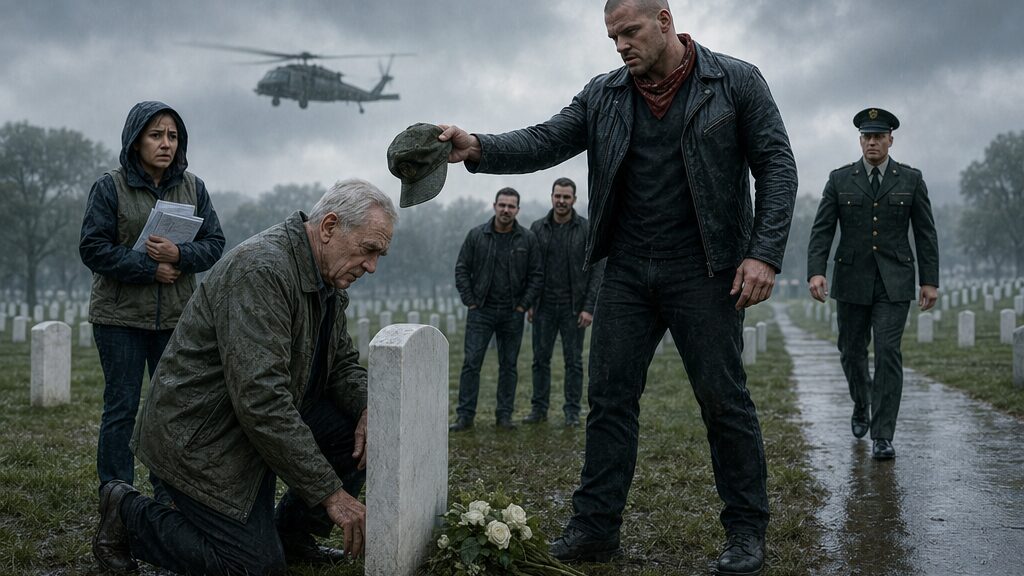
It fell stem-first into the damp grass, bending under the weight of morning rain, and for a moment George only stared at it. The cemetery stretched in front of him in pale rows, every headstone catching the same gray light, every name facing the same sky. Wind moved low across the hill and lifted the hem of his old green jacket. Somewhere beyond the trees, a helicopter engine tested its throat, distant and uneven, then faded again into the hush.
George bent slowly.
His knees did not like bending anymore. They argued with him before they obeyed. He lowered himself with one hand on the wet ground, careful not to crush the other roses against his chest. His old service cap sat low on his head, the cloth softened by years and weather. There was no bright badge on it, no polished pin, nothing that asked a stranger to look twice. Just faded green fabric, a bent brim, and the faint shape of a hand that had lifted it and set it down too many times to count.
“Morning, Jack,” he said.
The headstone answered with rainwater.
JACK CAMPBELL
The letters were clean because the cemetery kept them clean. George had never had to do that part. He had only had to come. Once a year, same day if he could manage it, same hour if his body let him. White roses, never red. Cap on until the first prayer. Left knee down first. Right hand on the earth.
He placed the fallen rose with the others at the base of the stone. Six stems. Susan had once told him six looked less like a display and more like somebody had chosen them by hand. George had never asked why that mattered. With Susan, some things mattered because they did.
The wind crossed the hill again. The roses trembled.
George removed his cap.
The cold touched the thin white hair above his forehead. He held the cap between both hands and bowed his head. Not far away, a grounds worker guided a small cart along the paved lane, tires whispering over wet concrete. A cluster of people gathered near the lower section where the memorial program would be held later in the morning. Honor guard members moved like dark strokes between the stones. Their voices did not reach him.
George liked that. Jack had never cared for crowds.
He closed his eyes and waited for the old sentence to come. Some years it came easily. Some years he had to stand there until shame loosened its fingers enough to let him speak.
“Still here,” he whispered. “Told her I would be.”
His thumb moved along the cap’s brim. The seam there had split twice. He had mended it badly the first time, better the second. A small dark stain near the crown had never washed out. Rain could not touch it. Soap had not touched it. Time had only made it less visible to anyone who had not already memorized it.
George heard footsteps before he heard the voice.
“Hey.”
He did not turn right away. People sometimes lost their way in the rows. They came looking for one name and found another. They asked softly, apologized, moved on. He kept his head bowed, giving the stranger time to see where he was standing and lower his voice.
The footsteps stopped too close behind him.
“I said hey.”
George opened his eyes.
A young man stood on the other side of Jack’s stone, looking down as if George had dropped something offensive at his feet. He was broad through the shoulders, shaved close at the scalp, with a black leather jacket darkened by mist. A red bandana was knotted at his neck. Two other younger men stood several steps behind him, hands in pockets, not laughing yet but ready to.
George’s fingers tightened once on the cap, then eased.
“You need something?” he asked.
The young man looked at the roses first, then at George’s face. “I could ask you that.”
George shifted his weight. His right knee pressed deeper into the grass. “I’m visiting.”
“This section’s closed until the program.”
George glanced toward the lane. There was no sign posted near the path he had taken. The cemetery had never closed Jack to him before. “Didn’t see a rope.”
“You didn’t see a lot of things, I guess.”
One of the companions gave a short breath through his nose, almost a laugh.
George kept his voice even. “I’ll be gone before your program starts.”
The young man’s eyes flicked to the cap. “You military?”
The question had edges on it. George heard them and chose not to pick them up.
“Once.”
“Once.” The young man repeated the word as if it tasted false. “That supposed to mean something?”
George looked back at Jack’s name. “Only to me.”
The young man stepped around the stone.
George felt the movement before he saw the hand. It came quick, not hard enough to strike but fast enough that his body, old as it was, remembered danger. The cap left his fingers. For one strange second it was simply gone from him, and his empty hands remained shaped around the place it had been.
The young man held it up.
“This yours?”
George’s mouth went dry.
Behind him, the helicopter engine sounded again, closer this time, a low pulse rolling under the clouds. The two companions turned their heads toward the noise, but the young man kept his eyes on George.
“Give it back,” George said.
He said it quietly. Too quietly, maybe. The young man smiled at that, not because anything was funny, but because he had found the spot where dignity could be pressed and made to hurt.
“You come out here dressed like this,” he said, turning the cap in his hand, “drop flowers on a grave that isn’t yours, and whisper like you own the place.”
George’s left hand settled against the stone. Jack’s name was cold beneath his palm.
“It isn’t mine,” he said.
“Then why are you here?”
George looked at him fully then. He saw anger, but not only anger. There were shadows beneath the young man’s eyes. His jaw was tight in the way of someone who had spent the morning preparing for a fight and found the wrong person to give it to.
George had known men like that. Boys like that. Some of them had lived long enough to become men. Some had not.
“This is not the place,” George said.
The young man’s face changed. A small flush came up under his skin. “Don’t tell me what this place is.”
He held the cap lower now, close enough that George could have reached for it if his knees were better and his pride worse.
One of the companions muttered, “Brian, leave it.”
Brian.
The name landed without surprise and still found a tender place. George kept his hand on the stone.
The young man heard the warning and ignored it. “No. I want to hear him say it. I want to hear why some old guy thinks he can kneel here before the family even gets here.”
George looked at the roses.
Family.
He had wondered, over the years, whether any of them still came. Susan had at first, when she could stand the drive. Then letters. Then the cemetery office had told him she had arranged for a note to be kept on file. After that, silence. Families changed shape around grief. Children grew up inside stories that had missing rooms.
George drew a breath.
“I knew Jack,” he said.
Brian’s expression hardened so quickly it was almost a flinch. “No, you didn’t.”
George did not answer.
“You think because the name’s on a stone nobody can call you out?” Brian said. “You think old age gives you permission to borrow a dead man?”
The words moved through the cold air. They reached the companions. They reached the grounds worker, who slowed his cart near the lane. They reached a woman in a volunteer vest carrying folded programs under one arm. She stopped beneath a bare-limbed tree and looked toward them.
George felt their attention gather.
He hated that more than the words.
“Please,” he said. “Put the cap down.”
Brian looked from George to the grave, then back at the cap in his hand.
“You want it?”
George did not move.
Brian turned his wrist and tossed it.
The cap struck the wet grass beside the white roses and rolled once, brim dipping into the mud.
For a moment nobody spoke.
The helicopter engine grew louder beyond the hill, steady now, beating against the low clouds. The sound seemed to press every stone deeper into the ground.
George looked at the cap lying near Jack Campbell’s grave.
His hand left the headstone. Slowly, carefully, he leaned forward to reach for it.
Chapter 2: The Man Who Would Not Argue at a Grave
George’s fingers stopped inches above the cap.
Mud had touched the brim. Not much. Just a dark smear along the edge where rainwater gathered in the grass. He could clean that later with a damp cloth and the corner of his sleeve. He had cleaned worse from it. Dirt did not trouble him.
Hands did.
The wrong hands on the wrong thing.
He lowered his palm, but his shoulder tightened before he could close his fingers. Brian’s boots shifted in the grass. George could see them beside the stone: black leather, wet at the toes, planted too wide. A young man trying to occupy more ground than his grief knew what to do with.
“Go on,” Brian said. “Pick it up.”
George let his hand hover.
Behind Brian, one of the companions looked away. The other kept watching with an expression that had begun as amusement and was turning uncomfortable. The grounds worker had stopped his cart completely now. The woman in the volunteer vest started toward them across the grass, careful between the rows.
George drew his hand back.
Brian frowned. “What, now you don’t want it?”
“Not like this.”
“Like what?”
George looked up from where he knelt. Rain had collected on Brian’s jacket shoulders in tiny beads. He could see that the young man was not as sure as he wanted to seem. Anger gave him posture. Hurt gave him the rest.
George said, “Not over him.”
Brian glanced at the name on the stone.
“Don’t talk about him.”
“I wasn’t.”
“You said you knew him.”
“I did.”
“No.” Brian’s voice cracked at the edge, and he pushed harder to cover it. “No, you people do this. You show up at ceremonies and tell stories. Shake hands. Get attention. My grandmother had boxes of letters from men who said they knew him. Men who suddenly remembered him when there was a program or a camera or a free breakfast.”
George listened without blinking.
“I don’t want anything,” he said.
“Then why come?”
George’s eyes moved to the white roses. One had tipped sideways when the cap rolled near it. A petal clung to the wet cloth.
“Because I said I would.”
“Who asked you?”
George’s throat closed.
There were answers that belonged to a room with curtains drawn and a kettle going cold on a kitchen table. There were answers written in a woman’s hand, blue ink pressed deep into paper because she had been trying not to shake. There were answers under smoke and rotor wash and a man’s fingers slipping from his sleeve.
Not here.
“Someone who had the right,” George said.
Brian stared at him. “That supposed to be mysterious?”
“It’s supposed to be enough.”
The volunteer reached them then, breathing a little hard from crossing the hill. She had dark hair pulled back under the hood of her rain jacket and a cemetery badge clipped to her vest. The programs under her arm had started to curl at the corners.
“Sir,” she said to Brian, low but firm, “please step back from the grave.”
Brian did not turn. “This is my grandfather’s grave.”
Her eyes moved to George, then to the cap in the grass. Something like recognition flickered there, though not the full kind. She knew the ritual perhaps, not the man.
“I understand,” she said. “But this gentleman has permission to be here.”
Brian gave a short laugh. “Permission from who?”
“The cemetery office keeps visitor notes for certain family arrangements.”
“Family arrangements?” Brian finally looked at her. “I’m family.”
“Yes,” she said. “I’m not disputing that.”
“Then tell him to leave.”
George shifted his knee. Pain ran hot up his thigh and settled into his hip. He did not let it show on his face, or he hoped he did not. The rain had begun again, not falling hard, just misting enough to make everything shine.
The helicopter was closer now. Somewhere beyond the trees, its blades chopped the air in long, even strokes. Memorial attendees near the lower path looked up, pointing. The sound made conversation harder. It gave Brian a reason to raise his voice.
“My grandmother never talked about him,” Brian said, stabbing a finger toward George. “Never. She talked about my grandfather. She talked about what kind of man he was. She talked about the unit. She talked about the day they brought her the flag. She never said some stranger was supposed to come put flowers on him every year.”
George flinched at the word flag though no one noticed.
The volunteer’s expression softened. “Mrs. Campbell left instructions.”
Brian’s face turned.
George saw the blow land. Not from the volunteer’s hand, not from the words themselves, but from the fact that they opened a door he had not known existed.
“What instructions?” Brian asked.
The volunteer hesitated. “I can’t discuss office records out here.”
Brian stepped closer to her, not threatening exactly, but urgent. “What instructions?”
George placed one hand against the ground and began the slow work of standing. The first push failed. His knee refused. He tried again.
“Sir,” the volunteer said, turning toward him, “please, let me help—”
“I have it.”
He did not have it. Not entirely. His right leg trembled. His hand sank into the wet grass. Brian watched him struggle, and for one second the anger in him slipped, leaving something rawer.
Then one of the companions snickered nervously. “Man, this is getting weird.”
Brian’s face shut again.
George rose halfway, bent, breathing through his nose. He could feel the wet in his trouser knee. He could feel the absence of the cap on his head more than the cold itself.
The cap remained in the grass.
He did not pick it up.
“Why won’t you answer?” Brian demanded.
George looked at Jack’s name.
Because your grandmother asked me not to make myself the center of his death.
Because I was breathing when he was not.
Because every story I tell about him begins with me surviving.
Because the dead cannot correct the living when we make ourselves too large.
He said, “Because this is a grave.”
Brian opened his mouth, then closed it.
The helicopter appeared over the tree line.
It was not low enough to be reckless, not close enough to be a rescue, but its presence changed the hill at once. Heads turned all along the cemetery road. The aircraft moved dark against the dull sky, circling toward the staging field beyond the memorial area. Wind pushed outward from its approach, running over the grass and fluttering the volunteer’s programs. The white roses trembled at Jack’s stone.
George looked up despite himself.
For a moment, the years folded badly.
Rotor wash. Smoke. Men shouting numbers into the dark. A hand on his collar. Jack’s voice, furious with life.
Move, Robinson.
George blinked.
The cemetery returned.
Brian was staring at the helicopter too, but not with memory. With annoyance. “Great,” he muttered. “They’re early.”
The volunteer held the programs tighter. “The flyover is being checked before the ceremony.”
George looked down at the cap. Wind had pushed it a few inches farther from the roses.
He bent again, slower this time.
Brian’s hand shot out, not touching him, but blocking the space. “No. You don’t get to just take it and walk off.”
George straightened as much as he could.
The volunteer said, “Mr. Campbell, enough.”
Brian did not look at her. “You said someone gave him permission. I want to know why.”
George’s voice was low. “Ask in the office.”
“I’m asking you.”
“I heard you.”
“And?”
“And I am not answering over your grandfather’s grave.”
The words landed quietly, but they held.
For the first time, Brian seemed to understand he could not force this old man to become what he wanted: liar, fraud, trespasser, excuse. George’s refusal did not rise to meet him. It stood still, and that made Brian angrier than shouting would have.
The helicopter settled beyond the hill. Its engine did not stop. It thudded through the ground, through George’s knees, through the stone rows.
From the lower path, a uniformed officer had started up the slope.
He moved quickly without running, cap held firm against the wind. His dress uniform was darkened at the shoulders by mist, and two honor guard members watched him leave the staging area with visible concern. He looked first at the volunteer, then at Brian, then at the old man standing bareheaded beside the grave.
The officer’s expression changed before he reached them.
George saw recognition form in his face and felt his own chest tighten.
Not here, he thought.
The officer came to a stop beside the stone.
“Mr. Robinson?” he said.
Brian turned.
George closed his eyes once.
Chapter 3: The Officer Put His Hand on George’s Shoulder
David Mitchell had seen the name Robinson three times before he saw the man.
The first time was on a brittle photocopy tucked into the memorial binder, an evacuation roster from decades earlier with four names circled in pencil and one marked with a cross. The second time was on a yellowed program from a unit reunion, folded around a photograph too faded to read clearly. The third was in a note from the cemetery office, clipped to the morning schedule: Annual private visit. Do not disturb if possible. White roses permitted before public ceremony.
He had paused over the note because of the handwriting beneath the typed line.
Susan Campbell requested this courtesy.
David did not know Susan Campbell. He knew Jack Campbell because the day’s ceremony required him to know the public parts: service dates, unit, burial section, name pronunciation, next of kin if present. He had expected a widow’s note to feel ceremonial, polished by repetition. Instead, that sentence looked tired. Requested this courtesy. Not demanded. Not claimed. Requested.
He had meant to ask the cemetery clerk about it after the flyover check.
Then he saw the old man on the slope.
At first, from the staging field, David noticed only the shape of conflict: a kneeling elder, three younger men too close, a volunteer crossing fast with her programs tucked like a shield under her arm. Then the old man tried to stand without his cap, and something about the bare head beside the grave made David start walking before he had decided to.
The helicopter wash pushed against his back as he climbed. Wet grass tugged at his polished shoes. He heard pieces before he arrived.
“…my grandfather’s grave.”
“…not answering over—”
Then he saw the cap in the grass.
David had been trained to read rooms, not gravesides, but the principle was the same. Find the object everyone pretended was not the center. The cap lay brim-down near the roses. The old man stood without reaching for it. The younger man stood as if daring him to.
David stopped beside the headstone and said, “Mr. Robinson?”
The old man’s eyes closed.
That told David more than a salute would have.
The younger man looked from David to George. “You know him?”
David kept his gaze on George. “Sir, are you all right?”
George opened his eyes. They were pale, tired, and more annoyed by being noticed than comforted by help.
“I’m standing,” George said.
It was not an answer. It was exactly the kind of answer David had heard from men who had learned to measure pain by whether it interrupted the mission.
The volunteer, Maria Lopez according to her badge, stepped closer. “Captain, I was trying to move this inside.”
David nodded once. “Thank you.”
“I didn’t do anything,” the younger man said.
David looked at him then.
The man was younger than David had first thought, maybe early thirties, built with the restless strength of someone who still trusted his body to explain him. The red bandana at his neck was soaked darker at the knot. Anger had made him careless, but his eyes were not empty. They kept flicking to the name Campbell as if the stone might confirm his version of the world.
“And you are?” David asked.
“Brian Campbell.”
That changed the ground under the moment.
David glanced at the headstone. Jack Campbell. Then back at Brian.
“I see.”
“No, you don’t,” Brian said. “Everyone keeps acting like I’m the problem here. This man won’t say why he’s at my grandfather’s grave.”
George said quietly, “David.”
It was not loud, but David heard the warning in it.
He had never met George Robinson in person. Still, the use of his first name stopped him. It sounded less like familiarity and more like command, not rank command, but the kind that came from someone who refused to let a younger man make the wrong mistake.
David lowered his voice. “Sir?”
“Not here.”
Brian threw up one hand. “That’s what he keeps saying.”
David looked down at the cap. Rain had begun to stipple the crown. He bent and picked it up.
George’s hand moved slightly, then stopped.
David saw the movement. He did not hand the cap over. Not yet. The old man had not asked him to. Instead, David held it carefully by the sides, mud away from the cloth, the way he would have held something borrowed from a chapel.
Brian watched that too.
A small uncertainty crossed his face.
David turned the cap once in his hands. There was no rank on it. No badge, no unit flash bright enough to settle an argument. Only wear. A careful repair along the brim. A darkened place near the crown. He looked at George and understood that whatever this cap proved, it was not meant to prove it to strangers.
“Mr. Campbell,” David said, “there are records connected to this visit.”
Brian stiffened. “What records?”
George’s eyes came up sharply.
David felt the boundary too late.
He had stepped toward correction. He could feel it in himself: the officer’s urge to restore order, to name the wrong thing, to make the young man understand in front of the people who had seen him do it. It was clean, that urge. Dangerous because it felt clean.
George’s face told him no.
David changed course.
“Records the cemetery office can discuss with family in the proper place,” he said.
Brian’s jaw tightened. “So everybody knows except me.”
“No,” Maria said softly. “Not everybody.”
The helicopter engine dipped, then rose again beyond the hill. Its rhythm rolled across the stones like distant thunder. Memorial attendees gathered near the lower path were watching now, though most pretended to look at the aircraft. The two companions had stepped back from Brian. One had removed his hands from his pockets. The other stared at the cap in David’s hands as if it had become heavier.
David moved closer to George.
“Sir,” he said, quieter, “may I?”
George looked at the cap.
For a moment, David thought he would take it. Instead George’s eyes shifted to the grave. Jack Campbell’s name stood between them all, clean and white and unable to refuse any of this.
George shook his head once.
David understood.
He held the cap against his own chest, not wearing it, not displaying it. Just keeping it from the grass.
Then he placed his free hand on George’s shoulder.
The old man went still.
David felt bone under the wet jacket. Not weakness exactly. Age, yes, and old pain, and the kind of thinness that came when the body gave back everything it had once borrowed. But under that there was a steadiness David could not name. George did not lean into the hand. He did not pull away. He simply accepted the weight long enough to let the moment change.
Brian saw it change.
His face shifted from anger to confusion, then to something defensive. “Why are you touching him like that?”
David removed his hand. “Because I should have come up sooner.”
George said, “You came when you came.”
The words carried no accusation. That made David feel worse.
Brian pointed toward the cap. “If he’s got some right to be here, then say it.”
David looked at George.
George looked at the grave.
Maria folded the damp programs tighter against her chest. “Mr. Campbell, maybe we should go to the office.”
“I’m not leaving him here.”
George turned his head then. “Brian.”
The young man flinched at hearing his name from George’s mouth.
George’s voice remained low. “Your grandmother would not want this.”
The color left Brian’s face in a slow, uneven way.
“You don’t get to talk about her,” he said.
“No,” George said. “I don’t.”
That answer was worse than denial. It held something back, and everyone felt it.
David made a decision. “The ceremony starts in less than an hour. Mr. Robinson has a private courtesy on file. Mr. Campbell, as family, you can ask the office to review what may be shared.”
Brian laughed once, harsh and thin. “Private courtesy. That what we’re calling it?”
George shifted his weight. Pain crossed his face before he buried it.
David stepped closer again. “Sir, let me walk you to the chapel.”
“I’m not done here.”
“Then I’ll wait.”
George looked at him. “No.”
There was no force in the word, but it stopped David anyway.
George looked at Brian. Not with anger. That might have been easier for the young man to bear. He looked at him as if seeing a boy standing in a doorway after adults had chosen silence for him.
“I came early so I would not be in your way,” George said. “That is all I can give you here.”
Brian’s mouth opened, but nothing came out.
The wind lifted. The roses shivered. Water rolled down the face of Jack Campbell’s stone.
David still held the cap.
He wanted to return it. He wanted to place it in George’s hands and make the wrong thing visibly right. But George had refused the simple repair because the deeper injury was not his cap in the mud. It was the dead man being used as the ground for a living argument.
Maria stepped beside Brian. “Come with me,” she said. “Please.”
Brian did not move.
David said, “There’s an evacuation list in the memorial packet. It may answer some of your questions.”
George’s eyes closed again.
Brian turned slowly toward David.
“What evacuation list?” he asked.
The helicopter engine beat harder over the cemetery, and this time no one looked up.
Chapter 4: The Name Missing from the Family Story
Brian had not expected the cemetery office to smell like coffee.
He had expected polished wood, maybe flags, maybe a place that felt official enough to explain why everyone on the hill had started speaking to him as if he were a problem to be managed. Instead, the office sat low beside the service road, beige walls, gray carpet, a humming printer near the counter, and a pot of coffee burned down to its last inch. Rain tapped steadily against the narrow windows. Beyond the glass, rows of stones faded uphill into mist.
Maria Lopez led him inside without touching his arm.
That bothered him more than if she had grabbed him. He would have known what to do with being restrained. He did not know what to do with someone making space for him to follow and trusting he would.
His two companions stayed outside under the overhang, suddenly interested in their phones. One of them had muttered, “We’ll wait here,” and Brian had not answered. The red bandana around his neck felt too tight. He loosened the knot with one finger and looked back through the window.
George Robinson stood under a leafless tree near the chapel path. David Mitchell was beside him, still holding the old green cap. They were not speaking. The officer stood like someone waiting for permission, and the old man looked smaller without the cap, bareheaded in the drizzle, shoulders slightly rounded beneath his wet jacket.
Brian turned away.
“He shouldn’t have been there,” he said.
Maria set the damp stack of programs on the counter. “He comes every year.”
The sentence landed too simply.
Brian stared at her. “What?”
“Every year that I’ve volunteered here. Before that, according to the office notes.”
“You know him?”
“I know where he stands.” Maria took off her hood and smoothed back loose strands of hair. “I know he comes early. I know he brings white roses. I know he leaves before the family ceremonies begin.”
Brian’s jaw worked. “Nobody told us.”
“I believe that.”
“You believe it?” The laugh that came out of him was wrong, too sharp for the quiet room. “That’s generous.”
The cemetery clerk looked up from the desk in the rear office, then lowered her eyes again. Maria did not look offended. That made Brian angrier.
“My grandmother never mentioned him,” he said. “Not once.”
Maria rested both hands on the counter, fingers spread, as if choosing patience with care. “Families leave things out for many reasons.”
“You don’t know my family.”
“No,” she said. “I don’t.”
That stopped him for a second.
The office door opened behind them. David stepped in first, bringing cold air and the low sound of the helicopter engine. George came after him slowly. He did not look at Brian. He moved to a chair against the wall near a rack of cemetery maps and lowered himself with controlled care.
David still had the cap.
Brian’s eyes went to it before he could stop them. The mud on the brim looked darker indoors. The sight pressed heat into his face.
George saw him look. He said nothing.
Maria went behind the counter and spoke softly to the clerk. The clerk opened a drawer, removed a thin folder, and hesitated.
“Family access?” she asked.
Maria looked to David.
David said, “Mr. Campbell is Jack Campbell’s grandson.”
The clerk nodded, but her mouth tightened. “Some items are courtesy notes, not full records.”
Brian stepped forward. “I just want to know why he was there.”
George’s eyes remained on the window.
Maria accepted the folder and opened it on the counter. Inside were printed pages, photocopies, a cemetery map, and a small yellow note clipped to one corner. Brian recognized his grandmother’s last name before anything else.
Campbell.
His anger shifted shape.
Maria did not hand him the whole folder. She turned one page toward him. “This is the visitor courtesy request. Filed years ago. Updated twice. It allows George Robinson to visit Jack Campbell’s grave privately on the morning of the memorial date, before scheduled public events, with white roses.”
Brian read the line twice.
George Robinson.
White roses.
Privately.
His throat tightened, and he hated that it did.
“Who filed it?” he asked.
Maria slid the yellow note free. “Susan Campbell originally requested it.”
The room changed around him.
His grandmother had written notes on everything. Freezer meals, medicine bottles, birthday cards, newspaper clippings, the backs of envelopes. Her handwriting had been narrow and slanted, more pressure on the downstroke than the up. He had not seen it since they cleared her house after the funeral. His mother had kept the family Bible. His uncle had taken the framed flag. Brian had taken a coffee mug from the kitchen because it still had a faint brown ring inside it.
Maria placed the note under the counter light.
It was his grandmother’s hand.
Please allow George Robinson his time before ours. He will not ask for anything. The roses are for Jack. George knows why.
Brian read it, and the room would not stay still.
He reached for the paper, then pulled his hand back. “Where did this come from?”
“The courtesy file,” Maria said.
“No. Where did she write it?”
“I don’t know.”
Brian looked over his shoulder.
George sat against the wall, hands resting on his knees. His fingers were stiff. One thumb moved once, rubbing against the side of his forefinger as if feeling for the missing cap’s brim.
“Did she give this to you?” Brian asked.
George’s eyes moved from the window to him.
“No.”
“Then how did the cemetery get it?”
George glanced toward Maria.
Maria answered gently. “It was mailed to the office with her request. There are other documents, but not all are ours to release without review.”
Brian turned back to the folder. “What other documents?”
David said, “Brian.”
The use of his first name from the officer sounded different now, less official and more like a hand against a door.
Brian ignored him. “What evacuation list were you talking about?”
David looked at George.
There it was again. Everybody looking to the old man as if the old man held the key and had the right not to use it.
Brian slapped his palm lightly against the counter, not hard enough to startle anyone but enough to hear it. “He took something from us. If he was part of my grandfather’s story and nobody told me, then he took that too.”
George slowly stood.
The motion silenced the room more effectively than anger would have. His hand found the chair back. His face had gone pale, but his eyes were steady.
“I took nothing from your family,” he said.
Brian turned. “Then why were you hidden?”
George looked at the note under the light.
“Ask the living who made that choice.”
“My grandmother’s dead.”
“I know.”
“Then you’re the living.”
Something moved across George’s face—not offense, not fear. Pain, maybe, but old pain, the kind that no longer arrived loudly because it had lived in the house too long.
David stepped between them by half a pace. “This is not the way.”
George lifted one hand slightly. David stopped.
The officer’s restraint irritated Brian and unsettled him. Outside on the hill, David had carried authority like a shield. Here, he kept setting it down whenever George glanced at him.
George said, “Your grandmother asked for quiet. I gave her quiet.”
“That’s convenient.”
“Yes,” George said. “It was.”
Brian had no answer to that.
The admission was not what he expected. It carried no defense. No excuse. George looked at the note as if it accused him too.
Maria turned another page in the file, then paused. “There’s a volunteer log from last year. And the year before. Same delivery. White roses placed before sunrise. Visitor departed before family arrival.”
Brian saw the neat typed entries. He saw dates. He saw his grandmother’s name written in the older notes, then later the cemetery’s own references after she was gone.
He remembered standing at this grave with relatives, hearing someone say, “The cemetery staff must have left flowers.” He remembered not caring enough then to ask. He had been younger, uncomfortable in dress shoes, embarrassed by grief in public. Later, after his grandmother’s death, the grave had become one of the few places where his anger felt allowed.
And now the old man he had shoved into that anger stood across the room without his cap.
Brian looked at David’s hands.
“Give it back to him,” he said.
David did not move.
George looked toward the cap, then away. “Not yet.”
Brian stared. “What do you mean, not yet?”
George’s voice was quiet. “You are still angry enough to think it would fix something.”
The words burned because they were true.
Maria folded Susan’s note back into place but did not close the folder. “There’s one more note referenced here,” she said. “Not in this folder. It says Mrs. Campbell left a sealed copy with the chapel office for George Robinson only.”
George’s head turned.
For the first time since Brian had seen him at the grave, the old man looked unprepared.
Maria noticed. “You didn’t know?”
George’s hand tightened on the chair.
“No,” he said.
The clerk returned to the rear drawer, searched through a small locked box, and brought out a cream-colored envelope protected in a clear sleeve. The paper had aged at the edges. On the front, in the same slanted hand, was written:
For George, if the boy ever asks.
Brian stopped breathing for a moment.
“The boy?” he said.
No one answered.
Maria held the envelope carefully, not offering it to Brian, not yet giving it to George.
George stared at Susan Campbell’s handwriting as if the dead had spoken from the counter.
Then Maria turned the envelope slightly, and Brian saw the line beneath the name, smaller, pressed deep into the paper.
George knows why.
Chapter 5: The Letter Susan Never Wanted Read Aloud
George did not touch the envelope until the chapel door was closed.
The room was small, set apart from the main cemetery office by a covered walkway and a short hall that smelled faintly of floor polish and wet wool. Six rows of wooden chairs faced a plain table beneath a narrow window. The window looked toward the hill, though rain blurred the stones into pale marks. Someone had left a folded flag in a glass case along one wall. George did not look at it.
David stood near the door with the cap in his hands.
Maria had brought the white roses from Jack’s grave after asking George with her eyes. They lay now on the table, damp petals resting against the wood. The old green cap sat beside them, mud still dark along the brim. David had tried once to clean it with a paper towel, but George had stopped him.
“Leave it,” George had said.
So the mud remained.
The envelope lay between the roses and the cap.
George sat in the front row, both hands on his cane though he had not brought a cane. He had gripped the back of the chair while sitting and had not let go until the chair itself seemed to become the thing keeping him steady. His knees ached from the grass. His hip ached from standing too long. None of that mattered much.
Susan’s handwriting did.
David cleared his throat. “Sir, you don’t have to open it with us here.”
George looked at the envelope.
“No,” he said. “I don’t.”
Maria stood by the table, quiet enough that the room did not seem crowded. Brian had not come in. He waited somewhere outside the chapel, or perhaps he had gone back to the office, or back to his companions, or to the grave to stand where his anger had left marks. George had not asked.
David shifted the cap from one hand to the other. “There are documents that could clear this up without you having to carry it.”
George looked up.
David was young enough to believe records cleared things.
Not too young. He had seen enough, George guessed, to know better in other rooms. But here, with a cemetery file and a family misunderstanding and a visible wrong done in public, the officer wanted the world to be repairable by paper.
“It is not a parking ticket,” George said.
David lowered his eyes. “No, sir.”
“And I am not a citation.”
“No, sir.”
Maria moved as if to step back, then stayed.
George reached for the envelope.
His fingers were not as reliable as they had been that morning. The edge of the sleeve slipped once. Maria almost helped, then caught herself. George was grateful. He slid the old paper free and turned it over.
The flap had been sealed, then carefully cut at some point by the cemetery office to preserve the contents in the sleeve. Susan must have known they would need to read enough to know where to keep it. She had thought of such things. George remembered her kitchen table, the neat stacks of envelopes, the jar of rubber bands, the kettle that whistled too long because no one wanted to be the first to stand.
He unfolded the letter.
Dear George,
He stopped.
The two words were enough to bring back her voice. Susan had never called him Mr. Robinson after the funeral. At first she had not called him anything. She had stood in a black dress that looked too large for her shoulders and accepted words from men whose faces she did not remember two minutes later. George had stood at the back of the church because he did not know whether he had the right to stand closer.
After the service she had found him by the side door.
“You’re Robinson,” she had said.
He had nodded.
“You were with him.”
He had nodded again.
She had looked at his uniform, his bandaged hand, the place above his left eyebrow where the stitches pulled when he blinked.
“Then don’t tell me he died brave,” she had said.
George had not.
Instead he had said, “He was himself.”
And Susan had closed her eyes as if that was the first truthful thing anyone had given her all day.
“Sir?” David said softly.
George realized the letter had blurred.
He blinked once and read.
Dear George,
If you are holding this, then either I am gone or too tired to answer what should have been answered years ago. I asked the cemetery to keep it because I trusted you to keep quiet, and that was unfair of me. I know you agreed because you thought it was kindness.
George’s mouth tightened.
Maria turned slightly toward the window, giving him privacy without leaving.
You came every year before us. I knew. They told me even when I stopped asking. White roses, early morning, gone before the family arrived. I told myself that was best. Jack did not need an argument at his grave, and I did not know how to explain to a child why the man who survived also had a right to mourn.
George lowered the page.
The chapel was too quiet.
David said nothing now.
George looked at the cap on the table. Mud had dried at the edge in a rough line. He remembered Brian’s hand holding it up. He remembered his own hand empty. He had thought, absurdly, not of insult but of Susan seeing it and frowning because he had let the cap get dirty before placing the roses.
He raised the letter again.
Brian may come one day with anger. He has Campbell blood and Campbell silence around him. We did not tell him enough. Maybe we told him the wrong parts. Maybe we were proud because pride was easier than grief. If he asks, tell him Jack pulled you out. Tell him Jack went back because that is what Jack would do. Do not tell him his grandfather died for glory. He did not. He died because there were men still breathing and he could reach them.
George’s hand shook.
There was more, but the words had opened the old place.
Rotor wash. Heat on one side of his face. Jack Campbell’s hand closed around his webbing, dragging him over torn ground. George shouting that others were still inside. Jack coughing, grinning because fear had always made him rude.
“Then stop lying there, Robinson.”
George had tried to stand. His leg had folded. Jack had shoved him toward the crewman waiting near the aircraft.
“Take him.”
George had grabbed Jack’s sleeve. “No.”
Jack had leaned close enough for George to smell smoke in his hair. “Tell Susan I wasn’t polite.”
Then he was gone into the dark again.
George looked down at his own hands, old now, clean except for cemetery dirt under one nail.
David said, “Mr. Robinson.”
George folded the letter carefully along its old creases.
“You read enough?” David asked.
George almost smiled. “Too much.”
Maria turned back from the window. Her eyes were wet, but she kept her voice steady. “Do you want me to put it away?”
“No.”
George laid the letter on the table beside the roses. “Not yet.”
David stepped forward. “Sir, with your permission, I can speak to Brian. I don’t need to tell him everything. But he should know he was wrong.”
George looked at him for a long moment.
“And you would like to be the one to tell him?”
David’s face changed. He understood the question beneath the question. “I’d like to keep him from doing more damage.”
“He has already done it.”
“Yes.”
“To me?”
David hesitated.
George touched the cap’s brim with two fingers. “He did not know where to put what they left him.”
“That doesn’t excuse throwing your cap.”
“No.”
“Then let me correct him.”
George’s hand stayed on the brim. The cloth felt damp and gritty. For decades he had worn it only on this day. Not to the grocery store, not to parades, not to veterans’ breakfasts where people asked what year and what unit and what was it like. He had worn it for Jack because Jack had once slapped it off his head and said only officers and fools wore caps indoors. George had told Susan that story, and she had laughed for the first time since the funeral.
“Correction is not the same as repair,” George said.
David absorbed that quietly.
Maria looked toward the chapel door. “He’s still outside.”
George nodded.
He had known Brian would be. Anger like that did not leave quickly. Shame stayed even longer.
The chapel door opened before anyone invited it.
Brian stood in the doorway, rain on his jacket, bandana loosened around his neck. Without his companions behind him, he looked less like a man starting a fight and more like someone who had walked too far into a room he did not know how to exit.
His eyes went first to the cap. Then to the letter.
“That hers?” he asked.
George did not answer immediately. He folded the letter once more and placed his palm over it.
“Yes.”
Brian swallowed. “Did she write about me?”
“Yes.”
The word unsettled him. He looked at David, then Maria, then back at George. “They said I could come in.”
“No one would stop you,” George said.
Brian took two steps inside and stopped. He did not sit.
The helicopter engine outside lowered, then faded to a waiting hum. The chapel seemed to breathe around it.
Brian pointed at the letter, but his hand lacked the force it had held before. “What did she say?”
George looked down at Susan’s handwriting beneath his palm.
“She said you might ask one day.”
Brian’s jaw tightened. “Ask what?”
George did not lift his hand from the letter.
David took a small step toward the door, then stopped himself. Maria stayed by the window.
Brian’s voice dropped. “Did my grandfather know you?”
George looked at him.
“Yes.”
“Were you there?”
“Yes.”
Brian’s breath caught, though he tried to hide it.
The room held them both. The old man seated beside the roses and the muddy cap. The grandson standing wet and angry and suddenly younger than he wanted to be.
Brian asked, “Did my grandfather die saving you?”
Chapter 6: George Chose the Truth Without the Applause
George did not answer inside the chapel.
He looked at Brian, then at the narrow window, where the rain had begun to thin and the hill showed itself in pale pieces. Jack’s grave was not visible from that angle, but George knew exactly where it stood. He had known all morning. He had known for years.
“Not here,” he said.
Brian’s face tightened at the phrase. “You keep saying that.”
“Yes.”
“Why?”
“Because you keep asking in rooms that are not his.”
For a moment, Brian looked ready to push back. Then his eyes dropped to the letter under George’s hand, to the cap, to the white roses lying damp on the table. Whatever argument he had brought with him did not survive the sight of those things together.
George stood.
David moved without thinking. George stopped him with a look.
The chair legs scraped softly against the floor. George reached for the cap, then paused. He did not put it on. He lifted it from the table and brushed one thumb along the muddy brim. The dirt smeared rather than came away.
Brian saw it.
Color rose in his face, but he said nothing.
George picked up the roses next. Maria reached to help, and this time he let her gather the loose stems and place them into his left hand. The gesture cost him less than refusing would have.
David opened the chapel door.
Cold air moved in. Outside, the cemetery had shifted toward afternoon light, though the clouds still hung low. The memorial attendees had gathered near the lower section, their umbrellas dotting the path in dark clusters. Honor guard members stood ready near the flag line. Beyond the hill, the helicopter waited for its scheduled pass, engine idling like a memory that would not leave.
They walked without procession.
David stayed back a few paces. Maria returned toward the office, though George sensed she watched from the covered walkway. Brian walked beside him at first, then slowed, unsure whether he had earned that position. George did not correct him.
At Jack Campbell’s grave, the grass still showed the marks of the morning. One crushed place where George had knelt. One darker patch where the cap had struck. The stone itself stood unchanged.
George lowered himself carefully. This time Brian moved as if to help, then stopped before touching him. George noticed. That was something.
He placed the roses again.
Six stems. The first one, the bent one, had lost two petals. He tucked it behind the others so the broken place faced the stone.
Brian stood on the far side, where he had stood before. But his boots were closer together now.
George held the cap in his lap.
“You asked if Jack died saving me,” he said.
Brian’s eyes lifted.
George looked at the headstone, not at him. “The answer people like is yes. It gives the story a clean shape.”
Brian said nothing.
“The true answer is that he died trying to save whoever he could still reach.”
The wind moved across the hill. A program page skittered along the path below until a grounds worker caught it under one shoe.
George’s voice remained even. “There had been an evacuation. Bad weather. Bad ground. Bad information. That is usually enough to make a bad day. I was crew chief on one of the aircraft. Jack was not supposed to be where he ended up. He was supposed to stay with the second group and wait for the next lift.”
“But he didn’t,” Brian said.
“No.”
George’s thumb pressed into the cap’s brim.
“He saw men pinned where the smoke was thick. He went in once. Brought one out. Went in again. Brought me close enough that someone else could drag me the rest of the way.”
Brian’s face tightened, but he kept still.
“I told him not to go back.”
George heard the old words in his mouth before he spoke them. Not a memory now. A stone under the tongue.
“I grabbed his sleeve. Told him the roofline was shifting. Told him to wait.”
Brian whispered, “Did he?”
George almost smiled.
“No.”
A small sound left Brian, not quite a laugh, not quite grief.
“Your grandfather was not always obedient,” George said.
“My grandmother said that.”
“She was right.”
The sky brightened behind the clouds. The stones around them seemed to sharpen, each name suddenly clearer in the wet light.
George continued, “He went back because there were still men calling. He did not make a speech. He did not look noble. He coughed and swore and told me to move my useless hide. That was Jack.”
Brian wiped at his face quickly, as if the rain had returned.
“What happened after?” he asked.
George looked down at his hands.
What happened after was heat and noise and the strange silence that came when a voice you expected to hear did not answer. What happened after was a medic cutting fabric from George’s leg. A crewman shouting numbers. A chaplain’s hand on his shoulder two days later. Susan Campbell standing in a black dress saying she did not want brave if brave was a word people used to make themselves comfortable.
“After,” George said, “I came home.”
Brian waited.
George did not fill the silence immediately. He let it show its size.
“Your grandmother asked me to come see her before I left town,” he said. “I thought she wanted details. I had practiced details. Not lies. Just the kind of truth that could sit in a room without breaking all the furniture.”
Brian looked at him.
“She asked whether he was alone.”
The question hung over the grave.
George swallowed once. “I told her no.”
“Was that true?”
“Yes.”
Brian looked at the stone. His mouth trembled before he pressed it still.
George rubbed the cap’s brim again. “Then she asked me not to come to the family service again.”
Brian’s head snapped up. “She asked you not to?”
“Yes.”
“Why?”
“Because everyone kept looking at me.”
Brian did not understand at first. Then his eyes shifted over George’s face, his jacket, the cap in his lap.
“They knew?”
“Some knew enough. Some guessed. Some wanted to thank me because I had been pulled out. Some wanted to ask what he said. Some wanted the story arranged so it would comfort them.”
“And she didn’t?”
“She wanted Jack to belong to his family that day.”
Brian looked away.
George’s voice lowered. “She was right.”
“No,” Brian said, too quickly. “That wasn’t fair to you.”
George let that pass. Fairness had never had much use at funerals.
“She wrote later,” George said. “Said if I needed to come, I should come early. Said white roses, not red. Said no speeches. Said no standing around so people could ask questions. Just come, remember him, and leave him with peace.”
Brian looked toward the roses.
“So you did.”
“Yes.”
“Every year?”
“When I could.”
“And nobody told me.”
George finally looked at him. “That was not my choice to make.”
Brian’s shoulders dropped. The anger had not vanished; it had lost its target. That made it heavier.
“I thought you were pretending,” he said.
“I know.”
“I thought you were one of those men who make everything about themselves.”
“I know.”
Brian looked at the cap. “And I threw that.”
George did not rescue him from the sentence.
Brian stepped around the stone slowly and stopped near him. He crouched, awkward in his leather jacket, knees cracking in a younger body that had not yet learned humility from pain.
“Why didn’t you say something?” he asked.
George looked at him for a long time.
“Because you were standing at your grandfather’s grave.”
“That’s it?”
“That is enough.”
Brian’s eyes filled, and this time he did not wipe them quickly enough to hide it. “I was wrong.”
“Yes.”
The answer was plain, not cruel. Brian took it like a man accepting weight into both hands.
From the lower field, a command carried faintly through the air. The ceremony was nearing its formal start. The helicopter’s engine rose, deeper now, gathering itself. People turned their faces upward.
David stood by the path, far enough not to intrude, close enough to come if George needed him. He held no authority over the moment now. George had taken it back without raising his voice.
Brian looked toward the officer, then at the small crowd below. “He could tell them.”
“Who?”
“The captain. He could tell everybody I was wrong. What I did.”
“Yes,” George said. “He could.”
Brian waited, almost wanting punishment because punishment had shape.
George placed the cap across his knees. “But Jack does not need that either.”
Brian looked at him, confused.
George lifted the roses’ ribbon from the grass and tucked it beneath the stems. “You want to be ashamed where people can see it. That would make it easier. They could judge you, and you could be done.”
Brian’s face tightened.
George’s voice remained quiet. “Do something harder.”
“What?”
“Remember differently.”
The helicopter lifted beyond the hill.
Its sound rolled over the cemetery, and this time George did not let it pull him backward. He heard the blades and the air and the old violence under it, but he also heard rainwater dripping from roses. He heard Brian breathing. He heard Jack’s name in stone, not smoke.
Brian reached toward the cap, then stopped.
George saw the movement.
“Not yet,” George said.
Brian lowered his hand.
The aircraft rose into view, dark against the broken clouds. People below lifted phones. The honor guard stood still. The noise filled the spaces between the headstones, but it did not feel like rescue. It felt like ceremony. Like the living trying, imperfectly, to give sound to memory.
George used one hand on the stone to push himself up.
Brian stood too, ready but not touching.
George turned back toward Jack’s grave as the helicopter came over the cemetery for its first pass. He held the cap at his side, muddy brim against his palm, and faced the stone bareheaded.
Chapter 7: The Cap Was Returned Before the Last Flyover
The helicopter made one full pass over the cemetery and then banked toward the west, leaving the air trembling behind it.
George stood bareheaded until the sound thinned. The cap hung from his right hand, low against his trouser seam, the muddy brim brushing his leg when the wind shifted. Around the lower path, people began to lower their phones. The honor guard remained still. A child somewhere whispered and was hushed. Umbrellas tilted back toward the ceremony as if the sky had finished speaking.
Brian did not move.
He stood a few feet from George, eyes fixed on the old cap. His hands opened once at his sides, then closed again. Whatever apology he had imagined had no shape now. George could see him searching for one anyway.
The first pass had filled the cemetery with noise. The silence after it felt more demanding.
George looked down at Jack’s grave.
The white roses had held. Six stems lay together at the base of the stone, pale against the wet grass. One broken petal clung to the mud where the cap had fallen earlier. George bent carefully, picked it up between two fingers, and set it beside the flowers. A useless repair, maybe, but not every repair had to be useful.
Brian swallowed. “Mr. Robinson.”
George did not turn. “George is fine.”
The young man took that in as if it were more than permission. “George.”
The name sounded difficult in his mouth. Not because it was hard to say, but because it brought the old man closer than anger had allowed.
“I don’t know how to fix what I did.”
George looked at the stone. “Most things like that do not fix clean.”
Brian stared at the back of his own hands. “I thought if I found someone to blame, it would make sense.”
“Yes.”
“My grandmother used to sit at her kitchen table with his letters. She’d take them out, put them back, take them out again. If I asked, she said he was a good man. That was all. A good man.” His voice roughened. “I hated that. Everybody else had stories. My friends’ grandfathers had stories. Funny ones, loud ones, things they could repeat at cookouts. I had a photograph and a folded flag nobody let me touch.”
George listened.
“She kept him perfect,” Brian said. “So perfect he didn’t feel real.”
George looked at him then.
There it was. Not cruelty, not truly. A boy grown into a man around a silence too polished to hold. George had seen other families do it. They made saints of the dead because saints did not cough, complain, make bad jokes, forget anniversaries, lose socks, get scared, get angry, or make the living miss them in ordinary ways.
“Jack was real,” George said.
Brian gave a small broken laugh. “Yeah?”
“Very.”
“What was he like?”
George’s eyes moved back to the name.
He could have told Brian about the evacuation again. He could have sharpened the story until it gleamed. Men did that sometimes, polished the worst day of someone else’s life until it became something safe to admire. George had spent years refusing that habit.
So he chose a different truth.
“He cheated at cards badly.”
Brian blinked.
George said, “Not well. Badly. Everybody knew. He would hide a card with half of it sticking out of his sleeve and act offended when someone pointed it out.”
Brian’s mouth opened slightly. The grief in his face did not vanish, but it changed posture.
“He sang when he was nervous,” George said. “Never the right words. Sometimes not even the right tune.”
“My grandmother said he couldn’t sing.”
“She loved him, so she may have been generous.”
Brian wiped a hand over his eyes and laughed once, quietly enough that it did not disturb the grave.
George nodded toward the roses. “And he hated red roses.”
Brian looked down. “Why?”
“Said they looked like someone was trying too hard.”
“That sounds like him?”
“It sounded like him to Susan.”
A second helicopter pass began to gather somewhere beyond the trees. Lower this time, or perhaps the air carried it differently. The ceremony below shifted in expectation. Commands traveled faintly up the hill.
David stood near the path, watching without watching. Maria had come halfway from the covered walkway and stopped beneath a tree. She held the cream-colored envelope in its sleeve against her chest, protecting it from the mist. Neither of them approached.
Brian saw them too.
His face tightened. “They all saw me throw it.”
“Yes.”
“I should tell them I was wrong.”
George considered that. The desire had merit. It also had danger. Public shame could masquerade as repair. It could feed the same hunger that had started the morning: the need to make grief visible enough that someone else would know what to do with it.
“You can,” George said. “But ask yourself who it serves.”
Brian’s eyes dropped.
George lifted the cap slightly. The cloth felt heavier than it had that morning, not because of water or mud, but because it had become part of Brian’s lesson now too. He did not love that. He had never wanted his belongings to teach anyone anything.
Still, the day had made its choice.
Brian stepped closer. “May I?”
George looked at him.
The young man held out both hands, palms up, not grabbing, not claiming. His fingers were steady only because he was forcing them to be.
George placed the cap in them.
Brian held it as David had held it earlier, carefully by the sides, mud turned away from the crown. He looked down at the worn seam, the crooked repair, the dark place near the top.
“I’m sorry,” he said.
George did not answer quickly.
The apology was not enough, but it was not nothing. George had learned to respect the difference.
Brian looked up. “I am. I don’t mean—” He stopped himself, breathed, and began again. “I threw it because I wanted you to feel small. That’s what I did.”
George’s gaze stayed on him.
“And you didn’t deserve it,” Brian said. “Even if you had been a stranger. Even if you hadn’t known him.”
That was better.
George nodded once.
Brian’s shoulders loosened a fraction, but he did not look relieved. Good, George thought. Relief too soon spoiled the work.
The second pass came overhead.
The helicopter moved across the cemetery with a steady, solemn force. This time Brian did not look up. He lowered himself beside the grave, one knee touching the wet grass where George’s knee had pressed before. Carefully, with both hands, he lifted the cap toward the old man.
George looked at it for a long moment.
The scene had nearly arranged itself into something public. Officer near the path. Volunteer beneath the tree. Family members in the distance. A young man kneeling, an old veteran standing, a cap between them. Someone below might have seen and guessed wrong in a kinder direction. They might have thought it ceremony.
George did not want ceremony.
He accepted the cap.
The mud had dried rough along the brim. Brian’s thumbs had not tried to rub it clean. That mattered more than if he had polished it.
George set the cap on his head.
The cloth settled into its old place. Damp, bent, familiar. He adjusted the brim with two fingers.
Brian remained kneeling. “Should I tell my family?”
George looked toward the gathering below. People stood shoulder to shoulder under umbrellas, waiting for names to be read and rituals to begin. Families carried all kinds of stories into places like this. Some true. Some softened. Some wrong by mercy, some wrong by fear.
“Tell them Jack hated red roses,” George said.
Brian looked up, startled.
“Tell them he cheated at cards,” George continued. “Tell them he sang badly. Tell them he was brave if you need to, but do not stop there.”
Brian’s eyes filled again. “And you?”
George glanced at the stone. “If they ask.”
“What if they don’t?”
“Then let him be enough.”
Brian bowed his head.
Maria approached quietly and stopped at the edge of the grave space. She did not step onto the grass until George looked at her. Then she came forward with Susan’s envelope.
“I can return this to the file,” she said.
George took it from her, but did not put it away. The envelope’s sleeve was cool and slick. Susan’s handwriting faced outward.
For George, if the boy ever asks.
The boy had asked.
George held the envelope toward Brian.
Brian recoiled slightly. “That’s yours.”
“No,” George said. “It was waiting for both of us.”
Brian stared at the handwriting. He reached for the sleeve, then stopped. “I don’t know if I can read it.”
“Not today, then.”
Brian nodded, and that was another kind of restraint.
Maria’s eyes moved to the roses. “The ceremony will begin soon.”
George looked down at them. Six white roses, one damaged petal, one ribbon tucked under. He had completed the ritual and somehow not completed it at all.
Susan had asked him to come before the family. To leave before they arrived. To keep Jack’s grave from becoming a place where the living competed over pain.
But Susan had also written the letter.
If the boy ever asks.
George removed one rose from the group. Not the bent one. A clean stem, small and white, rainwater resting in the folds. He held it a moment, remembering Susan’s kitchen table, Jack’s terrible singing, the heat of the evacuation, the years of arriving early and leaving unseen.
Then he gave the rose to Brian.
Brian accepted it as carefully as he had held the cap.
“What do I do with it?” he asked.
George looked toward the headstone.
“Remember gently.”
Brian closed his fingers around the stem. Not too tight.
David walked closer then, stopping at a respectful distance. “Mr. Robinson, the family section is gathering. If you want, I can make room for you there.”
George almost smiled. David still wanted to arrange honor into its proper place. He did not fault him for it.
“No,” George said. “I have had my time.”
Brian stood. “You don’t have to leave.”
George looked at him. “Neither do you.”
That answer seemed to strike Brian harder than an invitation would have.
Below them, the first formal notes of the ceremony carried through the damp air. Not loud. Not grand. Just a measured sound moving between the rows. The helicopter had turned away for its final approach, waiting beyond the trees.
George adjusted his cap once more.
He looked at Jack Campbell’s name.
“Still here,” he said softly. “Like I told her.”
Brian turned his face away, not to hide this time, but to give the words room.
George stepped back from the grave. His leg protested. Before he could steady himself on the stone, Brian moved, then stopped himself again. He did not touch without being asked.
George noticed. “You can give me your arm to the path.”
Brian’s face changed.
He offered his arm, awkward and careful. George took it lightly, using only what he needed. Together they walked the few steps from the wet grass to the paved lane. At the edge, George released him.
Maria returned toward the office with the envelope after George nodded. David stayed by the path, his posture formal but his eyes lowered, as if he understood at last that the most important part of the morning was not his to witness.
Brian stood with the white rose in one hand.
“You’ll come next year?” he asked.
George looked down the long road between the stones. The clouds were breaking at the far edge of the cemetery, and a thin line of light had touched the tops of the markers.
“If I can,” he said.
“And if you can’t?”
George looked back at the rose.
Brian followed his gaze.
The final flyover began, the sound rising beyond the trees, deep and steady and no longer mistaken for rescue. George put one hand to the brim of his cap—not a salute, only a small touch to keep it in place against the wind.
Then he walked away before anyone could thank him too loudly.
The story has ended.