The Old Veteran Stayed Silent After His Papers Fell in the VA Hallway
Chapter 1: The Folder Raymond Would Not Let Anyone Carry
Raymond Bennett woke before the alarm because his right knee had begun its old weather report.
It pulsed once, deep under the bone, then again as if someone had placed a thumb inside the joint and pressed. Rain, maybe. Or just age. At seventy-eight, Raymond no longer trusted his body to tell the difference between weather, memory, and warning.
The kitchen was still dark except for the strip of light over the stove. He had left it on the night before, not because he was forgetful, though people had started using that word around him with the soft, careful tone they used for breakable dishes. He had left it on because the folder was on the table, and he wanted to see it the moment he came in.
It sat exactly where he had placed it: brown, thick, wrapped with one of Nancy’s old blue rubber bands. The top corner had softened from years of handling. The label across the front was written in Raymond’s square block letters.
REED, THOMAS H. — SERVICE RECORD CORRECTION.
He stood in the doorway for a moment, leaning on the cane before asking his leg to move again. The cane had belonged to no one special. It was aluminum, dull gray, with a black rubber foot that squeaked on waxed floors. Raymond disliked it for being necessary. He disliked it more for being useful.
On the chair beside the table, his bright blue shirt waited, ironed flat the night before. Nancy would have approved of the color. She had always said blue made him look awake even when he was bone-tired. His gray trousers hung over the chair back with the belt already threaded because his fingers had been stiff lately, and a man could avoid embarrassment by preparing before his hands betrayed him.
The coffee maker coughed itself alive. Raymond poured half a cup, then left it untouched while he checked the folder one more time.
He did not need to. He knew every page.
Copy of enlistment record. Copy of corrected birth certificate. Three letters. Two photographs. One statement from a man in Ohio who had served with Thomas Reed and remembered the night the unit clerk typed “Read” instead of “Reed” on a field report, then told everybody it could be fixed later.
Later had lasted fifty-four years.
Raymond lifted the first tab and saw Nancy’s handwriting under his own. She had labeled the early drafts when her hands were still strong. Her letters were round where his were square.
“Don’t let them make you mad,” she had told him once, sitting at this same table with the folder open between them. “Mad gives them a reason not to listen.”
“I know how offices work,” Raymond had said.
“I know you do.” She had tapped the stack. “That’s why I’m saying it.”
He slid the papers back into order and pressed the folder closed. For a moment, his palm stayed on top of it.
Thomas Reed had been dead for six years. Nancy for three. Promises did not die on schedule.
At eight fifteen, Raymond buttoned his shirt slowly, tucked it in, then stood before the narrow mirror near the back door. He saw an old man with white hair combed flat, shoulders still trying to remember how to square themselves, and eyes that looked more tired than he wanted them to. He adjusted his collar, then took the folder under his left arm and the cane in his right hand.
The folder was too thick to fit inside the small cloth bag Emily Reed had offered him. She had wanted to drive him, too.
“I can meet you there,” she had said over the phone the evening before. “You don’t have to do this alone.”
“It’s just papers,” Raymond had answered.
“It’s not just papers.”
No. It was not. That was why he had to carry them himself.
Outside, the morning air smelled like wet pavement and cut grass. The bus stop was two blocks away. It had once taken him five minutes. Now he allowed twenty and used eighteen.
A neighbor’s garage door opened halfway down the street. Someone’s dog barked. A delivery truck hissed at the curb. Ordinary sounds, ordinary morning, but Raymond held the folder tight against his ribs as if wind might come from nowhere and scatter half a lifetime.
At the stop, a woman in scrubs glanced at his cane, then at the folder.
“Do you want the bench?” she asked.
Raymond looked at the metal bench. A young man with headphones had his backpack on it.
“I’m all right,” Raymond said.
The woman gave the young man a look. He did not see it. Raymond stood.
The bus arrived late and lowered itself with a mechanical sigh. He climbed aboard one step at a time. The driver waited, and Raymond appreciated him for not making a show of it. The small kindnesses were the ones a man could accept without feeling reduced by them.
The VA building rose pale and square at the edge of downtown, all glass doors and careful landscaping. The flag near the entrance snapped lightly in the damp breeze. Raymond did not look at it long. Flags had never been the hard part. Desks were the hard part. Names were the hard part. People behind counters who said “policy” as if the word had been handed down from a mountain.
Inside, the lobby smelled of floor polish, coffee, and old coats. Men and women sat in rows of molded chairs, some alone, some with folders on their laps, some with younger relatives doing the talking for them. Raymond signed in at the kiosk after two attempts. The touchscreen ignored the first press of his finger.
At the intake desk, the clerk was young enough to call him “sir” in a voice that meant “slow down.”
“Purpose of visit?”
“Records correction review. Ten o’clock. Reed family file.”
The clerk typed with quick fingers. “Do you have a confirmation number?”
Raymond opened the folder’s front pocket and slid out the printed page. He placed it on the counter, turned it toward her.
She looked surprised that he had it ready.
“Okay,” she said. “You’re in the right place. Third-floor records. Elevator to the left. They’re doing a military liaison event today, so the hall might be crowded.”
Raymond took the confirmation sheet back and returned it to the pocket. “Will the appointment hold?”
“It should.” Her eyes moved to the computer again. “But they’re saying walk-in corrections may be cut off early.”
“This isn’t a walk-in.”
“No, sir. I see that.” She softened a little. “Just don’t be late getting upstairs.”
He nodded once. That was all.
At the elevator, a group of uniformed soldiers entered before him, laughing quietly among themselves. One held the door when he noticed Raymond, but there was no space left that would not require turning sideways and pressing the folder against someone’s sleeve.
“I’ll take the next,” Raymond said.
The soldier holding the door looked relieved and guilty at the same time. The doors closed.
Raymond stood under the humming ceiling light, watching the numbers rise.
The folder warmed beneath his arm.
When the next elevator came, he stepped in alone. As it climbed, he looked down at the blue rubber band around the folder. Nancy had kept a kitchen drawer full of them, wrapped around envelopes, recipes, old warranties, church bulletins, everything she believed might matter if someone patient enough took the time to look.
The elevator chimed.
Third floor.
The doors opened to a clean hallway lined with framed photographs, office signs, and arrows printed on blue placards. At the far end, near the records office, several soldiers in camouflage stood by a rolling table with coffee urns and paper cups. A few older veterans waited along the wall. Voices overlapped. Shoes clicked. Somewhere a printer jammed and beeped in complaint.
Raymond shifted the folder higher under his arm and stepped out.
The rubber foot of his cane squeaked once on the polished floor.
No one turned.
Chapter 2: Coffee on the Service Number
The hallway was narrower than it had looked from the elevator.
Raymond paused just outside the doors, measuring the space the way he had learned to measure crossings, stairwells, wet sidewalks, and crowded rooms. There was a path along the right wall if the soldiers moved their boots. There was another between the coffee table and a row of chairs, but a woman with a walker was already there, speaking to a clerk with a clipboard.
Records Office 314 was halfway down the hall.
Raymond could see the sign.
That made it worse. A man could endure a long road more easily than a short one blocked by people who did not know he needed to pass.
He started forward, cane first, left foot, right foot. The folder stayed tucked under his arm. A paper cup rolled near the baseboard, nudged by someone’s shoe. The coffee urn gave off a burnt smell.
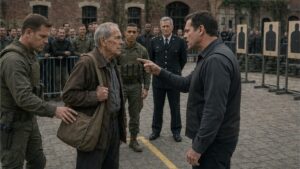
A young soldier in camouflage stepped backward from the coffee table without looking. Raymond stopped before the soldier’s heel came down on the cane.
“Excuse me,” Raymond said.
The soldier turned. He had a clean face, clipped hair, and the drawn alertness of a young man trying to look older in uniform. His name tape read MILLER.
“Sir, you need to keep this lane clear,” the soldier said.
Raymond glanced at the lane. There was no lane, only people. “I have an appointment in records.”
“Everyone does today.” The soldier lifted one hand, palm out, not touching him but stopping him all the same. “You can wait by the elevators until they call.”
“I was told to check in at the office.”
The soldier looked at the folder, then at Raymond’s cane, then past him toward another cluster of people. “Sir, we’ve got active processing going on. I can’t have folks wandering through.”
Folks.
Raymond had been called worse. The word still found its place under his ribs.
“I’m not wandering,” he said.
The soldier exhaled through his nose. “Okay. Just give me a second.”
He turned away, already finished with Raymond in his mind.
Raymond waited. Ten seconds. Twenty. The records-office door opened. A supervisor called a name that was not his. Two soldiers crossed with a box of forms. A man in a Navy cap asked someone where the restroom was.
Raymond took one careful step around the coffee table.
“Sir,” Miller said sharply.
The word snapped heads toward them.
Raymond stopped.
Miller came back fast. Not running, not quite, but with the stiff, irritated stride of someone whose small authority had been tested in public. His sleeve brushed the folder under Raymond’s arm.
It was not a hard collision. Later, Raymond would remember that. He would remember that the young man did not shove him, did not strike him, did not intend the exact thing that happened.
But the folder was old. The rubber band was older.
It snapped.
The sound was small, almost childish.
Then the papers slid.
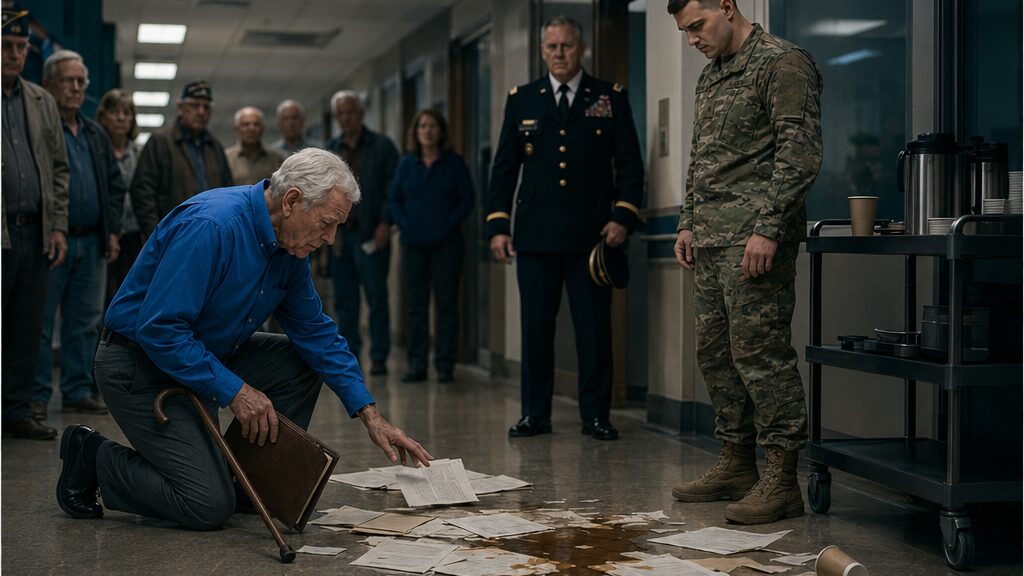
They fanned out across the polished floor in a white rush: copies, letters, photographs, tabs Nancy had written, forms Raymond had sorted at the kitchen table under the stove light. A paper cup tipped from the edge of the coffee table as Miller jerked back. Brown liquid spread in a quick crescent, reaching the nearest page before Raymond could bend.
For one second nobody moved.
Raymond looked down.
The top sheet showed Thomas H. Reed’s service number in the upper right corner. Coffee touched the edge, then crawled inward.
Raymond lowered himself slowly, one hand gripping the cane, the other reaching for the paper.
“Sir, don’t—” Miller began.
“Please don’t step on that number,” Raymond said.
His voice was quiet enough that the hallway had to lean toward it.
Miller froze with one boot half-raised. The sole hovered above the page.
Raymond’s knee protested as he bent. Pain rose hot through his leg, but he got two fingers on the corner of the paper and slid it away from the coffee. The wet edge left a brown streak on the floor.
“Sir, you need to let staff handle that,” Miller said, lower now, embarrassed by the people watching.
Raymond did not answer. He placed the page on top of his shoe to keep it from soaking further, then reached for another.
A woman in the row of chairs murmured, “Oh, Lord.”
The clerk with the clipboard stepped forward, then stopped as if unsure whether she was allowed to help.
Miller crouched, but not close enough to touch the papers. His face had gone red along the cheekbones. “I told you to wait, sir.”
Raymond picked up a photograph. It showed three young men in fatigues, sun-whitened and grinning beside a truck. Thomas Reed stood in the middle. Raymond was on the left, thinner than memory, one hand lifted as if telling the photographer not to waste film.
The coffee had missed that one.
He laid it carefully on a dry patch beside his knee.
“You can’t block the hall,” Miller said, and the words came out too loud.
Raymond looked up then.
Not sharply. Not angrily. Just up.
Miller’s mouth tightened, as if he had expected an argument and received something worse.
At the far end of the hall, a door opened. A man in a dark dress uniform stepped out with two officers behind him. He was middle-aged, broad-shouldered, with silver at the temples and ribbons over his left breast. The hallway changed around him the way rooms sometimes changed around rank. Conversations thinned. Backs straightened.
The nameplate on his uniform read CARTER.
“What happened here?” Joseph Carter asked.
No one answered quickly enough.
Miller stood. “Sir, the gentleman entered the processing lane after being asked to wait. His paperwork fell.”
Raymond continued gathering pages.
Joseph’s eyes moved from Miller to the floor, then to Raymond’s hand, then to the cane leaning awkwardly against Raymond’s shoulder because he needed both hands now.
“His paperwork fell,” Joseph repeated.
Miller swallowed. “Yes, sir.”
The coffee reached another page. Raymond caught it just in time.
Joseph stepped forward and bent, not fully, but enough to read the heading on the sheet Raymond had placed on his shoe.
His expression changed by less than an inch. Raymond saw it anyway.
“Records correction,” Joseph said.
Raymond slid another wet page free. “Yes.”
“For Reed?”
Raymond’s fingers paused.
“Yes.”
Joseph looked at the arrangement of the scattered pages. They were not random, even in disaster. Tab A near the baseboard. Witness statements near the chair leg. Copy forms by the cane. Raymond’s order had broken open, but the shape of it remained.
Joseph removed his cap. “Sergeant Miller.”
Miller’s shoulders locked. “Sir.”
“Pick up the dry pages. Edges only.”
Miller hesitated for half a beat, then crouched. This time he reached carefully.
Raymond said, “Not that one.”
Miller stopped.
“That goes behind the birth certificate. It has to stay with the correction request.”
The young soldier looked at the page in his hand, then at Raymond.
For the first time, he did not look through him.
Joseph crouched beside Raymond, uniform creasing at the knee. “Sir, who taught you to build a file like this?”
Raymond gathered the photograph last. His hand trembled once, so slightly only he could feel it.
“I did,” he said.
The hallway stayed quiet.
Somewhere behind them, the coffee urn clicked as it reheated itself, busy with nothing that mattered.
Chapter 3: The Man Whose Name Was Misspelled Twice
They gave Raymond a chair in a small interview room with a square table, two boxes of tissues, and a wall clock that ticked too loudly.
He would rather have stood.
Sitting made people believe they had done something for him. It made them speak in lower voices, as if the chair had moved him closer to helplessness. But his knee had begun shaking after the hallway, and the papers needed the table more than his pride needed another performance.
Joseph Carter stood near the door while the records supervisor inspected the damaged pages. Sergeant Miller stayed by the wall, hands clasped behind his back, eyes fixed somewhere above the table. He had carried in a stack of dry documents using both hands, careful as a man holding glass.
Raymond did not thank him.
Not yet.
The records supervisor was a woman with rimless glasses and a badge that swung forward whenever she leaned over the packet. She sorted the pages into three piles: dry, damp, damaged.
The damaged pile grew too quickly.
“This coffee reached the lower corner here,” she said. “And here. This one might scan, but the ink on the witness signature is blurred.”
Raymond folded his hands around the top of the cane. “The signature was clear this morning.”
No one answered.
He had not meant it as accusation. Still, Miller shifted against the wall.
The supervisor turned another page. “Mr. Bennett, some of these are copies of copies.”
“They’re the only copies I could get.”
“I understand, but for a formal correction request, legibility matters.”
“Legibility mattered in 1970, too,” Raymond said.
The supervisor looked up.
Joseph watched Raymond with an expression that held warning and sympathy in equal parts.
Raymond looked down at his hands. The left thumb had a coffee stain along the nail. He rubbed it once against his trouser seam, but the brown half-moon stayed.
The supervisor adjusted her glasses. “Tell me about Thomas Reed.”
Raymond waited a moment. He had learned that if you answered too fast, people heard eagerness instead of truth.
“He was in my unit,” Raymond said. “For part of a year. Then he was assigned forward with a transport section. Good mechanic. Bad card player. He could sleep sitting up with a wrench in his hand.”
Joseph’s face softened, but he said nothing.
“The Army spelled his name wrong on a field casualty-related support report,” Raymond continued. “Not the main file. One of the supporting records. Read instead of Reed. Later, another clerk copied the mistake into a unit notation. Then a stateside form listed his middle initial wrong. Two errors. Separate pages.”
The supervisor made a note. “And this affected his family?”
“It affected what the system could find when they needed it.”
“Needed it for what?”
Raymond looked at the folder. The rubber band lay broken beside it like a little blue vein.
“His daughter tried to verify certain service-connected records after he died. The file kept coming back incomplete. Not denied cleanly. Not accepted cleanly. Just incomplete.” He looked at the supervisor. “Incomplete can bury a man better than no.”
Miller’s eyes lowered.
The supervisor touched the blurred witness statement. “This document is important.”
“It places him with the transport section under the corrected spelling.”
“Do you have another copy?”
Raymond’s mouth went dry.
“No.”
“Can you get one?”
“The man who signed it died in January.”
The room changed again, not like it had changed around Joseph’s rank in the hallway, but more slowly, as if the walls had absorbed the fact and passed it between them.
The supervisor set the page down. “I’m sorry.”
Raymond nodded. He did not want sorry. Sorry was soft and could not be filed.
Joseph stepped closer to the table. “Is there any way to process the packet pending replacement?”
“We can start a preliminary review,” the supervisor said, “but the damaged statement may be a problem. If the signature cannot be verified, it weakens the chain.”
“The chain was already weak,” Raymond said.
His voice had sharpened. He heard Nancy before anyone else could react.
Don’t let them make you mad.
He released the cane handle and flattened his palm over the dry pages.
“I apologize,” he said.
The supervisor’s expression flickered. “You don’t need to apologize.”
“I do if I want you listening.”
Joseph looked away for a second.
The supervisor sat back. “Mr. Bennett, how long have you been assembling this?”
Raymond thought of kitchen mornings, phone calls, county offices, stamped envelopes, one winter afternoon when Nancy had been too weak to sit up but still asked whether Ohio had called back.
“Long enough,” he said.
Miller’s voice came from the wall, quiet. “Sir, may I ask something?”
Joseph turned his head. “Careful.”
Miller nodded. He looked at Raymond, not at Joseph. “Why are you doing this for him? If he’s been gone six years.”
Raymond could have ignored him. A younger version of himself might have. But the question had not been cruel. It had been clumsy, and clumsy was not the same as cruel.
“Because he asked me once to check a number,” Raymond said.
“A service number?”
“A name first.” Raymond touched the stained page. “He got a letter where his name was wrong. He laughed about it in front of the others. Said the Army could lose your socks, your pay, and your last name before breakfast. I told him I’d look at it when things slowed down.”
He stopped.
The wall clock ticked three times.
“They didn’t slow down,” Joseph said.
“No,” Raymond said. “They did not.”
The supervisor lowered her pen.
Raymond could feel them all waiting for more, but there were some rooms in a life that did not open just because people had become polite.
He drew the damaged witness statement toward him. The ink had feathered along the bottom where the coffee had soaked in. The service number remained readable. Barely.
“I came today because Emily Reed has been asked to produce proof her father’s own file should have contained,” he said. “I told her I had the proof. This morning, I did.”
Miller’s face tightened as if struck, though no one touched him.
The supervisor gathered the damaged pages. “I can request an exception review.”
“How long?”
“I can’t promise.”
“How long?” Raymond repeated, softer.
“A few weeks. Maybe longer if they reject the witness statement.”
Raymond closed his eyes for one breath. Emily would be on her way soon. She had arranged childcare, changed a work shift, and told her young son that maybe today Grandpa Thomas’s Army papers would finally say what they were supposed to say.
He opened his eyes. “Then we start with what’s dry.”
Joseph nodded once. “I’ll stay until the packet is logged.”
The supervisor looked at him. “Colonel, that isn’t necessary.”
“No,” Joseph said. “But I will.”
Raymond did not look at Miller. He could feel the young soldier’s guilt standing in the corner like another person.
The supervisor reached for the intake stamp. “Mr. Bennett, I’ll need your attestation on the first page before we scan it.”
Raymond took the pen she offered. His fingers were stiff. The line for his signature seemed thinner than it should have been.
He signed slowly.
Raymond Bennett.
Former clerks had habits that never left. He checked the date, checked the page count, checked the spelling of Reed.
Then he saw the supervisor lift the coffee-stained sheet again and hold it under the light.
“This witness name,” she said. “The one that blurred at the bottom. Do you know if it appears anywhere else?”
Raymond looked.
The name was almost gone.
His chest tightened.
“No,” he said. “Not in what I brought.”
Miller shifted by the wall.
Raymond turned then, because sometimes a man could feel a thought forming in another man before it became words.
Miller was staring at a torn wet corner of paper stuck to the cuff of his own boot.
On it, in blue ink, was half a name Raymond had not seen clearly since morning.
Chapter 4: Brian Miller Learns What Silence Costs
Brian Miller did not notice the paper stuck to his boot until Raymond looked at it.
For one hard second, he thought the old man was looking at his uniform, judging the crease at his knee where he had crouched in coffee, or the way his hands had not known what to do on the hallway floor. Then Raymond’s eyes dropped lower, and Brian followed them.
A wet triangle of paper clung to the outside of his right boot, just above the sole. It had stuck there in the hallway when he stepped back from the spill. The edge was torn. Blue ink bled across the fibers.
He bent before anyone told him to.
The room seemed to hold its breath while he peeled the paper loose with two fingers. It sagged slightly in his hand. The letters were incomplete, but not gone.
…WARD CO…
Below that, part of a number. Or maybe a date.
Brian held it out.
Raymond did not take it right away. His hand rested on the cane, knuckles raised and pale.
The records supervisor reached for the fragment first. “Let me see.”
Brian gave it to her.
She carried it to the table, laid it beside the damaged witness statement, and turned both pieces carefully, searching for fit. The torn edge matched a pale space near the bottom of the page. Not perfectly. Close enough to make Brian’s throat tighten.
“That may be part of the witness block,” she said.
Raymond leaned forward. “Can it be used?”
“Not like this. It helps us guess, not verify.”
Joseph Carter looked at Brian. There was no anger in his face now. That made it worse. Anger would have given Brian something to stand against. This steady disappointment left him nowhere to put his hands.
“Sergeant Miller,” Joseph said, “step outside.”
Brian’s mouth went dry. “Yes, sir.”
The hallway had been cleared. The coffee had been wiped away, but a dull patch remained on the floor where the mop had passed. A paper caution sign stood near the wall, yellow and ridiculous, warning people about a danger that was already over.
Joseph closed the interview-room door behind him.
Brian stood at attention.
“At ease,” Joseph said.
Brian shifted his feet, but nothing in him eased.
“Tell me what happened.”
Brian stared at the wall. “The hallway was congested. I asked Mr. Bennett to wait near the elevators. He attempted to move through the processing area. I stepped in to redirect him. Contact occurred with his folder.”
“Contact occurred.”
Brian swallowed. “I brushed it, sir.”
“And after his papers fell?”
“I tried to maintain the lane.”
Joseph let the silence sit there until Brian heard the words as if someone else had spoken them.
Maintain the lane.
An old man on one knee. Papers in coffee. And Brian had been worried about a lane no one had marked, in a hallway he did not own.
Joseph turned slightly, looking through the glass strip beside the door. Inside, Raymond sat with his hands folded, his shoulders narrow beneath the bright blue shirt. The records supervisor spoke to him gently. He listened without nodding too much.
“Do you know why you’re here today?” Joseph asked.
“VA liaison support for the records event, sir.”
“That’s your assignment. I asked why you are here.”
Brian had no answer that did not sound like something printed on a schedule.
Joseph lowered his voice. “A liaison is a bridge, Sergeant. Not a barricade.”
Brian felt heat rise again, sharp and young and useless. “Sir, with respect, the hallway was out of control. We had civilians wandering through, appointments backing up, people asking questions I wasn’t briefed to answer—”
“Civilians.”
The word stopped him.
Brian looked through the glass again.
Raymond’s cane leaned against the table. Its black rubber tip was still damp.
“I didn’t mean—”
“I know what you meant,” Joseph said. “That’s part of the problem.”
Brian shut his mouth.
Joseph looked tired suddenly, not physically but in some older place. “You saw an old man moving slowly and decided he was disorder. You saw papers and decided they were clutter. You saw a cane and decided he needed managing.”
Brian’s jaw tightened. He wanted to defend himself, but every defense replayed the hallway in smaller, uglier pieces.
The old man’s voice came back to him.
Please don’t step on that number.
Not don’t step on my papers. Not what are you doing. Not even you spilled it.
That number.
“He didn’t yell,” Brian said before he could stop himself.
“No.”
“Most people would have.”
Joseph watched him.
Brian stared at the caution sign. “I think that made it worse.”
“For whom?”
Brian had no answer.
A clerk passed carrying a stack of folders and slowed when she saw Joseph. Joseph gave a slight shake of his head, and she kept walking.
“Go to the break room,” Joseph said. “Clean your boot. Then report back here. You are not finished with this.”
Brian’s stomach sank. “Am I being removed from duty, sir?”
“Not yet.”
That should have relieved him. It did not.
The break room was at the end of the hallway, past a vending machine that hummed louder than necessary. Brian entered alone. The room held a sink, a microwave, a coffee machine, and a small table covered with sugar packets. He turned on the faucet and braced one hand against the counter.
The coffee on his boot had dried at the edges. He wet a paper towel and rubbed. Brown came away in streaks.
He had been in worse trouble before. Late paperwork. A missed equipment check. Once, a sergeant had chewed him out so loudly that three offices heard it. That kind of trouble had shape. You took it, corrected it, moved on.
This was different because Raymond Bennett had not asked for punishment.
Brian almost wished he had.
He scrubbed harder at the boot until the leather squeaked. A small fleck of paper fell near the sink. He reached to throw it away, then stopped.
It was no bigger than a fingernail. Part of a photocopy corner. Not the witness signature. Not enough to matter, probably. But he picked it up anyway and laid it flat on a dry paper towel.
There was writing on it.
Not much.
—Ohio
Brian bent closer.
Below it, an old typed line ended in the letters: Co.
Company? County? Command?
He stared at the fragment, feeling foolish and desperate at once. The old man had built that file over years. Brian had ruined parts of it in seconds. Now he was trying to make guilt into usefulness with a scrap small enough to lose under a thumb.
The break-room door opened.
A security guard stepped in, stopped when he saw Brian, then nodded toward the towel. “You saving that?”
Brian straightened. “It may belong to a file.”
The guard’s expression shifted. “From the spill?”
“Yeah.”
“Maintenance tossed some wet towels from the floor into the gray bin. Not trash yet. They were waiting to see if records wanted them.”
Brian turned off the faucet. “Where?”
“Utility closet by the coffee cart.”
Brian was out the door before the guard finished pointing.
The utility closet smelled of mop water and disinfectant. A gray bin sat beside the bucket wringer. Brian lifted the lid and found a plastic liner with damp paper towels, coffee-stained napkins, and two soggy forms that did not belong to Raymond’s packet.
He did not care who saw him.
He sorted through the mess on the floor of the closet, separating anything with ink, anything with a straight edge, anything that looked like it might once have carried a name. His sleeves picked up damp spots. Coffee darkened his fingertips.
By the time Joseph found him, Brian had laid six fragments on a clean towel.
Joseph stood in the doorway.
Brian did not stand. “Sir, I found more pieces. Maybe nothing useful, but there’s Ohio on one. And maybe part of Company.”
Joseph looked down at the fragments.
For the first time that day, his expression gave Brian something other than correction.
“Bring them,” Joseph said.
Brian gathered the towel carefully.
When he returned to the interview room, Raymond looked at the fragments in his hands, then at the coffee stains on his sleeves.
Brian expected gratitude and dreaded it.
Raymond only said, “Lay them flat.”
So Brian did.
One by one.
The smallest piece, the one from the break room, fit near a line Raymond had thought lost. Not enough to restore the signature, not enough to solve the file, but enough to show that the witness had been from Ohio and attached to a company designation that might still exist in an archive.
The records supervisor wrote it down.
Brian stood behind the chair, hands empty now.
Raymond touched the fragment with one finger, not pressing, just holding it in place against the page.
“Paper remembers poorly when people treat it badly,” he said.
Brian did not know whether it was meant for him.
He heard it anyway.
Chapter 5: Emily Reed Arrives With Nothing Left to Expect
Emily Reed arrived at the VA with her work badge still clipped to her sweater and a child’s dinosaur sticker stuck to the back of her phone.
Raymond saw the sticker first as she stepped into the records office doorway, scanning the room with the careful dread of someone used to bad news. She was in her early forties, hair pulled back too quickly, face tired in the way working mothers looked tired, as if every hour of sleep had been negotiated with someone smaller, older, or less patient.
“Mr. Bennett?” she said.
Raymond started to rise.
“Don’t,” she said immediately, crossing to him. “Please don’t.”
He settled back, embarrassed by relief.
Emily looked at the table.
The packet lay open in controlled disorder. Dry pages were stacked by tab. Damp pages rested on paper towels. The coffee-stained witness statement sat under a clear plastic sleeve the records supervisor had found somewhere. Several fragments were arranged beside it like pieces from a broken plate.
Emily’s mouth changed before she spoke.
“What happened?”
Raymond looked at Brian, who stood near the wall again, quieter than before. Then he looked back at Emily.
“There was a spill.”
Her eyes moved to his cane, to the damp edge of his trouser cuff, to the paper towels.
“A spill,” she repeated.
“Yes.”
“Did you fall?”
“No.”
Her shoulders lowered a fraction. “Okay.”
That one word carried more fear than complaint.
The records supervisor introduced herself and explained the situation with professional gentleness. Preliminary review could begin. Some pages remained usable. The damaged witness statement would complicate verification. An exception might be possible, but there were no guarantees.
Emily listened without interrupting. Her fingers tightened around her phone until the dinosaur sticker wrinkled.
When the supervisor finished, Emily nodded as if she had expected every word.
“They always need one more thing,” she said.
Raymond felt the sentence land in him.
Joseph pulled a chair for her. She sat but did not take off her coat.
“I’m sorry,” Raymond said.
Emily looked at him quickly. “No. Don’t do that.”
“I told you I had it ready.”
“You did have it ready.”
“Not anymore.”
Her face softened and sharpened at once. “Mr. Bennett, my father spent half his life joking that the Army knew how to send him places but not how to spell him once he got there. He acted like it didn’t bother him.” She looked at the damaged page. “It bothered him.”
Raymond looked at the photograph drying near the window ledge. Three young men beside a truck. Thomas Reed’s grin had survived the coffee.
“He made jokes when he wanted people to stop looking,” Raymond said.
Emily gave a small laugh without humor. “Yes. That was him.”
Brian shifted near the wall. Emily noticed him for the first time. She saw the uniform, the lowered eyes, the coffee-darkened cuff. She understood enough.
Raymond said, “Sergeant Miller found some torn pieces that may help.”
Emily looked at Brian. “Thank you.”
Brian’s face flushed. “Ma’am, I’m the reason they needed finding.”
The room went still.
Emily’s gaze stayed on him. Raymond saw anger rise in her, not loud, but bright. She had taken time off work. She had believed Raymond when he said the packet was ready. She had arranged care, carried hope carefully enough not to call it hope, and now this young soldier stood before her confessing that his impatience had damaged what little proof remained of her father’s record.
Raymond waited.
Emily looked back at the papers instead of speaking.
It was a mercy, though not a soft one.
The records supervisor cleared her throat. “Ms. Reed, we were asking whether your family might have any secondary materials. Letters, recordings, anything where your father mentioned a witness name or unit assignment.”
Emily shook her head, then stopped.
“What?” Raymond asked.
She looked uncomfortable. “It’s probably nothing.”
“Nothing has been our most reliable source so far,” Raymond said.
A reluctant smile touched her mouth and disappeared. She opened her phone, scrolled, then held it without pressing anything.
“My dad saved old voicemails,” she said. “He never deleted anything. Drove me crazy. After he died, I transferred some from his phone to mine because I couldn’t stand wiping it clean.”
Raymond’s hand tightened around the cane.
Emily kept looking at the screen. “There’s one from you.”
The room narrowed around Raymond.
“From me?”
“I think so. Years ago. You called him after my mom’s funeral, maybe? Or before. I don’t remember. He saved it under ‘Bennett Army paper.’”
Raymond stared at the phone as if it were something alive.
Emily glanced at the others. “I haven’t listened to it in a long time.”
Joseph said, “Only if you’re comfortable.”
“I’m past comfortable,” Emily said. “I’m trying to be done.”
Raymond heard no disrespect in it. Only exhaustion.
The supervisor leaned forward. “If the voicemail mentions the witness name or gives context, it may help us locate supporting records. It won’t replace a signed statement by itself, but it could guide an archive search.”
Emily looked at Raymond. “Do you want me to play it?”
He did not.
The answer rose clear and immediate.
He did not want his own younger voice in this room. He did not want to hear how he had sounded when Thomas was still alive, when Nancy was still in the kitchen, when the file was not yet a burden with softened corners. He did not want to remember whatever he had promised casually, believing there would always be time to make good on it.
But Emily was watching him with her father’s eyes. Not the shape, exactly. The waiting.
Raymond nodded.
“Not here,” he said.
The records supervisor checked the wall clock. “We can use the conference room after closing. It’ll be quieter.”
Brian spoke before Joseph could. “I can stay.”
Everyone looked at him.
He straightened. “If there’s an archive search, I may have access through the liaison system. Limited, but maybe enough to find a unit roster or company record. Sir.”
Joseph studied him. “You understand staying does not erase what happened.”
“Yes, sir.”
“And this is not about making yourself feel better.”
Brian swallowed. “I know, sir.”
Raymond wondered if he did.
Emily stood and walked to the window ledge. She picked up the photograph by its dry corner. “Is this him?”
“Yes,” Raymond said. “Middle.”
She looked at her father at twenty, sun in his eyes, grin wide enough to make the war look far away though it was not.
“I’ve never seen this one.”
“You can keep it after we copy it.”
Her eyes shone, but she did not cry. Raymond respected her for it and wished she did not have to be so practiced.
She turned the photograph slightly. “Who’s that?”
Raymond looked at the young man on the left. Himself, before the cane, before the careful mornings, before he understood how long a mistake could live.
“That was me.”
Emily studied the photograph, then looked back at him.
For the first time that day, Raymond felt truly seen, and it unsettled him more than being overlooked had.
“My dad trusted you,” she said.
The words were not accusation. That made them harder.
Raymond looked at the open packet, the stained page, the broken rubber band beside the folder.
“He should have been able to,” he said.
No one answered.
Outside the interview room, the hallway began to empty. Chairs scraped. The coffee cart was wheeled away. Somewhere, a custodian laughed softly with a clerk. The building continued its ordinary closing sounds while Raymond sat with a promise spread wet and fragile across the table.
Emily placed the photograph down with care.
“I’ll play the voicemail,” she said. “But if it hurts, I’m not apologizing.”
Raymond looked at her.
That sounded like Thomas.
For the first time since the folder fell, Raymond nearly smiled.
Chapter 6: The Voicemail Raymond Never Wanted Played
After closing, the VA building sounded larger.
Without the daytime voices, every small noise traveled: the click of Joseph’s pen, the soft buzz of fluorescent lights, the distant roll of a trash bin somewhere beyond the elevators. In the conference room, the long table had been cleared except for Raymond’s papers, now laid out in careful rows on paper towels. Damp pages curled at the corners. The coffee stain on the witness statement had dried into an uneven brown tide.
Raymond sat at one end of the table. Emily sat beside him, phone in both hands. Joseph stood near the wall with his jacket unbuttoned. Brian sat across from Raymond, no longer at attention but not relaxed either. The records supervisor had left to scan what she could before the system locked for the night.
Emily tapped her phone awake.
“I don’t know what’s on it,” she said.
Raymond nodded.
His throat felt lined with dust.
The voicemail began with static, then a beep, then his own voice.
Not young. Not old either. Stronger than now. Less careful.
“Tom, it’s Raymond. Listen, I found that old copy you asked me about. You were right. They put Read on the transport notation. No second e.”
Emily closed her eyes.
Raymond looked down at his hands. The voice kept going.
“I called the county office too. Birth certificate says Reed clear as day. I don’t know who they had typing back then, but he did you no favors.”
A faint sound came through the recording, perhaps Raymond laughing once. He did not remember laughing.
“There was another fellow on that line with us when they logged the truck assignments. Ward. I think his name was Jack Ward. Ohio man. C Company attached motor pool, at least for that week. He’d remember. I’ll write it down before I forget.”
Brian’s head lifted.
Joseph looked at him but said nothing.
The voicemail continued.
“Don’t let them tell you it’s too small to fix. Names aren’t small. Call me back when you get this.”
Then a pause.
Raymond remembered the pause before the recording did.
His old voice returned, quieter.
“And Tom? I should’ve said something when that captain brushed it off. I knew it was wrong then. I let it pass because everybody was tired and nobody wanted one more form. That was on me.”
The message ended.
No one moved.
Emily lowered the phone slowly until it rested against the table. The screen dimmed.
Raymond looked at the papers without seeing them. A man could carry guilt so long it became part of his posture. He had thought his cane made him bend. Maybe it only revealed what had been happening for years.
“I didn’t know he saved that,” he said.
Emily’s voice was rough. “He saved everything that told him he wasn’t crazy.”
Raymond closed his eyes.
The room gave him the mercy of quiet.
He saw Thomas Reed at twenty-two, leaning against a truck with grease under his nails, waving off the error with a joke. He saw a captain at a folding desk, annoyed at being asked about a spelling mistake while supply forms stacked beside him. He saw himself, young and tired, holding the paper, knowing the name was wrong.
We’ll fix it later, the captain had said.
Raymond had believed him because believing him was easier than becoming a problem.
Later had become a room like this.
“I should have pushed,” Raymond said.
Emily did not touch his arm. He was grateful. If she had, he might not have held.
“You were young too,” she said.
“That doesn’t fix it.”
“No,” she said. “It doesn’t.”
The honesty steadied him.
Brian leaned forward carefully. “The voicemail said Jack Ward.”
Raymond opened his eyes.
“Do you know that name?” Joseph asked.
Brian shook his head. “No, sir. But if he was attached to C Company motor pool, there may be a roster index or transfer note in the liaison archive. Not the full personnel file, but enough to confirm assignment.”
Joseph looked at him. “Can you access that?”
“Maybe. My current assignment includes temporary archive coordination for the event. I’d need authorization.”
“You’ll have it.”
Brian stood. “Now?”
Joseph glanced at Raymond.
Raymond looked at the phone in Emily’s hands, then at the stained statement. The service number remained visible. Jack Ward’s name, once nearly lost to coffee and time, now existed in three places: a torn fragment, a dead man’s saved voicemail, and Raymond’s memory.
“Now,” Raymond said.
Brian left the room with Joseph.
Emily stayed.
For a while, neither she nor Raymond spoke. The fluorescent light hummed. The paper towels beneath the documents had begun to dry in ridges.
Emily played the voicemail again, softer this time, stopping before the last part.
“My son asks about him,” she said.
“Your father?”
She nodded. “He was three when Dad died. He remembers his laugh. Not much else. I kept trying to get the records fixed because I wanted to be able to tell him his grandfather’s service counted. Officially, I mean.” She looked embarrassed by the word.
“It did count,” Raymond said.
“I know.” She touched the phone. “But sometimes knowing something in your kitchen doesn’t help when every letter says incomplete.”
Raymond understood that too well.
Emily looked at him. “My dad never blamed you.”
“He should have.”
“No. He blamed the system. Sometimes the Army. Sometimes himself for not keeping better copies.” Her mouth moved like she almost smiled. “Sometimes he blamed a clerk in Missouri he never met.”
Raymond let out a quiet breath. “That sounds like him.”
“He talked about you when he was sick. Said Bennett was the only man he knew who alphabetized bad news.”
Raymond looked away.
Nancy had laughed when Thomas said that at their table years ago. She had served coffee, real coffee in ceramic mugs, and teased Raymond for arranging napkins by size when company came. Thomas had taken the teasing as permission to stay for supper. That was how he had been. A man who could turn a correction request into an evening.
Emily leaned back. “Why didn’t you tell me about the voicemail before?”
“I didn’t remember it.”
“Not at all?”
“I remembered calling. I didn’t remember saying that.”
“The part about the captain?”
Raymond nodded.
Emily studied him, not unkindly. “Maybe you didn’t want to.”
The words should have stung. Instead, they opened something that had needed air.
“No,” Raymond said. “I did not.”
The conference-room door opened before either could say more. Brian entered with Joseph behind him, carrying a printed sheet and wearing an expression that had not yet decided whether it was hope.
“We found a roster reference,” Brian said.
He placed the paper on the table but did not push it toward Raymond, as if he had learned that documents deserved permission.
Joseph took over. “C Company attached motor pool had a temporary duty list from that month. Jack Ward appears on it. Not a full witness verification, but it establishes he was where the voicemail and fragment suggest.”
Emily covered her mouth.
Raymond reached for the sheet. His fingers trembled, and this time he did not hide it.
The paper was fresh, warm from the printer. Clean black type. No coffee. No softened edges. No old crease from being carried through years.
WARD, JACK — C CO ATTACHED MOTOR POOL.
Raymond read it twice. Then a third time, because a man who had spent years watching names disappear did not trust one appearance.
Brian sat down slowly. “It doesn’t fix the signature.”
“No,” Joseph said. “But it gives the supervisor a path.”
Emily wiped under one eye with the heel of her hand. “A path is more than we had this morning.”
Raymond looked at Brian.
The young soldier’s face was open now in a way it had not been in the hallway. Still ashamed, yes, but also present. Not trying to escape the room, not trying to turn usefulness into absolution.
Raymond placed the roster reference beside the stained witness statement.
Old paper. New paper.
Damage and repair did not erase each other. They sat side by side.
“Sergeant Miller,” Raymond said.
Brian straightened. “Sir?”
“Tomorrow, when they ask what happened to the file, tell it plainly.”
Brian’s eyes flicked to Joseph. “Yes, sir.”
“Not worse than it was. Not better.”
“No, sir.”
Raymond looked back at the papers. The room was quiet again, but not empty the way it had been before the voicemail. Thomas’s saved message seemed to remain in the air, stubborn and ordinary.
Names aren’t small.
Raymond pressed two fingers against the corner of the stained page.
For the first time all day, he believed the file might survive the truth.
Chapter 7: The Correction No One Could Sign for Him
The next morning, Raymond wore the same blue shirt.
He had washed the coffee from the cuff in the sink before dawn and pressed the fabric with the heel of his hand while it was still damp. The stain had faded but not vanished. A faint shadow remained near the button, pale brown against blue, like a reminder the cloth had decided to keep.
He considered changing shirts. Then he did not.
The folder, however, looked different.
The records supervisor had given him a new one before he left the night before, clean and stiff, with a metal fastener and a clear plastic sleeve for the intake sheet. Raymond had transferred nothing into it at home. He had sat at his kitchen table with both folders side by side, Nancy’s old brown one and the new government-issued one, and he had left the papers where they were.
At eight forty, he returned to the VA with the old folder under his arm.
The broken blue rubber band was tucked in the front pocket.
Brian Miller was waiting near the third-floor elevator.
He stood when the doors opened. Not at attention. Not exactly. He stood as if he had been told not to make a performance of respect and was trying to obey.
“Mr. Bennett,” he said.
Raymond stepped out carefully, cane first. “Sergeant.”
Brian looked at the folder. “May I carry that?”
“No.”
The answer came too quickly. Raymond heard the edge in it.
Brian accepted it with a nod. “Yes, sir.”
They walked together down the hallway. The coffee cart was back in its place, but shifted farther from the traffic path. A strip of blue tape now marked a walkway along the wall. Someone had put the caution sign away.
Small changes. Not redemption. Still, Raymond noticed.
Outside Records Office 314, Joseph Carter spoke with the supervisor. Emily Reed stood beside the door with her coat folded over one arm. Her phone was in her hand, but she was not looking at it. When she saw Raymond, her face opened with relief she did not try to hide.
“You came back,” she said.
Raymond looked at the folder under his arm. “It would be a strange time not to.”
She smiled, then pressed her lips together.
The records supervisor led them into the same interview room. The table had been cleared. In the center sat a rebuilt packet, clipped in sections: identity documents, service references, unit roster, damaged witness statement, voicemail transcript, attestation form. The coffee-stained original page lay inside a protective sleeve, its brown edge visible like an old bruise.
Raymond lowered himself into the chair. His knee was worse today. He had expected that. Pain usually waited until the work was nearly done to ask for attention.
The supervisor turned the packet toward him. “We can submit a preliminary correction request with supporting notation. Colonel Carter provided authorization for the liaison archive printout. Sergeant Miller documented the incident and the recovery of the fragments. Ms. Reed provided the voicemail and permission to transcribe it.”
Raymond looked at the pages. “And the damaged statement?”
“It will be included as an original supporting document, with explanation.” She hesitated. “It may still be challenged.”
“Most true things are.”
Emily glanced at him.
The supervisor placed one final form before Raymond. “This is your attestation. You are confirming that, to the best of your knowledge, the packet is complete, the account is accurate, and the damaged document was part of the original file you brought yesterday.”
Raymond reached for the paper. Joseph stopped him with a gentle clearing of his throat.
“There’s one more thing,” Joseph said.
Brian’s face changed before anyone else spoke.
The supervisor folded her hands. “Because the document damage occurred in the facility, there is an incident report. You may attach a statement. You are not required to, but if you do, it becomes part of the administrative record.”
Raymond looked at the form. “What kind of statement?”
“Your account of what happened in the hallway,” Joseph said.
Emily’s eyes moved from Raymond to Brian.
Brian stood near the wall, hands at his sides. He did not look away this time.
Raymond understood then why the room felt held in place. The file could move forward. Brian’s mistake could also move forward, separate but attached, like a shadow fastened to paper. One sentence from Raymond could make the hallway into a disciplinary matter sharp enough to cut.
He had earned the right to be angry.
That was the trouble with anger. It liked to arrive carrying receipts.
The supervisor slid a blank statement sheet across the table. “You can take your time.”
Raymond looked at the clean lines waiting for words.
He remembered the hallway: Miller’s raised palm, the word folks, the snap of the rubber band, the coffee reaching Thomas Reed’s service number. He remembered the young soldier saying maintain the lane as if a lane mattered more than a man on one knee. He also remembered Brian in the utility closet, sleeves wet, sorting through dirty paper towels because a fragment might still matter.
Both were true.
Raymond picked up the pen.
His hand was stiff, but the letters came.
On the morning of the records review, my folder was damaged after contact in a crowded hallway. Sergeant Brian Miller had previously directed me to wait near the elevators. I proceeded toward the records office because I had an appointment. The contact was not a deliberate attempt to damage my documents. Afterward, Sergeant Miller recovered several fragments and assisted in rebuilding the packet.
He paused.
Joseph watched without moving. Emily’s hands were clasped in her lap. Brian looked as if he had stopped breathing.
Raymond added one more sentence.
The incident happened because I was treated as an obstruction before I was treated as a person with business in that office.
He set the pen down.
No one spoke for several seconds.
Then the supervisor took the page, read it, and looked at Raymond over her glasses. “This is what you want attached?”
“Yes.”
Brian looked down.
Joseph’s face remained still, but Raymond saw the approval there and something more complicated than approval. Maybe relief. Maybe humility.
The supervisor clipped the statement to the incident report.
“Now the attestation,” she said.
Raymond drew the final form closer. His name was already typed beneath the signature line. Raymond Bennett. Witness and preparer.
For a moment, he saw the younger version of himself at the field desk, holding Thomas Reed’s misspelled paper, letting a captain’s impatience become law because it was easier to be quiet. Then he saw Nancy at the kitchen table, sliding tabs onto pages. He saw Thomas laughing so nobody would know the joke had teeth. He saw Emily holding the photograph of her father as if the picture were a door.
He signed.
Slowly. Completely.
Raymond Bennett.
The supervisor checked the signature, then stamped the corner of the packet. The sound was small, firm, official.
Received.
Emily covered her mouth with both hands. No one pretended the stamp solved everything. It did not correct the record by itself. It did not restore the years. It did not call Thomas Reed back to hear his own name spelled right by the government that had once misplaced it.
But it entered the fight properly.
The supervisor gathered the packet. “I’ll scan this now.”
“Before you do,” Raymond said.
She stopped.
Raymond looked at Brian. “Read the service number.”
Brian blinked. “Sir?”
“The one you nearly stepped on.”
Emily’s eyes filled, but she did not look away.
The supervisor opened the protective sleeve and turned the coffee-stained page toward Brian. He stepped closer. The number sat in the upper right corner, faint but legible.
Brian leaned over the page.
At first, his voice caught. He cleared it.
Then he read the number aloud.
Not fast. Not as data. As if each digit had weight.
Raymond listened until the last number settled in the room.
“Again,” Raymond said.
Brian read it again.
This time, his voice did not catch.
Raymond nodded. “Now you know why I asked you not to step on it.”
Brian’s eyes shone, though nothing fell from them. “Yes, sir.”
“No,” Raymond said quietly. “Not sir. Mr. Bennett is fine.”
Brian held his gaze. “Yes, Mr. Bennett.”
The supervisor took the page for scanning. Joseph opened the door for her, and the room emptied by one important degree.
Emily leaned toward Raymond. “Thank you.”
He looked at the closed folder, the old brown one, lighter now.
“Don’t thank me yet.”
“I’m thanking you for showing up.”
That he could not argue with.
Outside the interview room, the scanner began its steady pull, page after page, turning damp survival into record. Raymond listened with one hand resting on his cane.
For the first time, the sound of an office machine did not make him feel small.
Chapter 8: The Next Old Man in the Hallway
One week later, the third-floor hallway smelled of coffee again.
Raymond noticed it as soon as the elevator doors opened. Burnt, ordinary, too strong. He stepped out with his cane and paused long enough for the doors to close behind him. The hallway was busy, but not crowded the way it had been before. The blue tape still marked the walking path along the wall. The coffee table remained farther back. A small sign had been added beside it.
PLEASE KEEP WALKWAY CLEAR.
Someone had printed the words in bold capital letters and taped the paper at eye level. The tape was crooked.
Nancy would have fixed that.
Raymond let himself stand there a moment before moving forward. He had dressed in the same blue shirt again, now properly washed. The stain at the cuff had faded to almost nothing unless he knew where to look, and he did. The old brown folder was under his arm, but it no longer bulged. Most of the documents had been copied and logged. What remained inside were duplicates, notes, and the photograph Emily had insisted he keep until she could make a better scan.
He had not wanted to come back for the update in person. That was what he told himself while buttoning his shirt. The truth was simpler and less flattering. He had wanted to see whether the hallway remembered.
Hallways did not remember. People did, if they chose to.
Brian Miller stood near Records Office 314 with a clipboard in hand. He was speaking to an elderly man in a faded cap who leaned heavily on a walker. The man held a plastic envelope upside down, papers sliding toward the unsealed end.
Raymond stopped.
Brian did not see him.
“Take your time,” Brian said to the man.
The elderly man fumbled with the envelope. A few pages slipped halfway out. Brian reached, then stopped short of taking them.
“May I help hold that while you close it?” he asked.
The man looked suspicious, then nodded.
Brian held the envelope steady while the man tucked the papers back inside. He did not rush him. He did not glance over his shoulder. He did not call him sir in that strained way people used when patience was running thin.
When the envelope was sealed, Brian pointed down the hall. “Your office is this way. I’ll walk with you.”
The man said something Raymond could not hear.
Brian leaned closer, listened, then smiled a little. “No problem. We’ll go slow.”
Raymond looked at the blue tape on the floor.
No applause. No witness except a few people waiting in chairs and one old man by the elevator who knew what he was seeing.
Emily arrived three minutes later with her phone in one hand and her son’s backpack over one shoulder. The child was not with her; she had come during a school hour. Her face was anxious, but it no longer held the flat expectation of disappointment.
“You okay?” she asked Raymond.
“I’m standing.”
“That is not always an answer.”
“It is today.”
She smiled.
Joseph Carter came from the records office wearing his service uniform, though less formally than the week before. He greeted Emily first, then Raymond. Brian returned from escorting the elderly man and stopped a few steps away, waiting to be included rather than inserting himself.
Joseph held a slim packet.
“The review board accepted the preliminary correction package for active consideration,” he said. “They have not completed the full correction yet. That will take time.”
Emily nodded, bracing.
“But,” Joseph continued, “the supporting notation has been entered. Your father’s file now carries an administrative flag linking Reed with the misspelled Read entries and the motor pool reference. It means the next reviewer will not start from zero.”
Emily closed her eyes.
Raymond felt the words settle more deeply than he expected.
Not fixed. Not finished. Not the clean ending people liked to imagine when they did not understand paperwork. But no longer buried in separate drawers under separate mistakes.
Emily opened her eyes. “So when they pull his file—”
“They will see the connection,” Joseph said. “And the correction request will move with the supporting materials attached.”
She pressed her phone against her chest. “My dad would have pretended that wasn’t a big deal.”
“He was good at pretending,” Raymond said.
She laughed once, and this time it did not break.
Joseph handed her a copy of the receipt. Emily ran her fingers over the printed lines, stopping at her father’s name.
Thomas H. Reed.
Spelled correctly.
Raymond looked away to give her room.
Brian stood beside the records-office door, clipboard held against his leg. His expression carried hope and shame in equal measure. Raymond had seen that combination before in young men after they understood they had survived a lesson but not escaped it.
“Mr. Bennett,” Brian said.
Raymond turned.
“I wanted to tell you—” Brian stopped, glanced at Emily, then began again. “I wrote a separate statement. Not for the file. For my unit. About the hallway procedures. And about me.”
Raymond waited.
“I requested to stay on liaison support through the end of the month,” Brian said. “If they allow it.”
“Why?”
Brian looked toward the old man with the walker, now seated near the records door. “Because I thought this duty was beneath me.”
The answer was plain enough to be useful.
Raymond nodded once. “And now?”
“Now I think I was beneath it.”
Emily looked at him then, not warmly, exactly, but fairly.
Raymond shifted the cane in his hand. “Do the work. Don’t make a shrine out of regret.”
Brian absorbed that. “Yes, Mr. Bennett.”
Joseph’s mouth moved almost into a smile.
The records supervisor appeared at the doorway with another set of copies for Emily. She explained the next steps: mail confirmation, possible requests, expected delays. Emily listened carefully, asking questions Raymond could tell she had written down somewhere. When the supervisor handed her the final receipt, Emily held it the way she had held the photograph, with both caution and hunger.
Raymond reached into the old brown folder and took out that photograph.
“I made a copy,” he said.
Emily stared at it. “You were supposed to keep it until I scanned it.”
“I did. Then I decided you should have the original.”
She shook her head. “No, Mr. Bennett. That’s yours too.”
“It was your father’s face.”
“You’re in it.”
Raymond looked down at the three young men beside the truck. Thomas in the middle, grinning. Raymond on the left, trying not to smile. A third man half turned toward someone outside the frame. Sunlight made all of them look unwisely permanent.
Emily touched the edge. “Keep it,” she said. “When the correction comes through, we’ll make a copy for my son. I want to tell him who’s standing next to his grandfather.”
Raymond’s throat tightened. He returned the photograph to the folder with care.
A paper shifted inside, and the broken blue rubber band slipped partly out of the pocket. Emily noticed it.
“What’s that?”
“Nothing.”
She raised an eyebrow.
Raymond pulled it free. “Nancy’s rubber band. It broke last week.”
Emily held out her hand. He placed it in her palm.
“It held a lot for something that small,” she said.
“Yes.”
“Do you want to keep it?”
Raymond looked at the stretched, snapped loop. For years it had held pages together because Nancy had put it there. Then it had failed exactly when everything needed holding most. But the papers had not disappeared. People had knelt. Fragments had been found. A voicemail had spoken. A new packet had been clipped, stamped, scanned, and carried forward.
“No,” he said. “Throw it away.”
Emily looked uncertain.
Raymond closed her fingers over it gently. “Some things are allowed to be done.”
She nodded.
Across the hallway, Brian helped the man with the walker rise when his name was called. He did not take the walker. He did not pull the man by the elbow. He simply waited until the man had his balance, then opened the records-office door and held it.
Raymond watched them go in.
Joseph stood beside him. “You could have ended his assignment.”
“I know.”
“Why didn’t you?”
Raymond looked at the closed records door. “Because ending a thing is not the same as correcting it.”
Joseph accepted that in silence.
Emily tucked the receipt into her bag. “Can I walk you down?”
Raymond almost said no. The word came from habit, not need. He stopped it.
“To the elevator,” he said.
They moved together down the blue-taped path. Emily walked at his pace without making it obvious. Joseph returned to the office. Brian remained at the door, clipboard in hand, eyes on the hallway.
Near the elevator, Raymond paused and looked back.
The floor was clean. No papers. No coffee spreading toward a service number. No old man on one knee while people watched and wondered whether to help. But Raymond could still see it, not as humiliation now, not entirely. He saw it as the place where a broken folder had opened and forced everyone nearby to decide what kind of person they were going to be.
Emily pressed the elevator button.
“Mr. Bennett,” she said, “when this is finally corrected, I want you there.”
“If I’m able.”
“You’ll be able.”
He gave her a look.
She smiled. “Fine. If you’re willing.”
The elevator chimed.
Raymond stepped in, turned, and faced the hallway once more. Brian looked up from the records door and gave a small nod. Not a salute. Not a performance. Just acknowledgment.
Raymond returned it.
The doors began to close.
As the hallway narrowed to a bright line, Raymond heard his cane tap once against the elevator floor. The sound was thin, ordinary, and steady.
He did not feel young. He did not feel healed. He did not feel triumphant.
He felt seen.
For that morning, it was enough.
The story has ended.