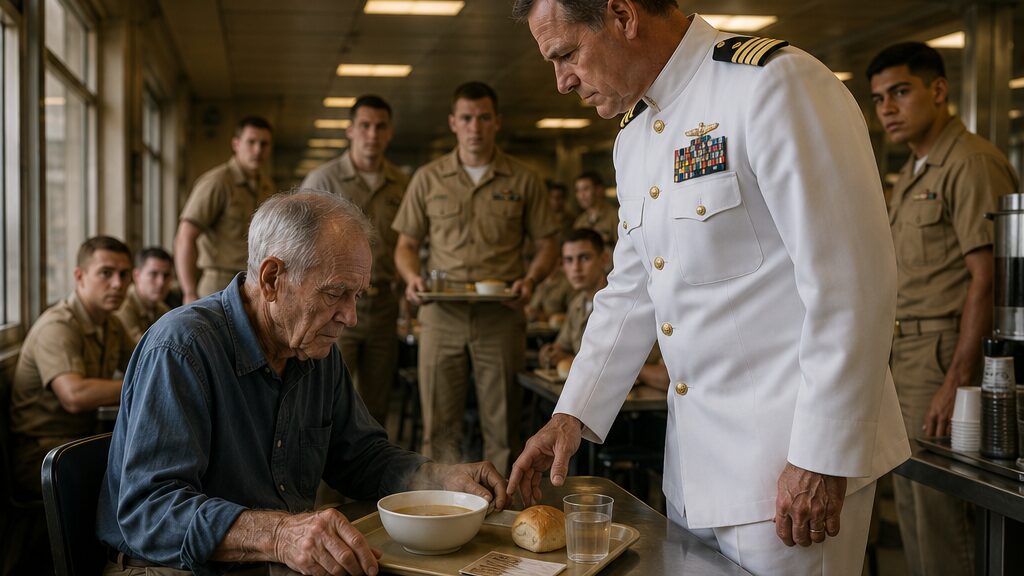
The Old Man Held His Cafeteria Tray While The Officer Learned Why Silence Still Commands Respect
Chapter 1: The Tray He Would Not Let Go
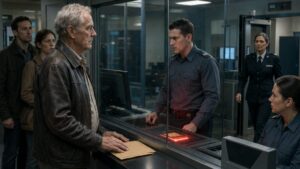
The officer at the door looked at Charles White’s visitor card as if it had been pulled from the bottom of a drawer no one had opened in twenty years.
Charles kept his hand steady on the counter.
Behind the security window, the clerk turned the card over, then back again. The plastic sleeve was cloudy at the edges. The blue ink had faded until the stamped seal looked more like a bruise than an emblem. Charles could feel the young sailors in line behind him shifting their weight, impatient without quite meaning to be cruel. Lunch had started, and the smell of warm bread and boiled vegetables had already drifted through the corridor.
“You have business on base today, sir?” the clerk asked.
Charles looked past him, down the long passageway. The tile had been replaced. The old scuffs were gone. Even the walls seemed brighter than they should have been.
“Mess hall,” Charles said.
The clerk glanced at the card again. “For an event?”
“No.”
“A meeting?”
“No.”
The clerk waited, his expression polite but tightening. Charles knew that look. It was the look people used when they wanted an old man to understand that he was slowing down the machinery around him.
“Lunch,” Charles said.
A sailor behind him gave a small laugh, quickly swallowed. Charles did not turn around.
The clerk tapped something into his computer. “This pass type isn’t in the current system.”
“It was issued before your system.”
“Yes, sir, I can see that.”
Charles looked at the card. He did not offer the explanation resting behind his teeth. He had learned, long ago, that explanations given too soon were often treated as excuses.
After a moment, the clerk slid the card back through the slot. “I’ll clear you for the cafeteria wing only. Stay within the marked access route.”
Charles nodded once, took the card, and tucked it into his shirt pocket. His fingers lingered there for half a second, feeling the stiff edge through the faded blue cloth.
The walk to the mess hall was longer than he remembered.
Or maybe his knees had become less forgiving.
He moved past framed photographs of ships he did not know, crews with faces too young and clean to have lived through anything yet. He passed a glass display case with challenge coins, model vessels, and plaques polished to a shine that made them look almost decorative. Nothing in the corridor smelled of diesel, salt, or wet rope anymore. It smelled of disinfectant, waxed floors, and institutional coffee.
At the mess hall entrance, Charles stopped.
The old room had survived, but only in outline. The ceiling still hung low. The serving line still turned left after the drink station. The windows still held the noon light in a pale rectangle across the floor. But the tables were new, smooth metal and laminate. The chairs had been changed. The clatter was lighter now, forks tapping plastic trays instead of the heavier sound he remembered.
For a moment, Charles did not move.
Then someone behind him said, “Sir? You going in?”
Charles stepped forward.
The noise wrapped around him at once: voices, trays sliding, ladles striking pans, boots on tile. Sailors in working uniforms moved in quick groups, carrying food and talking in clipped bursts. A few glanced at Charles’s civilian clothes, then away. His shirt was clean but old. His khakis hung loose. His shoes had been polished that morning, though the leather was cracked at the bend.
He took a tray from the stack.
It was lighter than the old ones.
His hands knew the motion anyway. Tray under the left palm. Thumb along the rim. Keep it level. Do not spill when the deck shifts. There was no deck beneath him now, only polished tile, but his body remembered other floors.
At the serving line, the kitchen supervisor looked up.
“Help you, sir?”
Charles studied the pans behind the glass. Chicken, rice, green beans, a tray of rolls. At the end, under a steel lid, he saw the pot.
“Soup today?” he asked.
The kitchen supervisor lifted the lid halfway. Steam rose, soft and white.
“Vegetable barley.”
Charles closed his eyes once. Not long enough for anyone to notice, he hoped.
“One bowl,” he said. “Please.”
“That all?”
“Yes.”
The supervisor ladled the soup into a plain white bowl and set it on Charles’s tray. The bowl clicked against the plastic. Charles added a roll because the old habit insisted on it, then a paper napkin, then a cup of water he did not really want.
At the cashier station, the young sailor there looked uncertain. “Sir, are you with a group?”
“No.”
“You active duty?”
“No.”
“Retired?”
Charles took the visitor card from his pocket and placed it beside the tray. The sailor looked at it, then at Charles, then toward the far side of the room where an officer in white dress uniform was speaking to two younger officers near the coffee urn.
Charles saw the glance. He kept his hand on the tray.
The cashier hesitated only a moment, then said, “Go ahead, sir.”
Charles picked up the tray and turned toward the seating area.
He knew the table would not be there. He had told himself that in the parking lot. He had told himself that while passing security. He had told himself that before leaving his small house that morning, when he stood at the kitchen sink and buttoned his shirt with fingers that sometimes resisted him.
Still, he looked for it.
Not the exact wood. Not the scratches. Not the initials carved underneath by boys who believed they would never become old. He looked for the place.
Third row from the windows. Far enough from the serving line that the steam did not reach it. Close enough to the door that a man could leave quickly if orders came. Under the clock, when the clock had hung there. Near the pillar, when the pillar had still been painted gray.
The table there now was square instead of long. Two sailors sat at one end, bent over their phones, eating quickly. Another chair was open.
Charles stood beside it.
One of the sailors looked up. He was very young, with a face still soft at the edges. “You need this seat, sir?”
Charles shook his head. “No. Finish your meal.”
The sailor seemed relieved. Charles moved one table over, then stopped. The angle was wrong. He turned back to the square table and waited, his tray balanced in both hands.
The second sailor noticed him now. “Sir?”
Charles heard the room shifting around him, not in sound but in attention. A few heads turned. An old man standing with a tray drew notice in the way a dropped utensil did. Briefly, then with annoyance if it continued.
“I can sit elsewhere,” Charles said.
But he did not.
The first sailor gathered his tray. “No, it’s all right. We’re done.”
“You don’t have to move.”
“We’re done,” the sailor repeated, though half his sandwich remained untouched.
Both sailors stood. Their chairs scraped. The sound cut sharper than Charles expected.
He lowered himself into the seat nearest the window side, slowly because his knees required it, carefully because he did not want the soup to tremble over the rim. When the tray touched the table, something inside him settled and hurt at the same time.
He placed the bowl in front of him.
Steam lifted into his face.
For one breath, the room thinned. The new tables faded. The voices became younger, rougher, louder. Someone laughed with his mouth full. Someone shouted for salt. Someone cursed because the cook had watered down the coffee again. A bowl slid into place across from him. Then another. Then another.
Charles set his spoon beside the bowl and pressed both hands flat on either side of the tray.
He had made it.
He had not been certain he would.
He bowed his head, not as a performance, not as prayer anyone else needed to see, but because the first spoonful was never his.
A shadow fell across the tray.
Charles opened his eyes.
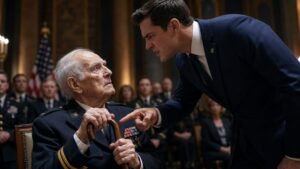
The officer in white stood on the other side of the table, tall, squared, bright with pressed fabric and polished brass. His uniform carried authority cleanly. It made the space around him obey. Two younger officers stood behind him, and beyond them a few sailors had stopped pretending not to watch.
The officer looked first at the bowl, then at the visitor card lying beside Charles’s napkin.
“Sir,” he said, controlled and formal, “who authorized you to eat here?”
Charles kept his hands on the tray.
The soup steamed between them.
Chapter 2: The Officer In The White Uniform
Patrick King had seen the old man from across the mess hall before anyone called attention to him.
At first, he had registered only the mismatch.
Civilian clothes. No escort. Old visitor card placed beside the tray like a claim. A line of young sailors watching him as if unsure whether they were supposed to intervene.
On any other day, Patrick might have sent a petty officer to handle it quietly. But the base had been under tightened access rules for three weeks. A contractor had wandered into a restricted corridor the previous month. A visiting family member had filmed too much near the pier. Every briefing since had carried the same message: small lapses became public failures.
Patrick had repeated that message himself.
Order was not cruelty. Procedure was not disrespect. He believed that. He had built his career on believing it.
Still, as he approached the table, he felt the room notice him noticing.
The old man looked up. His face was narrow, deeply creased, the skin at his jaw loose with age. His eyes were not confused. That was the first thing Patrick saw and did not know where to put. They were tired, yes. Guarded. But clear.
“Sir,” Patrick said, “who authorized you to eat here?”
The old man’s hands remained flat on the tray. Weathered hands. Clean nails. A thin tremor at the right thumb.
“The gate cleared me,” he said.
“The gate cleared you for access. That doesn’t necessarily authorize mess privileges.”
“I understand.”
Patrick waited. He expected more: a complaint, a name dropped, anger at being questioned, confusion about rules. The old man gave him nothing.
Behind Patrick, the mess hall had softened into a listening silence. Not complete silence; no military cafeteria ever fully surrendered its noise. But spoons slowed. Conversations lowered. Attention gathered like heat.
Patrick nodded toward the card. “May I see that?”
The old man lifted one hand from the tray, took the card, and held it out.
Patrick accepted it.
The card was worse up close. Old lamination, faded print, a retired-veteran meal authorization line with an office code Patrick did not recognize. The expiration box had been stamped with a word so pale he had to tilt it toward the light.
Indefinite.
That could not be current. Nothing was indefinite anymore.
“What office issued this?” Patrick asked.
“Personnel services.”
“That office was reorganized years ago.”
“Yes.”
“You’re aware this format isn’t valid under current access policy?”
The old man looked at the bowl before answering. “I was not aware they changed the bowl.”
Patrick blinked. “Sir?”
“The bowl,” the old man said. “Used to be heavier.”
A few sailors shifted behind Patrick. Someone made a small sound, half amusement, half discomfort.
Patrick felt his jaw tighten. This was exactly how these encounters became difficult. An old man answered one question with another. A room full of junior personnel watched to see whether rules bent under sentiment.
“Sir, I need you to answer directly. Are you here with a command-sponsored group?”
“No.”
“Are you attending a ceremony?”
“No.”
“Do you have a current sponsor on base?”
“No.”
Patrick placed the card on the table, near the tray but not on it. “Then we have a problem.”
The old man nodded once, as though he had expected this long before Patrick arrived.
“I’ll go after I finish,” he said.
The simplicity of it irritated Patrick more than defiance would have. “This isn’t a public diner.”
“No.”
“Meals here are for authorized personnel.”
“Yes.”
“And if you are not currently authorized, I can’t allow you to remain seated as if the rule doesn’t apply.”
The old man’s fingers curved around the edges of the tray.
Patrick saw it. So did the young sailor standing near the beverage station. Tyler Martinez, mess duty, third week on rotation. His eyes flicked from Patrick’s hand to the old man’s tray.
Patrick had not touched it yet.
He only leaned forward, one hand settling on the table beside the bowl. Close enough to make the point. Close enough that the steam brushed his knuckles.
The old man lowered his gaze.
The room felt suddenly smaller.
Patrick heard himself say, “Sir, I’m going to ask you to step away from the table.”
The old man did not move.
Not in defiance. That would have been easier. His shoulders did not square. His mouth did not harden. He simply remained seated, both hands around the tray as if holding it level on rough water.
“I’ll leave after I finish the bowl,” he said again, quieter.
“Why this bowl?” Patrick asked, the question sharper than he intended. “Why this table? You walked past six empty seats.”
The old man looked up then.
For the first time, something passed through his face that Patrick could not name. Not anger. Not fear. Something older and more disciplined than both.
“This was the Eight Bell table,” the old man said.
Patrick stared at him.
The phrase meant nothing to him.
But it did something to the room.
A kitchen worker behind the serving line looked over. An older civilian employee near the dish return stopped with a stack of cups in his hands. Tyler Martinez straightened slightly, as if the words had touched a wire.
Patrick kept his voice even. “That is not a current designation.”
“No,” the old man said. “It wouldn’t be.”
“You served here before?”
The old man looked at the soup. “Not here.”
“Then where?”
The spoon lay untouched beside the bowl. The old man moved it half an inch with one finger, aligning it with the tray’s edge.
“Places that don’t have tables anymore.”
Patrick felt impatience and unease collide inside his chest.
“That doesn’t answer my question.”
“No.”
“Mr.—” Patrick glanced at the card. “White. Charles White. I’m not trying to embarrass you. But I have a responsibility to this facility and to the people assigned here.”
“I know what responsibility is.”
The words were not loud. They did not challenge Patrick’s authority. That was why they landed badly. A few sailors lowered their eyes.
Patrick could feel the encounter shifting beyond procedure. He needed to end it cleanly.
“Then you understand I can’t make exceptions because someone remembers an old nickname.”
The old man’s face changed, just a little. A line at the corner of his mouth tightened. His eyes moved past Patrick to the young sailors watching from three tables away, then to Tyler, then to the white sleeve near his bowl.
When he spoke, his voice was almost too quiet for the room to hear.
“Vegetable barley on the sixteenth,” he said. “Rolls if flour came in. Coffee weak enough to see the bottom. Men complained anyway.”
Patrick said nothing.
“The Eight Bell table sat under the clock because the first men called away from it never came back to finish.” Charles touched the rim of the bowl, not lifting it. “They kept setting bowls there awhile. Then they stopped.”
The mess hall held still.
Patrick’s certainty did not vanish. It cracked in a narrow, private place.
He looked down at the old card again. Charles White. Retired. Meal authorization. Indefinite.
Still, cracked certainty was not the same as permission. The room was watching. Rules had weight because people saw whether they held.
“I’ll verify the card,” Patrick said. “Until then, you need to come with me.”
The old man remained seated for another second. Then he nodded.
He picked up the spoon, placed it neatly beside the bowl, and drew his hands back from the tray.
“I said I would leave,” he said.
He stood slowly.
Tyler took one step forward, as if to help, then stopped when Charles steadied himself with a hand on the chair. Charles did not look at him. He did not look at Patrick either.
He took the faded visitor card from the table and tucked it into his shirt pocket. The bowl remained full enough that steam still rose from it.
Patrick moved aside to clear the path.
Charles walked past him without accusation.
At the edge of the seating area, he paused and turned back, not to Patrick, but to the tray.
For a moment, Patrick thought he might return for it.
Instead, Charles gave the bowl a small nod, as if leaving someone behind, and continued toward the exit.
No one in the mess hall spoke until he was gone.
Chapter 3: The Card That Looked Too Old
By two-thirty that afternoon, Patrick King had told himself six different versions of the same defense.
The card format was obsolete.
The base was under tightened access rules.
The mess hall was not open to unsupported civilian visitors.
He had not raised his voice.
He had not insulted the old man.
He had handled an irregularity in a public military space.
Each version held until he remembered the bowl.
Not the card. Not the policy. The bowl.
Charles White had looked at that plain white bowl as if Patrick’s hand near it had done more than interrupt a meal. As if it had reached into something Patrick had no right to touch.
Patrick stood outside the base access office with the card in a clear evidence sleeve he regretted using the moment he had asked for it. Evidence made the matter feel cleaner than it was.
Inside, Rebecca Lopez sat behind a desk layered with badge forms, visitor logs, and two computer monitors. She wore a navy cardigan over a collared shirt, her reading glasses hanging from a cord. She looked at Patrick over the top of them when he entered.
“You’re here about the older gentleman from lunch,” she said.
Patrick stopped. “You already heard?”
“It’s a base,” Rebecca said. “Nothing travels faster than a quiet mess hall.”
Patrick set the sleeve on her desk. “I need to know whether this authorization is valid.”
Rebecca did not touch it at first. She studied the card through the plastic, and something in her expression shifted from administrative alertness to recognition of age—not Charles’s age, but the card’s.
“I haven’t seen one of these in years,” she said.
“So it’s invalid.”
“I didn’t say that.”
Patrick exhaled through his nose. “It’s not in the current system.”
“A lot of things aren’t in the current system because nobody migrated them properly when Personnel Services split into three offices and half the paper archive went to storage.”
“That doesn’t make it active.”
“No,” Rebecca said. “It makes it annoying.”
She opened a drawer and pulled out a thin folder of reference sheets, the kind no one trusted until the computers failed. Patrick remained standing while she checked codes printed in small type. Outside her office window, sailors crossed the courtyard in pairs, laughing, carrying folders, holding coffee cups. The day continued with insulting normalcy.
Rebecca tapped one line with her fingernail. “Here. Retired meal access, limited ceremonial and memorial use. Issued under old base-community policy. Some were indefinite because the access wasn’t daily. It was tied to approved dates.”
Patrick leaned closer. “Approved by whom?”
“Originally? Personnel Services, chaplain’s office, sometimes command staff. Depends on the decade.”
“Can he use it for lunch without a sponsor?”
Rebecca looked at him. “That depends on whether the date is in the old approval list.”
“And where is that list?”
She gave him a look that said he would not like the answer.
“Probably storage,” she said.
Patrick stared at the card. “He said he wasn’t here for an event.”
“Maybe he doesn’t think of it as one.”
“That’s not how authorization works.”
“No,” Rebecca said carefully. “It’s how old arrangements get forgotten.”
Patrick straightened. He did not like the implied criticism, partly because Rebecca had not made it sharply enough for him to reject.
“I had a room full of junior personnel watching,” he said. “I can’t have unknown civilians eating in the mess because their old cards look sentimental.”
Rebecca removed her glasses. “Did he cause a disturbance?”
“No.”
“Did he refuse to leave?”
“Not exactly.”
“That means yes, but quietly?”
Patrick said nothing.
Rebecca picked up the sleeve at last. “What did he say?”
Patrick almost gave the efficient version. He remembered an old table name. He mentioned soup. He was vague. Instead he heard himself repeat the words.
“Vegetable barley on the sixteenth. Rolls if flour came in. Coffee weak enough to see the bottom.”
Rebecca’s expression changed again.
“You wrote that down?”
“No.”
“But you remembered it.”
Patrick looked away.
Rebecca opened a search window and typed Charles White’s name. Nothing appeared in the current visitor database except the temporary clearance from that morning. She tried an older archive index. It spun for several seconds before returning a partial record: White, Charles. Retired Navy. Legacy access. Memorial meal notation. File location: physical archive.
“No service record?” Patrick asked.
“This isn’t personnel command,” Rebecca said. “We don’t keep full service histories in visitor access.”
“I’m not looking for a biography. I need to know whether I removed an authorized guest from the mess hall.”
Rebecca leaned back. “You may have removed someone who had a reason to believe he was authorized.”
“That isn’t the same thing.”
“No,” she said. “It isn’t.”
The distinction did not comfort him.
Patrick took the card back after she copied its code. “Where is the physical archive?”
“Old records room, behind mess storage. Half the boxes are mislabeled.”
“Of course they are.”
Rebecca’s voice softened. “Commander King.”
He paused at the door.
“If you find out he was wrong, that’s easy. If you find out we were wrong, don’t make the correction about proving you can fix a process.”
Patrick turned.
Rebecca nodded toward the card. “People remember how they were handled before they remember what the rule was.”
He left without answering.
Outside the mess hall, the lunch rush had ended. The tables had been wiped. Chairs pushed in. The room smelled faintly of bleach and overcooked vegetables. No one would know where Charles had sat except Patrick did immediately.
The table near the window was empty.
A bus tray stood by the dish return with bowls stacked inside it. Patrick looked at them longer than he meant to.
“Sir?”
Tyler Martinez stood near the beverage station, holding a crate of clean cups.
Patrick gathered himself. “Martinez.”
Tyler’s eyes moved to the card in Patrick’s hand, then back up. “Did they find out who he was?”
“We’re checking an access issue.”
“Yes, sir.”
The young sailor shifted the crate against his hip. He looked as if he wanted to speak and had been trained not to.
Patrick nearly walked away. Then Rebecca’s warning returned, unwelcome and precise.
“What is it?” Patrick asked.
Tyler swallowed. “It’s just… what he called the table.”
“The Eight Bell table?”
“Yes, sir.”
“You’ve heard that before?”
“No, sir. That’s the thing. I asked the kitchen supervisor after he left. He hadn’t either. But one of the civilian cleaners said there used to be old names for parts of the mess before renovation.” Tyler glanced toward the windows. “He said none of them are on the current layout.”
Patrick looked at the empty table.
Tyler lowered his voice. “Sir, Mr. White didn’t look lost.”
“No,” Patrick said.
The word came out before he could stop it.
Tyler held the crate a little tighter. “He looked like everybody else was.”
Chapter 4: The Table No One Calls By Name
The old records room had no sign on the door.
It sat behind mess storage, past shelves of paper towels, industrial cleaner, spare chair legs, and boxes of disposable cups. The hallway narrowed there, as if the building itself had decided the past should not take up much space. Tyler Martinez carried a ring of borrowed keys from the kitchen supervisor and tried three before one turned with a reluctant click.
The door opened into stale air.
Patrick King stood behind him, still in uniform, though not the white dress uniform from the day before. The khaki made him look less ceremonial, less like a figure carved for command, but Tyler did not mistake that for softness. The commander had barely spoken on the way over.
Tyler reached for the light switch. Two fluorescent bars flickered, buzzed, then settled into a weak glow over rows of metal shelves.
“Records room,” Tyler said, unnecessarily.
Patrick stepped inside. “Let’s find the legacy access files.”
Boxes sat in uneven columns, labeled in handwriting from different years. Some said VISITOR PASSES. Some said MESS OPERATIONS. Several simply said OLD. One entire shelf had been marked TEMPORARY STORAGE in marker so faded it had become a permanent lie.
Tyler set the keys on a folding table near the door. “The kitchen supervisor said anything from before the renovation might be mixed with mess hall floor plans.”
Patrick looked at the shelves. “Of course.”
They worked without much talk.
Patrick opened boxes with the controlled impatience of a man who believed every misplaced paper represented someone else’s failure. Tyler handled them more carefully than necessary, partly because the paper felt brittle, partly because he did not want to be the person who tore the one thing they needed.
Most of what they found did not help. Old inspection forms. Equipment purchase orders. Seating charts from retirement luncheons. A complaint about a coffee urn. A note about replacing window blinds. Plastic binders with tabs that no longer matched their contents.
After twenty minutes, Tyler found a folder labeled MESS DECK RENOVATION – HISTORICAL ITEMS.
“Sir.”
Patrick came over.
Inside were photocopied floor plans, a few grainy photographs, and a handwritten note clipped to the front: Preserve old table-name references where practical. Most not practical.
Tyler read the line twice.
Patrick took the folder and opened it on the folding table. The first floor plan showed the mess hall before renovation, longer and narrower, with rows of rectangular tables instead of the square ones. Someone had penciled names beside a few locations.
Port Window.
Boiler Row.
Chief’s Corner.
Eight Bell.
Tyler felt the back of his neck tighten.
Patrick said nothing.
On the plan, Eight Bell sat near the windows, under the old clock, almost exactly where Charles had chosen to sit. Not exactly—walls had shifted, pillars moved, furniture changed—but close enough that the old man’s pause in the room no longer looked aimless.
“He knew,” Tyler said.
Patrick’s eyes stayed on the paper. “He knew where it used to be.”
“Why call it Eight Bell?”
Patrick turned to the photographs.
One showed the old mess hall with sailors crowded along benches, heads bent over bowls. The print was too blurred to make out faces. Another showed an empty table with eight bowls placed around it. No people. Just bowls, spoons, cups, and folded napkins. On the wall behind it hung a round clock.
Tyler leaned closer. “Are those memorial settings?”
Patrick picked up the photo by its edges. “Maybe.”
The word did not sound like enough.
A third photograph had a date stamped in the corner, years before Tyler had been born. The same table appeared again, this time with a small handwritten card propped at one end. The writing was too blurred to read, but the arrangement was unmistakable: bowls set for men who were not there.
Patrick turned the photo over. Someone had written in pencil: Eight Bell table kept through anniversary lunch. See chaplain list.
“Chaplain list,” Tyler said.
Patrick placed the photo down with more care than he had shown the boxes. “Find anything marked chapel, memorial, anniversary, or retired access.”
They searched again.
This time the room felt different. Not less dusty, not less disorganized, but less like clutter. Tyler began to see the papers as pieces of habits people had once believed would continue. A menu with soup marked in red. A note requesting extra rolls. A schedule for kitchen staff to keep one table clear between eleven-thirty and twelve-thirty on a date in June.
“What date was yesterday?” Tyler asked.
Patrick did not answer right away.
Tyler looked up.
“The sixteenth,” Patrick said.
The word lowered itself into the room.
Tyler found the next piece in a binder whose metal rings had rusted at the hinges. The cover said COMMUNITY LIAISON – RETIRED SERVICE ACCESS. Inside were typed pages listing dates, names, and permissions. Many were crossed out. Some had notes: deceased, relocated, inactive, family requested no contact.
Near the back, on a page protected by yellowed plastic, Tyler saw the name.
White, Charles. Annual memorial meal access. Mess hall. June 16. No escort required unless security posture requires. Legacy authorization indefinite.
Tyler did not touch it. “Sir.”
Patrick came to his side.
For a while, neither of them spoke.
The record did not solve everything. It did not explain the soup. It did not explain the table. It did not explain why Charles had come alone, or why no current office had known to expect him. But it answered enough to make yesterday’s scene change shape.
Patrick had not removed a confused old man from a place he did not understand.
He had removed a man from a place the base had forgotten how to understand.
Patrick took out his phone and photographed the page. His thumb hovered over the screen afterward, then lowered. “We need the chaplain list.”
Tyler turned back to the boxes. “Yes, sir.”
They found it in a narrow file tucked behind old holiday menus. No full story waited inside. No dramatic confession. No simple explanation that could repair a room in a single sentence.
Only a list of surnames. Eight of them. Beside each, a branch notation, an old ship identifier, and the same date.
At the bottom was a handwritten note: White requests no ceremony. Meal only. Table kept if possible.
Tyler read the line and felt ashamed in a way he did not know what to do with. He had stood there. He had watched Charles grip the tray. He had seen the commander’s hand near the bowl. He had thought, for one brief and ugly second, that the old man was being stubborn about soup.
Patrick closed the file.
His face was hard, but not with anger now.
“Who maintains this list?” he asked.
“The chaplain’s office maybe,” Tyler said.
“It should have flagged at the gate.”
“Yes, sir.”
“It should have been in the current system.”
“Yes, sir.”
Patrick looked around the dim records room, at boxes no one had opened because nothing bad had happened yet from keeping them shut.
“That’s what we’ll fix,” he said.
Tyler nodded, but the words sat wrong with him. Fix sounded too neat.
Patrick must have felt it too, because he did not move toward the door. He stood with one hand on the folder, looking at the penciled floor plan.
“Martinez.”
“Yes, sir?”
“When he said Eight Bell, you noticed.”
“Yes, sir.”
“Why didn’t you say anything yesterday?”
Tyler’s first answer was automatic. “I didn’t know anything for sure.”
Patrick waited.
Tyler looked down at the table. “And you were the one asking him.”
That was the part he had not wanted to say.
Patrick accepted it without flinching, which somehow made Tyler feel worse.
After a moment, Patrick slipped the old page back into the binder. “I gave you a reason to stay quiet.”
Tyler did not know whether he was supposed to respond.
Patrick picked up the folder. “Find out whether Mr. White has a phone number on file.”
Tyler searched the access binder again and found a line of contact information, one phone number written over another. There was also a note, newer than the rest, added by someone in careful block letters: Attends alone. Do not call unless access changes.
Patrick read it twice.
“Do not call unless access changes,” Tyler said softly.
Patrick’s mouth tightened.
From somewhere beyond the storage wall came the faint sound of the mess hall being prepared for dinner: pans sliding, water running, metal striking metal. Ordinary sounds. Yesterday they had seemed like background. Now each one seemed connected to a table no one had known how to name.
Patrick closed the binder.
“He’s expected to return,” Tyler said.
Patrick looked at him.
Tyler pointed to the date column, to the note repeated across earlier years, to the quiet persistence of a man who had kept coming long after the office that issued his card stopped existing.
“Every year,” Tyler said. “Same date.”
Chapter 5: The Meal Was Never For Him Alone
Charles White washed his hands longer than he needed to.
The faucet in his kitchen coughed once before the water ran clear. He held his fingers under the stream and watched the water move over the knuckles, around the old scars, beneath the nails he had trimmed the night before. The skin on the back of his hands had grown thin enough that the veins stood up like blue cord.
He dried them with a towel folded over the oven handle.
On the small table near the window, his visitor card lay beside his keys.
He had placed it there after coming home from the base and had not touched it again.
All evening, he had moved around it. Made tea. Left the tea to go cold. Took off his shoes. Polished them though they did not need polishing. Sat in the armchair while the house settled into its night noises. He had not turned on the television. He had not opened the mail.
Twice, he had reached toward the card.
Twice, he had drawn his hand back.
Now morning light lay over it, pale and honest. The old lamination caught the sun at one corner. It looked even worse than it had in the mess hall, more tired somehow, as if being questioned had aged it too.
Charles sat down.
The chair creaked beneath him. Across the table, the second chair remained pushed in. It had been pushed in for years. He kept it anyway.
He picked up the card.
The plastic edge had split near the top. He could have requested a replacement long ago, perhaps. He had never wanted one. A new card would have been more convenient, clearer, easier for clerks to scan. It also would not have carried the thumbprint of the office clerk who made it, or the faint bend from the year Charles had almost left it in his shirt pocket through the wash, or the dark line where rainwater had seeped in during the walk from the parking lot on the first anniversary he attended alone.
He set the card down again and turned it so the faded seal faced up.
“No escort required unless security posture requires.”
He remembered the woman at the office saying it when she issued the card. She had been kind, which had made it harder. Kindness often came with paperwork after loss. She had explained where to enter, which hall to use, who to ask for if anyone was confused.
“It’s just a meal,” Charles had told her.
She had looked at him as if she knew it was not.
The house was quiet.
Charles pushed himself up from the chair and went to the cabinet above the sink. He took down a chipped white bowl. It was not the same shape as the mess hall bowls, but close enough for his kitchen. He did not cook soup. He had tried once, years ago, on an anniversary when a storm had closed the base and the roads flooded. Vegetable barley from a can. A roll from the grocery store. Coffee weak enough to see the bottom because he had made it that way on purpose.
He had sat at his own table and failed to take more than three spoonfuls.
The meal belonged to the room.
That was the part no one outside it understood.
He dressed slowly. The blue shirt again, clean from yesterday because he had worn it only a few hours. Khakis pressed by hand. Belt pulled to the worn notch. Black shoes tied with effort. He stood before the hallway mirror and saw an old man trying to look presentable for a place that had asked him to leave.
The face in the mirror did not accuse him.
It did not comfort him either.
“You don’t have to go,” he said aloud.
His voice sounded unused.
He had said those words many times through the years. After the flu winter. After his knee surgery. After the year he fell in the driveway and lay there ten minutes before a neighbor saw him. After the base changed its gate route and he drove twice around the perimeter before finding the right entrance.
You don’t have to go.
But the sentence had never been true.
He reached into the hall closet and took his light jacket from the hook. In the inner pocket was a folded paper, soft at the creases. He did not need to unfold it. He knew the names. Still, he opened it because memory deserved the work of hands.
Eight surnames. Typed once by an office, copied once by him, then recopied when the first paper tore. No first names on this version. First names made the kitchen too crowded. First names brought voices.
He read the list silently.
At the fourth name, his thumb stopped.
There had been a bowl left in that man’s place because he was the one who complained loudest about soup and ate every spoonful anyway. Another bowl for the man who traded rolls for coffee. Another for the one who could sleep through any noise except the bell.
Charles had not been better than them.
He had only been elsewhere when the call came.
That was the whole terrible arithmetic of survival. A different assignment. A delayed repair. A petty argument with a supply clerk that kept him off a passageway at the right wrong moment. Men loved to make survival meaningful after the fact. Charles had never been able to. He had only made it orderly.
One meal. Same date. Same place if possible. No ceremony.
He folded the paper again.
Outside, the morning had warmed. He drove himself because accepting rides turned one quiet errand into someone else’s good deed. The road to the base ran past strip malls, a school, a gas station where a flag snapped hard in the wind. He kept both hands on the wheel and stayed in the right lane.
At the base chapel, he parked beneath a tree that had not been there when he was young.
He did not go in immediately.
Instead he sat in the car with the engine off, listening to it tick as it cooled. On the passenger seat lay his card. Beside it, the folded paper. He had not brought flowers. He had stopped bringing anything that required display.
The chapel doors were open. Inside, a base chaplain moved between rows, setting hymnals straight. Charles stepped in only far enough to stand in the back. The air smelled faintly of old wood and furniture polish.
No one approached him.
He was grateful.
He stood there until his legs began to ache, then sat in the last pew. The folded list stayed in his pocket. He did not need walls or candles to remember. Still, the quiet helped him gather himself after yesterday, helped him separate the officer’s hand from the bowl, the watching sailors from the men he had actually come to see.
Humiliation had a way of borrowing the shape of older grief if a man was not careful.
Charles had been careful most of his life.
When he left the chapel, a breeze moved across the walkway. He paused at the top of the steps. From there, he could see the roofline of the mess hall across the base, flat and ordinary, vents humming, doors opening and closing as if nothing inside could carry weight.
His knees hurt.
His pride hurt too, though he disliked the word. Pride sounded too grand for what he felt. What he felt was smaller and more stubborn: the wish not to be handled.
He thought of the bowl left full on the table.
That was what settled it.
Not Patrick King. Not the card. Not the sailors. The bowl.
He had left it behind unfinished, and that was not how the ritual ended.
Charles walked back to his car. He opened the passenger door and picked up the visitor card. For a moment, he held it in both hands the way he had held the tray.
Then he tucked the card into his shirt pocket, folded the list behind it, and turned toward the gate.
Chapter 6: The Bowl Set Back In Place
Patrick King reached the mess hall before lunch and asked the kitchen supervisor not to change the soup.
The supervisor looked at him over a tray of rolls. “Sir?”
“Vegetable barley,” Patrick said. “Keep it on.”
“It was already on the menu.”
“Good.”
The supervisor waited, sensing more.
Patrick looked toward the table near the windows. It had been cleared. Not marked. Not roped off. No sign, no folded flag, no framed photograph. He had considered all of those and rejected them one by one because each made the moment easier for everyone except the man it concerned.
“Leave that table open if you can,” Patrick said.
The supervisor followed his gaze. “The one by the windows?”
“Yes.”
“For a group?”
“For one man.”
The supervisor’s eyes changed. “The gentleman from last week.”
Patrick nodded.
“I heard about the records,” the supervisor said.
Patrick did not ask from whom. “If he comes in, let him take his tray himself. Don’t hover.”
“Yes, sir.”
“And no announcement.”
The supervisor held his gaze. “Understood.”
Patrick wished understanding were enough to undo a hand placed too near a bowl.
By eleven-thirty, the mess hall had begun to fill. Tyler Martinez stood near the beverage station, wiping the same counter twice. Rebecca Lopez came in briefly with a folder under one arm, not to interfere, she had said, but to confirm the corrected access note had reached the gate. Patrick had signed the update himself: Annual memorial meal access. June 16 observance window extended. No escort required. Handle without public challenge.
Handle without public challenge.
Even the correction sounded too official.
Patrick took a seat two tables away, then stood again. Sitting felt like waiting in ambush. Standing felt worse. He finally positioned himself near the side wall, where he could see the entrance without commanding the entire room.
At noon, Charles White entered.
No one announced him.
That mattered.
He came through the doorway in the same faded blue shirt, the same khakis, the same polished old shoes. His movement was slow but not uncertain. The security clerk had not escorted him. No one touched his elbow. He carried nothing visible except the old card in his shirt pocket.
Patrick felt the room notice him in small fragments. A glance here. A pause there. Tyler became very still beside the cups.
Charles took a tray from the stack.
Patrick watched his hands. The left palm slid under the tray. The thumb found the rim. The movement had practice in it, old and precise. At the serving line, the kitchen supervisor lifted the soup lid before Charles asked.
“One bowl?” the supervisor said.
Charles looked at him for a long second.
“Yes,” he said. “Please.”
The soup went into the plain white bowl. A roll followed. A napkin. A cup of water.
At the cashier station, the young sailor glanced at the screen, then at Charles’s card, then back at Charles.
“You’re all set, Mr. White,” the sailor said.
Charles’s fingers tightened slightly around the tray.
“Thank you,” he said.
Patrick heard the smallness of the exchange and knew it was larger than anything he had prepared.
Charles turned toward the seating area.
The table near the windows was open.
He saw that immediately. Patrick could tell because Charles stopped, just as he had the week before. Not long. Only enough for the past and present to find each other across the room.
Then he walked to it.
No sailors rose because no sailors had been seated there. No chairs scraped in reluctant courtesy. No one needed to make space for him by pretending they were finished. Charles lowered himself into the same seat. The bowl trembled once as the tray touched the table, then stilled.
Patrick waited.
Charles arranged the spoon beside the bowl. He placed the roll to the left. He set the water above the tray’s corner. His hands rested on either side, not gripping now, only keeping company with the meal.
Patrick approached before the first spoonful.
He regretted that too late.
Charles looked up at him. There was no fear in his face. No welcome either.
Patrick stopped farther from the table than he had before.
“Mr. White,” he said.
The old man’s eyes stayed on him.
Patrick had intended to say he was sorry immediately. But the room was listening again, even with everyone pretending not to. If he apologized loudly, he would turn Charles into a lesson. If he said nothing, he would remain the same man he had been last week.
So he asked the only question that did not take control.
“May I speak with you?”
Charles looked at the bowl, then back at Patrick. “Here?”
“Only if you allow it.”
That made a few nearby sailors look down at their trays.
Charles moved his spoon a fraction of an inch. “Briefly.”
Patrick nodded. “Your access record has been corrected.”
Charles’s expression did not change.
“You were authorized to be here,” Patrick continued. “The system failed to show that. I failed to account for that.”
The word failed cost him less than it should have and more than he expected.
Charles said, “Systems are made by people.”
“Yes.”
“So are failures.”
Patrick accepted that with a small nod.
He held a folded paper in his hand, but did not place it on the table. “We found the old notation. The Eight Bell table. The annual meal.”
Charles looked toward the windows. For a moment, his face went somewhere Patrick could not follow.
“I asked them not to keep it marked,” Charles said.
“I know.”
“Then why is it empty?”
Patrick looked at the table, at the open chairs, at the absence he had thought would be respectful.
“I thought you should not have to ask for a place.”
Charles’s gaze returned to him. “That is not the same as leaving one open.”
Patrick felt the correction land, quiet and exact.
“No,” he said. “It isn’t.”
Tyler, standing ten feet away, lowered his eyes.
Charles’s soup steamed between them. Patrick remembered his own hand near the bowl, the way Charles had curved his fingers around the tray. He had replayed that moment too many times. In memory, his hand had grown larger each time. Not because he had touched the meal, but because he had been willing to.
“There’s something else,” Patrick said.
Charles waited.
Patrick turned slightly toward the service line. The kitchen supervisor came forward carrying a fresh bowl on a small tray. Patrick took it himself. Vegetable barley, steam rising, roll beside it. He brought it to Charles’s table and stopped.
He did not reach over the old man’s tray.
He did not move the bowl already there.
“Last week,” Patrick said, “you left before you finished.”
Charles looked at the fresh bowl.
Patrick held the tray steady. “May I set this down?”
The silence that followed was not empty. It was full of sailors learning what permission sounded like.
Charles studied Patrick’s face, then the bowl, then the hand that held it away from his space.
“Yes,” he said.
Patrick set the new bowl on the table gently, to the right of the first, close enough for Charles to reach, far enough not to crowd him. Then he stepped back.
For the first time since entering, Charles looked unguarded enough to seem tired.
“I don’t need two,” he said.
“No.”
“Then why bring it?”
“Because I treated the first one like it was evidence.”
Charles’s eyes lowered.
Patrick continued, keeping his voice low. “It was a meal.”
Charles did not answer.
A few tables away, someone set down a fork too carefully.
Patrick took the folded paper from his hand. “We found the list. Not everything. Just enough.”
Charles’s face tightened.
“I did not bring it to read aloud,” Patrick said quickly. “And I won’t use it for a ceremony.”
The old man’s shoulders eased by almost nothing, but Patrick saw it.
“I don’t want them made into a display,” Charles said.
“I understand.”
“No,” Charles said, not unkindly. “You don’t.”
Patrick looked at him.
Charles picked up the spoon, then set it down again. “You may understand the instruction. That is different.”
Patrick felt heat rise in his face. He could have defended himself. He could have said he was trying. He could have explained the records, the policy correction, the careful planning that now seemed to have stepped wrong anyway.
Instead, he said, “You’re right.”
Charles looked surprised, and the surprise shamed Patrick more than anger would have.
The old man reached into his shirt pocket and removed his own folded paper. It had been opened and closed so many times the creases were soft as cloth.
“These are not for the room,” Charles said.
Patrick nodded.
“They are not for speeches.”
“No.”
“They were hungry when they sat down. That is what I remember most. Not brave. Not historic. Hungry. Tired. Complaining about the soup.”
His thumb moved over the folded list.
“They missed lunch,” Charles said.
The mess hall had gone nearly still.
Charles noticed. His mouth tightened.
Patrick turned his head slightly, enough for the nearest sailors to understand without a word. Conversations resumed in low, awkward fragments. Forks moved again. Chairs shifted. The room gave back a little privacy, imperfectly but sincerely.
Charles unfolded the paper.
Eight names, no first names, written by hand.
He slid it halfway across the table, not far enough to surrender it.
Patrick did not touch it.
Charles looked at him then, and his eyes were clear, tired, and commanding in a way no uniform could manufacture.
“If you want to correct something,” he said, “read them quietly.”
Patrick swallowed.
“To you?” he asked.
Charles looked at the two bowls, the tray, the open seat across from him, and the room that had finally stopped staring.
“Not to the room,” he said. “To the table.”
Chapter 7: The Table They Left Open
Several weeks later, Charles White entered the mess hall without stopping at the doorway.
That was how he noticed the change.
Not the table first. Not the cashier. Not the quiet look from the kitchen supervisor. He noticed his own feet carrying him forward without the small pause that had become a habit in public places. No bracing for correction. No searching for the person who would decide whether he belonged.
The security clerk at the gate had returned his visitor card with both hands.
“Good afternoon, Mr. White,” he had said.
Charles had nodded, not because the greeting solved everything, but because ordinary courtesy did not need to be refused.
Now, inside the mess hall, the lunch rush had thinned. It was not June sixteenth anymore. No anniversary pressed on the room. No old obligation had pulled him from his house that morning. He had come because Rebecca Lopez had called two days earlier and asked, very carefully, whether he would be willing to review the corrected retired-veteran meal list.
“I don’t need a program,” Charles had told her.
“No, sir,” Rebecca had said. “That’s not what this is.”
“I don’t need my name on a wall.”
“No, sir.”
“I won’t come if they’re making a thing of it.”
There had been a pause on the line.
Then Rebecca said, “We’re trying to make sure no one has to explain themselves at a table again.”
That was why he came.
At the serving line, the kitchen supervisor looked up but did not hurry toward him. Charles appreciated that. He took a tray from the stack himself. The same light plastic. The same rim under his thumb. He moved it along the metal rails slowly, letting others go around him when they needed to.
“Soup today?” the supervisor asked.
Charles looked at the pot.
“Chicken noodle,” the supervisor said. “Vegetable barley comes around next week.”
“Chicken noodle is fine.”
“One bowl?”
“Yes, please.”
The supervisor filled it without adding anything more. A roll followed. A napkin. Water. Charles reached the cashier station and placed his card beside the tray because he still believed in showing what needed to be shown.
The young sailor glanced at the screen.
“You’re all set, Mr. White.”
Charles put the card back in his pocket. “Thank you.”
As he turned toward the seating area, he saw the table near the windows.
It was not empty in the ceremonial way Patrick had tried before. No one had cleared the space with too much meaning. Two sailors sat at one side, eating quickly and arguing under their breath about a maintenance inspection. A third chair held someone’s cap. At the far end, one seat remained open.
Not reserved.
Available.
Charles stood with the tray in both hands.
One of the sailors looked up. He recognized Charles, or perhaps only recognized that he was old and carrying soup.
“Sir, you need this seat?” he asked.
Charles considered the question. It was almost the same as the one asked weeks before, yet it was not the same at all. No embarrassment hid beneath it. No eager escape. Just a young man making room if room was needed.
“If you’re using it, keep it,” Charles said.
The sailor moved his cap from the chair. “I’m not.”
Charles nodded and lowered himself into the open seat.
No one stopped eating.
That was the mercy of it.
He arranged his tray. Bowl centered. Roll to the left. Spoon straight. Water at the upper corner. The habit remained, but the pain beneath it had loosened. Not vanished. A man did not outlive grief by having people behave better for a month. But the room no longer seemed to push him away from his own memory.
Across the mess hall, Patrick King stood near the entrance with Rebecca Lopez and Tyler Martinez. None of them approached.
Charles saw them. They saw that he saw them.
Patrick gave a small nod.
Charles returned it.
That was enough.
The sailors at the table went on with their meal. One complained that the noodles were too soft. The other said that was better than rice again. Their voices were low, young, careless in the way ordinary lunch should be careless. Charles lifted his spoon and tasted the soup.
It was too salty.
He almost smiled.
After a few spoonfuls, Tyler came by carrying a rack of clean cups. He slowed beside the table without quite stopping.
“Need anything, Mr. White?”
Charles looked up. The young sailor held himself with the awkward respect of someone trying not to overcorrect.
“No,” Charles said. “Thank you.”
Tyler nodded. He started to move on, then hesitated.
Charles waited.
“I should’ve said something that day,” Tyler said quietly.
One of the sailors at the table looked down at his tray, pretending not to hear.
Charles set his spoon beside the bowl. “Did you know what to say?”
“No, sir.”
“Then learn for next time.”
Tyler’s face tightened, not from insult, but from receiving something heavier than reassurance.
“Yes, sir.”
“And don’t call me sir because you’re ashamed.”
Tyler blinked.
Charles picked up his spoon again. “Call me sir if that’s how you speak.”
Tyler nodded once, more carefully this time. “Yes, sir.”
He left with the cups.
Charles ate slowly. He did not hurry, and no one made him feel that he should. At the access office later, Rebecca would show him the updated list. He would correct two dates, cross out one duplicate entry, and ask that the word memorial be used sparingly. Meals were enough. A date was enough. A note to the cashier was enough.
He would not permit a plaque.
“People stop seeing tables when you put plaques on them,” he would tell her.
Rebecca would write that down though he had not meant it as instruction.
For now, he remained in the mess hall, with the bright window light touching the tray and the room moving around him.
Patrick finally entered the serving line. He took a tray, chose a sandwich, and stood at the cashier station like everyone else. When he passed near Charles’s table, he did not stop until Charles looked up.
“Mr. White,” Patrick said.
“Commander.”
Patrick’s eyes moved briefly to the bowl. “May I sit?”
Charles looked at the open chair across from him.
The question mattered. The answer mattered too.
“For a minute,” he said.
Patrick sat. Not heavily. Not as a superior lowering himself to listen. Just a man taking a chair he had asked for.
They remained quiet while a group of younger officers passed behind them. One glanced over, curious, then continued. No one gathered. No one made the moment into a display.
Rebecca had been right. They were learning the difference.
Patrick placed his hands on his own tray. “The list has been updated.”
“I’ll look at it before I leave.”
“Rebecca made sure there’s a note at the gate and the cashier station. Not just for you.”
Charles nodded. “Good.”
“The table won’t be marked.”
“Better.”
“But if a veteran comes in on one of those dates, the staff will know not to make them explain in the room.”
Charles looked out the window. Beyond the glass, the base moved under a clear sky: sailors crossing concrete, a truck reversing near a loading dock, the faint flash of water beyond a building line.
“That’s all it needed to be,” he said.
Patrick was silent for a moment. “I’m sorry for making you leave your meal.”
Charles did not answer quickly. He had accepted the practical correction. He had allowed the names to be read quietly to the table. He had returned. But apology was different. Apology asked him to do something with the harm once it had been named.
He looked at Patrick. “I know.”
Patrick absorbed that.
Not forgiveness. Not refusal. A fact.
Charles took another spoonful of soup. Patrick did not fill the silence with more regret.
After a while, Charles said, “They complained more than those two.”
Patrick followed his glance to the sailors at the other end of the table.
“The men on your list?”
Charles nodded. “About everything. Soup. Coffee. Boots. Weather. Officers.”
Patrick’s mouth moved slightly, almost a smile. “Especially officers, I imagine.”
“Especially officers.”
The smallness of the joke allowed something in Patrick’s shoulders to ease without making the moment light. Charles was glad. He did not want Patrick crushed. Crushed men often tried to redeem themselves too loudly.
The sailors at the far end stood, gathered their trays, and left. One pushed his chair in. The other forgot. Tyler, passing nearby, nudged it back into place without comment.
Patrick stood a minute later.
“Thank you for letting me sit,” he said.
Charles gave him a nod. “Thank you for asking.”
When Patrick left, he took his tray with him.
Charles remained until the bowl was nearly empty. He used the edge of the roll to gather the last of the broth, a habit so old he had forgotten when it began. He drank half the water. He folded the napkin once and set it beside the spoon.
The room had changed and had not changed. That was the honest thing. Young people still rushed. Coffee was still poor. Soup still needed pepper. Some eyes still flicked toward him and away again, unsure what story he carried. But no one’s hand came near his tray.
When he finished, Charles sat for another moment.
He did not bow his head this time. He had done that on the sixteenth. This was not that meal. This was another kind of duty, smaller but not meaningless: to be present in a room that had made room without turning him into a symbol.
He lifted the tray carefully.
At the dish return, he stacked the bowl with the others. Plain white, no different once emptied and rinsed. The spoon went into the bin. The cup into the rack. The tray slid onto the stack with a soft plastic scrape.
Before leaving, he looked back.
The table near the windows stood partly occupied again. A young sailor had taken the seat across from where Patrick had sat. Someone else had placed a tray at the far end. The chair Charles had used remained open for the moment, pushed in neatly, waiting without ceremony.
Charles touched the edge of the visitor card through his shirt pocket.
Then he walked out slowly, into the bright corridor, while behind him the mess hall carried on with its ordinary noise.
The story has ended.