They Forced the Old Commander to Kneel Beside the Grave They Had Tried to Erase
Chapter 1: The Headstone Standing Over the Wrong Number
George Harris stopped with his hand resting on the cold marble.
The name was right.
The number beneath it was not.
He lowered the flashlight until its narrow beam reached the small metal plate half buried in wet soil at the base of the headstone. Mud filled the first digit. He scraped it away with his thumbnail and read the sequence again.
Section C. Row Eleven. Plot Forty-Seven.
The grave belonging to the man named on the stone had stood for thirty-two years in Section C, Row Nine, Plot Twelve.
George knew because he had visited it more often than he admitted to anyone.
He glanced down the pale rows. Under the weak cemetery lamps, each stone looked suspended above the dark ground. Row Nine lay nearly fifty yards east, beyond a shallow drainage channel and a stand of bare trees.
A mistake that large did not happen when someone misread a clipboard.
George set his old flashlight on the ground and crouched. His knees resisted the movement, then gave with a dull ache. The soil around the stone was fresh and loose. Mud clung to his trousers as he brushed aside dead grass and exposed more of the plate.
Forty-Seven.
No doubt.
The engraved face above him carried the familiar name, rank, and dates. Nothing announced that the stone had been uprooted and placed over ground assigned to someone else.
“I’m sorry,” George said.
The words left him before he decided whom they were for.
He took out his phone and photographed the plate, then the wider row. On the screen, the flash made the disturbed soil look almost black.
He opened the cemetery’s public record page. He had checked it at breakfast. The listing had still shown Row Nine, Plot Twelve.
Now it showed Row Eleven, Plot Forty-Seven.
The update time was 3:14 that afternoon.
George stared at the digits until the screen dimmed.
He had expected neglect. A clerical error, perhaps. The records coordinator had mentioned water damage during their brief telephone call two days earlier and had promised someone would return his message.
No one had.
He had driven three hours instead.
The cemetery gates were still open when he arrived, though the posted visiting hours had ended eight minutes before. He had slipped through while an automated arm descended behind a departing maintenance truck. It had not felt like trespassing then. It felt more like refusing to let a machine decide whether the dead could still receive visitors.
Now, hearing a distant motor beyond the trees, George wondered whether coming alone had been another form of pride.
He reached inside his coat and unfolded the burial map he had carried for years. The paper had softened along its creases. A small blue circle marked Row Nine, Plot Twelve in his own handwriting.
He compared it with the stone before him.
Memory had not moved the grave.
Someone else had.
Headlights swept across the markers.
George remained kneeling as a white patrol vehicle turned onto the narrow path and accelerated toward him. Red light pulsed once on its roof, throwing color across the stones, then went dark.
The vehicle stopped close enough that muddy water splashed George’s shoe.
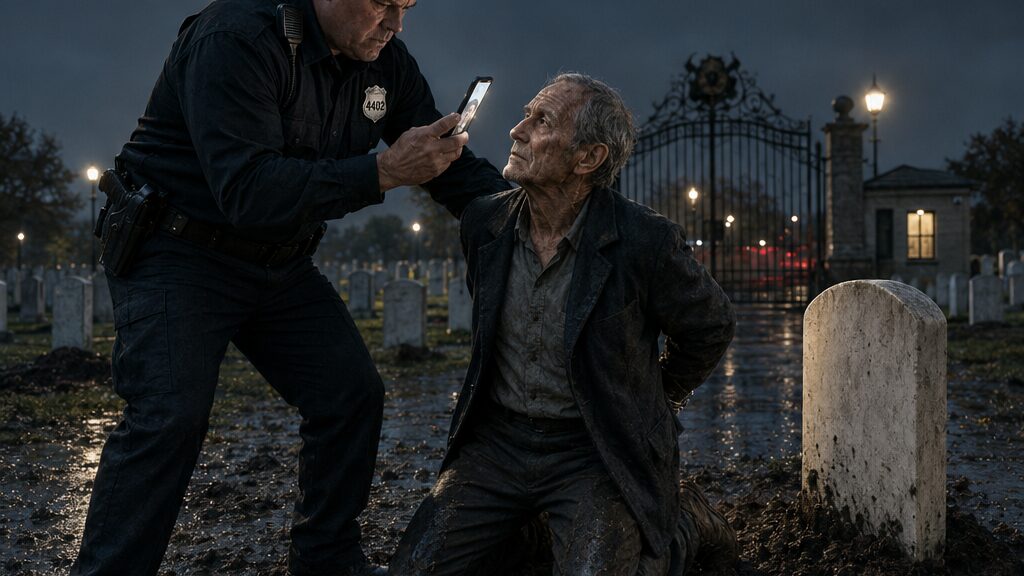
A broad man in a dark service uniform stepped out. His coat was zipped high, and a metal badge caught the beam from George’s flashlight.
“What are you doing?”
George rose carefully. “Checking a plot number.”
“You’re inside a secured cemetery after hours.”
“The gate was open.”
“It isn’t now.”
The man pressed a control clipped beside his radio. Behind them, metal rattled. Through the trees, George heard the main gates draw together.
“I’ll leave when I have the name of the person who authorized this relocation.”
The man’s expression changed at the word relocation. It was slight, no more than a tightening beside the mouth, but George had spent too many years studying rooms in which men lied with everything except their faces.
“Identification.”
George reached slowly into his coat. “The stone belongs in Row Nine.”
“I didn’t ask where it belongs.”
George handed him a worn leather wallet opened to his driver’s license.
The man looked at George instead of the card. His gaze moved over the faded coat, mud-marked trousers, and old shoes.
“We’ve had reports of a transient matching your appearance.”
George glanced at the empty path. “Matching my appearance.”
“Older male. Unkempt clothing. Seen around restricted property.”
“My clothing is wet.”
“Hands where I can see them.”
George let both hands hang open at his sides. “You have my identification.”
The man had not taken it. He was looking past George at the base of the grave.
“What were you digging for?”
“I wasn’t digging.”
“There’s disturbed soil.”
“Yes. That is why I’m here.”
The answer seemed to irritate him more than denial would have. He stepped around George and shone a larger flashlight over the ground.
George saw his attention settle on the exposed metal plate.
“Who told you about this row?” the man asked.
“No one.”
“You just wandered into a locked veterans’ cemetery and happened to find one marker out of thousands?”
“I came to find this one.”
“Why?”
George folded the map and returned it to his pocket. “Who authorized the move?”
The man turned. “You don’t ask the questions here.”
George studied the badge. The number under the nameplate was 4402. The name read Brandon Miller.
The desk sergeant’s radio hissed. A dispatcher’s voice mentioned a perimeter check, then dissolved into static.
George’s phone remained in his hand. Brandon noticed it.
“What did you photograph?”
“The plot number.”
“Show me.”
George held the screen where Brandon could see it. The image displayed the stone, the plate, and the dark ring of fresh soil.
Brandon’s eyes fixed on the photograph. He did not compare George’s face to an alert. He did not ask for the license again. He did not even look at the engraved name.
His concern had found its true object.
“Delete it,” Brandon said.
George locked the screen.
“No.”
Brandon stepped closer, blocking the weak cemetery lamp. “That wasn’t a request.”
“You called me a wanted man before reading my name. Now you want evidence removed before checking whether I belong here.”
“I want unauthorized images of protected burial ground deleted.”
“The cemetery website contains images of every public marker.”
“You entered after hours.”
“That does not alter the number beneath the stone.”
Brandon’s jaw tightened.
George had seen men reach this point before—the instant when authority discovered that repetition could not make an answer disappear. Some retreated into procedure. Others treated resistance as insult.
Brandon held out his hand.
“Give me the phone.”
George slid it into his coat pocket.
The radio hissed again. Brandon touched the transmit button without taking his eyes from George.
“Control, I have one possible match inside the east burial section.”
George looked past him toward the locked gates. Then he looked down at the headstone standing over the wrong man’s ground.
Brandon moved his hand toward the equipment on his belt.
“Last chance,” he said. “Delete the photograph.”
Chapter 2: The Sergeant Who Refused to Read the Name
Brandon took George’s license at last, glanced at the faded photograph, and slid the unopened wallet into his own coat pocket.
“You can verify it,” George said.
“I’ll verify it at the office.”
“The birth date alone will tell you I’m not the man in your alert.”
“You don’t know what’s in my alert.”
“You described him aloud.”
Brandon’s eyes narrowed. “Turn around.”
George did not move. “How old is the suspect?”
“Turn around and put your hands behind your back.”
“You said older male. That can mean sixty or eighty when the person wearing the coat is inconvenient.”
Brandon touched the radio at his shoulder. “Control, subject is refusing lawful direction.”
The words traveled into the dark with an official calm that did not belong to the scene.
George looked at the small green light on Brandon’s chest camera. It was recording.
“I have not refused to leave,” George said clearly. “I asked to have my identification verified and requested the authorization for a relocated grave marker.”
Brandon stepped close enough that George could smell coffee on his breath.
“You think speaking carefully changes what happened?”
“No. I think recording accurately does.”
For a moment neither man moved.
Beyond the cemetery wall, a truck passed on the highway. Its tires sent a fading hiss through the wet night.
Brandon pointed toward the patrol vehicle. “Walk.”
George obeyed, not because the command was justified but because the grave would remain where it was for the next few minutes. He needed to understand why Brandon wanted the photograph gone more than he wanted to establish the identity of a supposed fugitive.
They followed the path toward the gate. Brandon stayed half a step behind and to George’s right, where his hand could reach George’s arm.
“You patrol the grounds personally?” George asked.
“We’re understaffed.”
“At this hour?”
“Vandals don’t keep visiting hours.”
“Neither do clerical corrections, apparently.”
Brandon seized his elbow. “You’re done talking about the markers.”
George felt the strength in the grip and the intention beneath it. Brandon was not losing control. He was choosing a method he trusted.
A telephone rang inside the small security office ahead. Light glowed behind its blinds.
Brandon’s radio crackled.
“Desk, Ramirez calling line one. She says it’s about the east section.”
Brandon released George and answered quickly. “Patch it through.”
A woman’s voice came faintly over the shoulder unit. “Brandon? The motion alert came up. Is someone near the correction rows?”
“I have the cemetery trespasser.”
George slowed.
Brandon had never asked his name.
The woman hesitated. “The same person who called about the Thomas marker?”
Brandon’s hand closed around the radio. “I said I have it handled.”
“You need to document any contact. We can’t have another complaint before the review.”
“I know the procedure.”
“The drainage contractor starts again Monday. Nothing in that section should be disturbed until—”
Brandon cut the connection.
George stopped walking.
“What was her name?”
“Move.”
“Lisa Ramirez?”
Brandon stared at him.
“She left me a message two days ago,” George said. “She said there had been water damage and record corrections.”
“Then you already have your answer.”
“No. She said corrections. She did not say markers had been moved without notifying families.”
“The ground shifted. Some of the old section numbers were wrong. We’re fixing it.”
There it was: an explanation broad enough to sound reasonable and vague enough to conceal whatever did not fit.
George looked back toward the pale rows. “Why did she call it the Thomas marker?”
Brandon’s hand returned to George’s elbow, harder this time. “Because you called about it.”
“She recognized the motion alert by location. You called me the cemetery trespasser as though you expected one.”
“You’re hearing what you want.”
“I’m hearing you avoid the name carved on that stone.”
Brandon pushed him forward.
The patrol vehicle waited thirty yards behind them, its engine still running. Instead of continuing toward the office, Brandon steered George back toward it.
George noticed the change.
“You aren’t taking me inside.”
“I don’t need to.”
“You said you would verify my identification there.”
“I can do it by radio.”
“Then do it.”
Brandon pressed the transmit button. “Control, update. Subject became argumentative when advised he matched the bulletin. He is resisting escort and may have interfered with protected ground.”
George stopped again.
The falsehood was no longer implied. It had entered the record.
“I have walked where you directed,” he said.
“Keep moving.”
“You now have my identification in your pocket and have still not read my name.”
Brandon stepped in front of him. The green light on his camera reflected in George’s glasses.
“You came through a closing gate. You were on your knees digging at a grave. You refuse to surrender a device used to photograph a restricted work area. Those are facts.”
“The work area is not marked.”
“It doesn’t have to be marked for you to obey an officer.”
George’s attention moved over the man in front of him: squared shoulders, regulated haircut, polished equipment, mud only at the edges of his boots. Brandon had built himself around the appearance of control. Perhaps he had once believed control and order were the same thing.
“What happens Monday?” George asked.
Brandon’s expression froze.
“The contractor returns,” George continued. “To the section containing a grave your records coordinator said should not be disturbed.”
“I warned you.”
“Did the water expose something beneath the marker?”
Brandon’s face reddened. “You’re not an investigator.”
“No.”
The answer seemed to unsettle him.
George had held titles that once opened secure rooms and silenced crowded tables. He had put all of them away because he no longer trusted what they awakened in him. But observation survived retirement. So did patience.
He looked again at badge 4402.
Brandon noticed.
“You think memorizing my number gives you leverage?”
“It gives the next person an accurate detail.”
“There won’t be a next person. You’ll be booked, processed, and released when someone decides what shelter to send you to.”
“My address is on the license you refuse to read.”
Brandon lifted his chin, as if George’s calm were a form of insolence.
“You people all do this,” he said. “You turn a simple direction into a fight, then blame the uniform when the fight ends badly.”
There was strain beneath the contempt. George saw it now. The cemetery inspection, the complaints Lisa had mentioned, the need to finish before Monday—Brandon was standing on more than arrogance. Something beneath him was already giving way.
That did not excuse the choice he made next.
George looked toward the relocated headstone. “Who added Thomas’s grave to the work order?”
Brandon reached to his chest and pressed the camera button.
The green light went dark.
Then his other hand moved to the handcuffs on his belt.
Chapter 3: When the Dirt Became Evidence Beneath Him
The cuff closed as George’s right knee struck the disturbed earth.
Pain traveled upward through his hip and into his old shoulder, where Brandon had twisted his arm high behind him. George’s breath stopped halfway in.
“Other hand,” Brandon ordered.
George opened his left palm against the mud to steady himself.
The soil shifted beneath it.
Something sharp pressed into the base of his thumb.
“I said other hand.”
George lowered his head, not in surrender but to see what lay under his fingers. A corner of yellowed plastic showed through the black soil. Mud covered most of the printing, but a stamped line remained visible.
C-9-12.
The original plot designation.
Brandon forced George’s right wrist higher. White pain crossed his chest.
“Give me the phone.”
George pressed his left palm flat over the plastic.
Behind the headstone, the patrol vehicle’s headlights cast their shadows across three graves. Brandon’s shadow stood upright. George’s folded beneath it.
“Your camera is off,” George said.
“You were warned.”
“You created a resistance report before touching me.”
“You’re resisting now.”
“I’m keeping myself from falling.”
Brandon drove a knee against George’s back and searched the outside of his coat. His hand struck the phone but failed to pull it free from the deep inner pocket.
George shifted his weight onto his left arm, pinning the plastic deeper into the mud.
The tag had not drifted here in rain. Its torn edge was clean, and a small metal eyelet remained attached. Someone had ripped it from a stake or evidence cord and pushed it beneath the loose soil.
The water damage might have been real. So might the correction project.
But this grave had been marked for a reason someone wanted hidden.
Brandon yanked at the coat. “Stop moving.”
“My shoulder does not bend farther.”
“It will if you keep fighting.”
George closed his eyes for one second.
Another night surfaced behind them.
A windowless operations room. A map under red light. A route marked through hostile territory. A man standing across the table, listening while George explained why one member of the team had the language, the contacts, and the memory needed to complete the mission.
George had said he would go himself.
The man whose name now rose above him had refused.
The memory came without sound at first. Then the old voice returned, steady and almost amused.
You command the whole operation. I know the road.
George had signed the order.
Before dawn, the mission had saved six people and killed one.
For thirty-two years, George had come to the grave without telling the dead man’s daughter how the decision had been made. He had told himself that silence spared her the burden of command details. In truth, silence had kept him from hearing her judgment.
Now someone had moved the stone as if the ground beneath that choice could be reassigned by typing a new number.
Brandon tore the phone from George’s pocket.
The movement pulled the coat across George’s shoulder. He could not stop the sound that escaped him.
Brandon paused, breathing hard.
“You should’ve left when you had the chance.”
George opened his eyes. Mud had soaked through both trouser knees.
“You should turn your camera back on.”
“You don’t give orders here.”
“Then record your own protection.”
Brandon laughed once, but the sound carried no humor. “You think this is my first complaint?”
“No.”
The answer silenced him.
George felt Brandon’s weight shift.
A radio transmission broke across the grave row.
“Four-four-zero-two, status?”
Brandon raised the unit. “One detained. Subject attempted to destroy cemetery property and resisted restraint.”
George looked at the dark camera.
Brandon continued. “Possible wanted match. Elderly male, transient appearance, no reliable identification.”
“My license is in your left coat pocket,” George said.
Brandon pressed the radio closer to his mouth. “Subject is verbally disruptive.”
“Read the birth date.”
Brandon ended the transmission.
For the first time, uncertainty entered his movements. Not remorse. Calculation.
He held George’s phone under the patrol headlights and tried to unlock it.
“Code.”
George said nothing.
“I can confiscate this.”
“You already have.”
“I can hold it as evidence.”
“Of a photograph taken in a public cemetery.”
“Of interference with an active work site.”
“There were no barriers, notices, or work markings.”
“You’re not helping yourself.”
George’s left hand remained planted in the dirt. The edge of the tag cut lightly into his palm. If Brandon saw it, he would take it. If George tried to pocket it, Brandon would call the movement resistance.
So George did nothing.
Stillness had protected men in worse places.
Brandon angled the phone toward George’s face. Recognition unlocked the screen.
The cemetery photograph appeared.
Brandon’s thumb moved toward the trash icon.
“Deleting it creates a recoverable record,” George said.
Brandon stopped.
“You seem to know a lot about records.”
“I know that damaged evidence remains evidence.”
“You came here looking for trouble.”
“I came here looking for a grave.”
Brandon swiped away from the image and opened George’s contacts.
“What are you doing?”
“Finding someone who can come collect you.”
George understood then. Brandon wanted a harmless witness—a relative, a shelter worker, anyone whose arrival would support the story he had already transmitted. An old confused man collected after trespassing. A brief use of force. No reason to examine the soil.
The contact list was short.
George had removed most names when he retired. Some belonged to doctors, tradesmen, and people who no longer answered because they were dead.
Brandon scrolled.
“You don’t have family listed.”
“No.”
“No emergency contact?”
“One.”
Brandon’s thumb stopped.
The screen showed a formal entry George had never expected to use.
GENERAL PATRICK ALLEN — REGIONAL COMMAND.
Brandon stared at it, then at George’s mud-streaked coat.
A smile formed slowly.
“That’s good,” he said. “You put a general in your phone.”
George said nothing.
Brandon crouched beside him, bringing badge 4402 within inches of George’s face.
“Maybe he’ll send a helicopter.”
“He dislikes wasting fuel.”
The smile weakened.
Brandon pressed the call icon and switched on the speaker.
The line rang once.
Then a voice answered, immediate and alert.
“Sir?”
Chapter 4: The General Who Still Answered Him as Sir
Brandon’s grip loosened before George spoke.
The voice from the phone was older than George remembered, but the response had not changed. No demand for identification. No confusion over the hour. Just one word, delivered with the alertness of a man hearing an alarm no one else could detect.
“Sir?”
Brandon stared at the screen.
George kept his left palm pressed into the mud.
“Patrick,” he said.
A chair scraped sharply on the other end. “Where are you?”
“Veterans’ cemetery, east burial section.”
“Are you injured?”
“My right shoulder has been forced beyond its useful range. One wrist is cuffed. I am kneeling beside a displaced marker.”
Silence held for less than a second.
Then Patrick’s voice hardened. “Who put you there?”
Brandon snatched the phone closer. “This is Desk Sergeant Miller. I have an unidentified trespasser in custody. He may be impersonating—”
“Take your hand off that phone.”
Patrick did not shout. The command cut through the speaker with enough force that Brandon stopped speaking.
George lifted his head. Badge 4402 gleamed inches from him.
“Patrick,” he said, “record the following. Badge four-four-zero-two. Freeze his credentials and seal every physical and digital record connected to this cemetery.”
Brandon’s face changed.
Patrick answered immediately. “Understood. I’m ordering his arrest and sending military security.”
“No arrest yet.”
“Sir, he has you restrained in a cemetery.”
“He also has information we need intact. Secure the gates. Preserve the radio traffic, camera records, work orders, access logs, and every revision to the burial register. No one enters the east section without an evidence officer.”
Brandon found his voice. “You can’t freeze my authority on the word of a detainee.”
George looked at him. “You refused to read the name on my license.”
The radio on Brandon’s shoulder erupted in static.
“Four-four-zero-two, acknowledge command suspension.”
Brandon grabbed it. “Control, disregard. Possible communications breach.”
A different voice answered. “Your identification has been rejected by the regional system. Remain in place and surrender access devices to responding personnel.”
Brandon pressed the transmit button twice. Nothing happened.
His posture seemed to shrink inside the same uniform.
Patrick spoke through the phone. “George, I have a security team twelve minutes out. Are the cuffs still on?”
“One.”
“Tell him to remove it.”
“No.”
Brandon looked down sharply.
George’s shoulder throbbed with each breath, but the pain had become useful. It kept anger from becoming clean. Clean anger was dangerous; it made punishment feel like order.
“The restraint stays until witnesses arrive,” George said. “So does the scene.”
“You’re protecting him?” Patrick asked.
“I’m protecting the record.”
Brandon took one step back. “This is absurd. He was digging at protected ground. He resisted lawful escort. There’s a current alert for a vagrant who’s been sleeping near federal property.”
“Read the birth date on my license,” George said.
Brandon’s hand moved instinctively toward his coat pocket, then stopped.
“Read it,” Patrick ordered.
Brandon drew out the wallet. He opened it for the first time.
The flashlight beam shook slightly across George’s name and date of birth.
Brandon said nothing.
“How old is the suspect in your bulletin?” George asked.
“Fifty-eight,” Brandon muttered.
“And I am?”
Brandon closed the wallet.
Patrick’s voice sharpened. “Answer him.”
“Seventy-two.”
The radio crackled again, this time with overlapping channels. Gate control. Evidence preservation. A request for the cemetery administrator. Instructions to disable remote deletion from the security office.
In the distance, metal clanged as the gate motors engaged.
Brandon looked toward the sound. “You’re locking me in?”
“I’m locking everyone in,” George said.
“You have no idea what’s been happening here. We’ve had people camping against the wall, stealing flags, damaging irrigation lines. We have an inspection in three days and half the records are still wrong. Someone has to keep this place functioning.”
“Does functioning require turning off your camera?”
Brandon’s eyes flicked to the dark device on his chest.
“It malfunctioned.”
“You pressed the button.”
“You were reaching into disturbed soil.”
“I was on my knees because you put me there.”
“You planted something.”
George felt the torn tag beneath his hand.
Brandon saw the smallest movement of his fingers.
“There,” he said. “He’s hiding it now.”
He reached down.
“Do not touch him,” Patrick said.
Brandon froze again, but his gaze remained fixed on George’s muddy hand.
“What did you plant?” he asked.
George answered without looking away. “Something you already knew was there.”
For the first time, fear showed plainly in Brandon’s face.
Approaching engines sounded beyond the cemetery wall. Not sirens. Heavy vehicles moving quickly and without hesitation.
Patrick’s voice lowered. “George, tell me whose marker it is.”
George looked up at the engraved name.
He could have answered. Instead he said, “That question can wait until the site is secure.”
Patrick was quiet long enough for George to hear what the refusal cost him.
“All right,” the general said. “But I’m coming personally.”
“You are regional commander.”
“That is why I’m coming.”
The headlights appeared through the trees. Two dark vehicles stopped inside the gate, followed by a mobile evidence van. Uniformed personnel spread across the paths without approaching the grave until instructed.
Brandon raised both hands as though the gesture itself proved cooperation.
A security officer stopped several yards away. “Desk Sergeant Miller, place your radio, access card, and keys on the ground.”
“You’re making a mistake.”
“Place them on the ground.”
Brandon removed each item slowly. When the access card hit the wet path, its plastic edge bounced once.
The security officer turned to George. “Sir, may we remove the restraint?”
George lifted his left hand from the mud.
The torn tag remained beneath it, yellow against black soil.
Brandon pointed. “That wasn’t there before.”
“No one touches it,” George said. “Photograph the position first.”
The evidence team moved in.
Only after the tag, his hand, the cuff, and the disturbed earth had been documented did George allow the restraint to be opened. His right arm fell uselessly beside him.
Patrick arrived as a medic was examining the shoulder. He crossed the row in a dark overcoat, ignored every saluting officer, and stopped when he saw the mud on George’s knees.
Anger moved visibly through him.
George stood before Patrick could reach down to help.
“Not here,” he said.
Patrick understood. He turned toward Brandon instead.
The look he gave him made the desk sergeant step backward.
“Patrick,” George warned.
The general stopped.
A compact vehicle approached from the records building. A woman climbed out carrying a thick file against her chest. She was in her fifties, rain caught in her dark hair, and she looked from the security teams to Brandon with the stunned expression of someone watching a private compromise become public.
“Lisa Ramirez?” George asked.
She nodded.
“I brought the authorization file,” she said. “I approved temporary relocations after the flooding. I can explain every one.”
She opened the folder on the hood of the patrol vehicle. Several pages bore her initials. A work map showed a marked section along the drainage channel.
George scanned the listed plots.
Row Nine, Plot Twelve did not appear.
Lisa followed his finger down the page. Her face lost color.
“That grave wasn’t authorized,” she said.
Behind her, Brandon looked toward the locked records office.
George saw the movement.
So did Patrick.
Chapter 5: The Map That Proved Less Than Everyone Hoped
The official burial map placed the Thomas grave in two locations.
Neither was where the headstone stood.
George studied the paper spread across the records-room table while a wall clock clicked toward midnight. One version marked Row Nine, Plot Twelve. A digital printout, revised that afternoon, listed Row Eleven, Plot Forty-Seven. The physical marker remained sealed outside under floodlights while evidence officers worked around it.
Lisa sat opposite George with both hands wrapped around a paper cup she had not touched.
Patrick stood near the door, speaking quietly into a secure phone. Brandon sat under guard beside a filing cabinet, his wet uniform leaving a dark outline on the chair.
“The original register is correct,” Lisa said. “At least, it should be.”
“Should be?” Patrick asked.
“The cemetery was expanded in stages. Some older records were converted from handwritten ledgers. After the flooding, we found three sections where the digital grid did not align with the survey stakes.”
George placed the old folded map beside the official documents.
His copy showed Row Nine, Plot Twelve.
Lisa recognized the paper. “That was issued to families before the database conversion.”
“It was given to me after the burial.”
Her gaze moved to him. “You were there?”
George did not answer.
Patrick ended his call. “The central archive is sending the original interment record. Until then, assume none of these copies is definitive.”
Brandon laughed softly.
Every head turned.
“You lock down a cemetery because an old map disagrees with a database,” he said. “That’s the whole problem. Nothing here agrees. We’ve been trying to fix it for months.”
“By moving markers without authorization?” Patrick asked.
“By keeping the place open. You know what closure would do? Families turned away. Burials delayed. Funding frozen. Everyone above us wanted the inspection passed, but nobody sent enough surveyors to finish the work.”
Lisa looked down.
George saw guilt in the movement before she spoke.
“I approved temporary alignment,” she said. “Only for markers already documented as displaced by water. We were supposed to verify each location afterward.”
“How many were moved?” George asked.
“Eleven.”
Brandon leaned forward. “Twenty-three.”
Lisa’s head snapped up.
“You told me eleven.”
“Eleven were complete. The rest were staged.”
“You had no authority to stage additional graves.”
“I had contractors and equipment booked for two days. If we stopped every time your paperwork fell behind, we would still have open trenches during inspection.”
Patrick’s expression hardened. “So you added plots.”
“I completed the work.”
“You concealed the work,” George said.
Brandon met his eyes. “I prevented administrative paralysis.”
An evidence technician entered carrying a clear sleeve. Inside lay the torn tag George had found.
“The printed code matches a survey flag issued six weeks ago,” the technician said. “The flag was assigned to Row Nine, Plot Twelve. Inspection notation indicates a boundary discrepancy requiring a hold.”
Lisa closed her eyes.
George looked at her. “What kind of discrepancy?”
She took a breath. “The drainage contractor struck an old concrete edge where none should have been. We couldn’t determine whether it was a footing, a previous marker base, or part of an unrecorded burial enclosure. I ordered that strip held until survey review.”
“Did the review occur?”
“No.”
“Why not?”
“The inspection date was moved forward. Funding for the next survey phase was tied to remaining open.”
Patrick’s voice was cold. “That explains delay. Not relocation.”
Lisa nodded toward Brandon without looking at him. “I told security no one was to enter that row except the survey team.”
Brandon stood, and the guard immediately moved closer.
“I entered because the contractors left equipment unsecured.”
“At four in the morning?” George asked.
Brandon stopped.
Patrick turned to the technician. “Do we have access logs?”
“Current system shows no entry under badge 4402 before seven that day.”
“Current system,” George repeated.
The technician placed a laptop on the table. “Remote backup retained an earlier version. It was overwritten locally but not yet purged from the regional server.”
A list appeared on the screen.
04:12 — EAST BURIAL ACCESS
BADGE 4402
04:47 — RECORDS OFFICE ACCESS
BADGE 4402
05:03 — SECURITY ARCHIVE ADMINISTRATIVE REVISION
BADGE 4402
The room grew still.
Brandon looked at Lisa. “You knew we had to move those stones.”
“I knew we had to protect them from the drainage cut.”
“And how long were you going to wait? Another month? Another funding meeting? I had a cemetery full of families and an inspection team ready to label the whole place unsafe.”
“You moved a flagged marker onto an occupied number.”
“I moved marble. I did not move remains.”
“You don’t know that,” George said.
Brandon’s mouth opened, then closed.
That was the answer.
George looked at the maps again. Until that moment, some part of him had imagined a simple correction: lift the stone, carry it back to Row Nine, set it where it belonged.
But the torn tag did not prove where the remains lay. It proved only that the ground had raised a question before someone concealed it.
“How many graves border the drainage cut?” he asked.
Lisa counted silently on the survey sheet. “Nine directly. Fourteen more within the uncertain boundary.”
“Then no marker moves until all twenty-three are verified.”
Patrick looked at him. “Including Thomas?”
“Including Thomas.”
Brandon gave a bitter smile. “So after all this, you’re leaving him in the wrong place.”
“For now.”
“You called regional command, had the cemetery seized, and put half the staff under review for a grave you won’t even restore?”
George folded his old map along its softened crease.
“If I use influence to move one stone before the others are examined, I become another man deciding whose dead matter most.”
Lisa lowered the cup.
The door opened again. A gate officer stepped inside.
“There’s a woman outside asking for Mr. Harris. She says she is Carol Thomas.”
George felt the name in his shoulder more sharply than the injury.
The officer continued. “She brought a photograph she says shows the original grave location. She won’t surrender it unless she speaks to him.”
Patrick glanced at George. “Did you call her?”
“No.”
Lisa looked stricken. “I did. Earlier tonight, before the lockdown. I thought she should know someone had entered the row.”
“Let her in,” George said.
Minutes later, Carol entered wearing a raincoat over clothes hastily put on. She was near fifty, though George still saw the child from the memorial service in the set of her eyes.
She did not greet him.
She placed an old photograph on the table.
It showed her father’s headstone beneath a young elm, Row Nine visible on a wooden sign behind it. In the edge of the image, half turned away from the camera, stood George.
Carol tapped the faded figure.
“This was taken twelve years ago,” she said. “My mother thought you stopped visiting after the funeral.”
George looked at the photograph.
“I did not.”
“Then why did you never tell us?”
No one in the records room moved.
Carol’s voice remained level, but the hand resting beside the photograph had begun to tremble.
“How many years,” she asked, “have you been coming to my father’s grave without once coming to our door?”
Chapter 6: What George Never Told the Dead Man’s Daughter
“Did my father die because you sent him?”
Carol’s question stopped every official explanation before it began.
Patrick had offered her a chair, a summary of the lockdown, and an assurance that the grave would be protected. She refused all three. She stood beneath the records-room light with the old photograph in her hand and looked only at George.
He had faced hearings with less precision in them.
“Yes,” he said.
Patrick turned toward him.
Carol’s fingers tightened around the photograph. “That is not the answer the Army gave us.”
“The Army said he died during an intelligence recovery operation.”
“They said the mission required him.”
“It did.”
“They said there was no alternative.”
George’s mouth felt dry. “There was one.”
Carol waited.
“I offered to go in his place.”
Something shifted in her face—not relief, not yet, but the first fracture in a certainty she had carried for years.
“Why didn’t you?”
“Because your father refused.”
Brandon, still seated under guard, gave a quiet scoff. “This has nothing to do with the cemetery records.”
Carol turned on him. “You put the man who buried my father on his knees beside his grave. It has everything to do with why we’re here.”
Brandon looked away.
George rested his uninjured hand on the table. “The mission required someone known to the local network. Your father had spent two years building those contacts. He knew the road, the dialect, and the signals used at the crossing.”
“And you signed the order.”
“Yes.”
“After he volunteered.”
“Yes.”
Carol’s eyes glistened, but her voice did not soften. “Did he know he might not come back?”
“He knew the risk better than I did.”
“That sounds like something commanders say afterward.”
George accepted the blow without retreating from it.
“He told me I was responsible for every team in the operation, and he was responsible for the road. He said replacing him would increase the danger to everyone.”
“Did you agree?”
“No.”
“But you sent him.”
“Yes.”
The old word seemed to fill the room each time.
George saw the operations table again, the red-lit map, his own signature at the bottom of the order. He had spent decades simplifying the memory into guilt because guilt required only one guilty man. The truth had always been harder: two men had argued, one had possessed the necessary skill, and command had required a decision neither could make clean.
“The team recovered six people,” George said. “Your father redirected the extraction when the first route collapsed. He remained behind long enough to transmit the alternate crossing. Without that transmission, the others would have entered an ambush.”
Carol pressed the photograph against her chest.
“Why didn’t you tell my mother?”
“I told myself the details were classified.”
“For thirty-two years?”
“Not for thirty-two.”
The answer landed between them.
Carol nodded slowly. “So after they weren’t classified, you chose silence.”
George looked at the mud dried along his trousers.
“Yes.”
Before Carol could answer, Brandon rose abruptly.
“I moved markers,” he said. “I’ll admit that. I pushed the work because nobody else would make a decision. But he was digging in a protected section. He concealed an object under his hand and refused commands. The force was because he was disturbing evidence, not because of some grave conspiracy.”
The guard ordered him to sit.
Brandon remained standing. “Ask him. He hid the tag. He knew it was there.”
Patrick’s eyes moved to George.
Carol lowered the photograph.
George could have let the scene documentation answer. The evidence team had photographed the tag beneath his palm. The position supported his account.
But Brandon’s accusation contained one fact: George had concealed it.
“I found the tag only after I was forced down,” George said. “When I felt it beneath my hand, I covered it.”
Carol stared at him. “Why?”
“Because I believed he would remove it.”
“You believed?”
“I saw his reaction to the plot number. I knew his camera was off. I made a judgment.”
Patrick’s expression tightened. “You should have told me during the call.”
“Yes.”
“You let us secure the scene without disclosing that you were physically holding evidence.”
“Yes.”
Brandon seized on it. “He contaminated the site.”
“I did,” George said.
The simple admission robbed Brandon of momentum.
George continued. “My choice preserved the tag from immediate removal, but it also complicated custody. That belongs in the record.”
Patrick exhaled through his nose, angry now at more than one man.
Carol watched George carefully. “You do this often?”
“What?”
“Decide alone what truth other people can handle.”
He had no defense that was not another form of the habit.
“I have,” he said.
Outside, the floodlights threw hard white bars through the blinds. The sealed grave row waited beyond them.
Carol picked up her father’s photograph. “Show me where you found it.”
Patrick objected at once. “The site is controlled.”
“We can remain outside the evidence boundary,” George said.
His shoulder had been placed in a sling. Walking back through the wet cemetery, he felt older with each step. Carol stayed beside him without offering help.
At the edge of the sealed row, an evidence officer indicated the marked position. The displaced headstone stood above the wrong number, its pale face made harsh by portable lights.
George stepped to the boundary and lowered himself onto one knee.
This time, no one forced him.
He pointed to the patch of dark soil beside the base. “My hand was there. The tag was under the loose earth, torn end toward the stone.”
Carol stood over him.
“Is this how he died?” she asked.
“No.”
“I mean alone, because someone else decided they knew best.”
George looked at the name carved into the marker.
“No. He decided with me. Then I spent years telling the story as though only my decision mattered.”
Carol’s breath caught.
“I thought taking all the blame honored him,” George said. “It did not. It erased the part where he understood the danger and chose to act.”
“You made him into your punishment.”
“Yes.”
The word was quieter now.
Carol knelt opposite him, outside the evidence line. Mud touched the hem of her raincoat.
“My mother thought he had no choice,” she said. “She died believing that.”
George lowered his eyes.
“I am sorry.”
Carol did not tell him she forgave him.
Instead she reached through the space between them and touched two fingers to the edge of the old photograph.
“He should have been ours to understand,” she said.
“He should have.”
Behind them, Patrick’s phone rang. He listened, then approached.
“The archive has confirmed the original interment coordinates,” he said. “But the survey boundary remains unresolved. We’ll need a full ground review before anything is restored.”
Carol rose. “All the affected graves?”
Patrick glanced at George.
“All of them,” George said.
Back in the records office, a recorder was placed on the table. George gave his account from the moment he entered through the closing gate. He identified Brandon’s refusal to verify the license, the false radio report, the disabled camera, the use of force, and the evidence tag.
Then he described his own unauthorized entry and concealment of the tag.
Lisa gave a separate statement admitting she had approved temporary shortcuts and failed to notify every family.
Brandon requested counsel and said nothing further.
When George finished, Patrick reached for the recorder.
“Leave it running,” George said.
Patrick paused.
“This review will not be limited to Thomas’s grave. Every plot touched by the correction project must be independently surveyed. Every family must be notified. Every force complaint connected to cemetery access must be reopened.”
“That will likely close part of the grounds for months,” Lisa said.
“Then close it.”
“We may lose the inspection funding.”
“Then the funding decision becomes part of the record.”
Patrick studied him. “And your identity?”
“No ceremony. No statement describing this as one retired commander correcting one bad sergeant.”
Carol looked at George across the table.
He continued. “The story is the system that made shortcuts easier than truth and force easier than questions.”
Patrick nodded once.
George faced the recorder.
“My former authority brought help quickly,” he said. “It does not make my grave more important than the others.”
He placed his old folded burial map beside Carol’s photograph.
“Review every disputed name,” he said. “No one restores his marker until all of them are accounted for.”
Chapter 7: No One Rose Until Every Name Was Accounted For
The replacement crew refused to lower the headstone until George confirmed the plot number aloud.
A surveyor stood beside the open ledger with one gloved finger resting on the line. Behind him, the marker hung a few inches above its restored base, held by two gray lifting straps. The stone moved almost imperceptibly in the morning air.
“Section C,” the surveyor said.
“Row Nine,” George answered.
“Plot Twelve.”
“Plot Twelve.”
The surveyor looked toward Carol.
She held the original interment record in a clear sleeve. Her father’s name appeared beside coordinates verified by the central archive, ground radar, and a boundary survey completed three days earlier.
“Family confirmation?” the surveyor asked.
Carol studied the grave before nodding. “Confirmed.”
Only then did the crew begin lowering the stone.
George knelt beside the base, one knee pressed into the firm, newly graded soil. He kept his left hand against the corner while the workers guided it down. The position had been offered to a technician, but George had asked to steady it himself.
No one objected.
The cemetery looked different in daylight. Orange survey flags stood between the rows. Temporary numbered signs marked plots awaiting final verification. Part of the east section remained behind low barriers, but the barriers carried clear notices now: what work was occurring, who had authorized it, and how families could obtain the records.
Nothing had been hidden beneath the word correction.
When the marker settled, the lifting straps slackened.
George did not rise.
He brushed a thin line of soil from the engraved name with the side of his hand.
Thirty-two years had passed since he had stood at the first burial and listened to language made smooth for grieving families. Service. Duty. Sacrifice. Necessary loss.
All true.
None complete.
Carol stood on the other side of the stone. She wore the same raincoat she had worn the night of the lockdown, though the morning was dry.
“They verified twenty-three graves,” she said.
George nodded.
“Seventeen markers were in the right place. Four had been shifted within their rows. Two were over incorrect plot numbers.”
“And the remains?”
“All confirmed.”
The answer released something in the space between the graves. Not relief exactly. Relief suggested the danger had passed without cost.
The cost had merely become measurable.
Brandon’s unauthorized relocations were documented in the review, along with the altered access logs, disabled camera, false detention report, and three earlier complaints involving vulnerable visitors. Two had previously been closed after his written accounts were accepted over conflicting statements. Both were now reopened.
He had not been erased from any system.
His name remained in it, attached to what he had chosen.
Lisa approached carrying a narrow binder. She stopped several feet from George, as though uncertain whether she had earned the right to come closer.
“The family notification protocol is complete,” she said. “Every relocation now requires written approval, photographic documentation before and after, and direct notice before a marker is touched.”
Carol glanced at the binder. “Who verifies the notice?”
“A second records officer and a family liaison.”
“No security override?”
“Not without an emergency order entered into the regional archive.”
George looked up at Lisa. “And the old maps?”
“Digitized, but not discarded. We learned that part.”
There was no pride in her voice.
The independent review had recommended discipline for her shortcuts and failure to notify families. It had also recorded that she preserved the original files, admitted her decisions, and provided the records that exposed Brandon’s additions. She remained employed under supervision, helping build the safeguards her silence had once made necessary.
Accountability had not made everyone equally guilty.
George had insisted on that distinction.
A cluster of officials waited near the covered walkway. A lectern had been set there despite his objections, along with a folded regional flag and a framed document he had not agreed to receive.
Patrick separated from the group and crossed the grass.
“You could stand now,” he said.
“The sealant needs another minute.”
Patrick looked at the workers, who pretended not to hear.
“You’ve been told that twice.”
“Then it remains true.”
The general stood beside him. “The regional office wants five minutes. No press questions. A brief citation and acknowledgment of your service.”
“No.”
“They have already drafted it.”
“They can recycle the paper.”
Patrick’s mouth tightened. “You activated an emergency command response, preserved a compromised burial section, and exposed misconduct affecting twenty-three families.”
“I made a phone call because the man restraining me was too confident to check my name.”
“That is not all you did.”
“No. It is not all that happened, either.”
George looked toward the temporary signs carrying the names of every affected family.
“If you place me at that lectern, the story becomes an old commander rescuing one grave. That is easier than saying an inspection deadline taught people to hide errors, and a badge taught one man that frightened people could be managed with force.”
“The citation includes the review findings.”
“Then post the findings.”
Patrick lowered his voice. “They want to honor you.”
“They can honor the dead by keeping accurate records.”
For a moment the younger man George remembered showed through the four-star commander—the officer who had once taken correction as a wound before learning to use it as instruction.
Patrick looked at the framed document.
Then he signaled to an aide.
The lectern was removed.
The folded flag remained, but it was placed beside the public copy of the review rather than in George’s hands.
Patrick turned back. “You always did know how to ruin a ceremony.”
George touched the edge of the marker. “Some ceremonies improve when ruined.”
A worker tested the base and announced that it was secure.
George prepared to rise, but Carol spoke before he moved.
“There is one more record.”
She opened the binder she carried beneath her arm. Inside was a memorial archive form.
The space marked Eyewitness Account was blank.
George read the heading and felt his body resist more strongly than his knees did.
“I gave a statement to the review.”
“That statement explains the cemetery.”
“Yes.”
“This is about my father.”
George remained on one knee.
Carol crouched beside him, not touching the dirt. “The archive still says he died during an intelligence recovery operation. It says the mission required his presence. It does not say he volunteered after you offered to replace him.”
“That detail belongs to your family.”
“It belongs to his record.”
“Some choices should remain private.”
“That is what you told yourself before.”
The words were not cruel. That made them harder to dismiss.
George looked at the blank form.
For years, he had believed silence kept him from using a dead man’s courage to soften his own responsibility. If he spoke of the volunteer, the contacts, the saved team, perhaps people would tell him he had made the only possible decision.
He did not want absolution built from another man’s grave.
But Carol was not asking him to be absolved.
She was asking him to stop making her father voiceless.
“I will state what he said,” George told her. “I will not state that it cleared me of the decision.”
“I don’t want it to.”
“I will include that I signed the order.”
“You should.”
“And that the outcome does not make the risk acceptable after the fact.”
Carol nodded. “Tell it whole.”
Patrick handed George a pen.
George rested the archive form on the closed binder and wrote slowly. His shoulder still stiffened in cold air, a reminder of the night beside the displaced stone. He recorded the argument at the operations table. His offer to take the assignment. The refusal. The reason the other man believed he was necessary. The final transmission that redirected the team.
At the bottom, George wrote that command responsibility remained his.
Then he signed his name.
Carol read the account without speaking. When she finished, she placed it behind her father’s verified interment record.
George put one hand on the grave’s base.
Carol held out hers.
For an instant he looked at it as though accepting help might change the meaning of kneeling.
Then he took it.
They rose together.
Near the security office, the old access panel remained mounted beside the door while technicians prepared its replacement. Someone had entered Brandon’s former number during the final systems test.
The screen flashed red.
ACCESS REVOKED.
George watched it once, then turned away.
He left the old burial map with the records archive. The photograph Carol had brought remained in the memorial file. His phone held no secret image now; the grave photographs belonged to the investigation and the families.
At the cemetery path, Patrick stopped while George and Carol continued toward the restored row.
George did not look back at the panel, the officials, or the vehicles near the gate.
Carol stayed beside the correctly placed marker.
George walked on alone, but not hidden.
Behind him, the stone stood over the right number, and the full account of the man beneath it no longer belonged only to George’s guilt.
The story has ended.