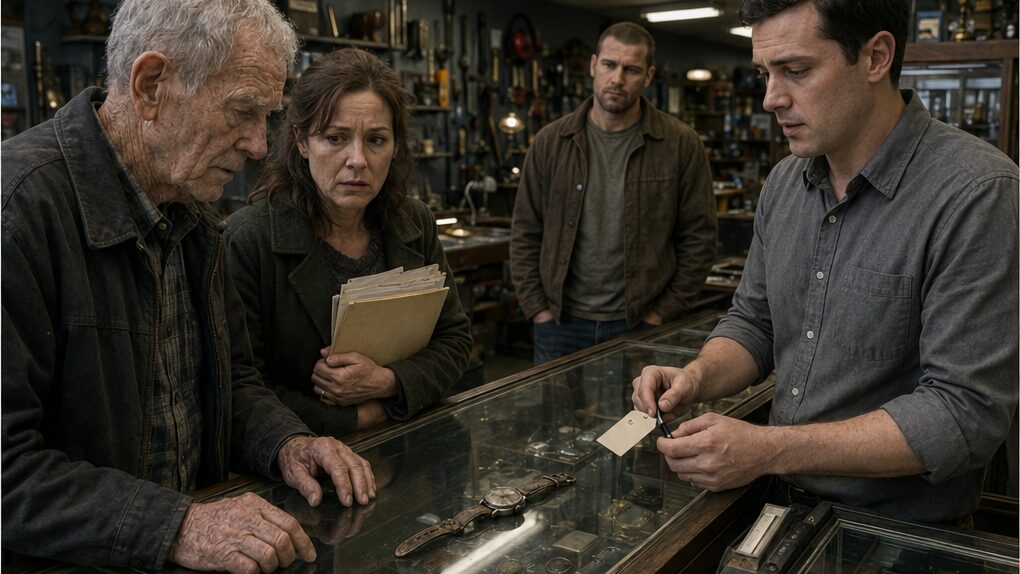
The Old Veteran Put His Stopped Watch on the Pawn Shop Counter, But No One Knew Who It Was Really For
Chapter 1: The Watch That Would Not Move Forward
The water came out brown.
Emily Taylor stood at her father’s kitchen sink with one hand on the hot tap and the other hovering beneath the faucet, as if her palm could shame the house into behaving. The pipe gave a cough deep in the wall. Then another spit of rusty water struck the porcelain and ran in thin orange veins toward the drain.
“Dad.”
Donald Mallory looked up from the table, where he had been lining up his morning pills with the careful patience of a man setting small parts on a workbench. “Let it run a minute.”
“I did.”
“Then let it run two.”
She turned the tap harder. The pipe complained again, and a breath of cold metal rose from the sink. No steam. No warmth. Just that tired brown trickle.
Emily shut it off. “The water heater’s gone.”
Donald picked up a white pill between finger and thumb, studied the line down the center, and pressed it against the edge of his butter knife.
“Don’t do that,” she said.
He did not look at her. “Do what?”
“Cutting them. I saw you.”
“It has a line for cutting.”
“It has a line so people can take half if their doctor tells them to take half.”
“My doctor talks too much.”
“Dad.”
The pill split unevenly. One half skittered across the table and hit the salt shaker. Donald caught it before it fell. His left hand trembled, but only after the job was done, as if the tremor knew better than to interrupt him mid-task.
Emily walked to the cabinet under the sink and opened it. A shallow pan sat beneath the pipe, holding a skin of stale water. Beside it were two folded towels, stiff with old damp. She shut the cabinet harder than she meant to.
“How long?” she asked.
Donald slid the pill halves into a small plastic organizer. “How long what?”
“How long has it been leaking?”
“It’s a house. Houses leak.”
“People fix leaks.”
“People also mind their tone in another man’s kitchen.”
Emily pressed her lips together. She was forty-six years old and still, when her father used that voice, she felt twelve. But the rust in the sink had not come from tone. The cold tap had not come from attitude. And the pile of envelopes tucked under the bread box had not placed itself there.
She reached for them.
Donald’s chair scraped.
“Those are mine,” he said.
“I know they’re yours.”
“Then leave them.”
“I’m not stealing state secrets. I’m checking bills.”
“You have your own bills.”
“And I pay them.” She regretted it the second it left her mouth.
Donald’s face did not change, which was worse. His eyes shifted to the window over the sink, to the narrow backyard with its bare clothesline and the old shed he had once painted every spring. Now the shed door sagged open at the bottom.
Emily softened her voice. “I didn’t mean it like that.”
“Sounded exact enough.”
She picked up the envelopes anyway, because fear had made her less careful than love usually did. Utility notice. Plumbing estimate. Pharmacy balance. Another repair slip with a red stamp across the top. Past Due. Past Due. Final Reminder.
Her throat tightened.
“Dad, why didn’t you tell me?”
Donald closed the pill organizer. “Because you make that face.”
“What face?”
“The face that says you’ve already decided I can’t handle my own sink.”
“The sink is not the problem. The water heater is the problem. The bills are the problem. You cutting pills is the problem.”
He stood slowly, not because he needed help, but because standing fast had become another thing he refused to perform for anyone. “I handled worse than a water heater before you learned to spell your own name.”
“I know that.”
“No. You remember hearing it. That’s different.”
Emily looked down at the envelopes again. There were more than she expected. She sorted them by urgency because sorting was easier than feeling. Beneath the pharmacy notice was a folded sheet that did not match the rest, cream-colored, with a logo she could not see before Donald’s hand came down over it.
“That one’s old,” he said.
“Then why hide it?”
“I’m not hiding it. I’m moving it.”
“Where?”
“Out of your business.”
He took the paper and tucked it into the pocket of his flannel shirt. His hand lingered there too long.
Emily stared at him. “What is that?”
“A paper.”
“Dad.”
“Emily.”
For a moment the kitchen was full of all the things they refused to say. Her mother’s empty chair near the window. The refrigerator that hummed too loudly. The calendar still showing last month because Donald never turned pages until someone made him. The brown stain beneath the sink. His pills cut in half.
Then the pipe knocked in the wall, a hollow metallic sound, and Emily flinched.
Donald did not.
“I can call someone,” she said. “I’ll cover the first payment.”
“No.”
“I didn’t even finish.”
“You don’t need to.”
“It’s a water heater, not a luxury cruise.”
“It’s my house.”
“And I’m your daughter.”
“That doesn’t make you my banker.”
Her eyes burned. “No, apparently I’m just the person who finds out after things are already falling apart.”
Donald looked at the envelopes in her hand, then at his coat hanging on the back of the chair. “There are things I can sell.”
The words struck her with an odd chill. “What things?”
“Things.”
“You mean tools?”
He shook his head. “Most tools left are worth less than the nails in the wall.”
“The truck?”
“Truck gets me places.”
“Dad, you’re not selling the truck.”
“I didn’t say truck.”
He walked past her into the hallway. Emily followed, though something in his shoulders warned her not to. He stopped at the narrow closet beside the bathroom, the one with old coats, a box of Christmas lights, and the cedar chest he had moved from the bedroom after her mother died. From the top shelf, he took down a small wooden box.
Emily had seen it only a few times in her life. Dark wood. Brass latch. No dust on it, though everything around it wore dust like a second paint.
Donald carried it to the kitchen table and sat. He did not open it right away.
“Dad,” Emily said quietly, “what’s in there?”
His thumb brushed the latch once. Twice.
When he opened the box, the smell of cedar and old leather rose between them. Inside, on a folded handkerchief, lay an old field watch with a cracked brown strap. The face was scratched. The glass was cloudy around the edges. Its hands had stopped at 4:17.
Emily exhaled. “That?”
Donald’s eyes moved to her.
She corrected herself. “I mean… I’ve seen that before. You never wear it.”
His fingers hovered over the watch before touching it. He lifted it gently, as if the strap might feel pain. “Wearing isn’t the only way a thing stays with you.”
The sentence had weight she did not understand. It made her think of her mother’s wedding ring in the drawer upstairs, of the coffee mug Donald never used but would not throw away, of the way grief made ordinary objects untouchable.
“Was it Mom’s?” she asked.
“No.”
“From the Army?”
He closed his hand around it. “Yes and no.”
“That’s not an answer.”
“It’s the one I have.”
Emily sat across from him. “If it matters that much, we shouldn’t sell it.”
A flicker crossed his face. Pain first. Then calculation. Then the old stubborn wall.
“We need money,” he said.
“I thought you didn’t want mine.”
“I don’t.”
“But you’ll sell that?”
He slid the watch back into the box and shut the lid. “There’s a pawn shop over on Miller Road.”
Emily looked from the box to the pill organizer, from the bills to the shirt pocket where he had hidden the cream-colored paper. “You know they won’t give you much for it.”
“I don’t need much.”
“How much do you need?”
He did not answer.
The cold house seemed to lean in around them.
Emily gathered the overdue bills and put them into a folder she had brought for tax papers. Donald watched each page disappear as if she were loading evidence against him. She tried to keep her movements calm.
“We’ll go this afternoon,” she said. “Just to ask. No promises.”
Donald gave a short nod.
He stood and reached for his coat. The wooden box was still on the table. Emily turned away to put the folder into her bag. Behind her, she heard the small click of the latch opening again.
Donald took the watch out, not the box. He held it for a long second, thumb resting on the stopped face. Then he slipped it into the inside pocket of his coat, close to his chest.
As he turned, the cream-colored paper he had tucked into his shirt pocket shifted loose. It drifted down silently, slid beneath the kitchen table, and came to rest near the leg of her mother’s empty chair.
Neither of them saw the name printed at the top.
Chapter 2: Twenty Dollars Under Fluorescent Light
“Twenty dollars,” Ryan Clark said, and reached for a yellow tag before Donald Mallory had fully let go of the watch.
The pawn shop lights hummed overhead. Fluorescent tubes washed the glass counters, the rows of used guitars, the old coin trays, and the shelf of power drills in a flat white glare that made everything look less alive than it had been outside. Donald’s field watch lay between a chipped calculator and a stack of pawn tickets, its cracked strap bent like a tired wrist.
Donald’s hand stayed near it.
Ryan looked young enough to be Donald’s grandson, though there was already strain around his eyes. He wore a store polo, a silver wedding band, and the expression of a man who had spent the morning telling people their things were worth less than they hoped.
“Twenty?” Emily said. “That’s all?”
Ryan glanced at her, then back at Donald. “It doesn’t run. Strap’s dry. Case is scratched up. There’s not much demand unless it’s a known model or in better condition.”
Donald’s left hand tightened.
Ryan picked up the watch by the strap again. “I mean, I can maybe do twenty-five if—”
“Don’t hold it like that,” Donald said.
Ryan froze. “Sorry?”
“Don’t hold it like junk.”
The words came out low, not loud, but something in the shop shifted. A man browsing socket sets near the tool shelf looked over. Emily felt heat rise in her face.
“Dad,” she murmured.
Ryan set the watch down more carefully. “I didn’t mean any disrespect.”
“You were reaching for a tag.”
“That’s just how we process items.”
“It’s not an item.”
Ryan swallowed. “Sir, you brought it to a pawn shop.”
Donald looked at him then. Not angry exactly. Worse than angry. Measured. “I know where I am.”
Emily stepped closer. “Dad, he’s only doing his job.”
“I heard him.”
“And we need to know what it’s worth.”
Donald’s gaze did not leave the watch. “That depends who you ask.”
Ryan rubbed the back of his neck. “I’m trying to be fair. If it ran, maybe more. If the strap was replaced, if the case was cleaned up—”
“No.”
“I haven’t finished.”
“You have.”
Ryan’s mouth closed.
Emily placed the folder of bills on the counter, partly to remind Donald why they were here and partly because she needed something solid between them. The top paper was the water heater estimate, folded under a utility notice. She kept thinking of the rusty water, of the pill split wrong, of the way he had said there were things he could sell.
“Dad,” she said softly, “please. You told me you don’t wear it.”
Donald’s jaw flexed. “Wearing isn’t the only way a thing stays with you.”
The man near the tool shelf turned fully now. He was in his thirties, maybe early forties, with a faded Army sweatshirt and a stiffness in the way he carried his right shoulder. He held a small wrench he seemed to have forgotten he was holding. His eyes moved from Donald to the watch, then to Donald’s left hand, where the tremor had started again.
Ryan reached for the watch with two fingers, more carefully this time. “There might be writing on the back. If it’s personal engraving, collectors usually don’t like that. We can clean—”
Donald’s palm came down on the counter.
Emily flinched. Ryan pulled his hand back.
“You touch that inscription,” Donald said, “and the sale is over.”
The man in the Army sweatshirt stepped closer. “May I see it?”
Donald turned his head a fraction. “You buying?”
“Maybe.”
Emily saw Donald’s hesitation, saw the old soldier in him take measure of the younger man’s stance, his hands, his eyes. Before Donald could answer, Ryan lifted the watch and offered it across.
Donald caught Ryan’s wrist.
Not hard. Just enough.
Ryan stopped breathing for a second.
Donald took the watch himself and placed it in the younger man’s open palm. “Flat,” he said.
The man obeyed. He did not dangle it. Did not turn it over quickly. He held it as if it had a right to be tired.
“Benjamin Carter,” he said quietly.
Donald gave no name back.
Benjamin angled the watch toward the light. The metal back was dull with years, its scratches crossing over one another like faded map lines. Near the center, almost worn smooth, were letters.
Benjamin’s expression changed before he spoke.
“What?” Emily asked.
He looked at Donald first, asking permission without words.
Donald took the watch back and turned it over himself. For the first time since they entered the shop, he let Emily see the back.
A.L. — Keep moving. I’ll be waiting.
Emily stared at the letters.
A.L.
Not her mother’s initials. Not Donald’s. Not any name she had ever heard at family dinners, memorial days, or the rare afternoons when her father had allowed his Army years to sit in the room for more than a sentence.
“Mom gave you that?” she asked, though she already knew the answer from his face.
“No.”
The silence after that felt sharper than the argument.
Ryan leaned in, curiosity overcoming caution. “A.L. someone from your unit?”
Donald folded the strap into his palm. “How much?”
Ryan blinked. “Sir?”
“You said twenty. Then twenty-five. I need forty.”
Emily turned to him. “Forty for the water heater won’t even—”
“Not for me,” Donald said.
The words landed between them.
Emily looked down at the folder. He had said not for me in the same voice he used when refusing help, but this was different. This was not pride shielding pride. It sounded like a door bolted from the inside.
Ryan shifted uneasily. “I can’t do forty on something I can’t resell except maybe as décor, and if I can’t clean it up—”
“You don’t clean the back,” Donald said. “You don’t replace the strap. You don’t polish the case. You don’t wind it to see if it moves. You don’t make it pretty for a case.”
“Then what exactly am I supposed to sell?”
Donald’s eyes lifted. “You’re not.”
Ryan’s face tightened. “Sir, I run a business. I’m not trying to insult you, but you can’t bring something in here, tell me it’s not an item, then tell me I can’t do anything with it.”
Emily heard the reason in that. She hated that she heard it. Ryan was embarrassed, not cruel. The shop had rent. He had a calculator by his elbow and a line of people’s disappointments probably waiting every day. But she also saw Donald’s thumb moving over the engraving like he was keeping it from vanishing.
Benjamin set the wrench down on the shelf behind him. “I’ll give you forty.”
Donald’s eyes cut to him. “For what?”
“For the watch.”
“No.”
Benjamin held still. “No?”
“You don’t get to buy grief because you recognize it.”
The sentence hit Benjamin in the chest. Emily saw it. Ryan saw it too and suddenly found interest in the calculator.
Benjamin nodded once, slowly. “Fair.”
Donald put the watch back on the counter. The face looked upward, forever fixed at 4:17.
Benjamin did not leave. “Then let me buy the story with it.”
“No,” Donald said.
Emily touched her father’s sleeve. He looked at her hand as if contact were another kind of question.
“Dad,” she whispered, “who is A.L.?”
He did not answer.
The folder slipped under Emily’s arm as she shifted, and one paper edged out from the back pocket where she had tucked the bills in a hurry. Cream-colored. Slightly bent from being folded and hidden. She caught it before it fell.
At the top, above a balance due and a line of small print, was the name of a nursing facility.
Beneath that, in neat black letters, was the resident name.
Alexander Lewis.
Emily’s fingers went cold.
Donald saw her reading it.
For one second, his face showed not anger, not embarrassment, but fear.
Then he reached for the paper.
Emily held on.
Chapter 3: The Name Emily Was Never Told
“Were you going to sell Mom’s things next too?” Emily asked, and laid the nursing-home bill on Donald’s living room table like evidence in a trial neither of them wanted.
Donald stood by the window with his coat still on. He had not sat down since they came back from the pawn shop. The watch was in its wooden box again, closed, beside the torn edge of a yellow pawn ticket Ryan had started to fill out before everything went wrong.
The house felt colder than it had that morning.
Emily had placed the folder of overdue bills beside the nursing-home invoice. Utility. Plumbing. Pharmacy. Water heater. Alexander Lewis. The name that had been hiding in her father’s shirt pocket and then on the pawn shop counter and now in the room with them.
Donald stared at the bill. “Don’t bring your mother into this.”
“I’m trying to understand what this is.”
“You understand too much already.”
“No, I understand almost nothing.” Her voice cracked, and she hated that. “I understand you were going to pawn a watch you can barely let someone touch. I understand you’ve got unpaid repairs. I understand you’re cutting pills. And now I understand there’s a man named Alexander Lewis whose nursing home is sending bills to your house.”
Donald’s eyes hardened. “That’s not your concern.”
“It became my concern when you started freezing in your own kitchen to pay it.”
He moved then, quick for his age, and took the bill from the table.
Emily did not stop him. “How long?”
Donald folded the paper once. “Emily.”
“How long have you been paying?”
“It’s not paying.”
“What is it, then?”
“Helping.”
“With what money?”
He looked at the wooden box.
The answer was there before he gave it.
Emily sat down slowly. “Dad.”
“It was small amounts.”
“You don’t have small amounts to spare.”
“He needed them more.”
“You needed hot water.”
“I’ve had cold water before.”
“That is not an argument. That is you punishing yourself and calling it discipline.”
Donald’s mouth tightened.
She knew she had hit something, though she did not know what. He turned away and set the bill on the mantel, face down, beneath the little brass clock that had not kept proper time since her mother died.
Emily saw the movement and almost laughed from the pain of it. Clocks stopped all over this house, and he kept them anyway.
“Who is he?” she asked.
“No one you know.”
“That’s obvious.”
Donald’s shoulders rose and fell once. “A man I served with.”
“The watch was his?”
Donald did not answer.
“The initials are his?”
Still nothing.
Emily stood again. “Was he at Mom’s funeral?”
“No.”
“Did she know about him?”
A long pause.
“Some,” Donald said.
“Some?”
“She knew enough.”
Emily rubbed her forehead. “I don’t even know what that means.”
“It means your mother understood that a man can owe something without hanging it on the wall for people to admire.”
“That’s not fair.”
“No,” Donald said. “It isn’t.”
The bitterness in his voice stopped her.
For a moment, she saw not the stubborn father who refused help, but an old man who had spent all day holding himself upright while strangers measured the price of something she had mistaken for clutter. Shame pushed through her anger, but fear was stronger.
“You should have told me,” she said.
“I should have done a lot of things.”
“That’s not an answer either.”
“It’s the only one I have.”
She reached for the watch box. Donald’s hand came down over it.
“Don’t.”
“I wasn’t going to open it.”
“You were thinking about it.”
“Yes,” she said. “Because I’m tired of being locked out of whatever hurts you.”
His face changed, and for an instant she thought he might apologize. Instead he said, “That watch was never your mother’s.”
The words came too sharp.
Emily stepped back.
Donald heard himself. His hand loosened on the box. “I didn’t mean it that way.”
“Yes, you did.”
“No. I meant—”
“You meant I built the wrong story around it because you never gave me the real one.”
Donald looked down.
There it was. Not victory. Not satisfaction. Just a door cracked open enough to show another locked door behind it.
Emily picked up her phone.
“What are you doing?” he asked.
“Calling the nursing home.”
“No.”
“Yes.”
“Emily, put it down.”
“If you won’t tell me whether this man is real, safe, alive, or using you—”
“He is not using me.”
“Then let me hear that from someone who answers the phone.”
Donald crossed the room, but she was already pressing the number printed on the bill. He stopped two steps away. Not because he could not take the phone from her, but because he would not. That restraint hurt worse than if he had shouted.
The line rang.
Emily watched him while she waited. His left hand had started trembling again. He tucked it into his coat pocket, where the watch had been earlier, and found nothing there.
A receptionist answered. Emily gave her name, then hesitated.
Donald’s eyes warned her.
She turned slightly away. “I’m calling about Alexander Lewis. My father has been receiving some billing notices, and I’m trying to make sure—yes, Donald Mallory.”
The name changed something on the other end. Emily heard it in the receptionist’s tone even before the words.
“Oh,” the woman said. “Mr. Mallory.”
Emily’s anger thinned. “You know him?”
The receptionist paused. “Mr. Lewis asks for him.”
Donald closed his eyes.
Emily gripped the phone. “He does?”
“Not every day. Some days he isn’t very clear. But when he is, yes. He asks whether the man with the stopped watch has come by.”
Emily looked at the wooden box.
Donald opened his eyes but did not speak.
“The man with the stopped watch,” Emily repeated.
The receptionist’s voice softened. “I’m sorry. Are you family?”
Emily looked at Donald. His face had gone still in a way she had seen only once before, at her mother’s graveside.
“I’m his daughter,” she said.
“Mr. Lewis has no close family listed. Your father has been… kind.”
Kind.
The word sounded too small for the bills on the table and the brown water in the sink.
“How is he?” Emily asked.
Donald turned away, but not before she saw the answer he feared.
The receptionist did not give details quickly. There were rules, she explained. Privacy. Medical information. But the pauses told their own story, and then she said enough.
“He’s been asking more. If Mr. Mallory plans to visit, sooner would be better than later.”
Emily’s throat closed.
Donald reached for the back of the chair and held it.
“Sooner,” Emily said. “How soon?”
Another pause.
“I can’t say. But I wouldn’t wait long.”
Emily thanked her and ended the call.
The living room was silent except for the old refrigerator humming in the kitchen and the faint tick of the mantel clock that never showed the right hour.
Donald picked up the wooden box with both hands.
“Dad,” Emily said, softer now, “what happened between you and Alexander Lewis?”
He looked at the box as if the answer were inside, stopped at 4:17, waiting for him to be brave enough to open it.
Then he sat down heavily in the chair and pressed the box against his chest.
“He pulled me out,” Donald said.
Emily did not move.
Donald’s eyes stayed on the floor.
“And I left part of him there.”
Chapter 4: The Man Who Pulled Him From Fire
Donald woke to helicopter blades.
They were not in the room, but his body never knew that at first. The sound came low and chopping from somewhere beyond the walls, beating against the dark until his hands gripped the arms of the chair and his lungs forgot the house around him.
Then the refrigerator clicked on.
The blades vanished.
He was in his living room, not under a red sky. His boots were not sinking into mud. There was no smoke. No screaming metal. Just the lamp burning beside him and Emily sitting at the kitchen table where he had left her hours earlier.
She had not gone home.
Donald shifted, and the watch in his coat pocket pressed against his hip. He had slept in the chair with his coat still on. That told him more than any clock could have.
Emily looked up from the table. The nursing-home bill lay open in front of her, but she was not reading it anymore. “You said his name in your sleep.”
Donald rubbed both hands over his face. “Did I?”
“Alexander.”
He did not answer.
“And another word. I couldn’t make it out.”
“Good.”
“Dad.”
He tried to stand too quickly. His knee caught, and pain flashed up his leg. Emily started toward him. He held one hand out.
“I’ve got it.”
She stopped, but not because she believed him. Because she was learning that rushing at him only made him retreat harder.
Donald steadied himself and walked to the kitchen. The house was colder now. The broken water heater sat unseen in the back room like an unpaid debt with pipes. He turned on the tap out of habit, then remembered and turned it off before the rusty stream could cough awake.
Emily watched him.
“You don’t have to tell me all of it,” she said. “But you have to tell me enough.”
He gave her a look. “Have to?”
“Yes.” Her voice did not rise. “Because I’m your daughter. Because I stood beside you while a stranger found out more from the back of that watch than I ever knew. Because a woman at a nursing home had to tell me an old man might be dying, and somehow I’m the one who feels like I broke into something.”
Donald looked toward the hallway. “You did.”
“That’s not fair.”
“No. It isn’t.” He pulled out the chair across from her and sat slowly. “Fairness was never the arrangement.”
The watch stayed in his pocket. He could not take it out yet.
Emily waited.
Donald reached for the bill. At the bottom were the small payments she had noticed, written in the facility’s neat bookkeeping hand. Fifty dollars. Thirty-five. Seventy. Thirty again. The amounts looked pitiful when lined up, like sandbags against floodwater.
“He saved my life,” Donald said.
Emily swallowed. “Alexander?”
Donald nodded once.
The kitchen light buzzed. He fixed his eyes on the bill instead of her face.
“We were young enough to think orders were the same as answers. Old enough to know better, but young enough anyway.” His thumb moved over one of the handwritten amounts. “There was a transport. Bad landing. Fire got in before sense did.”
Emily did not move.
Donald’s mind took him only as far as he allowed. He did not describe the smell. He would not give her that. He gave her shapes instead: the white flash, the slammed earth, the weight of harness and heat, his own hand fumbling against a buckle that would not give.
“I couldn’t get loose,” he said. “I thought I was. But I wasn’t. Something had me pinned. Smoke filled everything. Men were shouting, but sound gets strange when you think you’re about to die. It comes from underwater.”
His left hand had begun to tremble on the table. He covered it with his right.
“Alexander came back.”
Emily’s eyes shone.
“He had already made it out. He came back anyway. Cut me loose. Dragged me by the collar until I could breathe. I was fighting him, I think. Men do stupid things when they’re scared.”
“You?”
His mouth twitched without humor. “Especially me.”
He could feel the heat now. Not memory exactly. Body memory. The way skin remembered before the mind gave permission.
“He got me clear. Then part of the wreck shifted. I heard it. He did too. He pushed me. That’s all. One shove.” Donald tapped the table once. “One shove, and I was far enough away.”
“And he wasn’t?”
Donald looked at the bill.
“He lived,” he said. “But not how he went in.”
Emily put one hand over her mouth.
“No,” Donald said sharply.
She lowered it.
“Don’t make that face for him. He hated that face.”
“I’m sorry.”
“So was everyone. That was the trouble.”
The words came colder than he intended, but Emily did not flinch.
Donald took the watch from his pocket at last. He laid it on the table between the bill and Emily’s hands. The cracked strap curled inward. The face still read 4:17.
“It stopped then?” she asked.
“Near enough.”
“Near enough?”
“That’s what it said when he gave it to me.”
“He gave it to you after?”
Donald nodded.
The memory did not arrive gently. It came in pieces: Alexander propped in a field hospital bed, his skin the wrong color under harsh lights, one side of him wrapped and braced, mouth dry, eyes too alert. Donald standing at the foot of the bed with his own bandages hidden under his shirt because they looked small by comparison.
Alexander had held out the watch.
“Take it,” he’d said.
Donald had refused. Of course he had. Pride was easier than gratitude. “It’s yours.”
“Not if I can’t use both hands to wind it.”
“You’ll use them.”
Alexander had smiled in that sideways way of his, the smile of a man who knew more than he let on. “You always were bad at taking orders from anybody bleeding.”
Donald had taken the watch only because Alexander had kept his hand out until the nurse threatened to call someone.
On the back, the engraving had been fresh then.
A.L. — Keep moving. I’ll be waiting.
“He had that put on before?” Emily asked.
“Before that day. A joke, maybe. A promise to someone else. He never said.” Donald turned the watch over but did not show her the back again. “After the crash, he said it fit better with me.”
“What did he mean?”
Donald’s fingers tightened around the case. “That I wasn’t to sit down in that moment and stay there.”
Emily looked at the stopped hands. “But you kept the watch stopped.”
“I kept it honest.”
“Honest?”
“If I fixed it, people would look at it and see a working watch. They’d ask time. They’d say nice piece. Maybe polish it. Maybe replace the strap.” His voice thinned. “But it stopped where it stopped. That’s what it is.”
Emily’s gaze moved from the watch to him. “You never fixed it because fixing it felt like lying.”
Donald did not answer, but silence was answer enough.
She sat back. The chair legs scraped softly. “And you’ve been paying his bills because he saved you.”
“Part of his bills.”
“Because you owe him.”
“I do owe him.”
“You think money pays that?”
His head came up.
Emily did not back down. “I’m not saying don’t help him. I’m saying you’re hurting yourself and hiding it and calling it honor.”
His face hardened. “Careful.”
“No. You be careful.” Her voice shook now, but she kept going. “You let me fight the wrong enemy today. I thought the enemy was the watch. I thought it was clutter, or pride, or you refusing to admit you needed help. But the enemy was you being alone with this for so long you forgot anyone else could stand in the room.”
The kitchen seemed too small for the words.
Donald looked away first.
Emily pressed her hands flat on the table. “I pushed you. I know I did. I was scared. I am scared. The house is falling apart. You’re cutting medication. You won’t answer phones. And now there’s this man I never knew existed, asking for you.”
“He didn’t want visitors.”
“Did he say that recently?”
Donald’s mouth opened, then closed.
That was the first crack.
Emily saw it. “Or did you decide for him?”
He turned the watch face down. The inscription was against the table now, hidden. “He was proud.”
“So are you.”
“It kept us alive.”
“And now?”
He had no clean answer.
The kitchen phone rang.
Both of them looked at it.
Donald’s shoulders tensed. Emily did not reach for it this time. She waited.
The phone rang again. And again.
Donald stood and answered. “Mallory.”
He listened. His eyes shifted toward Emily, then to the watch on the table.
“Yes,” he said. “This is he.”
Emily straightened.
Donald’s grip tightened on the receiver. “Who told you I had a watch?”
His voice changed on the last word.
Emily stood.
Donald listened, his face closing piece by piece. “No. It is not for sale.”
A pause.
“I don’t care what he wrote in your log.”
Another pause.
Donald looked at the pawn ticket lying beside the watch.
“No,” he said. “You tell Ryan Clark I said no.”
He hung up.
Emily stepped closer. “What happened?”
Donald did not answer immediately. He picked up the watch, rubbed once at the case with his thumb, then stopped himself as though even that was too much alteration.
“What happened?” she repeated.
“Ryan called someone after we left,” Donald said.
“A collector?”
“He says a collector saw the description in the shop log.”
Emily glanced at the watch. “But you didn’t sell it.”
“No.”
“What does the collector want?”
Donald’s eyes were fixed on the stopped hands.
“To buy it if I change my mind.”
Chapter 5: A Collector’s Price and a Soldier’s Terms
Donald walked into Ryan Clark’s pawn shop the next morning and found the watch already described on a sheet of paper beside the register.
Military field watch. Nonworking. Engraving on back. Possible service history. Seller may return.
The words sat under Ryan’s hand as he tried to slide the paper into a folder.
Donald stopped at the counter. “Don’t put that away on my account.”
Ryan froze. His face went pale in the fluorescent light. “Mr. Mallory.”
Emily stood just behind Donald, close enough to help if his knee faltered, far enough not to shame him. The watch was in his coat pocket again. She had offered to carry it, and he had looked at her until she withdrew the offer.
“I can explain,” Ryan said.
Donald placed the pawn ticket on the glass counter. “Start with why a man called my house about something I never sold.”
Ryan looked toward the back room, then at the empty store. “He’s a regular buyer. Military pieces, old tools, watches, pocketknives. I didn’t give him your address.”
“He had my phone number.”
“No, sir. I called you. He didn’t.”
“He knew enough.”
Ryan swallowed. “I wrote the description after you left because I thought… I thought maybe I could get you more than twenty. I felt bad about yesterday.”
“You felt bad, so you made it easier to sell.”
“I was trying to help.”
Donald leaned both hands on the counter. “That sentence did a lot of damage yesterday.”
Ryan looked down.
Emily stepped in before Donald could cut deeper. “Did you send him a picture?”
“No. I didn’t have the watch.”
“But you put the inscription in your notes?”
Ryan hesitated.
Donald’s face hardened. “You wrote it down?”
“Initials only,” Ryan said quickly. “Not the whole line. I swear. I just said there was an inscription and the watch was stopped. He said that could matter.”
“It matters because it mattered to the man who wore it.”
“I know that now.”
“No,” Donald said. “You know it might raise the price.”
Ryan flinched.
The door behind them opened, setting off a small bell. Benjamin Carter stepped inside in the same faded Army sweatshirt, though today he wore a work jacket over it. He stopped when he saw the three of them around the counter.
“Bad time?” he asked.
“Depends what you’re here to buy,” Donald said.
Benjamin’s eyes moved to the pawn ticket. “Nothing.”
Ryan looked relieved and uncomfortable at once. “He came by after you left yesterday. Asked if you’d sold the watch.”
“I asked if the watch was safe,” Benjamin corrected.
Donald turned slightly. “From what?”
Benjamin came closer but did not crowd him. “From people who think preserving a thing means making it look new.”
The words found their mark.
Ryan opened a drawer and pulled out another paper. “The collector offered two hundred.”
Emily inhaled. Donald did not move.
“Two hundred?” she said before she could stop herself.
Ryan nodded, encouraged by someone reacting like a practical person. “Depending on authentication. More if there’s documentation. He’d want it cleaned, photographed properly, maybe sent out to see if the movement could be repaired.”
Donald’s eyes stayed on Ryan. “Repaired.”
“That’s what collectors do. Restoration.” Ryan’s voice grew steadier, business giving him something to stand on. “Look, Mr. Mallory, I get that it’s personal. I do. But two hundred is a lot more than twenty. If you need money—”
“I need men to stop improving what they don’t understand.”
Benjamin looked at the counter.
Emily touched the folder tucked under her arm. Inside were the water heater estimate she had gotten that morning and the nursing-home bill Donald had finally allowed her to carry. Between them, the numbers looked larger than her father’s pride and smaller than the watch, somehow.
“Dad,” she said carefully, “two hundred would help.”
He turned to her.
She lifted a hand. “I’m not saying sell it. I’m saying that’s the first number anyone has said that actually helps.”
Donald heard the fear beneath it. She was not pushing like yesterday. She was counting pipes, pills, winter, facility calls, and his thin coat. She was trying to keep him alive with arithmetic.
That did not make the number clean.
Benjamin spoke quietly. “Two hundred can be a fair price for the wrong thing.”
Ryan bristled. “I’m not trying to cheat him.”
“I didn’t say you were.”
“You implied it.”
“No.” Benjamin rested one hand on the edge of the counter. “I implied that sometimes respect gets confused with acquisition.”
Ryan stared at him. “That sounds like something people say when they don’t have bills.”
Benjamin’s face changed. Not anger, exactly. Memory. “I sold my service jacket in a place like this.”
The shop grew quiet.
Donald looked at him more closely.
Benjamin kept his eyes on the glass counter. “Years ago. Needed rent. Told myself it was just fabric. Patches. Name tape. Sweat. Smell of smoke I didn’t want in my closet anyway.” His jaw tightened. “Guy who bought it wore it to a costume party. I saw the pictures online because a friend thought it was funny.”
Emily’s expression softened.
Ryan looked ashamed but defensive. “That wasn’t here.”
“No,” Benjamin said. “But the counter looked a lot like this one.”
Donald felt the watch in his pocket. It was not beating, but he could feel its stillness the way some men felt a pulse.
Ryan pushed the paper with the collector’s offer across the glass. “I have rent too. Insurance. Taxes. People bring things here because they need money, not because I invented need. I price what comes in. I try not to rob anyone. Yesterday I got it wrong. Today I’m trying to get it less wrong.”
That was honest enough to slow Donald’s anger.
Emily looked between them. “What would the collector do with it?”
Ryan glanced at the paper. “Clean the case. Replace the strap with period-accurate leather. Photograph the inscription. Maybe get the movement running if parts exist.”
Donald’s hand moved to his pocket.
Benjamin saw. “That watch doesn’t need to impress anyone.”
Ryan said, “You don’t know what it needs.”
Benjamin looked at Donald. “No. He does.”
The simple trust unsettled Donald more than argument.
He took the watch out and placed it on the counter, not on Ryan’s velvet pad. The cracked strap curled against the glass. Everyone looked at it.
Ryan did not reach for it this time.
Donald turned it face up. “It stopped at 4:17.”
No one spoke.
“The man who gave it to me didn’t ask me to make it useful.” He turned it over, exposing the worn back but covering part of the inscription with his fingers. “He didn’t ask me to make it pretty. He told me to keep moving.”
Emily’s eyes filled, but she stayed silent.
Ryan’s voice was smaller. “Maybe selling it could be part of that.”
Donald looked at him. For a moment, that idea hurt because it was not cruel. It was possible. A man could keep moving by letting go. A man could turn memory into medicine, heat, a paid invoice. Maybe that was what frightened him most: that someone could be right for the wrong reason.
He picked up the collector’s offer.
Two hundred dollars.
A water heater service call. Part of Alexander’s care gap. Groceries. Pills cut whole instead of half. A number that could reach into the week and loosen its grip.
Ryan said, “He’d pay cash today.”
Donald folded the paper once.
Emily whispered, “Dad?”
He folded it again.
Then he tore it down the middle.
Ryan closed his eyes.
Donald tore it once more and laid the pieces on the counter beside the pawn ticket. “If a man wants the watch only after you clean off the years, he doesn’t want the watch.”
Ryan did not argue.
Benjamin’s shoulders eased.
Emily looked pained, but she did not stop him. That mattered. Donald noticed.
He gathered the torn pieces and placed them in Ryan’s trash can himself. Not dramatically. Carefully. As if even refusing needed order.
At the door, Ryan called after him. “Mr. Mallory.”
Donald stopped.
“I’m sorry,” Ryan said. “For writing it down before asking.”
Donald’s hand closed around the watch in his pocket. “Then learn which things not to write.”
Outside, the morning air hit cold.
Emily walked beside him to the curb. “You know we still don’t have enough.”
“I know.”
“For the heater or for Alexander.”
“I know that too.”
Benjamin had followed them out but stayed a few steps back. Donald could feel the younger man waiting, not pushing.
Emily opened the truck door. “What now?”
Donald looked at the torn-off edge of the pawn ticket still in his hand, then toward the shop window where the fluorescent lights made every object look priced before it was known.
“I don’t know,” he said, and the admission cost him more than the watch had.
Chapter 6: The Condition That Kept It His
Benjamin put sixty dollars on the counter, and Donald pushed it back so hard one of the twenties slid halfway over the glass edge.
“No.”
Ryan, who had been reaching for a receipt pad, stopped immediately.
Emily stood near the door of the pawn shop, arms folded against the cold that had followed them back inside. They had made it as far as Donald’s truck before Benjamin asked for one minute. Donald had said he had already given the shop too many minutes, but he came back anyway.
Now the money lay between them, more accusation than help.
Benjamin did not touch it. “I didn’t say charity.”
“I heard charity before you spoke.”
“That’s not on me.”
Donald’s eyes sharpened.
Benjamin held up one hand. “Maybe some of it is. I’m not good at this.”
“No one is good at handing old men cash and pretending it doesn’t mean what it means.”
Emily winced. Ryan looked down at the receipt pad.
Benjamin’s voice stayed even. “Then I won’t pretend. I want to give you money because I think you need it.”
Donald reached for the watch in his pocket. “Conversation over.”
“And because yesterday I almost did what he did.” Benjamin nodded toward Ryan, who accepted the blame without defending himself. “I saw the inscription and thought if I understood it, maybe I had a right to help.”
“You don’t.”
“No,” Benjamin said. “I don’t.”
That answer stopped Donald’s next words.
Benjamin looked at the money, then at the watch-sized bulge in Donald’s coat pocket. “I had men older than me teach me how to come home without saying they were teaching it. One of them paid for my bus ticket once. Told me it was a loan, then never let me repay it. I hated him for about a week.”
Donald said nothing.
“Then I understood he gave me a way to take help without feeling small.” Benjamin slid the bills back toward himself, straightened the edges, and placed them down again. “So I’m going to try again and probably still get it wrong.”
Emily’s face had changed. The fight had gone quiet in her.
Benjamin pointed to two of the twenties. “Forty for the watch.”
Donald’s mouth tightened.
Benjamin placed his finger near the third bill. “Twenty for the condition that it stays yours until you decide where it belongs.”
Ryan looked up.
Donald stared at him. “That makes no sense.”
“It does to me.”
“If it stays mine, you didn’t buy it.”
“Then write it as a hold. A trust. A bad business decision. I don’t care.”
Ryan said cautiously, “I can write a receipt that says no transfer of possession.”
Donald looked at him. “You stay out until asked.”
Ryan closed his mouth.
Benjamin accepted that with the smallest nod. “You said yesterday I don’t get to buy grief because I recognize it. You were right. So don’t sell me grief. Sell me the right to say I was in the room when you decided it still belonged to you.”
Donald’s anger rose again, then faltered because it could not find a clean place to land.
He knew pity. Pity leaned in too close. Pity softened its voice until you wanted to break something. Pity took decisions away and called it kindness.
This was not that.
This was a younger man standing straight, making a clumsy offer with careful hands, leaving the watch untouched.
Emily stepped closer. “Dad.”
He did not look at her.
“I can cover part of the heater deposit,” she said. “Not all of it today. But part. I made some calls this morning.”
“Without asking me.”
“Yes.” She swallowed. “I’m sorry. And I’m not sorry. Both can be true.”
Donald almost smiled despite himself, but it faded.
She continued, “There’s a payment plan. It’s not perfect. It means waiting a few days for installation unless we pay more upfront. But it’s something.”
“And Alexander?”
Her eyes moved to the folder. “We can go there. Today. We can talk to them. Not take over. Talk.”
Donald heard the care in the correction. Not take over.
Benjamin said, “Keep the sixty if it helps you get there.”
Donald’s gaze snapped back. “I didn’t agree.”
“No.”
Ryan slid the receipt pad forward with two fingers, then lifted both hands as if surrendering. “Only if you ask.”
Donald looked at the pad. A pawn receipt had seemed like humiliation yesterday. Proof that he had carried a promise to a counter and watched a stranger name its price. But a receipt could also be terms. A record of what had not been surrendered.
“What would it say?” he asked.
Ryan picked up the pen slowly. “Whatever you tell me.”
Donald considered.
The shop was quiet around him. The guitars on the wall. The tool shelf where Benjamin had first turned. The display case where Ryan would have placed the watch if Donald had been too tired to object. All of it waited.
“Write,” Donald said, “that the watch remains in my possession.”
Ryan wrote.
“That no cleaning, repair, polishing, strap replacement, winding, photographing, appraisal, or transfer happens without my say.”
Ryan wrote more carefully now.
Benjamin’s mouth softened, but he said nothing.
“Write that the sixty dollars is received under condition.”
Ryan paused. “What condition?”
Donald looked at Benjamin. “That no man in this room calls it charity.”
Benjamin nodded once. “Agreed.”
Ryan wrote the line.
Emily let out a breath she had been holding.
Donald took the three bills from the counter. They felt too light for what they had cost. He folded them once and placed them in his wallet behind his license, not in the pocket with the watch.
Ryan tore off the receipt and handed it over. This time Donald read every word.
His name. The date. The condition. The watch remaining in his possession.
He folded the receipt and put it in the same wallet slot as the money.
Benjamin finally spoke. “Thank you.”
Donald looked at him sharply. “For what?”
“For letting me get it less wrong.”
Donald studied him for a long second. “Don’t make a habit of thanking men for taking money.”
“I’ll try not to.”
At the door, Emily touched Donald’s elbow. He let her. Only for a moment, but he let her.
Outside, the cold had settled into the truck’s metal frame. Donald sat behind the wheel but did not start the engine. He took the watch from his pocket and placed it in his palm.
Emily waited in the passenger seat.
“You have somewhere to be?” he asked.
She glanced at him. “I had paperwork at the office.”
“Go.”
“No.”
“Emily.”
“I can do it tomorrow.”
“You shouldn’t have to.”
“I know.” Her voice was gentle, but firm. “That’s why I’m choosing to.”
He looked out through the windshield at the pawn shop window. Ryan stood inside, tearing the collector’s description into smaller pieces and dropping them in the trash. Benjamin remained near the counter, hands in his pockets, not watching them.
Donald opened the glove compartment and found a clean white handkerchief folded beneath old registration papers. He had put it there years ago and forgotten it. He shook it out once, laid the watch in the center, and folded the cloth around it with slow, exact corners.
Emily’s eyes followed every movement.
“Dad,” she said, “where does it belong?”
Donald held the wrapped watch for a long moment.
Then he put the truck in reverse.
“With Alexander,” he said. “And we go today.”
Chapter 7: The Room Where Time Was Waiting
“Did you fix it?”
Alexander Lewis opened his eyes before Donald had even reached the bed.
The question was barely a whisper, rubbed thin by age and medication, but it stopped Donald in the doorway as if someone had called him by rank. Emily stood behind him in the narrow hall, one hand still on the visitor badge clipped to her coat.
The nursing-home room was small and too warm. A muted television flickered from a bracket near the ceiling, showing a game nobody was watching. There were two framed prints on the wall, both of lakes Alexander had probably never visited, and a rolling tray with a plastic cup of water, a straw, and a folded napkin. The whole room smelled faintly of antiseptic, applesauce, and old sheets.
Alexander lay under a white blanket, thinner than Donald had prepared himself for. His face had folded inward around the bones. His hair had gone almost entirely silver. One hand rested on top of the blanket, the fingers curled slightly as if still holding something that had been taken away.
Donald took one step inside.
“No,” he said. “I didn’t fix it.”
Alexander’s mouth moved. It took a moment for the smile to arrive. “Good.”
Emily’s breath caught behind him.
Donald did not turn around. If he looked at her, he might leave. If he looked too long at Alexander, he might do worse and cry in a room where both men had spent a lifetime avoiding that kind of display.
A nurse adjusted the blanket and gave Donald a gentle nod. “He’s been awake on and off. Not for long stretches.”
Alexander’s eyes shifted. “Who’s that?”
Donald cleared his throat. “My daughter. Emily.”
Alexander turned his head with effort. “Little one?”
Emily stepped into view. “Not so little anymore.”
“No.” Alexander’s eyes traveled her face. “You had braids.”
Emily blinked. “You saw me?”
“Picture,” Alexander whispered. “Wallet. He showed it once. Pretended he didn’t want to.”
Donald looked at the floor.
Emily glanced at her father, and something in her expression softened with a hurt she had not expected. There had been a time, then, when Donald had carried her openly enough to show someone. A small picture in a wallet. A father who had not been all locked doors.
The nurse touched the bed rail. “I’ll be just outside.”
When she left, the room seemed to shrink.
Donald pulled the chair closer to the bed but did not sit. Instead he took the clean handkerchief from his coat pocket. He held it in both hands. The folded square looked too white in the room, too neat for what it carried.
Alexander watched it.
“You brought him,” he said.
Donald frowned. “Brought who?”
Alexander’s smile trembled. “Time.”
Donald looked away sharply.
Emily moved to the wall, giving them space without leaving. Her eyes went to the handkerchief, then to Alexander’s waiting hand.
Donald unfolded the cloth.
The stopped field watch lay in the center. Cracked leather strap. Scratched case. Clouded glass. The hands still fixed at 4:17, as stubborn as a held breath.
Alexander’s fingers twitched.
Donald placed the watch in his palm.
For a moment neither man spoke.
Alexander held it with the fragile care of someone receiving not an object but proof that a room he remembered had really existed. His thumb moved over the case, not polishing, not cleaning, just recognizing. When he turned it over, the worn inscription caught the soft light from the window.
A.L. — Keep moving. I’ll be waiting.
Alexander closed his eyes.
Donald stood there with his hands empty and felt, with sudden violence, that he had made a mistake. Not in bringing it. In keeping it so long. In almost selling it. In paying bills instead of walking through this door sooner. All the ways a man could confuse loyalty with distance lined up inside him, and none of them wore clean uniforms.
“I almost sold it,” Donald said.
Emily looked at him.
Alexander opened his eyes again.
Donald forced himself to keep going. “Yesterday. Pawn shop on Maple. I put it on the counter.”
The watch shifted in Alexander’s hand.
Donald’s voice roughened. “Young clerk offered twenty dollars. Said it didn’t run.”
Alexander stared at him for a long moment.
Then, instead of anger, there was sadness. Not surprise. Sadness, as if he had known Donald would try to turn himself into payment sooner or later.
“For me?” Alexander asked.
Donald said nothing.
Alexander’s eyes moved to Emily. Then back. “Don.”
The old nickname hurt.
Donald gripped the back of the chair. “They were short. Facility kept calling. You never had anyone close enough to answer. I had enough for some. Not all.”
“You had water?”
Donald did not answer quickly enough.
Alexander’s face tightened. “Heat?”
“House is old.”
“That’s not what I asked.”
Emily looked down.
Donald’s pride rose, even here. Especially here. “I handled it.”
Alexander’s hand closed around the watch with surprising strength. “You always did like making a mess sound like duty.”
Donald looked at him then.
For a second, the years fell strangely away. Alexander was not just the thin man in the bed. He was the younger man with soot on his face, laughing through cracked lips, issuing orders from a hospital bed because someone had to keep Donald from drowning in being alive.
“You gave it to me,” Donald said. “You told me to keep moving.”
“I did.”
“So I did.”
Alexander’s gaze went to the watch. “No. You kept walking. Not always same thing.”
Donald flinched.
Emily, from the wall, closed her fingers around the strap of her purse but did not interrupt.
Alexander took a breath that rattled softly. “I gave it to you because you were sitting in that chair like they’d buried you and forgot to finish. You wouldn’t look at anybody. Wouldn’t eat. Wouldn’t answer nurses unless they gave you a direct order.”
Donald remembered. He remembered the white blanket over his own knees. The untouched tray. The rage at the nurse who opened the curtains. The way sunlight had felt like accusation.
“You told me you were waiting,” Alexander said.
Donald’s throat tightened.
Emily looked between them.
“What was he waiting for?” she asked softly.
Alexander’s eyes stayed on Donald. “Permission.”
Donald turned away.
Alexander’s voice weakened, but he kept it steady enough. “I told him no. Told him I’d be waiting, but not there. Not in that minute. Not at 4:17.”
Donald wiped one hand down his face. “You were the one hurt.”
“You think that gave you the right to spend the rest of your life apologizing?”
Donald looked back, anger sparking because anger was easier than grief. “You pulled me out.”
“And I’d do it again.”
“It cost you.”
“Yes.”
The word had no decoration. That made it worse.
Alexander looked at the watch. “Some things cost. Doesn’t mean the man saved has to keep paying the bill forever.”
Donald’s mouth tightened. “Your bills say different.”
Alexander made a sound that was half laugh, half cough. Emily stepped forward, but he lifted a finger and she stopped.
“You think I asked them to call you?”
Donald hesitated.
Alexander saw the answer. “I told them not to bother anybody.”
“They had my name.”
“Emergency contact from years back.” His smile faded. “Should’ve changed it.”
Donald stared. “You knew?”
“That they called? First time, yes.” Alexander looked at Emily. “He came in mad as a wet cat. Paid at the desk. Wouldn’t come to my room.”
Donald looked at the bed rail.
Emily whispered, “You came here and didn’t see him?”
“Once,” Donald said.
“Three times,” Alexander corrected.
The room went still.
Donald’s face burned.
Alexander’s expression held no victory. Only exhaustion and old affection turned blunt by time. “Sat in the parking lot too. Nurse told me. Thought she was helping.”
Emily’s eyes filled again, but she blinked it back. She was learning quickly how not to pity men who would rather be understood.
Donald reached for the chair at last and sat. The movement was slow, not because of his knee alone.
“I didn’t know what to say.”
Alexander moved his thumb over the watch. “Could’ve started with hello.”
Donald let out a breath that broke at the edge. “Hello.”
Alexander smiled faintly. “There.”
For a moment, the room held them gently.
Then Alexander’s hand shifted, and the watch slid toward the blanket. Donald caught it before it fell. Their fingers touched around the case. One hand weak, one trembling. Both old.
Alexander looked at their hands. “You kept it stopped.”
“Yes.”
“Good.”
“I thought fixing it would be lying.”
“It would’ve been pretending.” Alexander’s eyes lifted to him. “But keeping it stopped doesn’t mean you have to be.”
Donald’s fingers tightened.
Emily stepped closer now. “He thought carrying it alone proved he remembered you.”
Alexander’s gaze warmed when he looked at her. “That sound like him.”
Donald said, “I’m sitting right here.”
“I know,” Alexander whispered. “Took long enough.”
The three of them almost smiled.
Almost.
Then Alexander’s face shifted with pain, and the moment thinned. Donald reached for the call button, but Alexander shook his head.
“Listen,” Alexander said.
Donald leaned closer.
“After I’m gone, don’t pay anything in secret.”
Donald started to protest.
Alexander closed his eyes briefly. “Don’t argue with a dying man. It’s bad manners.”
Emily gave a small, broken laugh.
Alexander continued, “If there’s something owed, let the office talk to people who know how. Veterans’ people. Facility people. Your daughter.” His eyes moved to Emily. “She looks stubborn enough.”
“She is,” Donald said.
“Good. You need one.”
Emily wiped under one eye with the side of her finger. “I can be stubborn.”
Alexander looked back at Donald. “Let her help you live. Don’t make her inherit silence and call it strength.”
The words landed harder than any accusation.
Donald stared at the watch. He had believed, for years, that keeping the promise private had made it pure. No one could misunderstand what they were never allowed to see. No one could polish it, price it, pity it, or tell him to move on.
But no one could stand beside him either.
Alexander slowly lifted the watch toward him.
Donald drew back. “No.”
“It was yours.”
“It was yours first.”
“Don.”
“No.” Donald’s voice shook, but he did not let go of the word. “You told me to keep moving. I did the best I could. Badly sometimes. But I kept it. I kept it stopped. I kept your words. Now you keep it tonight.”
Alexander’s eyes glistened. “And after?”
Donald looked at Emily. She did not answer for him.
He looked back at Alexander. “After can wait its turn.”
Alexander gave a small nod.
Donald closed Alexander’s fingers around the watch, careful not to press too hard. The cracked strap lay across the blanket like an old road. For once, Donald’s hands were empty, and the emptiness did not feel like betrayal.
Emily stood beside her father, close enough that her sleeve brushed his shoulder.
Alexander held the watch against his chest, the stopped face turned inward where no collector, clerk, or well-meaning stranger could read it.
Donald sat down at last and stayed.
Chapter 8: The Receipt He Kept in His Wallet
Hot water ran clear into Donald Mallory’s kitchen sink, and the cigar box on the table was empty.
Emily turned the tap off and looked over her shoulder before she said anything. Her father stood by the table with the box open in front of him, staring at the folded cloth inside. The cloth still held the shape of the watch, though the watch was not there.
For a moment, neither of them moved.
The new water heater rumbled softly from the back room. Not new exactly. Reconditioned, the repairman had said, but reliable. Emily had negotiated the payment plan with the careful patience of someone approaching a locked gate. Donald had argued about the deposit, the installation date, and the fact that she had written her number on the paperwork. Then he had signed because she had slid the pen across the table and said, “Your terms first. Then mine.”
He had looked at her for a long time before taking it.
Now the sink worked. The kitchen was warmer. His pills sat uncut in the organizer, though he had complained about the size of them that morning for the sake of form.
But the box was empty.
Emily crossed the kitchen and touched the edge of the chair. “Do you want it back?”
Donald closed the cigar box. “It isn’t lost.”
“That’s not what I asked.”
“No,” he said. “It isn’t.”
Several days had passed since the nursing-home visit. Alexander had slept before they left, the watch still under his hand. A nurse had promised to keep it with him and then, after one look at Donald’s face, had added, “No one will clean it.”
Donald had nodded once because if he had spoken, he might have embarrassed everyone.
There had been no dramatic call afterward. No clean ending. Alexander was still alive as of that morning, the nurse said. Resting. Asking less. Holding the watch whenever he woke.
Donald had begun to understand that some goodbyes did not announce themselves. They simply took longer than a man could stand and less time than he needed.
Emily picked up the folder on the table. It no longer bulged with hidden papers. There were still bills inside, but they were arranged in plain sight: water heater plan, utility extension, care facility statement, and a note from someone at the facility about a small veterans’ assistance fund.
She had made calls. Too many, in Donald’s opinion. But she had done one thing he had not expected. She had not used his name as a plea.
“The facility confirmed it,” she said. “The fund will cover part of Alexander’s outstanding balance. Not everything, but enough that they won’t keep calling you.”
Donald’s face tightened. “Who paid into it?”
“People.”
“What people?”
“People who already give to that fund.”
He looked at her.
“And Benjamin,” she admitted. “A little. Ryan too.”
Donald’s eyebrows rose.
“Ryan asked how to contribute without making it about you,” Emily said. “I told him that was the first sensible question he’d asked.”
Despite himself, Donald huffed.
“It’s not charity to you,” she added. “It goes through the facility. For Alexander and men like him. No announcement. No nameplate. No one clapping.”
“Good.”
“I thought you’d say that.”
He sat and took his wallet from his back pocket. The leather had worn pale at the corners. Inside, behind his license and the folded sixty-dollar receipt, he had tucked Ryan’s pawn paper. Not because he needed proof of the money. Because the words mattered.
The watch remains in Donald Mallory’s possession until Donald Mallory decides where it belongs.
That had been true when written. It was still true in a way Ryan probably had not meant. Possession was not always a pocket. Sometimes it was a decision a man could live with.
Donald folded the receipt along its crease and put it back.
Emily watched him. “Are you going somewhere?”
He reached for his coat. “Maple Street.”
Her eyes sharpened. “The pawn shop?”
“Yes.”
“Why?”
“To finish something.”
She looked wary. “Dad.”
“I’m not selling anything.”
“That was not my only concern.”
He almost smiled. “You coming?”
She hesitated only a second. “Yes.”
The pawn shop bell rang the same way it had before, but Ryan Clark looked up differently this time. No quick appraisal, no automatic salesman’s expression. He saw Donald and set down the bracelet he had been tagging.
“Mr. Mallory,” he said.
Donald walked to the counter. Emily stayed beside him.
Ryan’s eyes flicked to Donald’s hands, perhaps looking for the watch. Donald noticed.
“It’s not here,” Donald said.
Ryan nodded. “Okay.”
“That bother you?”
“No, sir.”
Donald placed the pawn receipt on the glass counter.
Ryan looked at it, then at him. “Is something wrong with it?”
“Yes.”
Ryan’s face fell.
Donald tapped the line about conditions. “You wrote what I told you to write. That part’s right.”
Ryan waited.
“But there’s another condition you should have written for yourself.”
Ryan glanced at Emily, then back. “What condition?”
Donald looked around the shop. The display cases were full of things separated from their stories: watches, rings, tools, instruments. Some had been sold freely. Some under pressure. Some, maybe, with grief still stuck in the hinges.
“When someone brings you something with a name on it,” Donald said, “or a date, or words worn down because somebody touched them for years, don’t start with what you can clean off.”
Ryan looked down at the counter.
Donald’s voice stayed steady. “Ask before polishing.”
The words seemed to hit Ryan harder than scolding would have. He reached beneath the counter, pulled out a small notepad, and wrote them down.
Ask before polishing.
Then he tore the paper free and taped it to the inside edge of the register where only he would see it unless he forgot.
Emily’s eyes softened.
Ryan said, “I put something into the veterans’ fund. Not because I’m trying to fix yesterday.”
Donald said nothing.
Ryan looked embarrassed but kept going. “Because I handled it like a thing. And because you were right. This place does that too fast.”
Donald studied him. The young man looked tired. Not cruel. Not absolved either. Just someone who had been made to see his counter from the other side.
“Don’t make it a performance,” Donald said.
“I won’t.”
“Don’t tell people why.”
“I didn’t.”
Donald picked up the receipt and folded it again. “Then we’re done.”
Ryan nodded. “Thank you for coming back.”
Donald paused at the door. “Don’t thank men for correcting you. Just do better.”
Ryan almost smiled. “Yes, sir.”
Outside, Emily slipped her hands into her coat pockets as they walked toward the truck. “You know,” she said, “that was almost gracious.”
“Don’t spread rumors.”
“I wouldn’t dare.”
They sat in the truck for a moment without starting it. Across the street, a delivery driver carried boxes into a diner. A child in a knit hat dragged one mitten along a brick wall while an adult hurried them along. Ordinary things. Moving things.
Emily looked ahead. “I was thinking about Sundays.”
Donald braced himself. “What about them?”
“I could come by after church. Or after errands. Not all day.” She glanced at him. “Before you object to the invasion.”
“I was gathering the proper objection.”
“I’m sure.” She smiled faintly, then grew serious. “I don’t want to ask you to talk about everything. I know you won’t. But maybe one story.”
“One story.”
“About Alexander. Or Mom. Or whoever you were before you became impossible.”
“I was born impossible.”
“That explains a lot.”
He looked out the windshield, but there was warmth in his face now, reluctant and unfamiliar.
“One story every Sunday,” she said. “That’s all. You can choose which one.”
He was quiet long enough that she thought he might refuse.
Then he said, “Some Sundays, the story will be short.”
“I can live with short.”
“Some Sundays, I may not feel like talking.”
“Then we’ll drink coffee.”
“I don’t have good coffee.”
“I’ll bring some.”
“That’s how it starts,” he muttered. “First coffee. Then curtains.”
Emily laughed, and this time the sound stayed in the truck without hurting anything.
A week later, the nursing home called just after dawn.
Donald answered in the kitchen while Emily, who had come early with coffee and a bag of groceries, stood by the sink. He said little. Yes. Thank you. No, he understood. Yes, he would come by.
When he hung up, Emily did not ask.
He looked toward the empty cigar box on the shelf.
“He went easy,” Donald said. “Nurse said he had the watch in his hand.”
Emily closed her eyes.
Donald took his wallet from the table and removed the pawn receipt. His fingers trembled, but not enough to stop him. He walked to the hallway closet, took down an old envelope of photographs, and sorted until he found one with two young men sitting on the back of a truck, both squinting into harsh sunlight. Donald had not looked at it in years.
Alexander was grinning in the photo, one arm slung over Donald’s shoulder, the watch visible on his wrist if a person knew where to look.
Donald carried the photograph to the kitchen table. He placed the pawn receipt behind it, not hiding it exactly, just keeping the two together.
Emily stood across from him, silent.
Donald touched the corner of the photograph once. “He told me to keep moving.”
“I know.”
“No,” Donald said, but gently. “Now you know.”
Emily nodded.
The new water heater hummed in the back room. The tap no longer coughed rust. On the register at Clark’s pawn shop, a young clerk had a note taped where his hand would brush it every day. In a nursing-home room not far away, a stopped watch waited with the man who had first worn it.
Donald closed the envelope around the photograph and receipt, then looked at his daughter.
“Some things,” he said, “don’t have to move to keep a man going.”
The story has ended.