They Called Her Porch Handrail a Violation Until Her Grandson Couldn’t Reach the Door
Chapter 1: The Stop Sign at the Lobby Counter
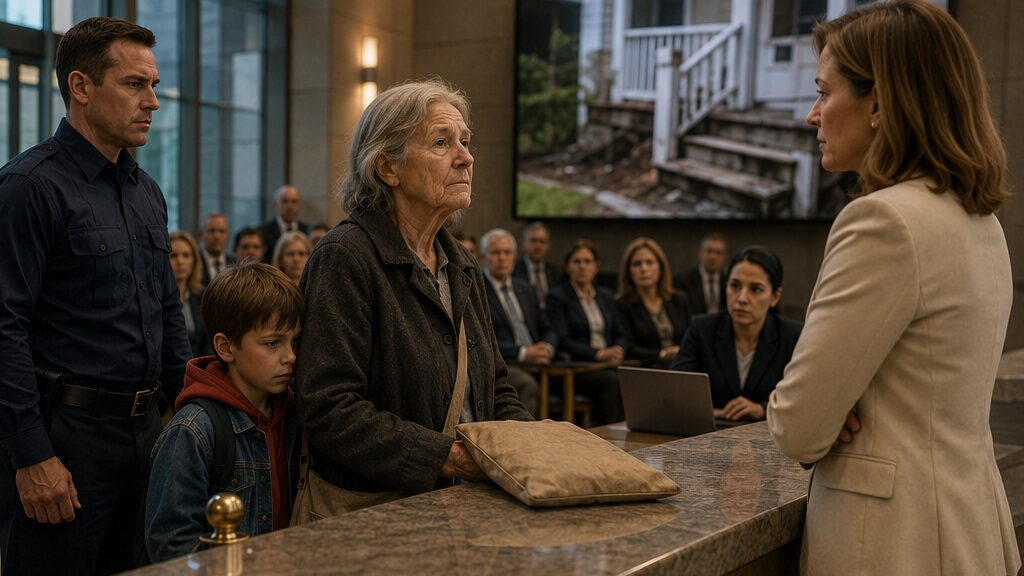
Richard Hall’s palm came up before Mary Carter had both feet inside the lobby.
It was not a gentle hand. It was flat, stiff, held at the height of her face as if she were a delivery that had arrived at the wrong entrance. Behind him, the glass doors of Riverbend Villas eased shut with their soft expensive whisper, sealing out the late-afternoon heat and trapping Mary and Justin beneath the cold chandelier light.
“Ma’am,” Richard said, “you’ll need to wait outside.”
Mary felt Justin’s fingers tighten around hers.
The boy had stopped half a step behind her, the hood of his red sweatshirt bunched beneath his denim jacket, his backpack slipping off one narrow shoulder. His eyes lifted first to Richard’s uniform, then to the gold stanchions, then to the rows of chairs where neighbors sat turned halfway around, pretending not to stare while doing nothing else.
Mary did not move back.
“I’m here for the hearing,” she said.
Richard’s expression did not change. He glanced toward the long polished counter at the front of the room. Beyond it, Brenda Lopez sat with a laptop open and a stack of printed agendas beside one elbow. At the far end, Ashley Clark stood in a cream blazer with her arms folded tight enough to make the sleeves crease.
Ashley saw Mary. Her mouth flattened.
“The hearing portion was closed when the board reached your item,” Richard said. “Mrs. Clark said no additional documents are being accepted.”
Mary’s right shoulder ached under the strap of her old beige bag. The bag had once been Michael’s fishing satchel before she cut away the torn lining and sewed in a pocket for envelopes. It hung against her hip now, soft and worn and out of place among the marble floor, glass walls, and the faint scent of furniture polish.
“My item concerns my porch,” Mary said. “I was told I could speak.”
A low sound passed through the seated neighbors. Not laughter exactly. More like the beginning of it, stopped for politeness.
Justin lowered his chin.
Mary felt that small motion in her hand more than she saw it. The child was learning, in real time, how grown people could turn a room into a punishment without raising their voices.
Ashley walked toward them.
Her heels clicked cleanly against the floor. She did not hurry. That was part of the message. People with authority never needed to hurry when everyone else was already waiting.
“Mary,” Ashley said, using her first name as if it were a correction. “We’ve been through this. The board cannot keep reopening the same violation because you bring another packet.”
Mary looked at her. She had known Ashley since Ashley moved into Riverbend Villas with a moving truck too large for the narrow street and a landscaper who replaced three healthy shrubs because they did not match the color plan. Back then Ashley had brought banana bread to every door. Now she spoke in the tone of someone defending the community from weeds.
“This is not another packet,” Mary said.
Linda White sat in the second row, one knee crossed over the other, phone resting face down against her skirt. She leaned toward the neighbor beside her and murmured something Mary could not hear. A smile moved at the corner of her mouth.
Mary kept her eyes forward.
Ashley shifted her attention to Justin. “Children are not permitted in hearings involving compliance disputes.”
“He is with me,” Mary said.
“That doesn’t make this appropriate.”
Justin’s fingers loosened, as if he thought letting go would make him less of a problem. Mary closed her hand around his again, not hard, only enough to tell him he was not to disappear for anyone.
Richard took one step sideways, blocking more of the walkway.
“Mrs. Carter,” he said, “please don’t make this difficult.”
The words landed in Mary’s chest with an old familiarity. Difficult. Stubborn. Confused. Unsafe. Words people reached for when they wanted an elderly woman to fold herself smaller.
She could feel the packet inside the bag. Its corners had softened from being carried too many times between kitchen table, mailbox, clinic, and board office. She had arranged the pages herself before leaving home: contractor estimate on top, clinic note beneath, photographs behind that, Michael’s yellowed sketch at the back where she would not have to see it unless she chose to.
Ashley’s voice cooled. “Your porch work was performed without final approval. The handrail is not a permitted finish. The replacement boards are visible from the common lane. The board has already ruled on the matter.”
Mary looked past her to the meeting room screen.
There, frozen in blue-white light, was a photo of her porch.
Someone had taken it from the sidewalk. It showed the half-installed rail, the fresh board, the unfinished edge where Paul had stopped working because the rain was coming and the old step had split wrong under his pry bar. From that angle, her home looked careless. Exposed. Like proof against her.
The neighbors saw a violation.
Mary saw the place Justin stepped over every Tuesday and Thursday, the place her left foot had slid in the dark, the place Michael had once knelt with a pencil tucked behind his ear and told her, “This board will need replacing before we do.”
Ashley followed her gaze. “As you can see, we have documentation.”
Something in Mary settled.
Not calmed. Not eased. Settled, the way dust settles after a door slams.
She let go of Justin’s hand just long enough to slide the beige bag forward. Her fingers found the packet by touch. The flap caught for a moment on the frayed seam, and the room seemed to lean toward the small struggle. Mary freed it without hurrying.
Richard’s hand was still raised.
Mary walked around it.
Only one step. Not enough to be dramatic. Enough to make him lower his palm because keeping it there would have looked like touching her.
She placed the old beige packet flat on the polished counter.
The sound was soft. Paper against stone. But in the clean room, it carried.
Brenda looked up from her laptop.
Ashley’s arms tightened again. “Mary, I just said—”
“The repair was not decorative,” Mary said.
Her voice was low. She did not raise it for the back row. They would listen if they wanted to.
Justin stood beside her, eyes on the packet now.
“And the delay,” Mary continued, “was not mine.”
For the first time since Mary entered, Ashley did not answer immediately.
Brenda’s fingers hovered above the keyboard. Richard shifted his weight. Linda sat straighter, her smile gone but not yet replaced by shame.
Ashley reached toward the packet, then stopped short of touching it. “The board already has photographs of the violation on your porch.”
Mary kept her hand resting on the packet.
“So do I,” she said.
Ashley turned toward the screen, toward the frozen image of the half-finished rail and exposed boards.
“The board has already photographed the violation,” Ashley repeated, louder now, as if volume could restore order. “And everyone here can see exactly what was done to your porch.”
Chapter 2: The Step Justin Was Told Not to Touch
Two days before the meeting, Justin stood at the bottom of Mary’s porch steps with one sneaker in the grass.
“Not that side,” Mary said.
He froze.
She hated how fast he obeyed now. Children were supposed to run up steps, not study them like a trap. But Justin had learned the porch the way Mary had learned it: right foot on the first step, hand on the doorframe, skip the left edge of the second board, do not lean on the post, do not carry anything heavy while stepping up.
“Use the middle,” she said, gentler. “Just like yesterday.”
Justin moved carefully. His backpack bounced against him. One shoe landed on the center of the board, and the step gave its small dry click.
Mary’s stomach tightened.
It had begun as a sound. A little complaint in the wood after rain. Michael would have heard it and fetched the tool bucket before breakfast. Mary had heard it and told herself she would call someone when it got worse, because calling someone meant explaining, and explaining always invited advice she did not want.
Then, three weeks ago, her heel slipped at dusk.
She had caught herself against the frame hard enough to bruise her shoulder. Not a fall, she told the clinic staff. Almost a fall, which was apparently enough for a printed recommendation and the sort of careful look people gave when they were already imagining your house without you in it.
Justin reached the top and looked back. “Like that?”
“Yes,” Mary said. “That’s right.”
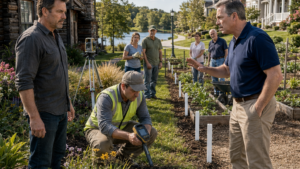
Paul Martin knelt beside the porch with a tape measure stretched across the damaged board. He was a compact man with sawdust on one sleeve and a pencil tucked over his ear, so like Michael in that one small habit that Mary had to look away the first time he did it.
“It’s not just the one board,” Paul said. He pressed his thumb near the edge. The wood flexed. “This one’s splitting underneath. The post is loose because it’s been carrying weight it shouldn’t. If I put in a short rail here and replace these two treads, you’ll be a lot steadier.”
Mary glanced down the lane.
Riverbend Villas was quiet in the late morning. Lawns trimmed. Mailboxes aligned. Window boxes approved in three colors only. Every house wore the same calm face from the street, as if nothing inside any of them ever broke.
“How short?” Mary asked.
Paul drew the measure back. “From the landing to the bottom step. Plain metal, dark finish. Nothing fancy.”
“Not shiny.”
“No.”
“Not wide.”
“No.”
“No ramp.”
Paul looked up at her. “I didn’t say ramp.”
“I know what people hear when you say safety.”
He studied her for a moment, then lowered his eyes to the board. “I can make it look like it’s always been there.”
Mary almost smiled. “Nothing around here is allowed to look like it has always been there unless a committee approved it first.”
Justin sat on the top step, keeping his feet away from the bad side. He had taken a folded snack bag from his backpack, but he was not eating. His eyes moved between Mary and the porch as if he understood more than she wanted him to.
Paul said, “You filed the form?”
Mary patted the beige packet lying on the small bench beside the door. “I gave them the first request last month. Hand-delivered it. Brenda stamped the copy.”
“Approval came?”
“No.”
“Denial?”
“No.”
Paul’s mouth tightened. “And you still want me to start?”
Mary heard the question under the question. Are you sure? Do you know what they can do? Do you have someone else to handle this?
She had handled Michael’s last hospital bill, the tree roots in the water line, the insurance letter that arrived with the wrong date, Justin’s school pickup when his mother’s shifts changed without warning. She had handled the quiet after Michael’s voice left the house. She could handle a board that took thirty days to ignore a stamped request.
“The clinic said I need a stable rail,” she said. “The paper is in there.”
Paul’s gaze went to the packet, then back to the step. “I’m not trying to get you fined.”
“I’m not trying to fall.”
That ended it.
He unfolded his work mat and set down a small drill, a box of screws, a level, and a length of dark rail wrapped in brown paper. No bright orange cones, no pile of boards in the yard. Mary had asked him to keep everything neat. He had agreed as if neatness mattered to him too, though she knew he was doing it for her.
Justin finally opened the snack bag. “Grandma, why can’t the people just say yes?”
Mary looked at the measuring tape stretched across the step. Its yellow line trembled slightly in the breeze.
“Because sometimes people want a thing to be tidy before they understand why it is there.”
He thought about that. “The step isn’t tidy.”
“No,” she said. “The step is honest.”
Paul gave a quiet snort and bent over his notes.
Mary went inside for the clinic paper. Her shoulder still pulled when she reached into the kitchen drawer, and she paused with one hand on the counter until the pain eased. The kitchen smelled faintly of lemon soap and old wood. On the refrigerator, Justin’s school calendar hung beside a photograph of Michael standing on the porch in a gray sweater, one hand resting on the post that was now loose.
In the picture, the post looked solid.
Mary took the clinic paper and slid it into the beige packet. She did not add the photograph. That belonged on the refrigerator. Not in a room full of people who would turn it into evidence.
When she returned outside, Paul had lifted the split board enough to show the dark weakness beneath. Justin stood close to the door.
“Stay back,” Mary said.
“I am.”
“Farther.”
He stepped back.
Paul looked up. “I can get the first board in before noon. Rail brackets after that.”
“Good.”
From the sidewalk, the faint click of a phone camera sounded.
Mary turned.
Linda White stood beside the curb with her sunglasses pushed into her hair and her phone raised chest-high. She did not pretend she had been checking messages.
“Morning, Mary,” Linda called. Her voice had that bright coating neighbors used when they wanted their rudeness to seem civic-minded. “Having work done?”
“Repair,” Mary said.
Linda’s eyes moved over the lifted board, the wrapped rail, Paul’s tools arranged on the mat. “Did the board approve exterior changes already?”
Mary did not answer quickly enough.
Linda’s thumb tapped the phone screen.
Paul lowered the split board back into place with a hollow knock.
“It’s a safety repair,” Mary said.
Linda smiled a small concerned smile. “Of course. I’m sure Ashley will want to know before it goes any further.”
Mary’s hand tightened on the packet.
Justin came to stand beside her, not touching her sleeve, but close enough that she felt him there.
Linda raised the phone again, framing the porch from the sidewalk where the broken edge and exposed board looked worse than they were.
The camera clicked a second time.
Chapter 3: The Notice Taped Over the Fresh Board
The violation notice was taped to the new board before the paint had fully dried.
Mary saw the white rectangle from the kitchen window just after eight the next morning. At first she thought Paul had left an invoice where the wind could take it. Then she saw the red border. The black block letters. The plastic sleeve pressed flat beneath two strips of blue painter’s tape, as if even the warning wanted not to touch the unauthorized wood too firmly.
She stood at the sink with one hand on the counter.
Outside, a maintenance inspector in a navy jacket was photographing her porch from three angles. Paul’s truck was parked along the curb, its back gate open. He had not unloaded the rail yet. The dark metal piece still lay wrapped in brown paper, halfway visible beneath a canvas tarp.
Mary dried her hands though they were not wet.
By the time she opened the front door, Paul had crossed the lawn from his truck.
“Mrs. Carter,” he said quietly, “don’t step on that side.”
“I know where to step.”
“I know you do. I’m saying they put the notice right where you’d reach for balance.”
The inspector looked up from his phone. “Please don’t remove that.”
Mary stood on the landing. The new board under her right foot was firm. The left side still gapped where Paul had planned to fit the second board and rail bracket. The porch looked worse paused than broken. A thing in the middle of becoming safe could look careless to anyone who did not need to use it.
“What is this?” Mary asked.
The inspector did not come closer. “Stop-work notice. Unauthorized exterior alteration. Pending board review.”
“This is already under review.”
“Then no work should have started.”
Paul wiped one hand on his jeans. “I opened the step because it was splitting underneath. Leaving it open is more dangerous than finishing it.”
“That’s not my call,” the inspector said.
Mary looked at the notice. The words blurred, then sharpened.
WORK MUST CEASE IMMEDIATELY.
She lowered herself one step, keeping a hand against the doorframe instead of the loose post. Paul shifted as if to help, then stopped when she glanced at him. He understood quickly. She gave him that.
“You can’t tape a warning to the repair and then say the danger is mine,” Mary said.
The inspector’s face tightened, not cruelly, but with the discomfort of a man who had expected a clipboard job and found himself in someone’s doorway.
“I’m documenting existing conditions,” he said.
“Existing because you stopped the work.”
“I didn’t stop anything. The association did.”
A sedan turned into the lane and parked behind Paul’s truck. Ashley Clark stepped out with a folder under one arm, hair smooth despite the damp air, expression already arranged for disappointment.
Mary felt, absurdly, that she should have changed out of her house sweater before opening the door. Then anger burned the thought away. It was her porch. Her sweater. Her morning.
Ashley came up the walk without stepping onto the grass. “Mary.”
“You sent someone to tape a notice to a board I need to stand on.”
“I sent an inspector to verify a reported violation.”
“Linda reported it.”
Ashley did not deny it. “Several residents expressed concern.”
Paul let out a short breath. “The concern should be the rotten step.”
Ashley turned to him. “And you are?”
“Paul Martin. Licensed contractor. Hired for repair work.”
“Then you should know better than to begin exterior modification without written approval.”
“It’s a two-board replacement and a short safety rail.”
“It is visible from the common lane.”
Mary almost laughed, but it came out as a dry sound. “So am I.”
Ashley looked back at her.
For a moment, neither woman spoke.
The morning was quiet around them. Sprinklers ticked across three lawns down. A delivery truck passed slowly, the driver glancing at the scene and then away. Somewhere a dog barked once behind a closed door.
Ashley opened her folder. “The handrail material does not match approved Riverbend exterior fixtures. The board has concerns about liability if nonstandard work is allowed. There are also questions about whether incomplete repairs create a hazard.”
Paul pointed to the porch. “Incomplete because I was ordered to stop.”
“You were ordered to stop because you began without approval.”
Mary stepped down one more stair.
The board gave no click under her. The fresh wood held. Her knees did not trust it yet.
“I brought the request to Brenda,” she said. “She stamped my copy.”
“Receipt is not approval.”
“I waited.”
“The guidelines clearly state homeowners must wait for final written approval.”
“I waited until I nearly went down on this step.”
Ashley’s face shifted. Not enough for apology. Enough to show she had heard something she had not wanted introduced on the sidewalk.
Paul looked at Mary. She had not told him about the near fall until yesterday. She had said enough for the repair, not enough for pity.
Ashley lowered her voice. “If there was a medical issue, you should have included appropriate documentation.”
“It was included.”
“In the original request?”
Mary hesitated.
The clinic paper had been printed after the first request. The first request had been Michael’s old sketch, Paul’s estimate, and her note asking for permission before replacing the boards. The clinic paper came after the slip. After the bruise. After she understood that waiting could be its own kind of danger.
“In the follow-up packet,” Mary said.
Ashley closed the folder. “Which the board had not accepted at the time work began.”
Paul said, “Ma’am, with respect, that doesn’t make the step safer.”
Ashley turned on him with the full force of procedure. “With respect, Mr. Martin, Riverbend Villas cannot allow contractors to decide which rules apply because a homeowner feels rushed.”
Mary felt the word rushed like a hand pressing between her shoulder blades.
She had not rushed when Michael’s shoes stayed by the door for six months because moving them felt like admitting he would not need them. She had not rushed when the porch first clicked. She had not rushed when the board said, in its printed way, that all requests would be reviewed in order received.
She had waited so long that a child had learned not to touch one side of her steps.
“I want the rail installed,” Mary said.
Ashley’s eyes returned to her. “If you continue work, fines will begin immediately.”
Paul stiffened. “I can at least cover the open side.”
“No further work,” Ashley said.
Mary bent carefully and peeled one corner of the notice from the fresh board.
The inspector stepped forward. “Mrs. Carter, please don’t remove—”
“I’m not removing it.”
She pressed the loosened corner back down so it would not flap loose in the damp. Then she looked at Ashley.
“It’s taped where my hand needs to go.”
Ashley’s jaw tightened. “The hearing is tomorrow at four. You may attend. You may bring your documents. But the rail stays unfinished unless the board decides otherwise.”
“And if it rains?”
“Then I suggest you use the garage entrance until the matter is resolved.”
Mary looked past her to the narrow side path leading to the garage. The concrete there sloped slightly, slick with moss where the sun never stayed long. Justin hated that way because the side door stuck and the light switch was too high for him in the dark.
“That entrance is worse.”
“It is an approved entrance.”
Mary looked at Paul. His mouth had gone flat, his hands closed around nothing.
Ashley stepped back from the porch. “I am trying to keep this from becoming more serious.”
“No,” Mary said softly. “You’re trying to keep it neat.”
Ashley paused on the walk, but did not answer.
When the sedan pulled away and the inspector followed, Paul remained by the curb with the rail still wrapped in his truck. The stop-work notice shivered against the fresh board in the first thin drops of rain.
Mary lifted it carefully from the tape, folded it once, and slid it into the beige packet beneath the clinic paper.
By noon, Ashley’s email arrived.
Hearing scheduled. Fines to begin immediately if unauthorized handrail remains on site or installation continues. Failure to comply may result in further enforcement.
Mary read it twice at the kitchen table while the rain darkened the porch boards outside.
Then she placed the printed email into the packet with the notice, the estimate, the stamped request, and the paper that said stable rail recommended.
At the bottom of the page, Ashley had added one final line.
Photographs of the violation will be displayed for the board.
Chapter 4: The Packet They Would Not Put on the Agenda
By evening, the beige packet had grown too thick for its string clasp.
Mary sat at the kitchen table with the porch light on behind her and rain ticking against the window over the sink. Every few minutes the wind pressed water across the glass, and the porch boards answered with small dark sounds. Not the dangerous click, not from inside the house, but close enough that she kept turning her head.
Justin sat across from her with his homework open and his pencil still. He had written his name at the top of the page and nothing else.
Mary slid Ashley’s email behind the stop-work notice. The paper edges caught on the old envelope seam.
“Do your fractions,” she said.
Justin looked down. “I am.”
“You are staring at the number three.”
“It’s a hard number.”
Mary almost smiled, but he was watching her too closely for jokes to hold. She tapped the table beside his page. “Start with the ones you know.”
He bent over the worksheet, drew one short line, then stopped again.
The kitchen was usually Mary’s safest room. It had the round clock Michael once fixed with a spoon handle when the second hand kept sticking. It had the little scar in the table from a dropped saucepan. It had the refrigerator with Justin’s school calendar and Michael’s photograph, where he stood on the porch in a gray sweater, one hand resting on the post that no one thought was unsafe then.
Tonight the room had changed into an office she had never wanted. Papers sorted into piles. Receipts smoothed flat. A clinic discharge instruction sheet with the words stable rail recommended underlined in blue. Paul’s estimate. Photographs Mary had taken herself that afternoon, careful close-ups showing the split beneath the board, the old nail heads rusted dark, the slight gap where a foot could slide.
She had taken none from the sidewalk.
From the sidewalk, the porch looked like a violation.
From the step, it looked like a warning.
Justin’s pencil rolled off the table. He did not reach for it.
“Grandma?”
“Yes?”
“Are they making you move?”
The rain filled the silence before she could answer.
Mary set down the paper in her hand. “No.”
He studied her face the way children did when they had already heard adults say no to soften a yes.
“Linda said if somebody can’t keep their house right, the board has to do something.”
Mary’s fingers tightened on the clinic note. “When did she say that?”
“When Mom dropped me off after school. Linda was by the mailboxes talking to another lady. She didn’t see me.”
Mary closed her eyes for one beat.
“People talk too much at mailboxes,” she said.
“She said your porch was getting unsafe.”
“She was right about that part.”
“And then she said maybe it was too much for you now.”
There it was. Not the fine. Not the rail. Not the notice taped where her hand needed to go.
Too much for you now.
Mary looked toward Michael’s photograph. His smile in that picture was small, almost unwilling, because he never liked being photographed. The porch behind him had still been painted the old brown that the HOA later called nonstandard and required everyone to change to approved slate gray. Michael had complained for three days and painted it anyway, but he kept one little patch of brown under the bottom step where no one could see.
For memory, he had said.
“I am not moving because Linda White thinks out loud,” Mary said.
Justin bent to pick up his pencil. When he came back up, his eyes were wet but stubbornly open. “But if they make you take off the rail and you fall?”
“I have not fallen.”
“You almost did.”
Mary had not told him that. Not in those words.
He looked down at the fraction worksheet. “I heard you on the phone with the clinic.”
The house seemed to get smaller around her. She had tried to do those calls while he was outside, while he was eating, while he was watching television. But children heard what adults hid. They collected the tone before the facts.
Mary reached across the table and turned his paper a little straighter. “I slipped. I caught myself.”
“That still counts.”
“It counts enough to fix the step.”
“And if they don’t let you?”
Mary opened the packet again because her hands needed work. “Then I will show them why they should.”
Justin’s mouth tightened in a way that belonged to his mother and Michael both. “They didn’t even let you talk yet.”
“They will.”
“How?”
Mary pulled the older papers from the back of the packet. She had avoided them all afternoon.
Michael’s porch sketch was folded into fourths, yellowed at the creases. He had drawn the front steps in pencil on the back of an old grocery list, the kind of practical diagram he made before every small repair. Two treads, one post, one note in his careful block print: replace before winter if left edge opens. Under that, in smaller writing: add rail when Mary starts using doorframe.
She had hated that line the first time she saw it.
Not because it was cruel. Because it was gentle and true and written before either of them was ready to need it.
Justin leaned forward. “Grandpa drew that?”
“Yes.”
“He knew?”
“Your grandfather noticed things before they became emergencies.”
Mary brushed one finger over the pencil line. Some of the graphite softened beneath her touch. She had kept the sketch because throwing away Michael’s useful papers felt worse than keeping them. There were notes for gutters, faucets, a loose hinge on the back gate. Small plans for a house he had meant to go on repairing.
At the bottom of the folded page, there was another note she had not remembered.
If committee asks, original porch profile unchanged. Safety rail only.
Mary let out a breath that felt as if it had been waiting years.
“What?” Justin asked.
“Nothing.”
But it was not nothing.
She turned to the folder of HOA papers she kept in the sideboard. Most of them were annual budgets, landscaping notices, paint charts, and reminders written in the language of civilized scolding. She had found the first repair request copy earlier: stamped RECEIVED by Brenda on the corner, dated five weeks ago. She had placed it near the top of the packet.
Now she searched deeper.
Justin watched without pretending not to.
“Grandma, what are you looking for?”
“A letter.”
“From them?”
“Maybe.”
She found it between an irrigation schedule and a reminder about holiday wreath dimensions. One sheet, folded once. Riverbend Villas letterhead. The kind of letter that looked important until it said almost nothing.
Mary unfolded it carefully.
Dear Mrs. Carter,
Your exterior repair request regarding front entry boards and proposed safety rail has been received and assigned for architectural review. You will be notified of the committee’s determination within thirty calendar days unless additional documentation is required.
Mary stared at the date.
Thirty calendar days had passed eight days before Paul lifted the first board.
She read the line again, not trusting herself. Then she checked the stamped copy. The dates matched.
The clinic paper had come later. The bruise had come later. The rail had become urgent later.
But the request had not been invisible.
Justin whispered, “Is that good?”
Mary sat very still. The rain kept falling. The porch light shone on the white notice taped outside, its red border just visible through the wet glass.
“It means,” she said slowly, “they knew before Linda took her picture.”
Justin looked from the letter to Mary’s face. “Will that make them stop?”
Mary folded the letter once along its old crease and slid it into the beige packet in front of the violation notice.
“No,” she said. “But it means I won’t have to ask them to remember.”
Chapter 5: The Photo Everyone Laughed At
The photograph on the meeting room screen made Mary’s porch look abandoned.
Ashley had chosen the worst angle.
The image filled the wall behind the board table: split board lifted, dark gap exposed, wrapped rail lying beside Paul’s tools, stop-work notice bright against the fresh lumber. From where Mary stood near the counter, the picture seemed larger than the porch itself, larger than the house, large enough to erase every careful step Justin had taken around the danger.
A murmur passed through the room.
Someone in the back row gave a short laugh, then covered it with a cough.
Justin’s face went red.
Mary kept one hand on the beige packet.
Ashley stood beside the screen with a remote in one hand. The cream blazer from earlier had not wrinkled. The photograph behind her was wrinkled with shadow and rain and bad timing.
“This,” Ashley said, “is why the board cannot allow homeowners to bypass review. One person begins work without approval, another sees it, then standards become suggestions.”
Mary glanced at Brenda. The secretary sat at the end of the board table with her laptop open and her eyes on the minutes. She had not looked at Mary since the packet landed on the counter.
Ashley clicked to the next photo.
Linda’s photo.
Mary knew it by the angle from the sidewalk. The railing material looked longer than it was. Paul’s tool mat appeared like a mess. The exposed board seemed to lean open as if neglected for months.
A woman in the second row whispered, “That’s right by the lane.”
Mary felt Justin shift closer.
Ashley’s voice stayed measured. “Mrs. Carter was informed that exterior changes require written approval. She proceeded anyway. The association must consider liability, architectural uniformity, and the effect on adjoining property values.”
The words were clean. That was what made them hurt.
Mary opened the packet.
The sound of the paper clasp unwinding was small, but Justin heard it. He looked at her hand.
Richard stood near the wall now, no longer between her and the counter. But his presence remained in the room like a door not fully open.
Ashley lowered the remote. “Mary, you may make a brief statement, but the board has already reviewed the photographs.”
Mary looked at the screen. “Those photographs were taken after the board’s delay made the repair urgent.”
Ashley’s chin lifted. “The board did not delay. You did not receive approval.”
Mary took out the stamped request. She did not hold it high. She placed it on the counter in front of Brenda, the way she had placed the packet earlier.
“Received five weeks ago.”
Brenda’s eyes moved to the paper despite herself.
Ashley said, “Receipt is not approval.”
“No,” Mary said. “But your letter says review within thirty calendar days unless more documents are required.”
She placed the letter beside the stamped copy.
Brenda stopped typing.
Ashley’s face remained composed, but something changed around her eyes.
“Architectural review timeframes depend on completeness,” Ashley said.
“Then who asked me for more documents?”
Silence opened, thin but noticeable.
Mary could feel the room shifting. Not to her side. She did not trust rooms to do that. But attention had sharpened. The neighbors who had laughed at the porch photo now wanted to know whether they had laughed too soon.
Ashley turned slightly toward Brenda. “Were additional documents requested?”
Brenda looked at her laptop. “I would need to check the correspondence log.”
Mary said, “I checked mine.”
That was sharper than she had planned. Justin looked up quickly, and Mary softened her hand on the packet.
Ashley set the remote down on the board table. “Regardless, the work began before final written approval. That is the issue before us.”
“The issue before me,” Mary said, “was whether I could use my front door.”
A rustle moved through the chairs.
Ashley’s mouth tightened. “No one has prevented you from using your home.”
Mary reached into the packet again and took out the clinic paper. She had not wanted this room to see it. She had folded it so the letterhead showed but not every instruction, because there were parts of being old that belonged to the body and not the board.
She placed it on the counter.
“Stable rail recommended,” she said.
Ashley looked at the paper but did not reach for it. “Medical documentation should have been submitted with the request.”
“It was submitted with the follow-up packet.”
“After work began.”
“After I slipped.”
The words left Mary before she could trim them.
Justin’s hand found the edge of her sleeve.
The room changed again. Not kindly, not entirely. But discomfort moved where amusement had been. Linda White uncrossed her legs.
Ashley looked down at the remote, then back at Mary. “I’m sorry you had an incident. But the association cannot be expected to authorize unapproved construction because a homeowner decides conditions are urgent.”
Paul was not in the room. Mary wished, briefly and foolishly, that he were. Not to rescue her. Only to say what wood sounded like when it split. To make the room hear the porch as something more than a photo.
Mary slid the clinic paper back beneath her fingers. “I decided the conditions were urgent because my foot went out from under me.”
Ashley lowered her voice. “Mary, you had options. You could use the garage.”
“The garage path slopes. It grows moss near the side wall. The light does not reach the lock.”
“That can be addressed separately.”
“No,” Mary said. “It cannot.”
The firmness surprised even her.
The board members looked up. Brenda did too.
Mary had spent weeks trying to make her request small. Two boards. Short rail. Dark finish. No fuss. She had believed that smallness would protect her from becoming a case. But smallness had only made it easy for others to call the danger decorative.
Justin’s fingers were still on her sleeve.
Mary gently moved his hand into hers.
“My grandson comes through that door after school,” she said. “He knows not to touch the left side of the step. He knows not to lean on the post. He knows to wait for me if his backpack is heavy because I do not want him pulling on me when I step up.”
Justin stared at the floor.
Mary wished she had not said so much. But the words had opened a door, and behind it stood the truth they had all walked around.
“That is not a landscaping preference,” she said. “That is how we enter my house.”
No one laughed.
Ashley’s expression had lost some of its polish. Not all. Enough.
Brenda cleared her throat. “The correspondence log shows the initial request received on the date Mrs. Carter stated. I don’t see a request for additional documentation in the outgoing record.”
Ashley turned toward her. “We can review that after the meeting.”
“It is in the meeting,” Mary said.
Her voice was still low, but it no longer asked permission.
Ashley looked back at her.
For the first time, Mary saw irritation not as authority but as strain. Ashley had come prepared to manage a violation. She had not come prepared to have the clock read back to her.
“The board can consider procedural timing,” Ashley said. “However, the current installation remains noncompliant.”
Mary touched the photo of Michael’s sketch inside the packet but did not take it out.
Not yet.
Ashley continued, “In light of your stated concerns, I am willing to propose a temporary solution. The handrail material and brackets will be removed immediately. The exposed boards may be covered with a temporary mat or approved safety strip while the architectural committee conducts a thirty-day review.”
Mary stared at her.
Justin’s hand went slack.
“A mat,” Mary said.
“Temporary,” Ashley replied. “Safe, reversible, and compliant.”
“A mat over a split step.”
“Over the repaired portion pending review.”
Paul’s fresh board outside. The unfinished edge. The notice. The rain. Justin’s shoe landing in the middle because she had trained him to avoid the side that could fail.
Mary folded the stamped request and set it back into the packet.
Ashley picked up a printed form from the board table. “If you sign acknowledgment tonight, fines can be paused during the review period, provided the handrail is removed by tomorrow afternoon.”
She held the form toward Mary.
Mary did not take it.
Across the room, Linda looked down at her phone, then away.
Ashley’s voice softened into something almost kind. “This protects everyone.”
Mary looked at the form. Then at the photograph of her porch, still frozen huge behind Ashley.
“No,” she said. “It protects the picture.”
Chapter 6: The Safe Compromise That Wasn’t Safe
Paul Martin read the agreement in Mary’s driveway with rain spotting the paper.
He stood under the raised back door of his truck, shoulders hunched against the weather, the wrapped handrail still inside where he had left it. Mary held an umbrella between them, though the wind kept pushing water sideways onto both their sleeves.
Justin watched from just inside the front door.
Mary could feel him there even without turning. He stood behind the glass storm door, one hand on the knob, not coming out, not going in. The porch had become a place he waited at now, not a place he crossed.
Paul finished the page and looked up. “They want me to remove the brackets?”
“They want the rail material and brackets removed by tomorrow afternoon.”
“I didn’t install the rail.”
“No.”
“So they want me to remove parts I haven’t put in yet.”
Mary’s mouth moved, but no answer came.
Paul looked down again. “Temporary mat or approved safety strip pending review. That’s not repair. That’s covering a problem.”
“They said it was safe.”
“Who said it?”
“Ashley.”
“Did she stand on the step?”
Mary glanced toward the porch.
Rain darkened the fresh board to the color of old bone. The left edge still opened where the second tread waited. The stop-work notice was gone from the board, but Mary could see the pale rectangle where tape had kept the rain off. The porch looked marked now, even without the paper.
“No,” she said.
Paul folded the agreement along its original crease. “I won’t sign off on a mat.”
“They did not ask you.”
“That’s convenient.”
Mary looked at him.
He rubbed one hand over his jaw. “Sorry.”
“Don’t be. It is convenient.”
A car slowed near the curb. The driver glanced at Paul’s truck, at Mary’s porch, at Mary under the umbrella, then continued. Riverbend Villas had always been good at slow cars during other people’s trouble.
Paul handed the agreement back. “Mrs. Carter, I can put down a temporary cover that keeps water out of the open edge. I can secure it without touching the rail. But if they’re telling me no work, even that gives them something to use.”
Mary slipped the agreement into the beige packet. The packet was inside a plastic grocery bag now, because the old paper had endured enough.
“What would you do if it were your house?” she asked.
Paul did not answer immediately.
That was why she had asked him. Men who answered too quickly usually wanted to be admired for the answer.
“I’d finish the safety work,” he said at last. “Then I’d argue about finish and color after nobody was going to get hurt.”
“And if they fined you?”
“I’m not on a fixed income.”
Mary gave him a look.
He looked away first. “Fair.”
Justin opened the storm door. “Grandma?”
Mary turned. “Stay inside.”
“I’m not coming out.”
His face was pale in the gray light. The red hood of his sweatshirt was pulled up though he was inside the house.
“What is it?”
He looked at Paul, then at Mary. “Do I have to go around through the garage today?”
“No.”
“But the step—”
“I said no.”
The sharpness of her own voice struck her. Justin blinked.
Mary closed her eyes briefly. “I’m sorry. No, you do not have to use the garage.”
He did not move from the doorway.
Paul watched the exchange with his eyes lowered, giving them the privacy of pretending to study his truck bed.
Justin said, “I can wait until Mom comes.”
“You are already here.”
“I mean after school. I can wait at the office until she gets off. Or I can stay with somebody else.”
The rain tapped the umbrella in quick nervous beats.
Mary heard what he was offering. Not convenience. Absence. A child trying to remove his weight from an adult’s problem.
“You are not staying somewhere else because of a porch board.”
“But if I come up too fast—”
“You won’t.”
“If I forget—”
“You won’t.”
“If you try to help me and you—”
He stopped.
Mary wanted to go to him, but the path from driveway to porch had become a calculation. Wet concrete, grass edge, first step, fresh board, bad side. She hated that her body made her think before comfort.
Justin saw the pause.
That was worse than falling.
He stepped back from the door. “I’m going to finish homework.”
The door closed carefully behind him.
Mary stood in the driveway with the umbrella trembling in her hand.
Paul said nothing.
“He used to run up those steps,” Mary said.
“I know.”
“No, you don’t.”
He accepted that with a nod.
She looked at the porch again. Michael’s porch. Her porch. The board’s photo. Justin’s obstacle. Ashley’s violation. All the same wood, depending on who looked from where.
Paul reached into his truck and pulled out a folded piece of clear plastic sheeting. “I can leave this with you. Not installed. Just leave it. You can decide whether to cover the open side if the rain gets hard.”
Mary almost laughed. “A gift of suspicious plastic.”
“Something like that.”
“Will they call it clutter?”
“Probably.”
He placed it on the top of a toolbox, not in her hands. Letting it be her choice.
The rain thickened.
Mary stepped toward the porch, and Paul moved closer without touching her. She could feel him restraining the instinct to offer an arm. She appreciated the restraint more than she would have appreciated the arm.
At the first step, she put her right foot in the center, as always. The fresh board held. She lifted her left foot to the landing.
The unfinished edge shifted.
Not far. Not enough to break. Just a short, ugly give beneath her weight.
Mary caught the doorframe with her free hand.
The umbrella dropped.
Paul was beside her in one stride but stopped before grabbing her. “Mrs. Carter.”
“I’m all right.”
Her voice sounded calm enough to belong to someone else.
Inside, Justin appeared at the storm door again, eyes wide.
Mary straightened slowly. Her shoulder burned where the old bruise had never finished healing. Rain ran down the back of her neck.
The step had not failed.
That was the kind of mercy people used against you. It did not fail, so the danger would remain theoretical to anyone who had not felt it move.
Justin opened the door. “Grandma?”
Mary picked up the umbrella before Paul could.
“I’m all right,” she said again.
Justin did not believe her.
Paul looked at the step, then at the wrapped rail in his truck. “I don’t like this.”
Mary climbed onto the landing. This time she did not tell Justin to stand back. He reached for her sleeve, stopped himself, and held the door open instead.
In the kitchen, she took the agreement from the plastic bag and laid it on the table. The paper had stayed dry. Of course it had. Paper rules stayed dry while people slipped in the rain.
She read the line about removal again.
Then she took out the stop-work notice, the stamped request, the letter promising thirty days, the clinic paper, and Michael’s sketch. She placed them around the agreement until the table looked less like a mess and more like a map.
Justin stood beside her, quiet.
Mary touched Michael’s note: add rail when Mary starts using doorframe.
She had used the doorframe again today.
“What are you going to do?” Justin asked.
Mary looked toward the porch, where rain blurred the glass and turned the outside world silver.
“For a long time,” she said, “I thought doing what they asked would prove I could stay.”
Justin waited.
Mary folded Ashley’s agreement once, then slid it into the beige packet behind the violation notice.
“Now I think doing what they ask might be how they make me leave.”
Chapter 7: The Rule They Used Against Her
Richard Hall did not raise his hand the second time Mary walked into the lobby.
He stood beside the same gold stanchions, in the same navy uniform, under the same cold chandelier light. His eyes moved to the beige packet tucked beneath Mary’s arm, then to Justin standing at her side. For one small second his hand twitched, as if the old order still lived in his body.
Then he stepped back.
Mary did not thank him.
Justin noticed. Mary could tell by the way his shoulders loosened beneath his denim jacket. He did not smile. Neither did she. Some doors opened too late to deserve gratitude.
The emergency board session had been called for six o’clock. Not because Ashley wanted it, Mary knew, but because Paul had sent a brief written statement saying he would not certify the proposed mat as safe, and because Brenda had quietly confirmed that the architectural review clock had expired before the stop-work notice was issued.
The meeting room was smaller tonight. Fewer neighbors. No full rows, no bright chatter. The screen was blank, which Mary appreciated more than she wanted to. Her porch did not hang over the room like a public accusation this time.
Ashley Clark sat at the center of the board table with a folder open before her. Brenda sat at the end, hands folded near her laptop. Linda White was in the second row, wearing a gray cardigan and no sunglasses. She looked at Mary, then at Justin, then down at her lap.
Mary guided Justin to a chair near the aisle.
“You can sit here,” she said.
“Are you sure?”
“Yes.”
He sat, but only on the edge.
Mary walked to the counter alone.
Ashley looked tired. Not softened, exactly. Tired in the way of people who have spent a day discovering that a rule they trusted had corners sharp enough to cut someone.
“Mrs. Carter,” Ashley said formally, “this emergency session concerns the unauthorized front-entry repair and the proposed temporary compliance agreement.”
Mary placed the beige packet on the counter.
“I’m not signing the removal agreement.”
Ashley’s lips pressed together. “You have not heard the board’s revised position.”
“I read the first position. I stood on my porch after it. That was enough.”
A board member shifted in his chair. Brenda’s fingers moved to the keyboard.
Ashley inhaled slowly. “The board is attempting to reduce fines while maintaining architectural control. No one is asking you to be unsafe.”
Mary opened the packet.
The first page she took out was Ashley’s agreement. She laid it flat. The second was the stop-work notice. Beside it, she placed the clinic recommendation. Then the stamped request. Then the letter promising review within thirty calendar days. Last came Michael’s old sketch, folded once and worn soft at the creases.
She did not open the sketch yet.
“This is my record,” she said. “I want it entered into the minutes.”
Brenda looked at Ashley.
Ashley looked at the papers.
Mary waited.
There were many kinds of silence. The first meeting had held the silence of people expecting an old woman to embarrass herself. This one held the silence of people measuring whether they could still pretend not to understand.
Ashley said, “Brenda, mark that Mrs. Carter has presented documents for review.”
Mary kept her hand on the packet. “Not just review. The record.”
Brenda’s eyes flicked up. Something like respect moved through her face and disappeared into professionalism. “Entered into the record,” she said, typing.
Mary opened Michael’s sketch.
The pencil lines looked thinner under the meeting room lights. The old grocery list printed faintly through the back. She did not show the room the grocery words. She turned the drawing toward Ashley, one finger resting beside Michael’s note.
replace before winter if left edge opens
add rail when Mary starts using doorframe
Ashley looked at it for a long moment.
“My husband drew this before he died,” Mary said. “He saw the step weakening before I admitted it. He also knew I would wait too long before asking anyone for help.”
Justin’s head lifted from the chair.
Mary did not look back at him. If she did, she might fold the sketch and stop. She had kept Michael out of too many rooms to make him useful now, but this was not using him. This was admitting the house had a history older than the violation notice.
“I submitted the repair request before work began,” Mary said. “I waited past the date your letter gave me. I sent follow-up medical documentation after I slipped. Then Linda’s photograph became more important than my stamped copy.”
Linda’s face flushed, but she did not speak.
Ashley straightened. “The concern was not Linda’s photograph alone. The concern was unapproved work that affected exterior appearance and potential liability.”
Mary nodded once. “Then let us talk about liability.”
Ashley’s expression sharpened.
Mary slid the clinic paper forward. “If I remove the rail and leave the step covered by a mat, and I fall, whose rule protected me?”
No one answered.
“Whose rule protects Justin when he comes through that door after school and tries not to touch the side I told him not to touch?”
Justin’s sneaker scraped lightly against the floor behind her.
Ashley looked toward him, then back to Mary. “The board never intended for a child to be put at risk.”
“The board did not ask where he walked.”
That landed more quietly than anger would have.
Brenda cleared her throat. “There is another matter.”
Ashley turned. “Brenda.”
Brenda’s gaze stayed on the laptop. “The governing documents include an emergency maintenance provision. It allows temporary safety-related repairs when delayed approval creates immediate access or structural risk, provided the homeowner submits documentation and agrees to final review of finish, color, and permanent materials.”
Ashley’s face went still.
Mary had seen the provision only that afternoon, after Brenda sent a scan with no message except a subject line: You should see section 8.4. Mary had printed it, read it twice, and then sat at the kitchen table with her hands over the page until Justin asked if she was angry.
She had not been angry then.
She had been awake.
Ashley said carefully, “That provision is typically applied to storm damage and utility access.”
“Typically,” Brenda said.
The board member beside Ashley leaned toward the documents. “But not exclusively?”
Brenda did not look at Ashley. “The language says immediate access or structural risk.”
Mary took the printed bylaw page from the packet and set it beside the clinic note.
“I am not asking to avoid review,” she said. “I am asking not to be made unsafe while you conduct it.”
Ashley tapped one finger against her folder. It was the first nervous gesture Mary had seen from her.
“The material still does not match approved fixtures.”
“Then review the finish.”
“The bracket style may not pass.”
“Then tell Paul which bracket will.”
“The board cannot create exceptions every time a homeowner begins work early.”
Mary leaned lightly on the counter. Her left shoulder ached from the slip in the rain. She could still feel the step shifting beneath her foot, that small treacherous give that left no mark for a photograph.
“I did not begin early,” she said. “I began after waiting too long.”
The room held that.
Ashley looked at the papers again. Her eyes paused on Michael’s sketch, then moved away as if private grief were too hot to touch.
For a moment Mary almost felt sorry for her. Ashley had built a life around order. Order made a room feel safe. Order made houses look cared for, streets look valuable, meetings look fair. But order, Mary had learned, could become a wall if nobody asked who had been left outside it.
Ashley closed her folder.
“I will recommend,” she said slowly, “that fines be suspended pending emergency review. The existing board replacement may remain temporarily. The handrail may be installed only if the material is submitted for final architectural finish approval.”
Mary said nothing.
Ashley’s tone tightened. “That is a significant compromise.”
“No,” Mary said. “It is a start.”
A board member glanced at Ashley.
Mary gathered the papers with deliberate care, but left the bylaw page and clinic note visible. “I will not remove a safety repair so the file looks cleaner. I will not put a mat over a step that already moved under my foot. I will not teach my grandson to wait in the driveway because adults are still deciding what safe should look like.”
Justin was very still.
Ashley’s face had color in it now. “What exactly are you asking the board to approve tonight?”
Mary had expected the question. Still, when it came, her throat tightened.
She had spent so long making the request small that naming it fully felt like stepping into wind.
“A temporary dark metal rail from the landing to the bottom step,” she said. “Two replacement boards secured by Paul Martin. Final finish and bracket style reviewed within ten days, not thirty. No fines while the emergency provision is in effect. And the violation notice removed from my account if the finished repair meets the safety condition.”
Ashley looked at Brenda.
Brenda typed without being asked.
“The board will need to vote,” Ashley said.
“Then vote.”
It was not loud. It did not need to be.
The vote took less time than the first meeting had spent displaying Mary’s porch. There were conditions. There were phrases Mary disliked: temporary authorization, subject to final compliance, no precedent beyond documented emergency need. Ashley made sure each one was read aloud.
Mary listened to all of it.
When Brenda finally said the motion carried, Mary did not feel triumph. She felt the heavy loosening of something that had been clenched too long.
Ashley looked at her across the table. “The fine will remain paused, not withdrawn, until final inspection.”
Mary returned Michael’s sketch to the packet. “Then I will see you at final inspection.”
Ashley gathered her folder, then hesitated. “Mrs. Carter.”
Mary looked up.
Ashley seemed to search for the version of herself that knew how to speak without a rule in her hand. She did not find it.
“I wish you had made the emergency nature clearer sooner,” she said.
Mary slid the packet clasp through its loop.
“I wish you had asked before you photographed my house.”
Ashley’s eyes dropped first.
Behind Mary, Justin stood.
This time, when Mary turned from the counter, he did not reach for her sleeve. He walked beside her through the lobby, past Richard, past Linda, past the polished glass reflecting them both as small figures moving toward the door.
At the entrance, Richard held it open.
Mary stepped through without pausing.
Chapter 8: The Handrail That Stayed
One week later, the handrail was cool beneath Justin’s palm.
He did not grab it because he was afraid. He touched it the way a child touches fresh paint he has been warned not to smudge, curious and careful and a little proud. The rail ran from the porch landing to the bottom step, dark and plain, with brackets Paul had chosen after three emails from the architectural committee and one phone call in which Mary said she would not discuss decorative scrollwork ever again.
The new boards no longer clicked.
Mary stood at the top of the porch in her house sweater, watching Justin test the route. First step. Rail. Second step. Landing. Door. Then down again, faster.
“Don’t make a game of it,” she said.
He slowed at once. Then he looked up and saw her mouth trying not to smile.
“It works,” he said.
“Yes.”
“It doesn’t look bad.”
“No.”
“It kind of looks like it was supposed to be there.”
Mary rested her hand on the rail. “That is what I asked for.”
Paul knelt near the bottom bracket, checking the last screw by hand though he had already checked it twice. “It’ll need final inspection, but it’s solid.”
Mary glanced at him. “You said that yesterday.”
“It was solid yesterday too.”
“Then why are you still turning screws?”
He stood, wiping his hands on a cloth. “Because you’re watching.”
Justin laughed softly.
The sound moved through Mary’s chest before she could prepare for it. He had not laughed on the porch in days. Not fully. The house seemed to hear it too, settling around them with a quietness that was not empty.
Across the lane, Linda White paused by the mailboxes.
Mary saw her before Justin did. Linda held a small stack of envelopes and wore the careful expression of someone deciding whether to cross a street that suddenly seemed wider than it used to.
Paul gathered his tools. “I’ll load up.”
Mary nodded.
Linda approached only after Paul stepped toward his truck.
“The rail looks good,” she said.
Mary kept her hand on it. “It is safe.”
Linda’s face tightened, accepting the correction. “Safe. Yes.”
Justin moved closer to Mary, but not behind her.
Linda looked at him. “I’m sorry if things felt uncomfortable at the meeting.”
Justin said nothing.
Mary did not rescue Linda from the silence.
Linda shifted the mail against her chest. “I told a few people the board had approved emergency work. Some had the wrong idea.”
Mary looked toward the row of houses, their windows bright and blank in the afternoon sun. “Where did they get it?”
Linda swallowed. “Some of it from me.”
That was more than Mary expected. Less than she could have asked for. Enough for the moment.
“I didn’t know about the step,” Linda said.
“You photographed it.”
“I photographed what I saw from the sidewalk.”
Mary looked down at the rail. “That was the problem.”
Linda’s eyes flicked to Justin, then away. “Yes.”
No apology came wrapped in tears. No neighbor appeared to witness it. Linda did not become someone else on the spot. She only stood there, uncomfortable and smaller than she had seemed in the meeting room.
Mary found she preferred that to a performance.
“Good afternoon, Linda,” she said.
Linda nodded, accepting the dismissal, and walked back toward the mailboxes.
Paul closed his truck gate. “Final inspection tomorrow?”
“Tomorrow.”
“You want me here?”
Mary almost said yes. It rose quickly, practical and tempting. Then she looked at the rail, at Justin standing upright beside it, at the front door opening behind her into the house she had crossed in and out of for decades.
“If you have time,” she said. “But I will be here.”
Paul smiled. “That sounds like you.”
The next afternoon, Ashley came with Brenda and the maintenance inspector.
No security officer. No meeting screen. No rows of chairs.
Ashley wore a navy jacket instead of the cream blazer. She carried a folder, but she did not open it right away. Brenda stood beside her with a tablet. The inspector walked the porch, pressed the boards, tested the rail with both hands, and nodded once.
“Solid,” he said.
Mary looked at Paul, who had come after all and stood near his truck pretending not to care.
Ashley reviewed the finish, the bracket placement, the width from the walkway, the way the rail followed the porch profile without blocking the common lane view. She asked two questions. Paul answered both without ornament. Brenda entered notes.
Finally Ashley closed the folder.
“The repair meets temporary emergency compliance and may remain,” she said. “Final approval will be recorded after the board ratifies the inspection notes tonight. The fine will be withdrawn.”
Mary waited.
Ashley added, “And the board will review emergency safety repair procedures at the next regular meeting.”
Brenda looked up from the tablet, just briefly.
Mary heard what Ashley did not say. You were right. We were late. The notice should not have gone on the board where your hand needed to be.
Maybe one day Ashley would learn to say such things. Maybe not.
Mary said, “Put the review in the minutes.”
Ashley nodded. “Brenda has it.”
The beige packet was not under Mary’s arm that day. It sat inside the house on the kitchen table, empty of its duty. The papers were still there, but they had stopped feeling like armor. Michael’s sketch lay on top. Before the inspection, Mary had unfolded it and looked one last time at his note: add rail when Mary starts using doorframe.
Then she had placed a new note beside it in her own handwriting.
Rail added. Door still mine.
After Ashley and Brenda left, Justin arrived from school with his backpack crooked and his red hood hanging loose. He stopped at the bottom of the steps, looking from the rail to Mary.
“Can I?”
Mary stepped aside.
He put his hand on the rail and came up without waiting for instructions. Not rushing. Not performing. Just coming home.
At the landing, he looked at Mary’s sleeve. For weeks his hand had gone there first, small fingers catching cloth because the house had taught him fear. This time his hand stayed on the rail.
Mary opened the front door.
Justin passed through, then looked back. “You coming?”
Mary rested her palm on the dark metal. It was plain. Approved. Strong. Nothing about it announced what it had cost her to keep it there.
“Yes,” she said.
She stepped inside under her own balance, and the door closed behind them without a sound.
The story h