The HOA Sent an Excavator for His Ramp Before Reading the Address Twice
Chapter 1: The Bucket Was Already at the Door
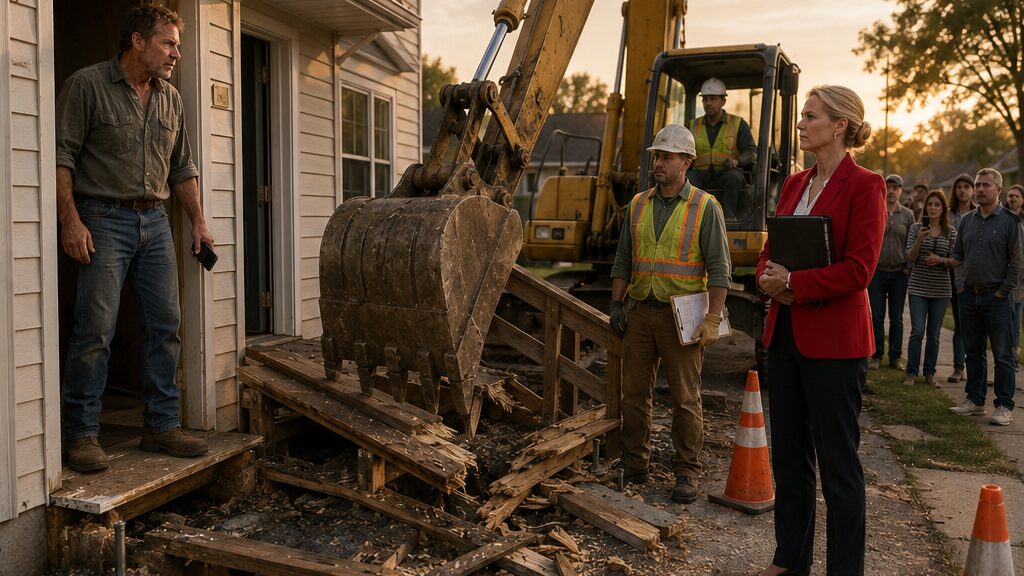
The excavator bucket came down on the ramp landing just as William Brown opened the side door.
The first sound was not a crash. It was a deep wooden crack, low and final, like a tree splitting inside a storm. One of the ramp boards jumped free, flipped once, and struck the orange cone beside the hydrangeas. Sawdust burst into the evening light.
William stood with one hand still on the doorframe.
For half a second, he thought he had opened the wrong door into someone else’s emergency.
Then the bucket lifted again.
“Stop!” he shouted.
The machine did not stop. Its engine growled in the side yard, heavy and careless, the metal arm swinging back over the ramp he had built for Linda only three weeks earlier. The temporary handrail leaned at an angle now, one post torn out of the ground, the screw holes ragged and bright where the wood had split.
William stepped down from the side threshold onto the narrow patch of exposed dirt beside the broken landing. His shoe slipped in sawdust.
“Stop the machine!”
The operator looked down from the cab but did not move his hands from the controls. A crew supervisor in a hard hat turned from the driveway, glanced toward the street, then toward a woman standing near a white SUV with an amber roof light.
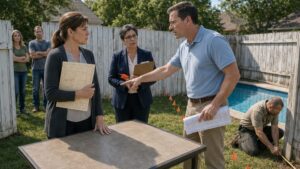
Debra Wright was easy to spot even before William recognized her. Bright red blazer, pressed black pants, a folder tucked under one arm, hair pinned back in a way that made every movement look official. Two neighbors stood behind her near the curb. One had a phone raised already.
Debra lifted a hand toward the operator.
The bucket paused in the air.
William crossed the torn ramp boards, his pulse hitting hard in his throat. “What are you doing on my property?”
Debra walked toward him without hurrying. That made it worse. Her shoes avoided the splinters as if she had expected them.
“Mr. Brown,” she said, “you were notified that this structure was in violation.”
“No, I wasn’t.”
“You were served notice.”
“When?”
Debra opened the folder. “The association issued an enforcement action for removal of a noncompliant exterior structure.”
“This is a ramp.”
“It is an unapproved alteration to the exterior appearance of the property.”
“My wife uses this door.”
“That does not exempt you from the approval process.”
William stared at her for a moment, because he could not make the words arrange themselves into anything human. Behind him, the side door stood open into the mudroom. The walker Linda used inside leaned against the wall, just beyond sight from the yard. He turned his body slightly, blocking the doorway.
“You are not touching another board,” he said.
The crew supervisor shifted his clipboard under one arm. “Sir, we’re just here to remove what we were contracted to remove.”
“By who?”
The supervisor looked at Debra.
Debra pulled a paper from the folder and held it so William could see the association letterhead at the top but not much else. “By the Lakeview Crossing Homeowners Association, pursuant to section seven point four of the architectural enforcement rules.”
William took one step closer. “Hand me the order.”
“I can provide you a copy after the removal is complete.”
“No. You can provide it now.”
The excavator idled behind them, engine shaking the ground through William’s soles. The bucket hung over the ramp like a held fist.
Debra’s jaw tightened. “Mr. Brown, interfering with authorized enforcement may result in additional penalties.”
“Then add my name twice.” William reached into his pocket and pulled out his phone. His hand shook enough that he had to grip it with both hands to open the camera. He tapped record and raised it toward Debra, then toward the machine. “Say it again. Say you’re removing a medical access ramp without handing me the order.”
A neighbor near the curb whispered something. Another car slowed in the street.
Debra looked toward the phones, then back at William. “No one has approved this as a medical access ramp. What we have is an unapproved wooden structure built without association clearance, without material review, and without inspection.”
“I submitted the request four weeks ago.”
“Received is not approved.”
“And nobody answered.”
“That is not permission to build.”
“It is when the other option is my wife falling at her own door.”
Debra’s eyes flicked toward the open side entrance. For the first time, her expression shifted—not into concern, but calculation.
“Mr. Brown,” she said, lower now, “if your household has special circumstances, they must be submitted through the proper channel.”
“They were.”
“Then the board will review them in order.”
“You brought an excavator.”
The words landed harder than he expected. Even the crew supervisor looked away.
Debra slid the paper back into the folder. “We had an unsafe condition on this property.”
William looked at the ramp. The landing was rough, temporary, built with pressure-treated boards and galvanized brackets, not pretty, not finished. But Andrew Taylor had built it solid enough for a wheelchair, wide enough for Linda’s bad days, shallow enough that William did not have to lift her down the side step anymore.
“It was unsafe after your machine hit it,” he said.
Debra turned to the supervisor. “Continue the removal.”
William moved before she finished.
He stepped directly in front of the bucket.
The operator killed the forward motion but not the engine. A sharp mechanical hiss cut through the yard. William felt heat coming off the machine. Dust stuck to his forearms.
The supervisor raised both hands. “Sir, don’t stand there.”
“Then shut it down.”
“We have authorization.”
“I want the exact address on that authorization.”
Debra’s face tightened again. “You know your address.”
“I know mine. I want to know the one on your paper.”
She hesitated.
It was small. A blink too long. A thumb pressed against the folder’s edge.
William saw it because he had spent years fixing little things before they became big things: hairline cracks in drywall, a leaking dishwasher line, a porch step that shifted a quarter inch under Linda’s foot. People missed damage because they looked where they expected damage to be. William had learned to look where someone did not want him looking.
“Open the folder,” he said.
Debra did not.
The supervisor gave her an uneasy glance. “Ma’am?”
“It is the correct enforcement packet,” she said. “Proceed.”
William kept the phone raised. “Read the address.”
“I am not conducting a hearing in your side yard.”
“You are conducting a demolition in my side yard.”
A siren chirped once at the end of the block.
William turned his head. A police cruiser rolled up behind the white SUV. It stopped at an angle, lights flashing but silent, blue and red flashing across the broken ramp boards, across Debra’s blazer, across the bucket suspended over the place where Linda had learned to trust the slope.
A police officer stepped out and approached with one hand lifted, calm but alert.
Debra moved first.
She crossed the grass toward the officer, folder already open, voice controlled and professional.
“Officer, thank you for coming. We have an authorized association enforcement action, and Mr. Brown is physically obstructing lawful removal.”
William looked down at the torn landing, at the exposed anchor bolts, at the place where the ramp no longer met the door.
Then he lifted his phone higher and kept recording as Debra handed the officer the packet.
Chapter 2: The Four-Week Approval Nobody Answered
Linda’s right foot hovered over the side step, searching for a place that was no longer safe.
Four weeks before the excavator came, William had stood below her with both arms raised, not touching unless she asked. That was the rule between them now. He could offer. He could wait. He could not make every doorway into a rescue.
“I’ve got it,” Linda said.
The step from the mudroom to the old concrete pad was only seven inches. William had measured it three times after her surgery, as if a number could explain why seven inches had become a cliff. The concrete had settled over the years and tilted slightly away from the house. In dry weather, it was annoying. After rain, it was slick. On Linda’s worse days, it was impossible.
Her hand tightened on the doorframe.
William pretended not to see how white her knuckles had gone.
“Take your time,” he said.
“I am taking my time.”
“I know.”
“That voice means you don’t know.”
He almost smiled. Almost.
She lowered her foot. Her knee trembled. The rubber tip of her cane found the concrete, slipped a fraction, then caught. William moved without thinking. His hand caught her elbow.
Linda froze.
He let go at once. “Sorry.”
She stayed still, breathing through her nose. The afternoon light from the driveway made her face look paler than it had in the medical office. She had sat through the appointment with her shoulders square and her questions ready, nodding when the doctor said recovery was not a straight line, nodding again when the nurse said uneven steps were exactly the kind of thing to avoid.
Now she could not get into her own house without negotiating with a slab of concrete.
“I’m fine,” she said.
“You’re not.”
Her eyes lifted.
William regretted it as soon as he said it. Not because it was false, but because it was the kind of truth that sounded like ownership when it came from someone standing below her.
Linda stepped down fully, steadied herself, and gave him a look that ended the conversation. But when she reached the kitchen, she sat longer than usual before taking off her shoes.
That night, William opened the HOA portal.
Lakeview Crossing’s website looked harmless enough: soft green banner, photos of trimmed lawns, tabs for dues, architectural requests, board minutes, community guidelines. He clicked through the architectural review form and filled in every box.
Project type: exterior access modification.
Location: side entry.
Materials: pressure-treated lumber, galvanized hardware, temporary handrail, removable structure pending permanent review.
Reason for request: safety access.
He paused at the medical documentation upload field.
From the living room, Linda said, “Don’t send the doctor’s letter.”
William turned in his chair. “They ask for supporting documents.”
“They don’t need my diagnosis sitting in a board inbox.”
“It doesn’t list everything.”
“It lists enough.”
He looked at the PDF on the screen. The letter was simple. Linda Brown required reduced-step access and temporary mobility accommodation during recovery. It did not dramatize. It did not beg. It did not explain pain or pride or the way she had started planning errands around how many thresholds she could manage.
“They’ll deny it without the letter,” he said.
“Then say it’s for safety.”
“They like forms more than sentences.”
Linda’s mouth tightened. “William.”
He knew that tone too. It meant she was not asking for agreement. She was asking for dignity.
So he uploaded the letter but marked the note in the description: medical documentation available upon board request. Then he deleted the attachment before submitting.
The portal spun for several seconds.
Request received.
No approval. No denial. Just a timestamp and a reference number.
For the next week, William checked each morning before work and each evening after dinner. The request stayed gray on the screen. Received. Under preliminary review.
Linda began using the front door more, though the path from the driveway to the front entrance was longer and uneven at the walkway seam. Twice, William found her pausing at the porch rail, pretending to examine the flowerpots.
On the ninth day, he called the management office. A recorded voice told him all architectural matters required written submission through the portal.
On the twelfth day, he sent a follow-up message.
On the fifteenth, he saw Debra Wright across the street photographing a neighbor’s fence panel. She had a measuring wheel in one hand and a tablet in the other. He considered walking over. Then he pictured himself explaining Linda’s condition while the neighbor pretended not to listen from behind a curtain.
He went back inside.
By the third week, Linda stopped arguing when he brought her through the garage and around the side, where the old concrete pad still waited like a dare.
That was when William called Andrew Taylor.
Andrew stood in the side yard the next morning, hands on his hips, looking from the door to the concrete, then to the slope of the ground.
“I can build you a temporary ramp that won’t be fancy,” he said. “Safe, removable, nothing poured. But I’m going to tell you straight—you got approval?”
“I submitted.”
“That’s not what I asked.”
William watched a delivery truck move slowly down the street. “They haven’t answered.”
Andrew rubbed the back of his neck. He was a contractor, but he was also a man who liked to keep working in neighborhoods that had gates, boards, and email lists. “Lakeview Crossing gets touchy.”
“My wife can’t wait for touchy.”
“I understand. I’m not saying don’t. I’m saying if they want to make trouble, they can.”
William looked at the side door. Linda was not visible, but he knew she was inside, probably standing far enough back not to be seen and close enough to hear.
“Build it so nobody can say it’s unsafe,” he said.
Andrew studied him for a moment, then nodded. “That I can do.”
They built it in one day. William helped carry boards, held posts, swept sawdust. Andrew checked the slope twice, then a third time. The ramp was plain and a little raw-looking, but when Linda came out that evening, she descended without William’s hand at her elbow.
At the bottom, she stopped.
William pretended to inspect a screw head.
“You’re allowed to look,” she said.
He did. Her eyes were wet, but her chin was up.
“It’s temporary,” he said.
“I know.”
“Until they approve the permanent one.”
“I know.”
For three days, the ramp made the house quieter. Not happier exactly. Just less watchful. Linda moved in and out without announcing it, without timing herself, without William drifting behind her like a nervous shadow.
On the fourth day, the portal changed.
William saw it after dinner. The request still showed received, but a small note had appeared beneath the status line. It was not in the message thread, not in the email confirmations, not anywhere a normal person would think to look.
Internal routing update: Hold for enforcement review.
William read it twice.
Then he looked toward the side door, where Linda’s cane leaned beside the ramp they had built because nobody had answered.
Chapter 3: The Notice on the Door Came Late
By seven the next morning, the neighbor’s video had already reached the Lakeview Crossing community chat.
William knew because his phone kept lighting up on the kitchen counter while he was taping plastic over the gouged side-door frame. He had not slept much. Every time he closed his eyes, he saw the bucket hanging above the ramp, the torn boards swinging from the teeth like broken ribs.
The first message he opened was from Andrew.
Is this your place?
Below it was a forwarded clip.
William did not press play right away. The thumbnail was enough: his side yard at sunset, Debra’s red blazer bright against the dust, William standing in front of the excavator with his phone raised. Someone had added a caption.
HOA finally dealing with that illegal ramp on Cedar Hollow.
Illegal.
He set the phone facedown.
Linda sat at the kitchen table with her walker angled beside her chair. The side door was behind her, sealed in plastic and blue painter’s tape, the lower trim scraped raw where the ramp landing had been attached. The empty space outside looked larger than the ramp ever had.
“Don’t read them,” she said.
“I’m not.”
“You’re holding your jaw like you are.”
He pressed another strip of tape along the plastic. It stuck to his thumb and folded over itself.
Linda watched him struggle for a few seconds. “William.”
He stopped.
“What does it say?”
He could have lied. He wanted to. Privacy had always felt like a fence they could choose to keep. But now the fence had holes in it, and people were already looking through.
“They’re calling it illegal.”
Linda’s face changed only slightly. A small closing around the eyes.
“Do they know what it was for?”
“No.”
“Because we didn’t tell them.”
He looked down at the tape.
She had not said it as blame. That was worse.
A sharp knock hit the front door.
William went through the hall and opened it before the second knock. A folded notice was taped at eye level to the storm door, though whoever had knocked was already walking away. The paper flapped once in the morning air.
He pulled it free.
NOTICE OF CONTINUING VIOLATION AND ASSESSMENT OF REMOVAL COSTS.
His name. His address. A reference number. A line stating that an unapproved exterior structure had been removed pursuant to association enforcement authority. A line warning that costs incurred by the association would be charged to his account.
At the bottom, the posting time was handwritten.
6:42 a.m.
William stared at the time.
The crew had arrived the day before at 5:10 p.m.
He took a picture of the notice still half-stuck to the glass. Then another of the door without it. Then one of the handwritten posting time.
His phone buzzed in his hand.
Andrew again.
Call me.
William stepped onto the porch, away from Linda’s hearing, and called.
Andrew answered before the first ring ended. “I didn’t know they were sending a machine.”
“When did they call you?”
“I didn’t take that job. That wasn’t my crew.”
“I know. When did you hear?”
“This morning. One of the guys on that crew called me because he recognized the ramp from a photo I sent him when I was pricing materials. He said they were staged down the block before five yesterday.”
William looked toward the side yard. The orange cones were gone now. Debra’s crew had taken the broken boards they had torn loose, except for one splintered piece lying near the hydrangeas.
“Before the notice,” William said.
“That’s what it sounds like.”
“She posted notice this morning.”
Andrew was quiet.
“Andrew.”
“I don’t want to get in the middle of the HOA.”
“You built the ramp.”
“I built what you asked me to build. Safe. Temporary. I’ve got pictures. But I can’t have Lakeview thinking I’m the guy who helps residents sneak around architectural review.”
William closed his eyes. He had expected that. He hated that he had expected it.
“I’m not asking you to take blame,” he said. “I’m asking you to tell the truth about when the crew was there.”
“I can tell you what the guy told me. I can send the texts. That’s all.”
“That’s enough.”
“It may not be. And William?”
“What?”
“You built before approval. They’re going to hang everything on that if they can.”
After the call, William stood on the porch while a woman walking a small dog slowed just enough to glance toward the side yard. He waited until she moved on before going inside.
Linda had the notice in her hand. He must have left it on the counter.
“They’re billing us?”
“They’re trying to.”
“For removing the thing we paid to build.”
“I’m going to challenge it.”
“With what?”
“The timeline. The notice. Andrew’s texts. The order.”
Linda looked at the sealed side door. “And me?”
William did not answer quickly enough.
She folded the notice carefully and placed it on the table. “I am not ashamed of needing a ramp.”
“I know that.”
“Do you?”
He opened his mouth, but another vehicle pulled into the driveway before he could answer.
A compact city car stopped behind his truck. A city inspector stepped out with a tablet under one arm and a measuring tape clipped to his belt. He looked less formal than Debra and more tired, which William found oddly reassuring.
“Mr. Brown?” the inspector asked.
“Yes.”
“I’m here regarding a reported unsafe exterior attachment and abatement activity.”
William stepped onto the porch. “The unsafe attachment was safe before the HOA tore it out.”
The inspector glanced at the damaged side yard. “I’m not here to argue. I’m here to verify what was removed and what condition they left behind.”
“Did the HOA call you?”
“They submitted a notice of enforcement completion.”
“Completion,” William repeated.
The inspector’s expression said he had heard worse words used for worse things. “Can I see the side entry?”
William led him around the house. Linda stayed inside, but William felt her presence behind the plastic-covered door, just as he had felt it the day Andrew built the ramp.
The inspector crouched near the exposed anchor holes. He took photos of the torn trim, the raw wood, the scraped siding. He measured the distance from the threshold to the ground and frowned.
“This was the landing point?”
“Yes.”
“For a ramp?”
“Yes.”
“Temporary wood structure?”
“Built by a contractor.”
“Any injury?”
“Not yet.”
The inspector looked up at that.
William held his gaze. “That was the point.”
The inspector stood and tapped on his tablet. “Do you have the abatement number from the HOA packet?”
William pulled up the photo he had taken during the confrontation. The officer had allowed him to photograph the top page after the crew finally backed the excavator away, though not before half the landing was gone. William zoomed in and read the reference number aloud.
The inspector typed it in.
His thumb stopped.
He looked at the number, then at the side door, then back at the tablet.
“What?” William asked.
The inspector did not answer immediately. He tapped again, slower this time.
“That abatement number,” he said finally, “belongs to a different file.”
William felt the whole morning narrow around the words.
The inspector turned the tablet slightly, not enough for William to read everything, but enough for him to see a different street name under the case heading.
“This isn’t your ramp,” the inspector said. “Not according to this.”
Chapter 4: The Board Calls Safety an Appearance Issue
The enlarged photograph on the clubhouse screen showed William’s damaged side entry as if it were evidence against him.
Not the excavator. Not the bucket teeth. Not the broken landing before it was hauled away. Just the raw doorway, the exposed anchor holes, the blue tape lifting at one corner of the plastic, and the strip of torn siding where the ramp had met the house.
Debra Wright stood beside the screen with a remote in one hand.
“This,” she said, “is the condition created by an unapproved exterior structure.”
William sat in the second row with the notice folded in his shirt pocket and his phone on his knee. He felt Linda’s absence more sharply than he expected. She had wanted to come. He had said the chairs were bad, the room was crowded, the walk from the parking lot was uneven. She had looked at him until he stopped listing reasons.
Then she had said, “You mean you don’t want them looking at me.”
He had not had an answer good enough to bring with him.
The clubhouse smelled faintly of floor cleaner and old coffee. Three board members sat at the folding table beneath the screen. Carolyn Jones sat on the far end with a calculator, a printed agenda, and the stillness of someone trying not to reveal which way she was leaning. Other residents occupied the back rows. Some watched William. Some watched Debra. One man watched the screen like the picture might change if he stared long enough.
Debra clicked to the next slide.
A photo of the ramp appeared. It had been taken before the removal, from the side angle, making the temporary boards look bulkier than they were. The handrail was unfinished. The screws were visible. The wood had not yet weathered into the brown-gray the HOA preferred.
“Section seven point four requires prior architectural approval for exterior modifications visible from common areas,” Debra said. “This installation was made without approval, without final material review, and without association inspection.”
William stood.
The chair at the board table looked up. “Mr. Brown, you’ll have a chance to speak after the presentation.”
“No,” William said. “Not after you frame my wife’s access as a decoration.”
A low sound moved through the room. Debra’s expression did not change, but her fingers tightened around the remote.
The board chair cleared their throat. “Mr. Brown.”
William kept his voice level. “That ramp was built because the side step is unsafe. I submitted the request before it was built. The portal shows it was received.”
“Received is not approved,” Debra said.
“You’ve said that.”
“Because it matters.”
“What also matters is that nobody answered.”
Carolyn looked down at her papers.
Debra turned toward the board, not William. “This is exactly why the process exists. If every resident decides urgency allows them to bypass review, we lose control of structural safety, drainage, appearance standards, and liability.”
William looked around the room. He could feel the phrase doing its work. Liability. It made people straighten slightly. It turned a ramp into a lawsuit waiting to happen.
Debra clicked again. A photo appeared of another property in the neighborhood: a sagging deck stair with yellow caution tape around it.
“Last year,” she said, “this association was warned by our insurance carrier after an unapproved backyard stair collapsed during a gathering. No one was severely injured, but we were put on notice. We cannot selectively enforce safety procedures because a resident believes their circumstances are urgent.”
For the first time, William understood part of her.
He did not forgive her. But he saw the road she had taken to arrive at his yard with a folder and a machine. It was paved with fear, minutes, warnings, policy language, and the kind of authority that grew harder the more it was questioned.
He sat back down because if he remained standing, he might say too much too soon.
The board chair nodded. “Thank you, Debra. Mr. Brown, you may speak.”
William walked to the front with his phone and three printed pages. He did not use the microphone. The room was small enough for everyone to hear him breathe.
“I submitted the request four weeks before removal,” he said. “I followed the portal instructions. I called. I sent a follow-up. Nobody denied it. Nobody asked for different materials. Nobody inspected the site. Then yesterday, an excavator came.”
Debra folded her arms. “Because the structure had already been installed.”
“Because my wife needed to get in and out of the house.”
He almost said more. He almost said the doctor’s letter was waiting, that Linda had counted the steps from the car to the side door, that he had caught her elbow one time too many. But he saw the man in the back row lean forward and remembered Linda’s voice: They don’t need my diagnosis sitting in a board inbox.
So he stopped at “needed.”
Debra used the pause. “Mr. Brown has referenced medical circumstances, but the board cannot evaluate claims that are not properly submitted.”
William turned toward her. “The request said safety access.”
“That is not the same as a formal accommodation request.”
“You didn’t ask for one.”
“It is the resident’s responsibility to submit a complete application.”
Carolyn finally lifted her head. “Was the medical note reviewed before removal?”
Debra looked at her. “There was no medical note attached to the visible packet.”
William felt the wording catch.
“Visible packet?” he asked.
Debra ignored him. “The application available to enforcement did not include sufficient documentation.”
Carolyn’s pen moved once across her agenda, though she did not write anything. “But was there any indication that the ramp was related to mobility?”
Debra’s face tightened. “The description used the phrase safety access.”
“That sounds like an indication.”
“It sounds like a phrase residents use when they want to avoid the review period.”
A few heads turned toward William. Not all against him. Not all with him. The room had shifted from certain to uncomfortable, and discomfort was not yet justice.
William placed the printed portal confirmation on the table.
“This is the submission. This is the follow-up. This is the notice they taped to my door this morning after the crew had already been there.”
Debra reached for the pages, but Carolyn took them first.
“The posting time is this morning,” Carolyn said.
“The formal cost assessment notice was posted this morning,” Debra replied. “The enforcement action was authorized separately.”
“Where is that authorization?”
“In the packet provided to the responding officer.”
William held up his phone. “The top page had an abatement number. The city inspector says that number belongs to a different file.”
The room went quiet enough for the overhead lights to hum.
Debra turned slowly. “The city inspector did not make any final determination.”
“He said it wasn’t my ramp.”
“He said the number required clarification.”
“That is not what he said.”
“Mr. Brown,” the board chair said, “we are not here to conduct a cross-examination.”
“No,” William said. “You’re here to decide whether I pay for the machine that tore out my wife’s ramp.”
Carolyn set the papers down. “Debra, if there is a question about the abatement number, shouldn’t we postpone cost assessment until we verify the file?”
Debra’s answer came too fast. “Delaying enforcement encourages noncompliance.”
“That wasn’t my question.”
A board member near the center shifted in their chair. Debra glanced toward them, then toward the residents. William saw the pressure move across her face: not guilt, not yet, but fear of losing the room.
“The association has to be consistent,” Debra said. “We had an unsafe condition previously. We were warned. If we allow residents to build first and explain later, we expose everyone.”
William heard the word everyone. He wondered how many times a person could say everyone before the person directly in front of them disappeared.
The board went into a short closed discussion at the table while the room murmured. William stayed where he was, hands at his sides. Carolyn kept the portal pages in front of her. Debra stood near the screen, her red blazer a flat, bright shape beside the photograph of his damaged door.
When the board chair called the room back to order, the decision sounded less like a decision than a door closing softly.
“The association will defer final determination pending confirmation of the abatement reference,” the chair said. “However, the removal cost will remain assessed to Mr. Brown’s account unless the board determines procedural error. Mr. Brown may resolve the matter by signing a no-fault compliance agreement.”
A paper slid across the table.
William picked it up.
The first paragraph waived additional daily fines. The second required him to acknowledge the ramp was installed before approval. The third said the association admitted no procedural error. The fourth made his fingers stop.
Resident agrees not to rebuild, replace, reinstall, or materially modify the exterior access structure without fresh written approval from the Architectural Review Committee.
He read the sentence again.
Debra watched him from beside the screen.
The room waited for his relief, his gratitude, his surrender.
William folded the agreement once and held it without signing.
Chapter 5: The Missing Page Behind the Order
“This order is not for your ramp,” the county clerk said.
She did not say it dramatically. She said it while looking at a computer monitor, one hand resting on a stack of permit folders, as if mismatched paperwork was not rare enough to startle her but serious enough to make her stop chewing the mint in her mouth.
William stood at the counter with the no-fault agreement folded in his back pocket.
“Can you print that?” he asked.
The clerk glanced over the top of her glasses. “I can print public record summaries. I can’t print internal notes or anything from the association unless they filed it with us.”
“I need whatever shows that number doesn’t belong to my address.”
She clicked twice. A printer behind her woke up and began its slow, uneven work.
The county records office was narrow and cold, with laminated signs taped to almost every surface. No cash refunds. Bring parcel number. Public counter closes at four. William had arrived when the doors opened, carrying a folder he had assembled at the kitchen table: portal confirmation, notice photo, inspector card, Andrew’s invoice, screenshots of the community chat he hated looking at.
The clerk retrieved the page and slid it under the glass.
“Abatement reference,” she said, tapping a line. “Original complaint address. Not yours.”
William looked down.
The street name was Cedar Ridge Lane, not Cedar Hollow Court. Similar enough for a careless eye. Close enough to share the same subdivision map. But not his house. Not his ramp. Not Linda’s door.
The attachment type read: rear deck stair enclosure.
William felt no triumph. Only a colder kind of anger, the kind that made him careful.
“Is there a photo attached?”
“Not in the public summary.”
“Can you tell me who submitted it?”
The clerk hesitated. “Association management filed the completion notice. The underlying complaint appears to have been referred by the HOA.”
“Debra Wright?”
“I can’t give you more than what’s printed there.”
He folded the page slowly. “You just did.”
Outside, he sat in his truck and called the city inspector. It went to voicemail. He left a message, then texted Andrew.
Can you meet?
Andrew replied twelve minutes later.
Ten minutes. Hardware store lot.
William drove there with the printed summary on the passenger seat. The sky had turned a hard pale gray, and the weather app on his dashboard showed rain beginning that night. Every red light seemed built to hold him in place.
Andrew’s truck was parked at the far edge of the hardware store lot, away from the contractor entrance. He leaned against the tailgate with a paper coffee cup in one hand and the guarded expression of a man who had decided to help but not too much.
William handed him the county printout.
Andrew read it once. Then he read the address line again.
“That’s not you.”
“No.”
“That’s over near the cul-de-sac with the brick mailbox.”
“Do you know it?”
“I priced a repair there six months ago. Rear deck stairs, bad ledger board. Different job completely.”
William watched his face. “The crew supervisor questioned the address?”
Andrew took a drink of coffee that had probably gone cold. “The guy who texted me said they had two photos in the packet. One was your ramp. One was a rotted stair enclosure. He thought it was weird.”
“Why didn’t he stop?”
“He asked.”
“And?”
Andrew looked toward the store entrance, where two contractors were loading drywall into a van. “He said the woman from the HOA told him the homeowner had been given multiple chances and was trying to stall.”
“Debra.”
“He didn’t use her name.”
“But it was Debra.”
Andrew did not answer.
William pulled out his phone. “Will he say that?”
“No.”
“You didn’t ask him.”
“I know guys like him. He works for the removal company. They get HOA jobs all over the county. He’s not going to write a statement saying the person who hires them ignored an address problem.”
William gripped the phone.
Andrew saw it and lowered his voice. “Look, I’ll send you my texts. He says they were staged before the notice. He says there were two photos. He says ‘address looked off.’ That’s what I have.”
“Send them.”
“I already did.”
William looked. Three screenshots waited in the thread. The crew supervisor’s name was cropped out, but the time stamps remained.
This the ramp you built?
Weird packet. Two addresses maybe?
HOA lady says proceed.
William stared at the last line.
HOA lady says proceed.
It was not everything. It was enough to make everything harder for Debra to explain.
“Why help now?” William asked.
Andrew crushed his coffee cup slightly between his fingers. “Because I built it safe.”
“That’s it?”
“That’s enough.”
William waited.
Andrew sighed. “And because I told you it could cause trouble. I didn’t think they’d send a machine. If I had thought that, I would’ve told you to chain the thing to the porch.”
For the first time since the bucket came down, William almost laughed. It caught in his chest and stayed there.
He showed Andrew the no-fault agreement.
Andrew read the fourth paragraph and swore under his breath. “They want you to admit it and stay stuck.”
“They want me quiet.”
“Are you going to sign?”
William looked toward the highway beyond the lot. Cars moved steadily, people going to jobs, appointments, stores, homes with doors they could still use.
“No.”
“Then you need a temporary access plan before the rain.”
“I need approval.”
“You need boards.”
“I can’t build again without giving them another weapon.”
Andrew nodded toward the printout. “They already fired the weapon. You’re arguing over who loaded it.”
William folded the agreement and put it back in his pocket. “Can you build something freestanding? Not attached. Something they can’t call exterior modification.”
Andrew grimaced. “Maybe. But if the HOA wants to fight, they’ll call a milk crate an exterior modification.”
William’s phone rang.
The city inspector.
He answered at once.
“I checked the reference,” the inspector said without greeting. “Your county printout is right. The abatement number links to a different property.”
William closed his eyes. “Can you put that in writing?”
“I can write that the number requires correction and that your side entry remains open to weather where the structure was removed.”
“That’s not the same as saying they removed the wrong thing.”
“It’s what I can say today.”
Today. Another word that made safety wait.
“When?”
“I’ll send preliminary notes by tomorrow afternoon. Final report may take longer.”
“Rain is coming tonight.”
“I saw the forecast. Cover the opening as best you can.”
“I had a ramp covering it until yesterday.”
The inspector was quiet for a beat. “Document everything.”
After the call, William stayed beside Andrew’s truck while wind moved grit across the parking lot. He had documents now: not enough to win, enough to prove he was not imagining the wrongness.
At home, Linda was at the kitchen table with the medical letter beside her. She had not opened it. The envelope lay under her hand, flattened by her palm.
William placed the county printout in front of her.
“It was the wrong order,” he said.
She read it slowly. “Then they have to let you rebuild.”
“They should.”
“That’s not what I said.”
He sat across from her.
For a while, neither of them spoke. The plastic over the side door clicked softly as wind pressed against it. Outside, the exposed anchor holes collected dust in the fading light.
Linda touched the envelope. “My appointment is Monday.”
“I know.”
“How am I supposed to leave the house?”
William looked toward the side door, where the ramp had been, where the ground waited uneven and low.
He had no answer that would get her safely to the car.
Chapter 6: The Rain Makes the Hole Honest
Rainwater ran through the gouged side-entry frame at 2:17 in the morning.
William knew the time because he was standing in socks on the mudroom tile, holding a towel against the bottom of the door, when his phone lit up on the shelf beside Linda’s spare cane. The plastic he had taped over the frame bowed inward with each gust. Water gathered at the lowest crease, swelled, then slipped through in thin, shining lines.
The ramp had hidden more than the step. It had shielded the seam where the old concrete pad pulled away from the house. Without the landing, the damage looked blunt and stupid: torn trim, exposed screw holes, raw wood drinking rain.
William pressed another towel into the gap.
Behind him, Linda said, “You can’t hold the house shut all night.”
He turned. She stood in the hallway with one hand on the walker, robe tied unevenly, hair loose around her face. He hated that she had gotten up. He hated more that she had managed it quietly so he would not stop her.
“Go back to bed,” he said.
“No.”
“It’s wet in here.”
“I noticed.”
A stronger gust slapped rain against the plastic. The painter’s tape peeled another inch from the wall.
William grabbed the roll from the shelf, tore a strip with his teeth, and tried to fix it one-handed. The tape stuck to his wet fingers, twisted, and folded. He crushed it in his fist.
Linda watched him without speaking.
“I’ll call Andrew when it’s light,” he said.
“For what?”
“Temporary cover. Freestanding platform. Something.”
“Didn’t Debra say no temporary boards?”
“Debra doesn’t get to decide whether water comes in my house.”
“She seems to be trying.”
William laughed once, short and humorless.
At seven, he sent Debra an email with photos attached: water line on tile, torn trim, plastic failure, exposed threshold. He kept the message short.
The removal has left the side entry open to weather and unsafe for household access. I am requesting immediate written authorization for temporary protective boards and access until the matter is reviewed.
He copied the management office and the city inspector.
Debra replied at 8:12.
Mr. Brown, because the matter remains under review, you are not authorized to install, reinstall, replace, or modify any exterior access structure without written approval. Emergency measures must be reviewed by the association to ensure compliance and prevent further liability.
William read it twice, then put the phone facedown before he threw it.
Linda sat at the kitchen table, the medical letter open now beside her coffee. She had read it before breakfast. She had not cried. That almost made it harder.
“She said no?” Linda asked.
“She said under review.”
“That means no.”
“It means she wants it to mean no.”
Linda looked toward the side door. “Then send the letter.”
William rubbed both hands over his face. “Once it’s in the board packet, everybody knows.”
“Everybody already thinks they know.”
He looked at her.
She pushed the letter across the table. “They saw the machine. They saw you. They saw half a ramp. They filled in the rest with whatever made them comfortable.”
“I was trying to keep you out of it.”
“I know.”
“You shouldn’t have to explain yourself to use your own door.”
“No,” she said. “But I also shouldn’t be trapped in the kitchen because we’re afraid of the neighborhood chat.”
The words were not sharp. That was why they cut cleanly.
William sat down across from her. The towel line in the mudroom darkened as water reached farther across the tile. He could hear each drop finding the metal threshold.
“I made it worse,” he said.
“You built me a ramp.”
“I built before approval.”
“You built because I needed it.”
“I didn’t attach the letter.”
“I asked you not to.”
“I agreed too fast.”
Linda’s fingers rested on the edge of the paper. “We both wanted privacy. Maybe that was our mistake. Not the ramp.”
He looked at the letter. The language was plain, almost too small for what it carried. Reduced-step access. Mobility accommodation. Risk of fall. Temporary recovery limitation. Nothing about the first time Linda had refused to leave the house for a follow-up because the step had scared her. Nothing about William standing in the garage afterward, pretending to reorganize paint cans until he could breathe normally.
“I don’t want them pitying you,” he said.
“I don’t need pity. I need a way out the door.”
That ended it.
William scanned the letter and sent it to the board with the subject line: Emergency Access Accommodation Documentation. Then he forwarded Debra’s refusal to the city inspector and attached the county printout again.
By noon, the rain had slowed but the mudroom smelled like wet wood. Andrew came by with a tarp, two weighted sawhorses, and a look that said he knew he was already too involved. He did not bring lumber.
“I can cover the opening,” Andrew said. “I’m not building anything they can call a ramp.”
“Cover it.”
They worked in the drizzle, stretching tarp from the siding to temporary supports set on the concrete pad. Andrew avoided the exposed anchor holes, stepping around them like evidence at a scene.
As he tightened the last strap, Debra’s white SUV slowed at the curb.
William stood from where he had been holding the tarp edge.
Debra did not get out. She lowered her window.
“Mr. Brown, any work performed while this matter is active may complicate your appeal.”
Andrew muttered something under his breath and kept his eyes on the strap.
William walked to the curb. Rain dotted Debra’s window, blurring the edge of her red blazer.
“This is a tarp,” he said.
“It appears to be an exterior installation.”
“It appears to be a tarp because water is coming into my house.”
“You were advised not to modify the entry.”
“You modified it with an excavator.”
Her mouth tightened. “The final hearing has been scheduled for Tuesday at six.”
“The inspector’s final report won’t be done.”
“You may present whatever information you have.”
“And until then?”
“Do not rebuild.”
Linda’s walker clicked behind him.
William turned sharply.
She stood in the open side doorway, one hand on the frame, the other on the walker. The tarp shifted above her in the damp wind. For one terrible second, William imagined her stepping down into the gap where the ramp had been.
“Linda,” he said.
“I’m not coming down.”
Debra’s eyes moved from William to Linda, then to the walker, then back. Something passed over her face, quick and guarded.
Linda spoke before William could. “I read your email.”
Debra straightened inside the SUV. “Mrs. Brown, this matter is being handled through the proper—”
“No,” Linda said. “It is being handled through my doorway.”
Andrew stopped moving.
Debra’s window remained half open. Rain gathered along the glass and fell in crooked lines.
“The hearing is Tuesday,” Debra said, quieter.
Then she drove away.
William returned to the side yard, but Linda was still at the threshold. The tarp cast gray light across her face.
“Now they’ve seen me,” she said.
“I’m sorry.”
“I’m not.”
He did not know what to do with that, so he helped her back inside without touching her until she held out her hand.
Late that afternoon, after Andrew left and the towel line was replaced for the third time, the doorbell rang.
William expected another notice.
Carolyn Jones stood on the porch with a plastic folder tucked under her raincoat. Her hair was damp at the edges, and she looked like someone who had spent the afternoon deciding whether caution was still a virtue.
“I shouldn’t be here as a board member,” she said.
William did not invite her in. Not yet.
Carolyn glanced toward the side yard. “I went back through old policy revisions after the meeting.”
William waited.
She pulled a page from the folder, folded once to keep it dry.
“There’s an emergency accommodation clause,” she said. “It was added six years ago after a resident’s surgery. Temporary access modifications can be approved by two board officers pending full review.”
William took the page.
The rain tapped lightly on the porch roof while he read the sentence that could have kept the ramp standing.
Carolyn looked past him toward the hallway, where Linda’s walker was visible beside the kitchen chair.
“Debra didn’t mention it,” she said. “And she should have.”
Chapter 7: The Folder Debra Would Not Open
Debra offered to waive the fine before William had even sat down.
The clubhouse chairs had been arranged in straighter rows this time, as if order could make the room fair. On the front table sat three stacks of paper, a microphone no one needed, and Debra’s red folder placed squarely in front of her like a closed door.
William stood just inside the entrance with a torn ramp board under one arm.
No one spoke for a moment.
The board had seen photographs. They had seen portal screenshots and notices. They had not yet seen the wood itself—the splintered end where the excavator teeth had caught, the metal bracket bent almost flat, the pale circles around the anchor holes where the screws had been ripped out instead of removed.
Debra looked at the board, not the board.
“Mr. Brown,” she said, “in the interest of resolving this efficiently, the association is prepared to waive the current removal assessment and any additional fines if you sign the compliance agreement tonight.”
William walked to the front table and set the torn board down gently enough that the room heard the small scrape of wood against plastic.
“Does the agreement let me rebuild the ramp?”
Debra’s mouth tightened. “It allows you to submit a new application through the appropriate channel.”
“That is not what I asked.”
“The association cannot retroactively approve work that was installed outside procedure.”
Carolyn Jones sat at the end of the table with the emergency accommodation clause in front of her. She did not look as cautious as she had two days before. She looked tired.
The board chair motioned toward the empty chair facing them. “Mr. Brown, please sit.”
William remained standing. “I’ll sit after I know whether you’re asking me to accept a waiver or asking me to stay without access.”
A faint rustle moved through the residents behind him.
Debra opened her red folder. “No one is denying access. We are denying unapproved construction.”
William took out his phone and laid it on the table beside the torn board.
“You denied temporary boards during rain.”
“Because the matter was under review.”
“You sent a crew before posting notice.”
“The enforcement action was already authorized.”
“You gave police an abatement number that wasn’t for my property.”
Debra’s eyes flicked once toward Carolyn.
There it was again: the small hesitation, the guarded blink. William had seen it in his side yard when he asked for the address. He had not imagined it.
Carolyn slid a paper toward the center of the table. “Before we discuss settlement, I want the emergency accommodation clause read into the record.”
Debra closed one hand over the edge of her folder. “That clause applies to temporary approval requests submitted as formal accommodations.”
Carolyn looked directly at her. “The clause says temporary access modifications may be approved by two board officers pending full review when delay creates a safety risk.”
The board chair reached for the paper. Carolyn did not release it until they were looking at her.
“Read the second sentence,” she said.
The chair adjusted their glasses. “Medical documentation may be requested but shall not be required prior to temporary action when the resident provides credible notice of access limitation.”
William looked down.
Credible notice.
Safety access. Side entry. Mobility limitation available upon request.
The words had been small in his portal submission. Too careful, maybe. Too private. But they had been there.
Debra said, “The application did not state disability.”
Linda had refused to come again, but this time she had not done it to hide. She had placed the medical letter in William’s folder herself and said, “Don’t let them turn me into a rumor. Read what matters.”
William opened the folder he had brought and removed the letter.
“My wife does not owe this room her full medical history,” he said. “But the board had enough to ask one question before sending machinery.”
He handed the letter to the chair, then to Carolyn. Debra did not reach for it.
Carolyn read silently. Her face changed only in the way a person’s face changes when a fact becomes a person.
The chair passed the letter to another board member.
Debra said, “Again, the issue is not sympathy. It is process.”
William nodded once. “Then let’s talk process.”
He tapped his phone.
The recording from the side yard filled the room, thin and harsh through the small speaker.
I want the exact address on that authorization.
You know your address.
I know mine. I want to know the one on your paper.
The room listened to Debra’s pause.
Then her voice again.
It is the correct enforcement packet. Proceed.
William stopped the recording.
No one moved.
Debra’s color had risen, but her voice stayed controlled. “That recording proves Mr. Brown was interfering with an enforcement action after admitting the structure had been installed without approval.”
William almost smiled. It would have been the wrong kind. “I did install it before written approval.”
That surprised more people than the recording had.
He rested one hand on the torn board. “I did that. I won’t pretend I didn’t. I waited. I called. I checked the portal. My wife still had to get through the door. So I made the choice. If the board wants to say I should have pushed harder before building, fine. I should have.”
Debra leaned forward slightly, sensing ground. “That admission supports the enforcement action.”
“No,” William said. “It explains my mistake. It doesn’t excuse yours.”
Carolyn placed the county printout beside the emergency clause. “The abatement reference used during removal corresponds to a different property.”
Debra opened the red folder fully now. “The packet contained supporting images of the Brown property.”
“And a different address,” Carolyn said.
“It contained multiple related enforcement materials.”
“Related how?”
Debra did not answer immediately.
The board chair looked at her. “Debra?”
Her hand moved inside the folder, separating pages as if the right order might appear if she handled them firmly enough. “There was an ongoing enforcement batch regarding unauthorized structures. The removal company received the packet prepared by management.”
“Who authorized release to the removal company?” Carolyn asked.
Debra’s eyes hardened. “I did.”
“After seeing the ramp request?”
“After seeing an installed structure.”
“After seeing the phrase safety access?”
“After seeing an incomplete application.”
“After seeing the abatement number?”
Debra looked down.
William understood, then, why she had never opened the folder in his yard. Not because she had known every detail was wrong. Because she had known enough was uncertain. Enough to stop. Enough to check. Enough to wait and lose face in front of a crew she had already ordered.
The board chair’s voice lowered. “Did you notice the address discrepancy before removal began?”
Debra’s lips parted, then closed.
The crew supervisor had questioned the address. Andrew’s screenshot sat in William’s folder. HOA lady says proceed. It was not signed. It did not need to be.
Debra said, “I believed the enforcement authority was sufficient.”
Carolyn sat back as if the words themselves had answered more than Debra intended.
William slid Andrew’s screenshot across the table. “The crew asked. You told them to proceed.”
Debra looked at the cropped text. “That is not an official statement.”
“No. It’s a man trying to keep his job while still telling the truth.”
The room was no longer with Debra, but it was not with William in any easy way either. People shifted, uncomfortable with the size of the mistake and what it might cost them through dues, insurance, reputation. William could feel their sympathy competing with their wallets.
The board chair picked up the no-fault agreement. “Mr. Brown, if we withdraw this agreement tonight, the matter may require legal review. That could delay approval further.”
There it was: the polite version of the same pressure.
Sign and wait. Fight and wait longer.
William looked at the torn board. He thought of Linda at the side door, refusing pity, asking for a way out. He thought of himself deleting the doctor’s letter attachment because privacy felt safer than exposure. He had wanted to protect her from being discussed, but silence had left room for Debra to discuss only wood, slope, and appearance.
He picked up the agreement.
Then he tore it in half once, cleanly, not for drama but because folded paper could still look undecided.
“I’m not signing away the truth,” he said. “Withdraw the violation. Approve emergency access in writing. Assign the damage to the association’s insurance. Then review permanent materials like you should have done the first time.”
Debra stood. “The board should not make a decision under emotional pressure.”
William looked at her. “You made one under embarrassment.”
The sentence did not land loudly. It landed exactly.
Carolyn turned to the board chair. “I move that the violation be withdrawn pending corrected review, that emergency access be approved under the accommodation clause, and that enforcement authority be suspended from Debra until the packet error is investigated.”
Debra’s face went still.
The chair looked down at the torn agreement, the medical letter, the county printout, the old clause, the board with its bent bracket.
William waited, his hand resting on the wood the machine had not managed to carry away.
Chapter 8: The Ramp Returns With Different Rules
Andrew set the first new ramp board exactly where the excavator had torn the old one out.
He did not speak while he worked. Neither did William. The morning had the careful quiet of a place after an argument, when every sound seemed to ask permission before entering. The new board was smoother than the old one, stained a muted brown Carolyn said would satisfy the exterior finish guideline. Underneath it, the old anchor marks were still visible in the repaired frame, pale circles around filled holes.
Andrew checked the level, adjusted one shim, then tapped the board down with the heel of his hand.
“That’ll hold,” he said.
William crouched beside him. “You said that last time.”
Andrew glanced at him.
William’s mouth almost moved into a smile. “It held. Until the bucket.”
Andrew accepted that with a short nod and drove the first screw.
Two weeks had passed since the hearing. Not cleanly. Nothing about repair moved cleanly once a board had to admit it had damaged someone’s home.
The violation had been withdrawn in writing the morning after Carolyn’s motion passed. The emergency accommodation approval came three hours later, with conditions: safe slope, removable structure, stained finish, final inspection after completion, permanent application to follow. William had read the email twice before showing Linda. She had read only the line that mattered.
Emergency access approved.
She had placed her fingers on the screen, not touching the words exactly, just near them.
The cost assessment disappeared from their account by Friday. The HOA’s insurance carrier sent an adjuster Monday to inspect the torn siding and water damage. The adjuster photographed everything with professional neutrality, including the towel line William had not removed from the mudroom because he wanted someone official to see what under review had looked like on the floor.
Debra did not come to the house.
Her name appeared once in an email from the board chair: Enforcement actions involving physical removal will require two-officer verification pending policy review. Ms. Wright will not oversee enforcement matters during this period.
William read that sentence longer than he expected.
He had imagined satisfaction. Instead, he felt the dull weight of knowing that if Debra had read one address twice, if he had attached one letter sooner, if anyone had asked one ordinary question, the old ramp would still be there and the wall would not smell faintly of damp wood.
Andrew worked through the morning. He installed the handrail posts, checked spacing, tightened brackets. This time, everything went into a shared folder before the screw heads were covered: photos, measurements, receipts, slope calculation, temporary approval email. William documented it all with his phone, but the recording felt different now. Less like defense. More like memory.
Near noon, Carolyn walked up the driveway carrying a clipboard and wearing the expression of someone who knew she would not be welcomed easily.
William met her beside the sawhorses.
“I’m not here to interfere,” she said.
“Good.”
She looked toward Andrew. “Final inspection isn’t until tomorrow. I just wanted to make sure the stain color was delivered.”
William pointed to the open can near the garage. “HOA-compatible brown.”
Carolyn accepted the edge in his voice without flinching. “I deserved that.”
“I wasn’t aiming that carefully.”
“I still deserved it.”
For a moment, they watched Andrew measure the handrail height.
Carolyn lowered her voice. “The board adopted an interim rule last night. Emergency access requests go to two officers within forty-eight hours. If there’s credible safety language, no enforcement action until review.”
“Interim,” William said.
“Permanent vote next month.”
“Debra?”
Carolyn looked toward the street. “She’s still on the board. Not enforcement.”
“That’s all?”
“That’s what we could do without turning the meeting into a lawsuit before fixing the rule.”
William wanted to argue. He wanted the world to balance in a way that felt visible. But practical justice, he was learning, often arrived with conditions, clauses, and unsatisfying edges.
Carolyn touched the clipboard against her leg. “She wasn’t the only one who let procedure do the thinking.”
William looked at her then.
Carolyn’s face held no performance. No big apology for the driveway. No hand over the heart. Just a tired woman who had assumed someone else checked the packet and now had to live in a neighborhood where assuming had torn out a ramp.
“I should have asked sooner,” she said.
William nodded once. “Yes.”
It was not forgiveness. It was not refusal either.
Carolyn left before Linda came out.
Andrew finished after lunch. The ramp looked better than the old one. William almost resented that. The first ramp had been plain, urgent, built under pressure and hope. This one was neater, documented, stained, and approved. It had survived the process by becoming something the process could recognize.
Linda stood inside the side doorway while William swept sawdust from the landing.
“You ready?” he asked.
“No.”
He turned.
She had one hand on the walker and one on the doorframe. Sunlight fell across the new boards, showing the faint grain under the stain. At the bottom of the ramp, Andrew pretended to organize his tools in the truck bed.
William stepped aside. Not below her. Not in front of her. Beside her, close enough if she asked.
Linda looked at the ramp for a long moment.
“This one is darker,” she said.
“Community standard.”
“That sounds expensive.”
“It was.”
Her mouth tilted, then steadied. She moved the walker forward. The front wheels touched the landing, rolled smoothly, and found the slope.
William did not reach for her.
Halfway down, Linda paused. Her shoulders rose once with a breath. Then she kept going. The walker reached the concrete pad, then the driveway. No stumble. No hand on her elbow. No audience except William, Andrew pretending not to watch, and the empty side yard where the machine tracks had been softened by rain.
At the bottom, Linda turned around.
“Well,” she said. “It works.”
William laughed then, quietly, and had to look away.
The wall repair took longer. The adjuster approved replacement trim and partial siding work, but the contractor could not come until the following week. For now, the mudroom still carried a faint stain along the baseboard, and one section of siding near the threshold was primer-white instead of matched paint.
Linda said she did not mind.
William minded enough for both of them, but he stopped saying so.
That evening, after Andrew left and Linda had gone in through the side door twice for no reason except that she could, William carried the last torn board from the garage. It was the one he had brought to the hearing, the one with the bent bracket still attached.
He considered throwing it away.
Instead, he leaned it against the inside garage wall beside the shelf where he kept paint cans and old hardware he might need someday. The board looked ugly there. Out of place. A piece of damage refusing to become trash.
Linda came to the garage doorway. “Keeping evidence?”
“Reminder.”
“For them?”
William looked at the pale torn end, the marks where the bucket teeth had bitten in, the empty screw holes that had once held something necessary in place.
“For me too.”
Linda understood. She always had, even when he was late catching up.
He turned off the garage light but left the board where it was, a rough strip of wood in the dark, waiting beside the house that could be entered again.
The story has ended.