The HOA Called His Greenhouse an Eyesore, Then Learned Who Controlled the Water Beneath Their Lawns
Chapter 1: The Machine Came Through Betty’s Glass Roof
The loader bucket came through the glass roof while Mark Allen was still inside.
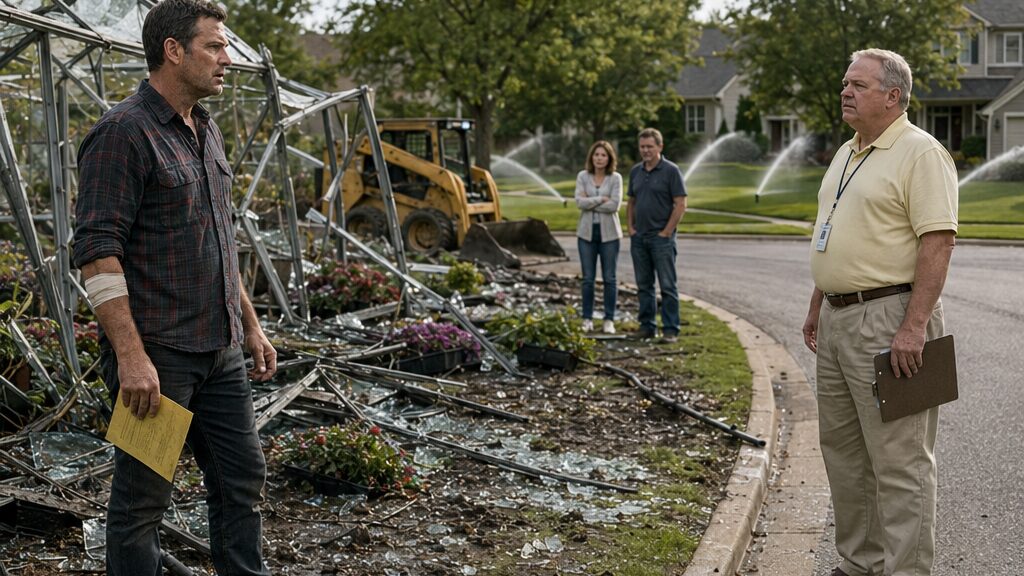
For one impossible second, he saw every pane above him tremble in its frame. Then the steel teeth punched through, and the whole east side of the greenhouse erupted in white shards.
Mark threw both arms over his head.
“Stop!”
The engine swallowed his voice.
A hanging basket dropped beside him. A bench tipped. Seed trays slid across wet concrete and burst open under his boots, scattering black potting soil and pale roots. The loader reversed with a hydraulic whine, dragging a section of aluminum framing outward. Glass crackled down in sheets.
Mark stumbled toward the center aisle.
“Stop the machine!”
The operator either could not hear him or had been told not to.
The bucket came forward again.
Mark lunged behind Betty’s old propagation table as a pane burst where his shoulder had been. Something sliced the back of his forearm. He felt the sting before he saw the blood.
Outside, beyond the fractured wall, a man in a pale yellow polo lifted one hand toward the operator.
Not to stop.
To guide.
Mark recognized Donald White.
The HOA president stood ten yards away with a lanyard on his chest and a clipboard tucked under one arm, watching the greenhouse come apart.
Mark kicked through a fallen brace and reached the side door. It had twisted in its frame. He shoved once. Nothing. Behind him, the loader engine rose again.
“Donald!”
Donald looked directly at him.
Mark hit the door with his shoulder. The latch tore loose. He fell out onto the gravel strip beside the greenhouse as another impact boomed behind him.
For a few seconds he stayed on one knee.
Blood ran from his forearm into his work glove. Fine cubes of safety glass glittered in his hair and across the shoulders of his plaid shirt. Somewhere inside, a hose had ruptured. Water hissed under the wreckage with the steady indifference of rain.
Mark lifted his head.
“What the hell are you doing?”
Donald glanced toward the operator, then back at him.
“You were notified.”
Mark stared.
The loader idled behind them.
“Notified of what?”
Donald’s expression changed only slightly, as though Mark had become difficult by asking the question.
“The structure was found noncompliant.”
“My greenhouse?”
“You received multiple notices.”
“I received letters about screening.”
“And appearance standards.”
“This property isn’t in your subdivision.”
Donald drew a breath through his nose. “The board’s counsel reviewed the matter.”
“Then show me the order.”
Donald tapped the clipboard.
“We have authority to abate.”
Mark looked past him.
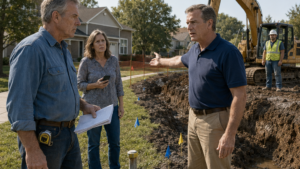
Two houses at the end of the cul-de-sac had people standing on their front walks. A woman held a coffee cup against her chest. A man beside a mailbox had his phone out, though Mark could not tell whether he was recording or merely pretending not to watch.
The loader operator leaned from the cab.
“You want me to keep going?”
Mark turned so fast pain flashed up his arm.
“No.”
Donald said, “Continue with the contracted scope.”
Mark took one step toward him.
The operator hesitated.
Donald’s face tightened. “Mark, don’t make this worse.”
The sentence stopped him more effectively than a hand would have.
Don’t make this worse.
Behind Mark lay thirty-two years of patched framing, replaced seals, repaired heaters, improvised benches, and rows of plants that had never cared whether the houses across the road approved of them.
Betty had built the first section with salvaged storm windows before Mark was born. Later she had replaced them pane by pane, saving for tempered glass as the greenhouse expanded. She grew tomato starts in March, chrysanthemums in September, herbs nearly year-round. She had sold flats from a folding table at the roadside and given away whatever remained too long.
Nothing in that greenhouse had been ornamental in the way Donald meant the word.
Even the flowers paid for themselves.
Mark looked through the torn wall.
The loader had crushed the north bench. Geraniums lay mashed into mud. A rack of irrigation fittings had vanished under broken framing. The main feeder line jerked across the floor, spraying water into a pile of glass.
“Shut it off,” he said.
Donald folded his arms.
Mark pointed toward the machine. “Shut it off now.”
“The contractor has a work authorization.”
“From who?”
“The association.”
Mark laughed once, without humor. “You don’t own this land.”
Donald’s eyes moved toward the watching neighbors. “There have been complaints for over a year.”
“Complaints don’t transfer title.”
“The greenhouse affects the view corridor.”
Mark looked at him.
“The what?”
“The visual approach into the development.”
The loader operator killed the engine at last. Silence came so suddenly that the ruptured hose sounded enormous.
Water ran beneath broken glass.
Donald stepped closer, lowering his voice.
“You could have avoided this. We asked you to cooperate.”
“You asked me to hide a working greenhouse behind a six-foot privacy fence.”
“It was visible from common areas.”
“It was here before the common areas.”
Donald’s jaw flexed.
For the first time, Mark saw something beyond self-importance in him. Strain. Not doubt, exactly. More like a man holding shut a door with his back.
“The board has homeowners asking why rules apply to them and not to you,” Donald said. “We cannot maintain standards selectively.”
“I’m not one of your homeowners.”
“You benefit from proximity to the development.”
Mark looked at the crushed flowers.
“That what you call this?”
Donald glanced toward the operator. “Finish the east and north sections. Leave anything outside the marked footprint.”
Mark moved between the loader and the greenhouse.
“No.”
The operator climbed down this time.
“I’m not driving with him there.”
Donald’s mouth tightened. “Mark.”
“Show me a court order.”
“It isn’t required.”
“Show me a county demolition permit.”
Donald said nothing.
Mark held his gaze.
There it was. Small. Quick. A pause that had not been there before.
Donald looked at the HOA management representative standing near a parked SUV. The representative immediately lowered her eyes to a folder.
Mark saw the exchange.
“What did you actually authorize?”
Donald’s answer came too fast. “Emergency abatement.”
“Emergency?”
“Unsafe condition.”
“It became unsafe when your machine hit it.”
One of the watching neighbors turned away.
Donald’s face reddened.
“You were served notice.”
“Not for demolition.”
“You ignored compliance deadlines.”
“Not for demolition.”
The same sentence, twice, landed differently.
Donald glanced at the blood on Mark’s sleeve.
For half a moment, Mark expected the morning to change shape. Expected someone to call an ambulance. Expected Donald to look at the broken structure and understand that whatever paper dispute they had been having was over.
Instead, Donald extended his hand.
Not to help him.
To give him a document.
A yellow sheet.
Mark did not take it.
“What is that?”
“Formal notice following abatement.”
Behind him, water kept flowing through the wreckage.
Donald held the paper out farther.
Mark finally accepted it with his uninjured hand.
The top line carried the HOA’s name.
Below it, in bold, was another demand.
Chapter 2: They Billed Him for Their Wreckage
The total at the bottom of the yellow sheet was $3,184.62.
Mark read it twice because the first time his mind refused to arrange the numbers into meaning.
Emergency abatement.
Contractor mobilization.
Debris handling.
Administrative processing.
He looked from the bill to the greenhouse Donald’s contractor had just torn open.
“You’re charging me for this.”
Donald’s voice stayed level. “Costs of enforcement are recoverable.”
“You broke it.”
“You failed to cure the violation.”
Mark glanced at his bleeding arm.
“I haven’t even been to urgent care.”
“That has nothing to do with the assessment.”
Something inside Mark went very still.
Donald mistook it for surrender.
“The balance is due within thirty days,” he continued. “The property also remains out of compliance until all debris is removed.”
Mark lifted his eyes.
“What debris?”
Donald pointed.
The broken greenhouse.
For several seconds neither man spoke.
Then Mark said, “You mean your debris.”
“The owner is responsible for site condition.”
A sprinkler clicked on behind Donald.
The sound was absurdly clean.
Tick.
Tick.
Tick.
A silver arc swept across the nearest lawn, darkening the grass in a perfect fan. The water reached the curb, touched the yellow notice in Mark’s hand, and left three round drops that immediately spread through the paper.
Donald stepped aside to keep his shoes dry.
Mark looked down at the wet page.
Then at the broken glass around his boots.
“You have until Friday to begin cleanup,” Donald said. “After that, continuing fines may be imposed.”
“How much?”
“Up to five hundred dollars per day.”
One of the neighbors by the mailbox shifted his weight.
Mark heard it.
That was what humiliation sounded like, he discovered. Not laughter. Not shouting. A shoe scraping pavement while someone decided it was safer not to look at you.
Donald lowered his voice.
“You should take this seriously.”
“I am.”
“I don’t think you understand the position you’re in.”
Mark folded the yellow sheet once.
Donald watched him.
“People spend years fighting associations,” he said. “They spend money they don’t have, and in the end they pay anyway.”
Mark looked past him.
The sprinkler completed another turn.
Across the cul-de-sac, a second sprinkler rose with a faint mechanical cough.
Then a third.
He had seen them every summer for years. Twelve houses, broad front lawns, green strips along sidewalks. He had complained privately about the waste and then forgotten it. The development had been built in phases after Betty’s pasture was sold off parcel by parcel by other families.
Mark’s land remained on the edge like a missing tooth in a perfect smile.
Tick.
Tick.
Tick.
The sprinkler nearest Donald dropped pressure for half a second.
At almost the same moment, the next one surged.
Mark’s eyes narrowed.
Donald was still talking.
“—and once legal fees are added, the balance can become substantial.”
Mark barely heard him.
The heads were not running independently.
Three pulsed. One weakened. Another strengthened. Then the first recovered.
A sequence.
He turned toward the far end of the road.
Beyond the last house, partly hidden by trees, lay the back corner of his property.
And the old pump shed.
Donald stopped speaking.
“What?”
Mark did not answer.
He watched another sprinkler rise.
A memory came without invitation: Betty leaning over the kitchen sink when he was sixteen, complaining that “those development people” had changed the pressure again. He had assumed she meant county water.
He had never asked.
Donald stepped into his line of sight.
“Mark.”
Mark looked at him.
“Who pays for the irrigation?”
Donald frowned.
“What?”
“These lawns.”
“That’s not relevant.”
“Who pays for the water?”
“The association maintains common irrigation obligations.”
“I didn’t ask who maintains it.”
Donald’s expression closed.
Mark felt the first clean edge of curiosity cut through his anger.
“Where does it come from?”
“You need to focus on your own property.”
The answer was so careful that Mark almost smiled.
Almost.
Instead he folded the notice again and slid it into his shirt pocket.
Donald’s confidence wavered.
“You have until Friday.”
Mark turned away.
Inside the greenhouse, he shut the feeder line manually where the pipe had split. The valve resisted, slick with mud and blood. When he finally forced it closed, the hiss stopped.
The silence afterward was worse.
He spent the next hour pulling intact trays from beneath twisted framing. An insurance adjuster called and asked him not to move anything that could affect the claim. A nurse at urgent care put six small adhesive closures across his forearm and asked how he had been injured.
“Construction accident,” Mark said.
It was easier than explaining.
By Tuesday morning, photographs of the greenhouse had circulated through the neighborhood’s private online group. Mark knew because one of the two neighboring homeowners came to the property edge and stood there with both hands in his pockets.
“I’m sorry about what happened,” the man said.
Mark waited.
The man looked toward the wreckage. “I didn’t know they were going to do that.”
“You complained?”
A pause.
“Not about demolition.”
“What did you complain about?”
“The plastic sheeting last winter. It was loose.”
Mark remembered it. One temporary sheet over a cracked pane during a January freeze.
“Anything else?”
The man looked embarrassed. “Some people said the structure hurt resale impressions.”
“Some people.”
“I’m just telling you what was said.”
Mark nodded.
The man seemed to want forgiveness for honesty. Mark gave him nothing.
That afternoon, another certified notice arrived.
Daily fines would begin if cleanup did not commence.
Mark put it on the kitchen table beside the first bill.
He made coffee and did not drink it.
From his window, he could see the nearest lawns. At 7:10 p.m., the sprinklers began.
Not all at once.
In order.
Mark stood.
First house.
Second.
Third.
Pressure shifted down the line.
He went to the hall closet, found an old flashlight, then crossed the yard as dusk settled over the broken greenhouse.
At the back of the property, weeds had grown shoulder-high around a low cinder-block structure with a rusted metal door.
The pump shed.
Betty had kept the key on a nail in the mudroom for years. Mark had thrown away the key ring after she died, convinced the shed held nothing but obsolete equipment.
He stood before the padlock.
Behind him, twelve lawns drank in sequence.
Mark fetched bolt cutters from the barn.
The lock snapped on the second try.
He pulled the door open.
Chapter 3: The Pipe Under Twelve Perfect Lawns
The meter inside the pump shed was moving.
Mark stood in the doorway with the broken padlock at his feet and watched the small black dial creep forward.
He did not touch anything.
The shed smelled of rust, damp concrete, and old mineral deposits. A thick pipe rose from the floor near the back wall, passed through a pressure assembly, then divided. One branch disappeared toward the greenhouse. The other ran horizontally through the wall facing the subdivision.
Mark aimed his flashlight at the second pipe.
The dial moved again.
His greenhouse feeder was closed.
The outdoor spigots were off.
The house used county water.
Still, the meter turned.
“No,” he said softly.
He followed the pipe with the light until it reached a large valve wheel crusted red at the edges. Beneath it, a metal tag had once carried lettering. Only three stamped characters remained readable.
IRR.
Mark put one hand on the wheel.
He should have called someone first.
Instead he pulled.
Nothing.
He braced a boot against the concrete curb and tried again. Rust cracked. The wheel shifted perhaps an inch, and somewhere in the pipe a deep vibration changed pitch.
Mark released it immediately.
Outside, faint across the dark field, a sprinkler coughed.
He stood still.
Then came the sound of pressure recovering.
Mark looked at the pipe running through his wall.
By midnight, every cardboard box from Betty’s attic was open across his kitchen floor.
Tax receipts. Seed catalogs. Machinery manuals. A warranty for a heater removed twenty years ago. Handwritten notes on tomato varieties. Envelopes full of cash-register receipts whose ink had faded nearly white.
Mark searched until his eyes burned.
At 1:17 a.m., he found a folded county map.
The paper cracked at the creases.
A blue pencil line ran from the old well site through what had once been pasture. Along the line, Betty had written one word.
Development.
Mark sat back.
He remembered her complaining about pressure. Remembered a developer’s truck in the drive when he was a boy. Remembered being sent outside while adults talked in the kitchen.
He had treated those memories as background noise.
Now the pump meter moved in his mind.
The next morning he drove to the county records office with the map on the passenger seat.
The clerk examined the parcel number and disappeared through a door. She returned with a cart carrying two bound index volumes and a thin folder.
“You’re looking for easements, transfers, utility rights?”
“Anything tied to water across the east parcel.”
“That parcel changed configuration.”
“I know.”
“Then you may need predecessor deeds.”
“I need whatever came before the development.”
The clerk gave him a look suggesting that this could take all day.
It did.
By noon, Mark had found the first reference.
A recorded agreement from decades earlier granted limited access for an irrigation line crossing part of the Allen property. The development named in the document did not yet exist under its current name. The beneficiary was an earlier land company.
Mark read the paragraph three times.
Term: twenty years.
Renewal: by written agreement.
He checked the execution date.
His pulse accelerated.
The original term had ended years ago.
There was no renewal attached.
He photographed every page.
Then he asked the clerk for the parcel map.
The map changed everything again.
The line did not merely touch the edge of Mark’s property. It entered near the old well site, crossed a narrow strip he still owned, and continued beneath the access road toward the subdivision.
Mark traced it with one finger.
“Can I get a certified copy?”
The clerk nodded. “Of the recorded map, yes.”
“And everything tied to that agreement.”
“I can give you what’s indexed. That doesn’t mean there aren’t later instruments under another parcel reference.”
The warning irritated him.
“How many references?”
“Potentially several.”
“So the agreement could have been renewed.”
“It could have been amended, replaced, incorporated, terminated, superseded, or ignored.”
Mark looked at her.
She shrugged lightly.
“Records tell you what was recorded. They don’t always tell you what people actually did.”
By Thursday morning, hope had become something sharper.
He found the receipts in a narrow envelope tucked inside Betty’s old accounting ledger.
Twelve checks.
Not from individual homeowners.
From the predecessor development company.
Annual amounts, modest at first, then larger. Each memo line used some variation of water access, pump contribution, or irrigation maintenance.
The payments stopped years before Betty died.
Mark remembered that period.
She had become slower. Less patient with paperwork. He had begun helping with repairs but not accounts. When she asked him to look through “the water things,” he had told her he would do it after the spring rush.
He never had.
The shame of it hit harder than he expected.
For years he had told himself he had kept his promise to her because the greenhouse still stood.
But promises were not structures.
He spread the checks beside the easement copy.
There was enough here to matter.
Maybe enough to win.
He called Joshua Thompson because the attorney had handled a boundary dispute for a farmer Mark knew.
Joshua agreed to meet that afternoon.
His office was small and aggressively plain. Mark laid out the map, agreement, receipts, and photographs of the pump assembly.
Joshua read without speaking.
At first Mark appreciated the silence.
Then he began to hate it.
“Well?”
Joshua held up one finger and kept reading.
Mark sat back.
Five minutes passed.
Finally Joshua said, “This is interesting.”
“Interesting good?”
“Interesting expensive.”
Mark’s jaw tightened.
“The term ended.”
“Yes.”
“No renewal is recorded.”
“Not under the references you searched.”
“The line crosses my property.”
“Apparently.”
“The pump is on my land.”
“Apparently.”
“The meter runs when their sprinklers run.”
Joshua looked up.
“That part is useful.”
Mark leaned forward. “Then I control it.”
Joshua did not answer.
Mark felt irritation rise.
“What?”
“There are several possibilities.”
“The agreement expired.”
“Maybe.”
“It has a date.”
“So do expired leases. People still litigate possession afterward.”
“This isn’t an apartment.”
“No. It’s potentially worse.”
Mark stared at him.
Joshua tapped the old agreement.
“There could be a later contract. There could be an implied arrangement. There could be prescriptive claims depending on facts. There could be utility obligations I haven’t seen. There could be a separate ownership interest in equipment. There could be conduct by your grandmother that matters.”
“She took payments.”
“Which helps you in one direction and may complicate another.”
“How?”
“It shows the use was known.”
“It also shows they paid.”
“Yes.”
“So when they stopped paying—”
“Maybe they breached. Maybe the arrangement changed. Maybe someone thought another fee covered it. I don’t know yet.”
Mark stood and walked to the window.
Across the street, an office building’s irrigation system clicked on.
He watched water darken the mulch.
“I could shut it off.”
Joshua’s chair creaked behind him.
“Could you physically?”
“Yes.”
“That wasn’t my question.”
Mark turned.
Joshua closed the folder.
“Do not confuse leverage with certainty.”
“They destroyed my greenhouse.”
“I saw the photographs.”
“They billed me for it.”
“I saw that too.”
“And you’re telling me to wait.”
“I’m telling you to understand what you’re touching before you turn anything.”
Mark looked at the certified map.
For two days, he had imagined the discovery as a locked door opening.
Now Joshua was telling him it opened onto another hallway.
Mark put both hands on the desk.
“The agreement expired.”
Joshua met his eyes.
“Expired is not the same as simple.”
Chapter 4: The Clause Donald Had Already Seen
Joshua found the missing document because somebody had referred to it without attaching it.
He called Mark at 8:12 Friday morning.
“Come in.”
Mark was standing beside what remained of the north greenhouse wall, holding a bent section of irrigation rail. “You find a renewal?”
“No.”
The word gave him a quick, ugly satisfaction.
Then Joshua added, “I found something worse.”
An hour later, Mark sat across from Joshua’s desk while the attorney enlarged a scanned page on his monitor.
It was not an easement.
It was a billing summary from the HOA’s property management company, dated fourteen months earlier. Most of the page concerned maintenance contracts. Near the bottom, one line item read:
Review irrigation access renewal per infrastructure memo.
Mark leaned closer.
“What infrastructure memo?”
“That,” Joshua said, “is the problem.”
The packet produced by the HOA contained no memo.
Joshua clicked to another document. Three months later, a board meeting agenda listed an executive-session item:
Water service continuity / legacy parcel exposure.
Mark read it twice.
“They knew.”
“Maybe.”
“You just showed me they knew.”
“I showed you that someone raised a concern.”
“And Donald was president.”
“Yes.”
“So he saw it.”
“Probably.”
Mark pushed back from the desk.
Joshua watched him.
“You keep trying to make every piece of paper the last piece,” he said.
Mark’s head turned.
“What does that mean?”
“It means you want one document to tell you that you’re right, they’re wrong, and everything after that is easy.”
“They drove a loader through my greenhouse.”
“I know.”
“Then don’t talk to me like I’m looking for a fairy tale.”
Joshua closed the laptop halfway.
“I’m talking to you like a man who is angry enough to mistake leverage for permission.”
Mark said nothing.
Silence had always served him well in arguments. Most people rushed to fill it. Joshua did not.
Finally Mark asked, “Can we demand the missing memo?”
“We already did.”
“And?”
“The association says it has produced all responsive nonprivileged records.”
Mark looked at the screen.
“Meaning?”
“Meaning the memo may be privileged. Or lost. Or under another file name. Or somebody is lying.”
That afternoon, Mark attended the HOA meeting because the latest notice said his appeal would be heard before fines continued.
He almost left when he saw the room.
Rows of folding chairs. A coffee urn on a side table. Printed agendas. Homeowners talking quietly in pairs, several of them lowering their voices when he entered.
Donald sat at the front beside the board treasurer and the management representative.
He wore a navy polo this time.
Mark took a chair in the back.
The first twenty minutes concerned pool hours and landscaping. People argued over dead shrubs with more feeling than anyone had shown while his greenhouse came down.
Then Donald called his name.
“Mr. Allen.”
Mark walked forward with the yellow notices in a folder.
Donald spoke for the record.
“The issue before us is continued noncompliance at the adjoining parcel and recovery of association costs related to emergency abatement.”
“Adjoining parcel,” Mark repeated.
Donald’s eyes narrowed slightly.
Mark placed the first notice on the table.
“Your own document calls me an owner subject to enforcement.”
“The language is standardized.”
“So when you need jurisdiction, I’m subject to the association. When you describe the land, I’m adjoining.”
The board treasurer shifted in his chair.
Donald said, “This is not a title hearing.”
“No. Apparently it’s a cleanup hearing for a mess you made.”
A few people looked down.
Donald’s face hardened.
“We acted after repeated complaints.”
“What complaints?”
“The structure’s condition.”
“What condition?”
“Visible deterioration. Improvised sheeting. Exterior materials inconsistent with neighborhood standards.”
“My grandmother built that greenhouse before your neighborhood existed.”
“And over time the area changed.”
“So the greenhouse became illegal because expensive houses appeared near it?”
“I did not say illegal.”
“Then why did you demolish it?”
The room went quiet.
Donald folded his hands.
“The board acted on advice.”
“Whose?”
“I’m not discussing privileged communications.”
Mark felt the anger rise, but beneath it another thought moved.
Advice.
Not an emergency discovered that morning. Advice.
“How long had you been planning demolition?”
Donald’s expression changed.
Only slightly.
But Mark saw it.
The management representative looked toward him too quickly.
Donald said, “The appeal concerns current compliance.”
Mark let the silence stretch.
He could have mentioned the easement.
He could have put the old receipts on the table and watched Donald’s face.
He did not.
That choice felt like control.
Later, he would understand it was also the beginning of something less admirable.
After the meeting, Donald caught him beside the damaged greenhouse.
The sun was down. Work lights from Mark’s barn threw broken frames into long shadows.
“You’re making this harder than it needs to be,” Donald said.
Mark kept sorting intact fittings into a plastic bin.
“Funny. I was thinking the same thing.”
Donald looked toward the glass.
“You know what people are saying?”
“No.”
“They’re saying this is retaliation because you never joined the development.”
Mark stopped.
“I was here first.”
“That is exactly the kind of answer that worries them.”
Mark straightened.
“Who is them?”
“Homeowners. People with mortgages. Families whose biggest asset is the house they bought here.”
“And my property doesn’t count?”
“I didn’t say that.”
“You didn’t have to.”
Donald rubbed his forehead.
For the first time since the demolition, he looked tired.
Not guilty.
Tired.
“You think I enjoy this?” he asked.
Mark stared at him.
Donald gave a short laugh. “Of course you do.”
“I think you enjoyed giving orders.”
“That’s convenient.”
“You stood there while the machine was moving.”
“The board had spent eleven months on complaints. Eleven months. Every meeting, somebody asking why we enforce fence color but ignore a deteriorating commercial-looking structure at the entrance.”
“It’s not the entrance.”
“It’s what buyers see.”
There it was again.
Buyers.
Views.
Value.
Donald looked toward the cul-de-sac.
“You know what happens if people stop believing the board can enforce anything? Every dispute becomes selective enforcement. Every violation becomes litigation.”
Mark said, “That still doesn’t give you my land.”
Donald’s jaw tightened.
Then Mark asked, “How much would a new irrigation system cost?”
Donald went still.
It lasted less than a second.
Mark almost missed it.
“What?”
“For the development.”
“I have no idea.”
“That’s not true.”
Donald looked toward the houses again.
A sprinkler rose from one lawn with a soft mechanical click.
Mark watched Donald watch it.
Then Donald said quietly, “You have no idea what a special assessment would do here.”
Mark’s pulse slowed.
Not because he was calm.
Because something had just aligned.
“How much?”
Donald exhaled.
“Some owners are already stretched. Dues went up twice. Insurance went up. A five-figure assessment—”
He stopped.
Mark said, “You knew there was a water problem.”
“I said no such thing.”
“You didn’t have to.”
Donald’s face closed again.
“Be careful.”
Mark almost laughed.
Donald stepped closer.
“I mean that. You are dealing with systems you don’t understand.”
Mark looked at him.
“Funny.”
He picked up the bin.
“I was about to say the same thing.”
The next morning Joshua called again.
The HOA had supplemented its records.
Still no infrastructure memo.
But buried in a board packet was a copy of an old water invoice with a handwritten note in the margin:
Confirm renewal status before capital plan.
The initials beside it were D.W.
Mark stared at the scan on his phone.
Donald White.
The note was dated eight months before the demolition.
By Monday, Mark’s anger had become precise.
By Wednesday, another yellow notice appeared on his front door.
Daily fines had begun.
Five hundred dollars.
Mark took the paper down, folded it once, and placed it on the passenger seat of his truck.
Then he drove toward the pump shed.
Chapter 5: One Turn of the Valve Was Not a Clean Victory
Mark placed Joshua’s legal notice on the concrete ledge beside the valve and wrapped both hands around the rusted wheel.
The notice had gone out forty-eight hours earlier.
It disputed the HOA’s continued use of the irrigation line, demanded immediate accounting of the system, reserved all property rights, and warned that continued access could not be assumed while ownership and contractual authority remained unresolved.
Joshua had made Mark read one sentence three times.
Do not characterize any physical interruption as punishment or retaliation.
Mark had asked, “What if that’s what it is?”
Joshua had looked at him for a long moment.
“Then at least be honest with yourself before you lie to everyone else.”
Now the pump shed was quiet except for the vibration in the pipe.
Mark could feel it through the wheel.
Water moving toward twelve lawns.
Past his wall.
Across his land.
Into a neighborhood whose board had torn apart Betty’s greenhouse and billed him for the privilege.
He pulled.
The valve resisted.
He leaned harder.
Rust cracked.
The wheel turned a quarter rotation.
The vibration changed.
Mark stopped.
He could leave it there.
Reduced flow. Pressure loss. Enough to force a phone call.
He turned again.
Another quarter.
Outside, faint and distant, a sprinkler began to cough.
Mark closed his eyes.
The sound gave him satisfaction.
He hated how clean it felt.
He turned the wheel farther.
Not all the way.
Enough.
By 6:20 that evening, Donald was standing in the cul-de-sac while three irrigation zones spat air.
Neighbors had gathered near the curb.
Mark watched from his property line.
One sprinkler rose six inches, released a brown burst of water, and sank again.
Donald pointed toward Mark.
“This is intentional interference.”
Mark did not answer.
The management representative stood beside Donald with a phone pressed to her ear. The board treasurer paced near the sidewalk.
A homeowner called out, “Can somebody explain what happened?”
Donald raised his voice.
“We believe Mr. Allen has disrupted association infrastructure.”
Mark crossed his arms.
The words carried.
Association infrastructure.
He looked at the pipe disappearing from his pump shed.
Donald started toward him.
“Turn it back on.”
Mark said, “Show me the agreement.”
Several neighbors went quiet.
Donald stopped.
“This is sabotage.”
“Show me the agreement.”
“You don’t get to endanger community property because you’re angry.”
“What property?”
“The irrigation system.”
“Whose water?”
Donald pointed a finger.
“You are creating liability for yourself.”
Mark felt the old instinct to say nothing.
This time the silence tasted different.
Not defensive.
Punitive.
He let Donald stand there with everyone watching.
Then Mark said, “My attorney sent notice.”
“That notice proves nothing.”
“Then neither does your claim.”
A woman near the curb asked, “What notice?”
Donald turned too quickly.
“This is a legal dispute unrelated to homeowners.”
Mark almost smiled.
For years, the water had been related enough to keep their lawns green.
Now it was unrelated.
By the next morning, the nearest lawns had begun losing color at the edges.
Not dramatically. Not yet.
But the sprinklers no longer rose with their old certainty. Some pulsed weakly. Others ran for seconds and stopped. The system had been designed around pressure it no longer had.
The HOA sent an emergency email calling the outage a suspected act of interference.
Donald called Mark twice.
Mark did not answer.
On the third day, Laura Ramirez came to his property.
Mark knew her by sight. She lived six houses down in a brick-front home with a maple tree near the driveway. He had seen her at the meeting but never spoken to her.
She did not come carrying a yellow notice.
She carried a grocery bag.
“What’s that?” Mark asked.
“Not a peace offering.”
She set it on a surviving greenhouse bench. Inside were bottled waters.
Mark looked at her.
“My son’s sprinkler head blew out yesterday,” she said. “I figured you might enjoy the symbolism.”
He almost laughed.
Almost.
Then she said, “Turn it back on.”
The humor vanished.
“No.”
“My yard isn’t Donald’s yard.”
“The line crosses my land.”
“I know what Donald says.”
“You mean what he doesn’t say.”
Laura folded her arms.
“I also know you shut it down.”
“Reduced it.”
“Fine. Reduced it enough that twelve houses lost irrigation.”
“Then maybe twelve houses should ask why.”
“We are asking.”
“Good.”
She stared at him.
Mark turned away and lifted a damaged irrigation rail onto the worktable.
Laura said, “You like this.”
He looked back.
“What?”
“Them being scared.”
“That’s not why I did it.”
“It’s part of why you haven’t answered the phone.”
Mark’s face tightened.
“You don’t know me.”
“No. I know what a person looks like when they finally get leverage.”
He set the rail down harder than necessary.
“You want to know what leverage looked like last week?”
He pointed to the broken greenhouse.
“It looked like a loader bucket.”
Laura’s eyes moved across the wreckage.
“I didn’t support that.”
“You live there.”
“That isn’t the same thing.”
“You pay dues.”
“So now everybody who pays dues demolished your greenhouse?”
Mark said nothing.
She stepped closer.
“My husband died three years ago.”
The sentence came so directly that he did not know what to do with it.
Laura continued before he could answer.
“I refinanced after the medical bills. I work. I make the payment. I raise my son. I do not sit around plotting against your greenhouse.”
Mark’s anger faltered, then returned in another shape.
“What does that have to do with irrigation?”
“Nothing, maybe. Except I bought that house believing the association maintained the system.”
“They don’t.”
“I know that now.”
Mark went still.
Laura reached into her purse and pulled out a thick packet.
She held it toward him.
“What is that?”
“My resale disclosure package.”
He did not take it.
“I bought four years ago. Read the utilities section.”
Mark accepted the packet.
He flipped through pages.
Common-area maintenance.
Stormwater obligations.
Exterior standards.
Irrigation maintenance.
No reference to a private well.
No reference to the Allen parcel.
No easement disclosure.
No dependency.
He looked up.
Laura’s face was hard.
“Do you see it?”
Mark turned another page.
Nothing.
“The board knew,” he said.
Laura shook her head.
“Maybe Donald knew. Maybe management knew. I don’t know yet.”
“You defended them at the meeting.”
“I asked whether they had authority. That isn’t defending them.”
“You sat with the homeowners.”
“I am a homeowner.”
The correction landed.
Mark looked back at the packet.
Laura said, “I thought you were being stubborn because you hated the development.”
“I don’t hate it.”
“You don’t exactly wave.”
“I work.”
“You also don’t explain anything.”
He almost told her that explanation had never saved anyone.
Instead he looked at the dry irrigation line running beside the ruined greenhouse.
Laura’s voice softened, but not much.
“My son asked me this morning if we were going to lose the house because the grass was dying.”
Mark looked at her.
“He heard two neighbors talking about property values.”
“That’s not on me.”
The answer came too quickly.
Laura heard it.
So did Mark.
She stepped back.
“No,” she said. “Not all of it.”
That was worse than accusation.
She left the disclosure packet on the bench.
At the property edge, she turned.
“I’m going to ask Donald when he first knew.”
Mark looked down at the pages.
Laura added, “You should ask yourself when you knew enough to warn the rest of us.”
Then she walked away.
Mark stood among broken glass with the packet in his hands.
For the first time since he turned the valve, the weakened sprinklers did not sound like justice.
Chapter 6: The Neighbors Were Not Told What They Owned
The child unscrewed the cap from a dry sprinkler head while three adults argued above him.
Mark saw it from across the cul-de-sac.
The boy was crouched in the grass, small fingers working at the plastic fitting. When the cap came loose, he peered into the dark opening as if water might be hiding inside.
Nothing came out.
Behind him, one lawn was still green.
The next had gone yellow along the curb.
Two houses farther down, sprinklers were running normally.
Uneven.
Mark stopped walking.
He had come because Laura asked him to meet near the HOA office. Now the lawns themselves showed him something the records had not.
Backup connections.
Not every house depended on his line equally.
A neighbor saw him and raised his voice.
“There he is.”
Mark kept moving.
The man stepped toward the sidewalk.
“You happy now?”
Mark glanced at the green lawn behind him.
“Your irrigation works.”
“That’s not the point.”
“It seems relevant.”
The man’s face reddened.
Another homeowner said, “Mine hasn’t run in four days.”
Donald emerged from the HOA office before the argument could sharpen.
He had changed.
Not physically.
The confidence was still there, but now it looked maintained.
“Mr. Allen,” he said, loud enough for everyone. “You need to restore service immediately.”
Mark looked at the cluster of residents.
“Tell them where the service comes from.”
Donald’s jaw tightened.
“This is not the place.”
“That’s convenient.”
“You were notified that your actions may expose you to damages.”
“And they were notified their irrigation depends on private land?”
Nobody spoke.
Donald said, “The association maintains the system.”
“That’s not what I asked.”
A woman near the office door looked at Donald.
“Private land?”
Mark felt the moment shift.
He could explain.
He had copies in his truck.
Maps. Receipts. The old agreement.
Instead he said nothing.
Donald filled the silence.
“This is a complicated historical matter that Mr. Allen is exploiting because of an unrelated enforcement action.”
There it was.
A complete story, clean enough to believe.
Vindictive landowner.
Angry about a violation.
Punishing neighbors.
Mark watched faces turn toward him.
He had evidence.
He still said nothing.
By noon, the neighborhood had split into camps without anyone having all the facts.
Some blamed Donald.
More blamed Mark.
A few blamed both.
Laura found him that afternoon outside her house.
“You’re helping him,” she said.
Mark looked at her.
“Donald.”
“How?”
“By refusing to speak.”
“I’m not arguing in the street.”
“That isn’t what I asked.”
She held up her phone.
“Emergency board email. Tonight.”
Mark did not take it.
Laura read from the screen.
“‘The association is responding to a deliberate interruption of irrigation service by an adjoining property owner following lawful enforcement activity.’”
Mark’s mouth tightened.
“Lawful.”
“Yes. That word is doing a lot of work.”
He looked toward the HOA office.
Laura said, “Come with me.”
They found Donald inside with the board treasurer and the management representative. Papers covered the conference table.
Donald stood when Mark entered.
“This meeting is not open.”
Laura walked past him and placed a printed page on the table.
“When did you first see this?”
Donald glanced down.
His face changed.
Not enough for everyone.
Enough for Mark.
It was the missing infrastructure memo.
Or part of it.
Mark stepped closer.
The heading referenced legacy irrigation access, incomplete renewal documentation, and potential capital exposure.
Donald looked at Laura.
“Where did you get this?”
“From a homeowner who served on the budget committee last year.”
“That document was preliminary.”
“When did you see it?”
“This isn’t productive.”
Laura’s voice stayed level.
“When?”
Donald looked at the board treasurer.
The treasurer looked away.
Mark understood before anyone answered.
Donald had seen it.
Laura did too.
“How long?” she asked.
Donald sat down slowly.
“Last year.”
The room went still.
Mark felt fury rise through him so cleanly that he had to grip the back of a chair.
Before the demolition.
Before the fines.
Before Donald stood in front of the shattered greenhouse and told him the board had authority.
Mark said, “You knew.”
Donald looked up.
“I knew there was uncertainty.”
“You wrote the note.”
“What note?”
“The water invoice. ‘Confirm renewal status before capital plan.’ Your initials.”
Donald’s face hardened.
“That proves exactly what it says. I wanted confirmation.”
“And when you didn’t get it?”
“We had competing priorities.”
Laura laughed once.
It was not amused.
“You hid it.”
“I did not hide anything.”
“You didn’t disclose it.”
“Because there was nothing final to disclose.”
Laura tapped the memo.
“Residents were buying houses.”
Donald’s restraint cracked.
“And what would you have had me do?”
The question came louder than he intended.
Everyone froze.
Donald stood again.
“Send a letter saying we might have a multimillion-dollar infrastructure issue? Based on an incomplete review? Trigger panic? Destroy sales? Force an assessment before we even knew whether it was necessary?”
Mark stared at him.
There was the fear.
Not invented.
Not noble either.
Donald continued, quieter now.
“Some people here cannot absorb ten thousand dollars. Some cannot absorb five. Dues have risen. Insurance has risen. We were trying to determine options.”
Laura said, “So you decided not to tell us.”
“I decided not to create a crisis before we had facts.”
“And then you demolished his greenhouse.”
Donald looked at Mark.
“The greenhouse was a separate compliance matter.”
Mark felt something inside him almost give way.
Separate.
The word was impossible.
He stepped forward.
“You knew my parcel might control the water.”
“I knew there was a documentation issue.”
“And you still sent a machine onto my land.”
Donald’s mouth tightened.
“The board was under pressure to enforce standards consistently.”
Mark laughed.
This time there was no humor left.
“Consistently.”
Donald looked toward the window, where one brown lawn sat beside a green one.
“I made decisions with the information available.”
“No,” Laura said. “You made decisions with information you kept from us.”
Donald turned toward her.
“And now what? You think he’s the hero?”
Mark’s head lifted.
Donald pointed toward him.
“He shut the system down knowing families would be affected.”
Laura looked at Mark.
The room changed again.
Mark could have defended himself.
Could have said he reduced pressure after legal notice.
Could have said the board caused the problem.
Could have said the line was his.
All of it contained truth.
None of it answered the question in Laura’s face.
Did you know?
Mark said, “I knew it would pressure the board.”
Laura’s expression tightened.
Donald seized the opening.
“There.”
Mark looked at him.
Donald continued, “This was never about ownership. It was revenge.”
Mark felt every eye in the room.
His silence had protected him after the demolition.
Now it was giving Donald a weapon.
Still, the old habit held.
He left without answering further.
Over the next two days, the lawns browned unevenly.
The difference became its own map.
Homes with backup irrigation stayed green.
Others faded.
One homeowner posted a photograph of dead sod beside an estimate for replacement. Another demanded the HOA sue Mark. Someone left a handwritten note on his mailbox calling him selfish.
Mark removed it and said nothing.
On the seventh day, Laura came to the greenhouse.
She did not bring papers.
“Emergency meeting tonight,” she said.
“I know.”
“Donald is asking the board to authorize litigation.”
Mark kept cleaning a section of frame.
Laura waited.
He said, “Joshua says they can try.”
“Are you going?”
Mark shrugged.
She stepped closer.
“You know what your problem is?”
He looked at her.
“You think silence makes other people reveal themselves.”
“Usually does.”
“Sometimes.”
She glanced toward the cul-de-sac.
“Sometimes it just lets the loudest person write the story.”
Mark set down the tool in his hand.
Broken glass remained in the soil around his boots, tiny pieces he kept finding no matter how carefully he cleaned.
Laura said, “I challenged Donald. I’ll keep challenging him. But I’m not going to lie for you.”
“I didn’t ask you to.”
“No. You don’t ask anybody for anything.”
The words hit somewhere old.
Betty had once said almost the same thing.
Not angrily.
Tiredly.
Mark looked toward the greenhouse foundation.
“What do you want me to say?”
“The truth.”
“He’ll use it.”
“Probably.”
“That’s your advice?”
“I didn’t say it was safe.”
Laura turned to leave.
At the property edge, Mark called after her.
“How much time do they give public comments?”
She looked back.
“Three minutes.”
Mark wiped his hands on his work pants.
“I’ll need five.”
That evening, before Donald could begin the emergency meeting, Mark Allen walked to the front table and asked for them.
Chapter 7: Mark Told the Truth That Hurt His Own Case
Donald began the emergency meeting by asking the board to sue Mark.
He did not ease into it.
“The association cannot permit an adjoining property owner to disable essential infrastructure as leverage in a private grievance.”
Mark stood near the back wall, holding a thin folder against his leg.
Every chair was occupied. Homeowners lined the side walls. Laura sat in the second row with her arms folded. Joshua had advised Mark not to treat the meeting as a legal hearing and had declined to speak for him.
“You need to decide what you are willing to own,” he had said.
Donald continued.
“We have documented losses. Landscape damage. Contractor expenses. Potential property-value impact. We should seek emergency relief compelling full restoration.”
A homeowner near the aisle said, “And damages.”
Another voice answered, “Maybe tell us why our water was private first.”
The room stirred.
Donald raised a hand.
“We will maintain order.”
Mark watched him do it.
That gesture had once made people quiet because Donald represented procedure. Now half the room looked at his hand before deciding whether to obey.
The board treasurer cleared his throat.
“Mr. Allen requested five minutes.”
Donald’s mouth tightened.
“Public comments are three.”
“I move we grant five.”
A second board member quietly agreed.
Donald looked down at the agenda.
“Fine.”
Mark walked forward.
Five minutes suddenly seemed like too many.
He set his folder on the table but did not open it.
Donald leaned back in his chair.
Mark looked at the room.
At the homeowners who had watched his greenhouse come down.
At others who had not been there.
At Laura.
At a man whose lawn had remained green because he apparently had a backup connection.
Then he said, “I reduced the water on purpose.”
The room went silent.
Donald moved first.
“There. Thank you.”
Mark did not look at him.
“I knew it would put pressure on the board.”
A woman in the third row shook her head.
Someone muttered, “Unbelievable.”
Mark felt the old instinct rise.
Stop talking.
Let them misunderstand.
Make them come to you.
He kept going.
“I had evidence that the irrigation line crossed my land. I had an old agreement that appeared expired. I had payment records. I had sent legal notice.”
Donald said, “None of which authorized collective punishment.”
Mark looked at him.
“No.”
The answer startled the room more than denial would have.
Mark continued.
“I did not know exactly which houses depended on the line. I did not ask. I saw twelve lawns, and I wanted the board to feel what it was like to have something taken without permission.”
Laura’s eyes stayed on him.
Mark’s throat tightened.
“That was my decision.”
A homeowner called out, “So you admit it.”
“Yes.”
Donald sat forward.
“Then there is no need for further debate.”
“There is.”
Mark opened the folder.
“But not because I’m innocent.”
The noise in the room faded.
He placed a usage record on the table.
“This is the pump activity from my property.”
Then the old access agreement.
“This is the recorded term.”
Then copies of Betty’s receipts.
“These are payments made for access.”
Then the county map.
“This is where the line crosses.”
Donald said, “We have counsel reviewing all of that.”
Mark nodded.
“You should.”
He placed one final page down.
The infrastructure memo.
Donald’s face changed.
Mark saw the instant he recognized it.
“This was circulated before my greenhouse was demolished.”
Donald said, “That document is incomplete.”
“It says renewal documentation could not be confirmed.”
“A preliminary concern.”
“It warns of capital exposure.”
“Again—”
“It was sent before you authorized enforcement against the parcel carrying the line.”
The room erupted.
Not applause.
Questions.
Real ones.
“When did the board know?”
“Why wasn’t this disclosed?”
“Was this in the budget?”
“Did management know?”
Donald struck the table with his palm.
“Order.”
Laura stood.
Nobody had called on her.
“When did you first receive it?”
Donald looked at her.
She did not raise her voice.
“The memo. What date?”
“This has already been discussed.”
“Not with the homeowners.”
Donald’s gaze moved around the room.
Mark saw fear there now.
Not fear of him.
Fear of losing control of the story.
Donald said, “We were evaluating options. A premature disclosure could have triggered unnecessary financial panic.”
A homeowner near the wall said, “You mean a special assessment.”
Donald hesitated.
That was enough.
The board treasurer looked down at his hands.
Another homeowner asked, “How much?”
Donald said, “There was no final estimate.”
“How much?”
“A range was discussed.”
The woman repeated, “How much?”
Donald exhaled.
“For independent infrastructure, potentially several thousand per property. More depending on route and connection costs.”
The room changed.
Mark could almost feel the mathematics happening.
Mortgages.
Insurance.
Savings.
College bills.
Repairs deferred.
Donald had not invented that pressure.
He had simply decided everyone else was better off not knowing.
Mark looked at the faces around him and understood, more clearly than he wanted to, why a frightened board president might delay the truth.
Then he remembered the loader.
Understanding was not absolution.
Donald pointed toward Mark’s documents.
“None of this changes what he did.”
Mark said, “He’s right.”
Donald stopped.
Mark looked at the homeowners.
“I should have warned you before I changed the flow.”
A man in the back said, “Would you have listened if the board hadn’t destroyed your greenhouse?”
Mark considered lying.
“No.”
The honesty hurt.
He heard it land.
“I thought silence was restraint,” he said. “Sometimes it was. Sometimes I just liked making people guess what I knew.”
Donald stared at him.
Mark continued.
“I am not turning everything back on tonight with no agreement. I’m also not pretending the current situation is acceptable.”
Joshua’s draft was in the folder.
Mark removed it.
“I will provide temporary metered irrigation access under three conditions.”
Donald gave a short, incredulous laugh.
“You don’t dictate terms to the association.”
Mark looked at the board, not at him.
“First, all fines and cleanup assessments tied to the greenhouse demolition are suspended immediately pending independent review.”
A murmur moved through the room.
“Second, the association discloses every document relating to the irrigation arrangement, renewal issue, and capital exposure to homeowners and to my attorney.”
Donald shook his head.
“Absolutely not.”
Mark continued.
“Third, the association funds an independent engineering plan for permanent water service that does not depend on unrecorded assumptions about my land.”
The board treasurer leaned toward the paper.
“And temporary access?”
“Metered. Paid. Ninety days, extendable only by written agreement.”
Donald stood.
“This is coercion.”
Mark met his eyes.
“No.”
He tapped the old agreement.
“Coercion was sending a machine onto land you knew might matter to you.”
The room went quiet again.
Mark did not enjoy it this time.
That surprised him.
The board treasurer asked for a recess.
Donald objected.
The motion passed anyway.
As people stood, Laura approached Mark.
“You left something out,” she said.
His stomach tightened.
“What?”
“That you could have made yourself look better.”
Mark glanced at Donald, who was arguing in a corner with two board members.
“I’ve done enough of that.”
Laura nodded once.
Twenty minutes later, the board returned.
The treasurer did not look at Donald when he spoke.
“We are prepared to consider temporary access.”
Donald’s chair scraped backward.
“Under protest.”
The treasurer continued.
“Subject to written terms and independent review.”
Mark looked at the folded draft in front of him.
For the first time since the glass roof came down, his leverage no longer felt like a weapon he had to hide.
He slid the three conditions across the table.
Chapter 8: What Flowed Back Was Not Forgiveness
Mark reopened the valve only partway.
The wheel resisted at first, then moved with a low metal complaint.
Beside him, a new meter clicked awake.
Joshua watched the numbers begin to advance.
“That’s enough,” he said.
Mark released the wheel.
Through the wall, water entered the line under the temporary agreement signed two days earlier.
Not free.
Not assumed.
Not permanent.
Metered.
Documented.
Paid.
Across the cul-de-sac, the first sprinkler rose slowly.
It sputtered once, threw a weak arc, then steadied.
Mark listened.
Weeks earlier, that sound had seemed like theft.
Then revenge.
Now it sounded like an obligation with boundaries.
The settlement did not arrive in one dramatic vote.
Nothing that mattered did.
The fines were suspended first, then formally voided after an independent review concluded that the demolition authorization had exceeded the association’s documented enforcement basis.
The cleanup charge disappeared with them.
The HOA’s insurer opened a separate claim regarding the greenhouse damage. Joshua warned Mark that compensation would still take time.
Mark accepted that.
Time was different from surrender.
Residents approved funding for an independent engineering study. The preliminary route for a new municipal connection was expensive enough to make the meeting room go silent, but not so expensive once everyone understood what continued dependence could cost.
The vote passed narrowly.
Donald resigned three days before the board was scheduled to consider his removal.
His resignation letter referred to “an atmosphere no longer conducive to effective volunteer leadership.”
Mark read the sentence once and put the letter down.
Donald still faced questions from the insurer, the association’s counsel, and homeowners who wanted to know why the infrastructure memo had not been disclosed.
There was no public humiliation scene.
No crowd waiting outside his house.
Donald simply stopped being the man who could raise one hand and make the room quiet.
Laura brought Mark the first resident oversight report on a Thursday afternoon.
No flowers.
No apology.
She set the signed document on his workbench.
“Quarterly disclosure,” she said. “Contracts, utility exposure, reserve assumptions.”
Mark flipped through it.
“You wrote this?”
“Committee did.”
“You joined a committee?”
“Don’t sound so disappointed.”
He looked at her.
“I’m trying to imagine it.”
“That explains the strain on your face.”
He almost smiled.
Outside, workers had marked a proposed municipal line across the road with bright paint and small flags.
Laura glanced toward the greenhouse site.
“You rebuilding?”
“Yes.”
“The same?”
Mark looked at the old foundation.
For months, he had assumed rebuilding meant restoring every dimension Betty had known.
Same roofline.
Same benches.
Same orientation.
He had even saved undamaged sections of frame for that purpose.
Then, while sorting one of her old ledgers, he found a note in the margin beside a failed crop record.
No point keeping a thing the same after the same stops working.
He did not remember her writing it.
He could hear her saying it anyway.
“No,” Mark said.
Laura followed his gaze.
“Different how?”
“Smaller north wall. Better ventilation. Separate irrigation zones.”
“Prettier?”
Mark looked at her.
“Careful.”
She smiled and left him with the report.
By early fall, the new greenhouse framing stood above the old foundation.
Some original pieces remained.
Not all.
Mark kept one section of Betty’s weathered propagation bench and rebuilt the rest at a height that no longer hurt his back. He installed new feeder lines with individual shutoffs instead of one system controlling everything.
Across the road, survey paint marked the future municipal connection.
The temporary meter continued to click in the pump shed.
Every month, the HOA paid the invoice.
Every month, Mark sent a copy to the oversight committee without being asked.
One evening, he walked from the new greenhouse frame toward the road.
The cul-de-sac lawns had mostly recovered.
Not perfectly.
One still carried a broad yellow scar near the curb. Another had been replanted with drought-tolerant ground cover instead of sod.
Mark stopped at the property edge.
A sprinkler turned.
Its arc did not reach him.
Behind him, water moved through his new greenhouse lines.
Ahead of him, small flags marked where an independent pipe would soon cross beneath the road.
For years, he had thought power meant knowing what others did not.
Then he thought it meant being able to close one valve.
Now he understood something Betty probably could have told him if he had asked while she was alive.
A boundary was not the same thing as a wall.
And letting something flow did not mean giving it away.
Mark turned back toward the unfinished greenhouse.
The new glass had not arrived yet, so the evening light passed cleanly through the open frame.
He could see the old foundation beneath it.
He could also see where it ended.
The story has ended.