They Fined Patrick Three Hundred Dollars a Day Over Two Inches—Then He Read the HOA’s Books
Chapter 1: The Tape Measure Stopped at Two Inches
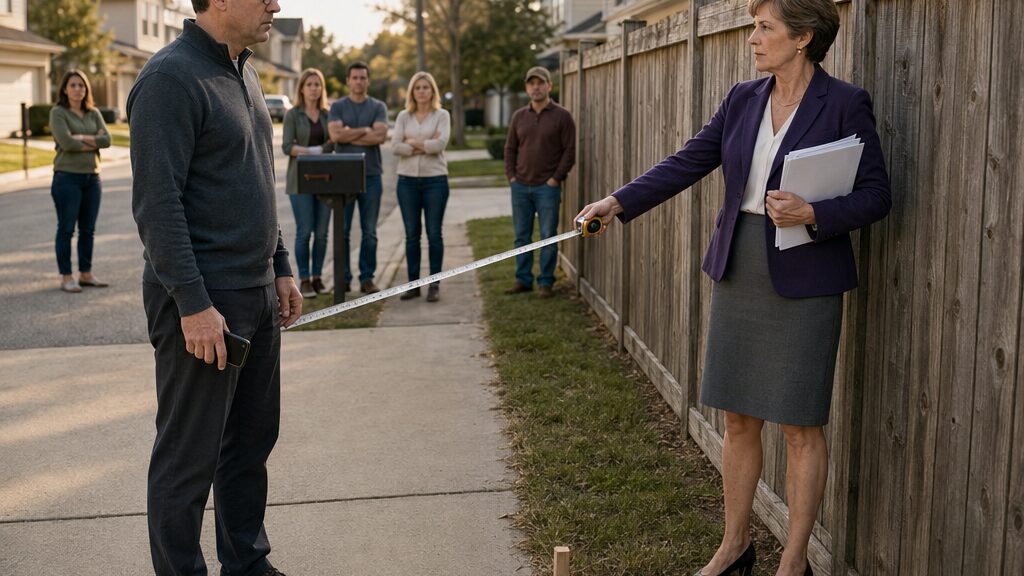
The tape measure snapped tight against the fence post, and Kathleen Roberts looked down as though it had delivered a verdict.
“Two inches,” she said.
Patrick Lewis stood halfway up his driveway with his keys still in one hand. He had come outside because he had seen three people gathered beside his fence: Kathleen in a purple blazer too formal for a Friday afternoon, a board member holding a clipboard, and a neighbor pretending to check a mailbox that had already been emptied.
Kathleen let the metal tape retract six inches, then pulled it out again.
“Actually, just under two and a quarter.”
Patrick looked at the fence. Eleven years of sun had silvered the upper edges of the cedar boards. One post leaned slightly inward near the back corner, but the line itself was straight. He had paid for it when he put in the pool. He remembered the contractor stringing orange line across the dirt while his daughter, still in elementary school then, had asked whether the backyard would look like a hotel.
“Two inches into what?” Patrick asked.
“The drainage easement.”
Kathleen pointed toward a narrow strip of grass running behind the lots.
Patrick stepped closer. “And this became a problem today?”
Her mouth tightened.
“It became an enforcement issue when it was documented.”
The board member shifted the clipboard against his hip. Across the street, the neighbor finally gave up pretending to examine the mailbox.
Kathleen reached into a leather portfolio and handed Patrick a laminated page. A section had been highlighted in yellow.
He read it once.
Then again.
“Three hundred dollars a day?”
“If the violation remains after Friday.”
Patrick looked up. “This is Friday.”
“Next Friday.”
“You’re giving me seven days to move an eleven-year-old fence.”
“To correct an encroachment.”
Patrick felt the first pulse of anger beneath his ribs. It was familiar, and because it was familiar, he distrusted it. Years ago, at work, he had raised a complaint about inventory reports being altered to hide missed targets. Within a week, people had stopped discussing the reports and started discussing him. Difficult. Rigid. Unable to let things go.
He had learned something from that.
Maybe the wrong thing.
He folded the notice once, carefully, then stopped when he realized it had been laminated.
“Who requested the inspection?”
Kathleen glanced toward the fence.
“That isn’t relevant.”
“It is to me.”
“A drainage review identified a potential obstruction.”
“Who requested it?”
“Patrick.”
She said his name softly, almost kindly, which irritated him more than if she had raised her voice.
“This subdivision has rules because inconsistency creates liability. One owner gets an exception, then another owner wants one. Soon nobody knows what standards mean.”
“You’ve walked past this fence for eleven years.”
“That doesn’t make it compliant.”
“No,” Patrick said. “It makes the timing interesting.”
The board member looked down at his clipboard.
Kathleen’s expression changed by less than an inch, but Patrick saw it.
“You can move the fence yourself,” she said. “Or the association can arrange removal and charge the cost back to your account.”
Several words landed at once.
Arrange removal.
Charge the cost.
Patrick looked toward the two neighbors now watching openly from the sidewalk.
Humiliation came quietly. Not as heat in his face, but as an awareness of posture. Where to put his hands. Whether speaking louder would make him look guilty. Whether silence made him look weak.
He lowered his voice.
“I want the exact authorization in writing.”
Kathleen blinked. “You have the notice.”
“I want the board action authorizing removal. I want the inspection reference. I want the easement map you relied on. And I want the date the daily fine can legally begin under the association documents.”
“We are not going to litigate this in your driveway.”
“I didn’t ask to.”
“You are making it more complicated than necessary.”
Patrick took out his phone.
Kathleen stiffened. “Are you recording me?”
“I’m photographing the measurement.”
He crouched beside the fence line and held the phone low enough to capture the tape crossing the property marker. The metal blade trembled in the breeze. Two inches. Maybe a little more.
He took three photographs.
What bothered him was that the measurement did not look invented.
He had expected, somewhere beneath his anger, to find that Kathleen was bluffing. That the fence sat comfortably within the boundary and the whole confrontation was a mistake.
It did not.
The post crossed the marked line.
Barely.
But visibly.
Patrick stood.
“All right,” he said.
Kathleen seemed almost surprised.
“All right?”
“It may be over.”
“It is over.”
“That isn’t the same sentence.”
The neighbor across the street laughed once before disguising it as a cough.
Kathleen’s eyes moved toward him, then back to Patrick.
“You have until next Friday.”
She opened her portfolio again and removed a second sheet.
This one was not laminated.
Patrick took it.
NOTICE OF INTENT TO CURE PROPERTY VIOLATION.
Below the heading was his address, the fence description, and a paragraph stating that failure to cure could result in association-arranged removal at the owner’s expense.
He skimmed downward.
A company name appeared near the bottom.
BRIGHT YARD SERVICES.
Patrick read it twice.
“What is this?”
“The vendor available if the association has to act.”
“You already selected a removal company?”
“We maintain vendor relationships.”
“My deadline hasn’t started.”
“It has started.”
“You just said I have until next Friday.”
“And if you fail to comply, we need to be prepared.”
Patrick looked at the board member.
“Was this approved in a meeting?”
The man’s lips parted, but Kathleen answered first.
“The association is not required to convene a special meeting for every enforcement step.”
“That wasn’t my question.”
“Patrick, the more combative you become, the less productive this is.”
There it was.
Not angry.
Not uncooperative.
Combative.
He felt an old office conference room return to him: a supervisor folding his hands and telling Patrick that his “tone” had become the issue after Patrick produced the wrong numbers in the right spreadsheet.
He almost handed the paper back.
Almost said fine.
Almost decided he would call a fence company Monday, pay whatever it cost, move the line, and keep his name out of everyone’s mouth.
Instead he looked at the bottom of the notice again.
A small line of print sat beneath the vendor name.
Authorization date.
Patrick’s eyes stopped.
He checked his phone.
Friday, June 12.
Then the paper.
June 10.
He read it once more.
Two days earlier.
Before Kathleen had stood in his driveway.
Before the tape measure had snapped tight.
Before he had been told he had a week to comply.
Patrick lifted the notice.
“Kathleen.”
She was already closing her portfolio.
“What?”
“When was Bright Yard authorized?”
Her hand paused on the zipper.
“The date is on the form.”
“I know.”
For the first time that afternoon, Kathleen did not answer immediately.
Patrick looked from the date to the two-inch mark beside the fence.
The violation might be real.
But somebody had authorized the company that would remove it before anyone had supposedly given him a chance to fix it himself.
Chapter 2: By Tuesday, the Fence Was Gone
Patrick knew something was wrong before he turned into his driveway.
The backyard looked too open.
For eleven years, the cedar fence had cut a clean horizontal line behind the house. Now rooftops from the next street appeared where there had always been wood.
Patrick braked so hard his laptop bag slid off the passenger seat.
He left the car crooked in the driveway.
The side gate was gone.
So were fourteen fence panels.
Mud tracks crossed the lawn in two dark ruts, flattening a strip of grass near the pool equipment. One post remained snapped at ground level. Another leaned over a torn hole packed with wet clay.
Patrick stood still.
Tuesday.
Four days after the measurement.
Three days before the deadline Kathleen herself had named.
A truck door slammed near the rear alley.
Patrick moved through the open gap.
A man in a work shirt was lifting a section of cedar into a trailer.
“Stop.”
The man turned.
“Excuse me?”
“Who hired you?”
The crew supervisor glanced toward the trailer, then back at Patrick.
“HOA work order.”
“This is my fence.”
The man wiped one hand on his pants. “We were told it was association-authorized removal.”
“By whom?”
“You need to talk to management.”
Patrick took out his phone.
The supervisor frowned. “Hey, don’t put me online.”
“I’m taking pictures of my yard.”
Patrick photographed the ruts, the broken post, the open pool area, the stacked panels. He made himself move slowly.
“What company?”
The man pointed toward the truck.
The logo was green and white.
BRIGHT YARD SERVICES.
Patrick felt the paper from Friday in his mind before he pictured it.
Authorization date: June 10.
He photographed the truck.
The supervisor lowered his voice.
“Look, sir, I don’t know the dispute. We got a work order.”
“Today?”
“No.”
“When?”
The man hesitated.
Patrick waited.
“Last week.”
There was no satisfaction in hearing it.
Only a hardening.
At his kitchen table, Patrick opened the brown folder where he had placed every HOA notice he had received since buying the house. He found Friday’s document and laid his phone beside it.
Bright Yard.
Same name.
The damage outside remained visible through the windows. Without the fence, the backyard seemed exposed in a way that was almost indecent. A neighbor walking a dog slowed near the open side yard, looked in, then looked away too late.
Patrick called the management office.
The property manager answered after eleven minutes on hold.
“I need the board authorization for removal at my address.”
A pause.
“Mr. Lewis, I see an enforcement action.”
“I know what you see. I want the authorization.”
“The vendor work was board-authorized.”
“On what date?”
“I don’t have that in front of me.”
“My compliance deadline was Friday.”
“I understand you’re upset.”
“My fence was removed Tuesday.”
“The notes indicate noncompliance.”
“What notes?”
Another pause.
Patrick heard keyboard clicks.
“I can’t interpret board deliberations for you.”
“I’m not asking you to interpret anything.”
“Mr. Lewis—”
“Send me the authorization.”
“I can send you the owner-account documents available through the portal.”
“That isn’t what I asked.”
The manager’s voice cooled.
“Then you may need to submit a formal records request.”
Patrick closed his eyes.
He could hear his own breathing.
“All right,” he said. “Send me the request procedure.”
The manager sounded relieved.
That relief bothered him almost as much as the fence.
At 4:18 that afternoon, an email arrived from the HOA.
The subject line read COMMUNITY STANDARDS UPDATE.
Patrick opened it.
The message did not name him, but it did not need to.
Recent enforcement activity, it said, had resulted from a homeowner’s failure to timely correct an easement encroachment. The board regretted any inconvenience but remained committed to consistent standards protecting drainage access and property values.
Patrick read the phrase failure to timely correct three times.
His deadline was still three days away.
At 5:03, another email arrived.
This one was an invoice.
$1,400.
Association-arranged fence removal.
Vendor: Bright Yard Services.
Patrick sat at the table while the refrigerator hummed behind him.
He could have forwarded everything to the neighborhood email list.
He could have written, She had them lined up before she even measured.
He could have copied every owner and asked why a contractor was dispatched before his deadline.
Instead he saved the invoice as a PDF.
Then he printed it.
That was his habit when something mattered. Screens changed. Portals updated. Attachments disappeared. Paper stayed where you put it.
The invoice came out warm.
He laid it beside the removal notice.
Same logo.
Same narrow gray line beneath the heading.
Same peculiar spacing around the invoice number.
He wrote the dates in the margin.
June 10: vendor authorization.
June 12: driveway measurement.
June 16: removal.
June 19: stated deadline.
He stared at the sequence.
The violation itself could be genuine.
That no longer answered the larger question.
Near nine that night, Patrick went to the hall cabinet for an old property packet. He wanted the original fence approval, anything showing what had been submitted eleven years earlier.
The cabinet was crowded with tax folders, appliance manuals, insurance renewals, and HOA packets he had never thrown away because throwing away official paper made him uneasy.
He found the fence approval in a faded envelope.
Behind it sat an annual association packet from the previous spring.
Patrick almost pushed it aside.
Then a green-and-white logo on one page caught his eye.
Bright Yard Services.
He carried the packet to the kitchen.
The entry was small, buried among landscaping and maintenance expenses.
The format of the vendor reference looked wrong in a way he could not immediately name.
Patrick picked up the $1,400 invoice and set it beside the old packet.
The numbers were different.
The job descriptions were different.
But the invoice structure was nearly identical.
And suddenly Patrick knew why the new bill had felt familiar before he had ever seen Bright Yard’s truck.
Chapter 3: The Boring Records Nobody Wanted to Read
The number was forty-one thousand dollars.
Patrick found it at 11:27 on a Wednesday night, six days after he submitted his formal records request and nine minutes after deciding he was too tired to trust his own eyes.
BRIGHT YARD SERVICES — DRAINAGE AND GRADING.
$41,000.
He leaned closer to the laptop.
The reserve ledger had been exported as a PDF that seemed designed to punish anyone foolish enough to inspect it. Narrow columns. Tiny dates. Abbreviated descriptions. Page numbers missing from two sections. He had spent hours moving between printed invoices and bank reconciliation statements, making notes in pencil because ink felt too permanent for conclusions he had not earned.
Now the contractor that removed his fence sat beside a five-figure reserve withdrawal.
Patrick did not smile.
He printed the page.
The HOA had granted him access to eighteen months of records after three emails, a formal request, and a reply from Kathleen reminding him that association documents could not be used to “harass volunteers or vendors.”
The first stack had arrived electronically.
The second required an appointment in the clubhouse records room.
The property manager had watched him sign the access log as though he were checking into a laboratory.
“You understand some information may be redacted.”
“I understand.”
“And vendor files are proprietary in part.”
“I’m asking for association financial records.”
“I’m just clarifying expectations.”
Patrick had learned to recognize that sentence.
It meant someone wanted the boundary of a conversation established before the conversation revealed why.
He carried his brown folder to a folding table beneath a framed photograph of the subdivision entrance. For three hours, he read what most owners never read: reserve schedules, check registers, monthly reconciliations, invoice approvals, landscaping adjustments, emergency drainage notes.
The boring stuff.
The kind of paperwork people voted to receive by email and never opened.
By the following Wednesday, his dining table had disappeared under it.
Patrick placed the $41,000 ledger page beside the $1,400 fence invoice.
Bright Yard.
Same company.
That alone proved nothing.
A contractor could remove fences and perform grading. A landscaping company could handle drainage. The world was full of ordinary explanations.
Patrick wrote at the top of a yellow pad:
DO NOT DECIDE FIRST.
He underlined it.
At work, his job involved tracing warehouse delays through systems that rarely failed in dramatic ways. A missing shipment was almost never caused by one spectacular mistake. It was usually three small ones. A scan performed late. A number entered wrong. A pallet placed two bays over.
Tiny gaps.
He opened the April bank reconciliation.
The first Bright Yard payment was $13,668.
The second was $13,671.
Patrick stopped.
He searched again.
A third payment appeared eight days later.
$13,661.
He added them.
$41,000 exactly.
Patrick sat back.
Three disbursements.
He pulled the supporting invoices.
The first described drainage correction, soil redistribution, and rear easement grading.
The second described drainage remediation, soil recontouring, and common easement work.
The third described grading correction and drainage stabilization.
Not identical.
Close enough to feel rehearsed.
He spread the three invoices across the table.
The totals differed by ten dollars between the highest and lowest.
Ten dollars.
Patrick looked toward the open folder containing photographs from his fence line.
Two inches.
A difference small enough to dismiss.
A difference large enough to use.
His phone rang.
Melissa Baker.
Patrick watched it ring twice before answering.
“Hey.”
“Are you home?”
“Yes.”
“I saw the fence.”
He looked through the window toward the open yard.
“Most people have.”
“That message Kathleen sent was unnecessary.”
Patrick said nothing.
Melissa continued.
“I mean, she didn’t name you.”
“She didn’t have to.”
“No.”
A pause.
“Are you fighting it?”
“I’m reviewing it.”
“What does that mean?”
“It means I’m reviewing it.”
Melissa exhaled softly.
“Patrick, I’m asking because people are talking.”
He almost laughed.
There it was.
The exact reason he had told no one.
“What are they saying?”
“That you refused access. That there was a drainage issue. That you threatened legal action.”
“I didn’t.”
“I’m not saying you did.”
“You called to tell me other people are saying it.”
“I called because sometimes when you go quiet, people fill in the space.”
Patrick looked down at the three invoices.
He could tell her.
He could say: I found forty-one thousand dollars.
He could ask whether she remembered Bright Yard.
Instead he heard the old office whispers in his head. Patrick has a theory. Patrick thinks everyone is crooked. Patrick can’t let anything go.
“I’m handling it,” he said.
Melissa was silent.
Then, “Okay.”
The word carried disappointment rather than agreement.
After they hung up, Patrick returned to the records.
At midnight, the $41,000 looked suspicious.
By one in the morning, it looked less certain.
The payment total matched the reserve withdrawal. That could mean proper accounting. Three disbursements could reflect phases. Similar invoices could result from repetitive work.
He hated how badly he wanted the papers to prove Kathleen wrong.
That desire contaminated everything.
Patrick got up, walked to the sink, and drank water.
When he returned, he started over.
Not with amounts.
With dates.
The first invoice had been approved April 3.
The second, April 11.
The third, April 19.
All three referenced work in the same rear drainage corridor.
He found photographs in a board packet showing grading equipment near common land behind several houses.
So work had occurred.
Another complication.
Not fake work, then.
Maybe not duplicate work.
Patrick wrote:
REAL PROJECT.
Then beneath it:
WHY THREE INVOICES?
At the clubhouse records room the next afternoon, he asked for vendor approval documents.
The property manager’s expression hardened.
“You’ve already received substantial access.”
“I’m looking for the supporting approvals for the April Bright Yard payments.”
“Why that vendor?”
Patrick met her eyes.
“Because I’m matching the ledger.”
“Is this about your fence?”
“It’s about the ledger.”
She folded her arms.
“I need to check what is available.”
Patrick waited.
Twenty-two minutes later, she returned with a thin file.
Too thin.
Inside were copies of invoices, a general insurance certificate, and three approval sheets.
Patrick sat.
The first approval bore a signature at the bottom.
The second had initials.
The third contained a signature again.
He photographed each page.
Back home, he enlarged the images on his screen.
There was a particular way the writer formed the capital R. A long first stroke, then a narrow loop that did not fully close.
Patrick had seen it before.
He opened the scanned fence-removal authorization dated June 10.
At the bottom was an approval notation.
The same narrow loop.
The same unfinished R.
He printed both pages and placed them side by side.
For several seconds, he felt the clean rush of discovery.
Then fear followed it.
Because handwriting resemblance was not proof.
Because real drainage work had happened.
Because the fence really did cross the easement.
Because three payments might have a legitimate explanation.
And because if Patrick was wrong, he was no longer simply a homeowner defending his yard.
He was a man quietly collecting documents about his neighbors while refusing to tell anyone what he suspected.
Patrick closed the brown folder.
His phone lit with a neighborhood notification.
Kathleen had posted a reminder about civility.
Patrick turned the phone facedown.
On the table, the two signatures remained visible beside three invoices whose totals differed by only a few dollars.
He still could not tell whether he was looking at misconduct, careless administration, or the pattern-making instinct of an angry man who desperately wanted his humiliation to mean something larger.
Chapter 4: The First Explanation Was Almost Convincing
“You’re wrong about why this started.”
Melissa Baker said it before Patrick had fully sat down.
The coffee shop was nearly empty, but she kept her voice low. Her cup stood untouched between both hands. Patrick had brought the brown folder despite telling himself he would not show her anything.
He looked at her.
“That’s a strong opening.”
“I knew you wouldn’t come if I said I wanted to talk about neighborhood gossip.”
“You were right.”
“I’m not talking about gossip.”
Melissa slid a folded sheet across the table.
Patrick did not touch it.
“What is it?”
“Read it.”
He unfolded the page.
The heading identified a drainage inspection conducted six weeks earlier. Several rear easements had been photographed after standing water appeared near a common swale. Recommendations included clearing obstructions, correcting grade deviations, and verifying encroachments along three lots.
Patrick’s address was one of them.
He read the paragraph twice.
The fence was mentioned.
Not by Kathleen.
By the inspector.
Patrick looked up.
“Where did you get this?”
“Board packet.”
“I didn’t receive this.”
“It was attached to the May meeting materials.”
“I checked May.”
“You checked the financial packet. This was under maintenance.”
Patrick hated that she knew what he had checked.
Melissa leaned back.
“You think Kathleen invented the problem because of your fence dispute.”
“I think she authorized a contractor before my deadline.”
“That’s different.”
“Yes.”
“But you’ve been talking like the whole drainage issue was fake.”
“I haven’t been talking to anyone.”
“That’s part of the problem.”
Patrick’s jaw tightened.
Melissa saw it.
“I’m not trying to corner you.”
“You brought me here to tell me I’m wrong.”
“I brought you here because you’re building something in your head and refusing to let anyone see it until you’re sure. And while you do that, everyone else is building something about you.”
Patrick folded the inspection sheet along its existing crease.
“The fence still stood eleven years.”
“I know.”
“The deadline still hadn’t expired.”
“I know.”
“Bright Yard was still authorized before Kathleen measured it in front of me.”
“I know.”
The words came more sharply than Melissa intended.
She looked down at her cup.
Then she said, “I also know there really was water behind the Baker lot and two others after that storm in April. The swale wasn’t draining right.”
Patrick said nothing.
Melissa’s last name on the mailbox had never made him think about where her property sat in relation to the rear corridor.
“You had water?”
“Not in the house. Along the back. Enough that my husband wanted someone to look at it.”
The mention of her husband remained casual, almost background, and Patrick did not ask more.
“Did you request the inspection?”
“No. But I supported it.”
That mattered.
Patrick looked again at the page.
Melissa continued.
“I defended Kathleen at the May meeting. Someone complained about the cost of drainage work, and I said people always complain until water reaches their foundation.”
Patrick’s attention sharpened.
“What cost?”
“I don’t remember the exact amount.”
“Was Bright Yard mentioned?”
“I don’t know.”
“Melissa.”
“I said I don’t know.”
For the first time, irritation broke through her careful tone.
Then she exhaled.
“I wasn’t listening that closely. That’s the truth.”
Patrick placed the inspection report on the table.
The coffee shop refrigerator clicked on behind the counter.
“What made you call me?”
Melissa looked through the window toward the parking lot.
“Because I saw Kathleen’s community email about your fence. And I knew the inspection was real.”
“That should make you trust her.”
“It did.”
Past tense.
Patrick waited.
Melissa rubbed one thumb against the paper cup seam.
“Then I remembered another complaint last year. A homeowner said the board was using the same landscaper for work that wasn’t competitively quoted. I told her she was making a neighborhood problem out of paperwork.”
Patrick felt something inside him become very still.
“Who?”
“Does it matter?”
“Yes.”
“She moved.”
“Was the contractor Bright Yard?”
Melissa’s eyes lifted to his.
“I don’t remember.”
That answer sounded honest.
It also sounded worse than a convenient one.
Patrick leaned back.
“You defended Kathleen.”
“Yes.”
“Why?”
“Because she gets things done.”
Melissa said it without apology.
Then, after a moment, “And because I was tired. Every meeting was somebody’s mailbox, somebody’s dues, somebody’s dog, somebody’s paint color. Kathleen would make a decision and the argument would end.”
Patrick looked at the brown folder beside his chair.
“You thought quiet meant solved.”
Melissa’s mouth tightened.
“I thought quiet meant we could live here.”
The sentence stayed between them.
Patrick recognized too much of himself in it to answer quickly.
Back home, he reopened the inspection report and compared it with the property plat.
The rear easement was genuine.
The fence post crossed it.
He took a tape measure outside.
The yard still looked wounded where the panels had been removed. Mud had dried in the tire ruts. Patrick hooked the tape at the property marker and drew it toward the old fence line.
Two inches.
A little more in one place.
He crouched there, one knee pressing into the grass.
For days, he had treated the measurement as a symbol of absurdity. Two inches against three hundred dollars. Two inches against eleven years.
Now the number changed shape.
Kathleen had not invented the line.
That did not absolve the removal.
It complicated it.
Patrick stayed crouched until a car slowed on the street.
He stood and carried the tape measure inside.
At his desk, he opened a document titled DRAFT TIMELINE.
The first sentence read:
Kathleen fabricated an easement emergency to force premature removal.
Patrick stared at it.
Then deleted fabricated.
He replaced it with accelerated enforcement following a genuine drainage inspection.
Less satisfying.
More accurate.
He hated how much relief he had felt when the $41,000 appeared. Hated the clean moral arrangement it had offered him: she was corrupt, he was right, the fence was proof.
But the inspection existed.
Real work had happened.
His own strongest theory was too broad.
Patrick spent the next hour separating facts into three columns.
CONFIRMED.
INFERRED.
UNKNOWN.
By the time he finished, the unknown column was longest.
At 3:40 that afternoon, he searched the county contractor registry.
Bright Yard Services appeared immediately.
Active registration.
Insurance on file.
Mailing address partially displayed.
Patrick clicked the full record request link.
The county site required an account. He created one.
The address populated.
He read the street name.
Then sat back.
One street over.
Kathleen’s street.
Patrick opened the subdivision directory.
Roberts.
Same street.
He compared the numbers.
Not the same house.
At least not from the partial record.
He felt foolish for the disappointment.
Then he noticed the county listing had two addresses: business location and registered mailing address. The mailing address was truncated on the public summary.
He submitted a request for the full registration record.
The next morning, an email from the county records office arrived with a pickup notice.
Patrick drove there during lunch.
The clerk handed him three pages.
He stood beside a counter and read the first.
Bright Yard Services.
Active.
Insured.
Registered mailing address:
Kathleen Roberts’s street.
Patrick’s eyes moved to the house number.
He stopped breathing for a second.
Then he checked the subdivision directory on his phone.
Same number.
Not near her house.
Not across from it.
Her house.
Chapter 5: One Street Over, Then the Same House Number
The clerk tapped the paper with one fingernail.
“Is there a problem?”
Patrick looked up.
“What?”
“You’ve been staring at that address.”
He lowered the registration record.
“No. I’m verifying something.”
The clerk nodded toward the counter.
“If you need business ownership filings, those are separate.”
Patrick’s pulse slowed.
Ownership.
He had almost skipped directly from address to conclusion.
“Can I request those?”
“You can search the registration number. State business records are public.”
Patrick thanked her and walked outside with the papers inside his brown folder.
In the parking lot, he opened his phone.
Bright Yard Services was not fake.
The state registry showed an active limited liability company. The dates went back more than three years. Insurance records matched. There were annual filings.
Patrick sat in his car and read carefully.
The registered agent was not Kathleen Roberts.
The organizer was not Kathleen Roberts.
The listed managing member shared her surname.
That was all he knew.
A surname was not a relationship.
Not yet.
He closed the browser before he could search social media and turn inference into certainty.
On the drive home, Kathleen’s house appeared at the end of her street.
Patrick slowed without meaning to.
A dark pickup sat in the driveway.
No company logo.
No trailer.
Nothing dramatic.
Just a house with trimmed shrubs and two ceramic planters near the steps.
He felt embarrassed by his own expectation.
Corruption, if that was what this was, did not owe him a villain’s set.
At his kitchen table, Patrick laid out the record.
Exact house number.
Bright Yard Services.
Kathleen Roberts.
He wanted to call Melissa.
Instead he wrote:
CONFIRMED: Bright Yard uses K. Roberts residential address as registered mailing address.
Then:
UNKNOWN: Ownership relationship.
He searched the company filings again.
The managing member’s surname matched Kathleen’s. An older annual filing included a first initial and middle initial.
Patrick found a public property record connected to the same surname.
Then an obituary from several years earlier.
Family names appeared.
He stopped.
The chain was suggestive, not clean.
He closed the page.
At five that afternoon, Melissa knocked on his door.
Patrick opened it but did not invite her in immediately.
She noticed the hesitation.
“You found something.”
“What makes you say that?”
“You’re holding the door like a security guard.”
He stepped aside.
At the kitchen table, she saw the contractor registration.
Her face changed before she spoke.
“That’s Kathleen’s address.”
“Yes.”
Melissa sat.
Patrick remained standing.
“The company is real,” he said. “Active registration. Insurance. State filings.”
“That doesn’t make this better.”
“It matters.”
“Patrick.”
“It matters.”
He sat across from her.
“The company is tied to someone with Kathleen’s surname. I think a family member. I don’t have enough to say more than that.”
Melissa looked at the page again.
“You’re defending her now?”
“No.”
“It sounds like it.”
“I’m trying not to accuse someone of stealing money because I found an address.”
Melissa gave a short, frustrated laugh.
“You have three payments.”
“I have three payments for work that may have been done.”
“You have your fence.”
“I have a real encroachment.”
“You have a contractor authorized before your deadline.”
“Yes. That is a fact.”
Melissa pushed back from the table.
“You know what I think?”
Patrick waited.
“I think you’re so scared of being called difficult that you keep moving the line for what counts as enough.”
The words struck harder because he had no immediate answer.
Melissa’s voice softened.
“I did the opposite. I kept telling myself nothing was enough to question Kathleen. A complaint wasn’t enough. One vendor wasn’t enough. Somebody moving away wasn’t enough.”
She looked down.
“I liked that meetings ended on time.”
Patrick watched her.
There it was again.
Not courage arriving from nowhere.
Guilt.
“I told that homeowner last year she was making things ugly,” Melissa said. “I said if she had real evidence, she should bring it. She said she had invoices. I never asked to see them.”
Patrick looked toward the folder.
“Why are you telling me now?”
“Because I recognized the company name after you asked me.”
The room went quiet.
“Bright Yard?”
Melissa nodded.
“I found an old email. She mentioned them.”
Patrick’s first reaction was anger.
Not at Kathleen.
At Melissa.
“You said you didn’t remember.”
“I didn’t. Then I searched.”
“And you waited until now?”
“I wanted to be sure.”
The irony sat between them.
Patrick almost smiled.
Neither of them did.
His phone buzzed.
An HOA notice.
EMERGENCY BOARD SESSION.
The meeting was scheduled for forty-eight hours later.
Agenda:
Vendor confidentiality.
Owner records conduct.
Pending enforcement matters.
Patrick read it twice.
Melissa leaned over.
“She knows.”
“She knows I requested the vendor files.”
“How?”
“Management office.”
“Can they do that?”
“They can tell the board an owner requested records.”
Melissa looked toward the registration page.
“She’s getting ahead of you.”
Patrick thought of the community email after his fence removal.
Failure to timely correct.
He thought of the driveway.
Combative.
Same pattern.
Define him first.
That evening, Patrick copied every confirmed document into a separate folder.
No handwriting theory.
No accusation of theft.
No claim that the drainage issue was fake.
Only records he could explain without guessing.
The next morning, he received a call from Stephen Walker.
The HOA treasurer had spoken to Patrick only twice in eight years.
“Can we meet?”
“About what?”
“The emergency session.”
“Say it now.”
Stephen lowered his voice.
“I’d rather not.”
Patrick almost refused.
Then he remembered Melissa saying that quiet created empty space.
They met near the clubhouse parking lot after dark.
Stephen remained beside his car.
He looked older than Patrick remembered, though perhaps worry had simply made him visible.
“You requested Bright Yard’s approvals.”
“Yes.”
“And contractor registration.”
“Yes.”
Stephen rubbed his forehead.
“Kathleen says you’re preparing a retaliatory accusation.”
“I’m preparing documents.”
“That answer is exactly why she’s worried.”
Patrick said nothing.
Stephen looked toward the clubhouse.
“I processed the payments.”
“All three?”
Stephen’s head turned sharply.
So Patrick knew.
That reaction was enough.
Patrick continued.
“Were there three scopes?”
“I had invoices.”
“That isn’t what I asked.”
Stephen’s shoulders dropped.
“There were work phases.”
“Documented where?”
“I don’t know.”
“You’re the treasurer.”
“I’m a volunteer.”
Patrick felt anger rise.
Stephen heard it before Patrick spoke.
“I know how that sounds.”
“Do you?”
“We get forty emails about pool keys and late fees. Contractors want payment. The property manager says paperwork is in order. The president confirms the work. I sign.”
“Without asking?”
“I asked sometimes.”
“Sometimes.”
Stephen looked at him.
“You think I wanted this job?”
“No. I think you kept it.”
That landed.
Stephen turned away.
For several seconds, neither man spoke.
Then Patrick opened the brown folder and removed a copy of the contractor registration.
He did not hand it over.
He only showed the address.
Stephen stared.
“What is that?”
“You tell me.”
His face lost color.
“I didn’t know.”
“Was the relationship disclosed?”
Stephen did not answer.
Patrick waited.
Cars passed on the main road beyond the subdivision wall.
Finally Stephen said, “There was no disclosure form.”
Patrick closed the folder.
Stephen caught his arm lightly before he turned away.
“Patrick.”
He stopped.
“I mean it. There was no disclosure form.”
The distinction in Stephen’s voice was worse than a denial.
Not no relationship.
No form.
Patrick looked back at the dark clubhouse windows.
The next question was no longer whether Kathleen knew Bright Yard.
It was how many decisions the board had approved without ever asking why the president’s family-linked contractor was being paid from their reserves.
Chapter 6: The Meeting Where Silence Became Evidence
Kathleen opened the emergency meeting by saying Patrick’s name.
“Before we begin,” she said, “I need to address misinformation arising from a recent enforcement dispute involving Mr. Lewis.”
Thirty-seven homeowners sat in folding chairs facing the board table.
Patrick stood in the back with the brown folder under one arm.
He had not spoken yet.
Kathleen had already defined him.
She wore a navy blazer this time. No gavel. The absence felt deliberate.
“This association will not permit confidential vendor information to be used as retaliation against volunteers performing their duties.”
A murmur moved through the room.
Patrick saw Melissa three rows from the front.
Stephen sat at the board table, looking down.
Kathleen continued.
“Mr. Lewis was cited for a documented easement encroachment. Rather than simply correct the violation, he initiated expansive records requests and has now raised unsupported implications about association vendors.”
Patrick felt every face turn.
He could have interrupted.
He did not.
The old instinct said wait until you are unassailable.
The newer one said silence was already being used.
Kathleen finished.
“Owner comments will be limited to three minutes.”
Patrick walked forward.
He placed the folder on the small table reserved for residents.
Kathleen looked at it.
“Three minutes.”
“I’ll start with where I was wrong.”
The room changed.
Not loudly.
But Patrick felt it.
Kathleen’s expression tightened.
Patrick held up the inspection report Melissa had given him.
“The drainage concern was real. An independent inspection identified a problem in the rear easement. My fence did cross the marked line.”
Someone whispered behind him.
Patrick continued.
“I believed, at first, that the entire violation had been fabricated to target me. That belief was wrong.”
Kathleen leaned back.
For one second, satisfaction appeared in her face.
Patrick set the inspection report down.
“The fence was still removed before the compliance deadline stated to me in my driveway.”
He placed the June 10 authorization beside the June 12 notice.
“And Bright Yard Services was identified for removal before that deadline—and before the public measurement.”
Kathleen raised a hand.
“This is precisely the kind of selective presentation—”
Patrick turned to her.
“Is either date wrong?”
She stopped.
“Context matters.”
“I agree.”
He opened the folder.
“That’s why I’m not accusing you of inventing the drainage problem.”
A homeowner near the aisle said, “Then what are you accusing her of?”
Patrick looked toward the voice.
“I’m asking why the same vendor was used.”
Kathleen’s chair scraped faintly.
Patrick laid down the $1,400 fence invoice.
Then the reserve ledger.
A few people leaned forward.
“Bright Yard removed my fence. Bright Yard also received forty-one thousand dollars from association reserves for drainage and grading.”
The room broke into overlapping voices.
Kathleen spoke over them.
“That project was approved.”
“I know.”
“It was completed.”
“I know work occurred.”
This answer seemed to unsettle her more than denial would have.
Patrick placed three invoices side by side.
“Three April payments.”
Stephen closed his eyes.
Patrick did not look at him.
“The totals differ slightly. The descriptions are similar. I am not telling you that proves fraud.”
Kathleen seized the word.
“Exactly.”
Patrick nodded.
“Exactly.”
A silence followed.
He took a narrow strip of white paper from the folder and placed it beside the invoices.
Two inches long.
Several people craned to see it.
Kathleen stared.
Patrick touched the strip with one finger.
“This is about how far my fence crossed the marked easement.”
No one spoke.
“That distance was enough to justify a three-hundred-dollar daily fine, physical removal before my stated deadline, and a fourteen-hundred-dollar charge to my account.”
He moved his finger from the strip to the invoices.
“The difference between the highest and lowest of these three payments is ten dollars.”
Someone in the second row said, “What?”
Patrick continued.
“I’m not saying small differences prove wrongdoing. I’m saying this board demanded precision from me while apparently accepting repeated payments to the same vendor without transparent disclosure.”
Kathleen stood.
“Vendor relationships are confidential.”
Patrick looked at her.
“Not when owners’ reserve money is involved.”
“They are private business records.”
“Then explain the payments without disclosing proprietary details.”
“You are not entitled to interrogate contractors.”
“I’m not interrogating a contractor.”
His voice remained low.
“I’m asking my board.”
The room went still again.
Kathleen’s face flushed.
“This meeting will not become a trial.”
“No,” Patrick said. “It shouldn’t.”
He looked toward Stephen.
“It should become a meeting.”
Stephen raised his head.
Patrick had not planned what came next.
That frightened him.
He had planned documents.
Dates.
Questions.
Not another person’s choice.
“Stephen,” Patrick said, “were three payments processed?”
Kathleen turned sharply.
“Do not answer that outside the agenda.”
The treasurer stared at the table.
A board member whispered something to him.
Stephen moved his microphone closer.
“Yes.”
The word was quiet.
The room erupted.
Kathleen struck the tabletop with her palm.
“Order.”
Patrick did not move.
Stephen continued.
“There were three disbursements.”
Kathleen faced him.
“You are omitting that invoices were submitted.”
“I know.”
“You reviewed them.”
“I processed them.”
“That is the treasurer’s function.”
Stephen looked out at the homeowners.
“No. It’s part of the function.”
Kathleen’s voice dropped.
“Stephen.”
He flinched at his own name.
Then he said, “I did not verify separate written scopes for all three phases.”
The murmuring deepened.
A homeowner asked, “Why not?”
Stephen swallowed.
“Because the property manager said the file was complete. Because the work was visible. Because Kathleen confirmed the invoices.”
Patrick watched him.
No villain.
No hero.
Just a man listing the small permissions by which responsibility disappeared.
Kathleen stood again.
“This is inappropriate. We are discussing internal personnel and vendor matters.”
“Vendor matters paid from reserves,” Melissa said from the audience.
Kathleen’s gaze found her.
“Melissa, please.”
The familiarity in those two words revealed more than Patrick expected.
Melissa did not sit back.
Kathleen reached for the agenda.
“I am moving to adjourn this meeting pending counsel review.”
Several homeowners objected at once.
Patrick felt the room tipping toward chaos.
This was the moment he had always hated.
Facts dissolving into sides.
Voices replacing sequence.
He picked up the microphone.
“I need to correct one more thing.”
The volume dropped unevenly.
Patrick looked at the crowd.
“I kept this to myself.”
Melissa watched him.
“I found the reserve entry days ago. I found the three payments. I didn’t tell neighbors because I was afraid of being wrong.”
Kathleen gave a short laugh.
“At least we agree on something.”
Patrick turned toward her.
“And because I was afraid of being called vindictive.”
Her smile disappeared.
He looked back at the room.
“That silence helped no one. It gave rumors room. It let people assume what they wanted about me. It also meant no one else could check my work.”
He opened the folder again.
“I’m not asking you to trust me. I’m asking for an independent review.”
A homeowner near the front nodded.
Another asked, “What about the vendor address?”
Patrick’s hand stopped.
Kathleen went very still.
He had not introduced it yet.
The room sensed that.
Patrick removed the contractor registration.
“This is where I need to be careful.”
Kathleen spoke immediately.
“This document contains private family information.”
The room changed.
Not because of what Patrick had said.
Because of what she had.
Melissa stood.
Slowly.
Kathleen looked at her with something close to warning.
Melissa ignored it.
“Patrick,” she said, “what address is on the registration?”
He hesitated.
This was the line.
The easy version would be dramatic.
Say the number.
Let the room explode.
But the company was real. The relationship required precision.
Patrick held out the page.
“I think someone else should read it.”
Melissa walked forward.
She took the record.
For a moment, only paper moved.
Her eyes tracked the lines.
“Bright Yard Services,” she read.
Kathleen pushed back her chair.
“Melissa.”
Melissa looked up.
“Is this record false?”
Kathleen’s mouth opened.
No answer came.
Melissa lowered her eyes to the page again.
Then she faced the homeowners.
“The registered mailing address is one street over.”
A murmur.
She read the street name.
Several people turned toward Kathleen.
Melissa’s voice became quieter.
“And the house number…”
She stopped.
Patrick saw her expression change, though she already knew what she was holding.
Kathleen stood rigid behind the table.
Melissa looked directly at her.
Then she asked the room, “Would someone like to explain why this contractor is registered to Kathleen Roberts’s exact home address?”
Chapter 7: What Kathleen Was Protecting Was Not Just Money
Kathleen asked for five minutes before the board reconvened.
Not five minutes with the board.
Five minutes with Patrick.
The clubhouse had emptied into clusters after Melissa read the address aloud. Homeowners stood in the hallway and parking lot speaking in lowered voices that carried anyway. Stephen remained at the board table with his hands folded around a paper cup he had not drunk from.
Kathleen waited beside the door to the small storage room.
“Five minutes,” she repeated.
Patrick looked at Melissa.
She did not nod or shake her head.
That helped.
He followed Kathleen inside.
The room smelled of dust and chlorine tablets. Folding tables leaned against one wall. A stack of holiday decorations filled the corner.
Kathleen closed the door but did not lock it.
“Bright Yard belongs to my nephew.”
Patrick said nothing.
She seemed to have expected surprise.
When none came, she continued.
“He started the company after losing a job. He was behind on his mortgage. His marriage was falling apart.”
“Does the board know?”
“Some people knew he was family.”
“That isn’t what I asked.”
Kathleen looked away.
“No.”
The word landed softly.
Patrick leaned against a folded table.
“Why use your address?”
“He couldn’t keep business mail at the rental yard. Things disappeared. I let him use mine.”
“And the forty-one thousand dollars?”
“He did the work.”
“I know work was done.”
“He bid below the company we used before.”
“Was there another bid?”
Kathleen’s face tightened.
“There were estimates.”
“Written?”
“Patrick.”
“Written?”
“One.”
He let the silence answer for her.
Kathleen folded her arms.
“You think this is simple because you have pages in a folder.”
“No.”
That stopped her.
Patrick continued.
“I thought it was simple. I was wrong.”
Outside, a chair scraped across the clubhouse floor.
Kathleen lowered her voice.
“The drainage problem was getting worse. People had water sitting behind their lots. The prior contractor wanted more than we could afford without another assessment.”
“So you called your nephew.”
“Yes.”
“And disclosed the relationship?”
“I told myself everyone knew.”
Patrick looked at her.
Kathleen’s jaw hardened.
“I know how that sounds.”
“It sounds like something you told yourself because the other version required a vote.”
She flinched.
Not dramatically.
Just enough.
“He needed the work,” she said. “We needed the work done. His price was competitive.”
“Then disclose it.”
“I should have.”
The admission came fast, almost impatiently, as if she resented the simplicity of it.
Patrick looked toward the closed door.
“What about my fence?”
Kathleen did not answer.
He waited.
“That inspection identified it.”
“I know.”
“It was inside the easement.”
“I know.”
“You keep saying that.”
“Because you keep explaining facts I’m not disputing.”
Her expression shifted.
For the first time, Patrick saw not authority but exhaustion.
“I could not look like I was favoring anyone,” she said.
He frowned.
“What does that have to do with me?”
“Everything.”
She stepped closer.
“People were already asking about Bright Yard. Small things. Why them again. Why no new bids. Why certain projects moved faster than others.”
Patrick felt the shape of it before she finished.
Kathleen looked directly at him.
“Then your fence came up in the inspection.”
“And you decided to be strict.”
“I decided to enforce the documents.”
“Before my deadline.”
Her mouth closed.
Patrick felt anger rise again, cleaner now.
“You pushed my removal through.”
“The easement had to be cleared.”
“You pushed it through because being harsh with me made you look impartial.”
Kathleen’s eyes flashed.
“That is not fair.”
“Is it wrong?”
She turned away.
The answer arrived in her silence.
Patrick thought of the mud tracks.
The open yard.
The community email describing him as noncompliant.
Three hundred dollars a day over two inches.
Kathleen spoke without facing him.
“I thought if I enforced everything strictly, no one could say I protected him.”
Patrick understood then.
Not an invented violation.
Not a fake contractor.
Something smaller and, in its way, uglier.
She had hidden favoritism in one place by displaying severity in another.
His property had become evidence for her innocence.
Kathleen looked back.
“I can fix your account.”
Patrick said nothing.
“The fourteen hundred dollars. I can have it withdrawn.”
“That should happen anyway.”
“I can also cover the fence cost privately.”
He stared at her.
She rushed on.
“No admission. No association money. I pay it. You rebuild. We stop this before people turn it into something it isn’t.”
“What is it?”
She looked tired.
“A failure of disclosure.”
“And three payments without separate scopes?”
“I did not create the invoices.”
“That wasn’t my question.”
“I trusted him.”
There it was.
Family loyalty presented as explanation.
Perhaps even truth.
Patrick opened the door.
Kathleen said, “You’re going to destroy him.”
Patrick stopped.
“No.”
“You put this into an audit, his business could collapse.”
“Maybe.”
“He has employees.”
“I know.”
“You don’t know anything about them.”
Patrick turned.
“And you knew almost nothing about me when you used my fence to prove you were tough.”
Kathleen’s face went still.
He left the room.
The board reconvened twenty minutes later.
Patrick did not repeat everything Kathleen had said privately. He did not announce her nephew’s financial problems or turn family trouble into evidence.
He presented the conflict.
The undisclosed relationship.
The address.
The payment pattern.
The accelerated enforcement.
Then he asked for an independent financial review, suspension of disputed vendor payments, and preservation of all records.
A homeowner demanded Kathleen resign immediately.
Another called for police.
Someone near the back shouted that the entire board was corrupt.
Patrick felt the meeting slipping toward the easy version again.
He stood.
“We do not know that.”
Several heads turned.
The angry homeowner frowned.
“What side are you on?”
Patrick looked at the brown folder in his hands.
Months ago, that question would have silenced him.
Now he answered.
“The side where we prove what we say.”
The room quieted unevenly.
Stephen moved that an independent review be commissioned.
Melissa seconded from the floor until someone reminded her she was not a board member, and for the first time that night, a few people laughed.
The motion was reintroduced properly.
It passed.
After midnight, Patrick walked home alone.
The missing fence left his backyard exposed to the streetlight.
He stood on his porch and thought about Kathleen’s offer.
Private repayment.
Quiet repair.
No spectacle.
Once, he would have called that peace.
Patrick took out his phone and emailed the property manager, Stephen, and the full board.
He rejected any private settlement tied to ending the review.
Then he requested written confirmation that the independent audit would proceed.
He pressed send before he could reconsider.
Chapter 8: The Fence Went Back Differently, and So Did Patrick
Six weeks later, Patrick watched a worker drive the first new fence post into the ground.
Not on the old line.
Three inches back.
The written settlement required only that the rebuilt fence clear the easement. Patrick had chosen an extra inch himself.
The worker held up a spacer.
“This good?”
Patrick measured it.
Then laughed under his breath.
“Yeah.”
The worker looked at him strangely.
“Something funny?”
“Long story.”
The yard still carried faint scars from the removal. New grass had taken in some places and failed in others. The pool equipment enclosure had been repaired. The $1,400 charge had disappeared from Patrick’s account after the board voted to withdraw it pending review of the premature removal.
The independent audit had not produced the ending people had predicted in the parking lot.
No dramatic arrest.
No declaration that every dollar had vanished.
It found something less cinematic and more difficult to dismiss: an undisclosed family conflict, weak approval controls, incomplete competitive-bid records, repeated payments whose supporting scopes could not be fully reconciled, and billing adjustments the auditor said lacked sufficient documentation.
Disputed vendor payments were frozen while the association pursued recovery and review.
Stephen resigned as treasurer, then volunteered to answer questions for the transition committee.
Kathleen resigned as president.
She did not move.
That surprised some people more than anything else.
Patrick still saw her.
At the mailbox.
Driving past.
Once, in the grocery store parking lot, where both of them noticed each other and neither pretended otherwise.
She had not apologized publicly.
Patrick no longer required himself to imagine the apology.
The new board scheduled an open homeowner meeting in the clubhouse.
Patrick arrived carrying the brown folder.
It was thicker than when the dispute began. Tabs divided invoices, bank records, inspection reports, correspondence, and audit findings.
Melissa sat near the front.
When Patrick approached, she looked at the folder.
“You planning to run the place now?”
“No.”
“Good.”
He smiled.
The new records committee had three members and a written policy requiring vendor disclosures, documented scopes, and owner access procedures.
When the committee chair called for transfer of supporting materials, Patrick stood.
For a moment, his hand remained on the folder.
He felt the old instinct.
Keep it.
Control it.
Trust paper only when it stays where you put it.
Then he carried it forward.
“This is indexed,” he said. “Copies of everything I used.”
The committee chair accepted it.
Patrick let go.
The folder looked smaller in someone else’s hands.
During owner comments, one man demanded that Kathleen be permanently barred from any committee. Another wanted the association to sue everyone connected to Bright Yard immediately.
Melissa spoke before Patrick did.
“We asked for rules to be followed,” she said. “That has to include us.”
No applause followed.
Just a quieter room.
Patrick preferred it that way.
The meeting approved a new election schedule, independent vendor review requirements, and a process for recovering unsupported charges without making claims beyond the audit.
Nothing felt triumphant.
It felt usable.
Outside, Patrick found Kathleen near the sidewalk.
She held her car keys.
For a second, both stood in the awkward space where neighbors must decide whether history has eliminated ordinary manners.
Kathleen looked toward his house.
“I saw the fence.”
“It’s almost done.”
“You moved it farther than required.”
“One extra inch.”
A faint expression crossed her face.
Not quite a smile.
“Careful,” she said. “People might think you’ve become reasonable.”
Patrick considered answering sharply.
Instead he said, “People think a lot of things.”
Kathleen nodded.
“I suppose they do.”
She walked to her car.
There was no reconciliation in it.
But there was no performance either.
That evening, Patrick cleaned the garage.
Near the workbench, beneath an old level and a box of screws, he found the wooden spacer he had cut during the dispute.
Exactly two inches.
He held it between thumb and forefinger.
Such a small thing.
Enough space for a fence to become a violation.
Enough difference between two invoices to look unimportant.
Enough distance between what someone could justify and what they should disclose.
Patrick almost dropped it into the trash.
Then he changed his mind.
He hung it on a nail above the workbench.
Not as evidence.
Not as a trophy.
A reminder.
Outside, the new fence stood a little farther back than necessary, and for the first time since the tape measure snapped tight in his driveway, Patrick did not feel that yielding an inch meant losing ground.
The story has ended.