The Day the HOA Lawyer Crossed Raymond’s Porch Line and Ruined Himself
Chapter 1: The Boot Lands Beside the Porch Step
The metal parking boot hit Raymond Martinez’s driveway hard enough to make the new porch step vibrate under his feet.
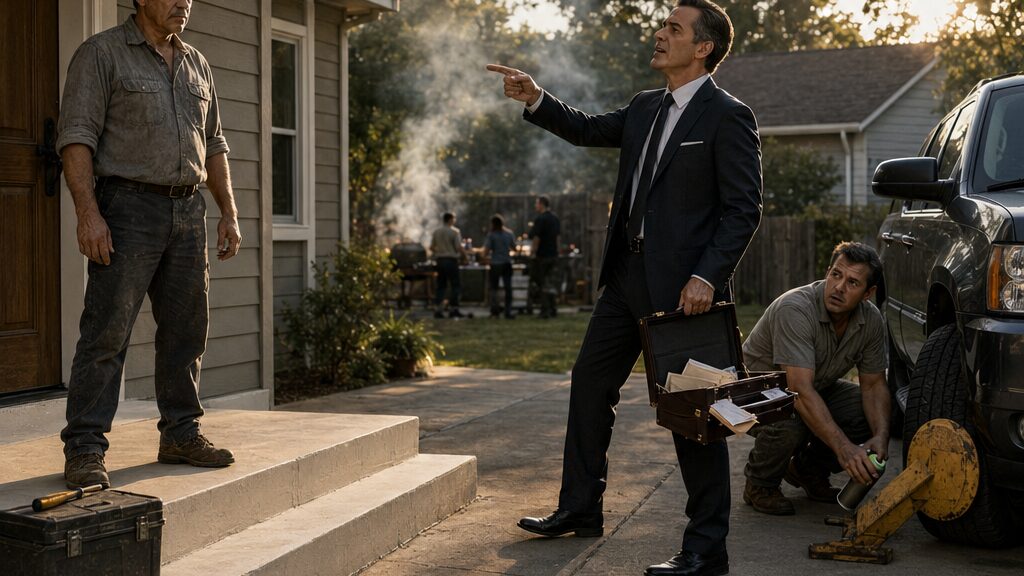
It landed with a flat, ugly clang beside the front tire of his truck, a yellow-black jaw of steel dropped onto clean concrete as if the driveway already belonged to someone else. Raymond stood behind the screen door with barbecue smoke still clinging to his shirt, one hand on the latch, the other tightening slowly around the rag he had been using on the grill tongs.
The man who had dropped the boot straightened his back and looked toward the sidewalk, waiting for permission.
George Scott gave it with a flick of two fingers.
George was dressed too sharply for late-afternoon heat: dark suit, polished shoes, pale shirt, a leather briefcase tucked against his side. He stepped off the public sidewalk and onto Raymond’s driveway with the careful little smile of a man who enjoyed making a trespass look like procedure.
Raymond watched the shoe first.
Not George’s face. Not the briefcase. Not the boot.
The shoe.
The front edge of it crossed the faint saw-cut line near the driveway apron, the place Raymond had measured so many times he could have drawn it from memory in the dark.
Behind the house, the barbecue lid clicked softly as heat shifted the metal. A thin ribbon of smoke climbed over the side gate, smelling of pepper, oak, and meat that had been cooking slowly since noon.
George looked up at the porch and smiled wider.
“Mr. Martinez,” he called. “Your barbecue smell violates community air quality standards.”
Raymond opened the screen door.
It creaked once, then settled behind him.
He stepped onto the newly installed front porch step, the one he had poured and finished himself after tearing out the cracked old concrete. Its edges were square, brushed clean, still pale compared to the older walkway. He had checked the setback twice. Then a third time. Then he had paid for a survey mark because after the last lawsuit, guessing where things belonged was no longer something he allowed himself.
“Get off my property, George,” Raymond said.
George sighed, as if Raymond had disappointed him by choosing the obvious line.
A second man, broader through the shoulders but uncertain around the eyes, stood near the boot with a clipboard strapped to one wrist. A can of neon spray paint hung from his other hand. His work shirt had a private contractor logo and his boots had dust from jobs that probably made more sense than this one.
George held up his briefcase.
“You have been notified repeatedly of ongoing violations.”
“I haven’t been notified of anything today.”
“You will be.” George snapped the latches on the briefcase. Inside were envelopes, thick and white, stacked in rows like ammunition. “Cease-and-desist letters, notice of noncompliance, notice of inspection, and preliminary action regarding vehicle immobilization.”
Raymond looked at the boot on the driveway.
“You brought a parking boot because of barbecue smoke?”
“Because of ongoing noncompliance.” George drew out one of the envelopes and held it between two fingers. “The smoke is today’s most urgent issue. Your backyard barbecue has generated documented air-quality complaints.”
“From who?”
George’s smile did not move, but something behind it tightened.
“The association is not required to expose complainants to retaliation.”
“So no one signed it.”
“That is not what I said.”
“It’s what you meant.”
The contractor shifted his weight. The spray can knocked lightly against his thigh. Raymond’s eyes moved to it, then to the boot, then to the briefcase hanging open in George’s hand. The scene arranged itself in layers: steel for the truck, paint for the concrete, paper for the threat, George’s shoe past the line.
Raymond breathed through his nose.
He had promised himself not to raise his voice on his own porch again. Not for them. Not after last year, when he had spent three months feeling like every engine slowing near his curb was another inspection, another letter, another warning taped where neighbors could read it.
George turned and pointed at the porch step.
“And then there is that.”
Raymond did not look down. “The step?”
“The newly installed front porch extension.” George pulled another paper from the briefcase, this one marked with a red tab. “Preliminary review indicates it extends two inches beyond allowable frontage aesthetics.”
“Frontage aesthetics,” Raymond repeated.
“Two inches matters in a planned community.”
“It’s inside my line.”
George gave a soft laugh. “Your interpretation of the line has been a recurring problem.”
Raymond looked toward the upper corner of his porch, where a small black camera sat beneath the eave. It was angled down at the driveway, not hidden, not dramatic. Just present. The red indicator blinked once.
George followed his gaze and his expression shifted for half a second. Not fear. Irritation.
“You’re recording?” George asked.
“Every inch.”
“That will not help you.”
“It usually does.”
The contractor glanced from George to Raymond. “Mr. Scott, do you want me to—”
“Charles,” George said without turning, “remain ready.”
Raymond took one step down from the porch. His shoe touched the new concrete step, then the walkway. He stopped before the driveway slope and pointed with two fingers toward the faint line near George’s feet.
“You’re past the property line.”
George glanced down theatrically. “Am I?”
“Yes.”
“By how much?”
“Enough.”
George tilted his head. “Funny. You suddenly care about inches.”
The words were meant for the street, though there was no one standing there yet. They were shaped like a performance, loud enough to travel. Raymond could feel the old trick in it: make the homeowner sound unreasonable, then bury him under process.
The barbecue gave a low pop behind the house. Smoke drifted over the gate again, sweet and harmless. George wrinkled his nose as if it were chemical waste.
“Your grill must be extinguished immediately,” he said. “The vehicle must remain in place pending review. The step must not be used until measured by the association’s approved inspector.”
Raymond’s jaw set.
“My grill is legal. My truck is parked on my driveway. My step is inside my property line.”
“That is your position.”
“That is the survey.”
George’s eyes sharpened. “A private survey paid for by you.”
“A court accepted it.”
The contractor’s hand tightened around the spray paint can.
George shut the briefcase with one click. “Charles, mark the tire position and prepare the boot.”
Charles hesitated. “On the vehicle now?”
“Now.”
Raymond moved down one more step. Not fast. Not reckless. Just enough that Charles stopped lifting the boot and looked at him directly.
“Don’t touch my truck,” Raymond said.
George placed himself slightly between Raymond and Charles, still smiling, still too close to the porch step.
“You are being given an opportunity to comply voluntarily.”
“No,” Raymond said. “I’m giving you one.”
George’s smile thinned.
Raymond pointed again at the driveway. “That line. Back over it. Take the boot with you. Put the paint away. Mail whatever nonsense you want from your office.”
“You don’t dictate enforcement protocol.”
“You crossed onto my property.”
“For inspection purposes.”
“You crossed onto my property.”
“For association business.”
Raymond’s voice dropped. “You crossed the line.”
For the first time, George’s face lost its courtroom smoothness. Not much, but enough. A pulse moved in his cheek. He looked past Raymond at the camera, then at the new step, then at the barbecue smoke sliding lazily through the side yard.
“Install it,” George said.
Charles raised the spray paint can and shook it.
The rattle cut through the driveway like teeth in a box.
Chapter 2: The Smell Complaint That No One Signed
Samantha Green’s front door opened at the exact moment George Scott began reading Raymond’s punishment aloud.
“Notice of immediate corrective action,” George declared, lifting the paper high enough for anyone on the street to see the letterhead. “Resident Raymond Martinez is hereby instructed to cease all odor-producing outdoor cooking activity pending review of repeated air quality complaints.”
Samantha stepped onto her porch in house slippers, one hand still holding a dish towel. Her eyes went first to the metal boot beside Raymond’s truck, then to Charles with the neon spray paint, then to Raymond standing motionless near the edge of his walkway.
“Raymond?” she called. “What’s going on?”
George answered before Raymond could.
“Routine enforcement action, Ms. Green. Please remain at a safe distance.”
That made Samantha’s mouth tighten. She had never liked being told what to do on her own porch, but she also had a blue tarp folded beside her garage because the HOA had already cited her roof color twice in one month. Fear traveled strangely in neighborhoods like theirs. It did not run. It settled, quiet and practical, into the way people closed blinds.
Raymond kept his eyes on George. “It’s not routine.”
George turned slightly toward Samantha, angling his body so the briefcase, the paper, and the boot made one neat picture.
“Mr. Martinez has created a continuing nuisance condition affecting nearby residents.”
Samantha frowned. “The barbecue?”
“Among other issues.”
“It smells like dinner.”
“Air quality standards are not based on appetite.”
Raymond almost laughed. The sound rose halfway, then died before it left his throat.
George heard it anyway.
“You find community health amusing?”
“I find unsigned complaints convenient.”
George lowered the paper. “The association is not obligated to reveal complainant identities.”
“Show the complaint without the name.”
“That is not how preliminary enforcement works.”
“Then it doesn’t exist.”
Samantha’s gaze shifted. For the first time, she looked at George’s feet. Raymond saw the moment she noticed what he had noticed earlier: George was not on the sidewalk. He was not even at the curb. He was standing deep enough in Raymond’s driveway that any normal delivery driver would have apologized.
“Mr. Scott,” Samantha said carefully, “shouldn’t you be doing this by mail?”
George gave her a patient smile. “We have tried softer channels.”
“No, you haven’t,” Raymond said.
George ignored him. “The association must act before violations spread.”
“Spread?” Raymond asked.
George tapped the paper. “Unapproved construction creates precedent. Odor complaints create habit. Vehicle noncompliance creates visual decay. One resident disregards standards, another follows, and soon the board is accused of selective enforcement.”
There it was, Raymond thought. Not smoke. Not two inches. Not the truck.
Control.
Charles bent and unfolded part of the parking boot. It opened with a heavy mechanical clack that made Samantha flinch.
“Don’t,” Raymond said.
Charles paused.
George looked over his shoulder. “Proceed.”
Samantha came down one step from her porch. “George, that seems excessive.”
He turned on her just enough to remind her that she had citations of her own. “Ms. Green, I would be cautious about interfering with association enforcement.”
Her face closed.
Raymond hated him for that more than the boot.
A phone began buzzing inside George’s jacket. He checked the screen and walked a few paces toward the curb, though not far enough to leave Raymond’s property. He answered low, but anger carried.
“Yes, Karen,” he said. “I’m handling it.”
Raymond’s head turned slightly.
George listened, eyes fixed on Raymond’s porch step.
“No, he’s doing the same thing. Standing there like the whole subdivision is his courtroom.” A pause. “Before tonight, yes.”
Samantha looked at Raymond.
George lowered his voice, but Raymond caught the next line because the street had gone still around them.
“Before tonight, or the board won’t protect you.”
George ended the call and slid the phone away. When he turned back, the smile had returned, but it sat badly on his face.
Raymond let the silence hang.
“Emergency meeting?” he asked.
George’s eyes narrowed. “You are not entitled to board scheduling.”
“I’m entitled to know why you’re on my driveway with a boot.”
“You’re entitled to comply.”
Charles cleared his throat. “Mr. Scott, I need the tire marked before I clamp it. Company procedure.”
“Then mark it.”
Charles looked at Raymond, then at the concrete.
“I said mark it,” George snapped.
The contractor shook the can again. Neon paint rattled inside. He moved toward the front tire, but slowly now, like a man approaching a dog that had not yet growled.
Samantha came to the edge of her lawn. “Raymond, maybe just let them measure the step. Don’t give them a reason.”
Raymond looked at her then.
She was scared. Not of him. Not exactly. Of being pulled into the machinery. Of letters. Fines. Meetings. Of losing a week of sleep over something that started as a smell.
“They already brought the reason with them,” he said.
George lifted a fresh letter. “Since you refuse voluntary compliance, additional notices will issue immediately. One for odor nuisance. One for unapproved structural projection. One for obstruction of enforcement. If the vehicle is moved before review, emergency towing may be authorized.”
“By noon?” Raymond asked.
George’s mouth twitched. “If necessary.”
Raymond took in the word. Necessary. George dressed every choice in it.
Behind George, Charles had clipped a form to his board. The top sheet faced Raymond for only a moment before the breeze flipped it back, but it was enough.
Job type: immobilization.
Address: Raymond’s.
Authorization: client approved.
A lower line, half blocked by Charles’s thumb, said: boundary access authorized by client representative.
Raymond stepped closer, not beyond his own line of restraint, but close enough that Charles pulled the clipboard to his chest.
“Who authorized boundary access?” Raymond asked.
George answered too quickly. “The association.”
“That’s not a name.”
“It doesn’t need to be.”
Charles looked at his clipboard as though it had betrayed him.
Samantha saw the movement. “George, did the board vote on this?”
George’s expression hardened. “Ms. Green, go back inside.”
She did not move, but she did go quiet.
Raymond glanced once at the porch camera. The little red light blinked steady as a heartbeat. He had wanted proof. He had wanted a clean, undeniable line crossed on record by the right person, with the right words, after the right warning.
But Samantha’s face made the plan feel less clean.
George lifted his hand toward Charles.
“You have your authorization,” he said. “Mark the driveway.”
Charles lowered the can toward the concrete beside Raymond’s tire.
As he did, the work order tilted again, and Raymond caught the full phrase this time, printed in black beside the job number:
Client authorized boundary access prior to arrival.
Chapter 3: The Injunction Raymond Kept Folded Away
Raymond stepped back inside for the document, then stopped with his hand on the kitchen drawer as if the brass handle had gone hot.
Outside, George’s voice rolled over the driveway, smooth and poisonous.
“Please note the resident has withdrawn from direct communication after refusing lawful instruction.”
Raymond could see him through the narrow window beside the front door. George had moved sideways, careful to keep the camera on the porch in view, and now held his phone at chest height, filming only Raymond’s closed door, not the boot, not Charles, not the shoe prints on the wrong side of the line.
The drawer waited under Raymond’s hand.
Inside was the folded injunction.
He had put it there because it was close to the porch but not visible from the door. Close enough to reach. Hidden enough that he did not have to see it every morning when he made coffee.
He pulled the drawer open.
The paper was in a clear sleeve, creased at the center from being folded and unfolded too often. Federal court seal. Case number. Names. Distance restriction. Association board members, representatives, agents, contractors, and persons acting on their behalf were prohibited from approaching within fifty feet of Raymond Martinez, his residence, or his property boundaries except through written counsel and court-approved process.
Fifty feet.
George was maybe twelve from the front step.
Raymond picked up the paper.
His fingers were steady. That bothered him more than shaking would have.
Through the window, Samantha stood near the edge of her yard, arms folded tight against herself. She looked toward Raymond’s door and saw the document in his hand. Her eyes changed. Not with relief. With worry.
Raymond knew what she saw: him standing hidden inside with a paper he could have shown already, letting the situation outside stretch tighter while a contractor hovered near his truck with a boot.
She mouthed something he could not hear.
Probably, Don’t.
Maybe, Stop.
He did neither.
The kitchen smelled faintly of charcoal and vinegar sauce. On the counter sat a plate covered with foil, the meal he had planned to eat on the back patio before the boot hit the driveway. A normal thing. A small thing. The kind of thing the HOA had learned to turn into evidence of attitude.
His gaze shifted from the injunction to the porch threshold.
The old step had cracked last winter, but the crack had started earlier, when a different HOA inspector had wedged a notice under the mat so hard the corner of it tore, then claimed Raymond had “failed to maintain safe entry aesthetics.” A week later, someone had left orange violation tape across the porch while Raymond was at work. It had rained before he got home. The tape bled adhesive into the concrete. He had scrubbed until his hands cramped.
When the lawsuit ended, he tore the step out himself.
Not because they ordered him to.
Because he wanted the entrance back.
Every line of the new step had been measured, squared, brushed, cured, and sealed by his own hands. Two inches too far, George had said, as if Raymond’s work were an act of trespass against them.
Raymond slid the injunction sleeve under his left arm and picked up the screwdriver from the toolbox beside the kitchen wall. He had used it that morning to tighten the grill handle. Its tip was old but clean, the handle worn to the shape of his palm.
He looked once at the small monitor on the counter that showed the porch camera feed.
George was filming himself now.
“Resident remains noncompliant,” George said into his phone. “We are documenting obstruction and refusal.”
Charles stood by the truck, the parking boot open near his feet. The spray paint can hung from his hand, nozzle pointed down. He did not look comfortable. But he had not left.
Raymond should have opened the door then.
He knew it.
Show the order. Name the distance. Call the police himself. Let the paper do what the paper was made to do.
Instead, he stood in his kitchen and watched George perform for the street.
He wanted George to say more. To step closer. To order the mark. To make it impossible for anyone, including Karen Thompson and whatever version of the board she would assemble tonight, to pretend this was a misunderstanding.
That was the part Raymond did not like looking at directly.
Not his caution. His hunger.
He wanted the trap sprung with George’s own hand inside it.
Outside, George turned toward Charles.
“Get him reacting,” George said, just low enough that he probably thought the porch camera would miss it.
Charles glanced up. “What?”
“He’s baiting us. So document him baiting us.”
“That’s not what I mean. I mean—there’s a line here, right?”
George’s face sharpened. “There is an enforcement need.”
Charles looked toward the porch. “He told us we were on his property.”
“He tells everyone that.”
Raymond closed his eyes for one second.
When he opened them, Samantha was watching the window. She had seen him standing there too long. Her face had hardened into something like disappointment.
He tucked the injunction into the back pocket of his jeans, not fully hidden but not displayed either, and opened the door.
The screen slapped softly against his palm.
George immediately raised his phone higher.
“Mr. Martinez has returned,” he announced.
Raymond stepped onto the porch. The new concrete held solid beneath him.
“Stop filming pieces,” Raymond said.
George smiled. “Truth often feels incomplete to the guilty.”
Raymond came down one step, then stopped beside the toolbox he kept near the porch wall. He placed the screwdriver on top of it, visible, deliberate, not in his hand.
Samantha noticed. So did George.
“What’s that for?” George asked.
“To fix things.”
“Is that a threat?”
“No.”
“You’re holding tools while my contractor performs lawful work.”
“My tools are on my porch.”
“Your porch is the subject of the violation.”
Raymond felt the old anger flare, quick and bright. He kept his hands open.
“You’re still past the line.”
George glanced toward the curb, then back. “You keep saying that.”
“And you keep staying there.”
Charles shifted the boot again. “Mr. Scott, I don’t think we should clamp until—”
George cut him off. “You are paid to complete the work order, not interpret property law.”
“I’m paid after completion.”
“And you will not be paid if you stand there shaking a paint can like a nervous intern.”
Charles’s face flushed.
That was George’s mistake, Raymond thought. Not the legal one. The human one. He could not stop humiliating people even when he needed them.
George drew a cease-and-desist letter from his briefcase and walked toward the porch.
Samantha’s voice rose. “George, don’t.”
He ignored her.
Raymond did not move.
George crossed another strip of driveway, then the narrow walkway, then stopped at the new step. He bent slightly and placed the envelope flat on the pale concrete, smoothing it once with his fingertips as if serving papers to the house itself.
“There,” George said. “Delivered.”
The envelope sat on Raymond’s porch step, white against new concrete, close enough that George’s polished shoe nearly touched the edge.
Raymond looked at it, then at George.
The injunction pressed against his back pocket like a second heartbeat.
Chapter 4: Two Inches Become Fifty Feet
“You are inside the fifty,” Raymond said.
George Scott’s hand stayed on the envelope he had just placed on the porch step. For a moment, the whole driveway seemed to hold its breath around that number. Charles stopped with the spray paint hanging near his knee. Samantha stood rigid at the edge of her lawn, one bare heel lifted slightly from the grass.
Then George straightened.
“Not under the capacity I’m here today,” he said.
Raymond looked at him.
George’s smile returned in pieces, like he was rebuilding it for the camera. “You are referring, I assume, to your order regarding board harassment. I am not here as a board member. I am here as counsel for the association in connection with enforcement.”
Raymond did not reach for the paper in his back pocket. Not yet.
“You know exactly what the order says.”
“I know exactly what it does not say.”
“That order covers representatives. Agents. Contractors. Anyone acting on behalf of the board.”
George lifted one finger, the way he might in a conference room. “That is your preferred reading.”
“It’s the court’s reading.”
“That remains to be tested.”
Samantha’s voice came thin from across the driveway. “George, if there’s a court order, why are you here?”
He turned to her with irritation barely hidden beneath politeness. “Because Mr. Martinez has spent months using legal theatrics to place himself above community standards. The association cannot function if every resident decides ordinary rules are harassment.”
Raymond stepped off the walkway and onto the upper edge of his driveway, staying well back from George. “You brought a parking boot to my house because I cooked ribs.”
“Because you created an enforcement emergency.”
“No. Karen created a meeting.”
For the first time, George’s eyes flashed with something unguarded.
Raymond saw it and knew he had touched the real bruise.
George lowered his voice. “You know less than you think.”
“I heard enough.”
George angled his phone again, making sure Raymond’s face was in frame. “Mr. Martinez is now referencing private board matters while obstructing a lawful inspection.”
Raymond almost said the word injunction again. Almost drew it out and let the seal catch the sun. It would have ended one part of this. Maybe.
But Charles was still standing by the truck. The boot was still open. George had said enough to show he knew the order existed, but not enough yet to show he intended to ignore it. Raymond hated the precision of that thought. Hated the part of himself that was counting words while Samantha watched him like he was walking toward a cliff.
“Charles,” George said, “resume.”
Charles did not move.
His eyes had gone to Raymond. “Is there really a fifty-foot order?”
Raymond nodded once. “Yes.”
Charles swallowed. “Against the HOA?”
“Against the board and anyone acting for them.”
George turned sharply. “No one asked for your legal interpretation.”
Charles held up the spray can slightly. “I’m the one supposed to put paint down.”
“You’re the contractor.”
“That means if this is wrong, I’m in it.”
“That means if you stop, you don’t get paid.”
The words snapped out harder than George likely intended.
Charles’s face reddened again, but this time he did not look embarrassed. He looked trapped. “You said this was cleared.”
“It is.”
“With who?”
“With the client.”
“Who is the client?”
“The association,” George said.
“That’s not a person.”
Raymond heard his own earlier words come back in Charles’s mouth and felt the first small shift under the surface of the scene. Not victory. Just friction. George’s machine had hit something that did not turn smoothly.
George took two steps toward Charles.
Raymond’s voice cut through the movement. “Careful.”
George stopped and looked back.
“You’re already close enough,” Raymond said. “Don’t make it worse.”
George laughed under his breath. “You would love that, wouldn’t you?”
Raymond said nothing.
“That’s what this is.” George swung the phone toward him again. “You’ve been waiting. Standing there with your little camera, your little line, your little trap. You want a violation because you can’t win by simply following the rules.”
Samantha flinched at the word trap.
Raymond felt it hit him too. Because there was truth inside it, twisted but alive.
He had been waiting.
He had been recording.
He had let George take three more steps than he should have because those steps had value now.
Raymond’s hand drifted toward his back pocket, then stopped. He could show the order and still be right. But right had not saved his old porch from orange tape. Right had not stopped board members from walking past his house twice a day after the first complaint. Right had not kept violation letters out of his mailbox until a federal judge put distance into writing.
George had learned to skate along the edge of consequence.
Raymond wanted him over it.
“You were warned,” Raymond said.
George’s mouth hardened. “Charles, mark the driveway.”
Charles looked down at the can.
George added, lower, “I am not carrying your invoice if you fail to perform. I will note noncompletion. You can explain that to your rental yard.”
Charles’s jaw worked. He lifted the spray paint.
Samantha took one step into the street. “Charles, don’t do it if you’re not sure.”
George snapped, “Ms. Green, if you interfere one more time, I will add your property file to tonight’s agenda.”
Samantha stopped as if the street itself had grabbed her ankles.
Raymond saw her fear and felt the anger in him change shape. It was no longer hot. It was clean, narrow, and cold enough to guide his hands.
Charles crouched by the front tire. The parking boot sat open like a steel mouth beside him. He shook the spray paint once, twice, three times. The rattle filled the space between the porch and curb.
Raymond moved.
“Do not mark my driveway.”
Charles froze.
George said, “Proceed.”
Charles lowered the can until the nozzle hovered inches from the concrete. It was aimed beside the tire, directly over the faint line where Raymond had scrubbed away last spring’s chalk marks from the old inspection.
The old tape flashed in Raymond’s memory. Orange adhesive bleeding into rain. His hands raw. George’s signature at the bottom of a letter that said noncompliance.
Not again.
Raymond crossed the remaining distance in three controlled steps.
George barked, “Do not touch my contractor.”
Raymond did not.
He bent, caught the neon spray paint can around the middle, and took it from Charles’s startled hand before the nozzle could depress.
Charles fell back on one knee.
George surged forward half a step. “Return association equipment immediately.”
Raymond straightened with the can in his left hand.
The injunction still pressed against his back pocket. The screwdriver lay on the porch toolbox behind him. The camera blinked. Samantha covered her mouth.
Raymond looked at George, then down at the line between driveway and walkway.
“No,” he said.
George pointed at him. “That is theft. That is obstruction. That is conversion of enforcement property.”
Raymond turned and walked back toward the porch.
“Put it down,” George ordered.
Raymond climbed one step, reached the toolbox, and picked up the screwdriver.
The spray can rattled once in his other hand, bright and loud in the sudden silence.
Chapter 5: The Neon Stain on George’s Shoes
Raymond held the neon spray paint in one hand and the screwdriver in the other while George Scott’s voice rose sharp enough to draw another curtain open across the street.
“Charles,” George said, “take it back.”
Charles did not get up.
He was still on one knee beside the truck, one hand hovering over the open parking boot, staring at the can in Raymond’s grip as if it had become something more dangerous than paint.
George stepped toward the porch.
“One more step and you make it easier,” Raymond said.
George stopped.
The screwdriver was not raised. Raymond held it down by his thigh, tip angled toward the concrete. But the warning landed harder than any shout would have. George looked at the porch camera, then at Samantha, then at Charles, calculating who had heard what.
“This is being recorded as a threat,” George said.
“Good.”
“You are holding a sharp tool.”
“You brought a clamp for my truck and paint for my driveway.”
“For lawful marking.”
“You’ve said that enough times. Maybe you believe it now.”
George’s face flushed. “Return the equipment.”
Raymond looked at the can. Neon green. Contractor grade. The kind that did not wash clean easily. A tool designed to leave a mark after the men who made it were gone.
“How much is the boot?” Raymond asked.
The question threw Charles. “What?”
“The boot. That thing by my tire. How much?”
Charles glanced at George, then back. “It’s a commercial immobilizer. Rental unit. With the lock assembly and damage deposit, over two thousand.”
Raymond’s gaze moved to the boot. “And the paint?”
“Not much.”
George cut in. “Irrelevant.”
Charles looked sick now. “The service order has penalties if equipment gets damaged on-site.”
“Charles,” George warned.
“He asked.”
Raymond looked back at George. “Who signed for it?”
George’s mouth tightened.
Charles answered before George could stop him. “Mr. Scott. Personal guarantee because it was short-notice after-hours deployment.”
The street seemed to take that in quietly. Samantha’s eyes flicked toward the boot, then George’s shoes, then Raymond’s hands.
Raymond almost smiled, but there was no joy in him. Just recognition. George had come armed with costs he thought would scare someone else.
George’s voice dropped. “You are making a catastrophic mistake.”
“No,” Raymond said. “I’m stopping one.”
He descended the step again, slowly, stopping near the edge of the driveway where George’s shoes had first crossed from public to private. The cease-and-desist letter still lay behind him on the porch step. The paper fluttered once in the low breeze.
George leaned toward him. “You puncture that can, and I will have you arrested for assault with a chemical agent.”
Raymond looked at the distance between them. “Then don’t stand where you’re not allowed.”
“I am allowed.”
“No. You are tolerated because people get tired.”
George’s eyes narrowed.
Raymond lowered the can toward the concrete, not toward George. “You walked across my line. You ordered him to mark my driveway. You ordered the boot. You knew about the fifty.”
George’s lips parted, then closed.
That silence was the first clean answer Raymond had gotten all day.
Samantha stepped closer, voice trembling but clear. “George, just leave.”
He turned on her. “You have no idea what this man has cost this community.”
Raymond’s grip tightened.
There it was again: the story George told himself. Raymond as expense. Raymond as inconvenience. Raymond as a hole in the budget where obedience should have been.
“You mean what it cost to stop you,” Raymond said.
George’s polished shoes shifted. One toe crossed closer to the faint line. He caught himself and froze.
Raymond saw it.
So did Samantha.
So did Charles.
George raised his phone. “Last chance. Return the can.”
Raymond placed the tip of the screwdriver against the side of the spray paint can.
Charles scrambled backward. “Wait—”
Raymond drove the screwdriver in.
The can screamed.
Neon paint burst sideways in a hard, hissing spray, spitting green across the concrete, the open parking boot, the lower pages spilling from George’s briefcase, and both of George Scott’s expensive shoes. It splattered up his tailored pants in bright, ugly streaks.
George jerked back with a strangled sound, not pain, but shock so complete it emptied his face.
Raymond released the can as pressure tore through it. It spun once on the driveway, coughing paint in a wild arc that drew a bright line across the concrete exactly where George had ordered Charles to mark it. The smell hit hard: chemical, sharp, fake, cutting through barbecue smoke.
Samantha gasped.
Charles said, “Oh, no. Oh, no.”
George stared down at himself. Neon green dripped from one shoe onto the driveway. One cease-and-desist letter stuck to the wet side of the boot like a ruined flag.
For a heartbeat, no one spoke.
Then George exploded.
“You assaulted me.”
Raymond stepped back, hands open now, screwdriver hanging loosely but pointed down. “I didn’t touch you.”
“You weaponized a pressurized container.”
“You brought it.”
“You aimed it at me.”
“You stood in front of it.”
George’s hand shook as he tried to wipe his pant leg, only smearing the paint brighter. “You’re finished. Do you understand me? Finished.”
Raymond’s pulse hammered once, twice, then settled into something colder than before.
He had done it.
And for the first time since the boot hit the driveway, he understood fully that doing it might not be enough to keep control of the story.
George had already dialed.
“Police,” he snapped into the phone. “I need officers at a residential enforcement scene. Homeowner has attacked legal counsel with a chemical device. Yes, I want charges.”
Samantha looked at Raymond, frightened again. “Raymond…”
He could hear what she was not saying. This looks bad.
Charles stood up slowly, both palms out, paint on one cuff. “Mr. Scott, maybe don’t say attacked—”
George whirled. “You will not speak unless asked.”
Charles shut his mouth, but his eyes changed. Not fear of Raymond now. Fear of George.
Raymond set the punctured can down with the screwdriver beside it, both on his side of the line of green. Then he reached into his back pocket and pulled out the clear sleeve.
George saw it.
For the first time all day, he did not speak first.
Raymond unfolded the Federal injunction. The paper crackled in the space between them, official seal catching the late light.
Samantha stepped off her lawn and onto the edge of the street. “Is that—”
“Yes,” Raymond said.
George’s face tightened around the jaw. “Put that away.”
“No.”
“This is not the venue.”
“You made it the venue.”
Sirens chirped once at the curb before the patrol car fully stopped. A door opened. Officer Joseph Nelson stepped out, one hand resting near his belt, eyes moving across the boot, the paint, George’s stained shoes, Raymond’s open hands, and the court order held against Raymond’s chest.
George lifted his ruined briefcase like evidence.
“Officer,” he said, voice rising again, “arrest him.”
Raymond raised the injunction higher.
Chapter 6: The Lawyer Who Called the Police on Himself
“Arrest him,” George Scott demanded, standing in neon-stained shoes beside the parking boot he had brought onto Raymond’s driveway.
Officer Joseph Nelson did not move toward Raymond. He stood at the curb for three seconds too long, taking in the scene with the tired stillness of a man who had answered enough neighborhood calls to distrust the loudest voice.
The paint was everywhere that mattered: on the boot, on George’s shoes, across the lower edge of his pant legs, over two white envelopes, and along the driveway in a crooked green burst that ended near Raymond’s front tire.
Raymond held the injunction flat against his chest.
Officer Joseph looked at him. “Sir, set the screwdriver down if you haven’t already.”
“It’s down,” Raymond said.
“Step away from it.”
Raymond did. Slowly. He moved back toward the porch step, keeping his hands visible.
George pointed at him. “He punctured a pressurized chemical container and sprayed me.”
“I didn’t spray you,” Raymond said. “I punctured the can on my property after he ordered my driveway marked.”
“Do not talk over me,” George snapped.
Officer Joseph lifted one hand. “Nobody talks over anyone.”
The simple authority in it quieted the street.
Another patrol door closed behind him. A second officer stayed near the car, watching the gathering neighbors. Samantha stood near the edge of Raymond’s driveway now, no longer on her porch, and Charles hovered beside the boot with the posture of a man hoping not to be noticed and needing badly to be heard.
Officer Joseph’s gaze went to the paper in Raymond’s hand. “What is that?”
“Federal injunction,” Raymond said. “Against the HOA board, their representatives, agents, contractors, and people acting on their behalf. Fifty-foot restriction.”
George laughed once, short and brittle. “That is a civil matter being misrepresented.”
Officer Joseph turned to him. “Were you aware of it before today?”
George’s expression changed by half a degree.
“Officer, I am legal counsel for the association. I am here in a professional capacity regarding ongoing violations.”
“That wasn’t my question.”
Raymond watched George’s throat move.
Officer Joseph held out his hand toward Raymond. “May I see it?”
Raymond walked halfway down the path and handed it over, then stepped back. The movement felt strange. For months, the paper had been something he protected like a weapon and a wound. Now it was in someone else’s hands, under the open sky, while neon paint dried on his driveway.
Officer Joseph read silently. His eyes moved slower when he reached the restricted parties. He glanced at George, then at Charles.
“Who are you?” he asked Charles.
“Charles Davis. Contractor. Vehicle immobilization service.”
“Who hired you?”
Charles looked at George.
Officer Joseph said, “Use words.”
“Mr. Scott requested the job. Short notice. Said it was HOA enforcement.”
George snapped, “That is an oversimplification.”
Charles’s fear broke into irritation. “You told me boundary access was authorized.”
Officer Joseph turned. “You have paperwork?”
Charles unclipped the work order from his board. His hand shook as he passed it over. A small streak of neon paint marked the corner.
George stepped forward. “Officer, that document is proprietary vendor material.”
Officer Joseph did not look up. “Step back.”
George stopped.
Raymond saw it land on him. The first order all day that George could not talk around.
Samantha spoke before anyone asked her to. “Raymond told him he was past the line.”
George’s head turned. “Ms. Green.”
She flinched at her name, then stayed where she was. “He did. More than once.”
Officer Joseph looked at her. “You witnessed that?”
“Yes.”
“From where?”
“My yard. Then the street.”
“You saw Mr. Scott on the driveway?”
“Yes.”
George said, “She is not a neutral witness. She has her own dispute with the association.”
Samantha’s face colored, but her voice held. “That’s why I didn’t want to say anything. I told Raymond not to make it worse. But George told Charles to mark the driveway after Raymond warned them.”
Officer Joseph made a note.
George’s phone buzzed in his hand. He ignored it, then looked at the screen. Raymond saw the name before George turned it away.
Karen.
George declined the call.
Officer Joseph handed the injunction to the second officer, who began measuring from Raymond’s porch step with a rolling tape pulled from the trunk. The tape’s small wheel clicked over concrete, over the green paint, past George’s shoes.
The sound was quiet. It still seemed louder than George’s arguments.
“Officer,” George said, trying for calm, “the association has legitimate interest in enforcing property standards. Mr. Martinez has a history of using litigation to obstruct normal governance. Today’s action was limited, procedural, and prompted by documented complaints.”
“Where are the complaints?” Officer Joseph asked.
“In association records.”
“Signed?”
“Anonymous for resident protection.”
Raymond looked at Samantha. She looked back, and something like apology flickered across her face.
Charles cleared his throat. “There’s also an invoice.”
George’s eyes snapped to him.
Charles held up a second page, folded in half. “For the boot. The equipment rental. Emergency deployment fee. Damage liability. He signed the personal guarantee because the HOA office was closed and the rental yard needed a person on the contract.”
George’s voice lowered dangerously. “Charles.”
“You just told him you wouldn’t carry my invoice,” Charles said. “In front of everyone.”
Officer Joseph took the invoice.
The second officer called from near the porch, “He’s well inside fifty.”
George began pacing, but the paint on his shoes left faint green smears each time he moved. He noticed and stopped, trapped by the evidence under his own feet.
A car turned sharply into the street.
Karen Thompson stepped out before it had fully settled against the curb. She wore a pale blazer and the expression of someone arriving not to help, but to limit damage. Her eyes moved across the driveway and stopped on George’s pants.
“Oh, George,” she said.
Not concern. Calculation.
George looked relieved anyway. “Karen. Tell them this was authorized.”
Karen’s face closed.
Officer Joseph turned. “Are you with the HOA?”
“I’m Karen Thompson, board president.” She glanced toward Raymond, then quickly away. “I came because I received a call about an incident.”
George said, “You instructed me to resolve the Martinez matter before tonight.”
Karen’s eyes flashed. “I instructed counsel to review available options. I did not authorize physical trespass.”
The words seemed to hit George harder than the paint had.
Raymond watched his posture shift, one shoulder dipping under a weight he had not expected to carry alone.
“That’s not what you said,” George whispered.
Karen kept her voice public. “The board would never authorize anyone to violate a court order.”
Raymond let out a breath through his nose. There it was: not justice, not yet. Self-preservation.
Officer Joseph looked from Karen to George. “Mr. Scott, I’m going to ask you directly. Before you stepped onto Mr. Martinez’s property today, were you aware of the Federal injunction restricting HOA representatives and agents from coming within fifty feet?”
George stood in the drying neon paint, briefcase hanging open, ruined papers visible inside.
For once, no legal phrase came quickly enough to save him.
Chapter 7: The Board Leaves Its Lawyer at the Line
Karen Thompson opened the emergency meeting by saying George Scott had not been authorized to set foot on Raymond Martinez’s property.
She said it while George sat two chairs away from her in the association room, his polished shoes still stained neon green, his pants marked to the knee, and his briefcase open on the floor like something that had been searched and abandoned. The room smelled faintly of paint, printer toner, and the bitter coffee someone had brewed for a meeting that was supposed to be about Raymond but had become, very quickly, about George.
Raymond stood near the back wall instead of taking a chair.
He had agreed to come only because Officer Joseph had advised that the board’s statements should be documented before anyone had time to clean them up. The officer remained by the doorway with a small notebook in hand, officially present as a follow-up to a reported injunction violation. Unofficially, Raymond thought, he was watching people try to step away from a line they had drawn themselves.
Karen folded her hands on the table. “The board did not vote to authorize physical entry onto Mr. Martinez’s property.”
George turned his head slowly.
“That is not accurate,” he said.
“It is absolutely accurate,” Karen replied.
Raymond watched her. Same calm blazer. Same boardroom voice. Same woman who, last year, had spoken about “community harmony” while three violation letters sat on his porch in the rain.
A map of the subdivision hung on the wall beside her. Raymond’s lot had been marked in yellow highlighter. Someone had also drawn a red ring around it, then crossed it out badly when the meeting changed direction. The red ring still showed under the black marker, ugly and obvious.
George saw Raymond looking at it.
“You were not the victim of a conspiracy,” George said.
Raymond did not answer.
Karen looked at George as if he had spoken out of turn in a room that used to belong to him. “Counsel was asked to review enforcement options before tonight’s meeting. Nothing more.”
George laughed, but it came out too dry. “You called me at five twenty-two and said the board would not protect me if I failed to resolve him before the vote.”
Karen’s eyes flickered toward Officer Joseph.
“I said the board needed clarity before tonight.”
“You said solve it.”
“I did not say trespass.”
George leaned forward. “You knew the only way to confirm the porch step projection was on-site measurement.”
“The step was not an emergency.”
“You made it one.”
Raymond felt Samantha move beside him. She had come after giving her statement at the curb, quiet and pale, still in the same house slippers. She had not asked to sit near him. She simply had, as if distance now felt like a second kind of lie.
A board member near the coffee urn whispered to another. Karen heard and tapped the table once.
“This meeting will remain orderly.”
Raymond finally spoke. “Was the barbecue complaint signed?”
Karen’s mouth tightened. “Resident complaints may be anonymous.”
“Was it signed?”
“Mr. Martinez—”
“Was there a complaint before George arrived at my driveway?”
Karen looked down at her folder. Not long. Long enough.
“There was a concern raised about outdoor smoke.”
“By who?”
“That is not relevant to the injunction issue.”
“It was relevant when he brought a parking boot to my driveway.”
George wiped one hand over his jaw. A thin streak of green paint remained along his cuff where he had tried earlier to clean himself with a damp paper towel and failed.
Officer Joseph stepped forward. “For the record, Ms. Thompson, did the board direct Mr. Scott to contact Mr. Martinez in person?”
Karen chose her words carefully. “The board did not formally direct in-person contact.”
“Informally?”
“I spoke with counsel about compliance options.”
“Did you know about the fifty-foot injunction?”
The room went still.
Karen’s hand moved to the folder in front of her.
“Yes,” she said.
“Did Mr. Scott know?”
George’s chair creaked.
Karen did not look at him. “The order was provided to counsel.”
Raymond reached into the folder he had brought from home. He had almost left it behind. He had almost convinced himself that the injunction alone was enough, that saying less would make him look calmer, cleaner, better than them.
But quiet had already cost him once today.
He removed a certified mail receipt and a printed delivery confirmation. The paper was old enough to have softened at the folds.
“This was delivered to George’s office after the order was signed,” Raymond said. “Same day the board got it. It lists the covered parties.”
George closed his eyes.
Karen stared at the paper as if it had appeared from the air. “Mr. Martinez, no one is disputing that an order exists.”
“You were disputing whether he knew.”
Officer Joseph took the delivery confirmation and compared it to the injunction copy. “Mr. Scott, is this your office address?”
George opened his eyes. “Many documents go through my office.”
“Is it your signature?”
George did not answer right away.
The silence had weight now. Not dramatic, not loud. Administrative. Deadly in its own plain way.
Samantha stepped forward before Raymond could say anything else.
“I saw Raymond warn him,” she said.
Karen looked at her, surprised. “Samantha, this is not—”
“I saw him warn George more than once. I thought Raymond was making it worse by not showing the paper sooner.” Her voice caught, but she kept going. “I did. I thought that. But George knew enough to argue about what capacity he was there in. He knew there was an order.”
George turned toward her. “You are speculating.”
“No,” she said. “I am ashamed that I almost stayed quiet.”
The words settled harder than accusation.
Raymond looked at her then, and for the first time that evening the tightness behind his ribs loosened. Not because she had saved him. She had not. The camera, the order, Charles’s work order, the paint, George’s own mouth—all of it had formed the trap. But Samantha had stepped across a different line. The one fear had kept her behind.
Charles stood near the doorway, holding his clipboard with both hands. He had changed shirts but not shoes; a fleck of green paint still marked one bootlace.
“There’s another issue,” he said.
George gave him a look that would have silenced him an hour earlier.
It did not now.
Charles lifted the invoice. “The equipment company wants confirmation of replacement payment tonight. The boot’s contaminated. Lock assembly took paint. Work order says damage on-site under personal guarantee.”
George pushed himself up from the chair. “That equipment was brought for association enforcement.”
Karen’s answer was immediate. Too immediate. “If it was brought without board authorization, the association cannot accept liability.”
George stared at her.
The room seemed suddenly too small for his breathing.
“You are going to leave this on me,” he said.
Karen’s face remained composed, but Raymond saw the fear under it. Not fear for George. Fear of insurance. Fear of minutes. Fear of residents discovering the board had walked right back to the edge of a court order and shoved someone else over.
“I am stating the board’s position,” she said.
George looked at the invoice in Charles’s hand. “You know what this does.”
Karen did not answer.
Charles said quietly, “They want the boot replaced, the service call covered, cleanup assessed, and the emergency legal hold fee paid before they release the rest of the units under your account.”
George sank back into his chair.
For the first time all day, he looked smaller than his suit.
Raymond had imagined this moment more than once during the worst months. Not this exact room, not neon paint, not George abandoned by Karen under fluorescent lights. But he had imagined George cornered by the same system he used on other people. He had imagined satisfaction as a clean thing.
It was not clean.
It was heavy.
George looked at him then, and the hatred was still there, but something else had broken through it.
“This will bankrupt me,” George whispered.
No one applauded. No one smiled.
Raymond looked at the map on the wall, at the yellow highlight around his lot, at the blacked-out red ring that still showed through.
He thought of the porch step waiting at home, pale concrete under one ruined envelope. He thought of the green paint drying by his tire. He thought of the grill gone cold in the backyard.
George’s whisper hung in the room, asking a question Raymond did not want to answer out loud: whether justice was enough, or whether he needed ruin too.
Chapter 8: Raymond Takes Back the Quiet Porch
The parking boot was gone by morning, but the neon stain remained.
Raymond opened his front door and saw it before he saw anything else: a hard green slash across the driveway near the front tire, faded at the edges from the cleanup crew but still bright where the paint had sunk into the pores of the concrete. The porch step was clean except for one pale square where the cease-and-desist letter had shielded it from dust before Officer Joseph took it into evidence.
For a moment, Raymond stood behind the screen door with his hand on the latch, exactly where he had stood when the boot first landed.
No clang came.
No polished shoe crossed the line.
No briefcase opened.
The street held its breath for ordinary reasons: sprinklers ticking, a delivery truck slowing at the corner, a dog barking behind a fence.
Raymond stepped onto the porch.
The concrete held under him, solid and square, two inches accused and still exactly where it belonged.
On the driveway, a folded notice had been tucked beneath a small stone near the stain. He recognized the court clerk’s plain envelope before he bent to pick it up. Inside was the temporary enforcement order Officer Joseph had said might come quickly if the judge reviewed the statements that night.
George Scott was personally responsible for the damaged immobilization equipment, emergency service costs, cleanup assessment, and related response fees under the signed guarantee and the finding that he acted outside board authorization while violating the protected distance. The HOA was ordered to revise all enforcement contact procedures involving Raymond’s property and to route future communication through approved written channels only.
There was another paragraph, more dangerous in its quietness.
Raymond could pursue additional sanctions.
He read that line twice.
Behind him, his grill sat closed on the back patio. The ribs from yesterday had gone into the refrigerator uneaten. The smell of smoke was gone now, but when Raymond closed his eyes he could still feel the old anger moving through it, taking a harmless thing and turning it into a charge.
The gate latch clicked next door.
Samantha came across her lawn carrying a covered plate in both hands.
She stopped at the edge of Raymond’s driveway, not because he asked, but because she saw the line now. Really saw it. Her eyes went to the green stain, then to him.
“I made too much,” she said.
Raymond looked at the foil-covered plate.
Neither of them believed that.
He walked down the step and stopped on his side of the driveway. “Thank you.”
She held it out without crossing farther. He took it.
For a second, their hands both touched the rim of the plate.
“I should have spoken sooner,” she said.
Raymond looked toward her house, toward the folded blue tarp by her garage. “You spoke.”
“After I was sure it wouldn’t cost me.”
“At least you were honest about that.”
Her eyes filled, but she did not look away. “I thought you were baiting him.”
“I was.”
The admission surprised them both.
Samantha’s fingers tightened around the dish towel she had wrapped beneath the plate. “Raymond—”
“I wanted him on record. I wanted him to say it, do it, stand there, leave no room. I let it go longer than I should have.”
“He still chose it.”
“Yes.”
“But you could have shown the order earlier.”
Raymond looked at the green paint. In the morning light, it seemed less like a victory mark and more like a scar that had learned how to glow.
“Yes,” he said. “I could have.”
Samantha nodded. She did not forgive him for that. She did not need to. The truth simply stood between them, cleaner than politeness.
“The board sent an email,” she said. “Karen says George acted alone.”
Raymond gave a dry breath that was almost a laugh. “Of course she does.”
“People aren’t buying it.”
“That won’t stop her from writing it.”
“No.” Samantha looked back at her own house. “But I’m going to send a statement about what I saw. Not just to the board. To the management company.”
Raymond studied her. “Your roof citation?”
“I know.”
“They’ll remember.”
“I know that too.”
She stepped back then, leaving the plate with him, and for once the space between their properties did not feel like distance. It felt like respect.
After she left, Raymond carried the plate inside and set it on the kitchen counter beside the new notice. He read the sanction paragraph again.
Additional sanctions.
The words offered a door he could open easily. He had the evidence now. George’s knowledge. Karen’s retreat. Charles’s work order. Samantha’s statement. The paint. The order. The personal guarantee. A clean chain.
He could make it hurt more.
Part of him wanted to.
Not the loud part. Not the part that punctured the can. A quieter part, older and more tired, that remembered standing in the rain scraping adhesive from his old porch step and thinking no one would ever understand how small humiliations could grind a person down. That part wanted every invoice sent, every hearing scheduled, every consequence sharpened until George and Karen and anyone like them thought twice before turning someone’s home into a file.
Raymond took the notice to the porch.
He sat on the disputed step.
The concrete was cool through his work pants. From there, he could see the whole line: the sidewalk, the driveway apron, the green stain, the place George had stood, the empty curb beyond the fifty feet. It looked smaller in daylight than it had felt yesterday. That bothered him too.
His phone buzzed with an email from the court clerk’s office. Attached forms. Options. Deadlines. Sanctions request.
Raymond opened the attachment, then closed it.
He went inside, took out a pen, and filled only the enforcement acknowledgment. He requested communication restrictions, cleanup documentation, preservation of records, and confirmation that no HOA representative, agent, or contractor would approach without court approval.
He did not request additional punitive sanctions.
His hand hovered over that unchecked box for a long time.
Then he capped the pen.
By noon, the grill was lit again.
Not because anyone was watching. Not because he wanted smoke to drift over the fence like a flag. He lit it because the grate needed heat, because the meat had already been seasoned, because a man should be able to cook lunch behind his own house without turning the act into evidence.
The first curl of smoke rose thin and blue.
Raymond stood beside the grill until the flame settled, then walked back through the side gate to the front porch. He sat on the two-inch-disputed step with a plate balanced on one knee. Across the street, a neighbor looked over, then lifted a hand once. Raymond lifted his back.
No one came closer.
The green stain still marked the driveway. The porch camera still blinked beneath the eave. The court order sat inside, filed where he could reach it but not where he had to see it every morning.
Smoke climbed behind the house, ordinary and quiet.
The fifty-foot line stayed empty.
The story has ended.