The HOA Lawyer Blocked Matthew’s Delivery Until the Public Road Proved Who Owned the Street
Chapter 1: The Truck Could Not Turn Around
The reverse alarm was already echoing between the trees when the steel scissor-gate screamed across the mouth of the cul-de-sac.
Matthew Roberts looked up from the open garage, one hand still resting on the edge of the empty space he had cleared for the crates. The truck filled the narrow street like a wall of white metal, its mirrors folded almost flat to keep from clipping the low branches. Its rear wheels were angled carefully, inching toward his driveway under the slow guidance of a delivery driver who looked too tense to blink.
Then the gate cut sideways across the asphalt.
It had not been there ten seconds ago.
Matthew stepped out from the garage shadow.
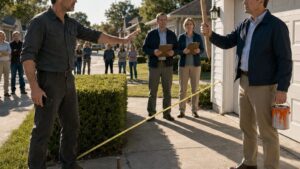
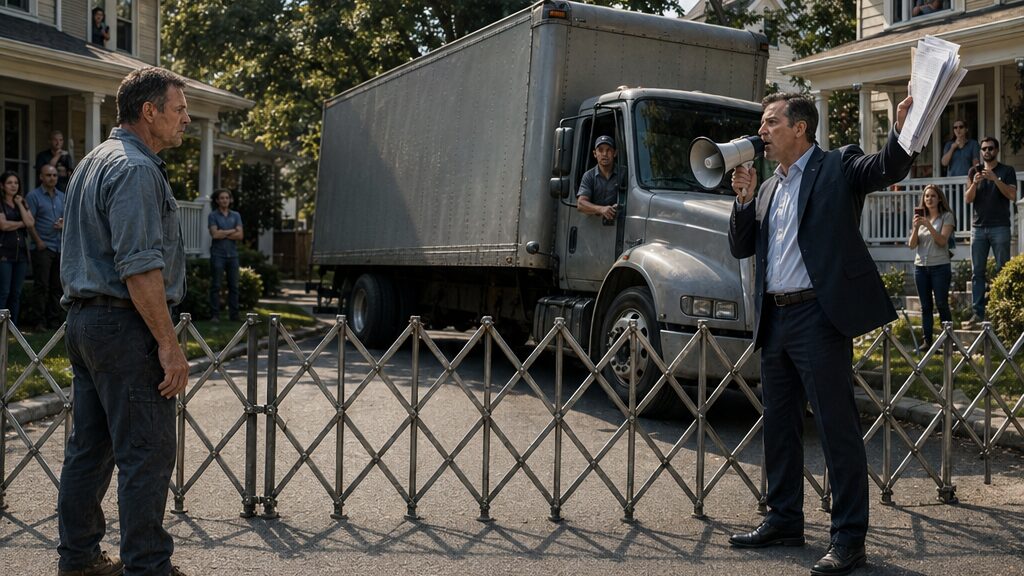
The gate was one of those expandable steel barriers the HOA used near the clubhouse during community events, waist-high and ugly, with crossed metal ribs and small rubber wheels under it. Someone had dragged it from the sidewalk and locked one end around the street sign pole. The other end stretched toward the opposite curb, enough to block the truck, enough to make the driver hit the brakes.
The truck hissed. The beeping stopped.
For one brief second, the whole cul-de-sac seemed to hold its breath.
Then Jonathan Carter walked into the road with a megaphone.
He was dressed like he had planned for photographs: dark blazer, pale shirt, polished shoes that did not belong on hot asphalt. Under one arm was a thick packet of papers clipped together with red tabs. His mouth had the tight, pleased shape Matthew had seen at too many HOA meetings, the expression of a man who mistook being prepared for being right.
Jonathan lifted the megaphone.
“Delivery window was Tuesday, two o’clock to two-fifteen.” His voice exploded down the street, too loud for the distance. “Turn around.”
The driver leaned out of the cab. “Sir, I’m already lined up. I can’t turn this around in here.”
“That is not my concern.”
Matthew felt the first flare of heat under his ribs, quick and familiar. He pushed it down before it reached his face.
“Jonathan,” he called.
Jonathan did not look at him. That was deliberate.
The truck’s side panel bore the delivery company’s clean blue lettering. Beneath it, strapped inside the trailer, were the machines Matthew had waited seven months for: precision tools he had ordered after two years of saving, measuring, wiring the garage, selling off old equipment, and refusing smaller work until he could do it properly. They were not hobby toys. They were the beginning of the workshop he had promised himself he would build without asking anyone in the neighborhood for permission.
The driver opened the cab door and climbed down with both hands raised slightly, as if the street itself had become a courtroom.
“Sir,” the driver said, “I’ve got a scheduled residential delivery. The paperwork says driveway drop.”
Jonathan snapped the red-tabbed packet open.
“Unauthorized commercial vehicle,” he said, still through the megaphone though the driver stood less than ten feet away. “Oversized access. Nonconforming delivery window. Potential pavement stress. Legal action starts now.”
Neighbors began appearing.
Not suddenly. Carefully.
A curtain shifted at Carolyn Baker’s front window. Across the circle, a garage door froze halfway open. Someone stood behind a porch column with a phone held chest-high, pretending not to record. The cul-de-sac was lined with maples and tidy lawns and homes that had all learned the same rule: watch first, speak later, and let somebody else become the example.
Matthew knew that rule too well.
He walked down the driveway.
Jonathan finally turned his head, and his smile widened just enough to show satisfaction.
“Mr. Roberts,” Jonathan said into the megaphone, making the name bounce off every house. “You were notified.”
“I was notified that delivery was discouraged during school traffic hours,” Matthew said. “It’s late morning. There is no school traffic on this street.”
Jonathan glanced toward the nearest porch, then back at Matthew.
“You were notified,” he repeated, slower, as if the repetition made it legal.
The delivery driver looked between them. “Mr. Roberts, I don’t want a problem. Dispatch said this was cleared.”
“It is cleared,” Matthew said.
Jonathan held up the packet. “Not by the association.”
Matthew stopped three paces short of the gate. He could smell hot rubber from the truck and the faint oil scent of the old steel barrier. Behind him, the garage waited with fresh plywood sheets on the floor, extension cords coiled along the wall, and a dedicated outlet he had installed at midnight after work because the electrician had been delayed.
All that empty space had felt like hope an hour ago.
Now it looked like a stage set for embarrassment.
Jonathan lowered the megaphone just enough to speak without amplification, but not enough to lose the threat of it. “You knew this would happen.”
Matthew said nothing.
That was what he had trained himself to do. Say less. Keep the peace. Collect papers. Wait until he had enough proof. Do not give men like Jonathan the anger they wanted to display as evidence.
But the truck sat helpless in the street, angled so tightly that its front bumper nearly kissed the curb. The driver kept glancing at the folded mirrors as if imagining the damage report.
Jonathan raised the megaphone again.
“Mr. Roberts has attempted to bring an industrial delivery vehicle into a restricted residential lane without observing the approved fifteen-minute access window.”
A murmur moved behind the windows.
Matthew’s jaw tightened.
“There is no fifteen-minute access window,” he said.
Jonathan’s eyes sharpened. “There is for commercial vehicles exceeding association threshold.”
“That truck is delivering to my residence.”
“Through a community-maintained approach.”
“The road is open.”
Jonathan looked at the steel gate, then at Matthew. “Clearly not.”
The driver took off his cap, rubbed his forehead, and checked his phone. “I need somebody to sign that I can proceed. If I hit that gate, if I cross it after he said legal action, that comes back on me.”
“You’re not hitting anything,” Matthew said.
“I can’t move,” the driver said. His voice dropped. “I can’t even back out now unless someone guides me all the way around the bend. If they put this on my report, I could lose the route.”
Jonathan heard that. Matthew saw him hear it.
The lawyer stepped closer to the driver and lifted the packet high enough for the nearest phones to catch it. “Your employer will be named in the complaint if you continue.”
The driver went still.
Matthew looked at the road beneath the gate. Smooth asphalt. Public streetlights. City drainage grates. Mailboxes placed according to municipal setback rules. Details most people passed every day without seeing.
Matthew had seen them.
For weeks, he had seen nothing else.
Still, he did not move toward the gate.
Not yet.
Because Jonathan wanted a scene with Matthew’s hands on metal before any evidence came out. He wanted the image first and the truth second. That was how he won. That was how he had always won.
Jonathan adjusted his blazer and turned his amplified voice toward the watching houses.
“Let the record reflect that Matthew Roberts has been informed of formal enforcement. Any attempt to bypass the barricade will be considered willful violation and destruction of community property.”
Matthew took one slow breath.
“Move it,” he said.
Jonathan smiled into the megaphone.
Instead of answering Matthew directly, he lifted the first page and read as if before a judge.
“Cease and desist notice to Matthew Roberts, homeowner of record, for unauthorized commercial incursion, attempted violation of community access standards, and refusal to comply with lawful association control.”
The words rolled over the cul-de-sac, hard and bright and public.
Matthew heard his own name land against the houses.
For the first time that morning, the delivery did not feel like machinery arriving.
It felt like a trial beginning.
Chapter 2: The Fifteen-Minute Rule Everyone Feared
Jonathan shoved the packet so close to Jacob Lewis’s chest that the delivery driver stepped backward and bumped the truck’s front tire.
“Your employer can be named,” Jonathan said, no longer pretending the megaphone was necessary. “Your vehicle number is visible. Your refusal to comply is being documented.”
Jacob looked down at the papers as if they might burn through his shirt. “I’m not refusing anything. I’m stopped.”
“Then remain stopped.”
Matthew saw Jacob’s hands curl and uncurl at his sides. The man had the flat, exhausted look of someone paid by the route, blamed by the minute, and trained to treat any official-looking paper as a threat. He was maybe in his thirties, but the morning had aged him. Sweat darkened the collar of his uniform.
“He has a legal delivery order,” Matthew said.
Jonathan turned the packet toward him. “He has a delivery order. That does not supersede association access rules.”
“It’s my driveway.”
“It is our access lane.”
That phrase moved through the watching houses more effectively than the megaphone. Our access lane. It made the road sound owned, curated, fragile. Not asphalt paid for by taxes, but carpet in a private hall.
Carolyn Baker had come out onto her porch now. She stood with one hand around the porch rail, shoulders tight beneath a pale sweater despite the heat. She watched Jonathan the way people watched loose dogs: not because she liked him, but because looking away felt unsafe.
Matthew caught her eye for a second.
She looked down.
Jonathan opened to a tabbed page. “Commercial deliveries over the approved weight threshold are permitted on Tuesdays between two o’clock and two-fifteen in the afternoon, subject to written pre-clearance, impact fee, and board discretion.”
Jacob blinked. “Fifteen minutes?”
“Correct.”
“That’s impossible for a truck this size.”
Jonathan smiled. “Then the resident should have chosen a compliant vendor.”
The driver stared at Matthew, panic and apology mixed together. “I didn’t know anything about a Tuesday window. Dispatch just gave me the address.”
“No one sane would know it,” Matthew said.
Jonathan lifted his chin. “Careful.”
There it was. The word that had governed the cul-de-sac for years without appearing in any bylaw. Careful. Careful with your tone. Careful with your fence height. Careful with your contractor. Careful or the next letter will be certified. Careful or your name will be read aloud in a meeting where everyone pretends not to stare.
Matthew had been careful.
When Jonathan had objected to the temporary dumpster during the garage rewiring, Matthew had moved it after two days and finished hauling debris in his pickup. When Jonathan had claimed the saw noise violated “evening harmony,” Matthew had stopped work at six, even though the rule said nine. When a smaller freight delivery brought the wrong pallet jack, and Jonathan had appeared with a clipboard and a demand for a two-hundred-dollar access fee, Matthew had paid it.
Not because Jonathan was right.
Because Matthew had wanted the job finished.
Because every argument cost time.
Because men who worked with their hands were always one raised voice away from being called threatening by men who worked with letterhead.
Jonathan turned toward the houses again.
“This is not personal,” he announced. “This is community protection. Pavement damage, safety risks, unauthorized commercial activity—”
“Pavement damage?” Carolyn said from her porch.
The words came out small, but they came out.
Jonathan paused.
Carolyn’s fingers tightened on the rail. “My sister’s medical equipment delivery had to pay an access fee last winter. They said the same thing.”
The cul-de-sac shifted.
Not loudly. A head turned behind a screen door. Someone’s phone rose higher. Jacob looked toward Carolyn with sudden interest.
Jonathan’s smile stayed, but something behind it thinned.
“That was a separate matter,” he said.
“You said it was a standard access fee.”
“It was resolved.”
“She needed the bed that day.”
“Mrs. Baker,” Jonathan said, his voice soft in the dangerous way, “I would be careful discussing another resident’s enforcement history in public.”
Carolyn’s mouth closed.
Matthew felt the shame of it like a hand at the back of his neck. Carolyn had taken one step into the street without moving from her porch, and Jonathan had pushed her back with a sentence.
The road belonged to whoever made everyone afraid to speak on it.
Jacob’s phone buzzed. He answered quickly, turning away. “Yes, I’m at the address. No, I can’t complete. There’s a barrier and a legal issue.”
Matthew watched his empty garage through the reflection in the truck’s chrome.
“Not legal,” he said.
Jacob covered the phone. “They’re asking if the road’s blocked.”
“It is,” Jonathan said.
Matthew looked at him. “By you.”
Jonathan did not deny it.
Jacob listened to dispatch, then shut his eyes. “No, I understand. Yes. I’ll tell him.”
He lowered the phone.
Matthew already knew.
“They’re giving me a few minutes,” Jacob said. “Then I have to mark it refused or obstructed and take it back to the depot. Redelivery may need new scheduling. Storage fee starts after forty-eight hours.”
“How much?” Matthew asked.
Jacob’s expression answered before he did. “For this freight class? A lot.”
Jonathan folded the packet closed with a neat tap against his palm.
“Consequences are unfortunate,” he said. “But predictable.”
Matthew stepped closer to the gate. One of its little wheels was turned sideways, jammed against a crack in the asphalt. The barrier looked flimsy until you considered what it represented: delay, fear, paperwork, a driver who could not risk his job, neighbors who could not risk fines, a man with a megaphone calling control safety.
“I submitted the delivery notice,” Matthew said.
“Insufficient.”
“You replied that it was received.”
“Receipt is not approval.”
“You waited until the truck was in the street.”
Jonathan’s eyes flicked toward the nearest phone recording from behind a curtain. “The violation occurs when the vehicle enters.”
“And the trap occurs when you block it after it can’t turn around.”
For the first time, Jonathan’s face hardened past smugness into irritation.
“You paid the prior access fee,” he said.
Matthew’s stomach tightened.
Jonathan lifted a page from the packet and turned it outward. “Last August. Two hundred dollars. Check number recorded. That payment acknowledged association control over oversized deliveries.”
The old mistake stood suddenly in the road with them.
Jacob looked at Matthew. Carolyn looked at him too. Matthew could feel the neighborhood doing the same silent math Jonathan wanted them to do. If Matthew had paid before, maybe he knew the rule. If he knew the rule, maybe this was defiance. If this was defiance, maybe Jonathan was only doing what he had to do.
Matthew had paid because he had been tired.
He had paid because arguing over two hundred dollars had seemed cheaper than losing half a day’s work.
He had paid because the last delivery had been smaller, because the driver had looked scared then too, because Matthew had told himself he would fight it later.
Later had arrived with a steel gate across the road.
Jonathan stepped close enough that only Matthew and Jacob could hear him without the megaphone.
“You want to play legal expert now?” he said. “After signing with your checkbook?”
Matthew looked at the paper, then at the truck, then at Carolyn standing silent on her porch.
His anger shifted. It was no longer the bright flash of being personally insulted. It sank deeper, colder, into something steadier.
He had not only bought peace for himself last August.
He had helped Jonathan sell fear to everyone after him.
Jonathan raised the megaphone again, his confidence restored.
“You already agreed we control access when you paid the last fee.”
Chapter 3: The Map Folded Beneath the Toolbox
Matthew’s garage smelled of plywood, dust, and machine oil that had not yet touched the machines it was meant to serve.
He crossed the threshold without answering Jonathan, leaving the megaphone’s hum behind him. The open garage swallowed the street noise for half a second, and in that half second his hands almost shook. Not from fear of Jonathan. From the old habit of stopping himself before action could be misunderstood.
The toolbox sat against the back wall under the pegboard.
It was dented black steel, older than most of the houses on the cul-de-sac, with one drawer that stuck unless lifted at the corner. Matthew had cleared space around it that morning, expecting the new crates to sit nearby. Now the empty floor looked accusing.
Outside, Jonathan’s amplified voice followed him.
“Mr. Roberts has walked away from the enforcement discussion.”
Matthew opened the top compartment.
Wrenches. Calipers. A voltage tester. The worn screwdriver he used when the good ones were too clean for the job. Beneath a tray of sockets lay a folded municipal map, creased soft at the corners from being opened and closed too many nights after work.
He stared at it before touching it.
Three weeks earlier, he had gone to city records because something about the HOA’s delivery letters had bothered him. Not the arrogance; that was old. The wording. “Community-maintained approach.” “Association access control.” “Private residential lane.” Phrases that sounded official but never quite said ownership.
The clerk had not been impressed by the letterhead.
“Your cul-de-sac?” the clerk had said, tapping through parcel overlays on the screen. “Public right-of-way. Dedicated and accepted. City maintains drainage. Tax-funded resurfacing scheduled in the next cycle.”
Matthew had printed the map. Then the maintenance record. Then the right-of-way note. He had taken them home and put them under his tools because carrying them around felt too much like wanting a fight.
He lifted the map now.
A shadow fell across the garage entrance.
Emily Anderson stood just outside, not stepping in. She wore pressed slacks and a blouse too formal for a morning at home, her phone held tight in one hand. As HOA treasurer, she had the careful face of someone who knew where bodies were buried and preferred them itemized.
“Matthew,” she said quietly.
He slid the map under one arm. “If you’re here to tell me to calm down, don’t.”
“I’m here to tell you that packet isn’t what he says it is.”
Matthew paused.
Emily looked over her shoulder toward the street. Jonathan was speaking to Jacob again, one arm lifted as if directing traffic, though nothing moved.
“It’s a cease-and-desist draft,” Emily said. “Not filed. Not stamped. Not a court order.”
Matthew’s grip tightened on the map.
“You know that?”
“I saw the invoice for preparation.”
“Then say it out there.”
Her mouth pressed thin. “It’s not that simple.”
“It is exactly that simple.”
“No.” Her voice sharpened, then dropped. “The board is already reviewing Jonathan’s contract. If this becomes public disorder, he’ll argue we undermined counsel during enforcement. He’ll make it about process. Liability. Insurance. He’s good at making everyone afraid of the wrong thing.”
Matthew almost laughed, but there was no humor in him.
“Everyone is already afraid of the wrong thing.”
Emily glanced at the map. Recognition passed over her face too quickly to hide.
“You have the right-of-way printout,” she said.
“So you know.”
“I know there is a question.”
“A question?”
“Matthew.”
He stepped closer. “Public right-of-way. City maintained. Tax-funded. That is not a question.”
Emily’s eyes flicked toward the street again. “A map proves the road status. It doesn’t prove intent. It doesn’t prove he knowingly blocked public access. If you go out there waving that and then rip his gate apart, he’ll make you the story.”
There it was. The same old warning dressed in better clothes.
Be careful.
Matthew looked past her at the truck. Jacob stood near the cab, phone in hand, shoulders bent under the weight of other people’s authority. Jonathan had the packet open again. Carolyn Baker remained on her porch, watching as if one more word from her might cost something she could not afford.
“Then what do you suggest?” Matthew asked.
Emily hesitated too long.
“Let the truck go back,” she said. “File a complaint. I can raise the issue internally.”
“Internally,” Matthew repeated.
“We can fix the rule.”
“The rule is blocking my delivery now.”
“I know.”
“Jacob’s job is being threatened now.”
“I know.”
“Carolyn paid him for a medical delivery.”
Emily flinched. “I didn’t know it was medical.”
“But you knew there were fees.”
She looked down.
Matthew folded the map once, carefully. He wanted to be fair to her. He could see the fear under her caution. Emily did not love Jonathan’s control. She feared the bill that would come when control collapsed. She was trying to save the association from the man it had hired, and maybe from admitting it had liked his usefulness until it became dangerous.
But fairness did not move trucks.
Outside, the megaphone squealed.
“Mr. Roberts,” Jonathan called. “Are you retrieving tools for vandalism, or are you ready to comply?”
Emily whispered, “Do not give him the picture he wants.”
Matthew slid the map and records into a flat clipboard. “He already made the picture. He just doesn’t know what’s in the frame.”
He walked past her.
The sun hit his eyes as he stepped back onto the driveway. Jonathan saw the clipboard immediately. His expression changed—not much, just enough. A tiny tightening around the mouth. A calculation.
“What’s that?” Jonathan asked.
Matthew kept walking.
Jonathan lifted the megaphone. “For the safety of all present, Mr. Roberts is approaching the barricade with unknown materials in hand.”
“They’re papers,” Jacob muttered.
“Sir, return to your cab,” Jonathan snapped.
Jacob did not move.
Matthew stopped ten feet from the gate. Close enough to see that Jonathan had looped a chain through the end of it and around the street sign pole. A small brass padlock held it in place. It was not only dragged across the road. It was fixed there.
“You locked it,” Matthew said.
Jonathan lowered the megaphone to his hip. “Temporary safety measure.”
“You blocked a truck where it can’t turn around, threatened the driver, and locked a gate across the street.”
“Community property used for community protection.”
Matthew looked at the clipboard in his hands. He could open it now. Show the map. Let the neighbors see. Maybe it would be enough.
But Emily’s warning had weight. Not because she was right to stay quiet, but because Jonathan was waiting for a way to twist the order of events. If Matthew displayed proof and touched the gate too quickly, Jonathan would call it premeditated destruction. If he argued too long, Jacob would be ordered to leave.
Matthew needed Jonathan to choose.
Openly.
After warning.
He lifted his eyes. “Unlock it.”
Jonathan’s smile returned, but thinner. “No.”
“The driver has a legal delivery.”
“He has an unlawful access attempt.”
Matthew raised the clipboard. “You are standing on a public road.”
A few neighbors shifted. Carolyn’s hand went to her mouth. Emily had moved to the edge of the driveway now, face pale.
Jonathan’s gaze snapped to the clipboard, then back to Matthew.
“I would strongly advise against amateur legal interpretations in a live enforcement situation.”
“Unlock the gate.”
Jonathan turned toward Jacob with sudden force. “If that truck moves one inch, you are part of the violation.”
Jacob froze beside the cab step.
Jonathan reached into his pocket, took out the padlock key, and closed his fist around it. Then he walked to the street sign pole, checked the chain, and gave the gate a hard tug so the metal rattled across the asphalt.
“This barricade is now secured,” he said into the megaphone. “Any movement through it will be treated as willful participation in enforcement obstruction.”
The road went quiet again.
Matthew stood with the folded map under his hand, feeling the old carefulness die by inches.
Chapter 4: When the Lawyer Needed an Audience
Jonathan did not aim the megaphone at Matthew anymore.
He turned slowly, polished shoes planted in the exact center of the cul-de-sac, and lifted the cone toward the houses as if the map in Matthew’s hands had created a jury.
“Residents should be advised,” Jonathan announced, “that Mr. Roberts is now attempting to introduce unverified documents into an active enforcement situation.”
A window shut somewhere on the left side of the street.
Matthew heard the latch click.
He kept the clipboard closed.
Jonathan’s eyes moved across the watching houses, counting faces, phones, silhouettes. He needed them. Matthew saw it clearly now. Not as neighbors. Not as people whose driveways opened onto the same asphalt. As witnesses to his authority. If the audience doubted him, his voice had to grow larger.
“This is not a debate,” Jonathan said. “It is a safety response.”
Jacob stood near the cab with one boot on the step, phone in hand, not climbing in and not stepping away. His dispatch call remained open on speaker. Tinny hold music played, absurdly cheerful beneath the pressure.
Emily Anderson stood at the edge of Matthew’s driveway, arms folded tight. She had retreated from the street but not inside. That counted for something, though not enough.
Carolyn Baker had both feet on her porch steps now. The movement was small. Matthew noticed anyway.
Jonathan noticed too.
“Mrs. Baker,” he said, lowering the megaphone just enough to sharpen the threat. “For your own protection, I suggest remaining clear of the enforcement area.”
Carolyn stopped.
Matthew looked at her. He did not ask her to speak. He had spent too many years resenting other people’s silence while protecting his own. He would not demand courage from someone else before finding his.
“Jonathan,” Matthew said, “unlock the gate.”
Jonathan turned back, smiling hard. “You keep returning to that demand as if volume will turn it into law.”
“I’m not raising my voice.”
“No,” Jonathan said. “You’re implying violence quietly. That may work in a garage. It does not work in a governed community.”
A few years earlier, that would have landed.
Matthew knew it because his shoulders still remembered. The way his body used to go careful when men like Jonathan put words like violence near him. The way he would lower his hands, soften his tone, take one step back to prove he was safe. It was not fear of a fight. It was fear of being described by someone else.
He did not step back.
Jonathan paced beside the gate, warming into his performance. “This subdivision maintains standards because we cannot allow every homeowner to reinterpret rules according to personal inconvenience. Today it’s one truck. Tomorrow it’s a crane, a cement mixer, a storage container blocking emergency access.”
Jacob’s head snapped up. “Emergency access is blocked by the gate.”
Jonathan ignored him.
Matthew looked at the truck’s trapped angle. Its rear corner hovered near Carolyn’s curb. Its cab pointed toward the bend where the street narrowed under the maples. Even if Jacob wanted to leave, he would need the exact path Jonathan had blocked.
“Your barrier is the emergency access problem,” Matthew said.
Jonathan spread his free hand. “The barrier is temporary.”
“Then move it.”
“It will be moved when the violation is resolved.”
“By sending the truck back.”
“Correct.”
The clean simplicity of it made Matthew’s hands tighten around the clipboard.
From the speaker of Jacob’s phone, the hold music stopped. A dispatcher’s voice broke through. “Jacob, are you still blocked?”
Jacob grabbed the phone. “Yes. Still blocked. Resident says it’s legal. HOA guy says it isn’t.”
“How much room do you have?”
“None safe. I’m angled in the cul-de-sac. Gate in front. Cars behind me if people don’t move.”
The dispatcher paused. “You have ten minutes, then we need you out of there or marked obstructed. We cannot keep that lift team waiting.”
Matthew looked toward the trailer.
Lift team. Special handling. Storage class. Every phrase cost money.
Jacob swallowed. “Understood.”
Jonathan heard it and almost concealed his satisfaction.
Almost.
Matthew turned to Emily. “You heard that.”
Emily glanced at Jonathan, then at the gate. “I heard.”
“Say what you told me.”
Her eyes flashed with warning. Not anger at him exactly. Fear of what his request would trigger.
Jonathan’s attention swung to her.
“What did you tell him, Emily?”
She went very still.
Matthew saw the whole balance of the street gather around her. The neighbors behind glass. Jacob with the phone. Jonathan with his packet. The gate locked to a public sign pole. One woman holding a fact and measuring the cost of speaking it.
Emily said, “I told him the board has not voted on any emergency road closure today.”
Jonathan’s jaw flexed.
“That was not the question,” he said.
“It is the answer I’m comfortable giving.”
“Comfort is not the standard.”
“No,” Emily said, quieter. “Risk is.”
For the first time, Jonathan looked genuinely exposed. Only for a breath. Then he recovered by turning away from her and back toward the audience.
“There is an internal review underway,” he said through the megaphone, voice too loud, “which has no bearing on today’s noncompliance.”
Internal review.
Matthew caught it.
So did Carolyn. Her hand moved up the porch rail.
Jonathan’s contract. Emily had not said it aloud, but she had loosened one board under his feet.
Jonathan seemed to realize that a second too late. His face tightened. He lifted the packet again and thrust a page toward Matthew.
“You want transparency?” he said. “Fine. Here is the association delivery control policy. Here is prior payment. Here is acknowledgement by conduct. And here is counsel’s notice of continuing violation.”
“Counsel is you,” Matthew said.
“I represent the association.”
“You represent your invoice.”
The words slipped out before Matthew could stop them.
A small sound moved through the cul-de-sac. Not laughter, exactly. More like air escaping.
Jonathan’s eyes went flat.
Matthew regretted the line immediately—not because it was false, but because it gave Jonathan a personal insult to hold up in place of the road. He had promised himself not to do that. Proof, not pride. Action, not bait.
Jonathan stepped close, lowering the megaphone. “You think I enjoy this?”
Matthew said nothing.
“You think residents want chaos? They call me because they are tired of men deciding their projects matter more than everyone else’s peace. They call when trucks crack curbs, when contractors block mailboxes, when noise starts before breakfast. You see one delivery. I see the pattern I’m paid to prevent.”
There it was: his justification, polished from use, not entirely invented. Matthew could hear the tired residents behind it, the real complaints Jonathan had learned to turn into weapons. That was what made him dangerous. He did not need every fear to be fake. He only needed to stretch a few real ones over every situation until they covered the truth.
“This truck isn’t blocking the road,” Matthew said. “You are.”
Jonathan’s face closed again.
Carolyn took one more step down from her porch. “Jonathan, about that access fee—”
He turned his head toward her.
She stopped mid-sentence.
The silence that followed was worse than if she had stayed inside. Everyone heard what almost came out. Everyone saw why it didn’t.
Matthew’s anger settled into something hard and clean.
Jonathan raised the megaphone, the street now fully his stage because no one else would claim it.
“This road is under HOA control,” he said. “This enforcement action will stand.”
Matthew opened the clipboard.
The municipal map unfolded in his hands, creases catching the late-morning light. He turned it outward, not toward Jonathan first, but toward the street itself—the truck, the gate, the watching houses, the asphalt Jonathan had been speaking over.
The colored lines showed the cul-de-sac clearly.
Matthew held it up in full view.
Chapter 5: The Public Road No One Owned
Matthew dropped the municipal map on the asphalt between the truck and the locked scissor-gate.
It did not flutter.
It landed flat, held by its own creases, the cul-de-sac outlined in city ink beneath the shadow of Jonathan’s polished shoes.
For a moment, nobody spoke.
The map was not dramatic. It had no seal big enough to impress neighbors from their porches, no ribbon, no judge’s signature. It was paper, printed at a municipal counter, folded by a man who had been too careful to show it until the street left him no choice.
Jonathan looked down.
Matthew watched his face.
The first change was not fear. It was recognition.
Small. Involuntary. Gone almost as soon as it appeared.
But Matthew saw it.
Emily saw it too. Her arms unfolded slightly, as if the same flicker had answered a question she had been trying not to ask.
“Public right-of-way,” Matthew said.
Jonathan lifted his gaze. “That is your interpretation.”
“No. That is the city’s parcel map.”
“Parcel maps are not legal opinions.”
“The road is taxpayer-funded. City drainage. City resurfacing schedule. Public access.”
Jonathan smiled, but the shape was wrong now. Too tight at the corners. “You printed a picture.”
Matthew unclipped the second sheet and laid it beside the map. “Maintenance record.”
Jonathan’s eyes dipped again despite himself.
“The HOA has no ownership of this road,” Matthew said. “No authority to lock a gate across it. No authority to detain a delivery truck on it. No authority to charge gate fees for using it.”
The word fees moved through the cul-de-sac like a pebble through glass.
Carolyn Baker came off the last porch step.
Jonathan snapped the megaphone up. “Residents are advised that Mr. Roberts is making unsupported allegations regarding association authority.”
Emily spoke before Matthew could.
“Jonathan.”
He turned toward her, relief and anger mixing as if he expected her to repair the room.
“Confirm the authority,” he said. “As treasurer, confirm that the association controls this access point.”
Emily’s face went pale.
Matthew felt the trap shift. Jonathan had used her silence as shield for years. Now he needed her voice.
She looked at the gate locked to the street sign pole. Then at the map. Then at the truck, still idling uselessly, its engine heat shimmering above the cab.
“I can’t confirm that,” she said.
Jonathan stared at her.
“I am asking in your capacity as an officer of the association,” he said.
“I understand.”
“Then answer properly.”
Emily’s mouth trembled once, but her voice held. “I cannot confirm that the HOA owns this road.”
A window opened across the street.
Jacob whispered, “What does that mean for me?”
“It means he has to move the gate,” Matthew said.
“No,” Jonathan said sharply.
The word cracked out of him before he put it through the megaphone. Raw, unpolished, almost desperate.
He caught himself and adjusted his blazer.
“No,” he repeated, amplified now. “It means there is a dispute. In a dispute, enforcement remains in place until lawful resolution.”
“You are standing on the lawful resolution,” Matthew said.
Jonathan stepped deliberately onto the corner of the map.
The gesture was small enough to deny, ugly enough for everyone to understand.
Matthew looked at Jonathan’s shoe on the paper.
Every old version of him wanted to bend, pick it up, protect the document, keep it clean. Every careful instinct told him not to give Jonathan the image. Do not snatch. Do not shove. Do not raise your voice.
So Matthew did nothing.
He let the shoe stay there.
Then he looked up.
“Move your foot.”
Jonathan did not.
Jacob’s dispatcher, still on speaker, said, “Jacob, status?”
Jacob fumbled with the phone. “They’re saying it’s a public road now. Or he is. I don’t know.”
“Is the obstruction removed?”
Jacob looked at the locked gate. “No.”
“Then we need you to prepare to return.”
Matthew felt the deadline hit the street like another barrier.
Jonathan heard it too.
He pointed the megaphone toward Jacob. “You will remain where you are until authorities arrive.”
Jacob’s eyes widened. “Remain? Dispatch just told me—”
“Leaving the scene could constitute flight from an active violation.”
“That’s not a thing,” Matthew said.
Jonathan swung toward him. “Are you licensed to advise this driver?”
“Are you licensed to detain him?”
The question hung there.
For once, Jonathan did not answer immediately.
Carolyn reached the edge of her lawn. Her voice was barely louder than the truck engine. “Jonathan, my sister’s delivery driver wanted to leave too. You told him he couldn’t until he paid.”
Jonathan’s head turned slowly.
“Mrs. Baker,” he said, each syllable clipped, “you are misremembering.”
“No,” she said, but the word shook. “I remember because she was crying inside.”
The cul-de-sac seemed to lean toward her.
Jonathan’s face reddened, not with shame. With fury at the breach.
“That matter was resolved through a voluntary administrative payment.”
“She paid because you said they would take the bed back.”
Jonathan took one step toward her.
Matthew moved half a step sideways, not between them fully, but enough.
Jonathan saw it. “Do not posture at me.”
“Then stop walking toward her.”
The polished lawyer mask slipped again. “This is exactly why rules exist. Because the moment one person senses weakness, everyone thinks their private grievance overrides order.”
Emily said, “Jonathan, stop.”
He rounded on her. “You stop. You think the board wants this? You think they want trucks tearing up roads and residents waving printouts and every enforcement letter questioned by people who don’t understand liability?”
“Not every letter,” Emily said. “This one.”
His eyes narrowed.
There it was, Matthew thought. The deeper truth pushing up through the cracks. Jonathan did not fear being wrong about one delivery. He feared the map spreading backward through every fee, every threat, every resident who had paid because his letterhead sounded heavier than their doubt.
Matthew bent slowly and picked up the map. Jonathan’s shoe had left a dusty mark across the printed roadway.
Matthew held it in one hand.
“This is your last chance,” he said.
Jonathan gave a short, humorless laugh. “No, Mr. Roberts. This is yours.”
He turned toward the truck and raised the megaphone so close to his mouth that the first breath boomed.
“Driver, you are instructed to remain stationary until police arrive. Any movement of that vehicle through this barricade will be treated as participation in unlawful obstruction of association enforcement.”
Jacob went white. “I can’t be detained here.”
“You are not detained,” Jonathan said. “You are being instructed.”
“By who?”
“By counsel for the governing association.”
Matthew looked at Emily.
She did not save Jonathan.
The silence became its own testimony.
Jonathan knew it. His voice sharpened. “This is a private controlled lane under HOA management.”
Matthew said, “Say that again.”
Jonathan turned.
“Say it while looking at the map.”
Jonathan’s eyes flicked to the paper in Matthew’s hand, then to the neighbors, then to the phones. He understood the danger now. Matthew saw him understand it.
And still, Jonathan chose the gate.
He walked to the locked end of the scissor barrier and planted one hand on the metal frame. His knuckles whitened around it.
“Nobody moves through here unless I allow it.”
Chapter 6: The Gate Came Off Its Tracks
Matthew wrapped both hands around the cold steel ribs of the scissor-gate and said, “Jacob, stay in the cab.”
The driver did not ask why.
He climbed up fast and shut the truck door with a hollow metal clap that carried down the road. The engine idled. The turn signal ticked uselessly against the silence. Behind Matthew, the map lay folded on the hood of his parked pickup, the maintenance record tucked beneath it so the breeze could not take it.
Jonathan still had one hand on the gate.
“Step back,” Matthew said.
Jonathan laughed once. “You touch that, and every person here sees you destroy community property.”
“Step back.”
“Is that a threat?”
“It’s a warning.”
Jonathan’s eyes lit at the word. He lifted the megaphone with his free hand, eager again. “Let the record reflect that Mr. Roberts has issued a verbal warning immediately prior to—”
Matthew pulled.
Not hard enough to break it. Not yet.
The gate shuddered along its crossed steel ribs. The small wheels beneath it jerked against the asphalt. The chain at the street sign snapped tight, rattling the pole. Jonathan flinched but kept his hand on the frame.
“Are you insane?” he shouted.
Matthew looked at his hand. “Let go.”
For a second, Jonathan did not. Pride held him there, palm flat against the barrier, the performance demanding that he remain attached to the thing he had made sacred.
Then the metal shifted again, and fear did what reason had not. He snatched his hand away.
Matthew planted his boots wider.
The gate was meant to expand, not resist sideways force. Its strength was theatrical: enough to suggest boundary, not enough to withstand a man who understood metal, wheels, leverage, and the difference between locked and load-bearing.
He did not yank blindly.
He lifted the loose end just enough to take weight off the jammed wheel. The ribs compressed with a grinding clatter. The chain held the far end fixed around the sign pole. The lock rattled. The signpost vibrated.
Jonathan stumbled backward. “Stop! Stop immediately!”
Matthew shifted his grip, lowered his shoulder, and drove the gate sideways.
The first wheel broke.
It snapped off with a sharp metallic crack and bounced across the asphalt into the grass.
A neighbor gasped.
Jonathan screamed, “Community property!”
Matthew heard him. Everyone heard him.
But they also saw Matthew’s face.
He was not wild. He was not swinging at people. He was not charging. His jaw was set, eyes focused on the hinge points, hands placed where steel could bite but not where anyone else stood. He looked like a man moving a dangerous piece of equipment out of a road.
That mattered.
Jonathan saw it matter.
He lunged for the packet on the ground and pulled out pages, shaking them above his head. “These are legal documents! This is willful destruction!”
Emily stepped closer. “Jonathan, those are drafts.”
The word cut through the metal noise.
Drafts.
Jacob’s cab window slid open.
“What?” he called.
Emily swallowed, then said it louder. “They are cease-and-desist drafts. They are not court orders.”
Jonathan turned on her, face dark. “You have no authority to characterize counsel’s documents.”
“I processed the invoice,” she said. “There is no filing number.”
The street changed.
Not into celebration. Into comprehension.
People looked at the packet differently. At the red tabs. At the thick pages Jonathan had held like law. The papers were still papers, but the spell had weakened.
Jonathan felt it and tried to replace it with volume.
“I am calling emergency services,” he said, pulling out his phone. “Destruction of property, threats, possible assault—”
Matthew pulled again.
The gate jumped its track.
The sound was enormous in the narrow street, a shriek of steel against asphalt followed by a deep popping snap as the joint nearest the lock warped out of alignment. The signpost shook. The chain bit into its own loop. The scissor ribs folded wrong, one over another, like a metal insect crushed under pressure.
Matthew stopped long enough to check the street sign pole. It leaned slightly but held.
He changed angle.
Jonathan spoke rapidly into his phone. “Yes, I need officers at the end of Maple Hollow Court. We have a resident destroying association property and threatening counsel during enforcement. Yes, he is currently—”
Matthew compressed the gate toward the grass.
The barrier fought him in ugly little catches. A twisted rib scraped his forearm. He ignored the sting. The steel was giving now, losing its shape because its shape had been the only thing that made it useful. Another wheel tore loose. The far end twisted around the chain until the padlock jammed against the post.
Matthew set one boot against the bottom bar, gripped the upper frame, and bent the loose section inward.
The gate folded with a dull, final groan.
It no longer crossed the road.
It lay half on the grass, half against the curb, twisted into a useless heap beside the street sign. The chain still held one ruined end. The path in front of the truck was clear.
No one moved.
Matthew’s breathing was heavy but controlled. He looked down at his forearm and saw a thin red scrape, nothing more. Then he walked to his pickup, took the municipal map and maintenance record, and returned to the place where Jonathan’s papers had scattered in the struggle.
Jonathan lowered the phone. His voice shook with effort to control it. “You just made this very easy.”
Matthew placed the map on the asphalt.
Then he placed the maintenance record beside it.
Then, one by one, he set three of Jonathan’s cease-and-desist pages next to them, face up. No seal. No filing stamp. No court name. No judge. Only Jonathan’s letterhead, the HOA name, and threats dressed like orders.
“Take a picture,” Matthew said.
Nobody seemed to know whether he meant Jonathan or the neighbors.
Carolyn did it first.
Her phone rose from her side. One careful click. Then another.
Across the street, the person behind the screen door stopped hiding and held their phone openly.
Jonathan’s face drained.
Matthew looked at Jacob in the cab. “Can you make the angle?”
Jacob stared at the cleared road, then at the ruined gate, then at Jonathan’s phone still pressed in his hand.
“I can,” he said. “But if police are coming—”
“They can talk to me,” Matthew said.
Jonathan seized on it. “Yes. They can.”
He lifted the megaphone again, though his hand was no longer steady.
“Driver, you are still instructed not to proceed.”
Matthew did not look at Jonathan.
He crouched, picked up the municipal map, and laid it across the top of Jonathan’s scattered injunction pages, pinning them under the city’s outline of the road. Then he placed one piece of the broken gate wheel on the corner to hold everything down.
The wind tugged at the papers, but they stayed.
The road ahead of the truck was open.
Jacob’s reverse lights brightened.
Chapter 7: The Hum That Filled the Cul-De-Sac
Jacob restarted the truck before Jonathan finished saying the word unlawful.
The reverse alarm cut through the lawyer’s voice in clean, mechanical bursts. Beep. Beep. Beep. The sound seemed louder now that the gate was folded into the grass, louder because the truck was moving, louder because Jonathan was no longer the only thing making noise in the cul-de-sac.
“Stop that vehicle!” Jonathan shouted.
Jacob kept both hands on the wheel.
Matthew stood near the front corner of the truck, one palm lifted low, guiding him with small motions. The scrape on Matthew’s forearm had begun to sting, but he did not look at it. He watched the tire line instead. Two inches from Carolyn’s curb. Then one. Then clear.
“Easy,” Matthew called.
Jacob’s window was down. “You sure?”
“Cut right. Slow.”
The truck obeyed, inch by inch, its long body sliding past the place where the gate had been. The ruined steel lay in the grass like something that had tried to be stronger than it was. One detached wheel rested against the municipal map, pinning Jonathan’s papers beneath the city’s outline of the road.
Jonathan moved alongside the truck, phone in one hand, megaphone in the other, trying to find a place where his body could matter without getting close enough to be blamed if Jacob clipped him.
“You are creating a record of continued violation,” he called. “Every foot of movement is additional evidence.”
Jacob’s face tightened, but he did not stop.
Matthew saw the fear pass through him and lifted his hand again, steady. “You’re clear.”
That was all. Not a speech. Not reassurance he could not guarantee. Just the truth of the moment: the truck had room. The road was open.
The rear wheels climbed the slight apron of Matthew’s driveway. The trailer groaned. The branches overhead brushed the roof with soft, dry scratches. One neighbor stepped fully out onto a porch. Another came to the curb and stood with crossed arms, not smiling, not cheering, just watching the impossible become ordinary.
The truck backed into place.
When Jacob set the brake, the hiss sounded like a lung emptying.
For the first time since the gate had screamed across the street, Matthew looked at the crates through the open rear doors.
They were larger than they had seemed in the shipping photos. Heavy plywood cases banded with black straps, stamped with handling marks and orientation arrows. Inside them were the machines he had made room for. The work he had postponed. The nights he had spent measuring electrical load and floor clearance. The promise he had made to himself every time an HOA letter arrived and he folded his anger into another drawer.
Jacob climbed down slowly.
“Liftgate still works,” he said, trying to sound professional and failing around the tremor in his voice. “If we move fast.”
“We move right,” Matthew said.
Jonathan stepped in front of the driveway.
Not far enough to block the liftgate, but enough that everyone saw the attempt.
“This delivery remains disputed,” he said.
Matthew looked at him. “Move.”
Jonathan’s eyes flicked toward the ruined gate, then to the neighbors. The same word had sounded different before. Earlier, it had been a request Jonathan could mock. Now it came with the road cleared behind it and the map on the asphalt.
He did not move.
Carolyn Baker did.
She stepped off her lawn and into the street, not near Matthew, not behind him, but toward the papers pinned under the broken wheel. Her face had gone pale, and she held her phone in both hands like it might steady her.
“Jonathan,” she said.
He kept his eyes on Matthew. “Mrs. Baker, return to your property.”
“No.”
The word was so soft that the truck engine almost swallowed it, but it changed the street again.
Jonathan turned.
Carolyn’s hands shook. “Last winter, my sister’s medical bed was on a delivery truck right there.” She pointed toward the bend. “You told the driver he couldn’t leave until someone paid the access fee.”
“That is false.”
“It isn’t.”
“It was an administrative resolution.”
“She was inside crying because she couldn’t sleep flat after surgery.” Carolyn’s voice cracked, then steadied in a strange way, as if the crack had freed it. “I paid because you said they would take it back. You said the HOA controlled the road.”
Jonathan’s mouth opened, but no words came out immediately.
Matthew looked at Carolyn. He had expected anger to make him feel taller. Instead, he felt something heavier: the knowledge that his own old payment had been one link in a chain wrapped around people who had needed help more urgently than he had.
Emily Anderson walked to the curb.
Jonathan saw her and snapped, “Do not participate in this.”
Emily’s face was drawn tight, but she no longer looked at the houses. She looked at the papers.
“I will not support a statement that this road is HOA-controlled,” she said.
“You are exposing the association.”
“No,” Emily said. “You did that when you locked a gate to a public sign.”
The words hit harder than shouting.
Jonathan looked around then. Really looked. Not for support, but for escape. The neighbors were no longer watching Matthew as the danger. Their phones were angled toward Jonathan, toward the papers, toward the ruined gate and the truck in the driveway. His audience had not disappeared. It had changed sides by changing focus.
Jacob cleared his throat. “I need a signature and a clear path for unloading.”
Matthew turned away from Jonathan first.
That was its own answer.
The liftgate lowered with a hydraulic whine. Jacob guided the first crate down while Matthew steadied one corner. The plywood case touched Matthew’s driveway with a solid, beautiful weight. The sound traveled up through his hands.
Jonathan tried again from the street.
“You think this is over because you got your toys?”
Matthew paused, but only to check the crate straps.
Jacob’s eyes flicked to him.
Matthew said, “They’re tools.”
The correction was quiet. It did not need to be larger.
The second crate came down. Then the third. The garage that had looked so empty an hour before began to fill with purpose. Matthew cut straps, pried lids, checked serial plates. He moved with care, not haste. Every bolt, every panel, every cable mattered.
Jonathan remained near the curb, holding a megaphone nobody needed him to use.
In the first crate was the compact milling unit, its casing wrapped in protective film. In the second, the power module. In the third, the control stand and leveling hardware. Jacob helped roll the first machine into the garage on a heavy pallet jack, then stood back as Matthew knelt to connect the temporary power line he had prepared.
For a moment, Matthew’s hand hovered over the switch.
He thought of every letter he had not answered the way he wanted. Every fee paid to avoid losing a day. Every time he had told himself the work mattered more than the insult, not seeing that the insult had begun taking the work too.
Then he pressed the switch.
The machine woke with a low hum.
Not loud at first. Deep. Clean. A vibration that moved through the garage floor and out into the driveway, steady as a held note. Indicator lights blinked on. The cooling fan rose. The hum grew fuller, smooth and powerful, until it filled the open garage and rolled into the cul-de-sac.
Jonathan lifted the megaphone by reflex.
The machine drowned it before he spoke.
Matthew stood in the doorway of his garage, one hand resting on the machine’s side, and listened to the sound that had been locked inside crates, behind a truck, behind a gate, behind years of careful silence.
The road stayed open behind him.
Chapter 8: The Road Was Never His
Jonathan’s megaphone lay dented near the grass by early evening, its handle angled toward the crumpled scissor-gate as if both objects had been dropped by the same careless hand.
The truck was gone.
Its tire marks curved cleanly from Matthew’s driveway to the open mouth of the cul-de-sac, proof that the turn had always been possible once the road was allowed to be a road. The street sign stood slightly crooked where the chain had bitten it. Around its base, bent steel ribs and broken wheels waited for whoever would have to admit ownership of the mistake before hauling it away.
Matthew stood in the garage with the machine still humming behind him.
He had turned it down after the first test cycle, but not off. The sound remained, low and steady, filling the spaces where Jonathan’s voice had been. It was not triumph exactly. It was work beginning.
On the folding table near the garage door sat the municipal map, the maintenance record, photos of the locked gate, photos of Jonathan’s unstamped papers, and three handwritten statements.
Jacob’s was short and careful. He wrote that he had been instructed not to move his vehicle after being threatened with legal action, despite having a scheduled residential delivery. He added that he had not been able to safely turn around while the gate was locked across the road.
Carolyn’s took longer. Her handwriting pressed deep into the paper. She described the medical bed, the winter delivery, the fee, her sister crying in the living room while Jonathan stood outside with a packet and a deadline.
Emily had not written a statement yet.
She stood at the edge of the driveway now, watching Matthew slide the photographs into a folder. Her face looked older than it had that morning.
“The board can address this,” she said.
Matthew did not look up. “It should.”
“Privately.”
The machine hummed behind him.
Matthew placed the municipal map on top of the stack. “No.”
Emily exhaled slowly. “Matthew, if this becomes a formal complaint outside the association, every resident pays for the legal response. Insurance may get involved. Reserves. Assessments. It won’t just hurt Jonathan.”
“He counted on that.”
Her mouth tightened.
“He counted on everyone being afraid that telling the truth would cost more than staying quiet,” Matthew said.
Emily glanced toward the street, where Carolyn stood near her own driveway with her arms folded, watching but not interrupting. “I’m not defending what he did.”
“You’re asking me to hide it.”
“I’m asking you to give us time to correct it.”
Matthew finally looked at her.
He wanted to be angry with Emily in the easy way. It would have been simpler to place her entirely on Jonathan’s side and be done with it. But he had seen her face when the map came out. He had heard her say the papers were drafts. She had spoken late, but she had spoken. Fear had made her slow, not blind.
That was different from Jonathan.
It was not innocent.
But it was different.
“How many fees?” Matthew asked.
Emily looked away.
The answer was in the movement.
“How many?” he repeated.
“I don’t know all of them.”
“But you know more than mine and Carolyn’s.”
She swallowed. “There are line items. Access coordination. Road impact. Special delivery administration. Some were small. Some weren’t.”
“On roads the HOA doesn’t own.”
“On roads we believed—”
“No,” Matthew said.
He did not raise his voice, but she stopped.
“Don’t say believed. Not after today.”
Emily’s eyes glistened, though whether from shame or frustration he could not tell. “Some of us didn’t look closely because Jonathan always had an answer. That is not the same as knowing.”
“It became knowing when nobody wanted to check.”
The words left a mark. He saw it.
For years, Matthew had told himself a similar version. He had not agreed with Jonathan. He had not supported him. He had only paid once, stayed quiet often, chosen work over conflict, peace over aggravation.
But peace had not been neutral.
It had been useful to the wrong person.
A car slowed at the entrance to the cul-de-sac, then continued when there was no gate to stop it. The ordinary motion drew Matthew’s eyes. For the first time all day, the road looked almost plain again: asphalt, curbs, leaves, mailboxes, the faint dusty mark where the map had been stepped on.
Public, he thought, not as a legal term now, but as a responsibility.
Carolyn crossed the street with her statement in hand. She hesitated before entering Matthew’s driveway.
“I wrote it all,” she said.
Matthew took the page gently. “Thank you.”
Her eyes went to the machine. “That’s what was in the truck?”
“One of them.”
“It sounds…” She searched for the word, then gave up with a small embarrassed smile. “It sounds expensive.”
Matthew almost smiled back. “It sounds like work.”
Carolyn nodded. Her gaze dropped to the folder. “I should have said something last winter.”
“So should I.”
That surprised her. He saw it.
Matthew tapped the statement she had given him. “I paid him before you did.”
“You didn’t know about my sister.”
“No. But I knew enough to question it.”
For a few seconds, neither of them spoke. The machine’s hum held the silence without letting it collapse.
Emily stepped closer to the table. “If you file this with the city, they will ask for records.”
“Good.”
“And if the HOA has to refund fees, there will be a fight.”
“Good.”
Carolyn looked at him.
Matthew shook his head once. “Not because I want one. Because the fight already happened. He just made sure each person had it alone.”
Emily’s shoulders lowered, as if the sentence had taken something from her she had been trying to keep. “I can provide the ledger categories,” she said.
Matthew waited.
“Not tonight,” she added quickly. Then, seeing his expression, she corrected herself. “Tomorrow morning. In writing.”
“That’s your choice.”
She looked at the folder. “No. It’s overdue.”
The light had changed by then, turning the cul-de-sac softer, making the bent gate look less like wreckage and more like evidence. Somewhere down the street, a child’s bike clicked over the pavement. The sound passed uninterrupted from one end of the road to the other.
Matthew gathered the map, records, photographs, and statements. He scanned them at the small desk inside the garage, naming each file with the date. Then he placed the originals in a large envelope addressed to the municipal right-of-way office and the copies in another for the HOA board.
When he sealed the first envelope, he felt no surge of victory.
Only a steady release.
Jonathan had left before the truck did, walking fast with his phone pressed to his ear, abandoning the broken gate and two pages of his own packet in the grass. He would return in some form: an email, a letter, a demand that the narrative be corrected. Matthew knew that. Men like Jonathan rarely disappeared after one defeat. They tried to rename it.
This time, he would not help.
Matthew carried the sealed envelopes to his pickup and placed them on the passenger seat for morning. When he returned, Carolyn had gone home. Emily stood by the curb, looking at the open road as if seeing the shape of a problem larger than one delivery.
“Matthew,” she said.
He stopped.
“I’m sorry I waited.”
He nodded once. “Me too.”
It was not forgiveness. Not yet. But it was honest, and that was more than the cul-de-sac had held that morning.
Matthew walked back into his garage.
The machine hummed steadily, ready for calibration. He rested one hand on its metal casing, feeling the vibration settle into his palm. Outside, the public road remained open under the trees, empty of gates, empty of threats, carrying the evening light without asking who allowed it.
Matthew turned the power dial up one notch, and the hum rose clean and beautiful behind him.
The story has ended.