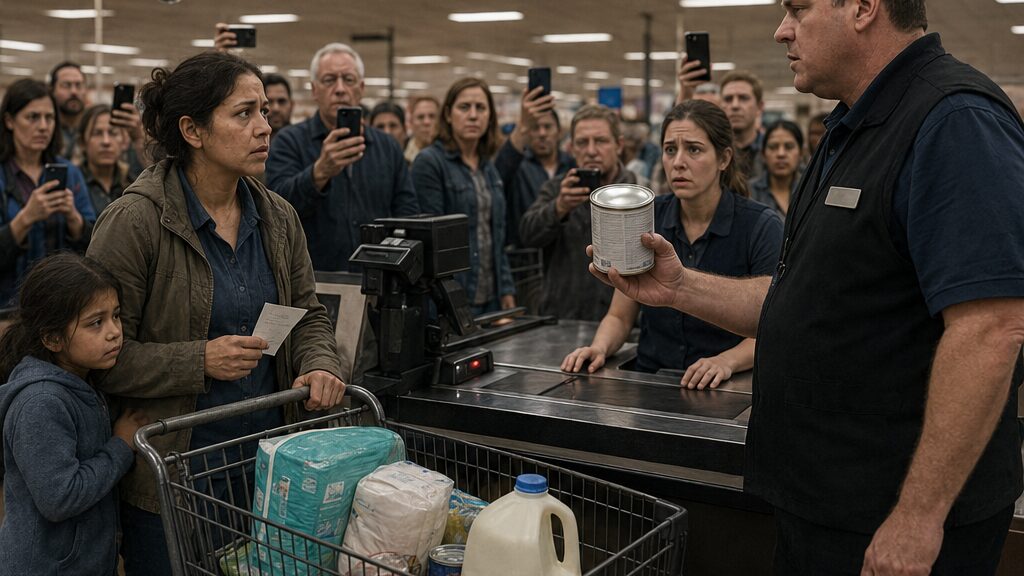
The Mother They Shamed Over Baby Formula Refused To Leave Until The Store Logs Spoke
Chapter 1: The Formula Can On The Checkout Belt
The can of baby formula reached the scanner before Maria Flores was ready for the sound it made.
One sharp beep.
Then a second sound, lower and uglier, from the register screen.
Stephanie Moore stopped with the can in her hand. Her fingers tightened around the white plastic lid as if the error had come from the formula itself.
Maria felt the line behind her shift.
She had been standing there for twenty minutes with one hand on the cart and the other resting near her child’s shoulder, counting the items over and over in her head because numbers were easier than worry. Formula. Milk. Diapers. Store-brand bread. Bananas. Rice. A small pack of chicken marked down with a yellow sticker. Nothing extra. Nothing that could be put back without changing the week.
The store was packed the way it always was on Saturday afternoon, too bright and too loud, carts squeaking, plastic bags snapping open, scanners chirping from every lane. Above them, black security domes hung from the ceiling like dark eyes. The checkout lanes were crowded with people who had already waited too long and wanted the person in front of them to become invisible.
Maria had tried to be invisible.
She had placed the formula first because it mattered most. She had lined up the rest of the groceries in order of importance. She had smoothed the family-assistance voucher twice before handing it over. She had even told Stephanie quietly, “It should cover the formula and milk.”
Stephanie had smiled, tired but kind. “We’ll get it through.”
Now the register screen flashed red.
Maria saw it reflected in Stephanie’s glasses.
“Is it okay?” Maria asked.
Stephanie scanned the voucher again. The machine answered with the same flat rejection.
A man behind Maria exhaled loudly through his nose. Somewhere farther back, a child asked for candy and was shushed. Maria’s own child leaned closer to her leg, small fingers gripping the side of her coat.
“It’s valid,” Maria said, softer than she meant to. “The office approved it this morning.”
Stephanie didn’t look annoyed. That made it worse. She looked afraid.
“Let me try entering it manually,” she said.
Maria opened her wallet. There were three folded bills inside and some coins tucked into the small torn pocket where receipts usually went. She knew exactly how much was there. Not enough. She had checked in the parking lot before coming in, with her door still open and her child eating the last crackers from a paper napkin.
The voucher had to work.
Stephanie typed numbers into the keypad, paused, checked the paper, typed again. The register beeped once more.
ERROR: ASSISTANCE PAYMENT NOT ACCEPTED.
Maria felt heat crawl up her neck.
“It’s not declined,” she said quickly. “It was approved. I called before I came. They told me—”
“I know,” Stephanie said, almost under her breath.
The words were so quiet Maria wondered if she had imagined them.
Then Stephanie glanced past Maria’s shoulder.
Maria followed her eyes.
A man in a dark store vest was standing near the end of the checkout area, watching. He was middle-aged, broad through the shoulders, clean-shaven, with a manager badge clipped high on his chest where everyone could see it. Ronald Hall. Maria had noticed him earlier by the customer-service desk, speaking into a radio and looking at the lines as if each customer were a problem to be solved.
Now he was walking toward them.
Stephanie scanned the voucher a third time before he arrived, quickly, almost guiltily.
The same error appeared.
Ronald stopped at the side of the belt and looked first at the screen, then at Maria’s cart, then at Maria. His eyes landed on the formula can in Stephanie’s hand.
“What’s the issue?” he asked.
Stephanie straightened. “Voucher error on lane six.”
“Declined?”
“It says not accepted.”
Maria held up the voucher. “It’s not declined. I had it approved. It’s for formula and milk. Maybe the system—”
Ronald took the voucher from her before she finished. He did not snatch it, exactly. He took it with the confidence of a person used to having things handed over. He looked at it for less than a second.
“We’ve had a lot of misuse with these,” he said.
The woman behind Maria leaned slightly to see. Maria felt it like a hand on her back.
“I’m not misusing anything,” Maria said. “I brought what they told me to bring.”
Ronald turned the voucher over, then set it on the counter beside the card reader, away from Maria’s reach.
Stephanie’s fingers were still around the formula can.
“Try it again,” Maria said to her, hating the pleading in her own voice. “Please.”
Stephanie looked at Ronald.
That look did something to Maria’s stomach. It said the problem was not only the machine. It said Stephanie knew there was a right thing to do and a dangerous thing to do, and they might not be the same.
Ronald’s jaw tightened.
“Line’s backed up,” he said. “We can’t hold everyone because someone came unprepared.”
The words struck quietly, but Maria still flinched.
“I did come prepared.”
She hated how small it sounded.
Ronald looked into her cart. Diapers. Milk. Bread. Bananas. Formula. Basic things, all suddenly exposed under fluorescent light as if they were evidence from a crime scene.
“You have another form of payment?” he asked.
Maria touched the edge of her wallet. She could feel the thinness of it without opening it.
“For part,” she said. “Not all. The voucher is for the baby formula.”
A phone lifted somewhere behind her. She saw the black rectangle from the corner of her eye.
Stephanie noticed too.
“Mr. Hall,” Stephanie said carefully, “I can call support and ask if—”
“No,” Ronald said.
He didn’t raise his voice. He didn’t need to. Stephanie stopped.
Maria’s child shifted against the cart. Maria rubbed a thumb over the small knuckles gripping the metal rail. She wanted to leave. Every part of her wanted to gather the child, abandon the cart, and disappear between aisles of cereal and laundry soap until no one remembered her face.
But the formula can was still in Stephanie’s hand.
The week was still waiting.
Maria swallowed. “Can we move to customer service and check the approval number? I don’t want to hold up the line.”
Ronald looked at her then with something almost like satisfaction, as if she had admitted the scene belonged to him.
“You already are.”
The man behind her muttered, “Come on.”
Maria’s shoulders folded inward before she could stop them.
She had worked a closing shift at the diner the night before, then cleaned rooms at a motel until noon. Her feet ached inside her shoes. Her hair was pulled back too tightly because she had not had time to fix it. She knew what she looked like. Tired. Worried. Poor. The kind of woman people believed things about before she spoke.
Stephanie set the formula can down gently on the belt, near the scanner.
Ronald reached for it.
Maria saw his hand close around the can, and something inside her went still.
“Wait,” she said.
He lifted it off the belt anyway.
The store noise thinned. The scanners in the other lanes seemed to fall away one by one. Even the child behind them stopped asking for candy.
Ronald held the formula can chest-high, label facing outward, as if presenting it to the line.
Then he looked at Maria and said, loud enough for the whole front end to hear, “If you can’t afford baby formula, maybe you shouldn’t have had a kid.”
Chapter 2: The Receipt He Threw On The Floor
The first phone rose before Maria could breathe.
Then another.
A black case. A cracked pink case. A silver phone held sideways by someone near the candy racks. Maria saw them all without looking directly, the way a person notices headlights just before impact.
Ronald Hall still held the formula can.
Her child pressed against her leg, not crying, not speaking, only watching the adults become strange. Maria lowered one hand and touched the child’s shoulder, steadying both of them.
“Please don’t say that,” Maria said.
She meant it to sound firm. It came out quiet.
Ronald’s eyes flicked to the phones, then back to her. For a moment she thought he might correct himself, smooth it over, turn his cruelty into policy language. Instead, he set the formula behind the scanner, outside her reach.
“This store is not a charity,” he said.
“I have a voucher.”
“You have a rejected voucher.”
“It isn’t rejected. The machine won’t take it.”
“That’s what people always say when the payment doesn’t go through.”
The line murmured. Not loudly. That was worse. It was the sound of strangers deciding whether they had witnessed misfortune or guilt.
Maria looked at Stephanie. “You saw it. I gave it to you before anything was scanned. I wasn’t trying to leave.”
Stephanie’s mouth opened.
Ronald turned his head just enough. “Stephanie.”
Her name cracked through the air like a warning.
Stephanie closed her mouth and looked down at the register.
Maria’s face burned.
The voucher lay on the counter near Ronald’s elbow. The formula sat behind the scanner. Her groceries were half-bagged and half-exposed, split between paid and unpaid, wanted and questioned. A gallon of milk sweated beside the card reader. The diapers looked enormous on the belt.
Ronald reached toward the printer. A receipt curled out, thin and white. He tore it free and scanned it with the expression of someone reading a sentence already decided.
“Assistance payment not accepted,” he said.
“That’s only what the register says.”
“That’s what matters.”
“No. What matters is whether it was approved.”
He looked up sharply. “Don’t argue with me at my register.”
The phrase struck her almost harder than the first insult. My register. My store. My rules. Maria felt the old habit rise in her: step back, lower your voice, make yourself less difficult. She had learned it in offices with plastic chairs, at school counters, in clinic waiting rooms, anywhere a person behind a desk could delay your life because they disliked your tone.
“I’m not arguing,” she said. “I’m asking you to check.”
Ronald gave a short laugh, not amused. “I’ve checked.”
He held up the receipt so the people behind her could see the red printed line.
A woman near the next lane whispered, “That’s embarrassing.”
Maria did not know whether the woman meant Ronald or her. Her body assumed it meant her.
Stephanie’s hands hovered over the register. “Mr. Hall, it happened on lane four too—”
“Stephanie.” Ronald’s voice dropped lower this time. “Finish voiding the transaction.”
Stephanie froze.
Maria saw it then: Stephanie knew something. It was there in the tightness around her eyes, the way she would not look at the formula can, the way her hand shook before she pulled it back from the keyboard.
“What happened on lane four?” Maria asked.
Ronald stepped between them. “Nothing that concerns you.”
“If it’s the same error, it does concern me.”
“Ma’am, you need to lower your voice.”
Maria’s voice had not been raised. She knew it. Stephanie knew it. The people recording knew it, and still Ronald’s warning made her feel as if she had done something wrong.
He turned and lifted his radio. “Security to lane six.”
The words moved through the checkout area faster than any shout.
Maria’s child’s fingers tightened in her coat.
“No,” Maria said. “There’s no need for security.”
Ronald looked at her cart. “There is when someone won’t accept that payment failed.”
“I’m not leaving with anything unpaid.”
“Good. Then you can leave without the unpaid items.”
“The formula is covered by the voucher.”
“The formula stays here.”
He took the receipt, crumpled it once, then seemed to think better of destroying it. Instead, he threw it down.
It landed near Maria’s shoe.
The little white strip lay against the dull floor tile, curling at one end. Maria stared at it. Something in that small gesture opened a deeper humiliation than the phones, deeper than the line, deeper even than the insult. He had thrown the paper down because he expected her either to leave it there or stoop for it in front of everyone.
For a second, she did neither.
Then the security guard arrived.
Jacob Miller was tall, wearing a black shirt with SECURITY across the chest and a radio clipped to his shoulder. He looked at Ronald first. That told Maria almost everything.
“What’s going on?” Jacob asked.
“Failed assistance payment. Customer refusing to move along.” Ronald pointed toward Maria’s cart. “I want the bag checked before she leaves.”
Maria’s mouth went dry. “I didn’t steal anything.”
Jacob glanced at her shopping bag hanging from the cart handle, the old cloth one she carried folded in her purse because plastic bags cost extra. It was empty except for a sweater and a packet of wipes. Still, his eyes went to it like the accusation had already entered the room.
“She has a child with her,” Stephanie said softly.
Ronald snapped, “That doesn’t make her exempt.”
Phones shifted closer.
Maria imagined the clip already: tired woman, assistance voucher, security called, manager holding formula. No one online would know she had worked all night. No one would know she had waited on hold to confirm the voucher. No one would know her child liked bananas sliced thin because it made one banana feel like more.
They would know only what Ronald had made visible.
Jacob reached toward the cart. “Ma’am, let’s step over to the side.”
Maria pulled the cart back an inch. Just an inch. Enough for the front wheel to squeak.
“I am not leaving,” she said.
Ronald’s eyebrows rose. “Excuse me?”
The old fear pounded in her chest. Don’t make trouble. Don’t give them a reason. Don’t become the kind of woman they already think you are.
But the receipt was still on the floor.
Maria bent down.
The movement made the crowd go quiet again. Her knees hurt from the long shift, and for one terrible second she felt exactly as Ronald wanted her to feel: small, watched, lowered.
Then she picked up the receipt.
She smoothed it between her fingers. The paper was warm from the printer and already creased where Ronald had held it too hard. There was a transaction number near the bottom. She saw it before the tears could blur it.
She folded the receipt once and held it in her palm.
Ronald extended his hand. “I’ll take that.”
“No.”
The word surprised even her.
Stephanie looked up.
Jacob paused beside the cart.
Maria tucked the receipt behind the voucher in her hand. “You said the register proves something. Then check the full record.”
Ronald’s expression changed. Not much. Only a tightening around the mouth, a flash of irritation too quick for most people to catch.
“I’m not opening store logs for every person who can’t pay.”
“I can pay what I owe. The voucher covers what it covers.”
“You’re holding up my front end.”
“You called security on me in front of my child.”
The words came out clearer now. Not loud, but solid.
Ronald looked at the phones again. “Move her to customer service.”
Jacob stepped closer, but his hand no longer reached as quickly.
Maria stood with one hand on the cart, one hand around the failed receipt, and her child tucked safely beside her.
“I’m not leaving,” she said, “until you check the logs.”
Chapter 3: The Cashier Who Almost Stayed Silent
Jacob’s hand touched the cart handle, and Maria pulled it back before he could move it.
The front wheel squealed against the tile. Not far. Not aggressively. But the sound cut through the checkout area like a refusal.
Jacob looked startled.
Maria kept her voice even. “Please don’t touch my cart.”
Ronald let out a breath through his nose. “This is exactly the kind of behavior I’m talking about.”
“What behavior?” Maria asked.
“Refusing a reasonable instruction from store security.”
“You told him to search my bag.”
“Because the payment failed.”
“My bag is empty.”
“Then you shouldn’t mind.”
That was the trap, and Maria felt how easily it could close. If she refused, she looked guilty. If she agreed, she gave Ronald the picture he wanted: security searching a single mother’s bag beside a cart with unpaid formula. The phones would not show the voucher approval. They would show her standing still while strangers looked through her things.
Stephanie’s face had gone pale behind the register.
Maria looked at her. “You said it happened on lane four.”
Stephanie’s eyes flicked to Ronald.
“Don’t pull my cashier into this,” Ronald said.
“She already is.”
The words came from behind Maria.
A man in line two lanes over had stepped forward slightly. He was neatly dressed, holding a basket with coffee, toothpaste, and a bunch of green onions sticking out at an angle. His phone was in his hand, but he was not holding it high like the others. He looked less curious than alert.
Ronald turned. “Sir, I need you to stay out of this.”
The man did not move back. “I’m watching a store manager accuse a customer of theft because a voucher didn’t scan.”
“I didn’t say theft.”
“You called security and asked for her bag to be checked.”
Ronald’s nostrils flared. “And you are?”
The man paused. “A customer.”
Ronald gave him a look that dismissed him and returned to Maria. “Customer service. Now.”
Jacob shifted his weight. He was still near the cart, still in the black security shirt, but there was uncertainty in him now. Maria saw it in the way he glanced at her child and then at the phones.
“Ma’am,” he said, quieter than Ronald, “it’ll be easier if we step over.”
“It will be easier for who?” Maria asked.
His face tightened, not with anger. With discomfort.
Before he could answer, another register three lanes down gave the same low error tone.
Everyone heard it.
A woman’s voice rose over the checkout noise. “No, I just used it yesterday. Try again.”
Maria turned.
At lane four, Donna Baker stood with her purse open and a discount card in one hand. Her cashier leaned toward the screen, scanning again. The register beeped with the same ugly refusal that had started everything.
Donna looked around, embarrassed to be noticed. She was not trying to join the scene. That was clear from how quickly she tucked her purse closer to her side. But the sound had already connected her to Maria.
Stephanie stared toward lane four.
Ronald saw her staring.
“It’s unrelated,” he said immediately.
Donna’s cashier called out, “Manager?”
Ronald snapped, “Use the manual entry.”
“She did,” Donna said, her voice thin. “It says not accepted. It’s the store discount for the milk and baby items.”
A murmur moved through the line.
Maria’s fingers tightened around the receipt.
Stephanie put one hand on the edge of her register as if steadying herself. “Mr. Hall…”
“Void this transaction,” Ronald said.
Stephanie did not move.
“Now.”
Maria saw the young cashier swallow. Stephanie’s name tag had a small scratch through one corner. Her hair was pulled back, but loose strands had escaped around her face. She looked tired in the way workers looked tired when they were not allowed to show it.
“Stephanie,” Maria said gently, “has this happened before?”
Ronald stepped toward the register. “Do not answer that.”
Stephanie looked at him, and for a second Maria saw the shape of something older than this moment: a manager’s sharp tone repeated enough times to become a rule, a worker learning which truths cost hours, shifts, rent.
Ronald leaned close to Stephanie and spoke in a low voice, but Maria heard enough.
“Corporate hates scenes,” he said. “You know that.”
Stephanie’s eyes filled, not with tears exactly, but with pressure.
The man with the basket had moved closer. “That sounds like an answer.”
Ronald pointed toward him. “Sir, step back.”
The man held up his phone just enough to show it was recording now. “Then handle the complaint properly.”
“This is not a complaint. This is a payment failure.”
Maria turned back to Stephanie. “When it happened before, did those people leave?”
Stephanie’s lips parted.
Ronald reached across the counter and tapped the register screen hard. “Void it.”
The command made Stephanie flinch. Maria saw it, and for the first time her fear shifted direction. It was no longer only fear of Ronald. It was fear of becoming one more person who let him make everyone smaller.
The second register beeped again.
Donna said, louder now, “It’s the same error code.”
Her cashier looked helplessly toward Ronald.
Ronald’s face reddened. “All right, everyone needs to calm down.”
“No one was yelling,” Maria said.
“You are causing confusion.”
“You caused confusion when you called security before checking your own system.”
The words felt dangerous. They came from a place Maria usually kept locked, a place where anger waited under manners.
Ronald stared at her. “Be careful.”
Jacob looked at him then.
It was a small look, but Maria noticed. So did Stephanie.
The man with the basket stepped fully into the open space between lanes. “What is your name?”
Ronald smiled without warmth. “My badge is visible.”
“I’m asking you to say it.”
“Ronald Hall. Store manager.” He angled his badge toward him. “Satisfied?”
“Not yet.”
The words landed calmly, but they changed the air around him. Ronald noticed. His eyes narrowed.
“And your name?” Ronald asked.
“David Clark.”
“Mr. Clark, unless you’re involved in this transaction—”
“I became involved when you called security on a customer over a system error.”
Ronald gave a short laugh. “People love turning every inconvenience into a rights issue.”
David’s voice stayed even. “Publicly accusing someone using assistance benefits can become one.”
That made Ronald pause.
Maria did not fully understand the legal weight of it, but she felt the pause. It was the first time Ronald had stopped moving forward.
Stephanie noticed too.
“Mr. Hall,” Stephanie said, so softly at first that Maria barely heard her, “lane four had it this morning.”
Ronald turned slowly.
Stephanie’s face had gone white. “And lane two. The manual entries weren’t clearing after approval.”
“Stop talking.”
“It happened before lunch.”
“I said stop.”
Stephanie looked at Maria, then at Donna, then at the formula can sitting behind the scanner where Ronald had put it, separated from the rest of the groceries like it had done something wrong.
Maria’s child leaned against her side. Maria kept her hand on the small shoulder and did not look away from Stephanie.
The cashier’s breath trembled.
“It’s been failing all day,” Stephanie blurted.
The whole front end went quiet.
Chapter 4: The Manager Code Behind The Error
David Clark stepped out of line before Ronald could answer Stephanie, holding his phone low and steady.
“What is your full name,” he asked, “and what is the store’s written policy for voucher disputes?”
Ronald’s face hardened around the question. The manager badge on his vest caught the fluorescent light: Ronald Hall. Store Manager. He touched it with two fingers as if the plastic rectangle settled the matter.
“My name is visible,” he said. “And store policy is not something we debate with customers in a checkout lane.”
“Then move the dispute to the service desk and review the transaction,” David said.
The front end stayed quiet. Even the scanners seemed softer, the whole store listening around the edges. Maria could feel every person near her waiting to see who would blink first.
Ronald turned back to Stephanie. “Void it.”
Stephanie’s hand hovered over the key. Maria saw the battle in her face: job against truth, fear against the sound of her own voice still hanging in the air.
“It’s been failing all day.”
Ronald leaned toward her. “One more word and you can clock out.”
The threat landed. Stephanie’s fingers curled away from the keyboard.
Maria’s child pressed closer, small cheek against her coat. Maria wanted to cover the child’s ears, wanted to make all of it smaller, softer, less public. Instead, she held the folded receipt tighter until the edge cut into the crease of her palm.
“I need the logs checked,” Maria said.
Ronald looked at her as if she had learned the phrase from someone else and used it above her place. “You don’t need anything except to leave this lane.”
David moved nearer the customer-service counter. “She has a transaction number. If the voucher was approved before the register rejected it, the record will show that.”
“Sir,” Ronald said, “I’m asking you to step back.”
“No,” David said. “You’re telling a mother she can’t buy formula because your system failed, then calling security before verifying the failure. I’m asking for the normal review that should have happened five minutes ago.”
Ronald’s eyes flicked to the phones again. The crowd had become a wall of witnesses, and he knew it. He took a breath through his nose, then spoke with the careful patience of someone performing fairness.
“Fine. Customer service.”
He scooped up Maria’s voucher from the counter and carried it toward the service desk. The formula can remained behind the register, set apart like confiscated property.
Maria pushed her cart forward. Jacob walked beside her, no longer touching the handle, but close enough to remind everyone why he had been called. Stephanie came out from behind the register with the store tablet tucked under one arm. She avoided Ronald’s eyes.
At the customer-service desk, the lighting felt harsher. Behind the counter were return bins, locked drawers, a printer, rolls of receipt paper, and a small front-end tablet mounted in a black case. The formula can was carried over by Ronald and placed behind the counter, still visible through the gap beside the register.
Maria stared at it. She could read the brand name, the feeding instructions, the little blue scoop printed on the label. Something necessary had been turned into something she had to earn back in front of strangers.
Ronald tapped the tablet awake. “Transaction number.”
Maria unfolded the receipt. Her fingers were not steady, but her voice was. She read the number.
Stephanie’s eyes darted to the screen as Ronald entered it.
For one second, nobody spoke.
Then Stephanie said, “That’s the one.”
Ronald turned the tablet slightly away from her. “I know how to read a transaction.”
David stepped close enough to see without crossing behind the counter. “Was the voucher submitted?”
Ronald gave him a flat look. “This is internal.”
“The accusation was public.”
A murmur of approval moved through the people watching. Ronald’s jaw worked.
Maria looked at the tablet, but from her side she could see only strips of text and boxes. Her voucher number. Her lane number. Time stamps. A green line near the top, then a red one below it.
“What does it say?” she asked.
Ronald did not answer.
Stephanie shifted closer. “It shows the voucher pinged the provider.”
“And?” Maria asked.
Ronald tapped the screen, too fast. “Provider response isn’t the same as store acceptance.”
David said, “Was it approved?”
Ronald’s hand paused.
The silence answered before he did.
Maria’s heartbeat moved into her ears.
“It says approved?” she asked.
Ronald angled the screen away farther. “It says pending store validation.”
Stephanie blinked. “No, it doesn’t.”
Ronald turned on her. “Excuse me?”
Stephanie’s face flushed, but she did not step back. “It says provider approved at 2:16.”
David lifted his phone slightly. “Please do not alter that screen.”
Ronald laughed once. “You people watch too many videos. I’m not altering anything. The system auto-rejected it after provider approval. That happens.”
“Then show the rejection line,” David said.
Ronald held the tablet closer to his chest. “I don’t have to show you internal records.”
Maria looked at him, then at the formula can. The old instinct rose again: take the partial win. Maybe he would let her leave with groceries now. Maybe arguing more would make him angrier. Maybe her child would remember only strangers staring and not why.
But then she saw the receipt in her hand. He had thrown it on the floor because he thought she would not know what to do with it.
She lifted it. “This matches that screen, doesn’t it?”
Stephanie glanced at the paper. “Yes.”
Ronald reached for the receipt. “I need that for the review.”
Maria pulled it back.
“No,” she said. “You can read it from here.”
Ronald’s expression darkened.
David’s voice stayed calm. “That’s reasonable.”
Jacob stood near the edge of the counter, arms loose at his sides. He was watching Ronald now, not Maria.
Stephanie touched the tablet screen before Ronald could stop her. “There’s an override trail.”
“Stephanie,” Ronald warned.
She swallowed, but her finger moved. “If it was automatic, it would show system validation failure. But this says manager review.”
Ronald snatched the tablet.
The movement was too quick.
Everyone saw it.
The crowd reacted in a single breath, phones rising higher. Donna Baker, still holding her own failed receipt from lane four, stepped closer. “Why did you take it like that?”
Ronald held the tablet tight. “Because this is store property.”
David’s tone sharpened for the first time. “Then stop handling it in a way that suggests you’re hiding the record.”
Ronald looked toward Jacob. “Clear the front.”
Jacob did not move.
“Jacob,” Ronald snapped.
The guard’s mouth tightened. “There are customers waiting for their transactions to be fixed too.”
That made Ronald look at him as if betrayal could come from a uniform.
Maria’s child tugged lightly at her coat. “Can we go?”
The small question nearly broke her.
Maria crouched enough to meet the child’s eyes without letting go of the receipt. “Soon,” she said. “But we have to make sure they tell the truth first.”
She stood again before her courage could thin.
Ronald had turned back to the tablet. His thumb hovered near the power button.
David stepped forward. “Do not restart that device.”
“I’m refreshing it,” Ronald said.
Stephanie leaned over the counter, panic breaking through her fear. “Don’t. If it syncs, the front-end view may clear.”
Ronald’s thumb pressed.
The screen dimmed for half a second.
Maria’s stomach dropped.
Then Stephanie reached across and tapped the corner of the screen, stopping the restart prompt before it completed.
Ronald grabbed her wrist—not hard enough to injure, but hard enough to make the crowd gasp.
Stephanie pulled free.
“Don’t touch me,” she whispered.
The words changed her. Maria saw it happen. Stephanie looked frightened still, but no longer only frightened. Shame had moved into anger.
Ronald stared at his own hand as if surprised by what it had done, then recovered. “You’re suspended.”
“No,” Stephanie said.
Ronald blinked.
“No?” His voice went dangerously soft.
Stephanie took the tablet from the counter while he was still processing the refusal and turned it outward.
The screen was visible now.
Maria saw the line Stephanie had seen.
Provider approved.
Manager override.
Ronald Hall.
Stephanie pointed at the final entry, her finger trembling but precise.
“That’s not automatic,” she said. “That’s his manager code.”
Chapter 5: The Mothers Who Left Without Formula
“One bad scan doesn’t make a conspiracy,” Ronald said, but Stephanie went pale at the word formula.
It was not a dramatic change. No gasp. No hand to her mouth. Only the blood leaving her face while her eyes moved from the tablet to the can behind the service counter.
Maria saw it.
So did David.
Ronald saw it last, and the muscle in his jaw jumped. “Stephanie, step away from the desk.”
Stephanie did not move.
The tablet remained angled toward the customers, its screen beginning to dim from inactivity. David reached forward and tapped the edge, keeping it awake without taking it from her. The red and green lines stayed visible. Approved. Overridden. Ronald Hall.
Maria’s receipt number sat at the top of the screen like a thread pulled from a larger knot.
“What happened with formula?” David asked.
Ronald barked a laugh. “Nothing happened with formula. People are turning a checkout issue into a circus.”
“You did that,” Maria said.
He looked at her sharply.
The words surprised her again, but they did not retreat. The more Ronald tried to make her disappear, the clearer her own voice became.
“You picked it up,” she said, nodding toward the can. “You held it so everyone could see. You made it about formula.”
Ronald’s eyes flashed. “Because that was the unpaid item.”
“It was the approved item,” Stephanie said.
The sentence hung there.
A customer somewhere behind them whispered, “Approved.”
Another repeated it under their breath. The crowd had turned from audience into something less predictable.
Ronald pointed at Stephanie. “You are done here.”
Stephanie’s hands shook around the tablet. “I should have said something earlier.”
“About what?” David asked.
She looked at Maria, and the apology in her eyes arrived before the words. Maria braced herself.
“There was a woman this morning,” Stephanie said. “Before lunch. She had two cans of formula and a voucher. Lane four rejected it after approval. Mr. Hall told her she was holding up the line.”
Ronald stepped toward her. “That is enough.”
Stephanie flinched, but kept speaking. “She left crying. She put one can back first, then the other. She kept saying the clinic told her it would work.”
Maria felt a cold, familiar ache behind her ribs.
A mother leaving without formula was not an idea. Maria could picture the exact movements: the embarrassed reach, the careful face, the attempt not to cry until outside.
Stephanie looked down. “Last week there was another. And one before that.”
Ronald slapped his palm on the counter. “You don’t know what you’re talking about.”
The sound made Maria’s child jump. Maria’s hand moved instantly to the small shoulder, her body angling between the child and the counter.
Jacob stepped forward. “Mr. Hall.”
Ronald turned on him. “Clear this crowd.”
Jacob did not answer.
“Now,” Ronald said. “Before somebody records office screens and we all lose our jobs.”
That sentence did more than he intended.
David’s eyes sharpened. “Office screens?”
Ronald’s mouth tightened. “Internal records. Customer privacy. Something you would understand if you weren’t looking for a performance.”
“I understand privacy,” David said. “I also understand when someone invokes it only after evidence appears.”
Ronald looked toward the service desk door that led to the small office behind the front end. The look was quick, but Maria followed it. So did Stephanie.
The door was half open. Inside, Maria could see a desk crowded with papers, a printer, a wall calendar, and a monitor showing blocks of inventory categories. On a shelf near the monitor sat a row of returned items with bright stickers: damaged box, wrong item, customer return.
One of them was a formula can.
Maria’s eyes fixed on it.
“Why is there formula in returns?” she asked.
Ronald said, “Because customers return things.”
“Can formula be returned?” Donna Baker asked from behind them. She sounded nervous about speaking, but she spoke anyway.
Ronald threw her a look. “Store policy varies.”
Stephanie’s voice was faint. “We don’t reshelve it once it leaves the store.”
“Stephanie,” Ronald said, “if you care about having a job next week—”
“I do,” she said, and her voice cracked. “That’s why I stayed quiet.”
The admission struck Maria in an unexpected place. She wanted to be angry at Stephanie. Part of her was. The woman had known. Maybe not everything, but enough. Enough that Maria might have been spared the first insult, the phones, the security call.
But Stephanie’s fear was not fake. Ronald had built a store where truth had to ask permission.
David moved toward the office door. “We need the transaction history for similar voucher disputes.”
Ronald blocked him. “You need to leave my office alone.”
“I’m not entering it,” David said. “I’m asking you to preserve the records.”
“Preserve?” Ronald repeated with contempt. “You’re a customer with a phone.”
David met his stare. “And a license to practice consumer law.”
The crowd reacted. Not loudly, but the reaction rippled.
Ronald’s expression changed. For the first time, he looked not irritated but calculating.
Maria looked at David, too. He had not led with that. He had waited. She understood then that he had been watching not just Ronald’s cruelty, but his choices.
“Then you know better than to interfere with store operations,” Ronald said.
“I know enough to advise her not to surrender that receipt.”
Maria’s fingers closed tighter around the paper.
Stephanie looked toward the office monitor. “There’s a return log.”
Ronald moved fast. “No.”
But Stephanie had already stepped around the counter, tablet still in hand. She did not enter the office fully; she stood at the doorway and tapped through a menu with the urgency of someone who knew the path by memory.
“Front-end returns,” she said. “Baby department. Formula.”
Ronald reached for the tablet again.
Jacob stepped between them.
It was a quiet move, but it changed everything.
Ronald stopped short, eyes wide with fury. “Are you refusing a manager’s instruction?”
Jacob looked uncomfortable, almost ashamed, but he did not move aside. “I’m making sure nobody grabs anybody.”
Stephanie tapped the screen. “There are returns after voucher disputes.”
David leaned in. “How many?”
Stephanie scrolled. “I don’t know. A lot.”
Ronald scoffed. “Returns happen. People change their minds.”
“Not like this,” Stephanie said.
Maria moved closer despite herself. The formula can behind the counter was suddenly no longer only the one she needed. It was every can that had passed through Ronald’s hands and become a reason to shame someone.
Stephanie touched one entry. “This morning’s dispute. Two formula cans removed from the transaction. Customer left. Twenty minutes later, return processed under manager approval.”
“That could be restock correction,” Ronald said.
Stephanie shook her head. “It says customer return.”
“Then a customer returned it.”
“She never bought it.”
Ronald’s face flushed deep red.
David held his phone closer to the screen. “Read the approval name.”
Stephanie looked at Ronald, then at Maria.
Maria saw the fear come back, but something stronger stood beside it now.
“Ronald Hall,” Stephanie said.
The service area went still.
David asked, “Are there more?”
Stephanie scrolled.
“One last week,” she whispered. “Same pattern. Voucher dispute. Formula removed. Customer left. Return processed after.” Her voice thinned. “Another three days before that.”
Ronald took a step back, then recovered with a sharp gesture toward the crowd. “This is confidential store data. Jacob, clear them out or you’re finished too.”
Jacob’s face tightened. He looked at Maria’s cart, the child pressed safely against her, the formula can behind the counter, the phones, Stephanie trembling over the tablet.
“No,” he said quietly.
Ronald stared at him.
David reached toward the tablet but did not touch it. “Stephanie, can you show only the entries tied to the approval code?”
Stephanie filtered the screen with two shaky taps.
The list shortened.
Three entries remained clearly visible, all baby formula, all processed after voucher disputes, all approved by Ronald Hall.
Maria looked at the screen until the words stopped being numbers and became people. Three mothers. Three lines. Three chances for someone to say the machine was wrong before Ronald made them feel wrong instead.
Ronald said, “This proves nothing.”
But his voice had lost its floor.
David looked at the three entries, then at Maria’s folded receipt, then at the formula can still sitting out of reach.
“It proves enough to ask a harder question,” he said. “Why were fake formula returns processed under your approval code after mothers were sent away?”
Chapter 6: The Override He Could Not Explain
Ronald lowered his voice for the first time.
“Take the groceries and go,” he said to Maria. “Before this gets worse for you.”
The change was almost more frightening than his shouting. He had stepped close enough that the crowd could not hear every word, close enough that the manager badge on his vest filled Maria’s vision. His voice had become smooth, controlled, private. The voice of someone moving the scene out of public view without moving his body.
Maria stared at him.
Behind the counter, the formula can waited beside the tablet. Her milk was still sweating in the cart. The bread bag had been crushed under a corner of the diaper pack. Her child’s head leaned against her side, heavy now with the exhaustion of standing too long under too much noise.
Ronald followed her eyes.
“I’ll comp it,” he said. “Formula, milk, diapers. All of it. You get what you wanted.”
What she wanted.
The words found the weakest place in her.
She wanted to leave. She wanted the formula in the cart and her child in the car seat. She wanted to drive home without anybody looking at her. She wanted to pour water into a bottle with steady hands and never again see her own face reflected in a stranger’s raised phone.
Stephanie stood near the office door, tablet held against her chest like a shield. David was on his phone now, speaking quietly but firmly to someone he had called after reading the return entries. Jacob stood between Ronald and Stephanie, looking as if each second cost him something.
Maria looked at the formula can.
Ronald reached behind the counter, picked it up, and held it out to her.
Not high this time. Not for the crowd. Low, between them.
A hush payment shaped like what her child needed.
Maria’s hand moved before she stopped it.
Her fingers almost touched the can.
Then she saw the receipt in her other hand.
The one he had thrown on the floor.
The paper had softened with sweat from her palm. The crease down the middle cut through the transaction number but did not erase it.
“What happens to the other mothers?” she asked.
Ronald’s face hardened. “There are no other mothers.”
“The return log says there are.”
“The return log is being misread by a cashier who just got herself suspended.”
Stephanie’s mouth tightened. Maria saw her flinch, but not fold.
David turned from his call. “I have corporate compliance on the line. They’re asking that the terminal not be altered and that all involved remain available.”
Ronald laughed sharply. “Corporate compliance doesn’t call customers.”
David held up the phone. “They do when a customer reports a potential benefits-handling violation and fraudulent returns in real time.”
The phrase made the crowd stir again.
Ronald’s eyes cut to the tablet, then to the office monitor, then to Jacob.
“You,” he said to Jacob, “escort Ms. Flores to the exit. She can take the comped groceries. We’ll handle this internally.”
Jacob did not move.
Ronald’s face reddened. “That is a direct instruction.”
Jacob looked at Maria. “Do you want to leave?”
The question was simple. It gave something back to her that Ronald had been taking piece by piece.
Maria looked at her child. Tired eyes. Small hand. Too much adult ugliness in one afternoon.
For a moment, her voice failed.
There it was: her flaw, her old survival. Endure. Smile. Leave before the people with power decide to punish you more. She could take the can. She could accept the groceries. She could tell herself the video would fade, that Stephanie and David could handle the rest, that one mother was not responsible for every wrong thing in a store.
Ronald seemed to sense the weakening. His voice softened further.
“Think about your child,” he said.
Maria looked up.
He had used those words as a blade once already. Maybe shouldn’t have had a kid. Now he tried to use the child as a leash.
The formula can stayed in his hand.
Maria stepped back from it.
“I am thinking about my child.”
Ronald’s mouth tightened.
David spoke into the phone. “Yes, she is still here. Yes, the manager is present. Yes, the cashier can identify the entries.”
Ronald raised his voice. “I do not authorize you to share internal information.”
David listened, then looked at Ronald. “They’re asking for the store number.”
Stephanie gave it before Ronald could stop her.
Ronald turned on her. “You are terminated.”
Stephanie’s eyes widened, but she did not take it back.
David repeated the store number into the phone.
Ronald strode behind the counter and grabbed a blank incident form from a drawer. He slapped it onto the desk and began writing.
Maria watched the pen move. The sight chilled her more than the shouting had.
“What are you doing?” she asked.
“Documenting the disturbance.”
“I didn’t cause a disturbance.”
“You refused to leave when asked, interfered with store operations, encouraged customers to record confidential screens, and became aggressive with security.”
Jacob’s head snapped up. “She wasn’t aggressive.”
Ronald kept writing. “You can add your statement later.”
“That’s not true,” Maria said.
“It will be in the report.”
The words landed with official weight. A report. A file. A ban. Something that could outlast the scene and follow her into the next time she needed formula, milk, diapers. Ronald did not have to win the truth if he could write the first version on store letterhead.
Maria felt the floor tilt beneath her.
David covered the phone with one hand. “Maria, do you still have the receipt?”
She nodded.
“Keep it visible.”
Ronald’s pen paused.
David spoke into the phone again. “The manager is preparing an incident report that appears inconsistent with the recorded timeline.”
Ronald dropped the pen. “You have no authority here.”
“No,” David said. “But they do.”
He held the phone slightly outward. A voice came through faintly, asking for Ronald Hall to preserve all transaction records and remain at the front-end terminal until a compliance reviewer could connect with the store.
Ronald stared at the phone as if it had insulted him.
Then he looked at Maria.
“You have no idea what you’re doing,” he said.
Maria believed him, in one way. She did not know corporate policies or return codes or what David’s legal phrases meant. She did not know whether Ronald could still twist the report. She did not know whether the people recording would post her face before supper.
But she knew the shape of the paper in her hand.
She knew the formula can had been approved before Ronald blocked it.
She knew leaving now would make his version easier.
She unfolded the receipt, smoothing it against the service counter. Her hands still trembled, but she did not hide them.
“My transaction number is 4816-203,” she said clearly.
David repeated it into the phone.
Ronald reached for the paper. Maria pulled it back and held it higher.
“My voucher was approved,” she said. “He overrode it. He called security on me. He threw this receipt on the floor. And now he’s writing that I caused a disturbance because I asked him to check the logs.”
The front end was silent again, but it was not the same silence as before.
This time, it did not belong to Ronald.
Stephanie moved beside Maria, still shaking. “I can show them the return entries.”
Donna Baker stepped forward with her own failed receipt. “And I can show them mine failed too.”
Jacob looked at Ronald, then at the incident form on the counter. “I won’t sign that.”
Ronald’s face drained of color.
David listened to the phone, then nodded once.
“They’re sending auditors to the front end,” he said. “No one touches the terminal.”
Chapter 7: The Badge Removed At The Front Doors
An auditor told Ronald Hall to take his hand off the terminal.
The words came from a woman in a plain dark blazer with a corporate badge clipped to her pocket, and they cut through the front end more cleanly than any shout had. She stood beside another auditor carrying a tablet and a thin folder, both of them newly arrived from the side entrance near customer service. Neither had hurried once they reached the checkout lanes. That made their presence feel heavier.
Ronald’s hand was still resting on the edge of the front-end terminal.
He removed it slowly.
“This has gotten completely out of proportion,” he said. “A customer payment failed. The customer became disruptive. My staff panicked because people started recording.”
Maria stood beside her cart, the folded receipt in her hand, the voucher tucked behind it. The formula can was still behind the counter, separated from the diapers and milk and bread as if the afternoon had not already proven what it was.
Her child leaned against the cart basket now, quiet and tired. Maria kept one palm on the cart and one wrapped around the receipt.
The first auditor looked at Ronald’s incident report on the counter.
“Is this your written account?” she asked.
Ronald straightened. “Yes.”
“Did you complete it before or after compliance instructed you to preserve records?”
Ronald hesitated for half a beat. “During.”
David Clark, standing near the customer-service counter, looked up from his phone. “After.”
Ronald shot him a look. “You are not part of this review.”
The auditor turned to David. “You are the reporting customer?”
“Yes.”
“And you witnessed the transaction dispute?”
“Yes.”
She nodded once, then looked at Maria. “Ms. Flores?”
Maria did not expect the sound of her own name to hurt. After Ronald’s “ma’am,” “customer,” and “someone,” hearing it spoken plainly made her throat tighten.
“Yes.”
“We’re going to compare the transaction record, voucher response, register logs, and manager activity. I need you to keep that receipt available.”
Maria lifted it. “I have it.”
Ronald gave a short laugh. “She refused to surrender store property.”
Maria almost lowered the receipt.
The old reflex came fast: prove she was reasonable, not difficult, not stealing even a piece of paper. But David’s earlier warning came back to her. Do not surrender that receipt.
She held it where the auditor could see the number.
The second auditor opened the terminal history. Stephanie Moore stood beside him, hands clasped so tightly her knuckles had gone pale. Jacob Miller hovered near the edge of the service desk, no longer standing between Maria and the exit, but between Ronald and the records.
Ronald noticed. His face hardened.
“This staff has been influenced by a crowd,” he said. “My cashier is emotional. Security failed to clear the area. This is exactly why customer disputes shouldn’t happen in front of other customers.”
The auditor did not look up. “Customer disputes also should not begin with security unless there is evidence of theft.”
“I had reason to believe—”
“What evidence?” she asked.
Ronald stopped.
The scanner in lane four beeped somewhere behind them, a normal cheerful chirp this time. The sound felt almost insulting.
Ronald recovered. “The voucher failed. She had unpaid formula.”
“The voucher did not fail at the provider level,” the second auditor said from the terminal.
The first auditor turned.
He tapped the screen. “Provider approved at 2:16. Store validation blocked at 2:17. Manager override code attached.”
Ronald folded his arms. “As I explained, some validation failures are routed through manager review automatically.”
Stephanie raised her head. “Not that code.”
Ronald snapped, “You don’t know every system function.”
“I know that one,” she said.
The tremor was still in her voice, but the words did not break.
The first auditor looked to Stephanie. “Explain.”
Stephanie swallowed. “When the system routes something automatically, it says system validation failure. When a manager blocks it, it shows manager override. The code on Ms. Flores’s transaction is Mr. Hall’s login.”
Ronald shook his head. “She’s trying to save her job.”
Stephanie flinched, but Maria saw her stay standing.
The auditor turned to the second screen. “Pull the incident report time.”
A few taps. A pause.
“Report opened at 2:39,” the second auditor said. “Compliance call logged at 2:37.”
David said, “That matches my phone record.”
Ronald’s face tightened.
The first auditor read aloud from Ronald’s report, her voice flat. “Customer became aggressive with security and attempted to leave with unpaid goods.”
Maria’s stomach turned.
“There it is,” Ronald said quickly. “I had to document the situation as it occurred.”
Jacob stepped forward. “That’s not how it occurred.”
Ronald looked at him with cold disbelief. “Careful.”
Jacob’s shoulders stiffened. He looked at the floor for a second, then at Maria’s cart. “She didn’t try to leave with anything. I reached for the cart because you told me to move her. She pulled it back and told me not to touch it. That’s all.”
The auditor typed something into her tablet.
Ronald stared at Jacob. “You’re choosing a stranger over your manager?”
Jacob’s face flushed. “I’m choosing what happened.”
Donna Baker, still clutching her own receipt, stepped from the crowd. “My register failed too.”
The auditor looked at her. “You’re another customer?”
Donna nodded, embarrassed by the attention but unwilling to retreat. “Lane four. Same error code. Mine was for a discount tied to baby items and milk. The cashier tried twice. It happened while he was saying hers was her fault.”
The second auditor pulled lane four’s log. He did not speak immediately.
Ronald seized the silence. “And it resolved, didn’t it? Because sometimes the system lags.”
Donna shook her head. “It didn’t resolve until a supervisor reset something after you were busy here.”
Stephanie said softly, “Because the front-end voucher validation was stuck.”
The second auditor nodded. “Lane four shows payment-assistance validation error at 2:24. No theft indicator. No customer fault.”
Ronald looked trapped for the first time. Not defeated, but cornered. Maria saw calculation move behind his eyes, searching for a narrower door.
He found one.
“Even if the system lagged,” he said, “that does not explain why Ms. Flores escalated the scene instead of accepting help. I offered to comp her groceries.”
The statement landed dangerously close to generosity. Maria felt the room tilt back toward uncertainty. A free-groceries offer could sound kind to someone who had not seen the formula held low between them like a bribe.
The auditor looked at Maria. “Did he offer that?”
Maria’s fingers tightened around the receipt. “Yes.”
Ronald almost smiled.
Maria continued. “After the tablet showed his code. After the return entries came up. He told me to take the groceries and go before it got worse for me.”
The almost-smile vanished.
David said, “That matches what I heard.”
Stephanie nodded. “Me too.”
Ronald’s voice sharpened. “They’re coordinating.”
“No,” Maria said.
Every face turned to her.
For a second, her voice threatened to disappear under all those eyes. She saw the phones again. The line. The formula can. The first insult. Her child’s small hand. The receipt on the floor.
Then she looked directly at Ronald.
“You used my child to shame me because you thought I’d leave.”
He stared at her.
The words were not loud. They did not need to be. They named the thing he had counted on staying nameless.
Maria held up the receipt. “You threw this on the floor because you thought I wouldn’t pick it up. You called security because you thought I’d get scared. You offered the formula after the screen showed your code because you thought I’d be grateful enough to disappear.”
The front end did not erupt. There was no sudden cheer. Only silence, thick and human, the silence of people who understood too late what they had been watching.
The first auditor looked back to the terminal. “Return log.”
The second auditor pulled the filtered list. Three entries. Baby formula. Voucher disputes. Customer left. Return processed later. Ronald Hall approval code.
Ronald’s voice came out too fast. “Returns are complicated. Staff make errors. Inventory corrections get mislabeled. You know that.”
The auditor asked, “Why were all three processed under your approval after voucher disputes?”
“I oversee loss prevention.”
“Why were customer returns recorded for formula that customers did not purchase?”
Ronald said nothing.
The formula can behind the counter seemed to grow brighter under the fluorescent lights.
The auditor closed the folder in her hand. “Mr. Hall, remove your manager badge.”
Ronald blinked. “What?”
“You are relieved of front-end authority pending investigation. Remove your badge and step away from the customer-service area.”
His face changed in pieces. First disbelief, then anger, then something Maria had not expected: fear.
“This store has been losing inventory for months,” he said. “I was trying to keep control of it. You sit in offices and tell us to reduce shrink, then act shocked when we enforce standards.”
“Enforcing standards does not include blocking approved assistance transactions,” the auditor said. “Nor falsifying returns.”
“I did not falsify—”
“Remove the badge.”
Ronald looked around the front end, as if searching for one person still under his control. Stephanie did not look down. Jacob did not move toward him. Donna held up her receipt. David’s phone remained at his side, still recording.
Maria stood with her child and the cart that had never left the checkout area.
Ronald lifted both hands to his chest. His fingers fumbled once at the clip. The badge came loose with a small plastic snap.
The sound was tiny.
Everyone heard it.
He set the badge on the counter beside the formula can.
The auditor picked up the can, looked at Maria, and placed it carefully in her cart.
Chapter 8: The Formula She Carried Through The Doors
“What do you need first, Ms. Flores?”
The auditor asked it with a pen in one hand and a tablet in the other, but Maria did not look at either. She looked at the formula can in her cart, finally sitting where it should have been all along, between the diapers and the milk.
“The formula scanned properly,” Maria said.
The auditor paused.
Then she nodded. “Of course.”
Stephanie stepped back behind the register. Her hands were still shaking as she lifted the can from the cart, scanned it, and waited. The normal beep sounded almost too gentle after everything that had happened.
This time the screen did not flash red.
Stephanie scanned the milk, then the diapers, then the bread, bananas, rice, and marked-down chicken. Maria gave her the voucher again. Stephanie entered the numbers slowly, checking each digit twice.
The register processed.
Approved.
The word appeared on the screen without drama. Green letters. A small confirmation tone. A receipt beginning to print.
Maria put one hand over her mouth before she could stop herself.
Not because the machine had worked. Because such a small word had required so much humiliation to reach.
Stephanie tore the new receipt carefully and handed it to her with both hands. “I’m sorry,” she said.
Maria took the paper.
There were many easy answers she could have given. It’s okay. Don’t worry. You helped. None of them were fully true.
So she stood with the new receipt in one hand, the old failed one in the other, and looked at Stephanie’s tired face.
“You should have said something sooner,” Maria said.
Stephanie’s eyes lowered. “I know.”
The honesty in that answer mattered more than an excuse.
Maria looked toward Ronald. He stood several feet away now, no badge on his vest, watched by the second auditor and Jacob. Without the badge, he seemed both smaller and more dangerous, like a man stripped of one kind of power and furious about losing it. His incident report lay on the counter, crossed now by notes and tablet screenshots.
Maria turned back to Stephanie. “But you said it today.”
Stephanie swallowed. “I almost didn’t.”
“I know.”
The auditor came to Maria with a printed form and a temporary store card. “We’re issuing compensation for the mishandled transaction and the public nature of the incident. This does not prevent you from making a separate complaint or speaking with anyone you choose. Corporate compliance will be contacting customers connected to the flagged formula returns.”
Maria looked at the card but did not take it right away.
Help always came with a second feeling. Relief first, then the old shadow behind it: who saw you needing it, who would mention it later, who would make you pay for it with your pride.
The auditor seemed to understand enough not to push the card closer.
“You are not required to sign anything today except acknowledgment that you received these items,” she said.
David, standing a few steps away, added quietly, “Read before you sign. Take a picture.”
Maria almost smiled at that, though her face felt too tired for it.
“I will.”
She read the acknowledgment. It was short. No admission, no silence, no promise not to complain. Just confirmation of groceries, compensation, and a formal apology noted in the store record. She signed her name carefully, each letter steadier than she expected.
Maria Flores.
The name looked ordinary. That made it powerful.
Behind the counter, the first auditor spoke to Stephanie. “You’ll be moved off this register for the rest of the day.”
Stephanie’s shoulders dropped.
Then the auditor added, “Not as discipline. We need your statement. After that, we’ll discuss interim front-end lead coverage.”
Stephanie blinked. “Me?”
“You understood the system issue and preserved the record. That matters.”
Stephanie looked as if she might cry, but she did not. She only nodded once, hard.
Jacob approached Maria slowly, hands visible, stopping before he came too close. “Ms. Flores.”
Maria turned.
His face carried the embarrassment of someone who wanted forgiveness but knew he had not earned the right to ask for it.
“I’m sorry,” he said. “When he told me to check your bag, I should have asked what evidence he had.”
Maria looked at the black SECURITY letters across his chest. Earlier, those letters had seemed like a door closing. Now they looked like cloth and thread.
“You should have,” she said.
He accepted it. “Yes.”
Her child shifted beside the cart, reaching for the small pack of bananas. Maria opened it, broke one free, and handed it down. The simple movement brought her closer to tears than the apology had.
Donna Baker appeared near the end of the counter, still nervous. “I told them about my register,” she said, as if reporting back to Maria mattered.
“Thank you,” Maria said.
Donna nodded quickly. “I should’ve spoken up right when it happened.”
Maria looked across the front end. Some customers had gone back to their carts. Some still watched. A few phones were lowered now, their owners looking ashamed of having recorded before understanding. Others still held them, but differently, less hungry.
The auditor gave Maria a folded copy of the apology. “We will also be preserving the video from the checkout cameras.”
Maria glanced up at the dark security dome overhead. Earlier it had felt like an eye waiting to accuse her. Now it had seen what people tried to twist.
She placed the apology paper in her wallet, but the failed receipt she kept separate. She folded it along the same crease Ronald had made when he crumpled it, then tucked it behind the voucher. Not hidden. Saved.
Ronald’s voice rose from behind the service desk. “You’re making a mistake if you think this is all on me.”
The auditor answered calmly, but Maria did not listen to the words. She had heard enough from him.
Her groceries were bagged now. Formula. Milk. Diapers. Bread. Bananas. Rice. Chicken. The cart looked ordinary again, and that was the strangest part. The same items that had been used to judge her now sat quietly in plastic bags, asking only to be taken home.
David stepped beside her. “Are you all right to get to your car?”
Maria looked at him. “Yes.”
He nodded. “Keep copies of everything.”
“I will.”
He hesitated. “You did the hardest part.”
Maria looked toward the automatic doors. Beyond them was the parking lot, afternoon light, her old car, the rest of the day she still had to survive. Work tomorrow. Bills next week. A kitchen counter waiting for groceries.
“No,” she said softly. “I did the part I should never have had to do.”
David accepted that with a quiet nod.
Maria pushed the cart forward.
The wheels clicked over the same tile where Ronald had thrown the first receipt. She passed the checkout lane where the formula had first reached the scanner. Stephanie stood near the register, watching her go, one hand pressed flat against the counter as if keeping herself upright.
Maria did not lower her eyes.
Near the customer-service desk, Ronald’s manager badge lay on the counter in a clear evidence bag, its plastic face turned upward. Ronald Hall. Store Manager. A title without a person inside it anymore.
The automatic doors opened.
Warm air moved across Maria’s face.
Her child walked beside her, one hand on the cart, the other holding the banana. In the top basket, the baby formula rode openly beside the diapers, the milk, the compensation card, the apology papers, and the folded failed receipt tucked behind the voucher.
Maria pushed the cart through the doors without rushing.
Behind her, the store noise continued, but it no longer carried her name like an accusation.
The story has ended.