The Inspector Who Risked His Promotion When a Private Party Locked Residents Out
Chapter 1: The Man Who Stood Across the Gate
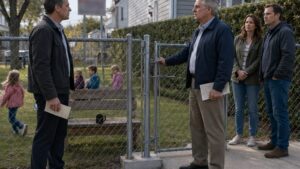
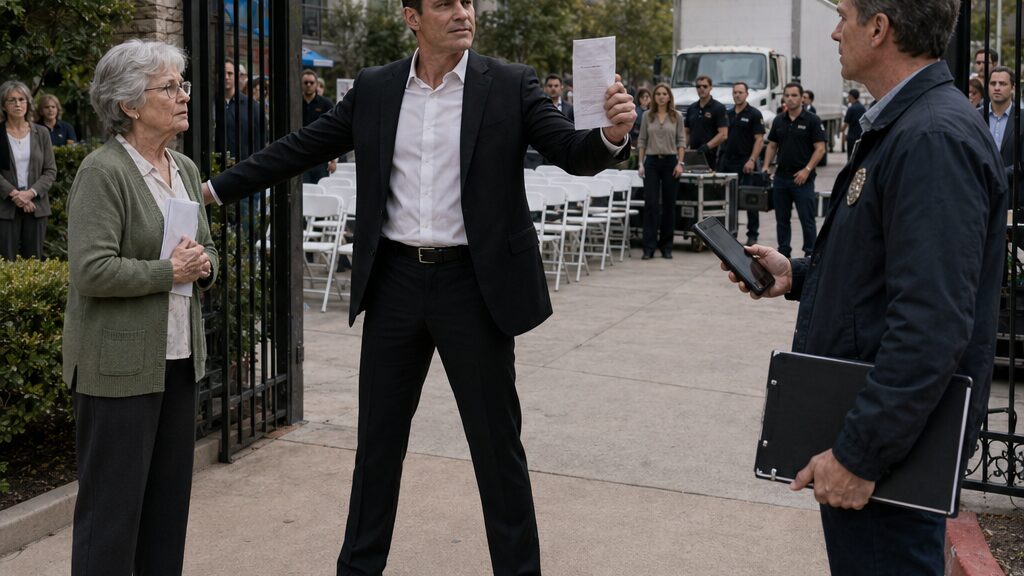
Justin Wright stood across the condominium gate with both arms extended, as if the iron bars belonged to him and the woman on the other side did not.
“I live here,” Linda Baker said.
She held a folded white notice against her chest. Her voice was steady, but her fingers kept pressing the paper flatter.
Justin smiled toward the arriving guests behind him. “And today, this entrance is reserved.”
Raymond Carter stopped six feet away and took in the scene before reaching for his badge.
White folding chairs filled the central courtyard in precise rows. A raised stage covered half the lawn. Rental workers wheeled speakers past a children’s play structure wrapped in decorative fabric. Beyond the gate, a line of black cars was already forming along the curb.
Raymond had expected a routine permit verification.
He opened his clipboard.
For several seconds, he wrote nothing.
“Municipal inspections,” he said. “Who is responsible for the event?”
Justin lowered one arm but left the other braced against the gate. His suit jacket was fitted too tightly across his shoulders, and his smile did not reach his eyes.
“That would be me.”
“Then step aside so the resident can enter.”
“She can use the rear entrance.”
Linda looked at Raymond. “The rear entrance has stairs.”
Justin sighed. “It is one morning.”
“I have a walker inside the community room.”
“Then someone can bring it to you.”
Raymond glanced down at the folded notice in her hands. The top line bore the condominium association’s letterhead. Most of the text was hidden by the crease.
“When were residents notified?” he asked.
Justin laughed softly. “You are here to inspect a permit, not run a customer-service desk.”
Raymond turned to Linda.
“May I see that?”
She handed him the notice. It stated that the courtyard and community room would be unavailable for a private event from eight in the morning until midnight. It did not mention alternative accessible entry. At the bottom, in smaller type, residents were instructed not to interfere with event operations.
Raymond read it twice.
“Who locked the community room?” he asked.
A maintenance worker standing near the stage looked away.
Justin leaned closer. “The association granted us exclusive access.”
“To the courtyard?”
“To the entire event footprint.”
“How many guests?”
“Four hundred.”
Linda gave a small, disbelieving breath.
Raymond looked past Justin at the rows of chairs. The permit request in his system had listed one hundred fifty attendees.
“Your application states one hundred fifty.”
“That was an estimate.”
“A difference of two hundred fifty is not an estimate.”
“It is a successful event.”
Two rental workers carried a metal truss through the gate. Justin moved aside for them, then immediately blocked the opening again before Linda could step forward.
Raymond noticed that.
He also noticed Justin watching to see whether he had noticed.
“Mr. Wright,” Raymond said, “move away from the gate.”
Justin’s smile thinned.
“You know who signed off on this?”
“I know whose name is on the permit.”
“And you know who reviews promotions in your department?”
Linda’s eyes shifted toward Raymond.
Justin’s voice dropped. “Field supervisor. That is the position, right?”
Raymond closed the clipboard.
For eleven years, he had trained himself not to react when someone tried to turn information into leverage. His first year in the department, he had corrected a senior inspector during a public hearing. The correction had been accurate. It had also cost him three years of favorable assignments.
Since then, he had learned to write concerns in margins, speak privately, and let supervisors decide what deserved daylight.
Justin saw the pause and mistook it for surrender.
“This does not need to become a problem,” he said. “Walk the site, check the exits, sign whatever you sign, and go enjoy your Saturday.”
Linda reached for the gate again.
Justin shifted his body in front of her.
The gesture was small. It changed the scene.
Raymond reopened the clipboard.
“Permit number?”
Justin gave it to him.
Raymond pulled the paper copy from the event packet. The authorization was legitimate. The city seal was correct. The dates matched. Temporary amplified sound, food service, and a raised platform had all been approved.
He traced the use conditions with one finger.
Nothing authorized exclusion of residents.
Nothing authorized closure of the community room.
Nothing expanded occupancy to four hundred people.
“The permit allows temporary use of the courtyard,” Raymond said. “It does not suspend resident access.”
Justin pointed at a paragraph near the bottom. “Read the amendment.”
Raymond did.
Temporary event operator may maintain controlled access within the approved footprint for the duration of permitted operations.
The language was broader than normal. Too broad.
“Controlled access is not exclusive possession,” Raymond said.
“That is your interpretation.”
“It is the code definition.”
“It is not what I was told.”
“By whom?”
Justin looked toward the courtyard instead of answering.
A box truck turned into the property and rolled over the red-painted curb. The security guard waved it forward until it stopped across the marked emergency lane.
Raymond heard the hydraulic brake release with a heavy sigh.
He stepped around Justin and raised his phone-sized city tablet.
“Do not photograph my equipment,” Justin said.
Raymond framed the truck, the curb markings, and the blocked lane in one image.
The tablet confirmed the timestamp and GPS location.
Justin followed him through the gate.
“I said do not photograph my equipment.”
Raymond took a second image.
A delivery worker opened the truck’s rear door. Stacked banquet tables filled the interior.
“Move the vehicle,” Raymond said.
“We are unloading.”
“Move it now.”
Justin came close enough that Raymond could smell coffee on his breath.
“You flag this event,” he said, “and your promotion ends today.”
Raymond looked at the courtyard, then at Linda still waiting beyond the gate with her folded notice.
He had heard threats before. Most were empty.
This one carried names, timing, and knowledge it should not have carried.
Raymond lowered the tablet and returned to the permit packet. He turned to the final page, where the broad access clause had been added beneath the printed conditions.
The sentence was handwritten.
Beside it were two initials from the municipal office.
Raymond recognized the handwriting before he recognized the initials.
Chapter 2: Every Photograph Went Somewhere Justin Could Not Reach
The delivery truck remained across the fire lane while Raymond took a third photograph.
Justin stepped into the frame.
Raymond lowered the tablet. “Move.”
“You are creating a false record.”
“The lane is blocked.”
“For unloading.”
“The code does not stop applying during unloading.”
Justin turned toward the security guard. “Tell him this vehicle was cleared.”
The guard looked at the red curb, then at Raymond’s badge.
“I was told to direct deliveries here,” he said.
“By whom?” Raymond asked.
Justin answered for him. “By me.”
Raymond entered the statement on his clipboard.
Violation one: obstruction of designated emergency access.
Justin watched the pen move.
A rental worker dragged a coil of electrical cable across the walkway leading to the west building. Raymond photographed it.
Violation two: unsafe obstruction of an accessible pedestrian route.
At the play area, decorative panels had been strapped to the fence. Two catering carts stood inside the gate near the slide.
Raymond checked the approved site plan. The entire play area had been marked as resident space and excluded from event use.
Violation three: unapproved expansion beyond permitted footprint.
He numbered each item in block letters.
Justin followed without speaking for almost a minute. His silence was more controlled now, but the skin along his jaw had tightened.
“You enjoy this?” he asked finally.
“No.”
“You people always say that.”
Raymond photographed the stage supports set into the lawn.
Justin moved beside him. “Do you understand what cancellation costs?”
“I understand what the permit allows.”
“I have forty-three employees and contractors attached to this event.”
“Then you should have followed the site plan.”
“I did follow the plan I was given.”
Raymond turned the tablet so Justin could see the approved boundary. The screen displayed the courtyard outline, the permitted stage location, and the resident access corridors left open.
Justin pointed to the handwritten amendment.
“That changes the plan.”
“It cannot erase a fire lane.”
Justin’s expression shifted. Not fear yet. Calculation.
“Those pictures stay on your device?”
“They upload to the city server.”
“Automatically?”
“With time and location data.”
For the first time, Justin looked at the tablet rather than at Raymond.
A notification confirmed the latest upload.
Raymond did not need to explain further.
Justin walked away and called someone.
Linda had entered through the gate after the truck moved several feet, but she remained near the wall, watching the workers rather than heading toward her building.
Raymond approached her.
“You can use the west walkway now.”
“They locked the community room yesterday afternoon,” she said.
“The notice says eight this morning.”
“I know what the notice says.”
“Who locked it?”
“The maintenance man. Joshua.”
Across the courtyard, the worker who had looked away earlier was carrying folded chairs.
Linda lowered her voice. “I asked him for my walker before he locked it. He said he had orders and would bring it later.”
“Did he?”
“No.”
Raymond looked at the time printed on the notice.
“When did you receive this?”
“Under my door at seven last night.”
The permit required seventy-two hours of resident notification for any event limiting shared-space access.
Raymond wrote the time in the margin.
Justin returned with his phone in hand.
“My attorney says you are exceeding your inspection authority.”
“Your attorney is welcome to contact the department.”
“He already has.”
“Good.”
“You say that now.”
Raymond finished the line and closed the clipboard.
“I am issuing an immediate correction order for the fire lane, accessible route, and unapproved play-area use. Those conditions must be corrected before the event opens.”
Justin stared at him.
“You are not shutting it down?”
“Not yet.”
The answer unsettled him more than a dramatic declaration would have.
Raymond pointed toward the lane. “Move every vehicle. Remove the cables from the walkway. Clear the play area.”
“And the gate?”
“Residents enter.”
“We have security concerns.”
“Then screen event guests. You do not exclude residents from their homes.”
Justin’s face reddened.
“You think this makes you brave?”
“No.”
“You think that woman will remember your name next week?”
Linda heard him.
She folded the notice again with slow precision.
Raymond looked at Justin. “The correction order stands.”
A woman in a navy blazer crossed the courtyard toward them. She carried a thick folder under one arm and walked quickly without appearing rushed.
“Raymond Carter?” she asked.
“Yes.”
“Angela Davis. HOA president.”
She shook his hand, then turned to Justin.
“You told me the city had approved exclusive use.”
“It did.”
Angela opened the folder and removed a signed agreement.
“The association granted Mr. Wright exclusive operational control of the courtyard, community room, and adjoining amenities from six this morning until one tomorrow afternoon,” she said. “The board approved it unanimously.”
Raymond read the first page.
The contract was not a city permit. It was a private use agreement between the HOA and Justin’s company. It promised vacant possession of the listed common areas and required the association to prevent resident interference.
Linda stepped closer. “You signed away our community room?”
“For one day,” Angela said.
“You did not ask us.”
“The governing documents allow temporary rental.”
“Not of our entrances.”
Angela’s composure slipped, then returned.
“We were under a deadline.”
“What deadline?” Raymond asked.
She glanced toward the residents gathering near the west walkway.
“That is association business.”
“Not if it caused code violations.”
Justin tapped the contract. “This is what I relied on. I paid for exclusive control.”
“You paid the association,” Raymond said. “You did not purchase suspension of city code.”
“I paid every fee your city requested.”
“And you still cannot block a fire lane.”
Justin turned on Angela. “You told me there would be no conflict.”
Angela held his stare, but her grip tightened around the folder.
Raymond saw something pass between them—not conspiracy, but shared panic.
“How much was the deposit?” he asked.
Neither answered.
The sound crew shut off a speaker test, and the courtyard became abruptly quiet.
Angela looked at Linda, then at the rows of guests beginning to arrive.
“We cannot cancel this event,” she said.
“Why?”
“Because the money is gone.”
Chapter 3: The Repair Bill Hidden Behind the Celebration
Angela unlocked a metal cabinet in the HOA office and pulled out a stack of envelopes bound with a rubber band.
“This is why,” she said.
The office was barely larger than a storage room. A folding table served as a desk. Paint samples, maintenance logs, and reserve-study binders crowded the shelves. Through the wall came the dull vibration of workers dismantling part of the stage.
Raymond stood opposite Angela while Linda remained near the door.
Justin had refused to join them. He was outside on the phone, attempting to salvage the event under the corrected conditions.
Angela placed three invoices on the table.
The top one was marked overdue.
Elevator control assembly replacement: $46,800.
A second invoice listed temporary stabilization work. A third warned that continued operation without replacement could result in shutdown.
“The west building elevator failed inspection six weeks ago,” Angela said. “We have elderly residents on four floors. Two use wheelchairs.”
“You have reserve funds,” Raymond said.
“We had reserve funds.”
“What happened to them?”
“Roof work. Insurance deductible. A plumbing failure in Building C.”
Linda looked at the invoices. “You told us the elevator repair was scheduled.”
“It is scheduled.”
“With event money?”
Angela did not answer immediately.
“The board proposed a special assessment,” she said. “The residents rejected it.”
“Because you proposed it three days before the vote,” Linda replied.
“We were given the final repair estimate three days before the vote.”
“You never showed us these.”
“I was trying not to frighten people.”
Linda gave a short, humorless laugh. “So you locked us out instead.”
Angela looked away.
Raymond opened his clipboard. Linda’s folded access notice had slipped between two pages. He set it on the table beside the invoices.
“How much did Justin pay?”
“Twenty-five thousand upfront. Another fifteen after completion.”
“And the deposit?”
“Transferred to the elevator contractor Thursday.”
Raymond felt his first clean certainty begin to break apart.
Angela had violated resident notice rules. She had signed an agreement promising control the association could not lawfully give. But she had not used the money for herself, nor for cosmetic improvements, nor for the board’s convenience.
She had tried to keep an elevator operating.
“You understood the event might restrict access?” he asked.
“I understood residents would use alternate routes.”
“Linda cannot use the rear stairs.”
“I did not know that.”
“You were HOA president.”
“I do not know every resident’s medical needs.”
“You knew the community room stored mobility equipment.”
Angela’s eyes hardened. “I knew we had forty-eight hours before the repair contractor released our slot. I knew another assessment vote would take weeks. I knew people on the fourth floor were already asking how they were supposed to buy groceries if the elevator was shut down.”
The wall vibrated again.
Outside, someone shouted for a cable ramp.
Angela lowered her voice. “I chose the problem I could solve.”
Linda picked up her notice.
“And decided the rest of us were smaller problems.”
No one answered.
A knock came at the open door.
Joshua Martinez stood in the hall wearing a faded maintenance shirt and work gloves.
“Mr. Carter,” he said, “you asked about the community-room lock.”
Raymond gestured him inside.
Joshua removed one glove, then the other. “I installed it.”
“Yesterday afternoon?”
“Yes.”
“Before the notice period began?”
“Yes.”
“Why?”
“Mr. Wright’s site manager said they needed secure storage overnight.”
Angela frowned. “I authorized morning access.”
Joshua looked at her. “The written work order said three Friday.”
“Who issued it?”
“The management office.”
“Did Linda ask for her walker?”
Joshua’s face changed.
“She asked me not to lock the room until she got it.”
“And?”
“I told her I would bring it.”
“But you did not.”
“No.”
“Why?”
“The rental crew arrived early. Then I got sent to open the loading entrance. By the time I came back, the event lock was on and the site manager had the key.”
Linda’s expression remained calm, which made Joshua’s shame more visible.
“You knew she needed that route,” Raymond said.
“Yes.”
“And you locked it anyway.”
Joshua rubbed his thumb across the seam of one glove.
“I have worked here nine years. The management company cut two maintenance positions in January. They told me if I could not handle event support, they would contract the whole job out.”
Angela stared at him. “No one told you to deny a resident mobility equipment.”
“No,” Joshua said. “They only told me not to delay setup for resident complaints.”
The distinction settled over the room.
Raymond wrote the statement down.
For years he had heard people use instructions that way—carefully worded, broad enough to create pressure, narrow enough to deny responsibility later.
“What happens if the event is canceled?” he asked Angela.
“Justin’s contract allows recovery of direct losses and vendor penalties.”
“How much?”
“His attorney estimated more than sixty thousand.”
Linda looked at the elevator invoices again.
“So we lose the repair money and owe him more.”
“Possibly.”
Angela pressed both hands against the table.
“That is what I have been trying to say. I made a bad choice because every available choice was bad.”
Raymond capped his pen.
“A bad choice under pressure is still a choice.”
“I know.”
It was the first thing she had said without defending herself.
Outside, the stage crew had begun removing the decorative panels from the play area. Through the office window, Raymond saw residents crossing the reopened walkway. Justin stood near the gate, speaking into his phone with sharp, controlled gestures.
The visible violations were being corrected.
The deeper ones were multiplying.
Joshua cleared his throat.
“There is something else.”
He pulled out his phone and opened an email.
The message had come from the property-management office the previous afternoon. It instructed maintenance and security staff to install barriers across all event access points and keep them in place for the full rental period.
Raymond read the final line twice.
Proceed regardless of resident objections. Refer all complaints to the board after the event.
“Who sent this?” he asked.
Joshua pointed to the sender line.
It came from a general management account.
Below the message was a forwarded chain containing language from the exclusivity agreement and the same broad access wording used in the city permit.
Raymond scrolled upward.
The earliest message in the chain had been sent to the property manager by Justin.
Attached was a marked-up permit draft.
The amendment was highlighted.
In the margin, someone had written: City language approved. Use this to support full access control.
Raymond’s attention stopped on the file history.
The amendment had not originated with the HOA.
It had been added before the board signed anything.
And the initials approving the wording belonged to someone inside his department.
Chapter 4: The Permit Language Raymond Had Seen Before
Raymond found his own initials beside the same sentence at 8:17 Saturday night.
The municipal records office was empty except for the low hum of fluorescent lights and the soft mechanical click of the scanner warming itself every few minutes. He had used his weekend access card because the electronic permit system showed only the current version of the document. Older drafts were stored in archived case folders, some digital, some still on paper.
The first matching permit was two years old.
Temporary event operator may maintain controlled access within the approved footprint for the duration of permitted operations.
The wording was identical.
Below it, in blue ink faded almost gray, Raymond had written:
Clarify that controlled access does not restrict lawful residential entry.
His initials appeared beside the note.
There was no formal objection number. No correction order. No memorandum to the permit supervisor.
Only the sentence in the margin.
Raymond sat back from the desk.
He remembered the case. A fundraising dinner at a private retirement community. The event operator had wanted to station security at all doors, and Raymond had raised the concern during an internal review. The senior inspector overseeing the file had told him the clause was merely operational language and that everyone understood residents could still enter.
Raymond had accepted the explanation.
Not because it satisfied him.
Because the senior inspector had lowered his voice and reminded him that the department was already behind on permit approvals. Because Raymond had been excluded from complex inspections for nearly three years after correcting a supervisor at a public hearing. Because he had learned that written disagreement lasted longer than the problem that caused it.
He had added the note, initialed it, and let the permit move forward.
Now the same clause sat inside Justin Wright’s file like a door left unlocked.
Raymond scanned the older page and attached it to a private working folder. Then he opened another archived permit.
The wording appeared again.
This time there was no note.
A third file contained a printed version of the clause, no longer handwritten. A fourth used it in a temporary market permit. A fifth allowed “controlled access” during a corporate reception at a residential marina.
The language had become standard.
Raymond checked the approval history. The same permit clerk had processed most of the files, but senior staff had signed them. In several cases, Brenda Lee’s name appeared in the review chain.
His phone rang.
Brenda.
Raymond watched the screen for two rings before answering.
“Carter.”
“What are you doing in records?”
The access system had alerted her.
“Reviewing related permits.”
“It is Saturday night.”
“The current case contains an amendment that appears in older files.”
There was a pause.
“Are you alone?”
“Yes.”
“Good. Listen carefully. Do not discuss the permit process with residents, the HOA board, or Wright’s people.”
“I have not discussed internal process.”
“Keep it that way.”
“The clause has been used for at least two years.”
“I know the clause.”
Raymond looked at the rows of file cabinets.
“Then you know it is too broad.”
“I know it was intended to help event staff manage guest entry.”
“It is being used to justify excluding residents.”
“That is a misuse by the operator.”
“It is a predictable misuse.”
Brenda exhaled slowly. “Raymond, the field issue is straightforward. Document the blocked lane, the accessibility problems, and the unapproved footprint. Those are enforceable. Do not turn one contractor’s behavior into an audit of the entire department.”
“One contractor did not write the clause.”
“No. But he chose how to use it.”
“So did we.”
The silence on the line changed.
When Brenda spoke again, her voice was quieter.
“You are being reviewed for field supervisor on Monday.”
“I know.”
“Then act like someone who understands scope.”
Raymond looked at the old permit with his initials in the margin.
“Scope is the problem.”
“No. Scope is how you keep a correctable incident from becoming a liability crisis.”
“A resident was denied accessible entry.”
“And you corrected it.”
“The community room was locked before the permitted period.”
“Add it to the report.”
“The HOA signed an exclusivity contract relying on city language.”
“That contract is not our responsibility.”
“Our language helped them sell authority they did not have.”
“Do not say that outside the department.”
Raymond heard a notification on his computer. A new document had entered the case system.
Brenda continued. “Complete the current inspection. Submit the evidence. Nothing else until we speak Monday.”
The call ended before he could answer.
The new document was a formal complaint from Justin Wright.
Raymond opened it.
Justin accused him of selective enforcement, professional intimidation, unauthorized photography, interference with a lawful contract, and prejudicial treatment of a permitted business. He claimed Raymond had ignored corrective actions and threatened to close the event despite full cooperation.
Attached were photographs.
In one, Raymond stood near the stage with the tablet raised. The angle made him appear to be photographing arriving guests rather than the blocked lane behind them. In another, Justin held the permit while Raymond pointed toward the gate. The image excluded Linda entirely.
There was also a written statement from Justin’s attorney asserting that Raymond’s conduct had caused measurable financial losses.
Raymond read the complaint without moving.
The facts inside it were incomplete, but not invented. He had photographed the site. He had ordered equipment moved. He had warned that continued violations could stop the event.
A narrow report could answer every allegation.
A broader one would expose the clause, the department’s review history, and Raymond’s failure to challenge it formally when he first noticed the risk.
He printed the complaint and clipped it beneath the current permit.
At home, he placed the clipboard on his kitchen table and opened the old scanned file on his laptop.
His house was quiet. He had turned on only the light over the stove, leaving the rest of the room in shadow. The promotion packet sat unopened near the fruit bowl where he had placed it Friday evening.
He had planned to review his interview notes that weekend.
Instead, he reread the sentence he had written two years earlier.
Clarify that controlled access does not restrict lawful residential entry.
The warning had been accurate.
It had also been useless.
Raymond opened a blank memorandum and typed the case number. He wrote three paragraphs describing the current violations. Then he stopped before mentioning the older permits.
His cursor blinked at the end of the page.
He remembered the senior inspector’s expression years earlier—not angry, only tired.
We cannot turn every imperfect sentence into a formal dispute.
At the time, Raymond had believed he was choosing patience.
Now he saw that he had chosen absence. He had put the concern in a margin where it could prove he noticed without requiring anyone to act.
His phone rang again just after nine Sunday morning.
Brenda did not ask whether she had awakened him.
“Justin Wright’s complaint has been copied to the city administrator,” she said. “His attorney requested an emergency review.”
“I saw it.”
“Monday. Eight-thirty. My office.”
“I will be there.”
“Bring the current case file.”
Raymond waited.
“Only the current file,” she added.
He looked at the older permit displayed on his laptop, his initials still visible beside the clause.
“Understood,” he said.
Brenda ended the call.
Raymond closed the laptop but did not remove the archived pages from the clipboard.
Chapter 5: Linda Refused the Easier Version of the Truth
“Why does your report begin yesterday?”
Linda’s question stopped Raymond before he reached the community-room table.
It was Sunday afternoon. The event had been reduced to a smaller gathering inside the permitted area, then ended early when several vendors withdrew. By morning, most of the white chairs were gone. The stage had been dismantled. Pale rectangles in the grass showed where its supports had stood.
The community room smelled of dust, coffee, and the cleaning solution Joshua had used on the floor.
Raymond had returned to verify that access had been restored. Linda sat beside a stack of old HOA binders, her walker now within reach.
“My report begins with the inspection,” he said.
“No. It begins with what you saw during the inspection.”
“That is generally how reports work.”
She looked at the clipboard under his arm. “Then it is not the whole report.”
Raymond set it on the table.
“I documented the locked room, insufficient notice, blocked routes, fire-lane obstruction, and permit violations.”
“And the city language?”
“That is under internal review.”
“Is it in your report?”
“Not yet.”
Linda nodded once, as though he had confirmed something she expected.
Angela stood near the filing cabinet with her arms folded. She had brought the HOA records Raymond requested but had not handed them over.
“I told her we should wait for you,” Angela said.
“For what?”
Linda opened one of the binders.
The plastic sleeves inside held meeting minutes, building notices, and amendments to community rules. She turned to a page marked with a yellow tab.
“Read the date.”
Raymond did.
Nine years earlier.
The rule required all temporary users of common property to preserve continuous resident access and prohibited locking any gate, hallway, or shared room needed for emergency movement.
“You helped draft this?” he asked.
“I was board secretary.”
“Why was it added?”
Linda looked toward the closed community-room door.
“A resident on the third floor had a stroke during a private reception.”
Raymond waited.
“The family rented the courtyard for an anniversary party. They locked the side gate because strangers kept walking through. When the ambulance arrived, the main drive was blocked by catering vans. The paramedics went to the side gate.”
Her hand rested flat on the binder page.
“No one could find the key.”
“How long?” Raymond asked.
“Six minutes.”
Angela lowered her eyes.
Linda continued. “Six minutes is not long in meeting minutes. It fits into one sentence. It was longer when his wife stood on the other side of that gate listening to the siren.”
“Did he survive?”
“Yes. He never returned to the same apartment. His wife moved the following year.”
Raymond read the rule again.
The language was plain. No controlled access. No approved footprint. No operational discretion.
Continuous resident access shall be maintained.
Not a technical preference.
A promise made after a failure.
“The current board removed this?” he asked.
Angela stepped closer. “No. It is still in effect.”
“Then why did you sign the agreement?”
“I did not remember this provision.”
Linda’s face tightened. “You signed a contract over common property without reading the common-property rules.”
“I read the current rental policy.”
“You read the summary.”
Angela looked at Raymond. “The management company prepared the agreement. They said it complied with the governing documents and city permit.”
“And you accepted that,” he said.
“Yes.”
Her answer contained no defense now.
She placed a thick folder on the table.
“These are the board emails, invoices, meeting minutes, and the management company’s draft contracts. I will release them to the city.”
Raymond reached for the folder.
Angela kept one hand on it.
“On one condition.”
He withdrew his hand.
“You include the department’s role,” she said. “Not just the HOA. Not just Justin.”
“That is not a condition you can place on an inspection request.”
“No. It is the condition under which I stop protecting the people who told us the language was valid.”
Linda looked from Angela to Raymond.
Angela continued. “The board made the decision. I signed the contract. I will own that. But I will not hand over records so the city can make us the only irresponsible people in the room.”
Raymond’s first instinct was resistance.
A public official did not bargain over evidence. He could issue a records demand if needed. He could obtain the documents without accepting Angela’s terms.
That would also let him write the easier report.
Justin exceeded the permit.
The HOA exceeded its authority.
Maintenance followed improper orders.
The city corrected the violations.
Everything after that could remain internal.
Linda lifted her folded access notice from the table.
“You want him to protect you,” she said to Angela.
“I want him to tell the truth.”
Linda turned to Raymond. “And you want the truth to start after your part.”
The words were not loud.
They landed harder than Justin’s threat at the gate.
Raymond opened the clipboard.
The old permit pages were beneath the current case file. Linda saw them.
“So you found it,” she said.
“I found several.”
“And?”
“I noted the concern two years ago.”
“Formally?”
“No.”
“Why not?”
Raymond looked down at his initials.
“Because I thought I could correct it without creating a fight.”
“Did you?”
“No.”
Linda folded the notice once more, along the same worn crease.
“My husband used to do that,” she said. “He would fix a loose step without telling the board the staircase was rotting. He thought quiet work was honorable.”
Raymond said nothing.
“It was honorable,” she continued. “It was also not enough.”
She placed the notice inside his open clipboard, directly over the old permit.
The paper looked small against the official forms.
“Yesterday, that notice told me I was in the way,” she said. “Today, it tells you what your quiet corrections cost.”
Angela released the records folder.
Raymond took it.
He sat at the table and opened his report.
The existing draft ended after the three site violations and resident-access order. He inserted a new section.
Prior Departmental Knowledge and Contributing Permit Language.
His hands remained steady as he typed.
He described the repeated clause. He cited the archived permits. He included his handwritten note from two years earlier. Then he wrote the sentence he had avoided since finding it:
The undersigned inspector identified the ambiguity but did not initiate formal correction or escalation.
Angela read over his shoulder but said nothing.
Linda watched him add the date and case number.
“What happens now?” she asked.
“I submit it.”
“To whom?”
“My supervisor.”
“And your promotion?”
Raymond closed the report window.
“I do not know.”
For once, the answer did not feel like something to conceal.
He attached the old permit scans, the HOA records index, Joshua’s email, the photographs, and Linda’s notice. Before submitting, he reviewed the entire file.
At the bottom was a certification box.
Complete and accurate to the best of the inspector’s knowledge.
Raymond checked it.
The upload began.
Chapter 6: Monday Morning in the Supervisor’s Office
Brenda placed Raymond’s promotion letter face down beside Justin Wright’s complaint.
The two documents touched at one corner.
Raymond sat across from her desk with the complete clipboard on his knees. Through the glass wall behind Brenda, department employees moved between cubicles without looking into the office.
“You submitted forty-seven pages,” she said.
“Fifty-two with attachments.”
“I noticed.”
She tapped the complaint.
“Wright alleges you interfered with a lawful event after the operator corrected every condition you identified.”
“He corrected the visible site violations after the order.”
“And yet you continued.”
“I continued the inspection.”
“You expanded it.”
“The permit language contributed to the violations.”
Brenda looked at him for several seconds.
“You included five unrelated permits.”
“They contain the same clause.”
“You included an internal note carrying your own initials.”
“Yes.”
“You included HOA correspondence that references conversations with a permit clerk who is not here to defend herself.”
“The clerk can be interviewed.”
“You included a statement that the department had prior notice of the ambiguity.”
“We did.”
Brenda’s expression hardened.
“You did.”
Raymond let the distinction remain between them.
She leaned back. “That is the problem you do not seem to understand.”
“I understand it.”
“No. You understand the moral version. I am asking whether you understand the administrative one.”
She turned the promotion letter over but kept one hand on it.
The top line congratulated Raymond on being selected as the preferred candidate for field supervisor, pending final approval.
The signature space was blank.
“We were prepared to complete this today,” Brenda said. “Your record is strong. Your field decisions are usually careful. Staff trust you.”
Raymond looked at the unsigned line.
“Usually?”
“Saturday was not careless. That would be easier.”
She moved the complaint aside.
“You were correct about the fire lane. Correct about accessibility. Correct about the play area. Correct that the HOA could not grant exclusive control over resident access.”
“Then what are we discussing?”
“Whether you had authority to turn a field inspection into a departmental review without notifying your supervisor.”
“I notified you.”
“After entering archives on a weekend and attaching historical files to an active enforcement case.”
“The historical files explain how the current violation happened.”
“They also expose the city to claims that it approved unlawful control language for years.”
“If that is true, the exposure already exists.”
Brenda’s fingers tightened on the promotion letter.
“You think saying it plainly makes this simple.”
“No.”
“Good, because it is not.”
She rose and closed the office door.
When she returned to her chair, her voice was lower.
“The clause was introduced during a backlog. Event permits were taking six weeks. Applicants complained that security staff could not manage private functions because our standard language did not distinguish guests from the public.”
“So the department broadened it.”
“We clarified operational control.”
“Without defining its limit.”
“We expected inspectors to enforce the limit on site.”
“That makes every resident’s access depend on whether an inspector arrives.”
Brenda looked toward the glass wall.
“Senior staff knew the language was imperfect,” she said. “They also knew it cut processing time and reduced disputes during permit review.”
“By moving the dispute to the property.”
“Yes.”
The admission brought no relief.
Raymond set the clipboard on her desk.
Brenda did not touch it.
“There is a path here,” she said. “Revise the report. Keep the active violations, the HOA contract, the resident-access order, and Wright’s conduct. Remove the historical permits and the statement of departmental knowledge. We open an internal policy review separately.”
“Would that review include my old note?”
“If relevant.”
“It is relevant now.”
“It is also disciplinary evidence against you.”
Raymond looked at the promotion letter.
Brenda followed his gaze.
“If you narrow the report, I can still recommend approval today. Your field action stands. Wright is held accountable. The residents are protected. Then we correct the clause internally.”
“And the public record says the contractor and HOA created the problem alone.”
“The public record says they committed the violations.”
“Using authority our language appeared to give them.”
“Apparent authority is not lawful authority.”
“It was enough for the board to rely on.”
Brenda’s composure cracked for a moment.
“And what do you want, Raymond? A public declaration that the department failed? A press conference? Every permit challenged? Every applicant asking whether city approval means anything?”
“No.”
“Then what?”
He placed Linda’s folded notice on top of the clipboard.
“This belongs in the same file as the clause.”
Brenda stared at the paper.
“It is a resident notice.”
“It is what the clause became.”
She looked away first.
A knock sounded. One of the review-panel members entered, followed by another administrator carrying a thin folder. They took the two chairs along the wall.
Brenda had convened the meeting before Raymond arrived.
The first panel member opened the folder.
“Mr. Carter, we need to address your admission that you identified similar language two years ago and did not formally escalate it.”
“I understand.”
“Were you instructed not to?”
“No.”
“Did your supervisor know?”
“I raised it during an informal review.”
“Is there a record?”
“My handwritten note.”
“That is not a formal record.”
“No.”
“Why did you not file one?”
Raymond could have described the senior inspector’s warning. The years of stalled assignments. The department culture that treated objections as disloyalty. Every statement would have been true.
None would have changed the box he had failed to check.
“I decided a margin note was sufficient,” he said.
“Was it?”
“No.”
The second panel member glanced at Brenda.
“Your promotion review is suspended pending investigation.”
Raymond felt the words physically, like a drop in an elevator before the cables caught.
“How long?” he asked.
“We cannot estimate.”
“Is this disciplinary?”
“It may become disciplinary.”
Brenda turned the promotion letter face down again.
The first panel member pointed to the clipboard.
“If we accept the file, it enters the official enforcement record in full. You understand that?”
“Yes.”
“You may withdraw and resubmit a narrower report before noon.”
Raymond placed both hands on the desk.
For eleven years, the clipboard had given him a way to keep distance. Facts on one side, decisions on the other. He recorded what he saw and let people above him decide what it meant.
Now the distance was gone.
He pushed the clipboard forward.
“I am submitting it in full.”
Brenda looked at him, not angrily.
Tiredly.
“You are giving up your copy?” she asked.
“The server contains the evidence.”
“Your personal working notes?”
“They are included.”
“Once accepted, you cannot remove them.”
“I know.”
The panel member took the clipboard.
The small pressure of its weight leaving Raymond’s hands felt more final than the suspended promotion.
Brenda stood and opened the office door.
“Then we proceed on all fronts,” she said.
She instructed an administrator to schedule an emergency joint hearing with the HOA board, Justin Wright and his attorney, the property-management company, the permit clerk, and the fire marshal.
“Today?” the administrator asked.
“Within forty-eight hours.”
Brenda looked at Raymond.
“You will attend as the reporting inspector and as a subject of the internal review.”
Raymond nodded.
Outside the glass wall, employees had begun to notice the gathering.
No one applauded. No one offered sympathy.
The administrator carried the clipboard out of the office.
Brenda picked up the unsigned promotion letter, slid it into a file, and closed the drawer.
Then she reached for the phone to order a hearing that could correct the system—or leave Raymond standing alone inside the record he had finally made.
Chapter 7: The Gate Opened Without Anyone Applauding
Joshua Martinez cut through the last black plastic tie and lowered the private-event lock from the gate.
The chain slipped loose with a dry metallic scrape. For a moment he held it in both hands, uncertain what to do with something that had caused so much trouble while looking so ordinary.
“Maintenance storage?” he asked.
Angela Davis shook her head.
“Dispose of it.”
Joshua placed the lock in a cardboard box beside the gate. No one cheered. A resident carrying groceries waited for him to clear the walkway, then passed without slowing.
Three weeks had gone by since the hearing.
The white chairs were gone. The stage marks had faded into the courtyard grass. Fresh red paint covered the section of curb damaged by delivery trucks, and two new signs identified the fire lane without mentioning the event that had made them necessary.
Raymond stood near the entrance with no clipboard under his arm.
He had left it with the department on Monday morning and had not been given it back. The official file now existed in a records system, a review-panel folder, and several attorneys’ offices. What had once been his working object had become evidence belonging to everyone involved.
Linda Baker approached along the reopened path, guiding her walker over the threshold without asking anyone to move.
Joshua stepped aside.
“I adjusted the closer,” he said. “The gate should stay open long enough now.”
Linda tested it by pulling the iron frame toward herself. It moved with less resistance than before.
“Better,” she said.
Joshua nodded. He seemed to expect more, perhaps anger or forgiveness.
Linda gave him neither.
She continued toward the community room.
Inside, folding tables had been arranged for an association meeting. The new resident-access policy was clipped to a communal inspection board near the door. Its language was short enough to read without legal interpretation.
No private use agreement may restrict a resident’s lawful entry, accessible route, emergency movement, or access to essential shared facilities.
Below it were the revised event-permit conditions issued by the city. The phrase controlled access had been removed.
Angela stood beneath the board, sorting copies of the new rental rules.
“The vote passed thirty-eight to six,” she told Raymond. “No exclusive courtyard rentals. Smaller events only. Resident routes stay open.”
“And the elevator?”
“The replacement assembly arrived Tuesday.”
“Paid?”
“Mostly.”
The HOA had kept the portion of Justin’s payment tied to the time the event had legally operated. Insurance covered part of the emergency repair. The rest would come from a smaller special assessment spread over twelve months.
Residents had complained.
They had also approved it.
Angela aligned the papers into a clean stack.
“I should have shown them the invoices the first time,” she said.
Raymond looked toward the elevator at the end of the hall. A new inspection certificate sat behind clear plastic beside the call button.
“Yes.”
She gave him a tired look. “You could pretend that was a difficult question.”
“It was not.”
“That is one thing I am learning about you.”
“I am trying to learn it about myself.”
Angela almost smiled.
The hearing had assigned responsibility in pieces rather than delivering the clean judgment everyone had expected.
The HOA had exceeded its governing authority and failed its notice obligations. The property-management company had been ordered to revise its event procedures and reimburse the association for part of the access-restoration cost. The city suspended use of the disputed permit clause and opened a review of every active permit containing it.
Justin’s company lost its preferred-contractor agreement with the association.
He did not lose his license.
The fire marshal concluded that the blocked lane and expanded occupancy created correctable hazards but did not prove deliberate concealment before Raymond arrived. Justin accepted a civil penalty, paid for curb repairs, and reimbursed the cost of restoring access systems.
Through his attorney, he denied mistreating residents.
He also refused to apologize to Linda.
“He sent the payment yesterday,” Angela said. “Every dollar ordered.”
“That is not the same as understanding.”
“No.”
Across the room, Linda opened the community-room filing cabinet.
Raymond watched her remove a worn binder and place it on the table. She had brought the old access notice with her, still folded along the same crease.
Before he could join her, his phone vibrated.
Brenda Lee’s name appeared on the screen.
Raymond stepped into the hallway.
“Carter.”
“The panel issued its preliminary employment decision,” Brenda said.
He looked through the glass door at the inspection board.
“And?”
“No formal discipline.”
He released a breath without meaning to.
Brenda continued before relief could settle.
“The promotion remains delayed.”
“For how long?”
“Six months, minimum. The panel wants the permit review completed and your supervisory judgment reassessed after that.”
“So not denied.”
“Not denied.”
The distinction mattered more than he expected and less than it would have a month earlier.
“Your old note helped,” Brenda said. “It proved you identified the concern. Your failure to escalate it is why they delayed advancement.”
“That seems accurate.”
“It is not the answer I recommended.”
Raymond leaned against the wall.
“What did you recommend?”
“Three months.”
He pictured the promotion letter face down on her desk.
“Thank you.”
“Do not thank me yet. You have been assigned to the policy-review group.”
“That sounds like punishment.”
“It may feel like it.”
A pause followed.
Then Brenda said, “The revised clause goes to the city attorney Friday. I want you to review it first.”
Raymond looked at the plain language posted beside the community-room door.
“I will.”
“And Raymond?”
“Yes?”
“You were right that the old language moved the dispute onto residents.”
He waited for a qualification.
None came.
Brenda ended the call.
When Raymond returned, Linda was standing before the filing cabinet. She slid the old notice into the binder behind the newly adopted access policy.
“You are keeping it?” he asked.
“Not as a complaint.”
“What, then?”
“A reminder.”
She closed the binder.
On the table beside her lay a slim wooden-backed clipboard with a clean metal clip. It was not the city-issued model Raymond had surrendered.
Linda noticed him looking at it.
“That belongs to the room,” she said. “Inspection schedules, maintenance requests, things people should not have to hide in drawers.”
Raymond picked it up. The wood was smooth and unmarked.
“You chose a clipboard?”
“I considered a locked box.”
He laughed once.
It surprised both of them.
Linda moved toward the door with her walker. At the threshold, she stopped beneath the new policy.
“Did you get the promotion?”
“Delayed.”
“I am sorry.”
“I am not sure I am.”
She studied him.
“That sounds noble.”
“It is not. I still wanted it.”
“Good.”
“Good?”
“People who pretend the cost does not hurt usually make someone else pay it.”
She pushed through the door. The adjusted closer held it open while she crossed.
Outside, Joshua carried the box containing the discarded lock toward the maintenance room. Angela spoke with two residents about the assessment. No one gathered around Raymond. No one congratulated him for the hearing or thanked him for changing the permit language.
The courtyard had returned to ordinary use.
A child rode a scooter across the path that had held electrical cables. Someone opened an upstairs window. Grocery bags rested beside a bench while a resident searched for keys.
Raymond placed the new clipboard on the community-room table beneath the inspection board.
There would be other forms. Other clauses. Other moments when a concern could be put safely into a margin and forgotten.
He understood now that quiet work could still be honorable.
It simply could not end in silence.
Linda reached the gate ahead of him. She pushed it open and continued toward her building without looking back.
Raymond followed.
The gate remained open behind him.
The story has ended.