She Chained the Only Road to His Home, Then Asked Him to Keep Quiet
Chapter 1: The Invoice Beside His Own Mailbox
Kathleen Harris was standing beside Gregory Nelson’s mailbox with a four-hundred-dollar invoice when he came down the driveway.
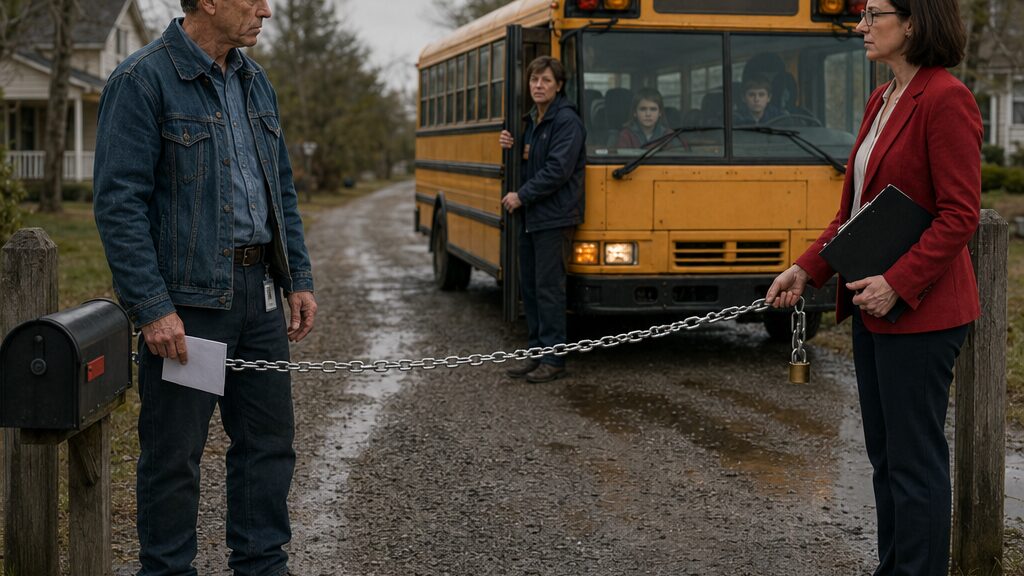
She held the paper at chest height as though she were waiting for him to recognize a warrant. Behind her, a length of new steel chain lay across the gravel, one end already looped through the cedar post on the south side of the road.
Gregory stopped ten feet away.
“What’s that?”
Kathleen extended the page without moving closer. She wore a red blazer despite the dust and carried a black clipboard under one arm. Her glasses had slipped low on her nose.
“Trespassing assessment,” she said. “For repeated unauthorized use of association property.”
Gregory looked past her at his mailbox, then down the road that curved between Raymond Lewis’s fence and Kathleen’s lower pasture before reaching the county highway.
“My unauthorized use of what?”
“The private road.”
He took the invoice. His name and address had been printed beneath the heading HARRIS RIDGE ROAD ASSOCIATION. A yellow label near the bottom read PAYMENT DUE WITHIN TEN DAYS.
Gregory rubbed the paper between his thumb and forefinger. It was heavier than ordinary copy stock.
“I’ve used this road since I bought the house.”
“Twelve years of use doesn’t create ownership.”
“No,” he said. “Recorded instruments do.”
Her mouth tightened slightly.
He read the listed violations. Crossing association-controlled property. Failure to obtain an annual access permit. Disturbance of maintained gravel surface.
The last one made him look down. His truck tires had left two shallow tracks where rain had softened the shoulder.
“Kathleen, what instrument gives the association exclusive control of this road?”
She pulled the clipboard closer. “The governing documents.”
“Which one?”
“The road agreement.”
“Recorded where?”
A small pause followed. Not long enough for anyone else to notice, perhaps, but Gregory worked in a county office where pauses often meant more than answers.
“At the township,” she said.
“Township clerks don’t record land instruments.”
Her expression hardened. “You know what I mean.”
He did. He also knew what she had avoided saying.
For years the three households along Harris Ridge had paid small amounts toward gravel, snow clearing, and culvert work. Kathleen had organized most of it. She had made phone calls when storms washed out the ditch and collected checks when the road needed grading. People had begun calling the arrangement an association long before anyone asked what authority the word carried.
Gregory handed the invoice back.
“I’m not accepting this.”
“You don’t have to accept the paper for the assessment to remain valid.”
The distant groan of a diesel engine reached them from the highway.
Kathleen bent, lifted the chain, and drew it across the road.
Gregory watched her thread it through the north post.
“What are you doing?”
“Restricting access until outstanding violations are resolved.”
“The school bus comes through here.”
“It can use the alternate route.”
“There is no alternate route suitable for a bus.”
Kathleen snapped a brass padlock through the chain links.
The bus appeared around the bend moments later, yellow body rocking over the gravel. Its brakes released with a hiss as Cynthia Davis slowed near the entrance.
Two children sat behind the windshield. One leaned into the aisle to see why they had stopped.
Cynthia opened the folding door but remained behind the wheel.
“What is this?”
Kathleen stepped toward her with the clipboard. “Temporary access restriction.”
Cynthia stared at the chain. “You put that across my route?”
“The road is privately managed.”
“My route sheet says I turn here.”
“You’ll need to use the field lane past Raymond’s place.”
Cynthia looked at Gregory. “Did the county approve this?”
The question landed harder than Kathleen’s invoice.
“No,” Gregory said.
“But you knew she was doing it?”
“I found out just now.”
Cynthia’s gaze moved from his work shirt to the identification clip still hooked at his belt. He had forgotten to remove it when he left the county office the previous evening.
“You work in property records.”
“I do.”
“So is this her road or not?”
Kathleen answered before he could. “The association has maintained and controlled it for sixteen years.”
“That isn’t what I asked.”
Gregory felt both women waiting for him.
He could have told Cynthia that maintenance did not prove ownership. He could have said that an unrecorded neighborhood agreement could not extinguish an existing easement. He could have walked back to his house, called the township attorney, and put the question into official hands before the bus moved another foot.
Instead, he looked at the invoice again.
Eight years earlier, a zoning dispute over an outbuilding had filled a meeting hall with people who knew his name but not his life. He had won the technical point and lost nearly everything else. His wife had grown tired of strangers calling the house. Michelle had stopped visiting on meeting nights. By the time the ruling arrived, the victory had felt like an empty room.
“I haven’t reviewed the records,” he said.
Cynthia’s face changed. Not anger exactly. Disappointment carried more weight.
“There are two children on this bus who live past that chain.”
“I know.”
“Then review them fast.”
Kathleen tore a sheet from her clipboard and handed it through the open door.
Cynthia glanced at it. “You want me to take a thirty-foot bus through the hay field?”
“The lane was used during the bridge work.”
“That was in August. It rained all weekend.”
“The restriction remains in effect.”
One of the children called from behind Cynthia. “Are we going home?”
Cynthia folded the paper once and laid it on the dash.
“I’m backing out,” she said. “Nobody move around.”
The bus reversed slowly toward the highway. Its warning beeper sounded between the trees.
Gregory stepped closer to the chain. The links were bright, almost silver, untouched by rust. Kathleen had wrapped red reflective tape around the center so no driver could claim not to have seen it.
“You ordered that recently,” he said.
“I planned ahead.”
“For what?”
“For the day people stopped treating shared maintenance as optional.”
“I paid every gravel assessment you sent.”
“You declined the gate reserve.”
“There was no gate.”
“There is now.”
He looked at her.
Kathleen lowered her voice. “You think because you work around deeds you can ignore community rules.”
“I think community rules should be written before they’re enforced.”
“They were written.”
“Then give me the document number.”
Her fingers tightened around the clipboard.
“You have ten days to pay.”
“And the bus?”
“That is the district’s problem.”
Gregory looked toward the highway. The bus had turned around and disappeared, but its engine could still be heard moving toward the field lane.
Kathleen checked the padlock twice. Then she slipped the key into the pocket of her blazer.
“You could file an objection,” she said. “Officially.”
He heard the challenge beneath the courtesy.
She knew about the old zoning fight. Everyone on Harris Ridge did. She knew that Gregory could spend weeks proving a point and months regretting it.
“I’ll look at the papers first.”
“That’s your choice.”
Kathleen walked back toward her house, leaving him beside the chain.
He could have called the township before returning inside. He could have photographed the lock, the posts, the road surface, and the bus’s tire marks. Instead, he folded the invoice and placed it in his shirt pocket.
The chain had been stretched exactly at waist height. Beyond it stood his mailbox, his driveway, and the road he had taken home every night for twelve years. Nothing in the landscape had changed except a length of steel and one person’s confidence that nobody would challenge it.
From somewhere beyond Raymond’s pasture came the low strain of the school bus climbing onto the field lane.
Then the engine revved harder.
Chapter 2: The Bus Sank Where the Road Ended
Cynthia called Gregory at 7:18 the next morning and said, “The rear axle is in the ground.”
He was still at his kitchen table, coffee untouched beside Kathleen’s invoice.
“Where are you?”
“Past Raymond’s hay shed. Halfway through that lane she gave me.”
Gregory stood so quickly that the chair struck the wall.
“Are the children all right?”
“They’re upright. The bus is tilted, and I’m not moving it another inch.”
He grabbed his jacket and went outside.
The chain remained across the gravel road, silver links beaded with moisture. Kathleen had added a laminated notice to the center. PRIVATE ASSOCIATION ACCESS—AUTHORIZED VEHICLES ONLY.
Gregory ducked beneath it rather than walking around the post.
The field lane began behind Raymond’s property as two pale tracks through grass. After the weekend rain, each rut held brown water. Gregory followed them past the hay shed until he saw the bus leaning toward the drainage ditch.
Its rear tires had sunk nearly to the rims. Mud fanned across the yellow body. Cynthia stood near the open door with one hand on the rail while two children waited inside.
Raymond was beside the rear wheel, probing the ground with a shovel handle.
“Don’t come any closer with your truck,” he called. “You’ll bury that too.”
Gregory stopped on firmer grass.
Cynthia climbed down. Mud coated the bottoms of her pants.
“I told her this lane wouldn’t hold.”
“I know.”
“No, you heard me tell her. That’s different.”
Gregory looked at the bus. The rear corner sat low enough that the emergency door almost touched the grass.
“Did you call dispatch?”
“They’re sending a wrecker. They also want to know who authorized the reroute.”
Kathleen appeared at the far end of the field wearing rubber boots and carrying the same clipboard.
Cynthia gave a short laugh without humor.
“Of course.”
Kathleen approached along the higher edge of the lane. “Is there damage?”
“To the bus or the road?” Cynthia asked.
“Either.”
“The children need to get home.”
“They’re six minutes from their stop.”
“Through mud.”
Kathleen gestured toward the chain beyond the pasture. “The regular access is closed.”
Gregory turned to her. “Open it.”
“The violations haven’t been resolved.”
“A bus is stuck because of your detour.”
“The driver chose to proceed.”
“You gave her written instructions.”
“I provided an alternative.”
Cynthia stepped between them. “You provided two tire tracks through a wet field.”
One of the children appeared in the bus doorway, backpack held against his chest.
“My shoes are going to get dirty.”
Cynthia’s voice softened. “We’ll find you a dry path.”
There wasn’t one. Raymond brought two feed sacks from his shed and laid them across the worst stretch, but they sank as soon as the first child stepped on them. Gregory lifted the younger child over a puddle while Cynthia carried both backpacks.
By the time they reached the gravel road, brown water had soaked through the children’s shoes.
They stopped at the chain.
The older child looked at the empty road beyond it. “Why couldn’t the bus go there?”
Nobody answered immediately.
Kathleen unlocked one end only long enough for the children to pass. Then she secured it again.
Cynthia watched her turn the key.
“I’m filing a route-safety report.”
“That is your right.”
“And I’m naming everyone who knew this chain was here.”
Her eyes shifted to Gregory.
His irritation rose first—at the implication, at the unfairness of being placed beside Kathleen in the same sentence. Then he looked at the mud on the children’s shoes.
Cynthia had not placed him beside Kathleen. He had done that by standing at the chain and choosing not to act.
“I’ll give a statement,” he said.
Kathleen clicked her pen. “Be careful what you claim in writing.”
Gregory met her gaze. “That advice goes both ways.”
For the first time since she had appeared at his mailbox, she looked uncertain.
It lasted only a moment.
By noon, the wrecker had pulled the bus free. By two, the school district had suspended service beyond the highway until the access question was resolved. Parents would have to drive their children to a temporary stop.
At four, Gregory returned from work and found Michelle’s car in his driveway.
She was standing in his kitchen holding three envelopes.
“These were under your door.”
Each bore the association’s name. One cited unauthorized pedestrian crossing. Another listed interference with an enforcement barrier. The third demanded two hundred dollars for emergency gate maintenance.
Michelle spread them across the table.
“You touched the chain?”
“I went under it.”
“And that costs two hundred dollars?”
“The gate maintenance does.”
“There is no gate.”
“There’s a chain.”
She looked at him as if deciding whether he was joking.
Michelle had her mother’s habit of pressing her lips together before saying something she expected him not to like.
“Pay it and challenge it later.”
“No.”
“Then challenge it now.”
“I’m reviewing the basis.”
“You work in the building where the basis is kept.”
“That doesn’t mean I can use county resources for a private dispute.”
“You can request public records like anybody else.”
He pulled a thin binder from the kitchen cabinet. Inside were photocopies of the association bylaws, annual meeting notes, and road-maintenance requests collected over the years.
Michelle sat across from him as he turned the pages.
There were rules about snow removal, gravel contributions, and access during repairs. There were procedures for late payments and notices. But the language shifted from page to page. In one document, the organization was called a road committee. In another, a homeowners’ association. A third described it as a voluntary maintenance group.
None contained a parcel number, deed reference, easement description, or recording stamp.
Gregory ran his finger beneath a paragraph Kathleen had cited on the invoice.
“The committee may regulate use of maintained surfaces,” he read.
Michelle leaned closer. “Does that mean she can block it?”
“It doesn’t say who owns the surface.”
“So she might be wrong.”
“She might.”
“You knew that yesterday.”
“I suspected it.”
“And you let the bus take that field.”
His hand stopped on the page.
“I didn’t let anything happen.”
“You didn’t stop it.”
“That isn’t the same.”
Michelle sat back. “That sentence ruined things before.”
He closed the binder.
The kitchen became very still.
She glanced toward the hall where an old photograph of the three of them still hung—Gregory, his former wife, and Michelle at seventeen, all squinting into sunlight before the zoning hearings began.
“I didn’t come here to fight,” she said.
“Then don’t.”
“I came because a parent called me. She said the man from property records stood there while Kathleen chained the road.”
“I told them I hadn’t reviewed the file.”
“That sounds careful to you. To everyone else it sounds like permission.”
A truck door slammed outside.
A neighboring homeowner came up the walk, angry enough not to knock before opening the screen door.
“My wife had to miss work to pick up the kids,” he said. “The district says the county employee on the road wouldn’t confirm whether the chain was legal.”
“I’m not authorized to speak for the county.”
“Then speak as the man who lives here.”
Kathleen’s envelopes lay between them.
The neighbor looked at them and shook his head. “You two can argue about documents. I’m reporting both of you.”
He left before Gregory could answer.
Michelle watched through the window until the man reached his truck.
“You’re losing the option to stay out of it,” she said.
Gregory reopened the binder. Near the back, beneath a stack of old invoices, was a folded sheet browned along the creases.
Michelle reached for it before he could stop her.
It was a copy of a subdivision plat, reduced from a larger document. Faint blue lines divided the parcels. A narrow strip crossed all three properties and joined the county highway.
The upper corner carried a handwritten note in Gregory’s own block lettering.
CHECK ORIGINAL—ACCESS LANGUAGE DOES NOT MATCH.
Michelle looked from the note to him.
“How long have you had this?”
Gregory did not answer.
She flattened the page against the table.
“Dad, why did you keep an old copy of the road plat in your desk?”
Chapter 3: The Map He Chose Not to Read
On Wednesday morning, Gregory found the road described in the original plat with three words Kathleen had never used.
PUBLIC ACCESS EASEMENT.
The text was faint, typed along the narrow strip connecting Harris Ridge to the county highway. He adjusted the archive lamp and leaned closer until the letters sharpened beneath the glass.
The plat had been filed in 1962, when the surrounding acreage was divided into three home sites and a working pasture. A dedication note referenced access for residents, public services, school transportation, and emergency vehicles.
Gregory read it twice.
Then he read the recording stamp.
There was no obvious ambiguity. The easement crossed private land, but the right of passage had been dedicated for broader use. Maintenance could be shared. Access could not be sold back to the people entitled to use it.
Kathleen’s chain had not created a private road. It had obstructed a recorded one.
Gregory’s first response was relief so immediate it felt almost physical. The invoice was weak. The chain could be challenged. The bus route could be restored.
Then he saw the date written in the retrieval log.
Eight years earlier, beside the file number, was his own signature.
He closed his eyes.
The archive room smelled of paper, dust, and the faint mineral odor of old concrete. Metal shelves rose behind him, holding decades of disputes that had once seemed urgent enough to change lives.
A county records clerk entered with a cart of folders.
“You found it.”
Gregory kept his hand on the plat.
“You remember this file?”
“I remember you requesting it before. Same road, wasn’t it?”
“When?”
The clerk pointed to the log. “Right there.”
He did not need to look again.
Eight years earlier, Kathleen had proposed the first mandatory road fee. Gregory had questioned the wording, requested the plat, and discovered the easement notation. At the time, the fee had been sixty dollars for gravel after a storm. Raymond had already paid. Kathleen had covered the difference herself.
Gregory had decided the legal distinction was not worth another neighborhood conflict.
He had folded the copy, written himself a note, and placed it in a desk drawer.
“What happened with it?” the clerk asked.
“Nothing.”
She studied him for a moment, then looked at the plat.
“Nothing has a way of becoming policy around here.”
She pushed the cart toward the next aisle.
Gregory stood alone with the map.
At nine-thirty, he submitted a formal public-record request under his own name. He did not use his employee access or ask anyone to accelerate it. He requested the plat, all recorded instruments affecting the easement, township correspondence about Harris Ridge, and the filings of the road association.
The county records clerk stamped his request.
“This makes it official,” she said.
“I know.”
At his desk, routine work gathered around him: title searches, parcel corrections, a surveyor’s question about a boundary description. He answered each one carefully. Yet every screen seemed to carry the image of the chain.
At noon, Cynthia sent him a photograph from the temporary bus stop. The two children stood beside the highway shoulder while cars passed behind them. No message accompanied it.
Gregory printed the photograph and placed it beside Kathleen’s invoices.
By early afternoon, the first batch of records arrived.
The association’s formation papers were thinner than he expected. Kathleen had registered a nonprofit maintenance group six years earlier. The stated purpose was to coordinate voluntary road care and preserve reliable access. The filing did not claim ownership of the road.
The bylaws attached to the state registration differed from the copies in Gregory’s kitchen binder. They contained no enforcement assessments, no gate reserve, and no authority to suspend access.
He marked each discrepancy with a removable tab.
The relief returned, but it no longer felt clean.
He had been right eight years earlier. He had also chosen not to say so. During that silence, voluntary contributions had become invoices. Invoices had become penalties. Penalties had become a chain.
At three, Raymond called.
“Heard you’re pulling records.”
“I am.”
“Kathleen’s telling people the county opened an investigation.”
“The county hasn’t.”
“Does she own the road?”
Gregory looked at the plat.
“No.”
The word came out quietly.
Raymond exhaled.
“You sure?”
“There’s a recorded public access easement.”
“That doesn’t mean nobody has to pay for gravel.”
“I didn’t say it did.”
“Because people skipped payments. You remember that. Kathleen kept that road from washing into the creek.”
“I remember.”
“Then don’t turn it into something simple.”
Gregory looked at the photograph of the children beside the highway.
“She chained a school route.”
“I told her not to.”
“But you didn’t stop her.”
Silence followed.
Gregory heard his own accusation coming back at him.
Raymond finally said, “You think you’re the only one who waited too long?”
The call ended before Gregory could ask what he meant.
At four-fifteen, the financial filings appeared in the public-record packet.
The association reported annual contributions, maintenance expenses, and cash reserves. The numbers were modest. Eight hundred dollars collected one year. Eleven hundred the next. Several years showed less.
Gregory opened the binder of invoices he had scanned that morning. Kathleen’s assessments to his household alone totaled more than nine hundred dollars across the current year. Raymond had mentioned paying for grading. The neighboring homeowner had complained about a separate drainage charge.
Gregory began a spreadsheet.
He entered every documented payment he could verify from his own canceled checks, copies attached to meeting notes, and amounts mentioned in association minutes. The total climbed past the reported figures before he reached the final folder.
He stopped and checked his work.
Then he checked it again.
For one year, the association had reported eight hundred and twenty dollars in contributions. Gregory could document at least four thousand one hundred dollars collected or invoiced across the three households.
Invoiced was not the same as received. Cash collected was not necessarily stolen. Some expenses might have been paid directly and omitted from both sides of the filing.
But the difference was too large to dismiss as careless arithmetic.
He requested the maintenance contracts.
There were none.
He requested receipts.
Only two appeared: one for gravel and another for culvert pipe, both several years old.
At five, the records clerk brought him a final envelope.
“This was attached to township correspondence, not the nonprofit file.”
Inside was a letter from Kathleen to a former township supervisor. She described the association as exercising “exclusive administrative control” over Harris Ridge and requested recognition of its power to assess access fees.
A handwritten reply appeared at the bottom.
Township has no record of private ownership. Applicant advised to submit recorded authority.
There was no evidence that Kathleen had ever submitted it.
Gregory placed the letter beside the plat.
The question had changed. It was no longer whether Kathleen had misunderstood the road. Someone had warned her that her authority lacked a recorded foundation.
Still, the financial gap did not prove what had happened to the money. Raymond’s warning remained: do not make it simple.
Gregory drew a line on a photocopy of the plat where the chain crossed the easement. The black mark looked blunt and ugly against the faded blue survey lines.
His phone rang.
Michelle.
“Did you find the original?”
“Yes.”
“And?”
“It’s a public access easement.”
She was silent for a moment.
“So you were right.”
He looked at his signature from eight years earlier.
“I knew enough to ask the question before.”
“That isn’t what I asked.”
“It’s the answer.”
He told her about the financial filings.
“Are you saying Kathleen stole the fees?”
“I’m saying the reports don’t match what appears to have been collected.”
“What happens now?”
“I need Raymond’s records.”
“And if he won’t give them to you?”
Gregory folded the township letter over Kathleen’s unsupported claim of exclusive control.
“Then I ask him why he’s protecting her.”
After work, he drove home by the highway shoulder and parked outside the chain. The afternoon sun flashed along the links. Someone had added another yellow label to his mailbox: ACCESS ACCOUNT DELINQUENT.
Gregory removed nothing.
He photographed the chain, the notice, the lock, the mailbox, and the tire ruts where the bus had once turned safely into the road.
Then he walked toward Raymond’s workshop carrying copies of the plat, the township letter, and a page showing four thousand one hundred dollars beside a reported eight hundred and twenty.
The workshop door was open.
Raymond stood inside beside an old metal filing cabinet, one hand resting on the top drawer.
When he saw the papers in Gregory’s hand, he pushed the drawer shut.
“You found the numbers,” Raymond said.
Gregory stopped in the doorway.
“I found numbers that don’t tell one story.”
Raymond looked toward Kathleen’s house beyond the fence.
“No,” he said. “They don
Chapter 4: The Missing Money Was Not One Story
Raymond kept his hand on the filing-cabinet drawer.
“You came here to accuse somebody,” he said.
“I came here because the filings don’t match the collections.”
“That sounds like an accusation.”
Gregory set the copies on the workbench between a bench vise and a coffee can filled with bent screws. The page showing four thousand one hundred dollars lay on top. Raymond looked at it without touching it.
“What’s in the drawer?” Gregory asked.
“Old association papers.”
“Receipts?”
“Some.”
“Bank statements?”
“Not exactly.”
Raymond’s workshop had always been orderly in the practical way of a man who reused everything. Nails were separated by size. Short lengths of copper pipe stood in a bucket. A damaged level hung above the door because, as Raymond once said, a crooked tool could still remind you to check your work.
The cabinet did not fit the room. Its drawers were dented, its lock broken, and a strip of masking tape across the top read ROAD.
“I was treasurer before Kathleen,” Raymond said.
“I know.”
“No, you know my name appeared on meeting notes. That isn’t the same thing.”
He pulled the drawer open.
Inside were three spiral notebooks, envelopes, canceled checks, and folded receipts held together with rubber bands. None had been arranged by year.
Gregory reached toward the nearest notebook.
Raymond shut the drawer again.
“I said I had papers. I didn’t say I was turning them over.”
“Why not?”
“Because the minute those leave this room, nobody will care what the money paid for.”
“They’ll care if it was reported.”
“You work with clean lines. Parcel boundaries. Recording dates. Legal descriptions.” Raymond tapped the cabinet. “This was three households trying to keep a road from washing out.”
“And now it’s one person charging people to cross it.”
“That came later.”
Gregory waited.
Raymond looked toward the workshop door. Kathleen’s house was partly visible beyond the pasture, its white porch railing bright against the dark trees.
“The flood year,” he said. “You remember it?”
Gregory did. Water had cut through the lower ditch, carried gravel into the creek, and left a trench deep enough to catch a truck axle.
“The township said it wasn’t their maintenance responsibility,” Raymond continued. “County said the easement gave access, not an obligation to rebuild the surface. We called contractors. Nobody would start without a deposit.”
“Kathleen paid it?”
“Thirty-two hundred dollars from her savings.”
Gregory said nothing.
“She called every hauling company in two counties. Sat out there while they laid pipe. Brought them sandwiches. When the second rain came, that culvert held.”
“That doesn’t grant ownership.”
“I didn’t say it did.”
“But people started treating her as if it did.”
Raymond’s eyes settled on him. “People started letting her.”
The words carried no heat. That made them harder to reject.
Gregory looked at the cabinet. “What happened to the collections?”
“Some paid her back. Some paid for gravel. Some went to snow clearing. Some was cash because the contractor gave us a lower price that way.”
“And some?”
Raymond rubbed one hand across his jaw.
“Some I can’t account for.”
“Because Kathleen took it?”
“Because I stopped keeping the books.”
“Why?”
“She said I was too loose with them.”
“Were you?”
“Yes.”
The answer came without defense.
Raymond opened the drawer and removed the oldest notebook. The cover was stained from damp fingers. Inside, payments appeared as initials and amounts. Expenses were listed in hurried phrases: PIPE, GRADER, DIESEL, NORTH DITCH.
Several entries had no receipts attached.
“Your public filings show less money collected than this notebook alone,” Gregory said.
“We filed what moved through the account.”
“What about cash?”
“Spent directly.”
“That still has to be reported.”
“I know that now.”
“You knew enough then.”
Raymond’s mouth tightened. “So did you.”
Gregory closed the notebook.
The accusation was deserved, but not equal. He had failed to challenge a claim. Raymond had helped maintain a system whose finances could no longer be reconstructed cleanly.
Still, Gregory could see the trap forming in his own mind. Kathleen had obstructed the road, therefore every earlier act of hers must have been selfish. The papers did not support that. At least not entirely.
Raymond pulled out a receipt for culvert pipe. Kathleen’s personal check number was written across the top.
“She kept the road open when the rest of us kept saying we’d settle up later,” he said. “That matters.”
“It does.”
“She got used to deciding because nobody else decided.”
“That also matters.”
Raymond studied him. “What are you going to do?”
“Find out which charges paid for real work and which ones were invented.”
“And the chain?”
“Comes down.”
“You make it sound easy.”
“It isn’t.”
Gregory gathered the copies but left the notebook where it was.
“I need those records.”
“You’ll get them when I know you’re not building a clean villain out of a dirty system.”
Gregory looked once more at the broken lock on the cabinet.
“Tomorrow morning,” he said. “After the township meeting, there may not be time to decide how the story looks.”
Raymond did not promise anything.
Kathleen was waiting on her porch when Gregory crossed the pasture path toward his house.
She had changed from the red blazer into a dark cardigan. The brass chain key rested beside a stack of envelopes on the porch table.
“You went to Raymond,” she said.
“I did.”
“He shouldn’t have involved himself.”
“He was treasurer.”
“He stopped being useful as treasurer years ago.”
Gregory climbed the steps but did not sit.
“I found the township letter.”
Kathleen’s hand moved toward the key, then stopped beside it.
“What letter?”
“The one advising you that the township had no record of private ownership.”
“That was one supervisor’s opinion.”
“It was a request for recorded authority. You never supplied any.”
“We had the road agreement.”
“The plat predates it.”
“You think a faded map maintains gravel?”
“No.”
“Or clears snow?”
“No.”
“Or calls a contractor when water is running through someone’s yard at two in the morning?”
Gregory looked at the key.
“You paid for the flood repair.”
Her expression changed. Not gratitude. Something closer to suspicion.
“Raymond told you.”
“He showed me the receipt.”
“I was repaid less than half.”
“That should be documented.”
“I documented what mattered.”
“You documented what gave you control.”
Kathleen stood.
For a moment, Gregory saw not the woman at the chain but the one Raymond had described—mud on her boots, phone against her ear, trying to keep a road from disappearing while everyone else waited.
Then she placed one finger on the stack of invoices.
“People promise to pay until the work is done. After that, they remember reasons they shouldn’t have to.”
“So you created penalties.”
“I created consequences.”
“You created an access permit for a public easement.”
“I created a system that worked.”
“The bus in the field didn’t look like a working system.”
Her face went still.
“That driver made a poor decision.”
“You left her no safe one.”
Kathleen picked up the key. It disappeared inside her closed hand.
“I can cancel your invoices,” she said.
Gregory did not answer.
“All of them. Trespass, gravel disturbance, gate reserve. Your account returns to zero.”
“In exchange for what?”
“You stop pulling records. You withdraw whatever complaint you intend to make. We reopen the road after the association adopts a revised access policy.”
“You want me to accept that you control access while pretending the fines never existed.”
“I want the road maintained without turning three households into a public scandal.”
“What about the other charges?”
“They can be reviewed internally.”
“By you?”
“By the board.”
“There are two board members, and one of them is you.”
Kathleen’s grip tightened around the key.
“You don’t have to destroy something to correct it.”
“No,” Gregory said. “But you do have to admit what it is.”
He descended one step.
Behind Kathleen, through the porch window, he could see labeled folders arranged in exact rows. She had built order around herself so carefully that any challenge to the system had become a challenge to her.
“Kathleen.”
She looked at him.
“Put the offer in writing.”
Her eyes narrowed.
“If you believe it’s a reasonable settlement,” he said, “write down the terms.”
For several seconds, only the wind moved through the dry grass beside the porch.
Then Kathleen released the key, picked up a blank sheet from the stack, and uncapped her pen.
Chapter 5: The Meeting Where Silence Became Evidence
Kathleen announced Gregory’s outstanding fines before the township chair had finished calling the meeting to order.
“Four separate assessments,” she said from the front table. “Totaling nine hundred and sixty dollars, all unpaid.”
The room held fewer than twenty people, but the accusation traveled through it like something much larger. Gregory sat in the second row with the 1962 plat in a document tube at his feet.
Kathleen had placed her invoice ledger on the table beside the brass chain key.
The township attorney lifted one hand. “Ms. Harris, we’ll address individual accounts after the access question.”
“The accounts establish why access was restricted.”
“They establish that you issued charges. They do not establish your authority to do so.”
A murmur moved through the folding chairs.
Kathleen adjusted her glasses. “The association has maintained Harris Ridge for sixteen years.”
The neighboring homeowner sat behind Gregory with his arms folded. Cynthia stood near the back wall in her district jacket. Michelle had taken the chair beside Gregory but had not spoken since they arrived.
The attorney looked toward him.
“Mr. Nelson, you requested time on the agenda.”
Gregory stood.
He had expected his hands to shake. They did not. The fear lived elsewhere—in the tightness beneath his ribs, in the old memory of microphones, minutes, and strangers repeating his words after meetings.
He carried the document tube to the front.
Kathleen watched him place it beside her ledger.
“I requested the original subdivision plat and all recorded instruments affecting the road,” he said. “The 1962 plat identifies the corridor as a public access easement.”
He unrolled the copy.
The faded lines resisted lying flat. The attorney held one corner while Gregory held the other.
“The easement includes residents, emergency services, school transportation, and public-service access,” Gregory continued. “I found no recorded instrument transferring exclusive control to the road association.”
Kathleen leaned forward.
“An easement does not remove maintenance obligations.”
“No.”
“Then your presentation is incomplete.”
“It is.”
That answer unsettled the room more than a denial would have.
Gregory placed copies of the nonprofit filing beside the plat.
“The association may coordinate maintenance. It may collect agreed contributions. What it cannot do, based on these records, is sell access rights it does not own or physically obstruct the recorded easement.”
The township attorney examined the filing.
“Were the fines adopted under these bylaws?”
Kathleen opened her ledger. “Under later amendments.”
“Recorded where?”
“Approved at association meetings.”
“Were all affected property owners notified?”
“They received minutes.”
Raymond was not in the room.
Gregory had looked for his truck outside and found the space empty.
The second board member shifted in his chair near Kathleen but did not meet anyone’s eyes.
Kathleen tapped the ledger. “Mr. Nelson has ignored road obligations while using his county position to undermine a private organization.”
Gregory felt the room turn toward him again.
He could have answered with the plat. He could have let the cleanest fact do all the work.
Instead, he looked at Michelle.
She gave no sign of what she wanted him to say.
“There’s something else,” Gregory said.
Kathleen’s hand stopped on the ledger.
“I requested this same plat eight years ago.”
A chair creaked in the back.
Gregory kept his voice level.
“I saw the public-access language then. I questioned whether the association could impose mandatory fees, but I chose not to raise the issue.”
The neighboring homeowner spoke first.
“You knew?”
“I knew there was a legal question.”
“Before she put up the chain?”
“Years before.”
The man rose halfway from his chair. “My children walked through mud because both of you decided this was your private argument.”
“It wasn’t my intention.”
“That doesn’t matter.”
“No,” Gregory said. “It doesn’t.”
The room went quiet.
Kathleen stared at him as though he had violated an agreement she had assumed existed between them: she would claim authority, and he would answer only where he could prove himself blameless.
The township attorney looked from Gregory to the plat.
“Why did you remain silent?”
“Because the original fee was small. Because the road needed work. Because I had been through a public land dispute before, and I didn’t want another one.” He paused. “I told myself silence kept peace. What it did was let an unsupported claim become normal.”
Michelle’s hand moved on the table beside him, not quite touching his.
Cynthia stepped away from the wall.
“I asked him Monday whether the road was private,” she said. “He wouldn’t answer.”
Gregory faced her. “I should have.”
The words did not repair the bus or dry the children’s shoes. But something in the room shifted. The dispute stopped being a contest between one righteous man and one unreasonable woman. It became a record of decisions people had avoided making.
The attorney returned to the documents.
“Mr. Nelson, you also raised financial discrepancies.”
Gregory laid out the filings and payment summary.
“The reported contributions do not match documented collections and invoices. But the numbers do not prove that all unreported money was misused.”
Kathleen’s eyes flicked toward him.
“Some funds appear to have paid for real repairs,” he said. “Including emergency culvert work advanced by Ms. Harris personally.”
The second board member looked surprised.
Kathleen said nothing.
“Other charges,” Gregory continued, “including access permits, trespass assessments, and the current gate reserve, do not appear in the filed bylaws.”
The attorney compared the ledger with the nonprofit papers.
“How much can you document?”
“At least four thousand one hundred dollars collected or invoiced during a year reporting eight hundred and twenty. I cannot yet separate paid amounts from unpaid invoices or undocumented expenses.”
“Where are the underlying records?”
Gregory looked at the empty chair where Raymond might have sat.
“Incomplete.”
Kathleen closed the ledger.
“This is exactly why internal matters should remain internal.”
The attorney looked at her. “A public access obstruction is not internal.”
“The road can be reopened.”
The neighboring homeowner stood fully this time. “Now?”
Kathleen glanced at the key.
“After a revised agreement is signed.”
“No,” the attorney said. “If the recorded easement is as represented, the obstruction must be removed pending review.”
For the first time, Kathleen lost control of her expression.
“You cannot order a private association to surrender its property.”
“We can seek an emergency order against obstruction of a recorded easement.”
The township chair asked, “How quickly?”
“Access can be addressed immediately. Financial restitution cannot. That requires an audit, complete records, and evidence of which payments funded legitimate maintenance.”
The room’s impatience rose.
People had come expecting a clean reversal. The attorney gave them procedure instead.
Gregory understood the disappointment. A map could show where people had the right to travel. It could not decide what they owed one another for years of neglected work.
Kathleen stood.
“You are taking one employee’s interpretation over sixteen years of practice.”
“I am taking the recorded instrument seriously,” the attorney said.
Gregory rolled the plat halfway, then stopped.
He placed the brass chain key beside it.
Kathleen’s gaze followed the movement.
“You built a system because the road needed one,” he said quietly. “But when people stopped agreeing with you, you treated the system as ownership.”
“You all let me carry it.”
“Yes.”
The answer seemed to strike her harder than an accusation.
“You paid when the culvert failed,” Gregory continued. “You made calls nobody else made. That still doesn’t give you the right to lock children out of the road.”
Kathleen’s face tightened.
“You want gratitude and confession in the same meeting.”
“No. I want the chain removed. The rest should be accounted for honestly.”
The township chair called for a recess while the attorney prepared an emergency filing.
People moved into the hall in small groups. Nobody applauded. The neighboring homeowner passed Gregory without speaking. Cynthia paused only long enough to say, “The route stays suspended until the chain is gone.”
“I understand.”
Michelle remained beside him.
“You told them,” she said.
“Not everything.”
“You told them the part that cost you.”
Gregory looked toward Kathleen.
She was gathering papers into exact stacks. Her hands moved quickly, but one page slipped twice before she managed to align it.
Outside, the parking lot was nearly empty when Gregory reached his truck.
Kathleen called his name.
She approached carrying a single sheet folded in thirds.
“You asked for this.”
He opened it beneath the parking-lot light.
The document stated that the association would cancel all assessments against Gregory Nelson if he withdrew his complaint, ceased challenging the association’s road authority, and agreed not to distribute financial records obtained during his review.
Kathleen’s signature appeared at the bottom.
“You understand what this means,” she said.
“I do.”
“It means you walk away owing nothing.”
“What happens to the other households?”
“Their accounts are separate.”
“And the chain?”
“Removed after an agreement.”
He folded the paper once.
Kathleen lowered her voice.
“You know the filings are incomplete because people paid cash. You know I spent my own money. If you hand that to the attorney, they will make one story out of all of it.”
Gregory looked at her.
“That’s what Raymond was afraid of.”
“He should be.”
“You are too.”
Her expression sharpened, then softened into something tired.
“I kept that road open when nobody else would.”
“And then you closed it when they stopped obeying you.”
She looked toward the dark meeting hall.
“You think admitting your silence makes you different from me?”
“No.”
The answer left nothing for her to push against.
Gregory placed the signed offer inside the document tube with the plat.
Kathleen watched him close the cap.
“Then what are you going to do?”
He looked through the glass doors. The township attorney was still inside, gathering the copies Gregory had left on the table.
“I’m going to give them the whole record.”
Chapter 6: The Offer He Refused to Hide
Gregory placed Kathleen’s signed offer before the township attorney at eight o’clock Friday morning.
The attorney read it once, then turned it over as if expecting another page.
“She handed this to you after the meeting?”
“In the parking lot.”
“Did you ask her to write it?”
“I asked her to put her settlement terms in writing.”
“Did you tell her you intended to submit it?”
“No.”
The attorney set the page beside the plat.
“This does not prove financial theft.”
“I know.”
“It may demonstrate an attempt to condition debt forgiveness on your silence.”
“I know that too.”
“And if you want this handled correctly, you cannot use your county position to access anything unavailable to the public.”
“I didn’t.”
The attorney studied him.
“You understand why I have to ask.”
Gregory looked through the office window toward the road outside. “Yes.”
By noon, the township had obtained a temporary order prohibiting further enforcement of the access restriction. The chain remained in place only because the order had not yet been served.
A county auditor arrived with two empty file boxes and a list of requested documents.
Kathleen brought her ledger, bank statements, invoices, and one plastic tote filled with receipts. Raymond did not appear.
The audit began in a conference room with no windows. Gregory sat at one end because he had submitted the complaint, not because he worked for the county. Kathleen sat at the other with her hands folded over the chain key.
The auditor separated records into three categories: documented maintenance, unsupported charges, and funds requiring explanation.
The first category grew faster than Gregory expected.
Gravel deliveries. Culvert pipe. Diesel for snow equipment. Equipment rental. Emergency grading after the flood.
Kathleen had paid several bills personally, then reimbursed herself from later collections. The reimbursements were poorly labeled but not hidden.
The second category was smaller and more damaging.
Access permits. Trespass assessments. Gate reserves. Administrative penalties that did not appear in the filed bylaws.
The third category consumed most of the table.
Cash payments with no receipts. Reimbursements without dates. Charges listed differently on separate household statements.
The auditor held up three invoices.
“These all refer to spring grading on the same date.”
Kathleen nodded.
Gregory’s invoice was for three hundred dollars. Raymond’s was for one hundred and fifty. The neighboring homeowner had been charged five hundred.
“Why are the amounts different?” the auditor asked.
“Usage impact.”
“Defined how?”
“Vehicle weight, frontage, frequency.”
“Where is that formula?”
Kathleen opened the ledger.
“It was applied by board discretion.”
“Recorded in the minutes?”
“The board understood it.”
The second board member, seated near the door, cleared his throat.
“I didn’t.”
Kathleen turned toward him.
“You approved the annual assessments.”
“I approved collecting for the grader. I never saw those individual amounts.”
The room changed.
Until then, Kathleen had been defending imperfect records. Now one of her own board members had separated himself from her decisions.
The auditor placed the invoices in the unsupported-charge box.
At three, Raymond arrived carrying the metal filing-cabinet drawer.
He had removed it from the cabinet entirely. The notebooks and envelopes shifted inside as he set it on the conference table.
Kathleen stared at him.
“You had no right.”
“I was treasurer.”
“You resigned.”
“I didn’t stop being responsible for what I failed to record.”
Raymond looked at Gregory.
“You said there wouldn’t be time.”
Gregory nodded.
The auditor began sorting the notebooks.
Raymond explained the cash work, the emergency purchases, and the contractors who had accepted checks made directly to them. He also admitted that he had allowed Kathleen to replace estimates with household-specific assessments because he was tired of being blamed whenever collections fell short.
“You knew the amounts were unequal?” the auditor asked.
“I knew they were different. I told myself she had a reason.”
“Did you ask?”
“Not after the first time.”
Kathleen gave a brittle laugh.
“So now everyone remembers their conscience.”
Raymond met her eyes. “Late is not the same as never.”
Gregory felt the words settle between all three of them.
By Monday, the preliminary accounting was complete enough for action.
The association had spent a significant portion of collected money on legitimate road work. It had also failed to report some cash activity properly and imposed penalties unsupported by its governing documents. Restitution would not equal every dollar residents had paid. Gravel had been delivered. The culvert had held. Snow had been cleared.
The unauthorized fines, however, would be canceled. Paid penalties would be returned where records supported them. Remaining maintenance costs would be recalculated under a temporary agreement administered outside Kathleen’s committee.
The attorney explained the findings in the township office.
The neighboring homeowner looked dissatisfied.
“So she doesn’t repay everything?”
“No,” the attorney said. “You received actual road maintenance. The audit separates legitimate shared costs from unsupported penalties.”
“What about fraud?”
“The evidence supports improper administration and inaccurate filings. Whether additional action is warranted will depend on the final audit.”
Kathleen sat against the wall, pale but composed.
Gregory expected relief when his own nine hundred and sixty dollars disappeared from the ledger.
Instead, he thought of Cynthia asking whether the road was private and of the answer he had refused to give.
Kathleen looked at him.
“You got what you wanted.”
“The chain is still up.”
“The order was served this morning.”
“Then open it.”
Her eyes moved to the key on the attorney’s desk.
“I am no longer authorized to act for the association.”
It was both surrender and refusal.
The attorney pushed the key toward the deputy sheriff standing near the door.
“The committee is suspended pending dissolution. The obstruction is to be removed before the school route resumes.”
The deputy picked up the key, examined it, and shook his head.
“Lock’s been exposed to rain. It may not turn.”
Kathleen said nothing.
Late Monday evening, Gregory walked home along the highway shoulder. The chain gleamed ahead in the headlights of passing cars. A white evidence tag had been attached beside the red reflective tape.
No longer an emblem of authority, it had become an item in a case file.
Raymond stood near his mailbox.
“They’ll hate all of us for a while,” he said.
“Probably.”
“You could have made the numbers look worse.”
“So could you.”
Raymond nodded toward Kathleen’s dark house.
“She saved that road once.”
“I know.”
“And then she started thinking that meant the road owed her.”
Gregory looked at the chain.
“We let her think it.”
Raymond did not argue.
At 5:42 Tuesday morning, headlights appeared at the county-road entrance.
A sheriff’s vehicle stopped beside the locked posts. The deputy stepped out carrying a court order in one hand and long-handled bolt cutters in the other.
Cynthia’s bus was due in less than twenty minutes.
Chapter 7: The Morning the Bus Used the Road Again
The deputy closed the bolt cutters around the chain while Gregory held the court order against the nearest post to keep the wind from folding it.
The first squeeze only flattened one link.
The metal groaned but did not break.
Kathleen stood at the edge of her driveway in a dark coat, her arms crossed. Raymond waited near his mailbox. No one spoke as the deputy repositioned the jaws and leaned his weight into the handles.
The link snapped with a sharp report.
One end of the chain dropped into the gravel. The other swung against the cedar post and scraped away a strip of bark.
For a second, the road looked exactly as it always had: two pale tracks curving past the mailboxes toward the houses. Then Gregory saw the cut chain lying in the ditch and understood that the road had not changed. The permission around it had.
The deputy removed the padlock and attached an evidence tag to the severed links.
“I’ll need this retained until the final order,” he said.
Kathleen stepped forward.
“That chain was purchased with association funds.”
“It is now evidence connected to an obstruction,” the deputy replied.
“The association is suspended, not dissolved.”
“The order authorizes removal.”
Kathleen’s eyes moved from the deputy to Gregory.
He had imagined this moment differently in the days since the first invoice. In some versions, she argued until no one listened. In others, she finally admitted the road had never belonged to her.
Instead, she stood on the shoulder with damp grass around her shoes and watched the deputy coil the chain as carefully as if it still had value.
At 5:58, the low sound of Cynthia’s bus reached them from the highway.
Kathleen turned toward her house.
“Stay,” Gregory said.
She stopped.
He was not sure why he had spoken. Perhaps because leaving would allow her to remember the morning as something done behind her back. Perhaps because part of him still believed witnessing a consequence mattered.
The bus appeared around the bend and slowed at the entrance.
Cynthia did not turn immediately. She brought the vehicle to a full stop beside Gregory and opened the door.
The two children sat in the first row. Their faces were bright in the interior lights.
Cynthia looked at the cut chain, then at Gregory.
“Is it clear?”
“Yes.”
“Officially?”
“The order is posted. The obstruction has been removed.”
She kept one hand on the wheel.
“And nobody’s going to put another one up this afternoon?”
The deputy answered from beside his vehicle. “Not without violating the order.”
Cynthia nodded once.
Then she looked back at Gregory.
“You should’ve said something Monday.”
“I should have said something eight years ago.”
Raymond lowered his gaze.
Kathleen remained near the ditch, still facing the road.
Gregory continued before the words could become easier.
“I saw the easement language when the first mandatory fees were proposed. I decided the road needed work and the argument wasn’t worth starting. When the chain went up, I used procedure as an excuse to wait again.”
Cynthia’s expression did not soften, but she listened.
“The children shouldn’t have paid for that,” he said.
“No,” she replied. “They shouldn’t have.”
One of the children leaned toward the open door.
“Can we go home now?”
Cynthia glanced over her shoulder.
“That’s the idea.”
She closed the door. The bus eased forward, tires crunching over the place where the chain had lain. As it passed Gregory, the younger child pressed a hand against the window.
The bus followed the curve toward the houses without slowing.
No one applauded. The deputy loaded the chain into his vehicle. Raymond returned to his mailbox. Kathleen walked back across her yard without looking at Gregory.
The practical work began later that morning.
A temporary maintenance agreement replaced the suspended committee. Contributions would be calculated from documented costs and approved openly by all affected households. No household could be denied access for nonpayment. Disputes would go through the township rather than Kathleen’s ledger.
Several weeks passed before the final audit meeting.
The township hall was less crowded than it had been during the confrontation. Outrage had brought people quickly. Accounting brought fewer.
The auditor placed a summary on the front table.
The association had spent most of its collected money on road work, though often without proper records. Kathleen’s personal advances exceeded the reimbursements she had received during the flood year. Those amounts would be recognized.
The unsupported penalties were another matter.
Trespass assessments, administrative charges, access permits, and the gate reserve had no basis in the filed bylaws or the easement. Any such amounts already paid would be returned. Unpaid penalties would be canceled. The association would be formally dissolved.
The neighboring homeowner raised a hand.
“So no criminal case?”
The auditor answered carefully. “The evidence shows inaccurate reporting, unauthorized assessments, and poor controls. It does not show that all missing funds were taken for personal use. The documented repair spending is substantial.”
“What about the different amounts charged for the same grader?”
“Those differences will be refunded where they exceeded each household’s recalculated share.”
Kathleen sat alone at the far end of the table. She wore no red blazer and carried no clipboard.
When the township chair asked whether she intended to appeal the dissolution, she stood.
“No.”
The answer surprised the room.
The chair asked whether she wished to make a statement.
Kathleen looked at the audit summary.
“I maintained the road when others would not.”
No one interrupted.
“I used methods the association had not formally authorized.” She glanced at Gregory. “I believed continued access should depend on continued contribution.”
“The recorded easement did not permit that,” the attorney said.
“I understand the finding.”
It was not an apology. It was also not defiance.
Kathleen signed the dissolution papers and capped the pen.
Gregory approached her after the meeting.
“You were right about the flood year,” he said.
She placed the pen beside the papers.
“I was right about more than that.”
“You were.”
Her eyes narrowed, as if agreement irritated her more than resistance.
“You think admitting your delay has repaired everything.”
“No.”
“Your daughter came to meetings. People listened when you spoke. They would have listened eight years ago.”
“I know.”
Kathleen gathered her copy of the audit.
“You could have stopped me sooner.”
“Yes.”
The word remained between them.
For the first time, Gregory did not try to divide responsibility into portions that made his own easier to carry.
Kathleen held his gaze.
“I don’t forgive you for turning it public.”
“I didn’t ask you to.”
“And I’m not asking you to forgive me.”
“I know.”
She walked out without offering her hand.
Michelle was waiting near the door.
“That went well,” she said.
Gregory looked at her.
“It went honestly.”
“That’s not the same thing.”
“No.”
She smiled faintly.
They left the hall together.
At the road entrance, the cedar posts still stood on either side of the gravel. The deputy had removed the evidence tag after the final order, but the chain had not been returned. One cut link remained in the township file with the plat and the audit report.
Gregory stopped beside the scar where the chain had struck the post.
Michelle touched the rough strip of exposed wood.
“Are you going to take these posts out?”
“They’re useful for reflectors.”
She looked at him, deciding whether he was making a joke.
He almost smiled.
At his driveway, she paused beside her car.
“Mom used to say you could explain any rule except the one you were living by.”
Gregory looked down the open road.
“She was usually right after I had stopped listening.”
Michelle opened the driver’s door but did not get in.
“You called me after the audit.”
“I should’ve called before.”
“Yes.”
He nodded.
She leaned against the door.
“I’m not promising Sunday dinner every week.”
“I wouldn’t trust that promise.”
“Maybe next Sunday.”
“All right.”
No embrace followed. Neither of them reached for one. But when she drove away, she took the gravel road slowly rather than turning back toward the highway.
That afternoon, Gregory walked to his mailbox.
For the first time since Monday, nothing had been taped to the post. No yellow delinquency label. No laminated notice. No invoice folded beneath the flag.
Inside lay a single envelope addressed in uneven pencil.
He opened it beside the road.
The card inside showed a yellow bus drawn between two crooked green lines. At the bottom, the two children had written their names beneath four words:
THANK YOU FOR OUR ROAD.
Gregory read it twice.
Then he looked toward the curve where the bus would appear the next morning.
The road was open, but the message did not feel like praise. It felt like a record of what silence had cost and what speaking had finally restored.
He folded the card along its original crease and placed it in his shirt pocket.
Behind him, the scarred cedar posts stood empty.
The story has ended