The HOA Buried a Drain Beneath His Yard, Then Asked Him to Surrender the Proof
Chapter 1: The Pipe Beneath the Memorial Garden
Cynthia Roberts slid the easement across Brian Adams’s kitchen table and kept two fingers pressed against the signature line.
“It needs to be signed today.”
Brian did not reach for the pen she had placed beside it. He looked instead at the words printed above the line: permanent and perpetual access for inspection, repair, replacement, and expansion.
“Expansion,” he said.
Cynthia’s expression did not change. She wore a navy blazer despite the late-summer heat, and a leather folder rested upright against her chair. “That is standard language.”
“For a drain already under my yard.”
“The drainage project is complete.”
“Then why are you asking permission now?”
The property manager shifted beside her. He had spent the first five minutes arranging papers he had not yet spoken about. Now he cleared his throat.
“The association has authority to maintain community infrastructure.”
Brian looked toward the back window. Beyond the glass, the garden appeared almost normal. Brown-eyed Susans leaned against their wire supports. The stone border his wife had chosen still curved around the beds. Only the long, shallow depression crossing the grass betrayed what had happened while he was away.
When he had returned from helping an old survey partner close a boundary dispute two states over, the soil had been reseeded. A contractor’s tracks remained near the side gate. No one had asked him to open it.
Cynthia tapped the paper.
“If you refuse, the board can assess legal costs, emergency-access charges, and continuing compliance fines. A lien is not where anyone wants this to go.”
Brian lifted his eyes to hers. Before she became board president, Cynthia had brought casseroles when his wife was ill. She had sat in this same kitchen and accepted coffee in the blue cup now drying beside the sink.
“You buried something across my property,” he said, “and you came here to threaten me for not approving it.”
“We prevented another flood.”
“That isn’t an answer.”
“It is the answer for every homeowner downhill from you.”
The property manager opened a site plan. A red line ran across Brian’s lot and continued toward the lower section of the subdivision.
“Thirty-six-inch stormwater pipe,” he said. “It carries runoff from the upper retention basin to the county channel.”
Brian studied the line. It cut through the garden, passed within twelve feet of the rear patio, and exited near the eastern fence.
“Who staked this?”
“The contractor.”
“Using what boundary control?”
The manager glanced at Cynthia.
She leaned back. “Brian, this is not a surveying seminar.”
“No. It’s my land.”
His voice remained level, which seemed to trouble her more than anger would have.
Cynthia closed the folder halfway. “The board acted under emergency authority. Two homes had structural damage last year. The insurer required corrective action. The pipe is functioning, the neighborhood is protected, and the only unfinished matter is the easement.”
Brian pushed the paper back across the table.
“Then it remains unfinished.”
Her jaw tightened. “You have until Friday.”
When they left, Brian waited until their car disappeared around the bend before walking into the backyard.
The air smelled of cut grass and damp clay. He followed the sunken strip past the hydrangeas. His wife had marked that bed with a rain gauge on a cedar post because she liked recording storms in a small notebook. The glass tube was empty now. Brian had continued checking it for months after she died, though there was no one left to tell how much rain had fallen.
He crouched near the stone border and pressed his thumb into the soft ground. The fill had settled almost three inches. A strand of black filter fabric showed beneath the mulch.
From the workshop, he brought a probing rod, a hand level, and a metal detector. He also took a small canvas pouch from the top drawer of his survey cabinet.
Inside lay a brass survey cap, worn smooth at the edges. He had carried it for years as a spare marker and never used it. His wife once teased him that he trusted brass more than people because brass stayed where it was set.
At the fence line, the detector gave a sharp tone over the original rear corner monument. Brian cleared the soil and exposed the iron pin. He set the brass cap beside it, then measured toward the pipe depression.
The association’s recorded common drainage strip ran along the rear ten feet of the lot. The new pipe did not.
It entered almost twenty-four feet inside his boundary.
Brian repeated the measurement from the eastern corner. Then he checked the distance from the patio and the old maple. The route was not a minor construction deviation. The contractor had chosen a direct line through his private yard rather than following the longer common corridor behind the lots.
He stood and looked toward the lower homes. Rooflines stepped down the hill. At the far end, Jacob King’s house sat beside a shallow swale that had overflowed twice. Brian remembered Jacob calling during the second flood, his voice breaking as water entered the rear bedroom.
The pipe had not been buried for decoration. It went somewhere people needed it to go.
That fact did not move the boundary.
Brian followed the depression back through the garden. One of the stone markers had been removed and returned upside down. He turned it over. A faint painted leaf showed on its lower face, a design his wife had made with a stencil. The contractor had replaced it without noticing.
He held the stone longer than necessary.
Inside, Brian spread the easement on the drafting table in his study. He opened the subdivision plat recorded twenty-eight years earlier, the declaration map, two amendments, and his closing survey. His fingertips moved across the sheets with the certainty of an old routine.
The common-area drainage easement followed the rear property lines. A separate utility easement crossed the front ten feet. Nothing crossed the garden.
He checked the legal description in Cynthia’s proposed document. It did not reference an existing easement. It created a new one, twenty feet wide, centered over the pipe already in place. It gave the HOA authority to remove trees, landscaping, fences, and improvements whenever it considered access necessary.
The document was not confirmation.
It was surrender.
Near dusk, someone knocked at the side door. Jacob stood outside in work clothes, his hands tucked into his pockets.
“I saw Cynthia’s car,” he said. “She tell you about the paperwork?”
“She showed me.”
Jacob looked past him toward the garden. “That pipe kept water out of our place during the storm last month.”
“I’m glad it did.”
“My kid finally moved back into the rear room.”
Brian nodded.
Jacob shifted his weight. “Then you’re signing?”
“No.”
The relief left Jacob’s face.
“Why not?”
“Because they had no right to put it there.”
“They said there was an easement.”
“They said a lot of things.”
Jacob stared at him. “You know what happens if they shut it down?”
“I know what happens when people treat permission as something they can collect afterward.”
“That’s not what I asked.”
“No,” Brian said. “It isn’t.”
Jacob walked away without saying good night.
Brian returned to the drafting table. The room had grown dark except for the lamp over the plans. He placed the brass cap on the common drainage line, then moved it to the center of the unauthorized route through the garden.
He searched every notation, recording reference, and amendment number again.
There was no easement.
But someone had signed a construction order as though there were.
Chapter 2: No Easement Appeared in the Record
The county records clerk searched the parcel index three times before she turned the monitor slightly away from herself.
“I’m not finding it.”
Brian stood at the counter with his reading glasses low on his nose. “Try the prior owner.”
She entered the name.
Nothing.
He gave her the name before that, then the subdivision developer, then the association itself. Each search returned deeds, liens released decades earlier, plat amendments, and mortgage records. None returned a drainage easement across his lot.
The clerk looked at the handwritten list Brian had prepared.
“You said the pipe is already installed?”
“About six weeks.”
“And the association says the right predates your ownership?”
“That is what they implied.”
She opened the scanned plat book. “The rear drainage easement is here.”
“Ten feet.”
“Yes.”
“The pipe is more than twenty feet inside the lot.”
She studied the image again. “There could be an unindexed instrument.”
“Then search the grantor books.”
The clerk did not seem offended by his precision. If anything, she became more interested. Together they worked backward through the records. They checked miscellaneous instruments, association declarations, utility agreements, amendments, and county drainage documents.
By late morning, the answer had become less uncertain and more troubling.
There was no recorded grant.
Brian asked for certified copies of the plat, the property index, and the search certification showing no additional easement associated with the parcel.
The clerk stamped each page, pressed the raised seal into the corner, and slid the packet beneath the glass.
“This does not prove no private document ever existed,” she said.
“I understand.”
“It proves none was recorded here.”
“That’s what matters to a buyer, a lender, and anyone claiming permanent rights.”
She nodded once. “You already knew that.”
“I wanted the county to say it.”
Outside, Brian sat in his truck and wrapped the certified plat around the brass cap so it would not scratch against the metal clipboard in his case. The cap made a small weight inside the rolled paper, like a hard truth no one could flatten.
He drove directly to the property-management office.
The manager received him in a conference room decorated with framed photographs of landscaped entrances. On the table lay a contractor invoice, a project timeline, and a copy of the same easement Cynthia had brought to Brian’s kitchen.
“You’ve been busy,” the manager said.
Brian placed the certified packet on the table.
“So has the county.”
The manager read the first page, then the second. His face remained composed, but he stopped tapping his pen.
“The board was advised that an older drainage right existed.”
“By whom?”
“The contractor understood access had been authorized.”
“That isn’t what I asked.”
The manager turned the invoice toward himself. “This was an emergency project.”
Brian reached across and rotated the invoice back.
Near the bottom, beneath mobilization and excavation costs, one line read: owner authorization confirmed.
“No owner is named,” Brian said.
“The association represents the community.”
“It does not own my lot.”
“The board has emergency-entry powers.”
“For immediate inspection and damage prevention. Not permanent construction.”
The manager’s patience thinned. “You’re parsing language while people’s homes are at risk.”
“I’m reading the documents you expect everyone else not to read.”
The room went still.
Brian pointed to the authorization line. “Who confirmed it?”
“I wasn’t present at the board’s executive session.”
“Then give me the minutes.”
“Executive minutes are privileged.”
“Give me the vote tally.”
“I’ll have to review the request.”
“Give me the written legal opinion that says the HOA could build a permanent drain on private property without an easement.”
The manager closed the invoice folder.
“You should direct legal questions to association counsel.”
“I will. After you copy this invoice.”
“That is a vendor document.”
“It was paid with association funds.”
The manager looked toward the door, perhaps calculating whether refusing would create more difficulty than complying.
“I can provide a redacted copy.”
“Do that.”
While he waited, Brian studied the project timeline. Survey and design had been completed in eleven days. Construction started four days later. No entry showed homeowner notice, easement acquisition, or title review.
The manager returned with the invoice and a new sheet of paper.
“The board has scheduled an emergency membership hearing for Thursday evening.”
Brian read the notice. The agenda listed drainage-system continuity, enforcement options, and homeowner noncompliance.
“My name isn’t on the agenda,” he said.
“It will be discussed without unnecessary personalization.”
“You already put ‘homeowner noncompliance’ in bold.”
The manager gave him a tired look. “Cynthia believes the community deserves to understand the consequences.”
“So do I.”
On the drive home, Brian passed Jacob’s street. Fresh mulch had been placed around the lower swale. A child’s bicycle leaned against Jacob’s garage, close to the room that had flooded.
Brian tightened his grip on the steering wheel.
The records had given him what he wanted: proof that the HOA’s claim did not exist in the public chain of title. He had expected satisfaction. Instead, the packet beside him felt heavier with every downhill roof he passed.
At home, he scanned the certified pages and photographed the contractor invoice. He enlarged the line stating owner authorization confirmed, then compared the date with his travel calendar. On that day, he had been hundreds of miles away.
His phone rang.
Cynthia did not greet him.
“I hear you went to the recorder.”
“I did.”
“You could have asked the board.”
“I did. You brought me a blank place to sign.”
“You are creating legal expense for every household in this community.”
“No. Whoever authorized that pipe created it.”
Her silence lasted half a second too long.
Brian heard it.
“Who confirmed owner authorization?” he asked.
“The hearing is Thursday.”
“That wasn’t my question.”
“You will have an opportunity to speak.”
“Before or after you tell the room I’m threatening their homes?”
Cynthia’s voice lowered. “Those people have lived through flooding you did not experience.”
“I helped stake the original drainage corridor before half those houses were built.”
“Then you should understand why the project was necessary.”
“Necessary and lawful are not the same word.”
She ended the call.
An hour later, the official hearing notice arrived by email. The subject line read Emergency Community Drainage Meeting. Brian opened the attachment.
The first paragraph described the new pipe as essential infrastructure protecting dozens of homes. The second warned that one homeowner’s refusal to provide permanent access could lead to removal, service interruption, litigation, reserve depletion, and special assessments.
His address was not listed.
It did not need to be.
At the bottom, in bold type, the notice urged all affected residents to attend and make their concerns known.
Brian printed it and placed it beside the unsigned easement.
By evening, three cars had slowed in front of his house. One driver pointed toward the backyard. Another neighbor stood across the street speaking into a phone while looking directly at Brian’s windows.
The dispute was no longer about a hidden pipe.
Cynthia had given the neighborhood a person to blame.
Chapter 3: One Folding Table, Sixty Angry Neighbors
“Everyone who believes the drain must remain operational, raise your hand.”
Cynthia asked the question before Brian had been allowed to speak.
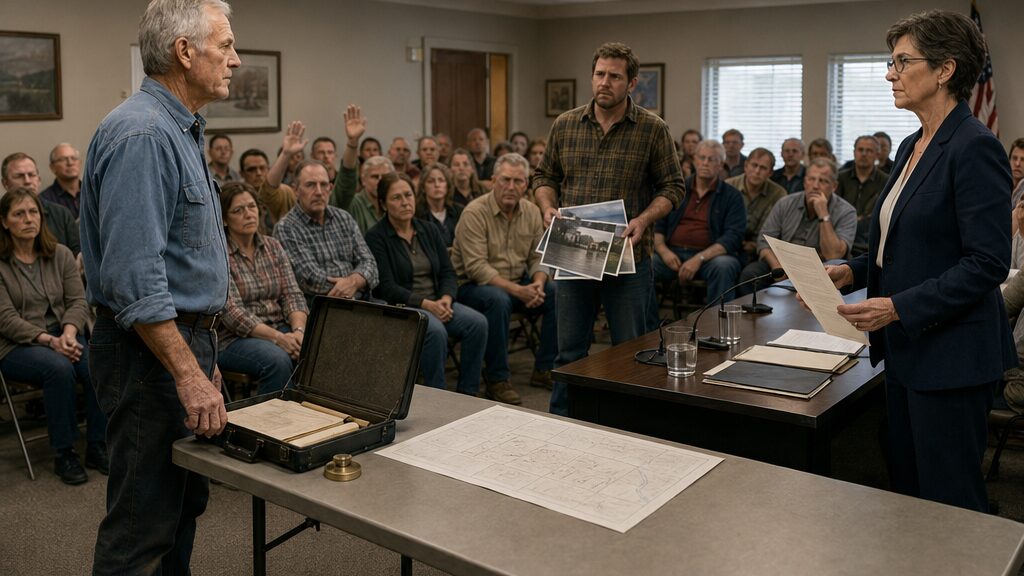
Hands rose across the clubhouse—first a dozen, then nearly every hand in the room. Folding chairs scraped as people turned to count one another. Several residents looked directly at Brian, who stood at the rear holding a flat survey case.
Cynthia faced him from behind the board’s table.
“I think the community’s position is clear.”
Brian walked down the center aisle.
“The question was clear,” he said. “The position you attached to me was not.”
A man near the front muttered that his insurance deductible had already doubled. A woman said nobody should be allowed to block emergency infrastructure. Someone behind Brian whispered, loudly enough to be heard, that retired people had time for lawsuits.
Brian reached the empty folding table set aside for homeowner comments. He placed his case on it but did not open it.
Cynthia summarized the project in a steady, practiced voice. Two years of worsening runoff. Repeated flooding on the lower streets. An insurance carrier threatening higher premiums and possible nonrenewal. The board authorizing a new underground line to carry stormwater safely to the county channel.
Then she held up the easement.
“The remaining issue is one signature.”
Murmurs moved through the room.
Brian looked at the paper in her hand. “What recording number establishes the existing right?”
Cynthia paused.
“This document formalizes access.”
“That isn’t a recording number.”
“Our counsel has advised that the association possesses broad emergency authority.”
“For permanent construction?”
The property manager leaned toward his microphone. “Mr. Adams, this is not a legal proceeding.”
“You threatened fines, a lien, and legal costs. It became one when you did that.”
A few heads turned toward Cynthia.
She set the easement down. “The board relied on available records and the urgent need to prevent further damage.”
Brian opened his survey case.
He removed the certified subdivision plat, his closing survey, the contractor invoice, and a narrow steel scale. Last, he unwrapped the brass cap and placed it on the table.
The small piece of metal caught the fluorescent light.
“What is that?” someone asked.
“A boundary cap,” Brian said. “It marks where a right begins or ends when people bother to establish one.”
Cynthia folded her hands.
Brian spread the certified plat flat. “This is the recorded subdivision map. Not my sketch. Not the contractor’s proposal. The county record.”
He placed the brass cap on the rear property line.
“The association owns a ten-foot drainage easement along the back of my lot. I have never disputed that.”
He moved the steel scale inward, measuring the route marked on the construction plan.
“The installed pipe enters twenty-four feet inside my property, crosses the garden, passes beside my patio, and exits near the east fence. None of that corridor is within the recorded common easement.”
The room became quieter, though not friendly.
Cynthia said, “The route was selected because the rear corridor contained mature trees and unstable ground.”
“That may explain why it was cheaper to use my yard. It does not create a property right.”
A board member reached for the plat. Brian slid a certified copy toward him.
The man examined the seal.
“Is there an amendment?” he asked Cynthia.
“The management company was told an older authorization existed.”
“Where is it?” Brian asked.
The property manager spoke. “The historical file remains under review.”
Brian lifted the contractor invoice.
“This invoice says owner authorization was confirmed before work began. It does not name the owner. I was out of state that day. No one called me. No one emailed me. No one mailed notice to this address.”
A woman in the second row lowered her raised hand.
Cynthia’s mouth tightened. “The board was operating under emergency conditions.”
“Then say that. Say you made an emergency choice. Don’t say I agreed.”
The silence that followed was different. It did not absolve Brian, but it removed the simple version of the story Cynthia had offered.
Jacob stood near the side wall. He had not raised his hand at first, but Brian had seen it go up when others did.
“Can I say something?” Jacob asked.
Cynthia nodded.
He carried a large envelope to the front and removed four photographs. The first showed muddy water across a bedroom floor. In the second, drywall had been cut away two feet above the baseboard. The third showed a child’s bed stacked in a hallway. The fourth showed Cynthia, wearing rubber boots and soaked clothes, carrying boxes out through Jacob’s garage during the earlier flood.
Jacob placed the photographs beside Brian’s plat.
“This is what the old system did,” he said. “Twice.”
Brian looked at the picture of Cynthia. Her hair was plastered to her forehead. She was not posing for a board newsletter. She was lifting a waterlogged box while Jacob’s family moved behind her.
“My kid slept in the dining room for seven months,” Jacob continued. “We replaced the wall, the floor, and half the electrical outlets. The association argued with the insurer the whole time.”
He looked at Brian.
“Since that pipe went in, the last two storms passed without water reaching our foundation.”
“I believe you,” Brian said.
“Then what are you asking them to do?”
“To acknowledge they used land they did not own.”
“And after that?”
Brian glanced at the brass cap.
Until that moment, the answer had felt obvious. Remove the pipe. Restore the garden. Make the board carry the cost of its decision.
But the photographs occupied the same table as the certified plat. Both were true.
Cynthia rose from her chair.
“This is the part Mr. Adams keeps leaving out. The pipe does not serve the board. It serves homes.”
“And this is the part you leave out,” Brian replied. “You asked me to grant permanent access after the work was complete, then threatened me when I refused.”
“Because removal would endanger families.”
“Then you should have secured the right before construction.”
“We did not have months.”
“You had time to design a cheaper route.”
The contractor’s representative, seated near the door, looked down.
Brian saw it and turned toward him. “How much longer was the recorded rear route?”
The representative hesitated.
Cynthia said, “That is not relevant.”
“It is the reason they crossed my yard.”
The representative rubbed his thumb along the edge of his folder. “Approximately four hundred additional feet, with tree removal and retaining work.”
“And the difference in cost?”
“I don’t have the final comparison.”
“You had an estimate.”
The man looked toward Cynthia before answering.
“Just over two hundred thousand.”
The room stirred again.
Now the choice had another shape. The board had not merely acted fast. It had chosen the shorter route through one owner’s land, apparently without owning the right to use it.
Cynthia lifted her chin. “The association did not have two hundred thousand dollars available.”
Brian looked at the residents. “So they spent less because they expected my property to absorb the difference.”
No one answered.
Jacob’s face hardened, but not entirely against Brian now.
A woman near the aisle asked, “Does this mean the pipe has to come out?”
Brian closed the contractor invoice.
“It means the association cannot compel me to donate a permanent easement.”
“Will you make them remove it?” she asked.
Cynthia watched him closely.
He could have softened the answer. He could have said negotiation remained possible. Instead, he remembered the overturned garden stone, the painted leaf buried face-down, and Cynthia’s fingers holding the signature line as if his consent were the last clerical step.
His pride answered before his caution did.
“Tomorrow,” Brian said, “I will send the association a formal demand to remove the pipe, restore my property, and use the corridor it already owns.”
A wave of voices broke across the clubhouse.
Jacob stared at him. “You saw those pictures.”
“I did.”
“And you’re still doing this?”
“I’m making the board correct what it did.”
“You’re making the rest of us live with the correction.”
Cynthia struck the table once with the heel of her hand, calling the meeting back to order, but the argument had moved beyond her control.
Brian gathered the papers. When he picked up the brass cap, Jacob’s flood photographs remained on the table beneath it for a moment. The polished metal covered the image of the child’s damaged room.
Brian removed it and slipped it into his pocket.
Outside, residents clustered under the parking-lot lights. Some avoided him. Others watched as though he had become both more credible and more dangerous.
Cynthia came through the clubhouse door carrying the unsigned easement.
“If you file that demand,” she said, “you force every homeowner here to pay for your principle.”
Brian locked the survey case.
“No,” he said. “Your board made the decision. The bill is only arriving now.”
He walked to his truck before she could answer.
By nine the next morning, the association would have ninety days to
Chapter 4: The Ninety-Day Demand Changed Every Side
Pamela Harris called the removal demand “financially catastrophic” before Brian had finished saying hello.
Her voice came through the kitchen phone with the clipped calm of someone who had already billed an hour for reading his letter.
“You are asking the association to excavate a functioning stormwater line, restore your property, rebuild four hundred feet of alternate corridor, and assume liability for every failure during the transition.”
“I’m asking it to remove infrastructure installed without my consent.”
“The preliminary estimate exceeds four hundred thousand dollars.”
Brian looked at the rain gauge outside the window. A thin line of water sat near the quarter-inch mark from an overnight shower.
“Then the board saved a great deal by using my yard.”
“The reserve account cannot absorb this.”
“That is not a property right.”
“No,” Pamela said. “It is a practical fact.”
She proposed a meeting. Brian declined.
She proposed mediation. He said he would consider it after the board acknowledged in writing that no easement existed.
Pamela was silent for a moment.
“You know I cannot make that admission in an introductory call.”
“Then this is not a negotiation.”
“It is an effort to prevent every household in your association from receiving a special assessment.”
Brian’s hand tightened around the receiver.
“They should ask Cynthia why that cost exists.”
“They will. After they ask why you demanded the most expensive possible remedy.”
The line went quiet when neither of them had anything useful left to say.
By noon, a certified letter from the association arrived. It rejected his demand, reserved all enforcement rights, and warned that any interference with the drainage system could expose him to claims from affected homeowners.
Brian placed it beside his own ninety-day notice.
One letter said the pipe was his problem because it crossed his land.
The other said it was not his pipe because the community needed it.
That afternoon, Jacob appeared at the side gate.
“I want to show you something.”
Brian almost refused. Jacob’s voice still carried the edge from the clubhouse. But he followed him downhill.
The rear bedroom in Jacob’s house smelled faintly of new paint and cut lumber. The drywall looked clean until Jacob moved a bookcase away from the wall.
A brown line remained on the stud behind it, nearly twenty inches above the floor.
“That was the first flood,” Jacob said.
He pointed higher, to a pencil mark on the framing.
“That was the second.”
A child’s paper airplane rested on the windowsill. The room was small, with a narrow bed and a row of model cars arranged on a shelf.
“We threw out everything below that line,” Jacob said. “The second time, my kid asked why we kept putting the room back if the water was going to take it again.”
Brian looked toward the backyard. From there, the land rose gradually to his own property.
“Cynthia came before the cleanup crew,” Jacob continued. “She helped carry wet boxes. She spent three nights calling the insurer and the county. Nobody else from the board stayed past the first afternoon.”
Brian remembered the photograph.
“That does not excuse what she did.”
“I didn’t say it did.”
“Then what are you saying?”
Jacob folded his arms. “You keep talking like the board built a swimming pool for itself. That pipe fixed something.”
“I know.”
“Do you?”
Brian turned from the exposed stud.
“The right solution was to use the recorded corridor.”
“The one that cost two hundred thousand more?”
“The one the association owned.”
Jacob gave a humorless laugh. “You think people here have two hundred thousand sitting around?”
“I think they had no right to take the difference from me.”
“And I think my kid had no choice about where the water went.”
The words landed without volume.
Brian looked again at the waterline. He had spent his career reducing land to bearings, distances, and legal descriptions because those things remained stable when people did not. But water ignored lines unless someone gave it somewhere else to go.
“I’m not asking you to forget your property,” Jacob said. “I’m asking whether removal is the only thing you’ll accept.”
Brian did not answer.
When he returned home, a white utility truck sat outside the gate. The property manager and a drainage contractor stood near the rear fence.
“You are not authorized to enter,” Brian said.
The contractor pointed toward the upper inlet beyond the garden. “Flow is slowing. We need to inspect the cleanout.”
“You can inspect from the common corridor.”
“The access point is inside your fence.”
“Because you installed it there.”
The manager held up a printed notice. “The declaration allows emergency entry.”
“Is there an emergency?”
“Not yet.”
“Then schedule the inspection and provide the scope in writing.”
The contractor glanced at the clouds building over the western ridge. “There’s a storm system expected within forty-eight hours.”
Brian opened the gate only far enough to stand in the gap.
“Send me the written scope.”
“We need twenty minutes,” the manager said.
“You needed my permission six weeks ago.”
The manager’s face hardened. “If a blockage causes damage, this refusal will be documented.”
“So will your attempt to enter without notice.”
Brian closed the gate.
For several seconds, the contractor remained where he was. Then the truck doors shut, and the vehicle pulled away.
The rain gauge had risen slightly by evening. Brian removed the glass tube, emptied it, and reset it with the zero line facing the kitchen.
His wife used to say a rain gauge did not predict anything. It only told the truth after the sky had made its choice.
Near midnight, rain began tapping the roof.
By morning, it had strengthened. Water ran along the curb in silver sheets. Brian put on his work jacket and walked to the rear fence.
The upper inlet should have been pulling runoff beneath the yard.
Instead, water circled its grate in a widening brown pool.
A low gurgle came from under the garden.
Then the water level climbed over the concrete rim.
Chapter 5: The Storm Exposed More Than the Drain
Muddy water pushed upward through Brian’s lawn in three pulsing boils.
One surfaced beside the hydrangeas. Another broke through the grass near the patio. The largest rose inside the memorial garden, lifting mulch and small stones as though something underneath were breathing.
Brian ran to the side gate.
Downhill, a truck horn sounded twice. The contractor’s white utility vehicle stopped at the curb, followed by the property manager and a county vacuum truck. Jacob came through the rain without a coat.
“Open it,” he shouted.
Brian looked back at the garden. Water had reached the cedar post supporting the rain gauge. The glass tube was full to its top, overflow streaming down the numbers his wife had once traced with a fingertip.
The contractor stood outside the gate with two workers and a portable pump.
“We have a blockage near the bend,” he said. “If we cannot reach the cleanout, pressure will force water back toward the lower inlet.”
“How long?”
“Maybe twenty minutes. Maybe less.”
Brian unlocked the gate.
The workers moved immediately, dragging hoses across the yard. One stepped toward the center of the garden.
“Not there,” Brian said.
The man stopped.
Brian pointed through the rain. “The pipe turns four feet east of the marked line. Your construction sketch is wrong.”
The contractor stared at him. “How do you know?”
“I measured the settlement and probed the alignment.”
He ran to the workshop, returned with his hand level, steel tape, and the brass survey cap. At the eastern corner monument, he set the cap in the mud, then pulled the tape toward the patio.
“Cleanout should be eighteen inches left of that stone,” he said. “If the as-built depth is accurate.”
The contractor signaled the crew.
They dug where Brian directed. Less than a foot below the surface, a circular access lid appeared beneath sod and landscape fabric. The contractor looked at the property manager.
“This was supposed to be exposed.”
Brian heard the words but did not answer. The vacuum hose went into the opening. The pump engine roared. Brown water shuddered through the line, stopped, then surged again.
A worker called from the upper inlet. “Still rising.”
Brian crouched beside the open cleanout. The flow sounded wrong—deep, irregular impacts followed by silence.
“Construction debris,” he said.
The contractor shook his head. “Could be a collapsed section.”
“No. Listen between the surges.”
Another impact struck inside the pipe.
“Rock or timber,” Brian said. “Something is turning at the bend.”
The contractor ordered a camera line fed through the opening. Its monitor showed black water, then a pale shape wedged across the joint.
“A root mass?” the manager asked.
Brian leaned closer. “Filter fabric.”
The contractor’s face changed. A torn roll of fabric left during installation had gathered branches and silt until it nearly sealed the pipe.
The vacuum truck pulled at the obstruction. The first attempt failed. The second brought out a black, tangled sheet wrapped around sticks and plastic construction ties.
Water dropped at the upper inlet.
A worker downhill spoke into his radio. “Flow restored.”
The pressure beneath Brian’s yard released with a long hollow sound. The muddy boils flattened.
Jacob bent forward, hands on his knees. “My street?”
“Drainage is moving,” the contractor said. “They’re clear for now.”
For now.
Brian looked toward the memorial garden.
The pump hoses had crushed the stone border. Two hydrangeas leaned with exposed roots. Mulch had washed into the excavation, and the cedar post holding the rain gauge lay at an angle. One worker had removed the upside-down painted stone and placed it beside the fence.
Brian walked to it and wiped mud from the faint leaf.
Behind him, Cynthia entered through the gate.
Her blazer was gone. She wore rubber boots, a yellow raincoat, and the same expression she had worn in Jacob’s flood photograph—focused, exhausted, and afraid of being too late.
“The lower basin is holding,” she said. “The county channel is still open.”
Brian stood.
“You knew the cleanout was buried?”
“No.”
“You knew there was no easement?”
Her eyes shifted toward the property manager.
“That is not a conversation for the middle of an emergency.”
“The emergency is over.”
“Not while the storm continues.”
The contractor approached with the filter fabric coiled in a bucket. “We need to excavate around the cleanout and rebuild the access collar. Otherwise this can happen again.”
“How much of the garden?” Brian asked.
“A six-foot working area.”
Cynthia looked at the damaged bed. “We will restore it.”
“You said that about permission.”
Rain struck the hood of her coat.
“Brian, the insurer gave us thirty days to show a corrective plan after the second flood. The county would not expedite the alternate outfall. Our engineering consultant said another major storm could put six homes at risk.”
“So you chose mine.”
“We chose the route that could be built before the deadline.”
“Without telling me.”
“You were away.”
“My phone worked.”
Cynthia’s face tightened. “The title review was supposed to confirm an existing access right.”
“And when it did not?”
She did not answer.
That silence carried more weight than the rain.
Brian looked at the contractor. “Finish the repair.”
Cynthia blinked.
“You are granting access?”
“I am preventing another blockage. Do not confuse that with granting an easement.”
For the next four hours, Brian worked beside the crew.
He checked the slope of the rebuilt collar, corrected the location of the access box, and made them compact the fill in lifts rather than dumping wet soil into the hole. When the contractor proposed moving a hose through the remaining flowers, Brian redirected it along the damaged trench.
By afternoon, the pipe ran freely.
Jacob returned with coffee in paper cups. He handed one to Brian without apology or gratitude.
“You saved us some water,” he said.
Brian looked at the torn garden.
“I helped fix a blockage I should have let them inspect yesterday.”
Jacob did not argue.
The admission hurt more because no one had forced it from him.
At dusk, the trucks left. The garden resembled a construction site again. The hydrangeas could perhaps be replanted. The stone border would have to be rebuilt. The rain gauge lay on Brian’s workbench, its glass tube unbroken but muddy.
He cleaned the brass survey cap under the sink. Clay filled the engraved groove around its rim. As he worked it free with a small brush, headlights moved across the kitchen wall.
A woman stood on the porch holding a clear plastic folder beneath her coat.
Brian recognized Brenda Taylor, the former treasurer. She had sat near the back of the clubhouse and left before the vote.
“I heard about the blockage,” she said.
“It’s cleared.”
“That isn’t why I’m here.”
She entered but did not remove her coat. Her hands trembled slightly as she opened the folder.
Inside was a printed email chain dated six days before construction began. The first message came from the association’s title consultant. The subject line read Adams Parcel—No Recorded Drainage Easement Located.
Below it was a reply from Cynthia.
Proceed under emergency authority. We cannot miss the insurance deadline.
A later message from Brenda warned that the board should postpone construction until Brian’s written consent had been obtained.
Cynthia’s final response contained one sentence.
If we delay, the carrier walks and every flooded homeowner will blame this board.
Brian read it twice.
“Why do you have these?”
“I kept the reserve files when I was treasurer.”
“Why bring them now?”
Brenda looked toward the dark backyard.
“Because I voted to approve the contract after she wrote that.”
The confession did not sound brave. It sounded late.
“She told us the easement could be cured afterward,” Brenda said. “I wanted to believe her because we had less than eighty thousand in reserves, and the insurer had already drafted the nonrenewal notice.”
“You knew.”
“Yes.”
“And you sat in that meeting while they called me noncompliant.”
Brenda lowered her eyes. “I was afraid if I spoke, every neighbor who had flooded would say I chose you over them.”
Brian folded the email along its existing crease.
“No,” he said. “You chose silence over both.”
She accepted that without defense.
When she left, Brian placed the email beside the cleaned brass cap and the broken rain gauge post.
He now had the proof that could expose Cynthia, overturn the board’s story, and strengthen his removal demand.
Outside, water moved steadily beneath the ruined garden, carrying the storm away from Jacob’s house.
Chapter 6: The Offer Was Small Because the Fear Was Large
“Fifteen thousand dollars,” Pamela said, “is a generous payment for an underground easement that does not prevent ordinary residential use.”
Brian looked at the settlement agreement in front of him.
Across the conference table, Cynthia sat with both hands around a paper cup she had not touched. The property manager had been excluded from the meeting. Pamela’s office was quiet enough that Brian could hear the ventilation system turn on.
“Permanent easement,” he said.
“Yes.”
“Permanent access.”
“For necessary maintenance.”
“Permanent authority to remove landscaping.”
“Only when reasonably required.”
Brian placed the cleaned brass cap beside the agreement.
“Then the payment should not be described as though you’re buying a temporary inconvenience.”
Pamela closed her pen. “What number do you consider appropriate?”
“This is not only about a number.”
Cynthia looked at him for the first time. “Then why demand removal?”
“Because it was the only consequence you appeared to understand.”
Pamela slid a legal pad toward herself. “Are you withdrawing the demand?”
“No.”
Cynthia exhaled through her nose.
Brian opened his survey case and removed a new drawing. It showed the installed line, the rear common corridor, the cleanout, the garden, and a narrower access strip centered precisely over the pipe.
“I am offering an alternative.”
Neither woman spoke.
“The easement will be limited to twelve feet, not twenty. No expansion without a separate recorded agreement. No storage, staging, or access outside the corridor except during a documented emergency.”
Pamela began writing.
“Independent inspection every two years,” Brian continued. “The report goes to every homeowner, not just the board. The cleanout remains exposed and marked. Any restoration must match existing landscaping or pay replacement value.”
Cynthia said, “That could be administered.”
“Condition five: the association funds a redesign study for the upper basin and the recorded rear route. This pipe cannot become the excuse for ignoring the rest of the system.”
Pamela’s pen paused. “That study could be expensive.”
“Less expensive than another unauthorized project.”
He placed a second page on the table.
“Condition six: compensation includes the easement value, restoration of the memorial garden, reimbursement of my survey and legal costs, and a reserve contribution dedicated to drainage maintenance.”
“And condition seven?” Cynthia asked.
Brian looked at her.
“The board discloses what happened.”
The room changed.
Pamela set down her pen.
Cynthia’s cup made a faint sound against the table as her fingers tightened.
“We can disclose that the documentation was incomplete,” she said.
“No.”
“That the board acted under emergency conditions.”
“You can disclose that too.”
“What wording do you want?”
“The truth. The title consultant found no recorded easement. The board knew before construction. It proceeded anyway and sought my signature afterward.”
Cynthia leaned back. “That would expose the association to claims.”
“The association is already exposed.”
“It would expose individual directors.”
“You signed the authorization.”
Her face hardened, but her voice stayed controlled. “You think I do not know that?”
For the first time, the fear beneath her authority was visible.
She looked toward the rain-streaked window.
“After Jacob’s second flood, I spent three hours holding a flashlight while an electrician shut down circuits in that bedroom. The insurer told us another major claim could end coverage. No coverage meant mortgage problems for some owners and unaffordable replacement policies for others.”
Brian said nothing.
“We had thirty days,” Cynthia continued. “The county permit was ready. The contractor had an opening in its schedule. The rear route required a retaining wall, tree removal, another engineering review, and money we did not have.”
“So you used mine.”
“I told myself the easement was a paperwork defect that could be cured.”
“You told yourself I would sign.”
“Yes.”
The word came without hesitation.
“And when I did not?”
“I thought pressure would make you see the larger risk.”
“You thought pressure would make me easier than the storm.”
Cynthia looked down.
Pamela intervened quietly. “The board’s conduct was wrong. That does not make every requested public admission advisable.”
Brian touched the brass cap with one finger.
“My wife planned that garden when she knew she would not see it mature.”
Neither woman moved.
“She drew the beds around the maple because she wanted something in the yard to outlast her. Before she died, she made me promise the association would never turn it into a common work area.”
His throat tightened, and he stopped until the room steadied.
“When the pipe went through it, I did not see drainage. I saw someone deciding her last plan did not matter because I was not home to object.”
Cynthia’s expression changed—not into innocence, but recognition.
“I did not know,” she said.
“You did not ask.”
“No.”
Brian looked at his drawing.
“I was wrong to refuse inspection before the storm. Jacob’s house could have flooded because I wanted every request to feel like surrender.”
Pamela watched him carefully.
“I will not repeat that mistake,” he said. “But cooperation begins after consent, not instead of it.”
Cynthia studied the seven conditions.
“The homeowners will have to pay an assessment.”
“A modest one, spread over time.”
“They will blame me.”
“They should know what they are paying for.”
“And you?”
“They can blame me for insisting on terms. I’ll stand in the room.”
Pamela calculated silently, turning pages between the proposed easement and settlement draft.
“The structure is workable,” she said at last. “The compensation amount and reserve contribution require board approval. The disclosure language will require negotiation.”
“The facts do not.”
Cynthia pushed back her chair.
“I need one night.”
Pamela looked at her. “The final board vote is tomorrow.”
“I know.”
Brian gathered the draft but left one copy on the table. The brass cap remained beside it until Cynthia reached toward the map, stopping just short of the metal marker.
“If I read that email aloud,” she said, “I cannot remain president.”
Brian placed the cap in his pocket.
“That is not a condition I wrote.”
“No,” Cynthia said. “It is the one you left for me to choose.”
She took the proposal and walked out of the conference room.
By the following evening, the neighborhood would learn whether she intended to protect her position or tell them how the pipe had truly entered Brian’s yard.
Chapter 7: A Boundary Chosen Is Not a Boundary Stolen
Cynthia began the meeting by reading the sentence she had hoped no homeowner would ever hear.
“If we delay, the carrier walks and every flooded homeowner will blame this board.”
No one shifted in the folding chairs. No one whispered. Even the ventilation fan above the clubhouse kitchen seemed louder than the room.
Cynthia stood behind the board table with the printed email held in both hands. Pamela sat at one end with several marked agreements. Brenda occupied a chair against the wall rather than beside the board members. Brian stood near the same folding table where he had spread the certified plat a week earlier.
This time, no one had been asked to raise a hand against him.
Cynthia lowered the email.
“The title consultant informed us before construction that no recorded drainage easement had been found across the Adams property,” she said. “I authorized the contractor to proceed under emergency authority anyway.”
A man in the front row asked, “Did counsel approve that?”
Pamela answered before Cynthia could.
“Association counsel was not given the final authorization until after construction began.”
The silence broke into scattered voices.
“You told us it was legal.”
“You said the owner had agreed.”
“Are we being sued?”
Cynthia did not reach for the gavel.
“I told myself the missing easement could be corrected afterward,” she said. “That was not consent. It was an assumption, and it was wrong.”
Brian watched her face. She looked tired, but not defeated. There was no plea for sympathy in her voice. She was giving the room facts that would cost her something.
Jacob sat two rows from the front. His hands were clasped between his knees.
Cynthia continued. “The project was necessary. The way we obtained the route was not.”
That distinction settled over the homeowners more slowly than anger had.
Pamela distributed a summary of the proposed agreement. The pages listed a twelve-foot easement centered on the existing pipe, permanent access limited to documented maintenance, independent inspections, landscaping restoration, a redesign study, compensation to Brian, reimbursement of his costs, and a dedicated reserve contribution.
At the bottom was the amount of the proposed special assessment.
A woman near the aisle read it twice. “We have to pay for the board’s mistake?”
Pamela folded her hands. “The association is made up of its homeowners. The project protects common property and multiple residences. Insurance may cover part of the legal expense, but not the easement value or the reserve correction.”
“So Brian gets paid and we get a bill?”
Several people turned toward him.
The old heat returned to the room, but it no longer had a single direction.
Brian rested his survey case on the folding table.
“I did not choose the route,” he said. “I did not choose to build before permission. I also did not choose to make your homes depend on a pipe under my garden.”
The woman crossed her arms. “But you are choosing the price.”
“I am choosing whether the right exists at all.”
A few voices rose again.
Brian opened the case and removed the revised map. He laid it beside the brass survey cap.
“The first easement they brought me was twenty feet wide. It allowed expansion, tree removal, and unrestricted access whenever the board considered it necessary. This one is twelve feet wide. It cannot be expanded without another agreement. It requires notice except during a real emergency. Every inspection report goes to all owners.”
He placed one finger on the corridor.
“This line is not where the association once claimed it had a right. It is where I am deciding to grant one.”
A board member asked, “And if the membership rejects the assessment?”
“The removal demand remains,” Pamela said.
The answer tightened every face in the room.
Jacob stood.
“At the last meeting, I asked Brian whether he understood what removal could do to us.”
Brian looked at him.
“I thought he cared more about proving a boundary than keeping water out of our houses,” Jacob continued. “Then the line blocked during the storm. He could have kept the gate shut. He didn’t.”
Someone said, “After refusing the inspection.”
“Yes,” Jacob replied. “He was wrong about that. He said so.”
Brian felt the room turn toward him again.
Jacob pointed to the agreement. “But the board was wrong first, and it was wrong bigger. Brian helped clear the blockage. He also found the buried cleanout and corrected the contractor’s measurements. We need the pipe. That does not mean we get to pretend his yard belongs to all of us.”
He sat down before anyone could applaud. No one did.
The absence of applause made the words feel more honest.
Brenda rose next. Her voice shook at first.
“I voted for the contract. I knew the easement had not been found. I was afraid another flood would ruin more homes, and I was afraid the assessment for the proper route would make everyone furious.”
She looked toward Brian.
“Fear did not make the vote lawful.”
Then she faced the room.
“The reserve fund was too low because several boards, including one I served on, kept dues artificially flat. We delayed drainage repairs and called it affordability. This assessment is not only the cost of one bad decision. It is the cost of years of avoiding the real number.”
That angered some residents more than Cynthia’s admission. Questions came quickly—about budgets, insurance, contractor liability, and whether former board members could be made to pay personally.
Pamela answered what she could. She refused to promise lawsuits would recover anything. The contractor had agreed to correct the access box and contribute to restoration, but it disputed responsibility for the route authorization. Insurance coverage remained uncertain.
There would be no hidden account that erased the cost.
At last, Cynthia called for the vote.
Before the ballots were distributed, Brian raised his hand.
“I have one addition.”
Pamela looked sharply at him.
“It is not another payment,” he said.
He turned the map so the homeowners could see the upper basin and the recorded rear corridor.
“The redesign study must produce a public maintenance schedule and a phased plan for the original common route. The pipe through my yard can remain, but it cannot become the permanent excuse for doing nothing else.”
A board member whispered with Pamela. She read the language, changed two words, and nodded.
The amendment passed first.
Then the easement agreement, restoration funding, independent oversight, and assessment passed together by a narrow margin.
No one cheered.
Some homeowners left immediately. One man folded his ballot into quarters before dropping it into the box, as though making the decision smaller would make it cheaper. The woman who had challenged Brian paused near him but said nothing.
Cynthia remained standing after the room began to empty.
“There is one more item,” she said.
The conversations stopped.
“After the agreement is recorded and the restoration contract is signed, I will resign as board president.”
A board member turned toward her. “You did not tell us that.”
“No.”
Cynthia looked at Brian, then at Jacob.
“I believed protecting the neighborhood required me to carry the decision alone. What I actually did was deny everyone else the right to make it honestly.”
Her voice wavered only on the last word.
“I will stay long enough to complete the correction. Then someone else should lead.”
Brian closed his survey case. He had imagined this moment differently during the first angry nights. In those versions, Cynthia was forced out, the room condemned her, and he felt the clean satisfaction of a line restored.
What he felt instead was the weight of what remained: an assessment, damaged trust, a garden to rebuild, and a pipe that would still belong to the community while lying beneath his land.
Cynthia approached the folding table.
“I am sorry about the garden,” she said.
Brian looked at the brass cap between them.
“You should be sorry about deciding I would surrender it.”
“I am.”
He believed her. Belief did not erase the choice.
“Finish the agreement,” he said.
“I will.”
By early autumn, the easement had been recorded.
The restoration crew rebuilt the stone border and replanted the hydrangeas. Brian made them leave a narrow strip of the corridor visible beneath low groundcover so future crews would not pretend they could not find it. The cleanout received a proper marked lid. The contractor installed permanent reference ties to the eastern boundary.
Brian set the brass survey cap at the edge of the twelve-foot corridor himself.
He drove it into the soil until only the stamped top remained visible. It did not mark where the association had assumed a right. It marked where he had chosen to grant one, under limits everyone could read.
Jacob helped reset the cedar post.
They worked without discussing the clubhouse meeting. When the post stood level, Jacob held it while Brian packed the soil around its base.
“My kid wants to repaint the numbers,” Jacob said.
Brian wiped dirt from his hands. “The old ones are still readable.”
“He said they look faded.”
“They are faded.”
Jacob waited.
Brian looked at the glass rain gauge. His wife’s handwriting remained on a small metal tag wired beneath it: Check after every storm.
“Bring him by Saturday,” Brian said.
Jacob nodded.
After he left, Brian placed the gauge beside the restored garden border. The hydrangeas were smaller than before. The new stones did not match the weathered ones exactly. One original stone, the one with the painted leaf, rested at the turn in the path with its design facing upward.
A light rain began near dusk.
Brian stood beneath the patio roof and watched drops collect in the glass tube. Somewhere below the garden, water entered the pipe and moved downhill toward the channel. He could hear none of it.
The boundary remained.
So did the drain.
For the first time, neither existed because someone had mistaken silence for permission.
The story has ended.