The HOA Called the Drone Flights Routine Until One Fell Into My Family’s Pool
Chapter 1: The Twelfth Flight Fell Into the Pool
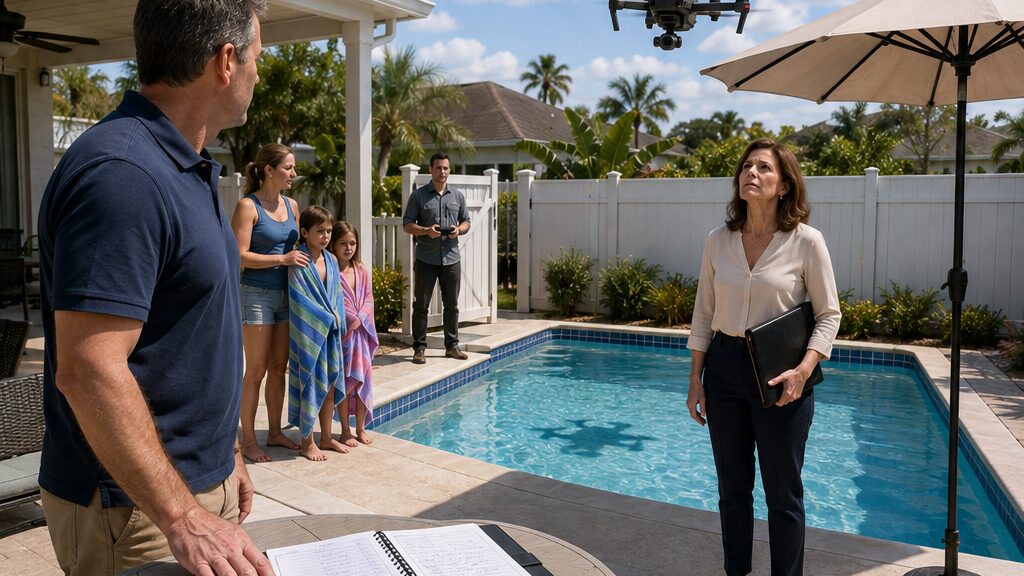
The drone hung above the pool like it had found the exact spot where it could make everyone uncomfortable.
Steven Harris opened the black spiral notebook on the patio table and turned past eleven dated entries to a clean line.
Above him, four rotors whined against the humid Florida afternoon.
He wrote one number.
“Steven,” Samantha said from beneath the covered patio, “the kids are getting out.”
He looked toward the shallow end. Both children had stopped playing. One was already climbing the steps, water running from a bright towel wrapped hurriedly around narrow shoulders. The other stared upward.
The drone shifted three feet to the left.
Its camera remained pointed down.
“Eric,” Steven called.
His neighbor stood on the far side of the privacy fence near the open gate, controller in both hands. Eric Roberts did not look at Steven. His eyes stayed on the small screen mounted above the joysticks.
“It’s a routine pass.”
“That’s what you said about the last eleven.”
A woman’s voice answered from closer by.
“And I told you this inspection was authorized.”
Donna Scott stood near the patio entrance with a folder tucked beneath one arm. She had arrived ten minutes earlier representing the HOA, wearing the composed expression Steven had come to associate with hearings about paint shades and landscaping deadlines.
“This is exactly why I asked you to come,” Steven said.
Donna glanced upward.
The drone had descended enough that Steven could see the tiny corrections in its position every time a gust pushed it sideways.
“I can see it.”
“No. You’ve seen drones before.” He pointed toward the pool. “Stand there.”
Donna frowned.
“Steven—”
“Right there. Where my daughter was.”
Samantha gave him a warning look, but he kept his voice level.
Donna stepped reluctantly toward the pool deck.
Steven tapped the open notebook.
“Eleven flights. Dates. Times. Approximate duration. This makes twelve.”
Donna looked down at the pages.
“You’ve been logging them?”
“I started after the third.”
Eric finally spoke from beyond the fence. “You realize writing something in a notebook doesn’t establish restricted airspace.”
Steven turned toward him. “And saying ‘authorized’ doesn’t tell me authorized for what.”
Donna’s expression tightened.
“This isn’t Eric freelancing over your property. The association contracted him.”
For a second, even Samantha said nothing.
Steven had suspected it. He had found enough pieces to know Eric’s repeated confidence came from somewhere. But hearing Donna say it beside the pool changed the shape of the problem.
“The HOA hired him to film my backyard?”
“To conduct exterior inspections.”
“That isn’t the same sentence.”
Donna opened her folder. “Roof condition, drainage concerns, visible exterior violations—”
“My roof is behind him.”
She stopped.
The drone was not facing the roof.
Its camera pointed almost straight down toward the pool.
Steven gestured toward the water.
“That’s the angle I’ve been talking about.”
Donna looked up again.
The drone hovered above her now.
Not directly overhead, but close enough that its shadow trembled across the pale pool deck beside her shoes.
For the first time since she had arrived, she stopped talking.
Steven watched her eyes follow the machine.
“That,” he said quietly, “is what my family sees.”
Eric called from the fence. “Donna, I’m repositioning.”
The drone slid toward the patio.
Donna raised a hand. “Take it higher first.”
“I’ve got clearance.”
“Eric, take it higher.”
The machine moved sideways instead.
Its buzzing grew sharper as it approached the edge of the covered patio.
Steven saw the patio umbrella shift in the afternoon breeze.
“Eric.”
“I see it.”
The drone backed away, then corrected again.
One rotor clipped the outer edge of the umbrella.
The sound was small—plastic striking fabric and metal.
Then everything happened at once.
The drone pitched sideways.
Eric shouted.
Donna stepped backward.
The machine struck the water hard enough to throw a fan of blue across the deck.
For one absurd second it floated, rotors twitching.
Then it sank.
Bubbles raced toward the surface.
Nobody moved.
Steven stared into the pool.
He had imagined a hundred endings to this argument.
None had included Donna standing beside him while Eric’s drone disappeared beneath three feet of water.
The first feeling that rose in him was satisfaction.
It lasted less than a second.
Because Eric was already coming through the gate.
“What did you do?”
“I didn’t touch it.”
“The umbrella moved.”
“It’s an umbrella.”
“You knew I was coming through here.”
Donna stepped between them.
“Everybody stop.”
Eric’s face had gone pale beneath the heat. He looked from the pool to Steven, then toward the umbrella.
“That’s commercial equipment.”
Steven closed the notebook.
“I didn’t fly it into my patio.”
Donna turned sharply toward him.
“Do not touch the drone.”
“I wasn’t planning to.”
“I mean it, Steven. Leave everything exactly where it is.”
He looked at her.
She was no longer embarrassed.
She was managing a liability problem.
“If there’s a claim that you deliberately obstructed an authorized HOA contractor,” she said, “the association may hold you responsible for the damage.”
Steven looked through the surface of the pool at the dark shape resting on the bottom.
Then at the open notebook beside him.
Eleven completed entries.
A twelfth line containing only a number.
Until that moment, he had believed the twelfth flight would finally prove he had been right.
Instead, it had given the HOA a new question to ask.
And possibly a way to make him the problem.
Chapter 2: Eleven Dates Before Anyone Believed Him
Six weeks earlier, Samantha called Steven through the kitchen door with a tone that made him drop the screwdriver in his hand.
“Come outside.”
He stepped onto the patio expecting a scraped knee or a broken pool toy.
Instead, Samantha pointed upward.
A drone hovered above the deep end.
Their children had gone quiet in the water.
Steven recognized the aircraft almost immediately. Eric had shown him the same model months earlier while photographing a house two streets over.
Back then, Steven had been interested.
Eric had explained the camera, flight time, and how real-estate clients liked sweeping shots that made ordinary roofs and backyards look larger than they were.
Steven had even joked that Eric should make his lawn look greener.
Now the camera was angled downward.
Toward his pool.
“Eric!” Steven called.
No answer came from the neighboring yard.
The drone drifted toward the fence, paused, then rose and disappeared behind the roofline.
Samantha folded her arms.
“You saw where that camera was pointing.”
“I saw.”
“Do you think he was filming us?”
“I don’t know.”
That answer satisfied neither of them.
Steven walked to the fence later that afternoon and found Eric loading equipment into the back of his SUV.
“Were you flying over our pool?”
Eric glanced up. “I passed over your place.”
“You stopped.”
“For a few seconds.”
“The camera was pointed down.”
Eric shut the rear hatch.
“I’m working around the neighborhood. Sometimes I have to frame a turn before I move.”
Steven nodded once.
He wanted the explanation to be enough.
“Just try not to hover over the pool. The kids were out.”
“Sure.”
For several days, nothing happened.
Then the drone returned.
This time Steven noticed its shadow first, a dark cross sliding over the water while he skimmed leaves from the shallow end.
He checked the time.
4:37 p.m.
He wrote the date and time on the back of an envelope sitting near the outdoor refrigerator.
The third flight came on a Sunday morning.
The fourth happened after dinner.
After that, Steven bought a cheap black spiral notebook from the grocery store.
On the first page he wrote:
Drone flights.
Nothing dramatic.
No legal language.
Just dates.
Times.
Where the drone appeared.
How long it stayed.
By the fifth entry, less than three weeks had passed.
Samantha found him standing beneath the patio roof watching the aircraft move slowly along the rear fence.
“Five?” she asked.
He nodded.
“You should say something again.”
“I did.”
“Then say it in writing.”
That night Steven typed a message to Eric, deleted it, rewrote it, and deleted it again.
Finally he kept it simple.
He said the repeated low flights were making the family uncomfortable. He asked Eric to redirect his route or keep the drone higher when passing the property.
Then he sent it.
Eric answered forty minutes later.
Steven read the message twice.
He showed Samantha.
Eric said he was operating legally, that residential flights sometimes required passing over neighboring areas, and that Steven did not control the air above the subdivision.
Then came the line that stayed with Steven longer than the rest.
You’re being way too sensitive about this.
Samantha handed the phone back.
“That was unnecessary.”
Steven stared at the words.
“Apparently I’m the problem now.”
“Don’t turn it into that.”
“He could have just said he’d avoid the pool.”
“I know.”
Instead of replying, Steven saved a screenshot.
The next afternoon, he made entry six.
The drone stayed high that time, barely more than a dot.
Steven almost felt foolish writing it down.
Then it descended.
The camera tilted.
His embarrassment disappeared.
Entries seven and eight came within four days.
By entry nine, the children had developed their own response to the buzzing sound.
They got out.
Nobody told them to.
They simply left the water and waited beneath the roof.
That bothered Steven more than anything Eric had written.
He had promised Samantha after the first message that the problem would probably settle down.
It had not.
So Steven changed how he handled it.
He stopped calling across the fence.
He stopped trying to catch Eric outside.
He began preserving everything.
Security-camera clips.
Times.
Messages.
Approximate flight paths.
He discovered that one of the exterior cameras caught enough of the backyard sky to show when a drone hovered above the pool.
The images were not perfect.
But they were consistent.
Flight ten happened on a Tuesday.
Flight eleven came the following Saturday.
Steven was writing it down when Eric appeared near the side fence carrying a controller.
Steven walked toward him.
“You got my message.”
“I responded.”
“And then you kept doing it.”
Eric exhaled through his nose.
“Steven, I’m working.”
“Over my pool?”
“I’m not sitting in my house watching your family.”
“I didn’t say you were.”
“You’re acting like it.”
Steven felt the heat rise in his face.
“Then give me a reason you need to hover there.”
Eric shifted the controller to one hand.
“I don’t have to explain every job I take.”
“You do when your job keeps stopping over my backyard.”
Eric started to turn away.
Steven said, “If this keeps happening, I’m going to the association.”
That made Eric look back.
Not worried.
Almost surprised.
Then he gave a short laugh.
“You might want to do that.”
Steven frowned.
Eric walked away.
That evening Steven reopened their earlier text exchange.
He read it more carefully.
He had been so irritated by “way too sensitive” that he had barely noticed the sentence before it.
Eric had written that his current routes involved legitimate association work in the neighborhood.
Steven stared at those two words.
Association work.
The conflict he thought belonged between two fences suddenly seemed to extend much farther.
Chapter 3: The Contract Was Smaller Than the Flights
The HOA property manager searched Steven’s address twice before looking up from the computer.
“There’s no active complaint against your property.”
Steven sat across the small clubhouse office desk with the black notebook on his knee.
“I didn’t ask whether there was a complaint.”
“You asked about inspections.”
“I asked why a contractor hired by the association has flown over my backyard eleven times.”
The manager’s polite expression became careful.
“I don’t have anything here showing eleven inspections.”
“That’s the problem.”
Steven placed photocopies of several pages from his log on the desk.
The manager glanced at them without touching them.
“These are your records?”
“Yes.”
“I can’t verify personal notes.”
“I’m not asking you to verify them. I’m asking what Eric Roberts was hired to do.”
The manager leaned back.
“I’d have to check the vendor file.”
“Please do.”
“There may be confidential business information.”
“Then give me what homeowners are entitled to receive.”
The manager’s mouth tightened slightly.
Steven recognized the look.
It was the look people used when a normal request had become administrative work.
Three days later, he still had nothing.
That was when Samantha told him to call an attorney.
Not because she wanted a lawsuit.
Because she wanted him to stop spending every evening reading HOA governing documents at the kitchen counter.
Catherine Lopez listened for nearly twenty minutes without interrupting.
When Steven finished, she asked one question.
“What do you actually want?”
“I want them to stop.”
“Good.”
He frowned. “That’s it?”
“That’s a better answer than ‘I want to teach my neighbor a lesson.’”
“I didn’t say that.”
“No. But you’ve brought me eleven logged flights, screenshots, camera clips, HOA emails, and a printed copy of a text message you’ve highlighted twice.”
Steven looked down.
The phrase way too sensitive glowed yellow on the page.
Catherine slid it aside.
“Let’s find out what the association authorized before we decide what anybody did wrong.”
She sent a formal records request.
The response came quickly after that.
The vendor agreement was less dramatic than Steven expected.
Eric’s company had been hired to perform aerial exterior-condition photography after a series of summer storms.
The listed scope focused on roofing surfaces, gutters, visible exterior damage, and common drainage concerns.
Steven read the document at Catherine’s office.
Then he read it again.
“Where’s the backyard compliance part?”
Catherine tapped the second page.
“I don’t see one.”
“What about pools?”
“No.”
“Fences?”
“Only where exterior storm damage is visible from the permitted survey route.”
Steven leaned back.
“So he wasn’t authorized.”
“Slow down.”
“You just said—”
“I said the written scope doesn’t describe what you’re complaining about. That is not the same thing as proving Eric invented the rest.”
Catherine took Steven’s photocopied flight log and placed it beside the agreement.
“What dates was this contract active?”
Steven checked.
The original inspection window lasted twelve days.
He looked at his notebook.
His first two entries fell inside it.
The next nine did not.
A pulse of satisfaction moved through him.
“There.”
Catherine did not react.
“Some of the later flights could involve follow-up work.”
“For nine separate follow-ups?”
“I’m telling you what they might say.”
Steven traced the dates with one finger.
For weeks, Eric’s certainty had irritated him more than the drone itself.
Now the written record finally seemed to give Steven something solid.
He left Catherine’s office feeling lighter than he had in days.
That feeling lasted until he got home.
Eric was standing near his driveway talking to another homeowner.
Steven parked, got out, and carried the folder toward the house.
Eric looked at it.
Then at Steven.
“You hired a lawyer?”
“You knew I was asking the HOA.”
“I asked if you hired a lawyer.”
Steven stopped.
“The written contract was for roof inspections.”
Eric’s jaw shifted.
“Okay.”
“It ended weeks before most of your flights.”
The other homeowner looked between them.
Eric glanced toward the street.
“This isn’t the place.”
“It was the place when your drone was hanging over my kids.”
Eric’s face changed.
“Don’t do that.”
“Do what?”
“Make it sound like I was out there trying to film your children.”
“You pointed a camera at my pool eleven times.”
“For work.”
“What work?”
Eric lowered his voice.
“You don’t know what you’re talking about.”
“Then explain it.”
“I don’t owe you my client files.”
“You owe me an explanation for repeatedly putting a camera over my family.”
The other homeowner stepped away without announcing it.
Steven noticed only after the silence between him and Eric had hardened.
Eric said, “Be careful what you accuse people of.”
Steven should have stopped.
Later, he would know exactly where the conversation could have been pulled back.
Instead he said, “If you didn’t want people thinking you were spying into backyards, maybe you shouldn’t have spent six weeks doing it.”
Eric stared at him.
“That’s what you’re going with?”
“You tell me what else to call it.”
Eric walked inside without another word.
By evening, the argument had traveled farther than Steven expected.
A neighbor Samantha barely knew sent her a message asking whether someone had really been recording children in backyard pools.
Samantha showed Steven the screen.
“You said that in front of somebody?”
“I said what happened.”
“No. You said what you think happened.”
“Eleven flights, Sam.”
“I know about the flights.”
“He won’t explain them.”
“That does not make the worst explanation true.”
Steven looked toward the notebook on the counter.
For the first time, the rows of dates did not feel quite as clean as they had in Catherine’s office.
His phone rang.
Unknown number.
He almost ignored it.
“Steven Harris?”
“Yes.”
“This is Donna Scott.”
He straightened.
The HOA president had never called him personally.
“I understand you’ve been making some serious claims about one of our contractors.”
Steven looked at Samantha.
“I’ve been trying to get someone from the board to explain why he keeps flying over my property.”
Donna paused.
Then she said something Steven had not expected.
“Eric Roberts was following my instructions.”
The certainty Steven had carried home from Catherine’s office shifted beneath him.
“What instructions?”
“That conversation needs to happen in person.”
“Did you tell him to film my pool?”
“I told him what we needed documented.”
“That’s not an answer.”
“No,” Donna said. “It isn’t. But if you’re going to accuse Eric of targeting your family, you should hear the rest before you decide who chose those flight paths.”
Steven looked again at the eleven dates in his notebook.
For weeks he had been asking why Eric kept coming back.
Now he finally had part of the answer.
And it pointed somewhere else.
Chapter 4: The Reason Donna Thought She Was Right
Donna Scott began the meeting by sliding three photographs across the clubhouse table.
Steven had expected policy language.
Instead, he saw roofs.
One had a dark section of lifted shingles near the ridge. Another showed staining around a vent. The third had a narrow gap where flashing had pulled away after one of the summer storms.
“Those are all in this subdivision,” Donna said.
Steven looked at Catherine.
She said nothing.
Donna folded her hands. “Two of those homeowners told us there was nothing wrong with their roofs.”
“What does that have to do with my pool?”
“I’m explaining why we started using aerial inspections.”
“I understand roof inspections.”
“No, you understand your roof inspection.”
Her tone remained controlled, but the correction landed harder than Steven expected.
Donna pulled another page from her folder.
Their insurer had requested updated exterior-condition information before renewal discussions. The association had already faced higher deductibles after repeated storm claims. Several homes had unresolved maintenance questions. Some owners had refused to schedule access. Others had accused the board of selective enforcement when inspectors walked individual properties.
“So you hired Eric,” Steven said.
“Yes.”
“To photograph roofs.”
“Initially.”
Catherine looked up at that word.
Steven noticed.
Donna continued. “It let us document visible conditions quickly, consistently, and without sending people onto private lots.”
Steven almost laughed.
“Without sending people onto private lots.”
Donna’s eyes narrowed.
“You know what I mean.”
“I know a camera has been over mine eleven times.”
“And I know you’ve already told half the neighborhood Eric was spying on your children.”
Steven felt Catherine glance at him.
“That’s not what I told half the neighborhood.”
“You said it in front of someone who repeated it.”
“He kept putting a camera over the pool.”
“And you converted that into motive.”
Steven reached for the notebook lying beside his chair.
Catherine put two fingers on its cover before he could open it.
“Let her finish.”
He looked at her.
Then pulled his hand back.
The notebook stayed closed.
Donna gathered the roof photographs into a neat stack.
“The first survey worked. We found problems people genuinely did not know about. We had documentation for the insurance review. It also gave the board something else.”
“What?”
“Consistency.”
Steven waited.
Donna said, “You have no idea how much of association management becomes an argument about who was treated differently. One homeowner gets a letter for a deteriorated fence. Another says the house three doors down is worse. Someone refuses an exterior inspection and then claims the board has no proof. Someone else says we only enforce against people who complain.”
“That sounds unpleasant.”
“It is.”
“It still doesn’t explain my backyard.”
Donna leaned back.
“No. It explains why I thought the system was useful.”
That answer was different enough from what Steven had expected that it quieted him.
He had come prepared for denial.
Maybe arrogance.
Maybe a technical argument that the HOA could see anything visible from above.
Instead Donna sounded tired.
Not guilty.
Not yet.
Tired.
She described homeowners refusing scheduled inspections because they worked during the day. Others did not want board volunteers near their fences. One confrontation the previous year had ended with an owner following a compliance volunteer down the sidewalk shouting about harassment.
“Aerial photographs took some of the personal confrontation out of it,” Donna said.
“And replaced it with cameras people didn’t know were coming.”
“We sent notice about the roof survey.”
“The roof survey.”
Donna stopped.
Catherine finally spoke.
“What happened after the roof survey ended?”
Donna’s fingers tightened around her pen.
“The board still had unresolved exterior compliance issues.”
“Did the board vote to extend Eric’s contract?” Catherine asked.
“Not formally.”
“Was there a written amendment?”
“No.”
Steven felt something sharp return to him.
He opened his mouth.
Catherine lifted one hand without looking at him.
Donna continued before he could speak.
“I asked Eric whether, when he was already operating in the neighborhood for legitimate work, he could provide usable compliance views of visible exterior conditions.”
Catherine repeated the phrase.
“Usable compliance views.”
“Yes.”
“Those were your words?”
“Approximately.”
Steven stared at her.
“What exactly did you want him looking for?”
“Fence conditions. Unapproved structures. Drainage obstructions. Exterior storage visible above fencing. Things the association is already responsible for enforcing.”
“My children?”
Donna’s face hardened.
“No.”
“My pool?”
“No.”
“Then why was his camera over it?”
“I don’t know what every flight angle looked like.”
“That’s why I asked you to stand under it.”
Donna’s expression changed.
For the first time, the afternoon by the pool seemed to enter the room with them.
The low mechanical buzzing.
The downward-facing camera.
The shadow on the deck.
Steven wanted to open the flight log and read every entry aloud.
Instead he left it closed.
Donna noticed.
“I never instructed Eric to hover over children.”
Steven said nothing.
“I never told him to photograph families.”
Still he said nothing.
Donna’s voice lost some of its board-president precision.
“I was trying to solve a problem.”
“And you created another one.”
“Yes.”
The word surprised him.
It was not an apology.
But it was not denial either.
Catherine leaned forward.
“Did you ever give Eric written limits after the original survey ended?”
Donna hesitated.
“No.”
“Altitude guidance?”
“No.”
“Instructions prohibiting photography into occupied backyard areas?”
“No.”
“Notice to homeowners that the contractor might continue collecting compliance images?”
Donna looked at the table.
“No.”
Steven felt the clean certainty he had wanted finally arrive—and immediately become more complicated.
Donna had not woken up one morning and decided to spy on him.
She had found a shortcut that worked.
Then kept using it after the reason for the original program had changed.
Catherine pulled the vendor contract from her folder and placed it beside Donna’s notes.
“I want to make sure I understand this correctly,” she said. “The written contract authorizes a time-limited exterior roof-condition survey. After that work ended, you verbally requested additional ‘usable compliance views.’”
Donna nodded once.
Catherine tapped the contract.
“Those words do not appear anywhere in here.”
Donna’s jaw tightened.
“No.”
Steven looked at the closed notebook.
The question was no longer whether someone had crossed a line.
The question was how many people had helped move it.
Chapter 5: Winning the Argument Started Costing Home
Samantha lifted the black notebook from the dinner table and placed it on the kitchen counter.
Steven looked up.
“I was using that.”
“The kids are eating.”
“It wasn’t in their way.”
“It was beside the plates.”
He glanced toward the counter.
The notebook lay open to the page containing entries nine, ten, and eleven.
“They asked what it was,” Samantha said.
“They know what it is.”
“That’s exactly the problem.”
Steven lowered his fork.
For several seconds neither of them spoke.
The children kept eating.
Samantha changed the subject for them, asking about school, then waited until they had carried their dishes away before turning back to Steven.
“I want the notebook out of the kitchen.”
“It’s evidence.”
“It is becoming furniture.”
“That’s not fair.”
“No?”
She pointed toward the laptop on the far end of the counter. Beside it sat printed HOA records, Catherine’s notes, copies of Eric’s texts, and a highlighted version of the drone contract.
“You spent Sunday organizing timestamps.”
“Because nobody believed me until I did.”
“I believed you.”
Steven stopped.
Samantha’s expression softened, but only slightly.
“You keep talking like the whole family needs proof.”
“That’s not what I mean.”
“It’s what it feels like.”
He pushed his chair back.
“The board authorized something they never told us about. Donna admitted it.”
“She admitted she handled it badly.”
“She admitted she expanded the inspections.”
“And now Catherine knows. The board knows. So what happens next?”
“We prove exactly how far it went.”
Samantha looked toward the counter.
“You already know enough to ask them to stop.”
“That isn’t enough.”
The words came out before Steven examined them.
Samantha noticed.
“Why?”
He had an answer ready.
Because there had been eleven flights.
Because Eric had dismissed him.
Because Donna had defended the program until she had been forced to stand beneath the drone herself.
But underneath those answers was something less comfortable.
He wanted them to admit he had been right from the beginning.
Not approximately right.
Not right about the privacy problem but wrong about Eric’s motive.
Completely right.
Samantha said quietly, “You told me six weeks ago you wanted the drone out of our backyard.”
“I still do.”
“Then why does it sound like you want more than that now?”
A knock at the side gate ended the conversation.
Steven stepped outside.
Eric stood on the other side of the fence.
No controller.
No drone case.
Just Eric.
“I need five minutes.”
Steven did not open the gate.
“You can talk from there.”
Eric looked toward the house.
“Fine.”
Steven folded his arms.
Eric rubbed the back of his neck.
“I heard about the meeting with Donna.”
“Then you know she told us about the compliance work.”
“I know.”
“And?”
“And I want you to stop telling people I was using my business to spy on your kids.”
Steven’s shoulders tightened.
“If you didn’t want that impression—”
“Stop.”
Eric’s voice was low, but there was nothing casual in it.
“I flew where I shouldn’t have. I should’ve listened when you complained. I can own that.”
Steven said nothing.
“But I did not take that contract so I could watch your family.”
“You pointed a camera at the pool.”
“Because Donna wanted usable images of backyard conditions.”
“There it is.”
“You think that makes me feel better?”
Eric stepped closer to the fence.
“The roof work ended. She started sending addresses. Fence lines. Sheds. Storage. Things she said the board needed documented.”
“And you just did it.”
“At first, yes.”
“Why?”
Eric gave a humorless laugh.
“Because people like steady work.”
Steven stared at him.
Eric looked embarrassed now, which somehow made Steven angrier.
“My real-estate jobs are inconsistent. One week I’m shooting six houses. Next week I have two cancellations and nothing else. The association paid on time.”
“So money made the pool okay?”
“No.”
“Then what are you saying?”
“I’m saying I kept telling myself it was an exterior job because that was easier than asking whether the job had changed.”
That answer did not fit the Eric Steven had built in his head.
He preferred the dismissive Eric.
The one who had called him sensitive.
That man was easier to hate.
Eric continued.
“The later flights weren’t normal roof photography.”
Steven felt a small, hard satisfaction.
“Say that at the board meeting.”
Eric’s face closed again.
“I’m saying it to you.”
“I need it on the record.”
“You need me publicly humiliated.”
“I need the truth.”
“No. You need everyone to know you beat me.”
Steven gripped the top of the fence.
“You had eleven chances to stop.”
“And you had one chance yesterday to tell Donna I never personally targeted your children. You didn’t.”
“She knows what you did.”
“That isn’t what I asked.”
Steven hesitated.
Eric saw it.
“You know there’s a difference.”
Steven looked toward the patio.
The children were not outside.
The pool was empty.
Still, his eyes went automatically to the sky.
Eric said, “I’ll answer questions about the work. But I’m not going into a room so you can call me some kind of predator and make me defend myself from that.”
Steven’s voice hardened.
“If the truth embarrasses you, that isn’t my problem.”
Eric stepped back.
“Then maybe you don’t actually want the truth.”
He walked away.
Steven remained by the gate long after Eric disappeared into his garage.
When he returned inside, Samantha was wiping the table.
“What did he want?”
“To protect himself.”
“From what?”
Steven did not answer immediately.
Samantha looked at him.
“Steven.”
“He admitted the later flights weren’t normal roof work.”
“That matters.”
“He wants me to stop saying he was personally targeting the kids.”
Samantha set the cloth down.
“Were you planning to?”
Steven looked toward the notebook on the counter.
Before he could answer, his phone buzzed.
An HOA email.
Donna had scheduled a final demonstration inspection for Saturday afternoon.
The message said the purpose was to observe the disputed flight conditions directly and establish whether Steven’s description of the flights had been exaggerated.
Samantha read over his shoulder.
“You’re smiling.”
Steven’s face went still.
“I’m not.”
“You were.”
He looked at the email again.
A part of him was already imagining Donna standing under the drone.
Already imagining her unable to dismiss what she saw.
Already imagining Eric forced to fly the route in front of everyone.
Samantha picked up the notebook and closed it.
“Just decide what you want Saturday to prove.”
Chapter 6: What Happened After the Drone Sank
Eric came out of the pool area holding the drone with both hands.
Water streamed from its arms and landed in dark spots across the pale deck.
“That’s thirty-two hundred dollars.”
Steven stayed beside the patio table.
“I didn’t fly it into the umbrella.”
“You had that thing sitting out in the flight path.”
“My patio umbrella?”
“You knew we were doing a demonstration.”
Donna stepped through the gate behind Eric.
“Nobody touches anything else.”
Eric stared at her.
“It’s already underwater-damaged.”
“I mean the site.”
Steven almost laughed.
“The site?”
Donna pointed toward the umbrella.
“This is exactly why I asked everyone to leave the area unchanged.”
“You saw what happened.”
“I saw the drone make contact with an obstruction.”
“On my patio.”
“A movable obstruction.”
Samantha appeared beneath the covered section of the patio.
Steven saw the children behind the glass door.
Watching.
He lowered his voice.
“You’re trying to turn my umbrella into misconduct.”
“I’m trying not to make conclusions before the facts are reviewed.”
“That standard showed up quickly.”
Eric set the dripping drone carefully on the patio table.
Water spread toward Steven’s notebook.
Steven pulled it away.
The page was still open to twelve.
He had written the number before the crash.
Nothing beside it.
No duration.
No flight path.
No description.
Just 12.
Eric saw the page.
“You really logged every one.”
“Yes.”
He shook his head.
“I thought you were exaggerating about that.”
Steven almost said something sharp.
Instead he looked at the water running from the drone onto the concrete.
The dramatic moment had happened.
The thing he had imagined as proof was sitting broken in front of him.
Yet somehow he felt less certain than before.
Donna began photographing the umbrella, the table, and the pool edge with her phone.
Eric watched her for a moment.
Then said, “You told me to bring it lower.”
Donna stopped.
Steven looked up.
“I told you to produce a normal demonstration of the inspection process.”
“No. At the fence you told me the camera angle needed to show what you’d been asking for.”
Donna’s face tightened.
“Eric.”
“You did.”
“That doesn’t mean I instructed you to operate unsafely.”
“I didn’t say you did.”
Steven stepped closer.
“What angle had she been asking for?”
Eric looked at him.
Donna answered first.
“We are not litigating this beside a swimming pool.”
Steven ignored her.
“Eric.”
He hesitated.
Then pointed toward the rear fence.
“For roof work, I’m high and mostly angled across the structure. For backyard compliance, you need lower views or steeper camera angles if you’re trying to identify fences, storage, structures.”
“Pools?”
“No.”
“But the pool ends up in the frame.”
“Yes.”
“People end up in the frame.”
Eric looked toward the glass door.
“Sometimes.”
Donna said, “That was never the purpose.”
Steven turned.
“But you knew it happened.”
Donna did not answer.
Eric did.
“She knew the images included occupied backyards.”
Donna’s voice sharpened.
“You sent hundreds of images.”
“And you asked for clearer ones when you couldn’t tell what you were looking at.”
Silence settled over the patio.
It was not the victory Steven expected.
Eric was not switching sides.
He sounded angry at both of them.
At Donna for pushing the work.
At Steven for what had been said around the neighborhood.
At himself, perhaps, for allowing the arrangement to continue.
Donna closed her folder.
“This conversation is over until counsel and the board review the damage.”
Eric looked at her.
“No.”
Donna blinked.
“No?”
“I’m not letting you write this up like Steven set a trap.”
Steven felt something inside him loosen.
Donna said, “I did not say he set a trap.”
“You said obstruction.”
“There was an obstruction.”
“There was patio furniture on a patio.”
Steven looked at the umbrella.
He had left it exactly where it always stood.
For the first time since the drone fell, he believed the crash might not erase everything else.
Donna turned to Eric.
“You are an association contractor.”
“Not for much longer, probably.”
“That isn’t the point.”
“It is to me.”
Donna stared at him.
Eric picked up the drone.
Then looked at Steven.
“I’ll tell them what the later work was.”
Steven waited.
“But I want something from you.”
“What?”
“You correct what you said about me.”
Steven’s jaw tightened.
Eric continued.
“I flew too low. I kept doing work after the original survey changed. I ignored you when you asked me to stop. Put all of that on the record.”
“I plan to.”
“But I was not using my business to target your children for myself.”
Steven looked toward Samantha.
She said nothing.
She did not need to.
Eric said, “If you want me to tell the truth about Donna’s instructions, you tell the truth about your accusation.”
“That sounds like a trade.”
“It’s not. I’ll answer questions either way.”
“Then why ask?”
“Because you know you crossed a line too.”
Steven wanted to reject that.
He wanted to point to eleven flights, the dismissive message, the soaked drone, Donna’s unwritten instructions.
He had proof.
That had become his answer to everything.
But proof of what Eric had done did not automatically prove what Eric had intended.
He looked down at the notebook.
Entry twelve remained unfinished.
For once, he did not immediately fill in the blank.
Later that afternoon, Catherine called.
Steven sat alone at the patio table while the pool filter hummed nearby.
He told her about the crash.
Then about Donna’s accusation.
Then Eric’s refusal to support the obstruction theory.
Finally he told her what Eric had asked.
Catherine was quiet for several seconds.
“Was your accusation accurate?”
“The flights happened.”
“That’s not what I asked.”
Steven rubbed his thumb along the notebook’s edge.
“I don’t know that he personally wanted footage of the kids.”
“Then you know what you need to do.”
“He still invaded our privacy.”
“Correcting one claim doesn’t erase the others.”
“It’ll look like I’m backing down.”
“To whom?”
Steven did not answer.
Catherine said, “You hired me because you wanted the flights stopped.”
“I know.”
“Do you still?”
“Yes.”
“Then decide whether you’re building a remedy or building a punishment.”
Steven looked toward the pool.
Samantha had brought the children back outside.
They were not swimming yet.
They sat at the edge with their feet in the water.
Waiting to see whether the afternoon belonged to them again.
Steven opened the notebook.
Beside 12, he wrote the date.
Then stopped.
“I’ll correct it,” he said.
Catherine asked, “Privately?”
Steven watched the blank space after the date.
“No.”
He closed the notebook.
“On the record.”
Chapter 7: He Brought Evidence, Not the Revenge
Steven’s first sentence at the board hearing made Donna Scott stop sorting her papers.
“I need to correct something I said about Eric Roberts.”
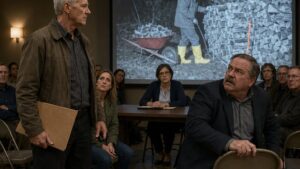
The clubhouse room had been arranged in two rows of folding chairs facing a long table. Donna sat at the center with two board members. The property manager had a laptop open beside her. Catherine Lopez sat to Steven’s right.
Eric occupied a chair near the wall.
Steven could feel several homeowners behind him waiting for the accusation they had heard repeated around the neighborhood.
He had prepared one.
Instead, he looked at the board.
“I said Eric deliberately targeted my children for his own purposes. I do not have evidence of that. I shouldn’t have said it.”
A chair creaked behind him.
Donna looked up fully now.
Eric did not move.
Steven continued.
“I’m not withdrawing what I can prove. I’m correcting what I can’t.”
Catherine had told him to keep it there.
He nearly did.
Then Donna said, “I appreciate the clarification.”
Something in her tone made the old anger stir.
Steven opened the folder in front of him.
“This does not change the twelve flights.”
Donna’s face settled back into board-president neutrality.
“No one has claimed it does.”
“It also doesn’t change the written scope of the original contract.”
One board member leaned toward the pages Steven had submitted.
Catherine had helped him compress six weeks into a simple timeline: date, approximate time, known contract status, and whether the flight appeared on Steven’s exterior security footage.
No photographs of the children.
No enlarged images of the pool.
No dramatic screenshots.
Only the record.
Steven placed the black notebook beside the timeline but did not open it.
Donna noticed that too.
The property manager summarized the original roof survey, the storm-damage concerns, and the association’s insurance-renewal pressure.
Donna took over from there.
“We had a genuine problem,” she said. “Homeowners wanted enforcement to be consistent but objected to in-person access. The aerial program provided objective documentation.”
“During the roof survey,” Catherine said.
Donna turned toward her.
“And afterward, for exterior compliance.”
“Under what written authorization?”
Donna paused.
“We have already established that the follow-up work was not formally added to the vendor scope.”
One of the board members asked, “Why not?”
Donna’s jaw tightened.
“Because at the time I considered it an extension of the existing process.”
Steven watched her carefully.
She was not lying.
That made the answer harder to dismiss.
Donna continued.
“The board was dealing with repeated complaints about selective enforcement. People did not want volunteers walking around side yards. Some refused access entirely. Eric already had equipment in the neighborhood. Using aerial images seemed less confrontational.”
Steven almost responded.
Then he remembered what Samantha had said.
You already know enough to ask them to stop.
So he waited.
The other board member turned toward Eric.
“Were you instructed to continue after the roof survey?”
Eric looked at Donna, then at Steven.
“Yes.”
“In writing?”
“No.”
“What were you told to photograph?”
“Visible compliance issues.”
“That’s broad.”
“It got broader.”
The room changed.
Donna’s shoulders stiffened.
Eric looked down at his hands.
“At first, it was obvious stuff. Fence damage. A shed visible over a fence line. Materials stacked along a side yard.”
“And later?”
Eric took a breath.
“Donna wanted clearer images.”
Donna said, “I wanted usable documentation.”
Eric looked at her.
“That meant lower.”
The property manager stopped typing.
Eric continued.
“If I sent something where you couldn’t tell what the condition was, I’d get asked for a better angle.”
Donna’s voice sharpened. “I did not instruct you to violate anyone’s privacy.”
“No. You told me what you needed to see.”
“That is not the same thing.”
“I know.”
Steven heard something in Eric’s answer that he had not expected.
No accusation.
No attempt to shift all responsibility.
Just a line both of them had crossed from opposite directions.
Eric turned toward the board.
“I should’ve pushed back. I didn’t.”
One homeowner behind Steven whispered something.
No one applauded.
No one needed to.
The board member nearest Donna looked at the submitted contract again.
“So the original roof survey ended, but aerial enforcement continued informally because it was easier than scheduling inspections.”
Donna said, “More efficient.”
Steven spoke before he could stop himself.
“For whom?”
Donna looked at him.
He expected irritation.
Instead she answered.
“For the board.”
The honesty quieted him.
She continued.
“We had an insurance deadline. We had homeowners accusing us of inconsistent enforcement. We had volunteers unwilling to conduct inspections after prior confrontations. I believed photographs would reduce conflict.”
“And when people complained about the photographs?”
“I treated those complaints as resistance to enforcement.”
Steven leaned back.
There it was.
Not a conspiracy.
Not personal hatred.
Something almost more ordinary.
Donna had found a system that made her job easier and decided that anyone objecting to it must be objecting to being held accountable.
Catherine touched the list of proposed remedies in front of Steven.
It was his turn.
He had arrived wanting Donna removed from the board.
He had written that demand himself.
Now he read the other items first.
End residential backyard drone monitoring.
Rescind notices based solely on aerial backyard images collected after the roof-survey period.
Require written scope, homeowner notice, and privacy limitations for any future aerial inspections.
Separate compliance decisions from unilateral vendor instructions.
When he finished, one board member asked, “Anything else?”
Steven looked at Donna.
“Yes.”
Catherine’s eyes shifted toward him.
“I asked that Donna be removed from the board.”
Donna’s face went still.
Steven continued.
“I still think what happened was serious.”
One board member nodded slowly.
“But?”
Steven looked at the closed notebook.
“But removing her completely doesn’t fix the policy that allowed this.”
Donna looked at him with an expression he could not read.
Steven said, “I’m asking that she no longer oversee compliance matters.”
The board recessed for twenty minutes.
When they returned, they declined to remove Donna from office.
For a moment, Steven felt the old disappointment flare.
Not enough.
Then the board member began reading the rest.
All backyard drone monitoring was suspended immediately.
Notices based solely on post-survey aerial images would be reviewed.
Future aerial inspection contracts would require written scope limits, advance notice, and restrictions on occupied private spaces.
Donna would remain president but would no longer chair compliance oversight while the policies were rewritten.
The room stayed quiet.
Donna wrote something on the paper in front of her.
Eric exhaled.
Steven realized Catherine was looking at him.
“Enough?” she asked softly.
He looked at the notebook.
Six weeks earlier, he would have wanted Eric punished, Donna removed, and everyone who doubted him forced to admit it.
Now the thing he had actually asked for at the beginning was happening.
The flights were stopping.
“Yes,” he said.
Outside the clubhouse, Samantha waited beside the car.
“Well?”
“They ended the program.”
She studied his face.
“And Donna?”
“Still president. Not in charge of compliance.”
“And Eric?”
Steven glanced back toward the clubhouse doors.
“He told the truth.”
Samantha nodded.
Then she opened the passenger door.
As Steven walked around the car, he heard the distant buzz of a drone somewhere beyond the neighborhood.
His body reacted before his mind did.
He looked up.
The sound faded toward the main road.
For the first time in weeks, he had no reason to write down the time.
Chapter 8: The Blank Line After Flight Twelve
The next time Steven heard a drone while his family was in the pool, his hand went automatically toward the patio table.
The black notebook was still there.
Closed.
He stopped before touching it.
“Dad?”
One of the children had frozen halfway through climbing onto a float.
Samantha turned in the water.
The buzzing grew louder.
Steven looked up.
A drone appeared above the roofline across the street.
For a second, every old instinct returned at once.
Find the camera angle.
Check the time.
Watch the altitude.
Identify where Eric was standing.
The machine traveled along the street-facing side of the houses.
It did not turn toward the backyard.
It did not slow.
Its camera remained angled toward the roof of a property farther down the block.
Then it continued east.
Samantha stayed where she was.
She did not tell the children to get out.
One of them splashed water toward her.
She splashed back.
The sound of the drone faded.
Steven realized he had been holding his breath.
Samantha looked at him.
“You okay?”
“Yeah.”
She glanced toward the notebook.
“You sure?”
He looked at it.
“Yeah.”
The policy changes had arrived by mail two weeks earlier.
The association had rescinded three violation notices issued to homeowners where the only supporting evidence came from the expanded drone program. The new inspection policy required written notice before aerial work and prohibited purposeful imaging of occupied private recreation areas except in a documented emergency.
Donna’s name remained at the bottom of HOA emails, but compliance notices now came through the property-management office rather than directly from her committee.
She had not apologized to Steven.
He had stopped waiting for one.
Eric lost the association contract.
Steven learned that from Eric himself three days after the board decision.
There had been no argument.
Eric had been loading camera cases into his SUV when Steven walked past the driveway.
“They terminated it,” Eric said.
Steven stopped.
“I figured.”
Eric shut the hatch.
“I’ve still got real-estate work.”
“That’s good.”
“It’s less steady.”
Steven nodded.
Neither man knew what to do with the silence after that.
Finally Eric said, “For what it’s worth, I changed my standard routes around this block.”
Steven looked at him.
“You didn’t have to tell me.”
“I know.”
That had been the whole conversation.
It was not reconciliation.
But it was no longer war.
Now, several weeks later, Steven returned to the pool chair and picked up the notebook.
He opened to the final used page.
The date of the demonstration flight appeared beside it.
The rest of the line was still blank.
He had meant to complete it after talking to Catherine.
Then after the hearing.
Then after the board decision.
He never had.
The gate latch clicked.
Steven looked over.
Eric stood on the other side of the fence.
“Got a minute?”
Steven walked over but did not open the gate.
A faint smile touched Eric’s face.
“Still talking through fences?”
“For now.”
“Fair enough.”
Eric held a folded piece of paper.
“The insurance company covered part of the drone.”
Steven’s stomach tightened.
“How much are you asking me for?”
“Not the whole thing.”
“That wasn’t my question.”
Eric looked toward the patio umbrella.
It was still in the same place.
“The insurer says operator error contributed. They also say the umbrella was a fixed environmental condition I should have accounted for.”
Steven waited.
“So why are you here?”
“Because one arm and the camera module weren’t covered.”
“And you think that’s my responsibility?”
“I think the demonstration happened because of a dispute at your property.”
“That’s different.”
“I know.”
Eric handed the paper over the fence.
The amount was far less than thirty-two hundred dollars.
Still enough to irritate Steven.
A month earlier, he would have refused immediately.
He would have called Catherine before Eric reached his driveway.
Now he read the page again.
“You’re not saying I caused the crash.”
“No.”
“You’re not saying the umbrella was improperly placed.”
“No.”
“Then why should I pay anything?”
Eric leaned against the fence.
“You don’t have to.”
Steven looked up.
Eric shrugged.
“I figured I’d ask. I also figured you’d say no.”
“That’s a strange negotiation strategy.”
“I’ve had worse ones.”
Steven almost smiled.
From the pool, Samantha called, “Everything all right?”
Steven turned.
“Yeah.”
She watched him for another second, then went back to the children.
Eric followed his gaze.
“I am sorry about the flights.”
Steven looked at him again.
Eric’s expression was uncomfortable.
Not polished.
Not rehearsed.
“I should’ve stopped after you asked the first time,” he said. “Contract or no contract.”
Steven folded the paper once.
“I shouldn’t have said you were targeting the kids.”
“I know.”
“That wasn’t an apology.”
Eric raised an eyebrow.
Steven exhaled.
“I’m sorry.”
Eric nodded.
“Okay.”
Neither offered a handshake.
Steven preferred it that way.
He looked again at the reimbursement figure.
“I’ll cover part of the camera module.”
Eric seemed genuinely surprised.
“Why?”
“Because I can.”
“That is not usually how you argue.”
“I’m trying something new.”
Eric laughed once.
They agreed on an amount neither considered completely fair.
That somehow made it feel more honest.
When Eric left, Steven returned to the patio table.
The notebook remained open.
The next line beneath twelve was empty.
For six weeks, every buzz overhead had demanded a date.
A time.
A duration.
Proof.
Now Steven put the pen against the blank thirteenth line.
He held it there.
Nothing needed recording.
Behind him, water splashed over the edge of the pool.
Samantha laughed.
Steven closed the notebook.
He slid it into the patio cabinet instead of leaving it on the table.
Then he took off his shoes and walked toward the pool.
One of the children shouted a warning just before sending a sheet of water toward him.
Steven stepped into it anyway.
Above the houses, the sky remained open and bright.
He looked up once.
Then he stopped looking.
The story has ended.