He Reported the Old Utility Pole—Then the Easement Led Straight Under His New Patio
Chapter 1: The Complaint That Brought County Trucks to Joshua’s Curb
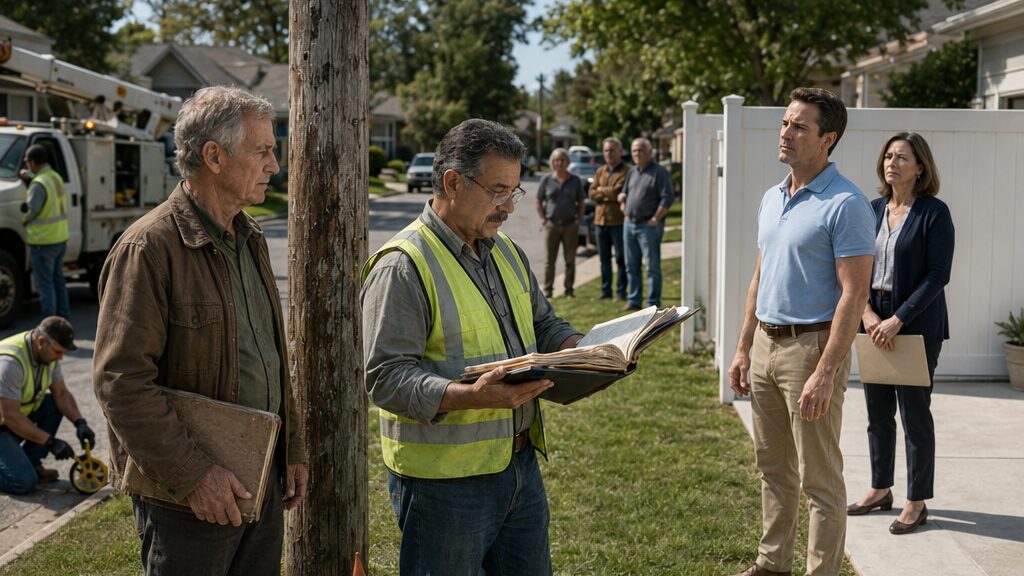
The first county truck stopped with its front bumper almost even with Joshua Martin’s mailbox.
The second rolled past it and braked beside the old utility pole.
Joshua stood at the edge of his porch with a coffee mug warming both hands. Across the property line, Brian Clark had already come outside. He wore a pressed polo and clean sneakers despite the damp grass, and his arms were folded in the satisfied way of a man watching a scheduled delivery arrive on time.
Two county workers climbed out. One opened a side compartment and pulled out a clipboard. The other looked up at the weathered pole, then down at the grass around its base.
Brian glanced toward Joshua.
“Well,” he said, “at least now we’ll get an answer.”
Joshua took a sip.
They had already had answers. Brian simply had not liked any of Joshua’s.
The argument had started eight days earlier with a knock at Joshua’s side gate. Brian had stood there looking past him at the pole as though noticing it for the first time, though he had lived next door for almost two years.
“That thing’s leaning,” Brian had said.
“It’s been leaning about that much since before you bought your house.”
“That doesn’t make it safe.”
Joshua had looked up. The pole was old, darkened by rain and summer heat, carrying a service line that disappeared behind the neighboring lots.
“If you’re worried about it,” Joshua had said, “call the county.”
Brian had frowned, apparently expecting resistance.
“I may do that.”
Joshua had shrugged and gone back to trimming the hedge.
Two days later came the HOA notice.
It was tucked under the handle of his storm door in a plastic sleeve. The language was polite enough: concern regarding an exterior structure inconsistent with current community appearance standards; request for documentation; possible corrective action pending review.
Joshua had read it twice, folded it along the existing crease, and put it on the kitchen table.
The next afternoon Brian came over again.
“I filed the county complaint too,” he said. “Just so you aren’t surprised.”
Joshua had been carrying a bag of lawn clippings toward the garage.
“You’ve been busy.”
“I’m trying to handle it properly.”
“Then handle it properly.”
Brian’s jaw tightened.
“I don’t understand why you’re being difficult.”
Joshua had almost laughed at that. Instead he carried the bag inside.
Now, on Thursday morning, “properly” had arrived in two white county trucks.
A third vehicle turned onto the street. Amy Anderson stepped out carrying a narrow folder against her ribs. As HOA president, she had learned to dress for disputes: practical flats, neutral blouse, expression already arranged into patience.
“Morning, Joshua.”
“Amy.”
She nodded toward the county crew. “I thought I should be here since our notice involves the same issue.”
Brian moved closer to her. Not beside her exactly, but near enough to suggest alignment.
The field supervisor introduced himself as Thomas Rodriguez. He was in his fifties, broad-shouldered, with reading glasses hanging from the neck of his safety vest.
“We got a complaint concerning the pole and possible encroachment or unsafe placement,” Thomas said. “We’re not here assuming either way. We’ll inspect what’s on file, confirm ownership and easement status, and go from there.”
Brian gave a small nod, as if this sounded reasonable because it was going where he expected.
Amy opened her folder.
“Our concern is separate,” she said. “The association’s architectural standards don’t specifically list utility poles, obviously, but we do have authority over unapproved exterior structures where ownership or responsibility falls to a homeowner.”
Joshua looked at her.
“Obviously?”
Amy noticed the word after she said it.
“I mean the standards weren’t written with this particular situation in mind.”
“That part I believe.”
Brian exhaled through his nose.
“Can we just let them do their job?”
Joshua turned to him.
“I haven’t stopped anybody.”
For several seconds, nobody spoke.
Thomas walked to the pole and studied the metal tag fixed several feet above the ground. One worker measured from the curb. Another took photographs of the base and the service direction.
Joshua felt no fear, but irritation worked under his ribs.
Not because of the inspection.
Inspections were useful when people understood what they were inspecting.
What bothered him was the audience.
A longtime neighbor slowed while walking a dog. Another stood at the end of a driveway pretending to sort recycling. Brian had chosen procedure, but procedure in a neighborhood was never truly private.
Thomas came back.
“Mr. Martin, do you know who installed the pole?”
“County contractor.”
“When?”
“Early nineties.”
Thomas’s eyebrows lifted slightly.
“You’re sure?”
“Yes.”
Brian spoke before Thomas could continue.
“It looks older than that.”
Joshua looked at him.
“It may have hurt its feelings to hear you say that.”
Amy pressed her lips together, almost hiding a smile.
Brian did not.
Thomas flipped a page on his clipboard.
“Our digital parcel layer is showing utility access through this section, but it’s not detailed enough to establish the exact corridor. We’ll need the recorded instrument if there is one.”
Amy immediately looked at Joshua.
“Do you have anything showing the pole was approved?”
There it was.
Not whether something existed.
Whether Joshua could produce it.
He set his coffee mug on the porch rail.
“Probably.”
Brian’s folded arms loosened.
“Probably?”
Joshua ignored him.
Thomas said, “Anything historical would help. Easement, survey, utility plan, service agreement. Old records are fine as long as we can match them to recorded data.”
Joshua looked past him at the pole.
Near its base, the ground had settled slightly over the years. He remembered when there had been no decorative fence next door, no concrete patio behind it, no HOA architectural committee debating mailbox finishes. Just survey flags, clay soil, and a half-built subdivision whose streets still ended in gravel.
He also remembered exactly where the utility corridor went.
That memory had been sitting quietly in him since Brian first started pouring concrete months ago.
Joshua picked up his mug.
“I’ve got something inside.”
Brian gave Amy a quick look.
Thomas waited.
Joshua climbed the porch steps, then paused with one hand on the door.
“It’s an old file,” he said. “But I think the county may want to see it.”
Chapter 2: The Yellowed Easement Nobody on the HOA Had Read
Joshua laid the folded easement on the porch table directly beside the HOA violation notice.
The contrast pleased him more than it should have.
Amy’s notice was crisp, white and freshly printed. The easement was yellowed at the folds, its corners softened from years inside a thick survey folder whose vinyl cover had cracked along the spine.
Thomas put on his reading glasses.
Brian leaned closer.
“What exactly is that?”
Joshua opened the document.
“A recorded utility easement.”
Brian looked from the paper to the pole.
“For that?”
“For more than that.”
Thomas held up one hand without looking away from the page.
“Give me a minute.”
Joshua stepped back.
This was the part he trusted.
Not persuasion. Not neighborhood politics. Not who had the cleaner house or newer car or stronger opinion at an HOA meeting.
Numbers either closed or they did not. Legal descriptions either matched recorded parcels or they did not.
Thomas traced a line with one finger, then called one of the workers over.
“You have county records access?”
“Yeah.”
“Pull instrument number four-seven-three, series ninety-three.”
Joshua corrected him quietly.
“Four-seven-eight.”
Thomas glanced down.
The final digit was faded near the crease.
He looked at Joshua, then entered the corrected number.
Brian noticed.
“How do you remember that?”
Joshua said nothing.
The worker searched on a tablet. After several seconds, a scanned document appeared.
Thomas compared the pages.
“Same recording date. Same grantor. Same legal description.”
Amy leaned in.
“So it’s valid?”
“I didn’t say that yet.”
Her expression tightened.
Thomas walked down the steps with the document and measured from a point near the curb. He checked the tablet, then the paper again. One worker drove a thin temporary flag into the grass.
Brian’s attention followed every movement.
Joshua watched the pole.
It looked exactly as it had the day before: weathered, slightly crooked, unimpressed.
Thomas eventually returned.
“The recorded easement is active,” he said.
Brian frowned.
“Active meaning what?”
“Meaning it wasn’t vacated or replaced. It grants access for utility installation, inspection, maintenance and repair across a defined corridor.”
Amy looked at her violation notice.
“And the pole?”
“Appears consistent with that easement.”
The words landed without drama.
Joshua preferred it that way.
Brian did not.
“Appears?”
Thomas removed his glasses.
“I’m not condemning it based on what I’ve seen. If you’re asking whether we’re ordering Mr. Martin to remove it this morning, the answer is no.”
Brian stared at the pole as though it had personally betrayed him.
Amy closed her folder.
“Then the association needs to pause its enforcement too.”
“Pause?” Joshua asked.
She met his eyes.
“Withdraw the current removal demand pending final confirmation.”
“That sounds different.”
“It is different.”
Amy pulled the notice from the porch table and slid it back into her folder.
That should have felt like victory.
For months Joshua had endured small comments from Brian about the “old infrastructure” on his side of the line—the worn mailbox post, the utility pole, the pickup he kept maintained but refused to replace simply because its paint had faded.
Now the county had come, the HOA had watched, and the pole remained.
Brian had wanted a public answer.
He had one.
Yet Joshua did not feel the satisfaction he had expected.
Thomas unfolded the easement again.
“There’s one issue.”
Brian seized on the phrase.
“What issue?”
Thomas pointed to the legal description.
“This instrument isn’t just for the pole location. It creates a corridor.”
Joshua kept his face still.
Amy said, “How wide?”
“Twenty feet in this section.”
Brian looked around as though twenty feet might suddenly become visible.
“On his property?”
Thomas did not answer immediately.
He walked toward the curb, then angled across Joshua’s front lawn. The worker followed with the tablet.
Joshua knew the route before either of them moved.
From the pole, the corridor passed behind Joshua’s side yard, crossed near the old drainage alignment, then continued through the adjoining parcel before bending toward the rear utility junction.
The adjoining parcel was now Brian’s.
Thirty years earlier it had been bare red clay.
Thomas stopped near the property line.
“Mr. Martin,” he said, “you said the pole went in around ninety-three.”
“Yes.”
“You involved with the installation?”
Joshua felt Brian turn toward him.
“I worked for county public works.”
“What kind of work?”
“Engineering.”
Thomas looked back at the old easement.
“Survey?”
“Some.”
Brian gave a short laugh with no humor in it.
“You were a county engineer?”
“Retired from there.”
“And you never thought that was relevant?”
Joshua looked at him.
“You never asked what I did.”
“That isn’t the same thing.”
“No.”
It wasn’t.
That was the first uncomfortable thing Joshua had admitted all morning.
Thomas crouched beside one of the old reference points and brushed loose dirt from a small metal cap nearly hidden by grass.
“This is probably still usable.”
Joshua recognized it immediately.
“We set that off the original centerline.”
Thomas looked up.
“We?”
Joshua nodded.
“I was on the survey crew before I moved into design.”
Now even Amy stared.
Brian said, “So you helped put this thing here.”
“No. I helped establish where the utility corridor went.”
Brian gestured sharply at the pole.
“That seems like a distinction only you care about.”
Thomas stood.
“It’s a distinction I care about.”
The edge went out of Brian’s voice.
Thomas studied the easement again, then looked toward the space between the houses.
“If this reference is good, we need to trace the corridor before I close the complaint.”
Amy frowned.
“Why? You’ve already established the pole is allowed.”
“The complaint asked the county to verify utility compliance. This easement protects access along the corridor, not just one piece of equipment. If there’s been construction over it, we have to note that.”
Brian stopped moving.
Joshua noticed it before anyone spoke.
The patio.
From the front yard it was barely visible beyond Brian’s white fence, but Joshua could picture it clearly: pale concrete, broad enough for a table and grill, running nearly the full width behind the house.
Poured four months earlier.
Right across the old route.
Thomas pointed through the narrow space between the properties.
“According to this description, the corridor continues that direction.”
Brian looked where he was pointing.
“No.”
Thomas turned.
“No?”
“My patio is back there.”
“I can see part of it.”
Brian’s face changed—not to fear yet, but calculation.
“The HOA approved that patio.”
Amy’s expression tightened.
“Architecturally.”
“What does that mean?”
“It means we approved the design submission.”
“You approved the project.”
“We don’t issue county utility clearance, Brian.”
He stared at her.
Joshua wished, suddenly and strongly, that the conversation had ended with the pole.
Thomas folded the easement and handed it back to Joshua.
“We’ll locate the corridor before we make any determination.”
Then he pointed across the line, directly toward Brian’s backyard.
Joshua had waited months for someone else to say what he already knew.
Hearing it aloud brought no pleasure at all.
Chapter 3: The Utility Line Continued Beneath Brian’s Perfect Backyard
By early afternoon, a broken line of bright utility paint ran from the grass near Joshua’s pole, crossed the property line, and stopped at the edge of Brian’s concrete patio.
Brian stood over the final mark as if he could erase its meaning by blocking it from view.
“You are not drilling through that slab,” he said.
The utility locator stayed crouched beside his equipment.
“Nobody said we were drilling.”
“You said the signal continues under it.”
“I said the locate suggests the line continues under it.”
“That patio was approved.”
Thomas, standing near the gate, answered without raising his voice.
“HOA approval and county utility clearance are different things.”
Brian looked at Amy.
She had returned for the afternoon inspection after a board call.
“You knew about the patio.”
“I knew about the design application.”
“You signed off.”
“On materials, dimensions, drainage notes and appearance.”
Brian laughed once.
“That is unbelievable.”
Joshua remained near the fence.
He had considered going inside.
He had even made it halfway to his porch before Thomas asked him to stay because his old survey knowledge might help interpret the original route.
Now he stood in Brian’s carefully finished backyard feeling less like a witness than an accomplice to something nobody had yet named.
The patio was handsome.
Joshua had never denied that.
Its concrete had been tinted a warm gray. A low step led from the back door to a broad level surface with room for chairs, planters and a small table. Near one edge stood a sturdy handrail that had always seemed excessive for Brian.
The locator moved several feet and tried again.
The signal weakened.
Joshua knew why.
He kept quiet for three seconds.
Then five.
Thomas looked at him.
“You remember a bend here?”
Joshua hated the question because he did.
“Yes.”
Brian turned immediately.
“Of course you do.”
Thomas ignored him.
“How far?”
Joshua studied the fence, the house corner, then the old pole visible through the side-yard opening.
“Original alignment jogged south before the rear junction. Maybe six feet.”
“Why?”
“Storm inlet conflict. They shifted the utility route during grading.”
Thomas nodded toward the locator.
“Try six feet south.”
The locator moved.
The signal strengthened almost at once.
Brian’s mouth opened, then closed.
The painted line continued.
Across the patio.
Not along its edge.
Across it.
Thomas took several measurements. Joshua watched each one confirm what memory had already told him.
When they finished, the line disappeared beneath the broadest section of concrete.
Brian looked at Joshua.
“You knew.”
Joshua folded his arms.
“I knew where the old alignment was.”
“That is not an answer.”
“It’s the answer you asked for.”
“How long?”
Amy said quietly, “Brian.”
“No.” He pointed at the painted marks. “He stood there for months watching this patio go in. He knew.”
Joshua felt heat rise behind his neck.
There were ways to answer that question which would make Brian sound foolish.
Joshua could say Brian had never asked him for engineering advice.
He could say the contractor should have checked recorded easements.
He could say county records were public.
All of those things were true.
None of them were enough.
Thomas interrupted.
“We still need record confirmation before anyone decides what corrective action is required.”
Brian rounded on him.
“Corrective action?”
“If permanent construction obstructs protected utility access, that has to be addressed.”
“You mean tear it out.”
“I mean addressed.”
“That is bureaucratic nonsense.”
Thomas’s expression hardened slightly.
“It means I am not going to tell you something has to be demolished before I verify the legal description, line depth, access requirement and permit history.”
That slowed Brian down.
Only slightly.
“What permit history?”
Amy looked away.
Joshua noticed.
Brian noticed too.
“The HOA had my plans.”
Amy answered carefully.
“The HOA did not represent that our approval replaced county permits.”
“You never told me I needed another review.”
“We tell every applicant that association approval does not supersede governmental requirements.”
“In six-point print.”
“In the application you signed.”
Brian’s face flushed.
For the first time that day, Joshua saw something besides confidence and anger.
Fear.
Not fear of embarrassment.
Money.
The patio had not been cheap. Joshua had watched trucks arrive for days, watched forms built and gravel compacted. Brian had replaced landscaping afterward, added drainage, repainted the fence.
The whole yard looked engineered to remove uncertainty.
Now uncertainty ran through its center in bright paint.
Thomas asked Joshua to accompany him to the county records office.
“I want to compare your copy against archived engineering sheets,” he said. “If you worked the original survey, you may recognize changes that weren’t carried into the newer mapping layer.”
Brian gave another humorless laugh.
“So now he’s consulting on the investigation he caused?”
“I caused?” Joshua said.
“You knew what would happen.”
“I didn’t file the complaint.”
“No. You just waited.”
That followed Joshua into the county building.
The records clerk brought out digitized plats, scanned easements and an old project index. Joshua sat beside Thomas at a public terminal while the locator report uploaded.
The old subdivision appeared on-screen in thin black lines.
Joshua recognized road names before they had names.
There was the original drainage channel. The rear service route. The utility corridor bending around a storm structure that had later been covered by landscaping.
Thomas enlarged the image.
“You were right about the jog.”
Joshua said nothing.
“You remember this stuff pretty well.”
“I spent enough years staring at it.”
Thomas leaned back.
“You know Brian’s going to ask when you first realized his patio crossed it.”
Joshua looked at the old plan.
He remembered the concrete truck months earlier.
He remembered Brian standing in the yard with his contractor.
He remembered a question shouted over the fence: Did you ever have drainage trouble back here?
Not utility trouble.
Not easements.
Drainage.
Joshua had answered no.
Later, when the contractor had wandered closer to the fence and asked whether Joshua knew of “anything underground back here,” Joshua had looked at Brian, who had said, “We’ve already got the plans approved.”
Joshua had replied, “Then you should be fine.”
He had known that was not quite an answer.
Thomas tapped the screen.
“This line was recorded correctly. Current GIS simplified it, but the easement controls.”
“So the patio’s over it.”
“Part of it, yes.”
Joshua stared at the map.
Thomas added, “That doesn’t automatically mean the whole patio goes.”
Joshua looked over.
“Depends on required access.”
“Exactly.”
That should have relieved him.
Instead it made his earlier silence feel heavier.
When they returned to the neighborhood, Brian was waiting beside the painted line.
Amy stood several feet away.
The afternoon light had shifted across the patio, making the bright markings look harsher.
Brian did not speak to Thomas first.
He looked directly at Joshua.
His voice was quieter now.
“That contractor asked you about this, didn’t he?”
Joshua felt Amy turn toward him.
He could have corrected the wording.
He could have explained that the contractor’s question had been vague.
He could have hidden inside accuracy.
Instead he said, “He asked if I knew of anything underground.”
Brian’s face went still.
“And?”
Joshua looked toward the old pole beyond the fence.
“I told him you had approved plans.”
“That’s not what he asked you.”
“No.”
Brian took one step closer.
“How long did you know, Joshua?”
Chapter 4: Joshua’s Silence Was Not as Innocent as It Looked
“How long did you know, Joshua?”
Brian’s question followed him into Friday morning.
By nine, Amy Anderson was sitting at Joshua’s kitchen table with the HOA folder closed in front of her and his survey folder lying several inches away, as though even the distance between the two documents had become part of the dispute.
She did not begin with the pole.
She began with the patio.
“Did you know the easement crossed Brian’s lot while he was building?”
Joshua looked toward the back window.
From his kitchen he could see the upper section of the old pole and, beyond the fence, the tops of Brian’s ornamental grasses.
“I knew the old corridor crossed the lot.”
“That isn’t exactly what I asked.”
He gave her a dry look.
“You’ve been talking to Brian.”
“I’ve been talking to everyone because the county is now asking questions the board should have asked months ago.”
Amy opened her folder.
“The association approved his architectural application. That approval did not authorize him to build over a utility easement. But if a board member or neighboring homeowner knew there was a problem and said nothing—”
“I’m not a board member.”
“No. You’re the retired county engineer who apparently remembers a thirty-year-old utility alignment better than our digital maps.”
“That doesn’t make me responsible for his permit.”
“No.”
Amy leaned back.
“But it may make you responsible for your silence.”
Joshua’s jaw tightened.
There were sentences a person could reject because they were false.
That one irritated him because it was not.
He reached for the survey folder, then stopped before opening it.
Months earlier, the folder had sat in almost the same place.
Brian’s patio contractor had been working beside the property line that afternoon. Wooden forms framed the new slab. Gravel had already been compacted, and a concrete truck was scheduled for the next morning.
The contractor had walked toward Joshua while Brian checked measurements near the back door.
“You ever have drainage trouble along this side?” the contractor had asked.
“No.”
“Anything underground we should know about?”
Joshua had looked toward the proposed slab.
He could see the line in his mind before there was concrete over it: from the old pole, behind the hedge, through the adjoining lot, then bending near the rear.
He had opened his mouth.
Brian had stepped closer.
“We already submitted the plan,” Brian said. “HOA approved everything.”
The contractor said, “I’m asking about utilities.”
Brian looked at Joshua.
“He knows the neighborhood, but some of that information is probably pretty old.”
Joshua remembered the tone more clearly than the exact words.
Not openly insulting.
That would have been easier.
Just dismissive enough to place him in the category Brian had assigned to several things since moving in: old fence posts, old trucks, old infrastructure, old men with old information.
Joshua had looked at the forms.
Then at Brian.
“If your plans are approved,” he had said, “you should be fine.”
The contractor had hesitated.
“You sure there’s nothing else?”
Joshua had lifted one shoulder.
“I’m not the county anymore.”
That had been true too.
The concrete was poured the next day.
Now Amy watched him across the kitchen table.
“He asked you?”
Joshua nodded.
“Generally.”
“And you understood what he meant.”
“I understood what he should have checked.”
Amy’s eyes narrowed.
“That isn’t the same thing.”
“No.”
“You could have said, ‘There’s a recorded easement. Call the county before you pour.’”
“Yes.”
The answer left the room quiet.
Joshua disliked how easily it came once he stopped defending himself.
Amy glanced toward the survey folder.
“Why didn’t you?”
He could have blamed Brian’s attitude.
He did, at first.
“He had an answer for everything. New drainage. New fence. New patio. Every time I mentioned something about the property, he acted like I was defending the past because I couldn’t stand change.”
“That bothered you.”
“It got old.”
Amy waited.
Joshua pushed his coffee cup away.
“He called the pole outdated before he ever bothered finding out what it did. He told me the neighborhood needed to look maintained. Like the rest of us had been waiting around thirty years for him to arrive and explain maintenance.”
Amy’s face softened, but only slightly.
“And so?”
“And so when his contractor asked, I decided Brian could figure it out himself.”
There it was.
Not an accident.
Not forgetfulness.
A choice.
Amy exhaled.
“I understand why you were angry.”
“I wasn’t angry.”
She looked at him.
Joshua looked away.
“Fine,” he said. “I was tired of him.”
“That’s different from not knowing.”
“Yes.”
Amy opened the HOA folder at last.
“The county sent a preliminary notice this morning. Until they establish access requirements, Brian can’t alter the patio or build anything else over the marked corridor.”
“Reasonable.”
“They also say permanent obstruction may require removal.”
Joshua’s gaze moved back to her.
“How much?”
“They don’t know yet.”
That was worse.
Partial demolition meant cost.
Full demolition meant far more.
He pictured the wide gray slab broken into chunks, the fence removed for equipment, the landscaping Brian had fussed over for months torn apart.
A day earlier, the image would have carried a certain satisfaction.
Now it felt uglier.
Amy stood.
“I need to go meet with two architectural-review members. They’re already worried Brian will claim the HOA told him everything was clear.”
“Did you?”
“No.”
“Then he can claim whatever he wants.”
Amy closed her folder.
“You really do enjoy being technically right.”
Joshua looked at her.
“That’s a cheap shot.”
“Yes.”
She picked up the folder.
“So was letting him pour concrete because you wanted him to learn a lesson.”
The door closed behind her.
Joshua remained at the table.
For a long time he did not open the survey folder.
When he finally did, he found the original plat folded under several inspection sheets. His own handwriting was still visible in the margin, small and square, marking a field adjustment to the route.
He remembered standing in raw clay with a survey rod while houses existed only as stakes.
Back then, the corridor had been a practical thing.
A path people might need twenty years later when something failed underground.
Nobody had cared what it looked like.
Nobody had imagined a patio.
A knock sounded at the front door.
Joshua closed the folder.
He expected Amy had forgotten something.
Instead Janet Clark stood on the porch.
She held the handrail with one hand and her cane in the other.
Joshua had spoken to Brian’s mother perhaps a dozen times. She had moved in six months earlier after selling her smaller house across town. She usually sat outside in the late afternoon when the heat eased, and once or twice she had brought over tomatoes Brian refused to eat.
Her face looked tired.
“Is Brian home?” Joshua asked.
“He doesn’t know I came over.”
Joshua opened the door wider.
Janet did not enter.
She glanced past him toward the side yard, where the old utility pole stood beyond the porch.
Then she looked back at him.
“Joshua, are they really going to tear out my patio?”
Chapter 5: The Patio Was Built for More Than Property Value
The temporary opening beside Brian’s patio had created a seven-inch step where there had not been one before.
Joshua noticed Janet struggling with it before he noticed anything else.
A small section of landscaping had been removed so the county locator could reach the edge of the slab. The compacted soil was lower than the concrete, and Janet stood at the back door with her cane testing the drop.
“Hold on,” Joshua said.
He moved toward her.
Brian came around the side of the house at the same moment.
“I’ve got her.”
The words were not hostile, but they stopped Joshua anyway.
Brian took Janet’s elbow and helped her down.
She gave him an irritated look.
“I can walk.”
“I know.”
“You keep saying that while grabbing me.”
Brian released her.
Joshua looked at the patio differently now.
The broad level surface. The handrail by the door. The absence of steps between the sitting area and the side entrance. Even the table had been placed with more clearance around it than Joshua would have bothered with.
Janet followed his gaze.
“He did all this because I fell last winter.”
Brian’s face tightened.
“Mom.”
“What?”
“You don’t need to explain it.”
“I’m not explaining. I’m telling him.”
She moved carefully toward a chair.
Joshua pulled it out for her.
Brian remained standing.
Janet lowered herself and rested both hands on the top of her cane.
“My old place had three steps off the back porch. I slipped on the second one carrying a grocery bag.”
“You broke your wrist?” Joshua asked.
“And scared him more than I scared myself.”
Brian looked toward the fence.
Joshua suddenly understood the speed of the project.
The trucks. The contractors. The constant measuring.
Brian had not simply been building a fashionable backyard.
He had been removing obstacles.
Janet nodded toward the concrete.
“This was supposed to make things easier.”
Joshua looked at the bright utility paint crossing the slab.
It now seemed almost cruel in its clarity.
Brian pulled a folded county notice from his pocket.
“They gave me five business days to provide access documentation or agree to corrective work.”
Joshua took the paper when Brian offered it.
The language was familiar. Not a demolition order. Not yet. A requirement to demonstrate that the protected corridor remained reasonably accessible for maintenance.
“Thomas told you the whole slab might not have to go.”
“He also told me it might.”
“That depends on width and approach.”
“I know what it depends on.”
Brian’s voice sharpened.
Janet tapped her cane against the concrete once.
“Stop.”
Neither man spoke.
She looked at Brian.
“Tell him the other part.”
Brian stared at her.
“Mom.”
“The contractor.”
Joshua already knew which contractor.
Brian’s shoulders dropped.
“The contractor said we should verify utilities before the pour.”
Joshua said nothing.
Brian continued.
“He asked whether I had county clearance.”
“And?”
“I told him the HOA approved it.”
“That’s not clearance.”
“I know that now.”
Joshua handed the notice back.
Brian’s mouth hardened.
“No. I knew then too.”
That changed the air between them.
Janet looked down.
Brian rubbed one hand over his face.
“The county review could take weeks. The contractor had an opening in his schedule. Mom was moving in. I had temporary ramps everywhere and she hated them.”
“I hated him hovering,” Janet corrected.
Brian ignored her.
“I thought the easement on my closing documents was along the rear fence. That’s how it looked on the simplified parcel map. The contractor said we should confirm it. I told him I would.”
“But you didn’t.”
“No.”
Joshua felt the easy version of the story fall apart.
Brian had not been tricked by the HOA.
He had not innocently followed every rule.
He had taken a risk because delay felt unacceptable, then convinced himself approval from one authority meant enough.
That was irresponsible.
It was also human.
Brian looked directly at Joshua.
“You still knew.”
“Yes.”
“I was wrong to pour without checking.”
“Yes.”
“You could have stopped it with one sentence.”
Joshua glanced toward Janet.
“Yes.”
The word tasted different this time.
Not surrender.
Responsibility.
Janet shifted in her chair.
“I don’t care which one of you gets to be more wrong.”
That almost made Joshua smile.
She pointed with her cane toward the old pole visible between the houses.
“I care whether I’m going to have a trench from my back door to the fence.”
Brian said, “They’re not doing that.”
“You don’t know.”
“No. I don’t.”
The admission silenced him.
Joshua walked slowly to the far edge of the patio.
He studied the house corner, the fence, the locator marks.
The old route had been shifted during subdivision grading because of a storm inlet.
He remembered the field adjustment because he had argued about it with the design office. The utility corridor was broad, but the actual service line did not run perfectly through its center.
More important, maintenance access had once been planned from an angle.
Joshua turned toward the pole.
He could almost see the old stakes again.
Brian noticed his expression.
“What?”
“Nothing yet.”
“What does that mean?”
“It means let me think.”
Brian gave a short, frustrated laugh.
“You’ve had months to think.”
Janet looked at him.
“Brian.”
He stopped.
Joshua crouched near the edge of the concrete and measured the distance with his eyes.
The original service route had approached from the north.
But the final as-built alignment—
He went still.
Thomas had focused on the recorded corridor. Correctly.
The corridor was twenty feet wide.
The actual maintenance path might not need all twenty feet if they could establish another workable approach from Joshua’s side.
He looked toward the narrow strip behind the pole, then toward Brian’s patio.
It would still cost Brian.
Concrete would still have to come out.
But perhaps not all of it.
Joshua stood.
“Do you still have the patio drawings?”
Brian frowned.
“Yes.”
“Dimensions too?”
“Yes.”
“Get them.”
“Why?”
Joshua looked again toward the old pole, no longer seeing an eyesore or even a vindication.
He saw a reference point.
“There used to be another access angle into that corridor,” he said. “If I remember it right, the county might not need the route they’re assuming.”
Brian stared at him.
“Might?”
“I said if I remember it right.”
Janet leaned forward.
“Can it save the patio?”
Joshua looked down at the bright line disappearing beneath the slab.
“Part of it,” he said. “Maybe.”
Chapter 6: Joshua Found Another Route but It Cost Him His Last Excuse
Joshua carried the entire survey archive into the county engineering office on Monday morning.
Not one easement.
Not one convenient sheet.
Everything.
Three binders. Two rolled plans. Field notes. Old inspection copies. A box of subdivision records he had kept after retirement because nobody at the county wanted paper originals once the archives were digitized.
Thomas Rodriguez looked at the stack.
“You moving back in?”
“I’m trying something different.”
“What’s that?”
“Giving you the information before you ask for it.”
Thomas studied him for a second, then pulled out a chair.
“Good habit.”
Joshua ignored that.
He spread the original utility sheets across a conference table.
Brian’s patio drawings lay beside them.
Joshua pointed to the recorded easement, then to the as-built utility line.
“The easement gives you twenty feet. The actual line sits off-center here because of the storm inlet adjustment.”
Thomas nodded.
“We confirmed that.”
“This was the original service approach.”
Joshua traced a diagonal route from the street-side pole toward the rear corridor.
Thomas leaned closer.
“That’s not in current mapping.”
“It wasn’t an easement change. It was construction access.”
“So legally it gives me nothing by itself.”
“Correct.”
“Then what are you proposing?”
“Use the existing easement but enter from this angle. Remove the corner section of patio instead of opening the entire central run.”
Thomas looked between the plans.
“We need equipment clearance.”
“I know.”
“And line depth.”
“I know.”
“And minimum working radius.”
“I know.”
Thomas raised one eyebrow.
Joshua sat back.
“Sorry.”
“That old county voice comes back quick.”
Joshua almost smiled.
Thomas called for a current field survey.
By Monday afternoon they were back between the two houses with measuring equipment set near the old pole.
Brian watched from his backyard.
He had stopped arguing every time a county employee crossed the gate, which Joshua considered progress.
Amy arrived midway through the work, carrying no HOA folder this time.
“What are they checking?” she asked.
“Whether my memory is expensive or useful.”
Thomas heard him.
“Currently undecided.”
The first measurements looked promising.
The service line sat where Joshua remembered. The edge of the easement gave enough legal width. Access from the street side could potentially avoid the central patio area.
Then the surveyor called Thomas over.
They spoke quietly.
Joshua knew from Thomas’s face that something had changed.
“What?”
Thomas pointed to the plan.
“Your old access line assumes a wider side clearance.”
Joshua looked toward Brian’s fence.
The replacement fence sat farther inward than the original property barrier had.
“How much did we lose?”
“About fourteen inches.”
Brian came closer.
“Is that bad?”
Thomas did not answer immediately.
Joshua did.
“Yes.”
The route needed room for maintenance equipment to turn without crossing outside the easement or striking permanent improvements.
Fourteen inches could destroy an idea as effectively as fourteen feet.
Brian looked at Joshua.
“So that’s it?”
“No.”
“You just said it was bad.”
“Bad and impossible are different words.”
Thomas crouched near the reference point.
“We can shift the approach, but then we get tight against the pole.”
Joshua followed the angle.
For years the pole had been the object Brian wanted removed.
Now it was the fixed point limiting the route that might save his patio.
Joshua almost appreciated the irony.
Almost.
“Measure from the original centerline,” he said.
“We did.”
“Not the GIS centerline. The monument.”
Thomas looked toward the small metal cap hidden in the grass.
They reset.
The next measurement changed the geometry by several inches.
Still not enough.
Joshua walked the route himself.
He paced from the pole, stopped near the fence, then turned toward the backyard.
The old survey notes contained a reference to a maintenance envelope wider than the equipment actually used now.
“What’s the current minimum turning clearance?” he asked.
Thomas gave him a number.
Joshua looked back at the measurements.
“You’re using old equipment standards.”
Thomas frowned.
“No. We’re using county access standards.”
“Check the equipment table attached to the current utility maintenance spec.”
Thomas stared at him.
“You’ve been retired how long?”
“Long enough to know standards get copied forward after equipment changes.”
Thomas pulled out his tablet.
For several minutes nobody spoke.
Brian stood on the other side of the fence with both hands pressed to his hips.
Amy watched the county workers.
Joshua looked at the pole.
If the current standard had not changed, his solution failed.
Part of him wondered whether he deserved that.
He had spent months letting Brian walk toward a problem because he wanted him humbled.
Now he was trying to undo the cost.
Being useful late did not erase being silent early.
Thomas finally looked up.
“Minimum operational clearance was revised two years ago.”
Joshua waited.
“How much?”
Thomas told him.
Joshua calculated mentally.
“Then we fit.”
“Maybe.”
“You just checked it.”
“I said the equipment fits. We still need an independent field confirmation.”
Brian muttered, “Of course we do.”
Thomas looked at him.
“That independent confirmation is the difference between a solution and another expensive assumption.”
Brian had no answer to that.
Tuesday morning, the county survey crew returned.
The final route cleared the fence.
It cleared the pole.
It stayed inside the recorded easement.
At the narrowest point, it worked by less than five inches.
Thomas checked the number twice.
“So,” Brian said, “what does that mean?”
Thomas pointed toward the patio.
“You still have an obstruction.”
Brian’s face fell.
“But?”
“But we don’t need the entire center section. This corner and the adjacent strip have to come out. The county needs permanent access maintained along the approved approach.”
Brian looked at the marked concrete.
It was not a small section.
Several feet of slab would be lost, along with one planter bed and part of the railing.
But the majority of the patio would remain.
Janet’s level access from the back door could be preserved.
Brian exhaled slowly.
“How much time?”
“That comes from permitting, but once you sign the corrective agreement, we can work with your contractor on sequencing.”
“And I pay for it.”
Thomas nodded.
“The obstruction is on your property.”
Brian looked toward Joshua.
For one second Joshua expected him to ask for half.
After all, Joshua had known.
Instead Brian looked down at the concrete.
“I figured.”
The answer relieved Joshua more than he expected.
Amy stepped closer.
“There’s another issue.”
Both men turned.
She held up her phone.
“The board is calling an open meeting tomorrow evening.”
Brian frowned.
“For what?”
“For the violation against Joshua, your architectural approval, and the fact that our review process apparently allows homeowners to confuse HOA approval with governmental clearance.”
Brian laughed bitterly.
“So everybody gets a turn.”
Amy looked at him.
“Yes.”
Then she looked at Joshua.
“Everybody.”
Joshua understood.
The meeting would not simply rescind his violation.
People would ask when he knew.
They would ask why he had remained silent.
He could answer with technical distinctions. He could explain that Brian was responsible for permits and easement research. Every word would be accurate.
None would answer the actual question.
Brian folded the county correction sheet and tucked it into his pocket.
Amy began walking toward her car.
Joshua remained beside the old pole.
The survey crew had placed temporary marks around its base, turning the thing Brian had called an eyesore into the reference point from which the compromise had been measured.
Thomas gathered his equipment.
“You got him a better outcome.”
Joshua looked toward Brian’s patio.
“I could’ve gotten him a better outcome before he poured it.”
Thomas did not disagree.
Across the fence, Brian heard him.
Neither man said anything.
Amy stopped beside her car.
“Seven tomorrow,” she called back. “Clubhouse meeting room.”
Joshua looked at Brian.
Brian looked at the concrete section he would have to remove.
By the next evening, both of them would have to decide which parts of the story they were willing to say out loud.
Chapter 7: The Pole Stayed, the Patio Changed, and Neither Man Walked Away Clean
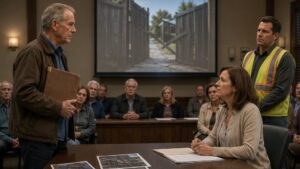
Amy Anderson began the meeting by rescinding Joshua Martin’s violation.
No buildup. No procedural throat-clearing.
“The association’s removal demand concerning the utility pole is withdrawn,” she said, looking down the folding table toward him. “The county has confirmed the pole sits within an active utility easement and is not an unauthorized homeowner structure.”
A few people shifted in their chairs.
Joshua did not.
He had imagined those words several times since the county trucks arrived. In most versions, they felt cleaner.
More satisfying.
Instead, he found himself looking across the clubhouse room at Brian Clark.
Brian sat beside Janet with the county correction agreement folded on the table in front of him. He had not brought his usual architectural-committee binder. No printed photographs. No list of standards. Nothing arranged to support an argument.
Amy continued.
“The board also needs to address the patio approval issued for the Clark property.”
Brian lifted his eyes.
Amy’s voice remained even.
“The HOA approved the project for compliance with association design standards. That approval did not represent county permitting, utility clearance, or easement verification.”
One of the architectural-review members said, “That language is on every application.”
“It is,” Amy said. “And it clearly wasn’t enough.”
Brian leaned back.
Joshua expected him to object.
He didn’t.
Amy placed a copy of the application on the table.
“The board approved appearance, drainage notes, dimensions and materials. We did not verify whether the proposed structure conflicted with a recorded county easement. We weren’t legally required to perform a county title review.”
She paused.
“But if homeowners reasonably come away believing our approval means a project is fully cleared, then we have a process problem whether or not we have a liability problem.”
That distinction sounded like Amy.
Joshua respected it.
She was not volunteering the HOA for blame it did not own.
She was not pretending it had done everything well either.
Brian finally spoke.
“So what changes?”
“We add a separate acknowledgment requiring applicants to confirm county permits and utility clearance where applicable. For additions, slabs, pools, fences and other permanent improvements, we’ll specifically tell them architectural approval does not verify easements.”
A longtime neighbor near the back said, “Shouldn’t we have been doing that already?”
Amy nodded once.
“Yes.”
The room went quiet.
Joshua looked at her more carefully after that.
It was not easy to say yes in a meeting like this.
People preferred explanations.
Explanations let everyone leave with their hands cleaner.
Brian unfolded the county agreement.
“I signed this today.”
Several heads turned.
He pushed the paper slightly forward but did not offer it around.
“The county approved the alternate access route. I’m removing the required section of patio and part of the planter bed. The railing gets relocated. The rest stays.”
Janet’s hands tightened around the handle of her cane.
Brian glanced at her.
“The back door stays level.”
A small change crossed her face.
Not relief exactly.
Something quieter.
Joshua felt it too.
That had been the part that mattered most in the end.
Not whether Brian lost enough concrete to make the story feel fair.
Whether Janet could still step outside without facing the obstacle the patio had been built to remove.
Amy said, “And the cost?”
“Mine.”
Brian’s answer came quickly.
Joshua looked at him.
Brian met his eyes.
“I built it. I skipped the county clearance. I pay to correct it.”
No one applauded.
Joshua was grateful.
Applause would have turned responsibility into performance.
A board member asked whether the contractor shared responsibility.
Brian rubbed his thumb over the fold in the agreement.
“He told me to verify utility restrictions before the pour.”
Janet looked at him but did not interrupt.
Brian continued.
“I thought the parcel map showed the easement along the rear fence. I also thought the HOA approval meant I was close enough to covered that I could keep moving.”
“Did the contractor refuse to build?” someone asked.
“No.”
“Then why is this all on you?”
Brian hesitated.
“Because he asked the question.”
That answer traveled through the room differently than an excuse would have.
Joshua felt his own turn approaching.
He had known it would.
Amy looked down at her notes.
“There is one more issue because it came up repeatedly during the county review.”
Brian’s shoulders stiffened.
Joshua knew the issue was not Brian.
Amy turned toward him.
“Joshua, several people have asked when you first knew the patio might cross the old utility corridor.”
There it was.
He could feel the room waiting.
The technical answer was easy.
He could explain that he had not surveyed Brian’s finished patio before construction. He could say the county’s modern GIS was simplified. He could distinguish between remembering an old alignment and verifying a present conflict.
All of that would be true.
All of it would hide behind precision.
Joshua rested both hands on the table.
“I knew there was a strong chance before the concrete was poured.”
Brian looked down.
A few people murmured.
Amy did not rescue him.
Joshua continued.
“Brian’s contractor asked me if I knew of anything underground. I did.”
The room went still.
“I didn’t give him the answer I should have.”
One board member frowned.
“Why not?”
Joshua looked toward Brian.
Months earlier, he would have enjoyed answering that question publicly.
He might have described every dismissive remark, every complaint about the pole, every time Brian treated neighborhood history as clutter left behind by people who had failed to modernize.
Now those things seemed true and small at the same time.
“Because I was angry,” Joshua said.
Brian looked up.
Joshua went on.
“Not yelling angry. Worse, probably. I was the kind of angry where you decide somebody should learn something the hard way.”
No one moved.
“Brian had made it clear he didn’t put much value on what I knew. I let that become an excuse not to say something useful.”
Amy asked, “Do you believe you were responsible for his patio being built over the easement?”
“No.”
Brian’s expression tightened.
Joshua did not soften the answer.
“He was responsible for checking permits and easements before he built. His contractor told him to check. The HOA approval was not county clearance.”
Then Joshua looked directly at him.
“But I could have warned him.”
Brian held his gaze.
“Yes.”
Joshua nodded.
“Yes.”
The room released a breath it seemed to have been holding.
That was the closest thing to reconciliation either of them was going to perform in public.
It was enough.
The rest of the meeting became practical.
Amy outlined the new application language. The board agreed to maintain a reference list directing homeowners to county permit and utility resources. Joshua offered copies of his historical subdivision records for the HOA archive, provided they were clearly labeled as reference material rather than current engineering documents.
Amy looked surprised.
“You’re willing to do that?”
“I’m tired of being the only person on the street who knows where half this stuff came from.”
A faint smile touched her face.
“That might be the most cooperative thing you’ve said to me in five years.”
“Don’t get used to it.”
Even Brian smiled at that.
Only briefly.
Several weeks later, a concrete saw began cutting a clean rectangle from the corner of Brian’s patio.
Joshua watched from his side yard.
The work was far less dramatic than it might have been.
No excavator tearing through the center of the backyard.
No entire slab shattered into rubble.
The contractor removed the marked section, shifted the planter bed, and rebuilt the railing to preserve Janet’s level route from the back door.
A narrow access strip remained clear.
Brian paid for all of it.
He complained about the price once, to Joshua, while standing beside the fence.
Joshua had said, “Cheaper than the first option.”
Brian had replied, “That does not make it cheap.”
“No.”
That was the whole conversation.
The old utility pole stayed exactly where it had been.
County workers replaced its faded identification tag and installed a small access marker near the corrected route. With the grass repaired around its base, the pole somehow looked more conspicuous than before.
Or maybe Joshua simply noticed it differently.
For years it had been part of the background.
Then it became an accusation.
Then evidence.
Then a reference point.
Now it was simply what it had always been: one piece of a system connecting properties whether the people living on them liked one another or not.
One afternoon Joshua was carrying hedge clippings toward the garage when Brian called his name.
He was standing beside the pole with a short measuring stake in one hand.
Joshua crossed the lawn.
“What?”
Brian pointed toward the new access marker.
“The contractor wants to put the replacement landscape edging back here.”
Joshua looked at the line.
“Don’t.”
Brian nodded.
“I figured.”
“Then why ask?”
Brian turned the stake between his fingers.
“Because I’m trying something different.”
Joshua recognized the phrase.
He had used it with Thomas when he carried his whole archive into the county office.
Brian pointed again.
“Where would you put it?”
Joshua looked along the easement.
This time he did not make him guess.
“Move it eighteen inches toward your patio. Keep this side open.”
Brian repositioned the stake.
“Here?”
“Little more.”
Brian moved it.
Joshua nodded.
“There.”
Brian pressed the marker into the soil.
For a few seconds, both men stood beside the weathered pole.
No apology arrived.
No handshake.
No promise that they would become friends.
Brian looked up at the wood, then back at Joshua.
“You know, I still think it’s ugly.”
Joshua picked up his bag of hedge clippings.
“That’s allowed.”
Brian gave the pole another look.
Then he stepped carefully around the new access marker instead of across it.
The story has ended.