The Old Gate Everyone Ignored Until One Neighbor’s Forgotten Records Changed the Entire Community Dispute
Chapter 1: The Gate That Everyone Thought They Owned
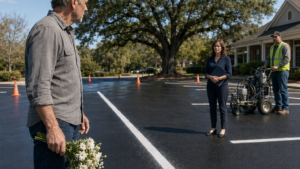
The chain was already hanging loose when Frank Martinez stepped out of his front door.
For a moment, he did not understand what he was seeing.
The morning sun caught the broken metal links near the bottom of the gate, making the damage impossible to ignore. The old wooden posts stood exactly where they had stood for nearly forty years, but the chain that had kept strangers from driving onto the narrow strip of land beside his house was no longer holding anything back.
Frank walked closer, his worn work shoes pressing into the gravel path he had repaired countless times himself.
Then he saw the cut.
The lock had not rusted away. It had not broken from age.
Someone had sliced straight through it.
He reached out and touched the sharp edge of the damaged chain. The metal was cold beneath his fingers.
His first thought was not anger.
It was disbelief.
Someone had come onto his property and decided his gate was a problem they were allowed to solve.
Behind him, the quiet of the neighborhood continued as if nothing had happened. A sprinkler clicked somewhere down the street. A garage door opened two houses away. A car passed slowly through the subdivision entrance.
Everything looked normal.
Except for the gate.
Frank had lived in the house long enough to remember when the street was not a neighborhood at all. Before the matching mailboxes, before the community signs, before the HOA meetings and the rules printed in thick packets delivered every January.
The house had belonged to his parents before him. The fence line had been there when he was a child. The gate was older than many of the people now making decisions about what belonged on the property.
He looked toward the narrow road beside his yard.
A small sign stood near the entrance.
PRIVATE ACCESS.
The words were faded, but Frank had painted the post himself years earlier.
He pulled his phone from his pocket and took a picture.
Then another.
He did not know exactly what had happened yet, but he knew one thing.
Someone wanted the gate gone.
A truck engine sounded from the street.
Frank turned.
A man in a bright safety vest stepped out of a maintenance vehicle. The man looked uncomfortable the moment he saw Frank standing beside the damaged chain.
“Mr. Martinez?” the man called.
Frank did not answer immediately.
The worker walked closer.
“I was hoping I’d catch you later.”
“Later?” Frank asked. “After you cut my gate?”
The worker stopped.
“It wasn’t my decision.”
“Who made it?”
The man looked toward the truck.
“Mr. Martinez, I was told there was approved access work scheduled here.”
“Approved by who?”
The pause lasted only a second.
But Frank noticed it.
“The HOA.”
Frank looked back at the broken lock.
“The HOA approved cutting my gate?”
“They approved clearing the access point.”
“That isn’t the same thing.”
The worker shifted his weight.
“I understand why you’re upset.”
“No,” Frank said quietly. “I don’t think you do.”
The worker looked down.
Nobody had threatened him. Nobody had shouted. That almost made the situation harder to dismiss.
Frank was not acting like someone looking for a fight.
He was acting like someone trying to understand why a decision had been made without him.
The worker explained that several residents had complained about the gate blocking a route that some believed should remain open. The HOA board had reviewed the concern. The work order had been issued.
Frank listened.
Then he asked the only question that mattered.
“Did anyone check whether they had the right to do it?”
The worker did not answer.
That silence followed Frank all the way to his phone call.
He stepped away from the gate and called the HOA office.
After several transfers, Jennifer Clark answered.
“Frank, I was expecting you might call.”
That sentence bothered him more than he wanted to admit.
“You were expecting me to call?”
“Matthew told us you saw the work.”
“Matthew cut my gate.”
“Frank, the board approved the access correction.”
“Correction?”
“Yes. The gate was preventing community access.”
Frank looked toward the damaged chain.
“My gate was protecting my property.”
Jennifer sighed.
“I understand this feels personal.”
“It is personal.”
“Frank, we’re trying to maintain consistency. Everyone in the neighborhood has to follow the same rules.”
Frank closed his eyes.
There it was.
The word he had heard so many times during HOA meetings.
Rules.
Always rules.
But rarely questions.
“Jennifer,” he said, “what document gives the HOA permission to remove my gate?”
There was a pause.
“A previous access agreement.”
“Can you send me a copy?”
“We have records.”
“That wasn’t my question.”
Another pause.
Finally, Jennifer said, “I’ll have someone look into it.”
Frank ended the call.
He stood there beside the damaged gate, holding his phone in one hand and the broken chain in the other.
For years, he had believed keeping records and maintaining his property was enough.
He had never wanted to argue.
He had never wanted attention.
He had watched new neighbors move in, watched new board members take over, watched the neighborhood slowly change.
He told himself that if something was true, people would eventually recognize it.
But now someone had cut through his gate because they believed the truth was already decided.
That afternoon, Frank went into the small office at the back of his house.
The room smelled like old paper and cedar wood.
He opened drawers he had not touched in years.
Tax records.
Repair receipts.
Property surveys.
Family documents.
He was not searching for a weapon.
He was searching for an answer.
Near the bottom of an old filing cabinet, his hand touched a worn brown folder.
He recognized it immediately.
The label was faded.
PROPERTY ACCESS.
Frank carried it to the desk.
Before opening it, he looked once more toward the window.
From there, he could see the gate.
The same gate everyone seemed to think they understood.
Slowly, he opened the folder.
Inside were documents older than the HOA itself.
And on the first page, he saw something that made him stop.
The signature he expected to find was missing.
Chapter 2: The Records Hidden Behind The Quiet Years
Frank read the same page three times before he accepted what he was seeing.
The document was real.
The paper was old.
The handwriting belonged to people who had lived on the property long before he ever owned it.
But the agreement that everyone seemed so certain existed had one problem.
A blank space.
A missing signature.
Frank placed the paper back on the desk and leaned into his chair.
For years, he had assumed the access issue was simple.
The gate was his.
The land was his.
The records were somewhere.
That was enough.
But now the situation had changed.
The HOA had not acted because they were ignoring the rules.
They had acted because they believed they already understood them.
And that was more complicated.
The next morning, Frank printed copies of the documents and placed them neatly inside the same folder.
He did not want to accuse anyone.
He wanted answers.
When he arrived at the HOA office, Jennifer Clark was already waiting.
She had a stack of papers on the table.
“Frank,” she said, standing up. “I appreciate you coming in.”
Frank sat across from her.
“I found the access records.”
Jennifer looked relieved.
“Good. Then maybe we can clear this up.”
Frank placed the folder between them.
“Maybe.”
Jennifer opened it.
She studied the pages carefully.
“The agreement is here.”
“Part of it is.”
Jennifer looked up.
“What does that mean?”
“It means the section showing access rights is incomplete.”
Jennifer turned the page.
“I’m not an attorney, Frank.”
“Neither am I.”
“Then how do you know this changes anything?”
Frank looked at the folder.
“Because everyone has been acting like this was settled.”
He tapped the missing signature.
“But nobody checked if it actually was.”
Jennifer became quiet.
For the first time since the gate was cut, Frank noticed something different in her expression.
Not anger.
Concern.
“I need to understand something,” she said. “Why didn’t you bring this up years ago?”
The question caught him off guard.
Frank looked away.
Because the honest answer embarrassed him.
Because he thought he would not have to.
“My father always believed people should keep their word,” he said.
Jennifer waited.
“And I believed that too.”
“But?”
Frank folded his hands.
“But I think I confused being reasonable with being silent.”
The admission surprised even him.
Jennifer looked back at the papers.
“The board believed there was a recorded access agreement.”
“Who told you?”
She hesitated.
“Previous board members.”
“Did they show you the document?”
Another pause.
“No.”
Frank nodded slowly.
That answer hurt more than he expected.
Not because Jennifer had admitted being wrong.
Because it meant nobody had been trying to be cruel.
They had simply repeated something until it sounded true.
When Frank returned home, the neighborhood already seemed different.
A neighbor watering flowers stopped when he saw him.
“Everything okay with the HOA?” the neighbor asked.
Frank knew what that meant.
News traveled quickly in a community where people attended meetings together and noticed every change.
“I’m looking into it,” Frank said.
The neighbor lowered the hose.
“Some people are saying the gate was causing problems.”
Frank looked toward his property.
“Some people saw the gate.”
The neighbor frowned.
“What does that mean?”
“It means they saw an obstacle. They didn’t see the history behind it.”
The neighbor did not argue.
But he did not agree either.
That was the hardest part.
Frank had spent years believing the truth would speak for itself.
Now he was learning that truth sometimes needed someone willing to carry it into the room.
That evening, he reviewed the documents again.
He found old maps.
Property descriptions.
References to access rights.
But every path seemed to lead back to the same problem.
The agreement everyone relied on was never completed.
The next day, Jennifer called.
“Frank, the board wants to discuss this at the next meeting.”
“Publicly?”
“Yes.”
Frank looked at the gate outside his window.
A month earlier, he would have avoided that room.
He would have hoped the paperwork would be enough.
He would have waited for someone else to explain.
But someone had already explained.
They had explained without him.
“When is the meeting?” he asked.
Jennifer told him.
Before hanging up, she added, “Frank?”
“Yes?”
“I want you to know something.”
He waited.
“I didn’t authorize this because I wanted to hurt you.”
Frank believed her.
That was the problem.
He believed she was telling the truth.
“I know,” he said.
After the call ended, Frank returned to the folder.
At the bottom of the final page, beneath the missing signature, he noticed a small handwritten note.
A reference number.
A record number he had never seen before.
Frank wrote it down.
Then he searched through the rest of the folder.
Nothing.
The note pointed somewhere else.
Somewhere outside his own records.
For the first time, Frank wondered if the missing signature was not the only thing everyone had overlooked.
Chapter 3: The Meeting Where The Gate Became A Symbol
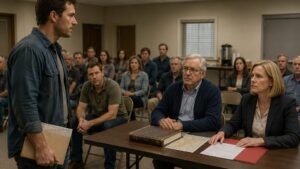
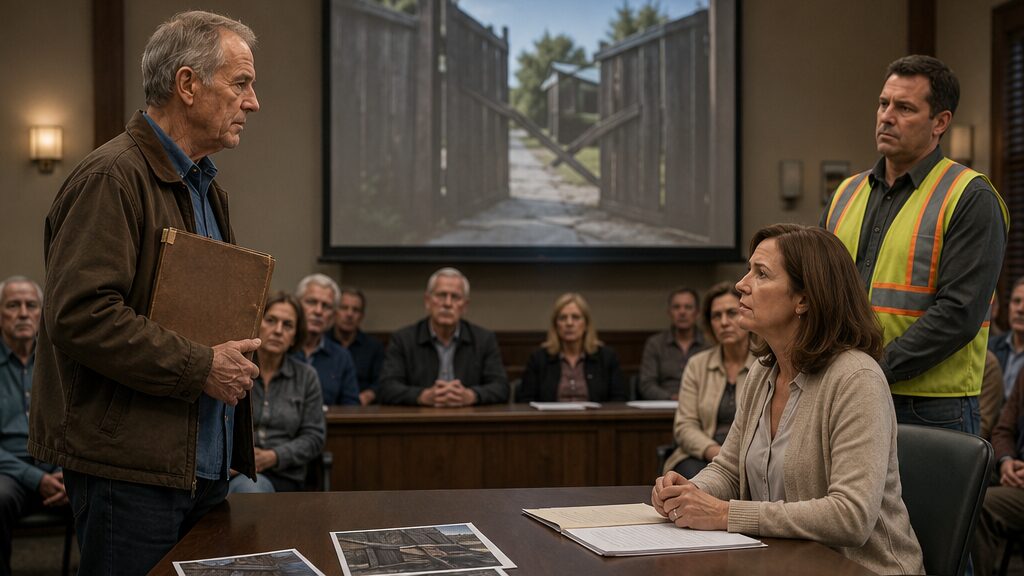
The first thing residents saw when they entered the HOA meeting room was not Frank.
It was the gate.
A large photograph was projected onto the wall behind the board table.
The broken chain.
The cut lock.
The damaged wooden posts.
The room became quiet.
Frank stood near the back holding the worn brown folder against his chest.
For years, he had attended meetings where decisions were discussed in terms of landscaping, parking rules, and neighborhood events.
Never had he expected his own property to become the subject on the screen.
Jennifer Clark sat at the front beside the other board members.
She looked uncomfortable.
Not because Frank was there.
Because everyone was looking at the photograph.
“This meeting is about resolving an access concern,” Jennifer began.
Frank listened.
Even now, she was choosing careful words.
Not damage.
Not mistake.
Concern.
“The board believed the gate prevented approved access through the area,” she continued.
A resident near the front nodded.
“We all thought that road was supposed to stay open.”
Frank looked around the room.
That was the problem.
Everyone thought.
Nobody knew.
Jennifer continued.
“We understand Mr. Martinez has raised questions about the original documentation.”
Frank stepped forward.
The room became silent.
“My question is not complicated,” he said.
His voice was calm.
“Who gave us permission to make a permanent decision about my property without confirming the original agreement?”
Nobody answered immediately.
A board member looked down at the papers.
Jennifer folded her hands.
“Frank, the board acted based on available information.”
“That is exactly what concerns me.”
A few people shifted in their seats.
Frank opened the folder.
“I am not saying anyone here intended to cause harm.”
He looked at Jennifer.
“I believe most people thought they were doing the right thing.”
That surprised her.
“But doing the right thing requires checking whether the information is right.”
He placed copies of the documents on the table.
The old paper looked almost out of place beneath the clean HOA forms.
“This access agreement was referenced for years.”
He pointed to the page.
“But the final approval was never completed.”
A resident raised a hand.
“So you’re saying the road was never supposed to be accessible?”
Frank shook his head.
“No. I’m saying we don’t actually know what was supposed to happen because nobody finished verifying the agreement.”
That distinction changed the room.
It was not a simple argument anymore.
It was uncertainty.
And uncertainty made people uncomfortable.
Jennifer picked up the document.
“Frank, the board needs time to review this.”
“I understand.”
“You should also understand why residents were frustrated.”
“I do.”
He looked toward the photograph behind them.
“But frustration does not create permission.”
The sentence stayed in the room.
Nobody clapped.
Nobody cheered.
That was not the kind of moment this was.
It was quieter.
More uncomfortable.
The kind where people had to consider whether they had been part of a mistake.
After the meeting, several residents approached Frank.
Some apologized.
Some asked questions.
One neighbor admitted he had assumed Frank was simply refusing to cooperate.
“I thought you were just being difficult,” the neighbor said.
Frank nodded.
“I know.”
The neighbor looked embarrassed.
“How did you stay calm?”
Frank looked back at the meeting room.
“I wasn’t calm.”
He smiled faintly.
“I was just tired of being quiet.”
The next morning, Jennifer called him.
“The board voted.”
Frank waited.
“We’re ordering a formal property review.”
He looked toward the gate.
“Good.”
“There is something else.”
“What?”
Jennifer hesitated.
“The review officer found another reference number connected to the old records.”
Frank stood still.
The same kind of number he had found in the folder.
“What does it point to?”
“We don’t know yet.”
Frank looked at the damaged gate.
The thing everyone had argued about.
The thing everyone thought they understood.
Now it seemed the gate was only the beginning.
“Frank,” Jennifer said quietly.
“Yes?”
“If the old records were incomplete…”
She stopped.
“What?”
Jennifer finished the sentence.
“How many other decisions were made the same way?”
Frank looked at the folder on his desk.
For the first time, the question was no longer only about his gate.
And that made the answer much harder to find.
Chapter 4: The Rule Everyone Followed Without Checking
The first thing the review officer asked Jennifer Clark was not whether the HOA had acted correctly.
It was a simpler question.
“Can you show me the original approval record?”
Jennifer looked down at the folder in front of her.
The problem was that she already knew the answer.
The folder contained copies. Summaries. Meeting notes. References to previous discussions.
But not the one document everyone had relied upon.
The one document that was supposed to make everything certain.
The property review meeting was held in a small office at the municipal records building, far away from the familiar walls of the HOA clubhouse. Without the neighborhood signs, the committee table, and the usual residents watching from folding chairs, the dispute suddenly felt different.
It was no longer about who was being difficult.
It was about what had actually happened.
Frank sat across from Jennifer with his old brown records folder resting beside him.
He noticed something about her that he had not noticed before.
She looked tired.
Not angry.
Not defensive.
Just tired.
The review officer moved through the paperwork carefully.
“According to the HOA files, the access route was considered established before the current board took over.”
Jennifer nodded.
“Yes.”
“Who verified the original agreement?”
Jennifer hesitated.
A few weeks earlier, that question would have sounded like an accusation.
Now it sounded like a missing step.
“I don’t know,” she admitted.
Frank looked at her.
The answer surprised him.
Not because he expected her to know everything.
Because he realized she had been carrying responsibility for decisions made long before she arrived.
The review officer turned another page.
“Several previous board records reference an access agreement. But the references appear to come from one another.”
Frank frowned.
“What does that mean?”
“It means each record may have been based on the previous record instead of the original source.”
The room became quiet.
Jennifer slowly understood.
“The assumption repeated itself.”
The officer nodded.
“Exactly.”
Frank looked at the folder beside him.
For years, he had believed the problem was that people ignored the truth.
But now he was seeing something more complicated.
Sometimes people did not ignore the truth.
Sometimes they never searched for it.
The review officer continued.
“The gate issue appears to have developed because a conclusion was treated as a fact.”
Jennifer leaned back.
Her expression changed.
Frank saw the moment she stopped trying to defend the old decision.
She was examining it.
“That means the board may have approved work based on incomplete information,” she said.
“Yes.”
Frank looked toward the window.
Outside, cars moved through the parking lot.
People going about ordinary days.
Neighbors.
Homeowners.
People who believed the systems around them worked because someone had checked.
Because someone had verified.
Because someone had asked the right questions.
But sometimes nobody asked.
“Frank,” Jennifer said quietly.
He turned.
“I owe you an apology.”
He did not answer immediately.
An apology was not what he had wanted when this began.
He had wanted the gate fixed.
He had wanted someone to admit they were wrong.
But now he realized those things were smaller than the real issue.
“I appreciate that,” he said.
Jennifer looked down.
“But I also understand why residents were frustrated.”
Frank nodded.
“They saw a gate.”
“And you saw a history.”
He looked at her.
“Yes.”
For the first time, they were not arguing about the same thing.
They had been looking at two different realities.
Jennifer had seen a barrier preventing access.
Frank had seen a boundary protecting something that had existed before anyone asked him to explain it.
The review officer closed the file.
“There is still one issue.”
Frank felt the room change.
“What issue?”
“The original property file references an additional document.”
Jennifer looked up.
“Another document?”
“Yes. A supporting record.”
Frank opened his folder.
“I don’t have it.”
The officer nodded.
“That is what we need to locate.”
The missing paper became the new center of the dispute.
Not because it would automatically prove one side right.
Because it represented the final piece of a story everyone thought they already understood.
After the meeting, Frank and Jennifer walked outside together.
Neither spoke for several moments.
Finally, Jennifer said, “I know this does not fix what happened.”
Frank looked toward the street.
“No.”
“It doesn’t.”
“But?”
Frank considered his answer.
“But knowing why something happened matters.”
Jennifer looked at him.
“You’re saying that because you want fairness.”
Frank shook his head.
“I’m saying that because I spent too long thinking being right was the only thing that mattered.”
She waited.
“And?”
“And I’m starting to think understanding matters too.”
That evening, Frank returned home and placed the records folder on his desk.
The gate was still damaged.
The review was not finished.
The neighborhood was still divided.
But something had changed.
The question was no longer whether Frank had proof.
The question was what that proof would reveal about everyone who had trusted the wrong information.
The next morning, the review officer called.
The missing document had been found.
And it changed the entire story.
Chapter 5: The Document That Changed The Neighborhood Story
The final document arrived in a plain envelope.
No dramatic announcement.
No special warning.
Just a few sheets of paper that had been sitting unnoticed in a municipal archive for years.
Frank held the envelope in his hand before opening it.
He thought about all the arguments that had happened because of a piece of information nobody had bothered to find.
He thought about the gate.
The broken chain.
The meeting.
The neighbors who had looked at him differently.
The people who had assumed he was simply refusing to cooperate.
Then he opened the envelope.
Jennifer was already in the room when the review officer placed the document on the table.
The HOA board members sat quietly.
Several residents watched from the back.
Nobody was there to win an argument.
Everyone was there to learn what had actually happened.
The review officer adjusted the pages.
“This document is the original access record connected to the property.”
Frank looked at the paper.
His hands remained still.
After everything, after weeks of searching, the moment felt strangely quiet.
The officer continued.
“The record confirms that an access discussion took place many years ago.”
Jennifer looked at Frank.
“But?”
The officer looked down.
“But the agreement was never finalized.”
The words settled over the room.
Not like a victory.
Like a weight being placed down.
The assumption that had shaped years of decisions was finally visible.
It had never been a completed agreement.
It had been an unfinished possibility.
Frank closed his eyes briefly.
The answer was there.
But it did not feel like revenge.
He had imagined this moment differently.
When he first found the missing signature, part of him wanted everyone to feel what he had felt.
The frustration.
The helplessness.
The feeling of watching people make decisions about something they did not understand.
But sitting there now, he only felt tired.
Jennifer looked toward the board members.
“We approved the work based on information that was never fully verified.”
Nobody disagreed.
One resident raised a hand.
“So the gate should not have been removed?”
The review officer answered carefully.
“The removal should not have happened without confirming the legal basis first.”
The resident looked down.
Another asked, “What happens now?”
That was the question everyone expected Frank to answer.
He felt it.
The room turning toward him.
For years, he had wanted people to listen.
Now they were.
And that made his next words more important.
“The gate should be repaired.”
Everyone nodded.
“But I don’t want this to become a fight where someone else has to lose just so I can feel like I won.”
The room became still.
Jennifer looked surprised.
Frank continued.
“I wanted my property respected. I still do.”
He touched the old folder beside him.
“But if we only learn that one person was wrong, we haven’t learned enough.”
The statement changed the mood.
This was not the ending many people expected.
There was no celebration.
No humiliation.
No moment where someone was forced to apologize in front of everyone.
Instead, there was something quieter.
Responsibility.
After the meeting, Jennifer approached him.
“I thought you would want the board to admit fault publicly.”
Frank looked at her.
“I did.”
She waited.
“And now?”
He looked toward the parking lot.
“Now I think fixing the problem matters more than making someone stand in the middle of it.”
Jennifer nodded slowly.
“That sounds easier than it is.”
Frank smiled faintly.
“It isn’t easy.”
That was the first honest agreement they had shared.
A week later, the HOA sent out a notice explaining the review results.
The notice did not blame one person.
It explained that future property decisions would require original documentation instead of assumptions passed from one board to another.
The gate repair was scheduled.
But the damage had already changed something deeper.
Neighbors who had once avoided the conversation began asking questions.
Some admitted they had judged Frank too quickly.
Others admitted they had never considered how easily old information could become accepted truth.
One afternoon, Frank stood outside near the gate while Matthew King arrived to inspect the repairs.
Matthew looked uncomfortable.
“I owe you an apology too,” he said.
Frank looked at him.
“You followed instructions.”
“I still cut it.”
Frank nodded.
“Yes.”
Matthew looked down.
“I should have asked more questions.”
Frank considered that.
Then he said, “Most of us should have.”
Matthew looked surprised.
Frank touched the wooden post beside the gate.
The damage was still visible.
The repair had not erased the mark completely.
Maybe that was appropriate.
Some things were worth remembering.
The gate was no longer just a boundary.
It was proof of how easily people could cross a line when they assumed they were right.
And how much could change when someone finally stopped assuming.
Before leaving, Jennifer handed Frank a small packet.
“What’s this?”
“Updated community review procedures.”
Frank opened it.
Inside was a new requirement.
Any future property decision involving boundaries, access, or ownership would require verified records and direct communication with affected homeowners.
Frank looked at her.
“You changed the rules.”
“We changed the process.”
He nodded.
That mattered.
Because the problem had never only been one gate.
It had been the belief that a decision became correct simply because enough people repeated it.
That evening, Frank walked back to the entrance of his property.
The old gate stood repaired.
Still the same wood.
Still the same hinges.
Still the same place where his family had passed through for decades.
But something about it felt different.
The gate had once represented everything people thought they knew.
Now it represented everything they had learned they did not.
Chapter 6: The Gate That Became A Different Boundary
Months later, Frank Martinez stood beside the repaired gate holding a small box of tools.
A neighbor had asked him to help fix a loose hinge.
Six months earlier, nobody would have expected that.
The same gate that had divided the neighborhood had somehow become the place where people stopped to talk.
Frank tightened the final screw and stepped back.
“It should hold now.”
The neighbor smiled.
“Funny.”
“What?”
“That gate caused more arguments than anything else in this neighborhood.”
Frank looked at it.
“That’s because everyone thought it was only a gate.”
The neighbor nodded.
That was the thing people understood now.
Objects carried stories.
Boundaries carried memories.
And sometimes the smallest piece of property could reveal the biggest misunderstandings.
The HOA had changed since the review.
Not completely.
Communities did not transform overnight.
Some residents still believed the board had handled the situation badly.
Others believed Frank had made the dispute larger than it needed to be.
Trust was not repaired by one meeting.
But the process was different.
Before decisions were made, people asked questions.
Before assumptions became rules, someone checked the records.
And before a neighbor became a problem, someone tried talking to them.
Jennifer had remained on the HOA board.
Frank was surprised by that.
He had expected her to step away after everything.
When he asked her why she stayed, she gave him a simple answer.
“Because leaving would be easier.”
Frank understood.
“And staying?”
“Staying means making sure it does not happen again.”
That answer stayed with him.
Because he knew something about difficult things.
Avoiding them did not make them disappear.
On the afternoon of the neighborhood gathering, Frank walked toward the gate carrying a small table.
The HOA had organized an event to discuss community improvements.
For years, meetings had been places where people defended positions.
Now, they were becoming places where people asked questions.
Frank placed the table near the entrance.
On it, he set the old brown records folder.
Not because he wanted to prove he had been right.
But because he wanted people to understand what had happened.
A younger homeowner stopped beside him.
“Is that the folder?”
Frank smiled.
“You’ve heard about it?”
“Everyone has.”
Frank laughed softly.
“That’s not always a good thing.”
The homeowner looked at the gate.
“Did you ever think you would become the person everyone talked about?”
“No.”
“Does it bother you?”
Frank thought about that.
Months earlier, attention had felt uncomfortable.
He never wanted to be the center of a neighborhood argument.
But being invisible had allowed other people to tell his story without him.
“I think,” he said slowly, “there’s a difference between wanting attention and being willing to be seen.”
The homeowner nodded.
That answer felt true.
Later, Jennifer approached.
The crowd was beginning to gather.
“I wanted to thank you,” she said.
Frank looked confused.
“For what?”
“For not turning this into something it didn’t need to become.”
Frank looked at the repaired gate.
“I wanted to.”
Jennifer smiled slightly.
“I know.”
He laughed.
“I really did.”
“But you didn’t.”
“No.”
He paused.
“Because winning was never the only thing I wanted.”
Jennifer looked toward the neighborhood.
“What did you want?”
Frank placed his hand on the gate.
“I wanted people to understand that something can belong to someone and still matter to everyone.”
Jennifer nodded.
“That’s probably the hardest lesson.”
The gathering began.
People talked about landscaping.
Road repairs.
Community plans.
Ordinary things.
The kind of things that seemed impossible during the weeks when everyone was focused on one broken lock.
As the afternoon ended, Frank returned to the gate.
The chain was still there.
The lock was new.
But this time, he did not close it completely.
He left it open.
Not because the boundary no longer mattered.
Because now people understood it.
A neighbor walking by noticed.
“You leaving it open?”
Frank looked back.
“For today.”
“Why?”
He looked at the street.
At the homes.
At the people who had once stood on different sides of the same argument.
“Because a boundary should protect what matters.”
He paused.
“But it should not stop people from finding each other.”
The gate remained open as the neighborhood lights came on.
The same gate that had started a dispute had become a reminder.
Not every conflict begins because someone wants to cause harm.
Sometimes it begins because people stop asking questions.
And sometimes the person everyone overlooks is the one who keeps the truth waiting until someone is finally ready to see it.
The story has ended.