The HOA Paved Over His Family Cemetery—Then One Forgotten Property Exception Changed Everything
Chapter 1: The Parking Lines Were Over His Brother’s Grave
Edward Jackson drove past the clubhouse twice before he understood that the cemetery gate was gone.
On the third pass, he slowed almost to a stop.
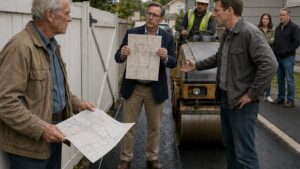
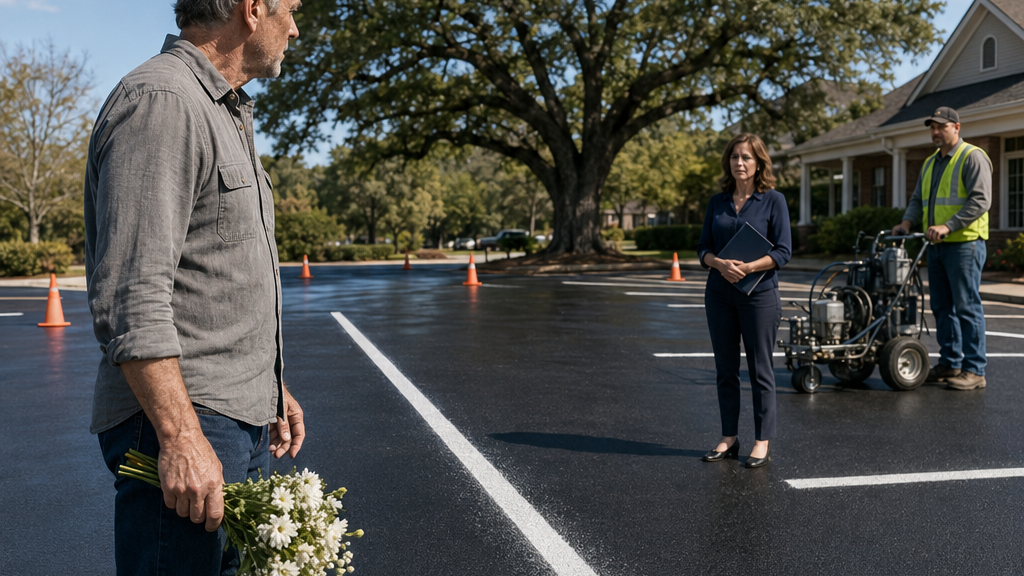
A contractor in a fluorescent vest lifted one hand impatiently from beside a striping machine. Fresh white lines divided the new blacktop into neat parking spaces. Orange cones stood across one entrance. Beyond them, a small crew rolled equipment toward the far end of the lot.
Edward stared through his windshield.
He had brought twelve white flowers from the grocery store that morning. They lay across the passenger seat in brown paper, the stems damp where the clerk had wrapped them.
He had intended to leave three at his brother’s grave.
Instead, he was looking at parking spaces.
He pulled onto the shoulder, got out, and walked toward the lot.
“Sir, you need to stay off that section,” the contractor supervisor called. “Paint’s fresh.”
Edward stopped.
Not because of the warning.
Because he had found the oak.
It rose behind the newest row of spaces, broad and crooked, with a split low limb that had been there when Edward was a boy. His father had once tied a rope swing to it. His mother had complained that children should not play so close to graves. Edward had ignored her until his older sister Anna nearly fell into an ant bed.
He knew the tree.
Which meant he knew exactly where he was standing.
A woman in a navy blouse came out of the clubhouse carrying a folder. Edward recognized her from a neighborhood notice mailed to him years earlier, though he had never met her.
“Mr. Jackson?”
“Yes.”
“I’m Samantha Miller. HOA president.”
Edward looked past her.
“Where’s the cemetery?”
She paused as if she had misheard him.
“The what?”
“The Jackson cemetery.”
Samantha glanced toward the crew, then back at Edward.
“This is the overflow project. The association approved it last month.”
“That wasn’t my question.”
Her expression tightened slightly.
“If you have a concern about the project, management can send you the approved site plan.”
Edward looked down at the bouquet in his hand.
A white parking stripe ran from a few feet in front of him toward the oak.
He tried to place the old iron gate.
There had been two brick-sized stones near the entrance. A cedar post had leaned inward. His mother always pushed the gate with her hip because the latch stuck in summer.
Now there was asphalt.
“You’re telling me this property belongs to the association?”
“That’s what our records show.”
“Where were the graves moved?”
Samantha stopped opening her folder.
“What graves?”
Edward looked at her.
He had spent thirty-six years supervising utility crews. He had learned that when something went wrong underground, shouting did not help. You marked the line. You shut down the equipment. Then you found out exactly what had been cut.
“My brother is buried here,” he said.
The striping machine hissed behind her.
Samantha’s face changed.
Edward pointed toward the second row of spaces.
“My mother’s parents were over there. My uncle was closer to the oak. My brother was near the west fence.”
The contractor supervisor had gone still.
Samantha lowered the folder.
“Mr. Jackson, I think there may be some confusion.”
“There are fourteen graves.”
“I understand what you’re saying.”
“No. I don’t think you do.”
He stepped to the nearest fresh stripe without crossing it.
“This morning I came here with flowers. I did not come here to complain about an HOA parking lot. I came here because my brother died before I was old enough to remember him, and my mother asked me for years not to let this place disappear.”
Samantha’s eyes moved toward the lot.
For the first time, she seemed to be seeing something other than parking spaces.
She asked, “Was there a recorded cemetery here?”
Edward almost laughed, but there was nothing funny in it.
“My family owned this whole side of the ridge before these houses were built.”
“That doesn’t answer whether—”
“The cemetery was excluded from the sale.”
Samantha looked back at him sharply.
“Do you have documentation?”
“I will.”
The answer came too quickly.
Edward knew it the instant he said it.
He remembered his father’s papers. He remembered signing documents during the land sale twenty years earlier. He remembered hearing the attorney say the cemetery was separate.
But memory was not a legal description.
Samantha recovered some of her administrative calm.
“We have a recorded plat showing this as common association property.”
“Then your plat is wrong.”
“That may be your position.”
“It’s not a position.”
Her mouth tightened.
“Mr. Jackson, I’m not going to argue with you in a parking lot.”
Edward lifted the flowers slightly.
“You paved my family cemetery.”
Behind them, the contractor supervisor stepped toward his truck and shut off the striping machine.
The sudden quiet felt larger than the argument.
Samantha looked toward him.
“I didn’t tell you to stop.”
The supervisor shrugged. “I’m not painting until somebody clears this up.”
She pressed her lips together.
Edward noticed the asphalt was not new everywhere. The base layer had been down long enough to collect pale dust near the clubhouse. Only the striping and final surface looked fresh.
This had not happened overnight.
That knowledge landed harder than the shock.
He had not been here since the previous fall.
He had kept meaning to come.
His mother had been dead six years, and without her reminders, visits had stretched from months to nearly a year.
He looked at the flowers.
For one ugly second, his anger turned inward.
Samantha said more quietly, “If there really are graves here, we need evidence immediately.”
Edward nodded.
“You’ll have it.”
He drove home without placing the flowers anywhere.
For nearly an hour, he sat at his kitchen table with the bouquet beside him and opened boxes he had not touched since clearing his parents’ house.
Tax receipts. Insurance policies. Survey copies. A folder marked LAND SALE in his father’s block printing.
Edward found the deed copy folded behind a closing statement.
He read the property description once.
Then again.
At the bottom of the second page was a paragraph he remembered without remembering the exact words.
The conveyance excluded a family burial ground.
Edward put one finger under the sentence.
For the first time that morning, he felt something close to relief.
Then he read the description after it.
No modern parcel number.
No clean bearings.
Only acreage, old reference points, and a cemetery exception written as though everyone involved would always know exactly where the burial ground was.
Edward looked toward the drying white flowers.
The deed proved they had meant to preserve something.
What it did not yet prove was exactly where that something sat beneath the new asphalt.
Chapter 2: The Exception Was There, but the Map Was Wrong
The county clerk found the cemetery exception in less than ten minutes.
Then she found a map that appeared to erase it.
Edward stood at the counter while she turned a monitor toward him.
“There,” she said, tapping the deed image. “Same exception you brought in.”
Edward nodded.
“So that settles it.”
The clerk gave him the kind of look he used to give homeowners who insisted a water leak had to be on the city side because they did not like the alternative.
“It settles that the exception exists.”
She opened another file.
A subdivision plat filled the screen.
Roads curved through rows of numbered lots. The clubhouse parcel sat near the bottom, bordered by common landscaping and a drainage easement.
Edward leaned closer.
The cemetery was not marked.
“That’s wrong.”
“I’m just showing you what was recorded.”
“Where’s the half-acre?”
She pointed to the clubhouse tract.
“This later plat appears to include the area.”
“It can’t.”
“Maybe not.”
Edward heard the difference between cannot and may not and disliked it immediately.
By noon he had copied every document the clerk suggested and called Catherine Perez, whose name he had received from a preservation group.
Her office was small enough that Edward could see stacked case files through the open door behind her desk.
She read the cemetery exception first.
“This helps.”
“It proves it.”
“It proves your family intended not to convey a burial ground.”
“That’s what I said.”
Catherine looked up.
“You called me because someone paved over what you believe is that burial ground. If you want me to help, you’re going to have to let me tell you when a document proves less than you want it to.”
Edward sat back.
He did not like her tone.
Which was probably why he listened.
She placed the deed beside the modern plat.
“Your older language identifies roughly half an acre reserved for family burial use. But it relies on landmarks and an earlier survey reference. The modern plat treats the surrounding tract as a single association parcel.”
“So somebody made a mistake.”
“Probably.”
“Probably?”
“Maybe several people did.”
Edward stared at the two sheets.
He had expected anger to carry him once paperwork confirmed what he knew.
Instead he felt the ground becoming less certain.
Catherine asked, “Do you have a survey?”
“My father did.”
“Where?”
“I haven’t found it.”
“Did the family maintain a fence?”
“Yes.”
“Was it always in the same place?”
“As far as I know.”
She waited.
Edward understood what she wanted.
“As far as I remember.”
“That’s different.”
He looked toward the window.
On the corner of her desk sat a photo of a field marked with survey flags.
Catherine said, “A cemetery right can survive development. An ownership exception can survive later transfers. Access rights can survive. But we need to know what survived, where it sits, and what later documents did to it.”
“The graves didn’t move.”
“No. But property descriptions can drift on paper without anybody moving dirt.”
Edward thought of the parking stripe running toward the oak.
“The dirt moved now.”
Catherine softened slightly.
“Yes.”
She spent the next hour tracing references.
The original family sale pointed backward to an earlier tract description. A later developer deed carried forward most of the acreage but shortened the list of exceptions. A transfer to the homeowners association referred broadly to common property shown on the subdivision plat.
Edward watched her pencil arrows between documents.
“What kind of title company misses a cemetery?”
“The kind that searches the wrong chain, relies too heavily on a plat, gets a bad legal description, or assumes an earlier exception was satisfied somewhere else.”
“That’s negligence.”
“It might be.”
“You sound like you’re defending them.”
“I’m trying to make sure that when you accuse them, you’re right about what they did.”
That silenced him.
He had spent the previous night imagining Samantha Miller having to stand on the lot while someone tore up every square foot of asphalt.
He had not imagined being wrong about any part of it.
Catherine reached the bottom of a document and stopped.
“What?”
She turned the page toward herself.
“There’s a reference here.”
“To what?”
“Survey exhibit. Prepared before final development approval.”
Edward leaned forward.
“Where is it?”
“Not attached to this copy.”
“Can the county find it?”
“Maybe. Maybe the developer has it. Maybe the title company does.”
She wrote down the reference number.
Edward glanced at the bouquet he had brought from home. The flowers had begun curling at the edges. He had set them on the corner of Catherine’s conference table because he still could not bring himself to throw them away.
He said, “My father always said the cemetery was protected.”
“I believe he believed that.”
“That sounds like lawyer language.”
“It is.”
Edward looked at her.
Catherine tapped the deed.
“This is useful. Don’t mistake useful for complete.”
They drove separately back to the county records office.
The clerk searched by document number, developer name, subdivision name, and filing date.
Nothing.
Then Catherine asked for the closing index connected to the developer’s original acquisition.
The clerk returned with a scanned list.
Near the bottom was a line referencing an exhibit under a project name Edward did not recognize.
Catherine read it twice.
“This may be the missing survey.”
“May be?”
She gave him a tired look.
Edward nodded. “Fine.”
The clerk opened the archived image.
Only the cover sheet had been scanned.
The survey itself was absent.
But the cover contained enough to make Catherine circle one line.
“Family cemetery boundary exhibit.”
Edward felt relief again.
Then Catherine pointed to the note beside it.
“Superseded.”
His relief vanished.
“By what?”
“That’s what we have to find out.”
She photographed the reference and requested the underlying closing file.
The clerk shook her head.
“That one was never digitized. If it survived retention, it’ll be in storage or with the original parties.”
Outside, Edward stood beside Catherine’s car.
“So we found proof there was a survey.”
“Yes.”
“And now we don’t have the survey.”
“Yes.”
He looked across the courthouse parking lot.
For years he had thought the cemetery survived because his father had handled things correctly.
Now it seemed possible his father had done everything he thought was necessary and still left behind a problem no one noticed until asphalt covered the graves.
Catherine opened her car door.
“Is there anyone else in your family who was involved in the sale?”
Edward hesitated.
“My sister.”
“Call her.”
“She won’t remember the legal details.”
“Call her anyway.”
Edward knew Anna would tell him not to turn this into a war.
That was exactly why he had not called.
Catherine seemed to read his silence.
“You don’t need people who remember it the way you do. You need people who remember what you don’t.”
Edward watched her drive away.
Then he looked at the photograph of the missing survey reference on his phone.
The deed had answered the first question.
The cemetery had been excluded.
But somewhere between that sentence and the HOA’s modern map, a boundary had disappeared.
And the document that might explain how was missing.
Chapter 3: His Sister Remembered the Promise Differently
“They moved the entrance,” Anna said. “They didn’t move the graves.”
Edward had barely finished telling her about the missing survey.
They sat at her dining table with his stack of copied deeds between them. Anna had made coffee neither of them was drinking.
“What entrance?”
“The cemetery entrance.”
“When?”
“When they started grading the subdivision.”
Edward stared at her.
“You knew that?”
“I thought you did.”
“No.”
Anna leaned back.
“Daddy complained about it for six months.”
Edward felt irritation rise because irritation was easier than admitting surprise.
“He never said anything to me.”
“You were working sixty-hour weeks.”
“That doesn’t mean—”
“You were never there.”
The sentence was not cruel.
That made it worse.
Edward looked down at the deed.
Anna reached for the copy but he kept his hand on it.
“What exactly did Daddy agree to?”
“I don’t know exactly.”
“You just said—”
“I said what I remember.”
Edward exhaled.
Catherine’s warning came back to him.
People who remember what you don’t.
Anna stood and disappeared down the hallway.
When she returned, she carried their mother’s old green notebook.
Edward recognized it immediately.
Their mother had used it for cemetery visits: names, dates, flowers planted, stones needing cleaning, which relatives had asked about burial space.
Anna opened it carefully.
Several pages held flattened flower petals, brown with age.
Edward touched one without meaning to.
“Mom put those in there?”
“Apparently.”
Anna turned to the back.
A folded sheet was tucked inside the cover.
She opened it on the table.
It was not a survey.
It was a hand-drawn sketch.
The old county road ran along one edge. The family fence appeared as a crooked rectangle. A dotted line marked a later gravel path approaching from a different direction.
Edward studied it.
“This fence is wrong.”
“Or your memory is.”
“I remember where it was.”
“So do I.”
He pointed to the northwest corner.
“It came farther out.”
Anna shook her head.
“Not after the subdivision started.”
Edward sat back.
There it was again.
Not ownership changing.
Not graves moving.
A boundary lived on the ground one way, in memory another way, and on paper perhaps a third.
Anna turned the notebook toward him.
“Daddy let them use the new access because construction trucks kept blocking the old lane. That’s what I remember.”
“Did he sign anything?”
“I don’t know.”
“Did he agree to move the cemetery line?”
“No.”
“Then this doesn’t change ownership.”
“I didn’t say it did.”
“Then what are we arguing about?”
Anna closed the notebook.
“You.”
Edward gave a short, humorless laugh.
“Me?”
“You walked in here wanting me to tell you Daddy handled everything perfectly and the HOA stole the cemetery.”
“They paved it, Anna.”
“I know.”
“My brother is under a parking lot.”
“My brother too.”
That stopped him.
Anna looked away.
For a moment neither spoke.
Edward had spent so much time thinking of the cemetery as his obligation that he had forgotten grief did not belong to whoever visited most often.
Anna ran one finger along the notebook cover.
“I want it protected,” she said. “I want the pavement off the graves. But if they offer a way to restore access and protect the site without spending five years fighting over every foot of old fence, I’m going to listen.”
“They don’t get to buy their way out.”
“Maybe not. But you don’t get to turn Mama into an argument she never made.”
Edward’s jaw tightened.
“What’s that supposed to mean?”
“She cared about the graves. She cared about us being able to reach them. I never heard her say the cedar post had to stand exactly where it stood in 1987.”
Edward looked at the sketch.
For the first time since Saturday, he saw how much of his certainty depended on childhood geometry.
The oak.
The gate.
The fence.
The little rise where his mother stood while arranging flowers.
Those memories were real.
That did not make every remembered line a surveyed boundary.
Anna pushed the notebook toward him.
“Take it.”
“You keep it.”
“You’re the one doing this.”
The words should have felt like support.
Instead they carried weight.
Edward folded the sketch carefully.
His phone rang.
Unknown number.
He almost ignored it.
Then answered.
“Edward Jackson?”
“Yes.”
“This is Gary Mitchell.”
Edward straightened.
The name had appeared on several closing documents from the original development company.
“I was told you were trying to reach me about the old Jackson property.”
“I am.”
There was a pause.
“I understand there’s a problem with the cemetery.”
Edward looked at Anna.
“That depends on what you call paving over it.”
Gary exhaled.
“I saw the pictures.”
“Then you know.”
“I know something went badly wrong.”
Edward gripped the phone.
“Did you buy the cemetery?”
“No.”
The answer came without hesitation.
“Did your company believe it owned it?”
“No.”
Anna’s eyes narrowed as she watched Edward’s face.
Gary continued.
“That cemetery was never supposed to transfer.”
Edward stood.
“Then why is it on the HOA plat?”
“I don’t know.”
“You signed the original closing papers.”
“I signed a lot of them.”
“You signed the exception.”
Another silence.
“Yes.”
Edward felt anger rising again, but this time he forced it down.
“What happened to the survey?”
Gary did not answer immediately.
When he finally spoke, his voice had changed.
“I think I know which survey you mean.”
“Do you have it?”
“No.”
“Can you find it?”
“Maybe.”
Edward waited.
Gary said, “Meet me Thursday morning. There are things about that closing file I should have checked twenty years ago.”
The call ended.
Anna looked at him.
“What did he say?”
Edward picked up their mother’s notebook.
“He said the cemetery was never supposed to transfer.”
Anna’s face tightened.
“That’s good, isn’t it?”
Edward looked down at the faded sketch showing an entrance he had forgotten and a boundary he no longer trusted completely.
“It means everybody remembers the cemetery being protected.”
He folded the sketch back into the notebook.
“What I still don’t know is how something everyone meant to protect disappeared from the record.”
Chapter 4: The Developer Remembered What the Closing File Forgot
Gary Mitchell recognized the sketch before Edward had finished unfolding it.
“That’s the cemetery exhibit.”
Edward stopped.
They were sitting in a borrowed conference room at a small real-estate office where Gary still kept a desk two mornings a week. The room smelled faintly of coffee and copier toner. On the table lay Anna’s faded hand-drawn map, copies of the original deed, and the modern subdivision plat.
“You’re sure?”
Gary leaned closer without touching the paper.
“I haven’t seen that in twenty years, but yes. Or something made from it.”
Edward watched him.
“You told me on the phone the cemetery never transferred.”
“It wasn’t supposed to.”
“That’s not the same sentence.”
Gary sat back.
“No.”
Edward had expected excuses. Instead Gary looked older than he had sounded on the phone.
He had white hair cut close, a careful button-down shirt, and the posture of a man accustomed to being blamed for decisions made by committees.
Edward placed the deed in front of him.
“You signed this.”
Gary nodded.
“We bought the surrounding acreage. The cemetery was carved out.”
“Then how did it end up on the HOA plat?”
“I don’t know yet.”
Edward almost answered sharply, then stopped.
Catherine had told him to ask what happened before deciding who had lied.
So he pushed the modern plat across the table.
Gary studied it for a long time.
Finally he said, “This legal description is broader than what I remember.”
“Broader enough to swallow half an acre?”
“Possibly.”
“You say that like half an acre is a rounding error.”
“It shouldn’t be.”
Gary rubbed his thumb along the edge of the paper.
“The development was done in phases. Early on, the cemetery had its own survey call. Later, once roads and common areas were replatted, the title work started referring to larger parent tracts.”
Edward said nothing.
Gary looked at him.
“That doesn’t mean anyone deliberately took it.”
“They paved it.”
“I know.”
Gary’s voice sharpened slightly for the first time.
“And I’m not telling you that’s acceptable. I’m telling you how a mistake can travel.”
He reached for Anna’s sketch.
“Your father agreed to move the access point, didn’t he?”
Edward stiffened.
“You knew about that?”
“I was there.”
“What did he agree to?”
“A gravel route from the new subdivision road. The old entrance interfered with grading.”
“Did he move the boundary?”
“No.”
“Did he sign away the land?”
“No.”
The answers came quickly.
Edward felt something inside him loosen.
Not much.
But enough.
Gary continued.
“The mistake, if I had to guess, came later. Somebody treated the access change like the cemetery itself had been incorporated into the common tract.”
“That’s a pretty generous word for it.”
Gary ignored the comment.
“There should have been a survey.”
“There was.”
Edward slid Catherine’s copied index reference across the table.
Gary read it.
His eyebrows lifted.
“Well.”
“You recognize the project name?”
“Yes.”
“What was it?”
“Our internal phase-two name before the subdivision was marketed under the final name.”
“Can you find the file?”
“Maybe not here.”
Gary stood.
He walked to an old cabinet against the wall and began opening drawers.
Edward waited.
The fourth drawer contained hanging folders from older projects. Gary pulled two, checked them, shook his head.
“The closing attorney kept the main archive.”
“Still practicing?”
“Retired.”
“Records?”
“Some went to county storage. Some went to successor counsel.”
Edward leaned back.
“So we have another missing file.”
Gary looked at him.
“You’re starting to understand real estate.”
By late afternoon, Edward and Catherine were back at the county archive with Gary’s old project name written on a yellow note.
The clerk searched a storage index that had not appeared in the public portal.
One box matched.
It took forty minutes to retrieve.
Inside were rolled plats, faded correspondence, and survey reproductions brittle at the edges.
Catherine unrolled the first sheet.
Wrong phase.
The second was utilities.
The third stopped Edward cold.
A rectangle marked FAMILY BURIAL GROUND sat against the old tree line.
Catherine flattened the corners.
“There.”
Edward leaned over the table.
The survey boundary was not exactly where he remembered it.
Anna had been right about that.
The western line fell several yards inside the place Edward had pictured as the old fence. The entrance had shifted east. The oak stood just outside one corner rather than inside it.
But the southern half of the newly paved lot crossed directly through the marked cemetery tract.
Catherine placed the modern plat on translucent paper above the old survey.
The lines did not match.
Not even close enough to argue about.
Edward traced the overlap with one finger.
“That row of spaces.”
“Yes.”
“My brother’s grave was around here.”
Catherine nodded.
“And at least part of the lot appears to be inside the excluded tract.”
The sentence should have felt like victory.
Instead Edward stared at the old boundary.
His childhood memory had been wrong.
Not about the cemetery.
Not about the graves.
But about the edges.
Catherine said quietly, “This is what we needed.”
Edward looked at her.
“You mean I was right.”
“Substantially.”
He almost smiled.
“Lawyers love that word.”
“It keeps people alive.”
Gary, who had followed them to the archive, stood at the end of the table.
“I should have checked the later plat.”
Edward turned.
“You were involved?”
“I signed off on the transfer package before the HOA took common areas.”
“You saw this survey?”
“Yes.”
“And the later plat?”
“Probably.”
“Probably?”
Gary looked down.
“At the time, I assumed title counsel had carried the exceptions forward.”
Edward felt the old anger return.
“So everybody assumed somebody else had checked.”
Gary did not argue.
“Yes.”
That answer was worse than a denial.
Catherine photographed the survey and requested certified copies.
Then she asked the clerk for the HOA transfer package.
The file was thinner.
Inside was the broad legal description, the modern plat, and a title commitment.
Catherine flipped pages quickly.
She stopped at a handwritten notation attached to an email printout.
“Edward.”
He stepped beside her.
The message had been sent to the property manager months before the paving contract was finalized.
A title-company representative had flagged a discrepancy between an older cemetery survey reference and the association’s parcel map.
The note requested clarification before permanent improvements were made.
Edward read it twice.
“What date?”
Catherine pointed.
Three weeks before the final asphalt layer.
Gary swore under his breath.
Edward felt the room narrow.
Until that moment, the story had been about old mistakes.
A forgotten exception. A bad transfer. A missing survey. People relying on professionals.
But this warning was recent.
Somebody had noticed.
Somebody had asked the HOA to stop and clarify.
Edward looked at Catherine.
“Who received it?”
She turned the page.
The message had been forwarded to the HOA board.
At the top of the forwarding chain was Samantha Miller’s name.
Chapter 5: She Knew the Boundary Was in Dispute
“Yes,” Samantha said. “We saw the warning.”
The clubhouse meeting room went still.
Edward had expected denial.
He had prepared himself for careful language—no recollection, insufficient information, pending review.
Instead Samantha sat at the folding table beneath the HOA seal and admitted it before Catherine finished asking.
Two board members sat beside her. The property manager had a laptop open. HOA counsel occupied the far end of the table with a thick packet of documents.
Edward sat in the first row with Anna beside him.
The white flowers he had bought that morning rested on the empty chair to his left.
He had almost left them in the truck.
Then he had decided they belonged in the room, not as evidence and not as a performance, but because he still had nowhere else to put them.
Catherine asked, “When did the board receive the title discrepancy notice?”
Samantha looked at the packet.
“Before the final paving.”
“How long before?”
“About three weeks.”
Edward’s hands tightened around each other.
Catherine continued.
“What did you do after receiving it?”
“We asked management to confirm the parcel map.”
“And?”
“The map showed the land as association property.”
“The warning specifically said the older cemetery survey might conflict with that map.”
“I know what it said.”
Edward looked at her.
Samantha met his eyes for only a second.
One board member shifted in his chair.
Catherine asked, “Why didn’t you stop construction?”
HOA counsel leaned toward Samantha.
“You don’t have to characterize board deliberations beyond what’s in the minutes.”
Samantha shook her head.
“It’s fine.”
She folded her hands.
“We had already delayed the project twice. Residents were parking along the entrance road during events. There had been complaints about emergency access. The contractor was charging rescheduling fees. We were told the title issue might be an old exception that had already been absorbed or satisfied.”
“By whom?”
“The property manager.”
The manager looked up sharply.
“I said that was possible.”
Samantha nodded.
“You did.”
There was no attempt to shift blame.
That surprised Edward.
Samantha continued.
“We believed we could complete the project and resolve the discrepancy afterward.”
Edward stood before he meant to.
Anna touched his arm.
He stayed standing.
“You believed you could pave first and figure out whether you owned it later?”
HOA counsel said, “Mr. Jackson—”
Samantha raised a hand.
“No. He’s entitled to ask.”
She looked at Edward.
“Yes.”
The answer struck harder than any excuse would have.
“You knew there might be graves under it.”
Samantha’s face tightened.
“We knew there was an old cemetery reference.”
“That’s not what I asked.”
“We did not know the precise boundary.”
“You had enough doubt to get a warning.”
“Yes.”
“And you kept paving.”
“Yes.”
Edward heard the striping machine again in his memory.
The soft hiss.
The white line running toward the oak.
He wanted to tell everyone in the room exactly what kind of person paved land after receiving a cemetery warning.
He wanted Samantha embarrassed.
He wanted the board members to look away from her.
Instead he saw the invoices in front of her.
Contractor fees. Engineering charges. Event dates. Insurance correspondence.
The harm had been preventable.
But it had not been committed by someone twirling a mustache over a graveyard.
It had been committed by people telling themselves delay was expensive and uncertainty could be cleaned up later.
That somehow made Edward angrier.
“You treated the cemetery like a paperwork problem,” he said.
Samantha looked down at the table.
“Yes.”
Catherine placed the old survey beside the newer plat.
“The overlap is not theoretical anymore.”
HOA counsel leaned forward.
“We’re not conceding ownership based on one historic survey.”
Catherine said, “Good. Then we’ll have the court determine it.”
The lawyer slid a document toward Edward.
“There may be another way.”
Catherine picked it up before Edward could.
She read silently.
Anna watched her.
“What is it?”
“A settlement framework.”
Edward turned.
“What kind?”
HOA counsel answered.
“The association would compensate the Jackson family, provide permanent recorded pedestrian access through common property, establish a memorial area adjacent to the current parking lot, and fund professional preservation work.”
Edward stared at him.
“Adjacent?”
“The proposal would avoid disturbing the completed improvements while recognizing the historical cemetery.”
“You want to leave the asphalt.”
“The association has significant sunk costs.”
Edward looked at Samantha.
She did not look proud of the offer.
“That’s what this is about?”
“No,” she said.
“Then vote to tear it out.”
One board member spoke for the first time.
“We have one hundred and forty-seven households paying assessments. We can’t make decisions like money doesn’t matter.”
Edward turned toward him.
“My brother has been there since before your subdivision existed.”
“And I’m not disrespecting that.”
“You are sitting on top of it.”
The room tightened again.
Anna stood.
“Edward.”
He looked at her.
She nodded toward his chair.
He sat.
The small act felt humiliating until he realized she was not silencing him. She was keeping him from becoming the version of himself everyone could dismiss as angry.
Catherine pushed the settlement document back.
“We’ll respond after reviewing it.”
Edward said, “My answer is no.”
Catherine turned.
“We’ll review it.”
“I’m not taking money to leave that lot in place.”
“I heard you.”
HOA counsel closed his folder.
Samantha remained seated.
Edward expected her to leave with the others when the formal meeting ended.
Instead she waited.
When the room had mostly cleared, she came toward him.
“I didn’t think the cemetery was fake.”
Edward looked up.
She spoke quietly.
“I want you to understand that.”
“Why?”
“Because I made a bad decision. I didn’t invent a story about you to make it easier.”
“You knew there was a chance.”
“Yes.”
“And you did it anyway.”
“Yes.”
“Why?”
She looked toward the clubhouse windows.
“Because every week I delayed, I had twenty emails asking why the board couldn’t finish one parking lot. Because the contractor wanted another fee. Because management said the title problem would probably be paperwork. Because I told myself if your claim was valid, lawyers would sort it out afterward.”
Edward said nothing.
Samantha looked back at him.
“That was wrong.”
It was not an apology big enough to repair anything.
But it was the first thing she had said that did not hide behind the association.
Edward picked up the flowers.
Outside, Anna waited beside his truck.
He unlocked the door.
She did not get in.
“Can I ask you something?”
“You usually do.”
She ignored the edge in his voice.
“If Mama were here, what do you think she’d want?”
“The asphalt gone.”
“Maybe.”
Edward turned.
Anna held his gaze.
“I think she’d take a settlement if it meant the graves were protected forever and we could always get to them.”
“You heard what they offered. A memorial beside a parking lot.”
“I didn’t say that offer.”
“Then what?”
“I’m saying I’m not sure she cared about winning the same way you do.”
Edward’s face hardened.
“This isn’t about winning.”
Anna looked at the flowers in his hand.
“Then make sure.”
She got into her car.
Edward stood alone between the clubhouse and the new lot.
He had spent days asking what the HOA knew.
Now he had an answer.
They knew enough to stop.
They had chosen not to.
But as Anna drove away, another question stayed with him.
If the pavement came up, if the court agreed with him, if Samantha Miller admitted fault in writing—would that protect the cemetery?
Or would it only make Edward feel that he had finally paid for the years he had not been there?
Chapter 6: Winning the Case Would Not Restore the Past
“You can win and still leave your family another lawsuit.”
Catherine said it before Edward had taken off his coat.
They were in a courthouse mediation room three weeks after the HOA meeting. No windows. Beige walls. A pitcher of water nobody had touched.
Edward set his folder on the table.
“That sounds like something the other side hired you to say.”
“It sounds like something your lawyer is telling you before you make a mistake.”
He sat.
Catherine spread the latest survey across the table.
A licensed surveyor had reconciled the old cemetery exhibit with modern control points. The result was better than Edward had feared and worse than he wanted.
The protected tract could be located.
Several graves could be identified by surviving records and noninvasive ground work.
But the old fence line could not be reconstructed with absolute confidence. The entrance his father had used after development was informal. Some remembered landmarks fell outside the legal boundary.
Catherine tapped the map.
“If the judge declares the historic exception valid but doesn’t settle access and maintenance, what happens when the board changes?”
“We enforce it.”
“With what recorded access route?”
Edward said nothing.
“What happens when you’re gone?”
That landed.
Catherine continued.
“Anna has children?”
“Yes.”
“Do they know where the old entrance was?”
“No.”
“Do they know which maintenance arrangement your father accepted verbally?”
“No.”
“Then stop building a solution that depends on everybody remembering what you remember.”
Edward looked at the survey.
Fresh black lines showed the modern lot.
A red boundary cut through it.
He had demanded complete removal from the first day.
Every paved square foot inside the cemetery tract.
The old fence restored.
The former approach reopened.
He still wanted that.
But the map told him something memory could not.
The old access lane crossed land now occupied by a drainage structure and the edge of a private residential lot. Recreating it exactly would create another dispute.
Catherine said, “You can protect the graves without rebuilding 1998.”
Edward looked up sharply.
“That’s easy for you to say.”
“Yes.”
She did not soften it.
“That’s why I’m useful.”
Hours later, the parties met at the site.
Survey stakes stood beyond the painted parking spaces. Edward had brought another bouquet of white flowers.
This time he did not carry it onto the asphalt.
He placed it beside a flagged stake marking the reconstructed cemetery boundary.
Samantha approached with HOA counsel.
The board had authorized mediation but not full restoration.
The surveyor walked everyone through the map.
“This line is defensible,” he said. “Within reasonable professional certainty.”
Edward asked, “And the original fence?”
“Parts of it may have been outside this boundary at different times.”
“What about the west corner?”
“Memory and physical evidence don’t align cleanly.”
Edward looked toward the oak.
For years, that tree had been his compass.
Now it stood outside the legal line.
Anna had been right.
He hated that mostly because it meant he had been wrong.
Not about the graves.
But about the idea that remembering something clearly made it exact.
Back inside the mediation room, HOA counsel increased the cash offer.
Edward did not read the number.
“No.”
Catherine touched the page.
“Let him finish.”
The lawyer continued.
“Compensation, recorded access, preservation funding, and a permanent memorial.”
“Pavement stays?”
“Most of it.”
“No.”
Samantha shifted.
“What if some of it doesn’t?”
Edward looked at her.
She pulled the survey closer.
“There are spaces outside the reconstructed boundary.”
“Yes.”
“If those remain, we can still meet part of the parking need.”
HOA counsel frowned.
“Samantha—”
“I’m asking.”
Edward studied the map.
The revised cemetery line cut through seven parking spaces and part of an eighth. Five spaces farther north were clearly outside it.
“You’d keep those?”
“If the board approves.”
Edward felt the old instinct rise.
No parking.
No compromise.
Put it all back.
Then he looked at the red line.
The cemetery had survived for generations without perfect paperwork. That was part of why they were here.
He asked, “What happens to the protected area?”
Samantha answered carefully.
“Pavement removed. Soil restoration as recommended. Recorded cemetery parcel or protected tract, depending on title resolution.”
“Access?”
“Permanent.”
“Not permission from the HOA. Recorded access.”
Catherine nodded slightly.
Samantha said, “Recorded.”
“Maintenance?”
“Shared obligation with a defined standard.”
“Future construction?”
“Prohibited inside the boundary.”
Edward looked at Catherine.
She said nothing.
This had to be his decision.
He stared at the map.
A month earlier, he would have called this surrender.
Now he saw the difference between recovering his childhood and protecting what remained.
“I won’t take cash to leave asphalt over the cemetery.”
“No one’s asking you to,” Samantha said.
“Your lawyer did.”
The lawyer looked down.
Edward continued.
“I want the money that would have been paid to us used for restoration, survey recording, legal costs, and long-term maintenance.”
Catherine looked at him then.
“And the title insurer contributes,” Edward added. “The HOA doesn’t carry all of it if the title work failed.”
HOA counsel said, “That’s not solely our decision.”
“Then get them involved.”
Samantha leaned over the map.
“And the five spaces outside the cemetery boundary remain?”
Edward looked at the area.
His old mental picture told him those spaces were cemetery ground.
The survey said otherwise.
Anna’s sketch said otherwise.
Gary’s memory said otherwise.
He let out a breath.
“Yes.”
The word hurt less than he expected.
“But there’s no expansion later because somebody decides the map is inconvenient.”
Catherine said, “We’ll record restrictions.”
Edward nodded.
“And an access route wide enough for maintenance equipment and family visits. No gate code that can be changed without notice.”
Samantha said, “Agreed.”
“Not agreed until it’s written.”
A small, tired smile crossed her face.
“Fair.”
For the first time since the parking lot appeared, Edward felt the conflict changing shape.
He was no longer asking someone to admit that his memory mattered more than their paperwork.
He was forcing the paperwork to become good enough that memory would not have to carry the burden.
The draft took another two hours.
Catherine revised access language.
HOA counsel narrowed maintenance obligations.
Edward rejected a clause allowing future board relocation of the path.
Samantha objected to nothing concerning the burial area itself.
By late afternoon, a preliminary agreement lay on the table.
It was not final.
The title insurer still had to approve its share. The court would have to accept the settlement framework. The HOA board had to vote on the cost and the loss of parking spaces.
Samantha read the last page.
Then she signed beneath a line marked subject to board approval.
She slid the document toward Edward.
He did not sign immediately.
He thought of the first morning.
The flowers above the asphalt.
His certainty that justice meant putting every old thing exactly where it used to be.
Then he signed.
Outside the courthouse, Catherine walked beside him toward the parking deck.
“You changed your position.”
“I corrected it.”
“That sounds less painful.”
“It is.”
She smiled.
Edward stopped near the stairwell.
“What if the board votes no?”
“Then we go back to court.”
“And how strong are we?”
“Stronger than we were.”
“Strong enough?”
Catherine gave him the look he had learned to recognize.
“No guarantees.”
Edward nodded.
He could live with that now.
When he reached his truck, Anna had sent him a message asking how it went.
He typed: We may have a real boundary. Real access too.
He paused, then added: Not the old way. A better documented one.
Three dots appeared.
Then Anna replied: Mama would have liked that sentence better than you do.
Edward almost laughed.
He put the phone away.
Across town, the HOA board would meet in forty-eight hours.
Samantha’s signature was on the proposal.
The survey was complete.
The cemetery finally had a boundary that did not depend on an oak tree, a cedar post, or one family’s memory.
But none of it mattered unless a room full of homeowners agreed to pay for undoing a mistake they had not personally made.
Chapter 7: The Asphalt Came Up One Strip at a Time
The first saw cut followed the same white parking line Edward had stared at the morning he came carrying flowers.
The machine screamed through the asphalt while a worker guided it slowly across the lot. Dust curled around his boots. Behind him, orange survey stakes marked the restored cemetery boundary with a precision the old cedar fence had never possessed.
Edward stood beyond the work zone with Catherine and Anna.
No one spoke until the saw stopped.
Then Anna said, “That line used to run right through where you were standing.”
Edward nodded.
“I remember.”
He did not add that he remembered too much now.
He remembered Samantha telling him not to cross wet paint. He remembered trying to name graves while a contractor waited beside a striping machine. He remembered how certain he had been that every part of the place should be returned exactly to the shape stored in his head.
The restoration plan had cured him of that certainty.
Court approval had come after the HOA board accepted the settlement by a narrow vote. The title insurer agreed to cover part of the legal and restoration costs. The association funded the remainder without a special assessment after cutting two planned landscaping projects and using reserve money designated for common-area corrections.
Not everyone had been pleased.
Edward knew that because a few residents had told him.
One man had asked why homeowners who never paved the lot should pay anything at all. A woman had complained that the loss of parking would make the clubhouse harder to use. Another resident had quietly told Edward she was embarrassed it had taken a lawsuit threat for anyone to stop and ask what was under the pavement.
There had been no public conversion.
No room full of people suddenly deciding Edward was right.
Only a recorded vote, revised documents, invoices, and work orders.
That suited him better.
The excavator arrived after the saw crew finished dividing the pavement into removable sections.
A cemetery preservation consultant stood beside the operator and gave instructions before the first bucket touched the lot.
“No digging below the base until we clear it,” she said.
Edward appreciated her tone. Practical. Unimpressed by drama.
He had learned to trust people who spoke that way.
The bucket slid beneath the first asphalt slab.
A black section lifted, cracked once, then tilted upward.
Beneath it was compacted stone.
For some reason, that affected Edward more than seeing the whole parking lot had.
The blacktop had always looked permanent.
Now it came up in pieces.
Anna touched his elbow.
“You okay?”
“Yes.”
“You don’t look okay.”
“I’m watching.”
That was the only answer he had.
Across the lot, Samantha stood near the clubhouse entrance speaking with the property manager.
She had attended every restoration coordination meeting after the settlement. She had not tried to make herself central to them.
Edward had noticed that too.
At midmorning, a temporary sign near the clubhouse driveway caught the wind and leaned sideways.
OVERFLOW PARKING.
Samantha walked over to it.
She loosened the plastic ties, lifted the sign from the post, and carried it toward a maintenance cart.
No one asked her to.
Edward watched her fold it flat.
She glanced toward him.
Their eyes met.
There was no smile.
No meaningful nod.
She simply placed the sign in the cart and went back to the site plan.
That small act stayed with him.
By noon, three of the disputed parking spaces were gone.
The remaining legal spaces outside the cemetery boundary had been re-striped farther north. A narrow landscaped separation would be installed between them and the burial tract. The access path would begin at the subdivision road, cross common property under a permanent recorded easement, and end at a small gate wide enough for maintenance equipment.
The gate would not be the old one.
That still bothered Edward.
He had argued for iron because he remembered iron.
Then the preservation consultant showed him photographs suggesting at least two different gates had stood there over the years.
His mother had remembered one.
Anna another.
Edward perhaps a third.
So he stopped asking for a reproduction of something none of them could prove.
They chose a simple metal gate and stone corner markers placed on the surveyed boundary.
The deed language would outlast all of them.
That mattered more.
Late in the afternoon, the crew exposed the section nearest where family records placed Edward’s brother’s grave.
The consultant raised one hand.
Everything stopped.
Edward felt Anna move beside him.
No remains were disturbed. The restoration plan had been designed to avoid excavation below necessary depth. But the ground beneath the removed pavement showed subtle changes in compaction, enough for the consultant to slow the process and compare the location with the old burial register.
She walked toward Edward.
“This is consistent with the mapped area.”
Edward swallowed.
“His grave?”
“We can’t identify an exact burial point from surface conditions alone. But the record position falls inside this section.”
It was not the certainty he had once demanded.
He surprised himself by accepting it.
“Then protect the section.”
“We will.”
He looked toward the newly exposed ground.
For years, his mother had placed flowers according to a stone marker that later disappeared during development.
Edward had treated his memory of that marker like coordinates.
Now he understood that memory could tell him who mattered without always telling him exactly where to draw a line.
Three weeks later, grass seed had taken across the restored soil.
The permanent boundary markers were installed.
Catherine met Edward at the county office to record the final documents.
The corrected property map showed the association tract bending around the cemetery instead of swallowing it.
The access easement was written separately.
Maintenance responsibilities were divided.
No future building, parking expansion, utility installation, or landscaping project could enter the protected area without the legal process specified in the agreement.
Edward read every page.
Twice.
Catherine waited.
When he finished, she said, “Satisfied?”
“No.”
She raised an eyebrow.
He signed anyway.
“You’re getting difficult in new ways.”
“I’m learning.”
“Apparently.”
Anna laughed from the chair beside him.
Samantha arrived ten minutes later to sign for the association.
She read the same sections Edward had underlined.
When she reached the clause prohibiting future improvements inside the cemetery boundary, she paused.
Then she signed.
Afterward, the four of them stood awkwardly in the hallway.
Samantha spoke first.
“I should have stopped the project when we got the warning.”
Edward looked at her.
He had imagined that sentence many times.
In those imagined versions, it had always felt satisfying.
In reality, it sounded tired.
“Yes,” he said.
Samantha nodded.
“I thought finishing the work would force the paperwork to get resolved faster.”
“It did.”
She looked surprised.
Edward continued.
“It just forced everybody else to pay for the way you resolved it.”
Her face tightened.
“I know.”
He could have said more.
He could have listed the months, the legal bills, the humiliation of standing with flowers on pavement.
Instead he said, “Don’t do that to the next person.”
“I won’t.”
It was not forgiveness.
It was enough for the hallway.
Early that summer, Edward returned alone.
The restored tract was still rough around the edges. Young grass grew unevenly. One corner had been reseeded after a storm washed soil toward the drainage ditch. The new gate looked too clean.
The cemetery did not look the way it had when he was twelve.
It never would.
Edward carried a small bouquet of white flowers through the gate.
No permission code.
No clubhouse office.
No temporary key.
The access belonged in the records now.
He walked slowly to the section marked in the burial register.
A preservation crew had reset surviving stones where possible and installed modest markers where identification was supported but old stones were gone.
Near the boundary stood one new survey marker.
Small.
Permanent.
Unemotional.
Edward crouched.
He placed three flowers near his brother’s grave.
For a while he remained there with one hand resting on his knee.
“I should’ve come more,” he said quietly.
The words were not for the court.
Not for Samantha.
Not for Anna.
There was no answer.
He did not expect one.
He looked toward the road.
Beyond the new boundary, five cars sat in the remaining HOA spaces. A family carried folding chairs toward the clubhouse. Someone closed a trunk. Ordinary life continued within fifty yards of the graves.
Once, that would have angered him.
Now he saw the difference.
The cars were outside the line.
The cemetery was inside it.
Everyone knew where one ended and the other began.
Edward reached down and straightened one white flower.
His mother had spent years guarding the cemetery through visits, memory, and insistence.
His father had protected it through an exception he believed would carry forward.
Both had done what they knew to do.
Edward had wanted to repair their imperfect protection by rebuilding the past.
Instead, he had done something less beautiful and more durable.
He had made the boundary difficult to forget.
Before leaving, he stopped beside the new marker.
The old oak stood beyond it, several yards farther away than his memory had always placed it.
He smiled at that.
Then he walked through the gate and closed it behind him.
The flowers stayed on the grass.
The parking lines did not cross them anymore.
The story has ended.