The Morning They Cut Into the Wall That Kept Ruth Home
Chapter 1: The Saw Before the Kettle
The first sound Pamela heard that Tuesday was a saw biting into stone.
It rose through the house in a raw metallic scream, loud enough to make the framed photograph on the hall table tremble against the wall. Pamela stood in the bedroom doorway with one sleeve of her cardigan hanging loose from her wrist.
Upstairs, the oxygen machine gave its steady breath.
Then Ruth called from the bedroom, thinly, “Pamela? What is that?”
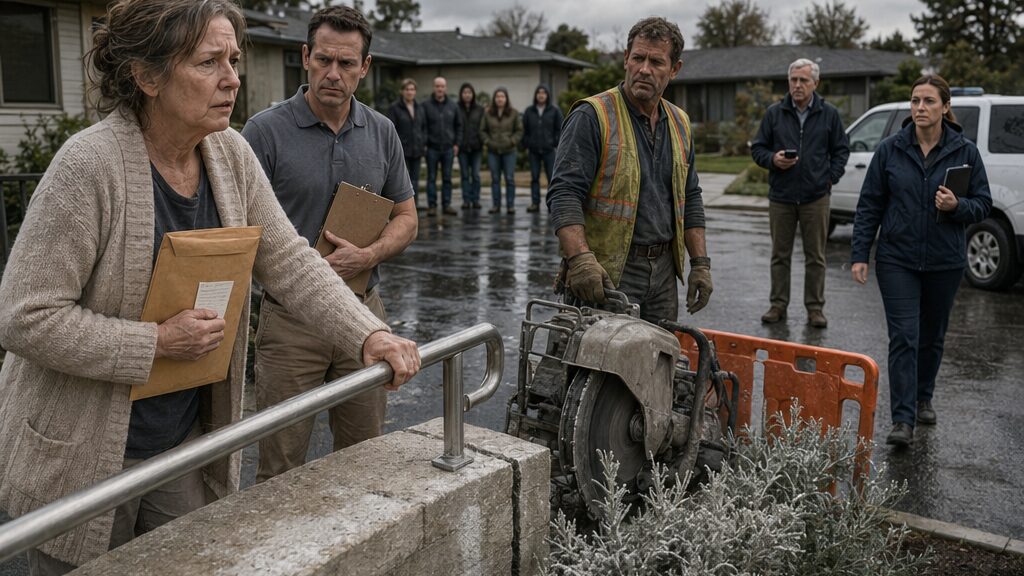
Pamela crossed the living room before she answered. Through the front window, a utility truck sat half across the mouth of the driveway. Orange barriers made a crooked square around the memorial garden. Two men in reflective vests stood beside a wheeled concrete saw. Another man, clean gray polo, khaki pants, clipboard held against his chest, watched them with the calm posture of someone who had already decided he was right.
The garden wall curved along the front walk in a low line of pale stone. White rosemary pressed over one edge. Blue salvia leaned against the wet grass. The jasmine Ruth had loved before the stroke reached for the handrail in thin green loops.
It was not a decorative wall.
Its inside edge held the steel rail steady where the path sloped toward the wheelchair ramp. The rail kept Ruth’s chair from drifting toward the garden when the therapist brought her home. It kept Pamela from having to brace the chair with one hand while opening the front door with the other.
Pamela had spent six months arranging it. Plans. Contractors. City forms. Measurements. Phone calls from hospital corridors. She had learned words she never wanted to know: transfer angle, accessible route, threshold clearance.
She had learned them because Ruth had come home.
“Pamela?” Ruth called again.
“I’m here.”
Pamela opened the front door without taking her coat. Damp air pressed against her bare arms.
The man with the clipboard looked up. “Mrs. Ellison.”
“What are you doing?”
“You were notified,” he said. “This is an enforcement matter.”
The saw operator lifted his hands from the machine. The blade slowed, whining down, but did not stop completely.
Pamela looked past the man to the wall. One of the workmen had already placed chalk marks across the capstones. A narrow cut showed black against the pale stone.
“You cannot touch that.”
“It is an unapproved hardscape extension.”
“It supports the access rail.”
The man’s expression altered only enough to suggest he had heard her. “Your personal situation does not override the exterior modification guidelines.”
The phrase landed in Pamela’s chest with more force than it deserved. Personal situation. As though Ruth’s wheelchair were a temporary inconvenience. As though the oxygen tubing upstairs were a potted plant left in the wrong place.
“My wife has a nurse coming in an hour.”
“I understand that is difficult.”
“No,” Pamela said. “You don’t.”
Across the cul-de-sac, a front door opened. George Pruitt stepped into his driveway carrying a coffee mug. He stood in his usual position beside the trimmed boxwood hedge, one hand resting on the top of it as if the hedge had asked for his protection.
He watched the barriers. The saw. Pamela barefoot on wet concrete.
For almost a year, George had complained about the wall. Not directly at first. He had mentioned it at a neighborhood gathering as if he were discussing drainage.
“Changes the visual flow,” he had said.
Later, he had told Pamela the stone made the street look uneven. The word he used was unfinished, though Pamela had noticed the way he looked at the wheelchair ramp when he said it.
Now he took out his phone.
Pamela turned back to the man with the clipboard. “What is your name?”
“Eric Keller. HOA compliance.”
She had seen his name on envelopes. She had left two of those envelopes under a stack of pharmacy receipts. One was still in the desk drawer. The other she had opened while Ruth slept and then folded shut again because it had contained too many deadlines and too little mercy.
“You sent notices to an old email,” Pamela said.
“The notices were delivered according to association procedure.”
“I haven’t used that account in years.”
“That is not something compliance can determine.”
The workmen looked at Eric, then at Pamela. They were not cruel-looking men. One of them, younger than the others, glanced toward the front door. Through the glass, Ruth’s folded wheelchair was visible in the entryway, waiting beside the ramp.
Pamela wanted to explain everything at once. That Ruth had once planted the jasmine herself, kneeling in the soil with dirt beneath her nails. That the wall had been built after the therapist watched the chair tilt on the old path and said, quietly, “This isn’t safe.”
That the night after the stroke, when Ruth had still been unable to speak clearly, Pamela had leaned close to her in the hospital room and said, “You will not leave this house because of stairs. Not while I can still stand up.”
Instead she said, “I have the approval.”
Eric glanced at the clipboard. “There is no active approval on record.”
“There is.”
“Then you should have supplied it before the compliance deadline.”
Pamela stared at him. Behind him, the saw operator shifted his weight. The blade ticked as it cooled.
George’s voice carried from across the street. “She’s making a disturbance.”
Pamela looked at him. Her face felt hot, but she kept her voice low.
“I’m trying to stop you from destroying something you don’t understand.”
George raised his phone slightly. “You should have followed the rules.”
“I did.”
The younger worker looked at the rail where it met the wall. Stainless-steel brackets sank into the stone cap. At the bottom of the ramp, the slope held a faint shine from the rain.
“Boss,” the worker said to the broad-shouldered supervisor, “that rail’s tied into it.”
The supervisor studied the structure more closely. “We were told it was a retaining wall.”
“It is,” Eric said. “An unauthorized one.”
“It is part of the route,” Pamela said.
Eric shut his clipboard with a soft, final sound. “Mrs. Ellison, please step away from the work area.”
For a second Pamela could not move. The barriers seemed absurdly bright against the wet lawn. Her rosemary had been crushed where someone rolled one of them through the flower bed.
Then Ruth called from inside.
Not loudly. Just her name.
Pamela went back into the house.
The kitchen drawer beneath the calendar stuck halfway open. She pulled it harder until old bills, discharge instructions, envelopes, and a bent measuring tape slid against one another. She knew the permit had been there. She remembered placing it under a folder labeled HOME ACCESS in block letters because she had thought, at the time, that neatness might protect them.
It was gone.
The saw started again.
The sound seemed to enter the house through every window.
“Mara?” Ruth called, then corrected herself, voice thick with fatigue. “Pamela. What is happening?”
Pamela pressed one hand against the desk. “Nothing. I’m looking for something.”
The lie came too easily. That frightened her more than the saw.
She opened the drawer beneath the cookbook shelf. Nothing. The cabinet over the microwave. More nothing. Her hands moved too fast, lifting stacks and setting them down without seeing what was underneath.
Then she remembered the rainy day at city hall four years earlier. She had come home drenched, carrying the permit envelope under her coat. The desk drawer had been jammed with medical invoices, so she had tucked the papers into the old cookbook box Ruth’s mother had given them.
Pamela climbed onto a chair and pulled the box down.
The lid smelled faintly of dust and cinnamon.
Inside were recipe cards in Ruth’s slanted handwriting. Lentil soup. Lemon cake. The potato gratin Ruth used to make on holidays because she always insisted nobody needed more than one dessert, then made two.
Beneath the cards lay a large brown envelope.
Pamela opened it with shaking fingers.
The city permit was there.
So was the contractor’s invoice. The accessibility inspection report. A printed email chain from the former architectural committee.
The final message sat at the top.
Approved as submitted, pending city permit confirmation.
Pamela heard stone crack outside.
She grabbed the envelope and ran.
Chapter 2: The Permit in the Cookbook Box
The blade had already cut halfway through the first support stone.
Pamela stumbled down the front steps with the brown envelope pressed to her chest. A loose recipe card slid free and landed faceup on the wet concrete.
Ruth’s handwriting curved across it.
Lemon cake. Beat the eggs until the color changes.
The saw screamed again.
“Stop!” Pamela shouted.
The operator lifted off the trigger, more startled than obedient. The blade spun in a fading silver circle. Dust drifted across the rosemary, turning its white flowers gray.
Eric moved toward her before she reached the barriers. “Mrs. Ellison, you need to stay clear.”
“This is the approval.” She held out the envelope. “The city permit. The inspection report. Everything.”
“This is not the time to litigate paperwork in the driveway.”
“It is exactly the time.”
She stepped around him. He caught her elbow—not hard, but enough to stop her. Pamela looked down at his hand until he took it away.
The supervisor had come closer. He was broad through the shoulders, with a red mark across his forehead where his safety glasses had rested. Pamela had heard one of the others call him Patrick.
“Please,” she said to him. “Just look at it.”
Eric’s jaw tightened. “Patrick, our authorization is clear.”
Patrick did not take the envelope at first. His eyes moved from the papers to the rail, then to the cut already scored through the stone. The brackets holding the rail had been bolted directly through the capstones. Beyond them, the ramp rose to the front door in a clean, gradual line.
“What were you told this was?” he asked Eric.
“An unapproved decorative retaining wall.”
“It holds the rail.”
“The rail can be addressed separately.”
Pamela let out a sound that was almost a laugh and almost something else. “Addressed how? After you cut the support out from under it?”
Patrick looked at the saw operator. “Kill it.”
The operator shut the machine down fully.
Eric’s face changed. Not much. A faint flush rose into his cheeks. “The crew is contracted to execute an enforcement order. That is what they are here to do.”
“And I’m contracted not to drop a rail on somebody’s porch because a form says a wall is decorative,” Patrick said.
The younger worker stood behind him, watching Pamela as though he had suddenly understood what he had walked into. His boots had left muddy crescents across the edge of the lawn.
Across the street, George lifted his phone higher.
“She’s refusing a lawful order,” he said, loud enough for the people gathering near their mailboxes to hear. “This is getting out of hand.”
Pamela turned toward him. “You complained about my wife’s ramp?”
“I complained about the wall.”
“You knew what it held.”
George’s mouth flattened. “I knew you had put up a structure without proper approval.”
“I have proper approval.”
“Then why are they here?”
For a moment, that question hung between them with all the ease of a lie people wanted to believe. A few neighbors looked away. One woman pulled her dog closer by its leash.
Pamela’s grip tightened around the envelope. She had spent years in this cul-de-sac learning what not to say. Don’t mention the hospital bills. Don’t complain when someone parks too close to the ramp. Don’t make every gathering about Ruth’s condition. Smile when people say they miss seeing her outside.
She had thought silence made life easier.
Now silence stood on her lawn in orange barriers.
Patrick opened the envelope. The first paper was a city permit, stamped in blue. He scanned it, then passed it to the younger worker, who held it carefully by the corners.
“Accessible route modifications,” Patrick read. “Reinforced retaining support. Handrail installation.” He looked at Eric. “This is your property?”
“She is the homeowner,” Eric said. “But HOA approval is distinct from city permitting.”
“There’s an HOA email right there,” Pamela said.
Patrick found it beneath the inspection report. He read the final line aloud without meaning to.
“Approved as submitted, pending city permit confirmation.”
Eric reached for the paper. “That is an old communication. It may not reflect the current status of the property.”
“It reflects the wall,” Pamela said. “It reflects the rail. It reflects the work you are cutting into.”
The younger worker crouched beside the damaged stone. His gloved fingers stopped just short of the cut.
“There’s a void underneath,” he said. “If that goes through, the rail could shift.”
Patrick swore under his breath, not loudly enough for anyone to accuse him of making a scene.
George spoke into his phone again. “Yes, I’m at twelve. There’s a woman here interfering with authorized work.”
Pamela felt every face on the street turn toward her. The nurse’s folding chair was visible through the front glass. The oxygen machine’s low rhythm seemed louder now, though she knew that was impossible.
Eric set the approval email back in the envelope. “Mrs. Ellison, I’m not disputing that you have documents. I’m saying the association has an active compliance finding. This should have been handled before enforcement.”
“I tried to handle it,” she said. “You sent forms. Then reminders. Then more forms. And every time I called, someone told me another department had to review it.”
“You did not provide the required update.”
“What update?”
“The exterior modification continuity form.”
Pamela stared at him. The phrase meant nothing. Or worse, it sounded almost familiar. One more attachment in one more email she had told herself she would open after Ruth’s appointment, after the pharmacy pickup, after the insurance call.
Behind her, the front door opened.
Ruth was not there. But the doorway stood wide enough for Pamela to see the wheelchair beside the ramp, waiting in the hallway as if it had heard every word.
Patrick handed the permit back. “I’m not cutting another inch until somebody from the city says this isn’t part of the access route.”
Eric looked past him to the road. “That is not your decision.”
“It is while I’m standing beside the saw.”
The silence that followed was broken by a small engine turning into the cul-de-sac.
A white city vehicle came around the curve and slowed beside the utility truck. A woman in a navy inspection jacket stepped out with a tablet under one arm.
She looked first at the cut stone, then at the rail, then at Pamela holding the permit folder against her chest.
“Who authorized demolition of an accessibility-support structure?” she asked.
Chapter 3: Inches From the Last Stone
No one answered Melissa at first.
The city inspector walked past the orange barriers without waiting for permission. Her boots clicked against the driveway, steady and impatient. She took the permit from Pamela, read the front page, then crouched beside the wall.
The cut ran almost all the way through the support stone. A dark line, narrow as a finger, split the pale surface beneath the rail bracket.
Melissa touched nothing.
“Who ordered the work?” she asked.
Eric stepped forward. “The homeowners association. This is an exterior compliance action.”
Melissa looked up. “That is not what I asked.”
“I issued the enforcement notice.”
“Based on what review?”
“Association standards.”
She tapped the permit with one finger. “This is an approved accessible route modification. The inspection record is complete. The wall is integrated with the handrail.”
“The association has separate aesthetic requirements,” Eric said. “The city permit does not erase private covenants.”
“No,” Melissa said. “But private covenants do not authorize anyone to remove permitted accessibility infrastructure without verifying what they are removing.”
Her voice was not raised. That seemed to unsettle Eric more than anger would have.
George had crossed halfway into the street now, phone still in his hand. “It’s not the rail people objected to,” he said. “It’s the wall. It changes the whole look of the cul-de-sac.”
Melissa turned toward him. “Are you the owner of this property?”
“No.”
“Then I’m not asking you.”
A few people near the mailboxes shifted. Nobody laughed. Nobody defended George. The absence of support seemed to make him stand straighter.
Patrick cleared his throat. “Our work order called it a decorative retaining wall.”
Melissa extended her hand. “May I see it?”
He gave her the folded page. She read it in silence. Pamela watched her eyes stop at the phrase unauthorized decorative retaining wall. Then Melissa looked back at the permit.
“Did anyone provide you this document before work began?” Patrick asked.
Eric answered before Pamela could. “The homeowner presented it this morning.”
“That is not what I asked,” Melissa said again.
Eric’s face had gone pale beneath the flush. “No city documentation was included in the enforcement packet.”
“Why not?”
“The association records did not show an active approval.”
Pamela heard the word active and felt something inside her tighten. It was the language people used when they wanted paperwork to have more life than a person did.
Melissa took photographs of the cut stone, the rail brackets, the ramp, the permit, and the work order. She asked Patrick where the crew had entered the property. She asked the younger worker who had marked the cuts. She asked Eric whether he had inspected the structure in person before authorizing demolition.
“I reviewed the exterior condition,” he said.
“That is not the same question.”
Eric paused. “I did not inspect the structural connection.”
Patrick looked away.
Melissa stood. “All equipment remains off. No one alters this structure further. Mr. Keller, I need the complete association file, including notices, board communications, photographs, approvals, and any correspondence related to this address.”
“The association is entitled to its own process.”
“You may have one,” she said. “You do not have one that allows a permitted access route to be compromised because someone dislikes how it looks.”
Pamela could not remember the last time anyone had said it so plainly.
For several seconds, she could only stare at the rail. It still stood. The final support stone held, though barely. Patrick had placed a hand against it earlier, as if he could feel the weakness through his glove.
“Can it be repaired?” she asked him.
He looked at the cut. “Stabilized today, maybe. Repaired properly after someone assesses the load.” He hesitated. “We should never have started before checking.”
It was not an apology exactly. But it was closer than anything else she had heard that morning.
Melissa wrote something on her tablet. “The city will require temporary stabilization. I’m also documenting possible damage to an approved route.”
Eric gave a short, brittle breath. “This is being escalated unnecessarily.”
Pamela turned to him. She had imagined, in the first minutes after seeing the saw, that if someone official came, the terror would leave her body. It did not. It had simply changed shape.
“You escalated it when you sent a saw.”
His gaze landed on hers, then slipped away.
A delivery truck rolled slowly past the edge of the cul-de-sac and continued on. Someone’s wind chime moved in a yard two houses down. The ordinary sounds made the stopped saw seem stranger, almost obscene.
Melissa handed Pamela a card. “Call me if anyone returns to the property before stabilization is arranged.”
Pamela took it.
“And call a licensed contractor,” Melissa added. “Not the original crew. You need an assessment independent of the demolition authorization.”
Patrick nodded once. “I can get temporary supports in place, with your permission. No cutting. No removal.”
Pamela looked at the wall, at the rosemary dusted gray, at the rail leading toward the front door. She thought of Ruth waiting inside, listening for the next sound.
“Yes,” she said. “Please.”
Patrick sent the younger worker to the truck for braces. The workmen moved differently now, quietly, carrying wood and steel instead of saws.
George lowered his phone at last. He stood in the middle of his driveway, staring at the city vehicle as if it had arrived for somebody else.
Eric folded his clipboard shut. “The board will review this.”
“Good,” Melissa said. “They should.”
He left without another word.
By noon, a temporary brace stood beneath the damaged stone. It was ugly and obvious: a steel post wedged into the garden bed, a broad plate resting under the cut capstone. Pamela hated the sight of it. But when she gripped the rail and put her weight against it, it did not move.
Inside, Ruth sat in her wheelchair near the open front door. Her face looked colorless from the morning, but her eyes stayed on Pamela.
“Is it safe?” she asked.
“For now.”
Ruth nodded. “For now is not the same as safe.”
Pamela knelt beside her. “I know.”
The phone rang before she could say anything else.
The number was local but unfamiliar.
Pamela answered.
“Pamela?” Kathleen’s voice came through, careful and shaken. “I just heard what happened.”
Pamela closed her eyes.
“I sent Eric the archive records last month,” Kathleen said. “The approval. The inspection confirmation. Everything.”
Pamela looked through the open door at the brace beneath the wounded wall.
“He had them before the crew ever reached your driveway.”
Chapter 4: The Approval That Did Not Disappear
“Eric had the approval before the crew reached your driveway.”
Kathleen’s words stayed in Pamela’s ear long after the call ended.
She stood at the kitchen counter with the phone still against her cheek. On the table, the permit folder lay open between a bowl of untouched oatmeal and Ruth’s medication organizer. The house smelled faintly of concrete dust whenever the front door opened.
Ruth watched from the doorway.
“Who was that?” she asked.
Pamela put the phone down too carefully. “Kathleen.”
“The former secretary?”
“She says she sent Eric the approval records.”
Ruth’s fingers rested on the wheel rim. “Before today?”
Pamela nodded.
For a moment, Ruth said nothing. The oxygen machine breathed from the bedroom, soft and steady.
Then Ruth looked toward the front hall, where Pamela had left the desk drawer open. A white envelope sat on top of the scattered papers.
“What’s that?”
Pamela followed her gaze.
Her stomach dropped.
“It’s nothing.”
Ruth’s eyes lifted to hers. “Nothing usually goes in the drawer you slam shut when I come into the room.”
Pamela should have moved toward the drawer. She should have picked up the envelope, explained it quickly, made the words manageable.
Instead she stood still.
Ruth rolled herself forward. The chair made a small, familiar sound over the hardwood. Pamela had heard it a thousand times. Today it seemed to scrape across the whole house.
“Ruth.”
“Please don’t.”
Ruth reached the desk and drew out the envelope. The HOA logo sat in the corner. It had been opened along one edge, then folded back into itself.
She read the first page.
“Exterior modification continuity form,” Ruth said. “Final notice.” Her voice caught on the last two words. “Pamela.”
“I was going to deal with it.”
“When?”
“I don’t know.”
Ruth looked at the date. “This came three weeks ago.”
Pamela felt the answer rise and stop behind her teeth. Three weeks ago had contained physical therapy, a prescription problem, a nurse who canceled twice, an insurance call that lasted forty minutes and ended with another number to call. Three weeks ago had also contained the night Ruth had cried in the bathroom because she could not fasten the button on her own sleeve.
There had never been a good time to explain that the house might become another thing they had to fight for.
“I saw it,” Pamela said. “I thought I understood it. Then I didn’t. Then I thought I would call after your appointment.”
“And then?”
“And then I didn’t.”
Ruth folded the notice along its old creases. “You didn’t tell me.”
“I didn’t want you worrying.”
“You didn’t want me involved.”
“That isn’t true.”
“It is a little true.”
Pamela looked down at the open folder. Ruth’s recipe cards had spilled beside the permit. One showed a small brown stain near the word cinnamon, probably from an afternoon years ago when they had laughed over a ruined pie crust.
“I’m trying to keep you home,” Pamela said.
Ruth’s face changed, not sharply, but enough that Pamela wished she could take the sentence back.
“I am home,” Ruth said.
The silence after that was worse than an argument.
Kathleen arrived an hour later with a slim gray file box tucked under one arm. She had aged since Pamela last saw her at a neighborhood meeting—her hair whiter, her back slightly bent—but she still carried papers as if they were fragile things that needed defending.
“I should have come sooner,” she said when Pamela opened the door.
“You sent the records.”
“I sent an email. That is not the same thing.”
Ruth sat at the dining table. Pamela had expected her to retreat to the bedroom, but she stayed. Kathleen noticed the unopened notice beside Ruth’s hand and did not comment.
Inside the file box were copies of old architectural committee minutes, the original approval form, and a printout of the email chain Pamela had found in the cookbook box. Kathleen laid them in a row.
“This was approved under the old access modification category,” she said. “The category was renamed later. They started asking homeowners to submit continuity forms so the new system could match the old files.”
Pamela looked at the final notice. “So I missed a form.”
“You missed a form,” Kathleen said. “That should have triggered a review. Not demolition.”
Ruth leaned forward. “Could they say the old approval expired?”
“They can say many things. It doesn’t make them right.”
Kathleen turned another page. A note had been copied onto the top in blue ink. The handwriting was narrow and angular.
Hold pending standards review.
Pamela recognized neither the hand nor the phrase at first.
Then Kathleen said, “Linda wrote that.”
The name settled heavily in the room.
“Why?” Pamela asked.
Kathleen looked toward the window. The temporary brace was visible through the garden, holding up the wounded stone like a crutch.
“George had been pressuring the board,” she said. “He kept saying the wall changed the character of the street. Linda thought reopening the file would calm him down.”
“By sending a crew?” Pamela asked.
“No.” Kathleen’s voice thinned. “By delaying the approval confirmation. Eric handled the enforcement side. I assumed, when I sent him the archive, he would stop and verify.”
Ruth touched the continuity notice with one finger. “And because Pamela hadn’t filed this, they had a reason not to.”
Kathleen did not answer immediately.
“It gave them something to point at,” she said finally.
Pamela wanted anger. It would have been easier than the feeling that moved through her instead—a tired recognition that she had handed them part of the weapon herself. Not the whole thing. Not the saw, not the order, not George’s phone raised across the street. But a form she had not opened. A truth she had kept from Ruth.
Kathleen packed the pages back into the file box, leaving the note with Linda’s handwriting on the table.
“There will be an emergency meeting,” she said. “You should come.”
Pamela almost said no.
The word formed itself out of habit. No, because Ruth needed her. No, because meetings were fluorescent rooms full of people who spoke in rules. No, because she was tired and the wall had not fallen and maybe that could be enough.
Then Ruth looked at her.
Not accusingly. Worse. Waiting.
Pamela picked up the note.
“Hold pending standards review.”
The words were small enough to fit in the corner of a page. Small enough, apparently, to place a saw on her lawn.
She folded the paper and put it back into the permit folder.
“Yes,” she said. “I’ll come.”
Chapter 5: The Street That Watched Quietly
The temporary brace looked worse in daylight.
It stood beneath the cut stone with a square steel foot planted in the dirt where Ruth’s rosemary had grown. The post held the wall up from below, blunt and industrial, as if the garden had been fitted with a crutch.
Pamela stood at the bottom of the ramp with a mug cooling in her hands.
Patrick’s truck was parked at the curb. He and the younger worker were checking the brace bolts, moving slowly around the damaged wall. The saw was gone. Its absence should have made the morning quieter. Instead, every small sound carried—the scrape of a wrench, the hum of a lawn mower two streets over, the wheels of Ruth’s chair crossing the kitchen floor inside.
Patrick straightened. “It’s stable for now.”
“For now,” Pamela repeated.
He nodded. “A structural contractor needs to decide what gets replaced. The cut went deep.”
Pamela looked at the groove. It had changed the stone permanently. Even after repair, she would know where the blade had entered.
Patrick rubbed his thumb over the edge of the work order folded in his pocket. “I brought you a copy.”
He held it out.
The paper was thin and creased from his pocket. At the top, beneath the HOA letterhead, the description read: UNAUTHORIZED DECORATIVE RETAINING WALL—REMOVAL AUTHORIZED.
No mention of the rail. No mention of the permit. No mention of Ruth.
“It’s all they gave us,” Patrick said.
Pamela read it twice.
“Did you ask for pictures?”
“There were pictures in the attachment.” He paused. “Just close-ups of the wall from the street side. They didn’t show the ramp connection.”
“Who sent it?”
“Eric’s office.”
Pamela folded the paper along its center, carefully enough not to tear it. “Thank you.”
Patrick looked uncomfortable, as though gratitude made him more accountable than anger would have. “I should’ve walked the site before we started.”
“You should have.”
He accepted that with a small nod.
A front door opened across the street. George came out carrying a yard bag, though there were no leaves on his lawn. He saw Patrick’s truck, then Pamela by the ramp. For a moment he considered returning inside. Instead, he walked to the curb and set the bag down.
“You’re making this bigger than it needs to be,” he said.
Pamela did not turn toward him. “A crew cut into my wife’s access rail support.”
“The rail is still standing.”
“Because they stopped.”
George glanced at the temporary brace. “People have a right to expect the neighborhood standards to mean something.”
Pamela looked at him then.
“Did you tell Linda this wall made the street look medical?”
His expression tightened. “I said it changed the appearance of the street.”
“A neighbor told me you used the other word.”
“You’ve been talking to people about me now?”
“No,” Pamela said. “People have been talking about you.”
A woman from the corner house was walking a small dog past the cul-de-sac. She slowed when she saw them, then continued with her eyes lowered.
George’s face went red. “This has become hostile.”
“It became hostile when you called the police because I held a permit in my own driveway.”
“I called because you were interfering with work.”
“You knew what the wall did.”
“I knew you had made changes without keeping the paperwork current.”
There it was again. The small, sharp point of truth inside the larger wrong.
Pamela felt it, and George saw that she did.
He picked up the yard bag. “Rules are rules.”
Then he crossed the street without looking back.
By noon, the nurse had arrived. Ruth sat by the front window while the nurse checked her blood pressure, her gaze fixed on the brace outside.
Pamela stood in the kitchen with the work order spread beside Kathleen’s copied archive note. She had begun a pile without meaning to: permit, inspection report, approval email, continuity notice, work order.
Each page seemed to speak a different language. Together they told a story no one had wanted to hear.
The doorbell rang.
A woman from two houses down stood there with her hands clasped tightly in front of her. Pamela knew her only as someone who waved at Ruth in passing.
“I saw what happened,” the woman said.
Pamela waited.
The woman glanced back toward George’s house. “I don’t want trouble.”
“I’m not asking you for anything.”
“I know.” Her voice lowered. “That’s why I came.”
She pulled her phone from her pocket and opened a message thread. Several photographs filled the screen: the wall, the rail, the garden. The pictures had been taken from different angles, most of them cropped so that the ramp was barely visible.
“George sent these around before the last board meeting,” she said. “He asked if anyone else thought it made the street look like a facility.”
Pamela looked at the screen.
One of the messages beneath the photographs read: We need the board to act before every house turns into an exception.
The woman’s thumb shook as she scrolled.
“I didn’t answer,” she said. “I should have.”
Pamela handed the phone back. “Can you send those to me?”
The woman hesitated, then nodded.
“I don’t want my name used.”
“I won’t use it without asking.”
When she left, Pamela stood in the doorway until her phone chimed.
Three photographs. One message. A date from two weeks before the demolition.
She added them to the table.
The pile grew.
That afternoon, another email arrived from the HOA. Pamela recognized the formal subject line before she opened it.
Emergency Board Meeting: Exterior Modification Review.
Not accessibility review. Not enforcement action. Not damage to a permitted route.
Exterior Modification Review.
Pamela read the words until they blurred.
Then she carried the printout to Ruth.
“They’re calling it something else,” she said.
Ruth looked from the paper to the wall outside.
“Then you’ll have to tell them what it really is.”
Chapter 6: What the Board Called Decorative
Linda did not say the word accessibility.
The community clubhouse was too cold, bright with ceiling lights that flattened every face. Pamela sat at a folding table near the front with Ruth beside her, the permit folder open between them. Kathleen sat one chair back, holding a thin stack of copied records. Patrick stood near the wall with his hands in his jacket pockets. Even Melissa had come, though she stayed near the doorway, clearly there as an observer and not a participant.
George sat in the second row.
Eric stood beside Linda at the front of the room, his clipboard tucked beneath one arm. He did not look at Pamela.
Linda cleared her throat.
“This emergency session concerns an exterior modification dispute involving a retaining structure at the Ellison property.”
Pamela felt Ruth’s fingers touch the edge of the table.
Linda continued. “The board’s objective is to clarify whether association guidelines were properly followed and determine a path toward resolution.”
Still no accessibility.
Pamela looked down at the photograph she had brought: the cut stone, the rail bracket, the temporary steel brace beneath it.
When Linda opened the floor to homeowner comment, George stood first.
“The issue,” he said, “is whether standards apply evenly. We all pay into this community. We all have to maintain certain expectations. If one resident gets to make permanent changes because of personal circumstances, where does that stop?”
Pamela watched several people nod, not strongly, but enough to make the room feel smaller.
Linda thanked him.
Then Pamela stood.
“My wife’s name is Ruth,” she said. “The wall you’re calling a retaining structure holds the rail that lets her come into her own house safely.”
The room quieted.
Linda folded her hands. “No one is disputing the importance of your family’s situation.”
“My wife is not a situation.”
Linda’s mouth tightened.
Pamela placed the city permit on the table in front of her. Then the inspection report. Then the original approval email.
“This was approved. The city inspected it. The rail was built into the wall. Your enforcement order called it decorative.”
Eric spoke before Linda could. “The association had no active continuity filing.”
Pamela turned toward him. “You had the approval record.”
“I had an archive email,” he said. “The continuity form had not been submitted. There was no confirmation that the original approval remained current under the updated standards.”
Kathleen stood then, papers trembling slightly in her hands.
“The old approval category was changed by the board,” she said. “The project itself did not become unapproved because the filing system changed.”
Linda looked at her. “Kathleen, this is a board matter.”
“I was secretary when the approval was issued.”
“You were no longer secretary when the continuity process began.”
“No,” Kathleen said. “And that is partly why I thought forwarding the archive to Eric would be enough.”
Eric finally looked at her.
Melissa stepped forward from the wall. “For clarity, the city permit remained valid. The approved accessible route was not revoked.”
Linda’s expression hardened. “This board cannot be governed by city procedures alone.”
“No,” Melissa said. “But city procedures do govern whether permitted access structures can be damaged without review.”
The word damaged seemed to move through the room. A few heads turned toward the photograph on Pamela’s table.
Eric drew in a breath. “I did not authorize damage. I authorized removal of an unapproved modification based on the information available.”
“You authorized demolition,” Pamela said.
“Based on a compliance file.”
“Did that file include the permit?”
He was silent.
“Did it include the approval email Kathleen sent you?”
His eyes went to the clipboard.
Linda said, “We are not here to interrogate staff.”
Pamela looked at the board president. “Then why am I here?”
The room held still.
Eric lifted his gaze. “I saw the email,” he said.
Ruth’s hand closed around the edge of the table.
“I saw it,” Eric repeated. “But the project had an unresolved continuity issue. I believed the board needed to determine whether the old approval could be relied upon.”
“And while it determined that,” Pamela said, “you sent a saw.”
“I believed the work order addressed a decorative wall.”
Patrick spoke from the back. “It didn’t say anything about the rail.”
Eric turned. “The crew was hired for the structure described.”
Patrick’s voice stayed level. “The structure was not described accurately.”
George stood again. “This is turning into a trial over one mistaken work order. The bigger point is still the same. We can’t let every exception become permanent.”
Pamela felt something settle inside her.
Not relief. Not anger exactly.
A decision.
She picked up one of Ruth’s recipe cards from the folder. She had tucked it there without thinking that afternoon, a card for lentil soup, creased at one corner.
“My wife used to make this when someone needed feeding,” Pamela said. “She made it for neighbors who had babies. For people with the flu. For George’s wife after her surgery.”
George’s face changed.
Pamela looked at him, then at Linda, then at the room.
“She cannot stand at the stove now. She cannot walk through the front door without that rail. You can call the wall whatever helps you sleep. Decorative. Unfinished. An exception. But my wife is not an inconvenience.”
No one applauded. The silence was too full for that.
Linda looked down at the papers in front of her.
“We regret that the enforcement action moved forward before the city documentation was fully reviewed,” she said.
Pamela almost laughed. The sentence had been polished until it had no one inside it.
“We can discuss compensation for repairs,” Linda added. “Privately.”
Pamela shook her head.
“No.”
Linda looked up. “Mrs. Ellison—”
“No private repair agreement. No quiet reimbursement. You need a written process for any resident with an approved access structure. Archive checks before enforcement. A review that uses the word accessibility when that is what is at stake.”
George muttered, “That’s a policy change over one wall.”
Pamela turned to him.
“It is a policy change because there is one wall today.”
Ruth moved beside her.
The room shifted as Ruth placed both hands on the wheels of her chair and rolled forward a few inches.
“I would like to speak,” she said.
Pamela’s throat closed.
Ruth looked at the board, then at the unopened continuity notice lying beside the permit folder.
“And I need to tell you something about why Pamela had to stand outside alone.”
Chapter 7: The Promise Ruth Refused to Carry Alone
Ruth’s voice was quiet, but the room bent toward it.
“The wall is not a favor to me,” she said. “It is part of how I live in my home.”
Her chair was angled toward the board, but Pamela could see the effort in her shoulders. Speaking for too long tired Ruth now. The words sometimes arrived slowly, as if she had to wait for them at a door.
No one moved.
Ruth continued. “After my stroke, Pamela promised I would not have to leave this house because of stairs. I know what that promise cost her.”
Pamela stared at the recipe card in her hand.
“But she began carrying it like a punishment,” Ruth said.
Pamela looked up.
Ruth’s eyes were wet, though her voice remained steady. “She thought protecting me meant keeping every problem away from me. The notices. The calls. The fear. I knew she was frightened. I did not know she had stopped opening the mail.”
A breath moved through the room. Not a gasp. Something smaller, harder to bear.
Pamela felt heat rise into her face.
Ruth turned toward her.
“I am not saying this to shame you,” she said. “I’m saying it because silence is how things got this far. People were quiet when they should have asked what the wall was for. Pamela was quiet when she needed help. I was quiet because I thought needing the rail made me too much.”
Pamela could not speak.
Ruth rested one hand on the permit folder.
“I do not want anyone here to decide that my life is a private exception. And I do not want my wife to have to fight alone to prove that I belong in my own home.”
For a moment, the clubhouse seemed to lose all its artificial light. Pamela saw only Ruth’s hand on the papers and the small crease at the edge of the lentil-soup card.
Linda cleared her throat.
“The board can vote tonight to suspend enforcement actions involving documented accessibility-related structures until we establish a review protocol.”
“Documented,” George said. “That’s broad.”
“It is careful,” Kathleen said from behind Pamela.
George looked as though he wanted to answer, but did not.
Linda called for the vote. One board member raised a hand. Then another. The motion passed without drama, without anyone seeming proud of it.
Pamela should have felt relieved.
Instead, her knees felt weak.
Linda turned toward her. “The association will cover stabilization and repair costs. We can arrange that through counsel. It does not need to become more adversarial than it already has.”
Pamela looked at Ruth.
Ruth did not nod or shake her head. She only waited.
Pamela understood then that this was what Ruth had meant. Not that Pamela needed permission. That she needed to stop making every decision in the name of love and calling it protection.
She faced Linda.
“It does need more than repair costs.”
Linda’s patience thinned. “What exactly are you asking for?”
“A written accessibility review process,” Pamela said. “Not a promise in meeting minutes. A requirement that records are checked before enforcement. An archive audit, so no one can say an approval disappeared because an old system changed names. And a rule that any work affecting an access route gets an independent review before a notice becomes demolition.”
Eric shifted beside the wall.
Linda said, “That would require additional board work.”
“Yes.”
“It would take time.”
“Yes.”
“We cannot guarantee every future circumstance.”
“No one asked you to,” Pamela said. “Just stop pretending you don’t see them.”
The words came out without shaking.
That surprised her.
Linda looked toward the other board members. They looked tired. Some looked embarrassed. One had been taking notes quickly since Ruth began speaking.
Eric stepped forward.
“I should have verified the structural role of the wall,” he said. His voice was low. “I relied on the file description.”
Pamela waited.
“I was trying to close a compliance matter that had been open too long,” he added. “I thought if I treated it like every other exterior issue, it would be handled fairly.”
“And did it feel fair?” Pamela asked.
Eric looked at the photograph of the cut stone.
“No,” he said.
It was not enough. It could not be enough. But it was something real, and Pamela recognized the difference.
Linda exhaled through her nose.
“All right,” she said. “The board will draft policy language. We will circulate it for review before the next meeting. The archive audit will be added to the agenda.”
Pamela sat down slowly.
Ruth reached for her hand beneath the table. Pamela held it.
Later, after the room had emptied and the fluorescent lights were being switched off in sections, Linda approached them with a folder.
“This is a preliminary repair authorization,” she said. “The association will sign it once counsel reviews the language.”
Pamela took it.
“Thank you,” Linda said, though she sounded as if the words hurt.
Pamela did not answer immediately.
Then she said, “Make sure the language says what happened.”
Linda’s eyes met hers.
“It will,” she said.
Outside, the night air was cool. Patrick was waiting near the clubhouse entrance, leaning against his truck.
“They schedule the repair?” he asked.
“Not yet.”
“They will.”
Ruth sat beside Pamela beneath the parking-lot light. Her face was tired, but not withdrawn.
On the drive home, neither woman spoke until they reached the cul-de-sac.
The temporary brace stood beneath the wall, visible in the wash of the headlights.
Pamela parked and switched off the engine.
“I’m sorry,” she said.
Ruth looked at the brace.
“I know.”
“I thought if I handled it all—”
“I know,” Ruth said again, softer this time. “But you don’t have to keep proving the promise by hurting yourself.”
Pamela looked at her.
Ruth’s hand found hers on the console.
“Let me carry some of it,” she said.
The next morning, an envelope arrived from the HOA.
Inside was a draft of the new policy language, a repair commitment, and a request that Pamela attend the first accessibility review meeting when it was formed.
She stood in the kitchen, holding the papers while Ruth watched from the table.
Outside, the brace waited beneath the cut stone.
Inside, the permit folder lay open beside Ruth’s recipe cards.
Pamela did not put the envelope in the drawer.
Chapter 8: The Wall That Stayed Standing
The sound outside was stone being set back into place.
Pamela stopped at the kitchen window with the dish towel in her hands.
For a second, she could not move.
The sound was lower than the saw had been. Not a scream. A measured scrape, then a soft knock as one pale stone settled against another. Patrick stood beside the rebuilt section of wall with a contractor Pamela had hired on Melissa’s recommendation. The temporary brace was gone. In its place, fresh mortar lined the repaired support stone beneath the rail.
The cut itself had been removed.
Not hidden. Removed.
Ruth rolled up beside Pamela.
“They’re done?” she asked.
“Almost.”
Outside, Patrick crouched near the rail bracket and pressed a hand against the new stone. The contractor checked something with a level. The rosemary had been replanted along the front edge of the wall, still small, its white flowers not yet open. The jasmine had survived. Its thin vines had been tied gently away from the work area and now reached again toward the rail.
Pamela opened the front door.
The ramp felt different under her shoes, though she knew it had not changed. The handrail was cool when she touched it. Solid. The repaired wall held it without a tremor.
Patrick looked up. “Want to test it?”
Ruth rolled down the ramp slowly, Pamela walking beside her without reaching for the chair handles. The wheels passed the repaired section. The chair did not pull toward the garden. The rail stayed firm beneath Ruth’s hand.
At the bottom, Ruth stopped.
She looked back at the house. Then at the wall.
“It feels like it’s supposed to,” she said.
Pamela swallowed.
Patrick removed his gloves. “The city inspector signed off on the repair plan yesterday. The final paperwork goes in this afternoon.”
“Thank you,” Pamela said.
He nodded toward the wall. “I should’ve seen what it was before we started.”
“You see it now.”
“I do.”
That was all he said. It was enough.
As Patrick and the contractor packed their tools, George stepped from his driveway. He had been standing there longer than Pamela realized. No phone in his hand. No coffee mug. Just both hands in his pockets.
He crossed halfway toward the street and stopped.
Pamela felt Ruth’s fingers tighten around the wheel rim.
George looked at the rebuilt wall.
“It looks good,” he said.
Pamela waited.
He glanced at the ramp, then at Ruth. His face seemed older than it had a few weeks earlier.
“I didn’t understand what it held up,” he said.
Ruth looked directly at him.
“No,” she said. “You didn’t.”
George nodded once. He seemed to expect something else from her. An opening. Forgiveness perhaps, or relief.
Ruth gave him neither.
After a moment, he walked back across the street.
Pamela watched him go, then looked down at Ruth.
“Was that all right?” Pamela asked.
Ruth’s mouth curved slightly. “It was honest.”
The new policy arrived three days later.
Pamela read it at the dining table while Ruth sorted recipe cards into two piles: ones she could still make with help, and ones she wanted to teach Pamela properly before winter.
The policy was dry, formal, full of numbered sections. But the words mattered.
Archive verification required before enforcement.
Independent review for structures connected to documented access routes.
No demolition or alteration without site inspection.
A separate process for residents whose modifications involved medical or mobility needs.
Pamela read each line twice.
At the end was an invitation from the board.
First Accessibility Review Meeting.
The paper rested beneath her fingertips.
Ruth looked over. “You’re going.”
Pamela looked toward the desk drawer across the room. It remained closed, but not because anything had been hidden inside. The unopened notice was gone. The permit folder sat on the shelf beside the cookbook box.
“I don’t know,” Pamela said.
Ruth placed a recipe card on the table between them.
It was the lentil soup recipe. The corners were soft from years of use. At the bottom, beneath the instructions, Ruth had written in smaller letters: Add more water than you think. It thickens while you wait.
Pamela smiled despite herself.
“That sounds like a yes,” Ruth said.
“I’m tired.”
“I know.”
“I don’t want this to become the thing I do now. Meetings. Policies. Explaining our house to people who should have understood the first time.”
Ruth leaned back in her chair. “Then don’t do it to explain our house.”
Pamela looked at her.
“Do it so the next person doesn’t have to stand in the driveway with a permit while someone tells them their life is decorative.”
The words stayed between them.
Outside, sunlight caught on the rail. The wall did not make the house look like a facility. It looked like a wall. A low curve of stone beside a garden. Something built because a person needed it.
Later that afternoon, Pamela moved the permit folder from the shelf to the kitchen table. She placed it beside Ruth’s recipe cards.
The folder was thicker now. City permit. Inspection report. Kathleen’s archive copies. Patrick’s work order. The new policy. The repair authorization.
Ruth watched as Pamela slid the papers into a clean file case.
“Not the drawer?” she asked.
“Not the drawer.”
Ruth nodded.
Pamela dressed for the meeting in the same cardigan she had worn the morning of the demolition. She noticed a faint gray mark near the cuff, probably concrete dust that had survived the wash. She considered changing it.
Then she left it.
At the front door, Ruth waited in her wheelchair, one hand resting lightly on the rail.
“You have your papers?” Ruth asked.
“Yes.”
“You have your keys?”
Pamela lifted them.
Ruth smiled. “Then go.”
Pamela stepped onto the ramp. At the repaired wall, she paused and looked back.
Ruth was framed in the open doorway, the house behind her warm and ordinary. The oxygen machine murmured from the bedroom. A pot of lentil soup simmered on the stove, thinner than Ruth’s old recipe would have allowed.
Pamela placed one hand on the rail.
Then she walked down the ramp and toward the street, carrying the folder openly at her side.
The story has ended.