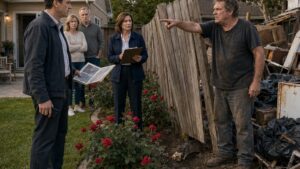
The Morning They Pulled Down the Fence That Kept Her Family Safe
Chapter 1: The Notice Folded Beneath the Grocery Receipts
Katherine found the notice when a carton of eggs slipped from her grocery bag and bumped against her ankle.
For one second she only stared at the bright yellow paper lying on the kitchen floor, half-hidden beneath a grocery receipt and a coupon for laundry soap. Then Linda, seated at the table with both hands around a mug of tea, asked for the third time, “Why is the gate locked?”
Katherine bent to pick up the paper.
“Because Eric is outside,” she said.
Linda looked toward the back window. “He knows how to come in.”
“He does. But he also knows how to chase his truck.”
The notice had the HOA logo at the top: a neat green tree inside a square border. Katherine had seen enough of those envelopes over the years to know they never contained good news. Still, she opened it carefully, as if a gentler touch might change the words.
FINAL COMPLIANCE NOTICE.
Her eyes moved down the page.
Unauthorized privacy structure. Revised landscaping restriction. Removal may proceed without further hearing.
The eggs had stopped rolling against the cabinet, but Katherine could still hear the small hollow tap they had made. She read the paragraph twice. Then a third time, slower.
“Are you mad?” Linda asked.
Katherine folded the notice along its old crease. “No.”
That was not true. But anger was too simple for what she felt. Anger had heat. This was colder. It moved through her chest like rainwater finding a crack in the foundation.
From the yard came the thin scrape of plastic wheels across wet grass.
Katherine set the grocery bag on the counter and crossed to the back door. Eric was crouched beside the cedar fence, pushing his red truck along the narrow strip of dirt where the garden bed met the boards. The truck had lost one headlight sticker months ago. Its wheels clicked unevenly, but Eric refused to throw it away.
The fence stood damp and dark behind him, six feet high except at the gate, where the self-latching metal catch sat just above his reach.
Katherine watched him push the truck toward the gate. It stopped against the bottom board.
“Grandma,” he called through the glass, “can I make a road?”
“Not by the gate.”
“Why?”
“Because I said so.”
He made a face at her, then turned the truck around.
Behind Katherine, Linda sighed. “He should be allowed to play in the yard.”
“He is allowed to play in the yard.”
“It used to be open.”
Katherine’s hand tightened around the door handle. “That was before.”
Linda’s face changed slightly, not into recognition exactly. More like a shadow moving across a room. “Before what?”
Katherine did not answer. She stepped outside instead, leaving the screen door to close behind her.
The yard smelled of wet cedar and the soil from yesterday’s rain. A few of the boards were beginning to pale at the edges, and one near the far corner had a knot shaped like an eye. Katherine had noticed that knot every time she checked the gate. It was part of the fence now, as familiar as the crack in the driveway or the kitchen drawer that stuck when it was humid.
Eric looked up at her.
“Can my road go all the way around?”
“Keep it inside the fence.”
“It is inside.”
“Good.”
He went back to his game, and Katherine walked to the gate. She lifted the latch, let it fall, and listened.
Click.
The sound should have reassured her. Instead, she stood there longer than she meant to, staring through the narrow gap between the boards at the access lane behind the houses.
It was only a strip of pavement. Too narrow for two cars to pass. A place where delivery vans backed up too quickly and teenagers on bicycles cut through after school. Before the fence, it had seemed harmless. Open. Ordinary.
Then Linda had walked into it one afternoon in her slippers, carrying a dish towel because she believed she was going to church.
Katherine had been inside on a work call, trying to answer questions about a schedule she no longer cared about. When she came outside, Linda was halfway to the lane, smiling at a passing truck as though she recognized the driver.
Nothing had happened. Not that day.
But Katherine had spent two years afterward saving for cedar boards one paycheck at a time.
She had kept every receipt.
“Katherine.”
Carol Wilson stood at the far edge of the lane, holding a folded umbrella though it had stopped raining. She wore a quilted vest and had the careful posture of someone who wanted to seem as though she had only happened to be there.
Katherine let the gate swing shut behind her before answering.
“Morning, Carol.”
Carol’s gaze went to the fence. It always did. “You got another one of those letters?”
Katherine looked down at the yellow paper in her hand.
“You saw it?”
“Donald has been making rounds.” Carol shifted the umbrella to her other hand. “Measuring things.”
“Measuring what?”
“Railings. sheds. fences.” She said the last word lightly, but her eyes stayed on the cedar boards. “He was behind your place last week.”
Katherine felt the coldness deepen. “Behind my place?”
“I thought you knew.”
“No.”
Carol pursed her lips. “Well. I assumed he’d told you. He’s been serious about the new standards.”
“The new standards don’t erase an approval.”
“That depends on the approval.”
Katherine did not want to have this conversation through a gate. She did not want Carol to see that the paper was shaking in her hand. “Do you know what he reported?”
Carol looked away first. “I only said the fence changed the look of the lane.”
“You complained.”
“I gave my opinion.”
“And now they can remove it without another hearing?”
Carol’s mouth tightened. “I didn’t say that.”
Eric drove his truck over a clump of mud and made a small engine noise. Linda called from inside, “Katherine, where did you put the sugar?”
Carol glanced toward the house.
“You have a lot on your plate,” she said, softer now. “Maybe it would be easier to work something out.”
Katherine almost laughed. The sound rose in her throat and stopped there.
“Easier for who?”
Carol did not answer. She opened her umbrella even though the sky had cleared and walked toward her own yard.
Katherine stood at the gate until Eric came over and pressed his fingers against the bottom board.
“Can I go see where Carol lives?”
“No.”
“Why not?”
“Because the gate stays shut.”
He looked at her, puzzled by the sharpness in her voice.
Katherine crouched and brushed damp hair from his forehead. “Sorry. You can see Carol another day.”
Inside, she put the groceries away one item at a time. Milk. Bread. Apples. She moved slowly, reading the notice again between each task. It said her appeal period had expired. It said she had failed to submit the proper forms. It said the board had authority to restore common landscaping access at the homeowner’s expense.
She opened the kitchen drawer beside the stove.
The blue folder was under a stack of takeout menus and a flashlight with dead batteries. She pulled it free. The plastic cover had a white scuff near one corner. Inside were permits, invoices, a folded survey in a clear sleeve, and the approval letter with a brown coffee stain near the date.
Linda had spilled coffee across it seven years ago and laughed until she cried.
Katherine unfolded the letter on the table.
Approved: six-foot privacy fence with self-latching gate due to rear access lane exposure and documented household safety considerations.
There it was. Plain. Signed.
For a few minutes, Katherine let herself breathe.
Then she found the copy of her appeal beneath the approval letter.
She had written that the fence had been authorized, that it was located within her property line, that it was needed because of family safety. She had attached the old letter. She had sent it by email two weeks ago.
But the final notice said the appeal window had closed.
No response. No phone call. No explanation.
Katherine looked toward the backyard. Eric had parked his truck beside the gate and was lining up fallen leaves like tiny cars. Linda stood at the sink, staring at a spoon in her hand as if she had never seen one before.
Katherine should have called the HOA that day. She should have driven to the office. She should have stood in front of the board and made them look at the letter.
Instead, she put the blue folder back in the drawer.
Not because she believed the notice.
Because she was tired.
That evening, after Eric’s mother picked him up and Linda had fallen asleep in the living-room chair, Katherine stood at the kitchen window with a dish towel in her hands.
The yard was dark except for the porch light. The cedar fence made a black line against the wet grass. Beyond it, somewhere in the lane, a truck engine coughed and idled.
Katherine leaned closer to the glass.
A white work truck was backing slowly down the narrow pavement behind her house.
It stopped beside the gate.
Chapter 2: The Gate Opened Toward the Street
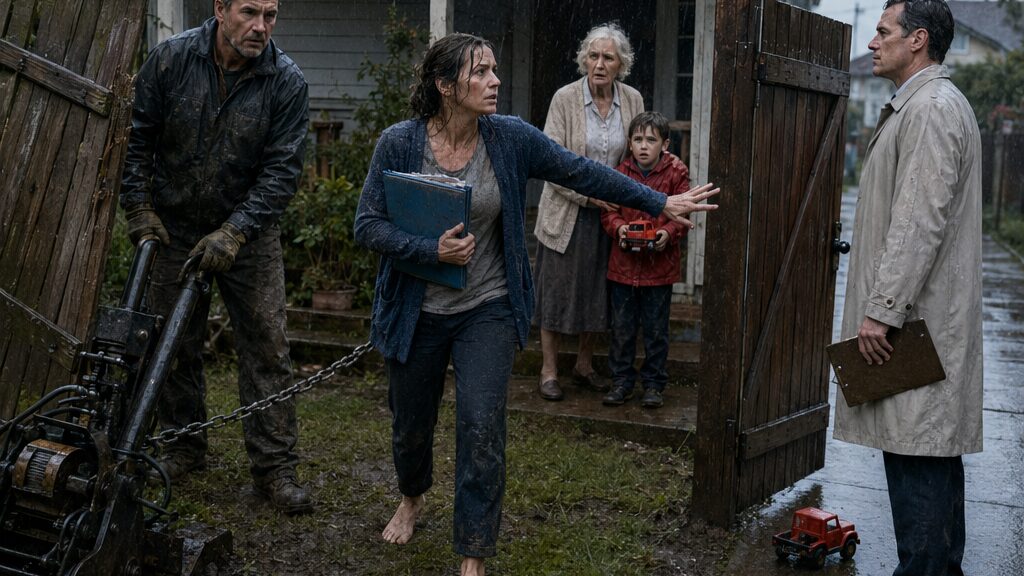
The post puller groaned before Katherine reached the backyard.
She had heard the engine from the kitchen, low and mechanical, and then the splintering sound of wood under strain. By the time she ran through the house, Linda was calling after her from the hallway and Eric had dropped his red truck in the middle of the back step.
Katherine did not stop for shoes.
The wet grass slapped against her bare feet as she crossed the yard. A thick chain was looped around the first cedar post beside the gate. It ran through the metal arm of a post puller parked near the garden bed.
Two men in work jackets stood beside it.
Donald Calder stood at the open gate with a clipboard tucked beneath one arm.
“Stop!” Katherine shouted. “Stop right now.”
The man nearest the machine looked at her. He was broad through the shoulders, with gray at his temples and rain darkening the collar of his jacket. His hand hovered near the controls.
Donald did not move. His raincoat was clean enough to make the mud around his shoes look deliberate.
“Mrs. Hall,” he said. “You were notified.”
“You cannot be in my yard.”
“The board approved removal under the landscaping restriction.”
“That fence is approved.”
“It was approved under a prior standard.”
Katherine pointed at the chain. “Take it off.”
The man with gray at his temples glanced at Donald. “Should we pause?”
Donald’s eyes stayed on Katherine. “The order is clear.”
“You’re tearing open my backyard.” Her voice came out thin at first, then steadier. “My mother is inside. My grandson is here.”
“Personal circumstances do not override community standards.”
The words landed so cleanly that for a second Katherine could not answer.
Behind her, the back door opened.
Linda stepped onto the porch in her cardigan, one hand braced against the frame. “Katherine?” she called. “Were we leaving?”
Eric came behind her, clutching his truck.
Katherine turned fast. “Stay there. Both of you.”
Eric looked past her toward the men. “Why are they taking the fence?”
“Because they made a mistake.”
Donald’s mouth tightened. “Please don’t mischaracterize this in front of the child.”
Katherine looked at him. “You brought machinery into my yard.”
The chain tightened.
The cedar post shuddered. Mud pulled away from its base with a sucking sound. One of the fence panels bent inward, and the privacy screen attached to it wrinkled and sagged like wet cloth.
John—she would learn his name later—raised a gloved hand. “Donald, maybe we should wait until the homeowner gets someone inside.”
“She has had ample time to address this,” Donald said.
Katherine’s throat burned. “I appealed.”
“The appeal was incomplete.”
“You never told me that.”
“You were sent the proper forms.”
“You sent an email with a link.”
Donald shifted his clipboard. “The board cannot make individualized exceptions because someone chooses not to follow procedure.”
A sharp crack cut through the yard.
The panel came loose from the post. It dropped sideways into the grass.
Eric startled. His red truck slipped from his hand and rolled down the slight slope toward the open gate. Its wheels rattled over the patio stones, then carried it beneath the gap where the panel had been.
It stopped near the sidewalk.
Linda watched it go.
For a moment, Katherine saw only her mother’s pale face and the little red truck resting beyond the line that used to keep both of them safe.
Linda stepped off the porch.
“Mama,” Katherine said.
Linda took another step.
The chain clinked as the machine idled.
John lowered his hand. “We need to stop.”
Donald turned to him. “The work must continue.”
“She’s walking toward the street.”
“The homeowner should supervise her family.”
Katherine felt something inside her change.
Until then, she had been trying to explain. She had been trying to make Donald understand that this was not a matter of taste or shade or whether Carol could see more sky from her kitchen.
But Donald understood.
He had looked at Linda. He had looked at Eric’s truck. He had heard Katherine’s voice break.
And he had decided it did not matter.
Katherine crossed the yard in three quick steps, caught Linda by the elbow, and brought her back toward the porch.
“I was getting the truck,” Linda said, embarrassed. “He’ll be sad.”
“I know.”
“Why is the gate open?”
“Because someone opened it.”
Linda looked at Donald, then at the fallen fence, and seemed suddenly smaller inside her cardigan.
Katherine led her into the kitchen. Eric followed silently, his eyes fixed on the red truck outside.
“Stay with Nana,” Katherine told him.
“But my truck—”
“I’ll get it.”
She went to the kitchen drawer, pulled out the blue folder, and returned to the rain.
Donald watched her approach as if she were performing exactly the kind of emotional display he had expected.
Katherine held the folder against her chest. “You want procedure? Fine.”
She opened it on the damp patio table. The pages lifted in the wind, and she held them down with both palms.
“This is the approval letter. This is the permit. This is the survey. The gate was required because of the rear lane. It says so right here.”
Donald did not bend to read.
“Historical documents do not supersede current restrictions.”
“Then tell me why your removal order says this fence is in a common landscaping easement.”
John looked up.
Katherine turned the paper toward him. “Please. Look.”
Donald’s voice sharpened. “You do not need to review homeowner documents.”
John did not answer him. He stepped closer, wiped rain from his brow with the back of his glove, and studied the survey.
Katherine held the clear sleeve open. Her hands shook, but she did not pull them away.
John crouched near the torn section of fence. Along the edge of the lane, half-buried in wet grass, small orange survey stakes marked a crooked line. One was less than a foot from the chain.
He looked from the stake to the paper. Then to the work order clipped to his board.
“Where did this order come from?” he asked.
“From the HOA,” Donald said.
John tapped the document. “It says we’re removing an obstruction from a common easement.”
“The committee determined the structure obstructed landscaping access.”
“That isn’t what this says.”
Donald’s jaw moved once.
Katherine felt the first thin thread of something besides fear.
“You told the board it was community land?”
“I reported concerns based on the access issue.”
“You reported a lie.”
“I reported what I observed.”
“You never asked me for the survey.”
“You had an opportunity to submit evidence.”
“I sent the approval letter.”
“Which was incomplete.”
John stood. “This fence is inside the stakes.”
Donald folded his arms. “It can still be noncompliant.”
“Maybe. But that’s different from an easement removal.” John looked at the broken panel. “And I’m not pulling another post until somebody explains why I’m being told it’s one thing on paper and another thing out here.”
Donald stepped closer. “You are under contract.”
“I’m under contract to do a specific job.” John’s voice stayed low, but the other worker had stopped moving too. “I need a clean work order.”
A screen door squeaked across the lane.
Carol stood beneath her porch awning, arms folded. Two other neighbors had appeared near their driveways. Katherine felt their attention settle over the yard like another kind of weather.
Donald saw them too.
His posture changed. Not much. Just enough for Katherine to understand that he had not expected the morning to become visible.
He lifted his chin. “The fence violates the revised standard. That remains true regardless of placement.”
“Then why call it an easement?” Katherine asked.
No one spoke.
The rain tapped against the fallen privacy screen.
John looked down at the orange stake again, then at the chain biting into the loosened post.
“This may be private property,” he said. “And that work order may not match it.”
Chapter 3: The Survey Stake Beneath the Rainwater
Donald reached for the approval letter before Katherine could slide it back into the folder.
She pulled it away.
“Don’t,” she said.
The word was quiet, but John looked up from the survey stake. So did Carol across the lane.
Donald held his hand in the air for a second, then lowered it.
“I am trying to assess the documentation,” he said.
“You had two weeks to assess it.”
“The documentation should have been submitted through the proper process.”
“It was.”
“It was not complete.”
“Then you should have told me.”
Donald’s eyes flicked toward the neighbors. “Mrs. Hall, this is not productive.”
Katherine laughed once, without humor. “You came into my backyard with a machine.”
John had walked to the post puller and switched off the engine. The sudden quiet made the damage look worse. One fence panel lay in the grass, tilted against a patch of crushed mint. The gate hung open at an angle, its latch twisted loose from the frame.
Inside the house, Eric pressed his face against the back window.
Katherine could see the red truck on the sidewalk beyond the open yard.
Carol stepped down from her porch. She crossed the lane carefully, avoiding the puddles gathering along the curb.
Donald turned toward her. “Carol, you should not involve yourself.”
She stopped at the gate. “I already am.”
Katherine did not know what to say. Carol had complained about the fence more than once. She had done it softly, always with that concerned look that made it seem as though she was speaking for the good of everyone.
Carol stared at the broken cedar panel.
“I told you I didn’t like how high it was,” she said to Donald. “I said it closed off the lane.”
“You raised valid community concerns.”
“I did not say it was on common land.”
Donald’s face remained still. “No one said you did.”
“You did. At the committee meeting.” Carol looked at Katherine now, then away. “You said Katherine would probably give in because she was alone and already overwhelmed.”
Katherine’s fingers tightened around the folder.
Donald gave a small, disbelieving shake of his head. “That is not what I said.”
“It is.” Carol’s voice shook, but she kept going. “You said people like her didn’t challenge notices. You said the board should act quickly before anybody made it complicated.”
The other worker shifted beside John. Neither man spoke.
Donald’s clipboard slipped slightly against his coat. “You are misremembering a discussion about consistent enforcement.”
“Maybe I am,” Carol said. “But I remember you saying that if one person got an exception, everyone would want one.”
John looked toward the line of houses. “There are other tall fences on this block.”
Carol’s eyes dropped.
Katherine followed his gaze. Two yards down, behind a row of trimmed shrubs, a dark privacy fence rose at least as high as hers. It had always been there. She had never thought about it because she had spent so much energy pretending not to notice what other people were allowed to have.
“Whose is that?” John asked.
Carol did not answer.
Donald did. “This case is not about any other property.”
“No,” Katherine said. “It’s about mine.”
John opened the work order again. “It says common landscaping easement.” He tapped the page with one wet finger. “If this was just a standards violation, why did the crew get sent out with that wording?”
Donald took a breath. “The committee uses standard language.”
“Not my standard language,” John said. “My company needs to know where it is permitted to pull posts. If I remove something on private land under an easement order, that’s a problem.”
Katherine had expected relief when John said it. Instead, she felt more exposed.
The papers in the blue folder were not magic. The survey might prove the line, but it would not make Donald admit he had been wrong. It would not put the cedar panel back up. It would not erase the moment Linda had stepped toward the sidewalk.
A car turned into the lane.
Samantha Martin climbed out holding a large umbrella and a phone against her ear. Her hair was pinned back too tightly, and her coat was buttoned wrong, as if she had dressed while moving.
“Yes,” she said into the phone. “I’m here now.”
Donald straightened.
Samantha ended the call and looked at the yard. Her eyes moved from the damaged fence to John’s idle machine, then to the open gate.
“What happened?” she asked.
Katherine almost said, You tell me.
Instead, she held out the blue folder.
“The HOA ordered removal of an approved safety fence,” she said. “The work order says it’s in an easement. It isn’t.”
Samantha accepted the folder carefully. She read the approval letter first. The coffee stain in the corner had spread over the years into a faint brown crescent.
John handed her the work order.
“This language doesn’t match the stakes,” he said. “And I stopped when there was an immediate safety issue.”
Samantha looked toward the house.
Linda stood behind the window with Eric beside her. Eric’s hand was pressed against the glass. His red truck sat alone near the sidewalk.
Samantha’s mouth tightened.
“Donald?” she said.
“The committee determined the fence no longer complied with revised standards,” he replied. “The old approval was conditional.”
“Was the easement designation verified?”
“It was based on access concerns.”
“That is not what I asked.”
Donald’s expression hardened. “I acted on the committee’s understanding.”
Samantha looked down at the approval letter again. “This refers specifically to rear-lane exposure and household safety.”
Katherine waited.
Samantha looked up. “An old approval can still be subject to current restrictions.”
The words hit harder than Katherine expected.
John frowned. “But that doesn’t make it an easement.”
“No,” Samantha said. “It doesn’t.”
For the first time, Donald looked uncertain.
Samantha stepped away to make another call. John took photos of the loosened post, the fallen panel, the orange stakes, and the work order. He photographed the damaged latch. Then he photographed the gap in the yard with the sidewalk visible beyond it.
Katherine watched him and understood that he was not taking pictures for her. Not exactly. He was taking them because he had seen something he did not want attached to his name.
It was not kindness. But it mattered.
Carol stood near the gate, twisting the handle of her umbrella.
“I’m sorry,” she said.
Katherine looked at her.
“I didn’t know he was going to do this today.”
“You knew he was measuring.”
“I thought he was sending another notice.”
Katherine wanted to tell her that another notice would have been enough. That every envelope had made her stomach tighten. That Carol’s dislike of the fence had helped turn a private fear into neighborhood business.
But Linda was still behind the window. Eric was still watching the empty space where his truck had gone.
Katherine only said, “You knew I needed it.”
Carol’s face folded in on itself. “I knew you said you did.”
There was a difference. Katherine heard it. Carol did too.
Samantha returned from the lane.
“I’ve suspended further removal pending review,” she said. “John, can your company install a temporary barrier today?”
John looked at the broken fence, then at the gate. “I can get materials from the truck.”
“Do that,” Samantha said. “Document everything.”
Donald opened his mouth.
Samantha raised one hand. “Not now.”
The temporary barrier was ugly. John and the other worker set two heavy posts into the ground and stretched a stiff panel of construction fencing between them. They secured the damaged gate with a chain and a new padlock until they could brace it properly.
It did not look like protection. It looked like an apology made out of whatever had been available.
By the time the work truck left, the rain had thinned to a mist.
Katherine stood beside the new barrier with the blue folder pressed against her side. Samantha had promised a formal review. She had said the old approval would be considered. She had said the board needed to determine whether the revised restriction allowed an exception.
None of it sounded like certainty.
Through the kitchen window, Linda lifted one hand in a small wave. Eric held up his red truck, which John had retrieved from the sidewalk and wiped clean with a shop towel.
Katherine went inside and placed the folder on the table.
The approval letter lay on top. Beneath it were the survey, the permit, and the appeal she had believed was enough.
Now she saw the blank space where the safety-impact form should have been attached.
She had never filled it out.
And somewhere in an HOA office, someone had decided that omission gave them the right to pull down her fence.
Chapter 4: The Exception Nobody Wanted to Name
The missing form was waiting for Katherine in the HOA portal like it had been there all along.
She sat at the kitchen table before sunrise, the blue folder open beside the laptop, while Linda slept in the living-room chair under a thin blanket. The temporary barrier outside had rattled twice in the wind during the night. Each time, Katherine had gotten up, checked the padlock, then stood at the window until her own reflection blurred over the dark yard.
On the screen, the appeal checklist showed six items.
Five had green marks.
The last one had an empty box beside it.
Safety Impact Supplement.
Katherine clicked it.
A page opened with small gray instructions. Describe the household safety concern. Attach documentation where applicable. Explain why ordinary compliance alternatives are insufficient.
She read it until the words stopped meaning anything.
There had been no phone call. No letter saying the appeal was incomplete. Only the link Donald had mentioned, tucked into an email that had arrived during a week when Linda had begun leaving cupboards open and Eric had been sick with a fever.
Katherine remembered opening the message at midnight, standing beside the washing machine with one of Eric’s small shirts in her hands. She had seen the request for “additional materials,” assumed it meant another copy of the approval letter, and sent that again.
Now she saw the blank form and felt the old anger turning inward.
She could have filled it out.
She could have written: My mother wanders.
She could have written: My grandson is small enough to chase a toy through an open gate.
She could have written: I cannot afford one ordinary mistake.
Instead, she had sent the documents and waited, because she could not bear the thought of explaining the rest to strangers who might decide Linda was a problem to be managed.
Linda stirred in the chair.
“Katherine?”
“I’m here.”
“Is it morning?”
“Almost.”
Linda looked toward the back window. The temporary fencing made a pale, uneven shape in the yard. “What happened to the gate?”
Katherine closed the laptop halfway. “They’re fixing it.”
Linda accepted that without asking more. Sometimes forgetting was mercy. Sometimes it was only another thing Katherine had to carry.
By midmorning, she had printed the checklist, the incomplete appeal notice, and the emails. She added them to the blue folder behind the survey. Then she walked the rear lane with Eric beside her, his red truck tucked beneath one arm.
The lane looked different with the fence broken. Katherine could see directly into her own yard now. The garden bed. The patio table. The kitchen window where Linda had stood yesterday. She hated how exposed it made the house feel, as if the boards had been hiding more than a patch of grass.
Eric stopped near the next property.
“Look,” he said.
A dark fence stood behind the house at the corner. It was taller than Katherine’s by at least a few inches, built from black-painted boards that met cleanly at the top.
“That one is big,” he said.
“I see it.”
“Why don’t they take that one?”
Katherine looked down the lane. There were more once she began seeing them. A stained wood fence behind one home. A white vinyl one near the drainage ditch. A tall screen beside the house where one of the board members lived.
She had passed all of them for years.
She had never measured them with her eyes because she had been too busy trying not to look like someone who resented other people.
Carol was on her porch when Katherine came back.
She had a grocery bag at her feet and a newspaper folded on the railing. She watched Katherine approach but did not smile.
“Can I ask you something?” Katherine said.
Carol nodded once.
“Those other fences. Did Donald measure them?”
Carol looked down at the newspaper. “I don’t know.”
“You said he was making rounds.”
“I saw him behind your yard.”
“Only mine?”
Carol’s silence lasted too long.
Katherine shifted the blue folder against her hip. “Carol.”
“He asked me about yours,” Carol said. “Not the others.”
“Why?”
“I thought because mine backs onto the lane too.” Carol’s fingers tightened around the paper. “I told him I didn’t like the height. I told him it felt closed in.”
“You told him that after seven years?”
“I didn’t know it had been approved for your mother.”
“You never asked.”
Carol flinched, but Katherine kept going.
“You saw Linda out there. You saw Eric.”
“I know.”
“No. You knew I had reasons. That’s not the same.”
Carol’s eyes filled, and Katherine hated that it made her feel cruel. She did not want Carol’s tears. She wanted a different past, one where her neighbor had crossed the lane years ago with a question instead of a complaint.
“I didn’t know Donald would make it into this,” Carol said. “At the meeting, he showed pictures from the lane. He said the fence blocked access and that the old approval had been a special favor.”
“Did he say it was on community land?”
Carol looked at the broken fence behind Katherine’s house. “He said it might as well be.”
That was not an answer, but it was enough.
At the HOA office, Samantha met Katherine in the records room. It smelled of copier toner and old carpet. A metal file cabinet stood open beside the desk, and stacks of maintenance invoices crowded the corners.
“I’ve pulled the committee records,” Samantha said. “You can review what applies to your address.”
Katherine sat across from her and opened the folder.
There were meeting notes. A copy of Carol’s complaint. Photographs of the fence from the lane. A printed version of Katherine’s appeal. The blank safety-impact supplement was attached behind it.
Then she found three photographs she had never seen before.
Donald stood in the rear lane, holding a measuring wheel. The pictures were dated nearly three weeks before the final notice. In one, he was kneeling near the survey stakes. In another, he was looking over the fence toward Katherine’s backyard.
“He came back there before he sent the notice,” Katherine said.
Samantha leaned over the desk. Her face tightened.
“The committee does inspections when a complaint is received.”
“Did he inspect the other fences?”
“I don’t know.”
“You should.”
Samantha said nothing for a moment. Then she pulled another paper from the file.
“This is the compliance sequence,” she said. “Donald submitted his report. The committee voted to issue a correction notice. When your appeal came in, it was marked incomplete.”
“By whom?”
“By the office.”
“Did anyone call me?”
“No.”
“Why not?”
Samantha’s shoulders lowered slightly. “We should have.”
The apology was too small, but it was the first one Katherine had heard.
Samantha pointed at the report. “The removal action was authorized after the appeal deadline passed. Donald requested expedited enforcement because of what he called continuing access concerns.”
“Access to what?”
“He wrote, ‘Community easement and visual corridor.’”
Katherine looked at the words until they seemed to grow larger on the page.
Visual corridor.
Not safety. Not property line. Not an actual lane that people used.
A view.
Her phone vibrated against the desk.
Donald Calder.
She stared at his name until Samantha noticed.
“You don’t have to answer,” Samantha said.
Katherine did anyway.
“Hello?”
“Mrs. Hall,” Donald said. His voice was measured, almost tired. “I heard you’re reviewing records.”
“I’m reading what you wrote about my property.”
“I’m trying to resolve this reasonably.”
“You already tried.”
“I understand you’re upset.”
“You ordered men to keep pulling while my mother walked toward the street.”
A pause.
“I ordered enforcement of a board decision. I did not create the circumstances in your household.”
Katherine gripped the phone. Samantha looked away, giving her privacy she did not want.
Donald continued. “I’m willing to recommend a compromise. A lower decorative barrier. Something that satisfies the current standard without putting you through more hearings.”
“A barrier that Eric can climb over?”
“That is not what I said.”
“A barrier that leaves the lane visible?”
“The neighborhood has standards for a reason.”
“And other six-foot fences?”
“I’m not discussing other properties.”
“Because you didn’t inspect them?”
His breath caught once, barely audible.
“You are making this harder than it needs to be,” he said. “The board may be willing to move quickly if you withdraw your complaint.”
Katherine looked through the office window at the thin trees along the parking lot. For years, moving quickly had meant swallowing things before they became bigger. It had meant signing forms, paying bills, closing gates, setting alarms, and telling herself she could handle whatever came next.
But Donald was offering her a smaller fence and a quieter ending.
He was offering her the same silence that had gotten her here.
“I’ll think about it,” she said.
After the call, she went back to the folder.
Beneath Donald’s report was an email chain printed on three pages. Samantha had not seen it; it had been clipped behind the committee packet.
Katherine read the subject line first.
RE: HALL FENCE — TEST CASE.
Her hands went cold.
Chapter 5: The Fences That Were Never Measured
Eric stopped in the middle of the lane and pointed over the hedge.
“That one is taller than ours.”
Katherine followed his finger. The fence behind the board member’s yard rose dark and solid above the shrubs, its top edge nearly level with the lower branches of a maple tree. It had no gaps. No decorative cutouts. No narrow view through to a “visual corridor.”
It was exactly what Donald had said Katherine could not have.
“Don’t touch the hedge,” she told Eric.
“I wasn’t.”
“You were thinking about it.”
He smiled, then looked back at the fence. “Did they get a yellow paper too?”
Katherine had no answer.
She had spent the morning copying records at the library, then walking the neighborhood with the blue folder under her arm. She told herself she was not searching for ammunition. She was only looking. But each time she found another tall fence, something inside her settled into place.
The point had never been that fences were forbidden.
The point was who had to explain needing one.
At the next corner, Carol sat on her porch steps with a cup of coffee. She looked as though she had been waiting.
Katherine almost kept walking.
Then Carol said, “I called Samantha.”
Katherine stopped.
Eric rolled his truck along the curb, staying close enough for Katherine to watch him.
“What did you tell her?”
“The truth.” Carol stared down into her cup. “I told her I complained about the fence because I didn’t like it. I told her I never said it was on common land. I told her Donald said your case would be easier if the board acted before you started asking questions.”
Katherine’s first feeling was not gratitude. It was anger that Carol had waited until now.
“And?”
“And Samantha asked whether I’d put it in writing.”
“Will you?”
Carol looked toward the lane. “I don’t want trouble with my neighbors.”
“You already brought trouble to mine.”
The words came out sharper than Katherine meant them to. Eric looked up.
Carol nodded slowly. “Yes.”
For a moment, Katherine saw the older woman not as an enemy but as someone who had mistaken discomfort for righteousness. That did not make the damage smaller. It only made it more ordinary.
Carol set her cup down. “I thought the fence made your yard look like you didn’t trust anyone.”
Katherine looked back toward her house. The temporary barrier leaned crooked in the distance.
“I didn’t trust the lane,” she said.
Carol swallowed.
“I’ll write it,” she said.
At the HOA office that afternoon, Samantha spread copies of several property files across the desk.
“I reviewed the fences you mentioned,” she said. “Three are over the current height limit.”
Katherine stared at the papers.
“And?”
“One predates the revised standard and was grandfathered. One was approved under a hardship exception that was never formally updated. The third…” Samantha paused. “The third belongs to a current board member. There is no approval in the file.”
“Was it cited?”
“Not that I can find.”
Katherine let out a breath through her nose. It was not surprise exactly. Surprise required believing the system had been neutral before you saw otherwise.
Samantha tapped Donald’s report. “The easement language came from him, not from the office. The contractor’s work order was generated from his committee submission.”
“So he wrote it.”
“He provided the wording.”
“And nobody checked?”
“I didn’t.” Samantha met Katherine’s eyes. “That was my failure.”
Katherine wanted to accept the apology, because accepting it would make the room easier to stand in. But Samantha had been the person who could have called. Could have read the old approval. Could have looked at the survey before sending men into the yard.
“You could have stopped it,” Katherine said.
“Yes.”
Samantha did not defend herself.
That mattered too, though not enough.
A knock sounded at the open office door. Donald stood there in a gray jacket, his clipboard under one arm. He looked from Katherine to the files on the desk.
“I thought we agreed to work toward a resolution,” he said.
“We did not agree to anything,” Katherine said.
Samantha stood. “Donald, this is a records review.”
“You’re letting her investigate other homeowners now?”
Katherine turned in her chair. “I’m asking why my fence was an emergency and theirs were not.”
“Because your fence is in a shared rear corridor.”
“So are theirs.”
“Not in the same configuration.”
“That’s not what your report says.”
Donald’s face tightened. “Mrs. Hall, you are turning a compliance issue into a campaign against your neighbors.”
“No,” she said. “You did that when you came into my yard.”
For the first time, something broke through Donald’s controlled expression. Not guilt. Frustration, perhaps. Or fear that the matter was moving beyond the narrow rule he had hoped to enforce.
“I’ve spent months trying to clean up standards the previous board ignored,” he said. “People complain when rules are not applied. They complain when exceptions are made. Every person has a reason their situation should be different.”
“My mother wandering is not a reason to make my yard prettier.”
“That isn’t what I said.”
“You said my family is a personal circumstance.”
Donald looked toward Samantha. “The board cannot make policy based on one household.”
Katherine stood.
“Then make policy based on what happened when you removed a safety barrier without checking the land, the approval, or the people inside the house.”
The room went quiet.
Donald adjusted his grip on the clipboard. “You have made your point.”
“No,” Katherine said. “I have not.”
He left without another word.
An hour later, John’s photographs arrived in Samantha’s inbox. He had taken close shots of the survey stakes, the work order, the chain around the post, the broken gate latch, and the gap between the yard and the sidewalk. He had included a note stating that he had halted work because the order’s easement description did not match the visible survey markers and because continued removal created an immediate safety risk.
Samantha read the note twice.
Then she picked up the phone.
“The board is calling a special hearing,” she said.
Katherine felt her stomach drop.
She had wanted answers. She had wanted Donald to stop talking as though she were a problem to be solved.
But a hearing meant sitting in a room with people who knew the street, the lane, the fence. It meant explaining Linda’s condition to neighbors who had once admired her garden and now might measure her by what she forgot.
“What if they decide I’m difficult?” Katherine asked.
Samantha’s expression softened. “They may.”
Katherine looked through the office window. Outside, Eric stood beside Carol on the sidewalk, showing her how the red truck’s back wheel sometimes caught when he pushed it too fast.
Samantha continued, “But difficult is not the same as wrong.”
Chapter 6: What Katherine Refused to Hide Again
“Why do you keep checking it?” Linda asked.
Katherine stopped with one hand on the temporary gate latch.
It was dark enough that the backyard had lost its edges. The construction panel made a faint silver line under the porch light. Katherine had already checked the lock twice since dinner. Now she pressed the latch once more, listened to the metal catch, and tugged it hard enough to make the whole frame shiver.
Linda stood in the doorway in her cardigan.
“You checked it before,” she said.
“I know.”
“Is someone coming?”
Katherine looked at her mother. Linda’s hair was soft and white around her face. She held the old approval letter in both hands, the coffee stain visible near the corner.
“No one’s coming tonight.”
“Then why are you afraid?”
The question was simple. That made it worse.
Katherine let go of the latch. “I’m not afraid.”
Linda waited.
The old lie sounded smaller in the dark yard.
Katherine sat on the porch step. After a moment, Linda lowered herself beside her, careful and slow. The approval letter rested in her lap.
“You used to like the gate,” Linda said.
“I still do.”
“You liked the sound.”
Click.
Katherine looked toward the temporary barrier.
“I liked knowing it worked.”
Linda touched the coffee stain with one finger. “I spilled on this.”
“You did.”
“Was I sorry?”
“You laughed.”
Linda smiled faintly. “That sounds like me.”
For several seconds, neither spoke. Somewhere down the lane, a car door shut. Katherine’s shoulders tightened before she could stop them.
Linda noticed.
“You think I’ll go somewhere,” she said.
Katherine’s throat closed.
“I think you get confused sometimes.”
“I do not like that.”
“I know.”
Linda folded the approval letter once, then unfolded it carefully. “Did I go somewhere before?”
Katherine had spent years avoiding that question. Not because Linda had asked it often. Because Katherine had answered it alone too many times.
She saw the old afternoon as clearly as if it were still waiting behind the house: the phone wedged between her shoulder and ear, a supervisor asking about shifts, her hands wet from rinsing dishes. Then the back door open. The yard empty. Linda in pale slippers near the lane, waving to a truck she believed was carrying people from church.
Katherine had reached her before anything happened.
But afterward, she had sat on the curb with Linda’s hand in hers and known that reaching someone in time was not the same as keeping them safe.
“Yes,” she said.
Linda looked at her.
“You walked toward the lane. I was inside. I didn’t see you leave.”
“I’m sorry.”
Katherine shook her head too quickly. “No. Don’t.”
“But you’re still sad about it.”
“I’m sad because I thought I could do everything by myself.”
Linda considered this. Her gaze drifted toward the dark yard.
Then she said, very softly, “You made the yard stop moving away.”
Katherine pressed her lips together.
Her phone vibrated on the porch beside her.
Donald Calder.
She let it ring once. Twice.
Linda touched her wrist. “Answer it.”
Katherine did.
“Mrs. Hall,” Donald said. “I won’t keep you long.”
“You already have.”
He ignored that.
“I understand the hearing is tomorrow night. I wanted to give you one final option before this becomes more painful for everyone.”
Katherine looked at the temporary gate.
“What option?”
“The board could authorize immediate replacement of the damaged structure with a compliant lower barrier. I would support that. We can resolve the property-line confusion internally. You would withdraw the complaint and the request for broader review.”
“And the safety exception?”
“That can be evaluated later.”
“That means no.”
“It means policy should not be made in the middle of a dispute.”
Katherine closed her eyes.
Donald’s voice softened, as though he were offering kindness. “You do not need to discuss your mother’s condition in front of the entire neighborhood. You do not need to turn your family into an example.”
She felt Linda’s hand beside hers on the porch step.
“You already turned us into an example,” Katherine said.
“I’m trying to prevent more damage.”
“You are trying to prevent people from seeing it.”
His breath came out slowly.
“Every homeowner has private burdens,” he said. “If we redesign standards around individual circumstances, we stop having standards.”
Katherine looked through the back window. On the kitchen table, the blue folder lay open beside John’s photographs. Eric’s red truck sat on top of the papers because he had brought it in after dinner and forgotten it there.
The truck looked too small to carry any meaning. A cheap piece of red plastic with one missing sticker.
But it had rolled through the open gate.
Linda had followed.
And Donald had watched.
“You don’t have to redesign everything,” Katherine said. “You just have to look at what is in front of you before you tear it apart.”
He was quiet.
Then he said, “I hope you consider what this will cost.”
The line went dead.
Katherine sat for a while without moving.
Linda leaned against her shoulder, light as a bird.
“I don’t want people to know things,” Katherine said.
“I know.”
“I don’t want them looking at you like you’re a problem.”
Linda looked down at the approval letter. “Am I?”
“No.”
“Then don’t act like I am.”
Katherine laughed once, and then she cried. Not loudly. She covered her face with both hands, embarrassed even in the dark, until Linda placed the letter in her lap.
Later, after Linda was asleep, Katherine brought everything to the kitchen table.
The blue folder.
The old approval letter.
The survey.
The incomplete appeal checklist.
Carol’s written statement, delivered that afternoon in a plain envelope.
John’s photographs.
The printed email with TEST CASE in the subject line.
She set Eric’s red truck beside them.
Then she called Samantha.
“I’m not taking Donald’s offer,” Katherine said.
Samantha was quiet for a moment. “All right.”
“I want the board to see everything.”
“They will.”
“And I want to ask for more than my fence.”
“What do you want?”
Katherine looked toward the backyard. The temporary gate stood where cedar boards should have been, holding only because she had checked it again and again.
“A rule that makes them call people before they do this,” she said. “A real safety review. Not a form nobody explains.”
“I’ll put it on the agenda.”
When the call ended, Katherine did not close the folder.
She left it open on the kitchen table beside the red truck, as if in the morning she might need proof that she had finally stopped hiding what mattered.
Chapter 7: The Board Meeting Behind Closed Blinds
“A visual obstruction that became an emotional argument.”
Donald said it without looking at Katherine.
He stood at the far end of the meeting room beneath a row of closed white blinds, one hand resting on the long table as though he belonged there more than anyone else. His gray jacket was pressed. His clipboard lay squarely beside a stack of HOA papers. Through the thin gaps in the blinds, the rear lane lights made faint yellow stripes across the wall.
Katherine sat opposite him with the blue folder on her lap.
The room was fuller than she expected. Carol had taken a chair near the back. John stood beside the door in his work jacket, holding a flat envelope of photographs. Samantha sat at the side table with a laptop open in front of her. The board members had arranged themselves behind the main table, their faces careful and tired.
Katherine had brought Eric’s red truck in her tote bag.
She had not meant to take it out. But when she placed the folder on the table, the truck came with it. It rolled a few inches and stopped against the old approval letter.
Donald looked at it briefly, then back at the board.
“The question is whether the Hall fence can remain under the revised landscaping standard,” he continued. “I understand there was an unfortunate timing issue during removal. But we cannot decide policy based on emotional pressure in a single household.”
Katherine felt her palms begin to sweat.
Samantha looked toward her. “Mrs. Hall, you may respond.”
Katherine had rehearsed on the drive over. She had planned to begin with the survey. Then the approval. Then the work order.
Instead, she looked at the red truck.
“My fence was not removed because someone measured it and found it unsafe,” she said. “It was removed because Donald told the committee it interfered with an easement.”
Donald interrupted. “I said it created access concerns.”
“The work order says common landscaping easement.”
Samantha pulled a copy from the file and placed it on the table.
Donald’s voice remained calm. “That was administrative wording.”
John shifted near the door.
Katherine opened the blue folder. The papers made a dry, familiar sound. She laid out the survey first, then the approval letter, coffee stain and all.
“This was approved seven years ago,” she said. “It says why. Rear-lane exposure. Household safety. The stakes are still there. The fence was built inside them.”
One board member leaned forward to look.
Donald folded his arms. “Again, past approval does not automatically override a revised standard.”
“No,” Katherine said. “But it should have meant someone asked why it was there before they sent a crew to remove it.”
The room was quiet.
Katherine took out the photo of the open yard. John had captured it just after the first panel fell: the gate hanging crooked, wet grass pressed flat, the sidewalk visible through the gap.
“My mother has memory problems,” Katherine said. “My grandson was in the yard. His truck rolled out when the fence came down. My mother followed it.”
She did not look at Carol. She did not look at anyone.
“I did not tell you all that before,” she said. “I thought I could just submit the old letter and be left alone. I thought if I handed in enough paperwork, no one would make me explain my family.”
Her voice shook once. She stopped, pressed a hand flat against the folder, and continued.
“But Donald saw what was happening. John asked him to pause. He told the crew to keep going.”
Donald’s face changed. Not much. His mouth tightened around the edges.
“I said the homeowner was responsible for supervising her family,” he replied.
John came forward before Katherine could answer.
“That’s what he said,” John told the board.
He laid his photographs beside the survey. Close shots of the orange stakes. The chain around the post. The damaged latch. The work order. The empty space between the yard and the lane.
“I don’t know your rules,” John said. “I know my work order. It said easement removal. I saw the stakes and asked about it. I saw a little kid’s toy go out through the open gate, and an older woman heading after it. I stopped because the order didn’t match what was in front of me.”
Donald turned toward him. “You were not asked to interpret HOA policy.”
“No,” John said. “I was asked to pull a structure out of the ground. I need to know whose ground it is.”
A murmur moved through the room.
Then Carol stood.
Katherine’s breath caught.
Carol had brought her written statement, but she had not said she would speak.
“I complained about the fence,” Carol said. Her hands were clasped so tightly in front of her that her fingers had gone pale. “I didn’t like how it looked from the lane. I thought it made things feel closed in.”
Donald watched her with a flat expression.
“But I never said it was on common property. I never said Katherine did not need it. Donald said that at the committee meeting.” Carol looked at the board. “He said her fence could be a test case. He said she was overwhelmed and would probably accept whatever notice she got.”
Donald shook his head. “That is not an accurate characterization.”
“It is accurate enough,” Carol said. “And I let him talk like that because I didn’t want to admit I’d complained about something I didn’t understand.”
The room seemed suddenly smaller.
Samantha clicked through documents on her laptop. “The committee email chain is in the record,” she said. “The subject line reads, ‘Hall Fence — Test Case.’”
One board member asked, “Who wrote that?”
Samantha turned the screen slightly.
Donald did not answer.
Katherine looked at him. She had spent days imagining this moment as a clean kind of victory, a room where the truth would land and everyone would understand.
It was not clean.
Donald looked tired now. Not defeated. Not remorseful. Tired in the way people looked when the story they had told themselves no longer fit the papers in front of them.
“I was trying to apply a standard that had been ignored for years,” he said. “You all asked for consistent enforcement. You cannot ask volunteers to make distinctions based on every household’s private situation.”
“No one asked you to ignore the rules,” Katherine said.
Donald looked at her.
“I asked you to read the approval. I asked you to check the line. I asked you to stop when my family was standing in an open yard.”
For the first time, he had no immediate answer.
One board member cleared his throat. “Mrs. Hall, the board is prepared to reimburse the cost of the damaged fence and authorize a replacement. We would prefer to resolve this directly.”
Katherine stared at him.
A replacement. A check. The same offer Donald had made, with softer words.
It would fix her yard. It would let Linda sit safely on the porch again. It would allow Eric to play without Katherine watching the gate every minute.
And then someone else would receive a yellow notice with an invisible form attached to it. Someone else would be told their reason was personal.
Katherine pushed the blue folder toward the center of the table.
“I do want my fence repaired,” she said. “But not only that.”
The board member’s expression cooled.
“I want a written safety review before any approved protective structure is removed. I want direct contact with the homeowner when an appeal is incomplete. I want the board to review every similar fence that was ignored or grandfathered without clear records. And I want no crew sent onto private property based on a volunteer’s wording alone.”
The red truck sat beside the approval letter.
Katherine touched it with one finger.
“Because when you call something a visual obstruction, you may forget there are people behind it.”
No one clapped.
No one needed to.
The board spoke quietly among themselves. Samantha left the table once to take a phone call, then returned with a paper in her hand.
“The board is voting now,” she said.
Donald sat very still.
The vote took less than ten minutes.
He was suspended from the compliance committee pending an investigation into the report language, the expedited action, and the unequal enforcement records. The board authorized immediate installation of a reinforced temporary gate at Katherine’s home and accepted Samantha’s recommendation for a formal safety-exception policy review.
When it was over, Donald picked up his clipboard.
He paused beside Katherine’s chair.
“I still believe rules matter,” he said.
Katherine looked up at him.
“They do,” she said. “That’s why you should have followed them.”
He left without another word.
Outside, John waited near the parking lot.
“I can be at your place before dark,” he said. “I’ve got better bracing in the truck.”
Katherine nodded.
The blue folder felt heavier in her arms than it had when she brought it in. But as she walked toward her car, it no longer felt like something she had to hide.
Chapter 8: The Latch That Finally Held
John arrived with fresh cedar boards stacked in the bed of his truck.
Linda watched from the porch in her cardigan, her hands resting on the railing as though she were afraid the yard might change again if she looked away. Eric sat cross-legged beside her, rolling the red truck along one porch step and back.
Katherine stood near the broken section of fence with a mug of coffee gone cold in her hand.
John set down the first board.
“Matches close enough,” he said.
“It looks new,” Katherine replied.
“It is new.”
She almost smiled.
The HOA had moved faster than she expected after the hearing. The temporary barrier had been reinforced that same night, and by the next afternoon Samantha had sent a written notice: the removal order was voided, the damage claim approved, and a new safety review process under consideration. It was not a miracle. The notice did not make the yard whole. It did not erase the sound of cedar cracking under the chain.
But John had come back.
He measured twice before setting the posts. He showed Katherine where the new latch would sit and asked Eric whether he could reach it.
Eric stretched on his toes.
“Nope,” he said proudly.
“Good,” John said.
By late afternoon, the new boards stood in a clean line beside the old ones. The cedar was pale compared with the weathered fence, almost gold where the sun reached it.
Carol appeared at the side gate carrying a manila envelope.
Katherine saw her before Carol spoke.
“Is this a bad time?” Carol asked.
John kept working. Eric looked up from his truck.
Katherine set down her coffee. “What is it?”
Carol held out the envelope. “A neighbor from the next street got a notice this morning. Not about a fence. About a ramp by the front steps.”
Katherine took it.
“It says the appeal form is online,” Carol continued. “I told her to call Samantha. I told her not to wait.”
The envelope felt light in Katherine’s hands.
“You didn’t have to bring this here,” she said.
“I know.”
Carol looked at the new boards. “I was wrong about your fence.”
Katherine waited.
“I still don’t love how it looks from the lane,” Carol added, almost apologetically.
A laugh escaped Katherine before she could stop it.
Carol’s mouth trembled into the beginning of a smile.
“But I know now it was never about what I liked.”
“No,” Katherine said. “It wasn’t.”
Carol nodded. She did not ask forgiveness. Katherine did not offer it in a neat sentence. They stood together for a moment beside the rebuilt line between their yards, with the lane behind them and the smell of fresh-cut cedar in the air.
Then Carol turned to Eric.
“Your truck still missing that sticker?”
Eric looked down at it. “It’s supposed to be like that.”
“Of course it is,” Carol said.
When she left, John fitted the new gate into place.
The hinges gave a soft metal squeak. He adjusted them, then tested the latch once.
Click.
Katherine heard the sound from where she stood.
Her chest tightened.
John tested it again. “You want to try?”
Katherine stepped forward. Her hand hovered over the wood for a second before she pushed the gate closed.
Click.
The latch caught firmly.
Linda had come down from the porch. She stood beside Katherine, close enough that their sleeves brushed.
“It looks nice,” Linda said.
“It does.”
Linda ran her fingertips over the new cedar board. “Will it always stay shut?”
Katherine looked at the gate.
The question was not really about the latch. She knew that.
She thought of the temporary barrier. The incomplete form. The blue folder spread across the hearing table. Carol’s envelope. John stopping his machine. Samantha admitting she had failed to call.
Nothing would always stay shut. Not gates. Not doors. Not the parts of life that needed watching.
Katherine took Linda’s hand.
“I can’t promise that,” she said.
Linda’s face fell slightly.
“But I can promise I won’t be the only one watching anymore.”
Linda looked at her for a long moment, then squeezed her fingers.
Eric climbed down from the porch with his red truck.
“Can I test it?” he asked.
John stepped back. “Go ahead.”
Eric placed the truck on the grass and pushed it hard. It bumped over a patch of dirt, rolled past the garden bed, and tapped gently against the new fence.
It stopped.
Eric nodded as if he had expected nothing less.
Then he ran to the gate and pulled it closed behind him.
The latch clicked into place.
The story has ended.