They Sent a Crew to Tear Down His Spillway Repair Before the Lake Broke Loose
Chapter 1: The Crew Arrived Before The Notice Dried
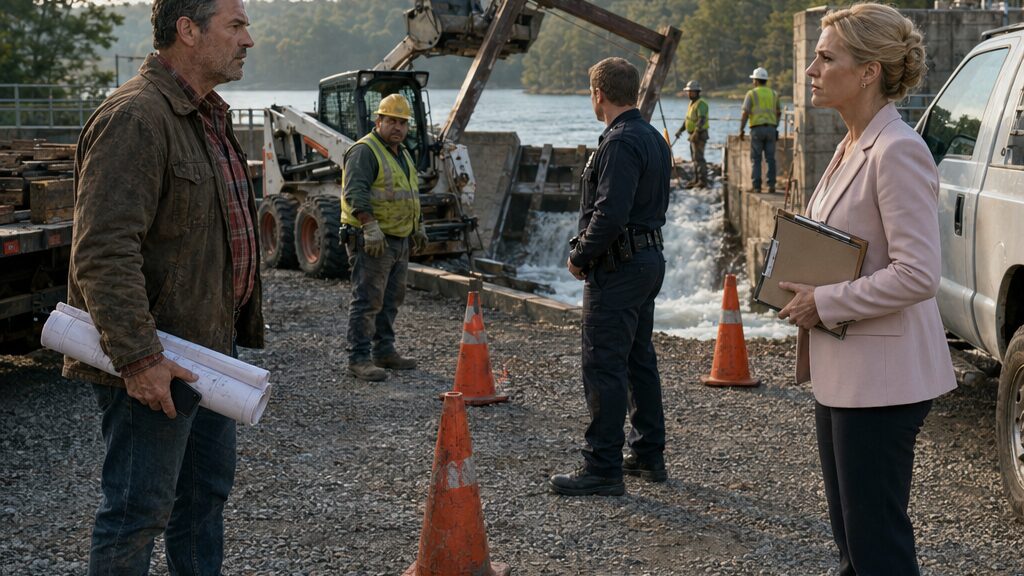
The skid steer already had its metal teeth under the first brace when William Carter reached the dam road.
For one second, he did not move. The machine groaned, the orange beacon spun, and the timber he had bolted across the lower spillway shuddered loose from the concrete like a bone being pulled from a joint. Two workers stood in the gravel with pry bars. A flatbed truck waited with its tailgate down.
William stepped out of his pickup with the rolled dam plans tucked under his arm.
“Stop that machine.”
The crew supervisor turned first. He was a broad man in a yellow vest, hard hat low over his eyes, one gloved hand lifted toward the operator. The skid steer paused with the brace hanging crooked from its bucket.
William walked past the first orange cone.
“Sir,” the supervisor said, “you need to stay clear of the work area.”
“That is my work area.”
A deputy stood beside the access gate, one hand resting near his belt, the other holding a folded paper. Ryan Davis had always looked too young to William, even though the man had probably been a deputy for ten years by now. This morning he looked uncomfortable before he even spoke.
“William,” Ryan said, “don’t make this harder.”
William looked past him to the spillway. The brace had not been pretty. It was not meant to be. Two pressure-treated beams, steel plates, anchor bolts, and a diagonal support tied into the old service ledge. It held the vibration down when the lake pressed against the cracked outlet gate. He had built it because the gate had begun to hum at night, low and metallic, like something alive inside the concrete.
The skid steer lowered the brace section onto the gravel.
A woman in a pale pink blazer stepped out from behind the crew truck with a clipboard against her chest. Rebecca Mitchell did not dress for dam roads. Her shoes were wrong for gravel, her hair pinned smooth despite the lake wind, her sunglasses held in one hand like she had brought them for a meeting and found herself in a trespass dispute instead.
“Mr. Carter,” she said. “This work has been deemed unauthorized.”
William stared at the beam lying on the ground. Fresh scrapes showed where the bucket had caught it.
“Unauthorized by who?”
“By the Lake Hollow Association board.”
“The same board that had my repair request for four weeks?”
Rebecca’s jaw moved once. “This is not an approved repair. It alters common infrastructure, creates liability, and may affect insurance coverage for every property owner on this lake.”
“It keeps the outlet gate from walking out of its seat.”
“That is your opinion.”
William held up the rolled plans. “It’s in the drawings.”
“You were instructed not to perform work on association property without approval.”
“I was instructed to wait,” William said. “The gate wasn’t waiting.”
The operator killed the engine. The sudden quiet made the water louder. It pushed through the concrete channel below the spillway in a white, restless sheet. Beside the gatehouse, the warning sign rattled on one loose bolt.
Rebecca looked to the supervisor. “Samuel, continue with removal.”
William turned his phone camera on before he knew he had decided to. His thumb found record. The screen caught Rebecca, the crew truck, the beam on the gravel, Ryan beside the gate.
“State your name and who authorized this,” he said.
Rebecca’s expression hardened. “You are creating a disturbance.”
“No. I’m creating a record.”
The supervisor, Samuel Garcia, shifted his weight. “Mr. Carter, I’m just here on a work order.”
“Then show me the order.”
Rebecca stepped between them. “You received notice.”
“When?”
“It was posted.”
“When?”
“This morning.”
William looked at the brace, then at the machine tracks cut deep into damp gravel. “This morning when the crew was already here?”
Ryan unfolded the paper in his hand. “The notice was placed at your residence at 7:10 a.m.”
William checked his watch. “It’s 7:38.”
Rebecca did not blink. “We shut down your dam repair this morning.”
The words landed wrong. Not like an explanation. Like a trophy.
William lowered his phone a little, just enough that she could see his face without the screen between them.
“You didn’t shut down my repair,” he said. “You removed the only thing reducing pressure on a cracked outlet gate.”
Rebecca glanced toward the concrete structure as if the gate might answer for itself. “The association cannot allow residents to install homemade structures on common property.”
“Homemade?” William pulled the rubber band from the plans. The roll snapped open against his forearm, revealing cross-sections, measurement notes, and a red-marked seam at the lower gate housing. “I maintained county pump stations for twenty-two years. I sent you the same layout with the emergency request. The brace is temporary. The permanent repair needs a contractor and a permit. I know that. But this”—he pointed toward the exposed bolt line—“was keeping the vibration from spreading.”
Rebecca’s eyes flicked to the paper, then away from it. “The proper place for those materials is the board meeting.”
“The proper place for those materials was your inbox four weeks ago.”
A crew worker lifted one of the steel plates and carried it toward the truck. William started forward.
Ryan stepped in front of him. “Don’t.”
“That plate is mine.”
“William.”
“That plate is holding back your road, too.”
Ryan’s face tightened. “Behind the cones. Now.”
For a moment, William wanted to push past him. He could see everything wrong at once: the angle of the exposed bolts, the darker water mark along the seam, the way one worker had set the brace down with no idea which side had been under load. His hands closed around the plans until the paper crushed.
Jessica would be on the lower road by now, heading back from the early shift at the clinic. If the spillway backed up, her driveway would be the first to take water. Then the culvert. Then the crawl space under the house he had spent two summers leveling after his divorce.
“Do not remove the diagonal support,” William said, each word forced flat. “At least leave that until an engineer looks at it.”
Rebecca turned to Samuel. “Remove all noncompliant materials.”
Samuel’s mouth opened, then closed. He nodded to his crew, but his eyes stayed on the exposed seam longer than before.
William raised the phone again. “Deputy Davis, are you ordering me not to touch a safety support on a failing gate?”
Ryan looked irritated now, but not angry. “I’m ordering you to stay out of an active work zone.”
“Say it so the camera hears you.”
“I’m not playing games with you.”
“Neither is the lake.”
Rebecca stepped closer, keeping her voice low enough that the crew might not hear. “Mr. Carter, if you had waited for approval, none of this would be happening.”
William laughed once, without humor. “That’s the sentence that’s going to look worst later.”
Her cheeks colored. “Is that a threat?”
“No. It’s a measurement.”
The skid steer started again. Its engine coughed, then roared. The bucket scraped gravel. The second brace section came loose harder than the first, with a cracking sound that turned every head toward the spillway.
Samuel lifted one hand. “Hold up.”
The gate shivered.
It was small. Anyone else might have missed it. A tremor through the metal, a dull knock somewhere inside the housing. William saw Ryan hear it. He saw Rebecca hear it and decide not to react.
William stepped back behind the cones, not because he agreed, but because the camera could see better from there.
“Samuel,” he said, “show me the work order.”
Rebecca snapped, “You don’t have to show him anything.”
Samuel hesitated. Then he pulled a folded sheet from the clipboard tucked under his arm and held it out just far enough for William’s camera to catch the top line.
Association Emergency Enforcement Removal. Authorized 5:42 a.m.
William went still.
The notice on his door had been posted at 7:10.
The machine had been on his road before the paper telling him why.
Chapter 2: The Rolled Plans Nobody Wanted Opened
Jessica Carter found the stamped copy wedged behind the coffee maker, half hidden under a stack of grocery receipts and an old water bill.
“Dad.”
William was at the kitchen table, flattening the dam plans with anything heavy enough to hold the corners down: a coffee mug, a socket wrench, a glass jar of screws, the old brown lake folder with a cracked spine. His phone sat beside him, battery low, screen smeared with dust from the dam road.
Jessica held up the paper.
Across the top, in blue ink, was the mark he had been looking for.
RECEIVED.
Four weeks ago.
William took it carefully, as if too much pressure might change what it said. The receipt was attached to his original emergency repair request: outlet gate vibration, lower spillway seam movement, temporary brace recommended until contractor review.
Jessica leaned over his shoulder. Her hair was still tied back from work, her clinic badge clipped to her jacket pocket. She smelled faintly of hand sanitizer and rain.
“You told me they never answered,” she said.
“They didn’t.”
“But they received it.”
He nodded.
“Then why didn’t you show this to Rebecca this morning?”
William looked at the plans instead of at her. “I didn’t know where it was.”
“That’s not the whole answer.”
He rubbed his thumb over the blue stamp. Four weeks ago, he had walked into the HOA office with the plans under his arm and a careful tone in his mouth. He had told the clerk it was urgent but temporary. He had said he knew the board needed to approve permanent work. He had said all the right words.
Then he had waited.
The gate started humming three nights later.
Jessica sat across from him. “You built it before they answered.”
“I built it after they didn’t.”
“That’s not the same thing.”
“No,” he said. “It’s not.”
The words sat between them with the weight of the wet beams now lying in someone else’s truck.
His email printouts were spread across the table. Follow-up request. No reply. Second notice. No reply. Photos attached. No reply. The last one was shorter than the others. Please confirm receipt. Gate vibration increasing.
Jessica picked up the old brown folder and opened it. Inside were repair notes, old inspection records, and a yellowing sketch his father had drawn years before in pencil. William reached for it, then stopped himself.
“That folder is older than me,” she said.
“Older than this house.”
“You keep everything except the one receipt you needed.”
“I found it, didn’t I?”
“I found it.”
He almost snapped back. The habit rose fast, familiar and ugly: I know what I’m doing. Instead he pressed both palms flat on the table until the urge passed.
“We’re going to the office,” he said.
The Lake Hollow Association office occupied the back half of the clubhouse, behind a glass door decorated with seasonal wreaths no one remembered to remove on time. The clerk at the counter looked from William to Jessica to the folder in his hand and seemed to decide she would rather be anywhere else.
“I need the file history for this request,” William said, placing the stamped copy on the counter.
The clerk adjusted her glasses. “I can confirm receipt.”
“I know receipt. I need to know where it went.”
“It was moved to review.”
“Whose review?”
She clicked her mouse twice, then stopped. “It doesn’t say.”
Jessica leaned closer. “How does it not say?”
“There’s just a status change.”
“By who?”
The clerk swallowed. “It doesn’t show that on my screen.”
William heard Jessica breathe in, ready to push. He put one hand slightly out, not touching her, just enough to slow her down.
“Print what you can,” he said.
“I’m not sure I’m allowed to release internal notes.”
“I’m the applicant.”
“It’s association property.”
“It’s a dam holding water above my house.”
The clerk glanced toward the closed office door behind her. “Mr. Carter, I’m trying to help.”
“Then help in writing.”
Her face tightened, but she printed two pages. One showed the submission. One showed the status change: Moved to Review. No reviewer listed. No date beyond the day after he submitted it.
Jessica photographed both pages before the clerk could change her mind.
As they stepped outside, William’s phone buzzed.
Rebecca’s email subject line filled the screen before he opened it.
NOTICE OF VIOLATION — UNAUTHORIZED STRUCTURE ON COMMON INFRASTRUCTURE.
He read it once. Then again.
Daily fines would begin immediately. The removed materials were to remain impounded pending board action. Any attempt to reinstall, alter, or access the dam gate would be treated as interference with association property and referred to enforcement.
Jessica read over his arm. “They’re fining you for something they already tore out?”
“They’re building a record.”
“Against you.”
“Against the repair.”
“Dad.”
He folded the notice into the brown folder, though it was only on his phone and there was nothing physical to fold. The motion was old. Put the bad paper in one place. Keep your hands busy. Don’t show how hard it hit.
Jessica touched the stamped receipt on top of the folder. “Why didn’t you push harder four weeks ago?”
He looked toward the dam road, invisible beyond the clubhouse roofline.
“Because I thought if I made enough noise, they’d make it about me.”
“And now?”
“Now they already have.”
That evening, another message arrived from the association.
Emergency board meeting. Agenda attached.
Jessica opened it first at the kitchen table.
Her mouth changed before she handed him the phone.
The agenda did not say outlet gate. It did not say spillway pressure. It did not say emergency repair request.
It said: Unauthorized Structure Removal and Resident Violation Review.
Chapter 3: One Locked Gate Behind Every House
The gate shuddered before William reached the waterline.
He heard it from the service path, a low metal knock that rolled through the concrete and came up through the soles of his boots. It was not the old hum. The hum had been steady, almost patient. This was sharper. A warning struck from inside a wall.
William stopped beside the gatehouse and listened.
There it was again.
Knock.
The lake was higher than it should have been after a dry night. A dark line marked the concrete where water had slapped during the early hours, inches above yesterday’s stain. At the lower spillway, where his brace had been, the exposed bolt holes looked raw. Water threaded from one of them in a thin, pulsing line.
He crouched, touched the wet mark, and smelled rust.
“Don’t,” a voice called.
Ryan Davis came up the path from the access gate, one hand lifting as if William were a child reaching toward a stove.
William stood slowly. “Tell me you hear that.”
“I hear water.”
“You hear the gate.”
Ryan looked toward the outlet housing. The lock chain on the gate wheel was new, bright steel against old paint. A plastic red tag hung from it: ASSOCIATION SECURED — DO NOT OPERATE.
William’s stomach dropped.
“Who locked it?”
Ryan looked at the tag instead of at him. “Association order.”
“The outlet gate needs to breathe.”
“The board restricted access until the meeting.”
“You can’t lock a pressure gate after removing a brace.”
“I’m not here to debate engineering.”
“Then why are you here?”
Ryan’s jaw tightened. “To make sure nobody tampers with it.”
William looked at the lake, then at the lower road beyond the trees. He could not see Jessica’s driveway from here, but he knew every foot of the slope. Water would cross the gravel first. Then it would find the culvert. If debris blocked that, it would spread sideways toward the houses built too low because people liked being close to the lake until the lake came close to them.
William pulled out his phone and opened the video from yesterday. The timestamp glowed at the corner. The skid steer. The first beam. Rebecca’s blazer. Samuel’s work order.
“Notice posted at 7:10,” William said. “Work order authorized 5:42. Did your report include that?”
Ryan did not answer.
“Did it?”
“I wrote what I observed.”
“You observed the crew already working before I got notice.”
Ryan looked down the path, where the access gate stood closed behind his patrol vehicle. “I observed a civil enforcement action with paperwork provided by the association.”
William stepped toward the locked wheel. Ryan moved with him.
“Don’t make me cite you.”
“Cite me for reading a lock?”
“For crossing the line.”
William stopped inches from the chain. The water knocked again from inside the housing, and this time Ryan’s eyes moved to the metal.
“You heard it,” William said.
Ryan exhaled. “I heard something.”
“The brace was damping that movement. Not fixing it. Damping it.”
“Then why didn’t you wait for an engineer?”
William gave him a tired look. “You ever call an ambulance and get told the committee meets next Thursday?”
Ryan’s face changed slightly, not enough to call sympathy, but enough to say the sentence had landed somewhere.
A white SUV rolled up outside the gate. Rebecca was not driving. Dennis Wright stepped out with a phone against his ear and a folder tucked flat under his elbow. He did not come through the gate. He stood on the outside gravel, looking at the lake as if it were a number he disliked.
William watched him speak quietly.
“No,” Dennis said into the phone. “Do not let him open that gate before the vote.”
Ryan turned.
Dennis saw them both looking and lowered the phone too late.
William walked toward the gate, stopping just short of the posted line. “Before what vote?”
Dennis ended the call. “Mr. Carter, you are not authorized to be here.”
“I live here.”
“This is association infrastructure.”
“That infrastructure is holding water above my daughter’s house.”
Dennis’s expression tightened at the word daughter, but he recovered. “Emotional arguments do not alter procedure.”
William almost smiled. “That’s what you think this is? Emotional?”
Dennis held up the folder. “The board has to consider insurance exposure, contractor liability, resident safety, and unauthorized modification of shared property.”
“Resident safety is the modification.”
“The board will decide that tonight.”
“The lake is deciding it now.”
Behind him, the gate knocked again.
This time no one spoke over it.
A thin stream of water spilled across the lower ledge and began running down the service path toward the road. William followed it with his eyes. It picked up dust, pine needles, and a strip of orange plastic shaved from yesterday’s cone.
Ryan saw it too.
“Is that normal?” he asked.
William looked at Dennis. “Ask the man who said not to open the gate.”
Dennis’s mouth flattened. “Until the board votes, nobody operates that mechanism.”
William looked back at the locked chain, the wet bolt holes, the empty place where the brace had been. He had spent his life fixing things before they became emergencies. Pipes, pumps, culverts, cracked valves, bad seals. He knew the sound of a system being asked to hold more than it had left.
For the first time since the crew arrived, he felt afraid of something bigger than being blamed.
He felt afraid he might obey.
His phone buzzed as Jessica’s name appeared on the screen.
He answered before the second ring.
“Dad,” she said, breathless. “There’s water on the lower road.”
Chapter 4: The Meeting Where Safety Became Violation
Rebecca Mitchell began the meeting by reading the violation aloud while William’s rolled plans sat unopened on the table in front of her.
“The resident installed an unauthorized structure on common infrastructure,” she said, her voice carrying cleanly across the clubhouse room. “The removal was completed under emergency enforcement authority, and the board will now determine fines, access restrictions, and any further remedies necessary to protect the association.”
William stood at the back with the brown folder under one arm, still damp along one corner from the dam road. Jessica stood beside him, her phone open to the flood alert from the lower road, her thumb resting on the screen like she might raise it in court.
Rebecca did not look at either of them.
The room was full enough that people had begun lining the wall near the coffee urn. Lake Hollow residents did not usually come to board meetings unless dues went up or someone painted shutters the wrong shade. Tonight, they had come because the word dam had moved quietly from porch to porch all afternoon, even though the agenda did not mention it.
Dennis Wright sat beside Rebecca with a laptop open and a stack of printed packets squared perfectly before him.
William stepped forward. “Before you vote on fines, you need to hear what you removed.”
Rebecca folded her hands. “You will have a chance to speak during resident comment.”
“This isn’t a comment.”
“That is the procedure.”
“It’s water.”
A few heads turned toward him. Rebecca’s face remained composed, but William saw the small tightening near her eyes.
“Mr. Carter,” she said, “please sit down until you are recognized.”
He stayed standing.
Ryan Davis was by the door in uniform, not officially part of the meeting but impossible to ignore. His presence pulled the room toward order. William understood that. It was why Rebecca wanted him there. The same reason she had wanted him at the dam road: procedure looked stronger with a badge beside it.
Jessica leaned close. “Dad.”
Not warning. Asking him to choose how this would go.
William put the folder on the front table. He did not slap it down. He placed it squarely in front of Rebecca.
“Recognize me now.”
A murmur passed through the room.
Rebecca’s mouth held a thin line. “Three minutes.”
William unrolled the plans. The paper resisted after being wound tight for too long, so he used the brown folder to hold one side flat and Jessica’s phone to hold the other. The red-marked seam showed under the fluorescent lights.
“This is the lower outlet gate,” he said. “This red line is where the housing has been moving. Not failing. Moving. The brace I installed was temporary support until a permanent contractor repair could be approved.”
Dennis tapped something on his keyboard. “With respect, you installed that without authorization.”
William looked at him. “With respect, I requested authorization four weeks ago.”
Jessica raised the stamped copy. “Received.”
Rebecca glanced at it, then at the residents watching. “Receipt does not constitute approval.”
“No one said it did,” William said. “But removal without review doesn’t constitute safety.”
Dennis cleared his throat. “The board has an obligation to control access to shared infrastructure. If every resident decides their personal assessment of risk overrides the approval process, we have no process.”
A resident near the wall said, “Is the dam unsafe?”
The question cut through the room better than William’s plans had.
Rebecca answered too quickly. “There is no formal determination that the dam is unsafe.”
William turned toward the resident. “There’s a locked outlet gate, a missing brace, and water on the lower road.”
Dennis leaned toward his microphone though he did not need it. “Water on a private road during seasonal rise is not evidence of structural emergency.”
Jessica held up her phone. “It’s not seasonal rise. It crossed the gravel this afternoon.”
Rebecca’s eyes flicked to the screen. For one second, William thought she might ask to see it.
Instead she said, “This is exactly why the board must prevent panic.”
The room shifted at that. Not loudly. Chairs creaked. Someone whispered. Panic was not a word people liked hearing from someone who also said there was no danger.
William pointed to the plans. “The brace should not have been removed before an engineer looked at these.”
Dennis folded his hands over his packet. “Opening an engineering review could trigger an immediate insurance inquiry.”
Rebecca turned sharply toward him.
It was small, but William saw it. So did Jessica.
Dennis continued, realizing too late that he had said more than he meant. “Which may affect every homeowner, not just Mr. Carter. A special assessment of that kind would be substantial. We have a responsibility not to create unnecessary financial consequences based on one resident’s unauthorized work.”
William stared at him. “You kept this off the agenda because of money.”
“That is not what I said.”
“That is exactly what you said.”
Rebecca intervened. “The treasurer is explaining the board’s broader duties. We cannot expose the association to insurance action every time a resident raises an alarm.”
“I raised it with photos.”
“You submitted a request.”
“And you buried it.”
“We did not bury anything.”
“Then who reviewed it?”
The room went quiet.
Rebecca looked at Dennis. Dennis looked at his laptop.
William waited.
No one answered.
A few residents leaned forward now, not convinced, but listening differently. The plans no longer looked like a prop from an angry man. Under the lights, the red seam, the bolt diagram, and the stamped receipt had become something harder to dismiss.
Rebecca gathered herself. “Mr. Carter, even if we accept that you believed the repair was necessary, you still acted without final approval. That exposed all of us.”
William looked down at the plans. She was not wrong, and that irritated him more than if she had lied.
“I acted because the gate was moving.”
“You acted because you decided your judgment was superior to the process.”
He felt Jessica watching him.
There it was. The part he had been avoiding. He had wanted the plans to speak so he would not have to admit the rest.
“Yes,” he said. “I did.”
The room stilled again.
Rebecca seemed surprised by the admission.
William pressed one finger to the red seam. “And if I had forced this into a public meeting four weeks ago instead of waiting for you to do your job, maybe we wouldn’t be here.”
Jessica’s hand lowered slightly.
Rebecca’s expression changed, not softening, but recalculating. “Then you admit the structure was unauthorized.”
“I admit I built it before the approval came. I do not admit it was unnecessary.”
Dennis seized the opening. “The admission is sufficient for enforcement.”
A board member at the far end shifted in his chair. “Shouldn’t we at least have someone look at the gate?”
Dennis turned. “After the meeting. Through proper channels.”
“When?”
Rebecca lifted the packet in front of her. “The motion before the board is to maintain the access restriction and gate lock until formal review can be scheduled. It also confirms the removal of unauthorized materials and imposes fines beginning today.”
William stared at the lockbox on the wall behind her, where the clubhouse kept its emergency keys. He thought of the red tag on the gate chain.
“You lock that gate through tonight,” he said, “and you’re not preserving evidence. You’re trapping pressure.”
Rebecca’s voice dropped. “We are not going to be intimidated by technical language.”
“It’s not technical. It’s water.”
Dennis called for the vote.
Hands went up around the table, some quickly, some slowly. The motion passed.
Jessica’s phone buzzed before Rebecca finished announcing it.
She looked down. Her face went pale in a way that pulled William from anger faster than any gavel could have.
“What?” he asked.
She turned the phone toward him.
Flood alert: Lower Lake Road. Standing water reported. Avoid travel.
Around the room, other phones began to sound.
Chapter 5: The Empty Brace Marks Filled With Water
Jessica woke William by pounding on his bedroom door, not knocking.
“Dad. Get up. The driveway’s underwater.”
He was out of bed before the second sentence landed, pulling on jeans in the dark while his phone lit the room with alerts he had slept through by mistake. Three missed calls. Two messages from neighbors. One from Jessica sent twelve minutes earlier: It’s over the gravel now.
He grabbed the brown folder from the chair, though he had no reason to bring paperwork into the rain. Habit had become armor.
Outside, the sound was wrong. Not just rain. Running water.
Jessica stood in the open front door in boots and a hooded jacket, flashlight beam shaking slightly in her hand. Beyond her, water crossed the driveway in a wide sheet, carrying leaves and grit toward the ditch. The lower road reflected the porch light in broken strips.
William stepped into it and felt the current push against his ankles.
“How fast did it come up?”
“Fast enough that I stopped calling and came upstairs.”
That hit harder than she meant it to. Upstairs. To wake him. Like he was a man who could fix anything if someone told him in time.
He looked toward the dark line of trees hiding the dam.
“We need pictures. Video too.”
Jessica gave a short, breathless laugh. “Now you want a record?”
He deserved that.
“Yes,” he said. “Now I want a record.”
They moved through the driveway with flashlights and phones, recording the culvert, the ditch, the water curling around the mailbox post. William narrated the time, location, and depth, keeping his voice flat. When the beam caught the crawl space vent, not yet reached but close enough to make his chest tighten, Jessica stopped filming.
“If it gets under the house—”
“It won’t.”
“You don’t know that.”
He did not answer, because she was right.
His phone rang while he was marking the water level against the porch step with a strip of tape.
Unknown number.
He answered.
“Mr. Carter?” The voice was low, almost swallowed by rain. “This is Samuel Garcia.”
William turned away from Jessica, though she looked at him immediately. “Why are you calling?”
“I shouldn’t be.”
“That’s not an answer.”
There was noise on Samuel’s end. A truck door, maybe. Wind.
“When we pulled that lower brace,” Samuel said, “it kicked.”
William closed his eyes.
“What do you mean kicked?”
“I mean it was loaded. More than it should’ve been. One of my guys loosened the second plate and the whole board shifted before the machine touched it. I told Ms. Mitchell it didn’t feel like trim work.”
William opened his eyes. “What did she say?”
“She said the board had reviewed it.”
“Did you see an engineer’s sign-off?”
“No.”
Jessica stepped closer, trying to hear. William put the phone on speaker.
Samuel hesitated when he realized.
“Mr. Carter, I got paid to remove noncompliant materials. That’s what the order said. But that brace wasn’t decorative. I know enough to know that.”
“Will you say that in writing?”
Silence.
Jessica’s flashlight beam moved from William’s face to the water crossing the drive.
Samuel said, “I’ve got a business.”
“I’ve got water at my porch.”
Another silence. This one changed shape.
“I can send a text,” Samuel said. “Not a statement. A text saying what I observed.”
“Send it.”
William ended the call with his hand damp around the phone.
Jessica looked at him. “He knew.”
“He suspected.”
“Rebecca knew?”
“I don’t know.”
But the question had already moved inside him and found a place to sit.
They drove to the dam with the truck in low gear, water cutting across the lower road in two places. William stopped once to move a branch from the culvert grate. By the time they reached the access gate, the rain had thickened, turning the headlights into white walls.
The chain was still on the gate.
The red tag slapped against it in the wind.
William got out and filmed the lock before touching anything. Then he climbed the side slope where the service path met the spillway fence. Jessica followed, slipping once and catching herself on the wet rail.
At the lower spillway, the empty bolt holes were no longer thinly leaking. Water pulsed from them in dirty bursts, each one timed with the knock inside the gate. The marks where the brace had pressed against concrete were dark, clean-edged, and filling with water like small wounds.
Jessica saw them and whispered, “That was holding it.”
“Damping it,” William said automatically.
She looked at him.
He stopped correcting.
“Yes,” he said. “Holding it enough.”
He moved to the emergency pump housing and pulled open the metal cover. The pump coughed when he switched it on, caught for three seconds, then died with a rubbery whine. He checked the intake by flashlight.
Debris. Pressure. Backflow.
He tried again.
Nothing.
Jessica wiped rain from her face with her sleeve. “What now?”
William looked at the locked wheel on the outlet gate above them. The pump had been a courtesy. The gate was the control.
“We call it in.”
“Dad.”
“We call emergency dispatch, we call Ryan, we call Rebecca, and we put every word on record.”
“And if they still say wait?”
The water knocked through the gate.
He did not answer.
Back at the truck, he called the emergency line first. He gave the dispatcher his name, the address, the condition of the lower road, the locked gate, the removed brace, the failed pump. He kept emotion out of it. Emotion gave people permission to call you unstable.
Then he called Ryan.
No answer.
Then Rebecca.
She answered on the fifth ring, voice tight and awake. “Mr. Carter, if you are at the dam, you are violating the board order.”
“The lower road is flooding. The pump failed. The bolt holes where the brace was removed are taking water.”
“An emergency report should go through proper channels.”
“I just called dispatch.”
“Then wait for response.”
“Unlock the gate.”
“No.”
Jessica stared at him.
William put the call on speaker.
Rebecca continued, “Until the board receives formal review, no resident is authorized to operate association infrastructure.”
“The review should have happened before you removed the brace.”
“That is not helpful right now.”
“No. The gate is helpful right now.”
There was a pause. In it, William heard something he had not heard from Rebecca before: fear being pressed flat.
“The preliminary engineering note did not state immediate failure,” she said.
William went still. “What note?”
Jessica’s eyes widened.
Rebecca did not answer.
“What note, Rebecca?”
“It was a cautionary email. It required context.”
“Who had it?”
Another pause.
“The board had not formally reviewed it.”
“But you saw it.”
“Mr. Carter—”
“You saw a caution note before ordering removal.”
“The issue was unauthorized work and liability exposure.”
“The issue is water at my daughter’s door.”
The old gatehouse alarm began ringing before she could answer.
Not loud at first. A cracked bell sound from inside the concrete room. Then again, faster. Metal on metal, thin and frantic in the rain.
William lowered the phone.
Jessica turned toward the dam.
Rebecca’s voice came small through the speaker. “What is that?”
William looked at the locked gate, the failed pump, the empty brace marks filling with water.
“That,” he said, “is the lake asking for a vote.”
Chapter 6: The Night William Stopped Asking Permission
William cut the plastic seal on the emergency drain while Ryan Davis shouted his name from the other side of the gate.
The red tag snapped loose and spun away into the rain.
“William, stop!”
He did not stop. He braced one boot against the wet concrete, gripped the wheel with both hands, and felt the old mechanism resist him like a thing that had been ordered to keep quiet. The gatehouse alarm rang above his head. Water hammered below. Jessica stood behind him with her phone raised, recording because he had told her to, though her face said she wanted to grab his arm instead.
Ryan reached the chain at the outer gate, flashlight jumping. “If you operate that drain, I’ll have to cite you.”
William looked over his shoulder. “Then cite the whole sentence.”
“What?”
William nodded toward Jessica’s phone. “Record it.”
Jessica moved closer, her hand shaking but the lens steady.
William faced the camera. Rain ran from his hair into his eyes.
“My name is William Carter. I installed the temporary lower spillway brace without final board approval after my written emergency repair request went unanswered. I did it because the outlet gate was vibrating under load and the lower homes were at risk. The association removed the brace yesterday morning before notice was posted and locked the gate after removal. The emergency pump has failed. Water is crossing Lower Lake Road and approaching occupied homes.”
Ryan stopped at the chain.
William swallowed. The next part had waited inside him for years, older than Rebecca, older than this storm.
“My father warned this association about this gate when I was twenty-three,” he said. “I kept my mouth shut when they laughed him out of a meeting because I was embarrassed he sounded scared. He was right then. I’m not staying quiet tonight.”
Jessica’s phone dipped a fraction.
He turned back to the wheel.
The first turn did nothing. The second gave with a shriek that ran up his arms. On the third, the emergency drain opened.
Water dropped somewhere inside the structure with a deep, violent rush. The whole gatehouse trembled. For a terrible second, William thought he had made it worse. Then the pressure sound changed. The knocking softened, not gone, but lower, spread through moving water instead of trapped behind steel.
Ryan climbed over the side gate rather than waiting for the lock. “Step back.”
“Not yet.”
“William.”
“The brace needs to go back on.”
“You cannot reinstall removed materials.”
William laughed once, breathless. “That sentence is going to age fast.”
Headlights cut across the service road.
A truck backed toward the spillway, tires sliding in mud. Samuel Garcia jumped out in a rain jacket, no hard hat, no company logo visible except a small patch on his sleeve. In the bed of his truck were the brace boards, wet and scuffed, the steel plates stacked beside them.
Ryan turned on him. “What are you doing?”
Samuel looked at the water coming through the bolt holes. “Fixing what I took apart.”
“You have authorization?”
Samuel looked at William.
William said, “No.”
Ryan’s mouth tightened.
Jessica lowered the phone enough to stare at her father.
William took a breath. “And I’m saying that on record. We don’t have authorization. We have water.”
Samuel and William moved fast, not smoothly. The old brace was not meant to be reinstalled in a storm by two men with one flashlight between them. Jessica held the beam while Ryan stood close enough to stop them and far enough not to. The first board slipped twice before seating against the wet concrete. Samuel cursed under his breath when a bolt refused the hole.
“It shifted,” Samuel said.
“The housing?”
“The plate line.”
“I know.”
“You knew it shifted this much?”
William did not answer.
Samuel looked at him, then back at the seam. “This thing was carrying more than I thought.”
“It was telling you that yesterday.”
“Yeah,” Samuel said. “I didn’t listen hard enough.”
They set the diagonal support next. William’s hands remembered the angles better than his eyes could see them. Twice he had to stop because his chest was too tight. Not from age, not only from the cold. From hearing his own voice say his father aloud.
His father had stood in this same clubhouse years earlier with a pencil sketch and a folded cap in his hands. He had said the gate had play in it. He had said small movement became expensive movement. Men with cleaner shoes had smiled at him like he was making country noise in a room built for property values.
William had sat in the back and said nothing.
Not because he thought his father was wrong.
Because he was young enough to hate being related to the man no one took seriously.
The memory struck harder than the rain. He tightened the bolt until his wrist hurt.
Jessica’s voice came softly behind him. “Dad, the water’s dropping off the path.”
He looked.
The thin sheets crossing the service path had slowed. The lower spillway still churned, but the pulsing from the bolt holes had eased. The brace held, ugly and necessary, dark against the concrete.
Ryan’s radio crackled. He stepped away to answer, then turned back toward the road. “City engineer’s coming. Emergency dispatch got three calls from lower residents.”
William nodded without looking up.
A new pair of headlights appeared through the rain near the gate.
Rebecca’s SUV stopped hard enough to throw gravel. She came out with a coat over her shoulders, hair no longer smooth, face pale in the flashing light from Ryan’s patrol vehicle.
“What have you done?” she called.
William was tightening the last plate.
“What you shut down.”
“The access road is flooding.”
“I know.”
“You opened the drain.”
“Yes.”
“You had no authority.”
He stood slowly, soaked through, hands black with mud and rust. “Put that in the report too.”
Rebecca stared at the brace, then at Samuel. “You brought those materials back?”
Samuel held her gaze for one second, then looked away. “They were under load when we pulled them.”
“You are not qualified to make that determination.”
“No,” Samuel said. “But I’m qualified to know when a board order feels wrong in my hands.”
Rebecca flinched as if he had raised his voice, though he had not.
Ryan walked toward them with his radio still in hand. “Everyone needs to leave the structure clear for the engineer.”
William stepped back. His legs felt unsteady, but he stayed upright.
A city truck rolled through the gate moments later. The city engineer climbed out in a hard hat and rain coat, carrying a flashlight bright enough to bleach the concrete white. No greeting, no performance. The engineer went straight to the lower spillway.
The light moved over the reinstalled brace, the wet seam, the fresh scrape marks, the empty bolt scars that did not quite disappear beneath the boards.
“Who removed this?” the engineer asked.
No one answered.
The alarm kept ringing above them.
The engineer turned, flashlight passing over William, Samuel, Ryan, and finally Rebecca.
“I asked who ordered removal.”
Chapter 7: The Order Withdrawn After The Lake Spoke
Rebecca Mitchell opened the emergency meeting with William’s citation still lying on the table between them.
It had been printed on association letterhead, placed beside the revised repair plan, and clipped to a thin packet marked INCIDENT REVIEW. The paper looked too clean for what it accused him of. Unauthorized access. Interference with common infrastructure. Operation of restricted gate mechanism. Reinstallation of removed materials.
William sat with both hands folded in front of him, dirt still dark beneath two fingernails no amount of scrubbing had cleared.
Across the room, Rebecca did not sit in her usual place at the center of the board table. She stood near the wall, arms held close, her pink blazer replaced by a plain gray coat. Dennis Wright sat beside the laptop, eyes fixed on the engineer’s report as if reading it hard enough might change a sentence.
The city engineer stood at the end of the table. The engineer had not come to persuade anyone. That much was clear. The report was only three pages, with photographs attached: the removed brace marks, the scraped concrete, the locked gate tag, the temporary support reinstalled during the storm.
“The lower spillway support installed by Mr. Carter was not a permanent repair,” the engineer said. “It was crude in finish, but functional as temporary bracing.”
Dennis shifted. “But unauthorized.”
The engineer looked at him. “I’m not speaking to association rules. I’m speaking to load and consequence.”
The room stayed quiet.
William did not look around for sympathy. The lower road still smelled of mud. Two homes had taken water in their garages. Jessica had spent most of the previous day helping a neighbor pull wet boxes from a storage room. Nobody in this clubhouse needed a hero. They needed the lake to stop coming through their doors.
The engineer continued. “Removal of the brace prior to review likely increased movement at the outlet gate housing. Locking the gate after removal reduced the system’s ability to relieve pressure. The emergency drain operation lowered immediate risk.”
Rebecca’s face tightened on the word likely. Not denial. Damage calculation.
Dennis leaned toward the table. “Likely is not certainty.”
“No,” the engineer said. “It is a professional finding based on available evidence.”
Ryan Davis stepped forward from the wall, a folder in one hand. “I have the timeline.”
Rebecca closed her eyes for a fraction of a second.
Ryan placed two pages beside the citation. “Work order authorization: 5:42 a.m. Crew arrival logged by gate camera: 6:31. Notice posted at Mr. Carter’s residence: 7:10. Mr. Carter arrived at the dam road at 7:38.”
A board member whispered, “They started before he knew?”
Ryan did not answer the whisper. He read from the page. “The removal was already underway when Mr. Carter arrived.”
William looked at the citation again. The line about interference seemed smaller now, though the ink had not changed.
Dennis tapped the table once. “Even if notice timing was imperfect, Mr. Carter admits he installed the original brace without final approval. That remains the initiating violation.”
Jessica, seated behind William, made a sharp movement. William lifted one hand slightly without turning around.
He had no interest in letting anger do the work this time.
“Yes,” William said.
Everyone looked at him.
“I installed it before final approval,” he said. “I should have forced the request into public record sooner. I should have come to a meeting with the pictures and made all of you say yes or no where people could hear it.”
Rebecca watched him carefully.
William slid the old brown lake folder forward and opened it to the stamped request. “But I did not sneak onto the dam because I wanted control. I acted because the gate was moving, and because the request sat somewhere inside this association until the lake made the decision for us.”
Dennis turned to Rebecca. “This is exactly the liability problem. If we excuse unauthorized work because it turned out to be convenient—”
“It did not turn out to be convenient,” Samuel Garcia said from the back of the room.
William turned.
Samuel had come in quietly, hat in both hands. His work boots left dry dust on the clubhouse floor.
Rebecca’s posture stiffened. “Mr. Garcia, this is a board proceeding.”
“I know.” Samuel looked at the engineer, then at William. “I was the one who removed the brace.”
No one interrupted him.
He cleared his throat. “The second beam was under load. When we loosened the plate, it shifted before the skid steer took weight. I should have stopped the job and asked for an engineer right then. I didn’t. The order said noncompliant structure removal, and I treated it like a fence panel.”
The words did not sound rehearsed. They sounded like they cost him business.
Dennis said, “You are not an engineer.”
“No,” Samuel said. “I’m the man whose crew had their hands on it.”
The room held that.
Rebecca looked down at the citation. For the first time since William had known her, she seemed less concerned with the room watching her than with the paper itself.
“The board received a caution note,” she said.
Dennis turned sharply. “Rebecca.”
She did not look at him. “It was preliminary. It did not declare immediate danger. It advised review before alteration of the outlet gate area.”
The engineer’s expression did not change, but the room did.
William felt Jessica’s hand touch the back of his chair.
Rebecca continued, voice even but thinner than before. “I believed the unauthorized structure created greater liability than leaving conditions unchanged until formal review. I also believed public discussion of dam risk without final engineering determination could cause panic and financial harm to residents.”
A neighbor near the wall said, “So you chose not to tell us?”
Rebecca looked at the resident. “I chose process.”
William heard the sentence the way he had heard the gatehouse alarm: thin, clear, impossible to dress up.
Dennis pushed back his chair. “The association cannot function if individual residents override authority.”
William met his eyes. “Authority removed the brace before notice. Authority locked the gate. Authority saw a caution note and called it context.”
Dennis’s face flushed. “You flooded the access road.”
“I opened the drain,” William said. “The road flooded because water needed somewhere to go. The engineer can say whether worse would have happened if it stayed trapped.”
The engineer looked at the report. “Worse was likely.”
Dennis went silent.
Rebecca picked up the citation. Her fingers paused over the top edge before she set it down again, turned toward the board, and spoke without her usual polished force.
“I move to withdraw the violation against William Carter, suspend all fines, release his impounded materials, and approve emergency temporary bracing under the city engineer’s conditions until permanent repair is bid and scheduled.”
No one clapped. No one cheered.
That helped William more than applause would have.
A board member seconded the motion. The vote passed with Dennis abstaining.
Rebecca took a stamp from the clerk’s tray. The word WITHDRAWN pressed across the citation in blue ink. She slid the paper toward William beside the revised repair plan.
“The approval is conditional,” she said. “Inspections, contractor oversight, no further work outside the emergency plan.”
William looked at the stamp, then at her. “I’ll follow conditions that keep the gate safe.”
Rebecca’s mouth moved as if an apology had come close enough to be visible and then stopped behind her teeth.
“I should have requested emergency review before removal,” she said.
“Yes,” William said.
It was not forgiveness. It was not cruelty. It was the cleanest truth he had.
Two days later, William stood at the dam access road while a licensed crew installed the new approved brace over the scars left by the first one.
The old bolt marks were still visible around the fresh plates. Dark rings in the concrete. Small reminders of where the support had been pulled loose and put back under rain, alarm, and accusation.
Jessica stood beside him with the brown folder tucked under her arm this time.
“You keeping those marks?” she asked.
“They’ll be covered.”
“Not all the way.”
William watched Samuel guide a board into place, slower now, checking the engineer’s measurements before tightening anything. Ryan stood by the gate, no longer blocking it, just watching the record become something no one could argue with later.
Rebecca remained near her SUV, speaking quietly with a board member. Dennis was not there.
Jessica leaned her shoulder against William’s arm. “Grandpa would’ve said you made too much noise.”
William looked at the repaired brace, the revised plan, the water moving lower and steadier through the spillway.
“No,” he said. “He would’ve said I made it late.”
The crew tightened the last plate. The brace settled into place without a shudder.
William picked up the withdrawn citation, folded it once, and put it into the brown folder—not as proof that he had won, but as a reminder that the next warning would not stay rolled under his arm until the lake had to speak for him.
The story has ended.