He Moved the Fence Eleven Feet, Then Dared His Quiet Neighbor to Fight Back
Chapter 1: The Fence Was Already There by Morning
The fence was there before David Mitchell had finished his first cup of coffee.
He saw it through the kitchen window and stood so still that the refrigerator motor seemed suddenly loud behind him.
Fresh cedar boards ran across the rear yard in a straight, six-foot wall where open grass had been the night before. Not near the old boundary. Not even close. The new fence cut inward beside the raised beds, passed within a few feet of the pear tree, and disappeared toward the side of the house through a strip of ground David had watered, mowed, repaired, and paid taxes on for nine years.
For several seconds, his mind tried to make the view reasonable.
A contractor mistake.
A temporary line.
Materials staged before installation.
Then a sprinkler head clicked on beneath the fence.
Water struck the new boards from the wrong side and burst back through the narrow gaps in silver fans.
David set down his mug.
He went outside in the work pants he had put on for his shift at the medical complex and crossed the deck without grabbing a jacket. The grass was damp under his shoes. Near the garden bed, torn soil showed where machines had chewed through the lawn. One corner of the bed had been clipped away. A length of black irrigation tubing protruded from the dirt like a severed cable.
He stopped beside the pear tree.
The fence stood close enough that one low branch pressed against the boards.
Yesterday there had been room to walk around the tree with a wheelbarrow.
Now there was not.
“Morning.”
David turned.
Kevin Wilson stood on the other side of the fence near an unfinished section, one hand resting on a post. He wore a burgundy polo and khaki shorts despite the cool morning. A paper coffee cup sat on the top rail beside him.
David looked at the post, then at Kevin.
“What happened to the old fence?”
Kevin’s eyebrows lifted slightly.
“Contractor took it out.”
“I can see that.”
Kevin waited.
David had known him for most of the nine years he had lived there. Kevin was the kind of neighbor who remembered when every family moved in, which roof had been replaced after the hailstorm, who had complained about trash cans at the HOA meeting, whose teenager parked overnight on the street.
He also had a way of answering questions as if the answer had been settled before anyone asked.
David pointed at the new boards.
“Why is it here?”
Kevin took his hand off the post.
“Because that’s the line.”
“No.”
The word came out before David had time to soften it.
Kevin gave a small laugh.
“Yeah.”
David stepped closer to the disturbed ground. “The old fence was over there.”
He pointed toward Kevin’s yard.
“Old fence was put up wrong.”
“By eleven feet?”
“I didn’t say eleven.”
“You moved it past my garden.”
Kevin glanced toward the raised beds.
The beds were plain cedar rectangles David had built himself. At that time of year they held herbs, late tomatoes, and more weeds than he liked to admit. His father had helped him lay out the first one years earlier, before the illness, before the hospital visits had turned dates into things David measured by parking receipts and medication schedules.
Kevin looked back at him.
“That strip was never yours.”
For a moment, David heard nothing but water tapping the wrong side of the fence.
He said, “What?”
“You don’t own that strip of land.”
Kevin spoke calmly, almost kindly. That made it worse.
David looked from him to the fence.
“You removed a fence while I was gone.”
“The contractor removed an old fence.”
“And put this one in my yard.”
“In my yard.”
The unfinished gap near the post gave David a clear view into Kevin’s property. Beyond it were stacks of pavers on pallets, a rolled tarp, and orange spray paint marking a rectangle behind Kevin’s house.
David had noticed deliveries the previous week. He had assumed Kevin was rebuilding the patio.
Nicole Wilson opened the back door and stepped onto their deck. She folded her arms.
“What’s going on?” she asked.
Kevin did not look away from David.
“David just noticed the fence.”
Nicole’s expression changed almost imperceptibly, not surprise exactly, but recognition.
David saw it.
“You knew about this?”
Nicole said, “Kevin said the old line was wrong.”
“The old fence has been there since before I bought the house.”
“And before you bought it,” Kevin said, “people around here knew it wasn’t right.”
David stared at him.
Kevin picked up his coffee cup.
“I’ve been here longer than you.”
There it was.
Not a survey. Not a marker. Not a deed.
Seniority.
David felt a familiar pressure gather behind his ribs. He had spent years learning how not to react to that pressure.
At work, he managed maintenance crews across four buildings. He dealt with failed pumps, leaking lines, contractors who missed deadlines, physicians who wanted repairs done without closing rooms, administrators who wanted explanations before they wanted solutions.
He had learned that raising his voice rarely fixed anything.
At home, the habit had become something else.
He had ignored Kevin’s mower crossing a little too far into the side strip. He had said nothing when the Wilsons’ old gate was rehung a foot beyond where David thought it belonged. Once, after Kevin stored landscape blocks near the garden for nearly two months, David had simply waited until they disappeared.
None of it had seemed worth a feud.
Now the new fence ran through the consequences of every time he had decided not to be difficult.
Kevin gestured toward the cedar boards.
“Honestly, you should be happy. Better fence than what was there.”
David looked at him.
Kevin smiled.
“You’re welcome for the upgrade.”
Nicole gave a brief laugh. Maybe at the wording. Maybe because Kevin did.
David looked past them, then back at the pear tree.
One branch had been bent behind a board. The bark was scraped pale where the wood pressed against it.
He walked along the fence.
At the first raised bed, he measured with his stride. Then again near the tree. Then near the side yard where the old gate had been.
The displacement was not uniform, but it was large.
Too large to explain as a post set six inches wrong.
He crouched beside the severed irrigation tube. Mud had formed where water leaked below the soil.
Kevin called from behind him, “You really going to make this a thing?”
David stood.
“I’m trying to understand what you did.”
“I fixed a line that should’ve been fixed years ago.”
“Based on what?”
Kevin’s smile thinned.
“The HOA history. The way the lots were always used. Ask anybody who’s been here.”
“That’s not a boundary.”
“It matters.”
“Not more than a deed.”
Kevin took a sip of coffee.
“You think your deed shows every blade of grass?”
“No.”
“Exactly.”
David almost answered. Instead he took out his phone and photographed the fence from the pear tree, then from the corner of the house, then the cut irrigation line.
Kevin watched him.
“That for court?”
David lowered the phone.
“I hope not.”
Kevin laughed again, louder this time.
A back door opened two houses down. Someone stepped onto a deck and pretended to inspect a planter.
David felt the social shape of the moment changing. What had begun as a private trespass was becoming neighborhood material.
Kevin seemed to feel it too.
He leaned against the post.
“Look, David. I’m not trying to start something. But that old fence was wrong. Everybody knew it. You bought the place the way it was, and nobody bothered fixing it.”
David looked at Nicole.
She did not laugh now, but she did not challenge him either.
David asked, “You sure about that line?”
Kevin’s face settled.
“I’ve been here fourteen years.”
“That wasn’t my question.”
“I’m sure.”
David nodded once.
He looked at the new fence, at the muddy water leaking under it, at the branch trapped against fresh cedar.
Then he looked back at Kevin.
“Then you won’t mind a survey.”
For half a second, Kevin said nothing.
Then he threw his head back and laughed.
Chapter 2: The Metal Pin Under the Roots
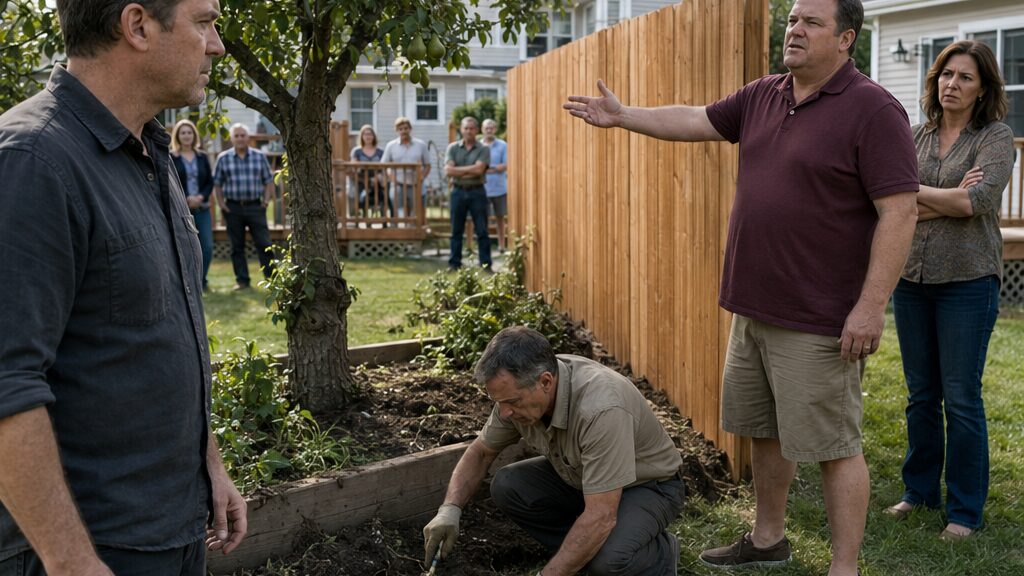
The detector gave a sharp electronic chirp beside the pear tree, and every conversation in the yard stopped.
Larry Campbell moved the wand back six inches.
Nothing.
Forward again.
Chirp.
Kevin Wilson, standing near his deck with Nicole, called out, “Congratulations. You found a bottle cap.”
Two neighbors watching from adjoining yards laughed politely.
David did not.
Larry crouched and placed the detector on the grass. He was in his late fifties, narrow-faced, sun-browned, and deliberate in a way David had already learned could be irritating when he wanted certainty.
Two days earlier, on the phone, David had asked how quickly a survey could settle a fence dispute.
Larry had said, “A survey can tell you what I can support professionally.”
“That’s what I’m asking.”
“No,” Larry had replied. “You’re asking if it’ll settle the dispute.”
Now he pulled on work gloves and used a narrow hand spade to scrape soil away from the detector mark.
Kevin folded his arms.
“This is what we’re doing?” he asked the nearby homeowners. “Digging up David’s weeds?”
David felt heat rise in his neck.
The pear bed was untidy. He knew that. Mint had escaped one corner. The late-season tomato vines leaned against their supports. The mulch needed replacing.
He also knew exactly what Kevin was doing.
Turning the place into evidence about the man.
Larry scraped away another layer of soil.
A dull brown circle appeared beneath a mat of roots.
He stopped.
Nobody laughed.
Larry cleared the edges with two fingers.
The object was iron, weathered almost the same color as the dirt.
David stepped closer.
“That it?”
Larry did not answer immediately. He cleaned more soil away, checked his field notes, then stood and walked back to the tripod-mounted instrument.
Kevin said, “It could be anything.”
Larry looked at him.
“It could.”
Kevin seemed encouraged by that.
Larry continued, “Which is why I don’t identify monuments by wishing.”
One of the watching neighbors coughed into a hand.
Larry checked measurements, returned to the exposed iron, then checked again against the recorded parcel data.
David watched the process with a growing impatience he tried not to show.
He wanted a sentence.
Yes or no.
Mine or his.
Instead Larry gave him numbers, angles, distances, references.
Finally he said, “This is consistent with the original corner monument.”
David looked at the rusted pin.
It was unimpressive.
A piece of iron buried under roots.
No bright flag. No engraved declaration of ownership.
Yet the entire yard seemed to reorganize itself around it.
Kevin walked closer to the gap in the unfinished fence.
“Consistent?”
Larry nodded.
“That’s the professional word.”
“So you’re not sure.”
“I’m sure enough to put my license behind the survey when I finish checking the other monument.”
Kevin smiled at David.
“There you go.”
David said nothing.
Larry spent another forty minutes working across the rear parcel. By then, more people had found reasons to be outside. A man watered a lawn that did not need watering. Someone dragged a trash bin toward a garage and left it halfway there.
David hated the attention.
Kevin appeared to enjoy it.
When Larry stretched a line and began establishing the measured boundary, Kevin called over, “How much is this costing you, David?”
David kept his eyes on Larry.
Kevin continued, “Seriously. You’re paying a licensed surveyor over some weeds?”
Nicole said quietly, “Kevin.”
“What? I’m asking.”
David looked at him then.
Kevin spread his hands.
“You could’ve talked to me.”
“I did.”
“You came outside accusing me.”
“I asked why a fence was in my yard.”
“My point exactly.”
Larry straightened from the instrument.
“Mr. Mitchell?”
David turned.
Larry gestured toward the iron pin.
“I need a clear line from here.”
David stepped aside.
Kevin said, “You know the old fence was never on the actual line.”
Larry glanced at him.
“Do you have a prior survey?”
“I have neighborhood records.”
“That wasn’t my question.”
Kevin’s jaw moved once.
Larry attached the end of a measuring tape near the established point, then extended it toward the new fence.
The tape crossed grass David had mowed the previous weekend.
It crossed the edge of the raised bed.
It passed the pear tree.
Then it met cedar.
Larry checked the reading.
David saw his expression change slightly.
Not surprise. Confirmation.
Kevin said, “Well?”
Larry looked at David.
“The fence varies along the run. Here, from the supported parcel line to the structure, you’re looking at just under eleven feet.”
Silence spread across the yards.
A sprinkler clicked somewhere beyond the houses.
David stared at the tape.
Eleven feet.
He had estimated with his stride, but hearing the number made the theft of space suddenly physical. Eleven feet was wider than many rooms in his house. Eleven feet was enough for the garden path, the pear tree, the irrigation trench, and room to walk beside them.
Kevin stepped toward the unfinished gap.
“That can’t be right.”
Larry said, “I’ll provide a stamped drawing after I complete the work.”
“The county map isn’t exact.”
“No parcel map should be used the way you’re describing. That’s why I’m measuring monuments.”
Kevin pointed toward the iron pin.
“That thing could’ve been moved.”
Larry’s face became still.
“It could have been. Which is why I checked more than one thing.”
Kevin looked toward the neighbors.
The easy confidence had left his posture, but only for a moment.
Then he laughed.
Not as loudly as before.
“So what now? Everybody claps?”
Nobody did.
David looked at the tape again.
He thought about how many times he had imagined this moment in the previous forty-eight hours. In those versions, proof felt like release. Kevin saw the number and backed down. Nicole apologized. The fence came out.
Instead Kevin stood there waiting for David to perform.
To gloat.
To shout.
To become the difficult man David had spent years trying not to be.
David looked at Larry.
“Measure it again from the pin to the fence.”
Kevin blinked.
Larry studied David briefly, then reset the tape.
No speech followed.
No accusation.
Just the small metallic sound of the tape extending over the grass.
That quiet seemed to bother Kevin more than anger would have.
The second measurement did not save him.
Larry recorded it.
David finally said, “I’ll need the completed survey as soon as you can get it.”
“You’ll have the preliminary drawing tomorrow. Stamped copy after that.”
Kevin scoffed.
“Great. Frame it.”
David turned to him.
“I’ll send you a copy.”
“You do that.”
Nicole touched Kevin’s arm, but he pulled away—not violently, just enough to make clear he did not want to be managed in front of people.
Larry began packing equipment.
David followed him toward the driveway.
At the side gate, out of easy hearing range, David asked, “So that’s it?”
Larry lifted the tripod into his truck.
“That’s what?”
“The fence is on my land.”
“Based on what I’ve established, yes.”
“By almost eleven feet.”
“At that location.”
“So he has to move it.”
Larry shut the truck compartment.
David waited.
Larry sighed.
“This is the part homeowners hate.”
“What part?”
“The part where a correct survey does not become a bulldozer.”
David frowned.
Larry leaned against the truck.
“I can establish and document the boundary. I can’t promise how your HOA treated prior improvements. I can’t tell you whether the county has a permit issue until someone checks. I can’t give you legal advice about private encroachment.”
“He built on my property.”
“I understand.”
“He cut my irrigation.”
“I saw it.”
“Then why are you making it sound uncertain?”
“Because the line can be certain while the remedy is not.”
The sentence followed David back through the side gate.
By evening, he had photographed the temporary markers Larry left and placed a small bucket upside down near the exposed iron pin so no one stepped on it.
The next morning, the preliminary survey arrived by email.
David printed it at work.
He looked at the line.
Looked at the fence.
Looked at the number.
Then, during lunch, he sent Kevin a text.
Your fence is on my property. The survey shows the encroachment. Please remove it by Friday. I’ll send the full stamped copy when available.
He read the message three times before pressing send.
For twenty minutes, nothing happened.
Then his phone vibrated.
Kevin’s reply contained six words.
It’s staying. Take me to court.
Chapter 3: The Old Sketch in the HOA File
“Before you file anything, you need to see this.”
Angela Scott kept one hand on a manila folder as if David might try to take it from her.
They sat in the HOA clubhouse office the following afternoon, a room barely large enough for two desks, a filing cabinet, and a bulletin board crowded with pool rules and faded landscaping notices. Through the window, David could see the common lawn and the rear roofs of houses along his street.
He had arrived with Larry’s preliminary survey in a clean folder.
He had expected forms.
Instead Angela locked the office door.
David looked at the folder beneath her hand.
“What is it?”
“History.”
“That’s not usually a comforting word in an HOA office.”
Angela almost smiled.
Almost.
She had been the board secretary for six years and treated records with the cautious seriousness of someone who had learned that neighbors could turn a photocopy into a weapon.
“I’m trying to keep this from becoming worse,” she said.
“My fence is eleven feet inside my property.”
“Kevin’s fence.”
“On my property.”
“Yes.”
The agreement came too quickly.
David sat back.
Angela opened the folder.
Inside were old architectural requests, handwritten notes, photocopied plats, and a faded landscaping sketch printed on yellowing paper.
She laid the sketch on the desk.
“This was submitted years before you bought your house.”
David leaned closer.
The drawing was crude. Two rectangles for homes. Curved shrubs. A path. A gate. A line that appeared to represent the old fence.
“What am I looking at?”
“The previous owner of your property requested landscaping changes. The committee approved them.”
“Okay.”
Angela pointed to the narrow strip between the homes.
“The use pattern.”
David stared at the page.
A dashed line curved near the garden area. It was not a survey boundary. There were no bearings, no monument references, no certification.
But the path and gate were recognizable.
Too recognizable.
He touched the corner of the paper.
“This gate.”
Angela nodded.
“You know it?”
David did.
The old wooden gate had been replaced four years earlier. The hinges had sagged, and Kevin had offered to help rehang it while David was working overtime during a hospital renovation project.
Kevin had shifted the post.
Not much.
Maybe a foot.
David had noticed.
He had said nothing.
Angela slid Larry’s preliminary survey beside the old sketch.
The contrast was immediate. Larry’s drawing was precise, measured, anchored by parcel information and monument references. The HOA sketch was informal.
Yet the old use pattern wandered across the formal line.
David felt something tighten in his stomach.
“That sketch doesn’t change ownership.”
“I didn’t say it did.”
“Then why show me?”
“Because Kevin has been telling people the strip was historically used with his lot.”
“He moved a fence eleven feet.”
“Yes.”
“Historical mowing doesn’t give him eleven feet.”
“No.”
“Then what exactly are we discussing?”
Angela folded her hands.
“We’re discussing why this may not be as simple socially as you think it is.”
David looked at her.
She continued.
“Some long-term owners remember the previous owner letting that side stay open. Kevin mowed part of it. There was drainage through there. The gate shifted. The landscaping plan was approved with features that don’t match the parcel line cleanly.”
“Approved by the HOA.”
“A landscaping plan. Not a boundary change.”
“Does Kevin understand that?”
Angela hesitated.
David saw the answer before she spoke.
“He understands what benefits his argument.”
Anger rose fast enough to surprise him.
“So the board knows he’s using your records to justify this.”
“The board knows there is a dispute.”
“And?”
“And the board is not going to declare private ownership.”
David pushed his chair back slightly.
“That’s convenient.”
Angela’s face hardened.
“It’s cautious.”
“It’s convenient.”
“For whom?”
“For everyone except the person with a fence in his yard.”
The words hung between them.
David regretted the tone almost immediately, which irritated him more.
Angela looked down at the records.
“This is exactly why I wanted you to see the file before the next meeting.”
“Why?”
“Because you’re acting like Kevin invented every inch of this out of nowhere.”
“He built the fence.”
“Yes.”
“He never asked me.”
“Yes.”
“He removed the old one while I was gone.”
“Yes.”
“Then what am I missing?”
Angela tapped the faded sketch.
“Your part.”
David stopped.
The office seemed smaller.
“My part?”
“You knew the gate was off.”
He stared at her.
“How would you know that?”
“Because you mentioned it.”
“When?”
“At a spring cleanup. Years ago.”
He searched his memory.
A Saturday morning. Mulch piles near the clubhouse. Coffee in foam cups. Someone complaining about parking.
He remembered saying something casual about Kevin rehanging the gate crooked.
A joke, almost.
Angela said, “You also let him mow that strip.”
“I didn’t let him.”
“You didn’t stop him.”
“That is not the same thing.”
“No. Legally, maybe not. Socially, it can become the same thing in people’s heads.”
David looked through the window.
A maintenance cart moved along the common lawn.
He thought of the first year Kevin’s mower crossed beyond where David believed the line lay. David had watched from the kitchen and decided the overlap was too small to mention.
Then the gate.
Then landscape blocks.
Then Kevin’s children cutting through the side strip years ago when they were younger.
Each event had seemed minor.
Each objection had seemed likely to make David look petty.
He had told himself that good neighbors did not measure every inch.
Now an eleven-foot wall stood beside his pear tree.
Angela said quietly, “I’m not telling you to accept the fence.”
David kept looking outside.
“I know.”
“I’m telling you Kevin’s story has enough pieces in it that people will believe him.”
That was worse than a lie.
A clean lie could be exposed.
A story built from half-truths could survive evidence.
Angela pulled Larry’s survey closer and aligned it over the faded sketch.
The formal parcel line cut through the old informal use pattern.
David saw his gate.
His old path.
The mowing strip.
And, on Larry’s drawing, the notation for the iron monument beside the pear bed.
The pin did not exist on the HOA sketch at all.
Buried in the yard.
Absent from the neighborhood’s memory.
David said, “So what happens now?”
“That depends what you want.”
“My property back.”
“I mean after that.”
He looked at her.
Angela’s expression was tired rather than hostile.
“Do you want enforcement? Mediation? Board review? A lawyer? Because those are different roads, and once you start some of them, you don’t get to pretend you’re still just having a disagreement over a fence.”
David thought of Kevin’s text.
Take me to court.
“I’m not pretending anything.”
Angela gathered two papers, then stopped.
“There’s something else.”
David waited.
She did not hand it over.
Instead she looked toward the locked office door.
“What?”
Angela lowered her voice.
“Kevin came in before the fence was built.”
David did not move.
“When?”
“About three weeks ago.”
The room went silent except for the faint hum of the fluorescent light.
David looked at the old sketch again.
“He came here for approval?”
“Not exactly.”
“What did he ask?”
Angela’s fingers tightened on the edge of the folder.
“He asked about the boundary.”
Chapter 4: He Knew the Line Was Disputed
The email arrived at 9:17 the next morning.
David was standing in the mechanical room of the medical complex, listening to a circulation pump make a sound it should not have been making, when his phone vibrated against a steel workbench.
He almost ignored it.
Then he saw Angela Scott’s name.
Forwarding this because you asked what Kevin was told before construction.
Below that was a message chain.
David read the first line twice.
Kevin—
The HOA cannot verify the proposed fence location as a property boundary. The landscaping sketch in our records is not a survey and should not be relied upon to establish ownership. Please confirm the line independently before permanent installation.
David stopped hearing the pump.
He scrolled.
The message was dated eighteen days before the fence went up.
The reply beneath it was from Kevin.
Understood. I’m checking.
David stared at those two words.
I’m checking.
A maintenance technician opened the mechanical-room door.
“You want me to shut that pump down?”
David looked up too slowly.
“What?”
“The bearing.”
“Yeah. Switch to backup and tag it.”
The technician glanced at the phone in David’s hand, then left without asking.
David read the chain again.
There was no dramatic confession. No sentence saying Kevin knew the fence was on David’s land. Nothing that would make the whole story clean.
It was worse in a quieter way.
Kevin had known the line was uncertain.
He had built anyway.
David called Angela.
She answered on the third ring.
“You saw it.”
“Yes.”
“I figured.”
“Why didn’t you show me yesterday?”
A pause.
“Because it’s board correspondence.”
“You showed me the sketch.”
“The sketch was part of an old property file. The email involves a current homeowner and a pending dispute.”
“He used your records to tell me the HOA backed him.”
“I know.”
“You knew yesterday.”
“I knew he asked.”
“You knew he was warned.”
Angela exhaled.
“David, I’m not protecting Kevin.”
“It feels a lot like it.”
“I’m protecting the association from becoming a witness before the board has even decided what it knows.”
David closed his eyes.
At work, that kind of sentence had a familiar shape. It was what departments said when a ceiling leaked between jurisdictions.
Not our pipe.
Not our roof.
Not our room.
He said, “Did he ever send you a survey?”
“No.”
“Any boundary verification?”
“No.”
“Then what was he checking?”
“I don’t know.”
David looked back at Kevin’s reply.
I’m checking.
“Forward the whole chain.”
“I already did.”
“I mean everything.”
“That is everything.”
The answer left a space where another explanation should have been.
David ended the call.
For the next hour, he worked badly.
He signed off on a repair request and realized he had entered the wrong building number. He walked halfway to an equipment room before remembering why he was going there. Twice, he opened Kevin’s email on his phone.
By lunch, anger had simplified the problem for him.
Kevin had been warned.
Kevin had lied.
Kevin could pay.
Then another message arrived.
Not from Angela.
From the fence contractor.
David had emailed the company the previous evening after finding its small metal tag attached to one of the posts. He had written only that a boundary dispute existed and requested the project contact information.
The contractor’s reply was cautious.
We were retained by the Wilson property owners. Our layout followed customer-provided placement instructions. We advised the customer that boundary verification was the owner’s responsibility. Work was scheduled in coordination with a separate patio project, and materials were ordered specifically for the site.
David read the last sentence again.
Separate patio project.
He remembered the pallets of pavers behind Kevin’s house.
He called the company.
The person who answered transferred him once, then again.
Finally a contractor came on the line.
“I can’t discuss their contract with you.”
“I’m not asking for the contract.”
“You’re asking about their contract.”
“I’m asking whether you were told the line was disputed.”
Silence.
Then, “We were told there was an existing-use issue.”
“What does that mean?”
“It means the customer directed placement.”
“Did you recommend a survey?”
“We recommend owners verify boundaries before installation.”
“That wasn’t my question.”
The contractor sighed.
“Mr. Mitchell, I’m trying not to get in the middle of a neighbor dispute.”
“You’re already in it.”
Another silence.
Then the contractor said, “The fence was tied to a larger yard schedule. Patio grading. Drainage work. Material delivery. There was a deposit. Changing dates would’ve had costs.”
David looked through the small break-room window at the parking lot.
“How much cost?”
“I’m not giving you someone else’s numbers.”
“But enough that waiting mattered.”
“I didn’t say that.”
“You didn’t have to.”
The line went quiet.
David thanked him and hung up.
For the first time since the fence appeared, Kevin’s behavior became more understandable.
Not acceptable.
Understandable.
The pavers. The orange paint. The patio rectangle. The need to keep the project moving. The public confidence.
If Kevin admitted uncertainty, the work stopped.
If the work stopped, money got trapped.
If money got trapped, he had to explain that to Nicole.
David disliked how much difference that understanding made.
It would have been easier if Kevin were simply stupid.
That afternoon, David went to the county offices with Larry’s preliminary survey, his deed, photographs of the fence, and copies of the HOA messages.
The zoning clerk examined the papers without enthusiasm.
“You have several issues here.”
“I have one fence.”
“You have several issues involving one fence.”
David waited.
The clerk tapped the survey.
“Private property boundary.”
Then the photos.
“Potential encroachment.”
Then the fence height and placement.
“Possible permit or setback review.”
Then the HOA material.
“Private covenant issue.”
“So who makes him move it?”
The clerk looked at David over the papers.
“Maybe nobody in this building.”
David felt his jaw tighten.
“The fence is on my land.”
“I’m not disputing your survey.”
“Then—”
“County code enforcement does not adjudicate private title.”
David leaned back.
The sentence sounded almost exactly like Larry’s warning.
The clerk continued.
“If there’s an unpermitted structure or a code violation, that can be reviewed. If there’s private encroachment, you may need civil remedies. If the HOA has separate approval requirements, that’s between the association and the owners.”
“So he can build eleven feet onto my property and everybody tells me it belongs to a different department.”
The clerk’s expression did not change.
“I’m telling you not to confuse one remedy with another.”
David looked down at the forms.
He had imagined paperwork as a lever.
Now it looked like a box of mismatched tools.
“Can I file?”
“Yes.”
“Everything?”
“You can submit what you have. We decide what falls within our authority.”
David filled out the complaint.
He attached the survey.
The deed.
Photographs.
The HOA warning.
When he reached the section requesting a description, he started writing in anger.
Neighbor knowingly constructed—
He stopped.
Crossed out knowingly.
He did not know that.
Not exactly.
He wrote instead:
Permanent fence constructed across surveyed parcel line after boundary uncertainty had been raised before installation.
The distinction mattered.
He hated that it mattered.
By the time he returned home, Kevin was in his driveway speaking to someone beside the stacked pavers.
David recognized the fence contractor’s truck.
Kevin saw him.
Neither man waved.
David carried his folder inside.
At the kitchen table, he opened his laptop and submitted the final electronic copies to the county portal and the HOA.
Before clicking the last button, he looked through the window toward the cedar wall.
The temporary bucket still covered the buried iron pin near the pear tree.
Kevin had been uncertain.
Kevin had been under pressure.
Kevin had spent money he feared losing.
And Kevin had built anyway.
David clicked Submit.
Chapter 5: The Orange Notice Did Not End It
The inspector stapled the orange notice directly to the cedar fence at 8:06 on a Thursday morning.
David watched from his deck.
The sound carried sharply across the yard.
Thwack.
Thwack.
Thwack.
The code inspector smoothed the paper with one gloved hand, photographed it, then stepped back.
For one brief, dangerous moment, David felt satisfied.
Not happy.
Satisfied.
The notice was visible from Kevin’s kitchen windows.
It was visible from the Wilson deck.
It was visible from the strip of yard Kevin had claimed as his own.
David went down the steps.
“What happens now?”
The inspector checked something on a tablet.
“The owner of record gets mailed notice as well.”
“For removal?”
“For the cited conditions.”
David looked at the orange paper.
It contained more words than he expected.
Possible unpermitted work.
Required documentation.
Correction timeline.
Follow-up inspection.
Nothing as simple as: Remove this fence.
“What cited conditions?”
The inspector pointed.
“Permit review. Placement relative to approved site documentation. We’ll need records.”
“The survey shows it’s on my property.”
“I saw your submission.”
“So the fence comes out.”
The inspector gave him the same careful look Larry had given him.
“The county can enforce county code.”
David almost laughed.
Instead he said, “Right.”
Across the fence, Kevin’s back door opened.
He came outside barefoot, saw the inspector, and stopped.
“What is that?”
The inspector turned.
“Mr. Wilson?”
Kevin came down from the deck.
Nicole appeared in the doorway behind him.
“What is that?” Kevin asked again.
The inspector introduced himself and explained the notice.
Kevin did not look at David until the word complaint was used.
Then he did.
“You filed this.”
David said, “Yes.”
Kevin walked to the fence and read the paper.
His face changed by degrees.
Confusion.
Recognition.
Anger.
Then something almost like relief.
He tapped one section.
“This doesn’t say the county agrees with his property claim.”
The inspector answered, “That is not what this notice addresses.”
Kevin looked at David.
“There.”
David felt the small satisfaction from a minute earlier collapse.
Kevin pointed at the survey stake Larry had placed near the pear bed. David had surrounded it with two short pieces of scrap wood so nobody hit it with a mower.
“You think that pin gives the county authority to settle ownership?”
David said, “The pin gives me a surveyed line.”
“And this”—Kevin slapped the orange notice with the back of two fingers—“is a code review.”
The inspector stepped between the argument without physically moving.
“Mr. Wilson, regardless of the private dispute, you need to respond by the date listed.”
Kevin read the notice again.
“What exactly do you want?”
“Documentation for the work. Any required permits. Approved plans if applicable. We’ll also review placement issues under the relevant code.”
“I replaced a fence.”
“You installed a new fence in a disputed location.”
“Disputed by him.”
The inspector’s expression stayed neutral.
“Respond by the date.”
Kevin looked at David.
“You can’t be serious.”
David said nothing.
“It’s a fence.”
David’s voice was quieter than he intended.
“It’s also a permit problem on property I’m telling you is mine.”
Kevin laughed once.
There was no humor in it.
“You’ve been waiting to say that.”
David felt the accusation land because part of it was true.
He had imagined this scene.
Not the exact words, but the balance of it.
Kevin angry.
David calm.
Something official nailed to cedar.
The realization made him uncomfortable.
He turned away first.
By noon, photographs of the orange notice had moved through the neighborhood.
Nobody sent them directly to David, but a nearby homeowner texted asking whether “the county was making Kevin tear it all out.”
David answered honestly.
I don’t know yet.
At five, the HOA board called a special meeting in the common-area room.
David arrived with the stamped survey.
Kevin arrived with Nicole.
Angela sat at one end of the table beside the HOA president. Several chairs remained empty; the board had chosen not to open the session to general homeowners.
Kevin placed a folder in front of him.
“This is getting ridiculous.”
The HOA president said, “We’re reviewing potential architectural violations.”
“You approved the historical layout.”
Angela’s mouth tightened.
“We approved landscaping shown on an informal sketch.”
“You can’t use that when it helps you and abandon it when it doesn’t.”
“It never established a property boundary.”
Kevin opened his folder.
“Then why keep it?”
No one answered immediately.
David saw Angela’s discomfort.
Kevin continued.
“I replaced a failing fence where the neighborhood treated the division for years.”
“Eleven feet inside my parcel,” David said.
Kevin looked at him.
“According to your survey.”
“According to a licensed survey.”
“And according to years of actual use?”
David felt the old impulse to retreat into silence.
Then he said, “Actual use that I should have challenged sooner.”
Kevin blinked.
It was the first time David had said it in front of him.
The HOA president leaned forward.
“We are not deciding title.”
David almost smiled at the repetition.
Of course they were not.
Nobody was.
The board moved into procedural language. Architectural approval. Liability. Historic records. Enforcement authority.
Then Angela said something that changed the room.
“Given the active boundary dispute, I recommend the board pause any independent enforcement until counsel reviews whether prior HOA records could be mischaracterized as approval.”
Kevin sat back.
David stared at her.
“You’re delaying.”
“I’m recommending review.”
“The county notice is already posted.”
“That is county action.”
“And this is exactly what you warned me about.”
Angela held his gaze.
“Yes.”
David understood then.
The orange notice had looked like an ending because it was bright.
Official.
Public.
But it was only another door.
Outside after the meeting, Kevin caught up with him near the sidewalk.
“You see it now?”
David kept walking.
“See what?”
“You thought you’d file some papers and everybody would line up behind you.”
David stopped.
Kevin stood several feet away.
The common-area lights cast hard shadows across his face.
“The county can’t decide ownership,” Kevin said. “The HOA doesn’t want liability. And if you sue, we both spend money for a year.”
David said, “You knew the line was disputed.”
Kevin’s expression changed.
Only slightly.
But David saw it.
“You got Angela’s email.”
Kevin looked toward the parking lot.
“She told you that?”
“You replied to it.”
“I said I was checking.”
“And then you built.”
Kevin’s jaw tightened.
“You don’t know the whole situation.”
“Then tell me.”
For a moment, David thought he might.
Instead Kevin said, “You should’ve dealt with this years ago.”
Then he walked away.
The next several days became a series of incomplete consequences.
The county requested additional documents.
The contractor delayed further patio work.
A follow-up inspection was scheduled.
Kevin did not remove the fence.
David checked the survey stake each morning. Once he found it leaning and pushed the protective scrap boards farther apart, careful not to touch the marker itself.
The pear tree’s leaves had begun to curl at the edges.
He noticed but blamed the season.
On Tuesday evening, David was carrying groceries from his truck when Nicole Wilson stepped out of her garage.
“David.”
He stopped.
She looked toward her house before crossing the driveway.
She seemed smaller without Kevin beside her. Not physically. Socially.
The folded-arm confidence from the first morning was gone.
“What?”
Nicole kept her voice low.
“That email you mentioned at the meeting.”
David waited.
“The one before construction.”
“Yes.”
She looked at him carefully.
“Did Kevin know about that before the fence went in?”
Chapter 6: The Cost Was Not Only Money
Nicole arrived at David’s front door the next morning holding a printed email that shook slightly in her hand.
“He told me this didn’t exist.”
David looked past her toward the Wilson house.
Kevin’s truck was gone.
“Come in.”
She hesitated before stepping across the threshold.
David led her to the kitchen. The room suddenly felt too personal for the conversation. His work schedule was clipped to the refrigerator. A bowl held unopened mail. Through the back window, the top of the new fence cut across the yard.
Nicole placed the paper on the table.
It was Angela’s email.
The same warning David had received.
The HOA cannot verify the proposed fence location as a property boundary.
Below it was Kevin’s reply.
Understood. I’m checking.
Nicole remained standing.
“I asked him last night.”
David pulled out a chair.
She did not sit.
“What did he say?”
“That Angela was covering herself after the fact.”
David said nothing.
“So I called her.”
That surprised him.
Nicole looked toward the window.
“She confirmed the date.”
David leaned against the counter.
“She did.”
Nicole finally sat.
“I approved the patio.”
The statement seemed disconnected until she continued.
“The whole backyard project. We refinanced some debt last year. We had a little room after that, and Kevin said if we did the patio now, it would help the house and fix the drainage by the back corner.”
David remembered the orange paint.
The pavers.
“He told me the fence line had been checked,” Nicole said.
“By who?”
“That’s what I asked.”
David looked at the printed email.
Nicole laughed once under her breath.
“I stood out there and smiled at you.”
He did not answer.
“I thought you were doing what you always do.”
“What do I always do?”
Her eyes lifted to his.
“Wait until something bothers you for months, then act like nobody knew.”
The accuracy of it struck harder because it came from her.
David straightened.
“That doesn’t justify the fence.”
“I didn’t say it did.”
“You’re in my kitchen with proof Kevin was warned, and somehow we’re discussing my personality.”
Nicole’s face closed.
For a second, David saw the old alliance return.
Then she pushed the email toward him.
“No. We’re discussing why I believed him.”
Silence settled between them.
David looked down.
Nicole said, “Kevin said the line had always been treated that way. He said you knew. He said you’d never objected because everybody understood the old fence was wrong.”
David thought of the gate.
The mower.
The landscape blocks.
He pulled out the chair opposite her and sat.
“I knew the gate was off.”
Nicole’s eyes narrowed.
“How much?”
“Not eleven feet.”
“That’s not what I asked.”
David rubbed one hand over his jaw.
“A foot, maybe.”
“And the mowing?”
“I saw it.”
“You never said anything.”
“No.”
“Why?”
The answer came automatically.
“It wasn’t worth a fight.”
Nicole stared at him.
David heard the sentence after it was spoken.
All the dignity he had attached to it.
All the years.
Not worth a fight.
He looked through the window at the fence.
His father had once stood near the pear bed with a shovel, arguing that David had dug the hole too shallow. David had been forty years old and still irritated by the correction.
His father had laughed and redone it himself.
The tree had survived because someone spoke up before the roots were covered.
David said, “I thought keeping peace meant not measuring everything.”
Nicole’s expression softened, but not much.
“And Kevin thought silence meant agreement.”
“Yes.”
The admission sat between them.
Nicole folded the email.
“He still built after the warning.”
“Yes.”
“He still told me it was verified.”
“Yes.”
“And now he says he can’t move it because we’ll lose the deposit and pay twice.”
David looked at her.
“There’s more work scheduled?”
“Not now. The contractor paused.”
She pressed her lips together.
“We’ve already spent enough that Kevin thinks backing down makes all of it wasted.”
“Keeping the fence doesn’t recover the money.”
“I know that.”
“Does he?”
Nicole looked away.
That was answer enough.
After she left, David went outside.
The pear tree looked wrong.
Not dramatically wrong. That was the problem.
Several leaves had dulled from green to a dry gray-green. One branch sagged lower than before.
David crouched near the trunk.
The soil was dry.
He followed the irrigation line toward the fence and found the cut section he had photographed the first morning. He had shut that zone off because of the leak, intending to repair it once access was restored.
Then work.
The survey.
The HOA.
The county.
He had forgotten the tree was fed by the same line.
David brought out a hose.
Water darkened the soil around the roots.
He stood there watching it soak in and felt a shame far different from the anger Kevin caused.
The fence had hurt the tree.
But David had seen the broken irrigation on the first morning.
He had documented it instead of fixing it.
Evidence first.
Repair later.
He had spent days proving someone else had crossed a boundary while neglecting what was inside it.
That afternoon, Kevin came home early.
David was still beside the pear tree.
Kevin stopped near the unfinished end of the fence.
“Nicole was here.”
“Yes.”
“You had no right dragging her into this.”
“I didn’t.”
“You showed her the email.”
“She brought me a copy.”
Kevin’s face changed.
David continued watering the soil.
Kevin said, “You think you’re winning.”
David turned off the hose.
“No.”
“That notice. The board. The contractor.”
“No.”
“Then what do you call it?”
David looked at the tree.
“Expensive.”
Kevin laughed bitterly.
“You have no idea.”
“Then tell me.”
Kevin stepped closer to the gap.
“The patio deposit is committed. Fence materials were custom ordered. Grading was scheduled. If we tear this out, I pay for removal, new posts, new labor, repair to your precious garden, and probably a second drainage plan.”
“Then you should have waited for a survey.”
“I know that now.”
David stared at him.
It was the first acknowledgment Kevin had made.
Not an apology.
Not even surrender.
But truth.
Kevin immediately hardened again.
“You also knew the line was messy.”
“I knew I’d let things drift.”
“You let us use it.”
“I didn’t give it to you.”
“You never said stop.”
There it was.
The same truth from opposite sides.
David felt anger rise, then stop before reaching his voice.
“I should have.”
Kevin blinked.
David said, “I should’ve said something when the gate moved. I should’ve said something when you started mowing past the line.”
Kevin’s expression shifted, uncertain now.
“But I’m saying it now.”
He pointed toward the cedar wall.
“That fence does not stay.”
Kevin’s face closed again.
“Then we’re done.”
“No.”
David walked toward the gap.
“I got a settlement suggestion from your contractor this morning.”
Kevin frowned.
“What?”
“They offered to discuss moving only the rear section and leaving the side run where it is.”
Kevin said nothing.
David continued.
“I’m rejecting it.”
“Of course you are.”
“But I’m not demanding you destroy the entire yard plan.”
Kevin looked at him warily.
“There’s a drainage issue near your patio corner. Larry noted the grade. I’ll consider a narrow access strip for drainage maintenance if it’s surveyed, written, recorded properly, and the fence goes back to the parcel line.”
Kevin stared.
David could see him calculating.
“You’d give access?”
“I’d document access.”
“For free?”
“This isn’t a sale.”
“Then what is it?”
David looked at the pear tree, at the dry leaves above the darkened soil.
“A boundary.”
Kevin said nothing.
David picked up the hose.
“The follow-up inspection is tomorrow. I’ll put the proposal in writing tonight.”
Kevin remained by the fence.
David added, “The encroachment comes out. The damaged ground gets repaired. The irrigation gets fixed. That part isn’t negotiable.”
Kevin’s mouth tightened.
“And if I say no?”
David met his eyes.
“Then tomorrow, everybody keeps spending money.”
That evening, David sat at the kitchen table with Larry’s survey, the warning email, and a blank document open on his laptop.
For years, he had believed conflict began when someone finally said no.
Now he understood that sometimes it began much earlier, in every moment no one did.
He typed the first line of the proposal.
The existing fence shall be removed from the Mitchell parcel.
Then he kept writing.
Chapter 7: The Line David Finally Drew
David placed the survey, the warning email, and the repair estimate on the HOA table, then covered them with his hand.
Kevin looked at the papers.
“So that’s your threat?”
“No.”
The meeting room was quieter than David had ever heard it. Angela sat near the filing cabinet with a legal pad. The HOA president had positioned himself at the far end of the table, careful to look neutral. Nicole sat beside Kevin but not close enough for their shoulders to touch.
The county follow-up inspection was scheduled for the next morning.
David had slept badly.
He had rewritten his proposal three times.
Now, with every document he had spent days collecting within reach, he discovered he did not want to begin with any of them.
Kevin leaned back.
“You called this meeting.”
“I asked for it.”
“To make me sign something before the inspector comes.”
David removed his hand from the papers.
“No. I asked for it because we’ve spent two weeks letting documents say things we should’ve said ourselves.”
Kevin gave a dry laugh.
“That sounds convenient now that you have the documents.”
David felt the familiar urge to wait.
Let Kevin finish.
Let the room settle.
Let somebody else correct the tone.
He recognized the habit as it happened.
This time, he did not obey it.
“You’re right about one thing.”
Kevin’s expression changed.
David continued.
“I should have dealt with the line years ago.”
Angela stopped writing.
Nicole looked at him.
David kept his eyes on Kevin.
“When the gate moved, I noticed.”
Kevin said nothing.
“When you started mowing farther over, I noticed.”
The HOA president shifted in his chair.
David went on.
“I told myself it wasn’t worth making trouble. I told myself good neighbors don’t argue over every foot of grass.”
Kevin’s mouth tightened.
“So you admit—”
“I admit I stayed quiet.”
“That matters.”
“Yes.”
The answer cut off whatever Kevin had prepared.
David nodded toward the old HOA sketch Angela had placed at the side of the table.
“It matters because silence gave you a story you wanted to believe.”
Kevin leaned forward.
“We all used that line.”
“No. We used the space loosely.”
“For years.”
“Yes.”
“And now because you paid a surveyor—”
“No.”
David’s voice rose only slightly, but the room changed.
“Not because I paid a surveyor. Because the parcel line exists whether I speak up or not.”
Kevin looked away first.
David pulled Larry’s survey from the stack and laid it flat.
The marked line ran cleanly through the confused history of gates, mowing, drainage, and assumptions.
Beside it, the original iron pin was shown as a fixed monument.
David touched the notation with one finger.
“I should have told you sooner that I believed this was the line.”
Kevin said, “You didn’t know.”
“I believed it enough to notice every time something crossed it.”
That landed.
David felt it in himself before he saw Kevin’s reaction.
For years, he had treated his own silence as proof of patience.
Now he heard it plainly.
He had noticed.
He had resented.
He had waited.
Then, when the fence appeared, he had expected the world to understand how obvious the violation was.
Kevin rubbed one hand across his jaw.
“So what? You confess to being passive and I pay for everything?”
Nicole closed her eyes briefly.
David slid the repair estimate forward.
“The fence leaves my parcel.”
Kevin pushed back from the table.
“Then we’re done.”
“No.”
Kevin stood.
David did not.
“The damaged irrigation gets repaired,” David said. “The ground gets restored. Larry verifies the new placement.”
“I said no.”
“And I’ll grant a narrow access agreement for drainage maintenance along the rear corner.”
Kevin stopped.
The room seemed to narrow around the sentence.
Nicole looked at David.
“What kind of access?”
David pulled out the final page of his proposal.
“Not ownership. Not adverse use. Not an informal understanding.”
Kevin’s face hardened.
“Meaning?”
“Meaning the fence goes to the surveyed boundary. But the drainage issue near your planned patio is real. Larry noted the grade. I’m willing to document access across a narrow strip for maintenance if the route is surveyed and the agreement is recorded properly.”
Angela reached for the page.
David handed it to her.
The HOA president said, “The association would need to review any architectural impact.”
“Yes,” David said.
Kevin looked from the paper to him.
“You expect me to thank you for access to land you say I’ve been stealing?”
“No.”
“Because that’s what this is.”
“No. This is me refusing to pretend the drainage problem disappears because I’m angry.”
Kevin laughed without humor.
“And what do you get?”
“My land back.”
“That’s it?”
David thought of the pear tree.
The severed irrigation.
The orange notice.
The satisfying moment he had watched an inspector staple paper to cedar.
He thought of how quickly justice could begin to resemble appetite if no one decided where enough was.
“That’s it,” he said.
Kevin stared at him.
Then he pointed at the repair estimate.
“You know what this costs?”
“Yes.”
“No, you know a number on paper.”
Nicole said quietly, “Kevin.”
He turned.
She had not spoken since the meeting began.
Kevin said, “Not now.”
Nicole’s face changed.
Not dramatically.
She simply stopped looking like someone waiting for permission.
“No,” she said. “Now.”
Kevin stared at her.
Nicole placed both hands on the table.
“I am not putting more money into keeping that fence where it is.”
His face flushed.
“We’ve discussed this.”
“You discussed it. You told me the line was checked.”
“It was complicated.”
“You told me it was checked.”
“I thought—”
“No.”
One word.
David felt something shift that had nothing to do with surveys.
Nicole continued.
“You got the warning. You told me you didn’t. You knew the contractor wanted verification. You pushed because you didn’t want to lose the schedule.”
Kevin’s jaw tightened.
“The deposit was already committed.”
“I know.”
“The patio materials were coming.”
“I know.”
“You wanted that patio too.”
“I did.”
Kevin looked around the room as if searching for the version of events in which that fact restored his position.
Nicole said, “Wanting it is not the same as telling me the boundary was verified.”
No one moved.
This was the surprise David had not expected.
Not Nicole changing sides.
Something smaller and harder.
Kevin had not built from certainty.
He had built from fear of stopping.
Every laugh, every claim of seniority, every dismissive joke about weeds had been layered over a decision he already knew might be wrong.
David looked at him and, for the first time, saw not a man certain of his land but a man trapped inside the cost of admitting he had gambled.
Kevin sat down slowly.
The HOA president cleared his throat.
“The county follow-up is still tomorrow.”
Kevin ignored him.
He looked at David.
“If I agree, you withdraw everything.”
David shook his head.
“No.”
Kevin gave a bitter smile.
“Of course.”
“I’ll notify the county that corrective work is scheduled. I’ll tell them we have a written resolution. I’m not lying about what happened.”
“Same thing.”
“No.”
David heard the firmness in his own voice and almost did not recognize it.
“The fence comes out first. Repair follows. The access agreement is separate and documented. No more handshakes that become memories.”
Kevin looked at the proposal.
For a long time, nobody spoke.
Then he asked, “Who pays Larry?”
“You pay for verification of the corrected fence. I pay my own cost for creating the access agreement.”
Kevin looked at Nicole.
She did not nod.
She did not need to.
He picked up the pen.
Angela moved the signature page closer.
Kevin read every line.
Twice.
At the section requiring removal of the encroaching structure, he stopped.
David waited.
The old version of him would have filled the silence.
Softened the demand.
Offered another week.
Suggested they think about it.
He did none of those things.
Kevin signed.
The sound of the pen against paper was almost nothing.
Angela signed as witness to the meeting record. Nicole added her signature where the Wilson property owners acknowledged the plan.
David signed last.
The HOA president gathered the copies.
Kevin stood.
David stood too.
For a moment, neither man moved.
Then David extended his hand.
It was not forgiveness.
It was not friendship.
It was an offer to end the meeting as two people who would still see each other’s roofs every morning.
Kevin looked at the hand.
Then at David.
He picked up his copy of the agreement and walked past him without taking it.
Chapter 8: Where the Old Pin Stayed
The first cedar panel came free with a crack of screws and lifted into the air between two removal-crew workers.
David stood beside the pear tree and watched eleven feet of stolen space reappear.
Not all at once.
A strip at a time.
The crew had arrived shortly after seven. Kevin had paid them to remove the fence, pull the misplaced posts, and prepare the line for reinstallation. The contractor’s truck sat in the Wilson driveway beside the unused pavers.
No one joked about an upgrade.
Kevin stayed near the patio area with a clipboard.
Three weeks had passed since the agreement.
Long enough for the county to mark the correction as underway.
Long enough for Angela to circulate revised HOA records distinguishing the old landscaping sketch from the surveyed parcel line.
Long enough for David to learn that winning could contain more invoices than triumph.
A worker lifted another panel.
Beyond it, David saw the raised bed fully again.
The garden looked smaller than he remembered.
The fence had distorted his sense of it.
Or maybe conflict had.
Larry Campbell arrived before noon.
He carried the same equipment he had used the day the yard filled with watching neighbors, though this time no one gathered on nearby decks.
He walked directly to the protected marker beside the pear bed.
David had left the scrap boards around it.
Larry glanced down.
“You guarded this thing better than some people guard their houses.”
David said, “I learned what happens when nobody knows where a line is.”
Larry gave him a look.
“People usually know. They just prefer another answer.”
He removed the protective pieces and checked the monument.
The old iron pin remained where it had been.
Rust-colored.
Unimpressive.
Certain.
Larry set his equipment and verified the corrected layout. The new post marks followed the parcel line. Near the rear corner, however, a narrow space remained open for the drainage-access route described in the agreement.
Kevin approached while Larry was working.
He stopped several feet from David.
“The grading crew comes tomorrow.”
David nodded.
“They have the repair estimate.”
“I know.”
“They’ll regrade your side where the equipment cut in.”
“And the irrigation?”
“Fence contractor’s covering the broken section.”
David looked at him.
Kevin added quickly, “It was in their work area.”
The old instinct to argue over responsibility stirred.
David let it pass.
Not because it did not matter.
Because this part was already written down.
Kevin looked toward the rear corner.
“I want the drainage access to stay exactly as drawn.”
“It will.”
“No shrubs planted across it.”
“That’s in the agreement.”
“I’m just saying.”
David almost smiled.
“So am I.”
Kevin looked at him then.
Something in his expression suggested he understood the answer.
The access would stay.
Not because Kevin had used the strip for years.
Not because the HOA remembered things loosely.
Not because David was trying to be nice.
It would stay because both households had named the need, measured it, and written it down before resentment could rewrite it.
Kevin glanced toward the pear tree.
“That thing going to make it?”
David followed his gaze.
Some leaves had recovered after the irrigation repair. Others had browned completely. One lower branch had been pruned where the bark damage was worst.
“I don’t know.”
Kevin nodded.
“The grading guy said roots near the fence line took a hit.”
“I know.”
For a second, David thought Kevin might apologize.
He did not.
Instead he said, “I should’ve waited.”
The sentence was so quiet that David nearly missed it.
Kevin looked toward the workers.
“The survey.”
David said nothing.
Kevin continued.
“I thought if I stopped the project, I’d lose the deposit. Then the patio date. Then the material price. Every day there was another reason not to stop.”
He rubbed the back of his neck.
“After a while, admitting I wasn’t sure cost more than pretending I was.”
David looked at the old iron pin at Larry’s feet.
“I should’ve spoken sooner.”
Kevin gave a short, humorless breath.
“Yeah.”
David looked at him.
Kevin met his eyes.
Neither man smiled.
It was the closest they had come to honesty.
By late afternoon, the misplaced posts were gone.
The crew filled the holes, rough-graded the torn ground, and stacked the old cedar panels for reuse where possible. The new fence line was marked properly, leaving David’s garden fully accessible and the agreed drainage route unobstructed.
Larry completed his verification.
Before leaving, he returned to the iron pin.
David watched him kneel.
“You’re covering it?”
Larry brushed loose soil toward the metal.
“That’s where it was before.”
For a moment, David wanted it left exposed.
Visible proof.
A permanent answer.
Then he looked at the yard.
At the corrected markers.
At the signed copy of the agreement inside his house.
At the new post locations.
The pin did not need to become a monument to the fight.
Larry pressed the soil gently over it.
The iron disappeared beneath the earth.
Still there.
Still true.
That evening, after the trucks left, David connected the hose.
He carried it to the pear tree and turned the water low.
The ground around the roots darkened slowly.
Across the restored boundary, Kevin stood near the unfinished patio with Nicole. They were looking at a drainage plan spread over a folding table.
Kevin glanced up.
David raised one hand.
After a moment, Kevin did the same.
Nothing more.
David moved the hose closer to the trunk.
One branch would not recover. Larry had nothing to do with that. Neither did the HOA or the county. Some damage stayed even after a line was corrected.
But near the upper part of the tree, among the tired leaves, new green growth had begun at the end of a branch.
David touched it with two fingers.
Years earlier, his father had stood in this same patch of yard and told him the planting hole was wrong.
David had been annoyed.
His father had been right.
The memory no longer felt like an accusation.
Water soaked into the soil beside the place where the old iron pin lay buried again, unseen and unmoved.
David stood there until the ground had taken enough.
Then he turned off the hose.
The story has ended.