The Man at the Sink
The Man at the Sink
Part I — The Floor No One Sees
By the time the lunch rush hit, the dish pit was already drowning.
Steam hung low over the industrial sink. Gray water hissed down the drain. Plates slammed into tubs faster than anyone could wash them. Somewhere beyond the swinging kitchen door, customers laughed over soup and sandwiches, unaware that the back room of the restaurant sounded like war.
Ruben stood in the middle of it with his sleeves rolled past his elbows and his shoulders bent from years of repetition. At sixty, he moved more carefully than he once had, but never slower than the job required. He rinsed, stacked, scrubbed, and reached with the kind of rhythm that came from surviving long enough to make hard work look ordinary.
Most people didn’t notice him.
That was the rule of places like Bellmere Grill. The servers noticed when silverware ran out. The cooks noticed when pans came back late. The manager noticed labor costs and broken inventory. But the man standing ankle-deep in soap and heat, the one making the whole machine run, was easiest to forget.
Ruben had learned long ago that being forgotten could be its own kind of shelter.
He had once repaired rooftop units in Phoenix summers hot enough to make metal burn your palms. Later he had loaded freight overnight in Dallas. Then came a back injury, then a divorce, then years of jobs that hired men with tired eyes because nobody else wanted them. The dish station at Bellmere was not a dream, but it was work. It was steady. It paid enough to keep a room over his head and medicine in the cabinet and send a little money, when he could, to a daughter who lived three states away and called less often than he wished.
So Ruben kept his head down and did the work.
That afternoon, the rush was worse than usual. A church group had filled the front room. The servers were cutting corners. The line cooks were swearing at one another in short, sharp bursts. Metal racks clattered. A stack of bowls nearly slipped from his hands when someone shoved through the pass too fast.
Then Maris came in.
He heard her before he looked up—the quick, hard click of nonslip shoes, the impatient exhale, the plastic rattle of an overloaded bus tub. Maris was one of the younger servers, all polished edges and restless energy. She wore her dark hair in a high ponytail that swung like a challenge when she turned. Her burgundy apron was always tied perfectly. Even at the end of a shift, she still looked composed in a way that made the rest of them seem like they had been assembled from leftovers.
She was good with customers. Good enough that the hostess excused her tone and the owner overlooked her lateness. Pretty enough that men in booth sixes and window tables tipped heavily when she smiled. And young enough to mistake speed for importance.
Ruben had seen her roll her eyes at prep cooks, snap at bussers, and speak to line staff as if they were furniture that had somehow developed the power to disappoint her.
Still, he had never given her a reason to target him directly.
Not until that day.
She stopped too close behind him, crowding the wet space between the dish rack and the sink.
Ruben kept his hands in the water and said nothing.
“Still too slow?” she asked.
The words were light, almost playful, but there was something sharp hidden inside them. He could feel it without turning.
A younger version of himself might have answered. Might have said something dry or cutting back. But age had taught him the cost of letting certain people drag you into the kind of scene they would always win.
So he went on rinsing a tray.
The silence should have ended it.
Instead, it seemed to amuse her.
There are humiliations that arrive with a warning and humiliations that happen so quickly your body understands them before your mind does. The next moment belonged to the second kind.
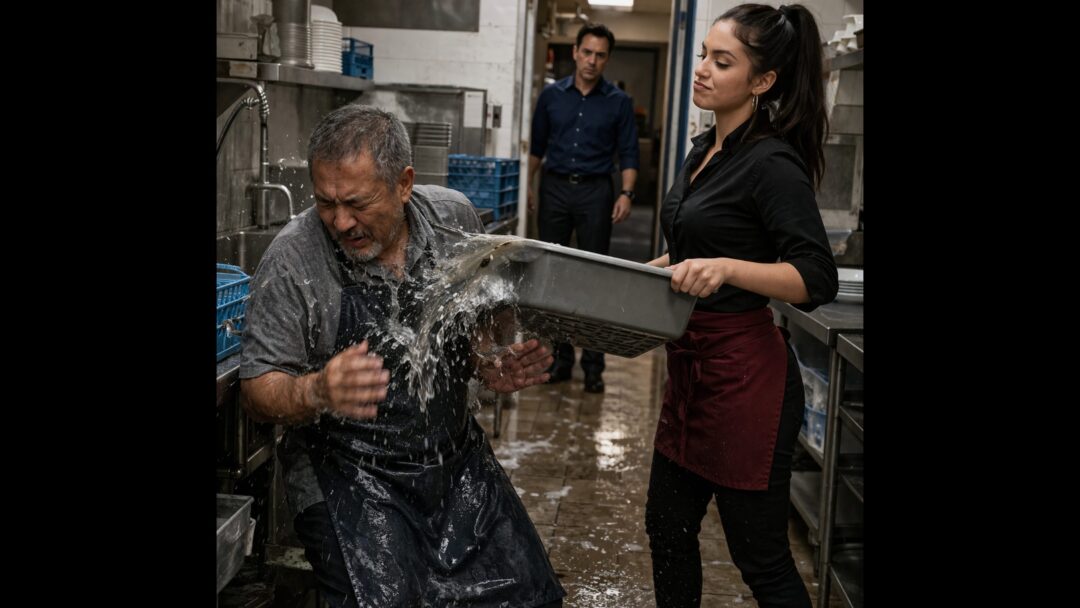
Maris tipped the bus tub.
Cold, filthy water mixed with melted ice, leftover sauce, and bits of soggy food splashed across Ruben’s shoulder, his chest, and the black rubber apron tied around his waist. The force of it made him jerk sideways. His hands flew up on instinct. Something stung near his eye. Water slapped the tile at his feet and spread in a greasy sheet across the floor.
For half a second the whole room seemed to go still.
Then Maris said, “Oops.”
Not startled. Not apologetic.
Amused.
Ruben lowered his hands slowly. His gray shirt clung damply to his skin. Dirty water dripped from his sleeves. He could smell sour dressing and coffee and the metallic tang of the sink. Heat rushed to his face, not from anger but from something older and sadder—the recognition of what had just happened, and of how easy it had been for her to do it.
From somewhere in the kitchen, a cook shouted for plates.
No one came.
No one said a word.
Ruben swallowed, reached for the yellow floor towel hanging from the side of the sink, and dropped to one knee.
“I got it,” he said quietly.
That was what hurt the most, though he would only understand it later. Not the water. Not the laughter hiding in her mouth. Not even the fact that she had done it because she thought she could.
It was the way his body moved automatically to clean up a humiliation that was never his.
Part II — The Shape of Silence
Maris stayed where she was while he wiped the floor.
Ruben could feel her standing over him, could feel the smug stillness of her posture even without looking up. The tile was slick. The towel darkened under his hand. He moved it in slow arcs, careful not to miss the edges of the spill. His lower back twinged sharply as he bent.
He told himself to finish the mess. Stand up. Go back to work. Let the moment pass like all the others life had taught him to swallow.
But something had changed in the air.
At first it was only pressure, a shift so slight it barely seemed real. Then came the sound of a shoe stopping just short of the water line.
Maris heard it too.
The room didn’t fill with noise; it emptied of it.
Ruben looked up.
A man stood in the service doorway just beyond the dish station, one hand at his side, the other loose near his belt. He was broad-shouldered, wearing a navy button-up rolled at the forearms and black slacks darkened slightly at the hem from kitchen moisture. His expression wasn’t dramatic. He didn’t storm in or shout or gesture. He simply stood there looking at the scene with the flat, controlled stillness of someone who had seen exactly enough.
Elias.
Floor manager. Forty, maybe. Quiet in the way that made people lower their voices around him without meaning to. He wasn’t the loud kind of authority. He didn’t need to be. He listened more than he spoke, and when he did speak, the kitchen usually changed shape around his words.
Maris’s posture shifted first.
It wasn’t a big movement. Just a tightening in her shoulders. A tiny hitch in her breath. The beginning of fear.
Elias stepped forward, careful not to rush. His gaze moved from the wet floor to Ruben kneeling with the towel, then to the half-empty bus tub still hanging from Maris’s hand.
No one said a thing.
In that silence, the truth of what had happened grew larger.
Ruben felt suddenly, painfully visible.
He should have felt relief. Instead, what came first was shame, the instinctive ache of being witnessed at his lowest point. Being sixty years old and wet with someone else’s contempt. Being seen on the floor.
Elias crossed the remaining distance and stopped beside the spill. His polished shoe reflected in the thin dirty sheen on the tile.
Ruben started to rise, but Elias gave the faintest motion with one hand—wait.
Then, without looking away from Maris, Elias reached for a gray rinse bucket sitting near the prep sink. He lifted it in both hands. It was not full, but it held enough cloudy water to make the possibility clear.
Maris stepped back so fast her heel clipped the leg of a steel table.
“What are you doing?” she said, and her voice came out thinner than before.
Elias raised the bucket just high enough.
Not theatrically. Not wildly. Just enough.
Enough for her to imagine the cold shock of it. Enough for her to feel, in one hard flash, the thing she had treated as entertainment.
Her hands came up halfway in front of her face.
Elias’s face did not change.
“Funny now?” he asked.
Ruben would remember that line later, not because it was cruel but because it wasn’t. Elias didn’t spit it at her. He didn’t savor it. He just placed it in the room like a mirror.
Maris looked at the bucket. Then at Ruben. Then back at Elias.
“I was joking,” she said.
But the words had no footing.
Elias held the moment just long enough for the lesson to settle.
Then he lowered the bucket.
Not on her.
Not on anyone.
He set it down with deliberate care, pointed once to the wet floor, and took the yellow towel from Ruben’s hand.
“Clean it,” he said to Maris. “Every drop.”
The shift in the room was immediate and complete.
A minute ago, Ruben had been the one kneeling.
Now Maris stood motionless, staring at the towel as if it were something beneath her and unavoidable at the same time.
Elias extended it once. No anger. No raised voice. No space left for refusal.
Maris took it.
Slowly.
Ruben started to push himself back onto one knee out of habit, but Elias turned toward him then and saw, really saw, the water on his shirt and the ache in the way he braced one hand against his thigh.
“Not you,” Elias said.
He reached down, gripped Ruben lightly by the forearm, and helped him stand.
The gesture was so simple that it nearly undid him.
Ruben had spent years learning how to survive disrespect by shrinking around it. A man doesn’t always notice how much smaller he has made himself until someone, with no fanfare at all, insists on returning his full height.
Across from them, Maris had gone to the floor.
Her burgundy apron brushed the wet tile as she knelt.
For the first time since she had entered the station, she said nothing.
Part III — Every Drop
Bellmere Grill had always sounded different from the dish pit. In the dining room, noise floated—forks, conversation, ice in glasses, laughter meant to be overheard. In the back, everything struck. Metal hit metal. Orders snapped. Water roared. Shoes slapped tile.
But in that strange minute after Elias made Maris kneel, even the kitchen seemed to listen.
Ruben stood beside the sink, unsteady more from emotion than from the splash itself. Elias remained near him, not touching now, just present. It was enough.
Maris scrubbed.
At first her movements were stiff with disbelief, as though she expected someone to stop the scene, to laugh and say the punishment had already made the point. When that didn’t happen, her motions became smaller and quicker. The towel dragged over the tile. Her dark ponytail slipped over one shoulder. The silver hoops in her ears flashed when she bent her head.
“Corners too,” Elias said quietly.
Not mean. Exact.
She pressed the towel harder.
Ruben could have looked away. Part of him wanted to. There was no pleasure in seeing her reduced. That would have made him too much like the thing that had just hurt him. What held him there wasn’t revenge.
It was recognition.
For once, the room had been made to understand what labor looked like when dignity was stripped from it.
He thought suddenly of other places, other humiliations. The shipping foreman who had called him “old timer” until everyone else did too. The apartment complex supervisor who once told him he should be grateful to mop up after tenants because “guys like you” didn’t have better options. The years he had spent acting as if each insult were smaller than it was, because objecting would only turn the wound into a spectacle.
Maybe that was why his eyes burned now.
Not because this was the worst thing that had happened to him.
Because it was one of the first times someone had decided it was unacceptable before he had to say so himself.
Maris finally wrung out the towel into a bucket, rose partway, then crouched again to catch a missed streak near the drain. When she looked up, her face was flushed. The arrogance had gone somewhere he could not follow. In its place was something messy and human—embarrassment, yes, but also confusion. As if she were meeting a version of herself she had managed not to know until now.
Elias bent, picked up a clean side towel from a shelf, and handed it to Ruben.
“This one’s dry,” he said.
Ruben stared at it a moment before taking it.
His throat tightened unexpectedly. He nodded once, unable to trust his voice.
The church group in the dining room must have finished their meals, because another wave of dishes began arriving from the service window. But nobody pushed into the dish pit now. Nobody cut across the spill area. Word moved fast in restaurants, especially the unspoken kind. One look at Maris kneeling on the floor while Elias stood nearby was enough to send the message through the line.
Something had happened here.
Something final.
Maris rose at last and held out the dirty towel without meeting either man’s eyes. Elias took it, dropped it into a bin, and let the silence stretch a few beats longer than comfort allowed.
Then he said, “Go wash up. Then apologize.”
She blinked once.
“To him?”
Elias looked at her, and whatever she saw there ended the question.
Maris turned to Ruben.
The apology, when it came, was awkward and spare. Not graceful. Not transformed by sudden wisdom. She swallowed hard and said she was sorry. Said she had crossed a line. Said it wouldn’t happen again.
Ruben studied her face while she spoke.
If she had offered excuses, he might have shut down. If she had cried for effect, he might have hardened against it. But there was no performance left in her. Only humiliation, stripped down enough to reveal the youngness beneath it.
He did not owe her comfort. He knew that.
Still, something in him had survived too much bitterness to be fed by one more mouthful.
He nodded. “All right.”
It was not forgiveness exactly.
But it was a door left unlocked.
Maris went to wash her hands and face. When she returned to the floor, she did not take the fastest tables or the best section. She restocked glasses in silence. Later, when a busser dropped a stack of ramekins, she crouched to help without complaint.
Ruben noticed because men like him notice changes in the room before anyone else does.
Elias stayed another few minutes in the dish station, drying his hands on a cloth that had already seen too much use.
“You should have called me,” he said finally.
Ruben gave a tired half-shrug. “Didn’t think it was worth making bigger.”
Elias looked at the sink, the stacked trays, the stained apron still clinging wetly to Ruben’s shirt. Then he looked back at him.
“That’s exactly why it gets bigger,” he said.
The words sat with Ruben long after Elias walked away.
Part IV — Full Height
That night, after closing, Ruben stood alone at the bus stop with a plastic bag holding his damp work shirt.
The city smelled like wet pavement and fryer grease. Cars hissed past under the orange wash of streetlights. His back hurt. His hands smelled faintly of detergent no matter how hard he scrubbed them. The day had left him tired in the deep, old-bone way he knew too well.
And yet something inside him felt oddly light.
He kept replaying the moment Elias had said, Not you.
Not because it was dramatic.
Because it wasn’t.
There had been no grand speech. No crowd applause. No cruel revenge dressed up as justice. Just a single refusal to let the wrong person remain on the floor.
Ruben boarded the bus and took his usual seat near the back. Across the aisle, a teenager watched videos without headphones. A woman in scrubs slept with her head against the window. The city slid past in reflections—laundromats, convenience stores, darkened storefronts, the glowing sign of a pharmacy open all night.
He thought about calling his daughter.
Instead he waited until he got home to his room, reheated a bowl of soup, and sat at the edge of the bed with his phone in both hands. It was late enough that she might not answer. Still, he called.
To his surprise, she picked up on the third ring.
“Dad?”
He smiled before he meant to. “Hey, mija.”
They spoke only ten minutes. About nothing dramatic. Her work. His shift. Whether he was sleeping enough. Whether she might visit in spring. He did not tell her the whole story, only a softened version. A bad moment at work. Someone stepped in. It turned out all right.
But after they hung up, he sat for a long time in the quiet room, thinking about how easily a life could become defined by what a person learns to endure.
The next morning, Ruben arrived early.
The dish pit was calm then, almost gentle. No rush yet. No crashing pans. Just the hum of refrigeration and the soft start of prep in the kitchen. He tied on a clean apron and filled the sinks.
A few minutes later, someone appeared at the entrance.
Maris.
She wore the same black shirt and burgundy apron, but her posture had changed. Less sharp. More careful. In her hands was a paper cup with a plastic lid.
“I brought you coffee,” she said.
Ruben looked at the cup, then at her face.
“I don’t know how you take it,” she added quickly, “so it’s just regular.”
For a moment neither of them moved.
Then Ruben took the coffee.
“Thank you,” he said.
She nodded once, almost relieved by the simplicity of the exchange. “I meant what I said yesterday.”
He believed that she meant it in the way young people often do after shame—imperfectly, but sincerely enough to begin.
“All right,” he said again.
This time the words felt a little more like forgiveness.
She lingered half a second, as if wanting to say more, then went back toward the dining room.
Ruben set the coffee near the drying rack and stood looking at it. Steam curled up in the cool kitchen air. It was such a small thing. Small enough that many people would miss its meaning.
But he did not miss it.
That afternoon, when the rush returned, the restaurant sounded the same as always. Orders flew. Plates piled up. Water ran. Work remained hard and thankless and necessary. Yet something fundamental had shifted.
People greeted him more directly.
A busser asked before leaving a stack too close to the sink.
One of the cooks brought back his own pan instead of tossing it into the pile.
Elias passed through the kitchen around noon, caught Ruben’s eye, and gave a brief nod that said more than conversation needed to.
The world had not transformed. Bellmere Grill had not become a place of miracles. There were still long hours and sore muscles and the blunt arithmetic of people judging one another by title and age and the cleanliness of their hands.
But dignity, Ruben realized, did not always arrive as a grand restoration.
Sometimes it arrived as a witness.
Sometimes as a dry towel.
Sometimes as a cup of coffee offered without an audience.
Near the end of the shift, Ruben looked down at the wet tile around his station and saw his own reflection broken in the shine. For years he had mistaken endurance for invisibility. He had thought survival meant lowering himself before anyone else could push him there.
He knew better now.
The floor would always need cleaning. That was the nature of work, and of kitchens, and maybe of life itself.
But there was a difference between kneeling because the job required it and kneeling because someone thought you belonged there.
Ruben straightened, rolled his shoulders back, and reached for the next rack of plates.
When Maris came through with another bus tub, she stopped at the line where the floor changed from dry tile to splash zone and waited for him to clear space before stepping in.
It was a small pause.
A respectful one.
He made room for her, and she set the dishes down carefully.
No smirk. No impatience.
Just work.
Ruben glanced once toward the service doorway, half expecting to see Elias there again. But the doorway was empty.
It didn’t matter.
Some presences remained even after people walked away.
Ruben turned back to the sink, the steam rising around him, the room loud and alive, and for the first time in a long while, he did not feel like the man no one saw.