What the City Chose to Remember
What the City Chose to Remember
Part I — The Edge of the Water
By the time anyone noticed the dog, it was already too late for an easy rescue.
The rain had come down hard for nearly an hour, turning the city’s canal into a furious gray chute that swallowed leaves, trash, and anything careless enough to slip near its edge. People on the walkway had stopped to watch the water hammer itself against the concrete walls. Most of them kept a cautious distance. The canal was steep, slick, and unforgiving even on dry days.
Then someone pointed.
A small dog, soaked through and shivering, was scrambling halfway down the slanted embankment. It had probably fallen from the upper path. Every time it tried to climb, its paws skidded, and the current snapped at its hind legs like it was waiting for one mistake.
Rowan saw it at the same moment the others did, but unlike the rest, he didn’t stop to calculate.
He was over the railing before anyone could tell him not to be.
“Rowan—”
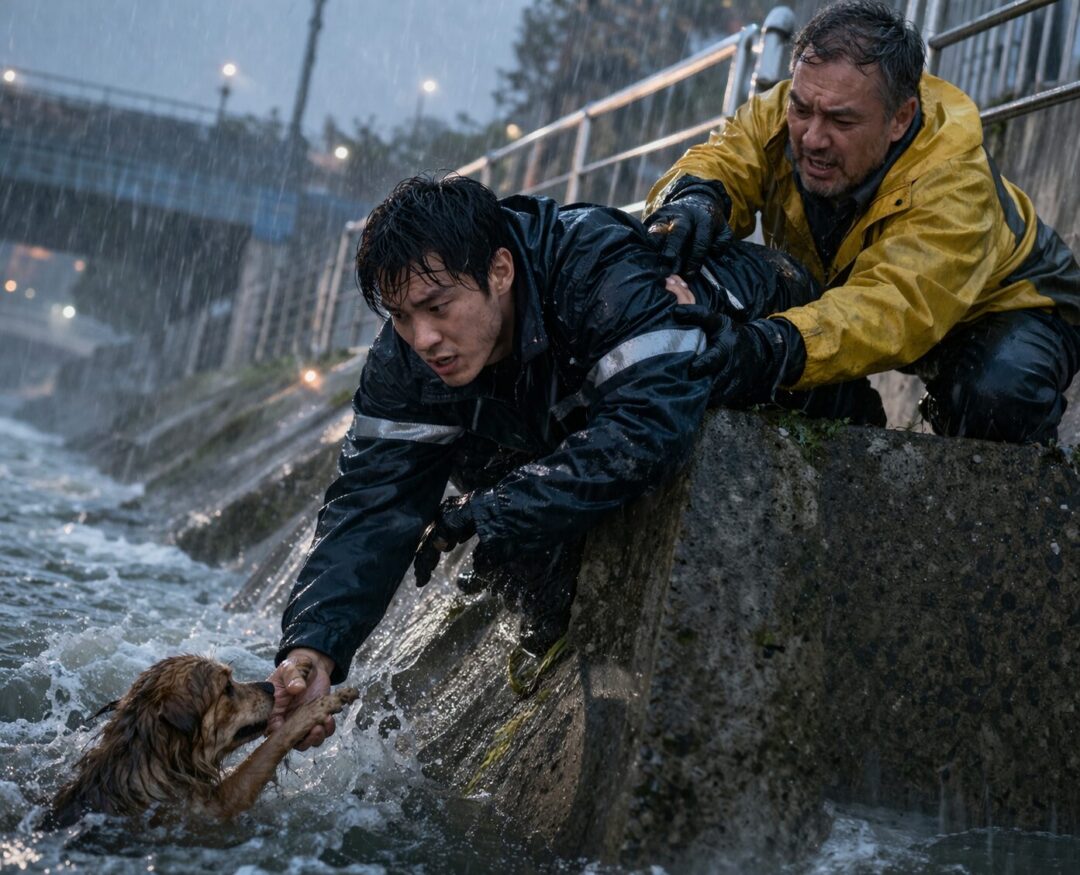
The warning barely registered. His boots hit wet concrete. His body dropped low. His left hand clamped to a drainage seam in the wall, his right arm reaching down toward the dog. Rain streamed off the dark reflective stripe across his jacket and ran into his eyes. Below him, white water churned and frothed.
The dog let out a sound so small it almost disappeared under the storm.
That was what did it.
Later, when people asked why he moved so fast, Rowan wouldn’t have a good answer. He only knew that some sounds reached a place in you deeper than thought. That frightened little cry had.
Behind him, Malik swore under his breath and lunged forward, grabbing a fistful of Rowan’s jacket.
“Don’t let go!”
The shout cracked through the rain.
Malik was bigger than Rowan, broader in the shoulders, planted harder into the world. He worked maintenance for the city, the kind of man who had spent twenty-five years around unstable machinery, flooded roads, snapped cables, and every other ordinary danger that came disguised as routine. He knew exactly how fast a body could disappear when concrete turned slick and water turned violent.
He also knew Rowan too well.
Three months earlier, Rowan had joined their crew with the reputation of being quiet, competent, and impossible to slow down once he decided something mattered. At first Malik had mistaken that for youthful stubbornness. Over time he realized it came from something older and harder—a habit of placing himself second so reflexively it no longer felt like sacrifice.
Now, with the dog slipping lower and Rowan stretched nearly horizontal over the slope, that quality looked less noble than terrifying.
“You’re too far,” Malik said, though he already knew the younger man wouldn’t listen.
Rowan didn’t answer right away. The dog had twisted, claws scraping uselessly at the wet concrete. Its eyes flashed white with panic. For a second it looked straight at him—not with trust, exactly, but with that raw animal plea that came before trust, before understanding, before anything except fear.
Rowan reached farther.
“I’ve got it.”
The words came out low, steady, absurdly calm.
Malik braced both boots against the railing posts and tightened his grip. Rain ran off the hood of his yellow jacket. His gloved hands locked harder around Rowan’s arm and shoulder. Around them, a few people had gathered, frozen between wanting to help and being afraid they’d only make things worse. No one spoke. The rain did enough speaking for everyone.
The dog slipped.
Rowan lunged.
His fingers caught fur first, then skin, then one frantic paw. The sudden weight nearly yanked him forward. Malik felt it in his own spine, in the dangerous half-second when all the balance in the scene shifted toward the water.
“Pull!” Rowan shouted.
Malik did.
The movement was ugly and desperate, not heroic in any cinematic sense. Boots scraped. Knees slammed concrete. The dog twisted, the current fighting to reclaim it. Rowan’s shoulder wrenched. Malik hauled backward with everything he had, teeth clenched, breath ripping from his chest.
Then the dog was there.
Not gracefully. Not cleanly. But suddenly, impossibly, there—scrambling over the edge, collapsing in a trembling heap against the rain-dark pavement.
Malik dropped to one knee first. “Easy. Easy.”
He wasn’t sure whether he was talking to the dog, Rowan, or himself.
For a few seconds nobody moved.
The rain hammered the canal. Rowan crouched with one hand flat to the ground, breathing hard, head bowed. The dog pressed itself low, sides heaving, ears pasted to its skull. Malik could feel his own heart pounding against the inside of his ribs like something trying to get out.
Then the dog lifted its head and looked at Rowan.
Something changed in his face.
It wasn’t triumph. Rowan wasn’t built for that. It was simpler and somehow heavier: relief, so complete it looked almost like pain.
By the time the animal control team arrived, the dog had already inched close enough to let Rowan touch its neck. By the time the storm eased, someone had uploaded the footage. By nightfall, half the city had watched two maintenance workers drag a soaked stray back from the edge of a flood canal.
By morning, everyone had an opinion.
Heroic, people said.
Foolish, others argued.
Brave.
Reckless.
Necessary.
Unnecessary.
For two days the story lived exactly where stories like that usually lived now—on phone screens, in clipped conversations, in passing bursts of outrage and admiration. Then the city moved on.
At least, that was what Rowan thought.
Part II — After the Storm
The dog survived.
That should have been enough to finish the story, but life rarely understood where a clean ending belonged.
The veterinarian who examined the animal said it had no chip, no collar, no active missing report. It was underweight, exhausted, and old enough to know hardship. Rowan visited on the second day because he couldn’t stop thinking about the wild look in its eyes. Malik came because he told himself someone had to make sure Rowan didn’t do anything sentimental and complicated.
The dog wagged its tail for Rowan before it did for anyone else.
That, Malik later insisted, was manipulation.
Rowan, who was kneeling beside the kennel while the dog pressed its muzzle into his palm, only smiled in that distracted way that meant some private decision was already forming.
He named the dog Drift, partly because of the canal current, partly because it seemed to belong to the kind of creature that had survived by moving through the edges of other people’s lives unnoticed.
Drift moved into Rowan’s apartment a week later.
If Rowan’s life had been orderly before, the dog dismantled that illusion quickly. There were accidents on the kitchen floor, anxious pacing at night, panic whenever heavy rain struck the windows. Rowan learned that Drift hated loud engines, distrusted umbrellas, and slept best with one paw touching the side of the couch where Rowan sat reading. Healing, he discovered, was not a single grateful moment. It was repetition. Meals on time. Quiet voices. Walks taken slowly. Fear returning without warning. Safety proven again and again until the body believed what the mind could not.
Malik watched this with the skepticism of a man who had spent most of his life pretending tenderness was impractical.
Then Drift started waiting for him too.
Every Thursday evening, after work, Malik came by with takeout and whatever complaint currently occupied his mind. The dog would limp-stumble to the door and stand there wagging itself loose while Malik muttered, “I’m not here for you.”
Nobody believed him.
The rescue video lingered longer than expected. A local station aired it. Then another. Rowan was invited to speak somewhere and refused. Malik was asked for a quote and gave one so short the reporter looked offended. A school sent letters. An animal rescue group posted the footage with swelling music and a caption about humanity. Rowan found the whole thing embarrassing.
“It was just a dog,” he said once when Malik mentioned how many people had seen the clip.
Malik had looked at him for a long moment before answering. “That’s never what people are actually watching.”
Rowan didn’t understand then.
He began to, slowly, in strange places. A woman at a grocery store touched his arm and said her son had seen the video and cried. A man at a gas station shook his hand without explanation. Someone left a bag of dog treats at the maintenance depot with a note that said, Thank you for reminding us who we can be.
The city itself remained silent.
Winter came. Then spring.
Drift grew stronger. The fur around his neck thickened. The fear in him softened into wariness, then into personality. He became possessive of sunlight on the living room floor. He hated bath time with dramatic integrity. He followed Rowan from room to room like a shadow that had finally found the right body to belong to.
The canal returned to being just a canal.
And then, almost a year later, an official envelope arrived.
Rowan stared at it from the kitchen counter as if it might bite.
Malik, who had stopped by after work and was eating noodles standing up, frowned. “Why do government envelopes always look like trouble?”
Rowan opened it.
There was to be a civic dedication ceremony, it said. The Department of Public Works, in partnership with the mayor’s office, would like to recognize an act of extraordinary courage and compassion that had moved the city. Rowan and Malik were requested to attend.
Malik read the letter twice.
“This feels dangerous in a different way,” he said.
Rowan almost laughed, but unease had already begun to spread through him. Recognition was one thing. Public attention was another. Ceremonies belonged to polished people and carefully chosen words. Whatever had happened that day in the rain had not felt polished. It had felt immediate, messy, almost private in its urgency.
He thought about not going.
Then Drift rested his chin on Rowan’s knee, and Rowan looked down at the dog who might have died in that canal and realized the day no longer belonged only to his discomfort.
So they went.
Part III — The Covered Shape
The morning of the ceremony was bright enough to feel unreal.
The same canal where rain had once turned everything into danger now glittered beneath clear sunlight. The concrete slopes looked less threatening. The walkway had been cleaned. Metal barriers stood in neat lines. A small crowd gathered near a raised platform, where city officials moved with practiced solemnity.
At the center of it all stood a large shape hidden beneath a dark cloth.
Rowan noticed it immediately.
So did Malik.
Neither of them said anything at first. They stood off to one side, dressed more neatly than usual but still unmistakably themselves—Rowan uncomfortable in a pressed shirt beneath his dark jacket, Malik muttering beneath his breath whenever anyone with polished shoes came too close.
Drift had not been allowed at the event, which Rowan secretly considered a flaw in the entire plan.
The mayor arrived to applause. Cameras lifted. Microphones appeared like hungry birds. Rowan endured a brief handshake, then another, then a third. People told them they were examples, reminders, symbols. Rowan nodded politely while the old discomfort tightened in his chest.
He kept glancing at the covered shape.
The speeches began. They were not bad, as speeches went. Better than he feared, anyway. Less self-congratulatory. More human. The mayor spoke about public service, about compassion without calculation, about the moral measure of a city not being how loudly it praised power but how faithfully it honored care.
Rowan listened only in fragments.
He was watching the cloth stir in the breeze.
At last the mayor turned and gestured toward the concealed monument.
There was applause again. A few city workers stepped forward. The cloth was grasped at two corners.
Malik leaned slightly toward Rowan, his eyes narrowing.
“For that day?”
It was barely more than a murmur, but Rowan heard the disbelief in it.
He felt it too.
The cloth came free in one clean motion.
Underneath stood bronze.
For a long second Rowan could not understand what he was looking at, only that it felt impossible. Then the shapes resolved.
A man hanging over the canal wall, one arm stretched downward.
Another man gripping him from behind, body braced with all its strength.
And below them, a small dog rising from the water toward the hand that had reached for it.
Not an abstract monument. Not a plaque. Not a general tribute to civic virtue.
That exact moment.
Their moment.
The one neither of them had thought anyone would remember once the storm passed.
The crowd broke into applause, but the sound came from far away. Rowan stood rooted to the spot, staring up at the bronze version of himself and recognizing almost none of himself in it. The sculptor had not made him look grander. If anything, the figure looked thin with effort, precarious, unfinished without the grip behind him.
Behind him. That was right too.
He looked at the second figure—the broad shoulders, the grounded stance, the hands locked in rescue not only of a dog, but of the man trying to save it. Malik, preserved in metal with the same fierce refusal to let go.
For the first time that morning, Rowan understood what the ceremony was actually about.
It had never been hero worship. It had never been spectacle.
It was memory.
Not of fame. Not of virality. Of choice.
The mayor was saying something at the microphone, but Rowan barely heard the words. He stepped closer to the monument. Sunlight caught the bronze surfaces and turned them warm. The sculpted water seemed frozen in the instant before becoming something else. Around him, people were still clapping. Some were crying.
Rowan felt suddenly exposed, then humbled, then unsteady with a kind of grief he hadn’t expected.
He thought of the storm. Of Drift’s body shaking on wet pavement. Of how little time there had been to think. Of how easily the world could have lost one frightened animal and forgotten it by dinnertime.
He thought of all the lives that vanished because no hand reached in time.
And he thought of one hand that had.
Not just his.
Malik came to stand beside him. For once, he had nothing ready to say. His usual armor—sarcasm, irritation, skepticism—had fallen away, leaving only a man looking at proof that a city had seen him more clearly than he had seen himself.
Rowan swallowed hard. His eyes stayed on the monument.
“It was just a dog.”
He meant it the way he had always meant it—not dismissively, but plainly. A small life. An ordinary creature. No title. No status. No reason to matter to anyone except the fact that it did.
Beside him, Malik let out a slow breath.
“That’s why it matters.”
The words settled into Rowan with the quiet force of truth.
He turned then, not to the cameras or the mayor, but to the crowd.
He saw workers in uniforms like theirs. Schoolchildren holding handmade drawings. An elderly woman with both hands pressed over her mouth. A teenager wiping his face with the back of his sleeve. People who had come because, somewhere in that moment by the canal, they had seen a version of the city they wanted to belong to.
A place where compassion did not need permission.
A place where saving one vulnerable life was not ridiculous, not excessive, not sentimental.
A place that chose to remember.
Part IV — What Stayed
That evening, after the ceremony was over and the phone calls unanswered and the official photographs endured, Rowan and Malik went back to Rowan’s apartment.
Drift met them at the door like he had been waiting all day for the world to return to its proper size.
The dog circled once, twice, then launched into Rowan hard enough to make him laugh for the first time since morning. Malik crouched beside them and rubbed behind Drift’s ears with awkward tenderness.
Neither man talked about the monument right away.
They ordered food. Drift tried to steal a dumpling. Malik pretended outrage. Rowan finally relaxed enough to sit on the floor with his back against the couch while the dog sprawled half across his legs, warm and alive and gloriously unaware of bronze, speeches, or history.
Outside, evening rain began to tap lightly against the windows.
Drift lifted his head at the sound. Once, that would have sent him trembling. Now he only listened, glanced at Rowan, and settled again.
Something in that small act undid the last of the day’s weight.
Rowan reached down, fingers resting in the thick fur at Drift’s neck.
He understood then that the monument was not really about the instant at the canal, however perfectly it had captured it. It was about everything that instant had made visible.
The choice to lean closer instead of stepping back.
The choice to hold on when holding on was dangerous.
The choice, afterward, to keep caring when the dramatic moment was over and all that remained was the slower work of healing.
Cities were built from concrete and money and law, people liked to say. But Rowan thought maybe they were also built from smaller things no one could measure cleanly: who got noticed, who got helped, what kinds of mercy were dismissed, what kinds were honored.
Drift sighed in his sleep.
Malik glanced over at the dog, then at Rowan. “You still embarrassed?”
Rowan considered it.
“Yes,” he admitted.
Malik nodded as if that was the correct answer. “Good.”
Rowan laughed softly. “You?”
Malik leaned back against the couch, crossing his arms. For a long moment he said nothing. Then he looked toward the rain-dark window.
“I think,” he said slowly, “I’m glad someone remembered the right part.”
Not the video. Not the attention. Not the argument.
The right part.
Rowan looked down at the dog asleep across his legs and felt the truth of that settle in him like something final and gentle.
Outside, the rain went on falling.
Inside, the small life that had once trembled at the edge of the water slept in perfect trust between two men who had changed more than they realized the day they refused to let it be carried away.
And somewhere across the city, beside a canal that had once looked like nothing but danger, bronze hands remained forever outstretched toward a life that mattered simply because it was a life.
That was what the city had chosen to remember.
And perhaps, Rowan thought, that was what made it worthy of being remembered too.