The Afternoon the Blue Cake Changed What Jennifer Would Carry
Part I — The Kitchen Floor
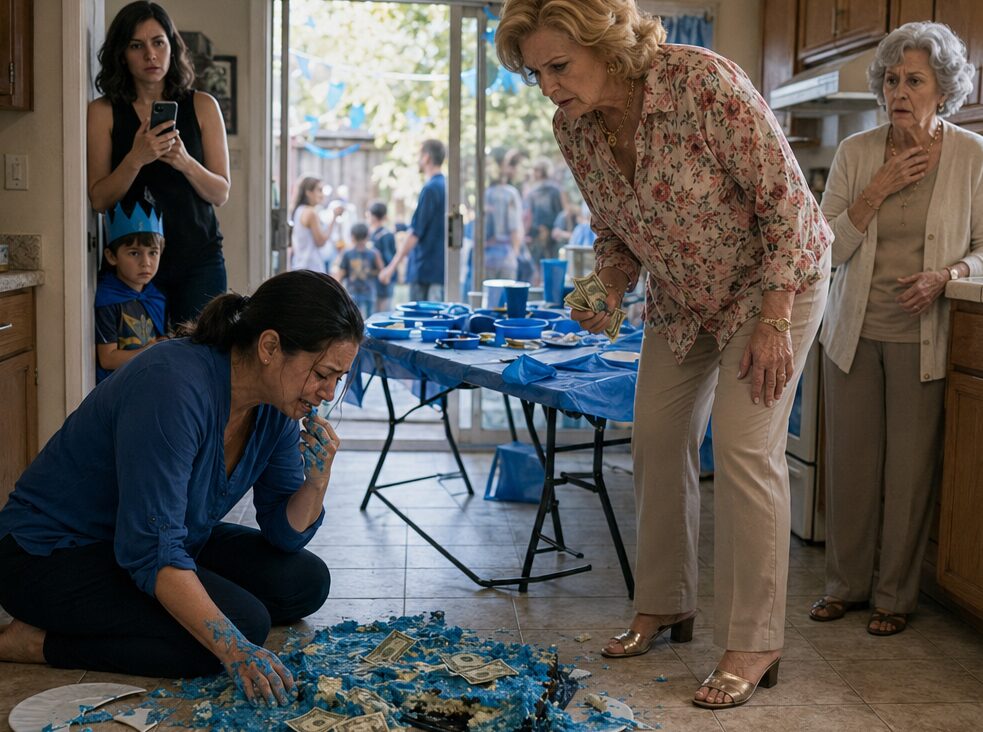
The cake was face-down on the kitchen tile, blue frosting spread under it like a bright, impossible mistake.
Half the message still showed through the smear.
Happy 6th Birthday Benjamin.
Jennifer sat on the floor beside it with one hand over her mouth, trying to keep the sound in her throat from reaching the backyard. Through the open sliding door, children were still shrieking around a crooked superhero piñata, unaware that the birthday song had already fallen apart in the kitchen.
A broken serving plate glittered near her bare foot.
Six crumpled one-dollar bills lay in the frosting.
Margaret stood over her in a floral blouse and expensive sandals, her blonde hair fixed in place, her face flushed with anger and something too cold to be embarrassment.
“Well,” Margaret said, gripping the rest of the money in one polished hand, “now everyone can see exactly what kind of mother you are.”
In the doorway, Christine froze with her phone lifted halfway between her chest and her face.
She had not meant to record. Not exactly.
But her thumb was already on the screen.
Jennifer looked at the cake again. The grocery-store border had been piped in blue because Benjamin loved blue. Blue sneakers, blue paper crown, blue plastic cups from the dollar store, blue napkins folded into the shape of lightning bolts because she had watched a video at midnight and practiced three times with paper towels.
Blue, because that was what six looked like to him.
Margaret bent to snatch another dollar from the floor before frosting touched it.
Something in Jennifer’s chest went still.
Not calm.
Past calm.
“Don’t,” she said.
Margaret did not look at her. “Don’t what? Clean up another one of your messes?”
Behind Christine, Nancy stood with one hand pressed to her necklace, her mouth forming a small, church-lady O. Somewhere outside, a child yelled that it was Benjamin’s turn to swing at the piñata.
Jennifer could hear Benjamin laughing.
That was the sound that did it.
Not Margaret’s words. Not the money. Not the broken plate. Not even the cake.
It was the fact that her son was still laughing because he did not know yet.
Jennifer put her palms against the floor. Her fingers slid in frosting. She rose too fast, one knee skidding, one breath catching hard enough to ache.
Margaret finally looked at her.
For the first time all afternoon, she looked uncertain.
“Jennifer,” Christine whispered.
Jennifer reached for Margaret’s sleeve.
And the whole kitchen seemed to hold its breath.
Part II — Before the Song
Four hours earlier, Jennifer had stood in that same kitchen smoothing a plastic blue tablecloth over a borrowed folding table, pressing out wrinkles that kept coming back.
The duplex was too small for a party. She knew that.
The living room could hold eight adults if no one opened the coat closet. The kitchen had enough counter space for the cake, paper plates, and one bowl of cheese puffs. The backyard was really a rectangle of grass divided from the neighbor’s yard by a tired wooden fence.
But Benjamin had woken up wearing his paper crown.
“Do I look six?” he had asked.
Jennifer had kissed the missing-tooth gap in his smile and said, “You look like the boss of six.”
That was enough. It had to be enough.
She had bought the cake with a coupon and twenty-four hours of guilt. She had stood in front of the bakery case at the grocery store counting in her head: rent, gas, lunch money, the minimum payment on the dental bill, the late fee she was pretending not to see. Then she had ordered the blue frosting anyway.
Steven was working a double shift at the warehouse. He had called at seven that morning sounding tired enough to fall asleep standing up.
“I can still try to get home before candles,” he said.
“Don’t promise him unless you know,” Jennifer said.
There was silence. Then he said, “I hate this.”
“Me too.”
She did not say what both of them knew: Margaret had offered to cover the party at her community room, the one with clean bathrooms and a kitchenette and framed watercolor prints of sailboats. All Jennifer had to do was let Margaret send the invitations, choose the cake, and “handle the guest list.”
Jennifer had said no.
So Margaret arrived at noon with two bags of ice, a tray of sandwiches Jennifer had not asked for, and the expression of a woman stepping into a place she had already judged.
“Oh,” Margaret said, looking around the kitchen. “You’ve done it all yourself.”
Jennifer smiled. “That was the plan.”
Margaret set the ice down in the sink. “I only meant, you didn’t have to make it so hard.”
“It’s not hard. It’s a birthday party.”
Margaret’s eyes moved to the paper streamers taped over the doorway. One side had sagged in the humidity.
“Of course,” she said.
That was how Margaret did it. Never a direct insult first. Always a soft landing. Always a sentence with a second sentence hidden inside it.
Jennifer turned to the cake box and checked the lettering again, though she had already checked it seven times.
Happy 6th Birthday Benjamin.
The letters were a little uneven. The Y dipped lower than the rest. It made her love it more.
Margaret came up behind her.
“Well,” she said, “he won’t care that it’s from a grocery store.”
Jennifer closed the box.
“No,” she said. “He won’t.”
Margaret gave a small laugh. “I was agreeing with you.”
Jennifer picked up the stack of blue plates. “Can you put these on the table?”
Margaret looked at them as if they might stain her hands. “Plastic?”
“Kids drop things.”
“Yes,” Margaret said. “They do learn what we expect of them.”
Jennifer kept moving.
That was the trick. Keep moving and Margaret’s words could not land. Tape the streamer. Open the chips. Fill the cooler. Wipe the counter. Smile when Benjamin ran in wearing his cape backward and asked if everyone was coming.
“Yes,” Jennifer said. “Everyone who matters.”
Margaret heard it.
Jennifer knew she heard it because Margaret stopped arranging the plates and looked toward the cake box.
“Your father would have loved this,” she called to Benjamin, voice bright. “He always had proper parties.”
Benjamin blinked. “Dad’s not here.”
“He’s working hard,” Jennifer said quickly.
Margaret touched Benjamin’s paper crown. “Yes. Someone has to.”
Jennifer looked at her then.
Margaret looked back, pleasant as a closed door.
Part III — Six Dollars
By two o’clock, the duplex had filled with children, parents, noise, and the heavy smell of pizza warming in the oven.
Christine arrived late with a bag of superhero stickers and a look that said she had already sensed the weather in the room.
“You okay?” she asked Jennifer near the refrigerator.
“Fine.”
“You do that thing with your mouth when you’re not fine.”
“I’m hosting.”
“That’s not an emotion.”
Jennifer shoved a stack of napkins into Christine’s hands. “Make yourself useful.”
Christine held her gaze for half a second, then softened. “Okay.”
In the living room, Margaret was already making herself useful in her own way.
She moved the gift bags from the floor to the side table because “people might trip.” She turned the paper plates so the blue side faced outward. She told one child not to touch the balloon garland because Jennifer had “worked very hard on what she had.”
Every correction sounded like praise if you were not listening closely.
Jennifer was listening closely.
So was Benjamin.
He stood near the hallway in his blue paper crown, watching his grandmother straighten the gift table. His cape dragged behind him. One sleeve had a streak of frosting from where he had snuck a finger into the cake box and Jennifer had pretended not to notice.
Margaret spotted it.
“Benjamin,” she said, “we don’t touch food before guests are served.”
His face fell.
Jennifer crossed the room. “He’s excited.”
“Excited children still need manners.”
“He has manners.”
Margaret smiled toward Nancy, who had come from church with a wrapped book and a lemon bundt cake nobody had asked for. “Jennifer is very protective.”
Nancy smiled carefully, the way people smile when they do not want to be pulled into a family sentence.
Jennifer wanted to say, And you are very cruel.
Instead, she crouched beside Benjamin and adjusted his crown.
“You’re doing great, birthday boss,” she whispered.
He leaned into her for one second. Then another child shouted from the yard, and he ran off.
Margaret watched him go.
“He could use more structure,” she said.
Jennifer kept her voice low. “Not today.”
“Especially today. Children remember occasions.”
“I know they do.”
Margaret’s expression sharpened, but before she could answer, she reached into her purse and pulled out a white envelope.
“Benjamin,” she called.
He came back at once because presents had a magnetic force.
Margaret knelt, holding the envelope like it was something sacred.
“This is from Grandma,” she said. “Six dollars. One for every year. So you can learn what money looks like when people work for it.”
Benjamin opened the envelope and counted the bills with serious concentration.
“One. Two. Three. Four. Five. Six.”
“Very good,” Margaret said.
Then she looked up at Jennifer.
“Maybe your mother can put it somewhere safe. We wouldn’t want it getting mixed in with all the other things she owes.”
The room did not go silent.
That would have been kinder.
Instead, the room kept going. Children laughing. Ice shifting in the cooler. Paper cups crinkling. An adult pretending to check a text. Nancy looking down at her bundt cake.
Jennifer felt every sound become sharp.
“Margaret,” she said quietly.
Margaret stood. “What?”
“Not in front of him.”
“I didn’t say anything untrue.”
Christine appeared beside Jennifer. “Maybe we can put the presents in the bedroom.”
Margaret’s smile did not move. “I’m only trying to teach him responsibility.”
“He’s six,” Jennifer said.
“And dental bills come whether children are six or sixteen.”
There it was.
The tooth.
The bill.
The envelope Margaret had written a check for three months ago when Benjamin woke up crying, cheek swollen, and Jennifer’s insurance had not covered enough. Steven had been between overtime rotations. Jennifer had swallowed her pride because her son needed a dentist more than she needed dignity.
Margaret had said, “Don’t worry. Family helps family.”
Then she had mentioned it at Thanksgiving.
Then in January.
Then over speakerphone while Steven’s cousin was in the car.
And now here, between pizza and cake.
Jennifer reached for the envelope in Benjamin’s hand. Her fingers trembled once.
“I’ll put it in my room,” she said.
Margaret’s eyes dropped to the tremor.
“You’re shaking,” she said.
Christine stepped between them lightly. “Who wants stickers?”
Benjamin looked from his mother to his grandmother.
Nobody answered him when he asked, “Did I do something?”
Jennifer heard it.
She would remember later that she heard it and still did not stop the day right then.
She only touched his cheek and said, “No, baby. Never.”
Part IV — The Better House
The party should have recovered after that.
Children are generous with adults. Give them pizza, balloons, and a backyard, and they will forgive nearly any atmosphere they cannot name.
For twenty minutes, Jennifer almost believed she had saved it.
Benjamin chased his cousins around the piñata. Christine tied the sagging streamer back up. Nancy helped pour lemonade. A neighbor from the other side of the duplex complimented the tablecloth and said blue had always been her favorite color.
Jennifer accepted the kindness like water.
Then she went to the kitchen for candles and heard Margaret’s voice.
“She makes herself the victim,” Margaret was saying.
Jennifer stopped at the edge of the doorway.
Nancy stood near the sink, holding a stack of cups. Margaret was beside the cake box, one hand resting on top as if guarding it.
“I know she tries,” Nancy said softly.
Margaret sighed. “Trying isn’t the same as providing stability.”
Jennifer’s fingers tightened around the little box of candles.
“She takes everything personally,” Margaret continued. “But look around. Steven working himself sick. The rent always late. Benjamin eating grocery-store cake in a backyard with a broken fence. He could spend weekdays with me. At least until they get on their feet.”
Nancy did not answer quickly enough.
That silence did something to Jennifer.
It was not agreement. Maybe it was discomfort. Maybe it was a prayer forming itself. It did not matter.
For one suspended second, Jennifer saw the shape of Margaret’s real desire. Not just criticism. Not just control of the party.
A version of the future.
Benjamin’s backpack by Margaret’s door. Benjamin’s toothbrush in Margaret’s clean guest bathroom. Benjamin telling people he stayed at Grandma’s during the week because Mommy had too much going on.
Jennifer stepped into the kitchen.
“No,” she said.
Both women turned.
Margaret’s eyebrows lifted. “Were you listening?”
“You’re talking about my son in my kitchen.”
Nancy looked at the cups in her hand. “I should—”
“Stay,” Jennifer said.
The word surprised all three of them.
Margaret recovered first. “Jennifer, don’t be dramatic.”
“You don’t get weekdays. You don’t get to stand in my house and audition for my life.”
“I am trying to discuss what is best for Benjamin.”
“No. You’re trying to make me small enough to step over.”
Margaret’s mouth tightened. “If you were less proud, people could help you.”
Jennifer laughed once, dry and awful. “You don’t help. You keep receipts.”
The words hung there.
Then Benjamin appeared in the hallway.
His crown had slipped over one eye. His face was open in the way children’s faces are open right before they understand too much.
“What’s weekdays?” he asked.
Jennifer’s anger vanished so quickly it left her dizzy.
Christine came up behind him and set both hands on his shoulders. She looked at Jennifer, then Margaret, then Nancy.
Nobody moved.
Margaret softened her voice, but not her meaning. “Grandma was just saying you could come stay with me more often, sweetheart. Wouldn’t that be fun?”
Benjamin looked at Jennifer.
That look went through her.
Not because he wanted to go. Not because he did not.
Because he was asking her which answer would keep everyone from getting upset.
Jennifer walked to him and knelt.
“You live with me,” she said. “You visit Grandma. That’s all.”
Margaret exhaled. “You make everything sound hostile.”
Jennifer stood.
“After cake,” she said, “you need to leave.”
Christine’s eyes widened.
Nancy looked toward the backyard.
Margaret stared at Jennifer as if Jennifer had spoken in a language she did not recognize.
“It is my grandson’s birthday,” Margaret said.
“Yes. And somehow you keep making it about you.”
The backyard door slid open. Two children ran in asking when cake was. Someone yelled that the piñata had a dent in it. The oven beeped because Jennifer had forgotten to turn it off after the pizza.
The house moved on because houses do that.
They keep needing things while people fall apart inside them.
Christine pulled Jennifer into the narrow hallway near the bathroom.
“Why do you let her talk to you like that?” she whispered.
Jennifer turned on her too fast. “Because I don’t have the luxury of being twenty-five and offended.”
Christine flinched.
Jennifer knew she should stop.
She didn’t.
“You don’t have a kid. You don’t have rent. You don’t have a dentist looking at you like you waited too long. You don’t have in-laws who cover an emergency and then hang the receipt over your head forever.”
Christine’s face closed.
“I was trying to help you,” she said.
“I don’t need another person watching.”
The hurt in Christine’s eyes landed, but Jennifer had nowhere to put it.
So she carried it back into the kitchen with the candles.
Part V — What Fell
The cake was supposed to be simple.
Candles. Song. Pictures. Blue frosting on Benjamin’s mouth. One normal memory placed gently over the day’s sharp edges.
Jennifer cleared the kitchen counter while everyone gathered near the table. Children crowded first, then adults behind them. The room became too small again. Too much perfume. Too much heat. Too many people pretending they had not heard things they had heard.
Margaret stood near the cake box.
“I’ll bring it out,” Jennifer said.
“You’re shaking,” Margaret replied.
“I’ve got it.”
“You don’t.”
That was the whole problem between them, compressed into three words.
Margaret lifted the cake box before Jennifer could reach it.
“Margaret.”
“It’s fine.”
“Put it down.”
“Don’t make a scene in front of everyone.”
A few parents looked away. Nancy did not.
Christine stood in the doorway, phone in one hand, not raised yet.
Benjamin bounced on his toes near the table, trying to see over his cousin’s head. “Can I blow them out?”
“In a second,” Jennifer said.
Her voice sounded strange. Too thin.
Margaret opened the cake box and slid her hands under the plastic tray.
The cake was beautiful for one last second.
Cheap, yes. Uneven, yes. Too blue, maybe. But bright and sweet and his.
Happy 6th Birthday Benjamin.
Jennifer reached for the tray.
Margaret turned away.
The envelope of six dollars, which had been tucked near the cake box, slipped off the counter. Bills fluttered down. Jennifer’s hip knocked the serving plate on the edge. It dropped and shattered.
Someone gasped.
Margaret jerked backward.
Jennifer grabbed for the cake.
For a second, both of them held it.
Then nobody did.
The tray tipped sideways. Blue frosting flashed. The cake hit the tile with a soft, final sound that was worse than breaking.
The room stopped.
Not the backyard. Not the whole world.
Just that room.
Benjamin’s smile disappeared first.
Jennifer saw it from across the kitchen: the change in his mouth, the small confusion, the effort not to cry because he could tell crying might make everything bigger.
Christine moved toward him, but he had already seen the words.
Happy 6th Birthday Benjamin.
Bent. Smeared. Ending at his own name.
“I can fix it,” Jennifer said.
No one had asked her to.
She dropped to her knees and reached for the cake with both hands, trying to lift the collapsed corner back onto the tray. Frosting covered her fingers. Crumbs broke apart. The blue border stuck to her palm.
“I can fix it,” she said again.
Margaret looked down at her shoes.
There was frosting on the side of one sandal.
“Oh, for heaven’s sake,” she said.
Jennifer froze.
Margaret bent and began picking up the dollar bills.
Not the plate.
Not the candles.
Not the cake.
The money.
“This is what happens,” Margaret said, “when you pretend you can handle things.”
Christine pulled Benjamin back from the hallway, one hand over his shoulder. He did not fight her. That was worse. He simply let himself be moved, still staring at the floor.
Jennifer’s breath came in small, useless pieces.
“Stop talking,” she said.
Margaret picked up another bill. “Excuse me?”
“Please stop talking.”
“I am trying to clean up.”
“No,” Jennifer said. “You’re trying to make sure the money doesn’t get dirty.”
Margaret straightened. Her face had gone red under the makeup.
“You should be grateful anyone in this family still cleans up your messes.”
The sentence entered the room and stayed there.
Jennifer looked at Nancy.
Nancy looked back.
Jennifer looked at Christine.
Christine’s phone was lifted now. Not high. Not like entertainment. Like a shield she did not know how to use.
Margaret leaned down toward Jennifer, lowering her voice just enough to make it more vicious.
“If you spent half as much energy being responsible as you do being offended, maybe Benjamin would have had a proper birthday.”
Jennifer’s hands were full of her son’s cake.
Blue frosting under her nails.
Crumbs in her palms.
Her own sister in the doorway with proof.
Her child in the hall learning what adults could do to joy.
Something in her stopped bending.
Jennifer rose.
It happened too fast for anyone to make it noble.
She grabbed Margaret’s sleeve, the floral fabric bunching in her fist. Margaret pulled back, startled, one sandal sliding on frosting. Jennifer pushed forward. Not hard enough to throw her. Hard enough to make the balance shift.
Margaret stumbled.
Her knee hit the tile.
“Jennifer!” Christine shouted.
Margaret’s hand came down in the cake.
For one second, the kitchen became pure motion: Nancy stepping back, a child crying in the living room, Christine reaching but not arriving, Margaret twisting, Jennifer sobbing without knowing she had started.
Then Jennifer forced Margaret down.
Not long.
Not clean.
Just enough.
Blue frosting smeared across Margaret’s cheek and the front of her floral blouse. Her perfect hair dipped into the ruined border. The words on the cake disappeared under both of them.
Jennifer held her there, shaking.
“Look at what you did to him,” she said.
Her voice broke on the last word.
No one spoke.
Then Margaret made a sound Jennifer had never heard from her before.
Not pain.
Shock.
The shock of a woman who had spent years standing above other people and had never imagined the floor.
Jennifer let go.
She stepped back so quickly she nearly slipped.
Margaret pushed herself up, frosting on her face, on her hands, on the pearls at her throat. For a moment she looked less like a grandmother, less like a judge, less like a woman who always knew the correct thing to say.
She looked like someone who had finally been made part of the mess she kept naming.
Then her face hardened.
“You attacked me,” Margaret said.
Jennifer said nothing.
The house waited.
Margaret turned toward Nancy. “You saw that.”
Nancy held her necklace.
“Yes,” she said quietly. “I saw quite a bit.”
Margaret blinked.
That was the second silence of the day that changed something.
Christine lowered her phone.
Benjamin stood behind her, peeking around her side, crown crooked, eyes wet but dry enough to be brave.
Jennifer looked at him and felt the victory, if that was what it was, leave her body.
There was only the kitchen.
The cake.
Her son.
And what she had done in front of him.
Part VI — Still Six
Margaret left through the front door because she would not walk past the children in the backyard with frosting on her blouse.
Before she went, she pointed at Jennifer with a blue-streaked finger.
“I hope you’re proud of yourself.”
Jennifer wanted to say no.
She wanted to say yes.
Both would have been true.
Margaret looked at Benjamin once, but he had stepped behind Christine. That landed more visibly than anything Jennifer could have said.
Nancy followed Margaret to the porch, speaking in the low voice of a woman trying to keep damage from spreading while knowing it already had. The neighbor parents gathered their children with careful cheer. No one asked for cake.
The party thinned in awkward pieces.
A shoe found. A gift bag retrieved. A child told to say thank you. A mother mouthing, Call me, though Jennifer knew she would not.
Then the duplex was quiet except for the flies near the lemonade and one balloon scraping the ceiling.
Jennifer stood in the kitchen, hands still blue.
Christine came in first.
For a moment, neither sister spoke.
Then Christine looked at her phone, pressed the screen twice, and turned it toward Jennifer.
The video vanished.
Jennifer stared at the empty camera roll.
“You didn’t have to,” she said.
Christine’s eyes were wet. “Yeah,” she said. “I did.”
That was the apology.
Both of them understood it.
Christine grabbed a roll of paper towels. Jennifer crouched to pick up the broken plate.
“Don’t,” Christine said. “I’ll get it.”
“I can—”
“I know you can.” Christine’s voice softened. “Let somebody help without making you pay for it.”
Jennifer looked away.
That almost undid her more than Margaret had.
They cleaned in pieces. Frosting first, because it spread. Glass next, because it hid. Money last, because neither of them wanted to touch it.
Benjamin waited in the hallway.
He had taken off his cape. The paper crown was still on his head, bent on one side.
Jennifer washed her hands, but the blue stayed in the lines of her skin.
She knelt in front of him.
“I’m sorry,” she said.
He looked toward the kitchen. “Is my cake all gone?”
Jennifer’s throat tightened. “Most of it.”
“Because Grandma dropped it?”
No adult answer was safe.
“Because the grown-ups weren’t careful with your day,” Jennifer said.
Benjamin thought about that with terrible seriousness.
Then he walked past her into the kitchen.
“Benjamin,” Christine said gently, “watch your feet.”
He stopped at the edge of the cleaned tile. On the cake tray, near the corner that had folded under instead of hitting the floor, there was one piece with blue frosting still intact. Not pretty. Not clean enough to serve. But still there.
He pointed to it.
“Can we still sing?”
Jennifer closed her eyes.
The question was so small. That was why it hurt.
Christine left without asking and came back twelve minutes later with a grocery-store cupcake in a clear plastic clamshell. Vanilla. Blue frosting. One candle shaped like the number six because the store had no regular candles left.
Only four children remained: two cousins, the neighbor girl from the other side of the fence, and one boy whose mother had stayed because she had “nowhere urgent to be,” which was the kindest lie Jennifer had heard all day.
They gathered around the folding table.
No one mentioned the cake.
Benjamin stood on a chair, paper crown bent, superhero sneakers planted wide. Jennifer lit the candle with hands that had finally stopped shaking.
Christine began the song too loudly.
Everyone joined.
Happy birthday to you.
The room sounded thin without the crowd. It sounded real.
Benjamin smiled halfway through, and Jennifer saw the effort in it. Not fake. Just brave. The way children sometimes help adults survive what adults caused.
When he blew out the candle, everyone clapped too much.
He laughed then.
Not the same laugh as before.
But a laugh.
Jennifer carried that sound carefully. She did not pretend it fixed the day. She only let it exist beside what had happened.
Later, after the children were gone and the duplex smelled like sugar, mop water, and tiredness, Jennifer found Margaret’s envelope on the counter.
The six dollars had dried stiff from the frosting.
The dental bill receipt was still folded inside, because of course Margaret had brought it. Not to ask for payment. Not directly. Just to remind her that every rescue had a shadow.
Jennifer sat at the table and counted out what she had in her wallet.
Not enough.
Then she opened the coffee can above the fridge where she kept emergency cash for gas. She added that. Still not enough for everything she owed, but enough to begin.
Christine watched from the doorway.
“You don’t have to do it tonight,” she said.
“Yes,” Jennifer said. “I do.”
She put the money in a clean envelope.
On a scrap of blue napkin, she wrote one sentence.
No more help with strings.
She did not write an explanation. She did not write sorry. She did not write thank you.
At the mailbox, the evening air felt cooler than it should have. Across the duplex yard, the piñata still hung from the doorway, dented but not broken open. Someone would have to take it down tomorrow.
Jennifer slid the envelope inside and raised the red flag.
When she came back in, Benjamin was asleep on the couch under his cape. Christine had covered him with a throw blanket and set his bent paper crown on the coffee table like something worth saving.
Jennifer stood over him for a long time.
There would be calls tomorrow. From Margaret. From Steven after Margaret reached him first. Maybe from Nancy, maybe from no one. There would be explanations she refused to give and apologies she did not owe and one apology she did owe, to the small boy asleep under a superhero cape.
She touched the edge of his crown.
A little blue frosting had dried on it.
Jennifer did not wipe it away.
Not yet.
Some marks were proof that something had happened.
Some were reminders of what would not happen again.