The HOA Manager Spilled Her Paint, Then Learned She Had Audited Contracts for Eleven Years
Chapter 1: White Paint Across Jennifer Lee’s Driveway
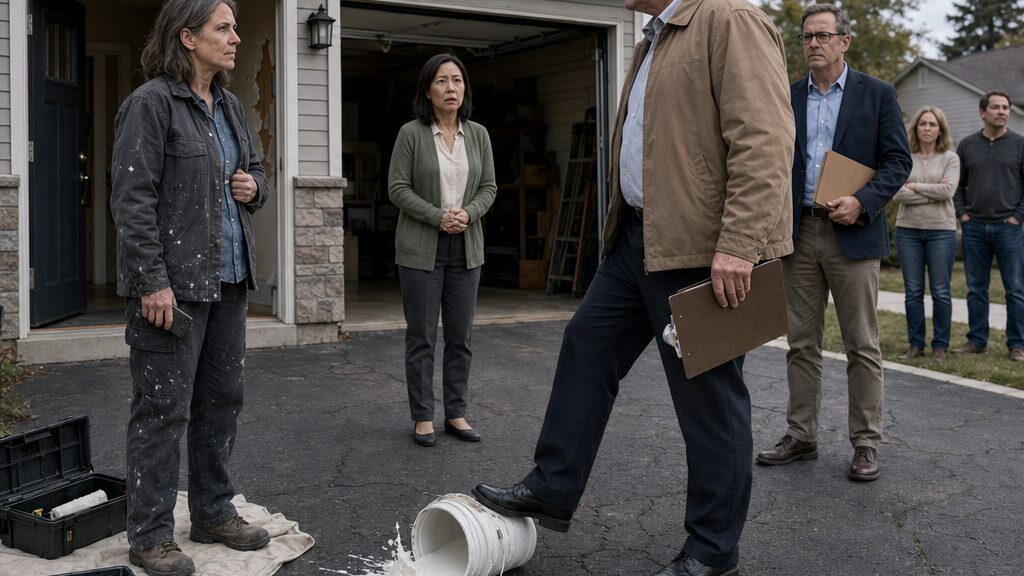
The paint bucket struck the driveway on its rim.
For one suspended second, it rocked between Gregory Carter’s polished shoe and the cracked concrete. Then it tipped, and a sheet of white paint rolled across the black surface toward Debra Wilson’s boots.
Nobody moved.
Gregory looked down at the spreading paint, then back at Debra as though she had caused it.
“That,” he said, pointing at the widening pool, “is exactly the kind of carelessness we’re dealing with.”
Debra’s right hand tightened around the handle of her roller tray. Her left stayed close to the inside pocket of her faded denim work jacket, where a folded work order pressed against her ribs.
Jennifer Lee stood three steps away near the garage, pale and silent. Beside Gregory were Anthony Harris, the HOA treasurer, and the association president. Two homeowners had stopped on the sidewalk. One held a leash so tightly that the small dog at the end of it stood motionless.
Gregory turned enough to include everyone.
“The association has calculated fifteen thousand dollars in corrective costs,” he said. “Ms. Wilson can accept the back-charge, or we proceed formally.”
Debra set the roller tray on a clean drop cloth.
“Proceed how?”
Gregory’s mouth flattened. He had expected anger. She could see that now. He had stepped close when he arrived, voice already raised, clipboard tucked under one arm as if the whole exchange had been scheduled for an audience.
“You’ll receive the documents.”
“What documents?”
“The damage claim. Recovery costs. Vendor suspension.”
“And the fifteen thousand covers what, exactly?”
Gregory glanced toward the damaged wall visible through Jennifer’s open front door. Plastic sheeting hung across the hallway. A jagged strip of paint had bubbled away near the baseboard, exposing gray drywall beneath.
“Removal, remediation, repainting, inspection, administrative expense.”
Debra looked at Anthony. He had lowered his eyes to the clipboard in Gregory’s hand.
“Is that what you were told?” she asked him.
Anthony raised his head. “I was told there was a failed finish and resulting interior damage.”
“Resulting from my paint?”
Gregory answered for him. “From work performed under your contract.”
The wording mattered. Debra let the silence settle until Gregory shifted his weight.
“Say it clearly,” she said.
His eyebrows rose. “Excuse me?”
“You’re charging me fifteen thousand dollars because you say my paint caused the damage inside Jennifer’s house. Is that the association’s position?”
The president looked toward Gregory. Anthony stopped pretending to study the clipboard.
Gregory gave a short laugh. “You’re not conducting an examination.”
“No. I’m asking what I’m being charged for.”
“You have the notice.”
“The notice says defective workmanship and associated loss. You just said my paint caused the wall damage. Those are not the same statement.”
A faint breeze pushed the edge of the drop cloth toward the spilled paint. Debra caught it with the toe of her boot before the fabric touched the white pool.
Gregory’s face darkened.
“The work failed,” he said. “The association had to intervene. You owe fifteen thousand dollars.”
“Because my paint caused the damage?”
“Yes.”
Debra took out her phone.
Gregory stared at it. “What are you doing?”
She photographed the spilled bucket, his shoe beside it, the observers, and the open doorway behind Jennifer. Then she held the phone at chest height.
“Could you repeat that?”
“You don’t have permission to record me.”
“I’m taking notes.”
“With a camera?”
“The paint won’t stay like this.”
One of the homeowners on the sidewalk looked away, hiding a smile. Gregory noticed.
He stepped closer to Debra. “You should be thinking about whether your insurance will survive a claim this size.”
“My insurance hasn’t been contacted.”
“It may be.”
“By the HOA?”
“By whichever party is required to protect this community.”
There it was again: language wide enough to frighten, narrow enough to deny later.
Debra slid the phone into her pocket.
“I want the full claim in writing,” she said. “The cause, the inspection date, the repair basis, and every fee.”
“You already have enough paper.”
“I want what you just said.”
Gregory’s gaze dropped to the paint spreading past the driveway crack. “You don’t seem to understand your position.”
“I understand that you signed my completion approval.”
Anthony looked sharply at Gregory.
The change was small, but Debra caught it.
Gregory recovered quickly. “A preliminary sign-off does not prevent later discovery.”
“It wasn’t preliminary.”
“That’s a contractual interpretation.”
“It said completed.”
The folded work order seemed heavier inside her jacket. She did not take it out. Not yet.
Gregory reached beneath the top sheet on his clipboard and removed a printed page.
“As of today, Debra Wilson Painting is suspended from the Bishop Lane preferred-vendor program pending resolution of the claim.”
Jennifer finally moved. “Gregory, is that necessary?”
He did not turn toward her. “It is automatic.”
“I never complained about her work.”
“That is not the issue.”
“It’s my house.”
“And it is an association-managed renovation.”
Jennifer’s lips parted, but no words came.
Gregory held the page toward Debra.
She did not take it immediately.
The preferred-vendor program was not a formal license. It was more useful than one. For six years, nearly half of Debra’s residential work had come from three managed communities that shared contractor recommendations. Suspension from Bishop Lane would travel. Not officially. A phone call here, a warning there, a note in a vendor file.
She took the page.
At the bottom, beneath Gregory’s printed name, was a line stating the suspension had been issued due to “potential insurance noncompliance.”
Debra looked up. “You just said defective work.”
“It’s all connected.”
“How?”
“You can discuss that with counsel if you choose to make this difficult.”
The president murmured Gregory’s name, but he lifted one hand without looking at her.
“I am trying to keep a fifteen-thousand-dollar failure from becoming a special assessment,” he said. His voice was quieter now, almost reasonable. “Nobody wants that. Not the board. Not Jennifer. Not the homeowners whose dues already increased this year. There are ways to resolve this without making it worse.”
“For whom?” Debra asked.
His expression hardened again.
He pointed to the suspension notice. “Ten days.”
Then he turned, signaling the end of the encounter as if he had merely completed an inspection.
Anthony followed more slowly. Before stepping away, he looked at the white paint, then at Debra’s clean roller tray.
The two homeowners moved on. The dog’s nails clicked against the sidewalk. The association president paused beside Jennifer, said something too low for Debra to hear, and hurried after Gregory.
Debra crouched beside the spill.
The paint had crossed the crack and formed a thin white branch down the slight slope of the driveway. She pushed an absorbent cloth against its edge, containing it before it reached the gutter.
Jennifer brought a stack of old towels from the garage.
“I’m sorry,” she said.
Debra kept working. “For the paint?”
“For all of it.”
“Did you tell him my work failed?”
“No.”
“Did you tell anyone?”
Jennifer folded a towel twice before placing it beside the spill. “Gregory said the inspection found damage.”
“That isn’t what I asked.”
Jennifer’s hands stopped.
Debra looked at her then.
The homeowner’s face carried something more complicated than embarrassment. Fear sat beneath it, held in place by habit.
“I didn’t complain about you,” Jennifer said.
“Then why did you stay quiet when he said you had?”
“He didn’t say I had.”
“He let everyone think it.”
Jennifer glanced toward the street. Gregory’s SUV was still visible at the corner, waiting to turn.
“The wall damage was there before you opened the first can,” she whispered. “I showed it to him the morning you started.”
Debra’s hand remained pressed against the towel as white paint soaked into the fabric.
“Then why,” she asked, “didn’t you tell the board?”
Jennifer looked toward her open front door.
“Because Gregory told me what would happen if I did.”
Chapter 2: The Approval Gregory Pretended Not to Remember
Two weeks earlier, Gregory Carter had dragged his thumb across Jennifer’s freshly painted trim and found nothing.
Debra watched from the hallway while he inspected the six-room project with the seriousness of a man searching for a reason not to approve it. He crouched near the baseboards, leaned toward corners, and held his phone sideways to catch flaws in the light.
There were none.
The walls were a warm off-white Jennifer had chosen after testing seven nearly identical samples. The trim lines were straight. The repaired nail holes had disappeared beneath two coats. Drop cloths covered the hardwood, and every switch plate had been removed rather than painted around.
Jennifer stood in the kitchen doorway with both hands wrapped around a coffee mug.
“It looks brighter,” she said.
“It looks finished,” Gregory corrected.
He rose and checked the work order attached to his clipboard.
Debra waited.
She had learned not to fill an inspection with explanations. People who needed to feel authoritative often mistook silence for uncertainty. Let them look. Let them touch the trim twice. Good work did not become better because she defended it.
Gregory walked into the front room and stopped near the section of wall beside the window.
The drywall there had shown a faint stain on the first morning. Jennifer had said the exterior flashing had been checked and the moisture was old. Gregory had arrived later, examined it briefly, and told Debra to seal the area before applying the finish coat.
Now the wall appeared smooth.
He pressed two fingers against it.
“Dry,” he said.
“It was dry before primer,” Debra replied.
He gave her a look that suggested she had answered a question he had not asked.
Jennifer set down her mug. “So we’re good?”
Gregory signed the work order with a thick black pen.
He wrote his initials beside the line marked COMPLETED, added the date, and handed the clipboard to Debra.
“Submit your final invoice Monday.”
Debra checked the initials before tearing off her copy.
Gregory noticed. “You think I’m going to deny signing it?”
“I check every page I’m given.”
“That must slow you down.”
“It saves time later.”
His smile held no warmth.
Jennifer walked Debra to the front door. “Thank you,” she said. “For being patient with all the changes.”
“There were three.”
“It felt like more.”
“Changes always do.”
Jennifer laughed, and for a moment the job ended the way most jobs did: with tired relief, a handshake, and the quiet satisfaction of leaving a house cleaner than Debra had found it.
Three days later, the certified letter arrived at her workshop.
The envelope bore the HOA management company’s return address. Debra opened it standing at her workbench, expecting a request for an insurance certificate or tax form.
The first line stopped her.
NOTICE OF FAILED WORKMANSHIP AND VENDOR LIABILITY.
She read the page once without moving.
Then again, more slowly.
The association alleged that her paint application had trapped moisture, caused finish separation, damaged drywall, and required removal and restoration. Estimated cost: $14,600. Administrative processing fee: $400. Response deadline: ten calendar days.
Attached was a suspension warning and a statement advising residents not to engage her services until her insurance status had been reviewed.
Debra placed the pages flat on the bench.
Her first instinct was not anger. It was inventory.
She pulled out the signed work order, her photographs, the product data sheets, Jennifer’s color approval, and the timestamped image she had taken after the final coat dried. She arranged them in order.
Completion approved Friday.
Failure allegedly identified Saturday.
Notice prepared Monday.
No second inspection appeared on any page.
She read the notice again and found the phrase Gregory had used nowhere during the walkthrough: “moisture entrapment due to premature coating.”
Debra called Jennifer.
The call rang five times before going to voicemail.
She did not leave a message.
Instead, she drove to a paint supplier across town and asked the counter clerk to confirm the curing specifications for the primer and finish she had used. The temperatures during application were within range. Humidity had been moderate. The products were compatible.
By the time she returned to the workshop, two messages waited on her phone.
The first was from a Bishop Lane homeowner asking whether Debra’s liability insurance had lapsed.
The second was from another client canceling an estimate.
“My neighbor said the HOA sent a warning,” the woman explained in the voicemail. “I’m sure it’s probably nothing, but we can’t take a risk right now.”
Debra listened twice.
Then she called her insurance agent.
No claim had been filed.
No one from the HOA had contacted the carrier.
The warning was not reporting an insurance problem. It was creating one.
She sat at the workbench and looked at Gregory’s initials beside COMPLETED.
For eleven years, she had reviewed documents that tried to conceal intent behind formal language. Most bad paperwork was not clever. It was crowded. Extra phrases softened dates, blurred responsibility, and made ordinary people feel foolish for asking simple questions.
She had left that work behind.
At least, that was what she told herself whenever she locked the old files in the metal box beneath the shelving unit.
Debra returned to the notice.
A table on the second page listed the corrective work. Removal. Drywall repair. Moisture treatment. Repainting. Inspection.
The inspection charge was dated Sunday.
The management office was closed Sundays.
She circled it in pencil.
At the bottom of the page, a line referenced an attachment labeled “Initial Property Condition Report.” No such report had been included.
Debra logged into the vendor portal using her contractor account. The site showed her invoice as “disputed” and her access as “restricted.” She downloaded every file still visible before the account could be shut down completely.
Most were copies she already had.
One was not.
It was an early project summary created four days before she began painting. The page contained a list of renovation items: flooring, trim repair, flashing review, wall preparation.
Beside the front-room wall entry was a short note:
PREEXISTING MOISTURE OBSERVED. OWNER ADVISED. MONITOR BEFORE FINISH.
Debra read it three times.
The document was signed electronically by Gregory.
She compared it with the condition report attached to the HOA’s notice. In the later version, the wall entry had been shortened to:
WALL PREP REQUIRED BEFORE FINISH.
The moisture reference was gone.
Debra printed both versions and placed them side by side.
Outside the workshop, a delivery truck backed into the neighboring unit, its warning signal repeating at steady intervals. Debra barely heard it.
The question was no longer whether Gregory had forgotten the stain.
The question was who had told him about it—and why he had removed the record before blaming her.
Chapter 3: The Office Where Paperwork Became a Weapon
Gregory refused to look at his own signature.
Debra laid the work order on his desk Monday afternoon, unfolded along the crease, with his initials facing him.
He leaned back in his chair.
“I know what my initials look like.”
“Then read what they’re beside.”
The HOA management office occupied a converted townhouse near the community entrance. File boxes crowded one wall. Framed certificates hung behind Gregory’s desk, along with an aerial photograph of Bishop Lane taken before half the newer homes had been built.
Gregory laced his fingers over his stomach.
“I’ve already explained that a sign-off does not waive later discovery.”
“You approved completed work on Friday.”
“And damage appeared afterward.”
“Who inspected it?”
He glanced toward the computer monitor. “The association did.”
“Who?”
“Qualified personnel.”
“Name one.”
His chair creaked as he leaned forward. “You came here to discuss resolution, not interrogate my staff.”
“I came to find out whether there was a second inspection.”
“There was a documented assessment.”
“That isn’t the same thing.”
Gregory reached for the work order, not to examine it but to slide it back toward her.
Debra kept two fingers on the page.
“Did you return to Jennifer’s house after signing this?”
His eyes met hers.
“No.”
The answer came too quickly.
“Did anyone from the board?”
“I don’t manage individual schedules.”
“Did an inspector enter the house?”
“The condition was reviewed.”
“From inside?”
His jaw tightened. “This is why contractors need to stay within their role.”
“My role is the one being charged fifteen thousand dollars.”
“Your role is painter.”
The word landed with deliberate weight.
Gregory pushed the work order harder. Debra released it before the paper wrinkled.
“You put color on walls,” he continued. “You don’t interpret association contracts, reserve allocations, or liability procedure. That’s what people here are paid to do.”
Debra refolded the page once along its existing crease.
“Then help me understand.”
His expression shifted. He heard surrender where she had offered none.
Debra pointed to the notice. “What inspection established that my paint caused the damage?”
Gregory opened a folder and removed a photograph of Jennifer’s front-room wall. The finish had blistered near the floor. A dark stain marked the exposed drywall.
“This.”
“That establishes damage.”
“It establishes failure.”
“It doesn’t establish cause.”
“It’s paint coming off a wall you painted.”
“What was the moisture reading?”
He hesitated.
“Who took it?”
“You’re deflecting.”
“What date was this photograph taken?”
“The weekend after completion.”
“The file says Tuesday.”
Gregory looked down despite himself.
Debra had printed the image metadata beneath the photograph.
For the first time, the confidence in his face thinned.
“Digital timestamps are not always reliable,” he said.
“No. But your Sunday inspection charge is also dated before this photograph.”
He shut the folder.
“You think you’ve found a technicality.”
“I think nobody inspected the wall before you issued the failure notice.”
“The damage was evident.”
“To whom?”
“To the property manager.”
“You.”
“Yes.”
“From where?”
His hand flattened on the desk.
Debra waited.
He looked toward the office door, which stood partly open. A staff member moved past carrying a stack of envelopes. When the footsteps faded, Gregory lowered his voice.
“You are making this harder than it needs to be.”
“You said that Saturday.”
“And I meant it.”
He removed another packet from a drawer. This one bore Jennifer’s address and a project number Debra recognized from the work order.
“Here is the contractor-damage claim,” he said. “It will be submitted against your carrier if we don’t reach an agreement.”
Debra scanned the first page.
The claim listed replacement drywall, exterior flashing repair, dehumidification, repainting, and administrative review. The flashing repair alone accounted for nearly six thousand dollars.
“My contract did not include exterior work.”
“The damage chain includes all necessary correction.”
“The flashing caused the moisture.”
“That has not been determined.”
“Then why are you charging me to replace it?”
Gregory’s mouth tightened.
Debra turned to the budget page. The expenses were assigned to Jennifer’s renovation reserve line, not to a private insurance claim. A handwritten notation authorized “vendor recovery” to restore the account.
“You overspent the renovation reserve,” she said.
His hand came down over the page.
“You don’t have authority to review that.”
“You put it in the claim you handed me.”
“It is internal accounting.”
“It shows the HOA paid for exterior repair, then reassigned the cost to me.”
“It shows the community covered an emergency.”
“Before deciding who caused it.”
“It shows responsible management.”
For the first time, Gregory sounded less smug than tired.
He stood and walked to the window overlooking the entrance road.
“You know what happens when a reserve project runs fifteen thousand over?” he asked. “The board starts talking about assessments. Homeowners call at night. Retirees ask whether they need to choose between dues and prescriptions. Every contractor says their piece of the job was perfect. Every resident says the problem belongs to someone else.”
He turned back.
“My job is to keep that from becoming chaos.”
“By assigning it to whoever has the least leverage?”
“By resolving it.”
“You changed the condition report.”
His face closed.
Debra placed both versions on the desk.
The first included preexisting moisture. The second did not.
Gregory looked at them without touching either.
“That was a draft.”
“It was signed.”
“Internal notes are updated all the time.”
“Why remove the moisture reference?”
“Because the wall was cleared for finishing.”
“By whom?”
“Again, you are not the auditor here.”
The sentence passed between them.
Debra felt the old reflex rise: mark the inconsistency, request the underlying record, preserve the original, do not reveal how much you understand.
She had spent years training herself not to live that way anymore. Yet her hands remembered before the rest of her did.
Gregory returned to his chair and pulled out a final document.
“This is what I’m prepared to offer,” he said.
The agreement reduced the back-charge to seven thousand dollars, released half of Debra’s unpaid invoice, and restored her vendor status after six months. In return, she would waive further dispute and agree not to discuss the matter with residents, board members, or other contractors.
At the bottom was a new fee.
“Four hundred dollars?” Debra asked.
“Processing.”
“For what?”
“Preparing the settlement.”
“You charged four hundred in the original notice.”
“That was claim processing.”
“And this is settlement processing.”
“You wanted paperwork.”
His smile returned, thinner than before.
Debra placed the folded approval beside the unsigned agreement.
“Did anyone physically inspect Jennifer’s wall between your Friday approval and the Monday notice?”
Gregory stared at her.
She did not move.
“No,” he said at last. “The homeowner supplied photographs, and I made the determination.”
It was the first clean answer he had given her.
Debra picked up both documents.
“You should sign,” he said. “Seven thousand is less than fifteen.”
“It’s also more than zero.”
“You’re gambling your business over pride.”
“No.”
She slid the agreement back across the desk.
“I’m deciding whether you made a mistake or built a file around one.”
Gregory’s face lost its remaining softness.
“You walk out without signing, the carrier notice goes tomorrow.”
“Send everything.”
“You think because you found two dates you understand what you’re looking at.”
Debra placed the folded work order inside her jacket.
“I understand enough to ask for the rest.”
At home that evening, she did not turn on the kitchen lights. She carried a cup of coffee into the workshop and knelt beside the shelving unit.
The metal box had not been opened in five years.
Its key resisted at first. Debra pressed harder until the lock gave with a dry click.
Inside were county audit notebooks, numbered binders, and a photograph she kept facedown beneath them.
She lifted the first notebook.
On its cover, in her own handwriting, were the words:
CONTRACT RECOVERY — ALTERED CHRONOLOGIES.
Debra sat on the concrete floor with the box open between her knees.
She had not left county work because she stopped understanding files like Gregory’s.
She had left because once, when understanding had mattered, she had waited too long to speak.
Chapter 4: The Damage Was Real but the Blame Was Not
The moisture meter chirped before Debra had pressed it fully against the wall.
She held it still beside the blistered paint. The digital reading climbed, paused, then climbed again.
Jennifer stood behind her with both arms folded tightly across her chest.
“That’s high, isn’t it?”
“It’s active,” Debra said.
She moved the meter six inches upward. The reading dropped. Near the baseboard it rose again. The pattern spread sideways beneath the front window, narrow and uneven, nothing like moisture trapped beneath an entire coat of paint.
Debra scraped a loose chip into a clear sample bag. The paint separated cleanly from softened drywall paper. Beneath it, the gypsum was cool and gray.
“This didn’t start with the finish coat.”
Jennifer looked toward the front door as if Gregory might appear there.
Debra sealed the bag and set it beside the folded work order on her tool case.
“Tell me exactly what happened before I started.”
Jennifer rubbed one thumb across the other. “I noticed a stain after the first heavy rain. It was small. Gregory said it was probably old.”
“When?”
“About a week before you came.”
“You told him?”
“He came over.”
“Did he test it?”
“He touched the wall. Then he went outside and looked at the window.”
Debra stood. “Did he take pictures?”
Jennifer did not answer.
That was answer enough.
“Jennifer.”
“One.”
“Where is it?”
“I uploaded it to the HOA project portal.”
Debra opened the portal on her phone. Her vendor access remained restricted, but Jennifer logged in through the homeowner account. They searched the renovation folder together.
Invoices. Color approvals. Flooring photographs. A replacement trim estimate.
No moisture photograph.
Jennifer refreshed the page. “It was there.”
“Who can remove files?”
“Gregory. Maybe the board administrator.”
“Did anyone else see it?”
“I sent it to him through the portal. I don’t know.”
Debra crouched again and examined the base of the wall. The damage followed the line beneath the window, then narrowed toward one corner.
“Has the exterior flashing been replaced?”
Jennifer nodded. “The week after you finished. Gregory said it was precautionary.”
“Who paid?”
“The HOA reserve, I think.”
“And what did he tell you caused the wall damage?”
Jennifer’s shoulders stiffened.
“Your paint.”
“Before or after the flashing repair?”
“After.”
Debra packed the meter into its case. “Why didn’t you tell the board you had reported moisture first?”
Jennifer walked to the window and pulled the curtain aside. Outside, the replacement flashing showed as a thin strip of brighter metal against the siding.
“He told me the project was already over budget,” she said. “He said if the board decided the leak was a common-property issue, they could charge my unit for the emergency repair until responsibility was settled.”
“A special assessment.”
“He said it could be several thousand dollars. Maybe more if mold testing was required.”
“So you let him blame me.”
Jennifer turned. Her face had gone red, but her voice remained low.
“I didn’t agree with him.”
“You didn’t disagree where anyone could hear.”
“I thought he would fix it and then sort it out.”
“He did sort it out. He put my name on the bill.”
Jennifer looked down at the plastic-covered floor.
Debra wanted to tell her that fear did not make silence harmless. The words were ready. She had used versions of them in county interviews, when contractors claimed they had followed instructions they knew were wrong.
She did not say them.
Not yet.
At the county records office, the clerk showed Debra how to access archived permit notes for Bishop Lane. The flashing repair itself had not required a permit, but the association’s exterior maintenance request remained attached to a larger renovation record.
The request predated Debra’s first day by nine days.
Debra printed it.
The description was brief: WATER INTRUSION AT FRONT WINDOW. FLASHING FAILURE SUSPECTED. INTERIOR FINISHING PENDING.
The person listed as requester was Gregory Carter.
The finding cleared Debra of one thing and implicated him in another, but it did not explain the whole claim. A leaking window could damage drywall. It could require repainting. The loss was real.
The fifteen thousand dollars had not been invented from nothing.
That made it more dangerous.
By Wednesday afternoon, Debra sat at Cynthia Green’s kitchen table with the permit note, both condition reports, the paint sample, and the signed work order arranged in rows.
Cynthia was a narrow woman in her early sixties who moved with brisk care, as though every drawer in the kitchen had an assigned closing speed. She had served as HOA secretary for four years before resigning.
“I remember Jennifer’s project,” she said. “Gregory pushed it through because the exterior repair line was nearly empty.”
“Why use renovation reserve money?”
“Because the maintenance reserve had already exceeded its quarterly allocation.”
“Who approved that?”
“The board, technically.”
“Technically?”
Cynthia poured coffee into two mugs. “Gregory presents urgent repairs as finished decisions. The board votes after the contractor is already scheduled.”
Debra slid the permit note toward her. “He knew about the leak before I painted.”
Cynthia read it and exhaled.
“That doesn’t surprise you,” Debra said.
“No.”
“What does?”
“That you got a copy.”
Debra leaned back.
Cynthia opened a drawer beneath the table and removed a worn accordion folder. “When I resigned, I kept personal notes. Not association records. Dates, meeting topics, questions I asked.”
“That sounds like records.”
“It sounds like a woman who stopped trusting the minutes.”
She pulled out three photocopied pages.
Each was a vendor charge summary. A landscaper. A fence repair company. A drainage contractor.
The amounts differed, but each included a four-hundred-dollar processing fee.
Debra looked closer.
All three charges had been assigned after reserve overruns.
“Were these disputed?”
“The landscaper stopped answering. The fence company settled. The drainage contractor was removed from the vendor list.”
“Did the board review causation?”
“Gregory said the documentation was clear.”
“Was it?”
“I didn’t see the underlying files.”
“Why not?”
Cynthia folded her hands. “Because when I asked, he said I was obstructing urgent recovery. Then neighbors started hearing I opposed necessary repairs.”
“And you resigned.”
“I told myself I was protecting my health.”
The admission settled between them without defense.
Debra looked at the repeated fees. Gregory had not created the entire process for her. He had used it before.
Cynthia pushed the pages closer.
“I don’t know whether those vendors were innocent,” she said. “I only know the pattern was always the same. The reserve went over. Gregory found someone outside the board to carry it.”
Debra placed the folded work order beside the three summaries.
One altered chronology could be called carelessness. Four began to look like a method.
Chapter 5: The Audit Debra Never Finished Speaking About
The old vendor name appeared halfway down Cynthia’s second page.
Debra saw it before she understood why her chest had tightened.
A small concrete contractor had been charged for drainage failure three years earlier. The company name matched one written inside her county notebook, beside a date from twelve years ago and a red mark she had drawn so hard the pen cut the paper.
She carried the copied page to the county archive Thursday morning.
The records clerk brought out a box of closed procurement files and left Debra at a narrow table beneath fluorescent lights.
The contractor had performed sidewalk repairs for the county. A supervisor later accused the company of defective grading and withheld payment. Debra had been assigned to review the claim.
She had found inconsistent measurements within two days.
She had found altered inspection dates within four.
Then the supervisor’s office requested more time, and Debra waited.
There had been meetings. Revisions. Polite warnings about jurisdiction. Her manager had suggested that challenging the supervisor publicly could damage several active projects.
Debra documented everything.
She did not elevate it soon enough.
By the time the county reversed the claim, the contractor had lost equipment, dismissed employees, and closed.
The file contained no dramatic ending. Only a final letter authorizing partial payment to a company that no longer operated.
Debra pressed her palm against the tabletop.
She remembered the owner sitting across from her, work cap in both hands, asking whether the truth in her file meant he would be paid before the bank took his truck.
She had answered carefully.
She had said the review was continuing.
At the time, she believed careful language was integrity.
Later, it sounded like cowardice.
Her phone vibrated.
Anthony Harris had left a message asking her to meet privately at the HOA office after business hours.
When Debra arrived, he was waiting alone in the conference room. A single folder sat in front of him.
“I’m not here as Gregory’s representative,” he said.
“Then why here?”
“Because these are association documents.”
He opened the folder and slid an agreement across the table.
The charge against Debra would be canceled. Her unpaid invoice would be released. Her preferred-vendor status would be restored immediately.
In exchange, she would agree that the dispute resulted from “unclear project communication” and would not discuss internal HOA records or other vendor claims.
Debra read it twice.
“This is Gregory’s settlement with better wording.”
“It’s the board’s attempt to stop additional cost.”
“Does the board know he removed the moisture note?”
Anthony’s eyes moved toward the closed door.
“Some members have concerns.”
“Concerns about what?”
“Reserve accounting. Documentation. The way vendor recovery has been handled.”
“How long?”
He rubbed the edge of the folder with one thumb. “Long enough that this is not the first question.”
“Then why offer me silence?”
“Because an open review could create liability.”
“For the HOA.”
“For homeowners.”
“Jennifer said the same thing.”
Anthony looked tired. “People hear ‘association liability’ and imagine an insurance policy absorbing everything. It doesn’t work that way. Deductibles, legal fees, reserve replenishment—those come back to residents.”
“So Gregory stays in place.”
“I didn’t say that.”
“You didn’t say he leaves.”
Anthony leaned forward. “I am trying to separate your legitimate claim from a broader issue the board is not prepared to resolve tonight.”
Debra looked down at the agreement.
It gave her everything she had first wanted. Payment. Clearance. Her name restored.
She imagined signing it.
Jennifer would not face an immediate assessment. The board could deal with Gregory internally. Debra could return to work without opening the locked box again.
The thought brought relief so quickly it frightened her.
“What happens to the other vendors?” she asked.
Anthony did not answer at once.
“We would need authorization to review prior files.”
“And if I sign?”
“The immediate dispute closes.”
“Meaning the board loses the reason to authorize anything.”
“That is one interpretation.”
“It’s yours too.”
He sat back.
Debra took the pen resting beside the folder. She placed its tip above the signature line.
The old contractor’s voice returned to her with unwelcome clarity.
Does the truth in your file mean I get paid?
At the county, she had waited because the evidence was not complete enough, the chain of authority was not clear enough, the risk to other projects was not measured enough.
Every reason had sounded responsible.
The company had still closed.
Debra set the pen down.
Anthony watched her.
“There’s something you should know,” she said. “I worked construction-contract audits for the county for eleven years.”
His expression changed, not to disbelief but recognition.
“That explains the questions.”
“It explains why I know what Gregory did.”
“Why didn’t you say so before?”
“Because I don’t do that work anymore.”
“That isn’t an answer.”
“No.”
She folded the agreement along its center.
For a moment, Anthony seemed to think she meant to keep it.
Then she tore it once, turned the halves, and tore them again.
The sound was small in the empty room.
“I want an open hearing,” she said.
Anthony looked at the pieces.
“You understand what that can trigger?”
“Yes.”
“Legal review. Insurance notification. Possible assessments.”
“Yes.”
“And if the board finds the records inconclusive?”
“Then they can say that in public.”
He gathered the torn paper slowly.
“Gregory will argue that you’re retaliating because you were removed from the vendor list.”
“He should.”
“That doesn’t concern you?”
“It concerns me less than signing.”
Anthony stood but did not leave.
“Send me your written request by morning,” he said. “Include only what you can establish.”
Debra rose.
At the doorway, he spoke again.
“Were you good at auditing?”
She kept her hand on the knob.
“Yes.”
“Then why did you leave?”
Debra looked back at the closed folder between them.
“Because once before, I had enough to speak,” she said, “and I decided I needed more.”
The next morning, her request for an open board hearing was delivered to every director, Gregory Carter, and the association attorney.
Chapter 6: The Board Hearing Gregory Thought He Controlled
The damaged-wall photographs were already on the screen when Debra entered the clubhouse.
Gregory stood beside them with a remote in one hand. The largest image showed blistered paint curling away from dark drywall. Another showed a section of removed baseboard. The room was nearly full: board members at the front table, residents in folding chairs, Jennifer near the back, Cynthia against the side wall.
Debra carried one document case.
Gregory did not look at her.
“We have a contractor disputing a documented failure,” he was saying. “The issue before the board is whether association funds should absorb damage caused by private workmanship.”
The HOA president tapped the microphone. “Ms. Wilson has requested time to respond.”
“She will have it,” Gregory said. “I’m providing context.”
Anthony sat with his hands folded over a ledger. He did not meet Debra’s eyes.
Gregory advanced to a cost summary.
“Drywall replacement, moisture treatment, exterior correction, repainting, inspection, and administration total fourteen thousand six hundred dollars, excluding legal expense.”
A murmur moved through the residents.
He let it.
Debra took a seat at the small table facing the board.
When Gregory finished, the president nodded to her.
“You may begin.”
Debra stood and placed the folded work order on the table.
“The damage in those photographs is real,” she said.
Gregory’s head turned.
Several residents shifted. He had expected denial; she could see it in the quick narrowing of his eyes.
“The drywall was wet,” Debra continued. “The finish separated. Repairs were necessary.”
Gregory stepped closer to the board table. “Then the dispute is limited to cost allocation.”
“No. The dispute is causation.”
She opened her case and removed the county maintenance request.
“This report was created nine days before I began painting. It identifies water intrusion and suspected flashing failure at Jennifer Lee’s front window.”
She handed copies to the board.
Gregory lifted one. “A suspected condition is not a confirmed cause.”
“No. That is why I tested the wall.”
She presented the moisture readings and the paint sample photographs.
“The highest readings follow the lower window line. The coating separated from water-damaged drywall paper. It did not fail uniformly, and it did not trap moisture across the painted surface.”
The board attorney leaned toward the microphone. “Are you presenting yourself as an expert witness?”
“I’m presenting measurements and project records.”
“Your qualifications?”
Debra felt the old instinct to narrow her answer.
She looked toward the residents instead.
“I spent eleven years auditing county construction contracts. My work included altered inspection records, cost recovery, contractor claims, and payment disputes.”
Gregory laughed once.
“So this is personal.”
“Yes,” Debra said.
The room went still.
“It is personal when someone changes a record and uses it to take money from your work.”
She placed the original project summary beside the later version.
“The first states that preexisting moisture was observed. Gregory Carter signed it. The version attached to my failure notice removes that sentence.”
Gregory’s face flushed. “Internal project notes are routinely revised.”
“After conditions change.”
“They were revised because the wall was cleared.”
“By whom?”
“The project team.”
“Name the person.”
He looked toward the board attorney.
Debra continued before he could retreat into procedure.
“Mr. Carter approved my completed work on Friday. No one entered the house for a second inspection before the failure notice was prepared. He confirmed that to me in his office.”
“That conversation is disputed,” Gregory said.
“The photograph used to support the notice was taken Tuesday. The notice was prepared Monday. The Sunday inspection charge appears one day before the notice and two days before the photograph.”
Anthony raised his head.
“Repeat that,” he said.
Debra did.
She laid out the dates in a single row: moisture report, work start, completion approval, alleged inspection, failure notice, damage photograph, flashing repair invoice.
Anthony stood and leaned across the table.
“The exterior repair was authorized before the photograph?”
“Yes.”
He looked at Gregory. “The reserve ledger shows the repair expense posted before vendor recovery was initiated.”
Gregory set down the remote.
“Because immediate mitigation was required.”
“Why was it placed under Jennifer’s renovation reserve?” Anthony asked.
“There was no time to convene a separate allocation review.”
“And when that line exceeded budget?”
“We sought recovery from the responsible contractor.”
“Before determining responsibility.”
Gregory’s voice sharpened. “The board has been demanding that I control overruns for two years. Every month I’m told reserves are too low. Every emergency becomes my failure. So yes, I acted. I protected the community from another assessment.”
A few residents murmured agreement.
Gregory heard them and pressed forward.
“Ms. Wilson can make this look clean on paper because she has no obligation to maintain the neighborhood. I do. I receive the calls when roofs leak and pipes break. I explain why dues rise. I find money when there isn’t enough.”
Debra listened.
For the first time, she understood the full shape of his justification. He had not begun by wanting to ruin small contractors. He had begun by deciding that the board’s fear justified moving costs toward people with less influence.
Then he had made that decision easier each time.
“You were under pressure,” Debra said.
Gregory blinked.
“That doesn’t authorize you to change chronology.”
“I updated a draft.”
“You removed the fact that pointed away from me.”
“You cannot prove intent.”
“No,” she said. “But I can show a pattern.”
Cynthia brought copies of the three prior vendor summaries to the board secretary. Debra did not ask her to speak. The documents moved from hand to hand.
Each included the same processing fee.
Each followed a reserve overrun.
The board attorney whispered urgently to the president, then turned on his microphone.
“I need to caution the board. Expanding tonight’s inquiry into prior vendor matters may trigger notification duties, insurance issues, and potential claims against the association.”
The room tightened.
A resident in the second row asked, “Claims paid by whom?”
The attorney did not answer directly.
Gregory seized the pause. “This is exactly what I warned about. One vendor dispute is being turned into a threat against every homeowner here.”
Debra looked at the folded work order.
She had planned to use it last, as clean proof of contradiction. But clean proof would not answer Gregory’s strongest argument—that silence protected everyone from cost.
She unfolded the page completely and flattened it beneath the boardroom light.
“I know what delay costs,” she said.
The president started to interrupt, but Debra kept her voice level.
“Years ago, I found altered dates in a county claim against a small contractor. I documented them. I waited to elevate the issue because supervisors said a public dispute could disrupt other projects.”
Anthony watched her closely.
“The contractor lost his business before the county corrected the claim.”
The room remained quiet.
“I told myself I was being careful. I was protecting the process. What I protected was the people who controlled it.”
She placed one hand on Gregory’s signed approval.
“I will not ask this board to punish anyone without review. But canceling my charge and closing the file would repeat the same choice. It would protect the association tonight by leaving every prior vendor alone with whatever was done to them.”
The president looked toward the attorney.
The attorney shook his head slightly.
Anthony closed the ledger.
“I move that the charge against Debra Wilson be suspended pending independent review,” he said, “and that all vendor recovery files from the last five years be preserved immediately.”
Another board member seconded.
Gregory stared at him. “You know what that will cost.”
“Yes,” Anthony said. “I also know what the dates say.”
Before the president could call the vote, a chair scraped at the back of the room.
Jennifer stood.
Her hands trembled, but her voice carried.
“I reported the leak before Debra started,” she said. “I uploaded the photograph. Gregory told me not to mention it to the board because the repair could be assessed to my home.”
Gregory turned toward her.
“That is not what I said.”
“You said if I reopened the cause, I could be held responsible until the board decided.”
“I explained the financial exposure.”
“You told me to let you handle it.”
Jennifer looked at Debra, then at the board.
“And when he blamed her, I stayed quiet.”
No one moved.
The president lowered her eyes to the documents spread across the table.
The question before the board was no longer whether correcting the record would cost the community.
It was whether they would use that cost as another reason not to correct it.
Chapter 7: What Remained After the Paint Dried
The envelope from the HOA contained a check, a release letter, and no confidentiality clause.
Debra read the letter twice at her workbench before touching the check.
The association had withdrawn the fifteen-thousand-dollar charge. Her final invoice would be paid in full, with interest calculated from the original due date. The notice questioning her insurance had been rescinded, and corrected letters had been sent to the homeowners who received it.
At the bottom, one sentence carried more weight than the payment.
Debra Wilson Painting has been restored to the association’s approved vendor list without restriction.
She set the letter beside the folded work order.
Three weeks had passed since the hearing. In that time, the board had hired an outside accounting firm, preserved five years of vendor-recovery records, and notified its insurer that prior claims might require review. No one had used the word fraud in writing. The board attorney preferred “procedural irregularities.” Anthony called them “unsupported allocations.”
Debra called them what they were only when asked directly.
Costs placed on people who had less power to object.
Her phone rang.
Jennifer’s name appeared on the screen.
Debra let it ring once more before answering.
“The check came,” Jennifer said.
“It did.”
“They told me the wall repair is being covered from the exterior-maintenance reserve.”
“That’s where it belonged.”
There was a pause.
“I’m glad,” Jennifer said.
Debra looked at the payment amount. It covered her materials, labor, delayed jobs, and little else. It did not restore the canceled estimate or the homeowners who had stopped returning calls.
“Are you home this afternoon?” she asked.
“Yes.”
“I need to finish the driveway.”
“You don’t have to.”
“The paint is still there.”
A pressure washer had removed most of the spill, but a pale stain remained along the crack where the white paint had run downhill.
“I can have someone else do it,” Jennifer said.
“I know.”
Debra ended the call before either of them tried to turn it into forgiveness.
At Bishop Lane, Gregory’s SUV was gone from its usual space beside the management office.
Anthony had called the previous day to explain the board’s interim decision. Gregory had been removed from vendor oversight and reserve-allocation authority while the audit continued. He remained employed, handling routine maintenance requests under supervision.
Some residents were angry he had not been fired.
Others were angry there was an audit at all.
Debra understood both reactions less easily than she once would have. Gregory had altered records and shifted costs. He had also spent years being told to solve problems without raising dues, prevent assessments without delaying repairs, and make every financial shortage disappear.
Pressure explained the road he had chosen.
It did not erase the people he had pushed beneath the wheels.
Jennifer stood near the garage when Debra arrived. The damaged wall inside had been opened, dried, and repaired. A replacement contractor had primed the new drywall but left the finish coat for Debra.
“You came back,” Jennifer said.
“I had a contract.”
“It was already paid.”
“It still had my name on it.”
Debra unloaded a small can of white exterior coating, a brush, and a narrow roller. She did not bring a full bucket.
Jennifer watched her kneel beside the driveway crack.
“I keep thinking about that morning,” she said. “I could have said something before he knocked it over.”
“Yes.”
The single word made Jennifer flinch.
Debra cleaned loose paint from the concrete with a stiff brush.
“I was afraid,” Jennifer said.
“I know.”
“I thought if I stayed out of it, he would fix the wall and no one would lose much.”
“Someone was always going to lose.”
“I see that now.”
Debra dipped the brush.
Jennifer stepped closer. “I’m sorry.”
Debra worked coating into the stain. “I believe you.”
“That doesn’t sound like forgiveness.”
“It isn’t the same thing.”
Jennifer nodded as if the distinction hurt but made sense.
“I don’t know how to fix what I did.”
“You already started.”
“At the hearing?”
“At your front door, when you told me the damage came first.”
Jennifer looked toward the house. “I should have said it where everyone could hear.”
“Yes.”
Debra did not soften the answer. Jennifer had lived inside her fear long enough to know its shape. Pretending it had caused no harm would only preserve it.
After a while, Jennifer brought two glasses of water and set one on the driveway.
“The board asked me to join the repair committee,” she said.
“Are you going to?”
“I haven’t decided.”
“Why?”
“I’m not sure they want me there because I’m useful or because it looks good.”
“Both can be true.”
Jennifer gave a small, tired laugh. “That sounds like something an auditor would say.”
Debra glanced at her.
Jennifer lowered her eyes. “Anthony told me.”
“Of course he did.”
“He said you were the reason the board expanded the review.”
“The records were the reason.”
“No. The records were there before. You made them look.”
Debra rolled a final strip of coating across the pale stain.
At her workshop later, she removed the signed work order from her jacket. The paper had softened at the fold from being opened and closed so many times.
She placed it on the bench beside her old county notebook.
For years, the notebook had been proof of the moment she failed to speak soon enough. She had kept it locked away as if silence could be contained inside a metal box.
Now the pages told a fuller story.
She had failed once.
She had also learned exactly what failure required of her the next time.
Cynthia stopped by near closing with a list of vendors the outside auditors had contacted. The fence company still operated under a different owner. The landscaper had moved out of state. The drainage contractor’s phone number no longer worked.
“Not every file will lead anywhere,” Cynthia said.
“No.”
“Some people won’t want to reopen it.”
“No.”
“And some losses can’t be paid back.”
Debra looked at the list. “That doesn’t make the review useless.”
Cynthia nodded. “I should have pushed harder when I was secretary.”
Debra slid the list back to her. “Then push now.”
Before leaving, Cynthia paused at the door.
“Are you staying on the vendor list?”
“I haven’t decided.”
The answer surprised Debra when she heard it aloud.
For years, the list had meant steady work. It also meant letting one office control how half a neighborhood saw her.
The next morning, she accepted two private jobs outside Bishop Lane and declined an HOA repainting request until the new oversight rules were published.
She did not reject the community.
She stopped depending on its approval.
A week later, Debra returned to Jennifer’s driveway to check the coating. The white stain was nearly gone, but not completely. Along one side of the crack, a faint pale edge remained visible when the light crossed it.
Jennifer came outside and looked down.
“You missed a line,” she said.
“No.”
Debra ran one finger beside it.
The mark was thin enough that most people would never notice it. It followed the place where Gregory’s paint spill had first crossed the concrete, then disappeared near the gutter.
“You’re leaving it?” Jennifer asked.
“Yes.”
“Why?”
Debra stood and wiped the dust from her hand.
“So I don’t mistake covering something for correcting it.”
Jennifer looked at the line again.
Debra carried her brush back to the truck. Before closing the toolbox, she placed the signed work order inside a clear plastic sleeve, unfolded and visible from end to end.
The story has ended.