The HOA Gave Him Thirty Days to Tear Down His Stone House—Then the Hill Changed Everything
Chapter 1: The Notice Nailed Beside the Old Stone Door
The first hammer strike hit the brass nail beside Gregory Carter’s front door at 8:12 on Monday morning.
He heard it from the kitchen.
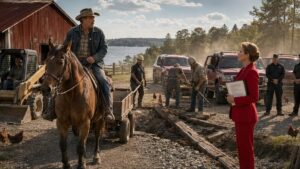
By the time he stepped onto the porch, the HOA property manager had driven the second nail through the plastic sleeve holding the notice. Heather Nelson stood two steps below him with a folder tucked against her ribs. Behind her, the structural inspector was unfolding a clipboard. Two neighbors had stopped on the lane.
Gregory read the largest line first.
THIRTY-DAY HAZARD COMPLIANCE NOTICE.
“You nailed it to the stone trim?”
“The mortar joint,” the manager said.
Gregory looked at the nail. “That isn’t a mortar joint.”
The manager took one step backward.
Heather spoke before the silence could become embarrassing. “Gregory, the board authorized formal notice after the safety review. We’ve tried to handle this informally.”
“You sent me three emails.”
“And a reinspection request.”
“I told you I wasn’t letting another contractor walk around my house without seeing the engineering file.”
Heather’s jaw tightened. “And you didn’t schedule the reinspection.”
That part was true.
Gregory took the paper from its sleeve and read farther. The order required stabilization or removal of identified masonry along the west wall and lower hillside structure. Failure to comply could trigger daily fines, legal fees, and an application for injunctive relief.
The house behind him had stood longer than anyone on the board had been alive.
Gregory had spent eleven years making sure it would stand longer still.
He folded the notice once.
“Show me what you think is failing.”
The inspector led them around the house.
The western wall descended toward the river in uneven gray courses, some original, some rebuilt by Gregory with stone salvaged from collapsed sections. Near the lower corner, the inspector tapped a pencil against a thin stair-step crack.
“There’s differential settlement here.”
“I know.”
Heather glanced at him. “You know?”
“I paid an engineer to look at it last spring.”
The inspector stopped tapping.
Gregory pointed toward the upper corner. “That section moved three-sixteenths of an inch in five years. The drainage correction stopped most of it.”
“Most?” Heather asked.
Gregory ignored her and kept walking.
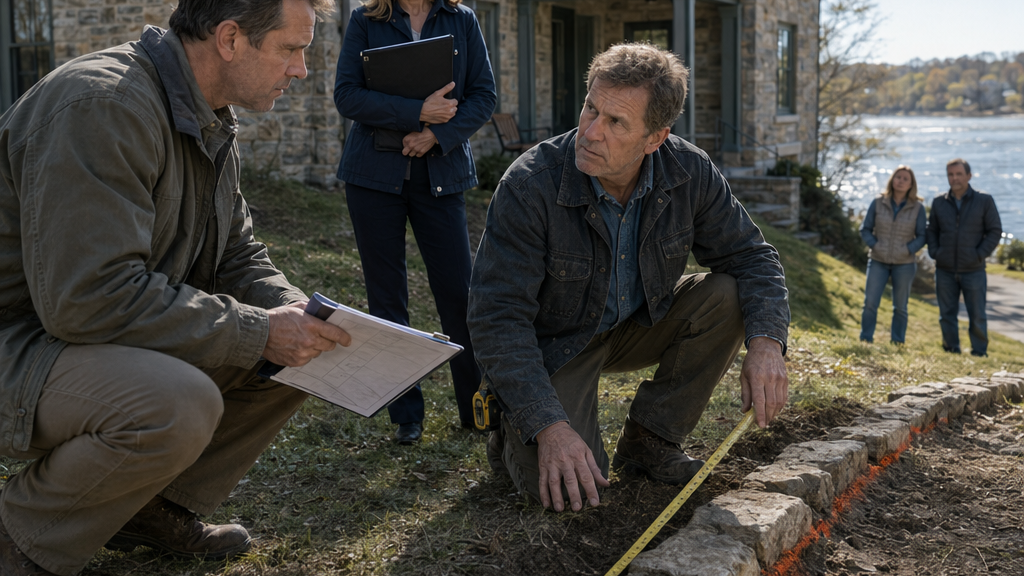
Farther downslope, orange paint had been sprayed across a cluster of half-buried stones. The mark was fresh enough to shine.
Gregory stopped.
“What’s that?”
“Limits of concern,” the inspector said.
“You marked this?”
“Yes.”
Gregory crouched.
The stones were not part of the visible house wall. They surfaced twenty feet beyond it, barely rising through the grass before disappearing beneath the slope. He had known they were there. His grandfather had called them the old terrace stones, though nobody in the family had ever explained what terrace they belonged to.
The orange stripe crossed one long dressed block.
Gregory brushed dirt from its upper face.
Then he looked back toward the house.
The inspector said, “We’re concerned the lower structure may be related to the same settlement.”
Gregory stood slowly.
“No.”
Heather sighed. “Gregory—”
“No. The house runs north-south here.”
He pulled a tape measure from the leather pouch he still wore most mornings out of habit.
The old stones ran northeast.
He stretched the tape along the exposed course, then sighted toward the foundation.
“They’re off by almost nineteen degrees.”
The inspector stepped closer.
Gregory moved three feet downslope, scraped loose soil away with the side of his boot, and exposed another squared edge.
“Your drawing,” he said.
The inspector opened his clipboard.
“Which foundation drawing did you use?”
The man turned two pages.
Then another.
Heather crossed her arms. “What exactly are you suggesting?”
“I’m asking him a question.”
The inspector laid the site exhibit on a flat stone.
Gregory recognized the modern property outline, the house footprint, the barn, the lane, even the retaining wall he had rebuilt near the driveway.
The buried stones were not on it.
The inspector looked from the sheet to the ground.
“That section isn’t shown.”
Gregory tapped the orange mark. “Then why did you include it in an order requiring removal or stabilization?”
“I didn’t write the order.”
Heather’s voice cooled. “The order applies to unsafe masonry identified during inspection.”
“You don’t know what this masonry is.”
“We know it’s old.”
“That isn’t the same thing.”
One of the neighbors shifted behind them. Gregory could feel the attention he had been trying not to acknowledge since the notice went onto his door.
Heather lowered her voice.
“We cannot keep making exceptions because you have sentimental attachment to old stone.”
Something in Gregory wanted to answer too quickly.
For eleven years he had heard variations of that sentence from contractors, board volunteers, appraisers, people who thought a crooked beam was worthless because it could be replaced by a straight one from a lumberyard.
He looked at the orange paint instead.
When he finally spoke, his voice stayed level.
“This isn’t about sentiment. You’ve marked a structure you can’t identify.”
Heather glanced at the inspector.
The inspector did not defend the exhibit.
Gregory expected that to buy him time.
It did not.
“The deadline stands,” Heather said.
He looked at her.
“Thirty days?”
“Unless the board receives sufficient professional documentation to amend the order.”
“You just heard your own inspector say the structure isn’t on his drawing.”
“And the inspection still found movement in masonry on this property.”
“So you’re keeping a demolition threat in place because one part of the house moved a fraction of an inch and another part isn’t even identified?”
“It does not say demolition of the house.”
“It says removal.”
“Of unsafe material.”
“You don’t know which material is unsafe.”
Heather’s expression changed, but only slightly.
“We offered reinspection. You declined.”
There it was.
His mistake, returned to him in clean administrative language.
Gregory folded the notice again.
Heather told the manager to photograph the site markings before they left.
The small group walked back toward the lane.
Gregory remained by the buried wall.
For several minutes he simply studied the angle.
The house foundation disappeared behind him. The old stones continued toward the rise behind the barn, not toward the cellar as he had always assumed.
He knelt again and cleared another handspan of soil.
A dark line showed between two stones.
At first he thought it was a root.
He worked around it with his fingers.
Metal.
Square-sided.
Hand-forged, judging by the taper.
Gregory stopped pulling.
The exposed end of an iron spike pointed into the hill.
It had been driven through a joint in a wall that, according to the HOA’s own drawing, did not exist.
Chapter 2: Eleven Years of Work Become Evidence
Gregory found the sealed envelope Tuesday morning underneath a stack of cedar invoices in his workshop.
The HOA’s date stamp was six months old.
His engineering report was still inside.
He stood at the workbench staring at the unbroken adhesive strip.
For several seconds, he thought there had to be another explanation. Maybe he had submitted a duplicate. Maybe the board had scanned another copy.
Then he remembered handing this exact envelope to the property manager after the spring meeting.
He opened it himself.
Inside were twenty-three pages of measurements, drainage photographs, crack gauges, and recommendations from a licensed structural engineer. The report did not say the house was perfect.
It did say the primary stone walls were serviceable.
Gregory sat down.
He had spent half of Monday furious that nobody had listened to him.
Now he was looking at evidence that nobody had even opened.
By nine, his dining table was buried beneath eleven years of records.
Restoration permits.
Receipts.
Photographs.
Engineering sketches.
A preservation grant letter from the county historical program.
Another smaller grant for timber stabilization.
He arranged the photographs by year.
In the earliest, the western room had no finished ceiling. Rafters showed dark against daylight where slate was missing. One picture caught his grandfather’s old pencil notation on a joist: REPLACED ’74.
Gregory touched the image once and moved on.
Sentiment was exactly what Heather had accused him of substituting for proof.
So he built proof.
At the HOA office, the property manager looked uncomfortable when Gregory placed the sealed envelope on the counter.
“This was in my submitted file.”
“I don’t personally review engineering documents.”
“Who does?”
“The board receives the management summary.”
“Who wrote the summary?”
The manager hesitated.
“The inspection findings were summarized after the site visit.”
Gregory pushed the engineer’s report forward.
“This predates the site visit.”
“I can add it to the record.”
“It was already supposed to be in the record.”
The manager’s face tightened. “Gregory, you also declined the follow-up inspection.”
“I asked for them to review this first.”
“And the board’s position is that you did not complete the process.”
He wanted to argue until someone admitted what seemed obvious.
Instead, he asked for a stamped copy showing the report had been resubmitted.
That was new for him.
It irritated him that Heather had been right about at least one thing: saying no to the reinspection had given the board a clean procedural fact to use against him.
That afternoon, Paul Williams came down from the neighboring cul-de-sac carrying a six-foot level and a laser measure.
Gregory had known Paul for seven years without ever becoming friends with him. Paul kept his hedges square, submitted architectural forms before replacing exterior lights, and once complained that Gregory’s lumber delivery blocked half the lane for forty minutes.
“You asked for a second set of eyes,” Paul said.
“I asked if you knew somebody.”
“I do.”
Paul raised the level.
“Me.”
They started at the crack the HOA inspector had marked.
Paul measured the wall, checked plumb, then set the laser against a reference point Gregory had installed years earlier.
He measured twice.
Gregory watched his face.
“Well?”
Paul wrote a number.
“There’s movement.”
“How much?”
“Enough that I wouldn’t ignore it.”
Gregory felt his shoulders harden.
“The drainage was corrected.”
“That may have slowed it.”
“May have?”
Paul glanced at him. “You called me because you wanted an engineer, not a neighbor who agrees with you.”
Gregory looked away.
Paul crouched at the base of the wall.
“The upper section is stable. This lower corner has rotated.”
“Failure?”
“I didn’t say failure.”
“Unsafe?”
“I’d brace it before winter and design a proper stabilization.”
Gregory let the words sit.
On Monday he had treated the notice as if every sentence in it had to be wrong because the process was wrong.
Now a part of the underlying concern was real.
Paul walked toward the orange-marked stones.
“These are different.”
“I know.”
“You’ve always known?”
“I knew they were there. I thought they were an old terrace.”
Paul sighted along them.
“Not tied into the house?”
“No.”
“Then they shouldn’t have been grouped into one finding without identifying them.”
Gregory handed him a photograph from 2014.
The same stones appeared behind piles of brush, long before the HOA inspection. In another image, taken while Gregory was rebuilding drainage, the exposed course seemed to continue farther beneath the slope.
Paul studied the picture.
“You documented everything.”
“Not everything.”
“You documented more than most contractors.”
Gregory almost corrected him—he was not most contractors—but stopped himself.
Paul returned to the house and put the level against the lower corner.
“This is the part you need to accept,” he said. “Heather can be wrong about the process and still be right that this needs work.”
Gregory looked at the old wall.
Eleven years of repair had taught him to distrust anybody who wanted quick answers from old structures.
But the same work had taught him that pretending movement did not exist was how walls came down.
“All right,” he said. “We stabilize this section.”
Paul nodded.
“Documented plan?”
Gregory exhaled.
“Documented plan.”
It felt less like surrender than he expected.
That evening, he opened the full HOA packet the manager had copied for him.
Most of it was ordinary: insurance letters, inspection photographs, meeting minutes, violation language.
Near the back was a folded color exhibit.
Gregory opened it across the dining table.
RIVERFRONT ACCESS CONCEPT — ALTERNATE B.
The proposed parking area sat beyond the current common lot.
A new access lane curved down toward the river.
Gregory followed the line with one finger.
It crossed the narrow western edge of his parcel.
Then it widened exactly where the HOA had shaded the lower masonry area as a safety constraint.
He looked at the date printed in the corner.
The access concept had been prepared three weeks before the HOA requested his reinspection.
Gregory stared at the line until the old stone wall in his photographs seemed to disappear beneath it.
Chapter 3: The Riverfront Plan Behind the Safety Vote
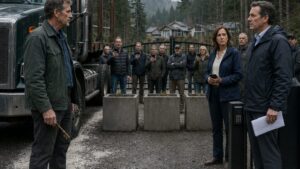
Gregory saw his house on the clubhouse screen before Heather called the meeting to order.
It was gray.
Not stone-gray. Computer gray.
A rectangular block labeled as a constraint beside a wide green band marked for future access.
He stood at the back of the room with the folded Alternate B exhibit in his hand and watched neighbors settle into rows of stackable chairs.
On the screen, eleven years of work had become an obstacle on a development diagram.
Robert King stood near the projector.
He wore no HOA badge because he was not a board member. He was there as planning adviser for the company proposing the riverfront expansion.
Heather tapped the microphone.
“We have two separate agenda items tonight. Property-safety compliance and the riverfront amenity feasibility study.”
Gregory nearly laughed.
Separate.
Robert began with the riverfront proposal.
He spoke in the calm language of benefits: safer pedestrian access, additional guest parking, improved river use, stronger resale appeal, reduced maintenance burden through private partnership.
The plan sounded reasonable until the map appeared.
Gregory raised his hand.
Heather looked at him but finished the slide first.
“Gregory?”
“Why is my parcel inside the access study?”
Robert answered.
“Only a marginal strip.”
“I didn’t ask how much.”
“The concept evaluates several potential alignments.”
“Why does the preferred one cross my property?”
Robert gave him the patient smile of a man used to explaining plans to people who had not helped make them.
“Because it provides the safest grade.”
Gregory unfolded his copy.
“And because the board believes the lower part of my property may have to be cleared.”
A murmur moved through the room.
Heather leaned toward the microphone.
“That is not what the compliance notice says.”
“It says removal of unsafe masonry.”
“If stabilization cannot satisfy the condition.”
“And this plan was prepared before the inspection that supposedly created the urgency.”
Robert’s smile disappeared.
Heather looked at the exhibit in Gregory’s hand.
For one second, she said nothing.
That second mattered more than any denial could have.
Gregory stepped closer.
“Which came first?”
“Gregory—”
“The discussion about acquiring access, or the inspection?”
Heather’s eyes moved toward the board treasurer, then Robert.
“The riverfront committee discussed possible access options before the inspection.”
The room changed.
Not loudly.
Nobody gasped. Nobody applauded.
But chairs stopped moving.
Gregory felt something colder than satisfaction.
“So before anyone called my masonry an urgent hazard, you were already discussing a route through the same area.”
Heather’s voice sharpened.
“We were discussing multiple routes.”
“Was mine the preferred one?”
Robert stepped forward.
“It became preferred because of slope, drainage, and cost.”
“Cost to whom?”
“To the association.”
“There it is.”
Heather raised a hand.
“No. That is exactly the kind of leap that makes this harder than it needs to be.”
Gregory turned toward her.
“Then explain it.”
She did.
The association’s insurer had sent two letters during the previous year concerning aging common-area retaining structures and adjacent private hazards. One referenced potential exposure if the HOA had documented notice of a dangerous condition and failed to act.
Heather held up a copy.
“This is not theoretical.”
Gregory read the highlighted section from where he stood.
It did not mention his house.
Heather continued.
“The board has an obligation to respond when an inspector identifies movement near an area used by residents.”
“Nobody uses that slope.”
“Children cut across it to the river.”
“Then fence it.”
“That does not resolve the condition.”
Paul, seated near the aisle, spoke for the first time.
“The house wall does have measurable settlement.”
Gregory looked at him.
A few faces turned immediately toward Gregory.
There was the complication Heather needed.
Paul continued before anyone could make too much of it.
“One section. That does not mean the buried masonry below it is the same structure.”
Robert frowned. “From a planning standpoint, unstable legacy masonry is still a constraint.”
“Legacy masonry?” Gregory said.
“It’s a technical description.”
“No. It’s a way to make something you haven’t identified sound disposable.”
Heather pressed her fingertips to the table.
“Gregory, the board should have reviewed your engineering report.”
The room went still again.
He had not expected that.
She looked directly at him.
“It was not included in the management summary provided to us. That is a process failure.”
Robert shifted beside the projector.
“But,” Heather continued, “you also refused the follow-up inspection that could have clarified the issue months ago.”
Gregory felt the rebuke land because it was deserved.
“I did.”
“And the insurer’s concern is real.”
“I know.”
Heather seemed almost surprised.
Gregory looked at the stone wall rendered as a line on the screen.
“My issue isn’t whether something needs repair. Paul told me yesterday the lower house corner does. I’ll repair it.”
A few board members exchanged looks.
“My issue is that somebody combined that repair with another structure nobody can identify, then kept a thirty-day order in place while a development plan benefited from clearing the same ground.”
Robert answered before Heather could.
“You’re implying misconduct where there may only be overlap.”
“Maybe.”
Gregory folded the exhibit.
“That’s why I want the records.”
The board agreed to provide the inspection chronology, planning exhibits, and survey base Robert’s team had used.
It was not a victory.
The deadline remained.
The access project remained.
The safety finding remained partly valid.
But by the time Gregory left the clubhouse, the story had changed. Heather could no longer pretend the two processes had never touched.
Paul followed him into the parking lot carrying a rolled survey.
“Wait.”
Under the yellow light over the clubhouse door, he spread the sheet across the hood of Gregory’s truck.
“This is the base survey from Robert’s packet.”
Gregory leaned over it.
House.
Barn.
Property line.
Drainage easement.
Existing retaining wall.
Paul tapped the western slope.
Nothing.
“The old stones should be here.”
“They aren’t.”
“Maybe they were under brush when this was done.”
Gregory shook his head.
“The upper course has been exposed for decades.”
Paul traced the contour lines.
Then he looked toward Gregory.
“Your house is on every survey.”
“So is the barn.”
“And the rebuilt retaining wall.”
Gregory stared at the blank section of paper.
The HOA had marked the buried wall as dangerous.
The developer had planned around clearing it.
Yet the survey underlying both processes did not show it at all.
Paul rolled the drawing halfway closed, then stopped.
“If it isn’t part of the house,” he said, “and it isn’t on the modern survey…”
Gregory looked toward the dark line of the river beyond the clubhouse windows.
“…then what was it built for?”
Chapter 4: What the New Survey Never Showed
Gregory had both hands around the exposed stone when the dirt beneath it gave way.
He stopped pulling.
A second squared block sat directly below the first, fitted so tightly that only a thin seam of dark soil separated them.
That was wrong for a field wall.
He lowered the stone back into place.
For ten minutes he did nothing except crouch on the slope behind the barn, studying what he had almost disturbed.
His grandfather had called these the terrace stones. Gregory had repeated the name for years without asking why. A terrace wall should have followed the contour of the hill. This one cut across it.
He brushed away leaves farther uphill.
Another dressed edge appeared.
Then another.
Gregory stood and took out his phone.
He did not dig again.
By noon, Anna Martinez was walking the slope with a notebook tucked beneath one arm.
She was smaller than Gregory had expected, with mud already on one shoe from crossing the drainage swale. She ignored the house at first and went directly to the stone.
“You said you found an iron spike?”
Gregory showed her the photograph instead of the spike itself.
“You left it?”
“Yes.”
“Good.”
Her approval irritated him slightly.
“I know how not to destroy old material.”
Anna looked at him.
“You also told me on the phone you were about to pull one of these blocks out.”
Gregory had no answer to that.
She crouched beside the exposed course.
“How old is the house?”
“Earliest documented section is early nineteenth century. Maybe older pieces.”
“And this?”
“I assumed it belonged to the farm.”
“That’s not what I asked.”
“I don’t know.”
Anna smiled faintly.
“That answer helps.”
She spent nearly an hour measuring direction, stone size, and elevation. Gregory followed with the patience he normally reserved for clients who insisted a sagging door could be fixed by trimming the bottom.
At one point she asked him to show her the modern survey.
He unfolded Paul’s copy over the hood of his truck.
Anna placed a finger where the buried wall should have been.
“Nothing.”
“Exactly.”
“That proves it wasn’t surveyed. It does not prove what it is.”
Gregory looked toward the slope.
“It’s built.”
“Yes.”
“It predates the subdivision.”
“Almost certainly.”
“And it isn’t part of my house.”
“Probably.”
“You have a talent for taking three facts and making them sound like no facts.”
“I have a talent for keeping people from ruining good evidence because they want the answer too quickly.”
He almost told her that the HOA had already given him a deadline for quick answers.
Instead, he handed her a folder of restoration photographs.
Anna stopped at one taken before Gregory had cleared brush behind the barn. The upper stones were visible through vines. Behind them, the slope rose in a shallow angular bench.
“When was this?”
“2013.”
She flipped to another.
“Same angle?”
“About five years later.”
“Do you have older aerials?”
“Not personally.”
“We can get them.”
That afternoon they drove to the county archives.
The records room occupied the lower floor of an administrative building that smelled faintly of paper dust and floor cleaner. A records clerk brought them subdivision plats, road maps, drainage exhibits, and older property descriptions.
The modern documents repeated the same omission.
House.
Barn.
Lane.
River.
No wall.
Then Anna requested survey copies predating the county’s current parcel system.
The clerk returned with oversized scans reproduced from older books.
Anna spread one beside Paul’s survey.
At first Gregory saw almost nothing familiar. The river was there, but the roads had different names or no names at all. Property boundaries followed trees, springs, and bends rather than neat bearings.
Anna rotated the sheet.
“Look at the hill.”
Gregory leaned closer.
Three short hatch marks crossed the slope above the river.
“What are those?”
“Could be a boundary feature. Could be a structure. Could be nothing more than a surveyor’s reference.”
“Same angle.”
Anna did not answer.
She placed the modern parcel map beside it and aligned the river bend.
The old hatch marks ran northeast.
So did Gregory’s buried stones.
He felt the first surge of certainty and checked himself before speaking.
Anna noticed.
“Better.”
“What?”
“You didn’t say, ‘That’s it.’”
“It matches.”
“It resembles.”
“It matches.”
“Gregory.”
He exhaled.
“It resembles.”
She nodded.
They searched another hour.
A later nineteenth-century map showed nothing at the location. An early road record mentioned a landing near the river but not the hill. The trail seemed to disappear just when Gregory thought it was becoming clear.
He pushed back from the table.
“So whatever it was, it vanished.”
“From these maps.”
“Same thing.”
“No.”
Anna slid the oldest survey closer.
“Maps omit things constantly. Especially structures no longer important to the person making the map.”
Gregory looked at the hatch marks.
“Then how do we prove anything?”
“We find corroboration.”
The word sounded painfully slow.
His thirty-day notice was already entering its second week.
Back at the house, an email from the HOA attorney was waiting.
The board acknowledged receipt of his engineering materials but stated that the enforcement period remained active pending formal amendment.
Gregory read the sentence twice.
Nothing had changed.
He could prove the inspector had used incomplete information and still wake up tomorrow with one fewer day.
He started toward the workshop, then stopped beside the wall.
His grandfather had repaired the house because it needed repair. Gregory had always imagined that obligation as physical: mortar, timber, slate, drainage.
Now the most responsible thing he could do was leave the stones alone.
The next morning Anna called before eight.
“County archive found an index entry we missed.”
Gregory set down his coffee.
“What kind of entry?”
“An eighteenth-century survey book cross-reference. The original page is damaged, but there’s a later transcription.”
“Does it mention the wall?”
“No.”
His disappointment arrived too quickly.
Anna continued.
“It mentions the river bend.”
Gregory waited.
“And?”
“And something described as ‘stores ground’ on the rise above it.”
He stared through the kitchen window toward the hill.
“What does that mean?”
“I don’t know yet.”
“You have a guess.”
“I have several, which is why I’m not giving you one.”
“Anna.”
There was a pause.
“When this language appears in records from that period,” she said, “it can refer to ground used for storage or supply.”
Gregory’s eyes moved toward the buried northeast line.
“Farm storage?”
“Possibly.”
“Or?”
Anna went quiet for a moment.
“Or something earlier than the farm.”
Chapter 5: The Hill Gives Up a Different History
“Everybody back.”
The archaeologist’s voice cut across the hillside so sharply that even Gregory obeyed before he understood why.
The survey crew stopped moving.
Anna froze with one hand above her notebook.
Near the shallow test area, the archaeologist crouched over a patch of dark soil no wider than a dinner plate.
“What did you find?” Gregory asked.
“Back, please.”
He took another step away.
The archaeologist lifted something with a small wooden tool and placed it into a tray.
It was not dramatic.
No shining relic. No intact weapon. No object anybody would recognize from ten feet away.
Just a curved fragment of coarse pottery, brown-gray beneath the dirt.
Gregory stared at it.
“That’s it?”
“That may be enough to tell us the soil layer is different.”
The archaeologist looked at the exposed profile.
“And nobody touches this area until I’m finished documenting it.”
For nearly two weeks Gregory had wanted something undeniable to come out of the ground.
Now that something had, the first consequence was that he could no longer touch his own hillside.
The irony would have bothered him more if the survey flags had not already begun multiplying behind the barn.
Red flags marked modern reference points.
White ones followed the visible stone.
By afternoon, that white line extended far beyond the section the HOA had painted orange.
The surveyor called Gregory over but kept him outside the flagged area.
“We picked up another return here.”
He pointed toward the upper slope.
“How far?”
“From the exposed corner? Just over ninety feet.”
Gregory looked toward the barn.
“That can’t be the same wall.”
“It may not be a wall in the sense you mean.”
The surveyor showed him a tablet display.
The elevations formed an angular platform rather than a simple retaining line.
Anna stood beside him.
“Remember the old survey marks?”
Gregory nodded.
“They’re close.”
“How close?”
“Close enough that I stopped calling it coincidence.”
That was as close to excitement as Anna had allowed herself.
The archaeologist recovered two more pottery fragments before the end of the day. On the second morning, a screened soil sample produced a small flattened lead ball.
Gregory watched it being bagged.
“Musket?”
“Possibly,” the archaeologist said.
Anna gave him a look before he could say anything.
He raised both hands.
“I said nothing.”
“Growth.”
“I’m fifty-nine. Don’t sound so surprised.”
But privately, something had shifted.
For years Gregory had treated the property’s history as his inheritance. The beam with his grandfather’s pencil mark. The hand-cut stone. The spring box below the cellar. Things his family had touched, repaired, or remembered.
The hill was becoming something else.
It did not belong to his family story.
His family had simply lived above it without knowing.
That realization unsettled him more than the HOA notice had.
The notice threatened something he believed was his.
The discoveries suggested that ownership had never been the whole truth.
On the sixteenth day of the deadline, Paul joined the survey crew with permission to compare structural alignments.
He set up near the modern house wall, then walked the bearing toward the buried feature.
After an hour, he returned to Gregory.
“You were right about one thing.”
“Only one?”
Paul ignored that.
“This isn’t a continuation of the house foundation.”
“Anna already suspected that.”
“I’m telling you as an engineer.”
Paul pointed toward the white flags.
“And the geometry is larger than I expected.”
The line now ran behind the barn and curved slightly toward the high ground.
“How large?”
“If the returns connect, well over a hundred feet.”
Gregory looked at the orange paint still visible on the first exposed block.
The HOA had marked a few feet of stone for correction.
The ground was answering with something that crossed the entire slope.
Anna arrived carrying photocopies in a plastic sleeve.
“The ‘stores ground’ notation appears in a second record.”
Gregory turned.
“Same wording?”
“Close. Different surveyor.”
She held the copy where he could see the faded transcription.
“Regional militia logistics were active around this river corridor in the eighteenth century. There were temporary supply points near crossings and landings.”
“Temporary?”
“Some lasted months. Some years. Some were reused.”
Gregory looked toward the archaeologist.
“And the pottery?”
“Consistent with the period.”
“The lead?”
“Also consistent.”
He waited.
Anna folded her arms.
“You want me to say it.”
“Yes.”
“No.”
Gregory laughed despite himself.
She softened.
“We have a credible possibility that part of this hill was used as a militia supply position. That is not the same as proving the exact function of every stone.”
“Credible possibility.”
“Yes.”
“For the first time, you sound impressed.”
“For the first time, you have enough evidence to justify being impressed.”
The distinction mattered.
So did the email that arrived less than an hour later.
The HOA attorney acknowledged the historical investigation and then stated that no private archaeological review automatically suspended the existing safety order.
Gregory read the message aloud to Paul.
“So they can still fine me?”
“They can try.”
“Helpful.”
“The house-wall issue hasn’t vanished.”
Gregory looked at the modern masonry.
Paul was right.
The lower corner still needed stabilization.
The buried feature might be eighteenth century or merely very old. Either way, it did not magically repair the part of Gregory’s house that had moved.
He had spent two weeks finding reasons the HOA was wrong.
The harder truth was that being wrong about one thing did not make them wrong about everything.
“Design the brace,” Gregory said.
Paul looked at him.
“For the house wall?”
“Yes.”
“You want to do that now?”
“I should’ve done it before.”
Paul’s expression changed.
Not approval exactly.
Respect, perhaps.
Gregory added, “But nobody touches the buried structure.”
“That’s reasonable.”
“No. It’s documented.”
Paul smiled.
“Even better.”
On the nineteenth day, the archaeologist uncovered enough foundation geometry to identify a compact rectangular feature embedded inside the larger earthwork.
The interpretation remained cautious, but one possibility appeared repeatedly in the field notes: storage foundation, potentially associated with powder or protected supplies.
Gregory did not repeat the phrase to neighbors.
He had finally learned what premature certainty cost.
Instead, he photographed the flags from outside the controlled area.
White markers now traced a broken line almost one hundred forty feet across the hill.
The original orange HOA mark looked absurdly small among them.
Heather arrived late that afternoon.
She stayed behind the temporary boundary rope.
Gregory expected an argument.
Instead, she stared at the field.
“I thought it was six feet of failed retaining wall.”
“So did your inspector.”
“I know.”
“He also marked it without knowing what it was.”
Heather looked at him.
“I know that too.”
Before Gregory could decide what to make of her tone, Anna came up the hill carrying her phone.
“The state preservation office responded.”
Gregory felt his stomach tighten.
“And?”
“They want an immediate inspection.”
Heather turned toward her.
“How immediate?”
Anna checked the message.
“They’re requesting access within forty-eight hours and recommending no disturbance in the flagged area until review.”
Gregory looked from the phone to the white line crossing the slope.
The thirty-day notice had eleven days left.
For the first time, another clock was running against it.
Chapter 6: Heather Has to Choose Which Risk Matters
Heather arrived at the clubhouse carrying two reports that could not both be followed in the way the board wanted.
Gregory saw them before he heard what they said.
One folder was Paul’s preliminary stabilization recommendation for the lower corner of the house.
The other carried the state preservation office letterhead.
Heather laid them side by side at the board table.
“Here’s where we are,” she said.
The room was smaller than during the riverfront presentation. No projector. No development rendering. Only board members, Gregory, Paul, Robert King, the property manager, and the HOA attorney.
Heather touched Paul’s report.
“This says a section of the private residence requires stabilization.”
Then the state letter.
“This says ground disturbance near the buried structure should stop pending review.”
Robert leaned back.
“Those are not incompatible.”
“No,” Heather said. “But our current enforcement order treats them as one condition.”
Nobody answered.
Gregory watched her.
Three weeks earlier, she had stood on his slope and told him the board could not keep making exceptions.
Now the problem was not an exception.
It was that the board’s paperwork had flattened two different structures into one.
Robert opened the development packet.
“We can amend the language without abandoning the timeline.”
Gregory almost responded.
Heather did first.
“What timeline?”
“The compliance timeline and the riverfront evaluation.”
“You mean the access option.”
“I mean the project.”
Robert’s voice remained measured, but the impatience underneath it was visible now.
“The preferred route is still the most practical. Historical review may require design adjustments, but there’s no reason to assume the entire concept disappears.”
Gregory leaned forward.
“No one said it disappears.”
Robert looked at him, surprised.
Gregory continued.
“I said you don’t get to clear something before you know what it is.”
The HOA attorney turned toward Gregory.
“And you understand the house-wall finding remains separate?”
“Yes.”
Heather’s eyes shifted to him.
Gregory placed Paul’s full stabilization sketch on the table.
“I’ll repair the lower house corner.”
Robert stopped moving.
Gregory felt the room change in the same quiet way it had during the last board meeting.
Heather said, “Regardless of what happens with the enforcement order?”
“If it needs stabilizing, it needs stabilizing.”
Paul added, “The work can be done without disturbing the archaeological area.”
“And documented?” Heather asked.
Gregory nearly bristled at the word.
Then he caught himself.
“Yes.”
Heather sat back.
Something in her face loosened.
For weeks she had treated his resistance as proof that he would oppose anything the board required. Gregory had helped create that assumption by refusing the first reinspection and answering procedure with pride.
Now he had removed that excuse.
The board treasurer opened the reserve spreadsheet.
“If the preferred river route changes, what does that do to the financial projection?”
Robert answered immediately.
“Potentially significant.”
“How significant?”
“Depends on the replacement alignment.”
Heather looked at him.
“You already evaluated alternatives.”
“At conceptual level.”
“Give us the range.”
Robert paused.
“A reroute could increase the association contribution substantially.”
“By how much?”
“Possibly six figures over the current structure.”
Several board members shifted.
There it was—the pressure Heather had been carrying.
Not a secret payoff to a villain.
Not a hidden envelope.
A budget.
An insurance problem.
A promised amenity.
Homeowners already angry about rising dues.
A board election in three months.
And a man with an old stone house sitting where the inexpensive route wanted to go.
Gregory had expected to feel vindicated.
Instead, he understood why the shortcut had been tempting.
Heather closed the reserve spreadsheet.
“The first complaint about Gregory’s wall came before Robert’s preferred alignment was selected.”
Gregory looked at her.
She continued.
“We had photographs of movement. We had insurance correspondence telling us to act on known hazards.”
“So the concern was real,” Gregory said.
“Yes.”
Robert nodded as though that settled something.
Heather turned toward him.
“But once the access plan favored that parcel, I should have separated the two issues completely.”
Robert’s expression changed.
“Heather—”
“I didn’t.”
The room went silent.
She looked at Gregory.
“I let the urgency of one process justify the pace of the other.”
It was not an apology.
Gregory did not need it to be one.
Heather glanced at the original thirty-day notice.
“We had enough information to require further evaluation. We did not have enough information to describe the buried masonry as a removable hazard.”
Robert pushed his chair back slightly.
“You’re talking as if the board acted improperly.”
“I’m talking as if we acted too broadly.”
“And if the archaeological review drags on for months?”
“Then it drags on.”
“The development agreement has deadlines.”
Heather’s voice stayed quiet.
“So did Gregory’s notice.”
Robert stared at her.
“The association has hundreds of owners whose costs matter.”
“I know.”
“A reroute costs them money.”
“I know that too.”
“And you’re prepared to do that because a private landowner found old stones?”
Heather opened the state letter.
“No. I’m prepared to stop pretending we know what the stones are when the state says we don’t.”
Gregory looked at the old orange inspection photograph attached to the file.
For the first time, the mark did not feel like an accusation.
It looked careless.
Heather addressed the board.
“I’m calling a special meeting before the compliance deadline. We’ll vote on rescinding or narrowing the current order, formally separate the house stabilization from the hillside review, and suspend any riverfront decision that assumes disturbance inside the state review area.”
Robert shook his head.
“You’re putting the entire project at risk.”
Heather met his eyes.
“No. I’m deciding which risk belongs to us.”
The sentence remained in the room after she said it.
Gregory collected Paul’s stabilization plan.
At the door, Heather stopped him.
“Gregory.”
He turned.
“You should have answered the first reinspection request.”
He almost smiled.
“I know.”
“And we should have opened your report.”
“I know that too.”
Neither of them offered more.
Outside, the evening light reached the clubhouse parking lot and the river beyond it.
Gregory unfolded Paul’s repair drawing on the hood of his truck.
For once, the plan showed exactly what was there.
The house wall that needed work.
The protected buffer beyond it.
The buried alignment marked separately.
No convenient gray block.
No merged hazard.
Behind him, the clubhouse door opened again.
Heather stepped outside holding her phone.
“The special meeting is Friday,” she said. “Six o’clock.”
Gregory folded the drawing.
“That’s three days before my deadline.”
“I’m aware.”
“What are you recommending?”
Heather looked back through the glass at Robert and the board members still inside.
“I haven’t written the motion yet.”
Then she met Gregory’s eyes.
“But I’m going to.”
Chapter 7: The Wall They Tried to Remove Stays
Heather Nelson did not wait for anyone else to make the motion.
At six twelve on Friday evening, with three days left on Gregory Carter’s compliance notice, she opened the folder in front of her and said, “I move that the board rescind the thirty-day enforcement order in its current form.”
Gregory had expected qualifications first.
He had expected the HOA attorney to speak, or the treasurer to warn about precedent, or Robert King to argue that the state review was preliminary.
Instead, Heather said the words herself.
The clubhouse remained quiet.
She continued.
“The original notice combined two conditions that should have been evaluated separately. The settlement at the southwest corner of Mr. Carter’s residence remains a legitimate structural concern. The hillside masonry does not presently have a sufficient factual basis for an order requiring removal or alteration.”
Robert shifted in his chair.
Heather did not look at him.
“The state preservation office has requested that the hillside remain undisturbed while its review proceeds. The proposed replacement order will address only the documented house-wall condition.”
A board member asked, “And the riverfront project?”
“Any alignment requiring disturbance inside the preservation review area is suspended.”
That produced the first real murmur in the room.
Gregory looked around.
Some neighbors seemed relieved. Others immediately began whispering about costs.
There was no clean division between people who supported him and people who did not. The same homeowners who disliked the board’s aggressive notice still wanted river access. The same people curious about the historic site did not necessarily want higher dues to protect it.
That made the room feel more honest than it had three weeks earlier.
Heather called for discussion.
Robert raised his hand.
“The board should understand what it is committing to. Alternate access will require more grading, a longer retaining system, and probably additional land work. The developer’s current participation was based on the preferred route.”
The treasurer asked, “Are they withdrawing?”
“I didn’t say that.”
“But they could?”
“They could revise their contribution.”
Heather nodded.
“So we’ll evaluate that when we have a route we can legally and responsibly evaluate.”
Robert glanced toward Gregory.
“One private parcel has effectively changed the economics of a project intended for the whole community.”
Gregory felt the old instinct rise—to defend the house, the land, the hill, every foot of it.
Instead, he said, “The hill changed the economics. I just happened to live on it.”
Robert looked as though he wanted to answer, but did not.
The vote passed.
Not unanimously.
That mattered to Gregory.
There was no burst of applause. No dramatic reversal where everyone suddenly agreed with him. Two board members opposed rescinding the original order because they believed the association needed stronger authority over unresolved hazards.
But the motion carried.
The thirty-day notice that had been nailed beside Gregory’s door ceased to control the entire property.
Afterward, Heather approached him near the clubhouse entrance.
“I’ll have the replacement notice delivered Monday.”
Gregory looked at her.
“Mail it.”
For the first time in weeks, she almost smiled.
“Certified?”
“Definitely.”
The state inspection took place the following Tuesday.
The preservation officer spent most of the morning with Anna Martinez and the archaeologist, moving slowly between flags and exposed features. Gregory remained outside the controlled area unless asked to enter.
That still felt unnatural.
It was his property.
His barn stood fifty yards away. His workshop door was open. The spring line ran beneath land he paid taxes on every year.
Yet he waited for permission to approach a wall he had once casually cleared weeds from.
Late in the morning, the preservation officer joined Gregory near the house.
“We’re recommending a protected archaeological buffer while additional study is completed.”
“Permanent?”
“Not necessarily in its current dimensions.”
“And my house?”
“Your house is separate from this review.”
Those words, simple as they were, felt like something being put back in its proper place.
Gregory nodded toward the lower corner.
“I’m stabilizing that.”
“I saw the plan.”
Of course she had.
There were plans now for everything.
Paul’s stabilization design used a restrained intervention rather than rebuilding the entire wall. Temporary bracing came first. Drainage was adjusted. The failed portion would be carefully reset with the original stone wherever possible, with the work photographed and logged.
Gregory would once have found that level of documentation insulting.
Now he photographed the first stone before removing it.
Paul noticed.
“Look at you.”
Gregory did not glance up.
“Say one word about personal growth and you’re off the job.”
Paul laughed.
The work took six weeks.
During that time, the riverfront plan changed too.
Robert’s company did not walk away. The preferred route did.
A revised access lane stayed farther uphill, using an existing common-area corridor before bending toward the river. It cost more. The parking area became smaller. Some landscaping and decorative features disappeared from the proposal.
Several homeowners complained.
Gregory understood them more than he would have a month earlier.
Money spent rerouting a lane was money that came from somewhere.
At the final planning meeting, he surprised Heather by supporting a limited easement along the uncontested edge of his parcel for drainage maintenance associated with the new route.
Robert looked genuinely startled.
“You’re agreeing to access?”
“For drainage inspection. Defined width. Defined purpose.”
Heather said, “And no construction staging.”
“No staging.”
Robert leaned back.
“That would help.”
Gregory looked at him.
“Then document it.”
The words came easily now.
Anna’s research continued through autumn.
The evidence never became the kind of story people liked to reduce to one dramatic sentence. No plaque appeared overnight declaring Gregory’s backyard a famous battlefield. No historian announced that a single legendary event had happened behind the barn.
The truth was quieter and, to Gregory, more convincing.
Survey records, artifact patterns, foundation geometry, and landscape features supported the conclusion that the slope had been used as part of an eighteenth-century militia supply position associated with movement along the river corridor. The rectangular feature was consistent with protected storage. The larger earthwork appeared to have shaped access and defense around it.
Important enough to preserve.
Complicated enough to study carefully.
That suited Gregory.
One afternoon, Anna brought him copies of the final archive references.
He reached for them.
She did not let go immediately.
“What?”
“I’m making sure you understand what these are.”
“Paper?”
“A record.”
“I know.”
“You used to say the stone spoke for itself.”
Gregory looked toward the wall.
“I was wrong.”
Anna released the folder.
“No argument?”
“Don’t get used to it.”
He built a cabinet in the workshop for the property records.
Engineering reports went into labeled binders.
Restoration photographs were dated.
Historical surveys were sleeved flat.
The state correspondence, preservation maps, stabilization drawings, easement agreement, and archaeological summaries each had their own section.
At the front, he placed one older photograph.
His grandfather’s pencil notation was visible on the exposed joist.
REPLACED ’74.
Gregory had spent years thinking that mark mattered because his grandfather had made it.
Now he understood something else about it.
The mark mattered because someone had bothered to leave evidence of what had been done.
By November, the lower corner of the house was stable.
The repaired masonry blended with the older wall without pretending to be ancient. Gregory could distinguish every stone he had reset, though most visitors could not.
Farther down the hill, the buried structure remained mostly buried.
That had been difficult to accept at first.
Part of him wanted the whole thing exposed—to see the line complete, to know exactly what lay beneath his ground.
The archaeologist had explained why leaving much of it undisturbed was often the better form of preservation.
So Gregory left it.
One Saturday morning, Heather walked down the lane while he was cleaning tools beside the repaired wall.
She stopped several feet away.
“That’s the section?”
“That’s it.”
She studied the masonry.
“It looks almost the same.”
“That was the idea.”
Her gaze shifted toward the hillside where discreet boundary markers now defined the protected area.
“The board approved the final riverfront revision last night.”
“I heard.”
“Reserve contribution is higher.”
“I heard that too.”
“Some people blame you.”
“I know.”
“Some blame me.”
Gregory set the brush down.
“Probably fair to both of us.”
Heather gave him a long look.
“That might be the closest thing to an apology I’m getting.”
“It wasn’t one.”
“I know.”
They stood without speaking.
The relationship between them had not become friendship. Gregory did not suddenly trust the board because Heather had corrected one decision. Heather did not suddenly approve of the way Gregory had ignored procedures whenever they annoyed him.
But something had changed.
She no longer saw his refusal as simple stubbornness.
He no longer saw every rule as evidence of bad faith.
Heather glanced at the house.
“For what it’s worth, I never wanted it torn down.”
Gregory believed her.
That was the hardest surprise of the whole dispute.
“You wanted the problem gone.”
“Yes.”
“And after a while those became the same thing.”
Heather nodded.
“Yes.”
She started back toward the lane.
Then she stopped.
“You still have the original notice?”
Gregory looked toward the workshop.
“In a file.”
“Of course you do.”
This time she did smile.
After she left, Gregory returned to the wall.
He ran his hand across the repaired section, feeling the small variations in the stone faces.
Eleven years earlier, he would have judged the day by whether something had been rebuilt.
Now the wall below his hand told a more complicated story.
One section had needed repair.
Another had needed protection from repair.
He had nearly confused possession with stewardship just as badly as the HOA had confused age with hazard.
The house remained his.
The hill, legally, remained his too.
But the story beneath it did not.
That winter, when Gregory replaced the plastic sleeve beside his workshop cabinet, he slid the original thirty-day notice inside.
Not as a trophy.
Not as proof that he had beaten anyone.
Beside it he placed Paul’s stabilization drawing, Anna’s oldest survey copy, and the state preservation map.
Four versions of the same place.
A hazard.
A structure.
A forgotten piece of history.
A responsibility.
In early spring, Gregory stood behind the house while morning light reached the slope.
The repaired house wall rose solidly beside him.
Farther away, only a few old stones remained visible through the grass where the larger buried line turned toward the river.
He could have walked down and touched them.
He did not.
Instead, he went inside the workshop and entered the final stabilization photographs into the property archive.
Before closing the binder, he wrote the date beneath them.
Then, after a moment, he added one short line in pencil.
REPAIRED. DOCUMENTED. LEFT THE OLDER STONE ALONE.
Gregory closed the binder.
Outside, the wall they had once marked for removal remained exactly where it belonged.
The story has ended.