When the HOA Sent Red SUVs to Tear Out the Road That Kept His Wife Home
Chapter 1: The Red SUVs Came Before the Notice
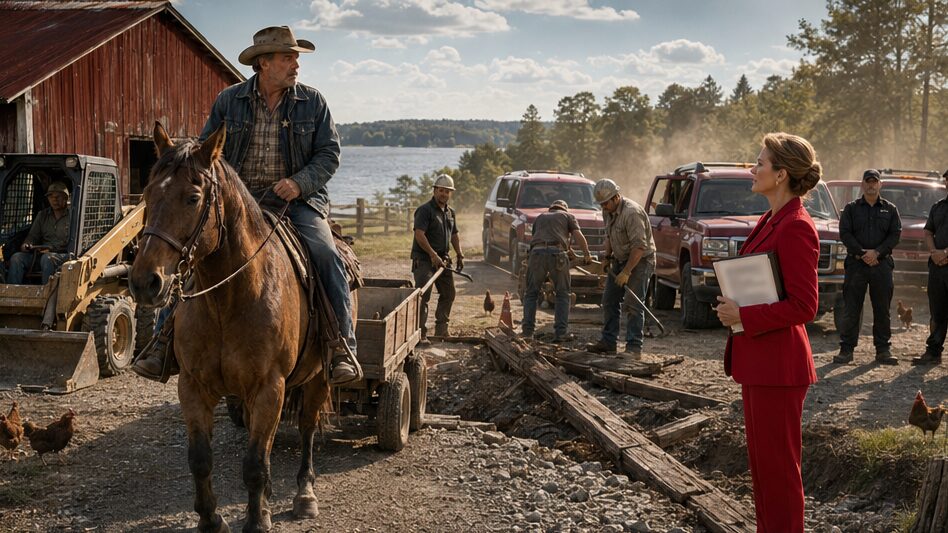
Edward Clark came around the side of the red barn on his horse and saw three men tearing the road out of the ground.
For a moment, his mind refused the picture.
The lake glittered beyond the split-rail fence. Chickens scratched at the edge of the dirt lane as if the engine noise meant nothing. The utility cart behind his horse creaked under two feed sacks and a coil of hose. Everything ordinary was still where he had left it that morning—barn, porch, water trough, the white cottonwoods along the ditch.
But at the low crossing between the barn lane and the house road, orange cones had been set in a crooked half circle. A flatbed truck idled with its ramp down. One worker was prying up the timber edge Edward had bolted into place three nights earlier. Another shoveled gravel from the raised approach into a loader bucket. A third man dragged one of the pressure-treated boards toward the truck as if it were scrap.
Edward pulled the reins.
His horse stopped so sharply the utility cart bumped against the traces. The chickens scattered then, wings flapping, dust lifting around their feet.
“Hold it,” Edward called.
The man with the pry bar looked up. The loader kept running.
Edward did not raise his voice. He guided the horse forward, down the lane, until the cart stood between the loader and the crossing. The horse’s ears flicked at the noise. Edward touched the animal’s neck once, steadying both of them.
“Shut that machine off.”
The worker in the loader looked toward the red SUVs parked beyond the cones. They had come in clean, all three of them, bright against the dust, lined up like they belonged at a county emergency scene. But the decals on the doors were not county. They were the lake subdivision’s private security mark, the one Edward had seen too often at the new gates on the far side of the water.
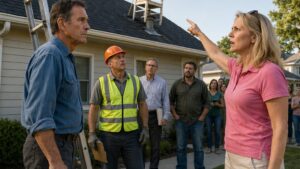
A man in a hard hat came toward him with a clipboard under one arm. “Sir, you need to clear the work area.”
“This is my road.”
“It’s a non-compliant structure crossing a shared drainage easement.”
Edward looked at the half-removed crossing. Two posts were already out. The gravel had slumped toward the ditch. Without the boards, the slope dropped hard enough to catch a wheelchair lift, a gurney wheel, a low ambulance step.
He felt the heat rise behind his eyes and put it somewhere else.
“Who ordered this?”
The hard-hat man glanced again toward the SUVs.
The back door of the middle one opened.
Karen Moore stepped out in a red suit so bright it looked staged against the dust. Her heels were wrong for the road, but she walked as if the ground should flatten itself for her. Behind her stood two uniformed security contractors, hands loose near their belts, not police, but close enough for anyone passing by to slow down and stare.
“Mr. Clark,” Karen said, already holding out a paper. “You were notified.”
Edward did not take it. “When?”
“The association issued a violation notice.”
“When?”
Karen’s mouth tightened. She extended the paper another inch. “This morning.”
Edward looked past her to the board in the worker’s hands. Fresh sawdust clung to the wet bolt holes. “They were already tearing it up when I rode around the barn.”
“That is not accurate.”
“The loader bucket is full.”
Karen glanced at the machine as if it had embarrassed her by existing. “The crew was instructed to secure the site pending removal.”
“You call that securing?”
The hard-hat man shifted his weight. “We were told removal was authorized.”
“By who?” Edward asked.
Karen stepped closer. “By the Lakeside Meadows Homeowners Association, under its enforcement authority over exterior modifications affecting shared access and drainage.”
Edward looked at the paper then. He let it hang in the air long enough for Karen’s arm to stiffen before he took it. The top line read: Emergency Removal and Compliance Action. The date was that day. The time stamp was 9:45 a.m.
He took his phone from his jacket pocket and checked the screen. 10:12.
A torn board hit the flatbed behind him.
His jaw moved once.
“You gave me twenty-seven minutes’ notice to remove the crossing I use to reach my house.”
Karen’s eyes flicked to the phone. “You have been aware for weeks that your property sits adjacent to association-controlled access.”
“Adjacent isn’t inside.”
“The road connects through association drainage infrastructure.”
“The ditch was here before your subdivision had a name.”
“That may be your belief.”
“It’s in the county map.”
“Then bring it to the hearing.”
Edward looked toward the house, partly hidden by cottonwoods and the curve of the lane. The porch ramp there was still in shadow. Susan would be inside near the kitchen window, because she always heard engines before he did. He imagined her hand on the curtain, her face trying not to show worry when he came in.
He folded the notice once, slowly. “Put the boards back.”
Karen’s expression changed, not much, but enough. She had expected anger, maybe confusion. Not an order.
“That is not going to happen today.”
Edward nudged the horse half a step forward. The animal moved into the gap between the loader and the torn crossing. The worker in the machine lifted both hands off the controls.
Karen’s security men straightened.
Edward held up his phone and started recording. “I want your name on video, your authority, the contractor’s authority, and the court order allowing removal on occupied private property.”
Karen’s cheeks colored. “Do not perform intimidation, Mr. Clark.”
“I’m documenting.”
“You are obstructing.”
“I asked for the order.”
“The HOA has an enforcement order.”
“That’s paper you wrote yourself.”
The hard-hat man looked away.
Karen’s eyes dropped for the first time to Edward’s jacket. The denim had fallen open when he lifted the phone. Pinned to the inner vest was the small star-shaped badge he wore on fire district calls when someone needed a gate opened, a culvert marked, a downed line reported before a truck drove into it. It was not police authority. It was not a weapon. It had never been a thing he used to win arguments.
But Karen saw the star and paused.
Edward saw her pause.
For five seconds, only the loader engine filled the road.
“Are you representing yourself as law enforcement?” she asked.
“No.”
“Then remove your horse from the work area.”
“Not until that machine is shut down and the boards are placed back where they came from.”
Karen turned to the hard-hat man. “Timothy, continue with removal.”
The man did not move.
Edward looked at him then. Really looked. Timothy Hall was younger than Edward, but not young enough to enjoy this. Sweat had gathered at his temple under the hard hat. His boots were dusty. His clipboard had a printed work order clipped on top with a job description too clean for the place it was destroying.
“Timothy,” Edward said, “what were you told this was?”
The man swallowed. “A non-approved access modification.”
“To what?”
Timothy’s gaze shifted to the barn. “Storage access, I believe.”
Edward felt the words strike harder than Karen’s threat.
Storage access.
The house road curved beyond the barn. The crossing was not ornamental. It was not a shortcut to hay bales. It was the only graded passage wide enough for the medical transport van to reach the porch without sending Susan over ruts that shook pain through her hips and spine.
He could say that now. He could make Susan’s body part of Karen’s file before Susan had agreed to it. He could expose the whole reason in front of workers, security, red SUVs, and dust.
Instead, he looked back at Karen.
“Your information is wrong.”
Karen’s voice cooled. “Then you should have completed the application properly.”
“I submitted the road repair form.”
“You submitted a proposed exterior change without association membership, without drainage review, and without proof of necessity.”
“I’m not in your association.”
“Not yet.” Karen stepped closer to the horse, ignoring the animal’s restless shift. “But if you continue using association access and refuse compliance, we will assess removal costs, daily fines, and pursue remedies against the property interest you keep pretending is separate.”
Edward lowered the phone. “Say that plain.”
Karen looked up at him, red suit sharp against the pale dust, red SUVs behind her like a warning.
“Join the association, Edward,” she said, “or we start the eviction process through the lien.”
Chapter 2: The Road Was Older Than Their Rules
The medical transport van stopped at the broken crossing, and the driver would not go one foot farther.
Edward stood beside the passenger door with one hand on the mirror and one eye on the house. Susan was waiting inside with her small blue transport bag on her lap. Maria Torres had arrived early to help her down the porch ramp, and now both women were visible through the kitchen window, one seated, one standing behind her, watching the van sit uselessly beside the torn road.
The driver climbed out and looked at the rutted drop where gravel had slumped into the ditch. “I’m sorry, sir.”
“It’s passable if you take it slow.”
“Not with the lift. Not with her chair in the back. If the rear end dips there, I can’t promise the ramp will clear.”
Edward looked at the gap. He had crossed worse in tractors, trucks, and once on a horse in water up to the stirrups. But the driver was not wrong. That was the curse of it. Karen’s crew had not destroyed the whole road. They had destroyed just enough to make it unreliable for the one person who could not gamble on it.
“What if I lay boards across?” Edward asked.
The driver glanced toward the stack of torn lumber Timothy’s crew had left near the ditch. “I can’t load over loose boards. Company policy.”
“Company policy,” Edward said, too quietly.
The driver heard the edge in it and lowered his eyes. “I’m not trying to make this harder.”
Edward looked at him, then let the anger leave his mouth before it became unfair. “No. I know.”
Inside the house, Susan shifted in her chair. Even from the yard, he could see the way she did it carefully, gathering herself before every movement as if her body had rules stricter than any association.
Maria came to the porch door. “Edward?”
He lifted a hand, not quite a wave, not quite an answer.
The driver checked his schedule on a tablet. “I can call dispatch and mark road access unsafe. They may be able to reschedule tomorrow if the route is cleared.”
Tomorrow. That word had become a kind of bill collector in their house. Treatment tomorrow. Medication tomorrow. Rain tomorrow. Call the doctor tomorrow. Fix the road tomorrow. Tell someone the truth tomorrow.
Edward nodded once.
When the van pulled away, it reversed all the way past the barn rather than attempt the torn crossing. The backup alarm beeped sharp and small in the quiet. Chickens fled under the fence.
Susan was waiting for him when he came inside.
Her transport bag sat unopened on the kitchen table beside a jar of morning pills and the folded paper Karen had handed him. She had not asked to read it. That was how he knew she already had.
“Was it the road?” she asked.
“The driver didn’t like the drop.”
“That isn’t what I asked.”
Edward hung his hat on the chair back. “Yes.”
Maria stood near the counter with her nursing bag at her feet. Her face held the professional calm people used when they had already decided not to interfere and then found they could not stay out of it.
“They need to know what the road is for,” Maria said.
Edward went to the sink and washed dust from his hands though there was not much dust on them. “They know it’s access.”
“Not enough.”
Susan touched the edge of the transport bag. “Edward.”
He dried his hands. “I’m going to the county office.”
“To do what?”
“Find the road records.”
Susan’s eyes followed him across the kitchen. “You already have the deed.”
“The deed doesn’t show the old fire route. My father kept a copy somewhere. County has the original.”
Maria folded her arms. “Records are good. But they don’t explain why missing one treatment matters.”
Edward did not look at her. “I’m not putting Susan’s condition in an HOA packet for Karen Moore to pass around like meeting minutes.”
Susan’s face tightened, not with disagreement exactly. With recognition.
“I didn’t ask you to hide me,” she said.
“You asked me not to make you a case.”
“I asked you not to let strangers talk about me like I’m not in the room.”
He had no answer for that, so he picked up the notice, folded it into his shirt pocket, and left before silence could turn into something heavier.
The county clerk’s office was thirty minutes away, in a brick building that smelled of paper, floor polish, and old rain. Edward had been there for brand inspections, culvert permits, fire district maps, and once to file a storm damage report after a cottonwood fell across the west fence. He knew the back counter where property records lived in flat drawers and scanned files that never loaded the first time.
The clerk behind the counter recognized him by the badge clipped to his vest more than by his name. “Fire district?”
“Property records today.”
“What parcel?”
“Clark ranch. Lakeside road edge. Old access easement near the barn ditch.”
Her fingers moved over the keyboard. “That area has had a lot of requests lately.”
“From who?”
She gave him the look clerks gave when they knew the answer and would not say it carelessly. “Subdivision office. HOA attorney. A survey company.”
Edward rested both hands on the counter.
The clerk printed him the parcel index. There was his grandfather’s name, then his father’s, then his own. There was the lake boundary. The old ranch lane. A drainage easement marked in faded survey language. And there, in a line of small text, was a reference to a 1978 emergency access attachment.
The clerk frowned at her screen. “Attachment B should be scanned with this.”
“Should be?”
“It’s indexed, but the image file is blank.” She clicked again. “Could be misfiled under the road district records.”
“I need it today.”
“I can request the archive pull.”
“How long?”
“If it’s in storage, tomorrow. Maybe the day after.”
Edward stared at the blank square on the screen where the attachment should have been. A missing page. A road older than Karen’s rules, but not provable in the one place proof mattered.
“Print what you have,” he said.
Back at the ranch, the torn crossing looked worse in the afternoon light. Water had seeped into the exposed gravel and left dark marks along the ditch edge. The boards Timothy’s crew had removed were stacked on Edward’s side of the lane, but the bolts were gone. So were two anchor brackets. The crew had taken them as if small pieces could not matter.
Edward carried the printed map inside and spread it across the kitchen table.
Susan’s blue bag was still there.
Maria leaned over the paper. “This is good, isn’t it?”
“It shows the road existed before the subdivision.”
Susan traced the faint line with one finger. “But?”
“But the attachment is missing.”
Maria glanced toward the window. “Can they keep working without it?”
“They can try.”
As if summoned by the words, Edward’s phone buzzed.
The email came from the Lakeside Meadows compliance office. Karen Moore’s name sat at the bottom, clean and official. Attached was an Emergency Violation Filing. The language was longer than the notice but colder. Unauthorized grade alteration. Drainage interference. Nonmember use of shared infrastructure. Potential hazard to lake runoff control.
A photograph showed Edward’s torn crossing from an angle that made the repair look like a pile of boards dumped into a ditch.
“They filed it already?” Susan asked.
Edward read one line twice.
Daily penalties may accrue pending full removal and restoration of original grade.
Original grade. As if the crew had not just destroyed the thing they were now calling dangerous.
Maria stepped back from the table. “Edward, listen to me. I am not telling you to give them everything. But if that road stays open like this, Susan misses treatment tomorrow.”
Chapter 3: The Badge Did Not Stop the Machine
The gravel truck reached the subdivision checkpoint at eight the next morning, and one of Karen Moore’s red SUVs was already parked across the lane.
Edward saw it from the tractor path above the barn. The truck driver sat with one elbow out the window, engine running, load covered in gray dust. Beyond him, a uniformed security contractor stood at the narrow gate the HOA had installed where the new lakeside pavement met the old ranch road. The gate had never mattered to Edward before. He used the barn lane. But the gravel truck was too heavy for the pasture cut-through, and the direct route crossed the strip Karen now claimed as association-controlled access.
Edward rode down with the horse instead of taking the pickup. The utility cart bumped behind him, empty except for his safety notebook, a measuring tape, his phone, and the printed county map rolled inside a mailing tube.
The security contractor lifted a hand before Edward reached the gate. “Delivery can’t proceed.”
“On whose order?”
“Association compliance.”
“I’m repairing damage their crew created.”
“You’ll need clearance from the office.”
Edward looked past him at the truck driver. “You still on the clock?”
The driver shrugged. “For now. After thirty minutes, dispatch charges waiting time.”
Of course it did. Every delay had a number attached when the person delaying you did not have to pay it.
Edward took out his phone and called the compliance office. No answer. He called again. This time Karen picked up on the fourth ring.
“Mr. Clark, if you are calling about unauthorized material delivery—”
“I’m calling about a safety hazard.”
“You are attempting to reinstall a structure that is under active violation review.”
“I’m attempting to make the road passable for medical transport.”
The line went quiet for half a breath.
“Is this the first time you are claiming a medical basis for the modification?” Karen asked.
Edward closed his eyes.
Not, Is someone in danger? Not, What transport? Not, Do you need temporary access?
A basis. A claim. A file category.
“I submitted an access repair request four weeks ago.”
“You submitted an incomplete form.”
“You didn’t respond.”
“We were still reviewing.”
“Your crew reviewed it with a pry bar.”
The security contractor looked away, as if he had not heard.
Karen’s voice tightened. “Do not reinstall anything before the special hearing.”
“When is that?”
“You will receive notice.”
“That isn’t an answer.”
“You will receive notice,” she repeated, and ended the call.
Edward held the phone in his hand longer than necessary. The gravel truck driver tapped his steering wheel with two fingers, not impatient exactly, but aware that his day was being rented by someone else’s fight.
Edward turned the horse back toward the barn.
The torn crossing waited in the sun. Without the fresh gravel, the slope had begun to collapse where the loader had scraped too deep. A thin run of water curved along the rut and pooled under one of the remaining boards. Edward got down from the saddle slowly. His knee complained. He ignored it.
In the barn office, he laid the county map on the desk beneath the safety notebook. The office was no bigger than a tack room, with a metal filing cabinet, a radio charger, a shelf of old veterinary supplies, and the smell of leather and dust. He had written dozens of fire access notes at that desk. Blocked culverts. Low limbs. A gate code that changed without warning. A driveway too narrow for an engine to turn.
Nobody cared about those notes until the night they needed a truck to get through.
He opened the notebook to a blank page and began measuring.
Width of crossing after removal: reduced by thirty-four inches.
Drop at east edge: unsafe for low-clearance lift vehicle.
Timber supports removed before notice received.
He clipped the star badge to his vest before returning to the road. Not to threaten anyone. To remind himself to write facts, not fury.
Timothy Hall came back just before noon in a white pickup, alone this time. No loader. No crew. He parked near the barn and stepped out with his hard hat in one hand.
Edward stood beside the crossing with the measuring tape hooked over one finger.
“Come to finish?” Edward asked.
Timothy shook his head. “Came to photograph. Ms. Moore asked for status pictures.”
“You mean evidence.”
“I mean pictures.”
Edward pointed to the torn ditch. “Take them from this side too.”
Timothy hesitated. “She asked for the road-facing angle.”
“Of course she did.”
For a moment neither of them moved. Then Timothy walked to the crossing and looked down into the cut. Up close, his face changed. Not dramatically. Just enough for Edward to see the worker separating from the work order.
“You use this for the house?” Timothy asked.
Edward said nothing.
Timothy looked toward the porch, then back at the barn. “They told us it served the barn and equipment storage. They said the house had separate access.”
“Who told you that?”
“The work packet came through the HOA office.”
“Karen?”
Timothy pressed his lips together. “I don’t know who wrote it.”
“You know who handed it to you.”
Timothy did not answer.
A red SUV appeared at the far bend before Edward could press him. It rolled in slow, deliberate, raising dust it did not need to raise. Karen stepped out with a folder under one arm and another security contractor beside her.
Edward felt the day narrow.
“Mr. Hall,” Karen called, “please complete your assigned documentation.”
Timothy lifted the camera but did not take a picture.
Karen turned to Edward. “You were instructed not to interfere.”
“I’m documenting the condition your crew left.”
“You are continuing to represent this as a safety matter without providing proper documentation.”
Edward took one step toward her. “You blocked the gravel truck.”
“You attempted unauthorized reconstruction.”
“You tore up my road.”
“You altered a drainage easement.”
“You lied to your contractor about what the road serves.”
Karen’s eyes flashed. “Be careful.”
Edward heard it then—the warning in her voice, the invitation to become the angry man she could write into a report. He heard it, and still his hand tightened around the measuring tape.
“No,” he said, louder than he meant to. “You be careful. You come onto my property with private security, tear out an access crossing, block repair material, and talk like paperwork makes it decent. Get off my land.”
The security contractor shifted forward.
Karen did not. She watched Edward as if he had just given her something she could use.
“Mr. Clark,” she said, each word precise, “your hostility will be noted.”
Edward’s chest rose once. He knew he had stepped wrong. The knowledge did not undo the step.
He reached into the cart and pulled out the mailing tube. “Here’s the county parcel map. The road predates your association.”
Karen did not take it. “Then present it at the hearing.”
“You haven’t told me when.”
“I came to do that.” She opened her folder and removed a single sheet. “Special compliance hearing. Forty-eight hours from now.”
Edward stared at the date.
“The county archive needs more time to pull the missing easement attachment.”
“That is not the association’s burden.”
“You schedule it before I can get the record?”
Karen held the notice out. “The board will consider your violation, removal costs, and continued nonmember access. You may attend. You may present documents. You may also resolve this immediately by signing the membership and access agreement.”
Edward took the notice.
The star badge caught the light against his vest. Karen looked at it once, then back at his face.
For the first time since the red SUVs arrived, Edward understood the badge would not stop the machine, the notice, the hearing, or the woman who had learned how to turn his silence into procedure.
Karen returned to the SUV. Timothy Hall lowered his camera without taking the road-facing photograph.
When the vehicles left, dust drifted over the torn boards stacked beside the ditch.
Edward stood there until the gravel truck driver called to say dispatch was canceling the load.
Chapter 4: The Hearing Was About Property Values
Edward walked into the HOA clubhouse and saw his road projected twenty feet wide on the wall.
The photograph had been taken from the wrong angle on purpose. From the screen, the torn crossing looked like a careless heap of gravel and lumber spilling into a ditch. The red barn was cropped out. The house was cropped out. The path from the crossing to Susan’s porch was cropped out. Across the top of the slide, in black letters, someone had typed: Unauthorized Structure Removal: Clark Property.
A few residents turned when Edward entered. Some looked away quickly. Others kept staring at the star-shaped badge on his vest as if it might explain why a rancher had walked into their polished meeting room with dust on his boots and a rolled county map under one arm.
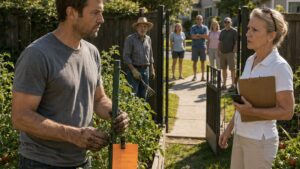
Karen Moore sat at the front table in the same red suit, her folder squared neatly before her. Beside her were board members with bottled water, laptops, and expressions trained to look neutral. Jonathan Allen sat two chairs down from Karen, a pen in his hand, his gray brows drawn together.
“Mr. Clark,” Karen said, not standing. “You are late.”
Edward looked at the clock above the coffee station. “I’m four minutes early.”
“This hearing was called to order at six.”
“The notice says six-fifteen.”
Karen glanced at the paper in front of her. “Then we’ll note that you are present.”
Edward did not sit. “Note this too. That photo is missing half the story.”
Karen clicked to the next slide. It showed a close-up of exposed gravel at the ditch line, marked with a red circle.
“The association is not here to debate your feelings about the photograph,” she said. “We are here to address an unauthorized alteration affecting shared drainage and access.”
A resident near the back muttered, “That’s the old ranch road.”
Karen’s eyes moved to the room, and the muttering stopped.
Edward took the chair at the small table placed opposite the board. The placement was deliberate. It made him look like someone requesting permission. He set the county map on the table but did not unroll it yet.
Karen began with procedure. Section numbers. Emergency authority. Drainage concerns. A prior storm. Insurance exposure. She spoke in a smooth, firm tone, the kind that made hesitation sound irresponsible.
“Mr. Clark has repeatedly refused to acknowledge that his property access intersects with association-managed infrastructure,” she said. “He installed a structure without review, ignored compliance communication, obstructed lawful removal, and yesterday became hostile toward authorized personnel.”
Edward’s hand tightened around the map tube.
Jonathan Allen looked up. “What communication did he ignore before removal?”
Karen turned a page. “The compliance office had an active review.”
“That isn’t the same as a notice.”
“The matter had urgency.”
Jonathan tapped his pen once. “Because of drainage?”
“Because unauthorized alterations near the lake can expose every member here to liability.”
A few people nodded. Edward saw how easily the word liability worked. It made fear sound practical.
He unrolled the county map and placed his palms on the curling edges. “This road existed before your association. The drainage ditch existed before your association. Your crew removed a repair from a crossing my family has maintained since before any of those houses across the lake were built.”
Karen glanced at the map without leaning closer. “That document does not establish your right to build whatever you choose.”
“I didn’t build whatever I chose. I repaired the crossing after the storm washed out the east side.”
“You changed the grade.”
“I stabilized it.”
“With lumber and gravel inconsistent with association standards.”
“I’m not in your association.”
“That,” Karen said, “is part of the problem.”
There it was. The room shifted slightly. Edward saw two board members look at Karen, then down at their papers. Jonathan stopped tapping his pen.
Karen clicked to a new slide. A diagram of the lakefront subdivision appeared, with neat lots, walking paths, and a shaded strip running along the ranch edge. Edward’s property was marked in pale yellow, different from all the others, like a tooth the map wanted pulled.
“The Clark parcel occupies a legacy access position affecting Lakeside Meadows drainage, road continuity, and emergency planning,” Karen said. “The board has long encouraged formal integration for the good of the community.”
Edward laughed once, without humor. “Integration.”
“Membership would create clear standards.”
“Control.”
“Shared responsibility.”
“Fees, inspections, approvals, and your red SUVs on my land whenever you decide something looks wrong.”
Karen’s face held, but her voice sharpened. “Mr. Clark, you use access connected to this community while refusing to accept community obligations.”
Edward leaned forward. “I use my road.”
Jonathan finally spoke again. “Ms. Moore, did the association engineer inspect the repair before removal?”
Karen paused. “We had photographic review.”
“By an engineer?”
“By compliance and maintenance.”
“That isn’t my question.”
A stir moved through the back of the room. Karen turned toward Jonathan with a look that carried more history than Edward knew.
“The board authorized emergency action based on the information available,” she said.
Jonathan looked at the projected photo. “The gravel slope in this image may actually be directing runoff away from the ditch cut, not into it.”
Karen’s mouth tightened. “You cannot determine that from one photograph.”
“Neither can compliance.”
For the first time that evening, Edward felt the room open by an inch.
He slid his own photographs across the table: the crossing before removal, the boards bolted into the bank, the measured width, the waterline, the tire track from the medical transport van turning back. He did not include Susan’s chair. He did not include the transport bag. He did not include the part of the truth that would make strangers quiet in the wrong way.
Karen picked up the photo of the van’s tire track. “What is this meant to show?”
“That the road is now unusable for certain vehicles.”
“What vehicles?”
Edward held her gaze. “Low-clearance vehicles.”
“Farm equipment?”
“Transport.”
“What kind of transport?”
The room waited.
Edward felt Susan’s absence like a hand on his shoulder and a lock on his mouth.
“Necessary transport,” he said.
Karen set the photograph down. “Mr. Clark, vague statements do not create exemptions.”
Jonathan looked at Edward then, not unkindly. “If there is a specific access need, the board needs to understand it.”
Edward heard Maria’s voice from the kitchen: Not enough.
He also heard Susan: I asked you not to let strangers talk about me like I’m not in the room.
He looked at the board, the residents, the projected road, and the cropped-out house. Every part of the room was designed to turn life into evidence.
“I’m asking you to restore the crossing while the county pulls the missing easement attachment,” he said. “You can inspect drainage. You can send someone qualified. But you can’t leave it torn open.”
Karen folded her hands. “The association is prepared to offer a reasonable path.”
Edward did not like the word before she finished it.
“Sign the membership and access agreement,” she said, “and the board may reconsider the repair under association standards, pending proper application.”
The offer landed softly. That made it worse.
Edward looked at the shaded strip on the projected map. If he signed, they would not just inspect the crossing. They would inherit the language to inspect the road, the barn exterior, the fence line, the porch ramp, every repair he made because Susan needed the home to keep fitting her life.
“You tore it up first,” he said.
Karen’s voice stayed calm. “You forced enforcement by refusing process.”
A sound came from the back of the room.
Not loud. A wheel against the threshold. The scrape of rubber over a metal door strip.
Edward turned.
Susan was in the doorway with Maria Torres behind her, one hand lightly on the chair, the other holding the folded blue transport bag against her side. Susan’s face was pale from the effort of the trip, but her eyes were steady, fixed not on Karen, not on the board, but on Edward.
The room went silent in a way the gavel never could have managed.
Edward stood so quickly his chair legs struck the floor.
Susan looked past him to the photograph of the torn road on the wall, then to the board table.
“Before you vote on what that road is,” she said, “you should ask who it carries.”
Chapter 5: Susan Refused to Be Hidden
“That road is not a driveway improvement,” Susan said. “It is how I stay in my home.”
No one in the boardroom moved.
Edward stood halfway between his table and the doorway, caught in the distance he had created by trying to protect her from rooms like this. Maria remained behind Susan’s chair, not pushing, not speaking, only present in the way a person stands when she has promised not to let someone fall.
Karen recovered first.
“Mrs. Clark,” she said, her voice measured, “this is a compliance hearing concerning exterior alteration and drainage.”
Susan gave her a small tired smile. “I heard enough from the hallway to understand what you think this is.”
Edward stepped toward her. “Susan—”
She lifted one hand. He stopped.
That hurt more than if she had snapped at him.
Susan rolled forward a few feet. The residents shifted chairs to clear space, clumsy with sudden politeness. The chair wheels hummed against the clubhouse floor, so smooth compared with the torn crossing outside their home.
She placed the folded blue transport bag on her lap. “I do not want my medical details discussed by people who do not know me. I do not want my husband arguing over my body like it is a permit attachment. But I also do not want to be trapped inside my own house because an office decided the road looked wrong in a photograph.”
Karen’s lips pressed together. “No one is trying to trap you.”
“You sent a crew that made my transport turn around.”
“That was not the information provided to us.”
“Then you acted on bad information.”
A murmur moved through the room. Jonathan leaned back, his pen still in his hand but no longer moving.
Karen glanced toward the residents. Edward saw her measuring the room, choosing the route that preserved authority.
“The association has procedures for medical accommodations,” she said. “If those procedures had been followed, the board could have reviewed appropriate documentation.”
Edward felt the blow before she finished. Susan turned her head slightly, just enough to look at him.
Karen opened the folder in front of her. “The file contains an access repair request submitted by Mr. Clark. It includes photographs, measurements, and a statement regarding storm damage. It does not include a medical accommodation request, a provider letter, or any indication that the repair was related to disability access.”
Edward’s mouth went dry.
Susan’s eyes did not leave him.
He could have argued that Karen had never asked. He could have said the form had no place for it, that he had called twice and been transferred to voicemail, that a road washed out by weather should not require an illness to matter. All of that was true. None of it erased the folded letter in the kitchen drawer, the one Maria had offered to help them attach.
Susan had signed it. Edward had not sent it.
Jonathan looked from Karen to Edward. “Mr. Clark?”
Edward reached into his shirt pocket and took out the copy of the notice, though he did not need it. His hands needed something to hold.
“I submitted the repair request.”
“With no medical basis,” Karen said.
Edward looked at Susan. “I didn’t think they had a right to it.”
Susan’s voice was quiet. “That wasn’t your decision alone.”
The words landed without anger. That was why they cut clean.
Maria stepped forward. “The medical basis exists. I have seen the letter.”
Karen looked at her. “And you are?”
“A visiting nurse.”
“Then you understand privacy requirements.”
“I understand access requirements too.”
Karen closed her folder. “The board cannot consider documentation it has not received through proper channels.”
“Your proper channels sent a demolition crew before the hearing,” Edward said.
Karen turned back to him. “And your incomplete filing created confusion about the purpose of the work.”
There it was—the part he could not simply deny. Karen had chosen force. Karen had narrowed facts. Karen had threatened his property. But Edward had left a hole, and she had driven the whole red convoy through it.
Susan took the folded paper from Maria. Edward recognized it before it opened. The accommodation letter. The one he had said they would hold back unless absolutely necessary, then kept holding back as the necessity grew teeth.
Susan placed it on the table in front of the board. “Here is the letter.”
Karen did not touch it. “The hearing packet has already been established.”
Jonathan reached for it instead. Karen’s hand moved slightly, but she stopped herself.
He read the first page. His face changed—not with pity, which Edward would have hated, but with construction in his eyes, the way a man who had built things understood load and grade and turning radius.
“This mentions vehicle lift clearance,” Jonathan said.
“Yes,” Maria replied. “And vibration limits during transport. The crossing after removal is not safe for her equipment.”
Karen looked at the other board members. “Even if accepted, this would require review. We cannot approve unverified construction tonight based on a newly introduced letter.”
Susan’s fingers tightened once on the transport bag.
Edward saw it. The small movement broke him more than any speech could have. He had thought privacy meant keeping Susan untouched by the fight. But privacy had become a curtain Karen could point to and say there was nothing behind it.
He sat beside Susan, not standing over her now.
“I should have sent it,” he said.
Susan looked at him.
“I thought I was keeping them out of your life.”
“You were keeping me out of the decision.”
The room heard it. Edward wished they had not. Susan did not seem to care anymore.
Karen cleared her throat. “The board’s immediate issue remains the violation and the costs incurred during emergency removal. The association can defer final penalties pending submission of a complete medical accommodation packet.”
“Defer?” Edward asked.
“Temporarily.”
“And the road?”
“No reconstruction until review.”
Maria’s voice sharpened. “She has treatment tomorrow.”
Karen’s face flickered. Not cruelty. Calculation under pressure. “The association is not a medical transport provider.”
“No,” Susan said. “But it became the reason mine could not reach me.”
Jonathan set the letter down. “We need more information before assigning costs.”
Karen looked at him. “The board also needs to maintain process.”
“The process is already compromised if removal started before notice.”
A board member beside him shifted uneasily. Another whispered something Edward could not hear.
Karen gathered the papers into a neat stack. “Then we will recess and reconvene after the county attachment is available and after the Clarks submit a complete packet.”
Edward looked up. “When?”
“Tomorrow if the county produces the document.”
“And if they don’t?”
Karen’s eyes held his. “Then the existing violation remains active.”
The gavel came down lightly, but it still sounded like a door.
Outside, the clubhouse parking lot was lit too bright. Edward helped Susan into the passenger seat of their truck while Maria folded the chair. For a while none of them spoke. Across the lot, Karen stood under the portico with two board members, red suit darkened under the yellow lights, her folder clutched against her ribs.
Susan waited until Maria stepped away to secure the chair in the back.
“You were afraid they would look at me differently,” she said.
Edward shut the passenger door halfway, then stopped. “Yes.”
“They already did. Because I wasn’t there.”
He looked down at the asphalt. Dust from the ranch still marked his boots.
“I’m sorry,” he said.
“I know.” Her voice softened, which somehow made it worse. “But tomorrow you don’t get to protect me by leaving me out.”
His phone rang before he could answer.
The county clerk’s number appeared on the screen.
Edward answered, one hand still on Susan’s door.
The clerk did not waste time. “Mr. Clark, we found the missing attachment.”
Edward looked at Susan. “Good.”
There was a pause on the line.
“It may not say what you expect,” the clerk said. “You should come in first thing.”
Chapter 6: The Map Gave Them the Wrong Victory
Edward read the missing attachment in the county records office and felt the clean victory vanish line by line.
The clerk had placed the old page in a plastic sleeve, as if age made it fragile enough to forgive what it said. The paper was yellowed, typed unevenly, and stamped with a county road district seal from decades before Lakeside Meadows existed. Edward stood at the counter with his hat in his hand and read the paragraph again.
Emergency access route acknowledged for fire, medical, agricultural, and county service use, subject to preservation of drainage flow and safe grade maintenance by property holder.
Property holder.
That helped him.
Subject to preservation of drainage flow.
That did not.
He had wanted the page to say the HOA had no standing, no argument, no hand on the road at all. He had wanted to walk into the next hearing, lay it on Karen Moore’s table, and watch the whole thing fall apart.
Instead, the page gave him rights with responsibilities attached.
The clerk watched his face carefully. “It confirms the road.”
“It confirms conditions too.”
“Yes.”
“Does it mention the HOA anywhere?”
“The HOA didn’t exist.”
Edward almost smiled, but the smile had no strength. “That’s something.”
“It also means anyone arguing drainage can make noise with it.”
“I know.”
She made him two certified copies. While the seal pressed into the paper, Edward thought of the torn crossing, the missing brackets, the water marks where the bank had slumped. His repair had been quick because it had to be. Safe enough for transport, he had believed. Strong enough until spring. But if Karen’s engineer—or Karen’s preferred version of one—could say the grade threatened drainage, she could keep the fight alive without ever mentioning Susan.
Back at the ranch, he laid the attachment on the kitchen table beside the medical accommodation letter.
Susan read it slowly. Maria stood near the stove with a coffee cup she had not touched.
“So it helps,” Susan said.
“It helps partway.”
“That’s still help.”
Edward walked to the window. The torn road was visible between cottonwoods, a pale wound across the lane. “Partway gets people trapped.”
Susan folded the page along its old crease. “So does waiting for perfect.”
He turned. There was no accusation in her face, only fatigue and a steadiness he had mistaken too often for needing protection.
“I need to measure the drainage properly,” he said. “Not just argue the road.”
Maria set down the cup. “What do you need?”
“Photos after the removal. Waterline marks. Measurements from before, if I can prove them. The accommodation packet. The fire access standard. And someone on that board willing to admit their approved fix won’t work.”
“Do you have someone?”
Edward thought of Jonathan Allen’s pen going still, his eyes on the letter, his question about runoff.
“Maybe.”
He found Jonathan at the HOA office an hour later, standing outside near a row of ornamental shrubs that had been trimmed into identical shapes. The building looked over the lake from the subdivision side, all stone veneer and tinted glass. Edward parked by the curb and stayed in the truck long enough to put the star badge in the glove box.
He did not want Karen looking at it again before she looked at the road.
Jonathan noticed the movement when Edward got out. “Leaving that behind?”
“Trying not to confuse people.”
Jonathan gave a short nod. “People confuse themselves fine without help.”
He held a folder under one arm. No red suit. No security. Just a retired contractor with lines around his eyes and a manila envelope he seemed unsure whether to hand over.
“You asked to see me,” Edward said.
“I asked because I went out there this morning.”
“To my road?”
“To the public shoulder near it. I didn’t cross your property.” Jonathan’s mouth pulled sideways. “Didn’t feel like adding trespass to the list.”
Edward waited.
Jonathan opened the folder and removed a printed diagram. “This is the standard culvert approach the association maintenance office was leaning toward. Concrete apron, uniform stone, lower profile.”
“Looks clean.”
“It is clean. It also creates a sharper transition at the top.” Jonathan tapped the diagram. “For most vehicles, fine. For a wheelchair lift van coming slow from a dirt surface? Not ideal.”
Edward looked at him.
Jonathan did not meet his eyes at first. “Your timber edge wasn’t pretty. But it spread the grade.”
“It was temporary.”
“I figured.” Jonathan tapped another page, this one marked with his own pencil lines. “A safer version could be built with compacted gravel, timber retaining edges set back, and a shallow drainage swale along the lake side. It would preserve flow better than what was there before removal.”
“Then say that at the hearing.”
Jonathan’s eyes came up. “I intend to say some of it.”
“Some.”
“I am treasurer of that board, Mr. Clark. I have members who bought homes believing standards meant something. I have an insurance carrier that asks questions every time someone touches water runoff. And I have a president who thinks if one legacy parcel ignores review, every lakefront owner will build whatever they want.”
“I didn’t ignore review.”
“You withheld the strongest reason for review.”
Edward looked away.
Jonathan’s voice softened. “I’m not saying that to defend what happened. I’m saying Karen will use it.”
“She already did.”
“She will use it harder tomorrow.”
“Tomorrow?”
Jonathan looked surprised. Then his face closed. “You haven’t received it.”
Edward’s phone buzzed at almost the same moment.
The email subject read: Final Compliance Vote and Cost Assessment.
Karen had scheduled the vote for the next evening. The board would decide whether to assess removal costs, daily penalties, and continued access restrictions. The final paragraph was short.
Execution of the enclosed membership and access agreement prior to the vote may stay further enforcement pending review.
Edward read it twice.
Jonathan watched him. “She wants this done before the expansion meeting next week.”
“What expansion?”
Jonathan looked toward the tinted office windows. Inside, someone moved behind the blinds.
“The lakefront phase,” he said. “New lots on the east side. The developer wants clean access maps, no legacy disputes, no unclear drainage responsibilities. Your parcel sits in the middle of a line they’d rather draw straight.”
Edward folded the email closed without meaning to. His thumb pressed hard against the phone case.
“So this was never just a road.”
“It was always a road,” Jonathan said. “That’s why it matters. But no, it wasn’t only the repair.”
Edward took the certified attachment from his folder and handed it over. Jonathan read the stamped page, his brow tightening.
“This helps you,” he said.
“Not enough.”
“No. Not alone.”
“I’m done wanting one page to fix what people chose to break.”
Jonathan looked at him then, and something like respect crossed his face, reluctant but real.
“Bring the medical packet,” he said. “Bring your measurements. Bring the fire access standard if you have it. Don’t make the argument that Karen has no concerns. Make the argument that the safe repair answers the real ones.”
Edward took back the attachment.
“And the annexation papers?”
Jonathan’s jaw moved. “Don’t sign them if you can avoid it.”
The words cost him something. Edward saw that.
Back at the ranch, Susan was on the porch with a blanket over her knees, watching Maria photograph the torn crossing from the safe side. The evening light caught the exposed boards and made the ditch look deeper than it was. Or maybe Edward had been telling himself it was shallower.
He sat beside Susan and laid the folder across his knees.
“It isn’t the clean win,” he said.
“I guessed by your face.”
“The road is recognized. Emergency access, medical access, agricultural use. But repairs have to preserve drainage.”
“That sounds reasonable.”
“It is.”
She turned her head. “You sound offended by that.”
“I wanted them wrong all the way down.”
Susan’s mouth curved faintly. “That would have been convenient.”
He let out a breath that was almost a laugh and almost not.
Then he opened the folder and took out the accommodation letter, the one she had placed on the board table and then taken back because Karen had refused to accept it into the packet.
“I need to submit the whole thing,” he said. “Not just the letter. The transport requirements, Maria’s note, the treatment schedule, the access measurements. Enough that they can’t call it sentiment.”
Susan looked toward the torn road.
For a long time, the only sound was Maria’s phone camera clicking at the ditch and the low movement of the horse in the barn lot.
Edward held the papers without pushing them toward her.
Susan finally reached out and touched the top page.
“I don’t want them owning my story,” she said.
“I know.”
“And I don’t want you using me as the reason you never have to admit you need help.”
Edward looked down.
She slid the folder closer to herself. “We submit what protects the house. Not everything. Not more than they need. But enough.”
Edward swallowed. “You’re sure?”
“No.” Susan looked at the crossing. “But I’m more sure than I am about missing another treatment because Karen Moore likes clean maps.”
Edward nodded once. He took a pen from his pocket and placed it in her hand.
Susan signed the release slowly, carefully, while the torn boards at the ditch waited in the fading light like pieces of a road that had not yet decided whether it still led home.
Chapter 7: The Road They Called a Violation
Karen Moore opened the final vote by placing Susan’s medical packet facedown on the table, as if the pages were something that might stain the polished wood.
“The board has received additional material from Mr. and Mrs. Clark,” she said. “However, we should be careful not to let sentimental arguments override structural compliance.”
Edward felt Susan’s hand still beside his on the table.
She had come this time without the blue transport bag. Maria Torres sat behind her, close enough to help, far enough to let Susan speak for herself. Edward had the certified easement attachment, the fire access standard, the drainage measurements, and photographs of the crossing spread in a neat stack before him. His star badge was not on his vest. It was in the glove box of the truck outside.
Karen’s eyes touched the empty place where it had been, then moved away.
Jonathan Allen sat with his own folder open. He looked tired. Not uncertain, Edward thought. Tired from knowing that a straight line on a map had become easier for the room than the road beneath it.
Karen continued. “The association’s position remains that unauthorized work was performed on a drainage-sensitive access area. We have offered Mr. Clark a clear path to review through membership and shared standards. He has declined.”
Edward looked at the agreement lying near Karen’s elbow. He had read it twice the night before. Buried in the clean language were future inspection rights, design control, fee obligations, and access restrictions broad enough to let the HOA call almost anything on his road a shared concern.
He stood.
“I declined because my wife’s access to our home is not a bargaining chip for annexation.”
A board member shifted. Karen’s mouth tightened.
Edward placed the easement attachment on the projector tray. The old typed paragraph appeared on the screen, stamped and enlarged.
“This road is a recognized emergency, medical, agricultural, and service access route. I’m not asking you to pretend drainage doesn’t matter. I’m saying you may inspect drainage, but you may not use drainage to remove medical access and then sell it back to me as membership.”
Karen leaned toward her microphone. “Mr. Clark, no one is selling you medical access.”
Susan turned her chair slightly toward Karen. “Then stop pricing it.”
The room went still.
Edward did not look at Susan, though he wanted to. If he did, he might lose the careful steadiness he had brought with him.
He placed the photographs beside the easement copy: the crossing before removal, the measured slope afterward, the medical transport tire tracks, the exposed waterline, and the alternative plan Jonathan had marked.
“The repair I built was temporary,” Edward said. “It was not pretty. It was not final. But it spread the grade wide enough for a lift vehicle and kept the ditch from cutting deeper after the storm. Your crew removed support before notice was delivered. After removal, medical transport could not reach the house.”
Karen folded her hands. “That is one interpretation.”
Maria stood. “It is also what happened.”
Karen looked at her. “The board has your written statement.”
“And now you have my spoken one.”
Jonathan leaned forward before Karen could answer. “I asked Mr. Hall to attend tonight.”
Edward turned.
Timothy Hall stood near the back wall in a clean work shirt, hard hat tucked under one arm. He looked as if every person in the room had become heavier than the machines he usually worked around.
Karen’s head turned sharply. “Mr. Hall was not on the agenda.”
Jonathan’s voice stayed even. “He supervised the removal. The board can hear two minutes.”
Timothy walked to the front. He did not look at Karen. He looked at the road photograph on the screen.
“We started before ten,” he said. “The notice time was after that.”
Karen’s jaw moved. “You were instructed to secure the site.”
“We removed two posts and loaded boards before Mr. Clark came down.” Timothy swallowed. “The work packet said the structure served equipment storage and barn access. It did not mention the house. It did not mention medical transport.”
Karen’s face did not change much, but Edward saw the room change around her.
A board member beside Jonathan asked, “Who prepared the packet?”
Timothy looked at Karen then. “It came from compliance.”
Karen lifted her chin. “Compliance used information available at the time.”
Edward heard the fear under the polished answer then. Not fear of him. Fear of losing the shape of authority in front of the board, the residents, the developer maps, the insurance files, the whole thin wall of process she had been holding up.
Jonathan opened his folder. “I have reviewed the site photographs, the easement attachment, the medical transport requirements, and the proposed association-standard repair. My conclusion is that the association-standard approach is not suitable for the documented access need without modification. Mr. Clark’s temporary repair was rough, but the principle of it was safer for the required vehicle.”
Karen turned on him. “You are not the association engineer.”
“No,” Jonathan said. “I am the treasurer. I am also the only person at this table who has poured culverts for thirty years.”
A restrained sound moved through the room, almost a laugh, almost relief.
Jonathan did not smile. “I move that the board withdraw the violation, suspend removal costs, permit immediate restoration of temporary access under county emergency standards, and require a drainage inspection within ten days to approve a permanent repair that preserves medical access and water flow.”
Karen’s hand tightened around her pen. “That motion weakens the association’s ability to enforce standards.”
“It corrects an enforcement action made on incomplete facts.”
“It invites every nonmember parcel to ignore process.”
Edward spoke before Jonathan could answer. “No. It tells them process has to ask what it is touching before it tears it out.”
Karen looked at him, and for the first time Edward saw not victory or defeat in her face, but calculation running out of places to stand. She had not come to destroy Susan’s access, not in her own mind. She had come to protect maps, standards, liability, expansion. She had chosen not to ask who lived behind the cropped photograph.
That choice was hers.
The vote was not unanimous. Karen voted no. One board member abstained. Jonathan voted yes, and enough followed.
The violation was withdrawn. Removal costs were suspended. Temporary access could be restored that night under county emergency standards. The permanent repair would be inspected, measured, and approved if it met drainage requirements without reducing medical access.
No one clapped.
Edward was grateful for that.
Outside, Karen passed him near the portico. The red suit looked darker under the lights.
“You understand this does not make your property exempt from future review,” she said.
Edward held Susan’s folder against his side. “I understand review better than I did three days ago.”
She looked toward Susan, who waited beside Maria near the truck. For a second Karen seemed about to say something more human than procedural. Then she closed her folder.
“I hope the permanent design is safe,” she said.
“So do I.”
That was all they gave each other.
By the next morning, the red SUVs returned to the ranch road, but they parked at the edge and stayed there. A county inspector marked the ditch. Jonathan walked the crossing with a measuring rod. Timothy brought back the boards his crew had removed and helped set temporary supports where the transport wheels could pass. Edward spread gravel with a shovel until his shoulders burned.
At noon, the medical transport van crossed slowly over the restored grade.
Edward stood beside the lane and watched the rear lift clear without scraping.
Susan watched from the porch, one hand on the rail, Maria beside her. She did not wave until the van stopped safely near the house. Then she lifted her fingers, small and steady.
Edward went to the truck and opened the glove box. The star badge lay inside beside a roll of measuring tape and the spare gate key. He touched it once, then left it there.
Later, after the crew had gone and the road held under the first careful pass of the utility cart, Edward led the horse across the repaired crossing. The wheels rolled over salvaged boards and new gravel, past the ditch, toward the red barn and the house beyond it.
Susan remained on the porch in the afternoon light, not hidden behind the curtain, not waiting for him to speak for her.
Edward took off his hat as he passed.
The road did not look perfect. It looked used, measured, braced, and open.
For the first time in days, it led all the way home.
The story has ended.